

- Industry Size (2026)
- USD 4821.3 Mn
- Forecast (2036)
- USD 8313.9 Mn
- CAGR (2026 to 2036)
- 5.6%
Railway Traction Inverter Market Size, Market Forecast and Outlook By FMI
The railway traction inverter market is expected to expand from USD 4,821.3 million in 2026 to USD 8,313.9 million by 2036. The market is likely to register a 5.6% CAGR during the forecast period. SiC technology is anticipated to lead technology type demand with a 30.2% share, while metro train type is projected to account for 32.4% share of train type revenue in 2026.
Summary of the Railway Traction Inverter Market
- Demand and Growth Drivers
- Railway electrification programs are expected to increase traction inverter requirements across electric locomotives and metro systems.
- SiC-based inverter adoption is likely to rise as rail operators focus on lower energy loss and compact power electronics.
- Rolling stock replacement is anticipated to support steady demand for upgraded traction power systems.
- Product and Segment View
- SiC technology is expected to remain a leading technology type due to higher efficiency and smaller inverter size.
- Metro train type is likely to retain a strong position as cities expand urban rail networks.
- OEM sales are anticipated to gain support from new train production and local manufacturing requirements.
- Geography and Competitive Outlook
- India is expected to lead country-level expansion due to rail electrification and metro network growth.
- Japan is likely to show steady adoption as high-speed rail systems continue using advanced traction technologies.
- Companies with SiC module capability and local production capacity are anticipated to strengthen their position.
- Analyst Opinion
- Nikhil Kaitwade, Principal Consultant for Automotive at FMI, suggests, “The railway traction inverter market is shifting toward SiC-based platforms as rail systems require lighter and more efficient traction electronics. Suppliers with semiconductor integration strength and local manufacturing capacity are likely to gain advantage as electrified rail procurement becomes more performance-focused.”
- Railway Traction Inverter Market Value Analysis
- The railway traction inverter market is moving from conventional silicon IGBT platforms toward SiC-based inverter architectures.
- Demand is likely to rise as rail electrification increases the need for efficient power conversion systems.
- Metro and high-speed rail projects are expected to create recurring demand for compact traction inverter designs.
- Spending is anticipated to improve as rail OEMs replace older power electronics with higher-efficiency inverter systems.
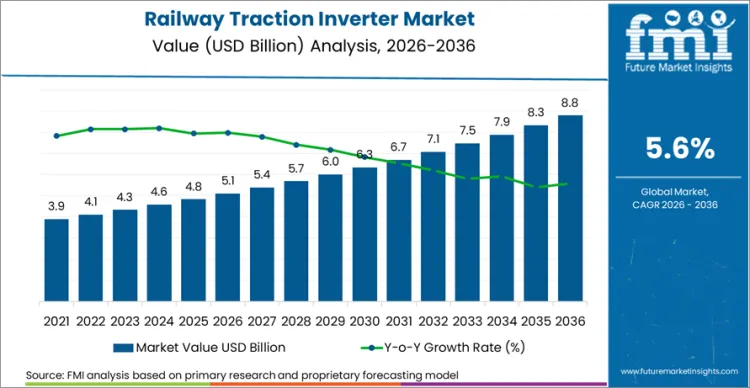
Key Takeaways, Market Size, and Forecast
- The railway traction inverter market is expected to reach USD 4,821.3 million in 2026.
- The railway traction inverter market is projected to attain USD 8,313.9 million by 2036.
- From 2026 to 2036, the market is anticipated to expand at a 5.6% CAGR.
- SiC technology is likely to account for 30.2% share of the technology type segment in 2026.
- Metro train type is expected to hold 32.4% share of the train type segment in 2026.
- India is projected to record the fastest country-level expansion at 7.2% CAGR through 2036.
Summary of Railway Traction Inverter Market
What Is Growth Outlook for Railway Traction Inverter Market as per Future Market Insights Projection?
Future Market Insights projects the railway traction inverter market to expand at a CAGR of 5.6% from 2026 to 2036, increasing from USD 5.1 Billion in 2026 to USD 8.8 Billion by 2036.
FMI Research Approach: FMI forecasting model based on UIC electrified network data and rolling stock backlogs.
How Do FMI Analysts Perceive Railway Traction Inverter Market to Evolve?
FMI analysts perceive the market evolving toward SiC MOSFET-based inverter platforms delivering higher efficiency and lower weight for high-speed rail.
FMI Research Approach: CRRC CR450 prototype (January 2025) and Mitsubishi Electric SiC traction deployment.
Which Country Holds Largest Share in Global Railway Traction Inverter Market?
China holds a significant share, supported by CRRC's dominant rolling stock position and the world's largest high-speed rail network.
FMI Research Approach: FMI modeling by rolling stock production volumes and electrified network length.
How Large Will Railway Traction Inverter Market Be by 2036?
The global market is projected to reach USD 8.8 Billion by 2036.
FMI Research Approach: FMI forecast from UIC electrification targets and rolling stock replacement cycles.
What Is Definition of Railway Traction Inverter Market?
The market includes revenue from power electronic inverter systems converting DC to AC for traction motors in electric locomotives, EMUs, metros, and trams.
FMI Research Approach: FMI taxonomy aligned with IEC railway traction standards.
What Are Globally Unique Trends Shaping Railway Traction Inverter Market?
Globally unique trends include SiC MOSFET migration, PMSM traction adoption in high-speed rail, and local manufacturing mandates in rail procurement.
FMI Research Approach: CRRC CR450 PMSM (January 2025) and ABB Traction Centre Australia (December 2025).
Railway Traction Inverter Market Key Takeaways
| Metric | Details |
|---|---|
| Industry Size (2026) | USD 5.1 Billion |
| Industry Value (2036) | USD 8.8 Billion |
| CAGR (2026 to 2036) | 5.6% |
Source: Future Market Insights (FMI) analysis, based on proprietary forecasting model and primary research
Bi-Annual Market Update for Railway Traction Inverter Market
The table below presents the annual growth rates of the global Railway Traction Inverters market from 2026 to 2036. With a base year of 2025 extending to the current year 2025, the report examines how the sector's growth evolves from the first half of the year (January to June, H1) to the second half (July to December, H2). This analysis offers stakeholders insights into the industry's performance over time, highlighting potential developments that may emerge.
These figures indicate the growth of the sector in each half year, between the years 2026 and 2036. The industry is expected to grow at a CAGR of 5.4% in H1-2024. In H2, the growth rate increases to CAGR of 5.6%.
| Particular | Value CAGR |
|---|---|
| H1 2026 | 5.4% (2021 to 2035) |
| H2 2026 | 5.6% (2021 to 2035) |
| H1 2036 | 5.5% (2026 to 2036) |
| H2 2036 | 5.7% (2026 to 2036) |
Moving into the subsequent period, from H1 2026 to H2 2036, the CAGR is projected to slightly increase to 5.5% in the first half and relatively increase to 5.7% in the second half. In the first half (H1) and second half (H2), the sector saw a similar increase of 10 BPS.
Strategic Developments and Highlights in the Railway Traction Inverter Market
Speedy Railway Electrification
The world over different governments are backing electrification projects for the advancement of rail transport systems that will be less dependent on diesel engines and as such be more focused on sustainability. Electrified rail networks power the use of traction inverters which is a prerequisite for power efficiency conversion and applying the technique optimally. For instance, the railway electrification plan in India is set to be completed by 2030 with 100% electrification, which will lift the region's inverter sales by a considerable amount.
Europe is leading the way when it comes to railway electrification components, with nations such as Germany and France pumping in enormous amounts into the extension of the electric railway network. Similarly, nations in Southeast Asia and Africa are now embracing the technology as a way of increasing their connectivity and therefore protecting the environment. The focus on eco-friendly technologies is, therefore, solidifying the position of the traction inverters around the world.
Greater Adoption of Metro and High-Speed Trains
Infrastructure projects such as construction of metro and high-speed rail lines are fronted by increased needs of commuters and urbanization. Advanced technologies used in the construction of traction inverters make them vital parts of these systems because of power conversion and reliability in operation. The countries of China, Japan, and South Korea set the standards of high-speed rail technology, leading the globe in efficiency and sustainability.
In urban areas, the accelerating metro networks like the one in India, the UAE, and Brazil constantly increase the traction inverter demand. Smart inverters accommodate regenerative braking and the energy recovery system, which in their turn, provide more efficiency in the metro and high-speed rail applications. More and more urban centers are taking on the role of metro systems being the first application of traction inverters in the coming years.
Innovations in Traction Inverter Technology
Technological improvements in traction inverters are not only making rail operations efficient but they also help with the protection of the environment. Silicon carbide (SiC)-based inverters are primarily at the forefront in these changes, featuring lower energy consumption, smaller sizes, and better efficiency. This makes them especially suitable for high-speed and long-distance trains where both the energy savings and the power density are the major requirements.
In addition, the modular design of the inverter is picked up and gaining popularity, as a result, this system has sufficient scalability and less maintenance cost in different applications. Manufacturers have also started to use lighter materials to reduce the weight of vehicles and enhance their energy efficiency. New technology developments are helping overcome operational challenges and at the same time are promoting a shift to cleaner transport systems.
Government Initiatives and Infrastructure
Government bodies are also proactive in achieving a climate-friendly environment through high-speed rail electrification projects and rejuvenation of infrastructures. European green deal targets a doubling of high-speed rail traffic by 2030, which would see a corresponding surge in traction inverter order growth. Similar schemes in Asia-Pacific include governments like China and India these are set to make expansions on the networks cost considerably of government and foreign investment funding.
PPP (Public-private partnerships) are instrumental too in the way they are driving infrastructure projects, especially in areas that require development, as they are the key players in this. The incentives and subsidies for using energy-efficient technologies which in turn lead to more traction inverters in the market, are also set to be responsible for the steady growth over the next decade.
Comparison of Historical vs Future Outlook on Changing Trends for Railway Traction Inverter Market
The global railway traction inverter sector is on track to achieve a valuation of USD 6.2 billion by 2036, accelerating from USD 3.8 billion in 2026 at a CAGR of 5.6%. As per Future Market Insights, expansion is structurally underpinned by global railway electrification programs and rolling stock replacement.
The International Union of Railways (UIC) reported in 2024 that the global electrified railway network exceeded 390,000 km. This compels rolling stock OEMs to scale production of traction power electronics. Simultaneously, the industry is shifting from silicon IGBT-based platforms to SiC MOSFET-based designs, forcing retooling of power module manufacturing.
In January 2025, CRRC unveiled the CR450 EMU prototype featuring a high-power permanent magnet traction system with an upgraded inverter and the world's first high-torque PMSM direct-drive motor. Dr. Nils Soltau, Deputy Manager at Mitsubishi Electric Europe, stated: 'SiC power modules allowed railway traction systems to become more efficient, more compact, and more reliable.' FMI opines that the convergence of SiC semiconductors with PMSM architectures creates a new inverter class delivering lower energy consumption per train-kilometer, aligning with national rail decarbonization targets.
The operational reality is defined by the need to balance global technology platforms with local manufacturing mandates. In December 2025, ABB inaugurated a 5,000-square-meter Traction Centre of Excellence in Australia for local production of traction converters. ABB stated: 'Celebrating Australia's first-ever local production of traction converters and motors, ABB delivers one of the most energy-efficient solutions.' As per FMI, local traction inverter manufacturing is becoming a procurement prerequisite in Australia, India, and Turkey where domestic content requirements in rail tenders are tightening.
Market Concentration and Competition Intensity in the Railway Traction Inverter Market
Tier-1 companies account for around 55-60% of the overall market with a product revenue from the Railway Traction Inverters market of more than USD 500 Million. The Tier-1 manufacturers like Schneider Electric, Hitachi Ltd, and other players would have prominent share in the market.
Tier-2 and other companies such Wabtec, Alstom and other players are projected to account for 40-45% of the overall market with the estimated revenue under the range of USD 500 Million through the sales of Railway Traction Inverters.
Country-wise Analysis of the Railway Traction Inverter Market
The section below covers the industry analysis for Railway Traction Inverters in different countries. The demand analysis on key countries in several regions of the globe, including North America, Latin America, East Asia, South Asia Pacific, Western Europe, Eastern Europe, Middle East, and Africa is provided. This data helps investors to keenly observe and go through the recent trends and examine them in an ordered manner.
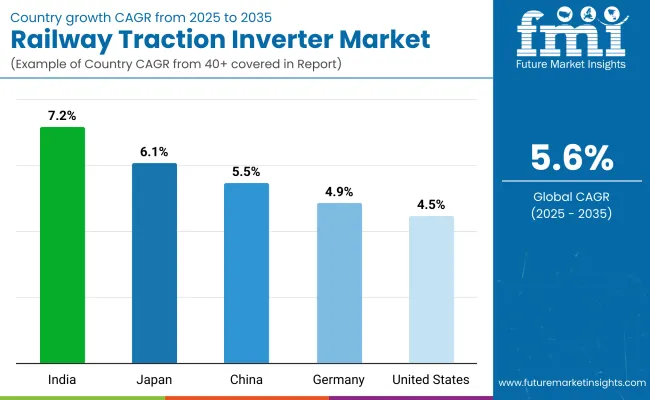
| Country | CAGR (2026 to 2036) |
|---|---|
| India | 7.2% |
| Japan | 6.1% |
| China | 5.5% |
| Germany | 4.9% |
| United States | 4.5% |
United States: Electrification of Rail under Progress
In the United States, the advancement in railway electrification focuses on metro and commuter lines to cut back emissions and be efficient. Such progress has been indicated in California's Caltrain electrification and in the upgrading of Amtrak's Northeast Corridor. Large governmental investments and alliances with renewable energy companies have sparked growth in inverter demand. The fact that Siemens Mobility provides electric locomotives to Amtrak shows rising demand. Collaboration between rail operators and technology providers is expanding the rail lines, enhancing electrification, and helping both parties grow mutually. The attention to integrating renewable energy into the rail system also supports the market. These trends are a show the futuristic vision of USA to modernize its railway network and shift towards greener, energy-efficient modes of transportation.
India: Growth in Railway Electrification and Metro Systems
The traction inverter market is taking shape in India. Government targets of ambitious rail electrification and metro line expansions in cities like Bengaluru and Pune form large growth drivers. Projects like the expansion of the Mumbai Metro illustrate the rising trend of using advanced rail technologies. Encouraging local manufacturing through the "Make in India" initiative develops innovative designs and competitive prices for traction inverters. Companies such as Alstom and ABB are also key players in the modernization of Indian railways. These factors underscore India’s progress toward energy-efficient, sustainable rail systems and its growing prominence in the global traction inverter market.
China: The Master in High-Speed Rail Systems
The worldwide for railway traction inverters is almost wholly owned by China because it has marketed its rail systems on the ground of both the high-speed train system and continued funds to upgrade rail infrastructure. The government is also behind this effort to develop ecological transport and move away from diesel locomotives which are given a boost by traction inverters promotion. The leading place that China has in the market is further occupied by the fact that it is the largest silicon carbide (SiC) producer and the state of the art technology used.
Market Definition
The railway traction inverter market represents revenue from power electronic inverter systems used to convert and control electrical power for traction motors in electric railway vehicles.
Inclusions cover IGBT and SiC MOSFET traction inverters, auxiliary converters integrated with traction, and battery-traction hybrid inverter platforms for high-speed rail, EMUs, metros, and electric locomotives.
Exclusions include standalone traction motors, signaling power supplies, and diesel-electric alternator systems. Onboard passenger HVAC inverters outside the traction chain are excluded.
Railway Traction Inverter Market Analysis by Top Investment Segments
The section explains the market value share of the leading segments in the industry. In terms of technology type, the SiC type will likely dominate and generate a share of around 30.2% in 2025.
Based train type, the Metro type is projected to hold a prominent share of 32.4% in 2025. The analysis would enable potential clients to make effective business decisions for investment purposes.
SiC Based Inverters the Highest Efficiency
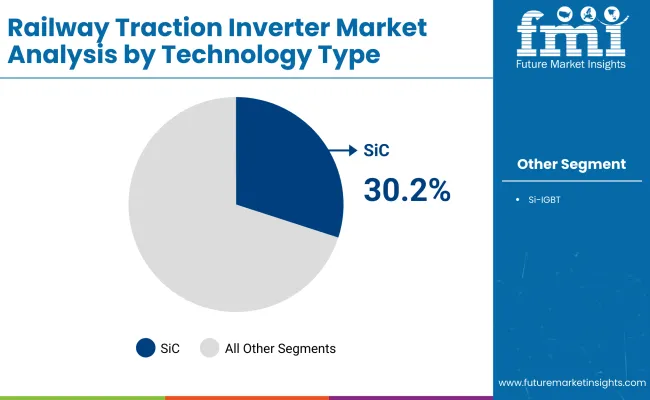
| Segment | Value Share (2025) |
|---|---|
| SiC (Technology Type) | 30.2% |
SiC-based traction inverters are a revolutionary force in the railway sector. These inverters have better energy efficiency, minimized energy losses, and smaller size which is why they are particularly useful in the operation of long-distance and high-speed trains. SiC technology is not only about efficiency; it also means more density. That is why SiC-based systems are on the rise in already established and burgeoning markets.
With the increasing concern of energy saving, SiC-based inverters are preferred primarily in both the developed and developing countries. For example, China and Europe are constructing high-speed rail lines with SiC-based technology. Reduced energy cost and maintenance are other factors propelling the use of SiC technology.
Metro and Urban Rail Systems to lead the train type
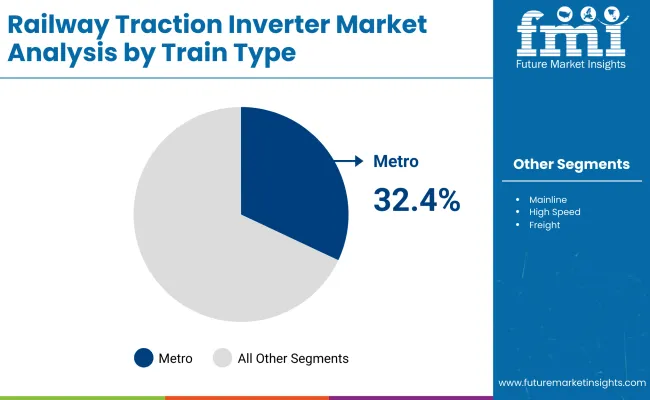
| Segment | Value Share (2025) |
|---|---|
| Metro (Train Type) | 32.4% |
Metro and urban rail systems remain the largest field of application for traction inverters. The high growth of metro networks is mainly facilitated by the high demand for effective public transport in congested urban agglomerations. On the emerging trends, India, Indonesia, and Vietnam are investing very heavily in metro rail infrastructure, reflecting a strong requirement for state-of-the-art traction inverters.
Metro application of regenerative braking systems perfectly suits energy recovery and efficiency topics and thus should be of the top priority for inverter manufacturers. With urbanization queues tightening, it will be indeed the time for metro systems traction inverters to stay at the forefront, thus representing a notable area for market expansion.
Competitive Landscape of the Railway Traction Inverter Market
The Railway Traction Inverter Market is showing a tough competition scenario where companies are getting alongside each other and also are getting bigger.
Leading companies such as ABB Ltd., Siemens AG, Alstom SA, Mitsubishi Electric Corporation, and Toshiba Corporation are all putting money in the latest inverter technologies to meet the growing energy-efficient railway sector's demand.
Coalitions and close work between rail companies and manufacturers are shaping the competition sphere. Siemens for one has started introducing modular inverter units to optimize scalability in diverse rail applications. Meanwhile, ABB is on the path with the lightweight SiC-based inverters to enhance power density and operational efficiency.
By the continued emphasis on sustainability and regional manufacturing, both long-standing brands and freshly evaporated ones will reap dividends and pave their way towards healthy growth in the next decade.
Recent Developments
- In January 2025, CRRC unveiled CR450 EMU prototype with world's first high-torque PMSM direct-drive traction motor and upgraded inverter.
- In December 2025, ABB inaugurated a 5,000-sqm Traction Centre of Excellence in Australia for local traction converter production.
- Mitsubishi Electric deployed SiC power module-based traction systems in European railway applications, demonstrating efficiency and size reductions.
Leading Companies in the Railway Traction Inverter Market
- Schneider Electric
- CRRC
- Wabtec
- General Electric
- Toshiba
- Mitsubishi Electric
- ABB
- Siemens
- Alstom
- Hitachi
Scope of Report
| Items | Values |
|---|---|
| Quantitative Units (2026) | USD 5.1 Billion |
| Product Type | IGBT Traction Inverters, SiC MOSFET Inverters, Hybrid Systems |
| Application | High-Speed Rail, Commuter EMU, Metro, Light Rail, Locomotives |
| Regions Covered | North America, Europe, Asia Pacific, Latin America, Middle East and Africa |
| Key Companies Profiled | CRRC, ABB, Siemens Mobility, Mitsubishi Electric, Alstom, Hitachi Rail |
Key Segments of the Railway Traction Inverter Market
By Technology Type:
The segment is further categorized into Silicon Carbide and Si-IGBT.
By Train Type:
The segment is further categorized into Mainline, Metro, High Speed, Freight, and Special.
By Capacity:
The segment is further categorized into Less Than 1 MW and Equal or More than 1 MW.
By Sales Channel:
The segment is further categorized into OEM and Aftermarket.
By Region:
Regions considered in the study include North America, Latin America, Western Europe, Eastern Europe, East Asia, South Asia & Pacific, and the Middle East and Africa.
Bibliography
- CRRC Corporation. (2025, January). CR450 EMU prototype unveiling. CRRC Press Releases.
- ABB Ltd. (2025, December). Traction Centre of Excellence inauguration Australia. ABB Press Releases.
- International Union of Railways. (2024). Global electrified railway network statistics. UIC.
- Mitsubishi Electric Corporation. (2025). SiC traction power module deployment. Mitsubishi Electric.
Frequently Asked Questions
What is the current global market size for Railway Traction Inverter?
The global market is valued at USD 5.1 Billion in 2026, driven by global railway electrification programs and the migration from silicon IGBT to SiC MOSFET power semiconductor technology in traction systems.
What is the projected Compound Annual Growth Rate (CAGR) for the market over the next 10 years?
The market is projected to grow at a CAGR of 5.6% from 2026 to 2036.
Which regions are experiencing the fastest expansion?
Asia Pacific leads driven by CRRC's dominant rolling stock production volume and China's extensive high-speed rail network, followed by Europe where SiC technology adoption in traction inverters is accelerating.
What are the primary market drivers?
The global acceleration of railway electrification and the migration to SiC MOSFET-based traction inverters delivering higher efficiency and lower weight are the primary growth catalysts.
Who are the leading suppliers in the industry?
CRRC, ABB, Siemens Mobility, Mitsubishi Electric, Alstom, and Hitachi Rail are key players, differentiating through SiC power module integration and local manufacturing in rail procurement markets.
Preview the report firsthand - request a free sample
Get SampleGet the brochure for pricing and purchase details.
Get PDFTable of Content
- Executive Summary
- Global Market Outlook
- Demand-side Trends
- Supply-side Trends
- Technology Roadmap Analysis
- Analysis and Recommendations
- Market Overview
- Market Coverage / Taxonomy
- Market Definition / Scope / Limitations
- Research Methodology
- Chapter Orientation
- Analytical Lens and Working Hypotheses
- Market Structure, Signals, and Trend Drivers
- Benchmarking and Cross-market Comparability
- Market Sizing, Forecasting, and Opportunity Mapping
- Research Design and Evidence Framework
- Desk Research Programme (Secondary Evidence)
- Company Annual and Sustainability Reports
- Peer-reviewed Journals and Academic Literature
- Corporate Websites, Product Literature, and Technical Notes
- Earnings Decks and Investor Briefings
- Statutory Filings and Regulatory Disclosures
- Technical White Papers and Standards Notes
- FMI Internal Proprietary Databases and Historical Market Datasets
- Subscription Datasets and Paid Sources
- Social Channels, Communities, and Digital Listening Inputs
- Additional Desk Sources
- Expert Input and Fieldwork (Primary Evidence)
- Primary Modes
- Qualitative Interviews and Expert Elicitation
- Quantitative Surveys and Structured Data Capture
- Blended Approach
- Why Primary Evidence is Used
- Field Techniques
- Interviews
- Surveys
- Focus Groups
- Observational and In-context Research
- Social and Community Interactions
- Stakeholder Universe Engaged
- C-suite Leaders
- Board Members
- Presidents and Vice Presidents
- R&D and Innovation Heads
- Technical Specialists
- Domain Subject-matter Experts
- Scientists
- Physicians and Other Healthcare Professionals
- Governance, Ethics, and Data Stewardship
- Research Ethics
- Data Integrity and Handling
- Primary Modes
- Tooling, Models, and Reference Databases
- Desk Research Programme (Secondary Evidence)
- Data Engineering and Model Build
- Data Acquisition and Ingestion
- Cleaning, Normalisation, and Verification
- Synthesis, Triangulation, and Analysis
- Quality Assurance and Audit Trail
- Market Background
- Market Dynamics
- Drivers
- Restraints
- Opportunity
- Trends
- Scenario Forecast
- Demand in Optimistic Scenario
- Demand in Likely Scenario
- Demand in Conservative Scenario
- Opportunity Map Analysis
- Product Life Cycle Analysis
- Supply Chain Analysis
- Investment Feasibility Matrix
- Value Chain Analysis
- PESTLE and Porter’s Analysis
- Regulatory Landscape
- Regional Parent Market Outlook
- Production and Consumption Statistics
- Import and Export Statistics
- Market Dynamics
- Global Market Analysis 2021 to 2025 and Forecast, 2026 to 2036
- Historical Market Size Value (USD Million) Analysis, 2021 to 2025
- Current and Future Market Size Value (USD Million) Projections, 2026 to 2036
- Y-o-Y Growth Trend Analysis
- Absolute $ Opportunity Analysis
- Global Market Pricing Analysis 2021 to 2025 and Forecast 2026 to 2036
- Global Market Analysis 2021 to 2025 and Forecast 2026 to 2036, By Technology Type
- Introduction / Key Findings
- Historical Market Size Value (USD Million) Analysis By Technology Type , 2021 to 2025
- Current and Future Market Size Value (USD Million) Analysis and Forecast By Technology Type , 2026 to 2036
- SIC
- Si-IGBT
- SIC
- Y-o-Y Growth Trend Analysis By Technology Type , 2021 to 2025
- Absolute $ Opportunity Analysis By Technology Type , 2026 to 2036
- Global Market Analysis 2021 to 2025 and Forecast 2026 to 2036, By Train Type
- Introduction / Key Findings
- Historical Market Size Value (USD Million) Analysis By Train Type, 2021 to 2025
- Current and Future Market Size Value (USD Million) Analysis and Forecast By Train Type, 2026 to 2036
- Metro
- Mainline
- High Speed
- Freight
- Metro
- Y-o-Y Growth Trend Analysis By Train Type, 2021 to 2025
- Absolute $ Opportunity Analysis By Train Type, 2026 to 2036
- Global Market Analysis 2021 to 2025 and Forecast 2026 to 2036, By Region
- Introduction
- Historical Market Size Value (USD Million) Analysis By Region, 2021 to 2025
- Current Market Size Value (USD Million) Analysis and Forecast By Region, 2026 to 2036
- North America
- Latin America
- Western Europe
- Eastern Europe
- East Asia
- South Asia and Pacific
- Middle East & Africa
- Market Attractiveness Analysis By Region
- North America Market Analysis 2021 to 2025 and Forecast 2026 to 2036, By Country
- Historical Market Size Value (USD Million) Trend Analysis By Market Taxonomy, 2021 to 2025
- Market Size Value (USD Million) Forecast By Market Taxonomy, 2026 to 2036
- By Country
- USA
- Canada
- Mexico
- By Technology Type
- By Train Type
- By Country
- Market Attractiveness Analysis
- By Country
- By Technology Type
- By Train Type
- Key Takeaways
- Latin America Market Analysis 2021 to 2025 and Forecast 2026 to 2036, By Country
- Historical Market Size Value (USD Million) Trend Analysis By Market Taxonomy, 2021 to 2025
- Market Size Value (USD Million) Forecast By Market Taxonomy, 2026 to 2036
- By Country
- Brazil
- Chile
- Rest of Latin America
- By Technology Type
- By Train Type
- By Country
- Market Attractiveness Analysis
- By Country
- By Technology Type
- By Train Type
- Key Takeaways
- Western Europe Market Analysis 2021 to 2025 and Forecast 2026 to 2036, By Country
- Historical Market Size Value (USD Million) Trend Analysis By Market Taxonomy, 2021 to 2025
- Market Size Value (USD Million) Forecast By Market Taxonomy, 2026 to 2036
- By Country
- Germany
- UK
- Italy
- Spain
- France
- Nordic
- BENELUX
- Rest of Western Europe
- By Technology Type
- By Train Type
- By Country
- Market Attractiveness Analysis
- By Country
- By Technology Type
- By Train Type
- Key Takeaways
- Eastern Europe Market Analysis 2021 to 2025 and Forecast 2026 to 2036, By Country
- Historical Market Size Value (USD Million) Trend Analysis By Market Taxonomy, 2021 to 2025
- Market Size Value (USD Million) Forecast By Market Taxonomy, 2026 to 2036
- By Country
- Russia
- Poland
- Hungary
- Balkan & Baltic
- Rest of Eastern Europe
- By Technology Type
- By Train Type
- By Country
- Market Attractiveness Analysis
- By Country
- By Technology Type
- By Train Type
- Key Takeaways
- East Asia Market Analysis 2021 to 2025 and Forecast 2026 to 2036, By Country
- Historical Market Size Value (USD Million) Trend Analysis By Market Taxonomy, 2021 to 2025
- Market Size Value (USD Million) Forecast By Market Taxonomy, 2026 to 2036
- By Country
- China
- Japan
- South Korea
- By Technology Type
- By Train Type
- By Country
- Market Attractiveness Analysis
- By Country
- By Technology Type
- By Train Type
- Key Takeaways
- South Asia and Pacific Market Analysis 2021 to 2025 and Forecast 2026 to 2036, By Country
- Historical Market Size Value (USD Million) Trend Analysis By Market Taxonomy, 2021 to 2025
- Market Size Value (USD Million) Forecast By Market Taxonomy, 2026 to 2036
- By Country
- India
- ASEAN
- Australia & New Zealand
- Rest of South Asia and Pacific
- By Technology Type
- By Train Type
- By Country
- Market Attractiveness Analysis
- By Country
- By Technology Type
- By Train Type
- Key Takeaways
- Middle East & Africa Market Analysis 2021 to 2025 and Forecast 2026 to 2036, By Country
- Historical Market Size Value (USD Million) Trend Analysis By Market Taxonomy, 2021 to 2025
- Market Size Value (USD Million) Forecast By Market Taxonomy, 2026 to 2036
- By Country
- Kingdom of Saudi Arabia
- Other GCC Countries
- Turkiye
- South Africa
- Other African Union
- Rest of Middle East & Africa
- By Technology Type
- By Train Type
- By Country
- Market Attractiveness Analysis
- By Country
- By Technology Type
- By Train Type
- Key Takeaways
- Key Countries Market Analysis
- USA
- Pricing Analysis
- Market Share Analysis, 2025
- By Technology Type
- By Train Type
- Canada
- Pricing Analysis
- Market Share Analysis, 2025
- By Technology Type
- By Train Type
- Mexico
- Pricing Analysis
- Market Share Analysis, 2025
- By Technology Type
- By Train Type
- Brazil
- Pricing Analysis
- Market Share Analysis, 2025
- By Technology Type
- By Train Type
- Chile
- Pricing Analysis
- Market Share Analysis, 2025
- By Technology Type
- By Train Type
- Germany
- Pricing Analysis
- Market Share Analysis, 2025
- By Technology Type
- By Train Type
- UK
- Pricing Analysis
- Market Share Analysis, 2025
- By Technology Type
- By Train Type
- Italy
- Pricing Analysis
- Market Share Analysis, 2025
- By Technology Type
- By Train Type
- Spain
- Pricing Analysis
- Market Share Analysis, 2025
- By Technology Type
- By Train Type
- France
- Pricing Analysis
- Market Share Analysis, 2025
- By Technology Type
- By Train Type
- India
- Pricing Analysis
- Market Share Analysis, 2025
- By Technology Type
- By Train Type
- ASEAN
- Pricing Analysis
- Market Share Analysis, 2025
- By Technology Type
- By Train Type
- Australia & New Zealand
- Pricing Analysis
- Market Share Analysis, 2025
- By Technology Type
- By Train Type
- China
- Pricing Analysis
- Market Share Analysis, 2025
- By Technology Type
- By Train Type
- Japan
- Pricing Analysis
- Market Share Analysis, 2025
- By Technology Type
- By Train Type
- South Korea
- Pricing Analysis
- Market Share Analysis, 2025
- By Technology Type
- By Train Type
- Russia
- Pricing Analysis
- Market Share Analysis, 2025
- By Technology Type
- By Train Type
- Poland
- Pricing Analysis
- Market Share Analysis, 2025
- By Technology Type
- By Train Type
- Hungary
- Pricing Analysis
- Market Share Analysis, 2025
- By Technology Type
- By Train Type
- Kingdom of Saudi Arabia
- Pricing Analysis
- Market Share Analysis, 2025
- By Technology Type
- By Train Type
- Turkiye
- Pricing Analysis
- Market Share Analysis, 2025
- By Technology Type
- By Train Type
- South Africa
- Pricing Analysis
- Market Share Analysis, 2025
- By Technology Type
- By Train Type
- USA
- Market Structure Analysis
- Competition Dashboard
- Competition Benchmarking
- Market Share Analysis of Top Players
- By Regional
- By Technology Type
- By Train Type
- Competition Analysis
- Competition Deep Dive
- Schneider Electric
- Overview
- Product Portfolio
- Profitability by Market Segments (Product/Age /Sales Channel/Region)
- Sales Footprint
- Strategy Overview
- Marketing Strategy
- Product Strategy
- Channel Strategy
- CRRC
- Wabtec
- General Electric
- Toshiba
- Schneider Electric
- Competition Deep Dive
- Assumptions & Acronyms Used


