

- Market Size (2026)
- USD 65.1 Bn
- Forecast (2036)
- USD 110.1 Bn
- CAGR (2026 to 2036)
- 5.4%
Inverter and E-Motor Dyno Test Systems Market Size, Market Forecast and Outlook By FMI
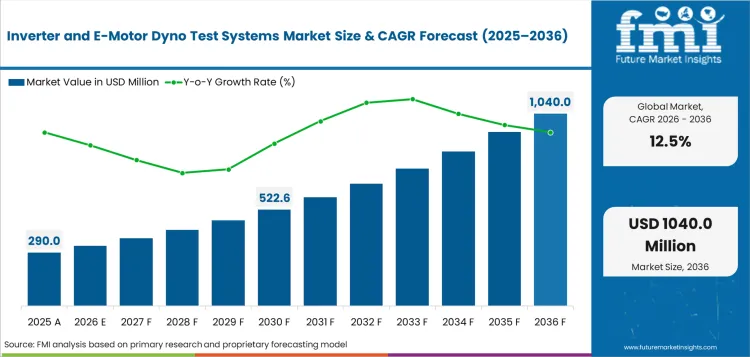
The inverter and e-motor dyno test systems market value stood at USD 290.0 million in 2025. Industry revenue is anticipated to reach USD 320.0 million in 2026 and rise to USD 1,040.0 million by 2036 at 12.5% CAGR. OEM labs are expected to hold 43.0% share by end user in 2026. By software layer, real-time automation is projected to account for 39.0% share in 2026.
Summary of the Inverter and E-Motor Dyno Test Systems Market
- Demand and Growth Drivers
- EV platform cycles are shifting test spending toward integrated test benches for simultaneous motor torque and inverter switching analysis.
- High-voltage architectures raise demand for regenerative dynos since laboratories need safer loading and lower energy waste.
- Silicon carbide inverters increase test complexity as switching frequency and thermal behavior need tighter measurement windows.
- Product and Segment View
- Integrated e-drive dynos are projected to account for 38.0% share in 2026 as combined motor-inverter checks reduce rework.
- OEM labs are expected to represent 43.0% share in 2026 since vehicle makers control final e-drive release.
- Real-time automation is forecast to capture 39.0% share in 2026 as repeatable duty cycles become a buying condition.
- Geography and Competitive Outlook
- China is expected to advance at 14.8% CAGR by 2036, supported by large EV output keeping engineering labs heavily used.
- India is projected to expand at 14.2% CAGR by 2036, influenced by local EV programs adding motor and controller validation capacity.
- AVL, HORIBA, Dyno One, and HBK maintain firm positions through dynos and power measurement systems.
- Analyst Opinion
- Nikhil Kaitwade, Principal Analyst for Automotive and Industrial Technologies at FMI, observes, “As electric mobility programs expand, e-drive validation has moved from a purely technical check into a launch-timing control point. Suppliers with stronger readiness will establish an unbroken digital data chain between inverter hardware and control software. Test system leaders able to deliver high-fidelity results under real-world duty cycles will reduce development risk and become preferred partners in shortening release cycles while improving reliability evidence.”
- Inverter and E-Motor Dyno Test Systems Market Value Analysis
- Inverter and e-motor dyno test systems are shifting from prototype lab equipment into a required validation asset for EV powertrain release.
- Automotive OEMs are expected to raise use of integrated test cells as inverters and motors need torque proof under repeatable load cycles.
- Real-time automation is preferred as test engineers need faster fault capture and cleaner control over high-voltage validation routines.
- Demand is supported by EV platforms and hybrid programs in which inverter durability can affect launch timing and warranty exposure.
Key Takeaways
- Inverter and e-motor dyno test systems market was valued at USD 290.0 million in 2025.
- Industry revenue is projected to reach USD 1,040.0 million by 2036 as e-drive teams need repeatable motor and inverter evidence.
- The sector is expected to expand at 12.5% CAGR from 2026 to 2036 across OEM labs and Tier 1 validation centers.
- The industry is projected to create an incremental revenue opportunity of USD 720.0 million between 2026 and 2036.
- OEM labs are projected to account for 43.0% share in 2026 as vehicle makers keep e-drive sign-off close to program teams.
- Real-time automation is expected to hold 39.0% share in 2026 with test cells needing faster fault capture and report output.
- EV production scale influences China to record an estimated 14.8% CAGR by 2036.
Inverter and e-motor dyno test systems remain relevant because electric powertrains still require torque proof and inverter safety validation. International Energy Agency stated in May 2025 that global electric car sales exceeded 17 million in 2024, giving test system suppliers a wider validation workload as EV programs move from prototype work into platform-level release. AVL states that its high-speed e-motor test system can run performance and function tests up to 60,000 rpm. High-speed motor programs therefore need dyno systems that hold control accuracy under dynamic load.
AVL reports that its Active Load Cabinet supports high-voltage inverter functional tests and works across four-quadrant operation. Four-quadrant testing gives engineers a route to check motor and generator behavior before full powertrain integration. NI states that physical dynamometer testing is costly and limited in test coverage for traction inverter validation. Simulation can reduce early test burden. Final hardware proof keeps dyno cells important. HORIBA reports that its e-motor test stands support performance and thermal behavior analysis under repeatable conditions. Repeatable testing is likely to keep lab investment active as automakers raise inverter and e-drive durability targets.
Inverter and E-Motor Dyno Test Systems Market Definition
Sector scope covers dynamometer benches and inverter test systems used to validate electric traction motors. Covered work includes torque mapping and speed testing. Inverter emulation and power measurement complete the core test boundary. Revenue scope includes dyno hardware, regenerative drives, battery emulators, automation software, safety enclosures, and commissioning services. Covered assets include passenger vehicle motors and commercial vehicle e-drive modules. Testing for industrial motors is included only if the system is specified for traction-style inverter duty cycles.
Inverter and E-Motor Dyno Test Systems Market Inclusions
Market scope covers commercially sold test systems categorized by test configuration and end user. Power range and test focus complete the main segmentation. Software layer is used to assess automation and data capture spending. Stakeholders include automotive OEMs, Tier 1 e-drive suppliers, independent test laboratories, and dyno system integrators. Power analyzer vendors and battery emulator suppliers form part of the same buying network. Safety auditors and calibration teams influence final bench acceptance.
Inverter and E-Motor Dyno Test Systems Market Exclusions
Study scope excludes chassis dynos without e-motor interfaces, engine-only dynamometers, general oscilloscopes, generic electrical meters, and software tools sold without physical test bench integration.
Inverter and E-Motor Dyno Test Systems Market Research Methodology
- Primary Research: FMI analysts reviewed OEM e-drive lab needs and Tier 1 supplier test cell buying behavior. Interviews focused on inverter emulation, regenerative loading, and traceable performance data.
- Desk Research: Desk review used International Energy Agency EV sales data and official vehicle production statistics. Company product pages were checked for dyno capacity, inverter interfaces, and power measurement features.
- Market Sizing and Forecasting: Forecast work combined EV program volume and average bench pricing. Country-level production scale and laboratory investment signals were used to adjust regional demand.
- Data Validation: Segment shares were checked against product portfolios and buyer workflow needs. Forecast outputs were compared with adjacent test equipment to keep the sizing realistic.
Why is the inverter and e-motor dyno test systems market growing?
- EV program growth is raising test cell hours as motor and inverter checks need repeatable proof before vehicle release.
- Silicon carbide inverter adoption is pushing laboratories toward faster data capture and cleaner power loss mapping.
- Regenerative loading lowers energy cost during durability cycles and supports safer high-voltage test routines.
Electric vehicle production scale is changing how validation teams buy dyno capacity. International Energy Agency data published in May 2025 placed global electric car sales above 17 million units in 2024. Higher vehicle output gives test equipment suppliers a wider validation workload as e-drive faults move from prototype risk into launch risk. Motor dynos and inverter benches give engineers a repeatable route to catch power loss before vehicle release. Suppliers with integrated automotive dyno and battery emulation support should gain project access as validation teams reduce road-test dependence.
High-voltage power electronics create another adoption route for bench suppliers. AVL describes its SPECTRA universal inverter as supporting silicon carbide inverter testing up to 1,000 VDC and 1 MHz control through field-programmable gate array hardware. Fast control speed matters as engineers check switching behavior and motor response under demanding duty cycles. Buyers move toward EV powertrain-in-the-loop (P-HIL) test benches only after physical bench data confirms model output. The practical result is higher demand for e-axle and inverter reliability platforms combining power analysis and real-time automation.
Market Segmentation Analysis
- Integrated e-drive dynos are anticipated to represent 38.0% share in 2026, driven by combined motor-inverter testing shortening fault tracing during vehicle program gates.
- OEM labs are estimated to secure 43.0% share in 2026 with automakers keeping final e-drive data close to release teams.
- 400 to 800 kW systems are expected to represent 34.0% share in 2026 due to passenger EVs and light commercial programs requiring mid-range capacity.
- Efficiency mapping is forecast to hold 32.0% share in 2026 since range and heat claims depend on verified power conversion data.
- Real-time automation is projected to reach 39.0% share in 2026 as laboratories need repeatable cycles and cleaner audit trails.
Demand is segmented by test configuration and end user. Power range, test focus, and software layer complete the scope. Test configuration includes integrated e-drive dynos, motor-only dynos, inverter benches, and portable rigs with integrated e-drive dynos holding a clear use case. End user scope covers OEM labs, Tier 1 suppliers, test laboratories, and universities with OEM labs holding a strong position. Power range includes below 400 kW, 400 to 800 kW, 800 kW to 1 MW, and above 1 MW systems. Test focus covers efficiency mapping, durability cycling, thermal validation, and production audit. Software layer covers real-time automation, HIL integration, data analytics, and manual control.
Insights into the Integrated E-Drive Dynos Test Configuration Segment
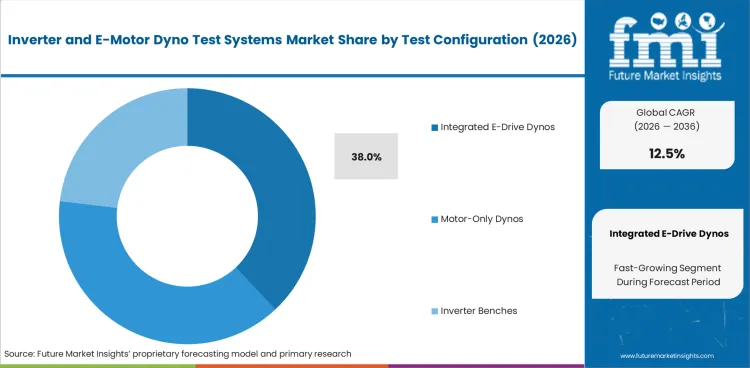
- Integrated e-drive dynos are expected to account for 38.0% share in 2026 since buyers need motor torque and inverter switching behavior captured during the same duty cycle.
- Motor-only dynos keep a useful role during early component design, while combined benches gain value as engineering teams move closer to vehicle release.
Insights into the OEM Labs End User Segment
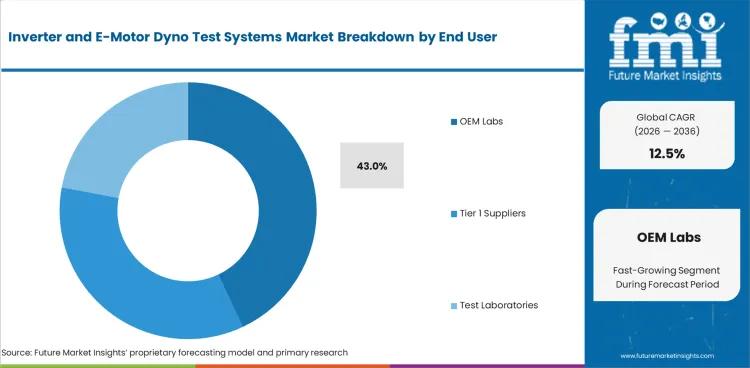
- OEM labs are projected to hold 43.0% share in 2026, led by automakers needing direct control over calibration data and release sign-off evidence.
- Tier 1 suppliers gain share by testing production-intent inverters and e-axles before handing validated data packages to vehicle programs.
Insights into the 400 to 800 kW Power Range Segment
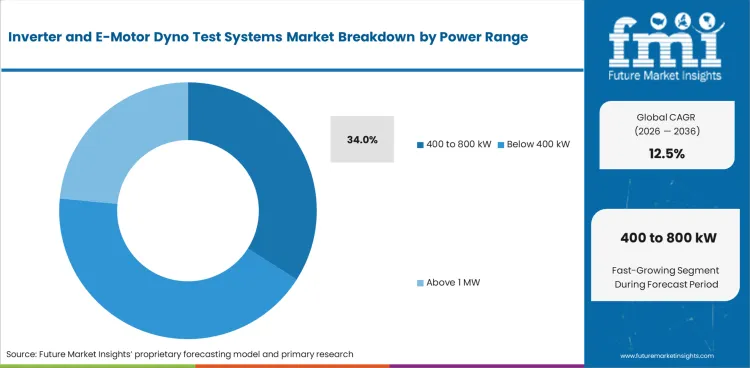
- 400 to 800 kW systems are anticipated to account for 34.0% share in 2026, led by mid-capacity benches integrating in passenger EV and light commercial duty cycles.
- Above‑1 MW systems generate higher contract value for heavy‑duty vehicles, and smaller order counts concentrate adoption within fewer labs.
Insights into the Efficiency Mapping Test Focus Segment
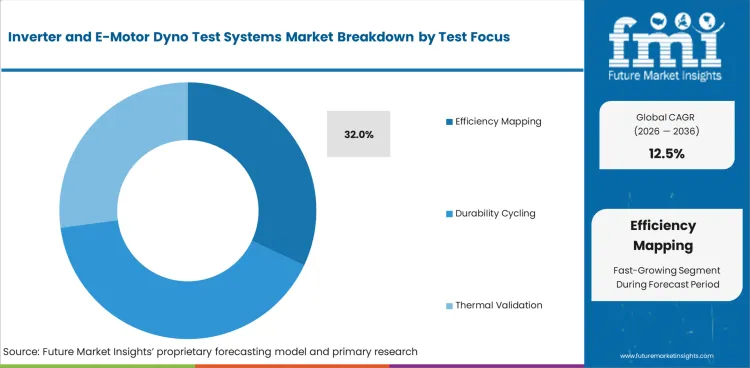
- Efficiency mapping is expected to represent 32.0% share in 2026 as range targets depend on precise power loss measurement across speed and load bands.
- Durability cycling expands as buyers request longer thermal proof and vibration records before component release.
Insights into the Real-Time Automation Software Layer Segment
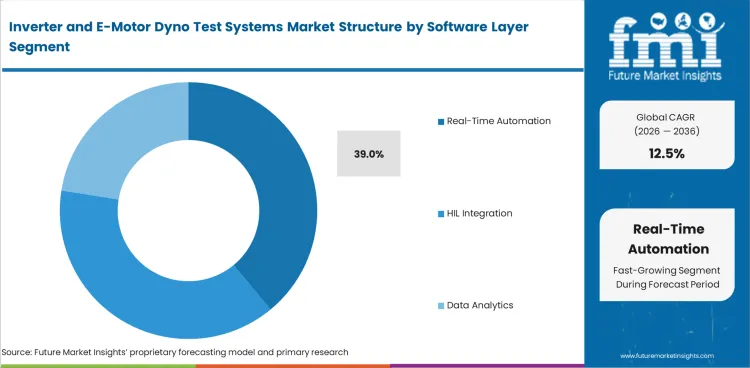
- Real-time automation is forecast to secure 39.0% share in 2026, driven by validation teams needing repeatable cycles and instant fault capture under high-voltage loading.
- HIL integration should expand as teams connect physical dynos with EV powertrain (P-HIL) benches for earlier software sign-off.
Inverter and E-Motor Dyno Test Systems Market Drivers, Restraints, and Opportunities
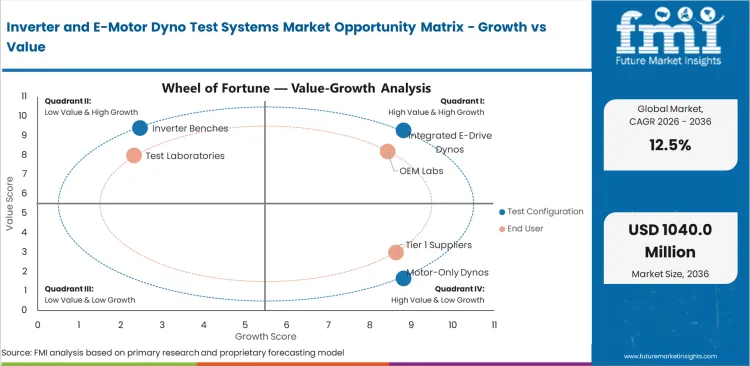
- High-voltage e-drive release checks are expected to raise system orders as teams need safe loading and fault logging.
- Capital cost is anticipated to slow smaller labs because regenerative dynos and chamber integration need higher upfront spending.
- Automation software creates prospects since labs seek quicker duty-cycle setup and cleaner data packages for audit review.
E-drive validation is now a program timing control point as EV programs move toward wider production. International Energy Agency material from May 2025 expected electric car sales to exceed 20 million in 2025, which raises the cost of late motor or inverter faults. Integrated dyno benches reduce release risk by testing torque delivery and electrical behavior before road fleets expand. Suppliers with test equipment depth and load system capability should gain as buyers seek closer correlation between bench results and vehicle energy use. Test cell cost is likely to stay a restraint for smaller laboratories, as regenerative systems need high-power rooms and skilled commissioning. Dyno One states that its HEViDyne systems combine four-quadrant motoring dynamometers with battery simulators and automation controllers. Integrated supply lowers engineering risk. It raises purchase complexity, creating an opening for suppliers able to package hardware and software into one approval route. Demand should shift toward EV powertrain-in-the-loop test benches able to combine physical proof with real-time control.
After-sales Service and Lifecycle Cost Analysis
After-sales service is expected to become a stronger purchase factor as dyno systems move into longer EV validation schedules. Power Test stated in November 2025 that unplanned dynamometer downtime can create high hourly losses for test users. Service value will shift toward OEM parts access and preventive maintenance kits protecting test accuracy over the equipment life. Buyers of test equipment are likely to prefer suppliers able to offer spare parts planning and uptime support inside the original contract. Annual maintenance contract structures are anticipated to gain wider use as labs seek lower downtime risk and clearer total cost of ownership.
Regulatory Compliance and Operating Standards Analysis
Regulatory compliance is likely to affect test system specifications as high-voltage vehicle safety rules become stricter. National Highway Traffic Safety Administration stated in February 2025 that FMVSS No. 305a applies to light and heavy electric-powered vehicles and includes propulsion battery performance requirements. The rule also requires manufacturers to compile risk mitigation documents and submit emergency response information. Test labs will need EV powertrain-in-the-loop test benches that support safer electrical validation and clean audit records. System buyers should favor benches with fault logging and controlled high-voltage operating procedures.
Regional Analysis
.webp "Top Country Growth Comparison Inverter And E Motor Dyno Test Systems Market Cagr (2026 2036)")
| Country | CAGR 2026 to 2036 |
|---|---|
| China | 14.8% CAGR |
| India | 14.2% CAGR |
| United States | 13.1% CAGR |
| Germany | 12.5% CAGR |
| South Korea | 12.2% CAGR |
| Japan | 11.8% CAGR |
| United Kingdom | 11.5% CAGR |
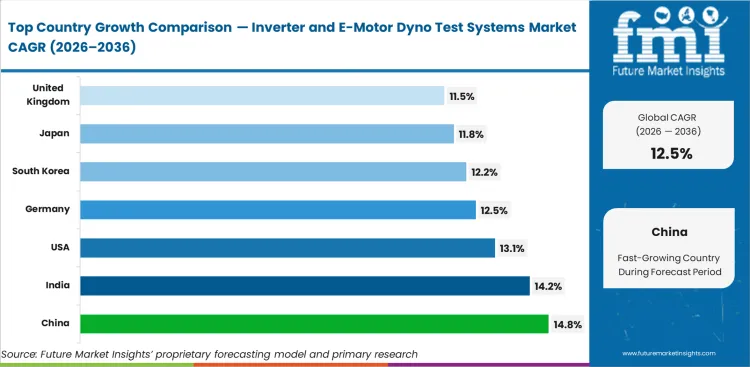
Source: Future Market Insights analysis, 2026.
Analysis of Inverter and E-Motor Dyno Test Systems Market by Key Countries
- China is expected to advance at 14.8% CAGR by 2036, led by local e-drive suppliers increasing inverter durability checks before platform release.
- India is projected to expand at 14.2% CAGR by 2036 since local EV programs add motor and controller validation capacity.
- United States is forecast to grow at 13.1% CAGR by 2036 due to OEM labs and independent test houses serving EV programs.
- Germany is expected to record 12.5% CAGR by 2036 as premium vehicle engineering maintains demand for efficiency and durability tests.
- South Korea at 12.2% CAGR, Japan at 11.8% CAGR, and United Kingdom at 11.5% CAGR by 2036, reflect strong supplier depth alongside slower vehicle volume scale.
Country performance differs by EV output scale and testing culture. China and India track above global pace due to production growth and new local platforms. United States benefits from large engineering programs and laboratory outsourcing. Germany and Japan have mature test standards supporting steady system upgrades. South Korea gains from battery and e-drive supplier depth. United Kingdom moves through specialist engineering, motorsport methods, and independent validation services.
Demand Outlook for Inverter and E-Motor Dyno Test Systems in China
The market in China is expected to advance at 14.8% CAGR by 2036, driven by very large EV output keeping e-drive laboratories under pressure. International Energy Agency material published in May 2025 stated electric car sales in China exceeded 11 million units in 2024. Scale at this level turns dyno testing into a production readiness tool. Local suppliers and foreign test houses are likely to see demand for integrated benches able to validate inverter behavior and motor efficiency across many model programs.
- Large EV output keeps dyno utilization high across OEM and Tier 1 laboratories serving passenger vehicle programs.
- Local vehicle platforms need faster engineering feedback as inverter software and motor hardware change across model cycles.
- Domestic e-drive suppliers support bench orders as export and local customers need repeatable proof for every program.
Opportunity Analysis of Inverter and E-Motor Dyno Test Systems in India
Adoption in India is projected to expand at 14.2% CAGR by 2036 as EV manufacturing moves from two-wheelers into broader passenger and fleet platforms. NITI Aayog reported in August 2025 that India EV sales reached 2.08 million units in 2024. Local component makers need bench capacity suited to smaller motors and higher-power passenger EV units. Suppliers offering modular rigs should convert faster than premium-only vendors as buyer budgets remain careful.
- Automotive production depth supports local e-drive testing as suppliers seek domestic validation before customer approval.
- Electric two-wheeler scale creates demand for lower power rigs with fast changeover and simple inverter interfaces.
- Passenger EV launches should raise spending on higher-power e-drive test cells.
In-Depth Analysis of Inverter and E-Motor Dyno Test Systems in the United States
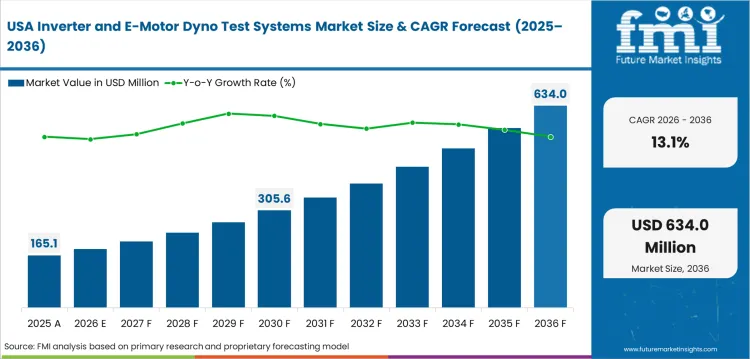
United States demand is forecast to grow at 13.1% CAGR by 2036, influenced by OEM laboratories and independent test houses serving EV and hybrid programs. Argonne National Laboratory data showed over 1.5 million EVs sold in 2024 with 9.9% share of U.S. vehicle sales. Vehicle makers need more repeatable validation even as consumer uptake fluctuates. Buyers should favor benches linking dyno output with road test data loggers for better lab-to-road correlation.
- U.S. laboratories buy higher specification systems as pickup and commercial EV programs require high torque validation.
- Independent test houses support outsourced validation since some automakers control capital spending during slower EV demand cycles.
- Software-heavy vehicle programs create demand for automotive network testing tied to powertrain bench data.
Demand Outlook for Inverter and E-Motor Dyno Test Systems in Germany
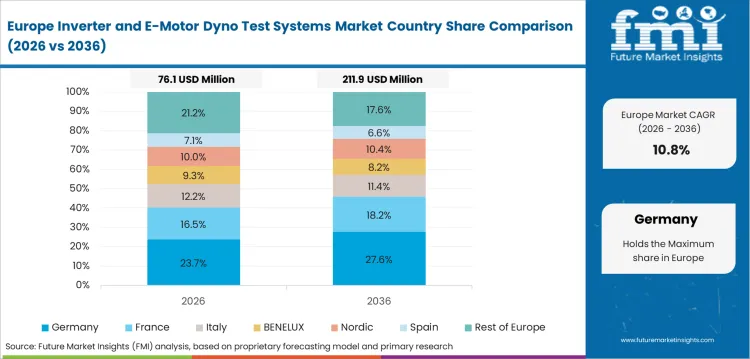
Demand in Germany is expected to record 12.5% CAGR by 2036 as premium vehicle programs keep test accuracy requirements high. European Automobile Manufacturers’ Association data published in January 2026 recorded 1,880,370 battery electric car registrations across the European Union in 2025. German buyers tend to specify repeatability and thermal control before buying new benches. Supplier prospects center on efficiency mapping and EMC-ready test cells supporting premium EV and hybrid programs.
- Premium vehicle engineering raises demand for torque accuracy and thermal repeatability across motor and inverter tests.
- European CO2 pressure sustains an active e-drive validation investment even as automakers adjust product timing.
- Germany retains a strong role for automotive dyno systems due to component suppliers improving efficiency data quality.
Sales Analysis of Inverter and E-Motor Dyno Test Systems in South Korea
Industry in South Korea are projected to rise at 12.2% CAGR by 2036 as battery and e-drive suppliers support global vehicle programs. International Trade Administration reporting from July 2025 noted EVs could reach 20% of national vehicle sales by the end of 2025. Supplier concentration makes local validation capacity commercially useful for export-bound programs. Test system buyers should value fast commissioning and strong service support due to frequent program changeovers.
- Battery and electronics supplier depth creates a natural buyer pool for inverter benches and high-voltage safety systems.
- Export-focused OEM programs need test evidence aligned with customer approval routines in North America and Europe.
- Local labs should invest in battery testing and certification links as e-drive and battery sign-off converge.
Opportunity Analysis of Inverter and E-Motor Dyno Test Systems in Japan
Sector growth in Japan is forecast at 11.8% CAGR by 2036 as hybrid and EV programs maintain careful validation routines. OICA production statistics for 2024 recorded 7,139,188 vehicles produced in Japan. Mature engineering culture supports steady investment in dynos handling durability and NVH-linked efficiency mapping. Adoption is slower than China or India because vehicle platform change is more measured. Suppliers with compact layouts and long service support should hold stronger readiness.
- Hybrid program depth contributes to motor and inverter testing even before full battery-electric volume expands further.
- Japanese suppliers prefer benches with proven reliability and precise torque measurement over low-cost generic rigs.
- Validation teams should add inverter duty motors evidence as mixed hybrid and EV production keeps motor types varied.
Sales Analysis of Inverter and E-Motor Dyno Test Systems in United Kingdom
Industry in the United Kingdom is expected to post 11.5% CAGR by 2036, supported by specialist engineering and motorsport methods that support outsourced EV validation. In May 2026, Society of Motor Manufacturers and Traders data marked the two millionth electric car registered in the United Kingdom. Specialist labs should benefit as OEMs use external validation capacity for targeted inverter and motor tests. Growth trails larger production countries due to lower local vehicle output scale.
- Independent engineering firms support test outsourcing as automakers seek flexible validation capacity without full internal capex.
- Motorsport and performance engineering depth improves demand for high response dynos and power measurement tools.
- Policy pressure around zero-emission vehicles supports e-drive validation spending and related EV test equipment.
Competitive Landscape and Strategic Positioning
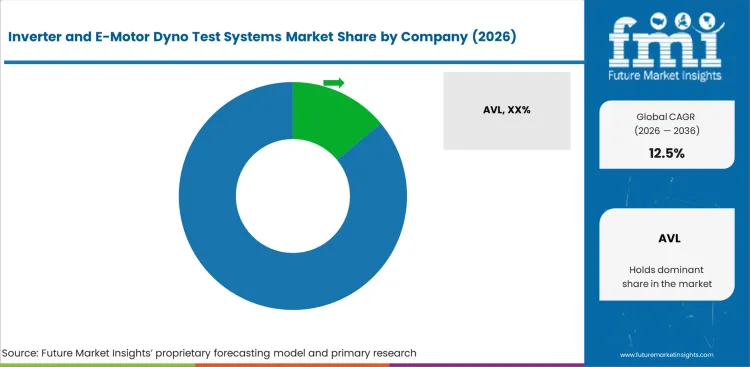
- Competition depends on regenerative dyno capability along with software automation and service reach across automotive engineering hubs.
- AVL and HORIBA hold strong positions based on broad e-mobility test portfolios and global support networks.
- Dyno One and Kistler compete depending on torque measurement systems and focused engineering support.
- Entry barriers stay high as buyers need safety design and power electronics knowledge. Commissioning skill and calibration evidence complete the buying test.
Competition in inverter and e-motor dyno test systems is led by global test system suppliers, focused dynamometer builders and measurement specialists. Buyers compare suppliers by complete test cell fit instead of a single equipment rating. AVL lists e-motor test solutions for performance and NVH work. Its portfolio covers EMC and durability checks, with production test systems completing the offer. HORIBA positions e-motor test stands around performance and efficiency work. Thermal behavior and durability evaluation strengthen its fit for e-drive validation labs. Supplier advantage comes from connecting dyno hardware and inverter emulation into a repeatable workflow.
Capability depth separates global vendors from smaller fabricators. AVL’s SPECTRA Universal Inverter supports multiple motor types and silicon carbide inverter emulation up to 1,000 VDC. HBK positions eDrive power analyzers for electric motors and inverters under changing torque and speed conditions. These capabilities give buyers better visibility into power loss and control response. Vendors with wider automotive test equipment depth should convert premium projects faster as validation evidence becomes a purchase condition.
Specialist companies can win focused projects by solving integration gaps. Dyno One announced in October 2024 that it purchased Sakor Technologies assets and created a test solutions division. The acquisition expands turnkey dynamometer capability for hybrid and electric vehicle systems. Kistler supports electric and hybrid powertrain testing with torque sensors and measurement chains. Smaller suppliers gain space in custom rigs and retrofit projects if they prove service speed and safety documentation.
Entry requirements are rising as test benches combine mechanical loading with high-voltage electronics. MAHLE announced in January 2025 a plan to sell its USA engineering services business to Dumarey Group, covering testing and engineering services in Plymouth. This transaction shows how specialized test assets can shift toward owners with focused service strategies. Suppliers better placed to win will combine high-voltage safety design and software control with reliable commissioning support. Smaller vendors can still compete in tailored projects. Broader validation programs are likely to favor suppliers with proven test cell delivery and service depth.
Key Companies in the Inverter and E-Motor Dyno Test Systems Market
Competition spans global test system integrators and measurement specialists, with regional turnkey dyno builders serving EV validation teams.
- Global test system integrators: AVL and HORIBA hold strong positions through complete e-mobility test portfolios. AVL offers e-motor dynos, universal inverter emulation, and PUMA automation. HORIBA provides e-motor test stands for performance, efficiency, thermal behavior and durability work. MAHLE Powertrain and FEV add engineering service depth for vehicle and powertrain validation programs across Europe, North America, and Asia.
- Measurement and software specialists: HBK and Kistler support dyno cells with power analyzers, torque sensors, and data acquisition chains. HBK eDrive power analyzers measure electrical and mechanical behavior under dynamic load changes. Kistler measurement systems support torque and powertrain testing. dSPACE and similar software firms influence HIL links as test cells connect physical benches with virtual controllers.
- Regional turnkey dyno builders: Dyno One uses Sakor assets to expand custom test cell capability in the United States. Unico and Magtrol serve selected dynamometer and drive applications with more focused portfolios. These firms compete on custom engineering, retrofit skill, and service speed. Buyer fit depends on power range, safety design, automation depth, and after-installation support.
Competitive Benchmarking: Inverter and E-Motor Dyno Test Systems Market
| Company | Regenerative Dyno Integration | Inverter Emulation Depth | Automation Data Chain | Geographic Footprint |
|---|---|---|---|---|
| AVL | High | High | High | Global |
| HORIBA | High | Strong | Strong | Global |
| MAHLE Powertrain | Strong | Medium | Strong | Europe and Asia |
| FEV | Strong | Medium | Strong | Global |
| HBK | Medium | Strong | High | Global |
| Kistler | Medium | Medium | Strong | Global |
| Dyno One | Strong | Medium | Moderate | North America |
| Unico | Medium | Strong | Moderate | North America |
| Magtrol | Medium | Low | Moderate | Europe and North America |
Source: Future Market Insights competitive analysis, 2026. Ratings reflect relative positioning based on regenerative dyno integration, inverter emulation depth, and automation data chain strength.
Key Developments in Inverter and E-Motor Dyno Test Systems Market
- In October 2024, Dyno One purchased Sakor Technologies assets. The acquired assets added engineered turnkey test solutions capability for hybrid and electric vehicle dyno projects.
- In January 2025, MAHLE announced its plan to sell the USA Powertrain engineering services business to Dumarey Group.
- In May 2025, International Energy Agency EV data showed global electric car sales above 17 million units in 2024.
Key Players in the Inverter and E-Motor Dyno Test Systems Market
Global Test System Integrators
- AVL
- HORIBA
- MAHLE Powertrain
- FEV
- IAV
Measurement and Software Specialists
- HBK
- Kistler
- dSPACE
- Keysight Technologies
- National Instruments
Turnkey Dyno and Drive Specialists
- Dyno One
- Unico
- Magtrol
- Mustang Advanced Engineering
- Dynomerk Controls
Report Scope and Coverage
| Item | Value |
|---|---|
| Market value in 2025 | USD 290.0 million |
| Market value in 2026 | USD 320.0 million |
| Market value in 2036 | USD 1,040.0 million |
| CAGR from 2026 to 2036 | 12.5% CAGR |
| Quantitative units | USD million |
| Market definition | Dynamometer and inverter test systems used for EV traction motor and controller validation |
| By test configuration | Integrated e-drive dynos, motor-only dynos, inverter benches, portable rigs |
| By end user | OEM labs, Tier 1 suppliers, test laboratories, universities |
| By power range | Below 400 kW, 400 to 800 kW, 800 kW to 1 MW, above 1 MW |
| By test focus | Efficiency mapping, durability cycling, thermal validation, production audit |
| By software layer | Real-time automation, HIL integration, data analytics, manual control |
| Regions covered | North America, Latin America, Western Europe, Eastern Europe, East Asia, South Asia and Pacific, Middle East and Africa |
| Countries covered | China, India, United States, Germany, South Korea, Japan, United Kingdom |
| Key companies profiled | AVL, HORIBA, MAHLE Powertrain, FEV, HBK, Kistler, Dyno One |
| Forecast period | 2026 to 2036 |
| Approach | Bottom-up EV validation bench modeling with country and segment cross-checks |
Source: Future Market Insights analysis, 2026.
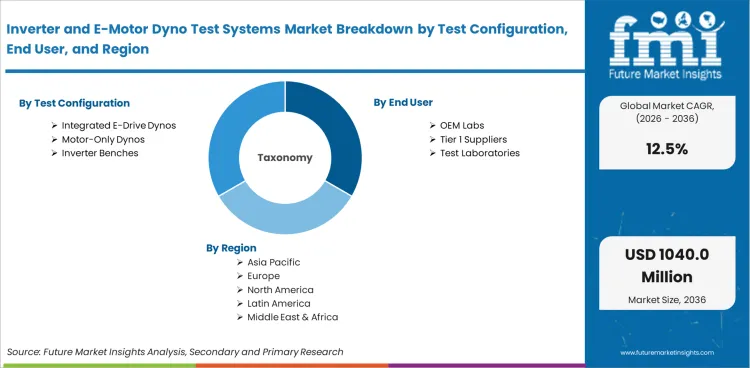
Inverter and E-Motor Dyno Test Systems Market Breakdown by Test Configuration, End User, Power Range, Test Focus, Software Layer, and Region
Inverter and E-Motor Dyno Test Systems Market Segmented by Test Configuration
- Integrated E-Drive Dynos
- Motor-Only Dynos
- Inverter Benches
- Portable Rigs
Inverter and E-Motor Dyno Test Systems Market Segmented by End User
- OEM Labs
- Tier 1 Suppliers
- Test Laboratories
- Universities
Inverter and E-Motor Dyno Test Systems Market Segmented by Power Range
- Below 400 kW
- 400 to 800 kW
- 800 kW to 1 MW
- Above 1 MW
Inverter and E-Motor Dyno Test Systems Market Segmented by Test Focus
- Efficiency Mapping
- Durability Cycling
- Thermal Validation
- Production Audit
Inverter and E-Motor Dyno Test Systems Market Segmented by Software Layer
- Real-Time Automation
- HIL Integration
- Data Analytics
- Manual Control
Inverter and E-Motor Dyno Test Systems Market by Region
- North America
- United States
- Canada
- Mexico
- Latin America
- Brazil
- Chile
- Rest of Latin America
- Western Europe
- Germany
- UK
- Italy
- Spain
- France
- Nordic
- BENELUX
- Rest of Western Europe
- Eastern Europe
- Russia
- Poland
- Hungary
- Balkan and Baltic
- Rest of Eastern Europe
- East Asia
- China
- Japan
- South Korea
- South Asia and Pacific
- India
- ASEAN
- Australia and New Zealand
- Rest of South Asia and Pacific
- Middle East and Africa
- Kingdom of Saudi Arabia
- Other GCC Countries
- Turkiye
- South Africa
- Other African Union
- Rest of Middle East and Africa
Research Sources and Bibliography
- European Automobile Manufacturers’ Association. (2026, January 27). New car registrations: +1.8% in 2025; battery-electric 17.4% market share.
- AVL. (2025, April 1). AVL unveils new inverter hardware testing solution. PR Newswire.
- AVL List GmbH. (2025, September 24). AVL SPECTRA™ Universal Inverter live demo.
- Dyno One. (2024, October). Important announcement regarding SAKOR.
- European Commission. (2025, July 7). Commission launches public consultation on CO₂ emission standards for cars and vans and on car labelling.
- European Commission. (2025, November 6). EU Climate Action Progress Report 2025.
- HBK. (2025, September 26). HBK boosts electric drive validation with MoBeLIV partnership.
- International Energy Agency. (2025, May 14). Global EV Outlook 2025.
- International Energy Agency. (2025, May 14). Trends in electric car markets. In Global EV Outlook 2025.
- International Organization of Motor Vehicle Manufacturers. (2026, April 23). Auto industry growth shifted east in 2025 amid global repositioning.
- Kistler Group. (2025, November). Power analyzer for the development and testing of electric and hybrid powertrains.
- MAHLE. (2025, January 8). MAHLE to sell US engineering services business.
- MAHLE. (2026, April 15). MAHLE improves operating result in 2025.
- National Highway Traffic Safety Administration. (2025, February 14). Federal Motor Vehicle Safety Standards; FMVSS No. 305a electric-powered vehicles: Electric powertrain integrity global technical regulation No. 20; incorporation by reference. Federal Register.
- National Institution for Transforming India (NITI Aayog). (2025, August). Electric vehicles in India: Unlocking a $200 billion opportunity. Government of India.
Bibliography is provided for reader reference and uses primary government, regulatory, official trade body, or official company publications.
This Report Answers
- What is the current and future value of the inverter and e-motor dyno test systems market from 2026 to 2036?
- What CAGR is expected for the inverter and e-motor dyno test systems market during the forecast period?
- Which test configuration is projected to hold a strong share in inverter and e-motor dyno test systems in 2026?
- Which end user group is expected to hold the stronger share of inverter and e-motor dyno test system demand?
- What factors are driving adoption of inverter benches and e-motor dynos across EV validation labs?
- How do high-voltage safety needs and silicon carbide inverters affect test system supplier selection?
- Which countries are expected to show stronger readiness for inverter and e-motor dyno test systems?
- Which companies are positioned across dynos, inverter emulation, power analysis, and turnkey test cells?
- How does FMI define the inverter and e-motor dyno test systems revenue scope?
- What forecasting approach was used to estimate inverter and e-motor dyno test system demand?
Frequently Asked Questions
What is the global market demand for inverter and e-motor dyno test systems in 2026?
The inverter and e-motor dyno test systems market value is expected to reach USD 320.0 million in 2026 as EV validation expands.
What will the inverter and e-motor dyno test systems market be worth by 2036?
Industry revenue is projected to reach USD 1,040.0 million by 2036 as high-voltage e-drive testing becomes more routine.
What is the expected CAGR for the inverter and e-motor dyno test systems market?
The sector is expected to expand at 12.5% CAGR from 2026 to 2036 across EV validation channels.
Which test configuration holds a strong share in the inverter and e-motor dyno test systems market?
Integrated e-drive dynos are projected to account for 38.0% share in 2026 due to combined motor-inverter testing reducing rework.
Which end user leads inverter and e-motor dyno test system demand?
OEM labs are expected to account for 43.0% share in 2026, led by automakers keeping final e-drive release evidence internal.
Why is China important for inverter and e-motor dyno test systems demand?
China is expected to advance at 14.8% CAGR by 2036, driven by EV output scale sustaining a high validation bench adoption.
What does the inverter and e-motor dyno test systems market include?
Scope includes dyno benches, inverter emulators, battery simulators, automation software, safety enclosures, and commissioning services for EV e-drive validation.
How did FMI forecast the inverter and e-motor dyno test systems market?
Forecasting combined EV program volume, average bench pricing, country production signals, and supplier portfolio checks across dyno hardware and automation software.
How much does an inverter and e-motor dyno test system usually cost?
System cost depends on power range and automation depth. A high-voltage integrated bench costs much more than a small motor-only rig.
How does an inverter and e-motor dyno test system work?
A dyno loads the motor while instruments measure torque, speed, voltage, current, and temperature under repeatable duty cycles.
Who uses inverter and e-motor dyno test systems?
Automotive OEM labs, Tier 1 e-drive suppliers, universities, and independent test houses use these systems to validate electric powertrains.
How do integrated e-drive dynos compare with motor-only dynos?
Integrated e-drive dynos test the motor and inverter together. Motor-only dynos suit early design work with simpler hardware requirements.
How long can an inverter and e-motor dyno test system last?
A well-maintained dyno test system can last many years. Software upgrades and power electronics refreshes often extend service life.
Preview the report firsthand - request a free sample
Get SampleGet the brochure for pricing and purchase details.
Get PDFTable of Content
- Key Takeaways
- Market Size and CAGR
- Top Growth Driver
- Fastest Growing Segment
- Leading Region
- Key Companies
- Emerging Opportunities
- Executive Summary
- Global Market Outlook
- Demand-side Trends
- Supply-side Trends
- Technology Roadmap Analysis
- Analysis and Recommendations
- Analyst Perspective (What is happening? Why now? What should investors know?)
- Key Questions Answered
- How large is the market?
- What is the CAGR?
- What are key trends?
- Which region dominates?
- Who are the leaders?
- Market Overview
- Market Coverage / Taxonomy
- Market Definition / Scope / Limitations
- Research Methodology
- Chapter Orientation
- Analytical Lens and Working Hypotheses
- Market Structure, Signals, and Trend Drivers
- Benchmarking and Cross-market Comparability
- Market Sizing, Forecasting, and Opportunity Mapping
- Research Design and Evidence Framework
- Desk Research Programme (Secondary Evidence)
- Expert Input and Fieldwork (Primary Evidence)
- Tooling, Models, and Reference Databases
- Data Engineering and Model Build
- Quality Assurance and Audit Trail
- Market Background
- Market Dynamics (Drivers, Restraints, Opportunity, Trends)
- Scenario Forecast (Optimistic, Likely, Conservative)
- Impact Analysis
- AI Impact
- Sustainability Impact
- Regulatory Impact
- Technology Impact
- Consumer / Buyer Analysis
- Purchase Drivers
- Adoption Barriers
- Buyer Journey
- Opportunity Map Analysis
- Product Life Cycle Analysis
- Supply Chain Analysis
- Investment Feasibility Matrix
- Value Chain Analysis
- PESTLE and Porter's Analysis
- Regulatory Landscape
- Regional Parent Market Outlook
- Production and Consumption Statistics
- Import and Export Statistics
- Global Market Analysis and Forecast, 2021 to 2036
- Historical Market Size Value (USD Billion) & Volume (Unit) Analysis, 2021 to 2025
- Current and Future Market Size Value (USD Billion) & Volume (Unit) Projections, 2026 to 2036
- Y-o-Y Growth Trend Analysis
- Absolute $ Opportunity Analysis
- Global Market Pricing Analysis, 2021 to 2036
- Global Market Analysis and Forecast, By Test Configuration, 2021 to 2036
- Introduction / Key Findings
- Historical Market Size Value (USD Billion) & Volume (Unit) Analysis By Test Configuration, 2021 to 2025
- Current and Future Market Size Value (USD Billion) & Volume (Unit) Analysis and Forecast By Test Configuration, 2026 to 2036
- Integrated E-Drive Dynos
- Motor-Only Dynos
- Inverter Benches
- Portable Rigs
- Integrated E-Drive Dynos
- Y-o-Y Growth Trend Analysis By Test Configuration, 2021 to 2025
- Absolute $ Opportunity Analysis By Test Configuration, 2026 to 2036
- Global Market Analysis and Forecast, By End User, 2021 to 2036
- Introduction / Key Findings
- Historical Market Size Value (USD Billion) & Volume (Unit) Analysis By End User, 2021 to 2025
- Current and Future Market Size Value (USD Billion) & Volume (Unit) Analysis and Forecast By End User, 2026 to 2036
- OEM Labs
- Tier 1 Suppliers
- Test Laboratories
- Universities
- OEM Labs
- Y-o-Y Growth Trend Analysis By End User, 2021 to 2025
- Absolute $ Opportunity Analysis By End User, 2026 to 2036
- Global Market Analysis and Forecast, By Power Range, 2021 to 2036
- Introduction / Key Findings
- Historical Market Size Value (USD Billion) & Volume (Unit) Analysis By Power Range, 2021 to 2025
- Current and Future Market Size Value (USD Billion) & Volume (Unit) Analysis and Forecast By Power Range, 2026 to 2036
- 400 to 800 kW
- Below 400 kW
- 800 kW to 1 MW
- Above 1 MW
- 400 to 800 kW
- Y-o-Y Growth Trend Analysis By Power Range, 2021 to 2025
- Absolute $ Opportunity Analysis By Power Range, 2026 to 2036
- Global Market Analysis and Forecast, By Test Focus, 2021 to 2036
- Introduction / Key Findings
- Historical Market Size Value (USD Billion) & Volume (Unit) Analysis By Test Focus, 2021 to 2025
- Current and Future Market Size Value (USD Billion) & Volume (Unit) Analysis and Forecast By Test Focus, 2026 to 2036
- Efficiency Mapping
- Durability Cycling
- Thermal Validation
- Production Audit
- Efficiency Mapping
- Y-o-Y Growth Trend Analysis By Test Focus, 2021 to 2025
- Absolute $ Opportunity Analysis By Test Focus, 2026 to 2036
- Global Market Analysis and Forecast, By Software Layer, 2021 to 2036
- Introduction / Key Findings
- Historical Market Size Value (USD Billion) & Volume (Unit) Analysis By Software Layer, 2021 to 2025
- Current and Future Market Size Value (USD Billion) & Volume (Unit) Analysis and Forecast By Software Layer, 2026 to 2036
- Real-Time Automation
- HIL Integration
- Data Analytics
- Manual Control
- Real-Time Automation
- Y-o-Y Growth Trend Analysis By Software Layer, 2021 to 2025
- Absolute $ Opportunity Analysis By Software Layer, 2026 to 2036
- Global Market Analysis and Forecast, By Region, 2021 to 2036
- Introduction
- Historical Market Size Value (USD Billion) & Volume (Unit) Analysis By Region, 2021 to 2025
- Current Market Size Value (USD Billion) & Volume (Unit) Analysis and Forecast By Region, 2026 to 2036
- North America
- Latin America
- Western Europe
- Eastern Europe
- East Asia
- South Asia and Pacific
- Middle East & Africa
- Market Attractiveness Analysis By Region
- North America Market Analysis and Forecast, By Country, 2021 to 2036
- Historical Market Size Value (USD Billion) & Volume (Unit) Trend Analysis By Market Taxonomy, 2021 to 2025
- Market Size Value (USD Billion) & Volume (Unit) Forecast By Market Taxonomy, 2026 to 2036
- By Country
- USA
- Canada
- Mexico
- By Test Configuration
- By End User
- By Power Range
- By Test Focus
- By Software Layer
- By Country
- Market Attractiveness Analysis
- By Country
- By Test Configuration
- By End User
- By Power Range
- By Test Focus
- By Software Layer
- Key Takeaways
- Latin America Market Analysis and Forecast, By Country
- Historical Market Size Value (USD Billion) & Volume (Unit) Trend Analysis By Market Taxonomy, 2021 to 2025
- Market Size Value (USD Billion) & Volume (Unit) Forecast By Market Taxonomy, 2026 to 2036
- By Country
- Brazil
- Chile
- Rest of Latin America
- By Test Configuration
- By End User
- By Power Range
- By Test Focus
- By Software Layer
- By Country
- Market Attractiveness Analysis
- By Country
- By Test Configuration
- By End User
- By Power Range
- By Test Focus
- By Software Layer
- Key Takeaways
- Western Europe Market Analysis and Forecast, By Country
- Historical Market Size Value (USD Billion) & Volume (Unit) Trend Analysis By Market Taxonomy, 2021 to 2025
- Market Size Value (USD Billion) & Volume (Unit) Forecast By Market Taxonomy, 2026 to 2036
- By Country
- Germany
- UK
- Italy
- Spain
- France
- Nordic
- BENELUX
- Rest of Western Europe
- By Test Configuration
- By End User
- By Power Range
- By Test Focus
- By Software Layer
- By Country
- Market Attractiveness Analysis
- By Country
- By Test Configuration
- By End User
- By Power Range
- By Test Focus
- By Software Layer
- Key Takeaways
- Eastern Europe Market Analysis and Forecast, By Country
- Historical Market Size Value (USD Billion) & Volume (Unit) Trend Analysis By Market Taxonomy, 2021 to 2025
- Market Size Value (USD Billion) & Volume (Unit) Forecast By Market Taxonomy, 2026 to 2036
- By Country
- Russia
- Poland
- Hungary
- Balkan & Baltic
- Rest of Eastern Europe
- By Test Configuration
- By End User
- By Power Range
- By Test Focus
- By Software Layer
- By Country
- Market Attractiveness Analysis
- By Country
- By Test Configuration
- By End User
- By Power Range
- By Test Focus
- By Software Layer
- Key Takeaways
- East Asia Market Analysis and Forecast, By Country
- Historical Market Size Value (USD Billion) & Volume (Unit) Trend Analysis By Market Taxonomy, 2021 to 2025
- Market Size Value (USD Billion) & Volume (Unit) Forecast By Market Taxonomy, 2026 to 2036
- By Country
- China
- Japan
- South Korea
- By Test Configuration
- By End User
- By Power Range
- By Test Focus
- By Software Layer
- By Country
- Market Attractiveness Analysis
- By Country
- By Test Configuration
- By End User
- By Power Range
- By Test Focus
- By Software Layer
- Key Takeaways
- South Asia and Pacific Market Analysis and Forecast, By Country
- Historical Market Size Value (USD Billion) & Volume (Unit) Trend Analysis By Market Taxonomy, 2021 to 2025
- Market Size Value (USD Billion) & Volume (Unit) Forecast By Market Taxonomy, 2026 to 2036
- By Country
- India
- ASEAN
- Australia & New Zealand
- Rest of South Asia and Pacific
- By Test Configuration
- By End User
- By Power Range
- By Test Focus
- By Software Layer
- By Country
- Market Attractiveness Analysis
- By Country
- By Test Configuration
- By End User
- By Power Range
- By Test Focus
- By Software Layer
- Key Takeaways
- Middle East & Africa Market Analysis and Forecast, By Country
- Historical Market Size Value (USD Billion) & Volume (Unit) Trend Analysis By Market Taxonomy, 2021 to 2025
- Market Size Value (USD Billion) & Volume (Unit) Forecast By Market Taxonomy, 2026 to 2036
- By Country
- Kingdom of Saudi Arabia
- Other GCC Countries
- Türkiye
- South Africa
- Other African Union
- Rest of Middle East & Africa
- By Test Configuration
- By End User
- By Power Range
- By Test Focus
- By Software Layer
- By Country
- Market Attractiveness Analysis
- By Country
- By Test Configuration
- By End User
- By Power Range
- By Test Focus
- By Software Layer
- Key Takeaways
- Key Countries Market Analysis
- USA
- Pricing Analysis
- Market Share Analysis, 2025
- By Test Configuration
- By End User
- By Power Range
- By Test Focus
- By Software Layer
- Canada
- Pricing Analysis
- Market Share Analysis, 2025
- By Test Configuration
- By End User
- By Power Range
- By Test Focus
- By Software Layer
- Mexico
- Pricing Analysis
- Market Share Analysis, 2025
- By Test Configuration
- By End User
- By Power Range
- By Test Focus
- By Software Layer
- Brazil
- Pricing Analysis
- Market Share Analysis, 2025
- By Test Configuration
- By End User
- By Power Range
- By Test Focus
- By Software Layer
- Chile
- Pricing Analysis
- Market Share Analysis, 2025
- By Test Configuration
- By End User
- By Power Range
- By Test Focus
- By Software Layer
- Germany
- Pricing Analysis
- Market Share Analysis, 2025
- By Test Configuration
- By End User
- By Power Range
- By Test Focus
- By Software Layer
- UK
- Pricing Analysis
- Market Share Analysis, 2025
- By Test Configuration
- By End User
- By Power Range
- By Test Focus
- By Software Layer
- Italy
- Pricing Analysis
- Market Share Analysis, 2025
- By Test Configuration
- By End User
- By Power Range
- By Test Focus
- By Software Layer
- Spain
- Pricing Analysis
- Market Share Analysis, 2025
- By Test Configuration
- By End User
- By Power Range
- By Test Focus
- By Software Layer
- France
- Pricing Analysis
- Market Share Analysis, 2025
- By Test Configuration
- By End User
- By Power Range
- By Test Focus
- By Software Layer
- India
- Pricing Analysis
- Market Share Analysis, 2025
- By Test Configuration
- By End User
- By Power Range
- By Test Focus
- By Software Layer
- ASEAN
- Pricing Analysis
- Market Share Analysis, 2025
- By Test Configuration
- By End User
- By Power Range
- By Test Focus
- By Software Layer
- Australia & New Zealand
- Pricing Analysis
- Market Share Analysis, 2025
- By Test Configuration
- By End User
- By Power Range
- By Test Focus
- By Software Layer
- China
- Pricing Analysis
- Market Share Analysis, 2025
- By Test Configuration
- By End User
- By Power Range
- By Test Focus
- By Software Layer
- Japan
- Pricing Analysis
- Market Share Analysis, 2025
- By Test Configuration
- By End User
- By Power Range
- By Test Focus
- By Software Layer
- South Korea
- Pricing Analysis
- Market Share Analysis, 2025
- By Test Configuration
- By End User
- By Power Range
- By Test Focus
- By Software Layer
- Russia
- Pricing Analysis
- Market Share Analysis, 2025
- By Test Configuration
- By End User
- By Power Range
- By Test Focus
- By Software Layer
- Poland
- Pricing Analysis
- Market Share Analysis, 2025
- By Test Configuration
- By End User
- By Power Range
- By Test Focus
- By Software Layer
- Hungary
- Pricing Analysis
- Market Share Analysis, 2025
- By Test Configuration
- By End User
- By Power Range
- By Test Focus
- By Software Layer
- Kingdom of Saudi Arabia
- Pricing Analysis
- Market Share Analysis, 2025
- By Test Configuration
- By End User
- By Power Range
- By Test Focus
- By Software Layer
- Türkiye
- Pricing Analysis
- Market Share Analysis, 2025
- By Test Configuration
- By End User
- By Power Range
- By Test Focus
- By Software Layer
- South Africa
- Pricing Analysis
- Market Share Analysis, 2025
- By Test Configuration
- By End User
- By Power Range
- By Test Focus
- By Software Layer
- USA
- Market Structure Analysis
- Competition Dashboard
- Competition Benchmarking
- Market Share Analysis of Top Players
- By Regional
- By Test Configuration
- By End User
- By Power Range
- By Test Focus
- By Software Layer
- Emerging Startups
- Innovation Benchmarking
- Competition Analysis
- Competition Deep Dive
- AVL
- Overview
- Product Portfolio
- Profitability by Market Segments (Product/Region/Sales Channel)
- Sales Footprint
- Strategy Overview
- Marketing Strategy
- Product Strategy
- Channel Strategy
- HORIBA
- MAHLE Powertrain
- FEV
- IAV
- HBK
- Kistler
- dSPACE
- Keysight Technologies
- National Instruments
- Dyno One
- Unico
- Magtrol
- Mustang Advanced Engineering
- Dynomerk Controls
- AVL
- Case Studies
- Success Stories
- Recent Developments
- Competition Deep Dive
- Assumptions & Acronyms Used


