

- Industry Size (2026)
- USD 320.0 Mn
- Forecast (2036)
- USD 1040.0 Mn
- CAGR (2026 to 2036)
- 12.50%
E-Axle and Inverter Efficiency and Reliability Test Platforms Market Size, Market Forecast and Outlook By FMI
The E-axle and inverter efficiency and reliability test platforms market crossed a valuation of USD 290.0 million in 2025. Demand is likely to be valued at USD 320.0 million in 2026, and the market is forecast to reach USD 1,040.0 million by 2036, at a CAGR of 12.50%. The expansion is tied to continued investment as automotive programs move toward high-frequency hardware-in-the-loop validation for silicon carbide switching architectures.
Summary of E-Axle and Inverter Efficiency and Reliability Test Platforms Market
- E-Axle and Inverter Efficiency and Reliability Test Platforms Market Definition
- High-performance laboratory infrastructure evaluates power electronics and integrated propulsion systems under simulated electrical and mechanical loads to measure efficiency, thermal behavior, and endurance under controlled conditions.
- Demand Drivers in the Market
- Thermal degradation profiling forces R&D directors to upgrade benches capable of executing transient load steps.
- Silicon carbide switching dynamics require validation managers to install low-inductance EV powertrain efficiency testing equipment.
- Shrinking homologation windows push program executives toward automated 24-hour endurance rigs.
- Key Segments Analyzed in the FMI Report
- Platform Type: Inverter benches estimated to hold 34.0% share in 2026, capturing immediate spending as isolated power electronics testing precedes integrated mechanical validation.
- Test Focus: Efficiency tests expected to record 28.0% share in 2026, satisfying regulatory demands for accurate electric drive efficiency mapping bench deployment.
- Power Class: 200-500 kW class is anticipated to garner 36.0% share in 2026, aligning perfectly with mainstream passenger electric drive unit specifications.
- End User: OEM labs are projected to secure 41.0% share in 2026, reflecting massive internal capital allocation to secure powertrain intellectual property.
- Configuration: System-level configurations are poised to capture 44.0% share in 2026, answering final homologation requirements before vehicle-level integration.
- India: 15.1% compound growth, sustained by aggressive domestic OEM timelines demanding localized high-voltage testing infrastructure.
- Analyst Opinion at FMI
- Nikhil Kaitwade, Principal Analyst, Automotive, at FMI, points out, "Generalist assumptions treat continuous full-load endurance as the ultimate hurdle for electric propulsion validation. Actual failure analysis reveals that transient thermal cycling under partial load creates microscopic bond-wire fractures long before steady-state maximums trigger safety limits. Test facility directors realize legacy dynamometers simply cannot replicate highly variable switching frequencies matching real highway traffic. Upgrading to advanced transient emulation prevents embarrassing field recalls, transforming validation infrastructure from a basic capital expense into absolute commercial insurance against silicon carbide reliability gaps."
- Strategic Implications / Executive Takeaways
- Test facility managers must transition from static load banking to highly dynamic power emulation.
- Validation engineering leads face immediate demands to integrate high-frequency data acquisition seamlessly.
- Capital planning directors risk severe testing bottlenecks if multi-axle synchronization capabilities remain underfunded.
- Methodology
- Target insights gathered directly from chief testing engineers and laboratory operations directors.
- Technical parameters verified against published SAE standards and ISO powertrain homologation procedures.
- Value baselines anchored to confirmed capital expenditure budgets for testing infrastructure modernization.
- Demand curves cross-referenced with semiconductor roadmap timelines for next-generation inverter rollouts.
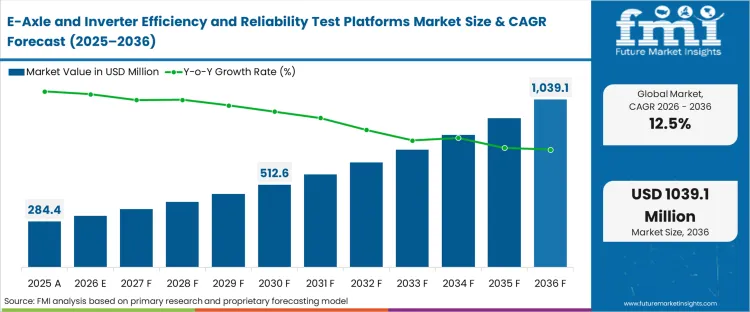
E-Axle and Inverter Efficiency and Reliability Test Platforms Market Key Takeaways
| Metric | Details |
|---|---|
| Industry Size (2026) | USD 320.0 Million |
| Industry Value (2036) | USD 1,040.0 Million |
| CAGR (2026–2036) | 12.50% |
Source: Future Market Insights (FMI) analysis, based on proprietary forecasting model and primary research
Compressed development schedules are forcing validation teams to run concurrent assessments of thermal limits and mechanical stress on advanced e-axle test platforms. Finding inverter switching faults only during physical prototype integration can cost Tier-1 suppliers millions in delay-related penalties. The strength of internal electric vehicle test equipment increasingly shapes supplier selection for next-generation powertrain programs. Purchasing directors often miss how quickly legacy low-inductance rigs become unfit for transient thermal event analysis at 20 kHz across 800V inverter validation benches.
Achieving closed-loop emulation above 15,000 RPM triggers widespread capability replacement across the EV powertrain testing landscape. Test house managers initiate capital expenditure cycles once their existing e-axle endurance test rigs fail to reproduce torque ripple effects seen in actual field data. Precise load-stepping replication unlocks true endurance validation without requiring completely assembled drive units.
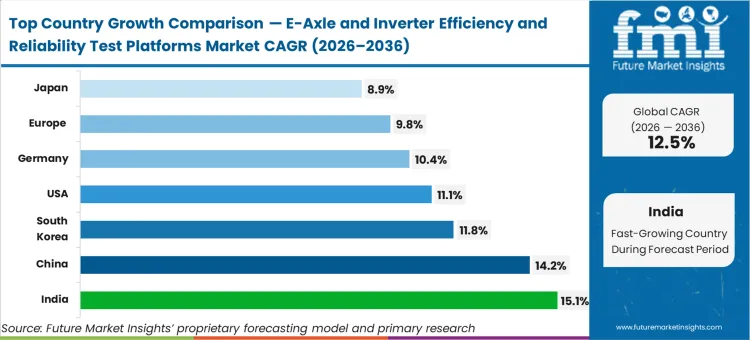
India leads geographic growth at 15.1% as domestic manufacturers localize electric drive test platforms. China tracks at 14.2% on aggressive high-speed motor qualification requirements forcing rapid capital deployment. South Korea expands at 11.8% driven by silicon carbide adoption mandates among top-tier brands evaluating power HIL for traction inverter testing. United States validation capacity grows at 11.1% responding to stringent highway-cycle durability standards. Germany advances at 10.4% as heritage automakers redesign test floors for multi-axle synchronization. Europe ex Germany adds 9.8% while Japan records 8.9% supported by steady hybrid transition evaluation. Structural divergence separates regions investing in ultra-fast switching emulation from those merely expanding baseline mechanical endurance capacity.
E-Axle and Inverter Efficiency and Reliability Test Platforms Market Definition
Purpose-built infrastructure verifies mechanical durability, electrical efficiency, and thermal stability of integrated propulsion systems under simulated load conditions. Systems execute complex duty cycles that mimic real-world driving environments to identify failure modes before vehicle integration. Advanced electric drive test platforms combine physical load machines with active control software to measure torque response, switching losses, and vibration signatures at extremely high rotational speeds.
E-Axle and Inverter Efficiency and Reliability Test Platforms Market Inclusions
The scope incorporates complete dynamometer test beds, high-voltage battery emulators, hardware-in-the-loop control systems, and supporting data acquisition software developed for evaluating standalone components or integrated electric vehicle e-axle assemblies. Revenue sizing covers installation of new systems, renewals for software-based test execution suites, and manufacturer-provided calibration services for dedicated motor-inverter emulation benches used by testing laboratories.
E-Axle and Inverter Efficiency and Reliability Test Platforms Market Exclusions
Standalone mechanical dynamometers designed for internal combustion engines fall outside evaluated boundaries due to insufficient dynamic response capabilities. General-purpose electronic multimeters, battery testing equipment lacking active drivetrain interfaces, and basic end-of-line functional testers are omitted. Routine maintenance contracts executed by third-party service providers separate from original equipment manufacturers do not contribute to core platform valuation totals.
E-Axle and Inverter Efficiency and Reliability Test Platforms Market Research Methodology
- Primary Research: Validation laboratory directors, test facility engineering leads, and capital equipment procurement managers within Tier-1 automotive operations.
- Desk Research: ISO standard documentation for electric drive testing, SAE technical papers on thermal emulation, and equipment manufacturer specification sheets.
- Market-Sizing and Forecasting: Installed base replacement rates and scheduled capital expenditure plans for laboratory upgrades at major automotive testing centers.
- Data Validation and Update Cycle: Independent hardware-in-the-loop software license volume growth cross-verifies physical bench deployment trajectories.
Segmental Analysis
E-Axle and Inverter Efficiency and Reliability Test Platforms Market Analysis by Platform Type
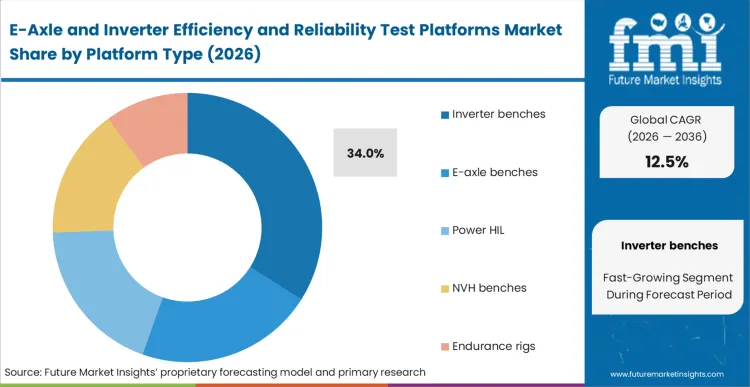
Isolated power electronics characterization occurs months before mechanical components arrive at validation laboratories. Inverter benches secure 34.0% share, and FMI's analysis indicates test engineers prioritize traction inverter test systems to debug complex software controls safely. Verifying algorithms on high-fidelity 800 V inverter modules prevents catastrophic hardware damage during later system integration. What procurement teams frequently overlook is how software compatibility dictates hardware choices, locking laboratories into specific vendor ecosystems for years based on initial data acquisition purchases linked to early electric vehicle battery connector protocols. Delays in upgrading bench capacity force expensive out-sourcing to third-party testing houses during critical launch phases.
- Decision Phase: Initial control algorithm debugging. Test engineers require absolute measurement precision to tune switching frequencies without risking complete mechanical prototype destruction.
- Qualification Metric: Data acquisition synchronization speed remains a critical purchase criterion. Laboratory managers assess microsecond-level recording capability to capture transient voltage spikes, switching instability, and fast thermal responses with precision. Platforms lacking this level of synchronization risk missing short-duration electrical events that directly affect inverter validation accuracy, fault diagnosis quality, and confidence in high-frequency power electronics testing outcomes.
- Expansion Trigger: Multi-variant platform launches. Program directors authorize additional bench purchases when software teams cannot complete calibration testing within single-shift constraints.
E-Axle and Inverter Efficiency and Reliability Test Platforms Market Analysis by Test Focus
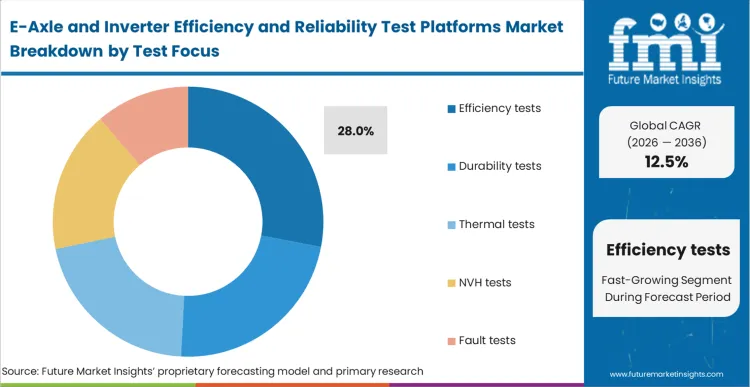
Efficiency tests command 28.0% share as compliance officers require certified baseline data before approving marketing range claims. FMI observes that mapping peak efficiency islands demands precise inverter efficiency test platforms combined with advanced power analysis. Highlighting a crucial contradiction, testing labs often invest heavily in EV traction inverter precision while relying on outdated mechanical fixtures that introduce unaccounted parasitic losses. Failing to isolate true electrical efficiency from mechanical drag results in published range figures falling short of actual highway performance.
- Baseline Requirement: Energy consumption mapping remains essential for certification readiness. Compliance officers require exhaustive matrices covering multiple torque and speed combinations to align testing output with agency protocols. These structured validation maps help laboratories document efficiency behavior across operating ranges, identify abnormal loss patterns, and demonstrate that propulsion systems meet required regulatory, reporting, and performance verification standards.
- Hidden Cost: Fixture calibration downtime. Laboratory technicians spend disproportionate hours verifying mechanical alignment to eliminate parasitic losses from final calculations.
- Lifecycle Benefit: Software refinement data drives platform value beyond validation alone. Calibration engineers rely on high-fidelity efficiency maps to fine-tune control algorithms, reduce conversion losses, and unlock marginal highway range gains. Precise mapping across load conditions helps teams improve inverter behavior, optimize torque delivery, and support better energy management decisions during advanced electric powertrain software development.
E-Axle and Inverter Efficiency and Reliability Test Platforms Market Analysis by Power Class
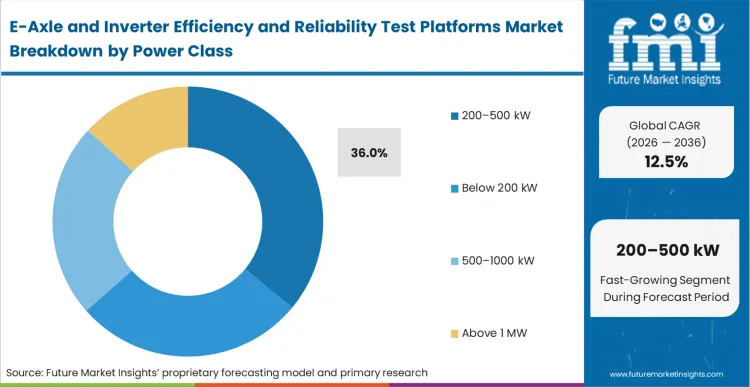
Passenger vehicle architectures cluster tightly around sweet spots balancing performance with thermal management realities. The 200–500 kW segment holds 36.0% share, supporting widespread deployment of dual-motor setups and high-performance single-axis units. As per FMI's projection, equipping test cells for this exact power band satisfies ninety percent of scheduled OEM electric drive unit testing volume. An ironic reality is that building universal 1 MW test cells to handle commercial vehicle e-axle testing actually compromises low-torque measurement accuracy needed for critical low-speed efficiency mapping on smaller cars. Purchasing oversized rigs leaves testing directors struggling to certify urban driving cycle performance adequately.
- Adoption Driver: Mainstream passenger platforms. Powertrain directors standardize cell specifications to match incoming high-volume vehicle architectures exactly.
- Edge Limitation: Low-torque accuracy constraints. Calibration engineers struggle to measure creeping speeds precisely when utilizing dynamometers sized for high-performance track testing.
- Qualification Standard: Continuous thermal rejection often defines usable platform capacity more than peak electrical load. Facilities engineers set acceptable power ratings according to available building cooling water capacity, since inadequate heat removal limits sustained testing duration. In many laboratories, thermal infrastructure becomes the real bottleneck, shaping how long high-load validation can run and which powertrain programs the site can realistically support.
E-Axle and Inverter Efficiency and Reliability Test Platforms Market Analysis by End User
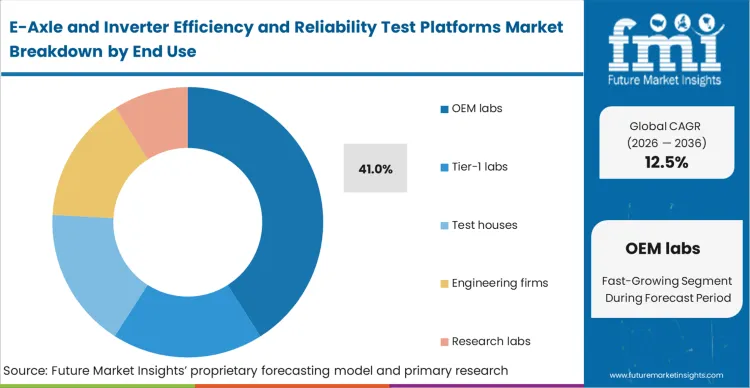
OEM labs account for 41.0% share, investing massive capital to keep next-generation silicon carbide secrets entirely in-house. FMI analysts note that maintaining total control over testing schedules allows rapid software iteration without negotiating external access for EV power module debugging. The unspoken structural friction involves OEMs realizing their massive internal investments still lack specialized high-frequency noise analysis, quietly outsourcing acoustic evaluation despite owning advanced dynamometers alongside automotive DC-DC converter rigs. Insufficient internal capacity forces program managers to truncate critical endurance cycles just to meet vehicle launch deadlines.
- Primary Adopter: Heritage automakers are expanding internal test infrastructure as capital planning executives approve major campus upgrades to shift engineering teams away from combustion engine programs. These investments support the transition toward electric propulsion validation, where new facilities must handle inverter behavior, thermal stress, and integrated e-axle testing. The scale of these upgrades often reflects long-term commitments to in-house electric powertrain development.
- Follower Shift: Regional Tier-1 suppliers. Validation managers add specific benches to pre-certify subassemblies before shipping them to demanding OEM integration teams.
- Final Convert: Specialized engineering firms. Partnership directors invest in niche NVH testing capabilities only after standard efficiency mapping becomes heavily commoditized.
E-Axle and Inverter Efficiency and Reliability Test Platforms Market Analysis by Configuration
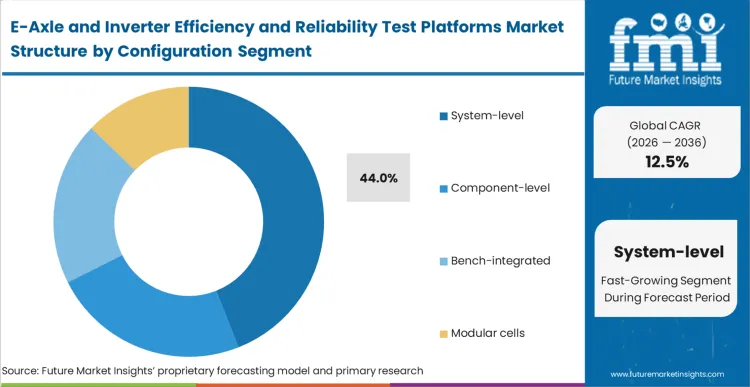
Verifying final homologation parameters requires running fully assembled physical hardware through complete driving profiles. System-level configurations achieve 44.0% share as certification engineers must document holistic behavior before public road trials begin. According to FMI's estimates, capturing intricate interactions between automotive axle mechanics and sophisticated e-axle NVH test benches demands perfectly synchronized load machines. What generalists miss is that true system-level testing rarely happens first; it acts as the final gatekeeping bottleneck where isolated e-axle hub bearing units successes occasionally compound into catastrophic system-level vibration issues. Misjudging system interaction delays vehicle-level prototyping by several costly financial quarters.
- Failure Prevention: Unexpected resonance identification. NVH engineers rely on complete assembly testing to discover destructive vibrations generated by software-hardware mismatch.
- Residual Risk: Sub-component masking. Fault analysis technicians struggle to pinpoint exact failure origins when testing completely sealed, highly integrated drive units.
- Value Capture: Comprehensive cycle validation. Program managers extract maximum return on investment by running fully automated 24-hour endurance loops on complete systems.
E-Axle and Inverter Efficiency and Reliability Test Platforms Market Drivers, Restraints, and Opportunities
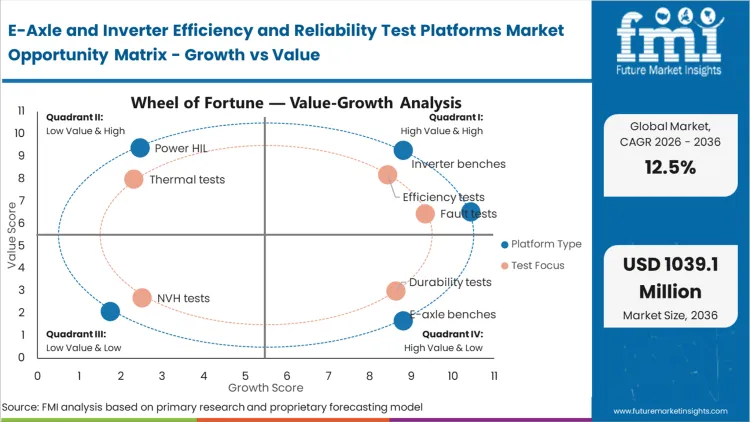
Product development is moving too quickly for validation teams to depend on traditional step-by-step testing. Directors are being pushed to complete thousands of hours of validation work simultaneously across multiple systems. Waiting until mechanical prototypes are finished to evaluate electric vehicle onboard charger interactions can delay full vehicle introduction. With advanced hardware-in-the-loop platforms, engineers can apply fault injections to real inverters while simulating mechanical loads digitally, reducing delays that older testing methods often create.
Grid power availability and facility cooling capacity severely bottleneck high-power rig installations. Testing a megawatt-class drive unit requires dissipating massive thermal loads continuously, demanding dedicated substation upgrades alongside robust e-axle input and output couplings to handle extreme mechanical stress safely. Building out facility utilities often costs more than purchasing testing platforms themselves. Shared energy recovery systems partially mitigate electrical consumption but fail to solve absolute thermal rejection limits plaguing older engineering campuses.
Opportunities in the E-Axle and Inverter Efficiency and Reliability Test Platforms Market
- dual-motor e-axle durability testing: Expanding rigs to accommodate torque-vectoring architectures allows laboratory directors to capture premium sport-utility validation contracts.
- e-drive fault injection testing: Deploying standardized short-circuit emulation helps calibration engineers verify safety responses without destroying expensive physical prototypes.
- electric axle acoustic testing: Adding high-fidelity noise measurement to endurance rigs empowers engineering teams to map frequency degradation over thousands of operating hours.
Regional Analysis
.webp "Top Country Growth Comparison E Axle And Inverter Efficiency And Reliability Test Platforms Market Cagr (2026 2036)")
Based on regional analysis, E-axle and inverter efficiency and reliability test platforms market is segmented into Asia Pacific, North America, and Europe across 40 plus countries.
| Country | CAGR (2026 to 2036) |
|---|---|
| India | 15.1% |
| China | 14.2% |
| South Korea | 11.8% |
| United States | 11.1% |
| Germany | 10.4% |
| Europe | 9.8% |
| Japan | 8.9% |
Source: Future Market Insights (FMI) analysis, based on proprietary forecasting model and primary research
Asia Pacific E-Axle and Inverter Efficiency and Reliability Test Platforms Market Analysis
Major manufacturing hubs witness rapid testing facility expansion as aggressive localization schedules reshape capital planning. Regional automakers prefer keeping heavy prototype validation close to production lines rather than shipping assemblies overseas. In FMI’s view, engineering executives now treat alignment between local testing infrastructure and gigafactory output capacity as a top capital priority.
- India: India is witnessing stronger investment in local validation capacity as domestic homologation rules make it harder to rely on overseas test data, especially for extreme ambient temperature performance. That shift is helping testing infrastructure move closer to where vehicle development is happening. As the market grows at 15.1%, domestic brands are gaining more room to speed up proprietary powertrain launches, reduce approval delays, and build greater independence across emerging electric vehicle programs.
- China: In China, compressed vehicle development timelines are keeping testing activity under constant pressure. Engineering teams are relying more on 24-hour durability rigs to keep pace with the rapid rollout of new energy vehicle electric drive systems. With the market expanding at 14.2%, high testing throughput is becoming an important advantage for domestic OEMs trying to shorten development cycles and move faster than global competitors.
- South Korea: South Korea’s market is being shaped by the transition from older operating architectures to more advanced 800-volt systems. That change is increasing the need for deeper inverter characterization across switching speed, thermal behavior, and efficiency performance. The market is advancing at 11.8%, reflecting how early validation of silicon carbide components is becoming more important. Companies that move sooner on specialized testing platforms are improving their position within next-generation electric powertrain programs.
- Japan: Japan is moving at a steadier pace, with growth of 8.9%, and the emphasis remains firmly on precision. Validation teams are working through detailed hybrid-electric transition matrices, while capital spending stays more selective than aggressive. Buyers continue to prioritize accurate NVH measurement and controlled performance validation over broad power expansion, which gives the market a more measured but technically demanding direction.
FMI's report includes emerging Southeast Asian hubs. Rising assembly operations trigger initial investments in localized end-of-line functional testers.
North America E-Axle and Inverter Efficiency and Reliability Test Platforms Market Analysis
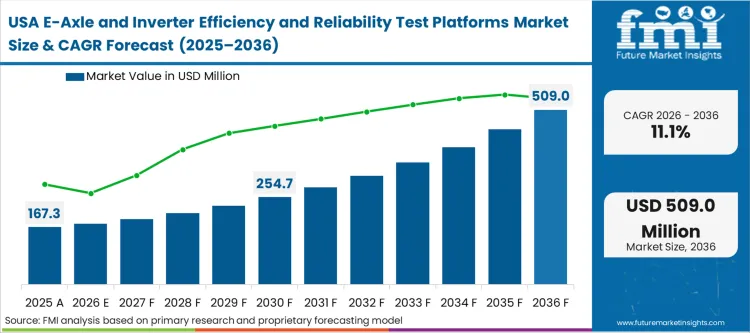
Highway cycle durability requirements dictate massive investments in high-torque endurance rigs. Validating powertrains for heavy passenger trucks requires running extreme towing simulations that quickly destroy standard passenger-car dynamometers. Based on FMI's assessment, battery electric vehicle BEV testing centers prioritize sheer mechanical robustness and high thermal rejection capacity.
- United States: Demanding consumer towing expectations force validation managers to simulate extreme load conditions accurately. Achieving 11.1% compound growth, expanding high-torque capabilities allows legacy automakers to defend highly profitable truck segments.
FMI's report includes Canadian and Mexican operations. Cross-border integration encourages establishing specialized cold-weather testing chambers in northern locations.
Europe E-Axle and Inverter Efficiency and Reliability Test Platforms Market Analysis
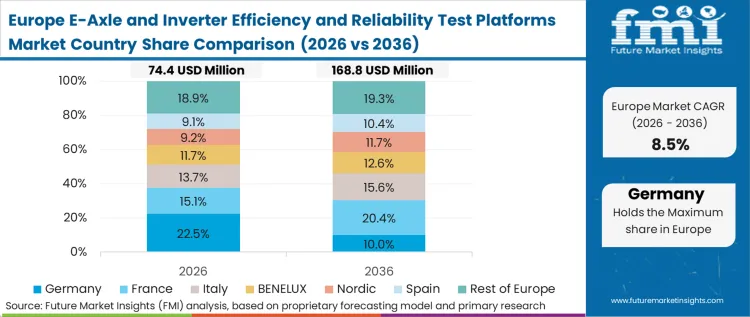
Heritage automakers possess immense mechanical testing expertise but face urgent needs to modernize control electronics evaluation. Upgrading campus infrastructure involves physically tearing out combustion testing cells to install high-voltage power emulators. FMI analysts observe that optimizing laboratory space utilization drives preferences for compact, highly integrated testing benches.
- Germany: Deep engineering traditions lead R&D directors to demand exceptionally high measurement precision, especially for premium segment performance and vehicle dynamics validation. Expanding at 10.4%, the market benefits from strong local technical authority and rigorous laboratory culture. This domestic strength allows suppliers to influence global validation benchmarks, shape stricter qualification practices, and maintain leadership in advanced electric powertrain testing standards.
- Europe: Stringent efficiency regulations force compliance officers to map energy consumption across diverse BEV electric drive unit driving profiles accurately. Tracking at 9.8%, widespread laboratory modernization helps regional Tier-1s maintain crucial supply chain relevance.
FMI's report includes Scandinavian testing grounds. Extreme winter proving requirements drive investments in specialized environmental chamber dynamometers.
Competitive Aligners for Market Players
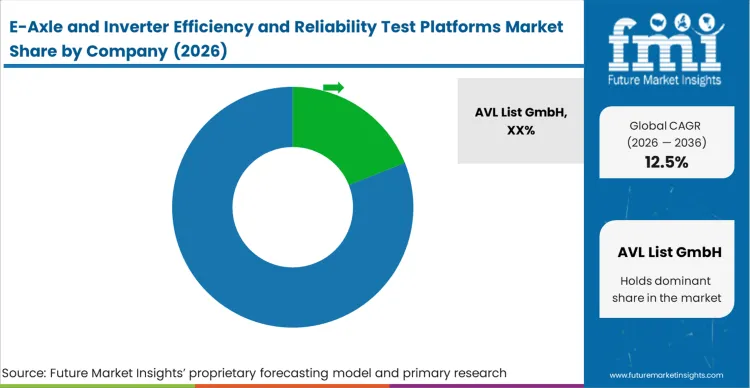
Established measurement technology providers tend to hold their position through strong software ecosystems that make labs less willing to switch. AVL List GmbH, HORIBA, and dSPACE remain important in this space because their systems are deeply tied to simulation, data acquisition, and broader test integration workflows. In practice, lab teams usually assess inverter HIL platform proposals based on how smoothly they fit into existing software environments. Hardware performance still matters, though the bigger disruption often comes from rebuilding automated testing scripts and retraining teams around a new system.
Incumbent traction inverter test bench suppliers also benefit from years of validated testing profiles that newer equipment makers cannot build quickly. Buyers want confidence that measurement repeatability will hold up over long operating periods and under demanding thermal conditions. Facility engineering teams stay focused on mechanical reliability for the same reason, since any failure in a drive motor test rig can slow broader vehicle development activity. New challengers usually have to prove stronger transient load emulation and enough practical value to justify replacing an established durability setup.
At the same time, large automotive testing centers are trying to avoid getting locked into one software environment. Procurement teams often spread contracts across multiple vendors so future upgrades remain easier to manage. Hardware-in-the-loop interoperability still makes that balancing act difficult. Facility directors therefore have to weigh the convenience of a unified vendor ecosystem against the longer-term flexibility of a more mixed testing environment.
Key Players in E-Axle and Inverter Efficiency and Reliability Test Platforms Market
- AVL List GmbH
- HORIBA
- dSPACE
- NI
- ATESTEO
- Schenck RoTec
- IPG Automotive
Scope of the Report
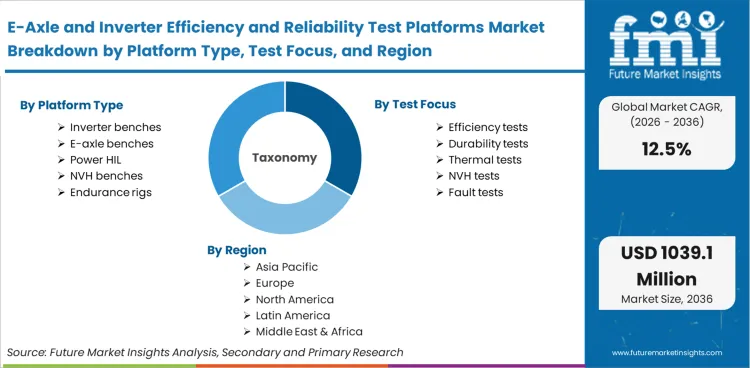
Scope of Report
| Metric | Value |
|---|---|
| Quantitative Units | USD 320.0 Million to USD 1,040.0 Million, at a CAGR of 12.50% |
| Market Definition | High-performance laboratory infrastructure evaluates power electronics and integrated propulsion systems by applying simulated electrical and mechanical loads to capture efficiency and endurance metrics. |
| Segmentation | Platform Type, Test Focus, Power Class, End User, Configuration, Region |
| Regions Covered | Asia Pacific, North America, Europe, Middle East and Africa, Latin America |
| Countries Covered | India, China, South Korea, United States, Germany, Japan |
| Key Companies Profiled | AVL List GmbH, HORIBA, dSPACE, NI, ATESTEO, Schenck RoTec |
| Forecast Period | 2026 to 2036 |
| Approach | Installed base replacement rates and scheduled capital expenditure plans for laboratory upgrades at major automotive testing centers. |
Source: Future Market Insights (FMI) analysis, based on proprietary forecasting model and primary research
E-Axle and Inverter Efficiency and Reliability Test Platforms Market Analysis by Segments
Platform Type
- Inverter benches
- E-axle benches
- Power HIL
- NVH benches
- Endurance rigs
Test Focus
- Efficiency tests
- Durability tests
- Thermal tests
- NVH tests
- Fault tests
Power Class
- 200–500 kW
- Below 200 kW
- 500–1000 kW
- Above 1 MW
End User
- OEM labs
- Tier-1 labs
- Test houses
- Engineering firms
- Research labs
Configuration
- System-level
- Component-level
- Bench-integrated
- Modular cells
Region
- North America
- United States
- Canada
- Latin America
- Brazil
- Mexico
- Rest of Latin America
- Europe
- Germany
- United Kingdom
- France
- Italy
- Spain
- Russia
- Rest of Europe
- Asia Pacific
- China
- Japan
- India
- South Korea
- ASEAN
- Rest of Asia Pacific
- Middle East and Africa
- GCC Countries
- South Africa
- Rest of Middle East and Africa
Bibliography
- Lustrissimi, E., Bianco, B., Caravaggi, S., & Rosato, A. (2024). Mathematical model for sizing and optimizing a test bench for electric motors of electric vehicles. International Journal of Thermal Design and Integration, 8, 497–504.
- National Renewable Energy Laboratory. (2024). Integrated traction drive thermal management: Keystone Project 3.
- USA DRIVE Partnership. (2024, March). Electric Drive Technical Team Roadmap.
- United Nations Economic Commission for Europe. (2024, July 24). Proposal for a new UN Regulation No. XXX on the determination of system power of hybrid electric vehicles and of pure electric vehicles having more than one electric machine for propulsion.
- Yan, S., Kong, Z., Liu, H., Zhang, L., Hu, X., & Hou, Y. (2024). Power loss evaluation of an E-axle gearbox considering the influence of gear oil factors. Lubricants, 12(1), 11.
This bibliography is provided for reader reference. The full FMI report contains the complete reference list with primary source documentation.
This Report Addresses
- Emulation accuracy required for 800-volt inverter validation loops.
- Mechanical dynamometer limitations facing silicon carbide switching architecture.
- Hardware-in-the-loop software integration protocols for test cell modernization.
- Transient thermal cycling implications for high-frequency data acquisition systems.
- Parasitic loss isolation techniques determining true drivetrain efficiency.
- Grid capacity constraints impacting megawatt-class testing facility upgrades.
- Acoustic measurement parameters defining end-of-line quality control.
- Supplier consolidation risks stemming from rigid software scripting dependencies.
Frequently Asked Questions
What is an E-Axle and Inverter Test Platform?
These are purpose-built laboratory platforms combining software control systems with physical load machines. Test facility directors use them to verify the mechanical durability, electrical efficiency, and thermal stability of integrated electric propulsion units before vehicle integration.
How are traction inverters tested for efficiency?
Calibration engineers utilize specialized measurement equipment to map torque and speed combinations exactly. This process demands perfectly isolating electrical efficiency from the mechanical drag introduced by testing fixtures to ensure published range figures reflect true highway performance.
Why do EV e-axles need durability benches?
Waiting for physical vehicle prototypes to discover transmission or motor flaws costs Tier-1 suppliers millions. Durability benches allow program managers to execute automated 24-hour endurance loops, simulating extreme towing or highway speeds to identify microscopic wear safely.
How does power HIL differ from dyno testing?
Power hardware-in-the-loop replaces physical spinning motors with digital emulation, allowing engineers to test real inverters against simulated mechanical loads. This bypasses the massive rotational inertia issues inherent to legacy dynamometers, providing much faster transient thermal cycling evaluation.
Which companies make e-axle test systems?
Major measurement technology providers dominating this space include AVL List GmbH, HORIBA, dSPACE, NI, ATESTEO, and Schenck RoTec. These companies differentiate themselves through high-speed data acquisition capabilities and open software architecture.
How much does an electric drive test cell cost?
Building a megawatt-class testing cell often requires millions in capital expenditure due to facility utility upgrades. Beyond the hardware itself, facilities managers must invest heavily in dedicated substations and chilled water infrastructure to dissipate continuous thermal loads.
Compare e-axle efficiency benches and inverter HIL systems.
Efficiency benches rely on physical rotation to map complete system energy consumption accurately. Conversely, inverter HIL systems utilize digital emulation to inject software faults and test control algorithms safely without risking the destruction of expensive mechanical prototype components.
What restrains megawatt-class rig deployment?
Operating massive dynamometers generates immense rejected heat that overwhelms standard building cooling loops. Facilities engineering teams frequently cap equipment sizing based entirely on available chilled water capacity rather than actual program testing requirements.
Why focus on transient load emulation?
Steady-state continuous running rarely fractures modern semiconductor bond wires. R&D directors specify highly dynamic load steppers precisely because mimicking aggressive city driving traffic creates the harsh thermal cycling that causes actual field failures.
How does India outpace broader expansion?
Aggressive domestic automakers are shifting from importing drivetrains to developing proprietary architecture locally. Building complete local technical centers eliminates the delays involved in shipping heavy prototype units to overseas laboratories for basic homologation.
What sets 200–500 kW benches apart?
This exact rating perfectly covers standard dual-motor passenger platforms while offering high low-end measurement accuracy. Sizing equipment tightly to actual vehicle specifications allows calibration engineers to map urban driving efficiency without fighting immense inherent machine drag.
Why are OEM labs capturing primary share?
Protecting intellectual property surrounding unique motor control algorithms mandates keeping development internal. Capital planning executives authorize massive campus modernizations to ensure sensitive silicon carbide switching strategies never leave secure corporate networks.
What role does acoustic measurement play?
Electric motors expose gear whine previously masked by combustion engines. NVH integration allows program managers to identify specific resonance frequencies early, avoiding expensive physical redesigns discovered during final vehicle integration prototyping.
How do system-level configurations add value?
Running complete assemblies identifies destructive interactions between specific control software and physical mechanical tolerances. Certification officers require these holistic evaluations to prove absolute powertrain stability before allowing prototype vehicles onto public testing routes.
Why track power HIL adoption?
Hardware-in-the-loop platforms allow engineers to trick physical inverters into behaving as if connected to actual spinning motors. Expanding this capability drastically reduces reliance on scarce mechanical prototypes during crucial early software calibration phases.
What defines efficiency test precision?
Regulators demand certified energy consumption figures derived from highly accurate torque and speed measurements. Laboratory technicians focus intensely on isolating and mathematically removing any friction generated by the testing fixture itself to improve published ranges.
How do Tier-1s manage testing costs?
Validation directors install specialized pre-certification benches to ensure subassemblies pass basic functionality parameters. Catching errors internally prevents sending defective units to demanding OEM partners, protecting crucial supplier quality ratings and avoiding rejection penalties.
What delays endurance rig setup?
Physically aligning heavy drive units to high-speed load machines requires painstaking mechanical precision. Test cell technicians spend hours balancing couplings to prevent destructive vibrations from ruining long-term durability measurements prematurely.
How does China maintain rapid growth?
Immense production volumes demand equally massive validation bandwidth. Local engineering directors continuously add automated rigs to support aggressive new model cadences, ensuring homologation processes never bottleneck factory output targets.
What challenges test software integration?
Different manufacturers utilize proprietary data formatting protocols that resist easy centralization. Systems engineers struggle to build unified laboratory dashboards when individual dynamometers refuse to share raw high-speed metrics openly.
Why prioritize thermal tests?
Excessive heat permanently demagnetizes permanent motors and degrades semiconductor lifespans. Program executives mandate extreme temperature profiling to determine exact safety derating parameters, ensuring vehicles maintain drivability even during aggressive mountain ascents.
What forces testing standardization?
International compliance agencies continually update certification methodologies to capture realistic driving emissions and efficiency. Equipment manufacturers update software suites specifically to keep testing laboratories aligned with these rigid evolving legal homologation structures.
Preview the report firsthand - request a free sample
Get SampleGet the brochure for pricing and purchase details.
Get PDFTable of Content
- Executive Summary
- Global Market Outlook
- Demand-side Trends
- Supply-side Trends
- Technology Roadmap Analysis
- Analysis and Recommendations
- Market Overview
- Market Coverage / Taxonomy
- Market Definition / Scope / Limitations
- Research Methodology
- Chapter Orientation
- Analytical Lens and Working Hypotheses
- Market Structure, Signals, and Trend Drivers
- Benchmarking and Cross-market Comparability
- Market Sizing, Forecasting, and Opportunity Mapping
- Research Design and Evidence Framework
- Desk Research Programme (Secondary Evidence)
- Company Annual and Sustainability Reports
- Peer-reviewed Journals and Academic Literature
- Corporate Websites, Product Literature, and Technical Notes
- Earnings Decks and Investor Briefings
- Statutory Filings and Regulatory Disclosures
- Technical White Papers and Standards Notes
- Trade Journals, Industry Magazines, and Analyst Briefs
- Conference Proceedings, Webinars, and Seminar Materials
- Government Statistics Portals and Public Data Releases
- Press Releases and Reputable Media Coverage
- Specialist Newsletters and Curated Briefings
- Sector Databases and Reference Repositories
- FMI Internal Proprietary Databases and Historical Market Datasets
- Subscription Datasets and Paid Sources
- Social Channels, Communities, and Digital Listening Inputs
- Additional Desk Sources
- Expert Input and Fieldwork (Primary Evidence)
- Primary Modes
- Qualitative Interviews and Expert Elicitation
- Quantitative Surveys and Structured Data Capture
- Blended Approach
- Why Primary Evidence is Used
- Field Techniques
- Interviews
- Surveys
- Focus Groups
- Observational and In-context Research
- Social and Community Interactions
- Stakeholder Universe Engaged
- C-suite Leaders
- Board Members
- Presidents and Vice Presidents
- R&D and Innovation Heads
- Technical Specialists
- Domain Subject-matter Experts
- Scientists
- Physicians and Other Healthcare Professionals
- Governance, Ethics, and Data Stewardship
- Research Ethics
- Data Integrity and Handling
- Primary Modes
- Tooling, Models, and Reference Databases
- Desk Research Programme (Secondary Evidence)
- Data Engineering and Model Build
- Data Acquisition and Ingestion
- Cleaning, Normalisation, and Verification
- Synthesis, Triangulation, and Analysis
- Quality Assurance and Audit Trail
- Market Background
- Market Dynamics
- Drivers
- Restraints
- Opportunity
- Trends
- Scenario Forecast
- Demand in Optimistic Scenario
- Demand in Likely Scenario
- Demand in Conservative Scenario
- Opportunity Map Analysis
- Product Life Cycle Analysis
- Supply Chain Analysis
- Investment Feasibility Matrix
- Value Chain Analysis
- PESTLE and Porter’s Analysis
- Regulatory Landscape
- Regional Parent Market Outlook
- Production and Consumption Statistics
- Import and Export Statistics
- Market Dynamics
- Global Market Analysis 2021 to 2025 and Forecast, 2026 to 2036
- Historical Market Size Value (USD Million) Analysis, 2021 to 2025
- Current and Future Market Size Value (USD Million) Projections, 2026 to 2036
- Y-o-Y Growth Trend Analysis
- Absolute $ Opportunity Analysis
- Global Market Pricing Analysis 2021 to 2025 and Forecast 2026 to 2036
- Global Market Analysis 2021 to 2025 and Forecast 2026 to 2036, By Platform Type
- Introduction / Key Findings
- Historical Market Size Value (USD Million) Analysis By Platform Type , 2021 to 2025
- Current and Future Market Size Value (USD Million) Analysis and Forecast By Platform Type , 2026 to 2036
- Inverter benches
- E-axle benches
- Power HIL
- NVH benches
- Endurance rigs
- Inverter benches
- Y-o-Y Growth Trend Analysis By Platform Type , 2021 to 2025
- Absolute $ Opportunity Analysis By Platform Type , 2026 to 2036
- Global Market Analysis 2021 to 2025 and Forecast 2026 to 2036, By Test Focus
- Introduction / Key Findings
- Historical Market Size Value (USD Million) Analysis By Test Focus, 2021 to 2025
- Current and Future Market Size Value (USD Million) Analysis and Forecast By Test Focus, 2026 to 2036
- Efficiency tests
- Durability tests
- Thermal tests
- NVH tests
- Fault tests
- Efficiency tests
- Y-o-Y Growth Trend Analysis By Test Focus, 2021 to 2025
- Absolute $ Opportunity Analysis By Test Focus, 2026 to 2036
- Global Market Analysis 2021 to 2025 and Forecast 2026 to 2036, By Power Class
- Introduction / Key Findings
- Historical Market Size Value (USD Million) Analysis By Power Class, 2021 to 2025
- Current and Future Market Size Value (USD Million) Analysis and Forecast By Power Class, 2026 to 2036
- 200–500 kW
- Below 200 kW
- 500–1000 kW
- Above 1 MW
- 200–500 kW
- Y-o-Y Growth Trend Analysis By Power Class, 2021 to 2025
- Absolute $ Opportunity Analysis By Power Class, 2026 to 2036
- Global Market Analysis 2021 to 2025 and Forecast 2026 to 2036, By End Use
- Introduction / Key Findings
- Historical Market Size Value (USD Million) Analysis By End Use, 2021 to 2025
- Current and Future Market Size Value (USD Million) Analysis and Forecast By End Use, 2026 to 2036
- OEM labs
- Tier-1 labs
- Test houses
- Engineering firms
- Research labs
- OEM labs
- Y-o-Y Growth Trend Analysis By End Use, 2021 to 2025
- Absolute $ Opportunity Analysis By End Use, 2026 to 2036
- Global Market Analysis 2021 to 2025 and Forecast 2026 to 2036, By Configuration
- Introduction / Key Findings
- Historical Market Size Value (USD Million) Analysis By Configuration, 2021 to 2025
- Current and Future Market Size Value (USD Million) Analysis and Forecast By Configuration, 2026 to 2036
- System-level
- Component-level
- Bench-integrated
- Modular cells
- System-level
- Y-o-Y Growth Trend Analysis By Configuration, 2021 to 2025
- Absolute $ Opportunity Analysis By Configuration, 2026 to 2036
- Global Market Analysis 2021 to 2025 and Forecast 2026 to 2036, By Region
- Introduction
- Historical Market Size Value (USD Million) Analysis By Region, 2021 to 2025
- Current Market Size Value (USD Million) Analysis and Forecast By Region, 2026 to 2036
- North America
- Latin America
- Western Europe
- Eastern Europe
- East Asia
- South Asia and Pacific
- Middle East & Africa
- Market Attractiveness Analysis By Region
- North America Market Analysis 2021 to 2025 and Forecast 2026 to 2036, By Country
- Historical Market Size Value (USD Million) Trend Analysis By Market Taxonomy, 2021 to 2025
- Market Size Value (USD Million) Forecast By Market Taxonomy, 2026 to 2036
- By Country
- USA
- Canada
- Mexico
- By Platform Type
- By Test Focus
- By Power Class
- By End Use
- By Configuration
- By Country
- Market Attractiveness Analysis
- By Country
- By Platform Type
- By Test Focus
- By Power Class
- By End Use
- By Configuration
- Key Takeaways
- Latin America Market Analysis 2021 to 2025 and Forecast 2026 to 2036, By Country
- Historical Market Size Value (USD Million) Trend Analysis By Market Taxonomy, 2021 to 2025
- Market Size Value (USD Million) Forecast By Market Taxonomy, 2026 to 2036
- By Country
- Brazil
- Chile
- Rest of Latin America
- By Platform Type
- By Test Focus
- By Power Class
- By End Use
- By Configuration
- By Country
- Market Attractiveness Analysis
- By Country
- By Platform Type
- By Test Focus
- By Power Class
- By End Use
- By Configuration
- Key Takeaways
- Western Europe Market Analysis 2021 to 2025 and Forecast 2026 to 2036, By Country
- Historical Market Size Value (USD Million) Trend Analysis By Market Taxonomy, 2021 to 2025
- Market Size Value (USD Million) Forecast By Market Taxonomy, 2026 to 2036
- By Country
- Germany
- UK
- Italy
- Spain
- France
- Nordic
- BENELUX
- Rest of Western Europe
- By Platform Type
- By Test Focus
- By Power Class
- By End Use
- By Configuration
- By Country
- Market Attractiveness Analysis
- By Country
- By Platform Type
- By Test Focus
- By Power Class
- By End Use
- By Configuration
- Key Takeaways
- Eastern Europe Market Analysis 2021 to 2025 and Forecast 2026 to 2036, By Country
- Historical Market Size Value (USD Million) Trend Analysis By Market Taxonomy, 2021 to 2025
- Market Size Value (USD Million) Forecast By Market Taxonomy, 2026 to 2036
- By Country
- Russia
- Poland
- Hungary
- Balkan & Baltic
- Rest of Eastern Europe
- By Platform Type
- By Test Focus
- By Power Class
- By End Use
- By Configuration
- By Country
- Market Attractiveness Analysis
- By Country
- By Platform Type
- By Test Focus
- By Power Class
- By End Use
- By Configuration
- Key Takeaways
- East Asia Market Analysis 2021 to 2025 and Forecast 2026 to 2036, By Country
- Historical Market Size Value (USD Million) Trend Analysis By Market Taxonomy, 2021 to 2025
- Market Size Value (USD Million) Forecast By Market Taxonomy, 2026 to 2036
- By Country
- China
- Japan
- South Korea
- By Platform Type
- By Test Focus
- By Power Class
- By End Use
- By Configuration
- By Country
- Market Attractiveness Analysis
- By Country
- By Platform Type
- By Test Focus
- By Power Class
- By End Use
- By Configuration
- Key Takeaways
- South Asia and Pacific Market Analysis 2021 to 2025 and Forecast 2026 to 2036, By Country
- Historical Market Size Value (USD Million) Trend Analysis By Market Taxonomy, 2021 to 2025
- Market Size Value (USD Million) Forecast By Market Taxonomy, 2026 to 2036
- By Country
- India
- ASEAN
- Australia & New Zealand
- Rest of South Asia and Pacific
- By Platform Type
- By Test Focus
- By Power Class
- By End Use
- By Configuration
- By Country
- Market Attractiveness Analysis
- By Country
- By Platform Type
- By Test Focus
- By Power Class
- By End Use
- By Configuration
- Key Takeaways
- Middle East & Africa Market Analysis 2021 to 2025 and Forecast 2026 to 2036, By Country
- Historical Market Size Value (USD Million) Trend Analysis By Market Taxonomy, 2021 to 2025
- Market Size Value (USD Million) Forecast By Market Taxonomy, 2026 to 2036
- By Country
- Kingdom of Saudi Arabia
- Other GCC Countries
- Turkiye
- South Africa
- Other African Union
- Rest of Middle East & Africa
- By Platform Type
- By Test Focus
- By Power Class
- By End Use
- By Configuration
- By Country
- Market Attractiveness Analysis
- By Country
- By Platform Type
- By Test Focus
- By Power Class
- By End Use
- By Configuration
- Key Takeaways
- Key Countries Market Analysis
- USA
- Pricing Analysis
- Market Share Analysis, 2025
- By Platform Type
- By Test Focus
- By Power Class
- By End Use
- By Configuration
- Canada
- Pricing Analysis
- Market Share Analysis, 2025
- By Platform Type
- By Test Focus
- By Power Class
- By End Use
- By Configuration
- Mexico
- Pricing Analysis
- Market Share Analysis, 2025
- By Platform Type
- By Test Focus
- By Power Class
- By End Use
- By Configuration
- Brazil
- Pricing Analysis
- Market Share Analysis, 2025
- By Platform Type
- By Test Focus
- By Power Class
- By End Use
- By Configuration
- Chile
- Pricing Analysis
- Market Share Analysis, 2025
- By Platform Type
- By Test Focus
- By Power Class
- By End Use
- By Configuration
- Germany
- Pricing Analysis
- Market Share Analysis, 2025
- By Platform Type
- By Test Focus
- By Power Class
- By End Use
- By Configuration
- UK
- Pricing Analysis
- Market Share Analysis, 2025
- By Platform Type
- By Test Focus
- By Power Class
- By End Use
- By Configuration
- Italy
- Pricing Analysis
- Market Share Analysis, 2025
- By Platform Type
- By Test Focus
- By Power Class
- By End Use
- By Configuration
- Spain
- Pricing Analysis
- Market Share Analysis, 2025
- By Platform Type
- By Test Focus
- By Power Class
- By End Use
- By Configuration
- France
- Pricing Analysis
- Market Share Analysis, 2025
- By Platform Type
- By Test Focus
- By Power Class
- By End Use
- By Configuration
- India
- Pricing Analysis
- Market Share Analysis, 2025
- By Platform Type
- By Test Focus
- By Power Class
- By End Use
- By Configuration
- ASEAN
- Pricing Analysis
- Market Share Analysis, 2025
- By Platform Type
- By Test Focus
- By Power Class
- By End Use
- By Configuration
- Australia & New Zealand
- Pricing Analysis
- Market Share Analysis, 2025
- By Platform Type
- By Test Focus
- By Power Class
- By End Use
- By Configuration
- China
- Pricing Analysis
- Market Share Analysis, 2025
- By Platform Type
- By Test Focus
- By Power Class
- By End Use
- By Configuration
- Japan
- Pricing Analysis
- Market Share Analysis, 2025
- By Platform Type
- By Test Focus
- By Power Class
- By End Use
- By Configuration
- South Korea
- Pricing Analysis
- Market Share Analysis, 2025
- By Platform Type
- By Test Focus
- By Power Class
- By End Use
- By Configuration
- Russia
- Pricing Analysis
- Market Share Analysis, 2025
- By Platform Type
- By Test Focus
- By Power Class
- By End Use
- By Configuration
- Poland
- Pricing Analysis
- Market Share Analysis, 2025
- By Platform Type
- By Test Focus
- By Power Class
- By End Use
- By Configuration
- Hungary
- Pricing Analysis
- Market Share Analysis, 2025
- By Platform Type
- By Test Focus
- By Power Class
- By End Use
- By Configuration
- Kingdom of Saudi Arabia
- Pricing Analysis
- Market Share Analysis, 2025
- By Platform Type
- By Test Focus
- By Power Class
- By End Use
- By Configuration
- Turkiye
- Pricing Analysis
- Market Share Analysis, 2025
- By Platform Type
- By Test Focus
- By Power Class
- By End Use
- By Configuration
- South Africa
- Pricing Analysis
- Market Share Analysis, 2025
- By Platform Type
- By Test Focus
- By Power Class
- By End Use
- By Configuration
- USA
- Market Structure Analysis
- Competition Dashboard
- Competition Benchmarking
- Market Share Analysis of Top Players
- By Region
- By Platform Type
- By Test Focus
- By Power Class
- By End Use
- By Configuration
- Competition Analysis
- Competition Deep Dive
- AVL List GmbH
- Overview
- Product Portfolio
- Profitability by Market Segments (Product/Age /Sales Channel/Region)
- Sales Footprint
- Strategy Overview
- Marketing Strategy
- Product Strategy
- Channel Strategy
- HORIBA
- dSPACE
- NI
- ATESTEO
- Schenck RoTec
- IPG Automotive
- AVL List GmbH
- Competition Deep Dive
- Assumptions & Acronyms Used


