

- Industry Size (2026)
- USD 173.33 Bn
- Forecast (2036)
- USD 259.04 Bn
- CAGR (2026 to 2036)
- 4.1%
Mask Bacterial Filtration Efficiency Tester Market Size, Market Forecast and Outlook By FMI
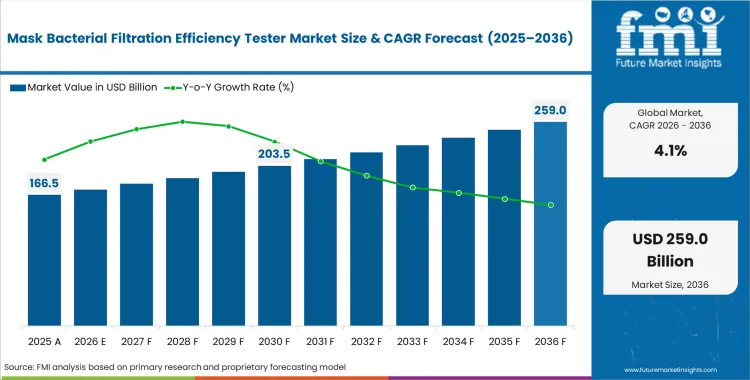
The mask bacterial filtration efficiency tester market was valued at USD 166.50 billion in 2025, projected to reach USD 173.33 billion in 2026, and is forecast to expand to USD 259.04 billion by 2036 at a 4.1% CAGR. Expanding respiratory protection standards and periodic revisions to medical device testing protocols are sustaining procurement cycles for filtration efficiency testing instrumentation. Quality assurance laboratories in mask manufacturing facilities treat bacterial filtration efficiency testers as mandatory capital equipment required for batch-release certification under national and international standards.
Summary of Mask Bacterial Filtration Efficiency Tester Market
- Market Overview
- The mask bacterial filtration efficiency tester market is valued at USD 166.50 billion in 2025 and is projected to reach USD 259.04 billion by 2036.
- The industry is expected to grow at a 4.1% CAGR from 2026 to 2036, creating an incremental opportunity of USD 85.72 billion.
- The market is a regulated testing instrumentation category where standards compliance, calibration accuracy, and laboratory throughput capacity define competitive positioning.
- Demand and Growth Drivers
- Demand is sustained by recurring equipment replacement cycles tied to national standards body revisions of mask performance testing protocols.
- Expansion of domestic mask manufacturing capacity across Asia Pacific and the Middle East is creating parallel demand for localized bacterial filtration efficiency testing infrastructure.
- Hospital infection control programs and occupational safety regulations mandate periodic re-certification of respiratory protective equipment, sustaining instrument utilization rates.
- Among key countries, China leads at 5.5% CAGR, followed by India at 5.1%, Germany at 4.7%, Brazil at 4.3%, and USA at 3.9%.
- Product and Segment View
- The market includes automated and semi-automated bacterial filtration efficiency testing instruments used to validate mask and respirator filtration performance against normative standards.
- Applications span medical protection device certification and civilian respiratory protective equipment quality assurance.
- BFE 80% to 95% testing leads by Filtration Efficiency with 25.0% share in 2026, reflecting the high volume of general-purpose surgical mask testing.
- Medical Protection leads by Application with 60.0% share in 2026, driven by recurring batch-release testing requirements at mask manufacturing facilities.
- The scope includes BFE testing instruments, aerosol generation modules, and sample collection assemblies, while excluding particle filtration efficiency testers and fit-testing equipment.
- Geography and Competitive Outlook
- China and India are the fastest-growing markets due to domestic mask manufacturing capacity expansion, while North America and Europe maintain equipment replacement cycles.
- Middle East and Africa are building testing laboratory infrastructure in line with regional PPE manufacturing scale-up.
- Competition is shaped by instrument precision, standards compliance certification, and after-sales calibration service networks, with key players including GESTER INTERNATIONAL CO., LTD., Junray, TESTEX, Guangzhou Biaoji Packaging Equipment Co., Ltd., HAIDA INTERNATIONAL, SANWOOD, UTSTESTER, LISUN GROUP, Sataton, Great Win Testing Machine CO. Ltd., Labtech.
- Analyst Opinion at FMI
- FMI is of the opinion that the bacterial filtration efficiency tester market is sustained by regulatory calibration cycles rather than one-time capital expenditure events. Laboratories that defer instrument replacement face standards non-compliance, risking batch rejection and production line stoppages.
- Strategic Implications / Executive Takeaways
- Testing instrument manufacturers must maintain updated standards compliance certifications to qualify for government laboratory procurement tenders.
- Mask manufacturers should negotiate bundled calibration and maintenance contracts to minimize instrument downtime during peak production periods.
- Regulatory compliance officers must track national standards body revision schedules to anticipate instrument upgrade requirements before enforcement deadlines.
Mask Bacterial Filtration Efficiency Tester Market Key Takeaways
| Metric | Details |
|---|---|
| Industry Size (2026) | USD 173.33 billion |
| Industry Value (2036) | USD 259.04 billion |
| CAGR (2026-2036) | 4.1% |
Source: Future Market Insights, 2026
Post-pandemic regulatory tightening across medical device testing standards has established recurring calibration and equipment replacement cycles for bacterial filtration efficiency testing instruments. National standards bodies in China, India, and the European Union have each updated mask performance testing protocols, requiring laboratories to procure instruments validated against the latest normative references. As per FMI, the expansion of domestic mask manufacturing capacity in Asia Pacific and the Middle East is creating parallel demand for localized testing infrastructure that supports batch-level quality release.
All key markets reflect accelerated deployment parameters. China sets a 5.5% pace. India sets a 5.1% pace. Germany sets a 4.7% pace. Brazil sets a 4.3% pace. USA sets a 3.9% pace. UK sets a 3.5% pace. Japan sets a 3.1% pace.
Mask Bacterial Filtration Efficiency Tester Market Definition
Mask Bacterial Filtration Efficiency Tester represents the laboratory instrumentation used to measure the bacterial filtration efficiency of face masks and respirators against standardized aerosol challenges. The market encompasses automated and semi-automated testing platforms, aerosol generation modules, and sample collection assemblies used for batch-release certification and regulatory compliance testing in medical device and PPE manufacturing environments.
Mask Bacterial Filtration Efficiency Tester Market Inclusions
Market scope includes automated BFE testing instruments, aerosol generation assemblies, sample collection systems, and calibration service contracts. Global and regional market sizes, forecast period 2026 to 2036, and segment breakdowns by Filtration Efficiency and Application are fully covered.
Mask Bacterial Filtration Efficiency Tester Market Exclusions
The scope excludes particle filtration efficiency (PFE) testers, respirator fit-testing equipment, and general-purpose air quality monitoring instruments. Standalone aerosol generators sold outside mask testing applications are omitted from the valuation.
Mask Bacterial Filtration Efficiency Tester Market Research Methodology
- Primary Research: Analysts engaged with procurement managers, technical specification leads, and operations directors across key end-use segments to map the decision gates triggering equipment and service upgrades.
- Desk Research: Data collection phases aggregated regulatory compliance timelines, standards body publication schedules, industry association technical reports, and publicly filed corporate disclosures.
- Market-Sizing and Forecasting: Baseline values derive from a bottom-up aggregation of hardware shipment volumes, software license revenues, and service contract values, applying region-specific adoption curves to project future demand velocity.
- Data Validation and Update Cycle: Projections are tested against publicly reported technology expenditure guidance from leading industry participants and validated through cross-referencing with regulatory filing data and trade association statistics.
Why is the Mask Bacterial Filtration Efficiency Tester Market Growing?
Market expansion is being supported by the increasing global demand for high-quality protective equipment and the corresponding need for reliable testing solutions that can verify filtration performance, ensure product safety, and support regulatory compliance across various mask manufacturing and quality assurance applications. Modern manufacturers and quality control specialists are increasingly focused on implementing testing solutions that can validate product performance, minimize quality risks, and provide comprehensive verification data in protective equipment production processes. Mask bacterial filtration efficiency testers' proven ability to deliver accurate measurements, ensure regulatory compliance, and support quality assurance make them essential equipment for contemporary mask manufacturing and quality control operations.
The growing emphasis on product safety and regulatory compliance is driving demand for mask bacterial filtration efficiency testers that can support standardized testing protocols, ensure performance verification, and enable comprehensive quality documentation. Manufacturers' preference for testing equipment that combines accuracy with operational efficiency and regulatory compliance capabilities is creating opportunities for innovative testing system implementations. The rising influence of quality assurance standards and consumer safety requirements is also contributing to increased adoption of mask bacterial filtration efficiency testers that can provide reliable performance verification without compromising manufacturing efficiency or product quality.
Segmental Analysis
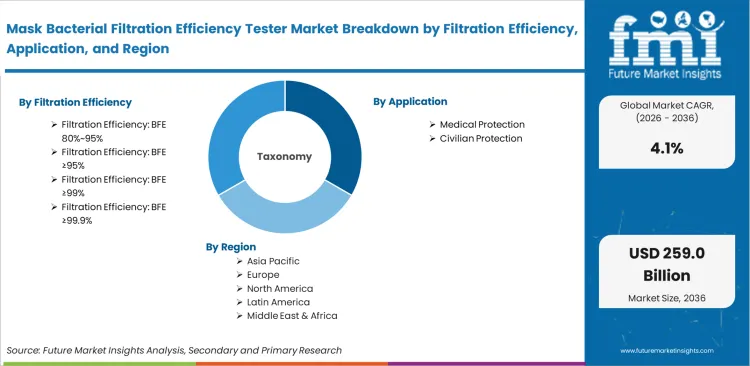
The market is segmented by filtration efficiency, application, and region. By filtration efficiency, the market is divided into filtration efficiency: BFE 80%~95%, filtration efficiency: BFE ≥95%, filtration efficiency: BFE ≥99%, and filtration efficiency: BFE ≥99.9%. Based on the application, the market is categorized into medical protection and civilian protection. Regionally, the market is divided into Asia Pacific, North America, Europe, Latin America, and the Middle East & Africa.
By Filtration Efficiency, the BFE 80%~95% Segment Leads the Market with 25% Share
The BFE 80%~95% segment is projected to maintain its leading position in the mask bacterial filtration efficiency tester market in 2026, with a 25% market share. Quality control specialists and manufacturers increasingly rely on BFE 80%~95% testing equipment for its ability to cover the standard mask requirements, established testing protocols, and versatile application across various mask types and manufacturing processes. This filtration efficiency range provides a proven methodology that aligns with regulatory standards, directly addressing the industry’s need for reliable performance verification and compliance testing. The segment forms the foundation of modern mask quality control, with strong demand across multiple mask categories. As manufacturers prioritize consistent performance verification and regulatory compliance, the BFE 80%~95% testing equipment remains central to comprehensive mask testing strategies.
- Provides comprehensive coverage of standard mask requirements for bacterial filtration.
- Aligns with regulatory standards, ensuring reliable performance verification.
- Essential for consistent quality control in diverse mask manufacturing processes.
By Application, the Medical Protection Segment Dominates Market Demand with 60% Share
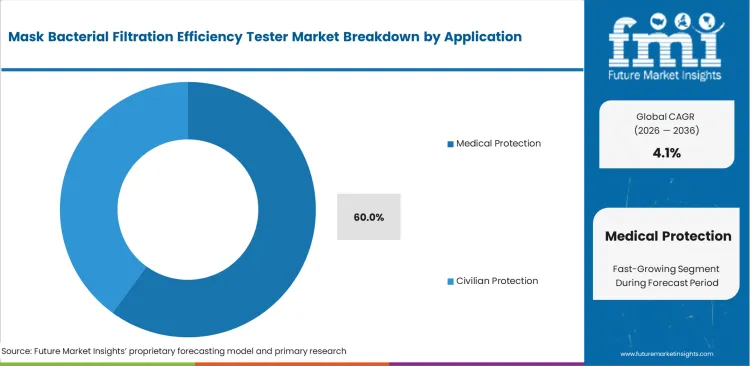
The medical protection application segment is projected to represent the largest share of mask bacterial filtration efficiency tester demand in 2026, with 60% of the market. Medical device manufacturers prefer bacterial filtration efficiency testing for medical masks due to stringent quality requirements, safety standards, and the need to ensure patient protection. The segment plays a critical role in supporting healthcare industry quality control and regulatory compliance, offering both safety and certification advantages. Continuous innovations in medical testing standards and specialized protocols enable precise performance verification, ensuring enhanced accuracy and alignment with regulatory guidelines. As the demand for high-quality medical protection products grows and safety standards become more stringent, the medical protection application will continue to dominate the market while driving advanced testing and quality assurance strategies.
- Ensures compliance with stringent safety standards and regulatory certification.
- Critical for medical device manufacturers to meet high-quality protection requirements.
- Dominates the market by supporting medical protection standards and quality assurance.
What are the Drivers, Restraints, and Key Trends of the Mask Bacterial Filtration Efficiency Tester Market?
The mask bacterial filtration efficiency tester market is advancing steadily due to increasing demand for quality assurance in protective equipment manufacturing and growing adoption of standardized testing protocols that provide enhanced product safety and regulatory compliance across diverse mask manufacturing applications. The market faces challenges, including high equipment costs and maintenance requirements, technical complexity in testing procedures, and the need for specialized expertise in testing operations and data interpretation. Innovation in automated testing systems and digital integration continues to influence product development and market expansion patterns.
Expansion of Automated Testing Technologies
The growing adoption of automated testing systems and digital measurement technologies is enabling manufacturers to achieve superior testing efficiency, enhanced data accuracy, and comprehensive quality documentation capabilities for improved manufacturing processes. Automated testing systems provide improved operational efficiency while allowing more consistent testing protocols and reliable results across various mask types and testing requirements. Manufacturers are increasingly recognizing the competitive advantages of automated testing capabilities for quality differentiation and operational optimization.
Integration of Digital Data Management and Connectivity Systems
Modern mask bacterial filtration efficiency tester manufacturers are incorporating digital data management technologies and connectivity solutions to enhance testing documentation, enable real-time quality monitoring, and ensure comprehensive traceability for regulatory compliance and quality assurance. These technologies improve operational efficiency while enabling new applications, including remote monitoring and predictive maintenance capabilities. Advanced digital integration also allows manufacturers to support comprehensive quality management and testing optimization beyond traditional manual testing operations.
Analysis of the Mask Bacterial Filtration Efficiency Tester Market by Key Countries
.webp "Top Country Growth Comparison Mask Bacterial Filtration Efficiency Tester Market Cagr (2026 2036)")
| Country | CAGR (2026-2036) |
|---|---|
| China | 5.5% |
| India | 5.1% |
| Germany | 4.7% |
| Brazil | 4.3% |
| USA | 3.9% |
| UK | 3.5% |
| Japan | 3.1% |
Source: FMI analysis based on primary research and proprietary forecasting model
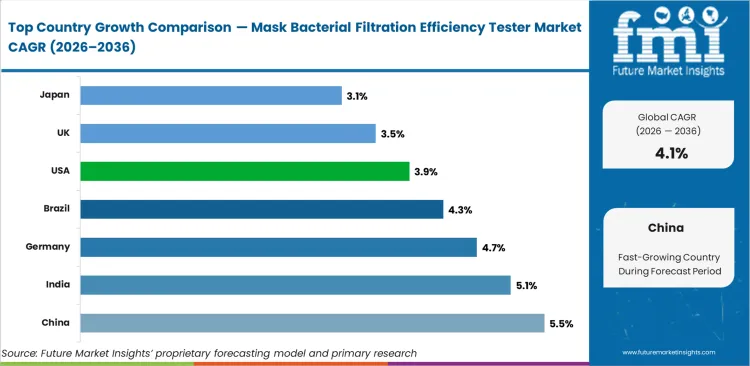
The mask bacterial filtration efficiency tester market is experiencing steady growth globally, with China leading at a 5.5% CAGR through 2036, driven by the expanding protective equipment manufacturing industry, growing quality control requirements, and significant investment in testing equipment and manufacturing quality assurance infrastructure. India follows at 5.1%, supported by rapid industrial development, increasing manufacturing capabilities, and growing adoption of quality testing equipment in protective equipment production. Germany shows growth at 4.7%, emphasizing precision engineering and advanced quality control technologies. Brazil records 4.3%, focusing on manufacturing infrastructure development and quality improvement initiatives. The USA demonstrates 3.9% growth, supported by established testing standards and emphasis on regulatory compliance. The UK exhibits 3.5% growth, emphasizing quality assurance and manufacturing excellence initiatives. Japan shows 3.1% growth, supported by precision manufacturing and advanced testing technologies.
The report covers an in-depth analysis of 40+ countries with top-performing countries highlighted below.
Sales Analysis in China
The mask bacterial filtration efficiency tester market in China is projected to grow at a CAGR of 5.5% from 2026 to 2036. As one of the largest manufacturers of masks and personal protective equipment (PPE), China has witnessed increasing demand for efficient testing equipment to ensure product quality. The growing awareness of air quality, pollution control, and the continuous impact of health crises have led to an increased focus on the performance of face masks. With a vast manufacturing sector, particularly in the medical and healthcare industries, there is a heightened need for testing systems to measure bacterial filtration efficiency (BFE). As China continues to strengthen its regulations regarding healthcare products and their safety standards, the demand for advanced testing equipment is set to rise. China’s rapid adoption of technological innovations will support the growth of the market, including the automation of the testing processes to enhance speed and accuracy.
- Strong demand driven by China’s PPE manufacturing sector
- Increased focus on health and safety regulations fueling demand
- Technological advancements supporting more efficient and automated testing systems
How will the Market Perform in India?
The mask bacterial filtration efficiency tester market in India is expected to grow at a CAGR of 5.1% from 2026 to 2036. As the demand for face masks surged due to the COVID-19 pandemic, the need for testing equipment to assess their effectiveness also grew. India, with its large population and expanding healthcare sector, faces increasing pressure to meet international quality standards for medical products, including masks. The adoption of stringent regulatory frameworks will boost the demand for reliable BFE testing equipment. India’s growing focus on air quality and pollution control is propelling the demand for high-quality masks, which, in turn, drives the testing market. India’s expanding industrial capabilities, particularly in manufacturing and healthcare, will further create demand for advanced and cost-effective bacterial filtration testing solutions.
- Growth in healthcare and manufacturing sectors pushing demand for testing solutions
- Regulatory pressure to meet international mask standards increasing market need
- Growing concerns about air quality fueling demand for efficient filtration testing
Opportunity Analysis in Germany
The mask bacterial filtration efficiency tester market in Germany is projected to grow at a CAGR of 4.7% from 2026 to 2036. Known for its strong medical device manufacturing industry, Germany has a highly regulated healthcare market that demands rigorous testing for PPE products, including face masks. As the country increasingly focuses on ensuring public health safety, the need for efficient BFE testing solutions is expected to rise. The expansion of Germany’s healthcare and industrial sectors, coupled with a shift toward more effective health solutions, will drive this growth. The rise of the medical tourism industry and Germany’s position as a medical hub in Europe will further support the demand for advanced filtration testing solutions. The continued adoption of smart technologies in manufacturing, along with automation in testing processes, will enhance the precision and efficiency of BFE testers, promoting their market growth.
- Growing healthcare and medical device manufacturing sectors fueling market growth
- Increased regulatory requirements boosting demand for accurate filtration testing
- Adoption of smart and automated technologies improving testing efficiency
Mask Bacterial Filtration Efficiency Tester Market Expansion in Brazil
The mask bacterial filtration efficiency tester market in Brazil is expected to grow at a CAGR of 4.3% from 2026 to 2036. As Brazil’s healthcare infrastructure continues to improve and evolve, the demand for reliable testing equipment for PPE, including masks, is rising. Brazil’s large population and growing concerns about air quality and healthcare safety contribute to the market’s potential. The country’s expanding manufacturing capabilities and increased focus on medical and healthcare product quality will support the demand for accurate and efficient BFE testing systems. Brazil’s position as a leading healthcare market in Latin America means that it will continue to rely on advanced technologies to ensure mask performance and meet both local and international safety standards. As the country strengthens its healthcare regulations, the need for dependable testing systems will become more pronounced.
- Expansion of Brazil’s healthcare infrastructure increasing demand for testing equipment
- Growing concerns about air quality and healthcare safety fueling market demand
- Increased focus on product quality in manufacturing driving BFE testing adoption
Mask Bacterial Filtration Efficiency Tester Market Adoption in the USA
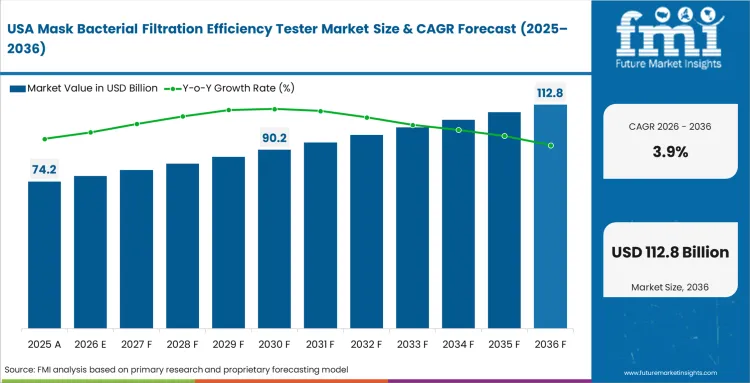
The mask bacterial filtration efficiency tester market in the USA is expected to grow at a CAGR of 3.9% from 2026 to 2036. As one of the world’s largest markets for medical equipment, the USA has seen an increased focus on personal protective equipment, particularly after the pandemic. The need for BFE testing has escalated with a growing demand for high-quality masks that offer protection against airborne bacteria and viruses. Stringent FDA regulations and guidelines in the USA, along with a growing emphasis on public health safety, continue to drive the demand for BFE testing equipment. The increasing adoption of advanced technologies, including automation and smart systems in testing, is also expected to improve the accuracy and efficiency of the testing process. With the USA’s strong healthcare sector and robust manufacturing infrastructure, the demand for these testing solutions will likely continue to rise.
- Stringent regulatory environment driving need for testing solutions
- Focus on high-quality masks for public health safety boosting market demand
- Adoption of advanced technologies improving testing speed and accuracy
Mask Bacterial Filtration Efficiency Tester Market Trends in the UK
The mask bacterial filtration efficiency tester market in the UK is expected to grow at a CAGR of 3.5% from 2026 to 2036. As the UK continues to focus on strengthening its healthcare infrastructure, there is an increasing need for accurate testing equipment for PPE products like masks. The government’s emphasis on ensuring high safety standards for healthcare products contributes to the rising demand for BFE testing solutions. With the growing adoption of advanced manufacturing technologies, including automation in testing processes, the market for BFE testers in the UK is expected to experience steady growth. The UK’s position as a hub for medical research and healthcare innovations further supports the demand for cutting-edge testing systems. The need for high-quality masks, particularly in healthcare and industrial settings, will also drive the demand for efficient BFE testing equipment.
- Increased healthcare regulations promoting demand for reliable testing solutions
- Growth in manufacturing and automation supporting testing equipment market
- Emphasis on high-quality PPE products boosting demand for filtration testing
Mask Bacterial Filtration Efficiency Tester Market Outlook in Japan
Mask bacterial filtration efficiency tester market in Japan is expected to grow at a CAGR of 3.1% from 2026 to 2036. As Japan continues to prioritize health and safety, particularly in healthcare settings, the demand for advanced filtration testing equipment will rise. Japan’s high standards in product quality and safety will drive the need for reliable and accurate BFE testing systems. With a strong medical and manufacturing industry, Japan’s focus on enhancing the quality and performance of PPE products like masks is expected to contribute to steady market growth. The increasing adoption of smart technologies in manufacturing, combined with Japan’s emphasis on precision and innovation, will ensure the continued demand for advanced testing equipment in the country’s healthcare and industrial sectors.
- High product quality standards driving demand for reliable testing systems
- Focus on health and safety in Japan fueling market growth
- Adoption of smart technologies and innovation supporting BFE testing solutions
Europe Market Split by Countries
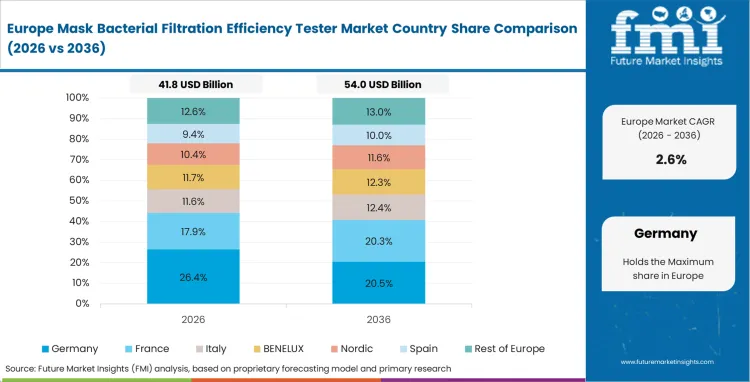
The mask bacterial filtration efficiency tester market in Europe is projected to grow from USD 61.3 million in 2026 to USD 89.2 million by 2036, registering a CAGR of 3.8% over the forecast period. Germany is expected to maintain its leadership position with a 26.0% market share in 2026, moderating slightly to 25.8% by 2036, supported by its strong manufacturing sector, advanced testing equipment industry, and comprehensive quality assurance infrastructure serving major European markets.
The United Kingdom follows with 20.0% in 2026, projected to reach 19.8% by 2036, driven by established quality assurance standards, a comprehensive regulatory framework, and advanced manufacturing excellence programs. France holds 18.5% in 2026, rising to 18.7% by 2036, supported by manufacturing infrastructure development and growing adoption of quality testing technologies. Italy commands 14.0% in 2026, projected to reach 14.1% by 2036, while Spain accounts for 9.5% in 2026, expected to reach 9.6% by 2036. The Netherlands maintains a 4.5% share in 2026, growing to 4.6% by 2036. The Rest of Europe region, including Nordic countries, Eastern Europe, and other markets, is anticipated to maintain its position, holding its collective share at 7.5% by 2036, attributed to increasing manufacturing modernization and growing quality testing adoption across emerging industrial markets implementing advanced testing standards.
Competitive Landscape of the Mask Bacterial Filtration Efficiency Tester Market
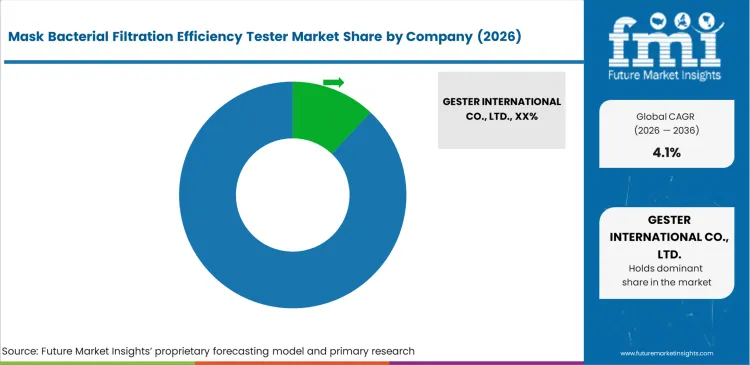
The mask bacterial filtration efficiency tester market is characterized by competition among established testing equipment manufacturers, specialized measurement system providers, and integrated quality assurance solution suppliers. Companies are investing in advanced testing technology research, automation development, precision engineering, and comprehensive product portfolios to deliver accurate, reliable, and efficient mask bacterial filtration efficiency testing solutions. Innovation in automated testing systems, digital integration, and precision measurement technologies is central to strengthening market position and competitive advantage.
GESTER INTERNATIONAL CO., LTD. Leads the market with comprehensive testing equipment solutions, offering advanced bacterial filtration efficiency testers with a focus on accuracy and reliability in diverse testing applications. Junray provides specialized testing equipment with an emphasis on precision measurement and quality assurance capabilities. TESTEX delivers innovative testing solutions with a focus on textile and protective equipment testing applications. Guangzhou Biaoji Packaging Equipment Co., Ltd. specializes in packaging and testing equipment with emphasis on manufacturing quality control. HAIDA INTERNATIONAL focuses on material testing equipment and quality assurance solutions. SANWOOD offers comprehensive testing equipment with a focus on precision measurement and industrial applications.
Mask Bacterial Filtration Efficiency Tester Market - Stakeholder Contribution Framework
Mask bacterial filtration efficiency testers represent a specialized quality control segment within protective equipment manufacturing, projected to grow from USD 166.5 million in 2026 to USD 248.8 million by 2036 at a 4.1% CAGR. These precision testing instruments measure BFE performance across filtration ranges from 80-95% to ≥99.9%, ensuring medical and civilian protection masks meet safety standards and regulatory requirements. Market expansion is driven by increased quality assurance demands in mask manufacturing, adoption of automated testing protocols, stringent regulatory compliance requirements, and growing emphasis on product safety verification across healthcare and industrial protection applications.
How Regulatory Authorities Could Strengthen Quality Standards and Compliance?
- Harmonized Testing Standards: Develop unified international standards for mask bacterial filtration efficiency testing protocols, measurement procedures, and acceptance criteria that enable consistent quality verification across different manufacturing regions and regulatory jurisdictions.
- Mandatory Testing Requirements: Establish comprehensive regulations requiring BFE testing for all mask categories, including specific testing frequencies, documentation requirements, and third-party certification protocols to ensure consistent product safety and performance verification.
- Laboratory Accreditation Programs: Create certification systems for testing laboratories conducting mask BFE assessments, including equipment calibration requirements, technician training standards, and quality management protocols that ensure reliable and reproducible testing results.
- Market Surveillance Systems: Implement systematic post-market monitoring programs using standardized BFE testing protocols to verify ongoing product compliance, identify quality issues, and take corrective actions when masks fail to meet established performance standards.
- Digital Compliance Platforms: Develop electronic systems for test data submission, compliance tracking, and regulatory reporting that streamline the certification process while maintaining rigorous quality control and traceability requirements.
How Industry Standards Organizations Could Advance Testing Methodologies?
- Technical Testing Protocols: Establish comprehensive guidelines for BFE testing procedures, including equipment specifications, calibration requirements, environmental conditions, and statistical analysis methods that ensure accurate and reproducible test results across different laboratories.
- Equipment Certification Standards: Develop qualification criteria for BFE testing equipment, including accuracy specifications, measurement range requirements, and performance verification protocols that ensure testing instruments meet industry quality standards.
- Interlaboratory Testing Programs: Coordinate proficiency testing initiatives across testing laboratories to validate measurement consistency, identify procedural variations, and establish best practices for BFE testing operations and data interpretation.
- Training and Competency Standards: Create certification programs for testing technicians covering equipment operation, measurement procedures, data analysis, and quality control protocols specific to mask bacterial filtration efficiency testing.
- Emerging Technology Integration: Guide development of advanced testing methodologies, including automated systems, digital data capture, and real-time monitoring technologies that improve testing efficiency while maintaining accuracy and reliability.
How Testing Equipment Manufacturers Could Drive Innovation and Accessibility?
- Advanced Automation Technologies: Develop fully automated BFE testing systems with integrated sample handling, measurement protocols, and data analysis capabilities that reduce human error, improve throughput, and ensure consistent testing procedures.
- Multi-Range Testing Capabilities: Create versatile testing platforms capable of measuring across all BFE ranges (80-95%, ≥95%, ≥99%, ≥99.9%) with high accuracy and precision, enabling laboratories to serve diverse mask manufacturing requirements with a single equipment investment.
- Digital Integration Systems: Implement IoT connectivity, cloud-based data management, and real-time monitoring capabilities that enable remote equipment oversight, predictive maintenance, and seamless integration with quality management systems.
- Cost-Effective Solutions: Design modular, scalable testing systems that make BFE testing accessible to smaller manufacturers and testing laboratories while maintaining measurement accuracy and regulatory compliance capabilities.
- User-Friendly Interfaces: Develop intuitive operating systems, automated calibration procedures, and comprehensive training programs that reduce technical complexity and enable efficient operation by technicians with varying experience levels.
How Mask Manufacturers Could Optimize Quality Control and Compliance?
- Integrated Quality Systems: Implement comprehensive quality management programs incorporating BFE testing at multiple production stages, including raw material verification, in-process monitoring, and final product validation to ensure consistent performance.
- Statistical Process Control: Adopt data-driven quality control methodologies using BFE test results to monitor production consistency, identify process variations, and implement corrective actions that maintain product quality and regulatory compliance.
- Supplier Quality Management: Establish BFE testing requirements for raw material suppliers, including filter media certification, batch testing protocols, and performance specifications that ensure incoming materials meet quality standards.
- Continuous Improvement Programs: Use BFE testing data to identify optimization opportunities in manufacturing processes, material selection, and product design that enhance filtration performance while maintaining cost-effectiveness.
- Regulatory Compliance Management: Develop comprehensive documentation systems linking BFE test results to batch records, regulatory submissions, and quality certifications that ensure traceability and support regulatory inspections.
How Healthcare Systems and Procurement Organizations Could Ensure Product Quality?
- Evidence-Based Procurement: Establish procurement criteria requiring verified BFE testing results, third-party certifications, and ongoing quality monitoring for all mask purchases to ensure healthcare worker and patient safety.
- Supplier Audit Programs: Implement comprehensive quality audits of mask suppliers, including review of BFE testing procedures, quality systems, and manufacturing capabilities, to validate product quality and supply chain reliability.
- Post-Market Surveillance: Develop systematic programs for testing procured masks using independent BFE testing to verify ongoing quality, identify performance issues, and maintain supplier accountability.
- Quality Database Systems: Create centralized databases tracking BFE testing results, supplier performance, and product quality trends that inform procurement decisions and support continuous quality improvement.
- Emergency Preparedness: Maintain strategic reserves of certified BFE testing equipment and qualified testing capabilities to ensure rapid quality verification during health emergencies or supply chain disruptions.
How Investors and Financial Enablers Could Support Market Development?
- Testing Infrastructure Investment: Finance establishment of accredited testing laboratories, equipment procurement, and facility development that expand global BFE testing capacity and improve access to quality verification services.
- Technology Innovation Funding: Support development of next-generation BFE testing technologies, including automated systems, artificial intelligence integration, and advanced measurement techniques that improve testing efficiency and accuracy.
- Market Access Financing: Provide capital for testing equipment manufacturers to expand into emerging markets, establish local service networks, and develop cost-effective solutions that improve global access to quality testing capabilities.
- Quality Assurance Platform Development: Finance digital platforms that integrate BFE testing data, regulatory compliance tracking, and supply chain quality management to create comprehensive quality assurance ecosystems.
- Research and Development Support: Fund collaborative research initiatives focused on improving testing methodologies, developing new measurement techniques, and advancing understanding of filtration performance relationships that drive industry innovation.
Key Players in the Mask Bacterial Filtration Efficiency Tester Market
- GESTER INTERNATIONAL CO., LTD.
- Junray
- TESTEX
- Guangzhou Biaoji Packaging Equipment Co., Ltd.
- HAIDA INTERNATIONAL
- SANWOOD
- UTSTESTER
- LISUN GROUP
- Sataton
- Great Win Testing Machine CO. Ltd.
- Labtech
Scope of the Report
| Metric | Value |
|---|---|
| Quantitative Units | USD 173.33 billion to USD 259.04 billion, at a CAGR of 4.1% |
| Market Definition | Mask Bacterial Filtration Efficiency Tester represents the laboratory instrumentation used to measure the bacterial filtration efficiency of face masks and respirators against standardized aerosol challenges. The market encompasses automated and semi-automated testing platforms, aerosol generation modules, and sample collection assemblies used for batch-release certification and regulatory compliance testing in medical device and PPE manufacturing environments. |
| Segmentation | Filtration Efficiency: Filtration Efficiency: BFE 80%~95%, Filtration Efficiency: BFE ≥95%, Filtration Efficiency: BFE ≥99%, Filtration Efficiency: BFE ≥99.9%; Application: Medical Protection, Civilian Protection |
| Regions Covered | North America, Latin America, Europe, East Asia, South Asia, Oceania, Middle East & Africa |
| Countries Covered | China, India, Germany, Brazil, USA, UK, Japan, and 40 plus countries |
| Key Companies Profiled | GESTER INTERNATIONAL CO., LTD., Junray, TESTEX, Guangzhou Biaoji Packaging Equipment Co., Ltd., HAIDA INTERNATIONAL, SANWOOD, UTSTESTER, LISUN GROUP, Sataton, Great Win Testing Machine CO. Ltd., Labtech |
| Forecast Period | 2026 to 2036 |
| Approach | Forecasting models apply a hybrid bottom-up and top-down methodology starting with installed base metrics and cross-validating projections against primary research and public disclosure data. |
Mask Bacterial Filtration Efficiency Tester Market by Segments
Filtration Efficiency:
- Filtration Efficiency: BFE 80%~95%
- Filtration Efficiency: BFE ≥95%
- Filtration Efficiency: BFE ≥99%
- Filtration Efficiency: BFE ≥99.9%
Application:
- Medical Protection
- Civilian Protection
Region:
Asia Pacific
- China
- India
- Japan
- South Korea
- ASEAN
- Australia & New Zealand
- Rest of Asia Pacific
North America
- United States
- Canada
- Mexico
Europe
- Germany
- United Kingdom
- France
- Italy
- Spain
- Nordic
- BENELUX
- Rest of Europe
Latin America
- Brazil
- Chile
- Argentina
- Rest of Latin America
Middle East & Africa
- Kingdom of Saudi Arabia
- Other GCC Countries
- Turkey
- South Africa
- Other African Union
- Rest of Middle East & Africa
Bibliography
- 1. ASTM International. (2025). ASTM F2101: Standard Test Method for Evaluating the Bacterial Filtration Efficiency (BFE). ASTM.
- 2. European Committee for Standardization. (2025). EN 14683: Medical Face Masks, Requirements and Test Methods. CEN.
- 3. World Health Organization. (2025). Technical Guidance on Respiratory Protective Devices. WHO.
- 4. National Institute for Occupational Safety and Health. (2025). NIOSH Guide to the Selection and Use of Particulate Respirators. NIOSH.
- 5. Standardization Administration of China. (2025). GB 19083: Technical Requirements for Protective Face Mask for Medical Use. SAC.
- 6. Bureau of Indian Standards. (2025). IS 16289: Respiratory Protective Devices. BIS.
This bibliography is provided for reader reference. The full Future Market Insights report contains the complete reference list with primary research documentation.
Frequently Asked Questions
How large is the demand for Mask Bacterial Filtration Efficiency Tester in the global market in 2026?
Demand for Mask Bacterial Filtration Efficiency Tester in the global market is estimated to be valued at USD 173.33 billion in 2026.
What will be the market size of Mask Bacterial Filtration Efficiency Tester in the global market by 2036?
Market size for Mask Bacterial Filtration Efficiency Tester is projected to reach USD 259.04 billion by 2036.
What is the expected demand growth for Mask Bacterial Filtration Efficiency Tester in the global market between 2026 and 2036?
Demand for Mask Bacterial Filtration Efficiency Tester is expected to grow at a CAGR of 4.1% between 2026 and 2036.
Which Filtration Efficiency is poised to lead global sales by 2026?
Filtration Efficiency: BFE 80%~95% accounts for 25.0% share in 2026.
How significant is the role of Medical Protection in driving Mask Bacterial Filtration Efficiency Tester adoption in 2026?
Medical Protection represents 60.0% of segment share in 2026.
What is China's growth outlook in this report?
China is projected to grow at a CAGR of 5.5% during 2026 to 2036.
What is Mask Bacterial Filtration Efficiency Tester and what is it mainly used for?
Mask Bacterial Filtration Efficiency Tester represents the laboratory instrumentation used to measure the bacterial filtration efficiency of face masks and respirators against standardized aerosol challenges. The market encompasses automated and semi-automated testing platforms, aerosol generation modules, and sample collection assemblies used for batch-release certification and regulatory compliance testing in medical device and PPE manufacturing environments.
What is included in the scope of this Mask Bacterial Filtration Efficiency Tester report?
Market scope includes automated BFE testing instruments, aerosol generation assemblies, sample collection systems, and calibration service contracts. Global and regional market sizes, forecast period 2026 to 2036, and segment breakdowns by Filtration Efficiency and Application are fully covered.
Preview the report firsthand - request a free sample
Get SampleGet the brochure for pricing and purchase details.
Get PDFTable of Content
- Executive Summary
- Global Market Outlook
- Demand-side Trends
- Supply-side Trends
- Technology Roadmap Analysis
- Analysis and Recommendations
- Market Overview
- Market Coverage / Taxonomy
- Market Definition / Scope / Limitations
- Research Methodology
- Chapter Orientation
- Analytical Lens and Working Hypotheses
- Market Structure, Signals, and Trend Drivers
- Benchmarking and Cross-market Comparability
- Market Sizing, Forecasting, and Opportunity Mapping
- Research Design and Evidence Framework
- Desk Research Programme (Secondary Evidence)
- Company Annual and Sustainability Reports
- Peer-reviewed Journals and Academic Literature
- Corporate Websites, Product Literature, and Technical Notes
- Earnings Decks and Investor Briefings
- Statutory Filings and Regulatory Disclosures
- Technical White Papers and Standards Notes
- Trade Journals, Industry Magazines, and Analyst Briefs
- Conference Proceedings, Webinars, and Seminar Materials
- Government Statistics Portals and Public Data Releases
- Press Releases and Reputable Media Coverage
- Specialist Newsletters and Curated Briefings
- Sector Databases and Reference Repositories
- FMI Internal Proprietary Databases and Historical Market Datasets
- Subscription Datasets and Paid Sources
- Social Channels, Communities, and Digital Listening Inputs
- Additional Desk Sources
- Expert Input and Fieldwork (Primary Evidence)
- Primary Modes
- Tooling, Models, and Reference Databases
- Data Engineering and Model Build
- Data Acquisition and Ingestion
- Cleaning, Normalisation, and Verification
- Synthesis, Triangulation, and Analysis
- Quality Assurance and Audit Trail
- Primary Modes
- Market Background
- Market Dynamics
- Drivers
- Restraints
- Opportunity
- Trends
- Scenario Forecast
- Demand in Optimistic Scenario
- Demand in Likely Scenario
- Demand in Conservative Scenario
- Opportunity Map Analysis
- Product Life Cycle Analysis
- Supply Chain Analysis
- Investment Feasibility Matrix
- Value Chain Analysis
- PESTLE and Porter’s Analysis
- Regulatory Landscape
- Regional Parent Market Outlook
- Production and Consumption Statistics
- Import and Export Statistics
- Market Dynamics
- Global Market Analysis 2021 to 2025 and Forecast, 2026 to 2036
- Historical Market Size Value (USD Million) Analysis, 2021 to 2025
- Current and Future Market Size Value (USD Million) Projections, 2026 to 2036
- Y-o-Y Growth Trend Analysis
- Absolute $ Opportunity Analysis
- Global Market Pricing Analysis 2021 to 2025 and Forecast 2026 to 2036
- Global Market Analysis 2021 to 2025 and Forecast 2026 to 2036, By Filtration Efficiency
- Introduction / Key Findings
- Historical Market Size Value (USD Million) Analysis By Filtration Efficiency , 2021 to 2025
- Current and Future Market Size Value (USD Million) Analysis and Forecast By Filtration Efficiency , 2026 to 2036
- Filtration Efficiency: BFE 80%~95%
- Filtration Efficiency: BFE ≥95%
- Filtration Efficiency: BFE ≥99%
- Filtration Efficiency: BFE ≥99.9%
- Filtration Efficiency: BFE 80%~95%
- Y-o-Y Growth Trend Analysis By Filtration Efficiency , 2021 to 2025
- Absolute $ Opportunity Analysis By Filtration Efficiency , 2026 to 2036
- Global Market Analysis 2021 to 2025 and Forecast 2026 to 2036, By Application
- Introduction / Key Findings
- Historical Market Size Value (USD Million) Analysis By Application, 2021 to 2025
- Current and Future Market Size Value (USD Million) Analysis and Forecast By Application, 2026 to 2036
- Medical Protection
- Civilian Protection
- Medical Protection
- Y-o-Y Growth Trend Analysis By Application, 2021 to 2025
- Absolute $ Opportunity Analysis By Application, 2026 to 2036
- Global Market Analysis 2021 to 2025 and Forecast 2026 to 2036, By Region
- Introduction
- Historical Market Size Value (USD Million) Analysis By Region, 2021 to 2025
- Current Market Size Value (USD Million) Analysis and Forecast By Region, 2026 to 2036
- North America
- Latin America
- Western Europe
- Eastern Europe
- East Asia
- South Asia and Pacific
- Middle East & Africa
- Market Attractiveness Analysis By Region
- North America Market Analysis 2021 to 2025 and Forecast 2026 to 2036, By Country
- Historical Market Size Value (USD Million) Trend Analysis By Market Taxonomy, 2021 to 2025
- Market Size Value (USD Million) Forecast By Market Taxonomy, 2026 to 2036
- By Country
- USA
- Canada
- Mexico
- By Filtration Efficiency
- By Application
- By Country
- Market Attractiveness Analysis
- By Country
- By Filtration Efficiency
- By Application
- Key Takeaways
- Latin America Market Analysis 2021 to 2025 and Forecast 2026 to 2036, By Country
- Historical Market Size Value (USD Million) Trend Analysis By Market Taxonomy, 2021 to 2025
- Market Size Value (USD Million) Forecast By Market Taxonomy, 2026 to 2036
- By Country
- Brazil
- Chile
- Rest of Latin America
- By Filtration Efficiency
- By Application
- By Country
- Market Attractiveness Analysis
- By Country
- By Filtration Efficiency
- By Application
- Key Takeaways
- Western Europe Market Analysis 2021 to 2025 and Forecast 2026 to 2036, By Country
- Historical Market Size Value (USD Million) Trend Analysis By Market Taxonomy, 2021 to 2025
- Market Size Value (USD Million) Forecast By Market Taxonomy, 2026 to 2036
- By Country
- Germany
- UK
- Italy
- Spain
- France
- Nordic
- BENELUX
- Rest of Western Europe
- By Filtration Efficiency
- By Application
- By Country
- Market Attractiveness Analysis
- By Country
- By Filtration Efficiency
- By Application
- Key Takeaways
- Eastern Europe Market Analysis 2021 to 2025 and Forecast 2026 to 2036, By Country
- Historical Market Size Value (USD Million) Trend Analysis By Market Taxonomy, 2021 to 2025
- Market Size Value (USD Million) Forecast By Market Taxonomy, 2026 to 2036
- By Country
- Russia
- Poland
- Hungary
- Balkan & Baltic
- Rest of Eastern Europe
- By Filtration Efficiency
- By Application
- By Country
- Market Attractiveness Analysis
- By Country
- By Filtration Efficiency
- By Application
- Key Takeaways
- East Asia Market Analysis 2021 to 2025 and Forecast 2026 to 2036, By Country
- Historical Market Size Value (USD Million) Trend Analysis By Market Taxonomy, 2021 to 2025
- Market Size Value (USD Million) Forecast By Market Taxonomy, 2026 to 2036
- By Country
- China
- Japan
- South Korea
- By Filtration Efficiency
- By Application
- By Country
- Market Attractiveness Analysis
- By Country
- By Filtration Efficiency
- By Application
- Key Takeaways
- South Asia and Pacific Market Analysis 2021 to 2025 and Forecast 2026 to 2036, By Country
- Historical Market Size Value (USD Million) Trend Analysis By Market Taxonomy, 2021 to 2025
- Market Size Value (USD Million) Forecast By Market Taxonomy, 2026 to 2036
- By Country
- India
- ASEAN
- Australia & New Zealand
- Rest of South Asia and Pacific
- By Filtration Efficiency
- By Application
- By Country
- Market Attractiveness Analysis
- By Country
- By Filtration Efficiency
- By Application
- Key Takeaways
- Middle East & Africa Market Analysis 2021 to 2025 and Forecast 2026 to 2036, By Country
- Historical Market Size Value (USD Million) Trend Analysis By Market Taxonomy, 2021 to 2025
- Market Size Value (USD Million) Forecast By Market Taxonomy, 2026 to 2036
- By Country
- Kingdom of Saudi Arabia
- Other GCC Countries
- Turkiye
- South Africa
- Other African Union
- Rest of Middle East & Africa
- By Filtration Efficiency
- By Application
- By Country
- Market Attractiveness Analysis
- By Country
- By Filtration Efficiency
- By Application
- Key Takeaways
- Key Countries Market Analysis
- USA
- Pricing Analysis
- Market Share Analysis, 2025
- By Filtration Efficiency
- By Application
- Canada
- Pricing Analysis
- Market Share Analysis, 2025
- By Filtration Efficiency
- By Application
- Mexico
- Pricing Analysis
- Market Share Analysis, 2025
- By Filtration Efficiency
- By Application
- Brazil
- Pricing Analysis
- Market Share Analysis, 2025
- By Filtration Efficiency
- By Application
- Chile
- Pricing Analysis
- Market Share Analysis, 2025
- By Filtration Efficiency
- By Application
- Germany
- Pricing Analysis
- Market Share Analysis, 2025
- By Filtration Efficiency
- By Application
- UK
- Pricing Analysis
- Market Share Analysis, 2025
- By Filtration Efficiency
- By Application
- Italy
- Pricing Analysis
- Market Share Analysis, 2025
- By Filtration Efficiency
- By Application
- Spain
- Pricing Analysis
- Market Share Analysis, 2025
- By Filtration Efficiency
- By Application
- France
- Pricing Analysis
- Market Share Analysis, 2025
- By Filtration Efficiency
- By Application
- India
- Pricing Analysis
- Market Share Analysis, 2025
- By Filtration Efficiency
- By Application
- ASEAN
- Pricing Analysis
- Market Share Analysis, 2025
- By Filtration Efficiency
- By Application
- Australia & New Zealand
- Pricing Analysis
- Market Share Analysis, 2025
- By Filtration Efficiency
- By Application
- China
- Pricing Analysis
- Market Share Analysis, 2025
- By Filtration Efficiency
- By Application
- Japan
- Pricing Analysis
- Market Share Analysis, 2025
- By Filtration Efficiency
- By Application
- South Korea
- Pricing Analysis
- Market Share Analysis, 2025
- By Filtration Efficiency
- By Application
- Russia
- Pricing Analysis
- Market Share Analysis, 2025
- By Filtration Efficiency
- By Application
- Poland
- Pricing Analysis
- Market Share Analysis, 2025
- By Filtration Efficiency
- By Application
- Hungary
- Pricing Analysis
- Market Share Analysis, 2025
- By Filtration Efficiency
- By Application
- Kingdom of Saudi Arabia
- Pricing Analysis
- Market Share Analysis, 2025
- By Filtration Efficiency
- By Application
- Turkiye
- Pricing Analysis
- Market Share Analysis, 2025
- By Filtration Efficiency
- By Application
- South Africa
- Pricing Analysis
- Market Share Analysis, 2025
- By Filtration Efficiency
- By Application
- USA
- Market Structure Analysis
- Competition Dashboard
- Competition Benchmarking
- Market Share Analysis of Top Players
- By Regional
- By Filtration Efficiency
- By Application
- Competition Analysis
- Competition Deep Dive
- GESTER INTERNATIONAL CO., LTD.
- Overview
- Product Portfolio
- Profitability by Market Segments (Product/Age /Sales Channel/Region)
- Sales Footprint
- Strategy Overview
- Marketing Strategy
- Product Strategy
- Channel Strategy
- Junray
- TESTEX
- Guangzhou Biaoji Packaging Equipment Co., Ltd.
- HAIDA INTERNATIONAL
- SANWOOD
- UTSTESTER
- LISUN GROUP
- Sataton
- Great Win Testing Machine CO. Ltd.
- Labtech
- GESTER INTERNATIONAL CO., LTD.
- Competition Deep Dive
- Desk Research Programme (Secondary Evidence)
- Assumptions & Acronyms Used


