

- Industry Size (2026)
- USD 560.6 Mn
- Forecast (2036)
- USD 1185.8 Mn
- CAGR (2026 to 2036)
- 7.80%
Connected Infotainment UX & Latency Test Platforms Market Forecast and Outlook 2026 to 2036
The connected infotainment UX & latency test platforms market is valued at USD 560.6 million in 2026 and is expected to reach USD 1,185.8 million by 2036, growing at a CAGR of 7.80%. This market represents a critical growth area within the automotive and tech sectors, where consumer demand for seamless, high-performance infotainment systems is pushing automakers to invest heavily in testing solutions. As vehicles become increasingly connected and integrated with technologies such as 5G, the ability to deliver fast, responsive infotainment systems are paramount. Test platforms that ensure minimal latency and superior user experience (UX) are not only essential for product development but also for compliance with safety and regulatory standards.
Quick Stats for Connected Infotainment UX & Latency Test Platforms Market
- Connected Infotainment UX & Latency Test Platforms Market Value (2026): USD 560.6 Million
- Connected Infotainment UX & Latency Test Platforms Market Forecast Value (2036): USD 1,185.8 Million
- Connected Infotainment UX & Latency Test Platforms Market Forecast CAGR (2026 to 2036): 7.80%
- Leading Platform Type in Connected Infotainment UX & Latency Test Platforms Market: Lab Test Equipment & Emulators
- Key Growth Regions in Connected Infotainment UX & Latency Test Platforms Market: Asia Pacific, North America
- Top Key Players in Connected Infotainment UX & Latency Test Platforms Market: Keysight, Rohde & Schwarz, Anritsu, Spirent, VIAVI, Vector Informatik, Tektronix, National Instruments (NI), dSPACE, DEKRA
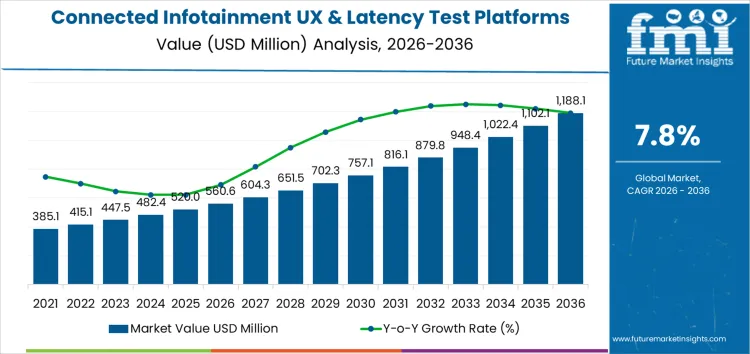
The economic relevance of this market is underscored by the competitive pressure OEMs face to enhance the in-vehicle experience while ensuring real-time connectivity. In an environment where automotive manufacturers are transitioning towards electric and autonomous vehicles, testing platforms enable critical validation processes that safeguard both brand reputation and customer loyalty. As connectivity becomes integral to the driving experience, investing in robust UX and latency testing infrastructure will be a key determinant for OEMs looking to stay ahead of regulatory demands and consumer expectations.
Connected Infotainment UX & Latency Test Platforms Market Key Takeaways
| Metric | Value |
|---|---|
| Industry Value (2026) | USD 560.6 Million |
| Forecast Value (2036) | USD 1,185.8 Million |
| Forecast CAGR (2026 to 2036) | 7.80% |
How Is the Global Connected Infotainment UX & Latency Test Platforms Market Advancing?
The global connected infotainment UX and latency test platforms market is growing as the automotive industry places increasing emphasis on providing enhanced user experiences through advanced infotainment systems. With features such as real-time navigation, voice control, and seamless connectivity with mobile devices, the demand for high-performance infotainment systems is rising. Consequently, the need for effective test platforms to ensure minimal latency and superior UX across these systems has become critical.
The growth is driven by the increasing complexity of these connected systems, which require rigorous testing for seamless functionality. UX testing focuses on improving ease of use and ensuring that infotainment systems are intuitive, while latency testing addresses the need for quick response times to avoid performance delays. As the automotive industry adopts technologies like 5G, which offer faster data speeds and reduced latency, the demand for sophisticated testing platforms has intensified.
With the growing focus on next-generation infotainment systems, including integration with autonomous driving and AI-powered voice assistants, test platforms are evolving. Innovations such as cloud-based testing, real-time analytics, and AI-driven test automation are increasing efficiency. As connected infotainment becomes a central feature in vehicles, the demand for robust UX and latency testing solutions will continue to drive market growth over the coming years.
What is the Segment-Wise Analysis for the Connected Infotainment UX & Latency Test Platforms Market?
The connected infotainment UX & latency test platforms market is segmented by connectivity under test and platform type. 4G or 5G cellular leads the market with a 44% share, followed by Wi-Fi or Bluetooth, V2X (DSRC or C-V2X), and multi-bearer connectivity. These connectivity types are essential for testing the performance and latency of infotainment systems in connected vehicles. In terms of platform type, lab test equipment & emulators dominate with a 40% share, followed by drive or field test toolkits, software analytics platforms, and services.
Why Does 4G or 5G Cellular Lead the Connected Infotainment UX & Latency Test Platforms Market?
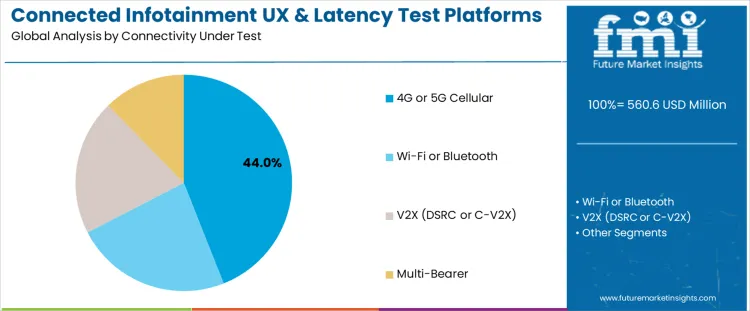
4G or 5G cellular accounts for 44% of the connected infotainment UX & latency test platforms market share, reflecting its crucial role in providing high-speed, low-latency connectivity for in-vehicle infotainment systems. With the growing demand for connected features such as real-time navigation, media streaming, and vehicle-to-everything (V2X) communication, 4G and 5G networks are essential for delivering seamless user experiences. These cellular technologies support the bandwidth and latency requirements needed for advanced infotainment services in modern vehicles. As the automotive industry moves towards fully connected and autonomous vehicles, the demand for 4G and 5G testing platforms continues to rise, further cementing their dominance in the market.
How Do Lab Test Equipment & Emulators Contribute to the Connected Infotainment UX & Latency Test Platforms Market?
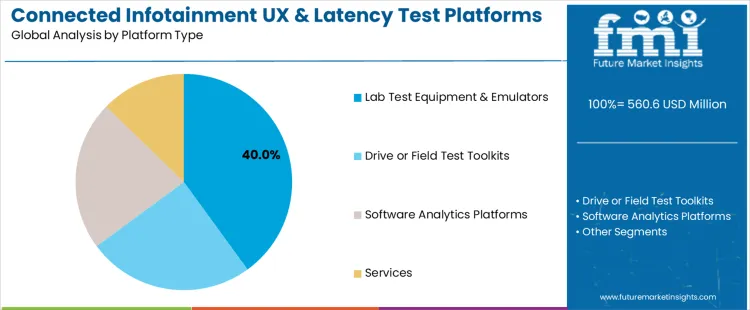
Lab test equipment & emulators lead the platform type segment with a 40% share, as they are crucial for conducting controlled tests on connected infotainment systems. These platforms simulate various real-world conditions, enabling engineers to test the performance and latency of infotainment systems under different connectivity scenarios, including 4G/5G, Wi-Fi, and Bluetooth. Lab test equipment and emulators allow for comprehensive testing of system performance, user interface responsiveness, and data transmission latency without the need for physical field testing. As the demand for high-quality infotainment systems with minimal latency and optimal connectivity increases, the adoption of lab-based testing solutions continues to be a key factor in the development and validation of these systems.
What Are the Key Dynamics for the Connected Infotainment UX & Latency Test Platforms Market?
eModern infotainment systems integrate navigation, voice assistants, media, vehicle controls, and connectivity services, making low latency and intuitive UX critical. OEMs and suppliers deploy dedicated test platforms to evaluate responsiveness, system stability, network performance, and user interaction under real‑world conditions. Rising adoption of 5G, over‑the‑air (OTA) updates, and connected services increases software complexity, making robust testing essential for quality assurance, safety, and customer satisfaction across diverse device and network environments.
How Are the Key Drivers Shaping the Connected Infotainment UX & Latency Test Platforms Market?
Growth in this market is largely propelled by the heightened demand for advanced infotainment features and integrated connectivity in passenger and commercial vehicles. Consumers expect fast‑loading interfaces, natural voice control, seamless content streaming, and real‑time data integration, making UX and latency testing a priority during development. The proliferation of in‑vehicle apps, third‑party services, and multi‑device connectivity means test platforms must validate performance across numerous scenarios and network conditions. OEMs are investing in automated test frameworks and analytics tools that can simulate real user behavior, assess system responsiveness, and optimize UX design while ensuring consistent performance despite updates and hardware variations.
Why Are There Restraints Impacting the Connected Infotainment UX & Latency Test Platforms Market?
A key challenge is the complexity and cost of developing advanced test environments that can accurately replicate varied network conditions, device integrations, and user interactions encountered in real driving scenarios. Ensuring compatibility across multiple operating systems, hardware configurations, and software versions adds to development costs and time. Another constraint is the shortage of specialized engineers capable of designing UX test scenarios and interpreting nuanced latency metrics. Rapid software evolution and frequent OTA updates also make maintaining up‑to‑date test libraries resource‑intensive and may slow adoption among smaller OEMs and suppliers.
What is the Growth Outlook for the Connected Infotainment UX & Latency Test Platforms Market by Country?
| Country | CAGR (%) |
|---|---|
| China | 9.2% |
| Brazil | 8.6% |
| USA | 7.6% |
| UK | 7.3% |
| Germany | 7.2% |
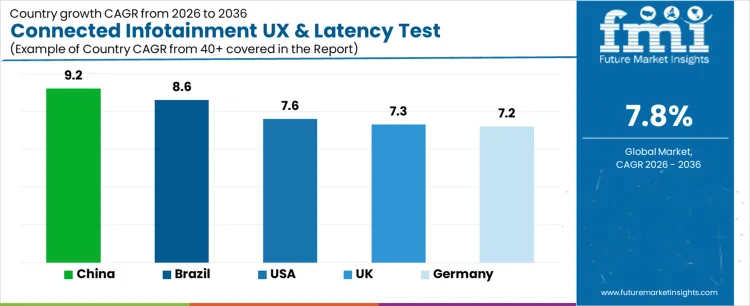
The connected infotainment UX & latency test platforms market is experiencing steady growth, with China leading at a 9.2% CAGR, driven by the country’s rapid adoption of electric and connected vehicles, alongside significant advancements in in-car technology. Brazil follows with 8.6%, supported by the increasing demand for smart mobility solutions and connected vehicle features. The USA’s market grows at 7.6%, fueled by the rising consumer expectation for seamless infotainment experiences and real-time connectivity. The UK’s market grows at 7.3%, driven by the focus on electric vehicles and regulatory standards for connected technologies. Germany’s market grows at 7.2%, supported by the country’s automotive industry shift towards electric vehicles and connected mobility.
What is Driving the Growth of the Connected Infotainment UX & Latency Test Platforms Market in China?
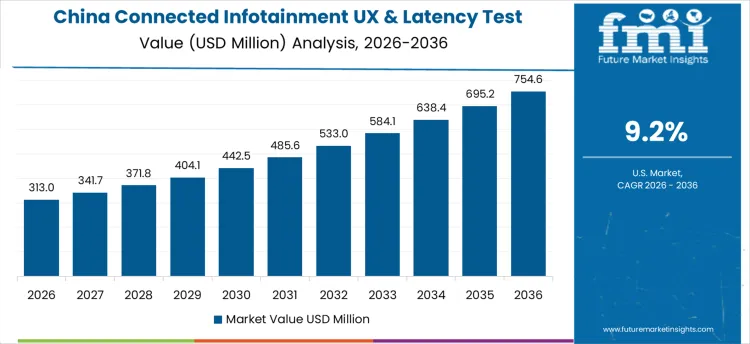
China’s connected infotainment UX & latency test platforms market is growing at 9.2%, driven by the rapid growth of the automotive and technology sectors, particularly in electric vehicles (EVs) and smart connected systems. As China continues to lead in the production and adoption of EVs, the demand for sophisticated infotainment systems and seamless user experiences increases. Infotainment platforms that offer enhanced connectivity, entertainment, and real-time interaction are essential, particularly as in-car technology evolves. China’s government initiatives to support innovation in the automotive and tech industries further contribute to the growth. The country’s focus on smart cities and connected mobility solutions continues to drive the demand for advanced UX and latency testing, making China a key market for connected infotainment platforms.
What is Contributing to the Growth of the Connected Infotainment UX & Latency Test Platforms Market in Brazil?
Brazil’s connected infotainment UX & latency test platforms market is growing at 8.6%, fueled by the increasing adoption of connected vehicle technologies and consumer demand for advanced infotainment features. As Brazil’s automotive sector modernizes and shifts towards smart mobility, there is a growing need for seamless user interfaces and high-quality infotainment systems. The rise of electric vehicles and the growing emphasis on in-car entertainment, navigation, and connectivity also boost the market. Brazil’s expanding infrastructure for smart cities and digital transformation initiatives supports the need for testing platforms that ensure minimal latency and optimized user experiences. As the demand for connected, feature-rich vehicles increases, the market for UX and latency test platforms in Brazil is set to expand.
How is the Connected Infotainment UX & Latency Test Platforms Market Expanding in the USA?
The USA’s connected infotainment UX & latency test platforms market is growing at 7.6%, driven by the rapid adoption of connected vehicles, electric mobility, and advancements in infotainment systems. As the automotive industry in the USA continues to innovate, there is an increasing demand for seamless infotainment experiences, including real-time navigation, entertainment, and communication features. Testing platforms that ensure low latency and high performance are essential for the functionality of these systems. The USA’s focus on autonomous driving, smart vehicle technologies, and in-car connectivity drives the need for comprehensive UX testing. As consumer expectations for personalized, interactive in-vehicle experiences rise, the market for infotainment UX and latency testing platforms in the USA is expected to maintain steady growth.
Why is the Connected Infotainment UX & Latency Test Platforms Market Growing in the UK?
The UK’s connected infotainment UX & latency test platforms market is growing at 7.3%, supported by the country’s strong automotive industry, which is increasingly focused on electric vehicles and connected mobility solutions. As the UK transitions to automotive future, with a focus on EVs and connected technologies, the demand for advanced infotainment systems grows. Consumers expect seamless, high-performance infotainment experiences, including real-time connectivity and entertainment options. The need for testing platforms to optimize UX and minimize latency in these systems is critical for maintaining vehicle quality and user satisfaction. With the UK’s focus on regulatory standards for connected technologies and electric mobility, the market for infotainment UX and latency test platforms is expected to expand.
What is Driving the Growth of the Connected Infotainment UX & Latency Test Platforms Market in Germany?
Germany’s connected infotainment UX & latency test platforms market is growing at 7.2%, driven by its strong automotive industry and the rise of electric and connected vehicles. As Germany’s automotive manufacturers, such as Volkswagen, BMW, and Mercedes-Benz, invest heavily in electric and autonomous vehicles, the demand for high-performance infotainment systems with minimal latency increases. Consumers expect seamless connectivity, advanced navigation, and entertainment features, which require robust testing platforms to ensure a superior user experience. Germany’s focus on smart vehicle technologies, mobility, and digital transformation in the automotive sector further contributes to the market’s growth. As the demand for in-car connectivity continues to rise, the need for testing platforms to optimize UX and performance will continue to drive the market.
What Are the Key Competitive Strategies in the Connected Infotainment UX & Latency Test Platforms Market?
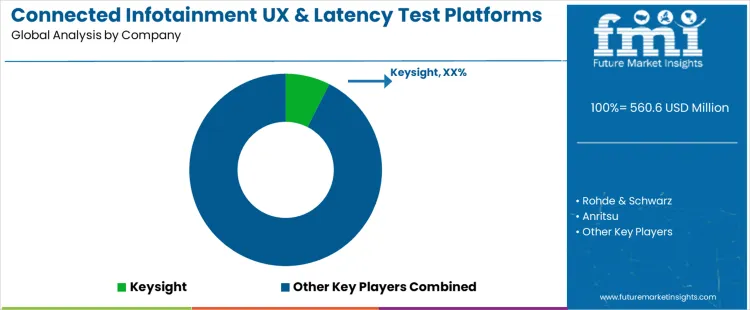
Competition in the connected infotainment UX and latency test platforms market is driven by real time performance validation, user experience metrics, and seamless integration with automotive electronics networks. Keysight leads with high performance network and protocol analyzers that measure latency across infotainment stacks and wireless interfaces, supported by intuitive interfaces that help engineers isolate UX bottlenecks. Rohde & Schwarz competes with versatile test suites that combine RF, protocol, and application layer measurements to ensure responsive infotainment systems under varied conditions. Anritsu positions its platforms with a focus on wireless connectivity testing, emphasizing low latency and robust throughput across cellular and Wi Fi links.
Spirent and VIAVI differentiate through scalable, automation ready test frameworks that support both lab and over the air testing of infotainment latency, with tools that stress real world traffic and multi protocol scenarios. Vector Informatik brings software centric platforms that validate both communication bus performance and UX timing, enhancing integration with in vehicle networks such as CAN, LIN, and Ethernet. Tektronix delivers high resolution signal capture and analysis systems that help engineers visualize timing issues and dissect latency sources down to microseconds.
National Instruments (NI) and dSPACE add value with modular hardware software ecosystems that support synchronized data capture, custom test scripting, and hardware in the loop validation. DEKRA complements these offerings with independent test services and certification support, focusing on consistent UX performance across global standards. Across vendors, product collateral emphasizes accuracy, repeatability, and actionable UX insights that help automotive developers optimize infotainment responsiveness and user satisfaction.
Key Players in Connected Infotainment UX & Latency Test Platforms Market
- Keysight
- Rohde & Schwarz
- Anritsu
- Spirent
- VIAVI
- Vector Informatik
- Tektronix
- National Instruments (NI)
- dSPACE
- DEKRA
Scope of Report
| Items | Values |
|---|---|
| Quantitative Unit (2026) | USD million |
| Connectivity Under Test | 4G or 5G Cellular, Wi-Fi or Bluetooth, V2X (DSRC or C-V2X), Multi-Bearer |
| Platform Type | Lab Test Equipment & Emulators, Drive or Field Test Toolkits, Software Analytics Platforms, Services |
| Regions Covered | Asia Pacific, Europe, North America, Latin America, Middle East & Africa |
| Countries Covered | USA, China, Japan, South Korea, India, Australia & New Zealand, ASEAN, Germany, UK, France, Italy, Spain, Nordic, BENELUX, Brazil, Chile, Mexico, Saudi Arabia, Other GCC Countries, Turkey, South Africa, Other African Union |
| Key Companies Profiled | Keysight, Rohde & Schwarz, Anritsu, Spirent, VIAVI, Vector Informatik, Tektronix, National Instruments (NI), dSPACE, DEKRA |
| Additional Attributes | Dollar sales segmented by connectivity under test, platform type, and region. The report provides insights into the regional CAGR and growth outlook, offering a comprehensive forecast of market dynamics and expected trends across segments and regions. |
Connected Infotainment UX & Latency Test Platforms Market by Key Segments
By Connectivity Under Test:
- 4G or 5G Cellular
- Wi‑Fi or Bluetooth
- V2X (DSRC or C‑V2X)
- Multi‑Bearer
By Platform Type:
- Lab Test Equipment & Emulators
- Drive or Field Test Toolkits
- Software Analytics Platforms
- Services
By Region:
- Asia Pacific
- China
- Japan
- South Korea
- India
- Australia & New Zealand
- ASEAN
- Rest of Asia Pacific
- Europe
- Germany
- United Kingdom
- France
- Italy
- Spain
- Nordic
- BENELUX
- Rest of Europe
- North America
- United States
- Canada
- Mexico
- Latin America
- Brazil
- Chile
- Rest of Latin America
- Middle East & Africa
- Kingdom of Saudi Arabia
- Other GCC Countries
- Turkey
- South Africa
- Other African Union
- Rest of Middle East & Africa
Frequently Asked Questions
How big is the connected infotainment UX & latency test platforms market in 2026?
The global connected infotainment UX & latency test platforms market is estimated to be valued at USD 560.6 million in 2026.
What will be the size of connected infotainment UX & latency test platforms market in 2036?
The market size for the connected infotainment UX & latency test platforms market is projected to reach USD 1,188.1 million by 2036.
How much will be the connected infotainment UX & latency test platforms market growth between 2026 and 2036?
The connected infotainment UX & latency test platforms market is expected to grow at a 7.8% CAGR between 2026 and 2036.
What are the key product types in the connected infotainment UX & latency test platforms market?
The key product types in connected infotainment UX & latency test platforms market are 4G or 5G cellular, Wi‑Fi or bluetooth, V2X (DSRC or C‑V2X) and multi‑bearer.
Which platform type segment to contribute significant share in the connected infotainment UX & latency test platforms market in 2026?
In terms of platform type, lab test equipment & emulators segment to command 40.0% share in the connected infotainment UX & latency test platforms market in 2026.
Preview the report firsthand - request a free sample
Get SampleGet the brochure for pricing and purchase details.
Get PDFTable of Content
- Executive Summary
- Global Market Outlook
- Demand-side Trends
- Supply-side Trends
- Technology Roadmap Analysis
- Analysis and Recommendations
- Market Overview
- Market Coverage / Taxonomy
- Market Definition / Scope / Limitations
- Market Background
- Market Dynamics
- Drivers
- Restraints
- Opportunity
- Trends
- Scenario Forecast
- Demand in Optimistic Scenario
- Demand in Likely Scenario
- Demand in Conservative Scenario
- Opportunity Map Analysis
- Product Life Cycle Analysis
- Supply Chain Analysis
- Investment Feasibility Matrix
- Value Chain Analysis
- PESTLE and Porter’s Analysis
- Regulatory Landscape
- Regional Parent Market Outlook
- Production and Consumption Statistics
- Import and Export Statistics
- Market Dynamics
- Global Market Analysis 2021 to 2025 and Forecast, 2026 to 2036
- Historical Market Size Value (USD Million) Analysis, 2021 to 2025
- Current and Future Market Size Value (USD Million) Projections, 2026 to 2036
- Y-o-Y Growth Trend Analysis
- Absolute $ Opportunity Analysis
- Global Market Pricing Analysis 2021 to 2025 and Forecast 2026 to 2036
- Global Market Analysis 2021 to 2025 and Forecast 2026 to 2036, By Connectivity Under Test
- Introduction / Key Findings
- Historical Market Size Value (USD Million) Analysis By Connectivity Under Test , 2021 to 2025
- Current and Future Market Size Value (USD Million) Analysis and Forecast By Connectivity Under Test , 2026 to 2036
- 4G or 5G Cellular
- Wi‑Fi or Bluetooth
- V2X (DSRC or C‑V2X)
- Multi‑Bearer
- 4G or 5G Cellular
- Y-o-Y Growth Trend Analysis By Connectivity Under Test , 2021 to 2025
- Absolute $ Opportunity Analysis By Connectivity Under Test , 2026 to 2036
- Global Market Analysis 2021 to 2025 and Forecast 2026 to 2036, By Platform Type
- Introduction / Key Findings
- Historical Market Size Value (USD Million) Analysis By Platform Type, 2021 to 2025
- Current and Future Market Size Value (USD Million) Analysis and Forecast By Platform Type, 2026 to 2036
- Lab Test Equipment & Emulators
- Drive or Field Test Toolkits
- Software Analytics Platforms
- Services
- Lab Test Equipment & Emulators
- Y-o-Y Growth Trend Analysis By Platform Type, 2021 to 2025
- Absolute $ Opportunity Analysis By Platform Type, 2026 to 2036
- Global Market Analysis 2021 to 2025 and Forecast 2026 to 2036, By Region
- Introduction
- Historical Market Size Value (USD Million) Analysis By Region, 2021 to 2025
- Current Market Size Value (USD Million) Analysis and Forecast By Region, 2026 to 2036
- North America
- Latin America
- Western Europe
- Eastern Europe
- East Asia
- South Asia and Pacific
- Middle East & Africa
- Market Attractiveness Analysis By Region
- North America Market Analysis 2021 to 2025 and Forecast 2026 to 2036, By Country
- Historical Market Size Value (USD Million) Trend Analysis By Market Taxonomy, 2021 to 2025
- Market Size Value (USD Million) Forecast By Market Taxonomy, 2026 to 2036
- By Country
- USA
- Canada
- Mexico
- By Connectivity Under Test
- By Platform Type
- By Country
- Market Attractiveness Analysis
- By Country
- By Connectivity Under Test
- By Platform Type
- Key Takeaways
- Latin America Market Analysis 2021 to 2025 and Forecast 2026 to 2036, By Country
- Historical Market Size Value (USD Million) Trend Analysis By Market Taxonomy, 2021 to 2025
- Market Size Value (USD Million) Forecast By Market Taxonomy, 2026 to 2036
- By Country
- Brazil
- Chile
- Rest of Latin America
- By Connectivity Under Test
- By Platform Type
- By Country
- Market Attractiveness Analysis
- By Country
- By Connectivity Under Test
- By Platform Type
- Key Takeaways
- Western Europe Market Analysis 2021 to 2025 and Forecast 2026 to 2036, By Country
- Historical Market Size Value (USD Million) Trend Analysis By Market Taxonomy, 2021 to 2025
- Market Size Value (USD Million) Forecast By Market Taxonomy, 2026 to 2036
- By Country
- Germany
- UK
- Italy
- Spain
- France
- Nordic
- BENELUX
- Rest of Western Europe
- By Connectivity Under Test
- By Platform Type
- By Country
- Market Attractiveness Analysis
- By Country
- By Connectivity Under Test
- By Platform Type
- Key Takeaways
- Eastern Europe Market Analysis 2021 to 2025 and Forecast 2026 to 2036, By Country
- Historical Market Size Value (USD Million) Trend Analysis By Market Taxonomy, 2021 to 2025
- Market Size Value (USD Million) Forecast By Market Taxonomy, 2026 to 2036
- By Country
- Russia
- Poland
- Hungary
- Balkan & Baltic
- Rest of Eastern Europe
- By Connectivity Under Test
- By Platform Type
- By Country
- Market Attractiveness Analysis
- By Country
- By Connectivity Under Test
- By Platform Type
- Key Takeaways
- East Asia Market Analysis 2021 to 2025 and Forecast 2026 to 2036, By Country
- Historical Market Size Value (USD Million) Trend Analysis By Market Taxonomy, 2021 to 2025
- Market Size Value (USD Million) Forecast By Market Taxonomy, 2026 to 2036
- By Country
- China
- Japan
- South Korea
- By Connectivity Under Test
- By Platform Type
- By Country
- Market Attractiveness Analysis
- By Country
- By Connectivity Under Test
- By Platform Type
- Key Takeaways
- South Asia and Pacific Market Analysis 2021 to 2025 and Forecast 2026 to 2036, By Country
- Historical Market Size Value (USD Million) Trend Analysis By Market Taxonomy, 2021 to 2025
- Market Size Value (USD Million) Forecast By Market Taxonomy, 2026 to 2036
- By Country
- India
- ASEAN
- Australia & New Zealand
- Rest of South Asia and Pacific
- By Connectivity Under Test
- By Platform Type
- By Country
- Market Attractiveness Analysis
- By Country
- By Connectivity Under Test
- By Platform Type
- Key Takeaways
- Middle East & Africa Market Analysis 2021 to 2025 and Forecast 2026 to 2036, By Country
- Historical Market Size Value (USD Million) Trend Analysis By Market Taxonomy, 2021 to 2025
- Market Size Value (USD Million) Forecast By Market Taxonomy, 2026 to 2036
- By Country
- Kingdom of Saudi Arabia
- Other GCC Countries
- Turkiye
- South Africa
- Other African Union
- Rest of Middle East & Africa
- By Connectivity Under Test
- By Platform Type
- By Country
- Market Attractiveness Analysis
- By Country
- By Connectivity Under Test
- By Platform Type
- Key Takeaways
- Key Countries Market Analysis
- USA
- Pricing Analysis
- Market Share Analysis, 2025
- By Connectivity Under Test
- By Platform Type
- Canada
- Pricing Analysis
- Market Share Analysis, 2025
- By Connectivity Under Test
- By Platform Type
- Mexico
- Pricing Analysis
- Market Share Analysis, 2025
- By Connectivity Under Test
- By Platform Type
- Brazil
- Pricing Analysis
- Market Share Analysis, 2025
- By Connectivity Under Test
- By Platform Type
- Chile
- Pricing Analysis
- Market Share Analysis, 2025
- By Connectivity Under Test
- By Platform Type
- Germany
- Pricing Analysis
- Market Share Analysis, 2025
- By Connectivity Under Test
- By Platform Type
- UK
- Pricing Analysis
- Market Share Analysis, 2025
- By Connectivity Under Test
- By Platform Type
- Italy
- Pricing Analysis
- Market Share Analysis, 2025
- By Connectivity Under Test
- By Platform Type
- Spain
- Pricing Analysis
- Market Share Analysis, 2025
- By Connectivity Under Test
- By Platform Type
- France
- Pricing Analysis
- Market Share Analysis, 2025
- By Connectivity Under Test
- By Platform Type
- India
- Pricing Analysis
- Market Share Analysis, 2025
- By Connectivity Under Test
- By Platform Type
- ASEAN
- Pricing Analysis
- Market Share Analysis, 2025
- By Connectivity Under Test
- By Platform Type
- Australia & New Zealand
- Pricing Analysis
- Market Share Analysis, 2025
- By Connectivity Under Test
- By Platform Type
- China
- Pricing Analysis
- Market Share Analysis, 2025
- By Connectivity Under Test
- By Platform Type
- Japan
- Pricing Analysis
- Market Share Analysis, 2025
- By Connectivity Under Test
- By Platform Type
- South Korea
- Pricing Analysis
- Market Share Analysis, 2025
- By Connectivity Under Test
- By Platform Type
- Russia
- Pricing Analysis
- Market Share Analysis, 2025
- By Connectivity Under Test
- By Platform Type
- Poland
- Pricing Analysis
- Market Share Analysis, 2025
- By Connectivity Under Test
- By Platform Type
- Hungary
- Pricing Analysis
- Market Share Analysis, 2025
- By Connectivity Under Test
- By Platform Type
- Kingdom of Saudi Arabia
- Pricing Analysis
- Market Share Analysis, 2025
- By Connectivity Under Test
- By Platform Type
- Turkiye
- Pricing Analysis
- Market Share Analysis, 2025
- By Connectivity Under Test
- By Platform Type
- South Africa
- Pricing Analysis
- Market Share Analysis, 2025
- By Connectivity Under Test
- By Platform Type
- USA
- Market Structure Analysis
- Competition Dashboard
- Competition Benchmarking
- Market Share Analysis of Top Players
- By Regional
- By Connectivity Under Test
- By Platform Type
- Competition Analysis
- Competition Deep Dive
- Keysight
- Overview
- Product Portfolio
- Profitability by Market Segments (Product/Age /Sales Channel/Region)
- Sales Footprint
- Strategy Overview
- Marketing Strategy
- Product Strategy
- Channel Strategy
- Rohde & Schwarz
- Anritsu
- Spirent
- VIAVI
- Vector Informatik
- Tektronix
- National Instruments (NI)
- dSPACE
- DEKRA
- Keysight
- Competition Deep Dive
- Assumptions & Acronyms Used
- Research Methodology


