

- Market Size (2026)
- USD 0.54 Bn
- Forecast (2036)
- USD 1.25 Bn
- CAGR (2026 to 2036)
- 8.7%
ESG Sensor Data Quality and Validation Test Platforms Market Size, Market Forecast and Outlook By FMI
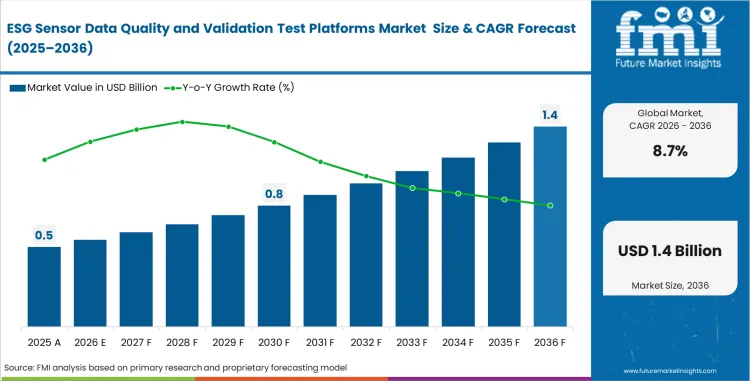
ESG sensor data quality and validation test platforms market was valued at USD 0.50 billion in 2025. As per FMI analysis, industry is estimated to reach USD 0.54 billion in 2026 at a CAGR of 8.7% during the forecast period. By 2036, overall valuation is expected to stand at USD 1.25 billion as regulated facilities, utility operators, and large building portfolios place greater emphasis on sensor-originated records that can withstand assurance review, exception testing, and audit scrutiny.
Summary of ESG Sensor Data Quality and Validation Test Platforms Market
- The market is forecast to reach USD 1.25 billion by 2036.
- The market is expected to grow at a CAGR of 8.7% from 2026 to 2036.
- The market was estimated at USD 0.50 billion in 2025.
- The market value is expected to rise to USD 0.54 billion in 2026.
- The forecast period represents an incremental opportunity of USD 0.71 billion.
- Enterprises are giving more weight to platforms that can trace sensor-originated readings, flag abnormal values before disclosure cycles close, and preserve the logic behind corrections across emissions, energy, and water records.
- Validation software remains the leading platform type, cloud continues to anchor deployment demand, and emissions stay at the center of sensor-domain spending.
- India is identified as the fastest-growing country through 2036.
Key Takeaways, Market Size, and Forecast
- ESG Sensor Data Quality and Validation Test Platforms Market is projected to grow from USD 0.54 billion in 2026 to USD 1.25 billion by 2036, at a CAGR of 8.7%.
- The ESG sensor data quality and validation test platforms market was valued at USD 0.50 billion in 2025.
- By 2036, the ESG Sensor Data Quality and Validation Test Platforms Market is expected to be worth USD 1.25 billion.
- From 2026 to 2036, the market is anticipated to expand at a CAGR of 8.7%.
- The market is predicted to create an incremental opportunity of USD 0.71 billion between 2026 and 2036.
- In 2026, Validation Software is expected to account for 34.0% of the platform type segment.
- India (10.8%) and Germany (9.5%) are projected to be two of the fastest growing markets.
ESG Sensor Data Quality and Validation Test Platforms Market key takeaways
| Parameter | Details |
|---|---|
| Market value (2026) | USD 0.54 billion |
| Forecast value (2036) | USD 1.25 billion |
| CAGR (2026 to 2036) | 8.7% |
| Estimated market value (2025) | USD 0.50 billion |
| Incremental opportunity | USD 0.71 billion |
| Leading platform type | Validation Software |
| Leading deployment | Cloud |
| Leading sensor domain | Emissions |
| Leading end use | Industrial Facilities |
| Leading validation mode | Continuous Validation |
| Leading platform share (2026) | 34.0% |
| Leading deployment share (2026) | 47.0% |
| Leading sensor-domain share (2026) | 39.0% |
| Leading end-use share (2026) | 36.0% |
| Leading validation-mode share (2026) | 33.0% |
Source: Future Market Insights, 2026
Compliance teams are now evaluating software in a more exact way than before. Selection no longer stops at dashboard visibility or report formatting. Buyers need platforms that can show where a reading came from, flag abnormal values before disclosure cycles close, and preserve the logic behind corrections made across emissions, energy, and water records. Delay creates an immediate burden inside the organization. Internal review cycles get longer, reconciliation work returns to spreadsheets, and reporting teams lose confidence in sensor-fed records that were expected to simplify environmental reporting.
Adoption becomes easier once enterprises treat validation logic as a permanent operating layer rather than a temporary addition before disclosure deadlines. Quality managers, emissions specialists, and enterprise reporting teams usually trigger that move when monitoring, reconciliation, and audit review are brought together inside one platform. Once that point is crossed, platform expansion across sites becomes easier because internal approval moves away from repeated tool-by-tool justification toward one accepted data-control approach.
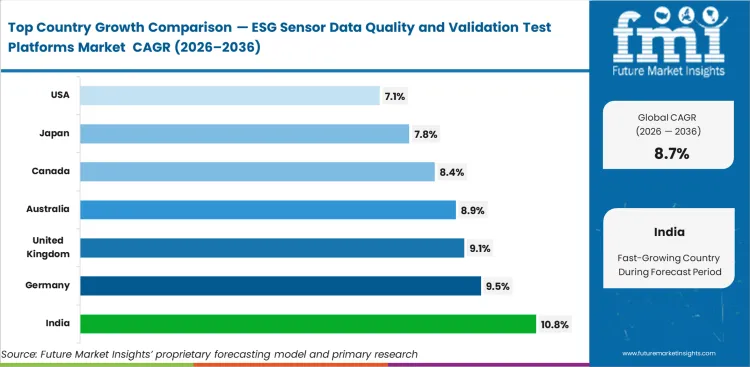
India is expected to record 10.8% CAGR in this market through 2036, followed by Germany at 9.5%, the United Kingdom at 9.1%, Australia at 8.9%, Canada at 8.4%, Japan at 7.8%, and the United States at 7.1%. Higher readings tend to appear where measurement discipline is widening across more reporting categories or where digital environmental controls are still climbing from a lower software base. Lower but steady readings usually reflect mature installed bases, longer enterprise approval cycles, and replacement-led spending rather than first-stage software entry.
Source: Future Market Insights (FMI) analysis and primary research
ESG Sensor Data Quality and Validation Test Platforms Market definition
ESG sensor data quality and validation test platforms are software-led systems used to validate, calibrate, reconcile, and audit sensor-generated ESG data across emissions, energy, water, and related reporting workflows where traceability, exception handling, and audit readiness determine practical value.
ESG Sensor Data Quality and Validation Test Platforms Market inclusions
Market scope includes all commercially traded platforms segmented by platform type, deployment, sensor domain, end use, validation mode, and region. Coverage includes validation software, DAHS suites, calibration suites, audit engines, and cloud, hybrid, and on-premise deployments for emissions, energy, water, and multi-metric sensor streams. Revenue sizing spans the 2026 to 2036 forecast period.
ESG Sensor Data Quality and Validation Test Platforms Market exclusions
The scope excludes standalone hardware sensors, generic ERP platforms, and broad ESG reporting tools that do not provide explicit sensor-quality, validation, reconciliation, calibration, or audit-control functions.
ESG Sensor Data Quality and Validation Test Platforms Market research methodology
Primary research: FMI analysts conducted interviews with quality managers, emissions specialists, enterprise reporting teams, and platform users to map validation priorities, exception handling needs, and rollout logic.
Desk research: Data collection aggregated platform materials, environmental reporting references, company information, and workflow documentation to establish verifiable baseline parameters.
Market sizing and forecasting: Baseline values reflect platform-use demand, applying segment leadership, workflow practicality, and country adoption patterns to project demand through 2036.
Data validation and update cycle: Projections are tested against reporting discipline, installed-base maturity, and comparative country growth spread before publication.
Segmental Analysis
Key Facts About Segments
- Validation Software is expected to account for 34.0% share in 2026.
- Enterprises usually start here because one rules-based layer can handle traceability, exception review, reconciliation logic, and internal sign-off before records move into wider reporting workflows.
- Cloud is likely to contribute 47.0% share in 2026.
- Multi-site environmental reporting keeps this deployment format in front, as centralized oversight, shared access, and faster workflow updates matter more than local software ownership in many enterprise settings.
- Emissions is anticipated to represent 39.0% share in 2026.
- Regulated records in this domain face closer assurance review, which keeps emissions at the front of software spending when data credibility and correction history need to hold up under scrutiny.
- Industrial Facilities are projected to capture 36.0% share in 2026.
- Multiple monitored points, site-level reporting duties, and harder-to-absorb review consequences keep this end-use group ahead of utilities, buildings, and service providers.
- Continuous Validation is expected to hold 33.0% share in 2026.
- Persistent anomaly detection and ongoing data-confidence checks are becoming more relevant than scheduled manual review alone in sensor-fed ESG workflows.
ESG Sensor Data Quality and Validation Test Platforms Market Analysis by Platform Type
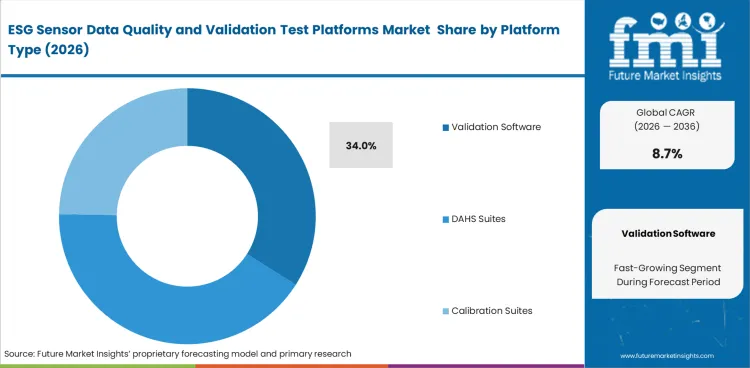
In 2026, Validation Software is projected to contribute 34% of total market share because enterprises want a rules-based layer that can test data integrity before it moves into wider sustainability or compliance workflows. Data credibility problems usually appear before reporting problems do. Quality teams can live with slower dashboards for a while, but pressure rises once abnormal readings, missing logs, and unexplained corrections begin piling up ahead of review cycles. That operating reality keeps Validation Software in front. Buyers usually start with this category because it touches the broadest set of issues at once; exception review, traceability, reconciliation logic, and internal sign-off. DAHS Suites and Audit Engines matter where environmental records are already mature, yet many organizations still need one common control point before they extend further. Weak platform selection often leaves teams with cleaner visualization but limited record defensibility when review pressure rises.
- Rules control: Validation Software applies acceptance logic before records enter formal reporting streams. Quality teams gain cleaner exception handling and fewer late-stage data disputes.
- Review traceability: Correction history, flag handling, and approval logic stay visible inside one workflow. Reporting teams spend less time rebuilding the path behind revised readings.
- Rollout readiness: Enterprises can extend validation tools across multiple sites without redesigning every downstream disclosure process at once. Expansion becomes easier when base controls are already in place.
ESG Sensor Data Quality and Validation Test Platforms Market Analysis by Deployment
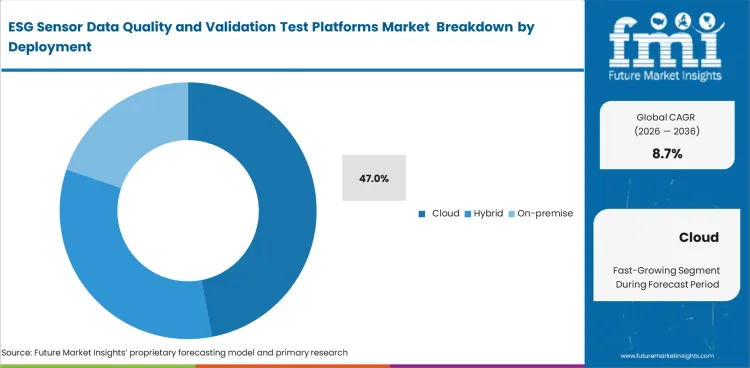
Multi-site environmental reporting puts pressure on data access, version control, and review timing. Cloud deployment answers that need more directly than isolated local installs, especially when teams must compare readings across facilities and preserve one audit path for many users. Cloud is expected to account for 47% share in 2026 because centralized oversight matters more than local software ownership in this category. Hybrid setups retain value where legacy control systems still anchor site operations, and on-premise tools continue to serve tightly managed industrial environments. Even so, enterprises moving records from site monitoring into assurance-ready reporting prefer deployment formats that simplify updates, user access, and rule management across dispersed assets. Organizations that remain tied to fragmented deployment models often inherit longer reconciliation cycles and more uneven control practices between sites.
- Central oversight: Cloud formats give reporting teams one place to review anomalies, approval history, and quality rules. Cross-site comparison becomes easier when data logic is not split between local systems.
- Update discipline: Platform improvements can be rolled out faster when rule changes, workflow edits, and exception thresholds do not require site-by-site software intervention. Internal consistency improves.
- User access: Shared access across sustainability, utility, and compliance teams supports faster review before disclosure windows close. Delayed approvals become less common when everyone works from the same record base.
ESG Sensor Data Quality and Validation Test Platforms Market Analysis by Sensor Domain
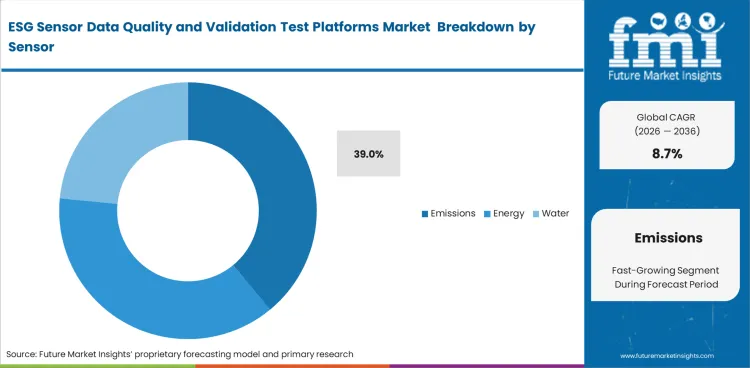
Regulated readings are where tolerance for unexplained variance is usually the lowest. Emissions records sit under heavier review than many other ESG-linked inputs, and that keeps Emissions at the center of validation spending. Since measured outputs in this domain are more likely to feed formal reporting, monitored site obligations, and assurance review than energy or water records handled only for internal optimization, hence, market estimates place Emissions at 39% share in 2026. Enterprises usually give this domain earlier funding because data credibility here is questioned more directly and reviewed more formally. Energy and Water remain important, especially in multi-metric enterprise systems, yet Emissions generally receives earlier attention because record defensibility matters sooner. Weak controls in this domain can turn a measurement issue into a disclosure issue in a very short time.
- Assurance exposure: Emissions records are more likely to face formal review than many internal-only environmental datasets. Data-quality gaps are noticed earlier and questioned more directly.
- Exception intensity: Abnormal readings, calibration doubts, and reconciliation gaps matter more when monitored outputs feed regulated records. Review teams need software that can explain the full correction path.
- Funding priority: Enterprises often release budget first where measurement credibility has the clearest reporting consequence. Emissions platforms therefore receive attention before broader multi-metric programs mature.
ESG Sensor Data Quality and Validation Test Platforms Market Analysis by End Use
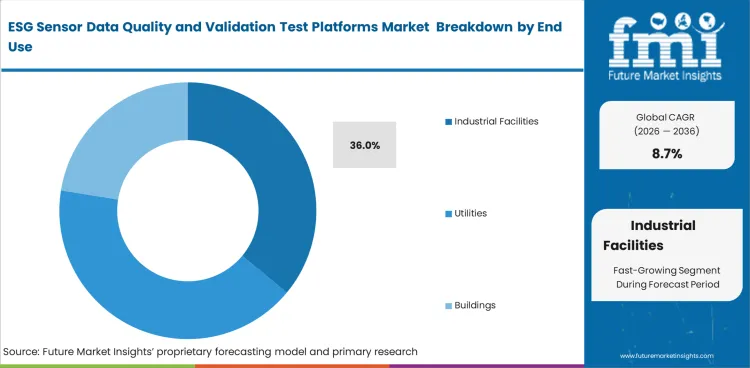
Industrial Facilities carry a heavier measurement burden than most other user groups in this category. Multiple monitored points, site-level reporting duties, utility records, and environmental review cycles all converge inside operations that already manage complex data ownership. Industrial Facilities are likely to secure 36% share in 2026 because these users gain immediate value from software that can reduce manual reconciliation and create a defensible path from raw readings to accepted records. Utilities, Buildings, and Service Providers continue to expand their role, yet industrial sites remain the strongest base for software-led validation because operational variance is wider and review consequences are harder to absorb. Facilities that postpone data-quality controls often end up paying for monitoring hardware without capturing dependable reporting value from it.
- Site complexity: Industrial users must reconcile many monitored points across emissions, energy, and utility records. Validation tools reduce manual checking across operating teams.
- Record defense: Site managers need software that can support internal review and external assurance when readings are questioned. Audit readiness matters as much as measurement capture.
- Expansion logic: Once a plant group standardizes data-quality controls, adoption can move across additional sites with fewer internal arguments about method consistency. Enterprise rollout becomes more manageable.
ESG Sensor Data Quality and Validation Test Platforms Market Drivers, Restraints, and Opportunities
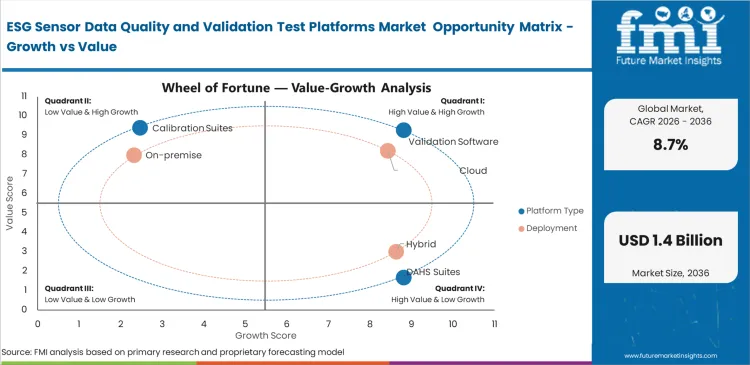
Environmental reporting teams are no longer choosing between visibility and manual review. They are being pushed to create a reliable chain from sensor output to accepted record. That change is lifting interest in platforms that can test anomalies, preserve exception history, and show why a correction was made before data reaches formal sustainability disclosure or internal carbon accounting. Audit-readiness needs are especially important where sensor records feed emissions or utility reporting. Validation logic therefore remains visible in software selection even when enterprises already use broader sustainability tools.
Internal ownership remains the main brake. Sensor governance, environmental reporting, utility management, and enterprise IT often sit under different teams, and that slows tool approval even when the operating problem is clear. Enterprises can recognize the need for validation yet still delay platform rollout because data standards, correction authority, and system responsibility are not fully agreed. Partial fixes exist through department-led deployments or narrow pilot programs, but those approaches can leave organizations with uneven rules and site-by-site variation that limits enterprise confidence.
Opportunities in the ESG Sensor Data Quality and Validation Test Platforms Market
- Assurance integration: Platforms that connect validation logic directly to review-ready records can gain favor with reporting teams preparing for wider disclosure and assurance routines. Enterprises benefit when one workflow shortens both exception review and audit preparation.
- Multi-site standardization: Enterprise groups with varied site practices have room to unify threshold rules, correction logic, and approval steps across facilities. Common control methods create cleaner comparison between operating locations.
- Emissions specialization: Narrower use cases tied to monitored emissions can open faster entry points for vendors extending from environmental software into higher-value data-quality control workflows. Focused deployment often becomes the first step toward broader platform adoption.
Regional Analysis
Key Facts About Country
- India is identified as the fastest-growing market among the countries highlighted, with ESG sensor data quality and validation test platforms expected to expand at a CAGR of 10.8% through 2036.
- Broader measurement discipline across more reporting categories keeps Germany close behind, and the market there is estimated to rise at 9.5% CAGR during the forecast period.
- Stronger enterprise reporting control supports the United Kingdom, where demand is projected to advance at 9.1% CAGR over the study period.
- Digital environmental controls are widening from a lower software base in Australia, placing the market on an anticipated 8.9% CAGR path by 2036.
- A steadier pace appears in Canada, where growth is likely to hold at 8.4% CAGR during the assessment period.
- Mature installed software and longer approval cycles leave Japan at a forecast 7.8% CAGR through 2036.
- The United States records the most moderate pace, with the market expected to grow at 7.1% CAGR over the forecast period.
Based on the regional analysis, the ESG Sensor Data Quality and Validation Test Platforms Market is segmented into North America, Latin America, Western Europe, Eastern Europe, South Asia and Pacific, East Asia, and Middle East and Africa across 40 plus countries.
.webp "Top Country Growth Comparison Esg Sensor Data Quality And Validation Test Platforms Market Cagr (2026 2036)")
| Country | CAGR (2026 to 2036) |
|---|---|
| India | 10.8% |
| Germany | 9.5% |
| United Kingdom | 9.1% |
| Australia | 8.9% |
| Canada | 8.4% |
| Japan | 7.8% |
| United States | 7.1% |
Source: Future Market Insights (FMI) analysis and primary research
North America ESG Sensor Data Quality and Validation Test Platforms Market Analysis
North America remains a key valuation base because monitored industrial operations, utility networks, and enterprise sustainability systems are already well established across the region. Platform adoption here is less about introducing sensor-linked environmental records for the first time and more about making those records review-ready across multiple internal teams. Data traceability, exception handling, and method consistency carry more weight than broad software breadth. Organizations in this region usually want platforms that can sit close to existing operating systems without creating another disconnected reporting layer, a pattern that also connects naturally with adjacent demand visible in environmental monitoring and emissions management.
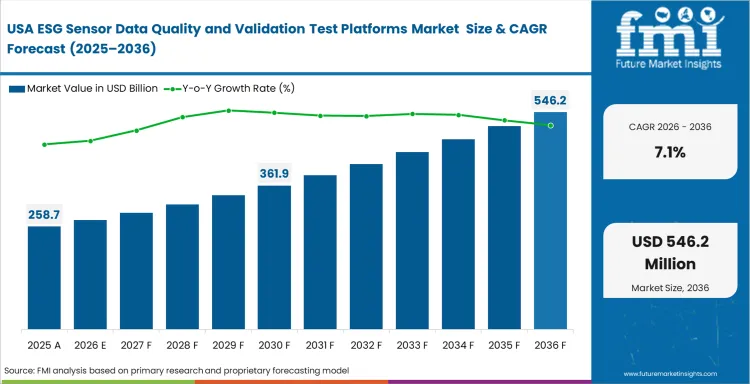
- United States: Industry outlook in the United States points to 7.1% CAGR through 2036. That pace reflects a market where replacement logic, software rationalization, and audit defensibility matter more than first-stage adoption. Installed monitoring depth keeps the United States central to regional valuation, but software expansion follows a measured path because many enterprises already run a mix of legacy site systems, reporting tools, and internal review methods. Integration burden matters here. Teams are usually not choosing whether to digitize environmental records at all; they are deciding how to clean up fragmented data logic across facilities that have matured at different times. Platforms that reduce reconciliation effort across business units are likely to gain stronger internal acceptance.
- Canada: Clear reporting discipline and a more uniform operating case for carbon-accounting support give Canada a firmer path for validation-focused software. Enterprises here often place more emphasis on consistent treatment of monitored records between facilities, especially when environmental reporting has to stand up to internal review without repeated manual correction. A more orderly reporting environment gives validation tools practical value beyond software convenience alone. Midway through that logic sits the forecast, with Canada expected to register 8.4% CAGR through 2036. Category expansion in this country is supported by the need to connect monitored emissions and energy records with cleaner review processes, which helps enterprises reduce variation in how site-level information is interpreted.
FMI's report includes Mexico and the rest of North America. Broader regional activity is supported by environmental reporting needs, monitored asset modernization, and the ability of enterprises to connect site-originated records with accepted internal review methods. Larger enterprise rollouts still define the commercial tone of the region.
Western Europe ESG Sensor Data Quality and Validation Test Platforms Market Analysis
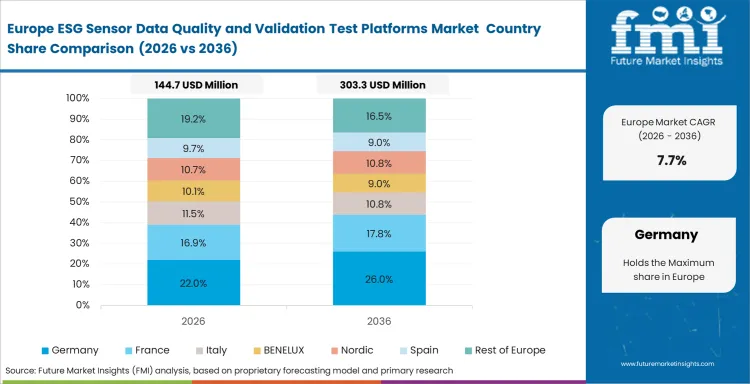
Western Europe remains one of the strongest homes for validation-led software because environmental records are expected to be traceable, reviewable, and ready for formal scrutiny rather than simply collected and displayed. Multi-country operators need one accepted logic across facilities, and that requirement raises the value of platforms that can preserve correction history, method consistency, and approval visibility. Review quality is a central issue here. Software selection often turns on whether the system can help enterprises defend environmental records across multiple jurisdictions without rebuilding the reasoning behind every adjusted value. Category logic here also aligns closely with broader digital-control demand seen in esg reporting software.
- Germany: Germany is forecast to post 9.5% CAGR through 2036 in this market. Much of that momentum comes from the practical need to keep plant-level records consistent across multi-site operations, where differences in method handling can weaken internal comparison and slow reporting review. Manufacturing depth gives Germany a different operating profile from service-heavy markets. Site-level environmental records are often tied to broader industrial digital systems, which means validation tools must fit existing operating logic instead of sitting outside it as a parallel workflow. That makes software selection more exacting, but it also creates a stronger long-term case for platforms that can standardize treatment of monitored data across plants.
- United Kingdom: Assurance habits and stronger attention to data governance keep the United Kingdom on a favorable path for this category. Internal teams often want a clear explanation of why a reading was accepted, corrected, or escalated before it enters formal environmental reporting. That preference gives validation software a direct role in the reporting chain rather than a secondary support function. In the United Kingdom, a 9.1% CAGR is expected through 2036 for this market. Expansion here is supported by the need for clearer correction ownership and better anomaly handling, especially in organizations where environmental reporting must pass through several layers of internal review before disclosure is finalized.
FMI's report includes France, Italy, Spain, Benelux, and the Nordic region. Benelux and Nordic countries also function as important European operating hubs for industrial processing, utilities, and enterprise reporting coordination. Software demand across those areas remains tied to method consistency, multi-site oversight, and the need to keep environmental records usable across dispersed business units.
South Asia and Pacific ESG Sensor Data Quality and Validation Test Platforms Market Analysis
South Asia and Pacific present a different pattern because validation software is often being adopted while broader monitoring and reporting practices are still being standardized. That creates room for faster category expansion once enterprises recognize that sensor installation alone does not resolve data-confidence issues. Internal review discipline, not just digital availability, shapes software relevance here. Organizations across the region are often trying to connect monitored records, environmental reporting, and accepted correction logic at the same time, which gives validation tools a wider opening than in more mature markets where systems are already deeply entrenched. Similar adoption logic can also be seen across adjacent software layers such as industrial energy management system.
- India: A 10.8% CAGR is expected for India through 2036. Broad industrial coverage and ongoing modernization of environmental record handling keep India at the top of the country ranking in this study. Many enterprises are still building a cleaner connection between monitored site information, central review teams, and formal sustainability reporting, so validation tools can enter relatively early in the software cycle. Category expansion here is supported by the practical need to cut manual review, standardize treatment of abnormal readings, and reduce disagreement between plant-level teams and central reporting functions. That makes software utility visible quickly, especially in organizations trying to raise consistency across a wide operating base.
- Australia: Dispersed industrial assets and resource-linked environmental monitoring needs give Australia a grounded case for validation-focused software. Enterprises often need one accepted review logic across sites operating under different conditions, and that requirement raises the value of platforms that can preserve traceability without forcing every location into a separate manual process. Australia is on a positive trend, with the sector expected to advance at 8.9% CAGR through 2036. What supports that pace is not volume alone, but the need to keep environmental records credible across distant operations where site-by-site variation can otherwise make internal review slower and less consistent.
- Japan: Careful software qualification and strong process discipline shape the Japanese market. Enterprises here usually want dependable integration with existing systems and a clear record of why values were changed, approved, or held for review. Adoption therefore tends to move with more caution than in faster-converting markets, yet the operating case remains solid because method control matters deeply in internal reporting environments. Industry outlook in Japan indicates 7.8% CAGR through 2036. That reading reflects a market where pace is moderated by careful approval cycles, while platform relevance remains supported by the need for continuity, precision, and stable data handling across business units.
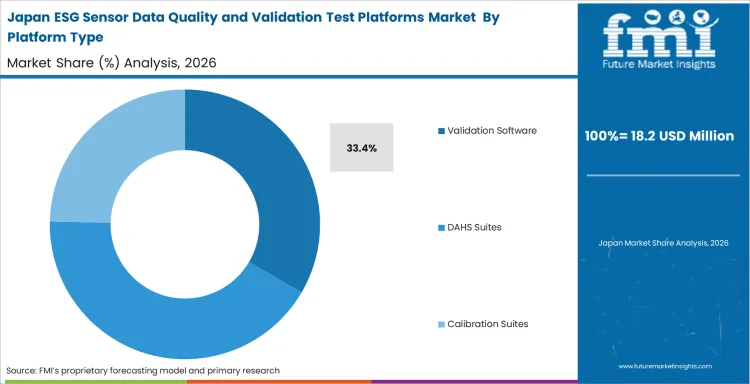
FMI's report includes ASEAN countries and the rest of Oceania. Wider regional valuation is supported by industrial processors, utilities, commercial facilities, and monitored site operators looking to improve environmental record quality without replacing every installed monitoring system. Pace across these markets usually depends on how quickly enterprises connect software-led data control with already active monitoring assets.
Competitive Aligners for Market Players
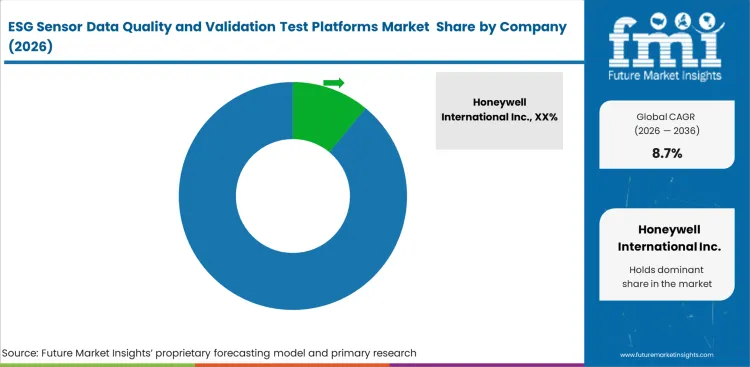
Buyers in the sector do not judge vendors on visualization alone. Record defensibility, anomaly handling, correction traceability, and integration fit usually determine whether a platform is taken seriously. Honeywell, Siemens, ABB, and Emerson benefit from closer ties to industrial operating environments and long-standing enterprise relationships, while GHGSat, Project Canary, and Qube draw attention where monitored emissions and specialist environmental records require tighter validation logic. Competitive standing therefore depends less on software breadth by itself and more on whether a vendor can support accepted review discipline across multiple internal teams, a requirement that also connects with adjacent categories such as emissions management.
Incumbents carry a clear advantage when customers want one supplier that understands plant data, environmental records, and enterprise reporting workflows together. That edge is not easy to replicate in a short time. Challengers need credible measurement logic, dependable service support, and a convincing path from monitored value to accepted record before enterprise customers expand deployment. Large organizations usually remain cautious with new vendor entry unless the platform can reduce review burden without creating fresh integration work. Similar selection logic appears in nearby software layers such as environmental monitoring, where data credibility matters as much as system visibility.
Buyer power remains meaningful because large enterprise customers can separate monitoring hardware, data validation, and reporting software across different vendors if one supplier does not meet review requirements. That keeps the field from concentrating too quickly. Through 2036, competitive pressure is likely to favor vendors that make software easier to defend internally, not just easier to demonstrate in pilot settings. Enterprise customers will continue to prefer providers that can reduce review burden across operations, reporting, and assurance teams without forcing costly process duplication.
Key Players in ESG Sensor Data Quality and Validation Test Platforms Market
- Honeywell International Inc.
- Siemens AG
- ABB Ltd.
- Emerson Electric Co.
- GHGSat Inc.
- Project Canary PBC
- Qube Technologies Inc.
Scope of the Report
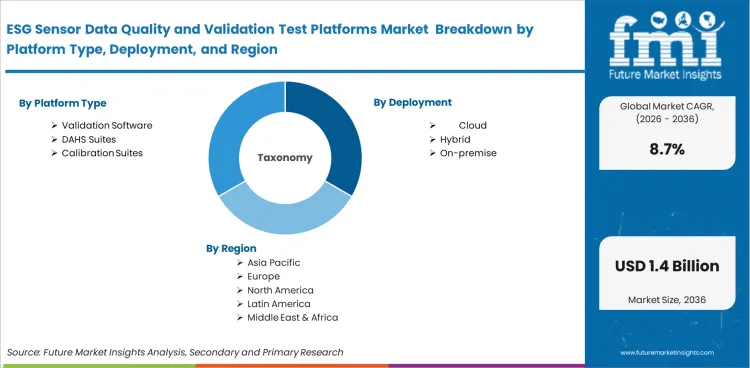
| Metric | Value |
|---|---|
| Quantitative Units | USD 0.54 billion to USD 1.25 billion, at a CAGR of 8.70% |
| Market Definition | ESG sensor data quality and validation test platforms cover software tools used to verify, reconcile, calibrate, and audit sensor-generated environmental records. Scope is limited to systems that improve data credibility for compliance, reporting, and assurance review. |
| Platform Type Segmentation | Validation Software, DAHS Suites, Calibration Suites, Audit Engines |
| Deployment Segmentation | Cloud, Hybrid, On-premise |
| Sensor Domain Segmentation | Emissions, Energy, Water, Multi-metric |
| End Use Segmentation | Industrial Facilities, Utilities, Buildings, Service Providers |
| Regions Covered | North America, Latin America, Western Europe, Eastern Europe, South Asia and Pacific, East Asia, Middle East and Africa |
| Countries Covered | India, Germany, United Kingdom, Australia, Canada, Japan, United States, and 40 plus countries |
| Key Companies Profiled | Honeywell International Inc., Siemens AG, ABB Ltd., Emerson Electric Co., GHGSat Inc., Project Canary PBC, Qube Technologies Inc. |
| Forecast Period | 2026 to 2036 |
| Approach | FMI combined primary interviews with environmental reporting leaders, compliance managers, utility data-control teams, and enterprise software participants. Baseline sizing was built from monitored asset bases and software requirements tied to record validation, calibration control, and audit-ready workflows. Forecasts were checked against country valuation patterns, adjacent categories, and competitive positioning. |
Source: Future Market Insights (FMI) analysis and primary research
ESG Sensor Data Quality and Validation Test Platforms Market Analysis by Segments
By Platform Type:
- Validation Software
- DAHS Suites
- Calibration Suites
- Audit Engines
By Deployment:
- Cloud
- Hybrid
- On-premise
By Sensor Domain:
- Emissions
- Energy
- Water
- Multi-metric
By End Use:
- Industrial Facilities
- Utilities
- Buildings
- Service Providers
By Region:
- North America
- United States
- Canada
- Western Europe
- Germany
- United Kingdom
- South Asia and Pacific
- India
- Australia
- East Asia
- Japan
- Latin America
- Eastern Europe
- Middle East and Africa
Bibliography
- U.S. Environmental Protection Agency. (2026, January 29). GHGRP Reported Data. U.S. Environmental Protection Agency.
- National Institute of Standards and Technology. (2025, November). Environmental Measurements: A Needs Assessment. NIST.
- IFRS Foundation. (2024, November). Progress on Corporate Climate-related Disclosures—2024 Report. IFRS Foundation.
- European Financial Reporting Advisory Group. (2025, July). State of Play 2025. EFRAG.
- Environment and Climate Change Canada. (2025, March 20). Reporting greenhouse gas emissions data: technical guidance 2025. Government of Canada.
This bibliography is provided for reader reference. The full FMI report contains the complete reference list with primary source documentation.
This Report Addresses
- Market intelligence to support strategic decision making across Validation Software, DAHS Suites, Calibration Suites, and Audit Engines
- Market size estimation and 10-year valuation forecasts from 2026 to 2036, supported by monitored asset mapping and enterprise software assessment
- Growth opportunity mapping across Platform Type, Deployment, Sensor Domain, and End Use with emphasis on data traceability and audit-ready controls
- Segment and regional valuation forecasts covering Emissions, Energy, Water, and Multi-metric workflows across Industrial Facilities, Utilities, Buildings, and Service Providers
- Competition assessment including record defensibility, integration fit, anomaly handling, service support, and enterprise approval readiness
- Validation workflow tracking including calibration control, reconciliation logic, exception review, audit engines, and cloud-based oversight tools
- Market access analysis covering compliance reporting needs, assurance review requirements, enterprise data-governance demands, and software qualification pathways
- Market report delivery in PDF, Excel, PPT, and interactive dashboard formats for executive strategy, sustainability planning, and operational benchmarking use
Frequently Asked Questions
How large is the ESG Sensor Data Quality and Validation Test Platforms Market in 2026?
FMI estimates the ESG Sensor Data Quality and Validation Test Platforms Market at USD 0.54 billion in 2026.
What will the ESG Sensor Data Quality and Validation Test Platforms Market be valued at by 2036?
Industry valuation is projected to reach USD 1.25 billion by 2036. Expansion at that level suggests enterprises are moving from one-time monitoring visibility toward software that can defend accepted records across sites and reporting cycles.
What CAGR is projected for the ESG Sensor Data Quality and Validation Test Platforms Market?
FMI projects a CAGR of 8.7% from 2026 to 2036. Pace at that level reflects a category supported by compliance relevance and software-control needs, while still constrained by internal approval, system ownership, and enterprise rollout discipline.
Which Platform Type segment leads the ESG Sensor Data Quality and Validation Test Platforms Market?
Validation Software leads the Platform Type segment. In 2026, Validation Software is expected to account for 34.0% share because most enterprises first need rules-based checking, exception review, and correction traceability before they extend toward broader data-handling layers.
Which Deployment segment leads the ESG Sensor Data Quality and Validation Test Platforms Market?
Cloud leads deployment in this market. Enterprises prefer it because centralized oversight, multi-site review, and easier rule updates fit how environmental records are managed across dispersed assets.
Which Sensor Domain segment leads the ESG Sensor Data Quality and Validation Test Platforms Market?
Emissions is the leading sensor domain. Market estimates place Emissions at 39.0% share in 2026 because monitored records in this area are more likely to feed formal reporting and assurance review than many internal-only environmental datasets.
What is pushing adoption in this market?
Stronger interest in auditable environmental records is the main force behind adoption. Enterprises want software that can explain why a value was accepted, corrected, or flagged instead of relying on manual review at the end of reporting cycles.
What is the primary restraint in this market?
Internal ownership remains the main restraint. Environmental teams, site operators, reporting functions, and enterprise IT often control different parts of the data chain, which slows platform approval even when the business need is clear.
Which country grows fastest in the ESG Sensor Data Quality and Validation Test Platforms Market?
India is the fastest-growing country in this study at 10.8% CAGR through 2036. Germany follows at 9.5%, but India has more room for software conversion because monitoring modernization and data-control standardization are rising together across a broader operating base.
Why does data validation matter more than dashboard visibility in this market?
Visibility tells a team what was recorded. Validation explains whether the reading should be trusted, whether it fits accepted logic, and whether the correction path can be defended later. Enterprises eventually learn that reporting confidence depends more on the second issue than the first.
How is this market different from general ESG reporting software?
General ESG reporting tools help assemble disclosures, workflows, and reporting outputs. ESG sensor data quality and validation test platforms sit closer to measurement credibility and focus on reconciliation, calibration, exception logic, and audit-ready handling of sensor-originated records.
What competitive pattern defines this market through 2036?
Competition is likely to remain moderate rather than narrowly concentrated. Large enterprises can separate monitoring, validation, and reporting layers across different suppliers, which keeps room open for both industrial software incumbents and specialist environmental data-control vendors.
Why does Validation Software lead before DAHS Suites or Audit Engines in many accounts?
Validation Software solves the broadest early issue. Enterprises need one place to test abnormal values, preserve correction history, and standardize acceptance logic before deeper workflow layers are funded.
Why does Cloud deployment remain ahead of On-premise in this category?
Multi-site review is the main reason. Reporting teams want one view of anomalies, one update cycle for rules, and one consistent record path across facilities rather than isolated local controls.
Why do Industrial Facilities remain the largest end-use group?
Industrial Facilities manage more monitored points, more utility records, and more environmental review requirements than many other users.
How does the United States compare with Canada in this market?
Canada at 8.4% CAGR benefits from steady reporting discipline and method standardization needs, while the United States at 7.1% reflects a larger, more mature installed base with longer enterprise approval cycles.
What explains Germany’s position in Western Europe?
Germany combines manufacturing depth, monitored industrial assets, and strong enterprise process discipline. Teams there usually want validation software that fits existing digital operations rather than sitting outside them as a separate manual review layer.
Why is the United Kingdom still advancing strongly in this category?
Assurance-led reporting habits help the United Kingdom maintain favorable software interest. Review teams usually place more weight on correction ownership, anomaly handling, and record traceability than on visualization alone.
How does Australia compare with Japan in the forecast period?
Australia at 8.9% CAGR benefits from dispersed assets and stronger need for one common review logic across operating sites. Japan at 7.8% remains steady but moves through more careful approval and integration cycles.
What role do specialist emissions platforms play in this market?
They often act as entry points. Enterprises facing immediate monitored emissions needs may begin with narrow validation use cases and later widen platform scope into Energy, Water, or broader enterprise records.
What is included in the scope of this market?
Scope includes Validation Software, DAHS Suites, Calibration Suites, Audit Engines, and deployment models used to verify, reconcile, and audit sensor-generated environmental records.
How was the market sized by FMI?
FMI built the market using monitored asset bases, reporting requirements, and enterprise need for software that validates sensor-originated ESG records.
Why are multi-site enterprises important to this market’s outlook?
Multi-site organizations face bigger problems with version control, method consistency, and approval timing.
What changes by 2036 in the way this category operates?
By 2036, enterprises are likely to treat validation as a normal operating layer rather than a temporary control step ahead of disclosure deadlines.
Preview the report firsthand - request a free sample
Get SampleGet the brochure for pricing and purchase details.
Get PDFTable of Content
- Executive Summary
- Global Market Outlook
- Demand-side Trends
- Supply-side Trends
- Technology Roadmap Analysis
- Analysis and Recommendations
- Market Overview
- Market Coverage / Taxonomy
- Market Definition / Scope / Limitations
- Research Methodology
- Chapter Orientation
- Analytical Framework
- Market Structure, Signals, and Trend Drivers
- Benchmarking and Cross-market Comparability
- Market Sizing, Forecasting, and Opportunity Mapping
- Research Design and Evidence Framework
- Desk Research Programme (Secondary Evidence)
- Company Annual and Sustainability Reports
- Peer-reviewed Journals and Academic Literature
- Corporate Websites, Product Literature, and Technical Notes
- Earnings Decks and Investor Briefings
- Statutory Filings and Regulatory Disclosures
- Technical White Papers and Standards Notes
- Trade Journals, Industry Magazines, and Analyst Briefs
- Conference Proceedings, Webinars, and Seminar Materials
- Government Statistics Portals and Public Data Releases
- Press Releases and Reputable Media Coverage
- Specialist Newsletters and Curated Briefings
- Sector Databases and Reference Repositories
- FMI Proprietary Databases and Historical Market Data
- Subscription Datasets and Paid Sources
- Social Channels, Communities, and Digital Listening Inputs
- Additional Desk Sources
- Expert Input and Fieldwork (Primary Evidence)
- Primary Modes
- Qualitative Interviews and Expert Elicitation
- Quantitative Surveys and Structured Data Capture
- Blended Approach
- Why Primary Evidence is Used
- Field Techniques
- Interviews
- Surveys
- Focus Groups
- Observational and In-context Research
- Social and Community Interactions
- Stakeholder Universe Engaged
- C-suite Leaders
- Board Members
- Presidents and Vice Presidents
- R&D and Innovation Heads
- Technical Specialists
- Domain Subject-matter Experts
- Scientists
- Physicians and Other Healthcare Professionals
- Governance, Ethics, and Data Stewardship
- Research Ethics
- Data Integrity and Handling
- Primary Modes
- Research Methods and Reference Sources
- Desk Research Programme (Secondary Evidence)
- Market Data Analysis and Forecast Development
- Data Collection
- Data Review and Validation
- Synthesis, Triangulation, and Analysis
- Research Quality and Validation
- Market Background
- Market Dynamics
- Drivers
- Restraints
- Opportunity
- Trends
- Scenario Forecast
- Demand in Optimistic Scenario
- Demand in Likely Scenario
- Demand in Conservative Scenario
- Opportunity Map Analysis
- Product Life Cycle Analysis
- Supply Chain Analysis
- Investment Feasibility Matrix
- Value Chain Analysis
- PESTLE and Porter’s Analysis
- Regulatory Landscape
- Regional Parent Market Outlook
- Production and Consumption Statistics
- Import and Export Statistics
- Market Dynamics
- Global Market Analysis 2021 to 2025 and Forecast, 2026 to 2036
- Historical Market Size Value (USD Million) Analysis, 2021 to 2025
- Current and Future Market Size Value (USD Million) Projections, 2026 to 2036
- Y-o-Y Growth Trend Analysis
- Absolute $ Opportunity Analysis
- Global Market Pricing Analysis 2021 to 2025 and Forecast 2026 to 2036
- Global Market Analysis 2021 to 2025 and Forecast 2026 to 2036, By Platform Type
- Introduction / Key Findings
- Historical Market Size Value (USD Million) Analysis By Platform Type , 2021 to 2025
- Current and Future Market Size Value (USD Million) Analysis and Forecast By Platform Type , 2026 to 2036
- Validation Software
- DAHS Suites
- Calibration Suites
- Validation Software
- Y-o-Y Growth Trend Analysis By Platform Type , 2021 to 2025
- Absolute $ Opportunity Analysis By Platform Type , 2026 to 2036
- Global Market Analysis 2021 to 2025 and Forecast 2026 to 2036, By Deployment
- Introduction / Key Findings
- Historical Market Size Value (USD Million) Analysis By Deployment, 2021 to 2025
- Current and Future Market Size Value (USD Million) Analysis and Forecast By Deployment, 2026 to 2036
- Cloud
- Hybrid
- On-premise
- Cloud
- Y-o-Y Growth Trend Analysis By Deployment, 2021 to 2025
- Absolute $ Opportunity Analysis By Deployment, 2026 to 2036
- Global Market Analysis 2021 to 2025 and Forecast 2026 to 2036, By Sensor
- Introduction / Key Findings
- Historical Market Size Value (USD Million) Analysis By Sensor, 2021 to 2025
- Current and Future Market Size Value (USD Million) Analysis and Forecast By Sensor, 2026 to 2036
- Emissions
- Energy
- Water
- Emissions
- Y-o-Y Growth Trend Analysis By Sensor, 2021 to 2025
- Absolute $ Opportunity Analysis By Sensor, 2026 to 2036
- Global Market Analysis 2021 to 2025 and Forecast 2026 to 2036, By End Use
- Introduction / Key Findings
- Historical Market Size Value (USD Million) Analysis By End Use, 2021 to 2025
- Current and Future Market Size Value (USD Million) Analysis and Forecast By End Use, 2026 to 2036
- Industrial Facilities
- Utilities
- Buildings
- Industrial Facilities
- Y-o-Y Growth Trend Analysis By End Use, 2021 to 2025
- Absolute $ Opportunity Analysis By End Use, 2026 to 2036
- Global Market Analysis 2021 to 2025 and Forecast 2026 to 2036, By Region
- Introduction
- Historical Market Size Value (USD Million) Analysis By Region, 2021 to 2025
- Current Market Size Value (USD Million) Analysis and Forecast By Region, 2026 to 2036
- North America
- Latin America
- Western Europe
- Eastern Europe
- East Asia
- South Asia and Pacific
- Middle East & Africa
- Market Attractiveness Analysis By Region
- North America Market Analysis 2021 to 2025 and Forecast 2026 to 2036, By Country
- Historical Market Size Value (USD Million) Trend Analysis By Market Taxonomy, 2021 to 2025
- Market Size Value (USD Million) Forecast By Market Taxonomy, 2026 to 2036
- By Country
- USA
- Canada
- Mexico
- By Platform Type
- By Deployment
- By Sensor
- By End Use
- By Country
- Market Attractiveness Analysis
- By Country
- By Platform Type
- By Deployment
- By Sensor
- By End Use
- Key Takeaways
- Latin America Market Analysis 2021 to 2025 and Forecast 2026 to 2036, By Country
- Historical Market Size Value (USD Million) Trend Analysis By Market Taxonomy, 2021 to 2025
- Market Size Value (USD Million) Forecast By Market Taxonomy, 2026 to 2036
- By Country
- Brazil
- Chile
- Rest of Latin America
- By Platform Type
- By Deployment
- By Sensor
- By End Use
- By Country
- Market Attractiveness Analysis
- By Country
- By Platform Type
- By Deployment
- By Sensor
- By End Use
- Key Takeaways
- Western Europe Market Analysis 2021 to 2025 and Forecast 2026 to 2036, By Country
- Historical Market Size Value (USD Million) Trend Analysis By Market Taxonomy, 2021 to 2025
- Market Size Value (USD Million) Forecast By Market Taxonomy, 2026 to 2036
- By Country
- Germany
- UK
- Italy
- Spain
- France
- Nordic
- BENELUX
- Rest of Western Europe
- By Platform Type
- By Deployment
- By Sensor
- By End Use
- By Country
- Market Attractiveness Analysis
- By Country
- By Platform Type
- By Deployment
- By Sensor
- By End Use
- Key Takeaways
- Eastern Europe Market Analysis 2021 to 2025 and Forecast 2026 to 2036, By Country
- Historical Market Size Value (USD Million) Trend Analysis By Market Taxonomy, 2021 to 2025
- Market Size Value (USD Million) Forecast By Market Taxonomy, 2026 to 2036
- By Country
- Russia
- Poland
- Hungary
- Balkan & Baltic
- Rest of Eastern Europe
- By Platform Type
- By Deployment
- By Sensor
- By End Use
- By Country
- Market Attractiveness Analysis
- By Country
- By Platform Type
- By Deployment
- By Sensor
- By End Use
- Key Takeaways
- East Asia Market Analysis 2021 to 2025 and Forecast 2026 to 2036, By Country
- Historical Market Size Value (USD Million) Trend Analysis By Market Taxonomy, 2021 to 2025
- Market Size Value (USD Million) Forecast By Market Taxonomy, 2026 to 2036
- By Country
- China
- Japan
- South Korea
- By Platform Type
- By Deployment
- By Sensor
- By End Use
- By Country
- Market Attractiveness Analysis
- By Country
- By Platform Type
- By Deployment
- By Sensor
- By End Use
- Key Takeaways
- South Asia and Pacific Market Analysis 2021 to 2025 and Forecast 2026 to 2036, By Country
- Historical Market Size Value (USD Million) Trend Analysis By Market Taxonomy, 2021 to 2025
- Market Size Value (USD Million) Forecast By Market Taxonomy, 2026 to 2036
- By Country
- India
- ASEAN
- Australia & New Zealand
- Rest of South Asia and Pacific
- By Platform Type
- By Deployment
- By Sensor
- By End Use
- By Country
- Market Attractiveness Analysis
- By Country
- By Platform Type
- By Deployment
- By Sensor
- By End Use
- Key Takeaways
- Middle East & Africa Market Analysis 2021 to 2025 and Forecast 2026 to 2036, By Country
- Historical Market Size Value (USD Million) Trend Analysis By Market Taxonomy, 2021 to 2025
- Market Size Value (USD Million) Forecast By Market Taxonomy, 2026 to 2036
- By Country
- Kingdom of Saudi Arabia
- Other GCC Countries
- Turkiye
- South Africa
- Other African Union
- Rest of Middle East & Africa
- By Platform Type
- By Deployment
- By Sensor
- By End Use
- By Country
- Market Attractiveness Analysis
- By Country
- By Platform Type
- By Deployment
- By Sensor
- By End Use
- Key Takeaways
- Key Countries Market Analysis
- USA
- Pricing Analysis
- Market Share Analysis, 2025
- By Platform Type
- By Deployment
- By Sensor
- By End Use
- Canada
- Pricing Analysis
- Market Share Analysis, 2025
- By Platform Type
- By Deployment
- By Sensor
- By End Use
- Mexico
- Pricing Analysis
- Market Share Analysis, 2025
- By Platform Type
- By Deployment
- By Sensor
- By End Use
- Brazil
- Pricing Analysis
- Market Share Analysis, 2025
- By Platform Type
- By Deployment
- By Sensor
- By End Use
- Chile
- Pricing Analysis
- Market Share Analysis, 2025
- By Platform Type
- By Deployment
- By Sensor
- By End Use
- Germany
- Pricing Analysis
- Market Share Analysis, 2025
- By Platform Type
- By Deployment
- By Sensor
- By End Use
- UK
- Pricing Analysis
- Market Share Analysis, 2025
- By Platform Type
- By Deployment
- By Sensor
- By End Use
- Italy
- Pricing Analysis
- Market Share Analysis, 2025
- By Platform Type
- By Deployment
- By Sensor
- By End Use
- Spain
- Pricing Analysis
- Market Share Analysis, 2025
- By Platform Type
- By Deployment
- By Sensor
- By End Use
- France
- Pricing Analysis
- Market Share Analysis, 2025
- By Platform Type
- By Deployment
- By Sensor
- By End Use
- India
- Pricing Analysis
- Market Share Analysis, 2025
- By Platform Type
- By Deployment
- By Sensor
- By End Use
- ASEAN
- Pricing Analysis
- Market Share Analysis, 2025
- By Platform Type
- By Deployment
- By Sensor
- By End Use
- Australia & New Zealand
- Pricing Analysis
- Market Share Analysis, 2025
- By Platform Type
- By Deployment
- By Sensor
- By End Use
- China
- Pricing Analysis
- Market Share Analysis, 2025
- By Platform Type
- By Deployment
- By Sensor
- By End Use
- Japan
- Pricing Analysis
- Market Share Analysis, 2025
- By Platform Type
- By Deployment
- By Sensor
- By End Use
- South Korea
- Pricing Analysis
- Market Share Analysis, 2025
- By Platform Type
- By Deployment
- By Sensor
- By End Use
- Russia
- Pricing Analysis
- Market Share Analysis, 2025
- By Platform Type
- By Deployment
- By Sensor
- By End Use
- Poland
- Pricing Analysis
- Market Share Analysis, 2025
- By Platform Type
- By Deployment
- By Sensor
- By End Use
- Hungary
- Pricing Analysis
- Market Share Analysis, 2025
- By Platform Type
- By Deployment
- By Sensor
- By End Use
- Kingdom of Saudi Arabia
- Pricing Analysis
- Market Share Analysis, 2025
- By Platform Type
- By Deployment
- By Sensor
- By End Use
- Turkiye
- Pricing Analysis
- Market Share Analysis, 2025
- By Platform Type
- By Deployment
- By Sensor
- By End Use
- South Africa
- Pricing Analysis
- Market Share Analysis, 2025
- By Platform Type
- By Deployment
- By Sensor
- By End Use
- USA
- Market Structure Analysis
- Competition Dashboard
- Competition Benchmarking
- Market Share Analysis of Top Players
- By Regional
- By Platform Type
- By Deployment
- By Sensor
- By End Use
- Competition Analysis
- Competition Deep Dive
- Honeywell International Inc.
- Overview
- Product Portfolio
- Profitability by Market Segments (Product/Age /Sales Channel/Region)
- Sales Footprint
- Strategy Overview
- Marketing Strategy
- Product Strategy
- Channel Strategy
- Siemens AG
- ABB Ltd.
- Emerson Electric Co.
- GHGSat Inc.
- Project Canary PBC
- Qube Technologies Inc.
- Honeywell International Inc.
- Competition Deep Dive
- Assumptions & Acronyms Used


