

- Industry Size (2026)
- USD 448.5 Mn
- Forecast (2036)
- USD 1101.4 Mn
- CAGR (2026 to 2036)
- 9.4%
Space Power HIL Test Platforms Market Forecast and Outlook 2026 to 2036
Demand for space power HIL test platforms is valued at USD 448.5 million in 2025 and is forecasted to reach USD 1,101.4 million by 2035, expanding at a CAGR of 9.4%. Demand growth is driven by the increasing complexity of satellite electrical architectures and the need for real-time validation of space power subsystems before launch.
Solar array simulators and maximum power point tracking systems represent the leading system under test in global demand, reflecting the critical importance of power stability, fault tolerance, and dynamic load response in spacecraft operations. Adoption emphasizes closed-loop real-time simulation, hardware-software co-verification, and mission-specific power scenario replication.
Quick Stats for Space Power HIL Test Platforms Market
- Global Space Power HIL Test Platforms Market Value (2025): USD 448.5 million
- Global Space Power HIL Test Platforms Market Forecast Value (2035): USD 1,101.4 million
- Global Space Power HIL Test Platforms Market Forecast CAGR (2025 to 2035): 9.4%
- Leading System Under Test in Global Demand: Solar Array Simulators & MPPT Systems
- Fastest-Growing Countries: China, Brazil, South Korea, USA, United Kingdom
- Top Players in Global Demand: dSPACE, OPAL-RT, Typhoon HIL, Speedgoat, NI (Emerson Test & Measurement), RTDS Technologies, Keysight Technologies, MathWorks, Siemens Digital Industries Software, Plexim
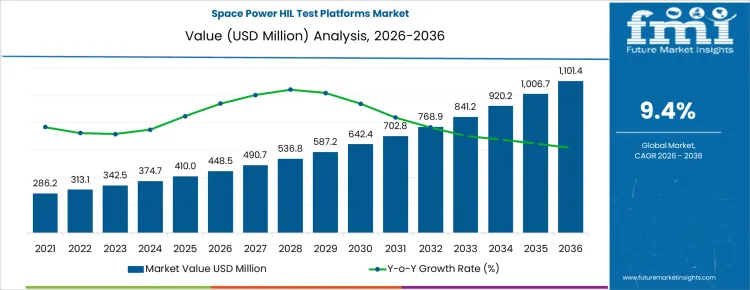
China, Brazil, South Korea, USA, and United Kingdom emerge as fastest-growing countries, supported by rising satellite production volumes and expanded investment in space-qualified power electronics testing. dSPACE, OPAL-RT, Typhoon HIL, Speedgoat, NI (Emerson Test & Measurement), RTDS Technologies, Keysight Technologies, MathWorks, Siemens Digital Industries Software, and Plexim maintain strong positions through high-fidelity real-time simulators, scalable HIL architectures, and integrated power system modeling capabilities.
Space Power HIL Test Platforms Market Key Takeaways
| Metric | Value |
|---|---|
| Market Value (2025) | USD 448.5 million |
| Market Forecast Value (2035) | USD 1,101.4 million |
| Forecast CAGR (2025-2035) | 9.4% |
Why is the Demand for Space Power HIL Test Platforms Globally Growing?
Demand for space power hardware-in-the-loop (HIL) test platforms is growing globally due to increasing complexity of spacecraft power systems and need for rigorous validation prior to launch. Spacecraft power subsystems, including solar arrays, batteries, power distribution units, and converters, require integrated testing that replicates real mission conditions with high fidelity. Satellite manufacturers and prime contractors adopt HIL platforms to detect design issues early, reduce integration risk, and improve reliability across diverse mission profiles. Growth in small satellite constellations, deep space probes, and reusable launch systems expands volume of power system development activity, creating consistent need for advanced test environments.
Research institutions and space agencies invest in HIL infrastructure to support technology demonstration and collaborative programs involving international partners. Test platforms that simulate electrical load dynamics, transients, and fault conditions enable evaluation of control algorithms and protection schemes before deployment. Standardization of qualification procedures across global space organizations reinforces structured testing practices. Providers of HIL solutions develop modular, scalable test rigs that support evolving interface standards and multi-domain simulations. Academic and industrial training programs use HIL platforms to prepare engineers for complex power system design challenges worldwide.
How Are the Segments Classified in the Space Power HIL Test Platforms Market Globally?
Demand for space power hardware-in-the-loop test platforms globally is shaped by increasing satellite power complexity, electrification of payloads, and mission-critical reliability requirements. Organizations evaluate real-time simulation accuracy, power interface fidelity, scalability across mission profiles, and integration with spacecraft avionics. Adoption patterns reflect growing emphasis on closed-loop validation during design, qualification, and acceptance testing across commercial, institutional, and exploration-oriented space programs.
Which System Under Test Accounts for the Largest Share of Global Demand?
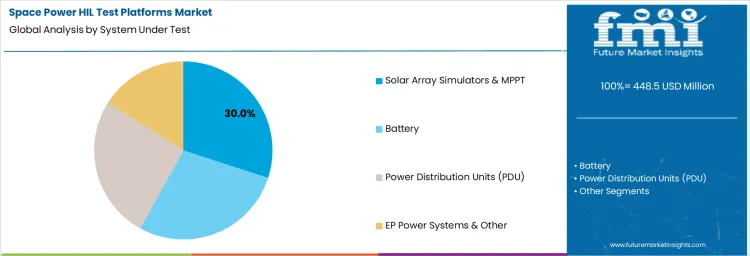
Solar array simulators and MPPT systems hold 30.0%, accounting for the largest share of global demand. These systems enable precise emulation of orbital solar conditions, degradation behavior, and dynamic load response across mission phases. Batteries hold 28.0%, supporting validation of charge-discharge behavior, thermal interaction, and lifecycle performance. Power distribution units hold 26.0%, enabling verification of load management, fault handling, and redundancy logic. Electric propulsion power systems and other units’ account for 16.0%, supporting integrated power validation scenarios. System-under-test distribution reflects priority given to energy generation and regulation subsystems.
Key Points
- Solar array simulators lead due to central role in power generation validation.
- Battery testing supports lifecycle and safety verification.
- PDU testing ensures fault tolerance and load management.
Which Platform Type Drives the Highest Demand for Space Power HIL Testing Globally?
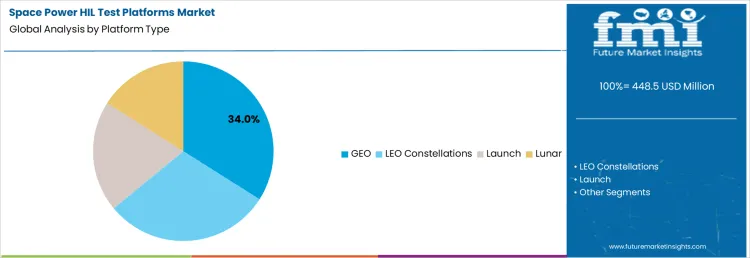
GEO platforms hold 34.0%, driving the highest demand for space power HIL testing globally. GEO missions require long-duration power stability, high-reliability subsystems, and stringent qualification standards. LEO constellations hold 30.0%, reflecting high production volumes and need for repeatable validation workflows. Launch platforms account for 20.0%, focusing on transient power behavior during ascent and deployment. Lunar missions hold 16.0%, supporting validation under extreme thermal and power cycling conditions. Platform-type distribution reflects mission duration, risk profile, and power system criticality.
Key Points
- GEO missions lead due to long-duration power reliability needs.
- LEO constellations drive scalable and repeatable testing demand.
- Lunar missions require extreme-condition power validation.
Which Offering Category Represents the Largest Share of Global Demand?
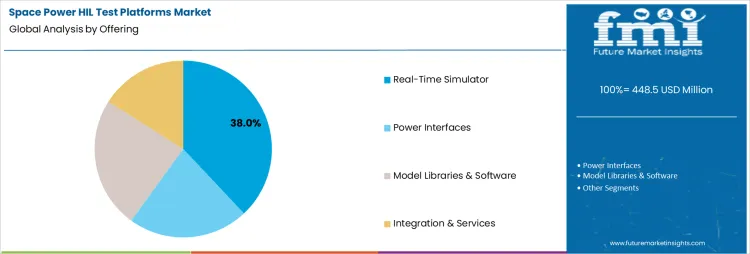
Real-time simulators hold 38.0%, representing the largest offering category in global demand. These platforms enable closed-loop interaction between simulated space environments and physical power hardware. Power interfaces hold 22.0%, supporting safe and accurate electrical coupling between simulators and hardware. Model libraries and software account for 24.0%, enabling mission-specific scenario configuration and behavior emulation. Integration and services hold 16.0%, supporting customization, deployment, and system commissioning. Offering distribution reflects emphasis on real-time validation capability within power system testing workflows.
Key Points
- Real-time simulators dominate due to closed-loop validation needs.
- Software models support mission-specific power behavior emulation.
- Integration services enable system deployment and customization.
What are the Key Dynamics in the Space Power HIL Test Platforms Market?
Global demand rises as spacecraft developers, system integrators, and research institutions adopt hardware-in-the-loop (HIL) platforms to validate power systems under realistic operational scenarios. Space power HIL platforms simulate electrical bus behaviour, energy storage dynamics, and interaction with loads and power converters. Adoption aligns with increasing complexity of power architectures for small satellites, deep space probes, and large communication constellations. Usage spans mission design verification, fault injection testing, and performance optimization across diverse global space sectors.
How do evolving spacecraft power architectures and mission assurance needs shape demand globally?
Advanced power systems incorporating solar arrays, batteries, power electronics, and distribution networks require comprehensive validation before launch. HIL platforms enable closed-loop simulation of spacecraft power bus responses under variable loads, eclipse cycles, and fault conditions. Satellite manufacturers in North America, Europe, and Asia-Pacific use HIL to assess control algorithms for maximum power point tracking, battery management, and fault tolerance. Space agencies integrate HIL testing into verification campaigns to reduce risk and ensure mission reliability. Emergence of electric propulsion, high-power payloads, and modular power subsystems increases test coverage requirements. Standardized interfaces within HIL frameworks support multi-vendor component evaluation and cross-project data comparability.
How do capital investment requirements, technical integration complexity, and infrastructure distribution influence global uptake?
Space power HIL platforms involve significant initial investment in real-time simulation, hardware interfaces, and data acquisition systems. Integration requires expertise in spacecraft power modelling, control software, and electrical hardware, raising deployment complexity for smaller organizations. Maintenance of high-fidelity simulators and calibration of hardware interfaces demand specialized talent. Fewer advanced facilities in emerging space regions create geographic concentration, with smaller entities relying on shared test labs or third-party services. Supply chain dependencies for real-time computing hardware and precision sensors influence delivery timelines. Demand growth depends on scalable, modular HIL solutions that lower entry barriers, collaboration between test service providers and developers, and continued emphasis on mission assurance across global space programs.
How Is Demand for Space Power HIL Test Platforms Evolving Globally?
Demand for space power hardware-in-the-loop test platforms is increasing globally due to rising satellite electrification, complex power architectures, and risk mitigation requirements. China leads with an 11.0% CAGR, supported by large-scale satellite programs and in-house qualification strategies. Brazil follows at 10.2%, driven by capability development in space power electronics testing. South Korea records a 9.8% CAGR, shaped by precision electronics integration and defense-linked space missions. USA posts 9.5%, reflecting commercial satellite constellations and rapid development cycles. UK records 9.0%, supported by shared test infrastructure and export-oriented validation services. Growth reflects increasing power subsystem complexity, digital twins’ integration, and stringent validation expectations worldwide.
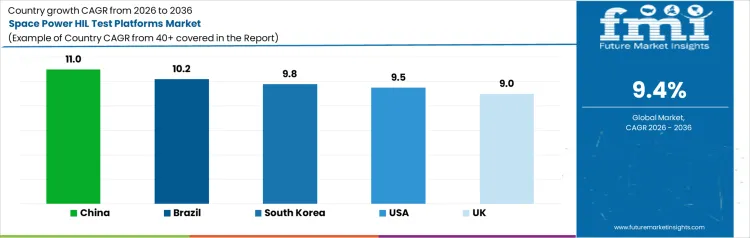
| Country | CAGR (%) |
|---|---|
| China | 11.0 |
| Brazil | 10.2 |
| South Korea | 9.8 |
| USA | 9.5 |
| UK | 9.0 |
What factors are driving rapid adoption of space power HIL platforms in China?
China drives demand through expansion of satellite constellations, high-power payload integration, and policy-backed space infrastructure investment. Country’s CAGR of 11.0% reflects widespread deployment of HIL platforms to validate solar arrays, batteries, power management units, and fault scenarios. Manufacturers prioritize closed-loop testing to reduce on-orbit failure risk. In-house HIL capability supports parallel development and shortened qualification timelines. Platforms emphasize scalability, real-time simulation accuracy, and automation. Academic and state laboratories also expand power system testing capacity. Growth remains volume-driven and strategically aligned with national space system reliability objectives.
- Large-scale satellite and constellation programs
- In-house validation of complex power subsystems
- Emphasis on real-time and closed-loop simulation
- Government-backed infrastructure investment
Why is Brazil emerging as a high-growth adopter of space power HIL systems?
Brazil demand is shaped by national space capability building, satellite power subsystem development, and academic research initiatives. Country’s CAGR of 10.2% reflects increasing use of HIL platforms for power electronics validation and fault response testing. Shared facilities enable efficient capital utilization across institutions. Collaboration with international partners encourages alignment with global test methodologies. Demand favors modular HIL systems suitable for small satellite platforms. Growth remains research-led and capability-focused, aligned with gradual progression toward operational satellite power system maturity.
- National and academic power system programs
- Shared HIL testing infrastructure
- Alignment with international validation standards
- Modular system adoption
How does South Korea’s electronics expertise shape HIL platform demand?
South Korea demand reflects strong power electronics manufacturing, system integration expertise, and defense-related space programs. Country’s CAGR of 9.8% is supported by adoption of HIL platforms for validating power converters, batteries, and control software. Manufacturers emphasize accuracy, latency control, and fault injection capability. Government programs promote standardized testing to ensure mission reliability. Compact and high-fidelity HIL setups suit space-constrained facilities. Growth remains technology-driven, aligned with precision engineering strengths and increasing complexity of onboard power systems.
- Power electronics and control system validation
- Precision and latency-sensitive testing needs
- Standardized qualification initiatives
- Compact high-fidelity HIL platforms
What market dynamics sustain steady growth in the USA?
USA demand is driven by commercial satellite manufacturers, constellation operators, and defense space programs. Country’s CAGR of 9.5% reflects reliance on HIL platforms to accelerate development and verify power subsystem behavior under mission scenarios. Companies integrate HIL testing with digital engineering workflows and software validation. Flexible platforms support rapid iteration and multiple mission profiles. Outsourced testing complements internal capacity during peak development phases. Growth remains commercialization-led, aligned with fast development cycles and high reliability expectations.
- Commercial and defense satellite programs
- Integration with digital engineering workflows
- Rapid iteration and scenario testing
- Combination of in-house and outsourced validation
How is the UK positioning within the global space power HIL ecosystem?
UK demand reflects growth of small satellite manufacturers, power electronics startups, and collaborative research centers. Country’s CAGR of 9.0% is supported by investment in shared HIL facilities serving multiple programs. Platforms enable subsystem validation, software testing, and customer acceptance processes. Government funding encourages industry collaboration and export-oriented testing services. Demand favors adaptable HIL architectures compatible with diverse satellite designs. Growth remains ecosystem-driven, aligned with positioning as a hub for satellite power system validation and testing services.
- Small satellite and startup-led demand
- Shared and collaborative HIL facilities
- Subsystem and software validation focus
- Government-supported infrastructure development
What is the competitive landscape of demand for space power HIL test platforms globally?
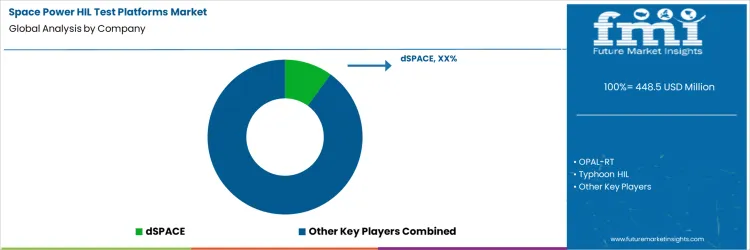
Demand for space power HIL test platforms is driven by electrification of spacecraft architectures and power subsystem complexity. Applications include validation of power distribution units, solar array regulators, battery management systems, and electric propulsion power electronics. Buyers require real-time simulation accuracy, deterministic latency, and hardware synchronization across multi-domain power models. Procurement teams evaluate model fidelity, scalability, fault injection capability, and compliance with space qualification workflows. Reliability under long-duration closed-loop testing and repeatable fault scenarios influences vendor selection decisions. Trend in the space power market reflects higher power levels, hybrid architectures, and tighter integration with digital engineering workflows.
dSPACE maintains strong positioning through real-time HIL platforms supporting power electronics and embedded controller validation. OPAL-RT supplies real-time simulators used for power system testing with emphasis on scalability and parallel computation. Typhoon HIL focuses on power electronics HIL platforms optimized for fast switching devices and detailed converter modeling. Speedgoat supports processor-in-the-loop and HIL testing through real-time target machines integrated with MATLAB-based workflows. NI, operating under Emerson Test and Measurement, provides modular HIL hardware and deterministic I O for power validation.
RTDS Technologies supports real-time electromagnetic transient simulation for high-fidelity power network testing. Keysight Technologies contributes power device emulation, measurement instrumentation, and system-level validation solutions. MathWorks and Siemens Digital Industries Software provide modeling, code generation, and digital twin integration supporting HIL workflows. Plexim delivers real-time simulation platforms specialized in power electronics and control verification.
Key Players in the Space Power HIL Test Platforms Market
- dSPACE
- OPAL-RT
- Typhoon HIL
- Speedgoat
- NI (Emerson Test & Measurement)
- RTDS Technologies
- Keysight Technologies
- MathWorks
- Siemens Digital Industries Software
- Plexim
Scope of the Report
| Items | Values |
|---|---|
| Quantitative Units | USD million |
| System Under Test | Solar Array Simulators & MPPT; Battery Systems; Power Distribution Units (PDU); EP Power Systems & Other Space Power Subsystems |
| Platform Type | GEO Satellites; LEO Constellations; Launch Vehicle Power Systems; Lunar Missions |
| Offering | Real-Time Simulators; Power Interfaces; Model Libraries & Software; Integration & Engineering Services |
| End User | Satellite OEMs; Component Suppliers; Space Agencies; Test Service Providers |
| Regions Covered | Asia Pacific; Europe; North America; Latin America; Middle East & Africa |
| Countries Covered | USA; China; Germany; France; UK; Japan; India; South Korea; and 40+ countries |
| Key Companies Profiled | dSPACE; OPAL-RT; Typhoon HIL; Speedgoat; NI (Emerson Test & Measurement); RTDS Technologies; Keysight Technologies; MathWorks; Siemens Digital Industries Software; Plexim |
| Additional Attributes | Growth is supported by rising deployment of LEO constellations, electric propulsion platforms, and lunar missions. Demand centers on real-time power validation, fault injection, hardware-in-the-loop accuracy, and system-level integration for qualification of space-grade power electronics across global space programs. |
Space Power HIL Test Platforms Market by Segment
System Under Test:
- Solar Array Simulators & MPPT
- Battery
- Power Distribution Units (PDU)
- EP Power Systems & Other
Platform Type:
- GEO
- LEO Constellations
- Launch
- Lunar
Offering:
- Real-Time Simulator
- Power Interfaces
- Model Libraries & Software
- Integration & Services
By End User:
- Satellite OEMs
- Component Suppliers
- Agencies
- Test Service Providers
Region:
- Asia Pacific
- China
- Japan
- South Korea
- India
- Australia & New Zealand
- ASEAN
- Rest of Asia Pacific
- Europe
- Germany
- United Kingdom
- France
- Italy
- Spain
- Nordic
- BENELUX
- Rest of Europe
- North America
- United States
- Canada
- Mexico
- Latin America
- Brazil
- Chile
- Rest of Latin America
- Middle East & Africa
- Kingdom of Saudi Arabia
- Other GCC Countries
- Turkey
- South Africa
- Other African Union
- Rest of Middle East & Africa
Frequently Asked Questions
How big is the space power hil test platforms market in 2026?
The global space power hil test platforms market is estimated to be valued at USD 448.5 million in 2026.
What will be the size of space power hil test platforms market in 2036?
The market size for the space power hil test platforms market is projected to reach USD 1,101.4 million by 2036.
How much will be the space power hil test platforms market growth between 2026 and 2036?
The space power hil test platforms market is expected to grow at a 9.4% CAGR between 2026 and 2036.
What are the key product types in the space power hil test platforms market?
The key product types in space power hil test platforms market are solar array simulators & mppt, battery, power distribution units (pdu) and ep power systems & other.
Which platform type segment to contribute significant share in the space power hil test platforms market in 2026?
In terms of platform type, geo segment to command 34.0% share in the space power hil test platforms market in 2026.
Preview the report firsthand - request a free sample
Get SampleGet the brochure for pricing and purchase details.
Get PDFTable of Content
- Executive Summary
- Global Market Outlook
- Demand-side Trends
- Supply-side Trends
- Technology Roadmap Analysis
- Analysis and Recommendations
- Market Overview
- Market Coverage / Taxonomy
- Market Definition / Scope / Limitations
- Market Background
- Market Dynamics
- Drivers
- Restraints
- Opportunity
- Trends
- Scenario Forecast
- Demand in Optimistic Scenario
- Demand in Likely Scenario
- Demand in Conservative Scenario
- Opportunity Map Analysis
- Product Life Cycle Analysis
- Supply Chain Analysis
- Investment Feasibility Matrix
- Value Chain Analysis
- PESTLE and Porter’s Analysis
- Regulatory Landscape
- Regional Parent Market Outlook
- Production and Consumption Statistics
- Import and Export Statistics
- Market Dynamics
- Global Market Analysis 2021 to 2025 and Forecast, 2026 to 2036
- Historical Market Size Value (USD Million) Analysis, 2021 to 2025
- Current and Future Market Size Value (USD Million) Projections, 2026 to 2036
- Y-o-Y Growth Trend Analysis
- Absolute $ Opportunity Analysis
- Global Market Pricing Analysis 2021 to 2025 and Forecast 2026 to 2036
- Global Market Analysis 2021 to 2025 and Forecast 2026 to 2036, By System Under Test
- Introduction / Key Findings
- Historical Market Size Value (USD Million) Analysis By System Under Test , 2021 to 2025
- Current and Future Market Size Value (USD Million) Analysis and Forecast By System Under Test , 2026 to 2036
- Solar Array Simulators & MPPT
- Battery
- Power Distribution Value (USD Million)s (PDU)
- EP Power Systems & Other
- Y-o-Y Growth Trend Analysis By System Under Test , 2021 to 2025
- Absolute $ Opportunity Analysis By System Under Test , 2026 to 2036
- Global Market Analysis 2021 to 2025 and Forecast 2026 to 2036, By Platform Type
- Introduction / Key Findings
- Historical Market Size Value (USD Million) Analysis By Platform Type, 2021 to 2025
- Current and Future Market Size Value (USD Million) Analysis and Forecast By Platform Type, 2026 to 2036
- GEO
- LEO Constellations
- Launch
- Lunar
- Y-o-Y Growth Trend Analysis By Platform Type, 2021 to 2025
- Absolute $ Opportunity Analysis By Platform Type, 2026 to 2036
- Global Market Analysis 2021 to 2025 and Forecast 2026 to 2036, By Offering
- Introduction / Key Findings
- Historical Market Size Value (USD Million) Analysis By Offering, 2021 to 2025
- Current and Future Market Size Value (USD Million) Analysis and Forecast By Offering, 2026 to 2036
- Real-Time Simulator
- Power Interfaces
- Model Libraries & Software
- Integration & Services
- Y-o-Y Growth Trend Analysis By Offering, 2021 to 2025
- Absolute $ Opportunity Analysis By Offering, 2026 to 2036
- Global Market Analysis 2021 to 2025 and Forecast 2026 to 2036, By By End User
- Introduction / Key Findings
- Historical Market Size Value (USD Million) Analysis By By End User, 2021 to 2025
- Current and Future Market Size Value (USD Million) Analysis and Forecast By By End User, 2026 to 2036
- Satellite OEMs
- Component Suppliers
- Agencies
- Test Service Providers
- Y-o-Y Growth Trend Analysis By By End User, 2021 to 2025
- Absolute $ Opportunity Analysis By By End User, 2026 to 2036
- Global Market Analysis 2021 to 2025 and Forecast 2026 to 2036, By Region
- Introduction
- Historical Market Size Value (USD Million) Analysis By Region, 2021 to 2025
- Current Market Size Value (USD Million) Analysis and Forecast By Region, 2026 to 2036
- North America
- Latin America
- Western Europe
- Eastern Europe
- East Asia
- South Asia and Pacific
- Middle East & Africa
- Market Attractiveness Analysis By Region
- North America Market Analysis 2021 to 2025 and Forecast 2026 to 2036, By Country
- Historical Market Size Value (USD Million) Trend Analysis By Market Taxonomy, 2021 to 2025
- Market Size Value (USD Million) Forecast By Market Taxonomy, 2026 to 2036
- By Country
- USA
- Canada
- Mexico
- By System Under Test
- By Platform Type
- By Offering
- By By End User
- By Country
- Market Attractiveness Analysis
- By Country
- By System Under Test
- By Platform Type
- By Offering
- By By End User
- Key Takeaways
- Latin America Market Analysis 2021 to 2025 and Forecast 2026 to 2036, By Country
- Historical Market Size Value (USD Million) Trend Analysis By Market Taxonomy, 2021 to 2025
- Market Size Value (USD Million) Forecast By Market Taxonomy, 2026 to 2036
- By Country
- Brazil
- Chile
- Rest of Latin America
- By System Under Test
- By Platform Type
- By Offering
- By By End User
- By Country
- Market Attractiveness Analysis
- By Country
- By System Under Test
- By Platform Type
- By Offering
- By By End User
- Key Takeaways
- Western Europe Market Analysis 2021 to 2025 and Forecast 2026 to 2036, By Country
- Historical Market Size Value (USD Million) Trend Analysis By Market Taxonomy, 2021 to 2025
- Market Size Value (USD Million) Forecast By Market Taxonomy, 2026 to 2036
- By Country
- Germany
- UK
- Italy
- Spain
- France
- Nordic
- BENELUX
- Rest of Western Europe
- By System Under Test
- By Platform Type
- By Offering
- By By End User
- By Country
- Market Attractiveness Analysis
- By Country
- By System Under Test
- By Platform Type
- By Offering
- By By End User
- Key Takeaways
- Eastern Europe Market Analysis 2021 to 2025 and Forecast 2026 to 2036, By Country
- Historical Market Size Value (USD Million) Trend Analysis By Market Taxonomy, 2021 to 2025
- Market Size Value (USD Million) Forecast By Market Taxonomy, 2026 to 2036
- By Country
- Russia
- Poland
- Hungary
- Balkan & Baltic
- Rest of Eastern Europe
- By System Under Test
- By Platform Type
- By Offering
- By By End User
- By Country
- Market Attractiveness Analysis
- By Country
- By System Under Test
- By Platform Type
- By Offering
- By By End User
- Key Takeaways
- East Asia Market Analysis 2021 to 2025 and Forecast 2026 to 2036, By Country
- Historical Market Size Value (USD Million) Trend Analysis By Market Taxonomy, 2021 to 2025
- Market Size Value (USD Million) Forecast By Market Taxonomy, 2026 to 2036
- By Country
- China
- Japan
- South Korea
- By System Under Test
- By Platform Type
- By Offering
- By By End User
- By Country
- Market Attractiveness Analysis
- By Country
- By System Under Test
- By Platform Type
- By Offering
- By By End User
- Key Takeaways
- South Asia and Pacific Market Analysis 2021 to 2025 and Forecast 2026 to 2036, By Country
- Historical Market Size Value (USD Million) Trend Analysis By Market Taxonomy, 2021 to 2025
- Market Size Value (USD Million) Forecast By Market Taxonomy, 2026 to 2036
- By Country
- India
- ASEAN
- Australia & New Zealand
- Rest of South Asia and Pacific
- By System Under Test
- By Platform Type
- By Offering
- By By End User
- By Country
- Market Attractiveness Analysis
- By Country
- By System Under Test
- By Platform Type
- By Offering
- By By End User
- Key Takeaways
- Middle East & Africa Market Analysis 2021 to 2025 and Forecast 2026 to 2036, By Country
- Historical Market Size Value (USD Million) Trend Analysis By Market Taxonomy, 2021 to 2025
- Market Size Value (USD Million) Forecast By Market Taxonomy, 2026 to 2036
- By Country
- Kingdom of Saudi Arabia
- Other GCC Countries
- Turkiye
- South Africa
- Other African Union
- Rest of Middle East & Africa
- By System Under Test
- By Platform Type
- By Offering
- By By End User
- By Country
- Market Attractiveness Analysis
- By Country
- By System Under Test
- By Platform Type
- By Offering
- By By End User
- Key Takeaways
- Key Countries Market Analysis
- USA
- Pricing Analysis
- Market Share Analysis, 2025
- By System Under Test
- By Platform Type
- By Offering
- By By End User
- Canada
- Pricing Analysis
- Market Share Analysis, 2025
- By System Under Test
- By Platform Type
- By Offering
- By By End User
- Mexico
- Pricing Analysis
- Market Share Analysis, 2025
- By System Under Test
- By Platform Type
- By Offering
- By By End User
- Brazil
- Pricing Analysis
- Market Share Analysis, 2025
- By System Under Test
- By Platform Type
- By Offering
- By By End User
- Chile
- Pricing Analysis
- Market Share Analysis, 2025
- By System Under Test
- By Platform Type
- By Offering
- By By End User
- Germany
- Pricing Analysis
- Market Share Analysis, 2025
- By System Under Test
- By Platform Type
- By Offering
- By By End User
- UK
- Pricing Analysis
- Market Share Analysis, 2025
- By System Under Test
- By Platform Type
- By Offering
- By By End User
- Italy
- Pricing Analysis
- Market Share Analysis, 2025
- By System Under Test
- By Platform Type
- By Offering
- By By End User
- Spain
- Pricing Analysis
- Market Share Analysis, 2025
- By System Under Test
- By Platform Type
- By Offering
- By By End User
- France
- Pricing Analysis
- Market Share Analysis, 2025
- By System Under Test
- By Platform Type
- By Offering
- By By End User
- India
- Pricing Analysis
- Market Share Analysis, 2025
- By System Under Test
- By Platform Type
- By Offering
- By By End User
- ASEAN
- Pricing Analysis
- Market Share Analysis, 2025
- By System Under Test
- By Platform Type
- By Offering
- By By End User
- Australia & New Zealand
- Pricing Analysis
- Market Share Analysis, 2025
- By System Under Test
- By Platform Type
- By Offering
- By By End User
- China
- Pricing Analysis
- Market Share Analysis, 2025
- By System Under Test
- By Platform Type
- By Offering
- By By End User
- Japan
- Pricing Analysis
- Market Share Analysis, 2025
- By System Under Test
- By Platform Type
- By Offering
- By By End User
- South Korea
- Pricing Analysis
- Market Share Analysis, 2025
- By System Under Test
- By Platform Type
- By Offering
- By By End User
- Russia
- Pricing Analysis
- Market Share Analysis, 2025
- By System Under Test
- By Platform Type
- By Offering
- By By End User
- Poland
- Pricing Analysis
- Market Share Analysis, 2025
- By System Under Test
- By Platform Type
- By Offering
- By By End User
- Hungary
- Pricing Analysis
- Market Share Analysis, 2025
- By System Under Test
- By Platform Type
- By Offering
- By By End User
- Kingdom of Saudi Arabia
- Pricing Analysis
- Market Share Analysis, 2025
- By System Under Test
- By Platform Type
- By Offering
- By By End User
- Turkiye
- Pricing Analysis
- Market Share Analysis, 2025
- By System Under Test
- By Platform Type
- By Offering
- By By End User
- South Africa
- Pricing Analysis
- Market Share Analysis, 2025
- By System Under Test
- By Platform Type
- By Offering
- By By End User
- USA
- Market Structure Analysis
- Competition Dashboard
- Competition Benchmarking
- Market Share Analysis of Top Players
- By Regional
- By System Under Test
- By Platform Type
- By Offering
- By By End User
- Competition Analysis
- Competition Deep Dive
- dSPACE
- Overview
- Product Portfolio
- Profitability by Market Segments (Product/Age /Sales Channel/Region)
- Sales Footprint
- Strategy Overview
- Marketing Strategy
- Product Strategy
- Channel Strategy
- OPAL-RT
- Typhoon HIL
- Speedgoat
- NI (Emerson Test & Measurement)
- RTDS Technologies
- Keysight Technologies
- MathWorks
- Siemens Digital Industries Software
- Plexim
- dSPACE
- Competition Deep Dive
- Assumptions & Acronyms Used
- Research Methodology


