

- Industry Size (2026)
- USD 2758.6 Mn
- Forecast (2036)
- USD 4987 Mn
- CAGR (2026 to 2036)
- 6.1%
Data Center Power Quality Monitoring Market Forecast and Outlook 2026 to 2036
The data center power quality monitoring demand is valued at USD 2,758.6 million in 2026 and is projected to reach USD 4,987 million by market, expanding at a CAGR of 6.1%. Growth is driven by rising power density, increasing deployment of AI and high-performance computing workloads, and stricter uptime requirements across critical digital infrastructure. Operators prioritize continuous monitoring of voltage stability, harmonics, transients, and load balance to prevent equipment damage, minimize downtime risk, and maintain operational resilience under fluctuating demand conditions.
Hyperscale data centers represent leading facility-size demand, reflecting large-scale cloud expansion and consolidation of compute resources. These facilities operate complex electrical architectures with high redundancy, making granular power quality visibility essential for asset protection and capacity planning. Efficiency and PUE optimization represent leading use cases, as energy costs and sustainability targets push operators to reduce losses, identify inefficiencies, and optimize power distribution paths. Adoption patterns indicate preference for integrated monitoring platforms that support real-time analytics, historical trend analysis, and predictive maintenance.
Quick Stats for Data Center Power Quality Monitoring Market
- Data Center Power Quality Monitoring Market Value (2026): USD 2,758.6 million
- Data Center Power Quality Monitoring Market Forecast Value (2036): USD 4,987 million
- Data Center Power Quality Monitoring Market Forecast CAGR (2026 to 2036): 6.1%
- Leading Facility Size in Global Demand: Hyperscale Data Centers
- Leading Use Case in Global Demand: Efficiency and PUE Optimization
- Fastest-Growing Countries: China, Brazil, South Korea, USA, Germany
- Top Players in Global Demand: Schneider Electric, Eaton, Vertiv, ABB, Siemens, Socomec, Fluke, Emerson, Janitza, Accuenergy
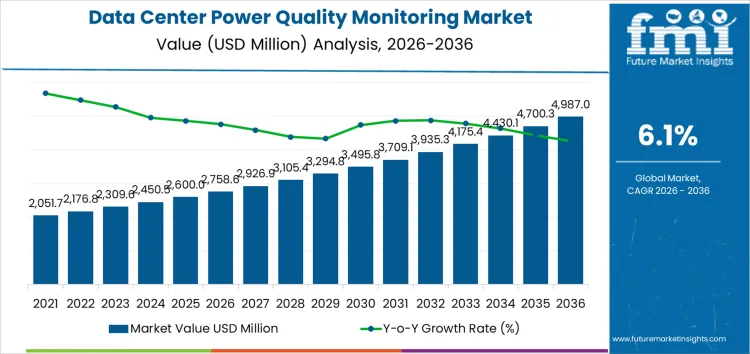
China, Brazil, South Korea, USA, and Germany emerge as fastest-growing countries, supported by new hyperscale builds and modernization of legacy facilities. Competitive landscape includes Schneider Electric, Eaton, Vertiv, ABB, and Siemens. These suppliers focus on high-accuracy sensors, intelligent analytics software, and scalable architectures aligned with evolving hyperscale power requirements.
Data Center Power Quality Monitoring Market Key Takeaways
| Metric | Value |
|---|---|
| Market Value (2026) | USD 2,758.6 million |
| Market Forecast Value (2036) | USD 4,987 million |
| Forecast CAGR (2026 to 2036) | 6.1% |
Why is the Demand for Data Center Power Quality Monitoring Market Growing?
Demand for data center power quality monitoring solutions is growing globally due to expanding reliance on digital infrastructure, cloud services, and mission critical compute workloads. Data centers require continuous visibility into voltage stability, frequency variation, harmonics, and transient events that can degrade equipment performance or cause unplanned downtime. Growth in hyperscale facilities, edge computing installations, and colocation campuses increases complexity of power distribution systems, which strengthens need for monitoring technologies that detect anomalies in real time. Operators adopt power quality monitoring to optimize uptime, support predictive maintenance, and improve energy efficiency across uninterruptible power supplies, generators, and distribution units.
Telecommunications networks and financial trading platforms depend on stable power delivery to support latency sensitive operations. Renewable energy integration and micro grid adoption within data centers introduce variability, which requires advanced monitoring to manage transitions and maintain service continuity. Standardization of uptime metrics and service level agreements encourages structured implementation of monitoring platforms to meet performance expectations. Test labs, certification bodies, and equipment manufacturers invest in quality measurement tools to verify compliance with international power standards. Global emphasis on operational resilience, cost control, and lifecycle performance reinforces continued demand for power quality monitoring across data centers worldwide.
How Are the Segments Classified in the Data Center Power Quality Monitoring Market?
Demand for data center power quality monitoring globally is shaped by rising power density, uptime accountability, and efficiency optimization requirements. Operators assess voltage stability, harmonic distortion visibility, real-time analytics, and integration with facility management systems. Adoption patterns reflect expansion of hyperscale infrastructure, growth of colocation capacity, and increased focus on continuous monitoring to support reliability, energy performance, and regulatory transparency.
Which Facility Size Represents the Largest Share of Global Demand?
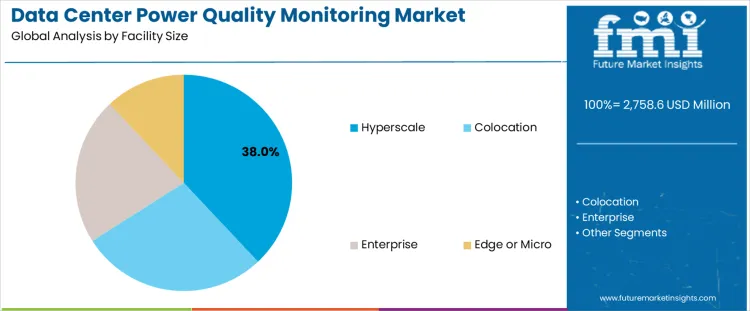
Hyperscale facilities hold 38.0%, representing the largest share of global demand. These facilities operate at high power densities, requiring continuous monitoring to manage load balance, power quality anomalies, and efficiency metrics. Colocation facilities hold 28.0%, supporting multi-tenant environments where power transparency and contractual performance assurance remain critical. Enterprise data centers account for 22.0%, focusing on internal reliability and infrastructure protection. Edge or micro data centers hold 12.0%, supporting localized computing with constrained power environments. Facility-size distribution reflects concentration of monitoring demand within large-scale power-intensive environments.
Key Points:
- Hyperscale sites dominate due to high power density and scale.
- Colocation facilities require tenant-level power visibility.
- Enterprise and edge sites address localized reliability needs.
Which Deployment Model Drives the Highest Share of Global Adoption?
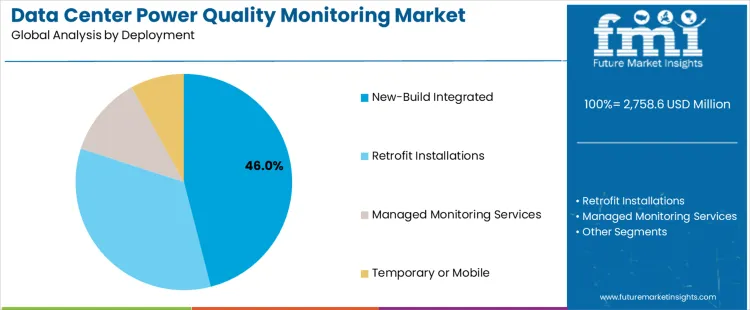
New-build integrated deployments hold 46.0%, driving the highest share of global adoption. Integrated monitoring enables power quality visibility from initial commissioning and supports optimized infrastructure design. Retrofit installations hold 34.0%, addressing legacy facilities requiring upgraded visibility and compliance alignment. Managed monitoring services account for 12.0%, supporting outsourced analytics and operational oversight. Temporary or mobile deployments hold 8.0%, addressing short-term capacity or transitional infrastructure needs. Deployment distribution reflects preference for embedded monitoring during initial facility development.
Key Points:
- New-build integration leads due to early-stage optimization benefits.
- Retrofits address legacy infrastructure visibility gaps.
- Managed and temporary models support flexible monitoring needs.
Which Use Case Accounts for the Largest Share of Global Demand?
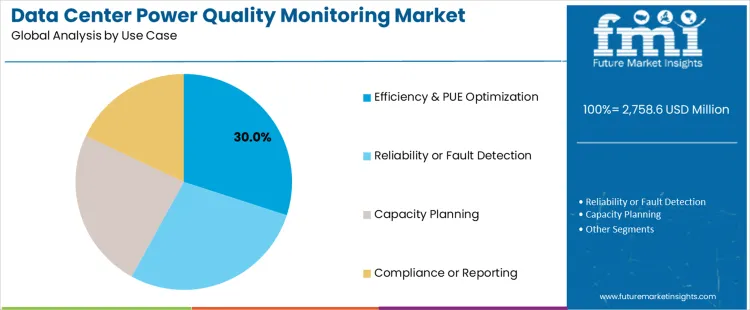
Efficiency and PUE optimization hold 30.0%, accounting for the largest share of global demand. Power quality data supports identification of losses, imbalance, and inefficiencies affecting overall facility performance. Reliability and fault detection account for 28.0%, enabling early identification of power disturbances and equipment risk. Capacity planning holds 24.0%, supporting informed expansion and load management decisions. Compliance and reporting account for 18.0%, addressing regulatory, contractual, and sustainability disclosure requirements. Use-case distribution reflects emphasis on efficiency and operational resilience.
Key Points:
- Efficiency optimization leads due to energy cost pressure.
- Reliability monitoring supports uptime assurance.
- Planning and compliance rely on accurate power data.
What are the Key Dynamics in the Data Center Power Quality Monitoring Market?
Global demand rises as data centers, colocation facilities, and cloud infrastructure providers adopt power quality monitoring systems to ensure reliability, uptime, and electrical stability. Monitoring solutions track voltage variation, harmonic distortion, frequency stability, and transient events across distribution networks and critical loads. Adoption aligns with rapid expansion of digital services, edge computing nodes, and enterprise IT workloads requiring uninterrupted power performance. Usage spans hyperscale facilities, regional data centers, and mission-critical installations prioritizing resilience and efficiency.
How do reliability requirements and operational efficiency priorities shape global demand?
Data center operators emphasize power quality to prevent equipment damage, avoid downtime, and optimize energy use. Real-time monitoring provides visibility into power distribution units, uninterruptible power supplies, and backup generators, enabling prompt response to anomalies. Hyperscale cloud providers deploy comprehensive monitoring to support service-level agreements and minimize risk of outages impacting critical services. Edge facilities and telecom nodes leverage compact monitoring systems to protect IT loads in distributed environments. Correlation of power quality data with environmental and workload metrics supports predictive maintenance, capacity planning, and energy optimization across diverse facilities. Standardized reporting and analytics reinforce consistency across multi-site operations.
How does technology integration complexity, cost pressures, and infrastructure variance influence market scalability?
Power quality monitoring platforms involve investment in sensors, data acquisition, analytics software, and integration with building management and IT systems. Variety of electrical architectures from legacy UPS systems to modern modular power electronics requires adaptable monitoring interfaces and protocols. Data interpretation demands skilled engineers to diagnose root causes and plan corrective actions. Cost sensitivity in smaller and edge data centers influences adoption timing and feature selection. Regional variation in electrical grid stability affects monitoring priorities and threshold criteria. Integration with broader DCIM and energy management frameworks introduces additional interoperability considerations. Global growth depends on modular, scalable monitoring solutions and harmonized data standards that support diverse facility sizes and operating conditions across the expanding global data center ecosystem.
How Is Demand for Data Center Power Quality Monitoring Evolving?
Demand for data center power quality monitoring is increasing globally due to higher rack densities, sensitive IT loads, and stricter uptime requirements. China leads with a 7.8% CAGR, supported by hyperscale expansion and in-house electrical validation. Brazil follows at 7.4%, driven by new facilities and grid variability management. South Korea records a 6.1% CAGR, shaped by dense urban deployments and electronics reliability standards. USA posts 6.0%, reflecting lifecycle monitoring across a large installed base. Germany records 5.8%, supported by compliance-driven monitoring and industrial colocation growth. Growth reflects need for continuous visibility into harmonics, transients, and power continuity worldwide.
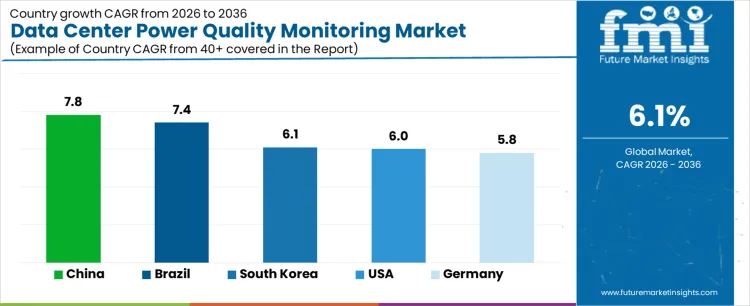
| Country | CAGR (%) |
|---|---|
| China | 7.8% |
| Brazil | 7.4% |
| South Korea | 6.1% |
| USA | 6.0% |
| Germany | 5.8% |
What factors are accelerating power quality monitoring adoption in China?
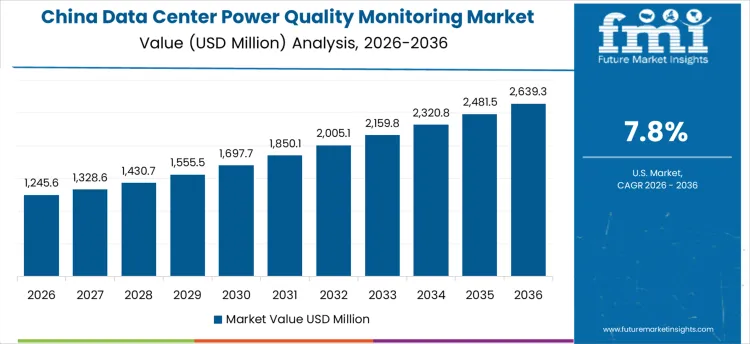
China drives demand through rapid buildout of hyperscale and regional data centers supporting cloud and AI workloads. Country’s CAGR of 7.8% reflects extensive monitoring of harmonics, voltage sags, and transient events across complex electrical architectures. Operators deploy meters and analytics to protect sensitive accelerators and improve energy efficiency. In-house monitoring shortens fault isolation time and supports preventive maintenance. Platforms emphasize scalability, real-time analytics, and integration with building management systems. Government-backed digital infrastructure programs sustain deployment volumes. Growth remains scale-driven and operations-focused, aligned with aggressive capacity expansion and reliability targets.
- Hyperscale and regional data center expansion
- Continuous monitoring of harmonics and transients
- Real-time analytics integrated with BMS
- Government-supported digital infrastructure programs
Why is Brazil showing strong growth in power quality monitoring demand?
Brazil demand is shaped by new data center construction, regional expansion, and grid variability considerations. Country’s CAGR of 7.4% reflects investment in monitoring to manage voltage fluctuations, outages, and power factor issues. Operators use analytics to optimize UPS performance and generator coordination. Shared service providers support deployment and interpretation of monitoring data. Collaboration with global vendors enables adoption of standardized metrics. Demand favors modular systems suitable for phased buildouts. Growth remains capability-building focused, aligned with improving resilience and operational efficiency.
- New data center builds and regional expansion
- Management of grid variability and outages
- UPS and generator performance optimization
- Modular monitoring systems for phased rollout
How do dense deployments influence monitoring needs in South Korea?
South Korea demand reflects dense urban data centers, high electronics sensitivity, and strict service continuity expectations. Country’s CAGR of 6.1% is supported by monitoring for voltage stability, frequency variation, and electromagnetic interference. Operators prioritize precision measurement and fast alerting to prevent equipment damage. Government-backed initiatives encourage standardized power quality practices. Systems emphasize compact form factors and high accuracy. Growth remains technology-driven, aligned with reliability standards and performance-critical operations.
- Dense urban data center environments
- Precision monitoring for voltage and frequency
- Fast alerting and fault prevention
- Standardized power quality practices
What dynamics sustain steady growth of power quality monitoring in the USA?
USA demand is driven by a large installed base requiring lifecycle monitoring, upgrades, and efficiency improvements. Country’s CAGR of 6.0% reflects adoption of monitoring to support retrofit projects and integration of renewable sources. Operators analyze power quality data to reduce downtime and maintenance costs. Platforms integrate with DCIM and analytics tools. Procurement emphasizes interoperability and standards compliance. Growth remains lifecycle-driven, aligned with modernization and operational optimization.
- Large installed base lifecycle monitoring
- Support for retrofits and renewable integration
- Analytics-driven downtime reduction
- Interoperable and standards-compliant systems
How is Germany positioned within the global power quality monitoring landscape?
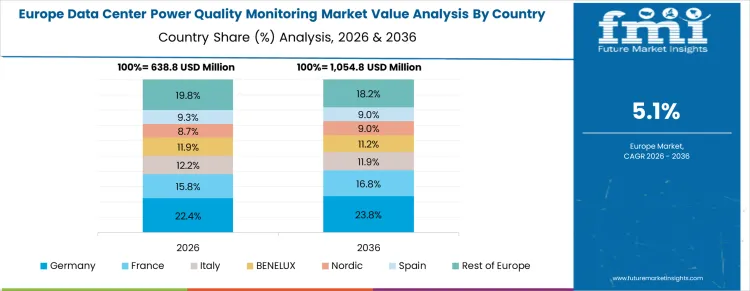
Germany demand reflects strong compliance culture, energy efficiency focus, and industrial colocation growth. Country’s CAGR of 5.8% is supported by monitoring to meet regulatory requirements and ensure deterministic power delivery. Operators validate harmonics and power factor across complex loads. Shared institutes and service providers expand access to expertise. Procurement favors documentation, traceability, and long-term data retention. Growth remains engineering-led, aligned with reliability and compliance expectations.
- Compliance-driven monitoring requirements
- Focus on energy efficiency and power factor
- Access to shared expertise and services
- Emphasis on documentation and traceability
What is the competitive landscape of demand for data center power quality monitoring?
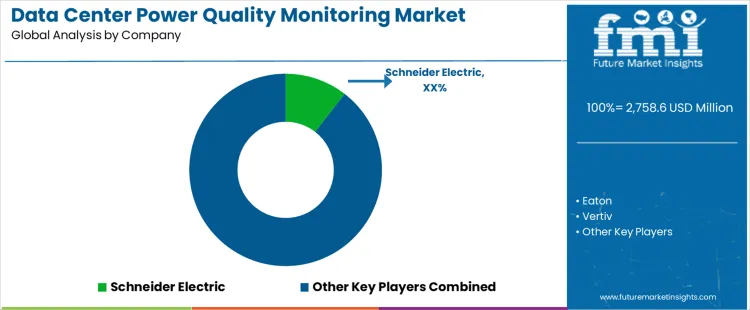
Demand for data center power quality monitoring is driven by hyperscale expansion, colocation growth, and rising sensitivity of digital infrastructure to power disturbances. Monitoring systems track voltage stability, harmonics, transients, power factor, and energy efficiency across critical electrical distribution points. Buyers prioritize real-time visibility, high measurement accuracy, cybersecurity resilience, and integration with building management and data center infrastructure management platforms. Procurement teams assess scalability across multi-site deployments, compliance with international power quality standards, and ability to support predictive maintenance strategies. Trend in the global market reflects higher rack power densities, increased use of distributed energy resources, and stronger focus on uptime assurance and operational efficiency.
Schneider Electric holds strong positioning through integrated power monitoring solutions embedded within its broader data center electrical and software ecosystems. Eaton and Vertiv support demand with power quality meters and analytics aligned with UPS, switchgear, and critical power infrastructure. ABB and Siemens contribute industrial-grade monitoring platforms used in large-scale and mission-critical data centers worldwide. Socomec and Janitza specialize in advanced power quality analyzers adopted for granular energy and disturbance analysis. Fluke, part of Fortive, provides portable and fixed monitoring instruments widely used for diagnostics and compliance verification. Emerson and Accuenergy support monitoring through power management systems and networked metering solutions. Competitive differentiation depends on measurement precision, software analytics depth, interoperability, and global service capability.
Key Players in the Data Center Power Quality Monitoring Market
- Schneider Electric
- Eaton
- Vertiv
- ABB
- Siemens
- Socomec
- Fluke (Fortive)
- Emerson
- Janitza
- Accuenergy
Scope of the Report
| Items | Values |
|---|---|
| Quantitative Units | USD million |
| Facility Size | Hyperscale Data Centers; Colocation Facilities; Enterprise Data Centers; Edge or Micro Data Centers |
| Deployment | New-Build Integrated Monitoring; Retrofit Installations; Managed Power Quality Monitoring Services; Temporary or Mobile Monitoring Systems |
| Use Case | Efficiency and PUE Optimization; Reliability Monitoring and Fault Detection; Capacity Planning and Load Management; Regulatory Compliance and Energy Reporting |
| Regions Covered | Asia Pacific; Europe; North America; Latin America; Middle East & Africa |
| Countries Covered | China; USA; Germany; Brazil; South Korea; and 40+ countries |
| Key Companies Profiled | Schneider Electric; Eaton; Vertiv; ABB; Siemens; Socomec; Fluke; Emerson; Janitza; Accuenergy |
| Additional Attributes | Demand is driven by hyperscale expansion, stricter uptime targets, and energy efficiency mandates. Adoption focuses on harmonic distortion analysis, transient detection, and real-time monitoring. Integration with DCIM and BMS platforms supports predictive maintenance, capacity forecasting, and standardized reporting across distributed data center infrastructures. |
Data Center Power Quality Monitoring Market by Segment
Facility Size:
- Hyperscale
- Colocation
- Enterprise
- Edge or Micro
Deployment:
- New-Build Integrated
- Retrofit Installations
- Managed Monitoring Services
- Temporary or Mobile
Use Case:
- Efficiency & PUE Optimization
- Reliability or Fault Detection
- Capacity Planning
- Compliance or Reporting
Region:
- Asia Pacific
- China
- Japan
- South Korea
- India
- Australia & New Zealand
- ASEAN
- Rest of Asia Pacific
- Europe
- Germany
- United Kingdom
- France
- Italy
- Spain
- Nordic
- BENELUX
- Rest of Europe
- North America
- United States
- Canada
- Mexico
- Latin America
- Brazil
- Chile
- Rest of Latin America
- Middle East & Africa
- Kingdom of Saudi Arabia
- Other GCC Countries
- Turkey
- South Africa
- Other African Union
- Rest of Middle East & Africa
Bibliography
- Schneider Electric. (2023). Power quality monitoring, analytics, and energy management solutions for hyperscale and colocation data centers. Schneider Electric SE.
- Eaton. (2023). Data center power quality monitoring systems for reliability, efficiency, and uptime assurance. Eaton Corporation plc.
- Vertiv. (2024). Electrical monitoring and power quality management for mission-critical data center infrastructure. Vertiv Group Corp.
- ABB. (2023). Power quality analyzers and monitoring platforms for high-density data centers and critical facilities. ABB Ltd.
- Siemens. (2023). Digital power monitoring and energy transparency solutions for data centers and critical infrastructure. Siemens AG.
Frequently Asked Questions
How big is the data center power quality monitoring market in 2026?
The global data center power quality monitoring market is estimated to be valued at USD 2,758.6 million in 2026.
What will be the size of data center power quality monitoring market in 2036?
The market size for the data center power quality monitoring market is projected to reach USD 4,987.0 million by 2036.
How much will be the data center power quality monitoring market growth between 2026 and 2036?
The data center power quality monitoring market is expected to grow at a 6.1% CAGR between 2026 and 2036.
What are the key product types in the data center power quality monitoring market?
The key product types in data center power quality monitoring market are hyperscale, colocation, enterprise and edge or micro.
Which deployment segment to contribute significant share in the data center power quality monitoring market in 2026?
In terms of deployment, new-build integrated segment to command 46.0% share in the data center power quality monitoring market in 2026.
Preview the report firsthand - request a free sample
Get SampleGet the brochure for pricing and purchase details.
Get PDFTable of Content
- Executive Summary
- Global Market Outlook
- Demand-side Trends
- Supply-side Trends
- Technology Roadmap Analysis
- Analysis and Recommendations
- Market Overview
- Market Coverage / Taxonomy
- Market Definition / Scope / Limitations
- Market Background
- Market Dynamics
- Drivers
- Restraints
- Opportunity
- Trends
- Scenario Forecast
- Demand in Optimistic Scenario
- Demand in Likely Scenario
- Demand in Conservative Scenario
- Opportunity Map Analysis
- Product Life Cycle Analysis
- Supply Chain Analysis
- Investment Feasibility Matrix
- Value Chain Analysis
- PESTLE and Porter’s Analysis
- Regulatory Landscape
- Regional Parent Market Outlook
- Production and Consumption Statistics
- Import and Export Statistics
- Market Dynamics
- Global Market Analysis 2021 to 2025 and Forecast, 2026 to 2036
- Historical Market Size Value (USD Million) Analysis, 2021 to 2025
- Current and Future Market Size Value (USD Million) Projections, 2026 to 2036
- Y-o-Y Growth Trend Analysis
- Absolute $ Opportunity Analysis
- Global Market Pricing Analysis 2021 to 2025 and Forecast 2026 to 2036
- Global Market Analysis 2021 to 2025 and Forecast 2026 to 2036, By Facility Size
- Introduction / Key Findings
- Historical Market Size Value (USD Million) Analysis By Facility Size , 2021 to 2025
- Current and Future Market Size Value (USD Million) Analysis and Forecast By Facility Size , 2026 to 2036
- Hyperscale
- Colocation
- Enterprise
- Edge or Micro
- Hyperscale
- Y-o-Y Growth Trend Analysis By Facility Size , 2021 to 2025
- Absolute $ Opportunity Analysis By Facility Size , 2026 to 2036
- Global Market Analysis 2021 to 2025 and Forecast 2026 to 2036, By Deployment
- Introduction / Key Findings
- Historical Market Size Value (USD Million) Analysis By Deployment, 2021 to 2025
- Current and Future Market Size Value (USD Million) Analysis and Forecast By Deployment, 2026 to 2036
- New-Build Integrated
- Retrofit Installations
- Managed Monitoring Services
- Temporary or Mobile
- New-Build Integrated
- Y-o-Y Growth Trend Analysis By Deployment, 2021 to 2025
- Absolute $ Opportunity Analysis By Deployment, 2026 to 2036
- Global Market Analysis 2021 to 2025 and Forecast 2026 to 2036, By Use Case
- Introduction / Key Findings
- Historical Market Size Value (USD Million) Analysis By Use Case, 2021 to 2025
- Current and Future Market Size Value (USD Million) Analysis and Forecast By Use Case, 2026 to 2036
- Efficiency & PUE Optimization
- Reliability or Fault Detection
- Capacity Planning
- Compliance or Reporting
- Efficiency & PUE Optimization
- Y-o-Y Growth Trend Analysis By Use Case, 2021 to 2025
- Absolute $ Opportunity Analysis By Use Case, 2026 to 2036
- Global Market Analysis 2021 to 2025 and Forecast 2026 to 2036, By Region
- Introduction
- Historical Market Size Value (USD Million) Analysis By Region, 2021 to 2025
- Current Market Size Value (USD Million) Analysis and Forecast By Region, 2026 to 2036
- North America
- Latin America
- Western Europe
- Eastern Europe
- East Asia
- South Asia and Pacific
- Middle East & Africa
- Market Attractiveness Analysis By Region
- North America Market Analysis 2021 to 2025 and Forecast 2026 to 2036, By Country
- Historical Market Size Value (USD Million) Trend Analysis By Market Taxonomy, 2021 to 2025
- Market Size Value (USD Million) Forecast By Market Taxonomy, 2026 to 2036
- By Country
- USA
- Canada
- Mexico
- By Facility Size
- By Deployment
- By Use Case
- By Country
- Market Attractiveness Analysis
- By Country
- By Facility Size
- By Deployment
- By Use Case
- Key Takeaways
- Latin America Market Analysis 2021 to 2025 and Forecast 2026 to 2036, By Country
- Historical Market Size Value (USD Million) Trend Analysis By Market Taxonomy, 2021 to 2025
- Market Size Value (USD Million) Forecast By Market Taxonomy, 2026 to 2036
- By Country
- Brazil
- Chile
- Rest of Latin America
- By Facility Size
- By Deployment
- By Use Case
- By Country
- Market Attractiveness Analysis
- By Country
- By Facility Size
- By Deployment
- By Use Case
- Key Takeaways
- Western Europe Market Analysis 2021 to 2025 and Forecast 2026 to 2036, By Country
- Historical Market Size Value (USD Million) Trend Analysis By Market Taxonomy, 2021 to 2025
- Market Size Value (USD Million) Forecast By Market Taxonomy, 2026 to 2036
- By Country
- Germany
- UK
- Italy
- Spain
- France
- Nordic
- BENELUX
- Rest of Western Europe
- By Facility Size
- By Deployment
- By Use Case
- By Country
- Market Attractiveness Analysis
- By Country
- By Facility Size
- By Deployment
- By Use Case
- Key Takeaways
- Eastern Europe Market Analysis 2021 to 2025 and Forecast 2026 to 2036, By Country
- Historical Market Size Value (USD Million) Trend Analysis By Market Taxonomy, 2021 to 2025
- Market Size Value (USD Million) Forecast By Market Taxonomy, 2026 to 2036
- By Country
- Russia
- Poland
- Hungary
- Balkan & Baltic
- Rest of Eastern Europe
- By Facility Size
- By Deployment
- By Use Case
- By Country
- Market Attractiveness Analysis
- By Country
- By Facility Size
- By Deployment
- By Use Case
- Key Takeaways
- East Asia Market Analysis 2021 to 2025 and Forecast 2026 to 2036, By Country
- Historical Market Size Value (USD Million) Trend Analysis By Market Taxonomy, 2021 to 2025
- Market Size Value (USD Million) Forecast By Market Taxonomy, 2026 to 2036
- By Country
- China
- Japan
- South Korea
- By Facility Size
- By Deployment
- By Use Case
- By Country
- Market Attractiveness Analysis
- By Country
- By Facility Size
- By Deployment
- By Use Case
- Key Takeaways
- South Asia and Pacific Market Analysis 2021 to 2025 and Forecast 2026 to 2036, By Country
- Historical Market Size Value (USD Million) Trend Analysis By Market Taxonomy, 2021 to 2025
- Market Size Value (USD Million) Forecast By Market Taxonomy, 2026 to 2036
- By Country
- India
- ASEAN
- Australia & New Zealand
- Rest of South Asia and Pacific
- By Facility Size
- By Deployment
- By Use Case
- By Country
- Market Attractiveness Analysis
- By Country
- By Facility Size
- By Deployment
- By Use Case
- Key Takeaways
- Middle East & Africa Market Analysis 2021 to 2025 and Forecast 2026 to 2036, By Country
- Historical Market Size Value (USD Million) Trend Analysis By Market Taxonomy, 2021 to 2025
- Market Size Value (USD Million) Forecast By Market Taxonomy, 2026 to 2036
- By Country
- Kingdom of Saudi Arabia
- Other GCC Countries
- Turkiye
- South Africa
- Other African Union
- Rest of Middle East & Africa
- By Facility Size
- By Deployment
- By Use Case
- By Country
- Market Attractiveness Analysis
- By Country
- By Facility Size
- By Deployment
- By Use Case
- Key Takeaways
- Key Countries Market Analysis
- USA
- Pricing Analysis
- Market Share Analysis, 2025
- By Facility Size
- By Deployment
- By Use Case
- Canada
- Pricing Analysis
- Market Share Analysis, 2025
- By Facility Size
- By Deployment
- By Use Case
- Mexico
- Pricing Analysis
- Market Share Analysis, 2025
- By Facility Size
- By Deployment
- By Use Case
- Brazil
- Pricing Analysis
- Market Share Analysis, 2025
- By Facility Size
- By Deployment
- By Use Case
- Chile
- Pricing Analysis
- Market Share Analysis, 2025
- By Facility Size
- By Deployment
- By Use Case
- Germany
- Pricing Analysis
- Market Share Analysis, 2025
- By Facility Size
- By Deployment
- By Use Case
- UK
- Pricing Analysis
- Market Share Analysis, 2025
- By Facility Size
- By Deployment
- By Use Case
- Italy
- Pricing Analysis
- Market Share Analysis, 2025
- By Facility Size
- By Deployment
- By Use Case
- Spain
- Pricing Analysis
- Market Share Analysis, 2025
- By Facility Size
- By Deployment
- By Use Case
- France
- Pricing Analysis
- Market Share Analysis, 2025
- By Facility Size
- By Deployment
- By Use Case
- India
- Pricing Analysis
- Market Share Analysis, 2025
- By Facility Size
- By Deployment
- By Use Case
- ASEAN
- Pricing Analysis
- Market Share Analysis, 2025
- By Facility Size
- By Deployment
- By Use Case
- Australia & New Zealand
- Pricing Analysis
- Market Share Analysis, 2025
- By Facility Size
- By Deployment
- By Use Case
- China
- Pricing Analysis
- Market Share Analysis, 2025
- By Facility Size
- By Deployment
- By Use Case
- Japan
- Pricing Analysis
- Market Share Analysis, 2025
- By Facility Size
- By Deployment
- By Use Case
- South Korea
- Pricing Analysis
- Market Share Analysis, 2025
- By Facility Size
- By Deployment
- By Use Case
- Russia
- Pricing Analysis
- Market Share Analysis, 2025
- By Facility Size
- By Deployment
- By Use Case
- Poland
- Pricing Analysis
- Market Share Analysis, 2025
- By Facility Size
- By Deployment
- By Use Case
- Hungary
- Pricing Analysis
- Market Share Analysis, 2025
- By Facility Size
- By Deployment
- By Use Case
- Kingdom of Saudi Arabia
- Pricing Analysis
- Market Share Analysis, 2025
- By Facility Size
- By Deployment
- By Use Case
- Turkiye
- Pricing Analysis
- Market Share Analysis, 2025
- By Facility Size
- By Deployment
- By Use Case
- South Africa
- Pricing Analysis
- Market Share Analysis, 2025
- By Facility Size
- By Deployment
- By Use Case
- USA
- Market Structure Analysis
- Competition Dashboard
- Competition Benchmarking
- Market Share Analysis of Top Players
- By Regional
- By Facility Size
- By Deployment
- By Use Case
- Competition Analysis
- Competition Deep Dive
- Schneider Electric
- Overview
- Product Portfolio
- Profitability by Market Segments (Product/Age /Sales Channel/Region)
- Sales Footprint
- Strategy Overview
- Marketing Strategy
- Product Strategy
- Channel Strategy
- Eaton
- Vertiv
- ABB
- Siemens
- Socomec
- Fluke (Fortive)
- Emerson
- Janitza
- Accuenergy
- Schneider Electric
- Competition Deep Dive
- Assumptions & Acronyms Used
- Research Methodology


