

- Industry Size (2026)
- USD 735.8 Mn
- Forecast (2036)
- USD 1618.2 Mn
- CAGR (2026 to 2036)
- 8.2%
Modular Data Center Factory Acceptance Test Market Forecast and Outlook 2026 to 2036
The modular data center factory acceptance test market is valued at USD 735.8 million in 2026 and is projected to reach USD 1,618.2 million by 2036, expanding at a CAGR of 8.2%. Growth is supported by accelerated deployment of prefabricated data centers, tighter commissioning timelines, and heightened risk sensitivity around power and cooling failures. Factory-based validation reduces on-site integration risk by identifying defects before shipment, supporting predictable deployment schedules and compliance with performance specifications across global projects.
Electrical systems testing represents leading FAT scope, reflecting criticality of power distribution units, switchgear, UPS, and protection systems in modular architectures. Verification focuses on load handling, fault response, redundancy behavior, and integration between electrical subsystems and control platforms. Emphasis on electrical validation reflects increasing power density, higher fault tolerance requirements, and rising deployment of AI-ready modules that demand stable and resilient power infrastructure prior to field installation.
China, Brazil, USA, South Korea, and Germany emerge as fastest-growing countries, supported by large-scale modular rollouts and infrastructure localization strategies. Competitive landscape includes Schneider Electric, Vertiv, Eaton, Huawei Digital Power, and Delta Electronics. These suppliers emphasize standardized FAT protocols, digital test documentation, and integrated simulation environments aligned with global modular data center delivery requirements.
Quick Stats for Modular Data Center Factory Acceptance Test Market
- Modular Data Center Factory Acceptance Test Market Value (2026): USD 735.8 million
- Modular Data Center Factory Acceptance Test Market Forecast Value (2036): USD 1,618.2 million
- Modular Data Center Factory Acceptance Test Market Forecast CAGR (2026–2036): 8.2%
- Leading FAT Scope in Global Demand: Electrical Systems Testing
- Fastest-Growing Countries: China, Brazil, USA, South Korea, Germany
- Top Players in Global Demand: Schneider Electric, Vertiv, Eaton, Huawei Digital Power, Delta Electronics, Rittal, STULZ, Mitsubishi Electric, Johnson Controls, Cummins
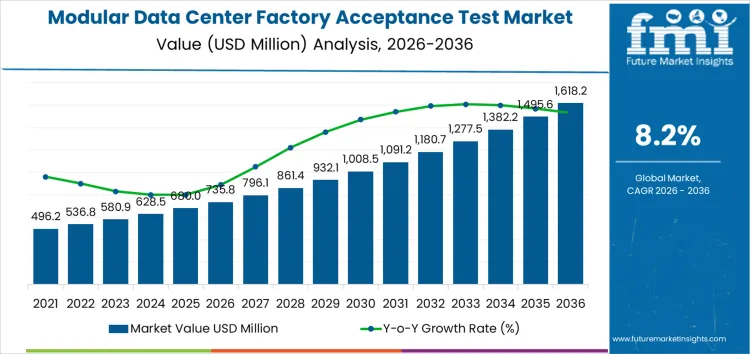
Modular Data Center Factory Acceptance Test Market Key Takeaways
| Metric | Value |
|---|---|
| Market Value (2026) | USD 735.8 million |
| Market Forecast Value (2036) | USD 1,618.2 million |
| Forecast CAGR (2026-2036) | 8.2% |
Why is the Demand for Modular Data Center Factory Acceptance Test Market Growing?
Demand for modular data center factory acceptance testing is growing globally due to rising deployment of prefabricated and rapidly deployable compute infrastructure across enterprise, cloud, and edge applications. Organizations adopt modular data centers to accelerate commissioning timelines, improve scalability, and reduce on site construction risk. Factory acceptance testing verifies power distribution systems, cooling units, network connectivity, and control logic before shipment, which strengthens reliability and reduces field rework. Growth in hyperscale facilities, colocation campuses, and edge compute nodes increases volume of modular units requiring structured testing prior to installation in diversified environments.
Standardization of test protocols across international supply chains encourages consistent evaluation procedures that align with regional regulatory and interoperability expectations. OEMs and integrators invest in automated test platforms that streamline verification of component performance, environmental control, and system resilience under simulated operational conditions. Telecom operators and industrial users require documented test results to support service level agreements and uptime guarantees. Expansion of digital services, IoT applications, and real time analytics increases pressure on data centers to deliver uninterrupted performance. Factory acceptance testing supports risk mitigation, component traceability, and quality assurance across global deployments, reinforcing steady adoption of test practices within modular data center programs.
How Are the Segments Classified in the Modular Data Center Factory Acceptance Test Market?
Demand for modular data center factory acceptance testing globally is shaped by accelerated deployment timelines, prefabrication adoption, and risk reduction requirements before site delivery. Stakeholders assess electrical integrity, thermal performance, control integration, and resilience under simulated operating conditions. Adoption patterns reflect emphasis on validating complete modules offsite to ensure predictable commissioning, reduced on-site rework, and consistent performance across standardized deployments.
Which FAT Scope Accounts for the Largest Share of Global Demand?

Electrical systems testing holds 30.0%, accounting for the largest share of global demand. This scope validates power distribution, protection coordination, grounding integrity, and fault response before shipment. Cooling and airflow testing holds 26.0%, supporting verification of thermal paths, airflow balance, and cooling capacity under load. Controls or BMS integration holds 22.0%, ensuring interoperability across monitoring, alarms, and automation. End-to-end performance and resiliency testing also holds 22.0%, validating module behavior under simulated failure scenarios. Scope distribution reflects priority for power integrity as the foundation of reliable modular operation.
Key Points
- Electrical systems lead due to critical power integrity validation.
- Cooling tests verify thermal capacity and airflow balance.
- Controls and resiliency testing ensure integrated operation.
Which Module Type Drives the Highest Share of Global FAT Activity?
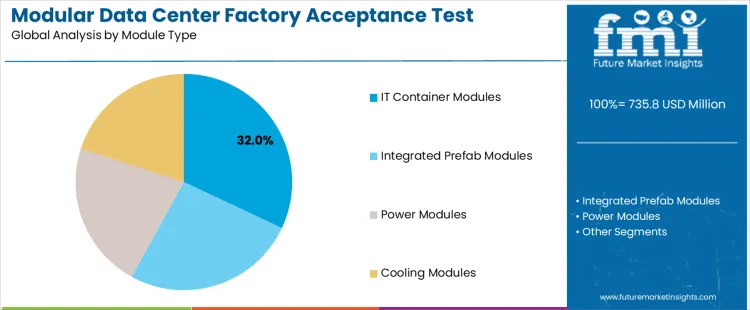
IT container modules hold 32.0%, driving the highest share of global FAT activity. These modules integrate compute, power, and cooling within transportable enclosures requiring comprehensive pre-delivery validation. Integrated prefab modules hold 26.0%, combining multiple functions into standardized units needing coordinated testing. Power modules account for 22.0%, focusing on UPS, switchgear, and distribution reliability. Cooling modules hold 20.0%, validating chillers, pumps, and airflow systems. Module-type distribution reflects prevalence of containerized IT deployments within rapid-scale strategies.
Key Points
- IT containers lead due to high integration density.
- Prefab modules require coordinated multi-system validation.
- Power and cooling modules address subsystem reliability.
Which Customer Segment Represents the Largest Share of Global Demand?

Hyperscalers hold 34.0%, representing the largest share of global demand. These customers require repeatable FAT processes to support rapid, large-scale deployment with predictable performance. Colocation providers hold 28.0%, validating tenant-ready modules and service-level compliance. Industrial or remote sites account for 20.0%, supporting resilient infrastructure in constrained environments. Government or defense customers hold 18.0%, emphasizing assurance, documentation, and mission readiness. Customer distribution reflects concentration of FAT demand among operators prioritizing speed, consistency, and risk mitigation.
Key Points
- Hyperscalers lead due to scale and deployment speed needs.
- Colocation providers validate tenant-ready performance.
- Industrial and public sectors emphasize assurance and resilience.
What are the Key Dynamics in the Modular Data Center Factory Acceptance Test Market?
Global demand rises as data center providers, hyperscale operators, and enterprise IT firms adopt modular data center architectures to accelerate deployment, improve scalability, and manage variable workloads. Factory acceptance testing (FAT) validates electrical integrity, mechanical assembly, cooling performance, and integrated system functionality prior to site delivery. Adoption aligns with rapid expansion of cloud services, edge deployments, and colocation capacity across diverse global regions. Usage spans OEM assembly sites, systems integrators, and independent test laboratories focused on quality assurance and compliance.
How do modular deployment strategies and performance assurance needs shape global demand?
Modular data centers provide pre-engineered units that reduce on-site installation time and support flexible capacity scaling. Buyers require FAT to confirm proper integration of power distribution, cooling systems, rack infrastructure, and control logic under controlled conditions before shipment. Hyperscale operators use FAT outcomes to minimize project risk and avoid costly rework in remote or constrained sites. Edge data center deployments in metropolitan and industrial zones emphasize repeatable performance across standardized modules. FAT supports verification of reliability metrics, redundancy configurations, and interoperability with broader facility systems. Standardized test protocols enhance comparability and accelerate deployment timelines across distributed sites worldwide.
How do capital costs, technical complexity, and standards variation influence market scalability?
Modular data center FAT involves investment in test rigs, instrumentation, and skilled engineers capable of validating complex subsystems. Integration of power, cooling, IT loads, and network interfaces requires comprehensive test planning and coordination across component vendors. Technical complexity increases when validating hybrid architectures that incorporate liquid cooling, renewable energy interfaces, and energy storage. Regional variation in safety codes, grid interconnection requirements, and data center classification standards necessitates FAT customization for specific markets. Smaller integrators may rely on shared test facilities or third-party service providers to manage costs. Global growth depends on modular, adaptable test frameworks and harmonized FAT criteria that support consistent quality assurance across evolving data center technologies worldwide.
How Is Demand for Modular Data Center Factory Acceptance Testing Evolving?
Demand for modular data center factory acceptance testing is increasing globally due to prefabrication adoption, compressed deployment timelines, and risk reduction before site installation. China leads with a 10.1% CAGR, supported by large-scale modular builds and standardized manufacturing. Brazil follows at 9.7%, driven by regional capacity expansion and reliance on prefabricated solutions. USA records an 8.2% CAGR, reflecting quality assurance needs across commercial and edge deployments. South Korea also posts 8.2%, shaped by precision manufacturing and dense urban installations. Germany records 8.0%, supported by compliance-driven validation and engineering rigor. Growth reflects emphasis on pre-shipment verification, integration testing, and predictable on-site commissioning worldwide.
| Country | CAGR (%) |
|---|---|
| China | 10.1% |
| Brazil | 9.7% |
| USA | 8.2% |
| South Korea | 8.2% |
| Germany | 8.0% |
What factors are accelerating factory acceptance testing adoption in China?

China drives demand through mass production of modular data centers for cloud, telecom, and industrial use. Country’s CAGR of 10.1% reflects widespread implementation of factory acceptance testing to validate electrical, cooling, and control systems before shipment. Manufacturers test load performance, redundancy behavior, and fault scenarios under controlled conditions. In-factory testing reduces site risk and accelerates commissioning schedules. Platforms emphasize automation, parallel testing, and standardized procedures. Government-backed digital infrastructure programs support volume production. Growth remains scale-driven and manufacturing-aligned, supported by standardized module designs and high throughput requirements.
- Large-scale modular data center manufacturing
- Pre-shipment validation of power and cooling
- Automated and standardized test procedures
- Government-supported digital infrastructure programs
Why is Brazil showing strong growth in factory acceptance testing demand?
Brazil demand is shaped by regional data center expansion and adoption of prefabricated modules to reduce construction timelines. Country’s CAGR of 9.7% reflects increased reliance on factory acceptance testing to ensure performance prior to deployment. Operators validate electrical integration, thermal performance, and monitoring systems. Shared manufacturing facilities adopt standardized test protocols to manage cost and quality. Collaboration with global suppliers supports alignment with international practices. Demand favors flexible test setups adaptable to varying module sizes. Growth remains capability-building focused, aligned with phased infrastructure expansion.
- Regional data center capacity expansion
- Reliance on prefabricated modular solutions
- Standardized factory test protocols
- Flexible testing for varied module designs
How do deployment timelines influence factory test demand in the USA?
USA demand reflects need to compress deployment schedules while ensuring reliability and compliance. Country’s CAGR of 8.2% is supported by factory acceptance testing for modular data centers serving cloud, edge, and enterprise sites. Operators verify power distribution, cooling response, and control integration before delivery. Testing reduces on-site labor and commissioning risk. Platforms integrate documentation and traceability for compliance. Growth remains lifecycle-driven, aligned with rapid deployment models and predictable performance requirements.
- Compressed deployment and commissioning timelines
- Pre-delivery validation of integrated systems
- Reduced on-site labor and risk
- Documentation and traceability emphasis
What role does manufacturing precision play in South Korea’s testing growth?

South Korea demand reflects precision manufacturing standards and dense urban deployments requiring high reliability. Country’s CAGR of 8.2% is supported by factory acceptance testing focused on integration accuracy and repeatability. Manufacturers validate thermal management, power redundancy, and monitoring accuracy. Government-backed initiatives promote standardized quality practices. Test environments emphasize controlled conditions and detailed data capture. Growth remains process-driven, aligned with electronics manufacturing rigor and strict uptime expectations.
- Precision manufacturing and integration validation
- Repeatable factory test processes
- Standardized quality assurance practices
- Controlled testing environments
How is Germany positioned within the global factory acceptance test landscape?
Germany demand reflects strong engineering culture, compliance requirements, and industrial modular data center adoption. Country’s CAGR of 8.0% is supported by factory acceptance testing to meet regulatory, safety, and performance standards. Manufacturers validate electrical safety, thermal resilience, and control system behavior. Shared test facilities support small and mid-scale producers. Procurement favors documentation, repeatability, and standards alignment. Growth remains engineering-led, aligned with predictable quality and long-term reliability expectations.
- Compliance-driven factory validation requirements
- Electrical safety and performance testing
- Shared facilities for smaller manufacturers
- Emphasis on documentation and standards alignment
What is the competitive landscape of demand for modular data center factory acceptance testing?
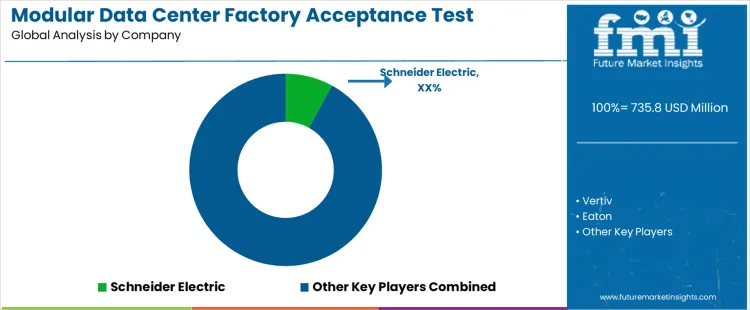
Demand for modular data center factory acceptance testing is driven by rapid deployment timelines, prefabrication adoption, and risk reduction before on-site installation. FAT programs validate electrical distribution, cooling performance, control logic, fire suppression interfaces, and integrated monitoring under simulated load conditions. Buyers require standardized test protocols, repeatable results, and documented compliance with international electrical and safety standards. Procurement teams evaluate test coverage depth, automation of test sequences, digital documentation quality, and ability to simulate real operating scenarios. Trend in the global market reflects increased use of off-site manufacturing, higher power density modules, and stronger emphasis on predictable performance prior to shipment.
Schneider Electric maintains strong positioning through integrated FAT frameworks aligned with its modular power, cooling, and management architectures. Vertiv and Eaton support global deployments with standardized FAT processes covering electrical, thermal, and control subsystems. Huawei Digital Power and Delta Electronics contribute factory test capabilities optimized for high-efficiency power and cooling modules used in large-scale deployments. Rittal and STULZ focus on enclosure-integrated and cooling-centric FAT validation supporting prefabricated designs. Mitsubishi Electric and Johnson Controls support FAT through power and building system integration expertise. Cummins participates through generator and backup power FAT validation aligned with mission-critical requirements. Competitive differentiation depends on test standardization, system integration depth, documentation rigor, and ability to compress deployment timelines without compromising reliability.
Key Players in the Modular Data Center Factory Acceptance Test Market
- Schneider Electric
- Vertiv
- Eaton
- Huawei Digital Power
- Delta Electronics
- Rittal
- STULZ
- Mitsubishi Electric
- Johnson Controls
- Cummins
Scope of the Report
| Items | Values |
|---|---|
| Quantitative Units | USD million |
| FAT Scope | Electrical Systems Testing; Cooling and Airflow Validation; Controls and Building Management System (BMS) Integration; End-to-End Performance, Redundancy, and Resiliency Verification |
| Module Type | IT Container Modules; Integrated Prefabricated Modules; Power Modules; Cooling Modules |
| Customer | Hyperscalers; Colocation Providers; Industrial or Remote Site Operators; Government and Defense Organizations |
| Procurement Model | OEM-Delivered Factory Acceptance Testing; Third-Party Commissioning Firms; EPC-Led FAT Programs; Customer In-House FAT |
| Regions Covered | Asia Pacific; Europe; North America; Latin America; Middle East & Africa |
| Countries Covered | China; USA; Germany; Brazil; South Korea; and 40+ countries |
| Key Companies Profiled | Schneider Electric; Vertiv; Eaton; Huawei Digital Power; Delta Electronics; Rittal; STULZ; Mitsubishi Electric; Johnson Controls; Cummins |
| Additional Attributes | Demand growth reflects accelerated deployment of prefabricated and modular data centers. Factory acceptance testing reduces on-site commissioning risk, validates performance before shipment, and shortens deployment timelines. Emphasis remains on integrated power, cooling, controls interoperability, and resiliency validation for mission-critical digital infrastructure. |
Modular Data Center Factory Acceptance Test Market by Segment
FAT Scope:
- Electrical Systems
- Cooling & Airflow
- Controls or BMS Integration
- End-to-End Performance & Resiliency
Module Type:
- IT Container Modules
- Integrated Prefab Modules
- Power Modules
- Cooling Modules
Customer:
- Hyperscalers
- Colocation Providers
- Industrial or Remote Sites
- Government or Defense
Procurement Model:
- OEM-Delivered FAT
- Third-Party Commissioning Firms
- EPC-Led FAT
- Customer In-House FAT
Region:
- Asia Pacific
- China
- Japan
- South Korea
- India
- Australia & New Zealand
- ASEAN
- Rest of Asia Pacific
- Europe
- Germany
- United Kingdom
- France
- Italy
- Spain
- Nordic
- BENELUX
- Rest of Europe
- North America
- United States
- Canada
- Mexico
- Latin America
- Brazil
- Chile
- Rest of Latin America
- Middle East & Africa
- Kingdom of Saudi Arabia
- Other GCC Countries
- Turkey
- South Africa
- Other African Union
- Rest of Middle East & Africa
Frequently Asked Questions
How big is the modular data center factory acceptance test market in 2026?
The global modular data center factory acceptance test market is estimated to be valued at USD 735.8 million in 2026.
What will be the size of modular data center factory acceptance test market in 2036?
The market size for the modular data center factory acceptance test market is projected to reach USD 1,618.2 million by 2036.
How much will be the modular data center factory acceptance test market growth between 2026 and 2036?
The modular data center factory acceptance test market is expected to grow at a 8.2% CAGR between 2026 and 2036.
What are the key FAT scopes in the modular data center factory acceptance test market?
The key product types in modular data center factory acceptance test market are electrical systems, cooling & airflow, controls or bms integration and end-to-end performance & resiliency.
Which module type segment to contribute significant share in the modular data center factory acceptance test market in 2026?
In terms of module type, it container modules segment to command 32.0% share in the modular data center factory acceptance test market in 2026.
Preview the report firsthand - request a free sample
Get SampleGet the brochure for pricing and purchase details.
Get PDFTable of Content
- Executive Summary
- Global Market Outlook
- Demand-side Trends
- Supply-side Trends
- Technology Roadmap Analysis
- Analysis and Recommendations
- Market Overview
- Market Coverage / Taxonomy
- Market Definition / Scope / Limitations
- Market Background
- Market Dynamics
- Drivers
- Restraints
- Opportunity
- Trends
- Scenario Forecast
- Demand in Optimistic Scenario
- Demand in Likely Scenario
- Demand in Conservative Scenario
- Opportunity Map Analysis
- Product Life Cycle Analysis
- Supply Chain Analysis
- Investment Feasibility Matrix
- Value Chain Analysis
- PESTLE and Porter’s Analysis
- Regulatory Landscape
- Regional Parent Market Outlook
- Production and Consumption Statistics
- Import and Export Statistics
- Market Dynamics
- Global Market Analysis 2021 to 2025 and Forecast, 2026 to 2036
- Historical Market Size Value (USD Million) Analysis, 2021 to 2025
- Current and Future Market Size Value (USD Million) Projections, 2026 to 2036
- Y-o-Y Growth Trend Analysis
- Absolute $ Opportunity Analysis
- Global Market Pricing Analysis 2021 to 2025 and Forecast 2026 to 2036
- Global Market Analysis 2021 to 2025 and Forecast 2026 to 2036, By FAT Scope
- Introduction / Key Findings
- Historical Market Size Value (USD Million) Analysis By FAT Scope , 2021 to 2025
- Current and Future Market Size Value (USD Million) Analysis and Forecast By FAT Scope , 2026 to 2036
- Electrical Systems
- Cooling & Airflow
- Controls or BMS Integration
- End-to-End Performance & Resiliency
- Electrical Systems
- Y-o-Y Growth Trend Analysis By FAT Scope , 2021 to 2025
- Absolute $ Opportunity Analysis By FAT Scope , 2026 to 2036
- Global Market Analysis 2021 to 2025 and Forecast 2026 to 2036, By Module Type
- Introduction / Key Findings
- Historical Market Size Value (USD Million) Analysis By Module Type, 2021 to 2025
- Current and Future Market Size Value (USD Million) Analysis and Forecast By Module Type, 2026 to 2036
- IT Container Modules
- Integrated Prefab Modules
- Power Modules
- Cooling Modules
- IT Container Modules
- Y-o-Y Growth Trend Analysis By Module Type, 2021 to 2025
- Absolute $ Opportunity Analysis By Module Type, 2026 to 2036
- Global Market Analysis 2021 to 2025 and Forecast 2026 to 2036, By Customer
- Introduction / Key Findings
- Historical Market Size Value (USD Million) Analysis By Customer, 2021 to 2025
- Current and Future Market Size Value (USD Million) Analysis and Forecast By Customer, 2026 to 2036
- Hyperscalers
- Colocation Providers
- Industrial or Remote Sites
- Government or Defense
- Hyperscalers
- Y-o-Y Growth Trend Analysis By Customer, 2021 to 2025
- Absolute $ Opportunity Analysis By Customer, 2026 to 2036
- Global Market Analysis 2021 to 2025 and Forecast 2026 to 2036, By Procurement Model
- Introduction / Key Findings
- Historical Market Size Value (USD Million) Analysis By Procurement Model, 2021 to 2025
- Current and Future Market Size Value (USD Million) Analysis and Forecast By Procurement Model, 2026 to 2036
- OEM-Delivered FAT
- Third-Party Commissioning Firms
- EPC-Led FAT
- Customer In-House FAT
- OEM-Delivered FAT
- Y-o-Y Growth Trend Analysis By Procurement Model, 2021 to 2025
- Absolute $ Opportunity Analysis By Procurement Model, 2026 to 2036
- Global Market Analysis 2021 to 2025 and Forecast 2026 to 2036, By Region
- Introduction
- Historical Market Size Value (USD Million) Analysis By Region, 2021 to 2025
- Current Market Size Value (USD Million) Analysis and Forecast By Region, 2026 to 2036
- North America
- Latin America
- Western Europe
- Eastern Europe
- East Asia
- South Asia and Pacific
- Middle East & Africa
- Market Attractiveness Analysis By Region
- North America Market Analysis 2021 to 2025 and Forecast 2026 to 2036, By Country
- Historical Market Size Value (USD Million) Trend Analysis By Market Taxonomy, 2021 to 2025
- Market Size Value (USD Million) Forecast By Market Taxonomy, 2026 to 2036
- By Country
- USA
- Canada
- Mexico
- By FAT Scope
- By Module Type
- By Customer
- By Procurement Model
- By Country
- Market Attractiveness Analysis
- By Country
- By FAT Scope
- By Module Type
- By Customer
- By Procurement Model
- Key Takeaways
- Latin America Market Analysis 2021 to 2025 and Forecast 2026 to 2036, By Country
- Historical Market Size Value (USD Million) Trend Analysis By Market Taxonomy, 2021 to 2025
- Market Size Value (USD Million) Forecast By Market Taxonomy, 2026 to 2036
- By Country
- Brazil
- Chile
- Rest of Latin America
- By FAT Scope
- By Module Type
- By Customer
- By Procurement Model
- By Country
- Market Attractiveness Analysis
- By Country
- By FAT Scope
- By Module Type
- By Customer
- By Procurement Model
- Key Takeaways
- Western Europe Market Analysis 2021 to 2025 and Forecast 2026 to 2036, By Country
- Historical Market Size Value (USD Million) Trend Analysis By Market Taxonomy, 2021 to 2025
- Market Size Value (USD Million) Forecast By Market Taxonomy, 2026 to 2036
- By Country
- Germany
- UK
- Italy
- Spain
- France
- Nordic
- BENELUX
- Rest of Western Europe
- By FAT Scope
- By Module Type
- By Customer
- By Procurement Model
- By Country
- Market Attractiveness Analysis
- By Country
- By FAT Scope
- By Module Type
- By Customer
- By Procurement Model
- Key Takeaways
- Eastern Europe Market Analysis 2021 to 2025 and Forecast 2026 to 2036, By Country
- Historical Market Size Value (USD Million) Trend Analysis By Market Taxonomy, 2021 to 2025
- Market Size Value (USD Million) Forecast By Market Taxonomy, 2026 to 2036
- By Country
- Russia
- Poland
- Hungary
- Balkan & Baltic
- Rest of Eastern Europe
- By FAT Scope
- By Module Type
- By Customer
- By Procurement Model
- By Country
- Market Attractiveness Analysis
- By Country
- By FAT Scope
- By Module Type
- By Customer
- By Procurement Model
- Key Takeaways
- East Asia Market Analysis 2021 to 2025 and Forecast 2026 to 2036, By Country
- Historical Market Size Value (USD Million) Trend Analysis By Market Taxonomy, 2021 to 2025
- Market Size Value (USD Million) Forecast By Market Taxonomy, 2026 to 2036
- By Country
- China
- Japan
- South Korea
- By FAT Scope
- By Module Type
- By Customer
- By Procurement Model
- By Country
- Market Attractiveness Analysis
- By Country
- By FAT Scope
- By Module Type
- By Customer
- By Procurement Model
- Key Takeaways
- South Asia and Pacific Market Analysis 2021 to 2025 and Forecast 2026 to 2036, By Country
- Historical Market Size Value (USD Million) Trend Analysis By Market Taxonomy, 2021 to 2025
- Market Size Value (USD Million) Forecast By Market Taxonomy, 2026 to 2036
- By Country
- India
- ASEAN
- Australia & New Zealand
- Rest of South Asia and Pacific
- By FAT Scope
- By Module Type
- By Customer
- By Procurement Model
- By Country
- Market Attractiveness Analysis
- By Country
- By FAT Scope
- By Module Type
- By Customer
- By Procurement Model
- Key Takeaways
- Middle East & Africa Market Analysis 2021 to 2025 and Forecast 2026 to 2036, By Country
- Historical Market Size Value (USD Million) Trend Analysis By Market Taxonomy, 2021 to 2025
- Market Size Value (USD Million) Forecast By Market Taxonomy, 2026 to 2036
- By Country
- Kingdom of Saudi Arabia
- Other GCC Countries
- Turkiye
- South Africa
- Other African Union
- Rest of Middle East & Africa
- By FAT Scope
- By Module Type
- By Customer
- By Procurement Model
- By Country
- Market Attractiveness Analysis
- By Country
- By FAT Scope
- By Module Type
- By Customer
- By Procurement Model
- Key Takeaways
- Key Countries Market Analysis
- USA
- Pricing Analysis
- Market Share Analysis, 2025
- By FAT Scope
- By Module Type
- By Customer
- By Procurement Model
- Canada
- Pricing Analysis
- Market Share Analysis, 2025
- By FAT Scope
- By Module Type
- By Customer
- By Procurement Model
- Mexico
- Pricing Analysis
- Market Share Analysis, 2025
- By FAT Scope
- By Module Type
- By Customer
- By Procurement Model
- Brazil
- Pricing Analysis
- Market Share Analysis, 2025
- By FAT Scope
- By Module Type
- By Customer
- By Procurement Model
- Chile
- Pricing Analysis
- Market Share Analysis, 2025
- By FAT Scope
- By Module Type
- By Customer
- By Procurement Model
- Germany
- Pricing Analysis
- Market Share Analysis, 2025
- By FAT Scope
- By Module Type
- By Customer
- By Procurement Model
- UK
- Pricing Analysis
- Market Share Analysis, 2025
- By FAT Scope
- By Module Type
- By Customer
- By Procurement Model
- Italy
- Pricing Analysis
- Market Share Analysis, 2025
- By FAT Scope
- By Module Type
- By Customer
- By Procurement Model
- Spain
- Pricing Analysis
- Market Share Analysis, 2025
- By FAT Scope
- By Module Type
- By Customer
- By Procurement Model
- France
- Pricing Analysis
- Market Share Analysis, 2025
- By FAT Scope
- By Module Type
- By Customer
- By Procurement Model
- India
- Pricing Analysis
- Market Share Analysis, 2025
- By FAT Scope
- By Module Type
- By Customer
- By Procurement Model
- ASEAN
- Pricing Analysis
- Market Share Analysis, 2025
- By FAT Scope
- By Module Type
- By Customer
- By Procurement Model
- Australia & New Zealand
- Pricing Analysis
- Market Share Analysis, 2025
- By FAT Scope
- By Module Type
- By Customer
- By Procurement Model
- China
- Pricing Analysis
- Market Share Analysis, 2025
- By FAT Scope
- By Module Type
- By Customer
- By Procurement Model
- Japan
- Pricing Analysis
- Market Share Analysis, 2025
- By FAT Scope
- By Module Type
- By Customer
- By Procurement Model
- South Korea
- Pricing Analysis
- Market Share Analysis, 2025
- By FAT Scope
- By Module Type
- By Customer
- By Procurement Model
- Russia
- Pricing Analysis
- Market Share Analysis, 2025
- By FAT Scope
- By Module Type
- By Customer
- By Procurement Model
- Poland
- Pricing Analysis
- Market Share Analysis, 2025
- By FAT Scope
- By Module Type
- By Customer
- By Procurement Model
- Hungary
- Pricing Analysis
- Market Share Analysis, 2025
- By FAT Scope
- By Module Type
- By Customer
- By Procurement Model
- Kingdom of Saudi Arabia
- Pricing Analysis
- Market Share Analysis, 2025
- By FAT Scope
- By Module Type
- By Customer
- By Procurement Model
- Turkiye
- Pricing Analysis
- Market Share Analysis, 2025
- By FAT Scope
- By Module Type
- By Customer
- By Procurement Model
- South Africa
- Pricing Analysis
- Market Share Analysis, 2025
- By FAT Scope
- By Module Type
- By Customer
- By Procurement Model
- USA
- Market Structure Analysis
- Competition Dashboard
- Competition Benchmarking
- Market Share Analysis of Top Players
- By Regional
- By FAT Scope
- By Module Type
- By Customer
- By Procurement Model
- Competition Analysis
- Competition Deep Dive
- Schneider Electric
- Overview
- Product Portfolio
- Profitability by Market Segments (Product/Age /Sales Channel/Region)
- Sales Footprint
- Strategy Overview
- Marketing Strategy
- Product Strategy
- Channel Strategy
- Vertiv
- Eaton
- Huawei Digital Power
- Delta Electronics
- Rittal
- STULZ
- Mitsubishi Electric
- Johnson Controls
- Cummins
- Schneider Electric
- Competition Deep Dive
- Assumptions & Acronyms Used
- Research Methodology


