

- Industry Size (2026)
- USD 936.5 Mn
- Forecast (2036)
- USD 2196.8 Mn
- CAGR (2026 to 2036)
- 8.9%
Imaging Radar & SAR Test Platforms Market Forecast and Outlook 2026 to 2036
Demand for imaging radar and SAR test platforms market is valued at USD 936.5 million in 2026 and is forecasted to reach USD 2,196.8 million by 2036, expanding at a CAGR of 8.9%. Demand growth is supported by increased deployment of synthetic aperture radar across defense surveillance, earth observation, autonomous systems, and spaceborne imaging missions.
HIL simulators represent leading platform type in global demand due to ability to replicate complex radar scenes, dynamic target behavior, and signal propagation conditions under controlled environments. Adoption emphasizes algorithm validation, waveform testing, sensor fusion verification, and end-to-end system performance assessment prior to field deployment.
China, Brazil, USA, South Korea, and United Kingdom rank among fastest-growing countries, driven by defense modernization programs, satellite radar investments, and autonomous mobility testing initiatives. Rohde and Schwarz, Keysight Technologies, Anritsu, Spirent Communications, dSPACE, NI (Emerson Test and Measurement), Ansys, MathWorks, Tektronix, and Mercury Systems maintain strong positions through advanced radar simulation platforms, integrated signal processing tools, and long-standing expertise in RF and defense-grade test systems.
Quick Stats for Imaging Radar & SAR Test Platforms Market
- Imaging Radar & SAR Test Platforms Market Value (2026): USD 936.5 million
- Imaging Radar & SAR Test Platforms Market Forecast Value (2036): USD 2,196.8 million
- Imaging Radar & SAR Test Platforms Market Forecast CAGR (2026-2036): 8.9%
- Leading Platform Type in Global Demand: HIL Simulators
- Fastest-Growing Countries: China, Brazil, USA, South Korea, United Kingdom
- Top Players in Global Demand: Rohde & Schwarz, Keysight Technologies, Anritsu, Spirent Communications, dSPACE, NI (Emerson Test & Measurement), Ansys, MathWorks, Tektronix, Mercury Systems
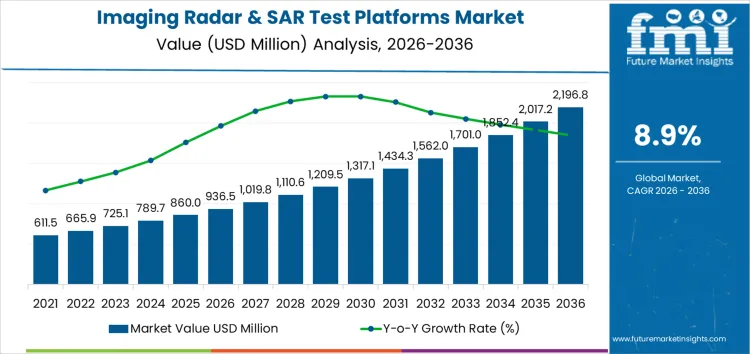
Imaging Radar & SAR Test Platforms Market Key Takeaways
| Metric | Value |
|---|---|
| Market Value (2026) | USD 936.5 million |
| Market Forecast Value (2036) | USD 2196.9 million |
| Forecast CAGR (2026-2036) | 8.9% |
Why is the Demand for Imaging Radar & SAR Test Platforms Market Growing?
Demand for imaging radar and synthetic aperture radar test platforms is growing globally due to expanding use of advanced radar systems in defense, aerospace, maritime surveillance, and earth observation applications. Nations invest in radar technology to support persistent wide area imaging, target detection, and reconnaissance across contested and remote environments. Development of airborne, spaceborne, and ground based SAR systems increases need for test platforms that verify resolution, signal processing performance, and scene interpretation accuracy prior to deployment. Defense organizations adopt standardized test facilities to evaluate radar cross section, Doppler performance, and clutter suppression under controlled and simulated conditions.
Civil agencies and research institutions deploy SAR for environmental monitoring, natural disaster assessment, and resource mapping, which strengthens demand for reliable test infrastructure. Commercial aerospace and autonomous vehicle sectors integrate imaging radar for navigation, collision avoidance, and situational awareness, increasing test complexity. Test platform suppliers develop modular systems that support antenna characterization, waveform fidelity analysis, and algorithm validation across frequency bands. Collaboration among international partners on radar standards and interoperability encourages structured evaluation procedures across development teams. Academic programs also expand test usage for radar research and sensor fusion experimentation.
How Are the Segments Classified in the Imaging Radar and SAR Test Platforms Market?
Demand for imaging radar and SAR test platforms globally is shaped by ISR modernization, spaceborne sensing expansion, and all-weather imaging requirements. Stakeholders evaluate signal fidelity, scenario realism, processing accuracy, and end-to-end validation capability. Adoption patterns reflect parallel growth across space, airborne, and maritime domains, supported by increased reliance on synthetic aperture radar for persistent surveillance, mapping, and security applications.
Which Platform Type Represents the Largest Share of Global Demand?
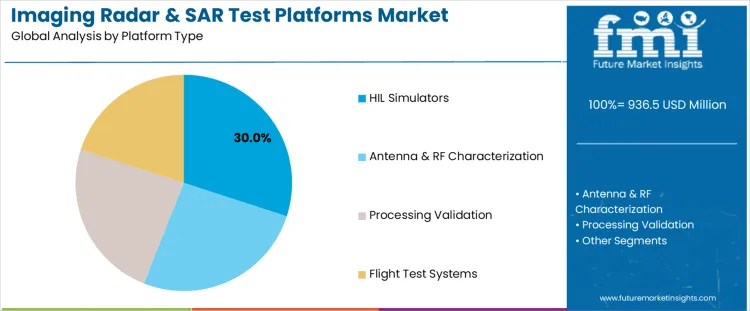
HIL simulators hold 30.0%, representing the largest platform-type share globally. These simulators enable closed-loop testing of radar hardware, signal processing chains, and mission scenarios under controlled conditions. Antenna and RF characterization systems hold 26.0%, supporting calibration, radiation pattern measurement, and RF performance validation. Processing validation platforms account for 24.0%, enabling assessment of imaging algorithms, clutter suppression, and target detection accuracy. Flight test systems hold 20.0%, supporting real-world validation under operational conditions. Platform-type distribution reflects emphasis on laboratory-based validation prior to costly flight testing.
Key Points
- HIL simulators lead due to end-to-end scenario validation capability.
- RF characterization supports antenna and front-end accuracy.
- Processing validation ensures imaging and detection performance.
Which End-User Category Drives Global Demand for Imaging Radar Test Platforms?
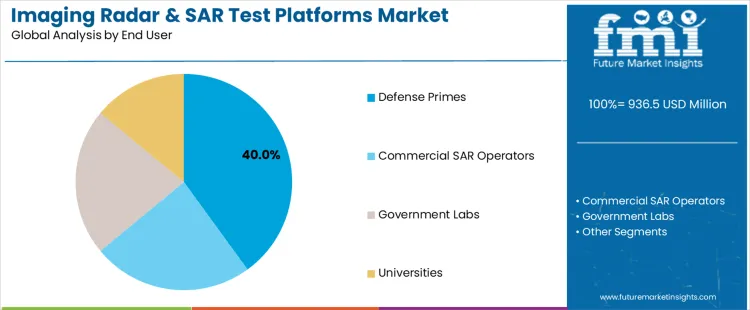
Defense primes hold 40.0%, driving global demand for imaging radar and SAR test platforms. These organizations conduct qualification and verification to meet mission, survivability, and performance requirements. Commercial SAR operators hold 24.0%, validating payload performance for earth observation and data services. Government laboratories account for 22.0%, supporting standards development, independent verification, and national programs. Universities hold 14.0%, advancing research, algorithm development, and experimental radar systems. End-user distribution reflects dominance of defense-led development alongside expanding commercial sensing activity.
Key Points
- Defense primes dominate due to mission-critical validation needs.
- Commercial operators support earth observation payload testing.
- Research institutions advance experimental radar capabilities.
Which Use Case Accounts for the Highest Share of Global Testing Activity?
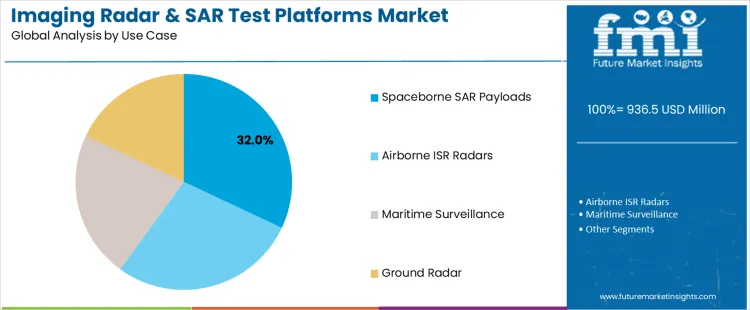
Spaceborne SAR payloads hold 32.0%, accounting for the highest share of global testing activity. These payloads require extensive validation of imaging performance, orbital dynamics, and long-duration reliability. Airborne ISR radars hold 28.0%, supporting surveillance and reconnaissance missions across defense and security operations. Maritime surveillance accounts for 22.0%, enabling detection and tracking under complex sea clutter conditions. Ground radar use cases hold 18.0%, covering border monitoring and fixed-site surveillance. Use-case distribution reflects strong emphasis on space-based and airborne sensing platforms.
Key Points
- Spaceborne SAR leads due to orbital mission complexity.
- Airborne ISR supports flexible surveillance operations.
- Maritime and ground radars address domain-specific challenges.
What are the Key Dynamics in the Imaging Radar & SAR Test Platforms Market?
Global demand rises as aerospace, defense, and earth observation sectors expand deployment of imaging radar and synthetic aperture radar (SAR) systems for surveillance, mapping, and environmental monitoring. Test platforms enable characterization of resolution, calibration stability, signal processing performance, and environmental robustness across airborne, spaceborne, and ground-based radar systems. Adoption aligns with strategic investment in situational awareness, disaster response, and remote sensing applications across multiple regions. Usage spans research institutions, defense laboratories, and commercial integrators requiring reliable validation of complex radar technologies.
How do expanded radar applications and operational performance requirements shape test platform demand?
Imaging radar and SAR are integral to modern surveillance, maritime domain awareness, terrain mapping, and change detection. System developers use test platforms to assess range resolution, Doppler performance, radiometric calibration, and clutter suppression under controlled conditions. Airborne platforms simulate varied flight profiles and target scenarios to verify onboard processing and real-time imaging algorithms. Spaceborne radar integrators evaluate system performance during environmental simulation, verifying phase stability and aperture synthesis. Government agencies and commercial operators require traceable performance data to support system acceptance and mission assurance. Increasing use of radar for climate monitoring, infrastructure mapping, and autonomous navigation broadens demand across civil and defense segments.
How do capital costs, integration complexity, and spectrum regulation influence global scalability?
Imaging radar and SAR test platforms involve significant investment in anechoic chambers, motion simulation rigs, and high-speed signal analysis equipment. Integration complexity arises from coupling RF hardware, digital beamforming, and advanced signal processing chains that require synchronized measurements. Testbed configuration must accommodate diverse frequency bands, antenna geometries, and waveform types, increasing engineering effort. Regulatory frameworks governing spectrum allocation and emissions influence test procedures and permissible environments. Skilled personnel are necessary to design, execute, and interpret complex test campaigns. Regional disparities in infrastructure and specialized facilities concentrate advanced test capability in major aerospace and defense clusters, while shared service providers and modular testing solutions support broader access and cost-effective validation pathways worldwide.
How Is Demand for Imaging Radar and SAR Test Platforms Evolving?
Demand for imaging radar and synthetic aperture radar test platforms is increasing globally due to expansion of Earth observation missions, defense surveillance requirements, and all-weather sensing needs. China leads with a 10.5% CAGR, supported by large-scale satellite constellations and defense radar programs. Brazil follows at 10.0%, driven by environmental monitoring and academic radar research. USA records a 9.0% CAGR, shaped by defense modernization and commercial remote sensing activity. South Korea posts 8.8%, reflecting electronics integration and aerospace development. UK records 8.4%, supported by collaborative research facilities and export-oriented radar validation services. Growth reflects higher resolution requirements, multi-band operation, and demand for ground-based risk reduction testing worldwide.
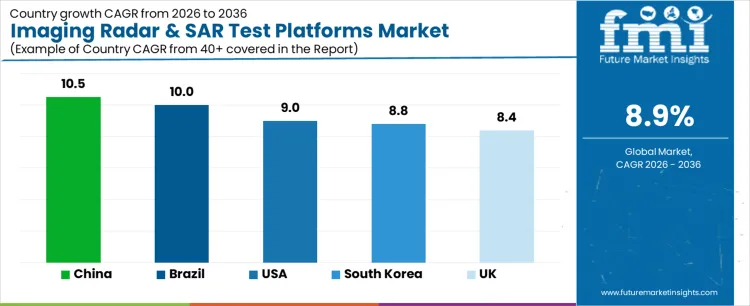
| Country | CAGR (%) |
|---|---|
| China | 10.5 |
| Brazil | 10.0 |
| USA | 9.0 |
| South Korea | 8.8 |
| UK | 8.4 |
What factors are accelerating adoption of imaging radar and SAR test platforms in China?
China drives demand through extensive Earth observation satellite deployment, defense surveillance programs, and radar technology localization. Country’s CAGR of 10.5% reflects investment in test platforms supporting SAR payload calibration, signal processing validation, and antenna performance assessment. Facilities enable end-to-end testing across frequency bands and imaging modes. Emphasis remains on in-house testing to protect sensitive designs and shorten development cycles. Academic and state laboratories expand shared test capacity for experimental radar systems. Growth remains policy-supported and scale-driven, aligned with national priorities in space-based and airborne sensing capability development.
- Large-scale Earth observation and defense radar programs
- Expansion of in-house SAR calibration facilities
- Multi-band and multi-mode testing requirements
- Government-backed testing infrastructure investment
Why is Brazil emerging as a fast-growing market for SAR test platforms?
Brazil demand is shaped by environmental monitoring needs, disaster management programs, and academic radar research. Country’s CAGR of 10.0% reflects increased use of SAR test platforms for validating systems used in deforestation tracking, agriculture monitoring, and coastal surveillance. Universities and public agencies invest in shared testbeds to support multiple research projects. Collaboration with international partners encourages adoption of global calibration standards. Demand favors flexible and mid-scale platforms suited for research and pilot missions. Growth remains research-led and capability-focused, aligned with gradual expansion of national remote sensing programs.
- Environmental and agricultural monitoring applications
- Academic and public-sector radar research
- Shared SAR testbed investments
- Alignment with international calibration standards
How do defense and commercial missions influence SAR test platform demand in the USA?
USA demand reflects strong defense surveillance programs, commercial Earth observation activity, and aerospace research. Country’s CAGR of 9.0% is supported by need for ground-based and airborne SAR test platforms to validate resolution, clutter suppression, and target detection performance. Defense agencies emphasize secure testing environments and repeatability. Commercial operators require calibration to ensure data consistency across constellations. Test platforms integrate advanced signal processing and simulation tools. Growth remains program-driven, aligned with modernization of sensing capabilities and competitive commercial imaging services.
- Defense surveillance and reconnaissance requirements
- Commercial satellite imaging validation needs
- Advanced signal processing and simulation integration
- Secure and repeatable test environments
What role does South Korea’s electronics expertise play in SAR testing growth?
South Korea demand reflects integration of radar payloads within advanced electronics and aerospace systems. Country’s CAGR of 8.8% is supported by adoption of SAR test platforms for component validation, antenna testing, and signal chain verification. Manufacturers emphasize precision measurement, data integrity, and compact system design. Government-backed programs encourage domestic testing capability development. Demand favors scalable platforms compatible with laboratory and field testing environments. Growth remains technology-driven, aligned with strengthening national radar and space electronics competencies.
- Electronics-integrated radar payload development
- Precision-focused component and antenna testing
- Government-supported domestic testing initiatives
- Scalable laboratory and field test platforms
How is the UK positioned within the global imaging radar test platform landscape?
UK demand reflects collaborative research models, defense-linked radar development, and export-oriented sensing solutions. Country’s CAGR of 8.4% is supported by investment in shared SAR test facilities serving academia and industry. Test platforms enable system calibration, algorithm validation, and performance benchmarking. Public funding supports infrastructure upgrades and cross-institution collaboration. Demand favors versatile platforms adaptable to airborne and spaceborne radar systems. Growth remains ecosystem-driven, aligned with UK’s role in advanced radar research and international technology partnerships.
- Shared SAR testing infrastructure across sectors
- Algorithm and system performance validation focus
- Government-funded research collaboration
- Export-oriented radar technology development
What is the competitive landscape of demand for imaging radar and SAR test platforms?
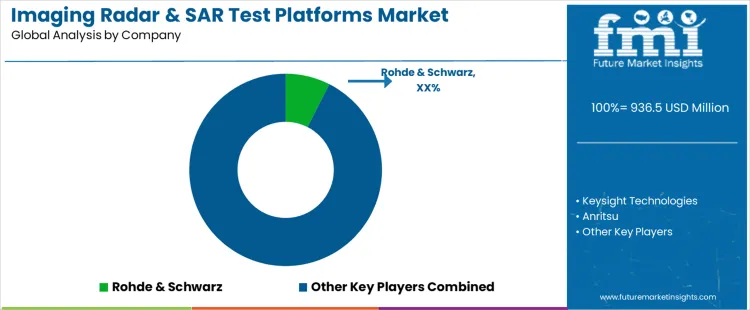
Demand for imaging radar and SAR test platforms is driven by defense modernization, spaceborne observation, and autonomous sensing programs. Testing environments require precise RF signal generation, phase coherence validation, motion simulation, and high-fidelity scene emulation. Buyers prioritize wideband performance, timing accuracy, repeatable clutter modeling, and compatibility with airborne and spaceborne radar architectures. Procurement teams assess real-time processing capability, scalability across frequency bands, and integration with digital engineering workflows. Reliability during long-duration scenario replay and availability of calibrated reference data influence platform selection decisions. Trend in the global market reflects higher resolution SAR modes, multi-static configurations, and increased emphasis on electronic protection validation.
Rohde and Schwarz maintains strong positioning through RF test systems supporting wideband radar signal analysis and SAR waveform validation. Keysight Technologies supplies advanced signal generation and analysis platforms used for radar performance characterization and hardware verification. Anritsu supports microwave and millimeter-wave testing required for high-frequency radar front-end validation. Spirent Communications provides scenario simulation and navigation emulation supporting motion compensation and geolocation accuracy testing. dSPACE and NI, operating under Emerson Test and Measurement, deliver real-time HIL platforms for radar processor and control validation. Ansys and MathWorks enable electromagnetic modeling, signal processing simulation, and algorithm verification supporting SAR system development. Tektronix contributes high-speed acquisition and analysis tools for transient radar signal capture. Mercury Systems supplies radar processing hardware and test subsystems used in defense-oriented SAR validation environments. Competitive differentiation depends on RF fidelity, scenario realism, integration depth, and alignment with evolving radar mission profiles.
Key Players in the Imaging Radar & SAR Test Platforms Market
- Rohde & Schwarz
- Keysight Technologies
- Anritsu
- Spirent Communications
- dSPACE
- NI (Emerson Test & Measurement)
- Ansys
- MathWorks
- Tektronix
- Mercury Systems
Scope of the Report
| Items | Values |
|---|---|
| Quantitative Units | USD million |
| Platform Type | HIL Simulators; Antenna and RF Characterization Platforms; Signal and Processing Validation Systems; Flight Test and Range Instrumentation Systems |
| Use Case | Spaceborne SAR Payload Testing; Airborne ISR Radar Validation; Maritime Surveillance Radar Systems; Ground-Based Radar Applications |
| End User | Defense Prime Contractors; Commercial SAR Operators; Government and National Laboratories; Universities and Academic Research Institutes |
| Regions Covered | Asia Pacific; Europe; North America; Latin America; Middle East & Africa |
| Countries Covered | USA; China; Brazil; UK; France; South Korea; and 40+ countries |
| Key Companies Profiled | Rohde & Schwarz; Keysight Technologies; Anritsu; Spirent Communications; dSPACE; NI (Emerson Test & Measurement); Ansys; MathWorks; Tektronix; Mercury Systems |
| Additional Attributes | Dollar sales by platform type and use case; rising defense and commercial SAR investments; adoption across spaceborne and airborne radar programs; demand for HIL and RF validation; integration with digital twins and simulation software; emphasis on end-to-end radar performance verification and mission readiness. |
Imaging Radar & SAR Test Platforms Market by Segment
Platform Type:
- HIL Simulators
- Antenna & RF Characterization
- Processing Validation
- Flight Test Systems
End User:
- Defense Primes
- Commercial SAR Operators
- Government Labs
- Universities
Use Case:
- Spaceborne SAR Payloads
- Airborne ISR Radars
- Maritime Surveillance
- Ground Radar
Region:
- Asia Pacific
- China
- Japan
- South Korea
- India
- Australia & New Zealand
- ASEAN
- Rest of Asia Pacific
- Europe
- Germany
- United Kingdom
- France
- Italy
- Spain
- Nordic
- BENELUX
- Rest of Europe
- North America
- United States
- Canada
- Mexico
- Latin America
- Brazil
- Chile
- Rest of Latin America
- Middle East & Africa
- Kingdom of Saudi Arabia
- Other GCC Countries
- Turkey
- South Africa
- Other African Union
- Rest of Middle East & Africa
Frequently Asked Questions
How big is the imaging radar & sar test platforms market in 2026?
The global imaging radar & sar test platforms market is estimated to be valued at USD 936.5 million in 2026.
What will be the size of imaging radar & sar test platforms market in 2036?
The market size for the imaging radar & sar test platforms market is projected to reach USD 2,196.8 million by 2036.
How much will be the imaging radar & sar test platforms market growth between 2026 and 2036?
The imaging radar & sar test platforms market is expected to grow at a 8.9% CAGR between 2026 and 2036.
What are the key platform types in the imaging radar & SAR test platforms market?
The key platform types in imaging radar & SAR test platforms market are HIL simulators, antenna & RF characterization, processing validation and flight test systems.
Which end user segment to contribute significant share in the imaging radar & sar test platforms market in 2026?
In terms of end user, defense primes segment to command 40.0% share in the imaging radar & sar test platforms market in 2026.
Preview the report firsthand - request a free sample
Get SampleGet the brochure for pricing and purchase details.
Get PDFTable of Content
- Executive Summary
- Global Market Outlook
- Demand-side Trends
- Supply-side Trends
- Technology Roadmap Analysis
- Analysis and Recommendations
- Market Overview
- Market Coverage / Taxonomy
- Market Definition / Scope / Limitations
- Market Background
- Market Dynamics
- Drivers
- Restraints
- Opportunity
- Trends
- Scenario Forecast
- Demand in Optimistic Scenario
- Demand in Likely Scenario
- Demand in Conservative Scenario
- Opportunity Map Analysis
- Product Life Cycle Analysis
- Supply Chain Analysis
- Investment Feasibility Matrix
- Value Chain Analysis
- PESTLE and Porter’s Analysis
- Regulatory Landscape
- Regional Parent Market Outlook
- Production and Consumption Statistics
- Import and Export Statistics
- Market Dynamics
- Global Market Analysis 2021 to 2025 and Forecast, 2026 to 2036
- Historical Market Size Value (USD Million) Analysis, 2021 to 2025
- Current and Future Market Size Value (USD Million) Projections, 2026 to 2036
- Y-o-Y Growth Trend Analysis
- Absolute $ Opportunity Analysis
- Global Market Pricing Analysis 2021 to 2025 and Forecast 2026 to 2036
- Global Market Analysis 2021 to 2025 and Forecast 2026 to 2036, By Platform Type
- Introduction / Key Findings
- Historical Market Size Value (USD Million) Analysis By Platform Type , 2021 to 2025
- Current and Future Market Size Value (USD Million) Analysis and Forecast By Platform Type , 2026 to 2036
- HIL Simulators
- Antenna & RF Characterization
- Processing Validation
- Flight Test Systems
- HIL Simulators
- Y-o-Y Growth Trend Analysis By Platform Type , 2021 to 2025
- Absolute $ Opportunity Analysis By Platform Type , 2026 to 2036
- Global Market Analysis 2021 to 2025 and Forecast 2026 to 2036, By End User
- Introduction / Key Findings
- Historical Market Size Value (USD Million) Analysis By End User, 2021 to 2025
- Current and Future Market Size Value (USD Million) Analysis and Forecast By End User, 2026 to 2036
- Defense Primes
- Commercial SAR Operators
- Government Labs
- Universities
- Defense Primes
- Y-o-Y Growth Trend Analysis By End User, 2021 to 2025
- Absolute $ Opportunity Analysis By End User, 2026 to 2036
- Global Market Analysis 2021 to 2025 and Forecast 2026 to 2036, By Use Case
- Introduction / Key Findings
- Historical Market Size Value (USD Million) Analysis By Use Case, 2021 to 2025
- Current and Future Market Size Value (USD Million) Analysis and Forecast By Use Case, 2026 to 2036
- Spaceborne SAR Payloads
- Airborne ISR Radars
- Maritime Surveillance
- Ground Radar
- Spaceborne SAR Payloads
- Y-o-Y Growth Trend Analysis By Use Case, 2021 to 2025
- Absolute $ Opportunity Analysis By Use Case, 2026 to 2036
- Global Market Analysis 2021 to 2025 and Forecast 2026 to 2036, By Region
- Introduction
- Historical Market Size Value (USD Million) Analysis By Region, 2021 to 2025
- Current Market Size Value (USD Million) Analysis and Forecast By Region, 2026 to 2036
- North America
- Latin America
- Western Europe
- Eastern Europe
- East Asia
- South Asia and Pacific
- Middle East & Africa
- Market Attractiveness Analysis By Region
- North America Market Analysis 2021 to 2025 and Forecast 2026 to 2036, By Country
- Historical Market Size Value (USD Million) Trend Analysis By Market Taxonomy, 2021 to 2025
- Market Size Value (USD Million) Forecast By Market Taxonomy, 2026 to 2036
- By Country
- USA
- Canada
- Mexico
- By Platform Type
- By End User
- By Use Case
- By Country
- Market Attractiveness Analysis
- By Country
- By Platform Type
- By End User
- By Use Case
- Key Takeaways
- Latin America Market Analysis 2021 to 2025 and Forecast 2026 to 2036, By Country
- Historical Market Size Value (USD Million) Trend Analysis By Market Taxonomy, 2021 to 2025
- Market Size Value (USD Million) Forecast By Market Taxonomy, 2026 to 2036
- By Country
- Brazil
- Chile
- Rest of Latin America
- By Platform Type
- By End User
- By Use Case
- By Country
- Market Attractiveness Analysis
- By Country
- By Platform Type
- By End User
- By Use Case
- Key Takeaways
- Western Europe Market Analysis 2021 to 2025 and Forecast 2026 to 2036, By Country
- Historical Market Size Value (USD Million) Trend Analysis By Market Taxonomy, 2021 to 2025
- Market Size Value (USD Million) Forecast By Market Taxonomy, 2026 to 2036
- By Country
- Germany
- UK
- Italy
- Spain
- France
- Nordic
- BENELUX
- Rest of Western Europe
- By Platform Type
- By End User
- By Use Case
- By Country
- Market Attractiveness Analysis
- By Country
- By Platform Type
- By End User
- By Use Case
- Key Takeaways
- Eastern Europe Market Analysis 2021 to 2025 and Forecast 2026 to 2036, By Country
- Historical Market Size Value (USD Million) Trend Analysis By Market Taxonomy, 2021 to 2025
- Market Size Value (USD Million) Forecast By Market Taxonomy, 2026 to 2036
- By Country
- Russia
- Poland
- Hungary
- Balkan & Baltic
- Rest of Eastern Europe
- By Platform Type
- By End User
- By Use Case
- By Country
- Market Attractiveness Analysis
- By Country
- By Platform Type
- By End User
- By Use Case
- Key Takeaways
- East Asia Market Analysis 2021 to 2025 and Forecast 2026 to 2036, By Country
- Historical Market Size Value (USD Million) Trend Analysis By Market Taxonomy, 2021 to 2025
- Market Size Value (USD Million) Forecast By Market Taxonomy, 2026 to 2036
- By Country
- China
- Japan
- South Korea
- By Platform Type
- By End User
- By Use Case
- By Country
- Market Attractiveness Analysis
- By Country
- By Platform Type
- By End User
- By Use Case
- Key Takeaways
- South Asia and Pacific Market Analysis 2021 to 2025 and Forecast 2026 to 2036, By Country
- Historical Market Size Value (USD Million) Trend Analysis By Market Taxonomy, 2021 to 2025
- Market Size Value (USD Million) Forecast By Market Taxonomy, 2026 to 2036
- By Country
- India
- ASEAN
- Australia & New Zealand
- Rest of South Asia and Pacific
- By Platform Type
- By End User
- By Use Case
- By Country
- Market Attractiveness Analysis
- By Country
- By Platform Type
- By End User
- By Use Case
- Key Takeaways
- Middle East & Africa Market Analysis 2021 to 2025 and Forecast 2026 to 2036, By Country
- Historical Market Size Value (USD Million) Trend Analysis By Market Taxonomy, 2021 to 2025
- Market Size Value (USD Million) Forecast By Market Taxonomy, 2026 to 2036
- By Country
- Kingdom of Saudi Arabia
- Other GCC Countries
- Turkiye
- South Africa
- Other African Union
- Rest of Middle East & Africa
- By Platform Type
- By End User
- By Use Case
- By Country
- Market Attractiveness Analysis
- By Country
- By Platform Type
- By End User
- By Use Case
- Key Takeaways
- Key Countries Market Analysis
- USA
- Pricing Analysis
- Market Share Analysis, 2025
- By Platform Type
- By End User
- By Use Case
- Canada
- Pricing Analysis
- Market Share Analysis, 2025
- By Platform Type
- By End User
- By Use Case
- Mexico
- Pricing Analysis
- Market Share Analysis, 2025
- By Platform Type
- By End User
- By Use Case
- Brazil
- Pricing Analysis
- Market Share Analysis, 2025
- By Platform Type
- By End User
- By Use Case
- Chile
- Pricing Analysis
- Market Share Analysis, 2025
- By Platform Type
- By End User
- By Use Case
- Germany
- Pricing Analysis
- Market Share Analysis, 2025
- By Platform Type
- By End User
- By Use Case
- UK
- Pricing Analysis
- Market Share Analysis, 2025
- By Platform Type
- By End User
- By Use Case
- Italy
- Pricing Analysis
- Market Share Analysis, 2025
- By Platform Type
- By End User
- By Use Case
- Spain
- Pricing Analysis
- Market Share Analysis, 2025
- By Platform Type
- By End User
- By Use Case
- France
- Pricing Analysis
- Market Share Analysis, 2025
- By Platform Type
- By End User
- By Use Case
- India
- Pricing Analysis
- Market Share Analysis, 2025
- By Platform Type
- By End User
- By Use Case
- ASEAN
- Pricing Analysis
- Market Share Analysis, 2025
- By Platform Type
- By End User
- By Use Case
- Australia & New Zealand
- Pricing Analysis
- Market Share Analysis, 2025
- By Platform Type
- By End User
- By Use Case
- China
- Pricing Analysis
- Market Share Analysis, 2025
- By Platform Type
- By End User
- By Use Case
- Japan
- Pricing Analysis
- Market Share Analysis, 2025
- By Platform Type
- By End User
- By Use Case
- South Korea
- Pricing Analysis
- Market Share Analysis, 2025
- By Platform Type
- By End User
- By Use Case
- Russia
- Pricing Analysis
- Market Share Analysis, 2025
- By Platform Type
- By End User
- By Use Case
- Poland
- Pricing Analysis
- Market Share Analysis, 2025
- By Platform Type
- By End User
- By Use Case
- Hungary
- Pricing Analysis
- Market Share Analysis, 2025
- By Platform Type
- By End User
- By Use Case
- Kingdom of Saudi Arabia
- Pricing Analysis
- Market Share Analysis, 2025
- By Platform Type
- By End User
- By Use Case
- Turkiye
- Pricing Analysis
- Market Share Analysis, 2025
- By Platform Type
- By End User
- By Use Case
- South Africa
- Pricing Analysis
- Market Share Analysis, 2025
- By Platform Type
- By End User
- By Use Case
- USA
- Market Structure Analysis
- Competition Dashboard
- Competition Benchmarking
- Market Share Analysis of Top Players
- By Regional
- By Platform Type
- By End User
- By Use Case
- Competition Analysis
- Competition Deep Dive
- Rohde & Schwarz
- Overview
- Product Portfolio
- Profitability by Market Segments (Product/Age /Sales Channel/Region)
- Sales Footprint
- Strategy Overview
- Marketing Strategy
- Product Strategy
- Channel Strategy
- Keysight Technologies
- Anritsu
- Spirent Communications
- dSPACE
- NI (Emerson Test & Measurement)
- Ansys
- MathWorks
- Tektronix
- Mercury Systems
- Rohde & Schwarz
- Competition Deep Dive
- Assumptions & Acronyms Used
- Research Methodology


