

- Industry Size (2026)
- USD 92.0 Mn
- Forecast (2036)
- USD 247.0 Mn
- CAGR (2026 to 2036)
- 10.40%
Cell Balancing Algorithm Hardware-in-the-Loop Test Platforms Market Size, Market Forecast and Outlook By FMI
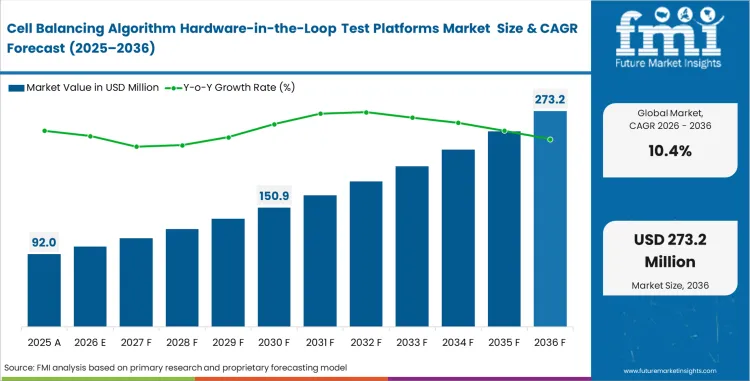
Cell balancing algorithm hardware-in-the-loop test platforms market recorded a value of USD 83.0 million in 2025. Industry valuation is expected to reach USD 92.0 million in 2026, with a CAGR of 10.40% over the forecast period. By 2036, total valuation is projected to reach USD 247.0 million as battery developers place more balancing logic, fault handling, and controller validation into repeatable bench environments before live pack integration.
Summary of Cell Balancing Algorithm Hardware-in-the-Loop Test Platforms Market
- Cell Balancing Algorithm Hardware-in-the-Loop Test Platforms Market Snapshot
- Cell Balancing Algorithm Hardware-in-the-Loop Test Platforms Market is valued at USD 83.3 million in 2025 and is projected to reach USD 247.4 million by 2036.
- Industry valuation is expected to advance at a 10.4% CAGR from 2026 to 2036, creating an incremental opportunity of USD 155.4 million over the period.
- Real-time battery emulation, repeatable fault injection, and confidence in algorithm behavior define this niche more than hardware volume alone.
- EV battery scale-up, wider stationary-storage BMS requirements, and the need to validate balancing, estimation, and protection logic before physical pack testing continue to shape the category.
- Cell Balancing Algorithm Hardware-in-the-Loop Test Platforms Market Demand and Growth Drivers
- A larger installed base of BMS development programs is lifting platform demand, supported by electric car sales above 17 million in 2024 and EV battery demand of about 1 TWh in the same year.
- HIL adoption is advancing because engineering teams need to check SoC, SoH, fault response, cell-balancing behavior, and communication performance under safe emulated conditions rather than relying only on live packs.
- Public and semi-public validation capacity is also expanding, with ARAI documenting broader battery safety and advanced test facilities tied to national and international standards.
- India leads the country outlook at 12.9% CAGR, followed by China at 12.4%, the United States at 10.1%, Germany at 9.8%, South Korea at 9.3%, Japan at 8.9%, and the United Kingdom at 8.5%.
- Long sales cycles, demanding system integration, and capital-spending decisions tied to new program launches continue to slow wider adoption.
- Cell Balancing Algorithm Hardware-in-the-Loop Test Platforms Market Product and Segment View
- Real-time HIL platforms, cell emulators, powered battery emulation systems, and supporting software sit at the core of this market, with each used to validate BMS control logic, balancing routines, and failure behavior across automotive and stationary-storage programs.
- Application demand comes from EV pack development, ESS control validation, Tier 1 subsystem engineering, and research-lab algorithm benchmarking.
- Signal HIL is expected to account for 38.0% share in 2026 because many validation programs still begin with controller-level logic checks before moving into higher-power emulation stages.
- Passive remains the more common production architecture in commercial battery systems, and that keeps it at the front of validation demand. The segment is projected to secure 42.0% share in 2026.
- 400V continues to sit at the center of mainstream EV validation programs because it reflects the widest active architecture base. In 2026, this voltage class is expected to contribute 45.0% of total market share.
- OEM Labs are likely to represent 36.0% of the market in 2026, since automakers and their engineering centers still carry much of the calibration, safety-case, and pre-integration burden.
- Automotive BMS programs still outnumber balancing-validation deployments in stationary storage and aerospace, which keeps EV Packs in the lead. The segment is anticipated to emerge with 63.0% market share in 2026.
- Market scope includes dedicated BMS HIL benches, battery cell emulators, power-aware battery emulation, and associated validation software, while standard battery cyclers, generic environmental chambers without BMS emulation, and broad TIC service revenue remain outside scope.
- Cell Balancing Algorithm Hardware-in-the-Loop Test Platforms Market Geography and Competitive Outlook
- India and China lead on forecast pace, while the United States and Germany remain important high-value demand centers backed by deep engineering budgets and mature OEM and supplier bases.
- Turnkey testbeds, tighter battery-emulator integration with real-time simulation, and modular platform design continue to influence competitive positioning as labs scale from lower-voltage validation toward 400V and 800V programs.
Key Takeaways, Market Size, and Forecast
- Cell Balancing Algorithm Hardware-in-the-Loop Test Platforms Market is projected to grow from USD 92.0 million in 2026 to USD 247.0 million by 2036, at a CAGR of 10.4%.
- The Cell Balancing Algorithm Hardware-in-the-Loop Test Platforms Market was valued at USD 83.0 million in 2025.
- By 2036, the Cell Balancing Algorithm Hardware-in-the-Loop Test Platforms Market is expected to be worth USD 247.0 million.
- From 2026 to 2036, the market is projected to expand at a CAGR of 10.4%.
- The market is projected to create an incremental opportunity of about USD 155.0 million between 2026 and 2036.
- In 2026, Signal HIL is expected to account for 38.0% of the platform type segment.
- India (12.9% CAGR) and China (12.4% CAGR) are two of the fastest growing markets.
Cell Balancing Algorithm Hardware-in-the-Loop Test Platforms Market Key Takeaways
| Metric | Details |
|---|---|
| Industry Size (2026) | USD 92.0 million |
| Industry Value (2036) | USD 247.0 million |
| CAGR (2026-2036) | 10.40% |
Source: Future Market Insights (FMI) analysis, based on proprietary forecasting model and primary research
Engineering teams are working through a different validation burden than they were a few years ago. Narrow lab scripts are no longer enough to confirm whether a battery management design is ready for the next stage of development. More program teams now need clear evidence of how much algorithm behavior can be proven in an emulated setting before prototype packs, vehicle builds, or storage deployments move ahead. Dedicated platforms therefore carry a more defined role within the wider battery testing equipment stack, because internal sign-off now depends more heavily on repeatability, trace coverage, and safe handling of edge-condition testing. Broader electric vehicle test equipment still matters, but it does not always address balancing logic with the same level of depth.
Program adoption depends on one practical condition. Validation teams need a test environment that can represent cell behavior, controller response, and fault states with enough confidence to reduce rework later in development. Once that capability is in place, platform selection becomes easier because the bench is treated less as optional lab hardware and more as part of the release discipline used across ev powertrain test benches.
Among the leading countries, India is expected to post 12.9% CAGR through 2036, supported by faster expansion in validation capacity and battery engineering activity. China follows at 12.4%, where high program volume keeps balancing validation tied closely to dense development cycles. A CAGR of 10.1% is projected for the United States, while Germany is forecast at 9.8% as both countries continue to rely on deeper battery management system workflows linked to vehicle and pack-level qualification. South Korea, at 9.3%, and Japan, at 8.9%, remain relevant through technically demanding engineering environments, while the United Kingdom is likely to register 8.5% through 2036 as specialized validation activity continues to expand from a narrower base.
Segmental Analysis
Cell Balancing Algorithm Hardware-in-the-Loop Test Platforms Market Analysis by Platform Type
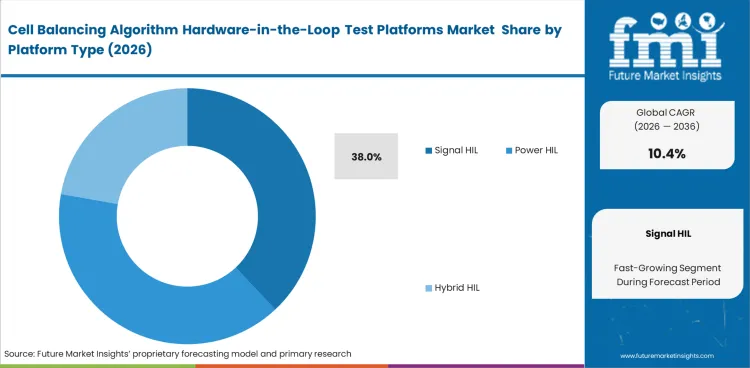
Controller-level validation sits at the front of most development workflows, and that keeps signal-oriented setups in a strong position. Buyers do not start with full power behavior in every case because early-stage algorithm work often depends on controllability, response visibility, and repeatable fault scripting before heavier system complexity is introduced. It has been estimated that Signal HIL will represent 38.0% of the market in 2026, supported by the way engineering teams shape development gates around debugging speed and interface flexibility. This advantage is less about lower sophistication and more about how efficiently the platform fits daily controls work. Programs that move too quickly into larger test environments can burden teams with extra setup steps before the balancing routine itself is stable. That practical sequence keeps signal-led systems central even as demand for broader battery management share analysis tools expands.
- Debug visibility: Signal HIL supports earlier access to controller behavior, which helps controls engineers isolate balancing logic issues before pack integration absorbs time and budget.
- Workflow fit: Daily calibration and algorithm refinement often progress faster on signal-focused benches, which makes them useful for teams managing multiple software iterations.
- Escalation path: Programs that begin with a stable signal-validation layer reduce the chance of carrying immature balancing routines into more complex and costly power-capable environments.
Cell Balancing Algorithm Hardware-in-the-Loop Test Platforms Market Analysis by Balancing Type
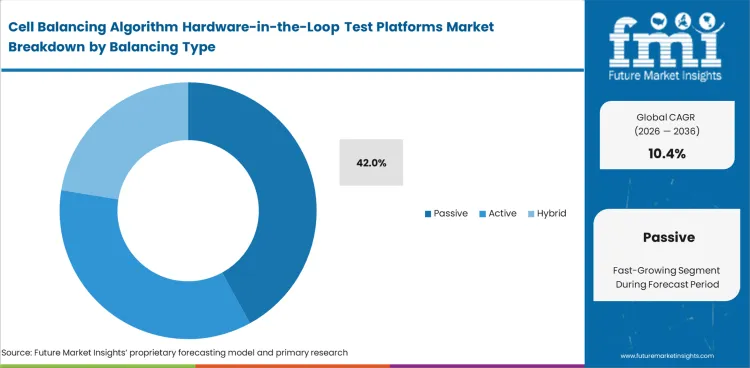
Thermal discipline, cost sensitivity, and architecture familiarity continue to influence how balancing strategies are validated. Passive designs remain common in the installed base, so test demand naturally follows the systems that battery developers are still using across a large share of commercial programs. A 42.0% market share is expected for Passive in 2026, and that lead reflects deployment reality more than technical novelty. Many engineering teams still need to prove behavior in architectures where energy is dissipated rather than redistributed, which keeps validation needs tied to simpler control structures and predictable handling profiles. Active balancing draws attention where performance goals are tighter, yet passive systems still dominate day-to-day validation volume because buyers are working against real program mix rather than only the appeal of advanced electric vehicle battery concepts.
- Architecture familiarity: Passive balancing remains easier to map to existing validation routines, which helps test teams reuse scripts and shorten learning curves.
- Thermal control: Heat behavior and discharge handling still need careful checking, and poor validation here can surface later as pack inconsistency or control instability.
- Program mix: Buyers often size platforms to match current production architecture, which keeps passive-oriented validation demand ahead while active methods build share gradually.
Cell Balancing Algorithm Hardware-in-the-Loop Test Platforms Market Analysis by Voltage Class
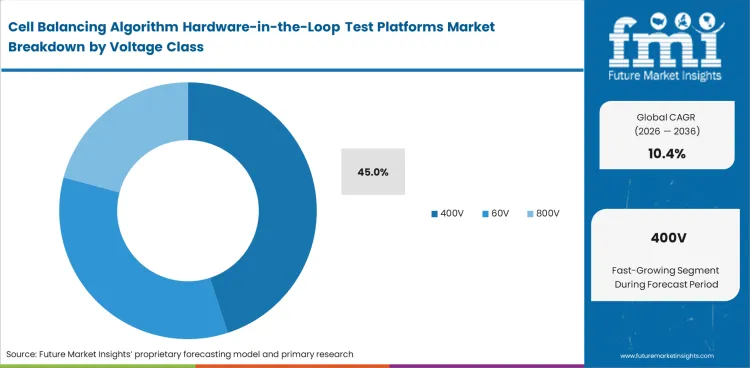
Battery developers still carry a wide base of work in mainstream pack architectures, and that supports 400V as the leading voltage class. In 2026, 400V is projected to contribute 45.0% of total market share because validation demand continues to cluster around programs that must balance scalability, system familiarity, and manageable engineering complexity. This lead does not imply slower technical progress elsewhere. It points to where the largest volume of active validation programs still sits. Buyers choose around installed engineering practices, available component ecosystems, and the need to prove balancing behavior at a level that aligns with present production work. Hence, the category remains grounded in broad battery formation testing workflows linked to mainstream mobility platforms, even as higher-voltage development expands.
- Installed base: A large share of current validation programs still centers on mainstream pack architectures, which keeps 400V demand ahead of narrower high-performance deployments.
- Engineering continuity: Teams prefer voltage classes that align with existing controller, emulator, and integration practices when release timing is under pressure.
- Transition burden: Buyers that underprepare for voltage-class migration can face added retuning work when balancing logic is carried across platforms with different operating behavior.
Cell Balancing Algorithm Hardware-in-the-Loop Test Platforms Market Analysis by End Use
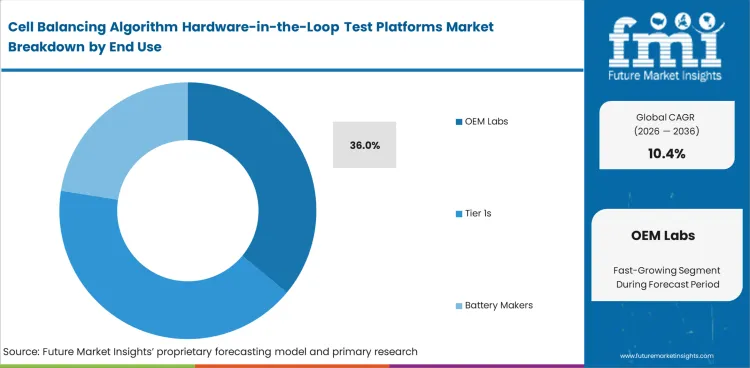
Release ownership still sits heavily inside the laboratories closest to the final integration decision, which is why OEM Labs continue to lead. Their role extends beyond checking whether a balancing routine runs. They need to judge whether controller behavior is acceptable under the combinations of conditions that can delay a launch or complicate pack sign-off. OEM Labs are expected to account for 36.0% share in 2026 because automakers remain responsible for merging software confidence, pack behavior, and downstream approval timing. The buying logic differs from the priorities of research groups or independent testing specialists, which may focus on narrower technical tasks. Spending remains linked to where release accountability is concentrated, and that keeps the segment tied to wider battery testing certification requirements across vehicle programs.
- Release accountability: OEM labs carry direct responsibility for integration sign-off, which makes deeper validation capability a practical requirement rather than a discretionary upgrade.
- Cross-team coordination: Controller, battery, and vehicle teams converge in OEM environments, so platform usefulness often depends on how well it supports shared workflows.
- Delay exposure: Weak in-house validation can push balancing issues into later build stages, where corrective work becomes harder to contain within normal program timing.
Cell Balancing Algorithm Hardware-in-the-Loop Test Platforms Market Analysis by Application
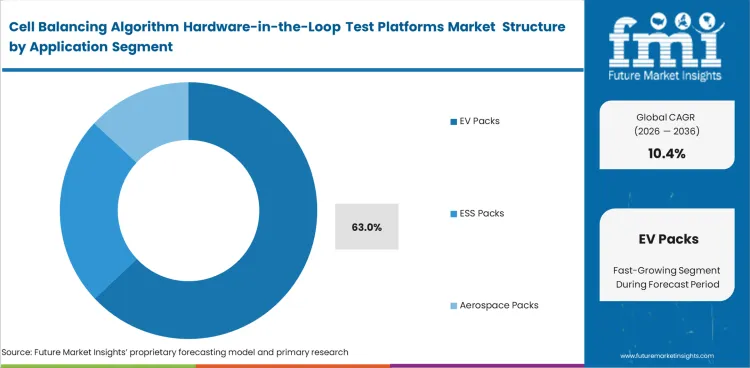
Mobility programs still generate the broadest and most frequent demand for balancing-oriented validation, which keeps EV Packs in the leading position. EV Packs are forecast to account for 63.0% share in 2026 because vehicle development involves a dense mix of controller refinement, pack integration, release discipline, and fault-behavior checks. That workload is larger and more repetitive than what most aerospace or off-highway applications currently require. Buyers in this segment are not only assessing whether balancing works. They are evaluating whether the control routine behaves consistently across the operating scenarios that matter to product release and field performance which explains why the category remains closely tied to the evolution of battery energy storage system and mobility engineering, even as adjacent use cases broaden.
- Program volume: EV development generates a higher frequency of validation cycles, which keeps platform usage and upgrade needs concentrated in automotive applications.
- Integration depth: Vehicle programs demand closer coordination between software, pack behavior, and safety logic, raising the value of specialized balancing validation benches.
- Field risk: Buyers that underestimate application-specific validation needs may discover balancing weaknesses later, when correction touches pack design, controls, and release schedules together.
Cell Balancing Algorithm Hardware-in-the-Loop Test Platforms Market Drivers, Restraints, and Opportunities
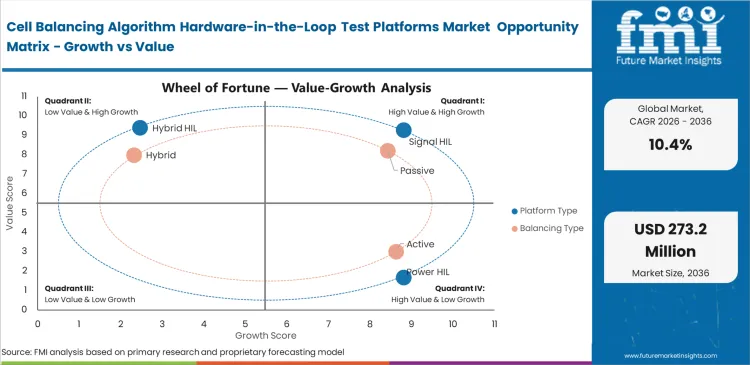
Battery program owners are under pressure to prove balancing logic before expensive physical validation absorbs time and engineering capacity. That pressure is changing buying behavior because teams now need more than a broad simulation environment. They need a bench that can support fault insertion, repeatable algorithm checks, and controller interaction without waiting for every full pack build to mature. Demand rises when validation groups are asked to narrow uncertainty earlier in the release path. Platforms that can sit alongside wider solid-state battery test equipment and advanced battery resistance tester workflows benefit because buyers want a cleaner handoff between software confidence and physical test readiness.
Lab adoption still slows when the buying process is split across controls teams, battery engineers, and capital-approval groups that do not define value in the same way. This is not a simple budget issue. It is an organizational friction problem. One group wants debugging efficiency, another wants model fidelity, and another wants equipment that can serve several projects at once. That misalignment can delay platform selection even when the technical need is clear. Vendors improve their position when they reduce integration burden and explain where the tool fits inside broader battery technology development rather than selling only on hardware depth.
Opportunities in the Cell Balancing Algorithm Hardware-in-the-Loop Test Platforms Market
- Platform convergence: Suppliers can win where buyers want balancing validation tied more tightly to charging, powertrain, and adjacent subsystem workflows built around charge cable durability equipment.
- Storage crossover: ESS developers can capture more value when balancing validation is adapted for larger duty profiles and longer operating windows linked to bess test platforms.
- Workflow modularity: Buyers respond well to modular systems that let labs start with balancing-specific needs and expand later into broader charger and inverter validation tasks without rebuilding the whole bench.
Regional Analysis
Based on the regional analysis, the Cell Balancing Algorithm Hardware-in-the-Loop Test Platforms market is segmented into Asia Pacific, North America, and Europe across 40 plus countries.
.webp "Top Country Growth Comparison Cell Balancing Algorithm Hardware In The Loop Test Platforms Market Cagr (2026 2036)")
| Country | CAGR (2026 to 2036) |
|---|---|
| India | 12.9% |
| China | 12.4% |
| United States | 10.1% |
| Germany | 9.8% |
| South Korea | 9.3% |
| Japan | 8.9% |
| United Kingdom | 8.5% |
Source: Future Market Insights (FMI) analysis, based on proprietary forecasting model and primary research
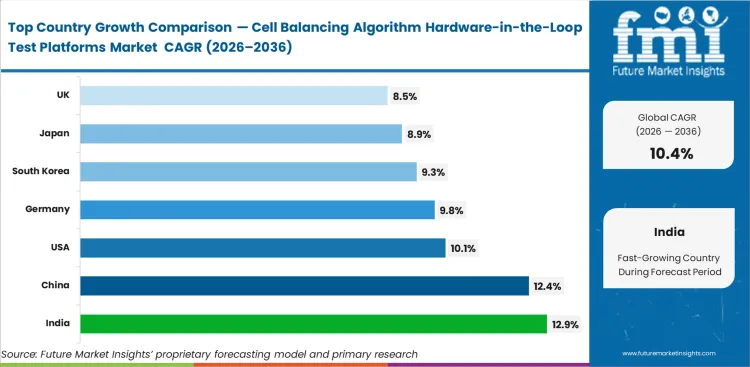
Asia Pacific Cell Balancing Algorithm Hardware-in-the-Loop Test Platforms Market Analysis
Asia Pacific remains the strongest growth center in this market because battery engineering work is broadening across both large-scale manufacturing countries and technically advanced development hubs. Buying activity is not driven by one single factor. Some labs are still building their first serious balancing-validation capability, while others are upgrading benches to support deeper controller checks, wider operating scenarios, and faster iteration cycles. That difference matters commercially. Suppliers do not win here by offering the same configuration to every buyer. They win by matching platform depth, service support, and integration effort to the maturity of the lab that is making the purchase.
- India: India is expected to record 12.9% CAGR in the market through 2036. That pace reflects a country still building out validation depth rather than merely refreshing an installed base. Battery development activity is widening, and local engineering teams need tools that can support controller checks before costlier pack-level testing absorbs time and budget. Buying decisions are often linked to capability creation, which changes the sales discussion. Suppliers are not just selling equipment. They are helping labs define how much balancing behavior can be tested in-house and how quickly new workflows can be established. That makes application support, usability, and installation fit especially important in the Indian market.
- China: China carries one of the strongest demand profiles in this category, and the market is projected to expand at a CAGR of 12.4% through 2036. Scale is the main commercial driver here. Battery development programs move quickly, and validation teams need platforms that can keep pace with larger engineering workloads and tighter development schedules. Buyers also place more weight on throughput and repeatability because balancing checks are part of a wider release process rather than a narrow lab exercise. Suppliers that cannot support fast deployment or adapt to broad program requirements face a harder path. China remains commercially attractive because platform demand is tied to active engineering volume, not only to selective high-end use.
- South Korea: Battery and electronics depth give South Korea a strong technical base, but the buying pattern is more selective than the headline demand story may suggest. The sector is likely to advance at a CAGR of 9.3% through 2036, supported by high-value engineering use and disciplined validation practice. Labs in this country often focus on what a platform can do under demanding development conditions rather than how broadly it can be rolled out. That shifts competition toward precision, integration quality, and support for advanced engineering workflows. Suppliers that rely on broad product messaging usually struggle to stand out. South Korea remains important because technical expectations are high, and credible execution carries more weight than catalog breadth.
- Japan: Japan remains a technically serious market where development discipline often shapes the buying cycle more than simple expansion logic. Demand is expected to move ahead at 8.9% CAGR through 2036. That rate is lower than India or China, yet it still reflects steady interest from buyers that value reliable validation environments and careful qualification. Lab teams tend to evaluate systems through the lens of repeatability, engineering fit, and how well the platform supports controlled development work over time. This makes the sales cycle more deliberate. Suppliers must show where the bench improves workflow without adding avoidable integration burden. Japan continues to matter because technically demanding users reward platforms that are precise, stable, and easy to incorporate into existing programs.
FMI’s report includes detailed tracking of validation demand across China, India, Japan, and South Korea. Differences in battery program scale, lab readiness, engineering depth, and test maturity continue to shape platform adoption across Asia Pacific..
North America Cell Balancing Algorithm Hardware-in-the-Loop Test Platforms Market Analysis
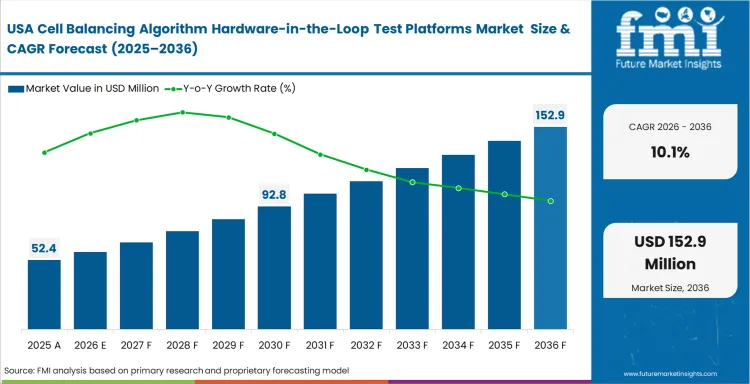
North America remains one of the most commercially valuable regions in this market because spending is tied closely to engineering accountability, program timing, and release confidence. Buyers here usually operate from a more mature validation base than many of their counterparts in faster-rising markets. That changes the commercial question. Labs are less focused on whether they need balancing-focused HIL capability at all, and more focused on whether a given platform reduces integration effort, supports repeated development changes, and fits existing approval routines. The region favors suppliers that understand how validation work moves through engineering organizations and where delays create real cost.
- United States: Strong automotive and battery-development activity keep the United States at the center of North American demand. The market in the country is projected to expand at a CAGR of 10.1% through 2036, supported by the scale of ongoing engineering work and the need for more disciplined controller validation. Buyers typically approach these platforms with a practical lens. They want systems that shorten debugging cycles, support repeated software changes, and connect cleanly with established validation environments. A technically capable bench is not enough on its own. Installation burden, interface compatibility, and support responsiveness often shape final vendor choice. The United States remains important because release readiness and validation quality are tied directly to program cost and timing.
FMI’s report includes detailed tracking of validation demand patterns across the United States. Differences in release discipline, engineering workflow depth, integration needs, and lab utilization continue to influence platform adoption across North American battery validation programs.
Europe Cell Balancing Algorithm Hardware-in-the-Loop Test Platforms Market Analysis
Europe remains a serious market for this category because buying behavior is shaped by technical discipline, documentation quality, and program consistency. The region does not lead on headline expansion, but it continues to hold commercial importance because many buyers evaluate platforms with a narrower tolerance for weak integration, vague performance claims, or poor workflow fit. Validation quality matters here in a direct way. Labs are usually comparing how well a system supports repeatable engineering work rather than simply how much functionality it offers on paper. That keeps demand steady and gives an edge to suppliers that combine technical depth with dependable execution.
- Germany: Germany is forecast to register 9.8% CAGR in the market through 2036, supported by dense automotive engineering activity and a strong culture of disciplined validation work. Buyers in the country tend to place weight on development continuity, documentation quality, and compatibility with established engineering routines. That creates a more demanding purchase process than in countries where capability creation is the main goal. Vendors must show how the platform fits actual release practice, not just how advanced the system appears in isolation. Germany remains a key market because it brings together technical rigor, broad automotive relevance, and a buying approach that rewards platforms capable of supporting serious development work over repeated program cycles.
- United Kingdom: Specialized engineering work continues to support demand in the United Kingdom, even though the market is narrower than in larger automotive centers. The industry outlook points to 8.5% CAGR through 2036. Buyers in this country often evaluate platforms through targeted use cases rather than broad rollout plans, which makes fit and application relevance more important than scale. Suppliers need to be clear about what the system improves inside a lab workflow and where it reduces validation burden without introducing unnecessary complexity. The United Kingdom remains commercially meaningful because focused engineering programs can still generate steady demand for capable platforms when the technical case and deployment logic are clearly aligned.
FMI’s report includes detailed tracking of validation demand across Germany and the United Kingdom. Differences in qualification discipline, documentation expectations, engineering continuity, and lab-use priorities continue to affect platform adoption across European battery development environments.
Competitive Aligners for Market Players
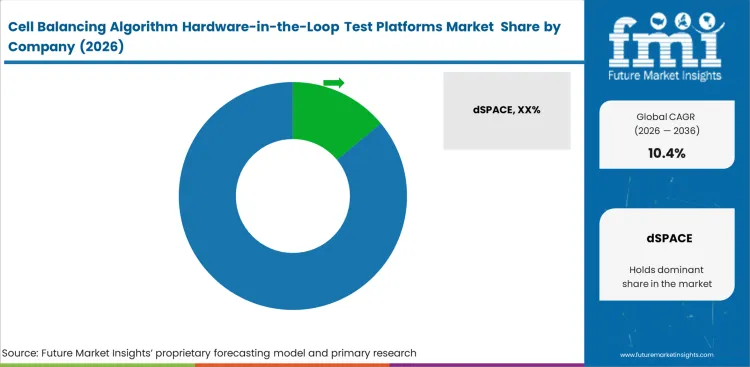
Competition in this category is shaped by how well a supplier fits into the buyer’s existing validation routine. Platform capability matters, but it does not close the sale on its own. Controls teams want debugging clarity, battery engineers want credible emulation behavior, and lab managers want systems that can be integrated without dragging projects into long customization cycles. It makes service depth, workflow fit, and interface flexibility more commercially relevant than broad product catalog size alone.
Established suppliers hold an edge where programs require broad interoperability, application support, and confidence in release-critical environments. Buyers choosing among these vendors are usually comparing more than hardware specifications. They are assessing response time, model depth, integration effort, and how well the system can support repeated changes during development. Challengers still find room where modularity, narrower specialization, or easier deployment reduces the burden on lean engineering teams. The market remains fragmented, where leadership still matters, yet few suppliers can dominate every use case within the wider automotive battery management system and battery testing equipment chain.
Vendor positioning also depends on how clearly the platform can extend into adjacent validation needs without losing focus on balancing logic. Buyers prefer tools that can stay useful as programs expand toward pack, charging, or inverter-related checks, but they remain cautious about systems that become too broad and dilute day-to-day usability. That tension keeps product design and commercial messaging closely linked. Suppliers that balance technical depth with a manageable user experience are more likely to remain relevant as engineering teams connect balancing work with broader battery energy storage system and electric vehicle test equipment activity.
Key Players in Cell Balancing Algorithm Hardware-in-the-Loop Test Platforms Market
- dSPACE
- NI (part of Emerson)
- Speedgoat
- Typhoon HIL
- OPAL-RT Technologies
- AVL
- Vector
Scope of the Report
| Metric | Value |
|---|---|
| Quantitative Units | USD 83.0 million in 2025, USD 92.0 million in 2026, and USD 247.0 million by 2036, at a CAGR of 10.40% |
| Market Definition | Hardware-in-the-loop validation platforms designed to test cell balancing algorithms under controlled and repeatable battery management system environments, including fault response, controller behavior, and emulated cell conditions. |
| Segmentation | Platform Type, Balancing Type, Voltage Class, End Use, Application, and Region |
| Regions Covered | Asia Pacific, North America, and Europe |
| Countries Covered | India, China, South Korea, Japan, United States, Germany, and United Kingdom |
| Key Companies Profiled | dSPACE, NI (part of Emerson), Speedgoat, Typhoon HIL, OPAL-RT Technologies, AVL, and Vector |
| Forecast Period | 2026 to 2036 |
| Approach | Platform demand assessment based on balancing-validation workflows, battery development activity, controller verification depth, and adoption across OEM labs, battery makers, Tier 1 engineering teams, research institutes, and test laboratories. |
Source: Future Market Insights (FMI) analysis, based on proprietary forecasting model and primary research
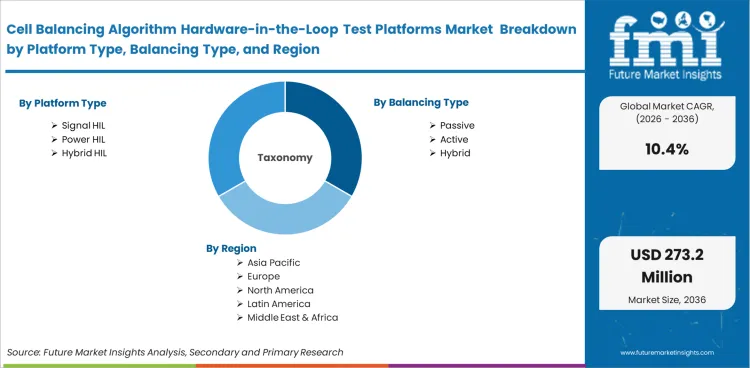
Cell Balancing Algorithm Hardware-in-the-Loop Test Platforms Market Analysis by Segments
Platform Type:
- Signal HIL
- Power HIL
- Hybrid HIL
Balancing Type:
- Passive
- Active
- Hybrid
Voltage Class:
- 400V
- 60V
- 800V
End Use:
- OEM Labs
- Tier 1s
- Battery Makers
- Test Labs
- Research Institutes
Application:
- EV Packs
- ESS Packs
- Aerospace Packs
- Off-Highway Packs
Region:
- Asia Pacific
- India
- China
- South Korea
- Japan
- North America
- United States
- Europe
- Germany
- United Kingdom
Bibliography
- Ashraf, A., Ali, A. O., Hannan, M. A., Mansor, M., Ker, P. J., Hussain, A., & Mohamed, A. (2024, March 07). Review of cell-balancing schemes for electric vehicle battery management systems. Energies.
- Automotive Research Association of India. (2025, September). 55th Annual Report 2024-2025. Automotive Research Association of India.
- Berger, F., Jöst, D., Barbers, E. M., Quade, K. L., Wu, Z., Sauer, D. U., & Dechent, P. A. (2024, December). Benchmarking battery management system algorithms - Requirements, scenarios and validation for automotive applications. eTransportation.
- International Energy Agency. (2025, May). Electric vehicle batteries. International Energy Agency.
- International Energy Agency. (2025, May 14). Global EV Outlook 2025. International Energy Agency.
This bibliography is provided for reader reference. The full FMI report contains the complete reference list with primary source documentation.
This Report Addresses
- Market intelligence to support strategic decision making across Signal HIL, Power HIL, Hybrid HIL, and balancing-oriented validation platforms.
- Market size estimation and ten-year revenue forecasts from 2026 to 2036, supported by validation workflow mapping and platform-demand assessment.
- Growth opportunity mapping across Platform Type, Balancing Type, Voltage Class, End Use, and Application with emphasis on earlier balancing-proof requirements.
- Segment and regional revenue forecasts covering Signal HIL, Passive, 400V, OEM Labs, and EV Packs across Asia Pacific, North America, and Europe.
- Competition strategy assessment including service support, integration fit, emulator depth, workflow usability, and responsiveness to engineering change.
- Platform development tracking including cell emulation, controller interfacing, balancing verification, fault insertion, and real-time validation capability.
- Market access analysis covering OEM lab adoption, Tier 1 engineering use, battery maker validation needs, research workflows, and test-lab positioning.
- Market report delivery in PDF, Excel, PPT, and interactive dashboard formats for executive strategy, engineering planning, and operational benchmarking use.
Frequently Asked Questions
How large is the Cell Balancing Algorithm Hardware-in-the-Loop Test Platforms Market in 2026?
The Cell Balancing Algorithm Hardware-in-the-Loop Test Platforms Market is expected to reach USD 92.0 million in 2026 as validation budgets align more closely with balancing-proof requirements.
What will the Cell Balancing Algorithm Hardware-in-the-Loop Test Platforms Market be valued at by 2036?
FMI estimates the Cell Balancing Algorithm Hardware-in-the-Loop Test Platforms Market will reach USD 247.0 million by 2036 as platform use deepens across vehicle and storage programs.
What CAGR is projected for the Cell Balancing Algorithm Hardware-in-the-Loop Test Platforms Market from 2026 to 2036?
The Cell Balancing Algorithm Hardware-in-the-Loop Test Platforms Market is projected to expand at a CAGR of 10.40% through 2036, supported by broader validation depth.
Which Platform Type segment leads the Cell Balancing Algorithm Hardware-in-the-Loop Test Platforms Market?
Signal HIL leads the Cell Balancing Algorithm Hardware-in-the-Loop Test Platforms Market, with 38.0% share in 2026, because early algorithm debugging usually starts in controllable environments.
Which Balancing Type segment leads the Cell Balancing Algorithm Hardware-in-the-Loop Test Platforms Market?
Passive leads the Cell Balancing Algorithm Hardware-in-the-Loop Test Platforms Market at 42.0% share in 2026, reflecting the large installed base of simpler production architectures.
Which Voltage Class segment leads the Cell Balancing Algorithm Hardware-in-the-Loop Test Platforms Market?
400V leads the Cell Balancing Algorithm Hardware-in-the-Loop Test Platforms Market with 45.0% share in 2026, supported by its broad role in mainstream battery validation programs.
Which End Use segment leads the Cell Balancing Algorithm Hardware-in-the-Loop Test Platforms Market?
OEM Labs lead the Cell Balancing Algorithm Hardware-in-the-Loop Test Platforms Market at 36.0% share in 2026 because release accountability still sits close to automakers.
Which Application segment leads the Cell Balancing Algorithm Hardware-in-the-Loop Test Platforms Market?
EV Packs lead the Cell Balancing Algorithm Hardware-in-the-Loop Test Platforms Market with 63.0% share in 2026, driven by the volume of mobility validation work.
What is driving demand in the Cell Balancing Algorithm Hardware-in-the-Loop Test Platforms Market?
What is driving demand in the Cell Balancing Algorithm Hardware-in-the-Loop Test Platforms Market? Demand in the Cell Balancing Algorithm Hardware-in-the-Loop Test Platforms Market rises as engineering teams seek repeatable balancing validation before costly pack integration begins.
Why are OEMs investing in the Cell Balancing Algorithm Hardware-in-the-Loop Test Platforms Market?
OEMs invest in the Cell Balancing Algorithm Hardware-in-the-Loop Test Platforms Market because earlier validation reduces debugging risk and strengthens release confidence inside internal laboratories.
How does Signal HIL support the Cell Balancing Algorithm Hardware-in-the-Loop Test Platforms Market?
Signal HIL supports the Cell Balancing Algorithm Hardware-in-the-Loop Test Platforms Market by giving controls teams faster visibility into logic behavior before higher-complexity benches are required.
How does Passive balancing shape the Cell Balancing Algorithm Hardware-in-the-Loop Test Platforms Market?
Passive balancing shapes the Cell Balancing Algorithm Hardware-in-the-Loop Test Platforms Market because many commercial programs still validate architectures built around simpler thermal behavior.
Which country grows fastest in the Cell Balancing Algorithm Hardware-in-the-Loop Test Platforms Market?
India grows fastest in the Cell Balancing Algorithm Hardware-in-the-Loop Test Platforms Market, with 12.9% CAGR, as validation capability expands from a smaller base.
How does China contribute to the Cell Balancing Algorithm Hardware-in-the-Loop Test Platforms Market?
China supports the Cell Balancing Algorithm Hardware-in-the-Loop Test Platforms Market with 12.4% CAGR, backed by large-scale battery development and broad domestic engineering activity.
What role does the United States play in the Cell Balancing Algorithm Hardware-in-the-Loop Test Platforms Market?
The United States supports the Cell Balancing Algorithm Hardware-in-the-Loop Test Platforms Market at 10.1% CAGR through strong engineering budgets and mature validation workflows.
How is Germany positioned in the Cell Balancing Algorithm Hardware-in-the-Loop Test Platforms Market?
Germany remains important in the Cell Balancing Algorithm Hardware-in-the-Loop Test Platforms Market with 9.8% CAGR, supported by dense automotive engineering and disciplined validation practices.
How do South Korea and Japan influence the Cell Balancing Algorithm Hardware-in-the-Loop Test Platforms Market?
South Korea and Japan support the Cell Balancing Algorithm Hardware-in-the-Loop Test Platforms Market through advanced battery engineering, recording 9.3% and 8.9% CAGR, respectively.
What is the outlook for the United Kingdom in the Cell Balancing Algorithm Hardware-in-the-Loop Test Platforms Market?
The United Kingdom records 8.5% CAGR in the Cell Balancing Algorithm Hardware-in-the-Loop Test Platforms Market, supported by specialized engineering and selective validation programs.
Who are the leading companies in the Cell Balancing Algorithm Hardware-in-the-Loop Test Platforms Market?
Leading companies in the Cell Balancing Algorithm Hardware-in-the-Loop Test Platforms Market include dSPACE, NI, Speedgoat, Typhoon HIL, OPAL-RT Technologies, AVL, and Vector.
Is the Cell Balancing Algorithm Hardware-in-the-Loop Test Platforms Market concentrated or fragmented?
The Cell Balancing Algorithm Hardware-in-the-Loop Test Platforms Market remains fragmented, although dSPACE leads with an estimated 14.8% share and suppliers compete on workflow fit.
What do buyers compare in the Cell Balancing Algorithm Hardware-in-the-Loop Test Platforms Market?
Buyers in the Cell Balancing Algorithm Hardware-in-the-Loop Test Platforms Market compare emulator depth, controller interfacing, integration effort, support responsiveness, and validation workflow fit.
What is included in the Cell Balancing Algorithm Hardware-in-the-Loop Test Platforms Market scope?
The Cell Balancing Algorithm Hardware-in-the-Loop Test Platforms Market includes HIL benches, cell emulators, balancing validation software, controller interfaces, and related engineering support services.
Preview the report firsthand - request a free sample
Get SampleGet the brochure for pricing and purchase details.
Get PDFTable of Content
- Executive Summary
- Global Market Outlook
- Demand-side Trends
- Supply-side Trends
- Technology Roadmap Analysis
- Analysis and Recommendations
- Market Overview
- Market Coverage / Taxonomy
- Market Definition / Scope / Limitations
- Research Methodology
- Chapter Orientation
- Analytical Lens and Working Hypotheses
- Market Structure, Signals, and Trend Drivers
- Benchmarking and Cross-market Comparability
- Market Sizing, Forecasting, and Opportunity Mapping
- Research Design and Evidence Framework
- Desk Research Programme (Secondary Evidence)
- Company Annual and Sustainability Reports
- Peer-reviewed Journals and Academic Literature
- Corporate Websites, Product Literature, and Technical Notes
- Earnings Decks and Investor Briefings
- Statutory Filings and Regulatory Disclosures
- Technical White Papers and Standards Notes
- Trade Journals, Industry Magazines, and Analyst Briefs
- Conference Proceedings, Webinars, and Seminar Materials
- Government Statistics Portals and Public Data Releases
- Press Releases and Reputable Media Coverage
- Specialist Newsletters and Curated Briefings
- Sector Databases and Reference Repositories
- FMI Internal Proprietary Databases and Historical Market Datasets
- Subscription Datasets and Paid Sources
- Social Channels, Communities, and Digital Listening Inputs
- Additional Desk Sources
- Expert Input and Fieldwork (Primary Evidence)
- Primary Modes
- Qualitative Interviews and Expert Elicitation
- Quantitative Surveys and Structured Data Capture
- Blended Approach
- Why Primary Evidence is Used
- Field Techniques
- Interviews
- Surveys
- Focus Groups
- Observational and In-context Research
- Social and Community Interactions
- Stakeholder Universe Engaged
- C-suite Leaders
- Board Members
- Presidents and Vice Presidents
- R&D and Innovation Heads
- Technical Specialists
- Domain Subject-matter Experts
- Scientists
- Physicians and Other Healthcare Professionals
- Governance, Ethics, and Data Stewardship
- Research Ethics
- Data Integrity and Handling
- Primary Modes
- Tooling, Models, and Reference Databases
- Desk Research Programme (Secondary Evidence)
- Data Engineering and Model Build
- Data Acquisition and Ingestion
- Cleaning, Normalisation, and Verification
- Synthesis, Triangulation, and Analysis
- Quality Assurance and Audit Trail
- Market Background
- Market Dynamics
- Drivers
- Restraints
- Opportunity
- Trends
- Scenario Forecast
- Demand in Optimistic Scenario
- Demand in Likely Scenario
- Demand in Conservative Scenario
- Opportunity Map Analysis
- Product Life Cycle Analysis
- Supply Chain Analysis
- Investment Feasibility Matrix
- Value Chain Analysis
- PESTLE and Porter’s Analysis
- Regulatory Landscape
- Regional Parent Market Outlook
- Production and Consumption Statistics
- Import and Export Statistics
- Market Dynamics
- Global Market Analysis 2021 to 2025 and Forecast, 2026 to 2036
- Historical Market Size Value (USD Million) Analysis, 2021 to 2025
- Current and Future Market Size Value (USD Million) Projections, 2026 to 2036
- Y-o-Y Growth Trend Analysis
- Absolute $ Opportunity Analysis
- Global Market Pricing Analysis 2021 to 2025 and Forecast 2026 to 2036
- Global Market Analysis 2021 to 2025 and Forecast 2026 to 2036, By Platform Type
- Introduction / Key Findings
- Historical Market Size Value (USD Million) Analysis By Platform Type , 2021 to 2025
- Current and Future Market Size Value (USD Million) Analysis and Forecast By Platform Type , 2026 to 2036
- Signal HIL
- Power HIL
- Hybrid HIL
- Signal HIL
- Y-o-Y Growth Trend Analysis By Platform Type , 2021 to 2025
- Absolute $ Opportunity Analysis By Platform Type , 2026 to 2036
- Global Market Analysis 2021 to 2025 and Forecast 2026 to 2036, By Balancing Type
- Introduction / Key Findings
- Historical Market Size Value (USD Million) Analysis By Balancing Type, 2021 to 2025
- Current and Future Market Size Value (USD Million) Analysis and Forecast By Balancing Type, 2026 to 2036
- Passive
- Active
- Hybrid
- Passive
- Y-o-Y Growth Trend Analysis By Balancing Type, 2021 to 2025
- Absolute $ Opportunity Analysis By Balancing Type, 2026 to 2036
- Global Market Analysis 2021 to 2025 and Forecast 2026 to 2036, By Voltage Class
- Introduction / Key Findings
- Historical Market Size Value (USD Million) Analysis By Voltage Class, 2021 to 2025
- Current and Future Market Size Value (USD Million) Analysis and Forecast By Voltage Class, 2026 to 2036
- 400V
- 60V
- 800V
- 400V
- Y-o-Y Growth Trend Analysis By Voltage Class, 2021 to 2025
- Absolute $ Opportunity Analysis By Voltage Class, 2026 to 2036
- Global Market Analysis 2021 to 2025 and Forecast 2026 to 2036, By End Use
- Introduction / Key Findings
- Historical Market Size Value (USD Million) Analysis By End Use, 2021 to 2025
- Current and Future Market Size Value (USD Million) Analysis and Forecast By End Use, 2026 to 2036
- OEM Labs
- Tier 1s
- Battery Makers
- OEM Labs
- Y-o-Y Growth Trend Analysis By End Use, 2021 to 2025
- Absolute $ Opportunity Analysis By End Use, 2026 to 2036
- Global Market Analysis 2021 to 2025 and Forecast 2026 to 2036, By Application
- Introduction / Key Findings
- Historical Market Size Value (USD Million) Analysis By Application, 2021 to 2025
- Current and Future Market Size Value (USD Million) Analysis and Forecast By Application, 2026 to 2036
- EV Packs
- ESS Packs
- Aerospace Packs
- EV Packs
- Y-o-Y Growth Trend Analysis By Application, 2021 to 2025
- Absolute $ Opportunity Analysis By Application, 2026 to 2036
- Global Market Analysis 2021 to 2025 and Forecast 2026 to 2036, By Region
- Introduction
- Historical Market Size Value (USD Million) Analysis By Region, 2021 to 2025
- Current Market Size Value (USD Million) Analysis and Forecast By Region, 2026 to 2036
- North America
- Latin America
- Western Europe
- Eastern Europe
- East Asia
- South Asia and Pacific
- Middle East & Africa
- Market Attractiveness Analysis By Region
- North America Market Analysis 2021 to 2025 and Forecast 2026 to 2036, By Country
- Historical Market Size Value (USD Million) Trend Analysis By Market Taxonomy, 2021 to 2025
- Market Size Value (USD Million) Forecast By Market Taxonomy, 2026 to 2036
- By Country
- USA
- Canada
- Mexico
- By Platform Type
- By Balancing Type
- By Voltage Class
- By End Use
- By Application
- By Country
- Market Attractiveness Analysis
- By Country
- By Platform Type
- By Balancing Type
- By Voltage Class
- By End Use
- By Application
- Key Takeaways
- Latin America Market Analysis 2021 to 2025 and Forecast 2026 to 2036, By Country
- Historical Market Size Value (USD Million) Trend Analysis By Market Taxonomy, 2021 to 2025
- Market Size Value (USD Million) Forecast By Market Taxonomy, 2026 to 2036
- By Country
- Brazil
- Chile
- Rest of Latin America
- By Platform Type
- By Balancing Type
- By Voltage Class
- By End Use
- By Application
- By Country
- Market Attractiveness Analysis
- By Country
- By Platform Type
- By Balancing Type
- By Voltage Class
- By End Use
- By Application
- Key Takeaways
- Western Europe Market Analysis 2021 to 2025 and Forecast 2026 to 2036, By Country
- Historical Market Size Value (USD Million) Trend Analysis By Market Taxonomy, 2021 to 2025
- Market Size Value (USD Million) Forecast By Market Taxonomy, 2026 to 2036
- By Country
- Germany
- UK
- Italy
- Spain
- France
- Nordic
- BENELUX
- Rest of Western Europe
- By Platform Type
- By Balancing Type
- By Voltage Class
- By End Use
- By Application
- By Country
- Market Attractiveness Analysis
- By Country
- By Platform Type
- By Balancing Type
- By Voltage Class
- By End Use
- By Application
- Key Takeaways
- Eastern Europe Market Analysis 2021 to 2025 and Forecast 2026 to 2036, By Country
- Historical Market Size Value (USD Million) Trend Analysis By Market Taxonomy, 2021 to 2025
- Market Size Value (USD Million) Forecast By Market Taxonomy, 2026 to 2036
- By Country
- Russia
- Poland
- Hungary
- Balkan & Baltic
- Rest of Eastern Europe
- By Platform Type
- By Balancing Type
- By Voltage Class
- By End Use
- By Application
- By Country
- Market Attractiveness Analysis
- By Country
- By Platform Type
- By Balancing Type
- By Voltage Class
- By End Use
- By Application
- Key Takeaways
- East Asia Market Analysis 2021 to 2025 and Forecast 2026 to 2036, By Country
- Historical Market Size Value (USD Million) Trend Analysis By Market Taxonomy, 2021 to 2025
- Market Size Value (USD Million) Forecast By Market Taxonomy, 2026 to 2036
- By Country
- China
- Japan
- South Korea
- By Platform Type
- By Balancing Type
- By Voltage Class
- By End Use
- By Application
- By Country
- Market Attractiveness Analysis
- By Country
- By Platform Type
- By Balancing Type
- By Voltage Class
- By End Use
- By Application
- Key Takeaways
- South Asia and Pacific Market Analysis 2021 to 2025 and Forecast 2026 to 2036, By Country
- Historical Market Size Value (USD Million) Trend Analysis By Market Taxonomy, 2021 to 2025
- Market Size Value (USD Million) Forecast By Market Taxonomy, 2026 to 2036
- By Country
- India
- ASEAN
- Australia & New Zealand
- Rest of South Asia and Pacific
- By Platform Type
- By Balancing Type
- By Voltage Class
- By End Use
- By Application
- By Country
- Market Attractiveness Analysis
- By Country
- By Platform Type
- By Balancing Type
- By Voltage Class
- By End Use
- By Application
- Key Takeaways
- Middle East & Africa Market Analysis 2021 to 2025 and Forecast 2026 to 2036, By Country
- Historical Market Size Value (USD Million) Trend Analysis By Market Taxonomy, 2021 to 2025
- Market Size Value (USD Million) Forecast By Market Taxonomy, 2026 to 2036
- By Country
- Kingdom of Saudi Arabia
- Other GCC Countries
- Turkiye
- South Africa
- Other African Union
- Rest of Middle East & Africa
- By Platform Type
- By Balancing Type
- By Voltage Class
- By End Use
- By Application
- By Country
- Market Attractiveness Analysis
- By Country
- By Platform Type
- By Balancing Type
- By Voltage Class
- By End Use
- By Application
- Key Takeaways
- Key Countries Market Analysis
- USA
- Pricing Analysis
- Market Share Analysis, 2025
- By Platform Type
- By Balancing Type
- By Voltage Class
- By End Use
- By Application
- Canada
- Pricing Analysis
- Market Share Analysis, 2025
- By Platform Type
- By Balancing Type
- By Voltage Class
- By End Use
- By Application
- Mexico
- Pricing Analysis
- Market Share Analysis, 2025
- By Platform Type
- By Balancing Type
- By Voltage Class
- By End Use
- By Application
- Brazil
- Pricing Analysis
- Market Share Analysis, 2025
- By Platform Type
- By Balancing Type
- By Voltage Class
- By End Use
- By Application
- Chile
- Pricing Analysis
- Market Share Analysis, 2025
- By Platform Type
- By Balancing Type
- By Voltage Class
- By End Use
- By Application
- Germany
- Pricing Analysis
- Market Share Analysis, 2025
- By Platform Type
- By Balancing Type
- By Voltage Class
- By End Use
- By Application
- UK
- Pricing Analysis
- Market Share Analysis, 2025
- By Platform Type
- By Balancing Type
- By Voltage Class
- By End Use
- By Application
- Italy
- Pricing Analysis
- Market Share Analysis, 2025
- By Platform Type
- By Balancing Type
- By Voltage Class
- By End Use
- By Application
- Spain
- Pricing Analysis
- Market Share Analysis, 2025
- By Platform Type
- By Balancing Type
- By Voltage Class
- By End Use
- By Application
- France
- Pricing Analysis
- Market Share Analysis, 2025
- By Platform Type
- By Balancing Type
- By Voltage Class
- By End Use
- By Application
- India
- Pricing Analysis
- Market Share Analysis, 2025
- By Platform Type
- By Balancing Type
- By Voltage Class
- By End Use
- By Application
- ASEAN
- Pricing Analysis
- Market Share Analysis, 2025
- By Platform Type
- By Balancing Type
- By Voltage Class
- By End Use
- By Application
- Australia & New Zealand
- Pricing Analysis
- Market Share Analysis, 2025
- By Platform Type
- By Balancing Type
- By Voltage Class
- By End Use
- By Application
- China
- Pricing Analysis
- Market Share Analysis, 2025
- By Platform Type
- By Balancing Type
- By Voltage Class
- By End Use
- By Application
- Japan
- Pricing Analysis
- Market Share Analysis, 2025
- By Platform Type
- By Balancing Type
- By Voltage Class
- By End Use
- By Application
- South Korea
- Pricing Analysis
- Market Share Analysis, 2025
- By Platform Type
- By Balancing Type
- By Voltage Class
- By End Use
- By Application
- Russia
- Pricing Analysis
- Market Share Analysis, 2025
- By Platform Type
- By Balancing Type
- By Voltage Class
- By End Use
- By Application
- Poland
- Pricing Analysis
- Market Share Analysis, 2025
- By Platform Type
- By Balancing Type
- By Voltage Class
- By End Use
- By Application
- Hungary
- Pricing Analysis
- Market Share Analysis, 2025
- By Platform Type
- By Balancing Type
- By Voltage Class
- By End Use
- By Application
- Kingdom of Saudi Arabia
- Pricing Analysis
- Market Share Analysis, 2025
- By Platform Type
- By Balancing Type
- By Voltage Class
- By End Use
- By Application
- Turkiye
- Pricing Analysis
- Market Share Analysis, 2025
- By Platform Type
- By Balancing Type
- By Voltage Class
- By End Use
- By Application
- South Africa
- Pricing Analysis
- Market Share Analysis, 2025
- By Platform Type
- By Balancing Type
- By Voltage Class
- By End Use
- By Application
- USA
- Market Structure Analysis
- Competition Dashboard
- Competition Benchmarking
- Market Share Analysis of Top Players
- By Regional
- By Platform Type
- By Balancing Type
- By Voltage Class
- By End Use
- By Application
- Competition Analysis
- Competition Deep Dive
- dSPACE
- Overview
- Product Portfolio
- Profitability by Market Segments (Product/Age /Sales Channel/Region)
- Sales Footprint
- Strategy Overview
- Marketing Strategy
- Product Strategy
- Channel Strategy
- NI (part of Emerson)
- Speedgoat
- Typhoon HIL
- OPAL-RT Technologies
- dSPACE
- Competition Deep Dive
- Assumptions & Acronyms Used


