

- Industry Size (2026)
- USD 312.5 Mn
- Forecast (2036)
- USD 733.1 Mn
- CAGR (2026 to 2036)
- 8.9%
Automated Calibration-as-a-Service Platforms for Test and Measurement Assets Market Size, Market Forecast and Outlook By FMI
The automated calibration-as-a-service platforms market was valued at USD 287.0 million in 2025. The market is estimated at USD 312.5 million in 2026 and is projected to reach USD 733.1 million by 2036, reflecting a CAGR of 8.9% over the forecast period.
Summary of Automated Calibration-as-a-Service Platforms for Test and Measurement Assets Market
- The market is forecast to reach USD 733.1 million by 2036.
- The market is expected to grow at a CAGR of 8.9% from 2026 to 2036.
- The market was estimated at USD 287.0 million in 2025.
- The forecast period represents an incremental opportunity of USD 420.5 million.
- The market is projected to reach USD 312.5 million in 2026.
- Cloud deployment leads the segment with a 52% share, driven by multi-site accessibility and ease of integration.
- Electronic instruments dominate the asset class segment with a 41% share, reflecting large installed test and measurement equipment bases.
- Subscription platforms lead the service model segment with a 46% share, supported by recurring software-based delivery models.
- Electronics accounts for 29% of end-use demand, due to high calibration frequency and dense instrument fleets.
- Scheduling functionality leads with a 34% share, as it forms the foundation of calibration workflow digitization.
- Key companies in the market include Fluke Calibration, Keysight Technologies, Transcat, Tektronix, Beamex, Trescal, and Rohde & Schwarz.
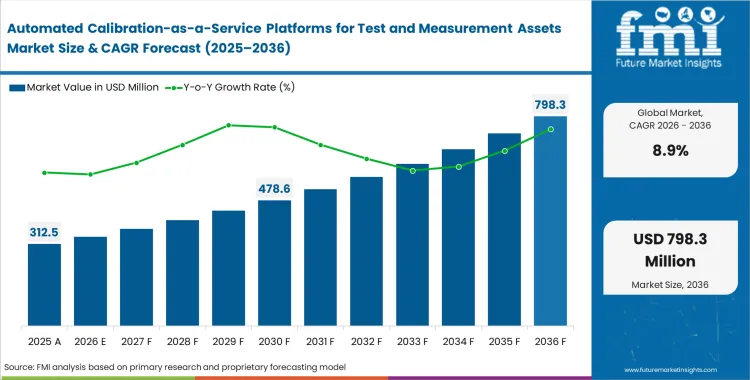
FMI analysis indicates that demand is rising as asset owners move away from manual tracking and adopt API-linked compliance workflows that reduce administrative delays and lower the risk of production disruption.
Calibration control has become harder to manage as instrument fleets spread across plants, labs, and service locations. Monitoring certificate status manually across large volumes of multimeters and related tools creates gaps that weaken audit readiness and slow maintenance coordination. Automated platforms are gaining ground because buyers increasingly value visibility, traceability, and scheduling control more than basic service cost comparisons. Instrument calibration services are now being evaluated as part of a broader asset-governance model, where equipment accuracy, documentation status, and service timing must remain visible before production or validation work begins.
Adoption tends to accelerate once instrument volumes move beyond what internal spreadsheets and local databases can manage efficiently. Larger installed bases create ongoing pressure to centralize calibration records, automate alerts, and connect service history with broader operating systems. Growth in the calibration management software market also becomes easier once general-purpose electronic test and measurement instruments are successfully linked to digital platforms, since that first layer of integration creates a workable path for wider deployment across more complex asset groups. Facilities with broader and more distributed test environments are therefore moving faster toward platform-based calibration management, where control, traceability, and scheduling discipline become harder to maintain through manual tools alone.
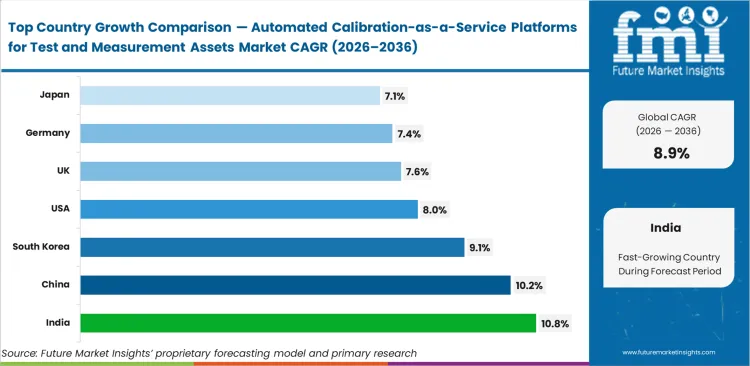
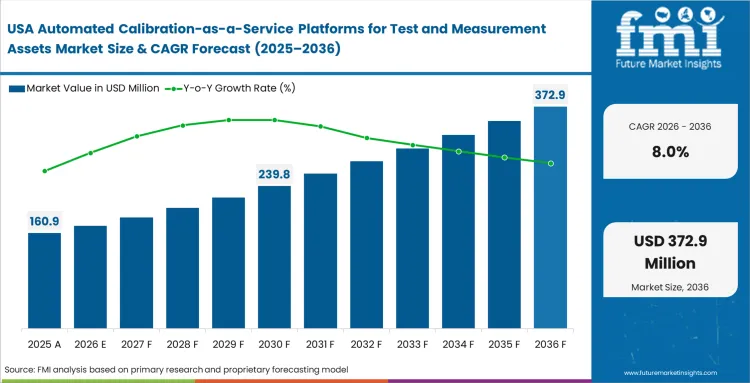
Automated calibration-as-a-service platforms demand in India is poised to expand at a CAGR of 10.8% through 2036 as contract manufacturing activity raises the need for faster compliance scaling across instrument fleets. China is estimated to grow at 10.2%, supported by EV production lines and electronics manufacturing environments that require frequent verification of measurement tools. South Korea is likely to record 9.1% CAGR, backed by dense semiconductor and precision testing infrastructure. The United States is anticipated to rise at 8.0% during the forecast period as fleet modernization continues across industrial and laboratory environments. The United Kingdom and Germany are expected to register CAGRs of 7.6% and 7.4%, respectively, where legacy-system upgrades and quality-control requirements continue to support digital calibration workflows. Japan is projected to grow at 7.1%, reflecting a more mature outsourced service environment. Differences across these markets reflect whether facilities are building automated compliance systems from the ground up or digitizing long-established metrology processes.
Segmental Analysis
Automated Calibration-as-a-Service Platforms for Test and Measurement Assets Market Analysis by Deployment
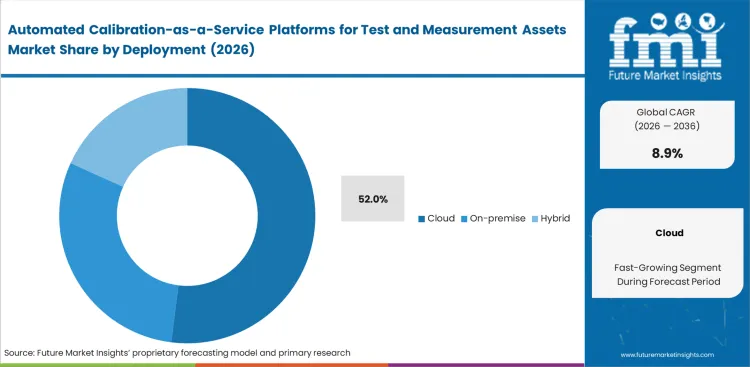
Cloud platforms are expected to account for 52.0% share in 2026. Deployment choice is shaped by how quickly calibration records need to move across sites, teams, and audit environments. Multi-location operations need immediate access to the same certificate status, usage history, and compliance records without waiting for local synchronization. A cloud-based setup also improves how calibration workflows connect with automated test equipment, especially when assets feed data from multiple facilities into one controlled system. Compliance value comes less from storage economics and more from the ability to verify instrument status without delay during inspections. Global operations work more smoothly when every site uses one current record set rather than separate local versions.
- Multi-site synchronization: Centralized records update calibration status across facilities without waiting for local database alignment.
- Version control: Standardized external deployment reduces software inconsistency across plants and lowers support effort for distributed teams.
- Audit readiness: Unified access to active certificates and service history allows faster document retrieval during regulatory or customer reviews.
Automated Calibration-as-a-Service Platforms for Test and Measurement Assets Market Analysis by Asset Class
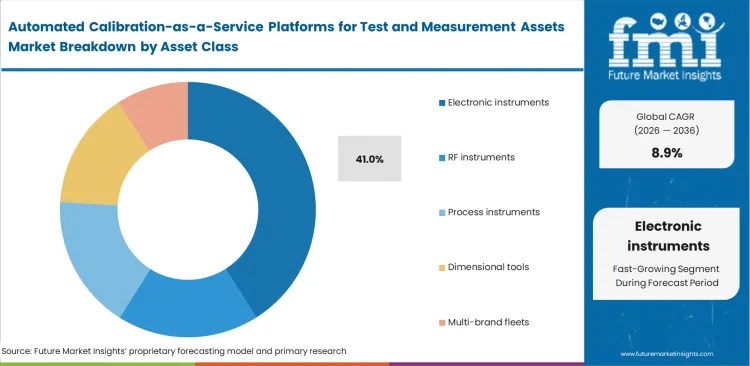
Asset intensity in this market is determined less by instrument count and more by calibration frequency and tolerance sensitivity. Electronic instruments are projected to secure 41.0% share in 2026 because oscilloscopes, analyzers, and similar tools can drift in ways that affect production quality long before the issue becomes visible in output. Facilities using these devices at high frequency need tighter tracking discipline because missed calibration windows can expose entire batches to measurement risk. Direct software integration also reduces transcription mistakes by moving performance data from instrument to platform without manual re-entry. Operational value rises when the platform identifies drift patterns early rather than simply storing completed certificates.
- Drift calculation: Historical performance data supports earlier identification of tools that are moving toward out-of-tolerance conditions.
- Batch protection: Fast identification of suspect instruments helps isolate affected production lots before they move further downstream.
- Vendor management: Platforms make it easier to compare turnaround time and service quality across external calibration laboratories.
Automated Calibration-as-a-Service Platforms for Test and Measurement Assets Market Analysis by Service Model
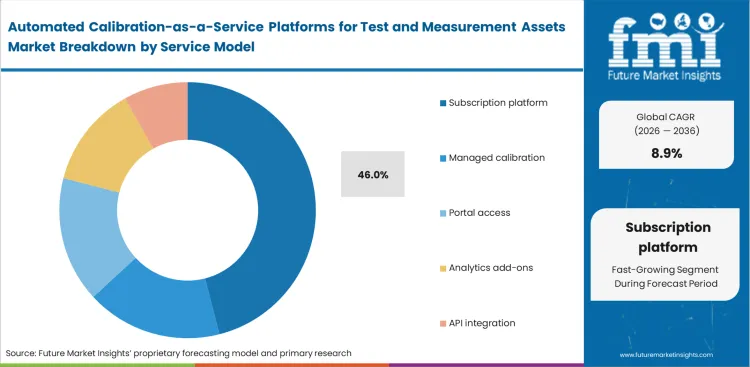
Service model selection usually comes down to budget structure, deployment speed, and the willingness to build internal software capability. Recurring payment structures make adoption easier for laboratories that prefer operating expense over large upfront approvals. Subscription platform configurations are expected to hold 46.0% share in 2026, reflecting that commercial advantage as well as the flexibility to scale usage over time. Integration with fixed asset management software further strengthens the model by linking calibration visibility to broader equipment records. Organizations that stay with manual or fragmented systems usually carry a heavier administrative load than they first anticipate.
- Operating expense conversion: Monthly or annual subscription billing reduces the approval burden associated with one-time software investment.
- Automatic feature deployment: Providers can roll out compliance updates continuously without requiring each customer site to manage separate installs.
- Tiered scalability: User access and asset limits can expand in line with operational growth rather than forcing oversized early commitments.
Automated Calibration-as-a-Service Platforms for Test and Measurement Assets Market Analysis by End Use
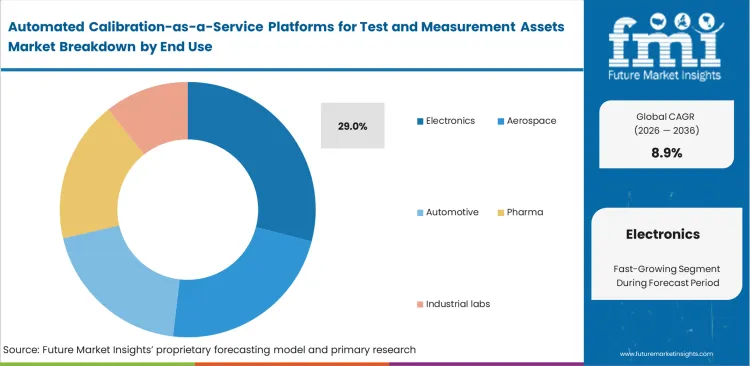
End-use demand is shaped by how much measurement error a production environment can tolerate before quality, traceability, or compliance is affected. Small handheld devices move constantly across workstations in electronics facilities, which makes manual tracking unreliable in high-volume settings. Platforms linked with equipment management software improve visibility over asset location, service status, and usage accountability. Electronics manufacturing is set to command 29.0% share in 2026 because calibration status directly influences line continuity, validation discipline, and defect control in these operations. Integration with computerized maintenance management systems adds another layer of control by preventing expired tools from remaining active in tightly regulated production spaces. Electronics facilities rely on digital calibration control because speed and traceability must work together.
- High-volume tracking: Software can monitor large populations of portable instruments moving across active production zones.
- Traceability mandates: Device history, calibration timing, and station-level usage records support stricter quality reporting requirements.
- Downtime prevention: Automated scheduling helps route tools out for service during planned maintenance windows instead of interrupting production.
Automated Calibration-as-a-Service Platforms for Test and Measurement Assets Market Analysis by Functionality
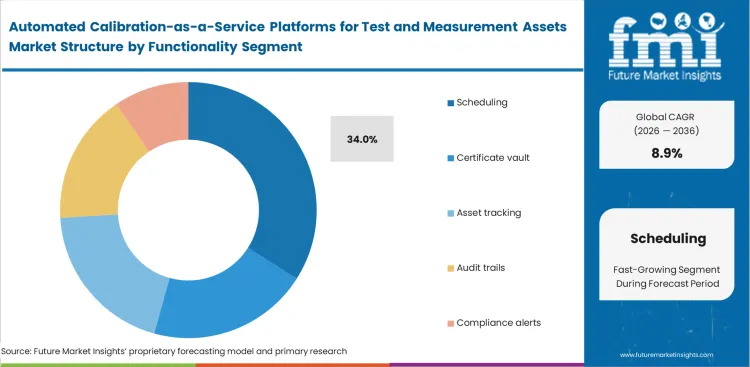
Functionality adoption usually begins with the features that keep calibration programs operational on a day-to-day basis. Advanced analytics add value later, but they are less useful when the scheduling foundation is weak. Calendar-driven tracking reduces the chance of technicians using out-of-tolerance devices simply because expiry status was missed or logged too late. Strong scheduling logic also improves the output of wider calibration workflow systems by feeding cleaner timing data into downstream processes. Scheduling modules are projected to secure 34.0% share in 2026 because every broader compliance workflow depends first on knowing which assets are due, overdue, or approaching expiration. Basic control functions remain central because administrative accuracy still determines the reliability of the larger compliance program.
- Automated notification: Timely alerts give teams enough lead time to arrange calibration, replacement, or temporary rental support.
- Compliance alignment: Device histories tied to recognized standards help simplify inspection preparation and evidence retrieval.
- Resource leveling: Workloads can be distributed more evenly across the calendar to avoid service backlogs near major certification periods.
Automated Calibration-as-a-Service Platforms for Test and Measurement Assets Market Drivers, Restraints, and Opportunities
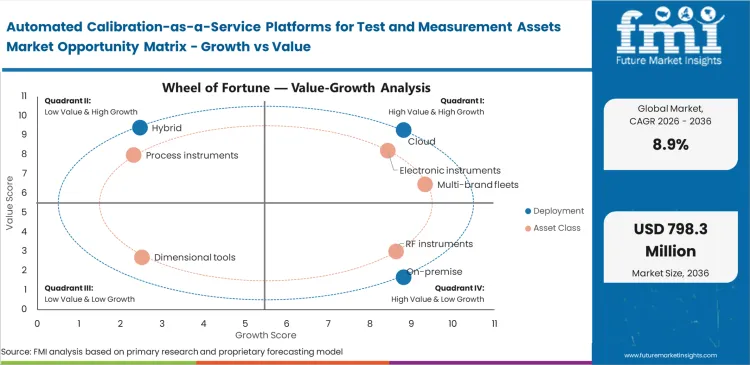
Audit failures often accelerate investment in calibration and compliance software. Manufacturers facing accreditation risk or shipment disruption usually have limited room to delay system upgrades until a later budget cycle. A failed inspection can interrupt production release, delay shipments, and raise the cost of non-compliance across regulated operations. This pressure is pushing companies toward software platforms that improve record control, certificate access, and audit readiness. Adoption tends to move faster in distributed factory networks, where spreadsheet-based tracking becomes harder to manage as instrument counts rise. Calibration certificate management software is gaining relevance because it improves visibility across records, service status, and compliance activity. As production networks expand, metrology software is increasingly being treated as part of operational control rather than as a secondary administrative tool.
Legacy internal databases still remain a major restraint on modernization. Historical calibration records are often stored in outdated formats that are difficult to extract, standardize, and map into newer systems. Upgrade decisions may therefore be delayed even when existing quality processes are no longer efficient. Integration work usually requires significant labor, especially where old record structures do not align easily with modern APIs and platform architecture. Bridging tools can ease part of this transition, though manual data cleaning often remains necessary before full deployment. Cost structure adds another layer of friction, particularly when pricing models scale with active instrument count across large enterprise fleets.
Opportunities in the Automated Calibration-as-a-Service Platforms for Test and Measurement Assets Market
- Predictive drift algorithms: Machine learning analyzes past performance predicting future calibration failures. Metrology engineers replace faulty equipment before it ruins production batches.
- Zero-touch integration: Smart instruments report calibration status directly into modern calibration asset tracking software via wireless protocols. Companies eliminate human data entry completely.
- Vendor consolidation: Platforms offering global enterprise asset management alongside tracking software secure enterprise contracts. Supplier relationships are streamlined to improve efficiency.
Regional Analysis
Based on regional analysis, automated calibration-as-a-service platforms for test and measurement assets market is segmented into North America, Latin America, Europe, East Asia, South Asia, Oceania, and Middle East and Africa across 40 plus countries.
.webp "Top Country Growth Comparison Automated Calibration As A Service Platforms For Test And Measurement Assets Market Cagr (2026 2036)")
| Country | CAGR (2026 to 2036) |
|---|---|
| India | 10.8% |
| China | 10.2% |
| South Korea | 9.1% |
| United States | 8.0% |
| United Kingdom | 7.6% |
| Germany | 7.4% |
| Japan | 7.1% |
Source: Future Market Insights (FMI) analysis, based on proprietary forecasting model and primary research
Asia Pacific Automated Calibration-as-a-Service Platforms for Test and Measurement Assets Market Analysis
Greenfield manufacturing expansion necessitates immediate metrology infrastructure across Asian industrial hubs. Factories scaling contract-production capacity abandon legacy manual tracking systems to handle massive equipment volumes. Modern facilities incorporate digital quality and compliance management solution architectures directly during construction to bypass future integration hurdles. FMI's analysis suggests this clean-slate approach accelerates software deployment faster than in markets burdened with older systems. Rapidly constructed electronics plants require instant ISO certification to secure global supply contracts, making automated verification essential for maintaining uninterrupted assembly lines.
- India: India is expected to expand at a CAGR of 10.8% in automated calibration platforms during 2026 to 2036. Growth is likely to be supported by rising semiconductor manufacturing activity across domestic production zones, where new facilities need stronger control over expanding instrument fleets. Cloud-based calibration systems are gaining importance as assembly lines add equipment quickly and manual record handling becomes harder to sustain. Early adoption of digital tracking also helps manufacturers build more stable compliance and maintenance workflows as plant networks scale over time.
- China: High-frequency electric vehicle testing necessitates rapid adoption of digital tracking tools across local automotive supply chains. Sales of automated metrology platforms in China are expected to increase at a CAGR of 10.2% during the forecast period. Manufacturers require real-time instrument data to prevent faulty battery shipments from reaching international markets. Incorporating platforms with localized API support ensures seamless integration across massive domestic production facilities.
- South Korea: South Korea is projected to witness 9.1% CAGR in the test and measurement calibration industry through 2036. Advanced fabrication plants require zero-defect measurement certainty to protect high-value wafer batches from undetected voltage drift. Specialized semiconductor calibration software is deployed to satisfy strict local compliance protocols. Customizing these portal architectures allows domestic tech companies to maintain rigorous quality control without sacrificing production speed.
Japan: Mature industrial sectors focus heavily on upgrading existing compliance frameworks rather than building new metrology networks. Japanese automated calibration-as-a-service platform sales are poised to grow at a CAGR of 7.1% during the assessment period. Manufacturing enterprises prioritize replacing aging local servers with modern, secure cloud vaults. This steady shift toward digitized systems yields highly stable recurring software integration across established automotive and electronics producers.
FMI's report includes Taiwan. Advanced chip foundries require absolute metrology precision, driving localized investments toward algorithmic maintenance tracking.
Europe Automated Calibration-as-a-Service Platforms for Test and Measurement Assets Market Analysis
Stringent automotive quality standards mandate undeniable traceability across regional supply chains. Factories producing precision components face continuous regulatory audits requiring instant digital proof of instrument accuracy. Manufacturing networks deploy comprehensive quality process management application modules to connect physical tools directly with compliance portals. FMI's assessment indicates European facilities prioritize deep API connectivity over basic scheduling features. Seamless data exchange between internal metrology labs and external certification bodies ensures uninterrupted production rhythms for major industrial suppliers.
- United Kingdom: Regulated aerospace and pharmaceutical industries actively modernize legacy tracking infrastructure to satisfy tightening European compliance standards. Organizations migrate from static spreadsheets to dynamic automated alert systems. The United Kingdom is anticipated to see calibration platform adoption grow at a CAGR of 7.6% over the forecast period. Transitioning away from fragmented databases directly reduces audit preparation hours and minimizes costly operational bottlenecks.
- Germany: High-precision manufacturing environments require absolute measurement certainty to maintain strict automotive export quality. The German automated calibration software sector is expected to register a CAGR of 7.4% from 2026 to 2036. Industrial facilities connect calibrators directly to existing enterprise resource planning systems. Securing this deep API integration successfully prevents out-of-tolerance test devices from entering active assembly lines and compromising final product integrity.
FMI's report includes France. Aerospace manufacturers integrate digital compliance software to satisfy rigorous international safety reporting mandates securely.
North America Automated Calibration-as-a-Service Platforms for Test and Measurement Assets Market Analysis
Large installed instrument bases are increasing demand for stronger consolidation across widely distributed manufacturing networks. Manufacturers managing thousands of measuring devices across multiple locations need better visibility over calibration status, service records, and asset movement. Enterprise users are therefore moving away from fragmented local software setups and toward broader platform standardization. Mature outsourcing structures also support this shift, since internal labs and external service partners both need access to more consistent data flows. Modern laboratory informatics platforms are gaining relevance because they help connect isolated records and improve coordination across complex service environments.
- United States: Defense contractors face strict federal audit requirements dictating total supply chain transparency. Factories rely on advanced aerospace calibration management tools to guarantee uncompromised traceability for critical measurement assets. Demand for automated calibration workflows in the United States is anticipated to rise at a CAGR of 8.0% through 2036. Manufacturers strongly prefer solutions offering certified secure cloud environments to protect sensitive operational data.
Competitive Aligners for Market Players
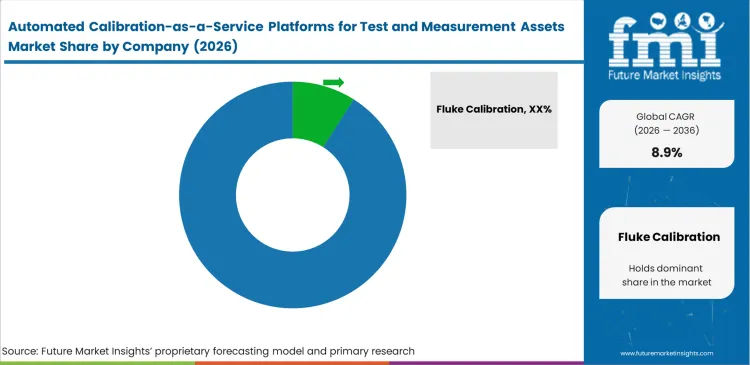
Integration flexibility remains a core factor in vendor positioning across this market. Software adoption is shaped heavily by how well a platform connects with existing instrument fleets, enterprise resource systems, and quality workflows already in place. Vendors are usually assessed on their ability to support data exchange across mixed operating environments rather than on interface design alone. Platforms with weak integration capability often struggle during pilot stages, especially in regulated settings where calibration records must move cleanly across broader compliance systems. Suppliers with stronger links to supplier quality management and related control functions tend to hold an advantage in more demanding enterprise deployments.
Established vendors also benefit from deeper protocol coverage across installed instrument bases. Communication readiness matters because a platform becomes more useful once it can recognize, read, and structure data from a wide range of device models without extensive manual setup. Newer entrants may offer a cleaner interface, yet limited protocol depth can slow deployment and reduce value in complex laboratory and plant environments. Vendor selection in calibration management software therefore depends as much on metrology compatibility and system fit as on front-end usability.
Large manufacturers also try to avoid software environments that tie them too closely to a single hardware ecosystem. Mixed-brand instrument fleets remain common across enterprise operations, which makes platform neutrality an important buying consideration. Broader success in the instrument calibration platform market depends on supporting multiple OEM environments without creating integration bias toward one equipment base. Open platform architecture is therefore more attractive in large-scale deployments, where internal labs and outside service partners both need consistent access across varied instrument networks. Closed systems tend to face narrower use where equipment diversity and workflow complexity remain limited.
Key Players in Automated Calibration-as-a-Service Platforms for Test and Measurement Assets Market
- Fluke Calibration
- Keysight Technologies
- Transcat
- Tektronix
- Beamex
- Trescal
- Rohde & Schwarz
Scope of the Report
| Metric | Value |
|---|---|
| Quantitative Units | USD 312.5 million to USD 733.1 million, at a CAGR of 8.9% |
| Market Definition | Centralized digital systems replace manual instrument tracking with automated compliance alerts. Software directly bridges hardware drift data with audit requirements, preventing production downtime. |
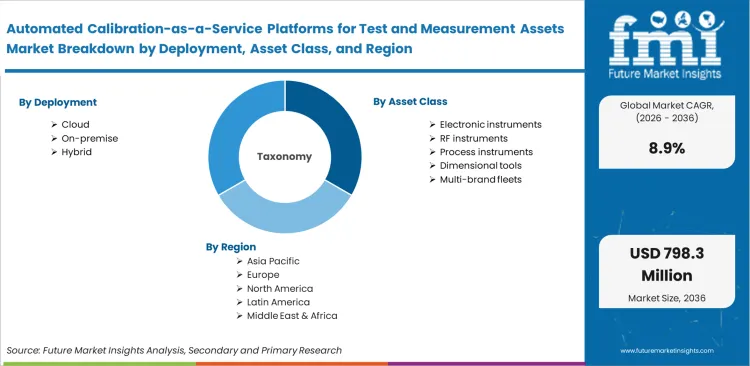
| Segmentation | Deployment, Asset class, Service model, End use, Functionality |
| Regions Covered | North America, Latin America, Europe, East Asia, South Asia, Oceania, Middle East and Africa |
| Countries Covered | India, China, South Korea, United States, United Kingdom, Germany, Japan |
| Key Companies Profiled | Fluke Calibration, Keysight Technologies, Transcat, Tektronix, Beamex, Trescal, Rohde & Schwarz |
| Forecast Period | 2026 to 2036 |
| Approach | Annual software license renewals for major testing facilities |
Source: Future Market Insights (FMI) analysis, based on proprietary forecasting model and primary research
Automated Calibration-as-a-Service Platforms for Test and Measurement Assets Market Analysis by Segments
Deployment:
- Cloud
- On-premise
- Hybrid
Asset class:
- Electronic instruments
- RF instruments
- Process instruments
- Dimensional tools
- Multi-brand fleets
Service model:
- Subscription platform
- Managed calibration
- Portal access
- Analytics add-ons
- API integration
End use:
- Electronics
- Aerospace
- Automotive
- Pharma
- Industrial labs
Functionality:
- Scheduling
- Certificate vault
- Asset tracking
- Audit trails
- Compliance alerts
Region:
- North America
- United States
- Canada
- Europe
- Germany
- United Kingdom
- France
- Italy
- Spain
- Asia Pacific
- China
- Japan
- South Korea
- Taiwan
- Singapore
- Latin America
- Brazil
- Mexico
- Argentina
- Middle East & Africa
- GCC Countries
- South Africa
Bibliography
- Bureau International des Poids et Mesures. (2024). Forum on metrology and digitalization (FORUM-MD): Report of the 1st meeting (7-8 March 2024) to the International Committee for Weights and Measures.
- Hackel, S., Schönhals, S., Gloger, B., Doering, L., Jagieniak, J., Demir, M.-A., Jordan, M., Söylev Öktem, G., Loewe, J., Mienert, K., & Keilholz, C. (2024). Digitization versus digitalization & digital transformation in the field of calibrations and their subsequent use. Physikalisch-Technische Bundesanstalt.
- Smith, I. M., Veltcheva, R. I., & Griffin, D. J. (2024). Case study on the generation and use of digital calibration certificates (NPL Report MS 56). National Physical Laboratory.
- Yang, P., Cai, C., Wang, J., Li, X., Zhong, R., Wang, X., & Zhuo, C. (2025). Digital transformation attempts in daily work of OIML-CS: Remote Testing Laboratory. OIML Bulletin, 66(3), 20250302.
- Mustapää, T., Koskinen, S., Sundfors, M., Jonsson, J., Riska, K., Löytynoja, L., & Broo, J.-A. (2024). Enabling the use of digital calibration certificates in industrial calibration management systems. Journal of Sensors and Sensor Systems, 13, 71-79.
This bibliography is provided for reader reference. The full FMI report contains the complete reference list with primary source documentation.
This Report Addresses
- Firms mitigating regulatory risks through centralized audit portals.
- Companies shifting manual tracking costs into recurring subscription models.
- Metrology engineers optimizing physical hardware drift calculations using predictive algorithms.
- Replacement of legacy homegrown databases with modern API architectures.
- Fleet operators synchronizing compliance statuses across distributed international manufacturing sites.
- Operations heads preventing costly production downtime via automated certificate expiration alerts.
- Tracing component failures back to specific uncalibrated test stations.
- Third-party service providers integrating local lab data with global enterprise tracking systems.
Frequently Asked Questions
What is calibration as a service?
It represents a shift from owning metrology infrastructure to subscribing to managed digital platforms. Facilities bypass purchasing expensive internal database servers by paying recurring fees for cloud-hosted tracking, automated compliance alerts, and sometimes bundled physical instrument logistics managed entirely by third-party experts.
How does automated calibration software work?
Software connects physical hardware inventories directly to digital compliance schedules. Algorithms track historical voltage drift and usage frequency, initiating automated email alerts to technicians well before a specific multimeter expires. This systematic approach eliminates human error inherent in manual calendar checking.
Compare cloud calibration platforms with on-premise systems?
Cloud environments provide instant cross-site visibility, allowing an auditor in one country to verify equipment health instantly from a centralized dashboard without localized syncing delays. On-premise setups remain physically isolated within specific factory networks, prioritizing strict data security over multi-site accessibility.
Which vendors offer calibration portals for multi-brand instruments?
Established metrology leaders like Fluke Calibration, Keysight Technologies, and Transcat dominate multi-brand integration. Closed digital architectures are actively penalized, preferring these major providers because they hold massive pre-configured communication libraries capable of reading diverse proprietary hardware protocols from almost any OEM.
Calibration software vs spreadsheet tracking: why switch?
Legacy spreadsheet reliance prevents immediate modernization and guarantees data entry errors. As tool fleets cross 500 active instruments, tracking certification expiry manually creates massive compliance vulnerabilities. Automated software halts assembly lines immediately if uncertified tools enter production zones, protecting OEMs from recall costs.
Calibration software vs CMMS: what is the difference?
Computerized Maintenance Management Systems (CMMS) handle general plant machinery repairs and broad preventative maintenance schedules. Dedicated calibration platforms manage strict metrology-specific workflows, calculating complex measurement uncertainties and generating exact ISO 17025 compliant documentation that generic ERP modules simply cannot produce natively.
Why does India present a stronger growth trajectory than Germany?
Greenfield electronics manufacturing expansion creates clean-slate IT environments. Indian facilities scaling contract-production capacity implement modern metrology software immediately upon factory construction. German factories, conversely, possess massive existing homegrown databases, making API integration slower and data migration significantly more complex.
How do algorithms change traditional drift calculation methodologies?
Machine learning analyzes historical voltage deviations to predict future failure points. Instead of following rigid calendar-based certification cycles, metrology engineers schedule proactive maintenance precisely when statistical models indicate imminent hardware drift, maximizing tool uptime while satisfying strict regulatory requirements.
Why are scheduling modules considered the baseline for compliance?
Predictive analytics hold zero value without accurate calendar foundations. Metrology coordinators need chronological alerts before attempting advanced algorithmic tracking. Basic automated notifications prevent administrative errors, ensuring technicians swap expiring multimeters with validated rental units well before an inspector arrives unannounced.
How does electronic instrument sensitivity drive recurring software revenue?
Oscilloscopes and spectrum analyzers drift out of tolerance significantly faster than dimensional calipers. This inherent fragility demands calibration cycles two to three times more frequently than standard tools. Managing this high-frequency turnover manually guarantees data entry errors, making automated digital tracking absolutely mandatory.
What vulnerability do API portals eliminate during external audits?
Physical clipboards and localized files create undeniable chronological gaps. Inspectors penalize facilities missing continuous historical documentation. Cloud portals provide undeniable timestamped audit trails proving continuous compliance for every physical asset over its entire lifecycle, turning stressful regulatory inspections into simple dashboard reviews.
Why do aerospace contractors prioritize secure on-premise deployments occasionally?
Government defense contracts strictly prohibit sensitive test data from residing on commercial servers. While cloud adoption accelerates globally, defense suppliers maintain physical hardware tracking internally to satisfy strict cyber-security mandates. These specialized use cases preserve hybrid architecture viability despite broader cloud migration trends.
What changes when smart instruments connect directly to these platforms?
Zero-touch integration eliminates human data transcription entirely. Next-generation multimeters broadcast their own calibration statuses directly into tracking portals via wireless protocols. Companies remove administrative labor from the metrology workflow, allowing engineers to focus exclusively on analyzing actual measurement deviations.
How are software costs justified?
Lost assets activate immediate production halts during ISO audits. Brands reframe platform subscriptions as risk mitigation strategies rather than basic software upgrades. The annual cost of a digital tracking portal is statistically irrelevant compared to the revenue lost when a factory line stops due to expired compliance documentation.
Why do manual spreadsheets remain dangerous in electronics manufacturing?
Circuit board assembly requires thousands of small, highly mobile handheld devices. Tracking these easily misplaced items manually guarantees physical inventory mismatches during unannounced audits. Software monitors large dynamic fleets simultaneously, preventing untracked multimeters from accidentally entering active cleanroom testing environments.
What role do predictive algorithms play in third-party vendor management?
Software tracks historical turnaround times across different external calibration laboratories. Hard performance data is used to negotiate service level agreements, dropping vendors who consistently miss return deadlines. Objective analytical dashboards replace subjective vendor relationships with strict data-driven accountability.
How does strict API integration protect brand reputations?
Component failures discovered in the field trace directly back to specific factory test stations. Software proves those exact stations held valid calibration certificates at the exact moment of assembly. This undeniable digital traceability protects contract manufacturers from facing liability claims initiated by major global consumer brands.
Why do mid-sized laboratories avoid enterprise resource planning metrology modules?
Generic ERP systems lack deep, metrology-specific data schemas. Firms discover that customizing basic inventory software to satisfy complex ISO 17025 requirements costs more than purchasing dedicated calibration platforms. Specialized software handles complex measurement uncertainty calculations natively without requiring expensive third-party database coding.
What friction prevents total global consolidation of metrology data?
Different international regulatory bodies demand slightly varying certificate formats. Multinational corporations struggle configuring centralized platforms to generate compliant paperwork for both European and Asian inspectors simultaneously. Software providers must constantly update regional reporting templates to ensure global portals remain locally viable.
How do these platforms alter internal IT support requirements?
SaaS configurations shift database maintenance burdens away from internal network administrators. External providers push regulatory updates and security patches continuously. IT departments embrace cloud metrology portals because they remove niche compliance software from their internal troubleshooting queues, freeing up technical resources.
Why is API compatibility the primary evaluation metric for new software?
Metrology data must flow seamlessly into broader maintenance workflows. If a tracking platform cannot communicate with existing computerized maintenance management systems, it creates isolated data silos. Isolated portals are rejected in favor of metrology software that integrates into the broader enterprise operational technology stack.
What consequence awaits operations heads who ignore digital traceability?
Tier-1 automotive and aerospace suppliers mandate digital compliance proof before awarding manufacturing contracts. Facilities attempting to submit manual calibration records lose bids to digitized competitors. Failing to implement automated tracking transitions from being an internal inefficiency to an external revenue barrier preventing business growth.
How do digital platforms change the metrology engineer's daily workflow?
Hunting for physical tools and deciphering handwritten calibration stickers stops entirely. Engineers start their shifts reviewing automated dashboard alerts prioritizing which instruments require immediate attention. Software removes administrative friction, allowing technical staff to focus entirely on precision hardware analysis and statistical process control improvements.
Preview the report firsthand - request a free sample
Get SampleGet the brochure for pricing and purchase details.
Get PDFTable of Content
- Executive Summary
- Global Market Outlook
- Demand-side Trends
- Supply-side Trends
- Technology Roadmap Analysis
- Analysis and Recommendations
- Market Overview
- Market Coverage / Taxonomy
- Market Definition / Scope / Limitations
- Research Methodology
- Chapter Orientation
- Analytical Lens and Working Hypotheses
- Market Structure, Signals, and Trend Drivers
- Benchmarking and Cross-market Comparability
- Market Sizing, Forecasting, and Opportunity Mapping
- Research Design and Evidence Framework
- Desk Research Programme (Secondary Evidence)
- Company Annual and Sustainability Reports
- Peer-reviewed Journals and Academic Literature
- Corporate Websites, Product Literature, and Technical Notes
- Earnings Decks and Investor Briefings
- Statutory Filings and Regulatory Disclosures
- Technical White Papers and Standards Notes
- Trade Journals, Industry Magazines, and Analyst Briefs
- Conference Proceedings, Webinars, and Seminar Materials
- Government Statistics Portals and Public Data Releases
- Press Releases and Reputable Media Coverage
- Specialist Newsletters and Curated Briefings
- Sector Databases and Reference Repositories
- FMI Internal Proprietary Databases and Historical Market Datasets
- Subscription Datasets and Paid Sources
- Social Channels, Communities, and Digital Listening Inputs
- Additional Desk Sources
- Expert Input and Fieldwork (Primary Evidence)
- Primary Modes
- Qualitative Interviews and Expert Elicitation
- Quantitative Surveys and Structured Data Capture
- Blended Approach
- Why Primary Evidence is Used
- Field Techniques
- Interviews
- Surveys
- Focus Groups
- Observational and In-context Research
- Social and Community Interactions
- Stakeholder Universe Engaged
- C-suite Leaders
- Board Members
- Presidents and Vice Presidents
- R&D and Innovation Heads
- Technical Specialists
- Domain Subject-matter Experts
- Scientists
- Physicians and Other Healthcare Professionals
- Governance, Ethics, and Data Stewardship
- Research Ethics
- Data Integrity and Handling
- Primary Modes
- Tooling, Models, and Reference Databases
- Desk Research Programme (Secondary Evidence)
- Data Engineering and Model Build
- Data Acquisition and Ingestion
- Cleaning, Normalisation, and Verification
- Synthesis, Triangulation, and Analysis
- Quality Assurance and Audit Trail
- Market Background
- Market Dynamics
- Drivers
- Restraints
- Opportunity
- Trends
- Scenario Forecast
- Demand in Optimistic Scenario
- Demand in Likely Scenario
- Demand in Conservative Scenario
- Opportunity Map Analysis
- Product Life Cycle Analysis
- Supply Chain Analysis
- Investment Feasibility Matrix
- Value Chain Analysis
- PESTLE and Porter’s Analysis
- Regulatory Landscape
- Regional Parent Market Outlook
- Production and Consumption Statistics
- Import and Export Statistics
- Market Dynamics
- Global Market Analysis 2021 to 2025 and Forecast, 2026 to 2036
- Historical Market Size Value (USD Million) Analysis, 2021 to 2025
- Current and Future Market Size Value (USD Million) Projections, 2026 to 2036
- Y-o-Y Growth Trend Analysis
- Absolute $ Opportunity Analysis
- Global Market Pricing Analysis 2021 to 2025 and Forecast 2026 to 2036
- Global Market Analysis 2021 to 2025 and Forecast 2026 to 2036, By Deployment
- Introduction / Key Findings
- Historical Market Size Value (USD Million) Analysis By Deployment , 2021 to 2025
- Current and Future Market Size Value (USD Million) Analysis and Forecast By Deployment , 2026 to 2036
- Cloud
- On-premise
- Hybrid
- Cloud
- Y-o-Y Growth Trend Analysis By Deployment , 2021 to 2025
- Absolute $ Opportunity Analysis By Deployment , 2026 to 2036
- Global Market Analysis 2021 to 2025 and Forecast 2026 to 2036, By Asset Class
- Introduction / Key Findings
- Historical Market Size Value (USD Million) Analysis By Asset Class, 2021 to 2025
- Current and Future Market Size Value (USD Million) Analysis and Forecast By Asset Class, 2026 to 2036
- Electronic instruments
- RF instruments
- Process instruments
- Dimensional tools
- Multi-brand fleets
- Electronic instruments
- Y-o-Y Growth Trend Analysis By Asset Class, 2021 to 2025
- Absolute $ Opportunity Analysis By Asset Class, 2026 to 2036
- Global Market Analysis 2021 to 2025 and Forecast 2026 to 2036, By Service Model
- Introduction / Key Findings
- Historical Market Size Value (USD Million) Analysis By Service Model, 2021 to 2025
- Current and Future Market Size Value (USD Million) Analysis and Forecast By Service Model, 2026 to 2036
- Subscription platform
- Managed calibration
- Portal access
- Analytics add-ons
- API integration
- Subscription platform
- Y-o-Y Growth Trend Analysis By Service Model, 2021 to 2025
- Absolute $ Opportunity Analysis By Service Model, 2026 to 2036
- Global Market Analysis 2021 to 2025 and Forecast 2026 to 2036, By End Use
- Introduction / Key Findings
- Historical Market Size Value (USD Million) Analysis By End Use, 2021 to 2025
- Current and Future Market Size Value (USD Million) Analysis and Forecast By End Use, 2026 to 2036
- Electronics
- Aerospace
- Automotive
- Pharma
- Industrial labs
- Electronics
- Y-o-Y Growth Trend Analysis By End Use, 2021 to 2025
- Absolute $ Opportunity Analysis By End Use, 2026 to 2036
- Global Market Analysis 2021 to 2025 and Forecast 2026 to 2036, By Functionality
- Introduction / Key Findings
- Historical Market Size Value (USD Million) Analysis By Functionality, 2021 to 2025
- Current and Future Market Size Value (USD Million) Analysis and Forecast By Functionality, 2026 to 2036
- Scheduling
- Certificate vault
- Asset tracking
- Audit trails
- Compliance alerts
- Scheduling
- Y-o-Y Growth Trend Analysis By Functionality, 2021 to 2025
- Absolute $ Opportunity Analysis By Functionality, 2026 to 2036
- Global Market Analysis 2021 to 2025 and Forecast 2026 to 2036, By Region
- Introduction
- Historical Market Size Value (USD Million) Analysis By Region, 2021 to 2025
- Current Market Size Value (USD Million) Analysis and Forecast By Region, 2026 to 2036
- North America
- Latin America
- Western Europe
- Eastern Europe
- East Asia
- South Asia and Pacific
- Middle East & Africa
- Market Attractiveness Analysis By Region
- North America Market Analysis 2021 to 2025 and Forecast 2026 to 2036, By Country
- Historical Market Size Value (USD Million) Trend Analysis By Market Taxonomy, 2021 to 2025
- Market Size Value (USD Million) Forecast By Market Taxonomy, 2026 to 2036
- By Country
- USA
- Canada
- Mexico
- By Deployment
- By Asset Class
- By Service Model
- By End Use
- By Functionality
- By Country
- Market Attractiveness Analysis
- By Country
- By Deployment
- By Asset Class
- By Service Model
- By End Use
- By Functionality
- Key Takeaways
- Latin America Market Analysis 2021 to 2025 and Forecast 2026 to 2036, By Country
- Historical Market Size Value (USD Million) Trend Analysis By Market Taxonomy, 2021 to 2025
- Market Size Value (USD Million) Forecast By Market Taxonomy, 2026 to 2036
- By Country
- Brazil
- Chile
- Rest of Latin America
- By Deployment
- By Asset Class
- By Service Model
- By End Use
- By Functionality
- By Country
- Market Attractiveness Analysis
- By Country
- By Deployment
- By Asset Class
- By Service Model
- By End Use
- By Functionality
- Key Takeaways
- Western Europe Market Analysis 2021 to 2025 and Forecast 2026 to 2036, By Country
- Historical Market Size Value (USD Million) Trend Analysis By Market Taxonomy, 2021 to 2025
- Market Size Value (USD Million) Forecast By Market Taxonomy, 2026 to 2036
- By Country
- Germany
- UK
- Italy
- Spain
- France
- Nordic
- BENELUX
- Rest of Western Europe
- By Deployment
- By Asset Class
- By Service Model
- By End Use
- By Functionality
- By Country
- Market Attractiveness Analysis
- By Country
- By Deployment
- By Asset Class
- By Service Model
- By End Use
- By Functionality
- Key Takeaways
- Eastern Europe Market Analysis 2021 to 2025 and Forecast 2026 to 2036, By Country
- Historical Market Size Value (USD Million) Trend Analysis By Market Taxonomy, 2021 to 2025
- Market Size Value (USD Million) Forecast By Market Taxonomy, 2026 to 2036
- By Country
- Russia
- Poland
- Hungary
- Balkan & Baltic
- Rest of Eastern Europe
- By Deployment
- By Asset Class
- By Service Model
- By End Use
- By Functionality
- By Country
- Market Attractiveness Analysis
- By Country
- By Deployment
- By Asset Class
- By Service Model
- By End Use
- By Functionality
- Key Takeaways
- East Asia Market Analysis 2021 to 2025 and Forecast 2026 to 2036, By Country
- Historical Market Size Value (USD Million) Trend Analysis By Market Taxonomy, 2021 to 2025
- Market Size Value (USD Million) Forecast By Market Taxonomy, 2026 to 2036
- By Country
- China
- Japan
- South Korea
- By Deployment
- By Asset Class
- By Service Model
- By End Use
- By Functionality
- By Country
- Market Attractiveness Analysis
- By Country
- By Deployment
- By Asset Class
- By Service Model
- By End Use
- By Functionality
- Key Takeaways
- South Asia and Pacific Market Analysis 2021 to 2025 and Forecast 2026 to 2036, By Country
- Historical Market Size Value (USD Million) Trend Analysis By Market Taxonomy, 2021 to 2025
- Market Size Value (USD Million) Forecast By Market Taxonomy, 2026 to 2036
- By Country
- India
- ASEAN
- Australia & New Zealand
- Rest of South Asia and Pacific
- By Deployment
- By Asset Class
- By Service Model
- By End Use
- By Functionality
- By Country
- Market Attractiveness Analysis
- By Country
- By Deployment
- By Asset Class
- By Service Model
- By End Use
- By Functionality
- Key Takeaways
- Middle East & Africa Market Analysis 2021 to 2025 and Forecast 2026 to 2036, By Country
- Historical Market Size Value (USD Million) Trend Analysis By Market Taxonomy, 2021 to 2025
- Market Size Value (USD Million) Forecast By Market Taxonomy, 2026 to 2036
- By Country
- Kingdom of Saudi Arabia
- Other GCC Countries
- Turkiye
- South Africa
- Other African Union
- Rest of Middle East & Africa
- By Deployment
- By Asset Class
- By Service Model
- By End Use
- By Functionality
- By Country
- Market Attractiveness Analysis
- By Country
- By Deployment
- By Asset Class
- By Service Model
- By End Use
- By Functionality
- Key Takeaways
- Key Countries Market Analysis
- USA
- Pricing Analysis
- Market Share Analysis, 2025
- By Deployment
- By Asset Class
- By Service Model
- By End Use
- By Functionality
- Canada
- Pricing Analysis
- Market Share Analysis, 2025
- By Deployment
- By Asset Class
- By Service Model
- By End Use
- By Functionality
- Mexico
- Pricing Analysis
- Market Share Analysis, 2025
- By Deployment
- By Asset Class
- By Service Model
- By End Use
- By Functionality
- Brazil
- Pricing Analysis
- Market Share Analysis, 2025
- By Deployment
- By Asset Class
- By Service Model
- By End Use
- By Functionality
- Chile
- Pricing Analysis
- Market Share Analysis, 2025
- By Deployment
- By Asset Class
- By Service Model
- By End Use
- By Functionality
- Germany
- Pricing Analysis
- Market Share Analysis, 2025
- By Deployment
- By Asset Class
- By Service Model
- By End Use
- By Functionality
- UK
- Pricing Analysis
- Market Share Analysis, 2025
- By Deployment
- By Asset Class
- By Service Model
- By End Use
- By Functionality
- Italy
- Pricing Analysis
- Market Share Analysis, 2025
- By Deployment
- By Asset Class
- By Service Model
- By End Use
- By Functionality
- Spain
- Pricing Analysis
- Market Share Analysis, 2025
- By Deployment
- By Asset Class
- By Service Model
- By End Use
- By Functionality
- France
- Pricing Analysis
- Market Share Analysis, 2025
- By Deployment
- By Asset Class
- By Service Model
- By End Use
- By Functionality
- India
- Pricing Analysis
- Market Share Analysis, 2025
- By Deployment
- By Asset Class
- By Service Model
- By End Use
- By Functionality
- ASEAN
- Pricing Analysis
- Market Share Analysis, 2025
- By Deployment
- By Asset Class
- By Service Model
- By End Use
- By Functionality
- Australia & New Zealand
- Pricing Analysis
- Market Share Analysis, 2025
- By Deployment
- By Asset Class
- By Service Model
- By End Use
- By Functionality
- China
- Pricing Analysis
- Market Share Analysis, 2025
- By Deployment
- By Asset Class
- By Service Model
- By End Use
- By Functionality
- Japan
- Pricing Analysis
- Market Share Analysis, 2025
- By Deployment
- By Asset Class
- By Service Model
- By End Use
- By Functionality
- South Korea
- Pricing Analysis
- Market Share Analysis, 2025
- By Deployment
- By Asset Class
- By Service Model
- By End Use
- By Functionality
- Russia
- Pricing Analysis
- Market Share Analysis, 2025
- By Deployment
- By Asset Class
- By Service Model
- By End Use
- By Functionality
- Poland
- Pricing Analysis
- Market Share Analysis, 2025
- By Deployment
- By Asset Class
- By Service Model
- By End Use
- By Functionality
- Hungary
- Pricing Analysis
- Market Share Analysis, 2025
- By Deployment
- By Asset Class
- By Service Model
- By End Use
- By Functionality
- Kingdom of Saudi Arabia
- Pricing Analysis
- Market Share Analysis, 2025
- By Deployment
- By Asset Class
- By Service Model
- By End Use
- By Functionality
- Turkiye
- Pricing Analysis
- Market Share Analysis, 2025
- By Deployment
- By Asset Class
- By Service Model
- By End Use
- By Functionality
- South Africa
- Pricing Analysis
- Market Share Analysis, 2025
- By Deployment
- By Asset Class
- By Service Model
- By End Use
- By Functionality
- USA
- Market Structure Analysis
- Competition Dashboard
- Competition Benchmarking
- Market Share Analysis of Top Players
- By Region
- By Deployment
- By Asset Class
- By Service Model
- By End Use
- By Functionality
- Competition Analysis
- Competition Deep Dive
- Fluke Calibration
- Overview
- Product Portfolio
- Profitability by Market Segments (Product/Age /Sales Channel/Region)
- Sales Footprint
- Strategy Overview
- Marketing Strategy
- Product Strategy
- Channel Strategy
- Keysight Technologies
- Transcat
- Tektronix
- Beamex
- Trescal
- Rohde & Schwarz
- Fluke Calibration
- Competition Deep Dive
- Assumptions & Acronyms Used


