

- Industry Size (2026)
- USD 233.1 Mn
- Forecast (2036)
- USD 367.4 Mn
- CAGR (2026 to 2036)
- 4.7%
Demand for Automated Test Equipment in South Korea Forecast and Outlook 2026 to 2036
The demand for automated test equipment in South Korea is forecasted to reach USD 367.4 million by 2036, growing at a CAGR of 4.7% from USD 233.1 million in 2026. Procurement priorities within the industry are increasingly focused on cost efficiency, reliability, and scalability, with buyers prioritizing vendors who offer long-term value. Risk aversion among buyers plays a critical role, with many opting for established suppliers to mitigate the potential for operational disruptions. Vendor lock-in is prevalent in this market, as many companies prefer to maintain consistent supplier relationships to avoid integration issues and additional costs. Switching costs are substantial, especially for companies that have heavily invested in specific technologies or platforms. As a result, outcomes are largely shaped by the balance between price sensitivity and the need for dependable, high-quality solutions. Future procurement strategies will reflect a cautious approach, emphasizing stability and minimizing operational risks.
Quick Stats for the Demand for Automated Test Equipment in South Korea
- Automated Test Equipment in South Korea Value (2026): USD 233.1 million
- Automated Test Equipment in South Korea Forecast Value (2036): USD 367.4 million
- Automated Test Equipment in South Korea Global Forecast CAGR (2026 to 2036): 4.7%
- Automated Test Equipment in South Korea Leading Segment: Semiconductor (60%)
- Key Growth Regions of Automated Test Equipment in South Korea: Jeju (leading CAGR ~5.6%)
- Top Players of Automated Test Equipment in South Korea: Teradyne, National Instruments, Chroma ATE, Astronics Corporation, Star Technologies
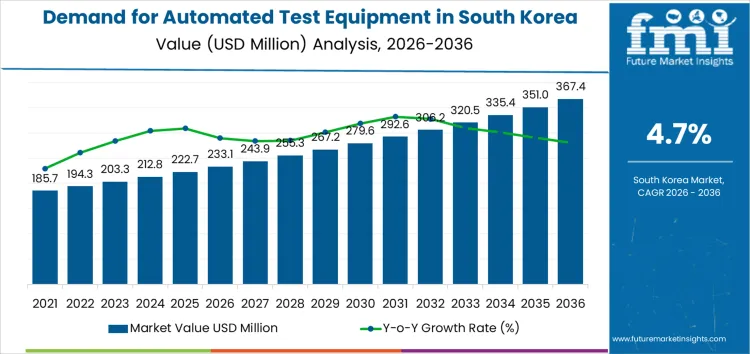
What is the Growth Forecast for the Automated Test Equipment Market in South Korea through 2036?
The automated test equipment (ATE) segment in South Korea is expected to grow steadily through the forecast period, supported by the country’s strong semiconductor and electronics manufacturing base. As chip complexity increases and production cycles become faster, manufacturers are relying more on automated testing systems to ensure accuracy, improve yield, and reduce defect rates. The need for consistent quality control in high-volume manufacturing is making ATE an essential part of modern production environments.
Growth will remain strong as South Korea continues investing in advanced semiconductor nodes, high-performance computing components, and next-generation technologies such as AI-enabled devices, automotive electronics, and 5G/6G infrastructure. Companies are also upgrading testing platforms to handle more complex packaging methods and tighter performance requirements. As automation expands across industrial sectors, demand for reliable and efficient testing solutions will continue rising. Overall, the outlook is positive, with ATE adoption increasing as manufacturers prioritize precision, speed, and production efficiency across South Korea’s evolving electronics ecosystem.
Key Takeaways of Automated Test Equipment in South Korea
| Metric | Value |
|---|---|
| Industry Sales Value (2026) | USD 233.1 million |
| Industry Forecast Value (2036) | USD 367.4 million |
| Industry Forecast CAGR (2026 to 2036) | 4.7% |
Why is the Demand for Automated Test Equipment Growing in South Korea?
Demand for automated test equipment (ATE) in South Korea has expanded over recent years as domestic industrial segments, especially electronics and semiconductors, emphasise rigorous quality assurance and production efficiency. Historically, ATE adoption responded to the growing complexity of integrated circuits and electronic components that required repeatable and precise testing to maintain product standards. South Korea’s semiconductor fabrication industry, anchored by leading memory chip producers, created consistent demand for ATE systems to support wafer sorting, final test, and system-level validation. These testing solutions reduced manual inspection errors and supported high throughput production lines that were already central to export growth. The country’s electronics, telecommunications and automotive sectors, each with intricate electronic sub-systems, also contributed to steady requirements for testing tools that could manage increasing component counts and performance thresholds. Industrial automation policies and manufacturing best practices reinforced capital investment in test equipment to sustain competitiveness and reliability in global supply chains.
Future demand is expected to advance as technological evolution and market structure change the scale and complexity of products manufactured in South Korea. The semiconductor industry’s strategic emphasis on advanced memory and logic devices will sustain investment in both memory and non-memory ATE systems. The integration of next-generation technologies such as 5G, Internet of Things and electric vehicles is likely to further expand testing needs across end markets that require precise verification of circuit performance and reliability under varied conditions. Supply chain diversification and policy-level support for automation and AI integration in industrial systems are set to influence equipment upgrades and adoption. Government initiatives promoting robotics and AI deployment in industrial settings reinforce broader adaptation of automated systems that include testing infrastructure. Commercial dynamics, such as the push for shorter product development cycles and higher quality standards, will continue to elevate reliance on automated test platforms across electronics and automotive components manufactured in South Korea.
What Are the Key Segments in Demand for Automated Test Equipment in South Korea?
Demand for automated test equipment (ATE) in South Korea is divided into types and applications. Key types include semiconductor ATE, PCB test equipment, and system-level test equipment, with semiconductor ATE holding the largest share at 55 %. On the application side, semiconductor is the leading sector at 60 %, followed by telecommunications and industrial automation. Regional trends are shaped by technological demands and the growing importance of precision in sectors such as electronics and telecommunications.
What Is the Demand Pattern for Automated Test Equipment in South Korea by Type?
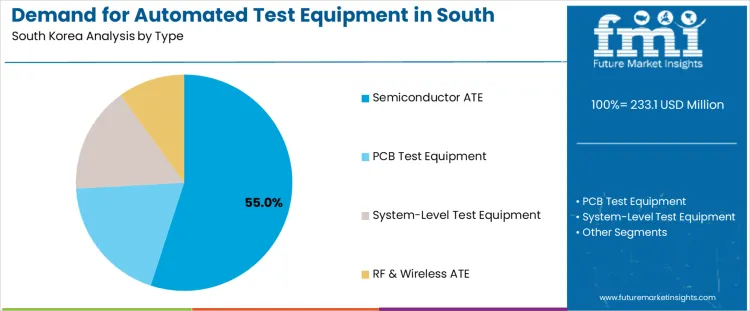
The demand for automated test equipment in South Korea by type is predominantly driven by semiconductor ATE, which holds a 55 % share. The semiconductor industry’s need for ATE is bolstered by the country’s significant semiconductor production capabilities. South Korea remains one of the largest producers of semiconductors, where automated testing is essential for ensuring high-performance and defect-free devices. Semiconductor ATE is used for testing integrated circuits, memory chips, and microprocessors, ensuring they meet the necessary standards before reaching end-users.
The importance of semiconductor ATE is amplified by the rapid technological advancements in semiconductor manufacturing processes, where accuracy and efficiency are paramount. The growing demand for high-quality, smaller, and more powerful chips in sectors such as consumer electronics and automotive further drives the ATE market. On the other hand, PCB test equipment, while smaller in market share, plays a critical role in ensuring that printed circuit boards function correctly before being integrated into larger systems. PCB testing ensures that electrical components are properly aligned and meet all required specifications. Although system-level test equipment has a smaller presence, its importance in testing complex systems for industrial automation and telecommunications is crucial for end-to-end quality assurance in electronics manufacturing.
What Is the Demand Pattern for Automated Test Equipment in South Korea by Application?
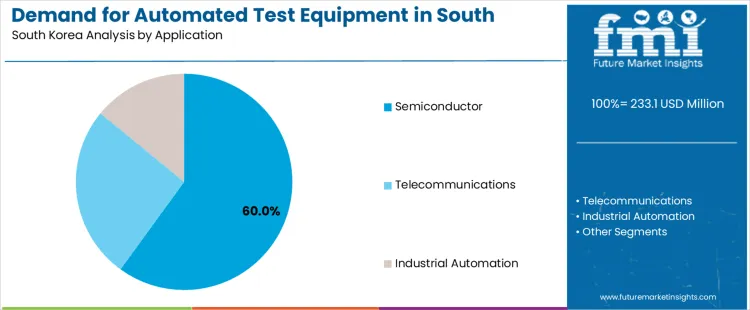
Demand for automated test equipment in South Korea is heavily influenced by the semiconductor sector, with 60 % of the market share attributed to semiconductor applications. This trend is a reflection of South Korea’s dominance in the global semiconductor industry, where advanced testing is required at multiple stages of the manufacturing process. Automated test equipment used in semiconductor testing ensures that the chips meet the stringent quality standards essential for their performance in various electronic devices, such as smartphones, computers, and automotive systems. This demand is further fueled by the need for precision as semiconductor designs become more complex, and as manufacturing processes continue to evolve towards smaller geometries and more powerful integrated circuits. Telecommunications is another important application area, where ATE is essential for testing RF and wireless equipment.
With the increasing rollout of 5G and advancements in wireless communication technology, ATE ensures the functionality and reliability of telecommunications infrastructure. The industrial automation sector also contributes to the market, with system-level test equipment playing a key role in testing integrated systems within automated manufacturing and production lines. This application ensures that robotic systems and automated machinery meet performance requirements before deployment, minimizing operational disruptions. As demand for higher operational efficiency in manufacturing and increased telecommunications infrastructure grows, ATE applications continue to expand, making it a critical component in various industrial and technological domains in South Korea.
What are the Key Dynamics in the Demand for Automated Test Equipment in South Korea?
Demand for automated test equipment (ATE) in South Korea is closely tied to the country’s strong semiconductor and electronics manufacturing base. South Korea hosts major global semiconductor firms and substantial fabrication capacity, which underpin requirements for automated testing solutions across memory and non-memory applications. Domestic production of integrated circuits, consumer electronics, and automotive electronics drives deployment of ATE for quality assurance and throughput. Industry forecasts indicate growth in the South Korea automated test equipment market through the next decade, reflecting broader equipment investment trends in semiconductor fabrication and finishing stages. The ATE segment plays a significant role within South Korea’s broader semiconductor equipment landscape, which captures a large share of global manufacturing tools and support systems.
What are the Drivers of Demand for Automated Test Equipment in South Korea?
Demand for ATE is supported by intensified semiconductor production, particularly in memory and logic devices where testing precision is critical. South Korea’s leading role in memory chip manufacturing creates consistent requirements for handlers, probers, and industrial test systems that ensure device performance and yield. Growth in electronics segments such as 5G, IoT, and automotive components increases complexity of chip designs and raises the need for automated validation processes. Government strategies promoting smart factory integration and Industry 4.0 practices further encourage adoption of automated testing and inline process quality checks. Expansion of electric vehicle systems and connected technologies also underpins increased use of test platforms. Global projections for semiconductor equipment investment, including test tools, suggest that South Korea will remain a core market for suppliers as chip demand linked to AI and data center applications rises.
What are the Restraints on Demand for Automated Test Equipment in South Korea?
Despite positive growth expectations, ATE demand faces restraints tied to capital intensity and economic cycles. Automated test solutions represent significant upfront expenditure for suppliers and manufacturers, which can constrain procurement decisions in periods of slower semiconductor capex. Smaller electronics producers may defer investment in advanced ATE systems until product volumes justify cost. Supply chain disruptions and global trade tensions impact equipment delivery schedules and project planning for fabrication facilities, which can in turn delay ATE deployment. Competition from global equipment suppliers places pricing pressure on domestic purchases and may limit margin for local integrators. Additionally, variability in international semiconductor demand can lead to cyclical fluctuations in testing equipment requirements, affecting planning horizons for both buyers and manufacturers.
What Key Trends Affect Demand for Automated Test Equipment in South Korea?
A key trend shaping ATE demand is integration of digital and smart testing capabilities, including data analytics and real-time monitoring to support complex product validation. South Korean industry is increasingly emphasizing automation within semiconductor production lines, which includes adoption of advanced ATE in memory and non-memory device testing. Growth in automotive electronics and advanced driver assistance system testing is influencing demand patterns, with greater emphasis on test solutions capable of handling diverse use cases. Standardization of test protocols across fabrication and assembly stages is emerging to enhance interoperability and reduce cycle time. Regional leadership in high-end memory chips and fabrication investment means ATE suppliers must innovate to address evolving performance and accuracy needs. Overall semiconductor investment projections, including growing equipment sales linked to AI and chip scaling, support continued ATE adoption in South Korea.
What is the Regional Analysis of Demand for Automated Test Equipment in South Korea?
The demand for automated test equipment in South Korea reflects regional industrial characteristics and technological advancements. Regions with a higher concentration of technology-driven industries and manufacturing facilities tend to exhibit stronger growth in demand for these specialized equipment. South Gyeongsang, known for its industrial base, shows a robust CAGR of 4.9%, driven by its focus on electronics and automotive manufacturing. North Jeolla, with a CAGR of 3.7%, has a more modest demand due to its concentration in agriculture and smaller-scale industries. South Jeolla and Jeju, with growth rates of 4.4% and 5.6%, respectively, demonstrate the rising demand for automation in manufacturing processes and increasing technological investments. The continued focus on innovation and industrial automation across South Korea's regions drives the demand for automated test equipment.
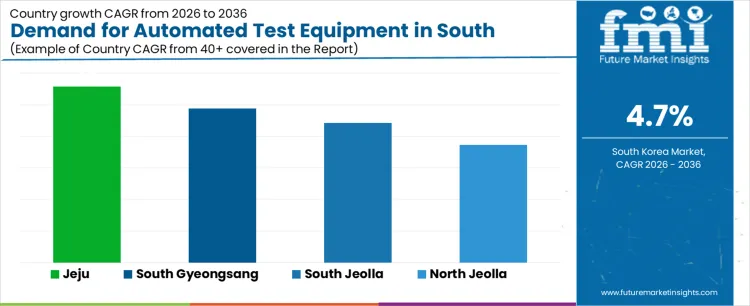
| Region | CAGR (2026 to 2036) |
|---|---|
| South Gyeongsang | 4.9% |
| North Jeolla | 3.7% |
| South Jeolla | 4.4% |
| Jeju | 5.6% |
What is the Demand for Automated Test Equipment in South Gyeongsang?
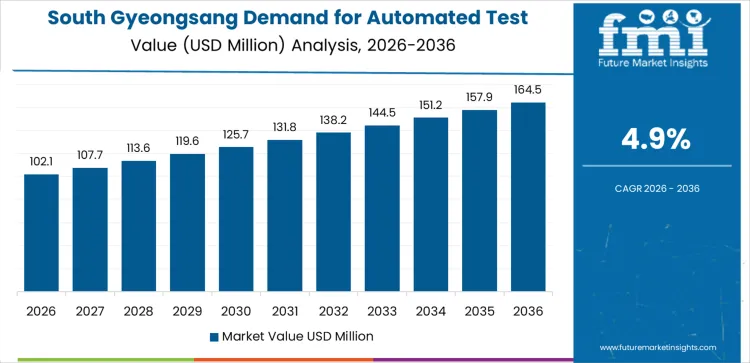
South Gyeongsang's demand for automated test equipment is projected to grow at a CAGR of 4.9% from 2026 to 2036. This region's industrial landscape, with its strong presence in electronics, automotive, and heavy industries, drives the need for advanced testing technologies. The region houses several manufacturing giants, which require automated test equipment for product quality assurance and process optimization. As automation continues to be integrated into production lines, South Gyeongsang’s demand for testing solutions that ensure the reliability and performance of complex systems is expected to remain high. The region's industrial output and continued investments in technological innovation are key factors behind the steady growth in demand.
What is the Demand for Automated Test Equipment in North Jeolla?
North Jeolla shows a slower pace of growth for automated test equipment, with a CAGR of 3.7% from 2026 to 2036. The region is less industrially diversified compared to South Gyeongsang or Jeju, focusing primarily on agriculture and smaller-scale manufacturing. While there are some advancements in local industries, the overall demand for automation and high-tech testing equipment is limited. However, as North Jeolla continues to invest in infrastructure and improve its manufacturing processes, there is potential for gradual demand increases in sectors such as automotive parts and agricultural machinery. The region's moderate growth is expected to be driven by technological advancements and industry-specific automation needs.
What is the Demand for Automated Test Equipment in South Jeolla?
South Jeolla, with a projected CAGR of 4.4%, experiences steady demand growth for automated test equipment. The region’s manufacturing sectors, particularly in shipbuilding, chemicals, and automotive, contribute to the increasing need for advanced testing solutions. South Jeolla’s industrial base continues to evolve, with more emphasis placed on improving efficiency and ensuring product quality through automation. As local industries integrate more automated production lines, demand for reliable test equipment that supports these systems will rise. With continued investment in technological advancements, South Jeolla is expected to experience consistent demand growth, particularly in sectors requiring high precision and rigorous testing.
What is the Demand for Automated Test Equipment in Jeju?
Jeju, with a CAGR of 5.6%, stands out for its strong growth in the demand for automated test equipment. The region’s focus on expanding technological infrastructure and increasing automation across industries has contributed to this rise. Jeju's emphasis on manufacturing, including agriculture and tourism-related production, drives the need for efficient testing systems. The integration of automated testing in local industries supports higher-quality production standards and enhances manufacturing capabilities. The projected growth rate in Jeju reflects the ongoing investment in automation and quality control systems. As the region continues to modernize its industrial capabilities, demand for automated test equipment is expected to grow at an accelerated pace.
What is the Demand for Automated Test Equipment in South Korea?
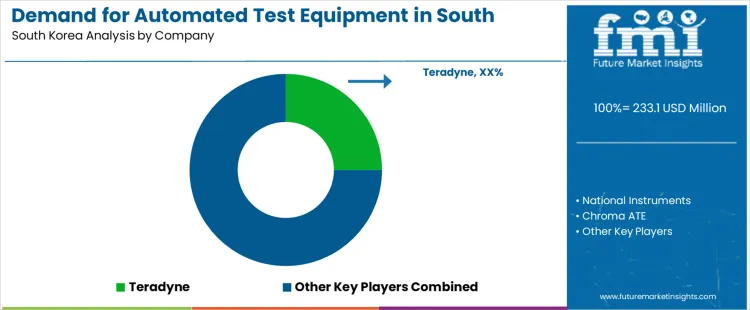
Demand for automated test equipment in South Korea has been shaped by the growth of semiconductor and electronics manufacturing. South Korea’s role as a major semiconductor producer has driven requirements for high-precision testing across design and production phases. Automated test systems are deployed to verify integrated circuits, memory devices, and advanced packages. The need to reduce defect rates and validate performance parameters under stringent quality standards has increased reliance on automated solutions. Demand has been underpinned by investments in 5G, artificial intelligence chips, and advanced logic devices, where test throughput and accuracy are essential. Requirements have also emerged from display and automotive electronics segments, where complex functional and environmental tests are mandated. Procurement cycles are influenced by production ramp-ups, capacity expansions, and design validation schedules set by leading contract manufacturers and original equipment manufacturers operating in South Korea.
Major suppliers have responded with product lines that address varied test needs while aligning with local market expectations. Teradyne has been positioned as a leading provider, with systems marketed for high throughput, modularity, and broad application support. Technical brochures emphasize interface options, software compatibility, and diagnostic capabilities. National Instruments has focused on modular instrumentation and software-defined test platforms, with documentation detailing programmable test architectures and integration workflows. Chroma ATE systems have been presented in product literature highlighting precision measurement, scalability, and support for power electronics and semiconductor tests. Astronics Corporation test solutions are described in brochures that outline high-reliability test modules and aerospace grade performance. Star Technologies literature emphasizes configurable test platforms and support services tailored to complex custom testing needs. Brochures from these companies typically include specifications such as signal ranges, channel counts, communication interfaces, and compliance standards that inform purchasing decisions by South Korean manufacturers and test houses.
Key Players of the Demand for Automated Test Equipment in South Korea
- Teradyne
- National Instruments
- Chroma ATE
- Astronics Corporation
- Star Technologies
Scope of the Report
| Items | Values |
|---|---|
| Quantitative Units (2026) | USD Million |
| Type | Semiconductor ATE, PCB Test Equipment, System-Level Test Equipment, RF & Wireless ATE |
| Application | Semiconductor, Telecommunications, Industrial Automation |
| End Use | Consumer Electronics, Automotive, Aerospace & Defense, Telecommunications, Industrial Automation |
| Companies | Teradyne, National Instruments, Chroma ATE, Astronics Corporation, Star Technologies |
| Region Covered | South Korea |
| Provinces Covered | South Gyeongsang, North Jeolla, South Jeolla, Jeju |
| Additional Attributes | Dollar sales by type, application, and end use. Demand is fueled by South Korea’s advanced semiconductor manufacturing ecosystem, expansion in telecom infrastructure, and growing need for system-level and RF testing across electronics, automotive, and aerospace industries. |
Key Segments of Demand for Automated Test Equipment in South Korea
Type
- Semiconductor ATE
- PCB Test Equipment
- System-Level Test Equipment
- RF & Wireless ATE
Application
- Semiconductor
- Telecommunications
- Industrial Automation
- Other
End Use
- Consumer Electronics
- Automotive
- Aerospace & Defense
- Telecommunications
- Industrial Automation
- Other
Provinces
- South Gyeongsang
- North Jeolla
- South Jeolla
- Jeju
Bibliography
- Korea Institute for Advancement of Technology. (2024). Industrial automation and smart manufacturing technology roadmap 2024–2030. Government of the Republic of Korea.
- Ministry of Trade, Industry and Energy. (2025). Semiconductor innovation and equipment localization strategy. Government of the Republic of Korea.
- Organisation for Economic Co-operation and Development. (2024). Digital transformation and automation trends in the manufacturing sector. OECD Publishing.
Frequently Asked Questions
How big is the demand for automated test equipment in south korea in 2026?
The demand for automated test equipment in south korea is estimated to be valued at USD 233.1 million in 2026.
What will be the size of automated test equipment in south korea in 2036?
The market size for the automated test equipment in south korea is projected to reach USD 367.4 million by 2036.
How much will be the demand for automated test equipment in south korea growth between 2026 and 2036?
The demand for automated test equipment in south korea is expected to grow at a 4.7% CAGR between 2026 and 2036.
What are the key product types in the automated test equipment in south korea?
The key product types in automated test equipment in south korea are semiconductor ate, pcb test equipment, system-level test equipment and rf & wireless ate.
Which application segment is expected to contribute significant share in the automated test equipment in south korea in 2026?
In terms of application, semiconductor segment is expected to command 60.0% share in the automated test equipment in south korea in 2026.
Preview the report firsthand - request a free sample
Get SampleGet the brochure for pricing and purchase details.
Get PDFTable of Content
- Executive Summary
- South Korea Market Outlook
- Demand-side Trends
- Supply-side Trends
- Technology Roadmap Analysis
- Analysis and Recommendations
- Market Overview
- Market Coverage / Taxonomy
- Market Definition / Scope / Limitations
- Market Background
- Market Dynamics
- Drivers
- Restraints
- Opportunity
- Trends
- Scenario Forecast
- Demand in Optimistic Scenario
- Demand in Likely Scenario
- Demand in Conservative Scenario
- Opportunity Map Analysis
- Product Life Cycle Analysis
- Supply Chain Analysis
- Investment Feasibility Matrix
- Value Chain Analysis
- PESTLE and Porter’s Analysis
- Regulatory Landscape
- Regional Parent Market Outlook
- Production and Consumption Statistics
- Import and Export Statistics
- Market Dynamics
- South Korea Market Analysis 2021 to 2025 and Forecast, 2026 to 2036
- Historical Market Size Value (USD Million) Analysis, 2021 to 2025
- Current and Future Market Size Value (USD Million) Projections, 2026 to 2036
- Y-o-Y Growth Trend Analysis
- Absolute $ Opportunity Analysis
- South Korea Market Pricing Analysis 2021 to 2025 and Forecast 2026 to 2036
- South Korea Market Analysis 2021 to 2025 and Forecast 2026 to 2036, By Type
- Introduction / Key Findings
- Historical Market Size Value (USD Million) Analysis By Type, 2021 to 2025
- Current and Future Market Size Value (USD Million) Analysis and Forecast By Type, 2026 to 2036
- Semiconductor ATE
- PCB Test Equipment
- System-Level Test Equipment
- RF & Wireless ATE
- Semiconductor ATE
- Y-o-Y Growth Trend Analysis By Type, 2021 to 2025
- Absolute $ Opportunity Analysis By Type, 2026 to 2036
- South Korea Market Analysis 2021 to 2025 and Forecast 2026 to 2036, By Application
- Introduction / Key Findings
- Historical Market Size Value (USD Million) Analysis By Application, 2021 to 2025
- Current and Future Market Size Value (USD Million) Analysis and Forecast By Application, 2026 to 2036
- Semiconductor
- Telecommunications
- Industrial Automation
- Semiconductor
- Y-o-Y Growth Trend Analysis By Application, 2021 to 2025
- Absolute $ Opportunity Analysis By Application, 2026 to 2036
- South Korea Market Analysis 2021 to 2025 and Forecast 2026 to 2036, By End Use
- Introduction / Key Findings
- Historical Market Size Value (USD Million) Analysis By End Use, 2021 to 2025
- Current and Future Market Size Value (USD Million) Analysis and Forecast By End Use, 2026 to 2036
- Consumer Electronics
- Automotive
- Aerospace & Defense
- Telecommunications
- Industrial Automation
- Consumer Electronics
- Y-o-Y Growth Trend Analysis By End Use, 2021 to 2025
- Absolute $ Opportunity Analysis By End Use, 2026 to 2036
- Market Structure Analysis
- Competition Dashboard
- Competition Benchmarking
- Market Share Analysis of Top Players
- By Regional
- By Type
- By Application
- By End Use
- Competition Analysis
- Competition Deep Dive
- Teradyne
- Overview
- Product Portfolio
- Profitability by Market Segments (Product/Age /Sales Channel/Region)
- Sales Footprint
- Strategy Overview
- Marketing Strategy
- Product Strategy
- Channel Strategy
- National Instruments
- Chroma ATE
- Astronics Corporation
- Star Technologies
- Teradyne
- Competition Deep Dive
- Assumptions & Acronyms Used
- Research Methodology


