

- Industry Size (2026)
- USD 220.0 Mn
- Forecast (2036)
- USD 390.0 Mn
- CAGR (2026 to 2036)
- 5.9%
High-Temperature Corrosion and Creep Testing Equipment for Process Industries Market Size, Market Forecast and Outlook By FMI
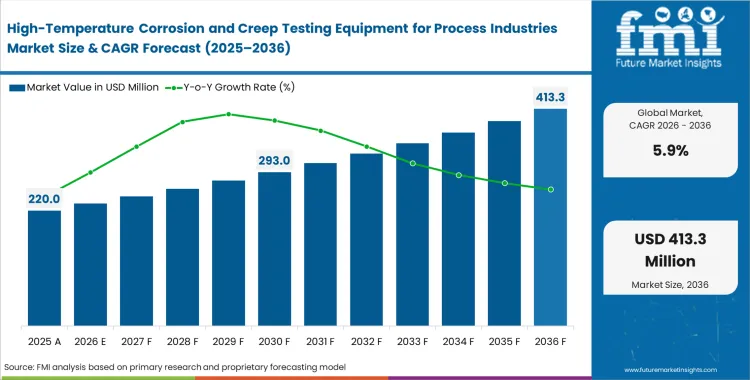
The High-Temperature Corrosion and Creep Testing Equipment market for process industries market crossed a valuation of USD 208.0 million in 2025 and is likely to be valued at USD 220.0 million in 2026, at a CAGR of 5.9%. Total spending is projected to climb to nearly USD 390.0 million by 2036 as process operators widen thermal-exposure validation for equipment running on alternative-fuel blends. That shift is raising demand for high-fidelity rigs and advanced material testing systems that can reproduce tightly linked temperature and pressure conditions with greater accuracy.
Summary of High-Temperature Corrosion and Creep Testing Equipment for Process Industries Market
- Market Snapshot
- The market is valued at USD 208.0 million in 2025, reflecting a stable base of high‑specification testing assets.
- The total is projected to reach USD 220.0 million in 2026 as operators expand qualification work across refining and process facilities.
- Valuation is expected to rise to USD 390.0 million by 2036, supported by long‑term investment in materials integrity and hydrogen‑related infrastructure.
- The market is set to grow at a 5.9% CAGR from 2026 to 2036.
- Incremental opportunity is estimated at USD 170.0 million across the forecast period.
- This segment functions as a specialist equipment category where technical compliance, temperature stability, repeatability, and validated performance outweigh low‑cost alternatives.
- Demand and Growth Drivers
- Demand is anchored in refinery throughput, petrochemical activity, and broader process‑sector integrity programs, which continue to rely on high‑temperature alloy qualification.
- Creep and rupture testing remain fundamental because long‑duration, constant‑load validation is still the accepted method for assessing high‑temperature alloy performance.
- High‑pressure/high‑temperature corrosion simulation is gaining importance as operators look for laboratory evidence that mirrors real plant conditions and exposes failure mechanisms early.
- Growth also reflects increased investment across energy, chemicals, advanced materials, and hydrogen‑processing assets, where elevated‑temperature behavior must be quantified before deployment.
- The long service life of creep frames, furnaces, and ancillary systems moderates demand, keeping a large share tied to retrofits, recalibration cycles, and selective upgrades rather than full new‑unit purchases.
- Product and Segment View
- The market covers creep frames, corrosion autoclaves, thermal analyzers, extensometers, and data systems, all focused on elevated‑temperature and corrosive‑service alloy evaluation.
- These systems support testing needs in refining, petrochemicals, power generation, hydrogen processing, and industrial research laboratories.
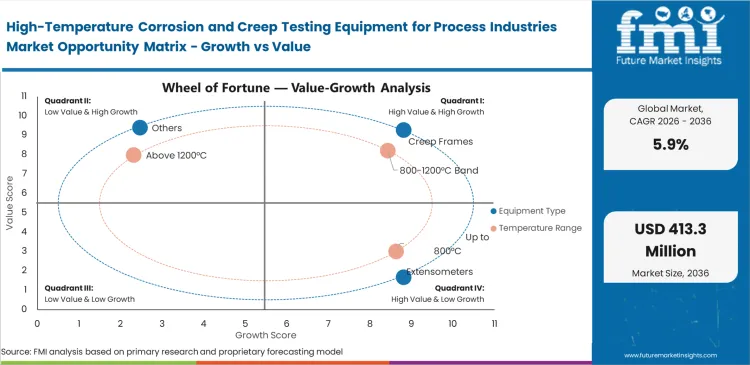
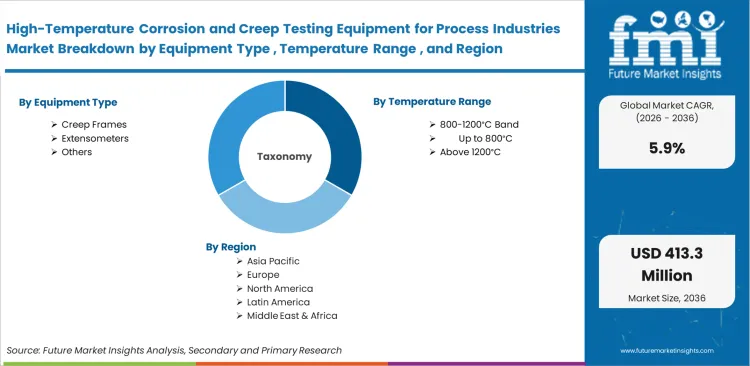
- Creep frames hold a 41.0% share, reflecting the continued centrality of long‑duration load and rupture‑life testing.
- The 800-1200°C temperature band leads with 46.0% share, aligning with the most common qualification ranges across refinery and power‑sector applications.
- Refining represents 29.0% of end‑use demand, driven by corrosion‑control mandates, refractory and sulfidation‑risk assessments, and turnaround‑driven metallurgy decisions.
- Creep‑rupture testing leads with 38.0% share, underscoring the focus on rupture‑life and residual‑life determination.
- New systems account for 63.0% of purchases as buyers favor fully validated, integrated platforms over mixed‑component configurations.
- Geography and Competitive Outlook
- China, India, and Saudi Arabia form the fastest‑growing country clusters, supported by ongoing capacity additions and asset‑integrity requirements.
- The United States remains a stable high‑value installed base with recurring demand for replacement, recalibration, and lifecycle‑extension services.
- Competition is defined by standards compliance, maximum operating envelope, calibration performance, custom reactor design, software architecture, and after‑sales capability.
- Key participants include ZwickRoell, Instron, MTS, Parr Instrument Company, Amar Equipment, and Walter+Bai.
- The market is moderately fragmented, with the leading player holding an estimated 14.0% share.
Reactor systems processing bio-feedstock blends are drawing closer scrutiny at the metallurgy stage because unqualified alloys can fail under sustained stress, cut permitted operating rates, and force early equipment replacement. Buyers are no longer comparing platforms on headline specifications alone. Long-term measurement stability now carries more weight, especially when calibration drift is poorly disclosed and difficult to benchmark across suppliers.
Hydrogen-service applications are pushing another layer of investment into this market as electrochemical monitoring moves closer to becoming a standard requirement. Operators are showing greater interest in corrosion-autoclave systems that combine creep measurement, thermal cycling, and continuous monitoring within one setup. These integrated platforms reduce qualification time and produce more consistent datasets across multiple stress conditions.
China is projected to grow at 6.7%, supported by ongoing capacity additions that require localized testing capability. India is expected to reach 6.5% growth as industrial labs invest in higher‑precision rigs. Saudi Arabia is forecast at 6.2%, reflecting maintained integrity requirements across refining assets. The United States is set for 5.6% growth, driven largely by retrofit programs. Germany, South Korea, and Japan are projected at 5.2%, 5.1%, and 4.8% respectively, where mature industrial infrastructure directs budgets toward calibration services, lifecycle extension of existing equipment, and higher‑accuracy material tester upgrades rather than new facility build‑outs.
Segmental Analysis
High-Temperature Corrosion and Creep Testing Equipment for Process Industries Market Analysis by Equipment Type
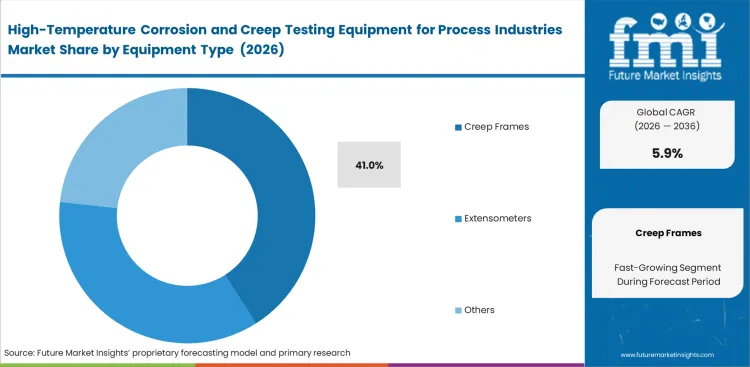
Continuous qualification requirements shape hardware purchases across metallurgical testing laboratories. Creep frames are estimated to account for 41.0% of market share in 2026 because long-duration test programs demand stable load application under sustained thermal stress. Chief metallurgists rely on dedicated load trains to hold constant stress for extended periods, a requirement that general mechanical testing setups often fail to meet once exposure time increases and thermal conditions become harder to control.
Standalone creep frames remain preferred because they maintain load precision and limit vibration that can distort long-run results. Rig stiffness plays a larger role than many buyers initially assume, especially in laboratories running qualification programs where data loss carries a direct cost. Facilities using unstable frames often end up discarding months of test work, turning a hardware compromise into an expensive validation setback.
- Load application: Precision weights maintain constant stress. Lab managers gain reliable long-term data.
- Thermal isolation: Independent heating zones protect sensors. Technicians avoid premature instrument failure.
- Data integration: Automated logging tracks micro-strain. Engineers capture critical rupture events instantly.
High-Temperature Corrosion and Creep Testing Equipment for Process Industries Market Analysis by Temperature Range
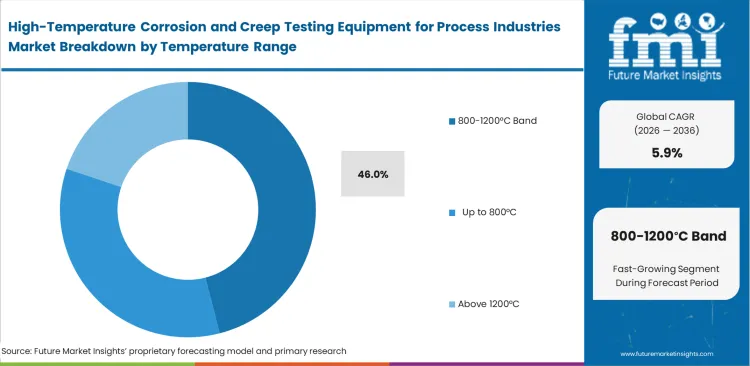
High-temperature corrosion and creep testing requirements in process industries are largely shaped by reformer service conditions. Operations teams continue to prioritize equipment that matches the thermal profile of mainstream petrochemical units. Most operating environments in petrochemical and related process settings remain within the 800-1200°C band under normal duty cycles. This temperature range is expected to account for 46.0% share in 2026. Test programs built around these conditions produce degradation data that can be used directly for material selection, maintenance planning, and equipment life estimation. FMI observes that spending remains concentrated in this range because it reflects current plant operating realities. Extending specifications well beyond actual service needs often raises capital cost without improving testing relevance. Laboratories that buy wider temperature capability than they use often tie up budget in underutilized capacity.
- Baseline simulation: Systems reproduce standard reformer temperature conditions. Process engineers generate more reliable estimates of vessel service life.
- Component protection: Conventional insulation is sufficient for these thermal loads. Maintenance teams can limit avoidable replacement cycles.
- Power consumption: Optimized heating elements reduce electricity draw. Facility managers improve day-to-day operating cost control.
High-Temperature Corrosion and Creep Testing Equipment for Process Industries Market Analysis by End Use
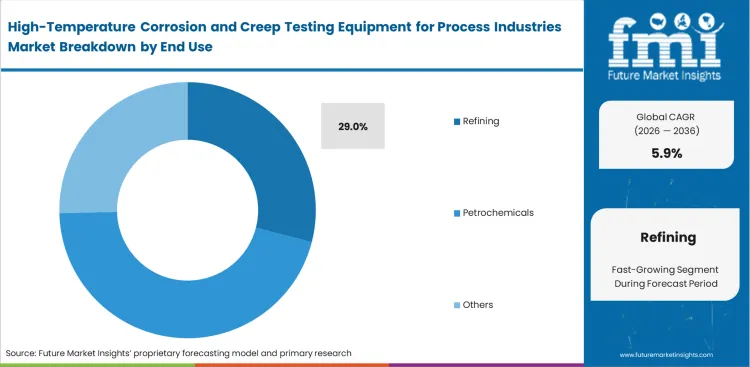
Feedstock changes are forcing refineries to reassess material performance much earlier in the operating cycle. Sour crude and bio-based feed inputs expose legacy distillation and upgrading units to more aggressive corrosive conditions than many older assets were designed to handle. Refining applications are projected to represent 29.0% share in 2026. Reliability teams need to test these feed combinations under controlled conditions before adjusting processing severity, residence time, or chemical treatment strategy. FMI analysis indicates refining remains the leading application because equipment failure in these environments can cause major safety, compliance, and shutdown costs. Testing under simulated reactor and process-unit conditions gives operators the evidence needed to qualify materials with greater confidence. Refineries that skip this stage face a higher risk of avoidable outages and poorly timed maintenance events.
- Crude simulation: Autoclaves handle high-sulfur feed conditions. Metallurgists assess safe operating limits before plant settings are adjusted.
- Pressure cycling: Systems reproduce start-up and shutdown stress patterns. Reliability engineers can identify early fatigue risk in exposed components.
- Chemical injection: Integrated ports support dynamic inhibitor testing. Operations teams can control treatment spending with better performance data.
High-Temperature Corrosion and Creep Testing Equipment for Process Industries Market Analysis by Test Method
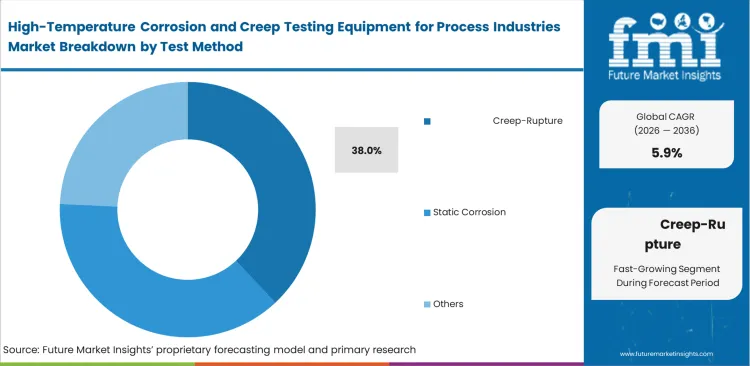
ASTM E139 remains a key reference point in how laboratories select creep testing procedures for high-temperature material qualification. Failure analysis teams rely on creep-rupture testing when they need clear evidence of long-term material limits under sustained thermal and mechanical stress. The method works by applying load over extended periods until the specimen reaches full separation, which helps establish the upper boundary of alloy performance under service-like conditions. FMI notes that this procedure continues to lead because rupture data is widely recognized by regulators, certifying bodies, and engineering teams as the most dependable basis for judging alloy capability. Faster screening methods may support early-stage evaluation, but they do not replace rupture-based evidence where compliance and design validation are concerned. Facilities that depend too heavily on modeled degradation rates without confirming rupture behavior often face documentation gaps during qualification and audit review. Creep-rupture procedures are forecast to command 38.0% share in 2026. This position reflects their continued importance in formal material approval workflows.
- Constant load: Dead-weight systems apply a stable force throughout the test period. Analysts record accurate time-to-failure data under fixed stress conditions.
- Strain tracking: Extensometers measure elongation continuously during the test cycle. Engineers use this data to build full deformation profiles over time.
- Rupture capture: Systems record the final separation event with precision. Metallurgists examine fracture surfaces to understand failure behavior and material weakness.
High-Temperature Corrosion and Creep Testing Equipment for Process Industries Market Analysis by Purchase Mode
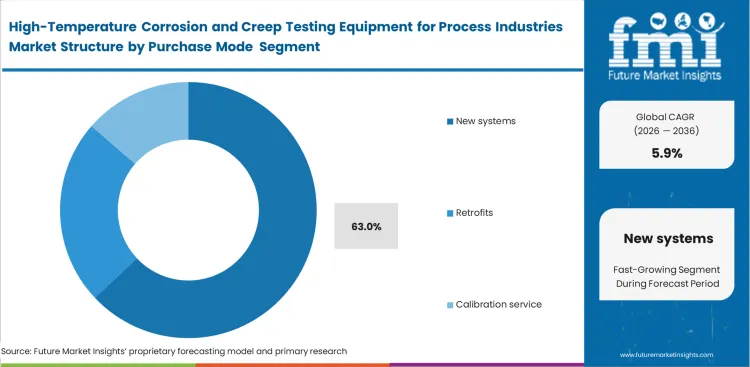
Capacity expansion in developing regions creates an acquisition strategy. New systems are estimated to secure 63.0% share in 2026. Greenfield laboratory construction necessitates complete hardware sourcing rather than component upgrades. Capital project managers prefer single-vendor ecosystems to ensure seamless data integration. According to FMI assessments, complete installations dominate because mixing legacy frames with modern sensors introduces unacceptable calibration errors. Piecemeal upgrades often cost more in integration labor than fresh installations. Laboratories attempting partial retrofits struggle with recurring software compatibility issues.
- Complete installation: Technicians deploy integrated hardware ecosystems. Lab managers avoid compatibility conflicts.
- Vendor calibration: Suppliers certify initial operational accuracy. Quality directors satisfy immediate audit requirements.
- Warranty protection: New purchases carry comprehensive coverage. Supply management teams minimize unplanned repair expenses.
High-Temperature Corrosion and Creep Testing Equipment for Process Industries Market Drivers, Restraints, and Opportunities
Unprecedented bio-feedstock introduction forces immediate metallurgical reassessment across global refining assets. Chief metallurgists must validate legacy reactor alloys against novel corrosive profiles before authorizing full-scale production. Delaying qualification risks vessel failure, compelling facility directors to invest heavily in advanced simulation hardware. Regulatory bodies increasingly mandate physical testing data over theoretical modeling. Pressure accelerates Purchasingent cycles for specialized autoclaves capable of recreating precise operational environments.
Sensor drift during extended testing limits data reliability. Independent calibration verification requires significant downtime, disrupting laboratory throughput. While manufacturers offer advanced insulation techniques, extreme thermal exposure eventually degrades extensometer precision. Reliability directors remain hesitant to commit millions to hardware that loses accuracy after six months of continuous operation. Component-level replacement programs offer partial mitigation but fail to resolve underlying material degradation issues affecting measurement sensors.
Opportunities in High-Temperature Corrosion and Creep Testing Equipment for Process Industries Market
- Automated calibration: Self-verifying sensors reduce maintenance downtime. Lab managers increase overall testing capacity.
- Hydrogen integration: Specialized testing equipment handles extreme embrittlement risks. Suppliers capture emerging alternative energy funding.
- Predictive software: Advanced algorithms flag anomalous strain rates early. Engineers halt tests before total equipment destruction occurs.
Regional Analysis
According to the regional breakdown, the High-Temperature Corrosion and Creep Testing Equipment market spans more than 40 countries and is categorized into seven key regions: North America, Latin America, Western and Eastern Europe, South Asia & the Pacific, East Asia, and the Middle East & Africa.
.webp "Top Country Growth Comparison High Temperature Corrosion And Creep Testing Equipment For Process Industries Market Cagr (2026 2036)")
| Country | CAGR (2026 to 2036) |
|---|---|
| China | 6.7% |
| India | 6.5% |
| Saudi Arabia | 6.2% |
| United States | 5.6% |
| Germany | 5.2% |
| South Korea | 5.1% |
| Japan | 4.8% |
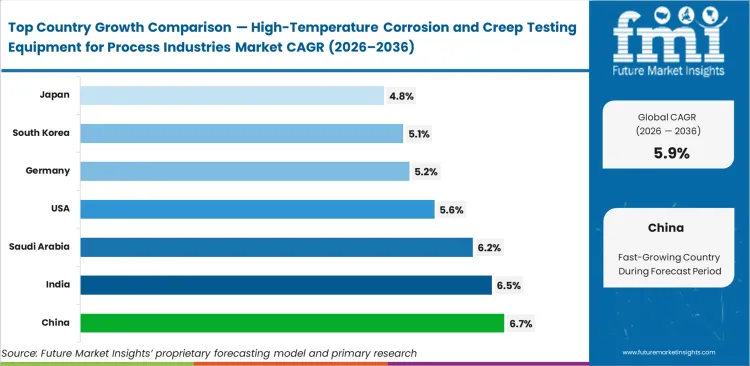
Source: Future Market Insights (FMI) analysis, based on proprietary forecasting model and primary research
East Asia High-Temperature Corrosion and Creep Testing Equipment for Process Industries Market Analysis
Massive investments in new process capacity reshape testing infrastructure requirements across East Asia. Industrial laboratory creation outpaces legacy facility upgrades, driving aggressive hardware acquisition. Capital project managers favor complete ecosystem installations over piecemeal retrofits. FMI analysis indicates regional demand centers on establishing baseline material properties for newly developed domestic alloys.
- China: Directors at expanding petrochemical complexes across the nation require high-volume testing frames to validate newly developed domestic alloys. Domestic suppliers capitalize on this urgent demand by offering lucrative, localized maintenance contracts. The high-temperature corrosion and creep testing equipment industry in China is expected to grow at a CAGR of 6.7% during the study period. This localized support ensures uninterrupted laboratory operations.
- South Korea: South Korea is anticipated to witness high-temperature corrosion and creep testing equipment demand grow at a CAGR of 5.1% over the forecast period. Mature industrial infrastructures limit fresh laboratory construction, forcing reliability engineers to focus expenditure strictly on upgrading existing frames. Facilities successfully integrating modern digital sensors extend legacy hardware lifespans significantly, allowing quality control departments to avoid complete ecosystem replacement costs.
- Japan: Chief metallurgists enforcing stringent quality control mandates require extreme measurement precision and highly stable thermal environments for material qualification. Driven by these rigorous standards, equipment sales in Japan are poised to grow at a CAGR of 4.8% during the assessment period. Vendors delivering superior long-term calibration stability secure entrenched operational positions, easily outcompeting lower-cost hardware alternatives suffering from premature sensor drift.
South Asia and Pacific High-Temperature Corrosion and Creep Testing Equipment for Process Industries Market Analysis
Emerging hydrogen-linked materials programs necessitate specialized testing capabilities throughout South Asia. Refining sectors upgrade legacy vessels to handle diverse feedstock profiles. Inspection directors demand robust hardware capable of withstanding erratic power supplies while maintaining test integrity. As per FMI projections, regional funding heavily targets standalone creep frames.
- India: Research facility managers continuously expand testing throughput to support emerging domestic manufacturing initiatives and hydrogen-linked materials programs. Agile vendors establishing localized hardware production capture massive commercial advantages by supplying durable systems built to withstand erratic regional power supplies. High-temperature corrosion and creep testing equipment adoption in India is likely to advance at a CAGR of 6.5% by 2036, securing uninterrupted material innovation.
Middle East and Africa High-Temperature Corrosion and Creep Testing Equipment for Process Industries Market Analysis
Asset integrity mandates dominate operational priorities across major petroleum-producing nations. Extreme environmental operating conditions require rigorous material qualification before deployment. Facility directors allocate substantial budgets toward simulating highly corrosive sour crude environments.
- Saudi Arabia: Extreme environmental operating conditions force reliability directors to implement continuous stress-rupture testing protocols on legacy vessels. Saudi Arabia is forecast to record steady growth in high-temperature corrosion and creep testing equipment adoption at a CAGR of 6.2% through 2036. Simulating highly corrosive sour crude environments prevents failures, while successful material qualification directly unlocks highly lucrative downstream petrochemical processing contracts for facility operators.
North America High-Temperature Corrosion and Creep Testing Equipment for Process Industries Market Analysis
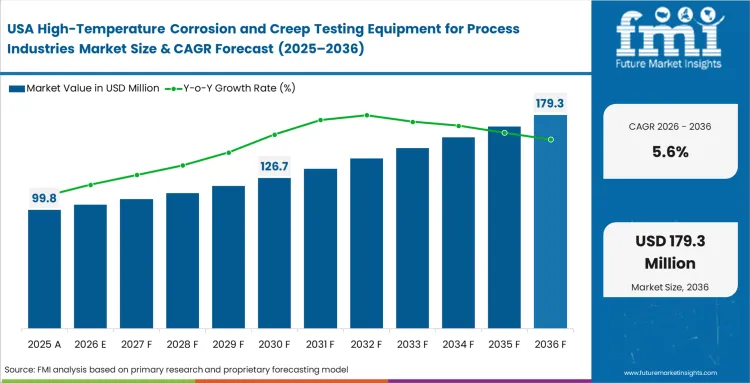
Established petrochemical complexes create steady replacement cycles across North America. Maintenance directors prioritize retrofits over fresh installations to maximize existing capital assets. Hardware standardization allows seamless integration of advanced digital tracking tools. FMI notes this region heavily favors comprehensive calibration service contracts.
- United States: Quality directors managing established petrochemical complexes prioritize upgraded digital sensors for legacy frames to maximize existing capital assets. Driven by this high reliance on retrofits, the United States high-temperature corrosion and creep testing equipment sector is expected to register a CAGR of 5.6% through 2036. Service providers offering rapid certification audits routinely capture significant market share directly from traditional, hardware-focused ecosystem manufacturers.
Western Europe High-Temperature Corrosion and Creep Testing Equipment for Process Industries Market Analysis
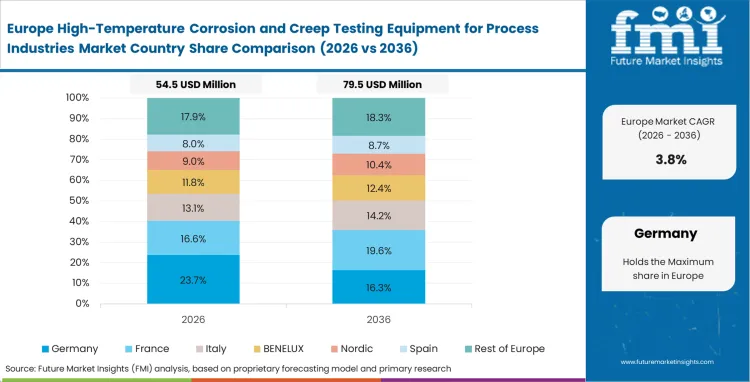
Stringent environmental regulations force immediate alternative fuel integration across Western Europe. Operations managers must validate bio-feedstock compatibility without delaying production schedules. Testing laboratories operate at maximum capacity, necessitating highly automated data collection systems. Based on FMI's assessment, demand centers entirely on long-term data reliability.
- Germany: Demand for high-temperature corrosion and creep testing equipment in Germany is anticipated to rise at a CAGR of 5.2% through 2036. Operations managers rushing to validate bio-feedstock compatibility without delaying production schedules push existing testing laboratories to maximum capacity. Because mature industrial networks restrict fresh facility creation, chief metallurgists concentrate capital expenditure primarily on complex retrofit projects requiring absolute precision sensor stability.
Competitive Aligners for Market Players
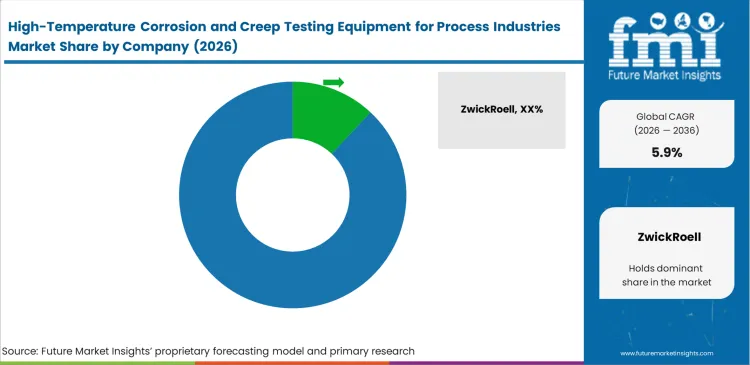
Incumbent manufacturers leverage massive historical databases of verified test results to maintain dominance. ZwickRoell and Instron dominate specification sheets because proprietary software ecosystems hold decades of validated material behavior data. Acquisition directors hesitate to switch vendors, knowing legacy data translation introduces unacceptable compliance risks. Hardware specifications matter less than seamless integration into existing laboratory information management systems.
Challengers attempt disruption by targeting specific niche applications like hydrogen embrittlement testing. Amar Equipment deliver specialized autoclaves tailored for emerging alternative fuels. True competitive advantage stems from sensor stability during 10,000-hour test cycles, not peak temperature claims. Startups focusing purely on advanced extensometer design capture significant retrofit business from frustrated reliability engineers.
Large refining conglomerates exercise buying power by demanding comprehensive calibration service level agreements. Facility managers refuse purchases lacking guaranteed maximum downtime clauses. Vendor survival depends increasingly on global service networks capable of deploying technicians within twenty-four hours. Hardware commoditization forces suppliers to generate margins through recurring software licensing and mandatory annual certification audits.
Key Players in High-Temperature Corrosion and Creep Testing Equipment for Process Industries Market
- ZwickRoell
- Instron
- MTS
- Parr Instrument Company
- Amar Equipment
- Walter+Bai
Scope of the Report
| Metric | Value |
|---|---|
| Quantitative Units | USD 220.0 million to USD 390.0 million, at a CAGR of 5.90% |
| Market Definition | Precision hardware simulates extreme operational environments to measure metallurgical degradation. Systems include pressurized autoclaves and stress-rupture frames utilized for material qualification. |
| Segmentation | By Equipment Type, By Temperature Range, By End Use, By Test Method, By Purchase Mode, By Region |
| Regions Covered | North America, Latin America, Western Europe, Eastern Europe, South Asia and Pacific, East Asia, Middle East and Africa |
| Countries Covered | China, India, Saudi Arabia, United States, Germany, South Korea, Japan |
| Key Companies Profiled | ZwickRoell, Instron, MTS, Parr Instrument Company, Amar Equipment, Walter+Bai |
| Forecast Period | 2026 to 2036 |
| Approach | Capital expenditure budgets for metallurgical testing facilities. |
Source: Future Market Insights (FMI) analysis, based on proprietary forecasting model and primary research
High-Temperature Corrosion and Creep Testing Equipment for Process Industries Market Analysis by Segments
Equipment Type
- Creep frames
- Corrosion autoclaves
- Thermal analyzers
- Extensometers
- Data systems
Temperature Range
- Up to 800°C
- 800-1200°C
- Above 1200°C
End Use
- Refining
- Petrochemicals
- Power generation
- Hydrogen
- Research labs
Test Method
- Creep-rupture
- Stress-rupture
- Static corrosion
- Dynamic corrosion
- Electrochemical corrosion
Purchase Mode
- New systems
- Retrofits
- Calibration service
Region:
- North America
- United States
- Canada
- Europe
- Germany
- United Kingdom
- France
- Italy
- Spain
- Asia Pacific
- China
- Japan
- South Korea
- Taiwan
- Singapore
- Latin America
- Brazil
- Mexico
- Argentina
- Middle East & Africa
- GCC Countries
- South Africa
Bibliography
- Wang, Y., Olson, A. P., & Couet, A. (2024). Radionuclide tracing based in situ corrosion and mass transport monitoring of 316L stainless steel in a molten salt closed loop. Nature Communications, 15, 3106.
- Obulan Subramanian, G., Kim, S. H., Jang, C., & Chiu, Y.-L. (2024). High-temperature corrosion and carburization behaviour of austenitic stainless steels in impurity-added CO2 environments. Corrosion Science, 232, 112016.
- Du, Y., Zhu, D., & Zhu, S. (2024). Experimental study on high-temperature creep behavior of full-locked and Galfan-coated steel cables. Journal of Materials in Civil Engineering, 36(1), 04023512.
- Shelton, P. H., & Wadley, H. N. G. (2024). A high temperature engine materials test facility. Review of Scientific Instruments, 95(4), 045119.
- Pillai, R., & Pint, B. A. (2024). Measure the effect of molten halide salt exposure on creep rupture lifetime. Oak Ridge National Laboratory.
This bibliography is provided for reader reference. The full FMI report contains the complete reference list with primary source documentation.
This Report Addresses
- High-Temperature Corrosion and Creep Testing Equipment for Process Industries Market size and forecast modeling.
- Equipment Type capacity constraints and deployment challenges.
- Temperature Range validation metrics across global processing sites.
- End Use procurement friction points impacting hardware acquisition.
- Test Method compliance issues driving facility upgrades.
- Regional analysis comparing China and Saudi Arabia expansion.
- Strategic advantages of specific calibration service level agreements.
- Competitive alignment strategies utilized by prominent legacy manufacturers.
Frequently Asked Questions
What is the baseline valuation for High-Temperature Corrosion and Creep Testing Equipment for Process Industries Market?
Sales reached USD 220.0 million in 2026. This figure establishes current capital expenditure across major metallurgical laboratories globally.
What growth rate characterizes expected hardware adoption?
Sourcing expands at 5.90% CAGR through 2036. Consistent investment carries cumulative opportunity to USD 390.0 million.
Which equipment category leads initial laboratory outfitting?
Creep frames account for 41.0% share in 2026. Chief metallurgists require specialized load trains to maintain constant stress over extended durations without vibration interference.
Why do specific temperature ranges dominate purchasing decisions?
Systems rated 800-1200°C hold 46.0% share in 2026. Reformer operating conditions establish baseline requirements, aligning perfectly with current petrochemical process parameters.
How do end-use sectors influence hardware design?
Refining applications represent 29.0% share in 2026. Sour crudes and bio-feedstocks introduce unprecedented corrosive elements, forcing rigorous material qualification before deployment.
Which test method drives standard compliance?
Creep-rupture procedures command 38.0% share in 2026. Regulatory bodies accept physical rupture data as definitive proof of alloy capability, rejecting theoretical modeling.
What purchase mode secures maximum budget allocation?
New systems secure 63.0% share in 2026. Capital project managers prefer single-vendor ecosystems to ensure seamless data integration and avoid software conflicts.
How does China shape regional demand profiles?
Aggressive laboratory infrastructure investment results in 6.7% growth. Acquisition directors prioritize high-volume testing frames to support expanding domestic petrochemical complexes.
What fundamental dynamic differentiates Saudi Arabia from Japan?
Saudi Arabia relies on fresh facility creation to protect refining assets, yielding 6.2% growth. Japan focuses on mature precision upgrades, generating 4.8% growth.
Why do incumbent vendors retain dominant market positions?
Proprietary software ecosystems hold decades of validated material behavior data. Acquisition directors hesitate to switch vendors, fearing legacy data translation introduces compliance risks.
What hidden operational risk threatens testing validity?
Sensor drift during extended testing limits data reliability. Extreme thermal exposure degrades extensometer precision, invalidating results after several months.
How do specialized autoclaves disrupt legacy hardware sales?
Emerging hydrogen embrittlement risks require continuous electrochemical monitoring. Standalone frames cannot replicate pressurized chemical environments, forcing operators toward enclosed systems.
What structural change impacts procurement timing toward 2036?
Extended facility lifecycles compel inspection directors to implement continuous stress-rupture testing. Delayed qualification directly threatens operational uptime.
How do retrofits compare economically to fresh installations?
Piecemeal upgrades often cost more in integration labor than fresh installations. Laboratories attempting partial retrofits struggle with recurring software compatibility issues.
What role do calibration contracts play in vendor selection?
Large refining conglomerates exercise buying power by demanding comprehensive service level agreements. Facility managers refuse purchases lacking guaranteed maximum downtime clauses.
Why do general mechanical testers fail high-temperature applications?
Standard setups drift under prolonged thermal exposure. Precise load application requires rigidity basic frames simply cannot maintain over 10,000 hours.
How does bio-feedstock introduction affect laboratory throughput?
Novel corrosive profiles force immediate metallurgical reassessment. Technicians must re-validate legacy reactor alloys, creating massive testing backlogs.
What limits broader adoption of 1200°C+ systems?
Purchasing broader thermal ranges adds unnecessary capital expense without delivering practical value. Laboratories over-specifying capabilities waste budget on unused capacity.
How do extensometers function within integrated systems?
These sensors monitor material elongation continuously. Engineers utilize resulting deformation curves to plot comprehensive failure trajectories.
What advantage do single-vendor ecosystems provide?
Technicians deploy integrated hardware without compatibility conflicts. Quality directors satisfy initial operational accuracy requirements immediately upon installation.
Why do hydrogen applications demand distinct testing protocols?
Standard oxidative degradation differs entirely from hydrogen embrittlement. Specialized testing hardware prevents vessel failures associated with novel alternative fuels.
What dictates absolute material limit determination?
Prolonged stress application until complete material separation reveals ultimate high-temperature strength. Accelerated testing protocols cannot substitute for physical rupture results.
How do localized maintenance networks provide competitive advantages?
Vendor survival depends increasingly on deploying technicians quickly. Hardware commoditization forces suppliers to generate value through rapid certification audits and repairs.
Preview the report firsthand - request a free sample
Get SampleGet the brochure for pricing and purchase details.
Get PDFTable of Content
- Executive Summary
- Global Market Outlook
- Demand-side Trends
- Supply-side Trends
- Technology Roadmap Analysis
- Analysis and Recommendations
- Market Overview
- Market Coverage / Taxonomy
- Market Definition / Scope / Limitations
- Research Methodology
- Chapter Orientation
- Analytical Lens and Working Hypotheses
- Market Structure, Signals, and Trend Drivers
- Benchmarking and Cross-market Comparability
- Market Sizing, Forecasting, and Opportunity Mapping
- Research Design and Evidence Framework
- Desk Research Programme (Secondary Evidence)
- Company Annual and Sustainability Reports
- Peer-reviewed Journals and Academic Literature
- Corporate Websites, Product Literature, and Technical Notes
- Earnings Decks and Investor Briefings
- Statutory Filings and Regulatory Disclosures
- Technical White Papers and Standards Notes
- Trade Journals, Industry Magazines, and Analyst Briefs
- Conference Proceedings, Webinars, and Seminar Materials
- Government Statistics Portals and Public Data Releases
- Press Releases and Reputable Media Coverage
- Specialist Newsletters and Curated Briefings
- Sector Databases and Reference Repositories
- FMI Internal Proprietary Databases and Historical Market Datasets
- Subscription Datasets and Paid Sources
- Social Channels, Communities, and Digital Listening Inputs
- Additional Desk Sources
- Expert Input and Fieldwork (Primary Evidence)
- Primary Modes
- Qualitative Interviews and Expert Elicitation
- Quantitative Surveys and Structured Data Capture
- Blended Approach
- Why Primary Evidence is Used
- Field Techniques
- Interviews
- Surveys
- Focus Groups
- Observational and In-context Research
- Social and Community Interactions
- Stakeholder Universe Engaged
- C-suite Leaders
- Board Members
- Presidents and Vice Presidents
- R&D and Innovation Heads
- Technical Specialists
- Domain Subject-matter Experts
- Scientists
- Physicians and Other Healthcare Professionals
- Governance, Ethics, and Data Stewardship
- Research Ethics
- Data Integrity and Handling
- Primary Modes
- Tooling, Models, and Reference Databases
- Desk Research Programme (Secondary Evidence)
- Data Engineering and Model Build
- Data Acquisition and Ingestion
- Cleaning, Normalisation, and Verification
- Synthesis, Triangulation, and Analysis
- Quality Assurance and Audit Trail
- Market Background
- Market Dynamics
- Drivers
- Restraints
- Opportunity
- Trends
- Scenario Forecast
- Demand in Optimistic Scenario
- Demand in Likely Scenario
- Demand in Conservative Scenario
- Opportunity Map Analysis
- Product Life Cycle Analysis
- Supply Chain Analysis
- Investment Feasibility Matrix
- Value Chain Analysis
- PESTLE and Porter’s Analysis
- Regulatory Landscape
- Regional Parent Market Outlook
- Production and Consumption Statistics
- Import and Export Statistics
- Market Dynamics
- Global Market Analysis 2021 to 2025 and Forecast, 2026 to 2036
- Historical Market Size Value (USD Million) Analysis, 2021 to 2025
- Current and Future Market Size Value (USD Million) Projections, 2026 to 2036
- Y-o-Y Growth Trend Analysis
- Absolute $ Opportunity Analysis
- Global Market Pricing Analysis 2021 to 2025 and Forecast 2026 to 2036
- Global Market Analysis 2021 to 2025 and Forecast 2026 to 2036, By Equipment Type
- Introduction / Key Findings
- Historical Market Size Value (USD Million) Analysis By Equipment Type , 2021 to 2025
- Current and Future Market Size Value (USD Million) Analysis and Forecast By Equipment Type , 2026 to 2036
- Creep Frames
- Extensometers
- Others
- Creep Frames
- Y-o-Y Growth Trend Analysis By Equipment Type , 2021 to 2025
- Absolute $ Opportunity Analysis By Equipment Type , 2026 to 2036
- Global Market Analysis 2021 to 2025 and Forecast 2026 to 2036, By Temperature Range
- Introduction / Key Findings
- Historical Market Size Value (USD Million) Analysis By Temperature Range, 2021 to 2025
- Current and Future Market Size Value (USD Million) Analysis and Forecast By Temperature Range, 2026 to 2036
- 800-1200°C Band
- Up to 800°C
- Above 1200°C
- 800-1200°C Band
- Y-o-Y Growth Trend Analysis By Temperature Range, 2021 to 2025
- Absolute $ Opportunity Analysis By Temperature Range, 2026 to 2036
- Global Market Analysis 2021 to 2025 and Forecast 2026 to 2036, By End Use
- Introduction / Key Findings
- Historical Market Size Value (USD Million) Analysis By End Use, 2021 to 2025
- Current and Future Market Size Value (USD Million) Analysis and Forecast By End Use, 2026 to 2036
- Refining
- Petrochemicals
- Others
- Refining
- Y-o-Y Growth Trend Analysis By End Use, 2021 to 2025
- Absolute $ Opportunity Analysis By End Use, 2026 to 2036
- Global Market Analysis 2021 to 2025 and Forecast 2026 to 2036, By Test Method
- Introduction / Key Findings
- Historical Market Size Value (USD Million) Analysis By Test Method, 2021 to 2025
- Current and Future Market Size Value (USD Million) Analysis and Forecast By Test Method, 2026 to 2036
- Creep‑Rupture
- Static Corrosion
- Others
- Creep‑Rupture
- Y-o-Y Growth Trend Analysis By Test Method, 2021 to 2025
- Absolute $ Opportunity Analysis By Test Method, 2026 to 2036
- Global Market Analysis 2021 to 2025 and Forecast 2026 to 2036, By Purchase Mode
- Introduction / Key Findings
- Historical Market Size Value (USD Million) Analysis By Purchase Mode, 2021 to 2025
- Current and Future Market Size Value (USD Million) Analysis and Forecast By Purchase Mode, 2026 to 2036
- New systems
- Retrofits
- Calibration service
- New systems
- Y-o-Y Growth Trend Analysis By Purchase Mode, 2021 to 2025
- Absolute $ Opportunity Analysis By Purchase Mode, 2026 to 2036
- Global Market Analysis 2021 to 2025 and Forecast 2026 to 2036, By Region
- Introduction
- Historical Market Size Value (USD Million) Analysis By Region, 2021 to 2025
- Current Market Size Value (USD Million) Analysis and Forecast By Region, 2026 to 2036
- North America
- Latin America
- Western Europe
- Eastern Europe
- East Asia
- South Asia and Pacific
- Middle East & Africa
- Market Attractiveness Analysis By Region
- North America Market Analysis 2021 to 2025 and Forecast 2026 to 2036, By Country
- Historical Market Size Value (USD Million) Trend Analysis By Market Taxonomy, 2021 to 2025
- Market Size Value (USD Million) Forecast By Market Taxonomy, 2026 to 2036
- By Country
- USA
- Canada
- Mexico
- By Equipment Type
- By Temperature Range
- By End Use
- By Test Method
- By Purchase Mode
- By Country
- Market Attractiveness Analysis
- By Country
- By Equipment Type
- By Temperature Range
- By End Use
- By Test Method
- By Purchase Mode
- Key Takeaways
- Latin America Market Analysis 2021 to 2025 and Forecast 2026 to 2036, By Country
- Historical Market Size Value (USD Million) Trend Analysis By Market Taxonomy, 2021 to 2025
- Market Size Value (USD Million) Forecast By Market Taxonomy, 2026 to 2036
- By Country
- Brazil
- Chile
- Rest of Latin America
- By Equipment Type
- By Temperature Range
- By End Use
- By Test Method
- By Purchase Mode
- By Country
- Market Attractiveness Analysis
- By Country
- By Equipment Type
- By Temperature Range
- By End Use
- By Test Method
- By Purchase Mode
- Key Takeaways
- Western Europe Market Analysis 2021 to 2025 and Forecast 2026 to 2036, By Country
- Historical Market Size Value (USD Million) Trend Analysis By Market Taxonomy, 2021 to 2025
- Market Size Value (USD Million) Forecast By Market Taxonomy, 2026 to 2036
- By Country
- Germany
- UK
- Italy
- Spain
- France
- Nordic
- BENELUX
- Rest of Western Europe
- By Equipment Type
- By Temperature Range
- By End Use
- By Test Method
- By Purchase Mode
- By Country
- Market Attractiveness Analysis
- By Country
- By Equipment Type
- By Temperature Range
- By End Use
- By Test Method
- By Purchase Mode
- Key Takeaways
- Eastern Europe Market Analysis 2021 to 2025 and Forecast 2026 to 2036, By Country
- Historical Market Size Value (USD Million) Trend Analysis By Market Taxonomy, 2021 to 2025
- Market Size Value (USD Million) Forecast By Market Taxonomy, 2026 to 2036
- By Country
- Russia
- Poland
- Hungary
- Balkan & Baltic
- Rest of Eastern Europe
- By Equipment Type
- By Temperature Range
- By End Use
- By Test Method
- By Purchase Mode
- By Country
- Market Attractiveness Analysis
- By Country
- By Equipment Type
- By Temperature Range
- By End Use
- By Test Method
- By Purchase Mode
- Key Takeaways
- East Asia Market Analysis 2021 to 2025 and Forecast 2026 to 2036, By Country
- Historical Market Size Value (USD Million) Trend Analysis By Market Taxonomy, 2021 to 2025
- Market Size Value (USD Million) Forecast By Market Taxonomy, 2026 to 2036
- By Country
- China
- Japan
- South Korea
- By Equipment Type
- By Temperature Range
- By End Use
- By Test Method
- By Purchase Mode
- By Country
- Market Attractiveness Analysis
- By Country
- By Equipment Type
- By Temperature Range
- By End Use
- By Test Method
- By Purchase Mode
- Key Takeaways
- South Asia and Pacific Market Analysis 2021 to 2025 and Forecast 2026 to 2036, By Country
- Historical Market Size Value (USD Million) Trend Analysis By Market Taxonomy, 2021 to 2025
- Market Size Value (USD Million) Forecast By Market Taxonomy, 2026 to 2036
- By Country
- India
- ASEAN
- Australia & New Zealand
- Rest of South Asia and Pacific
- By Equipment Type
- By Temperature Range
- By End Use
- By Test Method
- By Purchase Mode
- By Country
- Market Attractiveness Analysis
- By Country
- By Equipment Type
- By Temperature Range
- By End Use
- By Test Method
- By Purchase Mode
- Key Takeaways
- Middle East & Africa Market Analysis 2021 to 2025 and Forecast 2026 to 2036, By Country
- Historical Market Size Value (USD Million) Trend Analysis By Market Taxonomy, 2021 to 2025
- Market Size Value (USD Million) Forecast By Market Taxonomy, 2026 to 2036
- By Country
- Kingdom of Saudi Arabia
- Other GCC Countries
- Turkiye
- South Africa
- Other African Union
- Rest of Middle East & Africa
- By Equipment Type
- By Temperature Range
- By End Use
- By Test Method
- By Purchase Mode
- By Country
- Market Attractiveness Analysis
- By Country
- By Equipment Type
- By Temperature Range
- By End Use
- By Test Method
- By Purchase Mode
- Key Takeaways
- Key Countries Market Analysis
- USA
- Pricing Analysis
- Market Share Analysis, 2025
- By Equipment Type
- By Temperature Range
- By End Use
- By Test Method
- By Purchase Mode
- Canada
- Pricing Analysis
- Market Share Analysis, 2025
- By Equipment Type
- By Temperature Range
- By End Use
- By Test Method
- By Purchase Mode
- Mexico
- Pricing Analysis
- Market Share Analysis, 2025
- By Equipment Type
- By Temperature Range
- By End Use
- By Test Method
- By Purchase Mode
- Brazil
- Pricing Analysis
- Market Share Analysis, 2025
- By Equipment Type
- By Temperature Range
- By End Use
- By Test Method
- By Purchase Mode
- Chile
- Pricing Analysis
- Market Share Analysis, 2025
- By Equipment Type
- By Temperature Range
- By End Use
- By Test Method
- By Purchase Mode
- Germany
- Pricing Analysis
- Market Share Analysis, 2025
- By Equipment Type
- By Temperature Range
- By End Use
- By Test Method
- By Purchase Mode
- UK
- Pricing Analysis
- Market Share Analysis, 2025
- By Equipment Type
- By Temperature Range
- By End Use
- By Test Method
- By Purchase Mode
- Italy
- Pricing Analysis
- Market Share Analysis, 2025
- By Equipment Type
- By Temperature Range
- By End Use
- By Test Method
- By Purchase Mode
- Spain
- Pricing Analysis
- Market Share Analysis, 2025
- By Equipment Type
- By Temperature Range
- By End Use
- By Test Method
- By Purchase Mode
- France
- Pricing Analysis
- Market Share Analysis, 2025
- By Equipment Type
- By Temperature Range
- By End Use
- By Test Method
- By Purchase Mode
- India
- Pricing Analysis
- Market Share Analysis, 2025
- By Equipment Type
- By Temperature Range
- By End Use
- By Test Method
- By Purchase Mode
- ASEAN
- Pricing Analysis
- Market Share Analysis, 2025
- By Equipment Type
- By Temperature Range
- By End Use
- By Test Method
- By Purchase Mode
- Australia & New Zealand
- Pricing Analysis
- Market Share Analysis, 2025
- By Equipment Type
- By Temperature Range
- By End Use
- By Test Method
- By Purchase Mode
- China
- Pricing Analysis
- Market Share Analysis, 2025
- By Equipment Type
- By Temperature Range
- By End Use
- By Test Method
- By Purchase Mode
- Japan
- Pricing Analysis
- Market Share Analysis, 2025
- By Equipment Type
- By Temperature Range
- By End Use
- By Test Method
- By Purchase Mode
- South Korea
- Pricing Analysis
- Market Share Analysis, 2025
- By Equipment Type
- By Temperature Range
- By End Use
- By Test Method
- By Purchase Mode
- Russia
- Pricing Analysis
- Market Share Analysis, 2025
- By Equipment Type
- By Temperature Range
- By End Use
- By Test Method
- By Purchase Mode
- Poland
- Pricing Analysis
- Market Share Analysis, 2025
- By Equipment Type
- By Temperature Range
- By End Use
- By Test Method
- By Purchase Mode
- Hungary
- Pricing Analysis
- Market Share Analysis, 2025
- By Equipment Type
- By Temperature Range
- By End Use
- By Test Method
- By Purchase Mode
- Kingdom of Saudi Arabia
- Pricing Analysis
- Market Share Analysis, 2025
- By Equipment Type
- By Temperature Range
- By End Use
- By Test Method
- By Purchase Mode
- Turkiye
- Pricing Analysis
- Market Share Analysis, 2025
- By Equipment Type
- By Temperature Range
- By End Use
- By Test Method
- By Purchase Mode
- South Africa
- Pricing Analysis
- Market Share Analysis, 2025
- By Equipment Type
- By Temperature Range
- By End Use
- By Test Method
- By Purchase Mode
- USA
- Market Structure Analysis
- Competition Dashboard
- Competition Benchmarking
- Market Share Analysis of Top Players
- By Regional
- By Equipment Type
- By Temperature Range
- By End Use
- By Test Method
- By Purchase Mode
- Competition Analysis
- Competition Deep Dive
- ZwickRoell
- Overview
- Product Portfolio
- Profitability by Market Segments (Product/Age /Sales Channel/Region)
- Sales Footprint
- Strategy Overview
- Marketing Strategy
- Product Strategy
- Channel Strategy
- Instron
- MTS
- Parr Instrument Company
- Amar Equipment
- Walter+Bai
- ZwickRoell
- Competition Deep Dive
- Assumptions & Acronyms Used


