

- Industry Size (2026)
- USD 2.68 Bn
- Forecast (2036)
- USD 5.82 Bn
- CAGR (2026 to 2036)
- 8.10%
MEMS and Sensor Performance and Reliability Test Equipment Market Size, Market Forecast and Outlook By FMI
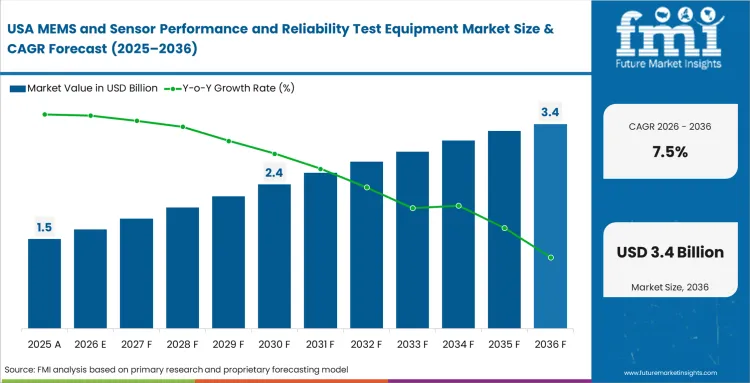
The MEMS and sensor performance and reliability test equipment market was valued at USD 2.45 billion in 2025. Valuation is poised to cross USD 2.68 billion in 2026 at a CAGR of 8.10% during this forecast period. Ongoing investment is forecast to increase the market to USD 5.82 billion by 2036, as advanced packaging architectures require rigorous functional verification prior to singulation.
Summary of MEMS and Sensor Performance and Reliability Test Equipment Market
- MEMS and Sensor Performance and Reliability Test Equipment Market Definition
- Production-grade metrology infrastructure designed specifically to validate mechanical movement, electrical response, and structural integrity of micro-electromechanical systems before final assembly. Equipment applies physical stimuli while measuring microsecond electrical responses.
- Demand Drivers in the Market
- Defect liability contracts compel foundry testing supervisors to mandate 100% functional verification on all automotive-bound silicon batches prior to shipment.
- Heterogeneous integration complexities require advanced packaging engineers to validate individual chiplets before committing them to expensive multi-die assemblies.
- Miniaturization roadmaps push metrology specialists to deploy sub-micron optical inspection platforms capable of identifying microscopic structural flaws rapidly.
- Key Segments Analyzed in the FMI Report
- By Equipment Type: Wafer Test Systems is expected to capture 42.5% share in 2026, driven by early-stage defect isolation economics prior to expensive singulation processes.
- By Sensor Type: MEMS Sensors is projected to hold 48.0% share through 2036, relying on mandatory multi-axis calibration routines required for modern consumer electronics.
- By Application: Automotive is set to reach 46.2% share in 2026, structured around zero-defect reliability mandates originating from autonomous driving safety regulations.
- By Test Function: Performance Testing is anticipated to garner 51.3% share in 2026, validating dynamic component behavior under simulated real-world operational stressors.
- By End User: IDMs is estimated to control 44.8% share in 2026, leveraging massive capital reserves to deploy proprietary end-to-end validation infrastructures internally.
- China: Localized semiconductor manufacturing in China is driving compound growth of 9.4%, with rising demand absorbing high‑density probe stations.
- Analyst Opinion at FMI
- Rahul Pandita, Principal Analyst, Technology, at FMI, notes that "Standard defect rate metrics capture static failures perfectly but miss dynamic calibration drift entirely. Facilities pass components based on basic electrical continuity checks, only to face massive field failures when mechanical structures deform under thermal stress. This measurement gap rewards legacy equipment vendors with high throughput marketing claims while penalizing operators with massive downstream warranty costs."
- Strategic Implications / Executive Takeaways
- Fab operations managers must secure multi-year probe card supply agreements immediately to avoid crippling ramp-up delays on next-generation product lines.
- Metrology vendor strategy heads risk total exclusion from tier-1 bids unless they integrate unified thermal and mechanical stimulus capabilities directly into probe stations.
- Test engineering directors evaluating capital expenditures face severe total-cost-of-ownership penalties when splitting validation workflows across disconnected legacy handler platforms.
- Methodology
- Primary inputs originate from fab operation supervisors evaluating capital expenditure cycles.
- Desk analysis utilizes JEITA shipment logs and NIST metrology publications.
- Sizing relies on capacity expansion announcements paired with probe card consumption rates.
- Validation involves cross-referencing vendor revenue against foundry capital budgets.
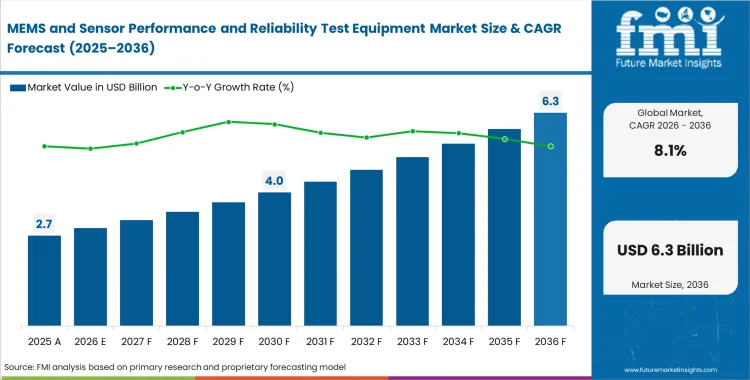
MEMS and Sensor Performance and Reliability Test Equipment Market Key Takeaways
| Metric | Details |
|---|---|
| Industry Size (2026) | USD 2.68 billion |
| Industry Value (2036) | USD 5.82 billion |
| CAGR (2026–2036) | 8.10% |
Source: Future Market Insights (FMI) analysis, based on proprietary forecasting model and primary research
Procurement directors at major outsourced semiconductor assembly and test facilities face immense pressure to secure high-throughput metrology platforms immediately. Yield optimization requires sub-micron defect detection at production speed, limiting operational efficiency for facilities relying on legacy sampling protocols. Missing this qualification cycle hands lucrative capacity contracts straight to competitors operating fully integrated semiconductor test equipment nodes. Operations managers routinely underestimate how custom probe card fabrication delays disrupt ramp-up schedules for novel device geometries.
When tier-1 automotive integrators mandate zero-defect liabilities in purchase agreements, parallel validation capabilities become mandatory survival mechanisms. Foundries initiate massive capital upgrades immediately following these contract stipulations. Full-wafer contact technologies transform validation bottlenecks into seamless manufacturing phases, driving demand for innovative MEMS testing solutions.
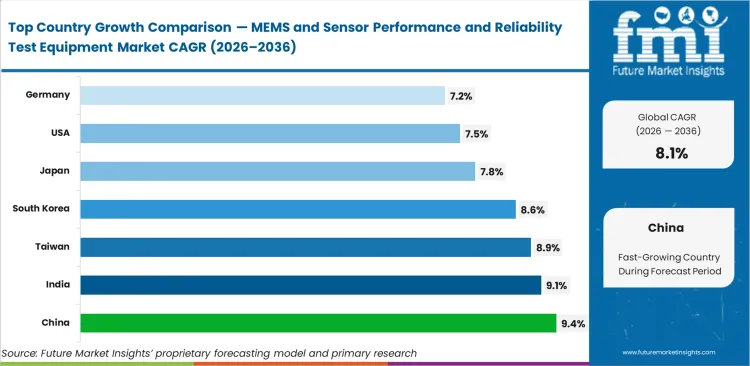
China expands at 9.4% as localized semiconductor manufacturing absorbs high-density probe stations. India accelerates at 9.1% driven by aggressive outsourced assembly deployments. Taiwan tracks at 8.9% leveraging mature foundry dominance to dictate global protocol standards. South Korea advances at 8.6% integrating high-resolution optical inspection within memory-logic hybrid lines. Japan progresses at 7.8% relying on precision metrology dominance. United States grows at 7.5% prioritizing complex RF-MEMS validation environments. Germany advances at 7.2% through stringent compliance verification mandates. Structural divergence across these geographies forces vendors to bifurcate product roadmaps.
MEMS and Sensor Performance and Reliability Test Equipment Market Definition
Production-grade metrology infrastructure exists specifically to validate mechanical movement, electrical response, and structural integrity of micro-electromechanical systems before final assembly. Validating these complex components requires specialized physical handling mechanisms entirely distinct from standard logic verification procedures. Equipment must apply precise physical stimuli like pressure, acceleration, or gas concentration while simultaneously measuring microsecond electrical responses, forming the core of any MEMS performance testing protocol.
MEMS and Sensor Performance and Reliability Test Equipment Market Inclusions
Scope incorporates wafer-level probe stations, packaged part handlers, burn-in ovens customized for arrays, and environmental stimulus chambers. Hardware ecosystems spanning industrial automation integration software to consumable contact pins fall inside this analytical boundary. Calibration instruments designed for high-volume manufacturing environments also reside within our tracked parameters for comprehensive sensor validation equipment.
MEMS and Sensor Performance and Reliability Test Equipment Market Exclusions
Standalone logic semiconductor testers lacking mechanical or environmental stimulus capabilities remain outside our focus. Standard laboratory microscopes and generic multimeters lack high-volume production throughput speeds required for inclusion. Consumer-grade diagnostic tools and basic printed circuit board inspection cameras fail our precision thresholds.
MEMS and Sensor Performance and Reliability Test Equipment Market Research Methodology
- Primary Research: Procurement directors, test engineering managers, and fab operation supervisors evaluating capital expenditure cycles directly inform baseline projections.
- Desk Research: Semiconductor industry capital equipment filings, JEITA shipment logs, and NIST metrology publications provide structural verification matrices.
- Market-Sizing and Forecasting: Fab capacity expansion announcements paired with historical probe card consumption rates anchor baseline volume calculations.
- Data Validation and Update Cycle: Vendor revenue disclosures cross-referenced against foundry capital expenditure budgets ensure continuous forecast calibration.
Segmental Analysis
MEMS and Sensor Performance and Reliability Test Equipment Market Analysis by Equipment Type
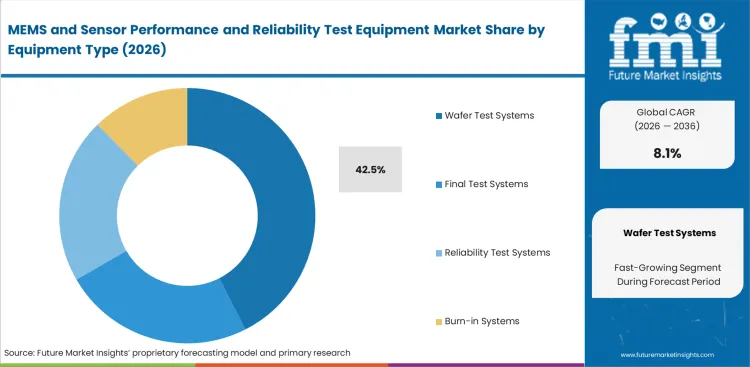
Packaged component handlers often fail to identify defective dies until significant value has already been added through expensive singulation and bonding processes. This late-stage discovery drives up scrap costs and erodes margins, particularly in high‑volume manufacturing environments. Wafer test systems are projected to hold a 42.5% share in 2026, as detecting faulty logic at this early stage helps foundries save millions that would otherwise be lost on unnecessary packaging. Fab operations managers consciously prioritize these investments to improve backend yield performance. Manufacturers that adopt high-parallelism probe cards are able to significantly reduce overall product costs. Delaying investment in advanced parallel probe architectures can also permanently restrict a facility’s production capacity.
- Pre-singulation isolation: Identifying defective dies before dicing helps foundries avoid wasting costly substrate materials. By implementing strict wafer-level MEMS testing, fab operations managers can achieve substantial yield improvements that directly impact quarterly profitability.
- Pin degradation modeling: Continuous high-force contact cycles can quickly wear down lower-quality probe tips under real manufacturing conditions. Test engineering teams depend on real-time degradation insights to plan preventive maintenance more effectively.
- Parallel indexing architectures: Testing thousands of dies at the same time requires strong computational capabilities built into the hardware. Facilities that underinvest in data backplane capacity risk creating bottlenecks that can slow down entire production lines.
MEMS and Sensor Performance and Reliability Test Equipment Market Analysis by Sensor Type
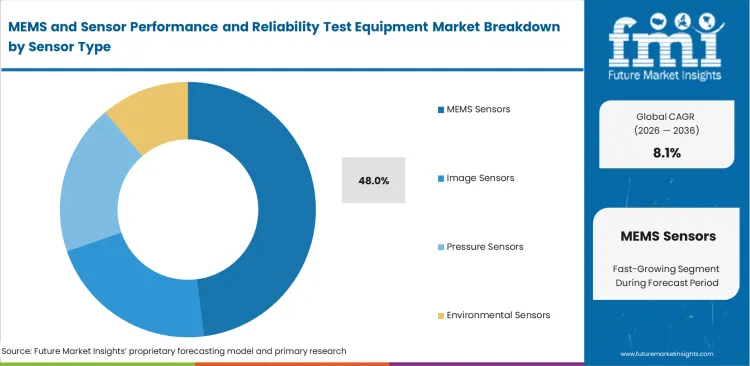
Validating physical movement requires advanced stimulus chambers that differ substantially from standard static logic testers. The demand for these systems is rising steadily, with MEMS sensors accounting for a 48.0% share in 2026, driven by the need for multi-axis calibration in modern navigation applications. Test engineering teams often design entire production floors around specialized equipment such as mechanical shakers and pressure chambers. These specialized handling systems often determine throughput limits more than the actual speed of electronic measurements. FMI analysts also point out an important but less obvious insight: while image sensors receive most of the mainstream focus, inertial measurement testing leads to significantly higher consumable wear because of the intense physical stress involved. Metrology teams managing mixed-product lines need to separate these workflows carefully to avoid vibration interference that can disrupt nearby optical calibration processes. Relying on generic, multi-purpose handlers can significantly limit overall factory output, making dedicated MEMS calibration systems a more practical choice.
- Mechanical stimulus integration: Testing inertial components involves applying controlled physical forces while simultaneously measuring rapid capacitance changes. Calibration engineers must carefully fine-tune these motion profiles to avoid damaging delicate microstructures.
- Vacuum stability requirements: Resonator testing depends on highly controlled atmospheric conditions during validation cycles. Facilities teams invest heavily in specialized environmental chambers to maintain consistent baseline testing environments.
- Optical isolation chambers: Vision sensors require complete darkness along with precisely calibrated light sources for accurate dead-pixel detection. Production teams that allocate separate cleanroom zones for optical testing can effectively avoid cross-contamination and ensure reliable results using advanced sensor testing setups.
MEMS and Sensor Performance and Reliability Test Equipment Market Analysis by Application
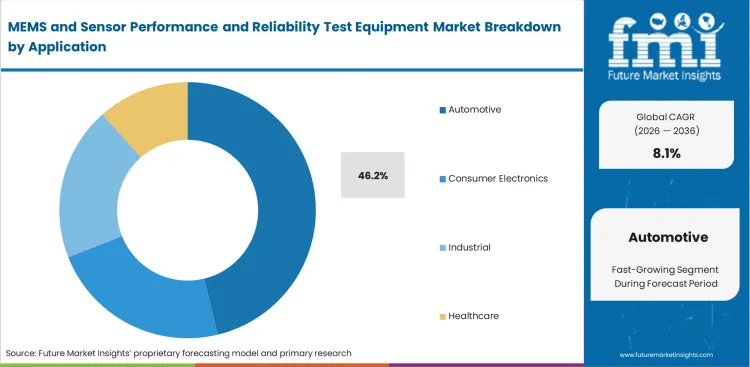
Autonomous driving systems have transformed sensor validation from a routine quality check into a critical safety requirement. With automotive applications holding a 46.2% share in 2026, as tier-1 suppliers place strict zero-defect expectations on their semiconductor manufacturing partners. Quality assurance teams operate under intense pressure, where even a single field failure traced back to inadequate testing can lead to immediate contract termination. Indicating rigorous thermal cycling requirements are a defining part of automotive-grade testing standards. There is also a practical industry insight: while consumer electronics drive higher overall volumes, automotive testing demands that hardware withstand extreme temperature conditions for extended periods, creating significant bottlenecks that conventional high-speed sensor handlers cannot manage efficiently.
- Safety compliance verification: Autonomous driving controllers must perform reliably across extreme temperature ranges. Quality assurance teams enforce extended burn-in cycles that can fully occupy standard testing capacity, strictly adhering to automotive MEMS testing standards.
- Consumer cycle compression: Mobile device manufacturers require extremely fast component validation to align with tight product launch timelines. Supply chain teams impose strict penalties on vendors for any delays caused by testing processes.
- Industrial harsh-environment simulation: Components used in factory automation must withstand continuous vibration and exposure to harsh chemicals. Test engineers develop advanced degradation profiles that go beyond standard validation requirements, using durable industrial sensor testing equipment.
MEMS and Sensor Performance and Reliability Test Equipment Market Analysis by Test Function
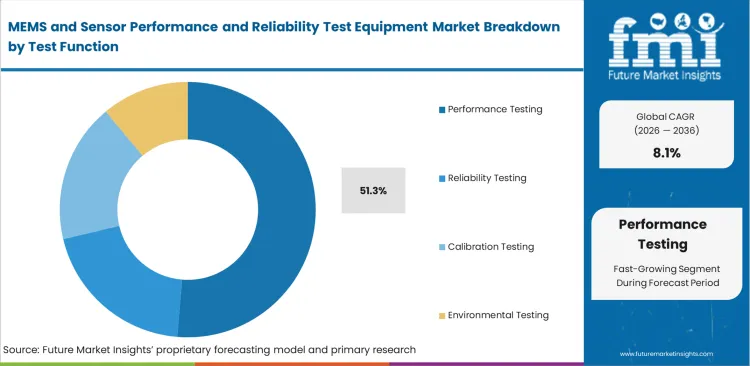
Performance testing accounts for a 51.3% share in 2026, as end-users increasingly reject components that are validated only through static continuity checks. Dynamic operational validation has become essential to ensure components can perform reliably under real-world conditions. Test engineering managers are now restructuring entire workflows to measure active signal-to-noise ratios during continuous physical actuation. Capturing these dynamic responses requires specialized high-frequency data acquisition systems that are directly integrated into handler electronics. In practice, engineers face a key challenge: modern automotive electronics demand thousands of calibration points per device, making traditional sequential testing impractical and pushing the industry toward parallel, asynchronous testing architectures. Facilities that continue relying on sequential validation methods ultimately limit their production capacity and efficiency over time.
- Dynamic response profiling: Measuring signal behavior during active physical movement helps confirm structural integrity more accurately. Test engineering teams rely on these dynamic profiles to identify hidden defects early using dedicated MEMS quality testing equipment.
- Drift rate quantification: Environmental sensors naturally degrade over time, making accelerated aging simulations essential. Quality teams use drift data to define accurate warranty periods through continuous sensor reliability testing systems.
- Cross-axis sensitivity mapping: Multi-axis gyroscopes often experience slight signal interference between different directions. Calibration engineers develop specialized software algorithms to correct this issue and ensure precise performance during MEMS reliability testing system deployment.
MEMS and Sensor Performance and Reliability Test Equipment Market Analysis by End User
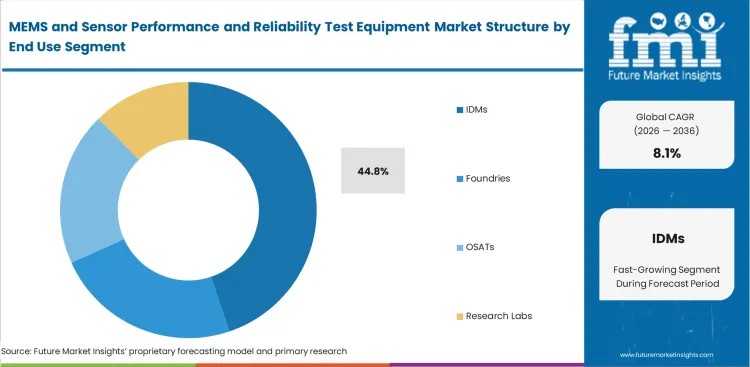
IDMs account for a 44.8% share in 2026, largely because they have the financial strength to build and control fully proprietary testing architectures. By managing both chip design and final assembly, they can optimize metrology across every stage of production. Fab operations managers within these organizations often purchase testing platforms in large volumes to standardize processes globally. This level of purchasing power pushes equipment vendors to customize hardware specifically to meet individual client needs. Practitioners within these environments face a tough reality: while custom advanced packaging handlers deliver high internal efficiency, they also lead to strong vendor lock-in, making future upgrades extremely costly and often requiring full production shutdowns. Capital expenditure teams that choose heavily customized systems often lose flexibility and bargaining power in the long run.
- Proprietary workflow enforcement: Large integrated organizations define their own testing processes tailored to their product designs. This allows fab operations managers to achieve efficiency levels that are difficult for more fragmented supply chains to match.
- Contract assembly economics: Outsourced assembly providers operate on very thin margins, which makes high equipment utilization essential. Procurement teams in these facilities prefer versatile handlers that can support a wide range of product designs.
- Laboratory qualification limits: Research labs focus on achieving maximum measurement accuracy while handling low production volumes. Engineering teams in these environments prioritize precision and resolution over testing speed.
MEMS and Sensor Performance and Reliability Test Equipment Market Drivers, Restraints, and Opportunities
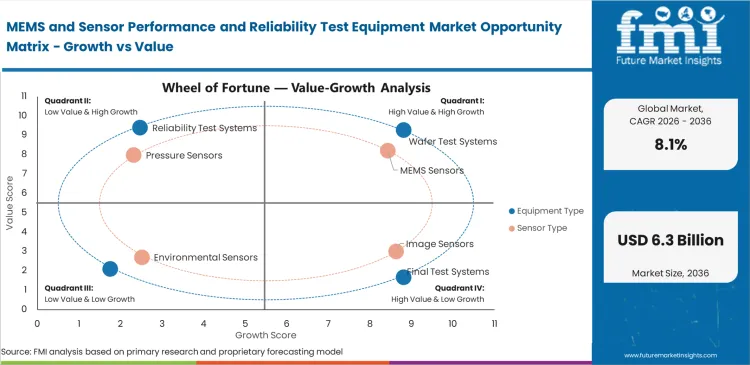
Aggressive outsourced assembly capacity scaling forces test managers to adopt highly parallel processing architectures immediately. Yield optimization requires sub-micron defect detection at production speed, limiting operational efficiency for facilities relying on legacy sequential sampling protocols. Missing this qualification cycle hands lucrative capacity contracts straight to competitors operating fully integrated testing nodes. Fab operations managers must deploy high-density probe stations rapidly to process complex heterogeneous chiplet assemblies before final encapsulation processes seal away defective components forever. Keeping pace with MEMS testing trends 2026 ensures facilities maintain compatibility with next-generation sensor node demands.
Chronic lead times for custom high-density probe cards cripple fast-iteration production cycles severely. Fab operations managers plan product ramp-ups months in advance, but minor geometric shifts in sensor design require completely new physical contact arrays. This physical manufacturing limitation persists despite software simulation improvements because drilling microscopic holes in ceramic substrates remains fundamentally difficult. Modular probe head assemblies offer partial relief but suffer from unacceptable signal degradation at high frequencies.
Opportunities in the MEMS and Sensor Performance and Reliability Test Equipment Market
- Over-the-air validation architectures: Eliminating physical contact pins entirely removes massive consumable expenses. Test engineering managers eliminate probe card lead times definitively through sensor test automation systems.
- Cryogenic testing integration: Quantum computing and specialized defense sensors require validation at near-absolute zero temperatures. Metrology directors command massive premium pricing for delivering these niche industrial sensors capabilities.
- Machine learning defect classification: Implementing advanced visual algorithms reduces false-rejection rates dramatically. Quality assurance directors reclaim millions in perfectly functional silicon previously discarded incorrectly.
Regional Analysis
.webp "Top Country Growth Comparison Mems And Sensor Performance And Reliability Test Equipment Market Cagr (2026 2036)")
Based on regional analysis, MEMS and Sensor Performance and Reliability Test Equipment Market is segmented into East Asia, South Asia, and North America across 40 plus countries.
| Country | CAGR (2026 to 2036) |
|---|---|
| China | 9.4% |
| India | 9.1% |
| Taiwan | 8.9% |
| South Korea | 8.6% |
| Japan | 7.8% |
| United States | 7.5% |
| Germany | 7.2% |
Source: Future Market Insights (FMI) analysis, based on proprietary forecasting model and primary research
East Asia MEMS and Sensor Performance and Reliability Test Equipment Market Analysis
Strong localization mandates are driving a surge in capital investment across regional semiconductor manufacturing hubs. Fab operations managers are increasingly focused on building fully independent testing ecosystems to protect supply chains from geopolitical uncertainties and trade restrictions. This push for self-reliance is skipping traditional upgrade cycles, with new facilities adopting advanced parallel probe architectures right from the start. Government subsidies are also reshaping capital investment decisions, enabling smaller foundries to access high-end metrology platforms that were once limited to large industry players. This rapid expansion is creating new challenges, including intense regional competition for skilled field service engineers who can install, calibrate, and maintain these sophisticated testing systems.
- China: Rapid build‑out of localized semiconductor manufacturing hubs is accelerating demand for advanced testing hardware across China. Operations managers are prioritizing investment in high‑density probe stations to strengthen production independence and reduce exposure to external supply chains. This focus is supporting an estimated 9.4% CAGR in semiconductor wafer test and probe station equipment sector, with domestic vendors gaining preference as long as they can meet throughput and reliability benchmarks set by tier‑one suppliers.
- Taiwan: A deeply established foundry ecosystem continues to give Taiwan outsized influence over global testing protocols and operating standards. Local test operations often set the baseline requirements that international fabless firms must meet, particularly around yield validation and reliability assurance. This environment is driving a projected 8.9% CAGR in semiconductor automatic test equipment (ATE), reflecting both intense competition and Taiwan’s ongoing role as a benchmark market for advanced testing practices.
- South Korea: The close integration of memory and logic manufacturing in South Korea is reshaping inspection and validation requirements on the production floor. Engineering teams are consolidating multiple inspection steps into unified inline platforms that support higher resolution and greater automation. Developments in South Korea are expected to contribute to an 8.6% CAGR in advanced semiconductor inspection and test systems, as fabs move steadily toward fully automated, low‑touch testing environments.
- Japan: In Japan, growth in testing and measurement equipment is being driven by a long‑standing emphasis on precision rather than sheer output volume. Production teams prioritize calibration accuracy and measurement stability, particularly for specialty and industrial semiconductor applications. This approach is supporting a 7.8% CAGR in high‑precision semiconductor metrology and test equipment, allowing suppliers to command premium pricing in export‑oriented and niche end‑use markets.
FMI’s report includes secondary assembly hubs in Macau and emerging micro‑metrology centers in Hong Kong. Procurement directors across these peripheral nodes struggle to secure adequate field service engineering support from major metrology vendors. Singapore is also emerging as a regional anchor point, with continued investment in advanced metrology infrastructure and stronger access to vendor support networks.
South Asia MEMS and Sensor Performance and Reliability Test Equipment Market Analysis
Outsourced assembly capacity is expanding rapidly as global supply chains continue to diversify their manufacturing bases. Procurement directors are setting up large testing facilities designed to handle high volumes while supporting a wide range of product types. FMI observes that, unlike dedicated foundries, these contract manufacturers focus on modular handler systems that can be quickly adjusted for different client requirements. Subsidized infrastructure zones are attracting significant foreign investment, transforming traditional manufacturing areas into advanced digital testing centers. The pressure to maintain competitive pricing is pushing these operators to run equipment at utilization levels that often exceed recommended limits.
- India: Outsourced semiconductor assembly activity is expanding quickly across India, creating immediate demand for additional testing capacity. To meet the expectations of global fabless customers, procurement teams are locking in long‑term agreements by demonstrating strong parallel testing and throughput capabilities. This momentum is supporting an estimated 9.1% CAGR in outsourced semiconductor test services, with early participants establishing a durable position in the global supply chain as capacity scales.
FMI’s report includes nascent electronics assembly operations in Bangladesh and specialized component handling facilities in Sri Lanka. Test engineering supervisors across these developing manufacturing zones are increasingly bypassing legacy sequential testing architectures in favor of more scalable approaches. Vietnam is also emerging as an important growth market, as electronics assembly activity expands and testing infrastructure investment accelerates alongside export demand.
North America MEMS and Sensor Performance and Reliability Test Equipment Market Analysis
Complex architectural validation demands force specialized laboratories to deploy advanced thermal and mechanical stimulus chambers. Test engineering supervisors focus entirely on developing novel testing protocols for next-generation aerospace and autonomous components. Extreme security mandates require these facilities to maintain fully isolated testing infrastructures disconnected from global data networks. This emphasis on bleeding-edge protocol development trickles down slowly to commercial foundries, establishing baseline validation requirements globally. High domestic labor costs punish operators relying on manual handling, accelerating full robotic automation integration across regional testing floors. Analyzing MEMS testing vs semiconductor testing requirements reveals a widening gap in necessary capital outlays.
- United States: Highly complex RF‑MEMS validation requirements in the United States continue to drive substantial investment in specialized anechoic testing chambers. Test engineering teams often develop proprietary calibration software to isolate extremely low‑level signal noise that standard tools cannot reliably detect. These technical demands are supporting an estimated 7.5% CAGR in advanced RF and MEMS semiconductor test equipment, reinforcing the country’s leadership in high‑margin, protocol‑driven testing applications where precision outweighs volume efficiency.
FMI’s report includes expanding cross‑border semiconductor packaging facilities in Mexico and specialized photonics testing laboratories in Canada. These nodes play a growing role in supporting North American backend capacity and advanced optical validation requirements. Costa Rica is also gaining relevance as multinational firms expand medical and precision electronics assembly operations, increasing demand for reliable testing and packaging support.
Competitive Aligners for Market Players
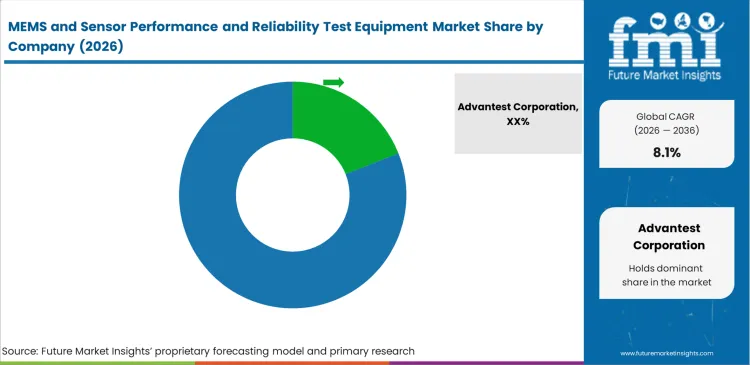
Leading automated test equipment manufacturers play a major role in shaping factory floor setups worldwide by promoting their own proprietary software ecosystems. Companies like Advantest Corporation and Teradyne, Inc. use their strong installed base of logic testers to bundle sensor testing solutions into existing procurement agreements. This makes it challenging for procurement teams to diversify their vendor base, as integrating different systems often leads to data compatibility and workflow issues. Smaller and specialized MEMS test system suppliers must ensure seamless API compatibility with these dominant platforms, or they risk being excluded from large-scale, tier-1 foundry projects.
Established vendors hold extensive libraries of proprietary mechanical handling algorithms built over years of experience and continuous refinement. Chroma ATE Inc. and Cohu, Inc. closely protect this intellectual property, especially since advanced thermal-cycling handler robotics are not easy to replicate. While new entrants in the market may offer better measurement electronics, they often struggle with the physical handling aspect—sometimes leading to damage of delicate silicon wafers during high-speed operations. Because of this risk, fab operations managers are unwilling to experiment with unproven systems that could result in significant losses. This reality continues to reinforce the strong position of established MEMS test equipment manufacturers.
Large outsourced assembly providers are actively pushing back against vendor lock-in by insisting on open data interface standards for all new equipment purchases. Test engineering supervisors intentionally split procurement contracts across multiple vendors to maintain pricing leverage during renewal cycles. Dedicated internal engineering teams write custom middleware to bridge incompatible hardware systems, sacrificing short-term efficiency for long-term strategic independence. Managing MEMS test equipment pricing models requires suppliers to adapt to these open-architecture demands or face gradual systematic replacement across major production facilities.
Key Players in MEMS and Sensor Performance and Reliability Test Equipment Market
- Advantest Corporation
- Teradyne, Inc.
- Cohu, Inc.
- Chroma ATE Inc.
- Keysight Technologies
- Rohde & Schwarz GmbH & Co KG
- National Instruments (Emerson)
Scope of the Report
| Metric | Value |
|---|---|
| Quantitative Units | USD 2.68 billion to USD 5.82 billion, at a CAGR of 8.10% |
| Market Definition | Production-grade metrology infrastructure designed specifically to validate mechanical movement, electrical response, and structural integrity of micro-electromechanical systems before final assembly. |
| Segmentation | Equipment Type, Sensor Type, Application, Test Function, End User |
| Regions Covered | North America, Latin America, Europe, Asia Pacific, Middle East and Africa |
| Countries Covered | United States, China, Japan, South Korea, Germany, Taiwan, India |
| Key Companies Profiled | Advantest Corporation, Teradyne, Inc., Cohu, Inc., Chroma ATE Inc., Keysight Technologies, Rohde & Schwarz GmbH & Co KG, National Instruments (Emerson) |
| Forecast Period | 2026 to 2036 |
| Approach | Fab capacity expansion announcements paired with historical probe card consumption rates |
Source: Future Market Insights (FMI) analysis, based on proprietary forecasting model and primary research
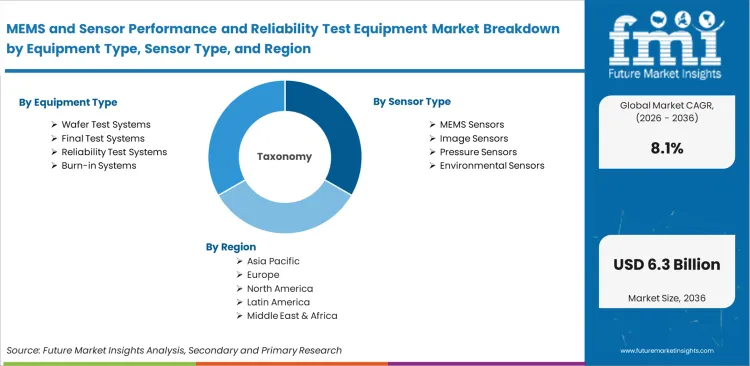
MEMS and Sensor Performance and Reliability Test Equipment Market Analysis by Segments
Equipment Type
- Wafer Test Systems
- Final Test Systems
- Reliability Test Systems
- Burn-in Systems
Sensor Type
- MEMS Sensors
- Image Sensors
- Pressure Sensors
- Environmental Sensors
Application
- Automotive
- Consumer Electronics
- Industrial
- Healthcare
Test Function
- Performance Testing
- Reliability Testing
- Calibration Testing
- Environmental Testing
End User
- IDMs
- Foundries
- OSATs
- Research Labs
Region
- North America
- Latin America
- Europe
- Asia Pacific
- Middle East and Africa
Bibliography
- USA Department of Commerce. (2025, February). Semiconductor supply chain and R&D report.
- National Institute of Standards and Technology. (2025). Sub-terahertz metrology for advanced electronics.
- Japan Electronics and Information Technology Industries Association. (2025). Electronic measurement equipment industry outlook.
- Semiconductor Industry Association. (2025). State of the USA semiconductor industry report.
- Korea Semiconductor Industry Association. (2025). Semiconductor equipment and materials outlook.
- European Semiconductor Industry Association. (2025). European fab capacity and equipment investment.
- Taiwan Semiconductor Industry Association. (2025). Advanced packaging metrology requirements.
This bibliography is provided for reader reference. The full FMI report contains the complete reference list with primary source documentation.
This Report Addresses
- Fab operations managers scaling parallel testing throughput architectures.
- Defect liability mandates enforced by tier-1 automotive integrators.
- Physical stimulus calibration bottlenecks limiting factory output limits.
- Sub-micron optical inspection adoption across high-density packaging lines.
- Probe card fabrication delays impacting new product ramp-up schedules.
- Equipment vendor lock-in dynamics driven by proprietary handler algorithms.
- Custom middleware development enabling open-source testing data interfaces.
- Capital expenditure models heavily distorted by sovereign manufacturing subsidies.
Frequently Asked Questions
What is the projected value of this sector in 2026?
Revenue is expected to cross USD 2.68 billion in 2026. This metric reflects aggressive capital deployment by foundries upgrading legacy metrology platforms to handle high-density sensor arrays.
What value will this sector reach by 2036?
Cumulative investment propels total valuation to USD 5.82 billion by 2036. Advanced packaging architectures mandate comprehensive functional verification prior to singulation, driving massive continuous equipment upgrades.
What growth rate applies to this forecast period?
A compound annual growth rate of 8.10% defines this trajectory. This sustained expansion heavily relies on continuous outsourced assembly capacity scaling across developing manufacturing zones globally.
Why do Wafer Test Systems hold leading segment share?
Identifying defective die before expensive singulation and bonding stages saves foundries millions in wasted packaging materials. Fab operations managers prioritize these capital purchases explicitly to optimize backend yield metrics.
Why do MEMS Sensors dominate equipment utilization?
Understanding what is MEMS testing fundamentally comes down to recognizing that inertial component validation requires complex multi-axis mechanical stimulus chambers. These rigorous physical calibrations consume massive amounts of dedicated factory floor space.
How does Automotive application shape testing protocols?
Autonomous driving safety mandates enforce zero-defect liabilities onto semiconductor manufacturers. Quality assurance directors build entire testing regimens specifically around extreme thermal cycling requirements to survive harsh automotive environments.
What non-obvious reality impacts equipment purchasing?
Procurement directors often ignore how specific contact pin metallurgy choices dictate maintenance intervals. Operators choosing cheaper platforms discover their consumable budgets exploding within six months of deployment.
Why does China expand faster than other nations?
Localized semiconductor manufacturing targets absorb high-density probe stations aggressively. Fab operations managers deploy massive capital explicitly to ensure sovereign production independence, bypassing traditional legacy upgrade cycles entirely.
What friction slows parallel testing adoption?
Chronic lead times for custom high-density probe cards cripple fast-iteration production cycles. Drilling microscopic contact arrays into ceramic substrates remains fundamentally difficult despite massive software simulation improvements.
How do IDMs leverage their market position?
Integrated organizations control both chip design and final assembly, allowing them to optimize metrology end-to-end. Massive purchasing power forces equipment vendors to customize hardware explicitly for specific proprietary workflows.
Why do OSATs resist proprietary hardware?
Contract assembly providers survive on microscopic margins requiring extreme equipment utilization. Tying validation floors to single-vendor ecosystems destroys pricing leverage and prevents rapid line reconfiguration across different client contracts.
What defines North American validation environments?
Complex architectural validation demands force specialized laboratories to deploy advanced thermal and mechanical stimulus chambers. Extreme security mandates require fully isolated testing infrastructures completely disconnected from global data networks.
Why is dynamic response profiling mandatory?
Measuring active signal changes during physical actuation proves structural integrity definitively. Executing a proper MEMS sensor validation process allows test engineering managers to utilize these dynamic profiles to catch hidden manufacturing defects invisible to standard continuity checks.
What happens when foundries skip mechanical testing?
Facilities pass components based on basic electrical continuity checks alone. Downstream field failures occur inevitably when mechanical structures deform under thermal stress, resulting in massive warranty liabilities.
How does heterogeneous integration alter metrology?
Combining multiple chiplets into single packages multiplies defect risk exponentially. Advanced packaging engineers mandate complete validation of every individual component before committing them to expensive multi-die assemblies.
What drives machine learning adoption in testing?
Implementing advanced visual algorithms reduces false-rejection rates dramatically. Quality assurance directors reclaim millions in perfectly functional silicon previously discarded incorrectly by rigid legacy vision thresholds.
How do mechanical handlers create vendor lock-in?
Incumbent vendors hold massive libraries of proprietary mechanical handling algorithms. Operations managers refuse to switch suppliers because untested physical handlers risk crushing fragile silicon wafers during high-speed indexing.
What limits open-source testing architecture adoption?
Merging distinct data-logging formats across varied hardware creates massive integration friction. Dedicated internal engineering teams must write custom middleware to bridge incompatible systems, sacrificing short-term efficiency.
Why do specific sensor protocols bottleneck lines?
Consumer electronics push massive volumes, but specific automotive components require hardware to maintain extreme temperature gradients for hours. This disparity forces facilities to separate specific workflows entirely.
How do optical sensors complicate validation flows?
Vision components require absolute darkness and calibrated light sources for accurate dead-pixel mapping. Realizing how MEMS sensors are tested alongside optical elements forces production supervisors to dedicate separate cleanroom zones to avoid severe cross-contamination risks entirely.
Preview the report firsthand - request a free sample
Get SampleGet the brochure for pricing and purchase details.
Get PDFTable of Content
- Executive Summary
- Global Market Outlook
- Demand-side Trends
- Supply-side Trends
- Technology Roadmap Analysis
- Analysis and Recommendations
- Market Overview
- Market Coverage / Taxonomy
- Market Definition / Scope / Limitations
- Research Methodology
- Chapter Orientation
- Analytical Lens and Working Hypotheses
- Market Structure, Signals, and Trend Drivers
- Benchmarking and Cross-market Comparability
- Market Sizing, Forecasting, and Opportunity Mapping
- Research Design and Evidence Framework
- Desk Research Programme (Secondary Evidence)
- Company Annual and Sustainability Reports
- Peer-reviewed Journals and Academic Literature
- Corporate Websites, Product Literature, and Technical Notes
- Earnings Decks and Investor Briefings
- Statutory Filings and Regulatory Disclosures
- Technical White Papers and Standards Notes
- Trade Journals, Industry Magazines, and Analyst Briefs
- Conference Proceedings, Webinars, and Seminar Materials
- Government Statistics Portals and Public Data Releases
- Press Releases and Reputable Media Coverage
- Specialist Newsletters and Curated Briefings
- Sector Databases and Reference Repositories
- FMI Internal Proprietary Databases and Historical Market Datasets
- Subscription Datasets and Paid Sources
- Social Channels, Communities, and Digital Listening Inputs
- Additional Desk Sources
- Expert Input and Fieldwork (Primary Evidence)
- Primary Modes
- Qualitative Interviews and Expert Elicitation
- Quantitative Surveys and Structured Data Capture
- Blended Approach
- Why Primary Evidence is Used
- Field Techniques
- Interviews
- Surveys
- Focus Groups
- Observational and In-context Research
- Social and Community Interactions
- Stakeholder Universe Engaged
- C-suite Leaders
- Board Members
- Presidents and Vice Presidents
- R&D and Innovation Heads
- Technical Specialists
- Domain Subject-matter Experts
- Scientists
- Physicians and Other Healthcare Professionals
- Governance, Ethics, and Data Stewardship
- Research Ethics
- Data Integrity and Handling
- Primary Modes
- Tooling, Models, and Reference Databases
- Desk Research Programme (Secondary Evidence)
- Data Engineering and Model Build
- Data Acquisition and Ingestion
- Cleaning, Normalisation, and Verification
- Synthesis, Triangulation, and Analysis
- Quality Assurance and Audit Trail
- Market Background
- Market Dynamics
- Drivers
- Restraints
- Opportunity
- Trends
- Scenario Forecast
- Demand in Optimistic Scenario
- Demand in Likely Scenario
- Demand in Conservative Scenario
- Opportunity Map Analysis
- Product Life Cycle Analysis
- Supply Chain Analysis
- Investment Feasibility Matrix
- Value Chain Analysis
- PESTLE and Porter’s Analysis
- Regulatory Landscape
- Regional Parent Market Outlook
- Production and Consumption Statistics
- Import and Export Statistics
- Market Dynamics
- Global Market Analysis 2021 to 2025 and Forecast, 2026 to 2036
- Historical Market Size Value (USD Million) Analysis, 2021 to 2025
- Current and Future Market Size Value (USD Million) Projections, 2026 to 2036
- Y-o-Y Growth Trend Analysis
- Absolute $ Opportunity Analysis
- Global Market Pricing Analysis 2021 to 2025 and Forecast 2026 to 2036
- Global Market Analysis 2021 to 2025 and Forecast 2026 to 2036, By Equipment Type
- Introduction / Key Findings
- Historical Market Size Value (USD Million) Analysis By Equipment Type , 2021 to 2025
- Current and Future Market Size Value (USD Million) Analysis and Forecast By Equipment Type , 2026 to 2036
- Wafer Test Systems
- Final Test Systems
- Reliability Test Systems
- Burn-in Systems
- Wafer Test Systems
- Y-o-Y Growth Trend Analysis By Equipment Type , 2021 to 2025
- Absolute $ Opportunity Analysis By Equipment Type , 2026 to 2036
- Global Market Analysis 2021 to 2025 and Forecast 2026 to 2036, By Sensor Type
- Introduction / Key Findings
- Historical Market Size Value (USD Million) Analysis By Sensor Type, 2021 to 2025
- Current and Future Market Size Value (USD Million) Analysis and Forecast By Sensor Type, 2026 to 2036
- MEMS Sensors
- Image Sensors
- Pressure Sensors
- Environmental Sensors
- MEMS Sensors
- Y-o-Y Growth Trend Analysis By Sensor Type, 2021 to 2025
- Absolute $ Opportunity Analysis By Sensor Type, 2026 to 2036
- Global Market Analysis 2021 to 2025 and Forecast 2026 to 2036, By Application
- Introduction / Key Findings
- Historical Market Size Value (USD Million) Analysis By Application, 2021 to 2025
- Current and Future Market Size Value (USD Million) Analysis and Forecast By Application, 2026 to 2036
- Automotive
- Consumer Electronics
- Industrial
- Healthcare
- Automotive
- Y-o-Y Growth Trend Analysis By Application, 2021 to 2025
- Absolute $ Opportunity Analysis By Application, 2026 to 2036
- Global Market Analysis 2021 to 2025 and Forecast 2026 to 2036, By Test Function
- Introduction / Key Findings
- Historical Market Size Value (USD Million) Analysis By Test Function, 2021 to 2025
- Current and Future Market Size Value (USD Million) Analysis and Forecast By Test Function, 2026 to 2036
- Performance Testing
- Reliability Testing
- Calibration Testing
- Environmental Testing
- Performance Testing
- Y-o-Y Growth Trend Analysis By Test Function, 2021 to 2025
- Absolute $ Opportunity Analysis By Test Function, 2026 to 2036
- Global Market Analysis 2021 to 2025 and Forecast 2026 to 2036, By End Use
- Introduction / Key Findings
- Historical Market Size Value (USD Million) Analysis By End Use, 2021 to 2025
- Current and Future Market Size Value (USD Million) Analysis and Forecast By End Use, 2026 to 2036
- IDMs
- Foundries
- OSATs
- Research Labs
- IDMs
- Y-o-Y Growth Trend Analysis By End Use, 2021 to 2025
- Absolute $ Opportunity Analysis By End Use, 2026 to 2036
- Global Market Analysis 2021 to 2025 and Forecast 2026 to 2036, By Region
- Introduction
- Historical Market Size Value (USD Million) Analysis By Region, 2021 to 2025
- Current Market Size Value (USD Million) Analysis and Forecast By Region, 2026 to 2036
- North America
- Latin America
- Western Europe
- Eastern Europe
- East Asia
- South Asia and Pacific
- Middle East & Africa
- Market Attractiveness Analysis By Region
- North America Market Analysis 2021 to 2025 and Forecast 2026 to 2036, By Country
- Historical Market Size Value (USD Million) Trend Analysis By Market Taxonomy, 2021 to 2025
- Market Size Value (USD Million) Forecast By Market Taxonomy, 2026 to 2036
- By Country
- USA
- Canada
- Mexico
- By Equipment Type
- By Sensor Type
- By Application
- By Test Function
- By End Use
- By Country
- Market Attractiveness Analysis
- By Country
- By Equipment Type
- By Sensor Type
- By Application
- By Test Function
- By End Use
- Key Takeaways
- Latin America Market Analysis 2021 to 2025 and Forecast 2026 to 2036, By Country
- Historical Market Size Value (USD Million) Trend Analysis By Market Taxonomy, 2021 to 2025
- Market Size Value (USD Million) Forecast By Market Taxonomy, 2026 to 2036
- By Country
- Brazil
- Chile
- Rest of Latin America
- By Equipment Type
- By Sensor Type
- By Application
- By Test Function
- By End Use
- By Country
- Market Attractiveness Analysis
- By Country
- By Equipment Type
- By Sensor Type
- By Application
- By Test Function
- By End Use
- Key Takeaways
- Western Europe Market Analysis 2021 to 2025 and Forecast 2026 to 2036, By Country
- Historical Market Size Value (USD Million) Trend Analysis By Market Taxonomy, 2021 to 2025
- Market Size Value (USD Million) Forecast By Market Taxonomy, 2026 to 2036
- By Country
- Germany
- UK
- Italy
- Spain
- France
- Nordic
- BENELUX
- Rest of Western Europe
- By Equipment Type
- By Sensor Type
- By Application
- By Test Function
- By End Use
- By Country
- Market Attractiveness Analysis
- By Country
- By Equipment Type
- By Sensor Type
- By Application
- By Test Function
- By End Use
- Key Takeaways
- Eastern Europe Market Analysis 2021 to 2025 and Forecast 2026 to 2036, By Country
- Historical Market Size Value (USD Million) Trend Analysis By Market Taxonomy, 2021 to 2025
- Market Size Value (USD Million) Forecast By Market Taxonomy, 2026 to 2036
- By Country
- Russia
- Poland
- Hungary
- Balkan & Baltic
- Rest of Eastern Europe
- By Equipment Type
- By Sensor Type
- By Application
- By Test Function
- By End Use
- By Country
- Market Attractiveness Analysis
- By Country
- By Equipment Type
- By Sensor Type
- By Application
- By Test Function
- By End Use
- Key Takeaways
- East Asia Market Analysis 2021 to 2025 and Forecast 2026 to 2036, By Country
- Historical Market Size Value (USD Million) Trend Analysis By Market Taxonomy, 2021 to 2025
- Market Size Value (USD Million) Forecast By Market Taxonomy, 2026 to 2036
- By Country
- China
- Japan
- South Korea
- By Equipment Type
- By Sensor Type
- By Application
- By Test Function
- By End Use
- By Country
- Market Attractiveness Analysis
- By Country
- By Equipment Type
- By Sensor Type
- By Application
- By Test Function
- By End Use
- Key Takeaways
- South Asia and Pacific Market Analysis 2021 to 2025 and Forecast 2026 to 2036, By Country
- Historical Market Size Value (USD Million) Trend Analysis By Market Taxonomy, 2021 to 2025
- Market Size Value (USD Million) Forecast By Market Taxonomy, 2026 to 2036
- By Country
- India
- ASEAN
- Australia & New Zealand
- Rest of South Asia and Pacific
- By Equipment Type
- By Sensor Type
- By Application
- By Test Function
- By End Use
- By Country
- Market Attractiveness Analysis
- By Country
- By Equipment Type
- By Sensor Type
- By Application
- By Test Function
- By End Use
- Key Takeaways
- Middle East & Africa Market Analysis 2021 to 2025 and Forecast 2026 to 2036, By Country
- Historical Market Size Value (USD Million) Trend Analysis By Market Taxonomy, 2021 to 2025
- Market Size Value (USD Million) Forecast By Market Taxonomy, 2026 to 2036
- By Country
- Kingdom of Saudi Arabia
- Other GCC Countries
- Turkiye
- South Africa
- Other African Union
- Rest of Middle East & Africa
- By Equipment Type
- By Sensor Type
- By Application
- By Test Function
- By End Use
- By Country
- Market Attractiveness Analysis
- By Country
- By Equipment Type
- By Sensor Type
- By Application
- By Test Function
- By End Use
- Key Takeaways
- Key Countries Market Analysis
- USA
- Pricing Analysis
- Market Share Analysis, 2025
- By Equipment Type
- By Sensor Type
- By Application
- By Test Function
- By End Use
- Canada
- Pricing Analysis
- Market Share Analysis, 2025
- By Equipment Type
- By Sensor Type
- By Application
- By Test Function
- By End Use
- Mexico
- Pricing Analysis
- Market Share Analysis, 2025
- By Equipment Type
- By Sensor Type
- By Application
- By Test Function
- By End Use
- Brazil
- Pricing Analysis
- Market Share Analysis, 2025
- By Equipment Type
- By Sensor Type
- By Application
- By Test Function
- By End Use
- Chile
- Pricing Analysis
- Market Share Analysis, 2025
- By Equipment Type
- By Sensor Type
- By Application
- By Test Function
- By End Use
- Germany
- Pricing Analysis
- Market Share Analysis, 2025
- By Equipment Type
- By Sensor Type
- By Application
- By Test Function
- By End Use
- UK
- Pricing Analysis
- Market Share Analysis, 2025
- By Equipment Type
- By Sensor Type
- By Application
- By Test Function
- By End Use
- Italy
- Pricing Analysis
- Market Share Analysis, 2025
- By Equipment Type
- By Sensor Type
- By Application
- By Test Function
- By End Use
- Spain
- Pricing Analysis
- Market Share Analysis, 2025
- By Equipment Type
- By Sensor Type
- By Application
- By Test Function
- By End Use
- France
- Pricing Analysis
- Market Share Analysis, 2025
- By Equipment Type
- By Sensor Type
- By Application
- By Test Function
- By End Use
- India
- Pricing Analysis
- Market Share Analysis, 2025
- By Equipment Type
- By Sensor Type
- By Application
- By Test Function
- By End Use
- ASEAN
- Pricing Analysis
- Market Share Analysis, 2025
- By Equipment Type
- By Sensor Type
- By Application
- By Test Function
- By End Use
- Australia & New Zealand
- Pricing Analysis
- Market Share Analysis, 2025
- By Equipment Type
- By Sensor Type
- By Application
- By Test Function
- By End Use
- China
- Pricing Analysis
- Market Share Analysis, 2025
- By Equipment Type
- By Sensor Type
- By Application
- By Test Function
- By End Use
- Japan
- Pricing Analysis
- Market Share Analysis, 2025
- By Equipment Type
- By Sensor Type
- By Application
- By Test Function
- By End Use
- South Korea
- Pricing Analysis
- Market Share Analysis, 2025
- By Equipment Type
- By Sensor Type
- By Application
- By Test Function
- By End Use
- Russia
- Pricing Analysis
- Market Share Analysis, 2025
- By Equipment Type
- By Sensor Type
- By Application
- By Test Function
- By End Use
- Poland
- Pricing Analysis
- Market Share Analysis, 2025
- By Equipment Type
- By Sensor Type
- By Application
- By Test Function
- By End Use
- Hungary
- Pricing Analysis
- Market Share Analysis, 2025
- By Equipment Type
- By Sensor Type
- By Application
- By Test Function
- By End Use
- Kingdom of Saudi Arabia
- Pricing Analysis
- Market Share Analysis, 2025
- By Equipment Type
- By Sensor Type
- By Application
- By Test Function
- By End Use
- Turkiye
- Pricing Analysis
- Market Share Analysis, 2025
- By Equipment Type
- By Sensor Type
- By Application
- By Test Function
- By End Use
- South Africa
- Pricing Analysis
- Market Share Analysis, 2025
- By Equipment Type
- By Sensor Type
- By Application
- By Test Function
- By End Use
- USA
- Market Structure Analysis
- Competition Dashboard
- Competition Benchmarking
- Market Share Analysis of Top Players
- By Regional
- By Equipment Type
- By Sensor Type
- By Application
- By Test Function
- By End Use
- Competition Analysis
- Competition Deep Dive
- Advantest Corporation
- Overview
- Product Portfolio
- Profitability by Market Segments (Product/Age /Sales Channel/Region)
- Sales Footprint
- Strategy Overview
- Marketing Strategy
- Product Strategy
- Channel Strategy
- Teradyne, Inc.
- Cohu, Inc.
- Chroma ATE Inc.
- Keysight Technologies
- Rohde & Schwarz GmbH & Co KG
- National Instruments (Emerson)
- Advantest Corporation
- Competition Deep Dive
- Assumptions & Acronyms Used


