

- Industry Size (2026)
- USD 124.7 Mn
- Forecast (2036)
- USD 438.6 Mn
- CAGR (2026 to 2036)
- 13.4%
Hydrogen Fuel Cell Stack Durability and Performance Test Equipment Market Size, Market Forecast and Outlook By FMI
The hydrogen fuel cell stack durability and performance test equipment market surpassed a value of USD 110.0 million in 2025. The industry is poised to reach USD 124.7 million in 2026 at a CAGR of 13.4% during the forecast period. Demand outlook carries the market valuation to USD 438.6 million by 2036 as electrochemical diagnostics and dynamic load simulation redefine validation standards for next-generation fuel cell systems.
Summary of Hydrogen Fuel Cell Stack Durability and Performance Test Equipment Market
- Hydrogen Fuel Cell Stack Durability and Performance Test Equipment Market Definition
- High-performance laboratory infrastructure evaluates electrochemical power generators under simulated electrical loads and precisely conditioned reactant gas flows to measure efficiency, durability, and endurance under controlled conditions. These platforms help engineers assess voltage behavior, degradation patterns, and stack response across demanding operating profiles, supporting faster validation of fuel cell systems intended for automotive, stationary, and heavy-duty applications.
- Demand Drivers in the Market
- Membrane degradation profiling forces principal electrochemists to upgrade benches capable of executing extreme freeze-thaw cycles.
- Heavy-duty commercialization timelines require validation managers to install high-throughput accelerated stress testing infrastructure.
- Shrinking homologation windows push program executives toward fully automated unattended endurance rigs.
- Key Segments Analyzed in the FMI Report
- Equipment Type: Integrated stack test stations are estimated to hold 33.0% share in 2026, capturing primary capital spend as complete gas and thermal management systems remain mandatory for accurate evaluation.
- Test Focus: Durability and lifetime cycling is expected to record 29.0% share in 2026, satisfying stringent commercial vehicle lifetime mandates demanding thousands of documented operational hours.
- Stack Scale: Full-stack platforms are anticipated to garner 37.0% share in 2026, aligning perfectly with the industry transition toward 200 kW-plus architectures for freight applications.
- End User: Fuel-cell OEM and stack developers are projected to secure 39.0% share in 2026, reflecting massive internal capital allocation designed to protect proprietary membrane intellectual property.
- Configuration: Modular automated benches are poised to capture 42.0% share in 2026, answering intense facility pressure to maximize testing density within limited specialized laboratory footprints.
- India: 15.3% compound growth, sustained by aggressive domestic initiatives mandating localized testing capacity for emerging green hydrogen programs.
- Analyst Opinion at FMI
- Nikhil Kaitwade, Principal Analyst, Automation, at FMI, states that, "Standard metrics capture steady-state efficiency perfectly, but evaluating heavy-duty viability requires understanding transient water management failures during dynamic load changes. Actual membrane degradation occurs during sudden power demands where localized starvation destroys catalyst layers in seconds. Test facility directors operating in the hydrogen fuel cell test bench market realize legacy benches lacking high-speed gas humidification control simply cannot replicate these fatal edge cases. Upgrading to highly responsive reactant conditioning prevents catastrophic field failures, transforming validation infrastructure from a standard capital expense into absolute commercial insurance against warranty claims."
- Strategic Implications / Executive Takeaways
- Test facility managers must transition from basic polarization mapping to highly dynamic accelerated stress emulation.
- Validation engineering leads face immediate demands to integrate high-frequency impedance spectroscopy seamlessly into routine lifetime cycling.
- Capital planning directors risk severe testing bottlenecks if massive facility-level hydrogen supply infrastructure remains underfunded.
- Methodology
- Target insights gathered directly from chief electrochemists and laboratory operations directors.
- Technical parameters verified against published DOE targets and European Commission validation procedures.
- Value baselines anchored to confirmed capital expenditure budgets for testing infrastructure modernization.
- Demand curves cross-referenced with commercial vehicle roadmap timelines for high-capacity stack rollouts.
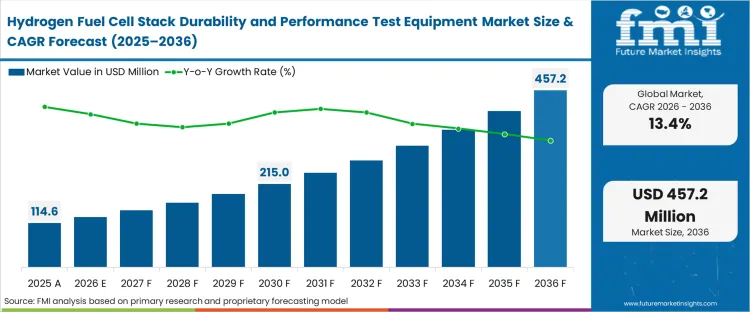
Hydrogen Fuel Cell Stack Durability and Performance Test Equipment Market Key Takeaways
| Metric | Details |
|---|---|
| Industry Size (2026) | USD 124.7 Million |
| Industry Value (2036) | USD 438.6 Million |
| CAGR (2026–2036) | 13.40% |
Source: Future Market Insights (FMI) analysis, based on proprietary forecasting model and primary research
Validation teams face immense pressure to compress 20,000-hour operational lifetime requirements into manageable development cycles within the hydrogen fuel cell durability test equipment market. Relying on traditional continuous-run methodologies prevents suppliers from discovering membrane degradation issues before commercial deployment. Upgrading internal fuel cell stack characterization capabilities directly dictates which propulsion developers secure next-generation commercial vehicle contracts. What engineering directors underestimate is how critically gas conditioning precision dictates testing validity, where minor humidity fluctuations in PEM fuel cell evaluations ruin months of costly degradation data.
Automated electrochemical impedance spectroscopy is reshaping laboratory upgrade cycles across the PEM fuel cell test equipment market. Once legacy rigs fail to separate ohmic resistance from mass transport losses during high-current testing, facility managers begin replacing existing platforms. With advanced diagnostics built into the system, teams can identify real failure modes without tearing cells apart, which significantly shortens development timelines.
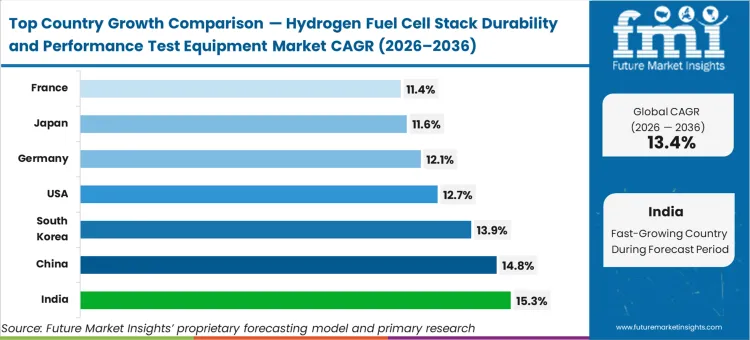
India leads geographic growth at 15.3% as domestic manufacturing mandates force localized validation of alternative powertrains. China tracks at 14.8% on aggressive commercial electrification timelines demanding high-throughput infrastructure. South Korea expands at 13.9% driven by state-backed initiatives accelerating zero-emission deployments. United States testing capacity grows at 12.7% responding to stringent heavy-duty freight emission targets within the fuel cell performance test equipment market. Germany advances at 12.1% as heritage automotive suppliers redesign research centers for gas-phase diagnostics. France adds 11.4% while Japan records 11.6% supported by mature export-oriented component manufacturing. Structural divergence separates regions investing in mega-watt scale heavy-duty validation from those expanding basic material science research capacity.
Hydrogen Fuel Cell Stack Durability and Performance Test Equipment Market Definition
Defining what is fuel cell stack durability test equipment involves specialized purpose-built laboratory infrastructure verifying the electrochemical performance, material longevity, and operational safety of proton exchange membrane assemblies under simulated environmental extremes. Systems execute complex gas flow, temperature, and electrical load profiles to identify catalyst degradation and membrane failure mechanisms before field deployment. Advanced platforms combine active reactant conditioning with high-frequency diagnostic software to measure voltage decay across individual cells during transient operation.
Hydrogen Fuel Cell Stack Durability and Performance Test Equipment Market Inclusions
Scope captures integrated fluid management modules, active electronic loads, electrochemical impedance spectroscopy analyzers, and dedicated fuel cell stack validation equipment required for evaluating global fuel cell components. Revenue sizing encompasses new bench installations, software license renewals for test execution suites, and specific calibration services provided directly by equipment manufacturers to laboratory operators.
Hydrogen Fuel Cell Stack Durability and Performance Test Equipment Market Exclusions
Standalone battery cyclers lacking active gas conditioning interfaces, generic laboratory multimeters, and basic fluid pumps fall outside evaluated boundaries due to insufficient control precision. Industrial hydrogen electrolyzer testing systems designed strictly for fuel production physics rather than power generation are omitted. Routine maintenance contracts executed by third-party service providers utilizing external fuel cell stack durability testing systems do not contribute to core platform valuation totals.
Hydrogen Fuel Cell Stack Durability and Performance Test Equipment Market Research Methodology
- Primary Research: Laboratory operations directors, principal electrochemists, and capital equipment procurement leads within major heavy-duty propulsion developers.
- Desk Research: DOE accelerated stress test protocols, European Commission technical capability roadmaps, and equipment manufacturer instrumentation specifications.
- Market-Sizing and Forecasting: Installed base replacement rates and scheduled capital expenditure plans for research facility modernizations across primary automotive hubs.
- Data Validation and Update Cycle: Independent high-current electronic load shipment volume growth cross-verifies physical bench deployment trajectories.
Segmental Analysis
Hydrogen Fuel Cell Stack Durability and Performance Test Equipment Market Analysis by Equipment Type
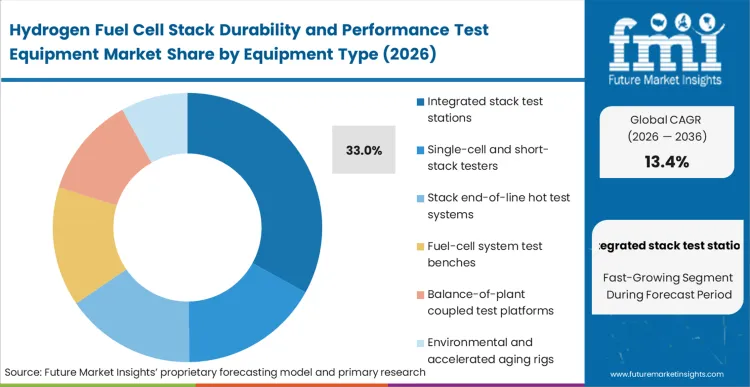
Managing precise reactant stoichiometry across hundreds of stacked cells requires incredibly sophisticated fluid handling. Integrated stack test stations secure 33.0% share, and FMI's analysis indicates principal electrochemists prioritize these complete systems to guarantee repeatable conditions during volatile load changes. Verifying internal water transport dynamics on high-capacity fuel cell electric vehicle platforms prevents membrane dehydration that permanently ruins expensive prototype stacks. Procurement teams evaluating stack durability cycling test rigs frequently overlook how software compatibility dictates hardware choices, locking laboratories into specific vendor ecosystems for years based on initial data acquisition purchases. Delays in upgrading humidification capacity force test laboratories utilizing a basic fuel cell polarization curve test station to run slower, less aggressive profiles that fail to uncover critical field vulnerabilities.
- Decision Phase: Initial test capability expansion. Laboratory managers require absolute reactant temperature precision to map catalyst behavior without introducing artificial humidity variables.
- Qualification Metric: Dew point response time. Test engineers evaluate how rapidly the station transitions between fully saturated and dry gas feeds to simulate dynamic highway driving.
- Expansion Trigger: Multi-variant platform launches. Program directors authorize additional integrated stations when existing equipment cannot support concurrent testing of differing stack geometries.
Hydrogen Fuel Cell Stack Durability and Performance Test Equipment Market Analysis by Test Focus
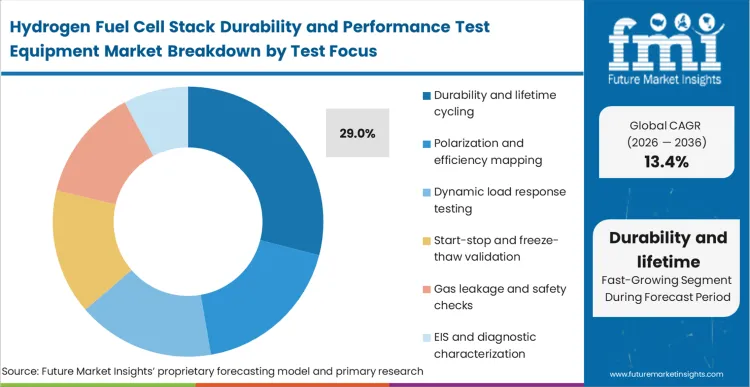
Durability and lifetime cycling command 29.0% share as compliance officers require certified baseline degradation data before approving marketing claims. FMI observes that executing fuel cell start-stop cycling validation demands continuous, uninterrupted station availability spanning several consecutive months. Highlighting a crucial structural contradiction, testing labs often invest heavily in rapid hydrogen fuel cell vehicle prototype development while severely under-equipping the teams conducting polarization curve testing for hydrogen fuel cells responsible for proving those prototypes will actually survive 20,000 hours of use. Failing to isolate true electrochemical degradation using a dedicated start-stop durability test platform for fuel cells results in published lifetime figures collapsing upon real-world deployment.
- Baseline Requirement: Accelerated stress protocol execution. Compliance officers mandate exhaustive matrices of voltage cycling and humidity swings to satisfy DOE technical targets.
- Hidden Cost: Facility gas consumption. Laboratory technicians manage massive operational budgets consumed entirely by the ultra-pure hydrogen required to run stacks continuously for months.
- Lifecycle Benefit: Warranty cost mitigation. Calibration engineers utilize high-fidelity degradation maps to tweak operational control algorithms, artificially extending stack life in the field.
Hydrogen Fuel Cell Stack Durability and Performance Test Equipment Market Analysis by Stack Scale
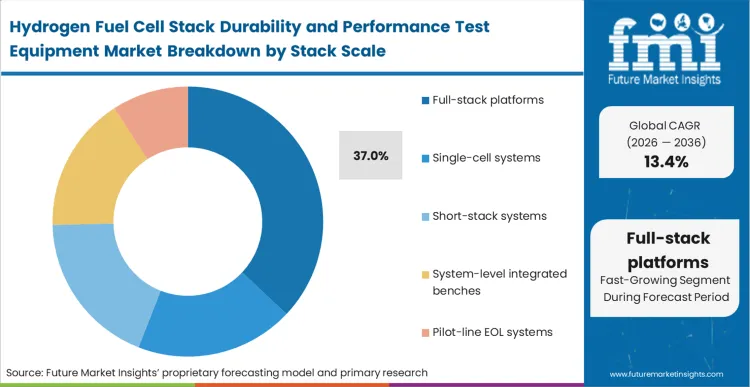
The full-stack platforms segment holds 37.0% share, supporting the widespread deployment of mega-watt scale assemblies intended for heavy freight and maritime applications. As per FMI's projection, equipping test cells for this exact scale satisfies ninety percent of scheduled fuel cell powertrain validation volume over the coming decade. Engineers determining which fuel cell test equipment supports 300 kW stacks realize that building universal test cells to handle everything actually compromises the ultra-low current measurement accuracy needed for critical single-cell diagnostic work. Purchasing oversized reactant delivery systems leaves testing directors struggling to certify fundamental material improvements adequately.
- Adoption Driver: Heavy-duty transport requirements. Powertrain directors standardize cell specifications to match massive incoming commercial vehicle architectures exactly.
- Edge Limitation: Low-flow mass controller accuracy. Research electrochemists struggle to meter gas feeds precisely when utilizing stations sized for full-scale commercial testing.
- Qualification Standard: Continuous heat rejection. Facilities engineers determine acceptable platform ratings based entirely on the building's chilled water capacity to absorb immense exothermic reactions.
Hydrogen Fuel Cell Stack Durability and Performance Test Equipment Market Analysis by End User
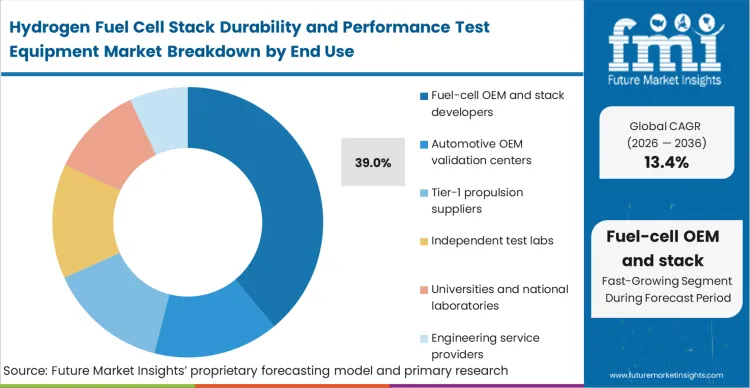
Internalizing critical degradation diagnostics protects sensitive proprietary membrane formulations from competitor exposure. Fuel-cell OEM and stack developers account for 39.0% share, investing massive capital to keep fundamental transport fuel cell IP entirely in-house. FMI analysts note that maintaining total control over testing schedules utilizing heavy-duty truck fuel cell validation equipment allows rapid material iteration without negotiating external access for specialized evaluations. The unspoken structural friction involves OEMs realizing their massive internal investments still lack specialized high-vibration environmental chambers, quietly outsourcing extreme climate evaluation despite owning advanced electrical load banks. Insufficient internal environmental capacity forces program managers to truncate critical freeze-thaw cycles just to meet vehicle launch deadlines.
- Primary Adopter: Dedicated stack manufacturers are expanding internal validation capacity as capital planning executives approve major campus upgrades to support mass-production readiness. These investments strengthen in-house testing for durability, performance consistency, and scale-up reliability across fuel cell programs. The shift reflects a broader move toward production-focused validation infrastructure, where manufacturers want tighter control over qualification speed, process stability, and commercialization timelines.
- Follower Shift: Automotive OEM validation centers. Validation managers add specific end-of-line benches to verify incoming subassemblies before shipping them to final vehicle integration teams.
- Final Convert: Independent test labs. Partnership directors invest in niche environmental testing capabilities only after standard polarization mapping becomes heavily commoditized.
Hydrogen Fuel Cell Stack Durability and Performance Test Equipment Market Drivers, Restraints, and Opportunities
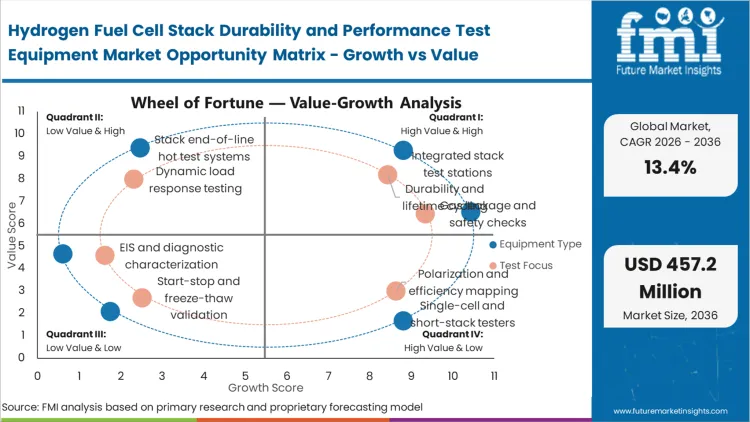
Accelerating heavy-duty development cycles force validation directors to execute thousands of test hours simultaneously rather than sequentially. Waiting for basic material improvements to pass linear testing milestones delays complete commercialization significantly. Implementing highly automated platforms specifically configured for freeze-thaw validation for PEM stacks allows electrochemists to simulate years of mechanical and thermal degradation in mere weeks. Relying on legacy manual testing methodologies practically guarantees competitors will reach production validation phases years earlier, capturing crucial early-adopter market share in the commercial transport sector.
Facility safety requirements and massive reactant consumption severely bottleneck high-power rig installations. Testing a 200 kW commercial stack requires feeding immense volumes of highly pressurized hydrogen continuously, demanding dedicated explosion-proof infrastructure alongside massive hydrogen pressure control valve manifolds to handle fluid delivery safely. Upgrading facility utilities to support advanced EIS fuel cell test equipment often costs considerably more than purchasing the testing platforms themselves. Shared gas recovery systems partially mitigate consumption expenses but fail to solve the absolute safety footprint requirements plaguing legacy engineering campuses located near residential zones.
Opportunities in the Hydrogen Fuel Cell Stack Durability and Performance Test Equipment Market
- In-situ impedance spectroscopy integration: Embedding high-frequency diagnostic capabilities directly into endurance rigs allows laboratory directors to map membrane dehydration precisely without interrupting long-term cycling tests.
- Closed-loop reactant recovery systems: Adding high-efficiency hydrogen recirculation to test stations empowers engineering facilities to slash operational gas budgets during thousands of operating hours.
- Manufacturing quality assurance: Procuring specialized units from stack hot test equipment suppliers helps calibration engineers verify end-of-line manufacturing consistency without delaying factory output targets.
Regional Analysis
.webp "Top Country Growth Comparison Hydrogen Fuel Cell Stack Durability And Performance Test Equipment Market Cagr (2026 2036)")
Based on regional analysis, hydrogen fuel cell stack durability and performance test equipment market is segmented into Asia Pacific, North America, and Europe across 40 plus countries.
| Country | CAGR (2026 to 2036) |
|---|---|
| India | 15.3% |
| China | 14.8% |
| South Korea | 13.9% |
| United States | 12.7% |
| Germany | 12.1% |
| Japan | 11.6% |
| France | 11.4% |
Source: Future Market Insights (FMI) analysis, based on proprietary forecasting model and primary research
Asia Pacific Hydrogen Fuel Cell Stack Durability and Performance Test Equipment Market Analysis
Aggressive commercialization timelines force testing facility expansion across major industrial hubs. Regional developers refuse to ship sensitive membrane assemblies across oceans for validation, preferring rapid iteration loops near actual production lines. The China fuel cell stack test equipment market continues expanding at 14.8%, providing domestic OEMs a distinct time-to-market advantage globally. Extremely condensed heavy-duty development cycles push engineering directors to automate 24-hour durability rigs continuously to support massive state-backed hydrogen targets. In FMI's view, matching local testing infrastructure to immense industrial output mandates remains the primary capital priority for regional engineering executives.
- India: India is becoming a faster-growing market as green hydrogen policy begins to shape how local fuel cell systems are tested and validated. One of the biggest drivers is the need to assess performance under the country’s wide range of ambient conditions instead of depending on overseas validation data. The market is expanding at 15.3%, and that growth is being reinforced by facility upgrades that help domestic brands move ahead with localized stack development. Subsidies tied to domestic manufacturing are also changing the competitive environment, pushing international testing equipment suppliers to build a stronger local sales and service presence. As diagnostic capacity improves, commercial vehicle makers are gaining more confidence in moving hydrogen programs forward under demanding operating conditions.
- China: China’s growth is being driven by speed. Heavy-duty fuel cell programs are moving on compressed timelines, which is pushing engineering teams to keep 24-hour durability rigs running almost continuously. With growth at 14.8%, the market reflects the importance of testing bandwidth in a development environment where time to market matters heavily. Local verification requirements are adding to that momentum by encouraging suppliers to build larger multi-station test halls that can safely manage very high power dissipation. This gives domestic OEMs a stronger development pace and more control over validation within the local ecosystem.
- South Korea: In South Korea, the market is being shaped by early technical investment and a broader industrial push toward clean energy systems. Growth stands at 13.9%, supported by stronger demand for advanced fuel cell characterization and faster diagnostic learning cycles. Government-backed research programs are helping local developers invest in high-throughput testing infrastructure earlier than many competitors in other markets. That is especially important in marine and commercial vehicle applications, where membrane degradation behavior and long-cycle durability need to be understood quickly. This is making testing capability a strategic advantage rather than just a development support function.
- Japan: Japan is following a more measured path, with growth at 11.6%, though the market remains highly demanding from a technical standpoint. Validation work is centered more on precision than speed, with engineers placing strong emphasis on degradation mapping, electrochemical diagnostics, and export-grade durability verification. Capital deployment is still cautious, but the money that is being spent is going into more exact measurement capability rather than broad capacity expansion. This keeps the market focused on long-term performance confidence and supports the country’s role in high-quality fuel cell development.
North America Hydrogen Fuel Cell Stack Durability and Performance Test Equipment Market Analysis
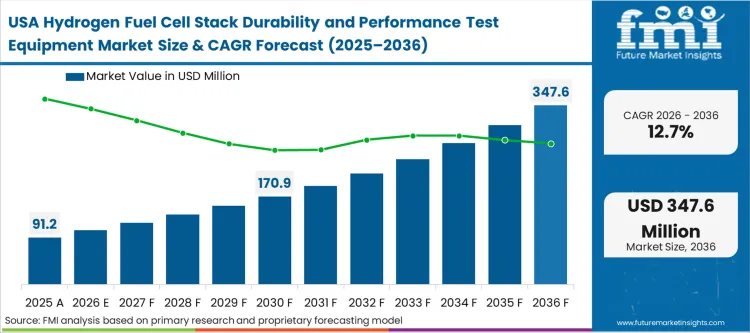
Stringent heavy-duty freight emission targets dictate massive investments in high-power endurance rigs. Validating stacks for Class 8 commercial trucks requires running extreme load simulations that quickly overwhelm standard passenger-car test stations. Based on FMI's assessment, validation centers prioritize sheer cooling robustness and high current-draw capability over compact footprints.
- United States: In the United States, fuel cell testing demand is being shaped by the need to validate performance under the heavy payload and long-distance duty cycles expected in commercial highway use. The market is growing at 12.7%, and that is supporting expansion in megawatt-scale testing capability as established propulsion suppliers work to protect their position in commercial truck programs. Department of Energy funding is also helping ease the cost of building specialized explosion-proof facilities, which is allowing more independent labs to offer certified accelerated stress testing for zero-emission vehicle startups that do not yet have in-house infrastructure.
Europe Hydrogen Fuel Cell Stack Durability and Performance Test Equipment Market Analysis
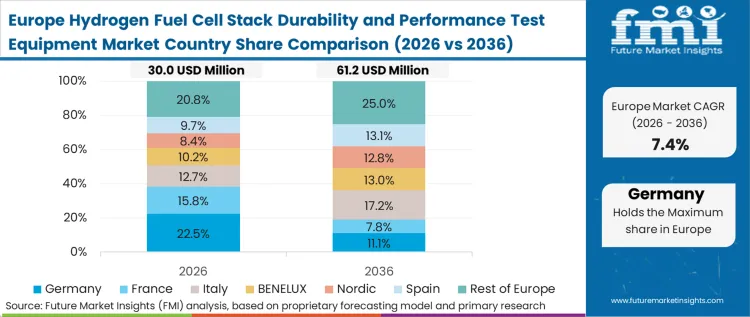
Heritage automotive suppliers possess immense combustion testing expertise but face urgent needs to modernize electrochemical evaluation. Upgrading campus infrastructure involves physically tearing out legacy engine dynamometers to install highly sensitive active gas conditioning benches. FMI analysts observe that optimizing existing laboratory space utilization drives preferences for highly integrated, multi-channel testing stations.
- Germany: Germany’s fuel cell testing market is being shaped by the precision standards expected in premium engineering programs. R&D teams are putting more weight on exact measurement quality, especially in applications where small performance deviations can affect broader validation outcomes. The market is growing at 12.1%, and that growth is supported by buyers who want new electronic load banks to work smoothly with existing facility safety systems. That compatibility matters in areas such as cold-weather membrane evaluation, where testing upgrades need to improve capability without disrupting the wider software environment.
- France: France is moving ahead through a more compliance-driven path. Efficiency and sustainability targets are making degradation mapping more important, especially in programs tied to public transportation. With the market tracking at 11.4%, laboratory modernization is helping regional Tier-1 suppliers stay relevant as validation expectations rise. Transport authorities are also asking for stronger proof of long-term operating performance, which is pushing component makers to spend more effort on start-stop cycling validation using modular automated benches before entering municipal procurement programs.
Competitive Aligners for Market Players
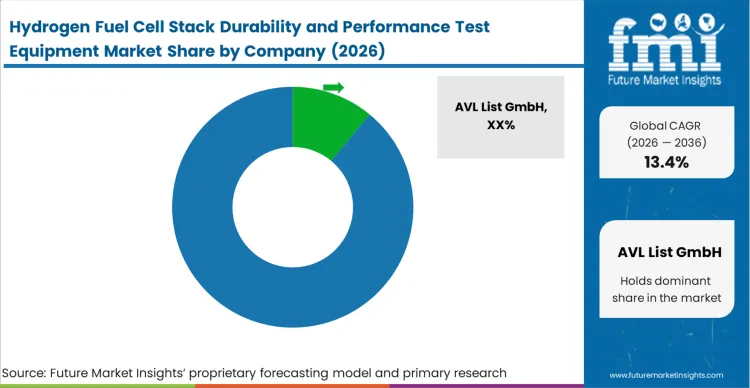
Competition in this market stays closely tied to software continuity inside the lab. Providers that already sit inside daily testing workflows have a clear advantage because buyers are reluctant to disturb systems built around existing automation, safety monitoring, and data handling routines. AVL List GmbH, HORIBA, and Scribner remain relevant for that reason. Their strength is not limited to the instrument itself. It comes from how comfortably their platforms fit into the wider operating environment of a fuel cell test facility. For many lab managers, replacing hardware is manageable. Rebuilding script architecture and retraining teams around a new control layer is much harder.
That gives established vendors a practical edge. Over time, they have built libraries of validated test routines and operating profiles that newer suppliers cannot assemble quickly. In fuel cell testing, credibility is earned through consistent repeatability, safe hydrogen handling, and stable long-duration performance. Facility heads pay close attention to that track record because safety failure in this environment can shut down an entire site. New suppliers usually need to offer something clearly useful, such as stronger control over transient humidification or better adaptability in complex stack testing, before buyers are willing to shift away from long-used systems.
Even with that advantage, large test centers are trying to keep future flexibility intact. More buyers now want open API access and cleaner interoperability so one vendor does not end up controlling the full lab architecture. Some teams are splitting purchases across suppliers for exactly that reason. The decision is becoming less about choosing one perfect platform and more about building a testing environment that remains reliable today while still leaving room for change later.
Key Players in Hydrogen Fuel Cell Stack Durability and Performance Test Equipment Market
- AVL List GmbH
- HORIBA
- Greenlight Innovation
- Scribner
- CHINO Corporation
- ENORISE
- FEV Group
Scope of the Report
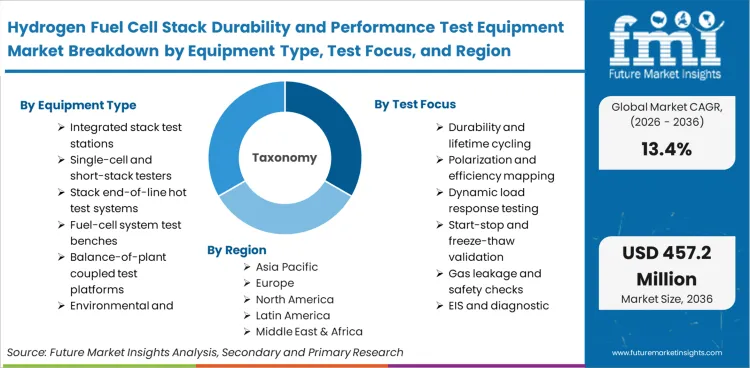
| Metric | Value |
|---|---|
| Quantitative Units | USD 124.7 Million to USD 438.6 Million, at a CAGR of 13.40% |
| Market Definition | Purpose-built laboratory infrastructure verifies the electrochemical performance, material longevity, and operational safety of proton exchange membrane assemblies under simulated environmental extremes. |
| Segmentation | Equipment Type, Test Focus, Stack Scale, End User, Configuration, Region |
| Regions Covered | Asia Pacific, North America, Europe, Middle East and Africa, Latin America |
| Countries Covered | India, China, South Korea, United States, Germany, Japan, France |
| Key Companies Profiled | AVL List GmbH, HORIBA, Greenlight Innovation, Scribner, CHINO Corporation, ENORISE, FEV Group |
| Forecast Period | 2026 to 2036 |
| Approach | Installed base replacement rates and scheduled capital expenditure plans for research facility modernizations across primary automotive hubs. |
Source: Future Market Insights (FMI) analysis, based on proprietary forecasting model and primary research
Hydrogen Fuel Cell Stack Durability and Performance Test Equipment Market Analysis by Segments
Equipment Type
- Integrated stack test stations
- Single-cell and short-stack testers
- Stack end-of-line hot test systems
- Fuel-cell system test benches
- Balance-of-plant coupled test platforms
- Environmental and accelerated aging rigs
Test Focus
- Durability and lifetime cycling
- Polarization and efficiency mapping
- Dynamic load response testing
- Start-stop and freeze-thaw validation
- Gas leakage and safety checks
- EIS and diagnostic characterization
Stack Scale
- Full-stack platforms
- Single-cell systems
- Short-stack systems
- System-level integrated benches
- Pilot-line EOL systems
End User
- Fuel-cell OEM and stack developers
- Automotive OEM validation centers
- Tier-1 propulsion suppliers
- Independent test labs
- Universities and national laboratories
- Engineering service providers
Configuration
- Modular automated benches
- Benchtop research systems
- Rack-mounted lab systems
- Containerized test cells
- Turnkey test-center installations
Region
- North America
- United States
- Canada
- Latin America
- Brazil
- Mexico
- Rest of Latin America
- Europe
- Germany
- United Kingdom
- France
- Italy
- Spain
- Russia
- Rest of Europe
- Asia Pacific
- China
- Japan
- India
- South Korea
- ASEAN
- Rest of Asia Pacific
- Middle East and Africa
- GCC Countries
- South Africa
- Rest of Middle East and Africa
Bibliography
- International Electrotechnical Commission. (2025). IEC TS 62282-7-1:2025 Fuel cell technologies - Part 7-1: Test methods - Single cell test methods for performance and durability of membrane electrode assemblies of proton exchange membrane fuel cells.
- Hong, J., Yang, J., Weng, Z., Ma, F., Liang, F., & Zhang, C. (2024). Review on proton exchange membrane fuel cells: Safety analysis and fault diagnosis. Journal of Power Sources, 617, 235118.
- Kim, J.-W., Yang, S., Shin, G. J., Oh, M. J., Lee, K., & Lee, J. H. (2024). Unveiling the long-term degradation mechanisms of the sealing structures for durable PEM fuel cells by ex situ accelerated stability evaluation of a membrane electrode assembly. Journal of Materials Chemistry A, 12, 25244-25253.
- National Renewable Energy Laboratory. (2024, May). Energy Systems Integration Facility (ESIF): World-class systems integration capabilities and research (NREL/PO-5B00-90155).
- USA Department of Energy, Hydrogen and Fuel Cell Technologies Office. (2024). Hydrogen and Fuel Cell Technologies Office Multi-Year Program Plan.
This bibliography is provided for reader reference. The full FMI report contains the complete reference list with primary source documentation.
This Report Addresses
- Humidification accuracy required for highly dynamic accelerated stress testing protocols.
- Gas flow limitations facing extreme high-power commercial vehicle scale-up requirements.
- Electrochemical impedance spectroscopy software integration for test cell modernization.
- Transient water management implications for high-frequency data acquisition systems.
- Parasitic resistance isolation techniques determining true fundamental cell efficiency.
- Facility safety footprint constraints impacting megawatt-class testing facility upgrades.
- End-of-line verification parameters defining high-volume manufacturing quality control.
- Supplier consolidation risks stemming from rigid software scripting dependencies.
Frequently Asked Questions
How are hydrogen fuel cell stacks tested for durability?
Testing fully assembled units requires precise humidity and temperature profiles mimicking actual operational extremes perfectly. Accelerating these thermal cycles too aggressively alters component degradation responses unnaturally, forcing principal electrochemists to run extended endurance profiles spanning months of continuous operating hours to capture accurate membrane wear data.
How large is the fuel cell stack test equipment market?
FMI estimates this specialized validation infrastructure space was valued at USD 110.0 million in 2025. Driven by aggressive heavy-duty commercial vehicle electrification and strict regulatory lifetime mandates, demand is projected to expand significantly, reaching a total valuation of USD 460.0 million by 2036 at a 13.40% compound annual growth rate.
Which companies supply fuel cell stack test benches?
Major measurement technology providers dominating this space include AVL List GmbH, HORIBA, Greenlight Innovation, Scribner, CHINO Corporation, ENORISE, and FEV Group. These companies differentiate themselves through high-speed data acquisition capabilities, proprietary humidification control, and open software architectures that integrate efficiently into existing laboratory safety networks.
Compare fuel cell stack durability rigs and system test benches.
Durability rigs isolate the fundamental electrochemical power generator to push membrane materials to absolute failure points safely over thousands of hours. Conversely, system benches evaluate the completely integrated package, monitoring destructive interactions between the stack and external air compressors or coolant pumps before final vehicle integration occurs.
Which fuel cell test equipment supports 300 kW stacks?
Mega-watt scale full-stack platforms specifically configured for heavy-duty commercial freight applications are required for this power level. These advanced rigs feature massive thermal rejection systems, high-capacity electronic load banks, and explosion-proof hydrogen delivery manifolds capable of handling continuous extreme fluid consumption safely.
Fuel cell stack tester vs system test bench: What drives selection?
Selecting between these platforms depends entirely on the development phase. Material scientists utilize stack testers to perfect catalyst ink formulations and internal water transport. Vehicle integration engineers demand system test benches to verify that external balance-of-plant components will not accidentally starve the stack during aggressive acceleration events.
PEM fuel cell test station price: What dictates capital expenditure?
Pricing scales directly with electrical load capacity and the precision of reactant conditioning modules. A basic single-cell research unit costs substantially less than a fully automated 200 kW commercial test cell, which requires expensive high-flow mass controllers, integrated impedance spectroscopy analyzers, and dedicated facility explosion mitigation systems.
What advantages do independent diagnostic labs offer?
Independent evaluation centers maintain specialized environmental extremes chambers and extreme high-current electrical load banks that smaller Tier-1 suppliers cannot justify building. Purchasing directors outsource edge-case freeze-thaw mapping while retaining routine polarization evaluation internally.
How is impedance spectroscopy affecting infrastructure?
Ultra-fast alternating current injections generate unprecedented diagnostic resolution detailing internal cell resistance. Validation leads require entirely new sensor arrays and incredibly fast data loggers just to capture these phase shifts accurately during standard degradation mapping runs.
What restrains megawatt-class bench deployment?
Operating massive fuel cell stacks continuously demands immense volumes of ultra-pure hydrogen and dedicated facility-level explosion mitigation. Facilities engineering teams frequently cap equipment sizing based entirely on available high-pressure gas storage safety limits rather than actual program requirements.
What role does environmental climatic testing play?
Water generated by fuel cells expands destructively when frozen inside membrane micro-channels. Climatic integration allows program managers to identify specific cold-start vulnerabilities early, avoiding expensive physical redesigns discovered during final field deployment.
How do system-level test configurations add value?
Running complete assemblies alongside balance-of-plant components identifies destructive interactions between specific air compressors and membrane tolerances. Certification officers require these holistic evaluations to prove absolute powertrain stability before allowing prototype vehicles onto public roads.
Why track single-cell research adoption?
Benchtop fundamental testers allow chemists to evaluate novel catalyst inks rapidly without manufacturing entire prototype stacks. Expanding this basic research capability drastically reduces reliance on scarce full-scale manufacturing runs during crucial early formulation phases.
What defines polarization mapping precision?
Regulators demand certified energy conversion figures derived from highly accurate voltage and current measurements. Laboratory technicians focus intensely on isolating and mathematically removing any resistance generated by the testing hardware wiring itself to improve published efficiencies.
How do Tier-1 suppliers manage testing costs?
Validation directors install specialized end-of-line verification benches to ensure subassemblies pass basic leak-down parameters. Catching manufacturing errors internally prevents sending defective units to demanding OEM partners, protecting crucial supplier quality ratings.
Preview the report firsthand - request a free sample
Get SampleGet the brochure for pricing and purchase details.
Get PDFTable of Content
- Executive Summary
- Global Market Outlook
- Demand-side Trends
- Supply-side Trends
- Technology Roadmap Analysis
- Analysis and Recommendations
- Market Overview
- Market Coverage / Taxonomy
- Market Definition / Scope / Limitations
- Research Methodology
- Chapter Orientation
- Analytical Lens and Working Hypotheses
- Market Structure, Signals, and Trend Drivers
- Benchmarking and Cross-market Comparability
- Desk Research Programme (Secondary Evidence)
- Company Annual and Sustainability Reports
- Peer-reviewed Journals and Academic Literature
- Corporate Websites, Product Literature, and Technical Notes
- Earnings Decks and Investor Briefings
- Statutory Filings and Regulatory Disclosures
- Technical White Papers and Standards Notes
- Trade Journals, Industry Magazines, and Analyst Briefs
- Conference Proceedings, Webinars, and Seminar Materials
- Government Statistics Portals and Public Data Releases
- Press Releases and Reputable Media Coverage
- Specialist Newsletters and Curated Briefings
- Sector Databases and Reference Repositories
- FMI Internal Proprietary Databases and Historical Market Datasets
- Subscription Datasets and Paid Sources
- Social Channels, Communities, and Digital Listening Inputs
- Additional Desk Sources
- Expert Input and Fieldwork (Primary Evidence)
- Primary Modes
- Qualitative Interviews and Expert Elicitation
- Quantitative Surveys and Structured Data Capture
- Blended Approach
- Why Primary Evidence is Used
- Field Techniques
- Interviews
- Surveys
- R&D and Innovation Heads
- Technical Specialists
- Domain Subject-matter Experts
- Scientists
- Physicians and Other Healthcare Professionals
- Governance, Ethics, and Data Stewardship
- Research Ethics
- Data Integrity and Handling
- Primary Modes
- Tooling, Models, and Reference Databases
- Data Engineering and Model Build
- Data Acquisition and Ingestion
- Cleaning, Normalisation, and Verification
- Synthesis, Triangulation, and Analysis
- Quality Assurance and Audit Trail
- Market Background
- Market Dynamics
- Drivers
- Restraints
- Opportunity
- Trends
- Scenario Forecast
- Demand in Optimistic Scenario
- Demand in Likely Scenario
- Demand in Conservative Scenario
- Opportunity Map Analysis
- Product Life Cycle Analysis
- Supply Chain Analysis
- Investment Feasibility Matrix
- Value Chain Analysis
- PESTLE and Porter’s Analysis
- Regulatory Landscape
- Regional Parent Market Outlook
- Production and Consumption Statistics
- Import and Export Statistics
- Market Dynamics
- Global Market Analysis 2021 to 2025 and Forecast, 2026 to 2036
- Historical Market Size Value (USD Million) Analysis, 2021 to 2025
- Current and Future Market Size Value (USD Million) Projections, 2026 to 2036
- Y-o-Y Growth Trend Analysis
- Absolute $ Opportunity Analysis
- Global Market Pricing Analysis 2021 to 2025 and Forecast 2026 to 2036
- Global Market Analysis 2021 to 2025 and Forecast 2026 to 2036, By Equipment Type
- Introduction / Key Findings
- Historical Market Size Value (USD Million) Analysis By Equipment Type , 2021 to 2025
- Current and Future Market Size Value (USD Million) Analysis and Forecast By Equipment Type , 2026 to 2036
- Integrated stack test stations
- Single-cell and short-stack testers
- Stack end-of-line hot test systems
- Fuel-cell system test benches
- Balance-of-plant coupled test platforms
- Environmental and accelerated aging rigs
- Integrated stack test stations
- Y-o-Y Growth Trend Analysis By Equipment Type , 2021 to 2025
- Absolute $ Opportunity Analysis By Equipment Type , 2026 to 2036
- Global Market Analysis 2021 to 2025 and Forecast 2026 to 2036, By Test Focus
- Introduction / Key Findings
- Historical Market Size Value (USD Million) Analysis By Test Focus, 2021 to 2025
- Current and Future Market Size Value (USD Million) Analysis and Forecast By Test Focus, 2026 to 2036
- Durability and lifetime cycling
- Polarization and efficiency mapping
- Dynamic load response testing
- Start-stop and freeze-thaw validation
- Gas leakage and safety checks
- EIS and diagnostic characterization
- Durability and lifetime cycling
- Y-o-Y Growth Trend Analysis By Test Focus, 2021 to 2025
- Absolute $ Opportunity Analysis By Test Focus, 2026 to 2036
- Global Market Analysis 2021 to 2025 and Forecast 2026 to 2036, By Stack Scale
- Introduction / Key Findings
- Historical Market Size Value (USD Million) Analysis By Stack Scale, 2021 to 2025
- Current and Future Market Size Value (USD Million) Analysis and Forecast By Stack Scale, 2026 to 2036
- Full-stack platforms
- Single-cell systems
- Short-stack systems
- System-level integrated benches
- Pilot-line EOL systems
- Full-stack platforms
- Y-o-Y Growth Trend Analysis By Stack Scale, 2021 to 2025
- Absolute $ Opportunity Analysis By Stack Scale, 2026 to 2036
- Global Market Analysis 2021 to 2025 and Forecast 2026 to 2036, By End Use
- Introduction / Key Findings
- Historical Market Size Value (USD Million) Analysis By End Use, 2021 to 2025
- Current and Future Market Size Value (USD Million) Analysis and Forecast By End Use, 2026 to 2036
- Fuel-cell OEM and stack developers
- Automotive OEM validation centers
- Tier-1 propulsion suppliers
- Independent test labs
- Universities and national laboratories
- Engineering service providers
- Fuel-cell OEM and stack developers
- Y-o-Y Growth Trend Analysis By End Use, 2021 to 2025
- Absolute $ Opportunity Analysis By End Use, 2026 to 2036
- Global Market Analysis 2021 to 2025 and Forecast 2026 to 2036, By Region
- Introduction
- Historical Market Size Value (USD Million) Analysis By Region, 2021 to 2025
- Current Market Size Value (USD Million) Analysis and Forecast By Region, 2026 to 2036
- North America
- Latin America
- Western Europe
- Eastern Europe
- East Asia
- South Asia and Pacific
- Middle East & Africa
- Market Attractiveness Analysis By Region
- North America Market Analysis 2021 to 2025 and Forecast 2026 to 2036, By Country
- Historical Market Size Value (USD Million) Trend Analysis By Market Taxonomy, 2021 to 2025
- Market Size Value (USD Million) Forecast By Market Taxonomy, 2026 to 2036
- By Country
- USA
- Canada
- Mexico
- By Equipment Type
- By Test Focus
- By Stack Scale
- By End Use
- By Country
- Market Attractiveness Analysis
- By Country
- By Equipment Type
- By Test Focus
- By Stack Scale
- By End Use
- Key Takeaways
- Latin America Market Analysis 2021 to 2025 and Forecast 2026 to 2036, By Country
- Historical Market Size Value (USD Million) Trend Analysis By Market Taxonomy, 2021 to 2025
- Market Size Value (USD Million) Forecast By Market Taxonomy, 2026 to 2036
- By Country
- Brazil
- Chile
- Rest of Latin America
- By Equipment Type
- By Test Focus
- By Stack Scale
- By End Use
- By Country
- Market Attractiveness Analysis
- By Country
- By Equipment Type
- By Test Focus
- By Stack Scale
- By End Use
- Key Takeaways
- Western Europe Market Analysis 2021 to 2025 and Forecast 2026 to 2036, By Country
- Historical Market Size Value (USD Million) Trend Analysis By Market Taxonomy, 2021 to 2025
- Market Size Value (USD Million) Forecast By Market Taxonomy, 2026 to 2036
- By Country
- Germany
- UK
- Italy
- Spain
- France
- Nordic
- BENELUX
- Rest of Western Europe
- By Equipment Type
- By Test Focus
- By Stack Scale
- By End Use
- By Country
- Market Attractiveness Analysis
- By Country
- By Equipment Type
- By Test Focus
- By Stack Scale
- By End Use
- Key Takeaways
- Eastern Europe Market Analysis 2021 to 2025 and Forecast 2026 to 2036, By Country
- Historical Market Size Value (USD Million) Trend Analysis By Market Taxonomy, 2021 to 2025
- Market Size Value (USD Million) Forecast By Market Taxonomy, 2026 to 2036
- By Country
- Russia
- Poland
- Hungary
- Balkan & Baltic
- Rest of Eastern Europe
- By Equipment Type
- By Test Focus
- By Stack Scale
- By End Use
- By Country
- Market Attractiveness Analysis
- By Country
- By Equipment Type
- By Test Focus
- By Stack Scale
- By End Use
- Key Takeaways
- East Asia Market Analysis 2021 to 2025 and Forecast 2026 to 2036, By Country
- Historical Market Size Value (USD Million) Trend Analysis By Market Taxonomy, 2021 to 2025
- Market Size Value (USD Million) Forecast By Market Taxonomy, 2026 to 2036
- By Country
- China
- Japan
- South Korea
- By Equipment Type
- By Test Focus
- By Stack Scale
- By End Use
- By Country
- Market Attractiveness Analysis
- By Country
- By Equipment Type
- By Test Focus
- By Stack Scale
- By End Use
- Key Takeaways
- South Asia and Pacific Market Analysis 2021 to 2025 and Forecast 2026 to 2036, By Country
- Historical Market Size Value (USD Million) Trend Analysis By Market Taxonomy, 2021 to 2025
- Market Size Value (USD Million) Forecast By Market Taxonomy, 2026 to 2036
- By Country
- India
- ASEAN
- Australia & New Zealand
- Rest of South Asia and Pacific
- By Equipment Type
- By Test Focus
- By Stack Scale
- By End Use
- By Country
- Market Attractiveness Analysis
- By Country
- By Equipment Type
- By Test Focus
- By Stack Scale
- By End Use
- Key Takeaways
- Middle East & Africa Market Analysis 2021 to 2025 and Forecast 2026 to 2036, By Country
- Historical Market Size Value (USD Million) Trend Analysis By Market Taxonomy, 2021 to 2025
- Market Size Value (USD Million) Forecast By Market Taxonomy, 2026 to 2036
- By Country
- Kingdom of Saudi Arabia
- Other GCC Countries
- Turkiye
- South Africa
- Other African Union
- Rest of Middle East & Africa
- By Equipment Type
- By Test Focus
- By Stack Scale
- By End Use
- By Country
- Market Attractiveness Analysis
- By Country
- By Equipment Type
- By Test Focus
- By Stack Scale
- By End Use
- Key Takeaways
- Key Countries Market Analysis
- USA
- Pricing Analysis
- Market Share Analysis, 2025
- By Equipment Type
- By Test Focus
- By Stack Scale
- By End Use
- Canada
- Pricing Analysis
- Market Share Analysis, 2025
- By Equipment Type
- By Test Focus
- By Stack Scale
- By End Use
- Mexico
- Pricing Analysis
- Market Share Analysis, 2025
- By Equipment Type
- By Test Focus
- By Stack Scale
- By End Use
- Brazil
- Pricing Analysis
- Market Share Analysis, 2025
- By Equipment Type
- By Test Focus
- By Stack Scale
- By End Use
- Chile
- Pricing Analysis
- Market Share Analysis, 2025
- By Equipment Type
- By Test Focus
- By Stack Scale
- By End Use
- Germany
- Pricing Analysis
- Market Share Analysis, 2025
- By Equipment Type
- By Test Focus
- By Stack Scale
- By End Use
- UK
- Pricing Analysis
- Market Share Analysis, 2025
- By Equipment Type
- By Test Focus
- By Stack Scale
- By End Use
- Italy
- Pricing Analysis
- Market Share Analysis, 2025
- By Equipment Type
- By Test Focus
- By Stack Scale
- By End Use
- Spain
- Pricing Analysis
- Market Share Analysis, 2025
- By Equipment Type
- By Test Focus
- By Stack Scale
- By End Use
- France
- Pricing Analysis
- Market Share Analysis, 2025
- By Equipment Type
- By Test Focus
- By Stack Scale
- By End Use
- India
- Pricing Analysis
- Market Share Analysis, 2025
- By Equipment Type
- By Test Focus
- By Stack Scale
- By End Use
- ASEAN
- Pricing Analysis
- Market Share Analysis, 2025
- By Equipment Type
- By Test Focus
- By Stack Scale
- By End Use
- Australia & New Zealand
- Pricing Analysis
- Market Share Analysis, 2025
- By Equipment Type
- By Test Focus
- By Stack Scale
- By End Use
- China
- Pricing Analysis
- Market Share Analysis, 2025
- By Equipment Type
- By Test Focus
- By Stack Scale
- By End Use
- Japan
- Pricing Analysis
- Market Share Analysis, 2025
- By Equipment Type
- By Test Focus
- By Stack Scale
- By End Use
- South Korea
- Pricing Analysis
- Market Share Analysis, 2025
- By Equipment Type
- By Test Focus
- By Stack Scale
- By End Use
- Russia
- Pricing Analysis
- Market Share Analysis, 2025
- By Equipment Type
- By Test Focus
- By Stack Scale
- By End Use
- Poland
- Pricing Analysis
- Market Share Analysis, 2025
- By Equipment Type
- By Test Focus
- By Stack Scale
- By End Use
- Hungary
- Pricing Analysis
- Market Share Analysis, 2025
- By Equipment Type
- By Test Focus
- By Stack Scale
- By End Use
- Kingdom of Saudi Arabia
- Pricing Analysis
- Market Share Analysis, 2025
- By Equipment Type
- By Test Focus
- By Stack Scale
- By End Use
- Turkiye
- Pricing Analysis
- Market Share Analysis, 2025
- By Equipment Type
- By Test Focus
- By Stack Scale
- By End Use
- South Africa
- Pricing Analysis
- Market Share Analysis, 2025
- By Equipment Type
- By Test Focus
- By Stack Scale
- By End Use
- USA
- Market Structure Analysis
- Competition Dashboard
- Competition Benchmarking
- Market Share Analysis of Top Players
- By Region
- By Equipment Type
- By Test Focus
- By Stack Scale
- By End Use
- Competition Analysis
- Competition Deep Dive
- AVL List GmbH
- Overview
- Product Portfolio
- Profitability by Market Segments (Product/Age /Sales Channel/Region)
- Sales Footprint
- Strategy Overview
- Marketing Strategy
- Product Strategy
- Channel Strategy
- HORIBA
- Greenlight Innovation
- Scribner
- CHINO Corporation
- ENORISE
- FEV Group
- AVL List GmbH
- Competition Deep Dive
- Assumptions & Acronyms Used


