

- Market Size (2026)
- USD 36.0 Mn
- Forecast (2036)
- USD 173.0 Mn
- CAGR (2026 to 2036)
- 17.0%
Hydrogen Fuel Cell Stack and Membrane Recycling for EU Mobility Industry
FMI analysis found that the hydrogen fuel cell stack and membrane recycling for EU mobility industry recorded a value of USD 30.8 million in 2025. Industry is expected to reach USD 36.0 million in 2026 and USD 173.0 million by 2036 at a CAGR of 17.0%. MEAs are expected to account for 41.0% share in 2026 within the component view. Closed loop service models are likely to represent 48.0% share in 2026 because recovery economics stay tied to material return and reuse quality.
Summary of Hydrogen Fuel Cell Stack and Membrane Recycling for EU Mobility Market
- The hydrogen fuel cell stack and membrane recycling for EU mobility industry is projected to reach USD 173.0 million by 2036.
- Industry is projected to expand at a 17.0% CAGR from 2026 to 2036.
- The market garnered a value of USD 30.8 million in 2025.
- Market value is estimated to surpass USD 36.0 million in 2026.
- MEAs are expected to account for 41.0% share in 2026 within the component segment.
- Closed loop service models are likely to represent 48.0% share in 2026. Traceable return flows and reuse quality keep this service structure commercially credible.
- PEMFC is expected to account for 82.0% share in 2026 within technology. Platinum is anticipated to represent 46.0% of the recovered-material segment in the same year.
- Spain leads country growth through 2036. Germany, France, and the Netherlands follow with a more established demand base.
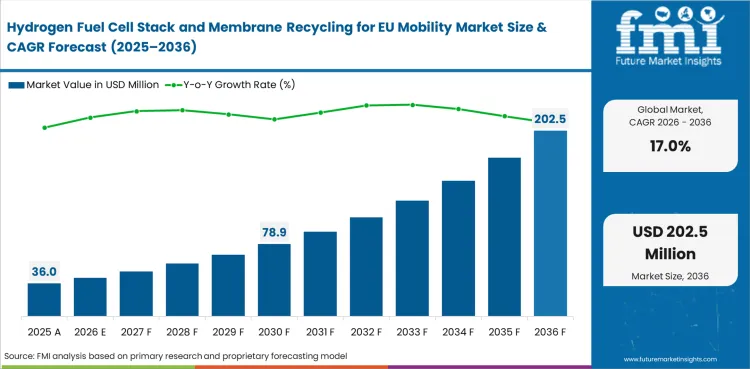
Key Takeaways, Market Size, and Forecast
- The market was valued at USD 30.8 million in 2025.
- It is projected to reach USD 173.0 million by 2036.
- The industry is expected to grow at a CAGR of 17.0% from 2026 to 2036.
- Market size is estimated at USD 36.0 million in 2026.
- MEAs are expected to account for 41.0% share in 2026.
- Closed loop service models are projected to hold 48.0% share in 2026.
Hydrogen Fuel Cell Stack and Membrane Recycling for EU Mobility Industry Key Takeaways
| Parameter | Details |
|---|---|
| Market value (2026) | USD 36.0 million |
| Forecast value (2036) | USD 173.0 million |
| CAGR (2026 to 2036) | 17.0% |
| Estimated market value (2025) | USD 30.8 million |
| Incremental opportunity | USD 137.0 million |
| Entry pricing | Early contracts are linked to recoverable value from manufacturing scrap, pilot-line rejects, and mobility-linked membrane and catalyst recovery |
| Ultra-luxury pricing | Higher-value realization depends on platinum-bearing assemblies, traceable scrap quality, and disciplined stack handling |
| Premium full-size pricing | Stronger commercial returns are associated with controlled recovery of membrane-bearing scrap into refining-ready outputs such as platinum salts and refined metal fractions |
| Leading battery electric luxury SUV brands | Not applicable; market structure is defined by recycling technology, component stream, recovered material, and service model |
| Brands referenced in market landscape | Johnson Matthey, Hensel Recycling, Mastermelt, BASF Environmental Catalyst and Metal Solutions, Heraeus Precious Metals, Umicore, Syensqo |
Source: Future Market Insights, 2026.
Hydrogen Fuel Cell Stack and Membrane Recycling for EU Mobility Industry Size, Market Forecast and Outlook By FMI
- Current market value is modest, though the growth path through 2036 is strong.
- Early demand comes mainly from manufacturing scrap and pilot-scale waste. Large end-of-life vehicle volumes have not formed yet.
- Platinum-bearing fractions and membrane-related scrap shape the recycling case.
- Scale-up depends on feedstock quality, collection discipline, and usable recovery routes.
Hydrogen fuel cell stack and membrane recycling for EU mobility industry is estimated at USD 30.8 million in 2025. Industry value is projected to reach USD 36.0 million in 2026 and expand at a 17.0% CAGR through 2036. Market value is likely to reach USD 173.0 million by 2036 as membrane-bearing scrap moves into recycling routes built for platinum and ionomer recovery.
Market expansion depends on scrap quality, traceability, and dismantling discipline. Mixed handling lowers recovery value when recycled output is expected to support fuel cell vehicle supply chains. Recycling choices connect directly with stack design, warranty flows, and qualification work.
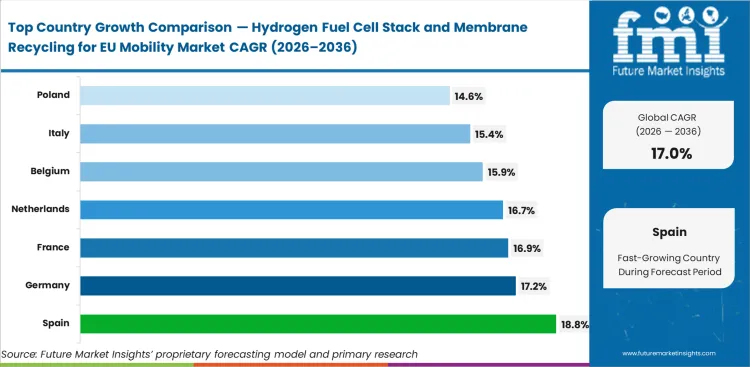
Spain is projected to post 18.8% CAGR through 2036 because a smaller base leaves more room for project-led expansion. Demand for hydrogen fuel cell stack and membrane recycling in Germany is expected to rise at a CAGR of 17.2% through 2036. France is likely to record 16.9% CAGR through 2036. The market for hydrogen fuel cell stack and membrane recycling in the Netherlands is set to expand at a CAGR of 16.7% over the assessment period. Belgium is anticipated to grow at 15.9% CAGR through 2036. Italy should record 15.4% CAGR in this market through the study period. By 2036, Poland is expected to post 14.6% CAGR in the hydrogen fuel cell stack and membrane recycling market.
Hydrogen Fuel Cell Stack and Membrane Recycling for EU Mobility Industry Definition
Hydrogen fuel cell stack and membrane recycling for EU mobility covers the controlled recovery of valuable materials from spent or rejected fuel cell stacks, membrane electrode assemblies, and catalyst coated membrane waste used in road and fleet transport. Scope covers value-bearing stack and membrane fractions rather than full vehicle dismantling. Commercial relevance comes from recovery of platinum group metals, ionomer, and selected secondary materials in a form suited to reuse or refining.
Hydrogen Fuel Cell Stack and Membrane Recycling for EU Mobility Industry Inclusions
Included within scope are PEM-dominant stack materials, catalyst coated membranes, membrane electrode assemblies, associated stack hardware, manufacturing scrap, pilot-line rejects, warranty returns, and selected end-of-life mobility stacks. Service models include closed loop recovery, toll refining, buyback arrangements, and contract recycling linked with PEM fuel cell manufacturing and hydrogen mobility supply chains. Material outputs such as platinum salts and reusable membrane-related intermediates fall within this study.
Hydrogen Fuel Cell Stack and Membrane Recycling for EU Mobility Industry Exclusions
Excluded from scope are full vehicle recycling revenues, traction battery recovery, stationary fuel cell recycling, hydrogen production assets, and generic mixed scrap treatment not designed for stack and membrane recovery. Fuel dispensing equipment, storage tanks, and hydrogen generation systems sit outside the market boundary because they do not form part of the stack-and-membrane recycling value pool sized in this report. Adjacent activities provide context, though they are not counted as direct market revenue.
Hydrogen Fuel Cell Stack and Membrane Recycling for EU Mobility Industry Research Methodology
- Primary Research: FMI's primary work in this market includes discussions with fuel cell material suppliers, precious-metal recovery specialists, mobility fleet operators, and stack-handling partners active in Europe.
- Desk Research: Secondary review draws on hydrogen mobility roadmaps, European fleet deployment references, recycling process literature, catalyst and membrane circularity material, and public company pages tied to the hydrogen value chain.
- Market-Sizing and Forecasting: Baseline sizing is anchored to recoverable value from manufacturing scrap, early stack retirement flows, and mobility-linked membrane and catalyst recovery economics across the EU.
- Data Validation and Update Cycle: Forecasts were cross-checked against recycling process maturity, country-level hydrogen mobility build-out, fleet concentration, and updates from FMI's primary research program.
Segmental Analysis
- PEMFC is expected to account for 82.0% share in 2026 because EU mobility recycling volume stays concentrated in proton exchange membrane fuel cell systems.
- In 2026, MEAs are projected to contribute 41.0% of total market share. Recoverable value stays concentrated in membrane and catalyst assemblies.
- Platinum is anticipated to represent 46.0% of the market in 2026 because precious metal recovery anchors recycling economics.
- Hydrometallurgy is likely to secure 38.0% share in 2026. Selective recovery suits catalyst-rich fractions better than bulk treatment routes.
- Manufacturing scrap is set to make up 44.0% of the market in 2026 because factory waste reaches recyclers earlier than retired mobility stacks.
- Market estimates place buses at 29.0% share in 2026. Centralized fleet handling and easier stack return logistics support that lead.
- A 48.0% share is expected for closed loop service models in 2026 because traceability and metal-credit visibility matter in long-cycle recovery contracts.
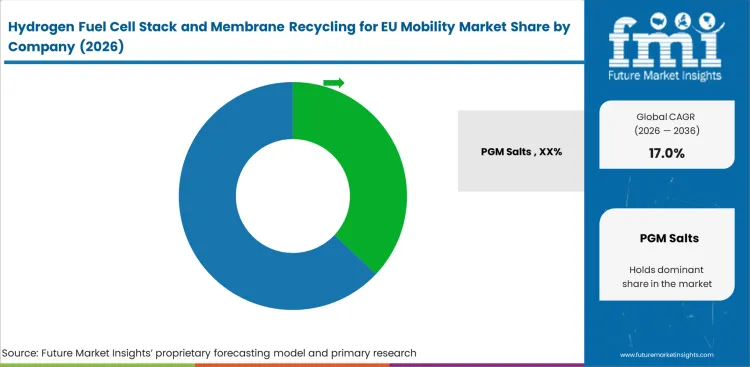
- PGM salts are forecast to represent 37.0% of market demand in 2026 since intermediate refining products fit existing industrial recovery channels more easily than rebuilt membrane outputs.
Hydrogen Fuel Cell Stack and Membrane Recycling for EU Mobility Industry Analysis by Technology
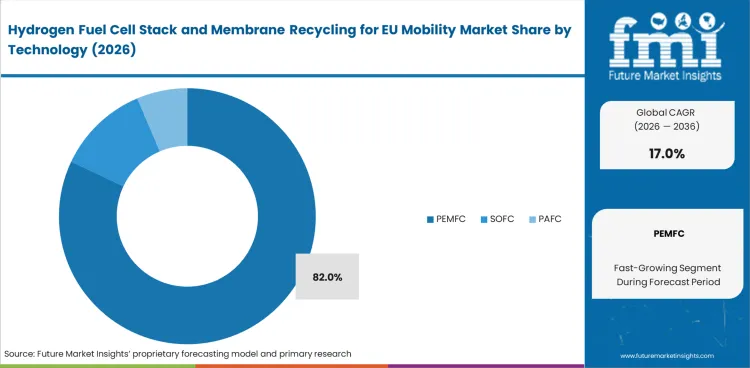
PEMFC sets the technical base for mobility recycling in Europe because transport platforms need quick start behavior and compact system design. PEMFC is expected to account for 82.0% share in 2026. Feedstock flow stays tied to buses, trucks, and passenger vehicles that define early hydrogen use. Recyclers build process discipline around membrane assemblies and catalyst layers that match mobility validation routines. Recovery economics stay concentrated in one chemistry stream because European mobility scrap is not spread evenly across fuel cell types.
- Duty-cycle fit: PEM systems suit mobility use patterns better and keep future recycling volume linked to one dominant technology family.
- Stack familiarity: Repeated exposure to similar membrane and catalyst layouts improves dismantling accuracy and recovery discipline.
- Qualification carryover: Process learning builds faster when production scrap and end-of-life material follow similar technical designs.
Hydrogen Fuel Cell Stack and Membrane Recycling for EU Mobility Industry Analysis by Component
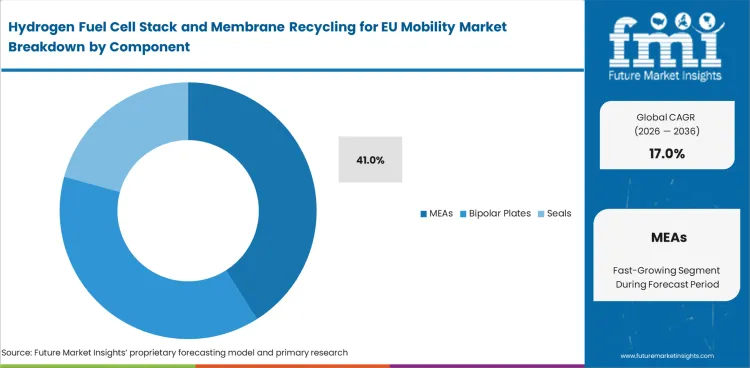
Commercial value inside a stack is uneven and process discipline decides how much of it survives separation. Frames and seals add volume. Membrane electrode assemblies carry the richer recovery opportunity. In 2026, MEAs are projected to contribute 41.0% of total market share. Sorting quality matters most when scrap moves out of fuel cell powertrain programs and adjacent stack assembly lines. Poor segregation cuts yield early and weakens the economics of the recycling chain.
- Value concentration: Most recoverable value sits in the membrane and catalyst assembly rather than in lower-value stack parts.
- Teardown discipline: Careful separation protects recovery quality and reduces damage to the richest material stream.
- Sorting priority: Early identification of MEA-rich waste keeps refiners from treating valuable material as mixed scrap.
Hydrogen Fuel Cell Stack and Membrane Recycling for EU Mobility Industry Analysis by Material Recovered
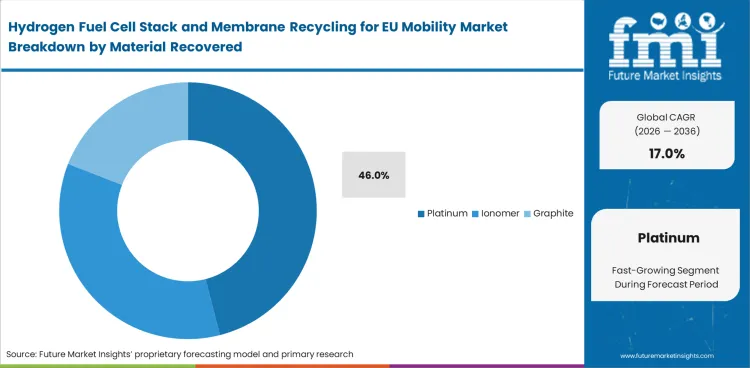
Platinum is projected to contribute 46.0% of total market share in 2026 because recycling programs start with the material that funds the process. Recyclers screen waste streams first for recoverable precious metal. Lower-value fractions receive attention after that screening step. Ionomer recovery draws interest in pilot work, though commercial logic centers on platinum return. Predictable metal yield keeps this segment commercially credible.
- Metal anchor: Platinum continues to support recycling economics because it carries the clearest recovery value.
- Residue quality: Cleaner catalyst fractions improve refining outcomes and lower avoidable losses.
- Reuse credibility: Recovery programs gain stronger acceptance when recovered metal can move back into qualified industrial use.
Hydrogen Fuel Cell Stack and Membrane Recycling for EU Mobility Industry Analysis by Recycling Process
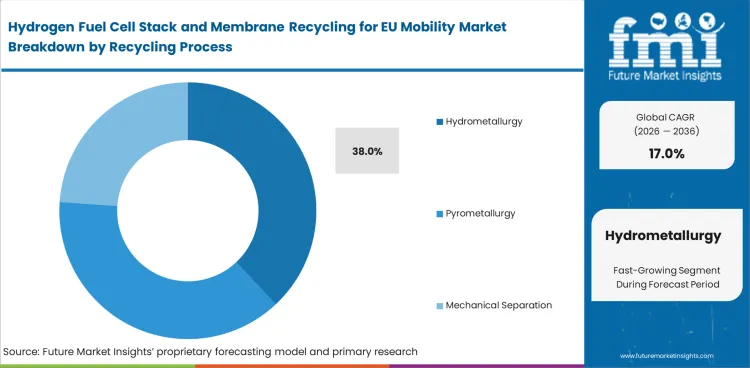
Process choice decides what fraction can be recovered with acceptable purity and what fraction leaves as lower-value residue. Front-end shredding matters when membrane-bearing material needs size reduction and controlled handling. Solution chemistry matters once valuable fractions are isolated. Hydrometallurgy is expected to account for 38.0% share in 2026 because selective recovery supports better treatment of catalyst-rich inputs than rough bulk processing. Front-end preparation helps only when it improves downstream separation quality.
- Yield control: Selective recovery protects value in catalyst-bearing material more effectively than blunt treatment routes.
- Pre-treatment balance: Early shredding or separation matters only when it improves high-value downstream recovery.
- Output consistency: Cleaner recovered fractions improve batch reliability and strengthen refining economics.
Hydrogen Fuel Cell Stack and Membrane Recycling for EU Mobility Industry Analysis by Source Stream
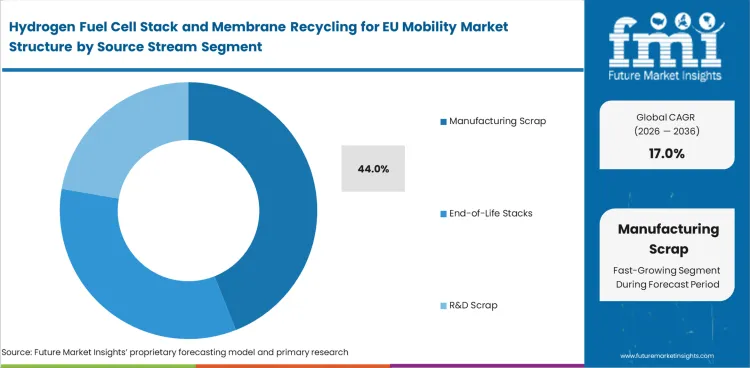
Manufacturing scrap reaches recyclers before retired vehicle stacks generate meaningful volume across Europe. In 2026, manufacturing scrap is likely to contribute 44.0% of total demand because rejected catalyst coated membranes and pilot-line waste are easier to identify and contract. Material composition is clearer at factory exits than in field returns. Manufacturers get faster feedback on losses when recovery partners process known batches instead of mixed returns. Early market buildout starts with structured waste and later broadens toward field-return flows.
- Scrap visibility: Production waste enters the recovery chain sooner because collection points are easier to define.
- Batch control: More consistent composition gives recyclers a cleaner starting point than mixed field returns.
- Contract clarity: Supply agreements are easier to build when waste arises from known manufacturing sites.
Hydrogen Fuel Cell Stack and Membrane Recycling for EU Mobility Industry Analysis by Vehicle Type
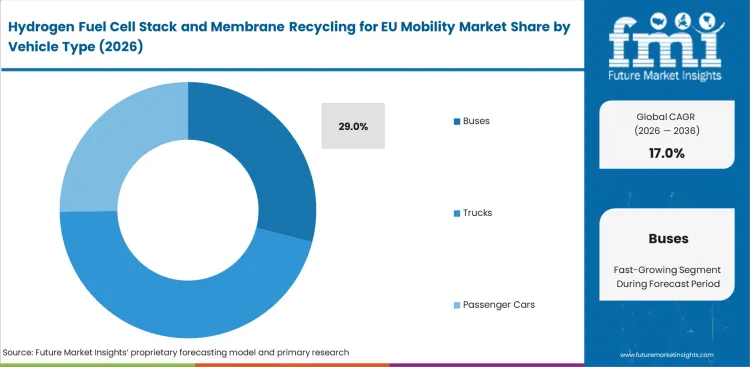
Vehicle type affects collection logic more than headline unit counts in the early market. Centralized fleet ownership makes stack return easier to plan. Depot-based handling lowers contamination risk and simplifies storage before shipment. Buses fit that pattern better than privately owned vehicles because service schedules are visible and removal timing is easier to manage. In 2026, buses are projected to contribute 29.0% share of the market. Centralized fleet ownership gives recyclers a cleaner link to return planning and wider mobility infrastructure rollout.
- Fleet concentration: Centralized ownership improves return logistics and reduces collection uncertainty.
- Removal timing: Planned service schedules make stack recovery easier before damage or contamination rises.
- Depot handling: Shared storage points reduce transport complexity and improve material accountability.
Hydrogen Fuel Cell Stack and Membrane Recycling for EU Mobility Industry Analysis by Service Model
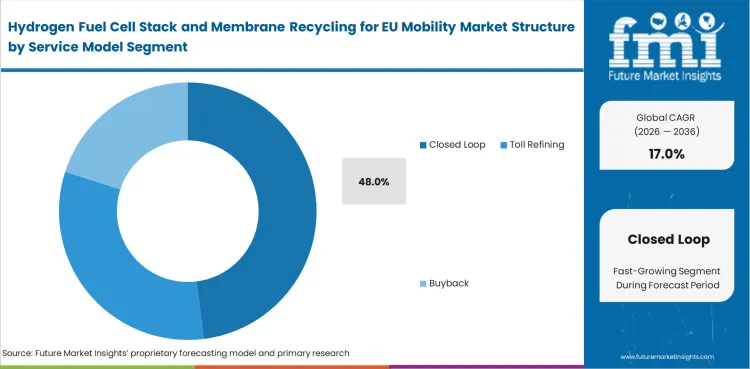
Service model matters because recyclers need to show where value goes after recovery and how it returns to the supply chain. Simple disposal arrangements give limited visibility into that process. Closed loop service models are forecast to account for 48.0% share in 2026 because metal credit and traceability improve confidence across long-cycle industrial programs. Documentation strength becomes more important when recovered material may move back into qualified production routes. Clear return records make the service easier to justify inside mobility recycling contracts.
- Return assurance: Closed loop structures give manufacturers clearer evidence of where recovered value ends up.
- Metal credit: Financial return becomes easier to understand when recovered content links to future supply.
- Traceability strength: Documentation matters more when recycled material may re-enter qualified production routes.
Hydrogen Fuel Cell Stack and Membrane Recycling for EU Mobility Industry Analysis by Output Product
Recovered output does not need to return as a finished stack component to carry commercial value. Intermediate products fit current refining practice better than rebuilt membrane outputs. Industrial channels for platinum salts are already established and qualification barriers are lower. PGM salts are poised to represent 37.0% share in 2026. That output mix keeps recovery activity closer to chemical recycling service models than to immediate component remanufacture. Commercial scale improves when output form matches existing refining demand.
- Refining route: Intermediate products fit established recovery practice with fewer qualification hurdles.
- Saleability: PGM salts move through existing industrial channels more easily than rebuilt membrane outputs.
- Scale readiness: Output forms that match refining norms reach commercial use faster than experimental return formats.
Aluminum-Heavy Return Packaging Is Getting Costlier
For hydrogen fuel cell stack and membrane recycling in the EU mobility market, pack cost is becoming more uneven. USA Bureau of Labor Statistics data for February 2026 show plastic resins and materials easing from 259.307 in October 2025 to 256.209 in February 2026. Aluminum mill shapes climbed faster from 301.541 to 347.297 over the same period. Specialty bags, pouches and liners stayed relatively firm from 281.220 to 281.624. Aluminum-rich return packs fit high-value stack movements. Day-to-day network transfers are more likely to use polymer-based cradles and lighter secondary wraps. [1]
For hydrogen fuel cell stack and membrane recycling in the EU mobility market, outer-pack selection is easier to justify along with recovery compatibility than with raw durability alone. The European Environment Agency states that the highest recycling rate in 2023 was registered for packaging at 67.5%. The OECD’s 2025 Sweden review adds a material benchmark. Recycling of paper and cardboard packaging was 78% versus 35% for plastic packaging. Corrugated and paper-based outer packs are the more defensible default for mainstream collection and transport. Plastics fit barrier, and contamination-sensitive handling where membrane integrity matters more than packaging recyclability. [2], [3]
Regional Analysis
- Demand for hydrogen fuel cell stack and membrane recycling in Spain is expected to rise at a CAGR of 18.8% through 2036.
- Germany is projected to record a CAGR of 17.2% in hydrogen fuel cell stack and membrane recycling during the forecast period.
- Sales of hydrogen fuel cell stack and membrane recycling in France are likely to increase at a CAGR of 16.9% through 2036.
- Hydrogen fuel cell stack and membrane recycling adoption across the Netherlands is anticipated to grow at 16.7% CAGR during the study period.
- Belgium is forecast to post 15.9% CAGR in the hydrogen fuel cell stack and membrane recycling market through 2036.
- The market for hydrogen fuel cell stack and membrane recycling in Italy is set to expand at a CAGR of 15.4% over the assessment period.
- Hydrogen fuel cell stack and membrane recycling demand across Poland is projected to increase at 14.6% CAGR by 2036.
Regional differences in this market come from feedstock quality, fleet concentration, and the pace at which hydrogen mobility moves from pilot activity into routine asset handling. Countries with better collection visibility and stronger industrial recycling capacity are building demand faster. Countries waiting for larger stack return volumes move more slowly.
.webp "Top Country Growth Comparison Hydrogen Fuel Cell Stack And Membrane Recycling For Eu Mobility Market Cagr (2026 2036)")
| Country | CAGR (2026 to 2036) |
|---|---|
| Spain | 18.8% |
| Germany | 17.2% |
| France | 16.9% |
| Netherlands | 16.7% |
| Belgium | 15.9% |
| Italy | 15.4% |
| Poland | 14.6% |
Source: Future Market Insights (FMI) analysis, based on proprietary forecasting model and primary research
Northwestern Europe Hydrogen Fuel Cell Stack and Membrane Recycling for EU Mobility Industry Analysis
Northwestern Europe is the most developed part of the industry because hydrogen mobility projects and industrial handling routines, combined with optimal refining capacity, align more closely here. Germany, France, the Netherlands, and Belgium benefit from stronger logistics corridors and better technical support. Early recycling demand depends on controlled material return with minimal quality loss. Hydrogen fueling station build-out makes asset recovery pathways easier to organize.
- Germany's position starts with industrial depth in places such as North Rhine-Westphalia, Hamburg, and the southern engineering belt where hydrogen mobility activity and material-handling capability sit closer together. Demand for hydrogen fuel cell stack and membrane recycling in Germany is expected to rise at a CAGR of 17.2% through 2036. Manufacturing scrap and pilot-line material support early activity because domestic technical capacity helps sort and process valuable assemblies before quality drops. Germany offers one of the clearest locations for recovery models built around disciplined return.
- France supports demand formation through bus, van, and regional mobility programs that create a more visible base for organized stack return. Auvergne-Rhône-Alpes and parts of the north matter because industrial hydrogen work and transport deployment can feed material into recovery routes with fewer handoffs. Sales of hydrogen fuel cell stack and membrane recycling services in France are likely to increase at a CAGR of 16.9% during the forecast period. Commercial progress depends on how consistently scrap is separated at source because mixed returns can weaken the value case before refining begins.
- Rotterdam and nearby logistics corridors give the Netherlands an edge in moving specialized material through short and efficient industrial routes. Demand stays tied to transport corridors, port activity, and hydrogen infrastructure planning that make mobility assets easier to identify and service. The market for hydrogen fuel cell stack and membrane recycling in the Netherlands is set to expand at a CAGR of 16.7% over the assessment period. Dutch recovery work builds around concentrated industrial access instead of broad national fleet size. Thus, the opportunity becomes practical and logistics controlled.
- Belgium gains relevance because Antwerp and related industrial clusters sit close to transport corridors and established materials-handling capability. Cross-border movement matters here because recovery chains do not stop at the national boundary in every case. Demand for hydrogen fuel cell stack and membrane recycling in Belgium is expected to rise at a CAGR of 15.9% over the forecast period. Growth is steady rather than explosive. Location and logistics compensate for a smaller domestic feedstock base.
FMI’s report covers other Northwestern European countries where smaller hydrogen mobility programs gain traction through industrial corridors and recovery logistics.
Southern Europe Hydrogen Fuel Cell Stack and Membrane Recycling for EU Mobility Industry Analysis
Southern Europe follows a different path. Spain and Italy expand from a smaller base through project-led mobility programs. Recovery activity is less concentrated than in Northwestern Europe, though future stack returns can rise quickly as hydrogen transport assets enter service. Commercial readiness depends on early handling routines, storage discipline, and contract design. Investment tied to hydrogen storage tank and transportation supports that buildup.
- Spain stands out because growth starts from a smaller base and that leaves more room for recovery demand to build as hydrogen mobility programs spread through freight and public transport routes. Madrid, Catalonia, and industrial corridors linked with logistics activity are relevant because organized fleet operations can create cleaner stack return points than fragmented vehicle ownership. Spain is projected to record a CAGR of 18.8% in hydrogen fuel cell stack and membrane recycling during the forecast period. That pace is credible only if separation and return routines mature alongside deployment.
- Italy moves more selectively because hydrogen mobility progress is uneven across regions where industrial and transport use cases overlap. Northern industrial areas such as Lombardy and Emilia-Romagna are more likely to support early recovery activity than areas where hydrogen vehicle deployment is sparse. By 2036, Italy is expected to post 15.4% CAGR in the hydrogen fuel cell stack and membrane recycling market. Demand is shaped by targeted fleet and corridor opportunities rather than nationwide scale. Success depends on whether recovery partners can build structured collection around a geographically patchy market.
FMI's report includes other Southern European countries where hydrogen transport plans exist, but recycling demand sits behind infrastructure readiness and fleet concentration.
Central and Eastern Europe Hydrogen Fuel Cell Stack and Membrane Recycling for EU Mobility Industry Analysis
Central and Eastern Europe shows earlier market formation from a smaller hydrogen mobility base and less established recovery systems. Feedstock visibility stays lower, which limits dedicated handling. Growth potential is credible from a low base as hydrogen storage and transport links strengthen regional collection and aggregation.
- Poland is the clearest example of an emerging rather than mature recycling base within this industry. Industrial centers such as Silesia and major logistics corridors matter because they offer the best chance of linking future hydrogen mobility assets with controlled material return. Hydrogen fuel cell stack and membrane recycling demand across Poland is projected to increase at 14.6% CAGR by 2036. That pace is slower than the western group, though meaningful for a segment at this stage. Economics stay harder to prove without concentrated collection.
FMI's report also reviews selected Central and Eastern European countries where hydrogen mobility is limited, but future industrial adoption could open regional recovery opportunities.
Competitive Aligners for Market Players
- Competition is shaped by actual recovery capability instead of broad market presence.
- Refiners with stack-material handling depth hold an early advantage.
- Specialist recyclers matter where dismantling quality affects value retention.
- Material owners favor partners that combine recovery yield, traceability, and usable return routes.
- The field includes refiners, specialist recyclers, and advanced materials companies.
- Leadership comes from recovery know-how instead of sector visibility alone.
- Firms active in precious metal recovery hold an early structural advantage.
- Membrane and catalyst handling capability carries more weight as recovery volumes rise.
Competition in this market is influenced by how effectively companies protect material value during recovery rather than by scale alone. Handling membrane and stack materials requires discipline and clear chain-of-custody practices. Players such as Johnson Matthey and Heraeus Precious Metals stay important because precious metal recovery defines the commercial baseline. Material owners assess providers on operational confidence and transparency as recovery volumes rise with hydrogen system deployment.
Established refiners benefit from experience in managing complex material streams within existing recovery frameworks. That experience supports value extraction without extra operating friction. Specialist recyclers such as Mastermelt stay relevant where careful dismantling and smaller batch control directly influence recovery outcomes. The market therefore sits between concentration and fragmentation, with leadership at the high-value end and meaningful participation from niche operators.
Through 2036, demand is expected to favor firms that combine physical recovery with documented pathways for reuse. Material owners want options that support closed material return instead of isolated metal recovery alone. Providers that deliver predictable yields and clear return logic will be preferred. That balance sustains roles for large refiners and specialized partners while narrowing entry for less disciplined operators.
Key Players in Hydrogen Fuel Cell Stack and Membrane Recycling for EU Mobility Industry
- Johnson Matthey
- Hensel Recycling
- Mastermelt
- BASF Environmental Catalyst and Metal Solutions
- Heraeus Precious Metals
- Umicore
- Syensqo
Scope of the Report
| Metric | Value |
|---|---|
| Quantitative Units | USD 36.0 million to USD 173.0 million, at a CAGR of 17.00% |
| Market Definition | Recovery of stack and membrane value from EU mobility fuel cell systems, centered on platinum-bearing and ionomer-containing materials rather than full vehicle recycling. |
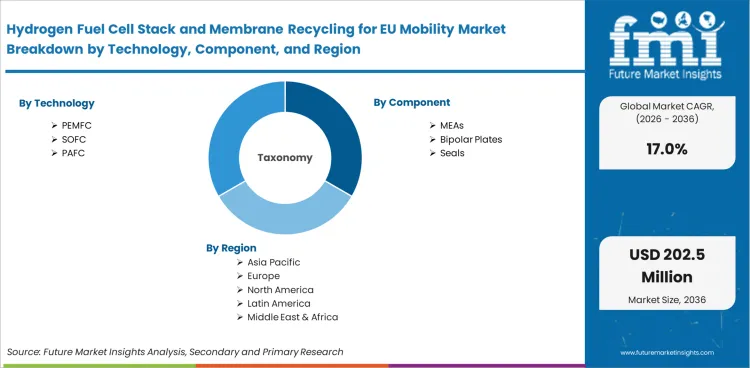
| Technology Segmentation | PEMFC, SOFC, PAFC |
| Component Segmentation | MEAs, Bipolar Plates, Gas Diffusion Layers, Seals, Frames |
| Material Recovered Segmentation | Platinum, Ionomer, Graphite, Titanium, Steel |
| Recycling Process Segmentation | Hydrometallurgy, Pyrometallurgy, Mechanical Separation, Thermal Pretreatment, Delamination |
| Source Stream Segmentation | Manufacturing Scrap, End-of-Life Stacks, R&D Scrap, Warranty Returns, Refurbishment Scrap |
| Vehicle Type Segmentation | Buses, Trucks, Passenger Cars, Vans, Rail |
| Service Model Segmentation | Closed Loop, Toll Refining, Buyback, Contract Recycling |
| Output Product Segmentation | PGM Salts, Refined Platinum, Ionomer Dispersion, Mixed Fractions, Secondary Metals |
| Regions Covered | Northwestern Europe, Southern Europe, Central and Eastern Europe |
| Countries Covered | Spain, Germany, France, Netherlands, Belgium, Italy, Poland, and selected EU member states |
| Key Companies Profiled | Johnson Matthey, Hensel Recycling, Mastermelt, BASF Environmental Catalyst and Metal Solutions, Heraeus Precious Metals, Umicore, Syensqo |
| Forecast Period | 2026 to 2036 |
| Approach | FMI combined primary interviews, public hydrogen mobility references, recycling process literature, and recoverable-value modeling linked to stack and membrane scrap generation. |
Source: Future Market Insights (FMI) analysis, based on proprietary forecasting model and primary research
Hydrogen Fuel Cell Stack and Membrane Recycling for EU Mobility Market Analysis by Segments
Technology:
- PEMFC
- SOFC
- PAFC
Component:
- MEAs
- Bipolar Plates
- Gas Diffusion Layers
- Seals
- Frames
Material Recovered:
- Platinum
- Ionomer
- Graphite
- Titanium
- Steel
Recycling Process:
- Hydrometallurgy
- Pyrometallurgy
- Mechanical Separation
- Thermal Pretreatment
- Delamination
Source Stream:
- Manufacturing Scrap
- End-of-Life Stacks
- R&D Scrap
- Warranty Returns
- Refurbishment Scrap
Vehicle Type:
- Buses
- Trucks
- Passenger Cars
- Vans
- Rail
Service Model:
- Closed Loop
- Toll Refining
- Buyback
- Contract Recycling
Output Product:
- PGM Salts
- Refined Platinum
- Ionomer Dispersion
- Mixed Fractions
- Secondary Metals
Region:
- Western Europe
- Germany
- France
- Netherlands
- Belgium
- Austria
- Switzerland
- Luxembourg
- Northern Europe
- Denmark
- Sweden
- Norway
- Finland
- Ireland
- Iceland
- Southern Europe
- Italy
- Spain
- Portugal
- Greece
- Malta
- Cyprus
- Eastern Europe
- Poland
- Czech Republic
- Hungary
- Romania
- Slovakia
- Bulgaria
- Croatia
- Slovenia
- Estonia
- Latvia
- Lithuania
Bibliography
- USA Bureau of Labor Statistics. (2026, March 18). Table 9. Producer price indexes for commodity and service groupings and individual items. USA Department of Labor.
- European Environment Agency. (2025, December 3). Waste recycling in Europe.
- Organisation for Economic Co-operation and Development. (2025). OECD environmental performance reviews: Sweden 2025. OECD Publishing.
- Hydrogen Europe. (2024, February 14). Long-term outlook on zero-emission mobility.
- Oxford Institute for Energy Studies. (2024, June). 2024 State of the European Hydrogen Market Report.
- World Platinum Investment Council. (2024, April 25). Hydrogen 101 - An introduction for investors.
- Advanced Propulsion Centre UK. (2024). Narrative Report 2024: Hydrogen Fuel Cell System and Storage.
- H2 MOBILITY Deutschland. (2025, September 3). Sustainability Report 2024 - Fuelling Progress with Hydrogen.
- Johnson Matthey & Syensqo. (2026). Demonstrating circularity for critical materials in proton exchange membrane (PEM) hydrogen technologies.
- Axt, M., Baldassarre, B., & Kirchherr, J. (2025, October). Towards greater circularity in the hydrogen technology value chain. Ecological Economics, 236, 108679.
- Lord, J., White, R., Murphy, R., & Sadhukhan, J. (2025, October 29). Aligning platinum recycling with hydrogen economy growth: a comparative LCA of hydrometallurgical and pyrometallurgical methods. Green Chemistry, 27, 14577.
- Trinh, H. B., Kim, S., Son, T., & Lee, J. (2024, February). Platinum recycling from fuel cell-spent electrocatalysts using oxidative leaching in HCl solution. Cleaner Engineering and Technology, 18, 100709.
- University of Leicester. (2025, May 2). Breakthrough in fuel cell recycling turns ‘forever chemicals’ into renewable resources.
This bibliography is provided for reader reference. The full FMI report contains the complete reference list with primary source documentation.
This Report Addresses
- Market intelligence to support strategic decision making across stack recycling, membrane recovery, platinum refining, ionomer handling, and EU mobility scrap flows.
- Market size estimation and ten-year forecasts from 2026 to 2036 supported by recoverable-value modeling linked to stack and membrane scrap generation.
- Growth opportunity mapping across technology, component, material recovered, process, source stream, vehicle type, service model, and output product.
- Segment and regional forecasts covering PEMFC, MEAs, platinum recovery, hydrometallurgy, manufacturing scrap, buses, closed loop models, and PGM salts across major EU countries.
- Competition assessment covering refining depth, dismantling discipline, material accountability, documentation quality, and return-to-supply capability.
- Country-level demand patterns across Spain, Germany, France, the Netherlands, Belgium, Italy, and Poland.
- Market scope boundaries clarifying what is included in stack and membrane recycling and what falls outside direct revenue measurement.
- Practical insight into how feedstock quality, collection discipline, and reuse comfort shape commercial outcomes in the EU mobility recycling chain.
Frequently Asked Questions
What is the Hydrogen Fuel Cell Stack and Membrane Recycling for EU Mobility Industry?
It covers recovery of fuel cell stacks, membranes, membrane electrode assemblies, catalyst-coated membranes, and related high-value materials used in hydrogen mobility across the European Union.
How large is this market at the start of the forecast period?
FMI estimates this space at USD 36.0 million in 2026.
What is the long-term outlook for fuel cell stack recycling in EU mobility?
Industry value is projected to reach USD 173.0 million by 2036 as hydrogen mobility waste streams become more commercially usable.
What growth rate is expected for this industry?
Demand is forecast to expand at a 17.0% CAGR from 2026 to 2036.
Why is hydrogen mobility recycling gaining commercial relevance now?
Value is starting to build because platinum-bearing assemblies, membrane scrap, and early stack waste offer a clearer recovery case than broad end-of-life vehicle volumes at this stage.
Which fuel cell technology leads current recycling activity?
PEM fuel cell recycling is expected to stay ahead, with PEMFC systems estimated to account for 82.0% share in 2026.
Which component matters most in the recycling chain?
MEA recycling is central because membrane electrode assemblies carry a high share of the recoverable value in mobility fuel cell systems.
Why does platinum recovery matter so much in this market?
Platinum recovery anchors the business case because precious metal value is easier to monetize than many lower-value stack fractions.
Which source stream leads near-term feedstock availability?
Manufacturing scrap is expected to contribute 44.0% share in 2026 because rejected membranes, CCM scrap, and production waste enter recovery channels earlier than large end-of-life volumes.
Which vehicle segment creates the strongest early opportunity?
Hydrogen buses lead the vehicle mix with an estimated 29.0% share in 2026 because centralized fleet handling makes collection and recycling more practical.
What kind of recycling model is gaining the most traction?
Closed-loop recycling is projected to represent 48.0% share in 2026 because buyers prefer traceable recovery with material value flowing back into usable supply chains.
Which recovered material leads the value mix?
Platinum is expected to account for 46.0% share in 2026 since it is the most commercially important output in stack and membrane recycling.
Which recycling process is used most often?
Hydrometallurgical recovery is estimated to hold 38.0% share in 2026 because it fits selective extraction of high-value catalyst materials.
Which EU country is expected to grow the fastest?
Spain is projected to post the highest growth rate at 18.8% CAGR through 2036.
Which countries form the strongest current demand base?
Germany, France, and the Netherlands remain the most established country markets because hydrogen mobility deployment and corridor relevance are more visible there.
What limits faster scaling in fuel cell membrane recycling?
Commercial buildout is held back by low retirement volumes, uneven feedstock collection, and the limited scale of advanced membrane and ionomer recovery.
Who are the main participants in this industry?
Johnson Matthey, Hensel Recycling, Mastermelt, BASF Environmental Catalyst and Metal Solutions, Heraeus Precious Metals, Umicore, and Syensqo are among the key names active in this space.
What does this report include within scope?
It covers recycling by technology, component, recovered material, process route, source stream, vehicle type, service model, output product, and country outlook within EU mobility applications.
What is excluded from this study?
Stationary fuel cell recycling, hydrogen production equipment, full vehicle dismantling, and traction battery recycling are outside the report scope.
Why does this market matter for the wider hydrogen value chain?
It shows how fuel cell stack recycling and membrane recycling can reduce material loss, improve circular use of platinum-bearing inputs, and support cleaner supply for EU mobility.
Preview the report firsthand - request a free sample
Get SampleGet the brochure for pricing and purchase details.
Get PDFTable of Content
- Executive Summary
- Global Market Outlook
- Demand-side Trends
- Supply-side Trends
- Technology Roadmap Analysis
- Analysis and Recommendations
- Market Overview
- Market Coverage / Taxonomy
- Market Definition / Scope / Limitations
- Research Methodology
- Chapter Orientation
- Analytical Lens and Working Hypotheses
- Market Structure, Signals, and Trend Drivers
- Benchmarking and Cross-market Comparability
- Market Sizing, Forecasting, and Opportunity Mapping
- Research Design and Evidence Framework
- Desk Research Programme (Secondary Evidence)
- Company Annual and Sustainability Reports
- Peer-reviewed Journals and Academic Literature
- Corporate Websites, Product Literature, and Technical Notes
- Earnings Decks and Investor Briefings
- Statutory Filings and Regulatory Disclosures
- Technical White Papers and Standards Notes
- Trade Journals, Industry Magazines, and Analyst Briefs
- Conference Proceedings, Webinars, and Seminar Materials
- Government Statistics Portals and Public Data Releases
- Press Releases and Reputable Media Coverage
- Specialist Newsletters and Curated Briefings
- Sector Databases and Reference Repositories
- FMI Internal Proprietary Databases and Historical Market Datasets
- Subscription Datasets and Paid Sources
- Social Channels, Communities, and Digital Listening Inputs
- Additional Desk Sources
- Expert Input and Fieldwork (Primary Evidence)
- Primary Modes
- Qualitative Interviews and Expert Elicitation
- Quantitative Surveys and Structured Data Capture
- Blended Approach
- Why Primary Evidence is Used
- Field Techniques
- Interviews
- Surveys
- Focus Groups
- Observational and In-context Research
- Social and Community Interactions
- Stakeholder Universe Engaged
- C-suite Leaders
- Board Members
- Presidents and Vice Presidents
- R&D and Innovation Heads
- Technical Specialists
- Domain Subject-matter Experts
- Scientists
- Physicians and Other Healthcare Professionals
- Governance, Ethics, and Data Stewardship
- Research Ethics
- Data Integrity and Handling
- Primary Modes
- Tooling, Models, and Reference Databases
- Desk Research Programme (Secondary Evidence)
- Data Engineering and Model Build
- Data Acquisition and Ingestion
- Cleaning, Normalisation, and Verification
- Synthesis, Triangulation, and Analysis
- Quality Assurance and Audit Trail
- Market Background
- Market Dynamics
- Drivers
- Restraints
- Opportunity
- Trends
- Scenario Forecast
- Demand in Optimistic Scenario
- Demand in Likely Scenario
- Demand in Conservative Scenario
- Opportunity Map Analysis
- Product Life Cycle Analysis
- Supply Chain Analysis
- Investment Feasibility Matrix
- Value Chain Analysis
- PESTLE and Porter’s Analysis
- Regulatory Landscape
- Regional Parent Market Outlook
- Production and Consumption Statistics
- Import and Export Statistics
- Market Dynamics
- Global Market Analysis 2021 to 2025 and Forecast, 2026 to 2036
- Historical Market Size Value (USD Million) Analysis, 2021 to 2025
- Current and Future Market Size Value (USD Million) Projections, 2026 to 2036
- Y-o-Y Growth Trend Analysis
- Absolute $ Opportunity Analysis
- Global Market Pricing Analysis 2021 to 2025 and Forecast 2026 to 2036
- Global Market Analysis 2021 to 2025 and Forecast 2026 to 2036, By Technology
- Introduction / Key Findings
- Historical Market Size Value (USD Million) Analysis By Technology , 2021 to 2025
- Current and Future Market Size Value (USD Million) Analysis and Forecast By Technology , 2026 to 2036
- PEMFC
- SOFC
- PAFC
- PEMFC
- Y-o-Y Growth Trend Analysis By Technology , 2021 to 2025
- Absolute $ Opportunity Analysis By Technology , 2026 to 2036
- Global Market Analysis 2021 to 2025 and Forecast 2026 to 2036, By Component
- Introduction / Key Findings
- Historical Market Size Value (USD Million) Analysis By Component, 2021 to 2025
- Current and Future Market Size Value (USD Million) Analysis and Forecast By Component, 2026 to 2036
- MEAs
- Bipolar Plates
- Seals
- MEAs
- Y-o-Y Growth Trend Analysis By Component, 2021 to 2025
- Absolute $ Opportunity Analysis By Component, 2026 to 2036
- Global Market Analysis 2021 to 2025 and Forecast 2026 to 2036, By Material Recovered
- Introduction / Key Findings
- Historical Market Size Value (USD Million) Analysis By Material Recovered, 2021 to 2025
- Current and Future Market Size Value (USD Million) Analysis and Forecast By Material Recovered, 2026 to 2036
- Platinum
- Ionomer
- Graphite
- Platinum
- Y-o-Y Growth Trend Analysis By Material Recovered, 2021 to 2025
- Absolute $ Opportunity Analysis By Material Recovered, 2026 to 2036
- Global Market Analysis 2021 to 2025 and Forecast 2026 to 2036, By Recycling Process
- Introduction / Key Findings
- Historical Market Size Value (USD Million) Analysis By Recycling Process, 2021 to 2025
- Current and Future Market Size Value (USD Million) Analysis and Forecast By Recycling Process, 2026 to 2036
- Hydrometallurgy
- Pyrometallurgy
- Mechanical Separation
- Hydrometallurgy
- Y-o-Y Growth Trend Analysis By Recycling Process, 2021 to 2025
- Absolute $ Opportunity Analysis By Recycling Process, 2026 to 2036
- Global Market Analysis 2021 to 2025 and Forecast 2026 to 2036, By Source Stream
- Introduction / Key Findings
- Historical Market Size Value (USD Million) Analysis By Source Stream, 2021 to 2025
- Current and Future Market Size Value (USD Million) Analysis and Forecast By Source Stream, 2026 to 2036
- Manufacturing Scrap
- End-of-Life Stacks
- R&D Scrap
- Manufacturing Scrap
- Y-o-Y Growth Trend Analysis By Source Stream, 2021 to 2025
- Absolute $ Opportunity Analysis By Source Stream, 2026 to 2036
- Global Market Analysis 2021 to 2025 and Forecast 2026 to 2036, By Vehicle Type
- Introduction / Key Findings
- Historical Market Size Value (USD Million) Analysis By Vehicle Type, 2021 to 2025
- Current and Future Market Size Value (USD Million) Analysis and Forecast By Vehicle Type, 2026 to 2036
- Buses
- Trucks
- Passenger Cars
- Buses
- Y-o-Y Growth Trend Analysis By Vehicle Type, 2021 to 2025
- Absolute $ Opportunity Analysis By Vehicle Type, 2026 to 2036
- Global Market Analysis 2021 to 2025 and Forecast 2026 to 2036, By Service Model
- Introduction / Key Findings
- Historical Market Size Value (USD Million) Analysis By Service Model, 2021 to 2025
- Current and Future Market Size Value (USD Million) Analysis and Forecast By Service Model, 2026 to 2036
- Closed Loop
- Toll Refining
- Buyback
- Closed Loop
- Y-o-Y Growth Trend Analysis By Service Model, 2021 to 2025
- Absolute $ Opportunity Analysis By Service Model, 2026 to 2036
- Global Market Analysis 2021 to 2025 and Forecast 2026 to 2036, By Region
- Introduction
- Historical Market Size Value (USD Million) Analysis By Region, 2021 to 2025
- Current Market Size Value (USD Million) Analysis and Forecast By Region, 2026 to 2036
- North America
- Latin America
- Western Europe
- Eastern Europe
- East Asia
- South Asia and Pacific
- Middle East & Africa
- Market Attractiveness Analysis By Region
- North America Market Analysis 2021 to 2025 and Forecast 2026 to 2036, By Country
- Historical Market Size Value (USD Million) Trend Analysis By Market Taxonomy, 2021 to 2025
- Market Size Value (USD Million) Forecast By Market Taxonomy, 2026 to 2036
- By Country
- USA
- Canada
- Mexico
- By Technology
- By Component
- By Material Recovered
- By Recycling Process
- By Source Stream
- By Vehicle Type
- By Service Model
- By Country
- Market Attractiveness Analysis
- By Country
- By Technology
- By Component
- By Material Recovered
- By Recycling Process
- By Source Stream
- By Vehicle Type
- By Service Model
- Key Takeaways
- Latin America Market Analysis 2021 to 2025 and Forecast 2026 to 2036, By Country
- Historical Market Size Value (USD Million) Trend Analysis By Market Taxonomy, 2021 to 2025
- Market Size Value (USD Million) Forecast By Market Taxonomy, 2026 to 2036
- By Country
- Brazil
- Chile
- Rest of Latin America
- By Technology
- By Component
- By Material Recovered
- By Recycling Process
- By Source Stream
- By Vehicle Type
- By Service Model
- By Country
- Market Attractiveness Analysis
- By Country
- By Technology
- By Component
- By Material Recovered
- By Recycling Process
- By Source Stream
- By Vehicle Type
- By Service Model
- Key Takeaways
- Western Europe Market Analysis 2021 to 2025 and Forecast 2026 to 2036, By Country
- Historical Market Size Value (USD Million) Trend Analysis By Market Taxonomy, 2021 to 2025
- Market Size Value (USD Million) Forecast By Market Taxonomy, 2026 to 2036
- By Country
- Germany
- UK
- Italy
- Spain
- France
- Nordic
- BENELUX
- Rest of Western Europe
- By Technology
- By Component
- By Material Recovered
- By Recycling Process
- By Source Stream
- By Vehicle Type
- By Service Model
- By Country
- Market Attractiveness Analysis
- By Country
- By Technology
- By Component
- By Material Recovered
- By Recycling Process
- By Source Stream
- By Vehicle Type
- By Service Model
- Key Takeaways
- Eastern Europe Market Analysis 2021 to 2025 and Forecast 2026 to 2036, By Country
- Historical Market Size Value (USD Million) Trend Analysis By Market Taxonomy, 2021 to 2025
- Market Size Value (USD Million) Forecast By Market Taxonomy, 2026 to 2036
- By Country
- Russia
- Poland
- Hungary
- Balkan & Baltic
- Rest of Eastern Europe
- By Technology
- By Component
- By Material Recovered
- By Recycling Process
- By Source Stream
- By Vehicle Type
- By Service Model
- By Country
- Market Attractiveness Analysis
- By Country
- By Technology
- By Component
- By Material Recovered
- By Recycling Process
- By Source Stream
- By Vehicle Type
- By Service Model
- Key Takeaways
- East Asia Market Analysis 2021 to 2025 and Forecast 2026 to 2036, By Country
- Historical Market Size Value (USD Million) Trend Analysis By Market Taxonomy, 2021 to 2025
- Market Size Value (USD Million) Forecast By Market Taxonomy, 2026 to 2036
- By Country
- China
- Japan
- South Korea
- By Technology
- By Component
- By Material Recovered
- By Recycling Process
- By Source Stream
- By Vehicle Type
- By Service Model
- By Country
- Market Attractiveness Analysis
- By Country
- By Technology
- By Component
- By Material Recovered
- By Recycling Process
- By Source Stream
- By Vehicle Type
- By Service Model
- Key Takeaways
- South Asia and Pacific Market Analysis 2021 to 2025 and Forecast 2026 to 2036, By Country
- Historical Market Size Value (USD Million) Trend Analysis By Market Taxonomy, 2021 to 2025
- Market Size Value (USD Million) Forecast By Market Taxonomy, 2026 to 2036
- By Country
- India
- ASEAN
- Australia & New Zealand
- Rest of South Asia and Pacific
- By Technology
- By Component
- By Material Recovered
- By Recycling Process
- By Source Stream
- By Vehicle Type
- By Service Model
- By Country
- Market Attractiveness Analysis
- By Country
- By Technology
- By Component
- By Material Recovered
- By Recycling Process
- By Source Stream
- By Vehicle Type
- By Service Model
- Key Takeaways
- Middle East & Africa Market Analysis 2021 to 2025 and Forecast 2026 to 2036, By Country
- Historical Market Size Value (USD Million) Trend Analysis By Market Taxonomy, 2021 to 2025
- Market Size Value (USD Million) Forecast By Market Taxonomy, 2026 to 2036
- By Country
- Kingdom of Saudi Arabia
- Other GCC Countries
- Turkiye
- South Africa
- Other African Union
- Rest of Middle East & Africa
- By Technology
- By Component
- By Material Recovered
- By Recycling Process
- By Source Stream
- By Vehicle Type
- By Service Model
- By Country
- Market Attractiveness Analysis
- By Country
- By Technology
- By Component
- By Material Recovered
- By Recycling Process
- By Source Stream
- By Vehicle Type
- By Service Model
- Key Takeaways
- Key Countries Market Analysis
- USA
- Pricing Analysis
- Market Share Analysis, 2025
- By Technology
- By Component
- By Material Recovered
- By Recycling Process
- By Source Stream
- By Vehicle Type
- By Service Model
- Canada
- Pricing Analysis
- Market Share Analysis, 2025
- By Technology
- By Component
- By Material Recovered
- By Recycling Process
- By Source Stream
- By Vehicle Type
- By Service Model
- Mexico
- Pricing Analysis
- Market Share Analysis, 2025
- By Technology
- By Component
- By Material Recovered
- By Recycling Process
- By Source Stream
- By Vehicle Type
- By Service Model
- Brazil
- Pricing Analysis
- Market Share Analysis, 2025
- By Technology
- By Component
- By Material Recovered
- By Recycling Process
- By Source Stream
- By Vehicle Type
- By Service Model
- Chile
- Pricing Analysis
- Market Share Analysis, 2025
- By Technology
- By Component
- By Material Recovered
- By Recycling Process
- By Source Stream
- By Vehicle Type
- By Service Model
- Germany
- Pricing Analysis
- Market Share Analysis, 2025
- By Technology
- By Component
- By Material Recovered
- By Recycling Process
- By Source Stream
- By Vehicle Type
- By Service Model
- UK
- Pricing Analysis
- Market Share Analysis, 2025
- By Technology
- By Component
- By Material Recovered
- By Recycling Process
- By Source Stream
- By Vehicle Type
- By Service Model
- Italy
- Pricing Analysis
- Market Share Analysis, 2025
- By Technology
- By Component
- By Material Recovered
- By Recycling Process
- By Source Stream
- By Vehicle Type
- By Service Model
- Spain
- Pricing Analysis
- Market Share Analysis, 2025
- By Technology
- By Component
- By Material Recovered
- By Recycling Process
- By Source Stream
- By Vehicle Type
- By Service Model
- France
- Pricing Analysis
- Market Share Analysis, 2025
- By Technology
- By Component
- By Material Recovered
- By Recycling Process
- By Source Stream
- By Vehicle Type
- By Service Model
- India
- Pricing Analysis
- Market Share Analysis, 2025
- By Technology
- By Component
- By Material Recovered
- By Recycling Process
- By Source Stream
- By Vehicle Type
- By Service Model
- ASEAN
- Pricing Analysis
- Market Share Analysis, 2025
- By Technology
- By Component
- By Material Recovered
- By Recycling Process
- By Source Stream
- By Vehicle Type
- By Service Model
- Australia & New Zealand
- Pricing Analysis
- Market Share Analysis, 2025
- By Technology
- By Component
- By Material Recovered
- By Recycling Process
- By Source Stream
- By Vehicle Type
- By Service Model
- China
- Pricing Analysis
- Market Share Analysis, 2025
- By Technology
- By Component
- By Material Recovered
- By Recycling Process
- By Source Stream
- By Vehicle Type
- By Service Model
- Japan
- Pricing Analysis
- Market Share Analysis, 2025
- By Technology
- By Component
- By Material Recovered
- By Recycling Process
- By Source Stream
- By Vehicle Type
- By Service Model
- South Korea
- Pricing Analysis
- Market Share Analysis, 2025
- By Technology
- By Component
- By Material Recovered
- By Recycling Process
- By Source Stream
- By Vehicle Type
- By Service Model
- Russia
- Pricing Analysis
- Market Share Analysis, 2025
- By Technology
- By Component
- By Material Recovered
- By Recycling Process
- By Source Stream
- By Vehicle Type
- By Service Model
- Poland
- Pricing Analysis
- Market Share Analysis, 2025
- By Technology
- By Component
- By Material Recovered
- By Recycling Process
- By Source Stream
- By Vehicle Type
- By Service Model
- Hungary
- Pricing Analysis
- Market Share Analysis, 2025
- By Technology
- By Component
- By Material Recovered
- By Recycling Process
- By Source Stream
- By Vehicle Type
- By Service Model
- Kingdom of Saudi Arabia
- Pricing Analysis
- Market Share Analysis, 2025
- By Technology
- By Component
- By Material Recovered
- By Recycling Process
- By Source Stream
- By Vehicle Type
- By Service Model
- Turkiye
- Pricing Analysis
- Market Share Analysis, 2025
- By Technology
- By Component
- By Material Recovered
- By Recycling Process
- By Source Stream
- By Vehicle Type
- By Service Model
- South Africa
- Pricing Analysis
- Market Share Analysis, 2025
- By Technology
- By Component
- By Material Recovered
- By Recycling Process
- By Source Stream
- By Vehicle Type
- By Service Model
- USA
- Market Structure Analysis
- Competition Dashboard
- Competition Benchmarking
- Market Share Analysis of Top Players
- By Regional
- By Technology
- By Component
- By Material Recovered
- By Recycling Process
- By Source Stream
- By Vehicle Type
- By Service Model
- Competition Analysis
- Competition Deep Dive
- PGM Salts
- Overview
- Product Portfolio
- Profitability by Market Segments (Product/Age /Sales Channel/Region)
- Sales Footprint
- Strategy Overview
- Marketing Strategy
- Product Strategy
- Channel Strategy
- Refined Platinum
- Ionomer Dispersion
- PGM Salts
- Competition Deep Dive
- Assumptions & Acronyms Used


