

- Industry Size (2026)
- USD 90.0 Mn
- Forecast (2036)
- USD 310.0 Mn
- CAGR (2026 to 2036)
- 13.00%
Hydrogen Refueling Protocol and Dispenser Performance Test Systems Market Size, Market Forecast and Outlook By FMI
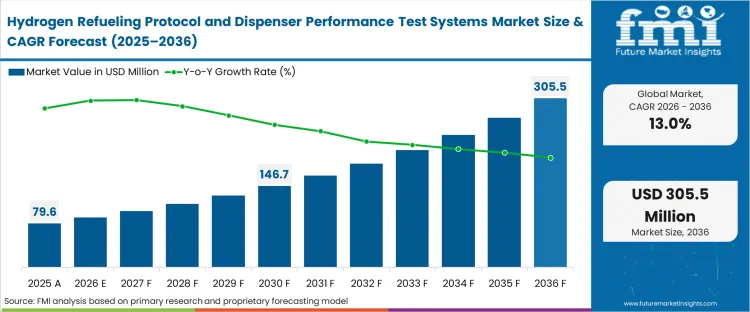
The hydrogen refueling protocol and dispenser performance test systems market crossed a valuation of USD 80.0 million in 2025. The industry is expected to reach USD 90.0 million in 2026 at a CAGR of 13.0% during the forecast period. Demand outlook carries the market valuation to USD 310.0 million by 2036 as infrastructure developers prioritize precise protocol validation and metrology compliance for hydrogen station commissioning.
Summary of Hydrogen Refueling Protocol and Dispenser Performance Test Systems Market
- Hydrogen Refueling Protocol and Dispenser Performance Test Systems Market Definition
- Purpose-built validation infrastructure verifies the thermodynamic accuracy, communication reliability, and operational safety of high-pressure dispensing equipment before it is used in public vehicle fueling environments. These systems simulate real dispensing conditions, monitor protocol behavior, and confirm that pressure control, temperature response, and safety interlocks perform as required. Their role is essential in reducing fueling risk, supporting compliance, and ensuring dependable hydrogen station performance under demanding operating conditions.
- Demand Drivers in the Market
- Rapid construction schedules force infrastructure developers to internalize mobile testing assets to eliminate third-party certification delays.
- Consumer protection regulations demand accurate weights and measures validation before authorizing retail billing operations.
- New high-flow commercial trucking protocols require entirely new testing platforms capable of absorbing massive pressure drops safely.
- Key Segments Analyzed in the FMI Report
- Equipment Type: Hydrogen station performance test devices are estimated to hold 31.0% share in 2026, capturing primary capital spend due to their comprehensive full-fill simulation capabilities.
- Test Focus: Protocol compliance validation is expected to record 28.0% share in 2026, satisfying strict regulatory demands for exact adherence to precise temperature and pressure tables.
- End User: Station developers and operators are projected to secure 34.0% share in 2026, reflecting the massive shift toward internalizing commissioning fleets to control project timelines.
- India: 15.0% compound growth, sustained by aggressive domestic initiatives mandating localized testing capacity for emerging transit networks.
- Analyst Opinion at FMI
- Nikhil Kaitwade, Principal Analyst, Automation, at FMI, notes, "Assuming standard industrial flow measurement works for retail hydrogen dispensing ignores the extreme thermodynamic realities of the fuel. When gas compresses into a vehicle tank, it heats rapidly. Dispensers must pre-cool the fuel and communicate with the vehicle to prevent structural damage. Testing this requires specialized vehicle surrogates that simulate full fill cycles. State regulators increasingly refuse to authorize station openings without comprehensive data logs from these validation trailers proving exact protocol compliance. Investing in advanced mobile testing units transforms from a minor quality assurance expense into the primary bottleneck determining whether a multi-million-dollar station actually generates revenue or sits idle awaiting certification."
- Strategic Implications / Executive Takeaways
- Infrastructure directors must transition from relying on external labs to building internal mobile validation fleets.
- Commissioning engineering leads face immediate demands to integrate automated metrology checks directly into protocol software testing.
- Capital planning executives risk severe operational bottlenecks if they ignore the rapid transition toward specialized high-flow commercial truck testing hardware.
- Methodology
- Target insights gathered directly from chief certification officers and station operations directors.
- Technical parameters verified against published SAE fueling standards and regional weights and measures regulations.
- Value baselines anchored to confirmed capital expenditure budgets for mobile testing trailer fleet expansion.
- Demand curves cross-referenced with public infrastructure construction timelines for high-capacity corridor rollouts.
Hydrogen Refueling Protocol and Dispenser Performance Test Systems Market Key Takeaways
| Metric | Details |
|---|---|
| Industry Size (2026) | USD 90.0 Million |
| Industry Value (2036) | USD 310.0 Million |
| CAGR (2026-2036) | 13.00% |
Source: Future Market Insights (FMI) analysis, based on proprietary forecasting model and primary research
Station operators face a complex reality where opening a site requires proving exact compliance with international dispensing standards. Relying on paper documentation fails when dispensing extremely cold gas under immense pressure. Upgrading validation capabilities directly determines which infrastructure developers receive final commissioning approvals. What planners frequently underestimate is how tightly hydrogen dispenser control software integrates with vehicle communication hardware. Evaluating these handshake protocols requires physical testing using advanced hydrogen dispenser performance validation systems. Securing hydrogen refueling station operational permits demands irrefutable metrology data proving accurate billing and safe tank temperature management. Delays in acquiring mobile testing systems force operators to push back grand openings, burning capital while sites sit idle waiting for third-party certifiers to arrive.
Understanding what drives demand for hydrogen fueling protocol test systems requires analyzing full network interoperability challenges. Infrastructure managers initiate capital expenditure cycles once their initial sites encounter communication faults with newer vehicle models. Precise software handshake emulation unlocks rapid station commissioning without risking damage to actual consumer vehicles. Upgrading from static flow meters to the latest hydrogen station equipment performance device market analyzers becomes the absolute prerequisite for expanding high-capacity commercial fueling corridors.
India leads geographic growth at 15.0% as domestic mandates force localized infrastructure validation. China tracks at 14.2% driven by aggressive heavy-duty fleet deployments requiring high-flow performance verification. South Korea expands at 13.1% guided by state-backed initiatives accelerating station rollout schedules. United States testing capacity grows at 12.8% responding to stringent consumer weights and measures regulations in early-adopter states. Germany advances at 11.9% as heritage gas suppliers modernize European corridors. Japan adds 11.4% while France records 10.7% supported by localized municipal fleet transition projects.
Hydrogen Refueling Protocol and Dispenser Performance Test Systems Market Definition
Addressing what is a hydrogen refueling protocol and dispenser performance test system reveals purpose-built validation infrastructure verifying the thermodynamic accuracy, communication reliability, and overall safety of high-pressure dispensing equipment prior to public vehicle fueling. Systems execute complex simulated fills to monitor precooling temperatures, pressure ramp rates, and infrared communication handshakes between the dispenser and the receptacle. Advanced platforms combine physical storage tanks with sophisticated data acquisition modules to prove adherence to international fueling protocols.
Hydrogen Refueling Protocol and Dispenser Performance Test Systems Market Inclusions
Scope captures any mobile hydrogen dispenser testing apparatus, dedicated data logging electronics, specialized flow measurement skids, and protocol emulation software required for evaluating retail dispensing installations. Revenue sizing encompasses new system fabrication, proprietary software license renewals for hydrogen fueling protocol compliance testing, and specialized calibration services provided directly by equipment manufacturers to certification agencies. Hardware designed to capture infrared signals according to SAE J2799 guidelines falls entirely within these evaluated boundaries.
Hydrogen Refueling Protocol and Dispenser Performance Test Systems Market Exclusions
Basic industrial flow meters lacking specific protocol communication capabilities fall outside evaluated boundaries due to insufficient control integration. General-purpose laboratory pressure transducers and standalone hydrogen valves are omitted. Equipment designed exclusively for validating natural gas or liquid fuel dispensers does not contribute to core platform valuation totals. Routine site maintenance contracts executed by third-party service providers separate from original testing equipment fabrication are excluded.
Hydrogen Refueling Protocol and Dispenser Performance Test Systems Market Research Methodology
- Primary Research: Certification agency directors, metrology laboratory managers, and commissioning engineers within major infrastructure development firms.
- Desk Research: SAE International protocol publications, state weights and measures regulatory frameworks, and equipment manufacturer technical specifications.
- Market-Sizing and Forecasting: Installed base replacement rates and scheduled capital expenditure plans for mobile testing fleet expansion.
- Data Validation and Update Cycle: Independent station commissioning volume growth cross-verifies physical testing device deployment trajectories.
Segmental Analysis
Hydrogen Refueling Protocol and Dispenser Performance Test Systems Market Analysis by Equipment Type
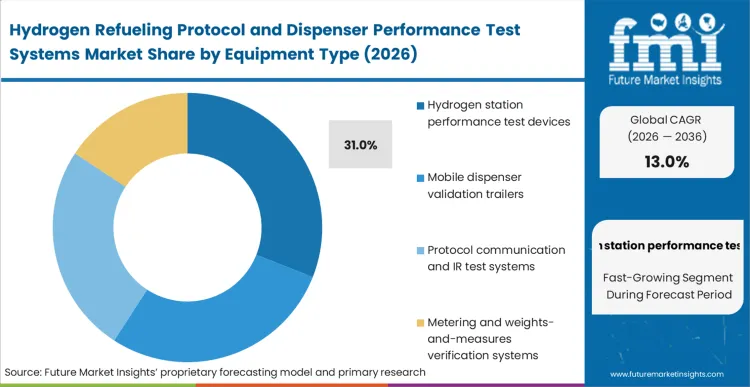
Hydrogen station performance test devices secure 31.0% share. FMI analysis indicates commissioning engineers prioritize these comprehensive systems when preparing an RFQ hydrogen station performance test device to execute full simulated fills without risking early consumer vehicles. Evaluating complex abort sequences prevents catastrophic over-pressurization events during public use. What infrastructure developers frequently overlook is how rapidly evolving fueling standards render older validation equipment obsolete. Upgrading software to handle new heavy-duty protocols dictates hardware choices, locking certification agencies into specific vendor ecosystems based on initial data acquisition integration. The reliance on advanced hydrogen compressor systems within the station forces testing devices to absorb immense pressure spikes safely. Delays in acquiring updated testing platforms force operators to postpone site openings during critical launch phases.
- Decision Phase: Initial site commissioning preparation. Engineers require absolute measurement precision to prove thermodynamic compliance before inviting state metrology inspectors to the site.
- Qualification Metric: Infrared communication reliability. Certifiers evaluate how accurately the testing device mimics a vehicle transmitting tank temperature data to the dispenser nozzle.
- Expansion Trigger: Network capacity upgrades. Program directors authorize additional testing trailer purchases when existing fleets cannot physically cover the geographic spread of newly constructed stations.
Hydrogen Refueling Protocol and Dispenser Performance Test Systems Market Analysis by Test Focus
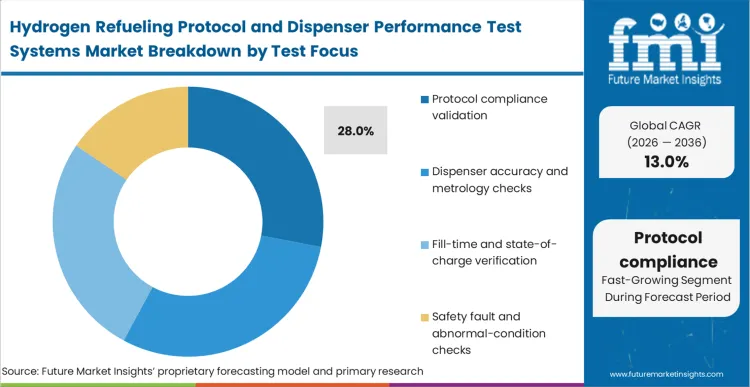
Adhering to international standards ensures that any consumer vehicle can fuel safely at any public station. Protocol compliance validation commands 28.0% share as regulatory bodies require certified baseline data before approving retail operations. For officials questioning how are hydrogen dispensers tested for J2601 compliance, FMI observes that mapping the complex table-based filling algorithms demands precise pressure measurement combined with rapid infrared signal decoding. Highlighting a crucial operational contradiction, developers often invest heavily in massive hydrogen storage tanks while severely under-equipping the engineering teams responsible for generating a hydrogen fueling protocol compliance rig quotation. Failing to isolate communication errors from mechanical dispensing faults results in intermittent fueling aborts that destroy early consumer confidence.
- Baseline Requirement: Fill table execution. Inspectors mandate exhaustive logging of temperature ramps to satisfy international engineering guidelines.
- Hidden Cost: Field deployment logistics. Technicians manage massive operational budgets consumed entirely by transporting heavy validation trailers between isolated regional fueling sites.
- Lifecycle Benefit: Software refinement data. Calibration engineers utilize high-fidelity fault logs to tweak dispenser control algorithms, reducing nuisance aborts during actual consumer transactions.
Hydrogen Refueling Protocol and Dispenser Performance Test Systems Market Analysis by End User
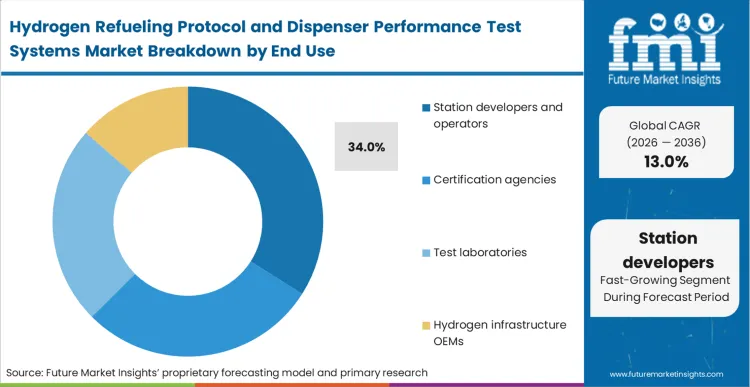
Internalizing critical validation capability prevents expensive delays waiting for third-party certifiers. Station developers and operators account for 34.0% share, investing capital to control their own commissioning schedules. FMI analysts note that maintaining total control over testing fleets sourced from reputable hydrogen station validation equipment vendors allows rapid software iteration without negotiating external access. The unspoken structural friction involves developers realizing their massive internal investments still lack specialized metrology certification, quietly outsourcing final weights and measures approval despite owning advanced protocol analyzers equipped with highly sensitive fuel cell electric vehicle emulation hardware. Insufficient internal regulatory authority forces program managers to truncate critical testing cycles just to meet ribbon-cutting deadlines.
- Primary Adopter: Dedicated infrastructure firms. Capital planning executives authorize fleet expansions to transition internal capabilities toward mass-deployment validation.
- Follower Shift: Certification agencies. Metrology directors add specific mobile trailers to verify site compliance independently before issuing final consumer sales permits.
- Final Convert: Research laboratories. Partnership directors invest in niche extreme-environment testing capabilities only after standard retail protocol mapping becomes heavily commoditized.
Hydrogen Refueling Protocol and Dispenser Performance Test Systems Market Drivers, Restraints, and Opportunities
Commissioning directors are now required to execute hundreds of site tests every year as hydrogen infrastructure development moves faster. Relying on limited state-owned testing capacity to verify dispenser performance can delay complete corridor rollouts. Privately owned automated field validation platforms help engineers identify protocol faults and adjust dispenser settings on site without waiting for external resources. Older manual testing methodologies increase the risk that competitors will launch operational stations months sooner and capture early-adopter fueling contracts. That urgency is turning mobile testing trailers into essential infrastructure deployment assets.
Extreme component fatigue and safe venting requirements severely bottleneck mobile testing operations. Executing hundreds of rapid simulated fills subjects the internal tanks and manifolds of the testing trailer to immense mechanical stress. Safely discharging the compressed gas after a test requires designated venting zones and strict adherence to local fire codes. Managing these localized safety footprints often costs commissioning teams significant operational time. The fundamental physical toll on high-pressure regulators inside the testing equipment necessitates frequent, expensive maintenance cycles that sideline crucial validation assets during peak station construction seasons.
Opportunities in the Hydrogen Refueling Protocol and Dispenser Performance Test Systems Market
- Heavy-duty protocol expansion: Developing high-flow validation platforms to accommodate emerging commercial truck standards allows equipment builders to capture premium infrastructure contracts.
- Automated metrology integration: Embedding certified weights and measures capability directly into protocol testing trailers empowers engineering facilities to complete full site approvals during a single visit.
- Digital twin diagnostic software: Deploying advanced analytics to simulate dispenser behavior using data from green hydrogen networks slashes the time required to diagnose field communication errors.
Regional Analysis
Based on regional analysis, hydrogen refueling protocol and dispenser performance test systems market is segmented into Asia Pacific, North America, and Europe across 40 plus countries.
.webp "Top Country Growth Comparison Hydrogen Refueling Protocol And Dispenser Performance Test Systems Market Cagr (2026 2036)")
| Country | CAGR (2026 to 2036) |
|---|---|
| India | 15.0% |
| China | 14.2% |
| South Korea | 13.1% |
| United States | 12.8% |
| Germany | 11.9% |
| Japan | 11.4% |
| France | 10.7% |
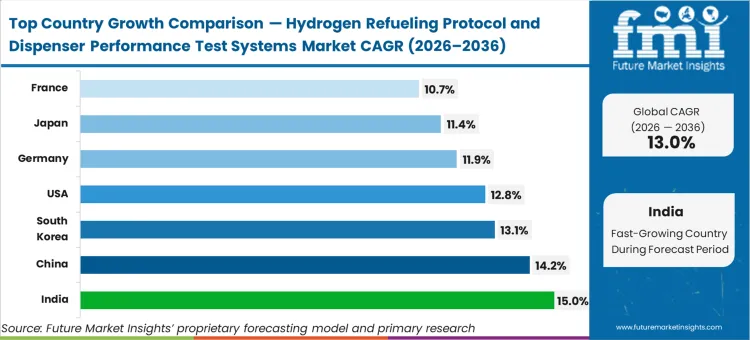
Source: Future Market Insights (FMI) analysis, based on proprietary forecasting model and primary research
Asia Pacific Hydrogen Refueling Protocol and Dispenser Performance Test Systems Market Analysis
Commercialization pressure is prompting wider testing facility expansion across major industrial hubs. Rather than wait for imported validation equipment, regional developers want localized testing assets that enable faster station commissioning and shorter iteration cycles. FMI analysis suggests that regional engineering executives now treat local testing infrastructure, sized to match state-backed hydrogen electrolyzer ambitions, as their foremost capital priority.
- China: China is moving quickly because hydrogen refueling programs are being developed on very compressed timelines, especially in heavy-duty mobility. That pace is pushing engineering teams to keep high-flow validation trailers in near-constant use so fueling systems can be checked under demanding pressure conditions without slowing deployment. With the market expanding at 14.2%, local operators are gaining a meaningful speed advantage, helped by stronger domestic verification requirements and larger multi-station testing fleets built for dense urban operating environments.
- South Korea: South Korea is approaching the market from a more capability-driven angle. As industrial and mobility systems shift further toward clean energy, developers need better onsite characterization of hydrogen generation and retail dispensing performance. The market is advancing at 13.1%, supported in part by public research funding that is helping buyers add more advanced diagnostic stations earlier in the development cycle. That is giving local players a faster way to map fueling protocol behavior and strengthen their role in global supply programs.
- Japan: Japan is taking a more measured route, though the technical bar remains high. Validation teams are expected to work through detailed safety matrices before public dispensing systems are cleared, and that is keeping demand centered on precision rather than rapid capacity buildout. At 11.4% growth, the market reflects careful spending priorities, with engineering centers giving more weight to exact diagnostic measurement and long-duration validation work, including closer attention to infrared communication testing within broader fueling protocols.
- India: India is starting to build momentum as domestic clean energy policy creates more pressure to validate fueling performance within local conditions. A major part of that comes from the need to test dispensing reliability under extreme ambient temperatures rather than depend on overseas certification. The market is growing at 15.0%, and stronger local validation capability is helping regional brands move faster with their own station launches while reducing dependence on external testing centers.
North America Hydrogen Refueling Protocol and Dispenser Performance Test Systems Market Analysis
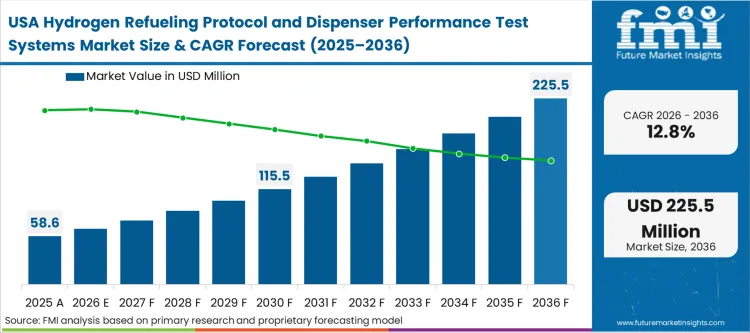
Consumer protection regulations are forcing large-scale spending on metrology verification infrastructure. Retail dispenser billing validation demands highly precise flow simulations, and these conditions rapidly expose the limits of basic diagnostic tools. According to FMI assessment, validation centers value robust measurement performance and high-pressure capability more than compact system layouts.
- United States: In the United States, hydrogen fueling test demand is being shaped by the need to validate station performance under the heavy-duty conditions expected in commercial highway use. The market is growing at 12.8%, supported by stronger demand for certification in truck-focused fueling programs. Public funding is also helping reduce the cost of advanced testing infrastructure, which is allowing more independent laboratories to offer certified validation services.
Europe Hydrogen Refueling Protocol and Dispenser Performance Test Systems Market Analysis
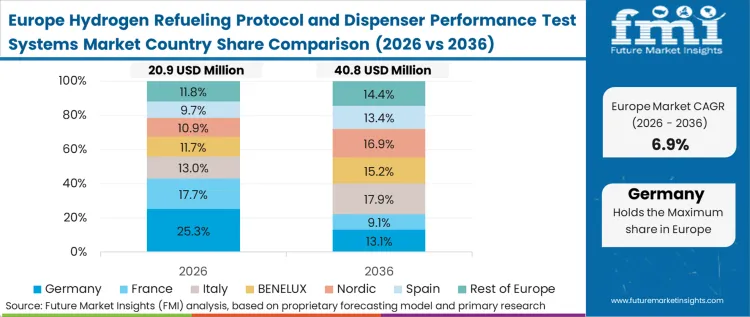
Heritage gas suppliers possess immense pipeline expertise but face urgent needs to modernize high-pressure retail dispensing evaluation. Upgrading regional corridors involves deploying mobile testing assets across diverse national borders to ensure uniform protocol compliance. FMI analysts observe that optimizing field deployment logistics drives preferences for highly integrated, ruggedized testing trailers.
Here is a more natural version with better flow:
- Germany: Germany’s growth is closely tied to the precision expected in its engineering and mobility programs. Research teams continue to demand highly accurate measurement, especially in applications where validation quality can influence wider industry standards. The market is expanding at 11.9%, and that technical discipline is helping domestic suppliers hold strong influence in how fueling protocols are assessed. Buyers are also placing more weight on compatibility, making sure new electronic protocol analyzers can work smoothly across different regional dispenser systems without creating integration problems.
- France: France is advancing through a more trust- and compliance-led path. Efficiency goals and sustainability targets are pushing operators to understand thermodynamic performance in much greater detail, especially in public transport projects where safety expectations are high. With the market tracking at 10.7%, much of the momentum is coming from upgraded validation practices that help operators demonstrate reliability more clearly. That is why infrastructure developers are spending more time on exhaustive fill-cycle testing with modular trailers before moving into municipal procurement programs.
Competitive Aligners for Market Players
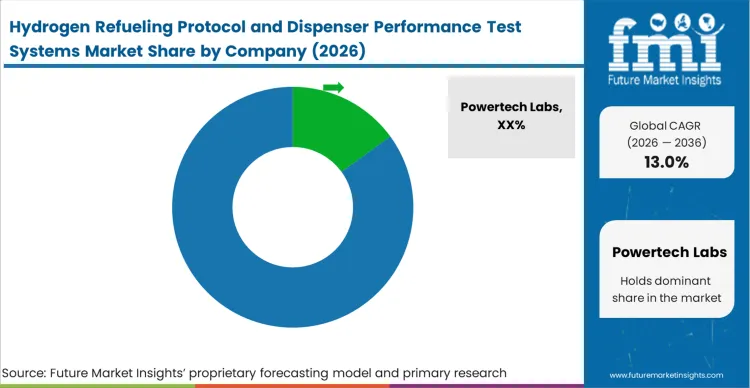
The companies that stay strongest in hydrogen dispenser testing are usually the ones already embedded in how labs operate day to day. Buyers are not just looking at the trailer, analyzer, or sensor package on its own. They are thinking about whether the system fits into existing safety workflows, whether older communication boards still work with it, and how much internal disruption a switch would create. That is why suppliers with long regulatory histories and familiar software environments tend to stay in place. Replacing hardware is one thing. Rebuilding years of automated scripts and retraining teams around a different logic layer is much harder.
That practical advantage becomes even stronger in field testing, where trust is built slowly. Operators want measurement repeatability, stable performance over long periods, and confidence that the equipment can handle volatile fueling conditions without creating safety exposure. A small leak or unstable reading is enough to shut down activity and trigger serious scrutiny. Because of that, newer players usually need to show something clearly better, especially in how they map fast transient thermodynamics during refueling, before labs are willing to move away from established vendors.
Even then, buyers are careful about giving too much control to one supplier. Many infrastructure teams want open API access and enough flexibility to keep future upgrades under their own control. Some are deliberately splitting contracts across vendors for that reason. So the decision is no longer just about choosing the most capable platform. It is also about building a testing setup that works smoothly today and still leaves room to adapt later.
Key Players in Hydrogen Refueling Protocol and Dispenser Performance Test Systems Market
- Powertech Labs
- CSA Group
- AVL List GmbH
- HORIBA FuelCon
- Intertek
- UL Solutions
- PDC Machines
Scope of the Report
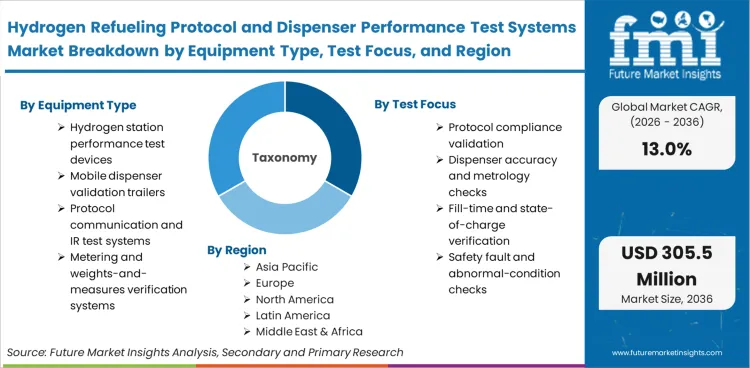
| Metric | Value |
|---|---|
| Quantitative Units | USD 90.0 Million to USD 310.0 Million, at a CAGR of 13.00% |
| Market Definition | Purpose-built validation infrastructure verifies the thermodynamic accuracy, communication reliability, and overall safety of high-pressure dispensing equipment prior to public vehicle fueling. |
| Segmentation | Equipment Type, Test Focus, End User, Region |
| Regions Covered | Asia Pacific, North America, Europe, Middle East and Africa, Latin America |
| Countries Covered | India, China, South Korea, United States, Germany, Japan, France |
| Key Companies Profiled | Powertech Labs, CSA Group, AVL List GmbH, HORIBA FuelCon, Intertek, UL Solutions, PDC Machines |
| Forecast Period | 2026 to 2036 |
| Approach | Installed base replacement rates and scheduled capital expenditure plans for mobile testing fleet expansion. |
Source: Future Market Insights (FMI) analysis, based on proprietary forecasting model and primary research
Hydrogen Refueling Protocol and Dispenser Performance Test Systems Market Analysis by Segments
Equipment Type:
- Hydrogen station performance test devices
- Mobile dispenser validation trailers
- Protocol communication and IR test systems
- Metering and weights-and-measures verification systems
Test Focus:
- Protocol compliance validation
- Dispenser accuracy and metrology checks
- Fill-time and state-of-charge verification
- Safety fault and abnormal-condition checks
End User:
- Station developers and operators
- Certification agencies
- Test laboratories
- Hydrogen infrastructure OEMs
Region:
- North America
- United States
- Canada
- Latin America
- Brazil
- Mexico
- Rest of Latin America
- Europe
- Germany
- United Kingdom
- France
- Italy
- Spain
- Russia
- Rest of Europe
- Asia Pacific
- China
- Japan
- India
- South Korea
- ASEAN
- Rest of Asia Pacific
- Middle East and Africa
- GCC Countries
- South Africa
- Rest of Middle East and Africa
Bibliography
- SAE International. (2024). J2799_202406: Hydrogen surface vehicle to station communications hardware and software - technical standard.
- National Institute of Standards and Technology. (2024, November 20). EPO No. 29: Hydrogen gas retail vehicle fuel dispensers.
- Ministry of New and Renewable Energy. (2024, May). Green hydrogen standards and approval systems in India. Government of India.
- Kim, C., Cho, S. H., Park, S. H., Kim, D. K., Kim, M., Lee, G., & Kim, S. (2024). Failure analysis and maintenance of hydrogen refueling stations. Journal of Mechanical Science and Technology, 38, 3829-3836.
- Kim, J. H., Lee, H.-Y., & Lee, J.-H. (2024). A study on metrological cross-validation of hydrogen refueling stations using a hybrid metrology evaluation system. Energy Reports, 11, 846-858.
This bibliography is provided for reader reference. The full FMI report contains the complete reference list with primary source documentation.
This Report Addresses
- Component fatigue limits impacting high-pressure validation trailer lifecycle costs.
- Safety venting regulations determining permissible mobile testing footprints in urban zones.
- Flow measurement accuracy required for certified metrology billing approvals.
- Software handshake emulation replacing physical test vehicles during commissioning.
- Precooling temperature evaluation driving advanced diagnostic platform procurement.
- Commercial truck protocol standards dictating extreme high-flow capacity expansion.
- Operator internalization of commissioning operations to eliminate third-party scheduling delays.
- Extreme thermal cycling degrading internal measurement components prematurely.
Frequently Asked Questions
How large is the hydrogen dispenser test systems market?
FMI assessed the market at USD 80.0 million in 2025. It is projected to reach USD 310.0 million by 2036, expanding at a CAGR of 13.00%.
To compare HyStEP and mobile dispenser testing trailers, what are the differences?
HyStEP established the original mobile validation concept for hydrogen station testing. Modern dispenser testing trailers add stronger metrology, rugged transport-ready designs, and faster fault-isolation capability.
What is HyStEP and how is it used?
The Hydrogen Station Equipment Performance device is a mobile vehicle surrogate used during station commissioning. It receives high-pressure gas and checks whether the dispenser follows fueling protocol, temperature control, and communication requirements.
How does heavy-duty hydrogen fueling validation differ from light-duty testing?
Heavy-duty validation uses higher-flow hardware and larger absorption capacity to simulate aggressive truck fueling events. Light-duty testing focuses on passenger vehicle fill profiles with lower flow and smaller gas volumes.
How do J2799 communication checks fit into dispenser validation?
J2799 checks verify that the dispenser correctly reads infrared signals from the vehicle during fueling. This ensures the station applies the right cooling strategy and fill rate for safe operation.
What is included in station commissioning and acceptance testing?
Commissioning validation includes protocol simulation, temperature ramp verification, flow accuracy checks, and safety fault testing. These steps confirm the station is ready for legal and safe public fueling.
How much does a mobile hydrogen dispenser testing apparatus cost?
Pricing depends on pressure rating, metrology certification, and diagnostic sophistication. High-capacity trailers with infrared sensing and vibration-controlled systems cost far more than basic flow skids.
Which countries are building the strongest demand for protocol-validation tools?
China, India, and South Korea are driving strong demand through state-backed hydrogen mobility programs. The United States and Germany also remain important markets due to strict compliance and metrology requirements.
What defines a dispenser metrology check?
A dispenser metrology check compares the actual dispensed hydrogen mass with the value shown on the billing display. Passing this test is essential before a station can legally sell fuel to retail users.
Why are developers internalizing testing operations?
Internal testing helps developers identify faults early and reduce dependence on third-party inspection schedules. It also improves first-pass compliance and lowers costly commissioning delays.
What initiates a safety fault check?
Technicians trigger a simulated fault such as signal loss or abnormal temperature rise during a fill event. The test confirms that the dispenser stops gas flow and activates the required safety response immediately.
How do testing devices handle vented gas?
After each simulated fill, the stored hydrogen must be discharged safely before the next cycle begins. Mobile testing units use controlled vent stacks to release gas without creating local flammability risk.
Why is testing liquid hydrogen dispensing fundamentally different?
Liquid hydrogen validation requires cryogenic sensors, insulated plumbing, and vacuum-jacketed hardware. Standard gaseous hydrogen testing trailers cannot safely manage extreme low-temperature liquid fueling conditions.
What challenges exist in infrared signal testing?
Infrared communication can be disrupted by sunlight, rain, frost, or nozzle alignment issues. Testing systems must confirm that the link remains stable under real operating conditions.
How does software impact hardware selection?
Control software determines how fault sequences, communication checks, and validation scripts are executed. Many buyers stay with the same vendor because switching platforms can be expensive and disruptive.
What is fill-time verification?
Fill-time verification measures how long a station takes to reach the target fueling state. It helps prove that the dispenser can meet expected consumer performance targets.
How do national labs utilize these systems?
National labs use advanced validation systems to study experimental dispenser designs and test future protocol revisions. Their data supports standards development before commercial deployment begins.
How are hydrogen tube trailers related to site testing?
Site testing consumes large hydrogen volumes across repeated validation cycles. Tube trailers are often needed to supply enough gas for commissioning and acceptance testing activity.
Why do engineering firms outsource component fabrication?
Ultra-high-pressure manifolds and vessels require specialized machining and certified materials expertise. Many equipment designers outsource these parts while focusing internally on controls, software, and system integration.
Preview the report firsthand - request a free sample
Get SampleGet the brochure for pricing and purchase details.
Get PDFTable of Content
- Executive Summary
- Global Market Outlook
- Demand-side Trends
- Supply-side Trends
- Technology Roadmap Analysis
- Analysis and Recommendations
- Market Overview
- Market Coverage / Taxonomy
- Market Definition / Scope / Limitations
- Analytical Lens and Working Hypotheses
- Market Structure, Signals, and Trend Drivers
- Benchmarking and Cross-market Comparability
- Market Sizing, Forecasting, and Opportunity Mapping
- Research Design and Evidence Framework
- Desk Research Programme (Secondary Evidence)
- Company Annual and Sustainability Reports
- Peer-reviewed Journals and Academic Literature
- Corporate Websites, Product Literature, and Technical Notes
- Earnings Decks and Investor Briefings
- Statutory Filings and Regulatory Disclosures
- Technical White Papers and Standards Notes
- Trade Journals, Industry Magazines, and Analyst Briefs
- Conference Proceedings, Webinars, and Seminar Materials
- Government Statistics Portals and Public Data Releases
- Subscription Datasets and Paid Sources
- Social Channels, Communities, and Digital Listening Inputs
- Additional Desk Sources
- Expert Input and Fieldwork (Primary Evidence)
- Primary Modes
- Qualitative Interviews and Expert Elicitation
- Quantitative Surveys and Structured Data Capture
- Blended Approach
- Why Primary Evidence is Used
- Field Techniques
- Interviews
- Surveys
- Focus Groups
- Observational and In-context Research
- Social and Community Interactions
- Stakeholder Universe Engaged
- C-suite Leaders
- Board Members
- Presidents and Vice Presidents
- R&D and Innovation Heads
- Technical Specialists
- Domain Subject-matter Experts
- Scientists
- Physicians and Other Healthcare Professionals
- Governance, Ethics, and Data Stewardship
- Research Ethics
- Data Integrity and Handling
- Primary Modes
- Tooling, Models, and Reference Databases
- Desk Research Programme (Secondary Evidence)
- Data Engineering and Model Build
- Data Acquisition and Ingestion
- Cleaning, Normalisation, and Verification
- Synthesis, Triangulation, and Analysis
- Quality Assurance and Audit Trail
- Market Background
- Market Dynamics
- Drivers
- Restraints
- Opportunity
- Trends
- Scenario Forecast
- Demand in Optimistic Scenario
- Demand in Likely Scenario
- Demand in Conservative Scenario
- Opportunity Map Analysis
- Product Life Cycle Analysis
- Supply Chain Analysis
- Investment Feasibility Matrix
- Value Chain Analysis
- PESTLE and Porter’s Analysis
- Regulatory Landscape
- Regional Parent Market Outlook
- Production and Consumption Statistics
- Import and Export Statistics
- Market Dynamics
- Global Market Analysis 2021 to 2025 and Forecast, 2026 to 2036
- Historical Market Size Value (USD Million) Analysis, 2021 to 2025
- Current and Future Market Size Value (USD Million) Projections, 2026 to 2036
- Y-o-Y Growth Trend Analysis
- Absolute $ Opportunity Analysis
- Global Market Pricing Analysis 2021 to 2025 and Forecast 2026 to 2036
- Global Market Analysis 2021 to 2025 and Forecast 2026 to 2036, By Equipment Type
- Introduction / Key Findings
- Historical Market Size Value (USD Million) Analysis By Equipment Type , 2021 to 2025
- Current and Future Market Size Value (USD Million) Analysis and Forecast By Equipment Type , 2026 to 2036
- Hydrogen station performance test devices
- Mobile dispenser validation trailers
- Protocol communication and IR test systems
- Metering and weights-and-measures verification systems
- Hydrogen station performance test devices
- Y-o-Y Growth Trend Analysis By Equipment Type , 2021 to 2025
- Absolute $ Opportunity Analysis By Equipment Type , 2026 to 2036
- Global Market Analysis 2021 to 2025 and Forecast 2026 to 2036, By Test Focus
- Introduction / Key Findings
- Historical Market Size Value (USD Million) Analysis By Test Focus, 2021 to 2025
- Current and Future Market Size Value (USD Million) Analysis and Forecast By Test Focus, 2026 to 2036
- Protocol compliance validation
- Dispenser accuracy and metrology checks
- Fill-time and state-of-charge verification
- Safety fault and abnormal-condition checks
- Protocol compliance validation
- Y-o-Y Growth Trend Analysis By Test Focus, 2021 to 2025
- Absolute $ Opportunity Analysis By Test Focus, 2026 to 2036
- Global Market Analysis 2021 to 2025 and Forecast 2026 to 2036, By End Use
- Introduction / Key Findings
- Historical Market Size Value (USD Million) Analysis By End Use, 2021 to 2025
- Current and Future Market Size Value (USD Million) Analysis and Forecast By End Use, 2026 to 2036
- Station developers and operators
- Certification agencies
- Test laboratories
- Hydrogen infrastructure OEMs
- Station developers and operators
- Y-o-Y Growth Trend Analysis By End Use, 2021 to 2025
- Absolute $ Opportunity Analysis By End Use, 2026 to 2036
- Global Market Analysis 2021 to 2025 and Forecast 2026 to 2036, By Region
- Introduction
- Historical Market Size Value (USD Million) Analysis By Region, 2021 to 2025
- Current Market Size Value (USD Million) Analysis and Forecast By Region, 2026 to 2036
- North America
- Latin America
- Western Europe
- Eastern Europe
- East Asia
- South Asia and Pacific
- Middle East & Africa
- Market Attractiveness Analysis By Region
- North America Market Analysis 2021 to 2025 and Forecast 2026 to 2036, By Country
- Historical Market Size Value (USD Million) Trend Analysis By Market Taxonomy, 2021 to 2025
- Market Size Value (USD Million) Forecast By Market Taxonomy, 2026 to 2036
- By Country
- USA
- Canada
- Mexico
- By Equipment Type
- By Test Focus
- By End Use
- By Country
- Market Attractiveness Analysis
- By Country
- By Equipment Type
- By Test Focus
- By End Use
- Key Takeaways
- Latin America Market Analysis 2021 to 2025 and Forecast 2026 to 2036, By Country
- Historical Market Size Value (USD Million) Trend Analysis By Market Taxonomy, 2021 to 2025
- Market Size Value (USD Million) Forecast By Market Taxonomy, 2026 to 2036
- By Country
- Brazil
- Chile
- Rest of Latin America
- By Equipment Type
- By Test Focus
- By End Use
- By Country
- Market Attractiveness Analysis
- By Country
- By Equipment Type
- By Test Focus
- By End Use
- Key Takeaways
- Western Europe Market Analysis 2021 to 2025 and Forecast 2026 to 2036, By Country
- Historical Market Size Value (USD Million) Trend Analysis By Market Taxonomy, 2021 to 2025
- Market Size Value (USD Million) Forecast By Market Taxonomy, 2026 to 2036
- By Country
- Germany
- UK
- Italy
- Spain
- France
- Nordic
- BENELUX
- Rest of Western Europe
- By Equipment Type
- By Test Focus
- By End Use
- By Country
- Market Attractiveness Analysis
- By Country
- By Equipment Type
- By Test Focus
- By End Use
- Key Takeaways
- Eastern Europe Market Analysis 2021 to 2025 and Forecast 2026 to 2036, By Country
- Historical Market Size Value (USD Million) Trend Analysis By Market Taxonomy, 2021 to 2025
- Market Size Value (USD Million) Forecast By Market Taxonomy, 2026 to 2036
- By Country
- Russia
- Poland
- Hungary
- Balkan & Baltic
- Rest of Eastern Europe
- By Equipment Type
- By Test Focus
- By End Use
- By Country
- Market Attractiveness Analysis
- By Country
- By Equipment Type
- By Test Focus
- By End Use
- Key Takeaways
- East Asia Market Analysis 2021 to 2025 and Forecast 2026 to 2036, By Country
- Historical Market Size Value (USD Million) Trend Analysis By Market Taxonomy, 2021 to 2025
- Market Size Value (USD Million) Forecast By Market Taxonomy, 2026 to 2036
- By Country
- China
- Japan
- South Korea
- By Equipment Type
- By Test Focus
- By End Use
- By Country
- Market Attractiveness Analysis
- By Country
- By Equipment Type
- By Test Focus
- By End Use
- Key Takeaways
- South Asia and Pacific Market Analysis 2021 to 2025 and Forecast 2026 to 2036, By Country
- Historical Market Size Value (USD Million) Trend Analysis By Market Taxonomy, 2021 to 2025
- Market Size Value (USD Million) Forecast By Market Taxonomy, 2026 to 2036
- By Country
- India
- ASEAN
- Australia & New Zealand
- Rest of South Asia and Pacific
- By Equipment Type
- By Test Focus
- By End Use
- By Country
- Market Attractiveness Analysis
- By Country
- By Equipment Type
- By Test Focus
- By End Use
- Key Takeaways
- Middle East & Africa Market Analysis 2021 to 2025 and Forecast 2026 to 2036, By Country
- Historical Market Size Value (USD Million) Trend Analysis By Market Taxonomy, 2021 to 2025
- Market Size Value (USD Million) Forecast By Market Taxonomy, 2026 to 2036
- By Country
- Kingdom of Saudi Arabia
- Other GCC Countries
- Turkiye
- South Africa
- Other African Union
- Rest of Middle East & Africa
- By Equipment Type
- By Test Focus
- By End Use
- By Country
- Market Attractiveness Analysis
- By Country
- By Equipment Type
- By Test Focus
- By End Use
- Key Takeaways
- Key Countries Market Analysis
- USA
- Pricing Analysis
- Market Share Analysis, 2025
- By Equipment Type
- By Test Focus
- By End Use
- Canada
- Pricing Analysis
- Market Share Analysis, 2025
- By Equipment Type
- By Test Focus
- By End Use
- Mexico
- Pricing Analysis
- Market Share Analysis, 2025
- By Equipment Type
- By Test Focus
- By End Use
- Brazil
- Pricing Analysis
- Market Share Analysis, 2025
- By Equipment Type
- By Test Focus
- By End Use
- Chile
- Pricing Analysis
- Market Share Analysis, 2025
- By Equipment Type
- By Test Focus
- By End Use
- Germany
- Pricing Analysis
- Market Share Analysis, 2025
- By Equipment Type
- By Test Focus
- By End Use
- UK
- Pricing Analysis
- Market Share Analysis, 2025
- By Equipment Type
- By Test Focus
- By End Use
- Italy
- Pricing Analysis
- Market Share Analysis, 2025
- By Equipment Type
- By Test Focus
- By End Use
- Spain
- Pricing Analysis
- Market Share Analysis, 2025
- By Equipment Type
- By Test Focus
- By End Use
- France
- Pricing Analysis
- Market Share Analysis, 2025
- By Equipment Type
- By Test Focus
- By End Use
- India
- Pricing Analysis
- Market Share Analysis, 2025
- By Equipment Type
- By Test Focus
- By End Use
- ASEAN
- Pricing Analysis
- Market Share Analysis, 2025
- By Equipment Type
- By Test Focus
- By End Use
- Australia & New Zealand
- Pricing Analysis
- Market Share Analysis, 2025
- By Equipment Type
- By Test Focus
- By End Use
- China
- Pricing Analysis
- Market Share Analysis, 2025
- By Equipment Type
- By Test Focus
- By End Use
- Japan
- Pricing Analysis
- Market Share Analysis, 2025
- By Equipment Type
- By Test Focus
- By End Use
- South Korea
- Pricing Analysis
- Market Share Analysis, 2025
- By Equipment Type
- By Test Focus
- By End Use
- Russia
- Pricing Analysis
- Market Share Analysis, 2025
- By Equipment Type
- By Test Focus
- By End Use
- Poland
- Pricing Analysis
- Market Share Analysis, 2025
- By Equipment Type
- By Test Focus
- By End Use
- Hungary
- Pricing Analysis
- Market Share Analysis, 2025
- By Equipment Type
- By Test Focus
- By End Use
- Kingdom of Saudi Arabia
- Pricing Analysis
- Market Share Analysis, 2025
- By Equipment Type
- By Test Focus
- By End Use
- Turkiye
- Pricing Analysis
- Market Share Analysis, 2025
- By Equipment Type
- By Test Focus
- By End Use
- South Africa
- Pricing Analysis
- Market Share Analysis, 2025
- By Equipment Type
- By Test Focus
- By End Use
- USA
- Market Structure Analysis
- Competition Dashboard
- Competition Benchmarking
- Market Share Analysis of Top Players
- By Regional
- By Equipment Type
- By Test Focus
- By End Use
- Competition Analysis
- Competition Deep Dive
- Powertech Labs
- Overview
- Product Portfolio
- Profitability by Market Segments (Product/Age /Sales Channel/Region)
- Sales Footprint
- Strategy Overview
- Marketing Strategy
- Product Strategy
- Channel Strategy
- CSA Group
- AVL List GmbH
- HORIBA FuelCon
- Intertek
- UL Solutions
- PDC Machines
- Powertech Labs
- Competition Deep Dive
- Assumptions & Acronyms Used


