

- Industry Size (2026)
- USD 480 Mn
- Forecast (2036)
- USD 935.4 Mn
- CAGR (2026 to 2036)
- 6.9%
Hearing Aid and True Wireless Earbud Acoustic Performance Test Systems Market Size, Market Forecast And Outlook By FMI
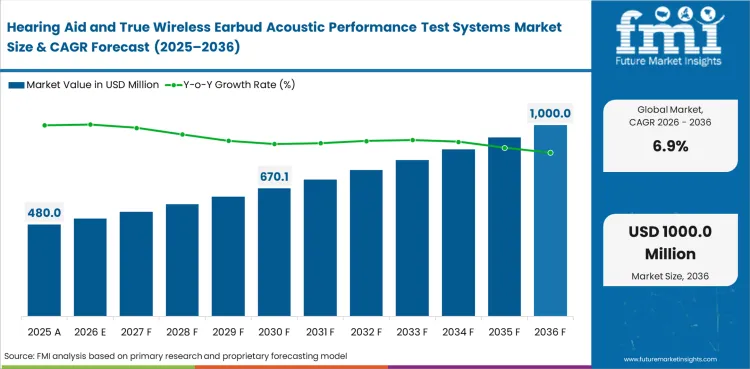
Future Market Insights notes the hearing aid and true wireless earbud acoustic performance test systems market at USD 449 million in 2025 and USD 480 million in 2026. The industry is projected to reach USD 935.4 million by 2036, which implies a 6.9% CAGR over the forecast period and an incremental opportunity of USD 455.4 million.
Summary of hearing aid and true wireless earbud acoustic performance test systems market
- The industry is estimated at USD 480 million in 2026 and is projected to reach USD 935.4 million by 2036.
- Forecast expansion stands at 6.9% CAGR from 2026 to 2036 with USD 455.4 million in incremental opportunity.
- Production line systems are expected to account for 34% of test type demand in 2026.
- Ear simulators are projected to contribute 29% of product type segment in 2026.
- TWS earbuds are likely to represent 52% of device type demand in 2026.
- OEMs are expected to contribute 46% of end use demand in 2026.
- Direct sales are set to make up 63% of sales channel demand in 2026.
- Audio Precision remains a reference supplier in analyzer-led workflows with an estimated 12% market share.
Key Takeaways, Market Size, and Forecast
- Hearing Aid and True Wireless Earbud Acoustic Performance Test Systems Market is projected to grow from USD 480 million in 2026 to USD 935.4 million by 2036, at a CAGR of 6.9%.
- The hearing aid and true wireless earbud acoustic performance test systems market was valued at USD 449 million in 2025.
- By 2036, the Hearing Aid and True Wireless Earbud Acoustic Performance Test Systems Market is expected to be worth USD 935.4 million.
- From 2026 to 2036, the market is projected to expand at a CAGR of 6.9%.
- The market is projected to create an incremental opportunity of USD 455.4 million between 2026 and 2036.
- In 2026, Production Line Systems are expected to account for 34.0% of the test type segment.
- China (8.1%) and India (8.0%) are two of the fastest growing markets.
Hearing Aid and True Wireless Earbud Acoustic Performance Test Systems Market key takeaways
| Parameter | Details |
|---|---|
| Market value (2026) | USD 480 million |
| Forecast value (2036) | USD 935.4 million |
| CAGR (2026 to 2036) | 6.9% |
| Estimated market value (2025) | USD 449 million |
| Incremental opportunity | USD 455.4 million |
| Leading test type | Production Line Systems (34% of test type segment) |
| Leading product type | Ear Simulators (29% of product type segment) |
| Leading device type | TWS Earbuds (52% of device type segment) |
| Leading end use | OEMs (46% of end use segment) |
| Leading sales channel | Direct Sales (63% of sales channel segment) |
| Key players | Audio Precision, GRAS Sound & Vibration, Brüel & Kjær, HEAD acoustics, Listen, Inc., Frye Electronics, CRYSOUND |
Source: Future Market Insights, 2026
Spending in this market is rising as test systems are expected to keep results stable from product development through factory validation. Manufacturers are placing greater value on platforms that combine analyzers and software into one repeatable process. Product complexity is increasing across hearing aids and wireless audio products. Demand is supported by calibration continuity and reliable application support. This keeps the market on a steady industrial path, not a volatile consumer-electronics cycle.
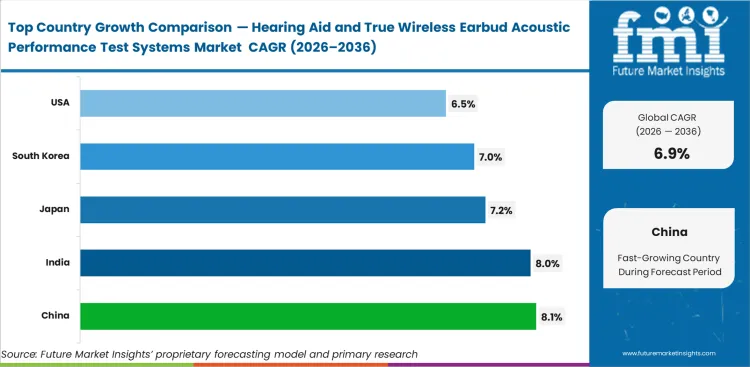
Among the countries, China is projected to expand at 8.1% CAGR through 2036, while India is expected to grow at 8% CAGR through 2036 as local hearables manufacturing continues to build. Japan is forecast to register 7.2% CAGR through 2036, and South Korea is set to record 7% CAGR through 2036, supported by disciplined audio engineering and electronics production. The United States is anticipated to grow at 6.5% CAGR through 2036, Germany is projected to rise at 6.1% CAGR through 2036, and the United Kingdom is expected to advance at 5.8% CAGR through 2036, with demand in these markets shaped more by installed validation capacity, hearing-device activity, and engineering-led spending.
Hearing Aid and True Wireless Earbud Acoustic Performance Test Systems Market Definition
The market covers hardware and software systems used to measure the acoustic performance of hearing aids and true wireless earbuds under controlled and repeatable conditions. Included systems generate, capture, analyze, and document parameters such as frequency response, output level, distortion, leakage, insertion response, microphone performance, and channel balance.
Hearing Aid and True Wireless Earbud Acoustic Performance Test Systems Market Inclusions
Scope includes audio analyzers, artificial ears, ear simulators, 2 cc couplers, acoustic chambers, head and torso simulators, test microphones, stimulus generation modules, switch boxes, and measurement software used for hearing aid and earbud verification.
Hearing Aid and True Wireless Earbud Acoustic Performance Test Systems Market Exclusions
The scope excludes finished hearing aids, finished earbuds, clinical audiometers used primarily for patient diagnosis, and generic laboratory microphones sold without a hearing aid or earbud testing use case. It also excludes broad semiconductor test equipment, battery test systems, and general Bluetooth certification services.
Hearing Aid and True Wireless Earbud Acoustic Performance Test Systems Market Research Methodology
- Primary Research: Supplier product pages, application notes, official product announcements, and sector associations were used to identify system architecture, active vendors, and practical equipment buying behavior across hearing aid and earbud test workflows.
- Desk Research: The model used 2024 to 2026 statistics from WHO, EHIMA, the British Academy of Audiology, World Bank WITS trade data, and official vendor documentation covering electroacoustic fixtures, analyzers, and software.
- Market Sizing and Forecasting: Sizing was built from a bottom-up view of addressable production and validation demand, then cross-checked against the installed nature of test benches, replacement cycles, and disclosed product breadth across active suppliers.
- Data Validation and Update Cycle: Values, shares, country rankings, and competitive assumptions were reconciled against current official pages and refreshed to reflect the position available as of April 2026.
Why Is the Hearing Aid and True Wireless Earbud Acoustic Performance Test Systems Market Growing?
- Demand is rising as higher hearing aid output and larger earbud production runs require more repeatable validation across engineering and factory environments.
- Connected hearing aids require tighter acoustic verification as Bluetooth streaming and miniature packaging increase test complexity.
- OEMs and contract manufacturers prefer unified workflows that keep R&D and factory limits aligned across product launches.
Manufacturers increasingly want systems that let engineering groups and production staff work from the same measurement framework, which reduces mismatch during product launch and ramp-up. This preference is visible across earphone and headphone products. It reflects the rising value of early defect isolation in designs using MEMS microphones. Suppliers with stronger application software and fixture control are gaining ground as manufacturers place more weight on repeatability.
Audio devices are carrying more wireless complexity, tighter packaging, and higher expectations for perceived sound quality, which makes older point-check methods less effective. Test environments are therefore becoming more software-driven and more closely aligned with adjacent areas such as industrial bluetooth, bluetooth low energy, loudspeakers, and ear health, helping this market expand through practical equipment upgrades rather than speculative buying.
Segmental Analysis
- Production line systems are expected to account for 34% share in 2026, reflecting the need for repeatable release checks in large audio programs.
- Ear simulators account for 29% share in 2026, while analyzers, acoustic chambers, HATS, and software support wider testing needs.
- TWS earbuds capture 52% share in 2026, while prescription and OTC hearing aids sustain regulated validation demand.
- OEMs hold 46% share in 2026, while contract manufacturers and specialist labs continue influencing configured system purchases.
- Direct sales represent 63% share in 2026, though distributors and system integrators remain relevant for deployment support.
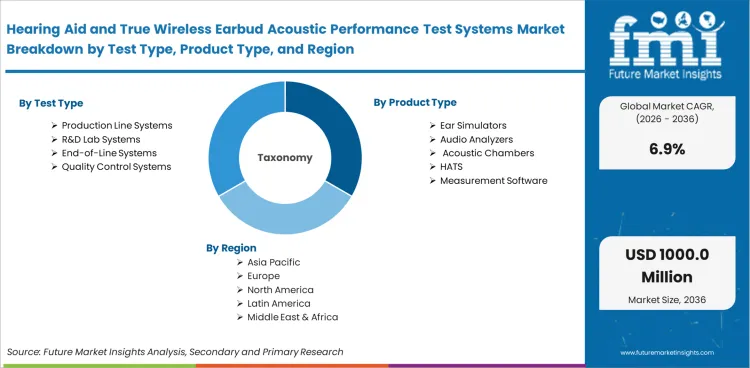
The market is segmented by test type, product type, device type, end use, and sales channel. Test type includes Production Line Systems, R&D Lab Systems, End-of-Line Systems, and Quality Control Systems. Product type covers Ear Simulators, Audio Analyzers, Acoustic Chambers, HATS, and Measurement Software. Device type includes TWS Earbuds, Prescription Hearing Aids, and OTC Hearing Aids. Sales channels include Direct Sales, Distributors, and System Integrators.
Insights into the Production Line Systems Segment
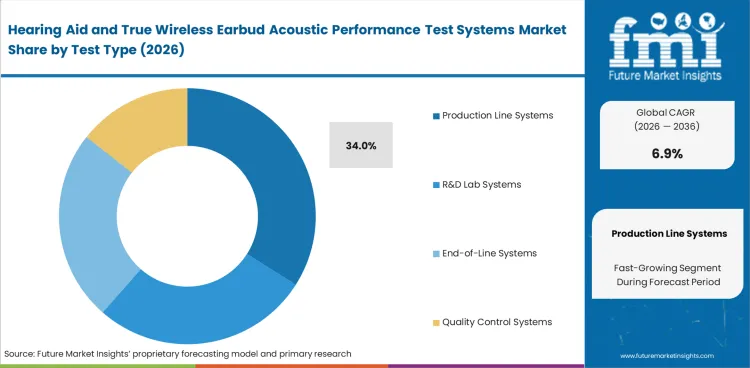
Production line systems are expected to account for 34% share in 2026. The segment leads because manufacturers need stable acoustic checks during release and ramp-up across larger audio programs. Manufacturers place high value on repeatable pass-fail routines that can move from engineering into plant use with limited variation.
Insights into the Ear Simulators Segment
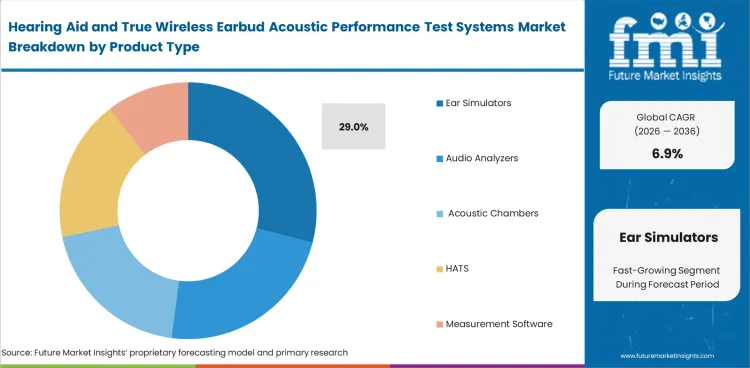
Ear simulators are projected to contribute 29% of product type demand in 2026. This segment reflects the need to measure in-ear devices under controlled and repeatable acoustic conditions across hearing aids and earbuds. Manufacturers rely on these tools for traceable calibration and comparable response over time.
Insights into the TWS Earbuds Segment
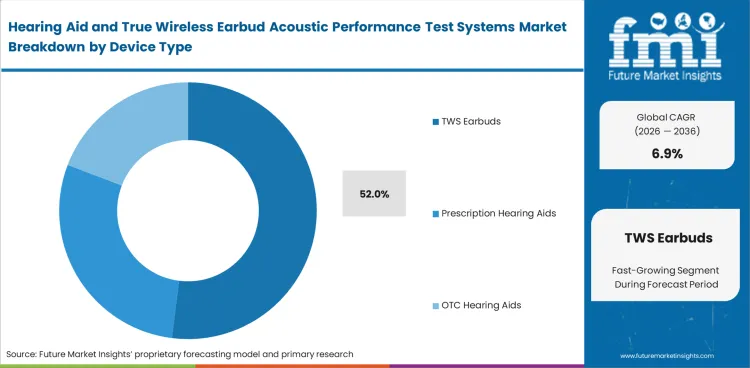
TWS earbuds are anticipated to represent 52% of the market in 2026. The segment remains ahead due to far higher production volumes and quicker model refresh cycles than hearing aids. Mnaufacturers need systems that can handle pairing checks and leakage testing with minimal setup delay.
Insights into the OEMs Segment
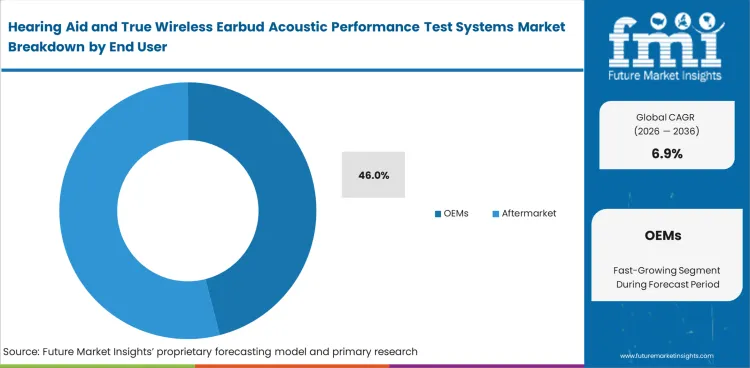
OEMs are likely to secure 46% share in 2026. Large manufacturers usually define test methods early and carry them through development and production transfer. This increases demand for configured systems. Software continuity and calibration planning stay important in these accounts, especially for programs linked with the ear health market and the conference microphones market.
Insights into the Direct Sales Segment
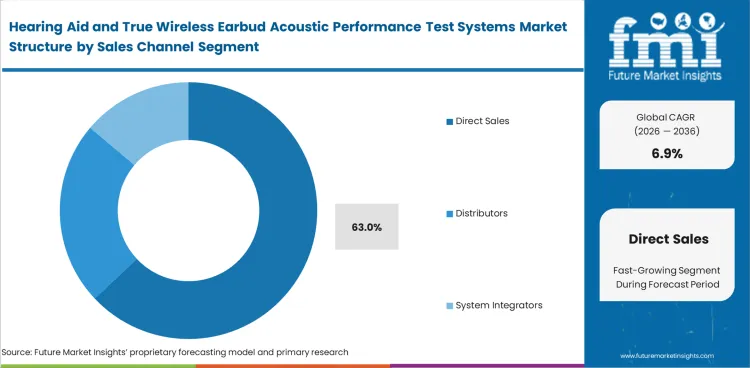
Direct sales are set to make up 63% of the market in 2026. Manufacturers usually need software configuration and calibration support before the system can be used effectively in daily testing. This keeps direct supplier relationships strong across hearing aid validation and premium earbud programs.
What are the Drivers, Restraints, And Key Trends In The Hearing Aid And True Wireless Earbud Acoustic Performance Test Systems Market?
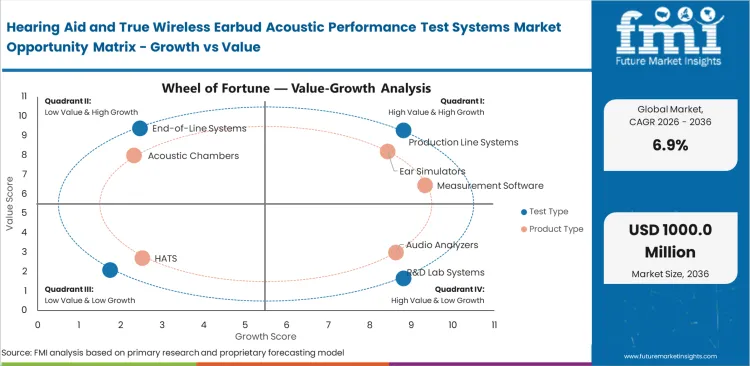
- Rising hearing aid output and larger earbud production runs are sustaining demand for more repeatable acoustic validation systems.
- Long operating life for analyzers and fixtures continues to slow full-system replacement in mature customer accounts.
- Software-led workflows are gaining importance as companies look for tighter integration across connected audio and factory testing tasks.
The market is advancing through practical testing needs tied to product complexity and factory consistency. Companies are buying systems that keep test methods consistent from lab work to factory use, since differences between sites can increase failure risk and slow product launch. This shift is becoming more visible across adjacent categories linked to the earphones market and the bluetooth low energy market, where compact connected devices need more disciplined validation support.
Rising Output of Hearing Aids and Earbuds
Demand is supported by higher hearing aid volumes and much larger earbud production runs. This expands the need for configured validation systems. Higher output does not translate directly into matching test-equipment growth, though it still raises bench demand during development and release testing.
Durable Installed Base and Replacement Drag
Replacement demand remains measured since analyzers and couplers usually stay in service for long periods. Many users extend equipment life through software upgrades or fixture changes instead of buying full new systems. This keeps market expansion steady, not rapid, especially in mature engineering environments.
Software-Led Workflow Development
Software is becoming a stronger differentiator as customers want integrated environments that combine measurement control and result interpretation. Manufacturers increasingly prefer systems that reduce setup time while keeping lab and production methods aligned across groups. This direction is strengthening supplier positioning in both hearing aid and earbud programs.
Analysis of Hearing Aid and True Wireless Earbud Acoustic Performance Test Systems Market By Key Countries
- China is projected to grow at 8.1% CAGR through 2036, supported by large-scale earbud manufacturing and export-linked testing demand.
- India is expected to expand at 8% CAGR through 2036, driven by rising hearables production and broader electronics growth.
- Japan is forecast to grow at 7.2% CAGR through 2036, supported by premium audio engineering and hearing-care discipline.
- South Korea is projected to rise at 7% CAGR through 2036, backed by compact electronics design and export-linked validation needs.
- United States is expected to grow at 6.5% CAGR through 2036, supported by strong lab demand and device qualification work.
.webp "Top Country Growth Comparison Hearing Aid And True Wireless Earbud Acoustic Performance Test Systems Market Cagr (2026 2036)")
| Country | CAGR |
|---|---|
| China | 8.1% |
| India | 8% |
| Japan | 7.2% |
| South Korea | 7% |
| United States | 6.5% |
Source: Future Market Insights, 2026
Demand Outlook for Hearing Aid and True Wireless Earbud Acoustic Performance Test Systems Market in China
China is projected to expand at a CAGR of 8.1% through 2036, with demand supported by large-scale earbud manufacturing and export-linked electronics production. The country holds a central position in factory-facing test demand because high unit output creates steady spending on analyzers and software used in qualification and end-of-line control. Local supplier access helps shorten customization cycles for fast-moving audio programs.
- Large-scale earbud production sustains factory acoustic testing demand.
- Export-linked electronics activity supports line-side validation investment.
- Supplier proximity helps speed fixture and application support.
Demand Outlook for Hearing Aid and True Wireless Earbud Acoustic Performance Test Systems Market in India
India is expected to grow at a CAGR of 8.0% through 2036, with demand driven by rising hearables production and broader electronics manufacturing expansion. The market is developing from a smaller installed base, which creates scope for fresh system placement across development and factory workflows. Configured platforms are gaining importance because they support domestic production and export-quality requirements.
- Rising hearables output supports new validation system demand.
- Electronics manufacturing expansion improves the market base gradually.
- Export-oriented production increases demand for repeatable test methods.
Demand Outlook for Hearing Aid and True Wireless Earbud Acoustic Performance Test Systems Market in Japan
Japan is forecast to advance at a CAGR of 7.2% through 2036, with demand supported by premium audio engineering and high-precision validation. The country holds commercial relevant for lab-grade analyzers and software used in product refinement and controlled testing work. Demand reflects engineering depth and quality expectations more than mass-market assembly volume, which keeps spending selective but technically demanding.
- Premium audio engineering supports higher-spec test system demand.
- Hearing-care discipline sustains validation needs in regulated devices.
- Product refinement activity supports continued lab-grade investment.
Demand Outlook for Hearing Aid and True Wireless Earbud Acoustic Performance Test Systems Market in South Korea
South Korea is projected to grow at a CAGR of 7% through 2036, with demand driven by compact electronics design and export-linked audio activity. The market benefits from a development base that values repeatability and efficient deployment across advanced product programs. Spending stays steady as companies need acoustic testing workflows that match fast engineering cycles and keep results consistent across validation stages.
- Compact electronics design supports efficient acoustic testing demand.
- Export-linked audio activity keeps validation spending commercially relevant.
- Software-rich workflows match local engineering speed requirements.
Demand Outlook for Hearing Aid and True Wireless Earbud Acoustic Performance Test Systems Market in the United States
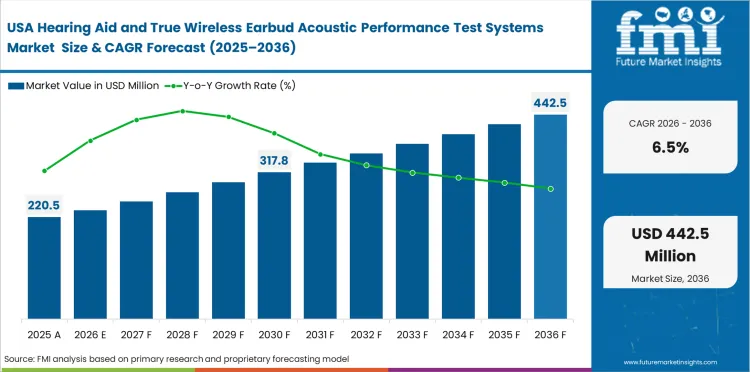
The United States is expected to expand at a CAGR of 6.5% through 2036, with demand supported by strong engineering lab activity, broad finished-device consumption, and continued product qualification needs. The country holds a major high-value market for analyzers and software used in hearing aid and wireless audio validation. Demand is also supported by wider device access and ongoing product variation across both regulated and consumer-oriented audio formats.
- Engineering labs remain key buyers of advanced validation systems.
- Broad device demand supports continued qualification activity.
- Product variation keeps analyzers and fixtures commercially relevant.
Demand Outlook for Hearing Aid and True Wireless Earbud Acoustic Performance Test Systems Market in Germany
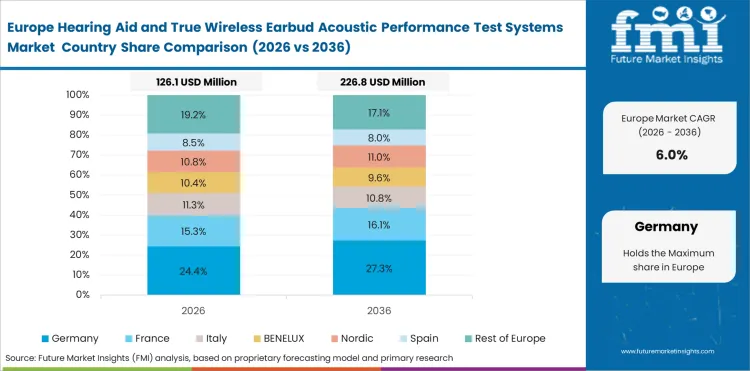
Germany is forecast to grow at a CAGR of 6.1% through 2036, with demand supported by engineering depth and hearing-device validation needs. The market stays attractive for higher-value systems used in lab validation and controlled product development. Companies place strong importance on accurate measurement and dependable workflows, which supports spending on configured platforms.
- Engineering depth supports demand for higher-value test systems.
- Hearing-device validation needs keep lab spending active.
- Traceable measurement methods remain important in buying decisions.
Demand Outlook for Hearing Aid and True Wireless Earbud Acoustic Performance Test Systems Market in the United Kingdom
The United Kingdom is projected to grow at a CAGR of 5.8% through 2036, with demand supported by hearing instrument activity, clinical fitting relevance, and an established base of audiology-linked validation equipment. The market grows at a steadier pace than the main Asian manufacturing hubs. It still holds commercial meaning for specialized testing and product support work. Demand depends on hearing-care use and installed validation capacity than by large-scale earbud assembly.
- Hearing instrument activity supports ongoing validation demand.
- Audiology-linked equipment base keeps replacement spending relevant.
- Growth remains steadier than in major Asian manufacturing hubs.
Competitive Landscape of Hearing Aid and True Wireless Earbud Acoustic Performance Test Systems Market
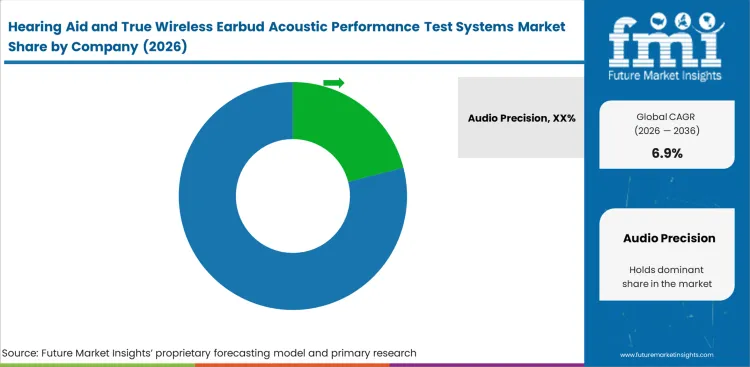
- Competition remains moderately fragmented with no single supplier controlling the full workflow across analyzers, fixtures, and hearing-aid-specific tools.
- Leading suppliers win through application depth, calibration credibility, and software continuity rather than through list-price competition.
- Specialist suppliers can still grow well in hearing aid test benches, coupler kits, and fast earbud testing systems when their products suit the job better than larger rivals.
Competition in this market remains moderate, with no single supplier controlling the full span of analyzers, fixtures, software, and hearing-aid-specific testing tools. Competitive strength is shifting toward suppliers that can support complete workflows with stable methods and dependable calibration support across engineering and factory use. Regional specialists hold value in selected hearing-aid benches and earbud production cells. Smaller firms are building positions in application-focused niches where deployment fit carries more weight than broad portfolio scale.
The hearing aid and true wireless earbud acoustic performance test systems market is shaped by established electroacoustic equipment suppliers and focused testing specialists. Audio Precision stays influential in analyzer-led environments due to strong acceptance in production and R&D workflows. GRAS Sound & Vibration maintains depth in ear simulators, couplers, and manikin-based setups used across in-ear and hearing-device validation.
Barriers to entry remain meaningful due to calibration requirements, fixture precision, software reliability, and the application support needed to keep methods repeatable from first setup through daily use. Strategic priorities across the supplier base include improving software continuity, broadening fixture libraries, reducing setup time, and extending production-line capability for high-volume audio programs. Suppliers that can combine measurement stability with workflow support remain better placed as customers move toward more integrated electroacoustic testing environments.
Major Industry Players
The supplier field spans global analyzer brands, acoustics specialists, and focused hearing-aid test providers.
- Global Player - Audio Precision, GRAS Sound & Vibration, and Brüel & Kjær fit this group because they offer broad electroacoustic measurement capability, recognized brands, and enough geographic reach to support multinational engineering and production programs.
- Regional Player - HEAD acoustics, Listen, Inc., and Frye Electronics fit this group because they are highly credible inside defined application areas while remaining more selective in footprint or product breadth than the broadest analyzer and fixture suppliers.
- Emerging Players - CRYSOUND and other integrated fixture suppliers fit this group because they target production efficiency, turnkey cells, and practical deployment in high-volume audio manufacturing.
Competitive Benchmarking: Hearing Aid and True Wireless Earbud Acoustic Performance Test Systems Market
| Company | Analyzer Depth | Fixture Range | Software Workflow | Geographic Footprint |
|---|---|---|---|---|
| Audio Precision | High | Medium | Strong | Global |
| GRAS Sound & Vibration | Medium | High | Strong | Global |
| Brüel & Kjær | High | High | Strong | Global |
| HEAD acoustics | High | Medium | Strong | Global |
| Listen, Inc. | Medium | Medium | Strong | Global |
| Frye Electronics | Low | High | Moderate | North America |
| CRYSOUND | Low | High | Moderate | Asia |
| Axiometrix Solutions | Medium | Medium | Moderate | Global |
| ACO Pacific | Low | Medium | Low | North America |
| Müller-BBM VibroAkustik Systeme | Low | Medium | Low | Europe |
Source: Future Market Insights competitive analysis, 2026.
Key Developments in Hearing Aid and True Wireless Earbud Acoustic Performance Test Systems Market
- In November 2025: Audio Precision introduced a new Bluetooth® 5 module for APx Series analyzers, expanding its audio test portfolio with broader support for Bluetooth 5 LE audio devices.
- In December 2025: HEAD acoustics introduced a new Bluetooth® LE Audio test solution, adding labCORE hardware and software extensions for Unicast, Auracast™, and controlled acoustic measurements.
Key Players in the Hearing Aid and True Wireless Earbud Acoustic Performance Test Systems Market
Major global players
- Audio Precision
- GRAS Sound & Vibration
- Brüel & Kjær
- HEAD acoustics
- Listen, Inc.
Key emerging players/startups
- Frye Electronics
- CRYSOUND
Scope of the Report
| Metric | Value |
|---|---|
| Quantitative Units | USD 480 million to USD 935.4 million, at a CAGR of 6.9% |
| Market Definition | The market covers acoustic performance test hardware and software used to design, qualify, validate, and production-check hearing aids and true wireless earbuds. It includes analyzers, artificial ears, ear simulators, couplers, manikins, acoustic boxes, and software used across research, line setup, end-of-line measurement, and failure analysis. |
| Segmentation |
|
| Regions Covered | North America, Europe, East Asia, South Asia, and Rest of World |
| Countries Covered | China, India, Japan, South Korea, United States, Germany, United Kingdom, and additional countries |
| Key Companies Profiled | Audio Precision, GRAS Sound & Vibration, Brüel & Kjær, HEAD acoustics, Listen, Inc., Frye Electronics, CRYSOUND, and other manufacturers |
| Forecast Period | 2026 to 2036 |
| Approach | Bottom-up analyst model built from official hearing-aid demand indicators, headphone trade data, and active supplier evidence for acoustic test systems across validation and production workflows. |
Source: Future Market Insights competitive analysis, 2026.
Hearing Aid and True Wireless Earbud Acoustic Performance Test Systems Market By Segments
Hearing Aid and True Wireless Earbud Acoustic Performance Test Systems Market segmented as Test Type
- Production Line Systems
- R&D Lab Systems
- End-of-Line Systems
- Quality Control Systems
Hearing Aid and True Wireless Earbud Acoustic Performance Test Systems Market classified by Product Type
- Ear Simulators
- Audio Analyzers
- Acoustic Chambers
- HATS
- Measurement Software
Hearing Aid and True Wireless Earbud Acoustic Performance Test Systems Market analysed by Device Type
- TWS Earbuds
- Prescription Hearing Aids
- OTC Hearing Aids
Hearing Aid and True Wireless Earbud Acoustic Performance Test Systems Market classified by Sales Channel
- Direct Sales
- Distributors
- System Integrators
Hearing Aid and True Wireless Earbud Acoustic Performance Test Systems Market by Region and Country
- North America
- USA
- Canada
- Mexico
- Latin America
- Brazil
- Chile
- Rest of Latin America
- Western Europe
- Germany
- UK
- Italy
- Spain
- France
- Nordic
- BENELUX
- Rest of Western Europe
- Eastern Europe
- Russia
- Poland
- Hungary
- Balkan & Baltic
- Rest of Eastern Europe
- East Asia
- China
- Japan
- South Korea
- South Asia and Pacific
- India
- ASEAN
- Australia & New Zealand
- Rest of South Asia and Pacific
- Middle East & Africa
- Kingdom of Saudi Arabia
- Other GCC Countries
- Turkiye
- South Africa
- Other African Union
- Rest of Middle East & Africa
Bibliography
- Audio Precision. (2025, November 17). Audio Precision introduces new Bluetooth® 5 module for APx series analyzers.
- HEAD acoustics. (2025, December 10). Bluetooth® LE audio testing in a new dimension.
- European Hearing Instrument Manufacturers Association. (2025, May 15). EHIMA members report continued growth in hearing aid sales in 2024. EHIMA.
- World Health Organization. (2024, January 2). Assistive technology.
- British Academy of Audiology. (2026, February 20). Hearing instrument sales show annual growth in 2025 with mixed quarterly trends.
This bibliography is provided for reader reference. The full FMI report contains the complete reference list with primary research documentation.
This report addresses
- Market size, forecast values, and CAGR for 2025, 2026, and 2036.
- Segment shares across test type, product type, device type, end use, and channel.
- Country demand patterns and modelled CAGRs across seven key markets.
- Competitive assessment of analyzer, fixture, and software suppliers.
- How official hearing-aid demand and headphone trade data shape equipment demand.
- Commercial implications of software-led workflows and production-line testing.
- Scope boundaries between dedicated acoustic test systems and adjacent electronics testing categories.
- Key supplier moves that affect configuration, throughput, and workflow consistency.
Frequently Asked Questions
What is the estimated 2026 market size?
The market is estimated at USD 480 million in 2026 based on analyst modelling of device-linked validation demand and active supplier coverage.
What will the market be worth by 2036?
The forecast value reaches USD 935.4 million by 2036 under the base-case assumption of steady replacement, broader software use, and continued earbud throughput growth.
What is the forecast CAGR?
The market is projected to expand at a CAGR of 6.9% from 2026 to 2036, which fits the profile of established industrial test equipment.
Which segment leads by test type?
Production line systems lead the test type structure with an estimated 34% share in 2026 because throughput and repeatability remain central buying criteria.
Which device segment is largest?
TWS earbuds account for the largest device share at an estimated 52% in 2026 due to much higher production volumes than hearing aids.
Which sales channel dominates?
Direct sales dominate with an estimated 63% share in 2026 since companies usually need configured systems, setup support, and calibration planning together.
Which sales channel dominates?
Direct sales dominate with an estimated 63% share in 2026 since companies usually need configured systems, setup support, and calibration planning together.
Preview the report firsthand - request a free sample
Get SampleGet the brochure for pricing and purchase details.
Get PDFTable of Content
- Executive Summary
- Global Market Outlook
- Demand-side Trends
- Supply-side Trends
- Technology Roadmap Analysis
- Analysis and Recommendations
- Market Overview
- Market Coverage / Taxonomy
- Market Definition / Scope / Limitations
- Research Methodology
- Chapter Orientation
- Analytical Lens and Working Hypotheses
- Market Structure, Signals, and Trend Drivers
- Benchmarking and Cross-market Comparability
- Market Sizing, Forecasting, and Opportunity Mapping
- Research Design and Evidence Framework
- Desk Research Programme (Secondary Evidence)
- Company Annual and Sustainability Reports
- Peer-reviewed Journals and Academic Literature
- Corporate Websites, Product Literature, and Technical Notes
- Earnings Decks and Investor Briefings
- Statutory Filings and Regulatory Disclosures
- Technical White Papers and Standards Notes
- Trade Journals, Industry Magazines, and Analyst Briefs
- Conference Proceedings, Webinars, and Seminar Materials
- Government Statistics Portals and Public Data Releases
- Press Releases and Reputable Media Coverage
- Specialist Newsletters and Curated Briefings
- Sector Databases and Reference Repositories
- FMI Internal Proprietary Databases and Historical Market Datasets
- Subscription Datasets and Paid Sources
- Social Channels, Communities, and Digital Listening Inputs
- Additional Desk Sources
- Expert Input and Fieldwork (Primary Evidence)
- Primary Modes
- Qualitative Interviews and Expert Elicitation
- Quantitative Surveys and Structured Data Capture
- Blended Approach
- Why Primary Evidence is Used
- Field Techniques
- Interviews
- Surveys
- Focus Groups
- Observational and In-context Research
- Social and Community Interactions
- Stakeholder Universe Engaged
- C-suite Leaders
- Board Members
- Presidents and Vice Presidents
- R&D and Innovation Heads
- Technical Specialists
- Domain Subject-matter Experts
- Scientists
- Physicians and Other Healthcare Professionals
- Governance, Ethics, and Data Stewardship
- Research Ethics
- Data Integrity and Handling
- Primary Modes
- Tooling, Models, and Reference Databases
- Desk Research Programme (Secondary Evidence)
- Data Engineering and Model Build
- Data Acquisition and Ingestion
- Cleaning, Normalisation, and Verification
- Synthesis, Triangulation, and Analysis
- Quality Assurance and Audit Trail
- Market Background
- Market Dynamics
- Drivers
- Restraints
- Opportunity
- Regional Parent Market Outlook
- Production and Consumption Statistics
- Import and Export Statistics
- Global Market Analysis 2021 to 2025 and Forecast, 2026 to 2036
- Historical Market Size Value (USD Million) Analysis, 2021 to 2025
- Current and Future Market Size Value (USD Million) Projections, 2026 to 2036
- Y-o-Y Growth Trend Analysis
- Absolute $ Opportunity Analysis
- Global Market Pricing Analysis 2021 to 2025 and Forecast 2026 to 2036
- Global Market Analysis 2021 to 2025 and Forecast 2026 to 2036, By Test Type
- Introduction / Key Findings
- Historical Market Size Value (USD Million) Analysis By Test Type , 2021 to 2025
- Current and Future Market Size Value (USD Million) Analysis and Forecast By Test Type , 2026 to 2036
- Production Line Systems
- R&D Lab Systems
- End-of-Line Systems
- Quality Control Systems
- Production Line Systems
- Y-o-Y Growth Trend Analysis By Test Type , 2021 to 2025
- Absolute $ Opportunity Analysis By Test Type , 2026 to 2036
- Global Market Analysis 2021 to 2025 and Forecast 2026 to 2036, By Product Type
- Introduction / Key Findings
- Historical Market Size Value (USD Million) Analysis By Product Type, 2021 to 2025
- Current and Future Market Size Value (USD Million) Analysis and Forecast By Product Type, 2026 to 2036
- Ear Simulators
- Audio Analyzers
- Acoustic Chambers
- HATS
- Measurement Software
- Ear Simulators
- Y-o-Y Growth Trend Analysis By Product Type, 2021 to 2025
- Absolute $ Opportunity Analysis By Product Type, 2026 to 2036
- Global Market Analysis 2021 to 2025 and Forecast 2026 to 2036, By Device Type
- Introduction / Key Findings
- Historical Market Size Value (USD Million) Analysis By Device Type, 2021 to 2025
- Current and Future Market Size Value (USD Million) Analysis and Forecast By Device Type, 2026 to 2036
- TWS Earbuds
- Prescription Hearing Aids
- OTC Hearing Aids
- TWS Earbuds
- Y-o-Y Growth Trend Analysis By Device Type, 2021 to 2025
- Absolute $ Opportunity Analysis By Device Type, 2026 to 2036
- Global Market Analysis 2021 to 2025 and Forecast 2026 to 2036, By End User
- Introduction / Key Findings
- Historical Market Size Value (USD Million) Analysis By End User, 2021 to 2025
- Current and Future Market Size Value (USD Million) Analysis and Forecast By End User, 2026 to 2036
- OEMs
- Aftermarket
- OEMs
- Y-o-Y Growth Trend Analysis By End User, 2021 to 2025
- Absolute $ Opportunity Analysis By End User, 2026 to 2036
- Global Market Analysis 2021 to 2025 and Forecast 2026 to 2036, By Sales Channel
- Introduction / Key Findings
- Historical Market Size Value (USD Million) Analysis By Sales Channel, 2021 to 2025
- Current and Future Market Size Value (USD Million) Analysis and Forecast By Sales Channel, 2026 to 2036
- Direct Sales
- Distributors
- System Integrators
- Direct Sales
- Y-o-Y Growth Trend Analysis By Sales Channel, 2021 to 2025
- Absolute $ Opportunity Analysis By Sales Channel, 2026 to 2036
- Global Market Analysis 2021 to 2025 and Forecast 2026 to 2036, By Region
- Introduction
- Historical Market Size Value (USD Million) Analysis By Region, 2021 to 2025
- Current Market Size Value (USD Million) Analysis and Forecast By Region, 2026 to 2036
- North America
- Latin America
- Western Europe
- Eastern Europe
- East Asia
- South Asia and Pacific
- Middle East & Africa
- Market Attractiveness Analysis By Region
- North America Market Analysis 2021 to 2025 and Forecast 2026 to 2036, By Country
- Historical Market Size Value (USD Million) Trend Analysis By Market Taxonomy, 2021 to 2025
- Market Size Value (USD Million) Forecast By Market Taxonomy, 2026 to 2036
- By Country
- USA
- Canada
- Mexico
- By Test Type
- By Product Type
- By Device Type
- By End User
- By Sales Channel
- By Country
- Market Attractiveness Analysis
- By Country
- By Test Type
- By Product Type
- By Device Type
- By End User
- By Sales Channel
- Key Takeaways
- Latin America Market Analysis 2021 to 2025 and Forecast 2026 to 2036, By Country
- Historical Market Size Value (USD Million) Trend Analysis By Market Taxonomy, 2021 to 2025
- Market Size Value (USD Million) Forecast By Market Taxonomy, 2026 to 2036
- By Country
- Brazil
- Chile
- Rest of Latin America
- By Test Type
- By Product Type
- By Device Type
- By End User
- By Sales Channel
- By Country
- Market Attractiveness Analysis
- By Country
- By Test Type
- By Product Type
- By Device Type
- By End User
- By Sales Channel
- Key Takeaways
- Western Europe Market Analysis 2021 to 2025 and Forecast 2026 to 2036, By Country
- Historical Market Size Value (USD Million) Trend Analysis By Market Taxonomy, 2021 to 2025
- Market Size Value (USD Million) Forecast By Market Taxonomy, 2026 to 2036
- By Country
- Germany
- UK
- Italy
- Spain
- France
- Nordic
- BENELUX
- Rest of Western Europe
- By Test Type
- By Product Type
- By Device Type
- By End User
- By Sales Channel
- By Country
- Market Attractiveness Analysis
- By Country
- By Test Type
- By Product Type
- By Device Type
- By End User
- By Sales Channel
- Key Takeaways
- Eastern Europe Market Analysis 2021 to 2025 and Forecast 2026 to 2036, By Country
- Historical Market Size Value (USD Million) Trend Analysis By Market Taxonomy, 2021 to 2025
- Market Size Value (USD Million) Forecast By Market Taxonomy, 2026 to 2036
- By Country
- Russia
- Poland
- Hungary
- Balkan & Baltic
- Rest of Eastern Europe
- By Test Type
- By Product Type
- By Device Type
- By End User
- By Sales Channel
- By Country
- Market Attractiveness Analysis
- By Country
- By Test Type
- By Product Type
- By Device Type
- By End User
- By Sales Channel
- Key Takeaways
- East Asia Market Analysis 2021 to 2025 and Forecast 2026 to 2036, By Country
- Historical Market Size Value (USD Million) Trend Analysis By Market Taxonomy, 2021 to 2025
- Market Size Value (USD Million) Forecast By Market Taxonomy, 2026 to 2036
- By Country
- China
- Japan
- South Korea
- By Test Type
- By Product Type
- By Device Type
- By End User
- By Sales Channel
- By Country
- Market Attractiveness Analysis
- By Country
- By Test Type
- By Product Type
- By Device Type
- By End User
- By Sales Channel
- Key Takeaways
- South Asia and Pacific Market Analysis 2021 to 2025 and Forecast 2026 to 2036, By Country
- Historical Market Size Value (USD Million) Trend Analysis By Market Taxonomy, 2021 to 2025
- Market Size Value (USD Million) Forecast By Market Taxonomy, 2026 to 2036
- By Country
- India
- ASEAN
- Australia & New Zealand
- Rest of South Asia and Pacific
- By Test Type
- By Product Type
- By Device Type
- By End User
- By Sales Channel
- By Country
- Market Attractiveness Analysis
- By Country
- By Test Type
- By Product Type
- By Device Type
- By End User
- By Sales Channel
- Key Takeaways
- Middle East & Africa Market Analysis 2021 to 2025 and Forecast 2026 to 2036, By Country
- Historical Market Size Value (USD Million) Trend Analysis By Market Taxonomy, 2021 to 2025
- Market Size Value (USD Million) Forecast By Market Taxonomy, 2026 to 2036
- By Country
- Kingdom of Saudi Arabia
- Other GCC Countries
- Turkiye
- South Africa
- Other African Union
- Rest of Middle East & Africa
- By Test Type
- By Product Type
- By Device Type
- By End User
- By Sales Channel
- By Country
- Market Attractiveness Analysis
- By Country
- By Test Type
- By Product Type
- By Device Type
- By End User
- By Sales Channel
- Key Takeaways
- Key Countries Market Analysis
- USA
- Pricing Analysis
- Market Share Analysis, 2025
- By Test Type
- By Product Type
- By Device Type
- By End User
- By Sales Channel
- Canada
- Pricing Analysis
- Market Share Analysis, 2025
- By Test Type
- By Product Type
- By Device Type
- By End User
- By Sales Channel
- Mexico
- Pricing Analysis
- Market Share Analysis, 2025
- By Test Type
- By Product Type
- By Device Type
- By End User
- By Sales Channel
- Brazil
- Pricing Analysis
- Market Share Analysis, 2025
- By Test Type
- By Product Type
- By Device Type
- By End User
- By Sales Channel
- Chile
- Pricing Analysis
- Market Share Analysis, 2025
- By Test Type
- By Product Type
- By Device Type
- By End User
- By Sales Channel
- Germany
- Pricing Analysis
- Market Share Analysis, 2025
- By Test Type
- By Product Type
- By Device Type
- By End User
- By Sales Channel
- UK
- Pricing Analysis
- Market Share Analysis, 2025
- By Test Type
- By Product Type
- By Device Type
- By End User
- By Sales Channel
- Italy
- Pricing Analysis
- Market Share Analysis, 2025
- By Test Type
- By Product Type
- By Device Type
- By End User
- By Sales Channel
- Spain
- Pricing Analysis
- Market Share Analysis, 2025
- By Test Type
- By Product Type
- By Device Type
- By End User
- By Sales Channel
- France
- Pricing Analysis
- Market Share Analysis, 2025
- By Test Type
- By Product Type
- By Device Type
- By End User
- By Sales Channel
- India
- Pricing Analysis
- Market Share Analysis, 2025
- By Test Type
- By Product Type
- By Device Type
- By End User
- By Sales Channel
- ASEAN
- Pricing Analysis
- Market Share Analysis, 2025
- By Test Type
- By Product Type
- By Device Type
- By End User
- By Sales Channel
- Australia & New Zealand
- Pricing Analysis
- Market Share Analysis, 2025
- By Test Type
- By Product Type
- By Device Type
- By End User
- By Sales Channel
- China
- Pricing Analysis
- Market Share Analysis, 2025
- By Test Type
- By Product Type
- By Device Type
- By End User
- By Sales Channel
- Japan
- Pricing Analysis
- Market Share Analysis, 2025
- By Test Type
- By Product Type
- By Device Type
- By End User
- By Sales Channel
- South Korea
- Pricing Analysis
- Market Share Analysis, 2025
- By Test Type
- By Product Type
- By Device Type
- By End User
- By Sales Channel
- Russia
- Pricing Analysis
- Market Share Analysis, 2025
- By Test Type
- By Product Type
- By Device Type
- By End User
- By Sales Channel
- Poland
- Pricing Analysis
- Market Share Analysis, 2025
- By Test Type
- By Product Type
- By Device Type
- By End User
- By Sales Channel
- Hungary
- Pricing Analysis
- Market Share Analysis, 2025
- By Test Type
- By Product Type
- By Device Type
- By End User
- By Sales Channel
- Kingdom of Saudi Arabia
- Pricing Analysis
- Market Share Analysis, 2025
- By Test Type
- By Product Type
- By Device Type
- By End User
- By Sales Channel
- Turkiye
- Pricing Analysis
- Market Share Analysis, 2025
- By Test Type
- By Product Type
- By Device Type
- By End User
- By Sales Channel
- South Africa
- Pricing Analysis
- Market Share Analysis, 2025
- By Test Type
- By Product Type
- By Device Type
- By End User
- By Sales Channel
- USA
- Market Structure Analysis
- Competition Dashboard
- Competition Benchmarking
- Market Share Analysis of Top Players
- By Regional
- By Test Type
- By Product Type
- By Device Type
- By End User
- By Sales Channel
- Competition Analysis
- Competition Deep Dive
- Audio Precision
- Overview
- Product Portfolio
- Profitability by Market Segments (Product/Age /Sales Channel/Region)
- Sales Footprint
- Strategy Overview
- Marketing Strategy
- Product Strategy
- Channel Strategy
- GRAS Sound & Vibration
- Brüel & Kjær
- HEAD acoustics
- Listen, Inc.
- Frye Electronics
- CRYSOUND
- Audio Precision
- Competition Deep Dive
- Market Dynamics
- Assumptions & Acronyms Used


