

- Market Size (2026)
- USD 2.5 Bn
- Forecast (2036)
- USD 4.2 Bn
- CAGR (2026 to 2036)
- 5.4%
How big is the Hemostasis Testing Systems Market in 2026?
USD 2.5 billion in 2026, reaching USD 4.2 billion by 2036 at a 5.4% CAGR
The hemostasis testing systems market is estimated at USD 2.5 billion in 2026 and is forecast to reach USD 4.2 billion by 2036 at a 5.4% CAGR. Demand is shaped by coagulation diagnostics, where laboratory analyzers test bleeding and clotting disorders. Laboratory analyzers account for 46.0% of Product Type demand in 2026, while Hemophilia holds 42.0% of applications.
The market was valued at USD 2.4 billion in 2025. Growth reflects rising coagulation testing demand and the shift toward automated and point-of-care hemostasis analysis. Demand is shaped by hospitals and diagnostic laboratories adopting laboratory analyzers and consumables for hemophilia, von Willebrand disease, and anticoagulant monitoring using optical detection technology.
Hemostasis testing systems are diagnostic platforms for bleeding and clotting disorders. Buyers judge analyzers through throughput and detection accuracy.
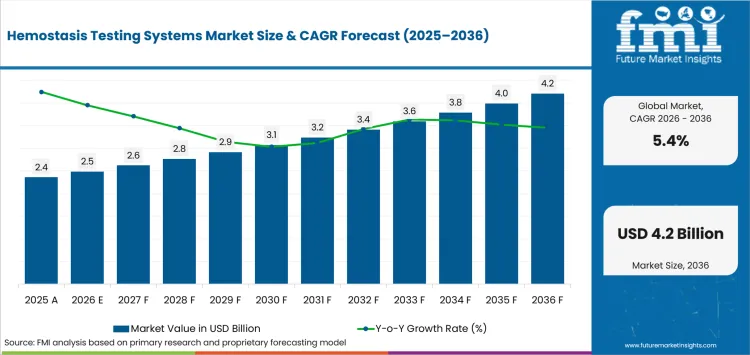
Summary of the Hemostasis Testing Systems Market
| Market Signal | Commercial Impact |
|---|---|
| Demand and Growth Drivers | Demand is driven by coagulation testing for bleeding disorders and anticoagulant monitoring, extending toward point-of-care use.
|
| Product and Segment View | Laboratory analyzers and hemophilia diagnosis lead the mix, built on optical detection systems.
|
| Geography and Competitive Outlook | India leads growth on laboratory expansion, while majors compete on throughput and detection accuracy.
|
| Analyst Opinion | High-throughput optical analyzers with reliable consumable supply will hold the strongest position as coagulation testing demand grows.
|
Why is the Hemostasis Testing Systems Market growing?
Rising Laboratory Analyzer and hemophilia-testing demand in coagulation diagnostics
- Sustained procurement of laboratory analyzers is shaped by hospitals performing coagulation testing for bleeding disorders.
- India is leading the way with growth of 7.1%, driven by laboratory expansion, diagnostic access, and coagulation testing.
- The application segment is led by Hemophilia at 42.0% share, supported by bleeding disorder diagnosis.
Demand is rising because bleeding disorders and anticoagulant therapy require coagulation testing. Adoption is increasing due to automated laboratory analyzers and point-of-care systems, which deliver accurate hemostasis measurement, with hospitals and diagnostic laboratories testing hemophilia, von Willebrand disease, and anticoagulant monitoring using optical detection technology.
How is the Hemostasis Testing Systems Market segmented?
By Product Type, Application, End User, Technology and Distribution Channel
- Laboratory analyzers are projected to lead Product Type with 46.0% share in 2026 due to central coagulation testing.
- Hemophilia is expected to lead application with 42.0% share in 2026 as bleeding disorder diagnosis drives use.
- Hospitals are forecast to lead end user with 48.0% share in 2026 as testing concentrates in hospitals.
Why do laboratory analyzers lead the Hemostasis Testing Systems Market?
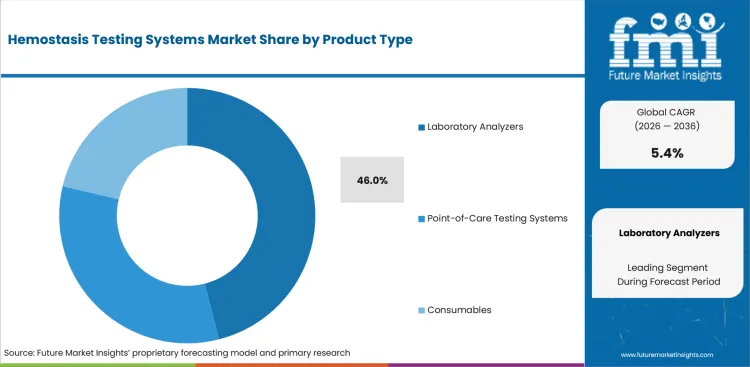
- Laboratory analyzers are expected to hold 46.0% share in 2026 because central coagulation testing handles high-volume diagnosis.
- Their throughput and accuracy anchor hospital and laboratory demand.
Hemophilia holds 42.0% share, led by bleeding disorder diagnosis
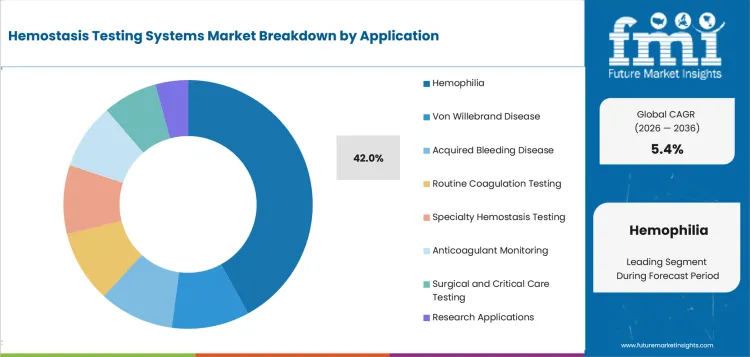
- Hemophilia forms the leading application at 42.0% share, anchored by bleeding disorder diagnosis.
- Von willebrand disease and anticoagulant monitoring follow as coagulation testing extends.
Which end user leads the market?
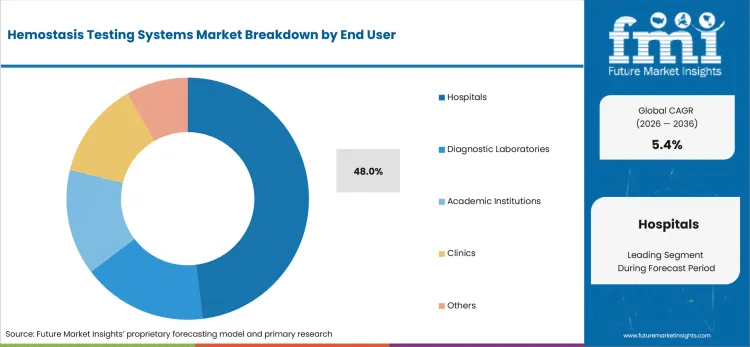
- Hospitals lead end user at 48.0% share as coagulation testing concentrates in hospital laboratories.
- Diagnostic laboratories and academic institutions follow as central and research testing extends.
Which technology leads procurement?
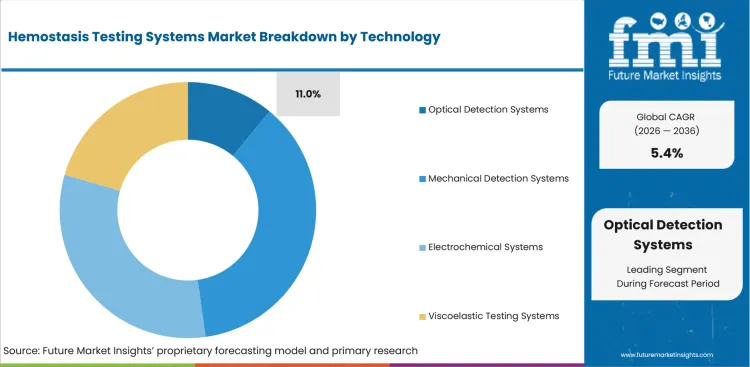
- Optical detection systems lead as they enable accurate coagulation measurement.
- Mechanical and viscoelastic systems follow for specific coagulation assessment.
Which distribution channel leads the market?
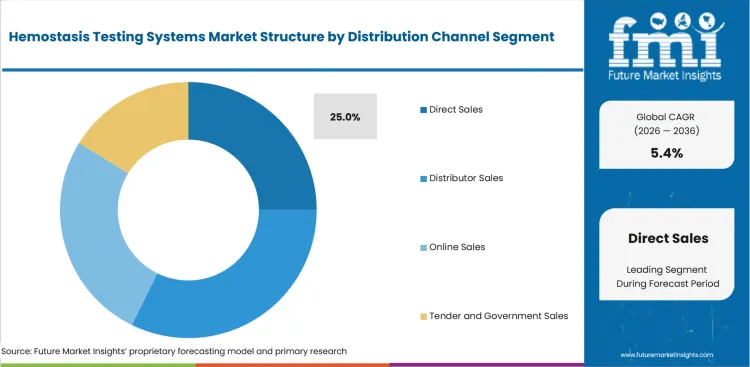
- Direct sales lead as hospitals and laboratories procure analyzers directly.
- Distributor and tender sales follow for reaching regional and government laboratories.
What drives and restrains the Hemostasis Testing Systems Market?
Driven by coagulation testing demand and automation; restrained by analyzer cost and skilled-staff requirements
Coagulation testing demand and automation support growth while analyzer cost and skilled laboratory staff requirements constrain access in lower-resource settings.
- Driver: Hospitals using laboratory analyzers for hemophilia and coagulation testing generate recurring demand for analyzers and consumables tied to bleeding disorder diagnosis and anticoagulant monitoring.
- Restraint: Diagnostic laboratories in lower-resource settings face analyzer cost and skilled laboratory staff requirements that limit hemostasis testing system adoption.
- Opportunity: Point-of-care testing and automation can widen adoption by extending coagulation testing into bedside and decentralized settings.
Coagulation testing demand is lifting hemostasis system adoption as hospitals diagnose bleeding disorders. Laboratory analyzers anchor demand while consumables support recurring testing.
The market is led by structural demand from coagulation diagnostics. Laboratory analyzers remain the leading product, while point-of-care systems serve decentralized testing. Constraints include analyzer cost, skilled-staff requirements, and reimbursement.
Which factors support expansion in the Hemostasis Testing Systems Market?
Analyzer placement and consumable demand support market value across hospital and laboratory channels
- Market value is supported by analyzer placement before consumable demand adds recurring revenue.
- Supplier pricing reflects throughput and detection accuracy before consumable supply affects renewal.
- Laboratories compare throughput and accuracy before standardizing on an analyzer platform.
Which countries are growing fastest in the Hemostasis Testing Systems Market?
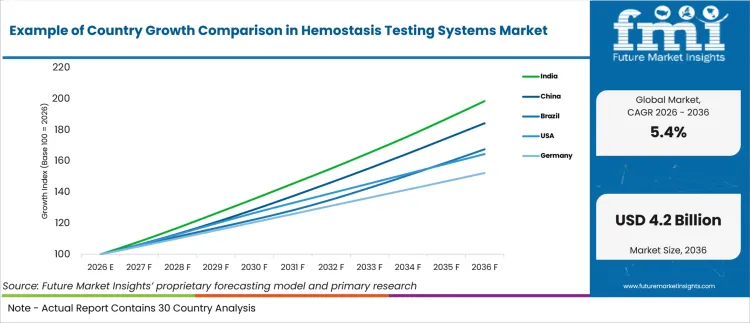
| Country | CAGR |
|---|---|
| India | 7.1% |
| China | 6.3% |
| Brazil | 5.3% |
| USA | 5.1% |
| Germany | 4.3% |
Source: Future Market Insights analysis, 2026.
How do country-level CAGRs compare in the Hemostasis Testing Systems Market?
The global Hemostasis Testing Systems Market is projected to expand at 5.4% from 2026 to 2036. The study covers more than 30 countries, and the primary markets are listed below.
- India is forecast to record 7.1% CAGR by 2036 as laboratory expansion and diagnostic access accelerate.
- China is expected to expand at 6.3% CAGR through 2036 as coagulation testing and access grow.
- Brazil is estimated to grow at 5.3% CAGR by 2036 as diagnostic access expands.
- The USA is projected to rise at 5.1% CAGR through 2036 as automated testing extends.
- Germany is forecast to post 4.3% CAGR by 2036 as a mature laboratory base shapes demand.
Who are the leading companies in the Hemostasis Testing Systems Market?
Siemens Healthcare, Roche Diagnostics, Abbott, Werfen, and Sysmex
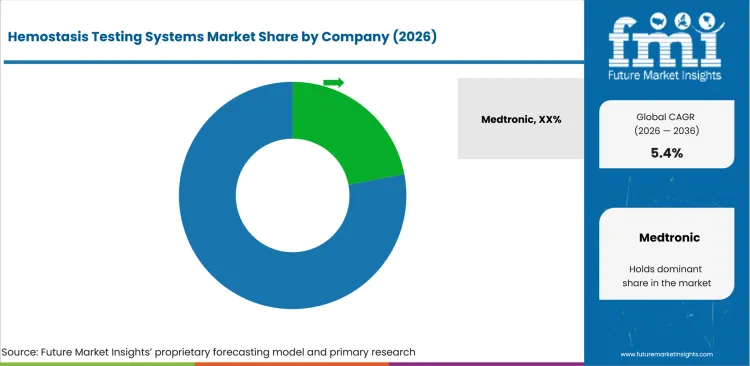
Siemens Healthcare and Roche diagnostics compete through coagulation analyzer platforms and detection accuracy. Throughput remains a further point of differentiation. Abbott and Werfen compete on hemostasis testing systems, while Sysmex holds positions in laboratory analyzers. These overlap with broader diagnostic and laboratory automation buying paths.
Buyers compare suppliers on throughput, detection accuracy, and consumable supply. Hospitals standardize on analyzers with reliable throughput and accuracy. Laboratories favor suppliers offering integrated analyzer and consumable systems with consistent supply.
Who are the key players in the Hemostasis Testing Systems Market?
Key global companies leading the Hemostasis Testing Systems Market include:
- Siemens Healthcare, Roche Diagnostics, and Abbott maintain leading positions through coagulation analyzer platforms, detection accuracy, and laboratory relationships across global markets.
- Diagnostic specialists such as Werfen, Sysmex, and Beckman Coulter compete through hemostasis testing systems.
- Specialist and emerging providers such as Haemonetics, Grifols, and Nihon Kohden target coagulation testing to establish positions and scale.
How do top Hemostasis Testing Systems Market companies compare?
Siemens and Roche lead on scale; Abbott also has a global footprint, while Werfen and Sysmex are more hemostasis-concentrated.
| Company | Platform Breadth | Detection Accuracy | Distribution Scale | Geographic Footprint |
|---|---|---|---|---|
| Siemens Healthcare | High | High | Strong | Global |
| Roche Diagnostics | High | High | Strong | Global |
| Abbott | High | High | Strong | Global |
| Werfen | Moderate | High | Strong | Europe-led |
| Sysmex | Moderate | High | Strong | Asia-led |
Source: Future Market Insights competitive analysis, 2026.
Key Developments in the Hemostasis Testing Systems Market
-
In March 2025, Werfen commercialised the ACL TOP Family 70 Series Hemostasis Testing Systems in North America following FDA 510(k) clearance and Health Canada licensure, spanning five models from low-volume through fully automated laboratories with centralised QC management and HemoHub Intelligent Data Manager integration. Network-wide quality management shifts competition from instrument throughput to laboratory-system connectivity. Platform-integration evidence supports multi-site laboratory networks assessing standardisation before renewing analyser fleets.
-
In June 2025, Sysmex America received FDA clearance for the CN-6000 Automated Blood Coagulation Analyzer, including the reagent products used in five commonly performed hemostasis tests. Simultaneous instrument and reagent clearance strengthens closed-system supply positions. Bundled-clearance evidence supports laboratory directors evaluating total reagent commitment before selecting a coagulation platform.
-
In January 2025, Werfen received FDA 510(k) clearance for Aptiva antiphospholipid syndrome IgG and IgM reagents, using particle-based multi-analyte technology capable of delivering up to 960 APS test results in eight hours and expanding the Aptiva platform to 18 FDA-cleared analytes. Thrombophilia diagnostics converge onto high-throughput multi-analyte platforms. Consolidation evidence supports laboratories assessing whether specialised coagulation and autoimmune testing can share instrumentation before capital planning.
Key Players in the Hemostasis Testing Systems Market
Global Diagnostics Leaders
- Siemens Healthcare GmbH
- Roche Diagnostics Limited
- Abbott
Hemostasis Testing Specialists
- Werfen
- Sysmex
- Beckman Coulter, Inc.
- Haemonetics Corporation
Emerging and Regional Players
- Grifols, S.A.
- Nihon Kohden Corporation
- Medtronic
Hemostasis Testing Systems Market - Scope & Definition
| Attribute | Detail |
|---|---|
| Market Definition | Hemostasis testing systems including laboratory analyzers, point-of-care systems, and consumables used for coagulation testing across bleeding and clotting disorders |
| Functions Covered | Coagulation testing, bleeding disorder diagnosis, anticoagulant monitoring, and specialty hemostasis analysis |
| Applications Covered | Hemophilia, von Willebrand disease, acquired bleeding disease, routine coagulation, and anticoagulant monitoring |
| End-Use Industries | Hospitals, diagnostic laboratories, academic institutions, and clinics |
| Inclusions | Laboratory analyzers, point-of-care testing systems, and consumables across detection technologies |
| Exclusions | General hematology analyzers outside hemostasis, and non-coagulation diagnostic systems |
Hemostasis Testing Systems Market - Research Methodology
| Method | Description |
|---|---|
| Primary Research | FMI analysts gathered input from manufacturers, service providers, technology developers, distributors, end users, procurement teams, and subject-matter experts. Interviews examined purchasing decisions, product or service evaluation, adoption barriers, approval requirements, pricing considerations, and expectations for technical or commercial support. Respondents were also asked what evidence is required before a trial, pilot, or initial order develops into regular purchasing. |
| Desk Research | Desk research covered government statistics, regulatory publications, trade data, industry associations, technical literature, standards, company filings, product information, and official corporate announcements. Sources were reviewed for relevance, publication date, geographic coverage, and consistency with the defined market scope. Claims relating to performance, applications, approvals, capacity, investment, and commercial activity were retained only when supported by credible public evidence. |
| Market Sizing & Forecasting | The market model combined the baseline value with historical performance, segment structure, pricing and volume indicators, adoption levels, company participation, and country-level demand conditions. Forecast assumptions considered economic activity, investment trends, regulatory developments, technology adoption, purchasing cycles, supply availability, and barriers to wider market use. Segment and regional estimates were reconciled before the final market total was calculated. |
| Data Validation | Estimates were checked against multiple independent indicators, including public data, company activity, trade patterns, industry developments, and findings from primary interviews. Validation also tested whether products, services, applications, and company revenues fell within the defined market boundaries. Adjacent categories, unsupported claims, overlapping revenues, and activities without direct market relevance were excluded to reduce double counting and maintain consistency across segments and countries. |
What does the Hemostasis Testing Systems Market report cover?
2021 to 2025 history and 2026 to 2036 forecasts across all segments and 30+ countries
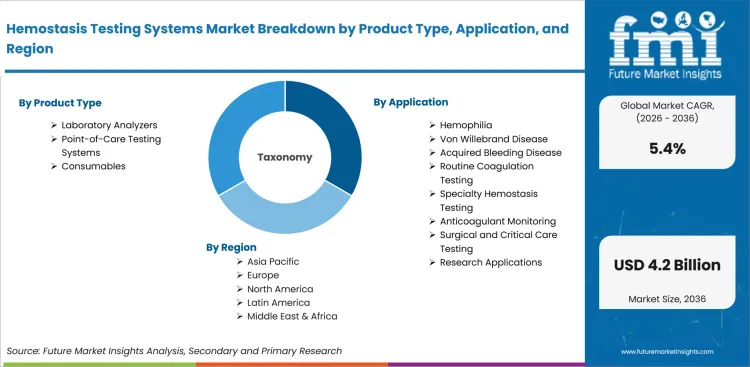
| Parameter | Details |
|---|---|
| Forecast period | 2026 to 2036 |
| Historical period | 2021 to 2025 |
| Quantitative unit | Value in USD billion |
| By Product type | Laboratory Analyzers, Point-of-Care Testing Systems, Consumables |
| By Application | Hemophilia, Von Willebrand Disease, Acquired Bleeding Disease, Routine Coagulation Testing, Specialty Hemostasis Testing, Anticoagulant Monitoring |
| By End user | Hospitals, Diagnostic Laboratories, Academic Institutions, Clinics |
| By Technology | Optical Detection Systems, Mechanical Detection Systems, Electrochemical Systems, Viscoelastic Testing Systems |
| By Distribution channel | Direct Sales, Distributor Sales, Online Sales, Tender and Government Sales |
| Regions covered | North America, Latin America, Western Europe, Eastern Europe, East Asia, South Asia and Pacific, Middle East and Africa |
| Countries covered | USA, India, China, Brazil, Germany, and other major markets |
| Key companies profiled | Siemens Healthcare, Roche Diagnostics, Abbott, Werfen, Sysmex, Beckman Coulter, Haemonetics, Grifols, Nihon Kohden |
| Approach | Bottom-up placement-based approach using analyzer installation, consumable demand, application, and supplier disclosures |
Market Segmentation Analysis
Hemostasis Testing Systems Market Segmented by Product Type:
- Laboratory Analyzers
- Central Lab Systems
- Large Hospital Deployment
- Reference Laboratory Use
- Satellite Lab Systems
- Department Level Testing Use
- Urgent Sample Processing
- Central Lab Systems
- Point-of-Care Testing Systems
- Portable Devices
- ICU Bedside Testing
- Operating Room Use
- Handheld Systems
- Emergency Department Use
- Ambulance Testing Applications
- Portable Devices
- Consumables
- Clotting Assay Reagents
- PT Test Reagents
- aPTT Test Reagents
- Specialty Assay Reagents
- D Dimer Reagents
- Fibrinogen Test Reagents
- Calibrators and Controls
- Quality Control Materials
- Instrument Calibration Kits
- Clotting Assay Reagents
Hemostasis Testing Systems Market Segmented by Application:
- Hemophilia
- Von Willebrand Disease
- Acquired Bleeding Disease
- Routine Coagulation Testing
- PT Testing
- aPTT Testing
- Thrombin Time Testing
- Specialty Hemostasis Testing
- D Dimer Testing
- Fibrinogen Testing
- Factor Assays
- Anticoagulant Monitoring
- Heparin Monitoring
- DOAC Assessment
- Warfarin Monitoring
- Surgical and Critical Care Testing
- Cardiac Surgery Support
- Trauma Care Testing
- OB GYN Emergency Use
- Research Applications
- Clinical Research
- Academic Research
Hemostasis Testing Systems Market Segmented by End User:
- Hospitals
- Public Hospitals
- Central Laboratory Demand
- Emergency Care Testing
- Private Hospitals
- Premium Diagnostic Services
- High Surgery Volume Use
- Public Hospitals
- Diagnostic Laboratories
- Independent Labs
- Routine Referral Testing
- Specialized Coagulation Panels
- Reference Labs
- High Throughput Batch Testing
- Regional Sample Processing
- Independent Labs
- Academic Institutions
- Coagulation Research Programs
- Clinical Validation Studies
- Clinics
- Specialty Clinics
- Cardiology Related Monitoring
- Hematology Follow Up Care
- Outpatient Centers
- Routine Anticoagulant Checks
- Pre Procedure Screening
- Specialty Clinics
- Others
Hemostasis Testing Systems Market Segmented by Technology:
- Optical Detection Systems
- Turbidimetric Methods
- Clot Formation Detection
- High Speed Processing
- Chromogenic Methods
- Factor Activity Measurement
- Colorimetric Assay Use
- Turbidimetric Methods
- Mechanical Detection Systems
- Ball Coagulometry
- Viscosity Based Detection
- Reliable Clot Endpoint Use
- Electromechanical Methods
- Interference Resistant Testing
- Lipemic Sample Handling
- Ball Coagulometry
- Electrochemical Systems
- Biosensor Platforms
- Point of Care Use
- Portable Rapid Testing
- Microfluidic Sensors
- Low Sample Volume Use
- Fast Turnaround Results
- Biosensor Platforms
- Viscoelastic Testing Systems
- TEG Systems
- Whole Blood Clot Dynamics
- Trauma Surgery Use
- ROTEM Systems
- Transfusion Decision Support
- Critical Care Demand
- TEG Systems
Hemostasis Testing Systems Market Segmented by Distribution Channel:
- Direct Sales
- Hospital Contracts
- Analyzer Procurement Deals
- Long Term Reagent Agreements
- Lab Network Contracts
- Multi Site Deployment Deals
- Service Bundled Sales
- Hospital Contracts
- Distributor Sales
- Medical Device Distributors
- Regional Coverage Supply
- Inventory Management Support
- Diagnostic Product Dealers
- SME Lab Reach
- Local Technical Support
- Medical Device Distributors
- Online Sales
- B2B Procurement Platforms
- Consumable Reorders
- Accessory Purchases
- Manufacturer Portals
- Service Request Access
- Direct Institutional Ordering
- B2B Procurement Platforms
- Tender and Government Sales
- Public Tenders
- Hospital Network Supply
- National Screening Projects
- Research Grants Procurement
- University Equipment Purchase
- Lab Modernization Programs
- Public Tenders
Hemostasis Testing Systems Market by Region:
- North America
- USA
- Canada
- Latin America
- Brazil
- Mexico
- Chile
- Rest of Latin America
- Western Europe
- Germany
- UK
- Italy
- Spain
- France
- Nordic
- BENELUX
- Rest of Western Europe
- Eastern Europe
- Russia
- Poland
- Hungary
- Balkan & Baltic
- Rest of Eastern Europe
- East Asia
- China
- Japan
- South Korea
- South Asia and Pacific
- India
- ASEAN
- Australia & New Zealand
- Rest of South Asia and Pacific
- Middle East & Africa
- Kingdom of Saudi Arabia
- Other GCC Countries
- Türkiye
- South Africa
- Other African Union
- Rest of Middle East & Africa
Research Sources and Bibliography
- World Health Organization. (2025, October). Global report on bleeding disorders and diagnostic capacity.
- Organisation for Economic Co-operation and Development. (2025, November). Health at a Glance: diagnostic laboratory capacity.
- USA Food and Drug Administration. (2026, February 9). Device clearances for coagulation analyzers.
- European Commission. (2025, December 6). In Vitro Diagnostic Regulation guidance for coagulation testing.
- World Federation of Hemophilia. (2025, September). Global bleeding disorder diagnosis and care report.
- Siemens Healthineers. (2026, February 12). 2025 annual report and diagnostics overview.
- Roche Diagnostics. (2026, February 1). 2025 results and diagnostics platform update.
This bibliography is provided for reader reference and is not exhaustive.
This Report Answers
- Market size estimates for 2026 and forecasts through 2036 for the Hemostasis Testing Systems Market.
- Analysis of product-type demand across laboratory analyzers and point-of-care systems.
- Country-level growth analysis covering India and China with Brazil, USA and Germany outlooks.
- Evaluation of company positioning across Siemens and Roche with Abbott, Werfen and Sysmex.
- Assessment of drivers and restraints with procurement patterns across hospital and laboratory channels.
Frequently Asked Questions
What is the growth prospect for the Hemostasis Testing Systems Market?
Demand is projected to grow as coagulation testing and anticoagulant monitoring drive hemostasis system adoption.
Which companies are expected to shape the Hemostasis Testing Systems Market?
Siemens and Roche are positioned to lead the competitive landscape, alongside Abbott, Werfen, and Sysmex.
Why do Laboratory Analyzers matter in this market?
Laboratory Analyzers account for the largest share of Product Type demand, as central coagulation testing handles high-volume bleeding disorder diagnosis.
How do analyzer cost and staffing influence demand?
Analyzer cost and skilled laboratory staff requirements influence hemostasis testing system adoption.
Which testing mode is gaining attention?
Point-of-care testing is gaining prominence for extending coagulation analysis to bedside and decentralized settings.
Preview the report firsthand - request a free sample
Get SampleGet the brochure for pricing and purchase details.
Get PDFTable of Content
- Key Takeaways
- Market Size and CAGR
- Top Growth Driver
- Fastest Growing Segment
- Leading Region
- Key Companies
- Emerging Opportunities
- Executive Summary
- Global Market Outlook
- Demand-side Trends
- Supply-side Trends
- Technology Roadmap Analysis
- Analysis and Recommendations
- Analyst Perspective (What is happening? Why now? What should investors know?)
- Key Questions Answered
- How large is the market?
- What is the CAGR?
- What are key trends?
- Which region dominates?
- Who are the leaders?
- Market Overview
- Market Coverage / Taxonomy
- Market Definition / Scope / Limitations
- Research Methodology
- Chapter Orientation
- Analytical Lens and Working Hypotheses
- Market Structure, Signals, and Trend Drivers
- Benchmarking and Cross-market Comparability
- Market Sizing, Forecasting, and Opportunity Mapping
- Research Design and Evidence Framework
- Desk Research Programme (Secondary Evidence)
- Expert Input and Fieldwork (Primary Evidence)
- Tooling, Models, and Reference Databases
- Data Engineering and Model Build
- Quality Assurance and Audit Trail
- Market Background
- Market Dynamics (Drivers, Restraints, Opportunity, Trends)
- Scenario Forecast (Optimistic, Likely, Conservative)
- Impact Analysis
- AI Impact
- Sustainability Impact
- Regulatory Impact
- Technology Impact
- Consumer / Buyer Analysis
- Purchase Drivers
- Adoption Barriers
- Buyer Journey
- Opportunity Map Analysis
- Product Life Cycle Analysis
- Supply Chain Analysis
- Investment Feasibility Matrix
- Value Chain Analysis
- PESTLE and Porter's Analysis
- Regulatory Landscape
- Regional Parent Market Outlook
- Production and Consumption Statistics
- Import and Export Statistics
- Global Market Analysis and Forecast, 2021 to 2036
- Historical Market Size Value (USD Billion) Analysis, 2021 to 2025
- Current and Future Market Size Value (USD Billion) Projections, 2026 to 2036
- Y-o-Y Growth Trend Analysis
- Absolute $ Opportunity Analysis
- Global Market Pricing Analysis, 2021 to 2036
- Global Market Analysis and Forecast, By Product Type, 2021 to 2036
- Introduction / Key Findings
- Historical Market Size Value (USD Billion) Analysis By Product Type, 2021 to 2025
- Current and Future Market Size Value (USD Billion) Analysis and Forecast By Product Type, 2026 to 2036
- Laboratory Analyzers
- Central Lab Systems
- Satellite Lab Systems
- Point-of-Care Testing Systems
- Portable Devices
- Handheld Systems
- Consumables
- Clotting Assay Reagents
- Specialty Assay Reagents
- Laboratory Analyzers
- Y-o-Y Growth Trend Analysis By Product Type, 2021 to 2025
- Absolute $ Opportunity Analysis By Product Type, 2026 to 2036
- Global Market Analysis and Forecast, By Application, 2021 to 2036
- Introduction / Key Findings
- Historical Market Size Value (USD Billion) Analysis By Application, 2021 to 2025
- Current and Future Market Size Value (USD Billion) Analysis and Forecast By Application, 2026 to 2036
- Hemophilia
- Von Willebrand Disease
- Acquired Bleeding Disease
- Routine Coagulation Testing
- PT Testing
- aPTT Testing
- Thrombin Time Testing
- Specialty Hemostasis Testing
- D Dimer Testing
- Fibrinogen Testing
- Factor Assays
- Anticoagulant Monitoring
- Heparin Monitoring
- DOAC Assessment
- Warfarin Monitoring
- Surgical and Critical Care Testing
- Cardiac Surgery Support
- Trauma Care Testing
- OB GYN Emergency Use
- Research Applications
- Clinical Research
- Academic Research
- Hemophilia
- Y-o-Y Growth Trend Analysis By Application, 2021 to 2025
- Absolute $ Opportunity Analysis By Application, 2026 to 2036
- Global Market Analysis and Forecast, By End User, 2021 to 2036
- Introduction / Key Findings
- Historical Market Size Value (USD Billion) Analysis By End User, 2021 to 2025
- Current and Future Market Size Value (USD Billion) Analysis and Forecast By End User, 2026 to 2036
- Hospitals
- Public Hospitals
- Private Hospitals
- Diagnostic Laboratories
- Independent Labs
- Reference Labs
- Academic Institutions
- Coagulation Research Programs
- Clinical Validation Studies
- Clinics
- Specialty Clinics
- Outpatient Centers
- Others
- Hospitals
- Y-o-Y Growth Trend Analysis By End User, 2021 to 2025
- Absolute $ Opportunity Analysis By End User, 2026 to 2036
- Global Market Analysis and Forecast, By Technology, 2021 to 2036
- Introduction / Key Findings
- Historical Market Size Value (USD Billion) Analysis By Technology, 2021 to 2025
- Current and Future Market Size Value (USD Billion) Analysis and Forecast By Technology, 2026 to 2036
- Optical Detection Systems
- Turbidimetric Methods
- Chromogenic Methods
- Mechanical Detection Systems
- Ball Coagulometry
- Electromechanical Methods
- Electrochemical Systems
- Biosensor Platforms
- Microfluidic Sensors
- Viscoelastic Testing Systems
- TEG Systems
- ROTEM Systems
- Optical Detection Systems
- Y-o-Y Growth Trend Analysis By Technology, 2021 to 2025
- Absolute $ Opportunity Analysis By Technology, 2026 to 2036
- Global Market Analysis and Forecast, By Distribution Channel, 2021 to 2036
- Introduction / Key Findings
- Historical Market Size Value (USD Billion) Analysis By Distribution Channel, 2021 to 2025
- Current and Future Market Size Value (USD Billion) Analysis and Forecast By Distribution Channel, 2026 to 2036
- Direct Sales
- Hospital Contracts
- Lab Network Contracts
- Distributor Sales
- Medical Device Distributors
- Diagnostic Product Dealers
- Online Sales
- B2B Procurement Platforms
- Manufacturer Portals
- Tender and Government Sales
- Public Tenders
- Research Grants Procurement
- Direct Sales
- Y-o-Y Growth Trend Analysis By Distribution Channel, 2021 to 2025
- Absolute $ Opportunity Analysis By Distribution Channel, 2026 to 2036
- Global Market Analysis and Forecast, By Region, 2021 to 2036
- Introduction
- Historical Market Size Value (USD Billion) Analysis By Region, 2021 to 2025
- Current Market Size Value (USD Billion) Analysis and Forecast By Region, 2026 to 2036
- North America
- Latin America
- Western Europe
- Eastern Europe
- East Asia
- South Asia and Pacific
- Middle East & Africa
- Market Attractiveness Analysis By Region
- North America Market Analysis and Forecast, By Country, 2021 to 2036
- Historical Market Size Value (USD Billion) Trend Analysis By Market Taxonomy, 2021 to 2025
- Market Size Value (USD Billion) Forecast By Market Taxonomy, 2026 to 2036
- By Country
- USA
- Canada
- By Product Type
- By Application
- By End User
- By Technology
- By Distribution Channel
- By Country
- Market Attractiveness Analysis
- By Country
- By Product Type
- By Application
- By End User
- By Technology
- By Distribution Channel
- Key Takeaways
- Latin America Market Analysis and Forecast, By Country
- Historical Market Size Value (USD Billion) Trend Analysis By Market Taxonomy, 2021 to 2025
- Market Size Value (USD Billion) Forecast By Market Taxonomy, 2026 to 2036
- By Country
- Brazil
- Mexico
- Chile
- Rest of Latin America
- By Product Type
- By Application
- By End User
- By Technology
- By Distribution Channel
- By Country
- Market Attractiveness Analysis
- By Country
- By Product Type
- By Application
- By End User
- By Technology
- By Distribution Channel
- Key Takeaways
- Western Europe Market Analysis and Forecast, By Country
- Historical Market Size Value (USD Billion) Trend Analysis By Market Taxonomy, 2021 to 2025
- Market Size Value (USD Billion) Forecast By Market Taxonomy, 2026 to 2036
- By Country
- Germany
- UK
- Italy
- Spain
- France
- Nordic
- BENELUX
- Rest of Western Europe
- By Product Type
- By Application
- By End User
- By Technology
- By Distribution Channel
- By Country
- Market Attractiveness Analysis
- By Country
- By Product Type
- By Application
- By End User
- By Technology
- By Distribution Channel
- Key Takeaways
- Eastern Europe Market Analysis and Forecast, By Country
- Historical Market Size Value (USD Billion) Trend Analysis By Market Taxonomy, 2021 to 2025
- Market Size Value (USD Billion) Forecast By Market Taxonomy, 2026 to 2036
- By Country
- Russia
- Poland
- Hungary
- Balkan & Baltic
- Rest of Eastern Europe
- By Product Type
- By Application
- By End User
- By Technology
- By Distribution Channel
- By Country
- Market Attractiveness Analysis
- By Country
- By Product Type
- By Application
- By End User
- By Technology
- By Distribution Channel
- Key Takeaways
- East Asia Market Analysis and Forecast, By Country
- Historical Market Size Value (USD Billion) Trend Analysis By Market Taxonomy, 2021 to 2025
- Market Size Value (USD Billion) Forecast By Market Taxonomy, 2026 to 2036
- By Country
- China
- Japan
- South Korea
- By Product Type
- By Application
- By End User
- By Technology
- By Distribution Channel
- By Country
- Market Attractiveness Analysis
- By Country
- By Product Type
- By Application
- By End User
- By Technology
- By Distribution Channel
- Key Takeaways
- South Asia and Pacific Market Analysis and Forecast, By Country
- Historical Market Size Value (USD Billion) Trend Analysis By Market Taxonomy, 2021 to 2025
- Market Size Value (USD Billion) Forecast By Market Taxonomy, 2026 to 2036
- By Country
- India
- ASEAN
- Australia & New Zealand
- Rest of South Asia and Pacific
- By Product Type
- By Application
- By End User
- By Technology
- By Distribution Channel
- By Country
- Market Attractiveness Analysis
- By Country
- By Product Type
- By Application
- By End User
- By Technology
- By Distribution Channel
- Key Takeaways
- Middle East & Africa Market Analysis and Forecast, By Country
- Historical Market Size Value (USD Billion) Trend Analysis By Market Taxonomy, 2021 to 2025
- Market Size Value (USD Billion) Forecast By Market Taxonomy, 2026 to 2036
- By Country
- Kingdom of Saudi Arabia
- Other GCC Countries
- Türkiye
- South Africa
- Other African Union
- Rest of Middle East & Africa
- By Product Type
- By Application
- By End User
- By Technology
- By Distribution Channel
- By Country
- Market Attractiveness Analysis
- By Country
- By Product Type
- By Application
- By End User
- By Technology
- By Distribution Channel
- Key Takeaways
- Key Countries Market Analysis
- USA
- Pricing Analysis
- Market Share Analysis, 2025
- By Product Type
- By Application
- By End User
- By Technology
- By Distribution Channel
- Canada
- Pricing Analysis
- Market Share Analysis, 2025
- By Product Type
- By Application
- By End User
- By Technology
- By Distribution Channel
- Mexico
- Pricing Analysis
- Market Share Analysis, 2025
- By Product Type
- By Application
- By End User
- By Technology
- By Distribution Channel
- Brazil
- Pricing Analysis
- Market Share Analysis, 2025
- By Product Type
- By Application
- By End User
- By Technology
- By Distribution Channel
- Chile
- Pricing Analysis
- Market Share Analysis, 2025
- By Product Type
- By Application
- By End User
- By Technology
- By Distribution Channel
- Germany
- Pricing Analysis
- Market Share Analysis, 2025
- By Product Type
- By Application
- By End User
- By Technology
- By Distribution Channel
- UK
- Pricing Analysis
- Market Share Analysis, 2025
- By Product Type
- By Application
- By End User
- By Technology
- By Distribution Channel
- Italy
- Pricing Analysis
- Market Share Analysis, 2025
- By Product Type
- By Application
- By End User
- By Technology
- By Distribution Channel
- Spain
- Pricing Analysis
- Market Share Analysis, 2025
- By Product Type
- By Application
- By End User
- By Technology
- By Distribution Channel
- France
- Pricing Analysis
- Market Share Analysis, 2025
- By Product Type
- By Application
- By End User
- By Technology
- By Distribution Channel
- India
- Pricing Analysis
- Market Share Analysis, 2025
- By Product Type
- By Application
- By End User
- By Technology
- By Distribution Channel
- ASEAN
- Pricing Analysis
- Market Share Analysis, 2025
- By Product Type
- By Application
- By End User
- By Technology
- By Distribution Channel
- Australia & New Zealand
- Pricing Analysis
- Market Share Analysis, 2025
- By Product Type
- By Application
- By End User
- By Technology
- By Distribution Channel
- China
- Pricing Analysis
- Market Share Analysis, 2025
- By Product Type
- By Application
- By End User
- By Technology
- By Distribution Channel
- Japan
- Pricing Analysis
- Market Share Analysis, 2025
- By Product Type
- By Application
- By End User
- By Technology
- By Distribution Channel
- South Korea
- Pricing Analysis
- Market Share Analysis, 2025
- By Product Type
- By Application
- By End User
- By Technology
- By Distribution Channel
- Russia
- Pricing Analysis
- Market Share Analysis, 2025
- By Product Type
- By Application
- By End User
- By Technology
- By Distribution Channel
- Poland
- Pricing Analysis
- Market Share Analysis, 2025
- By Product Type
- By Application
- By End User
- By Technology
- By Distribution Channel
- Hungary
- Pricing Analysis
- Market Share Analysis, 2025
- By Product Type
- By Application
- By End User
- By Technology
- By Distribution Channel
- Kingdom of Saudi Arabia
- Pricing Analysis
- Market Share Analysis, 2025
- By Product Type
- By Application
- By End User
- By Technology
- By Distribution Channel
- Türkiye
- Pricing Analysis
- Market Share Analysis, 2025
- By Product Type
- By Application
- By End User
- By Technology
- By Distribution Channel
- South Africa
- Pricing Analysis
- Market Share Analysis, 2025
- By Product Type
- By Application
- By End User
- By Technology
- By Distribution Channel
- USA
- Market Structure Analysis
- Competition Dashboard
- Competition Benchmarking
- Market Share Analysis of Top Players
- By Regional
- By Product Type
- By Application
- By End User
- By Technology
- By Distribution Channel
- Emerging Startups
- Innovation Benchmarking
- Competition Analysis
- Competition Deep Dive
- Medtronic
- Overview
- Product Portfolio
- Profitability by Market Segments
- Sales Footprint
- Strategy Overview
- Marketing Strategy
- Product Strategy
- Channel Strategy
- Siemens Healthcare GmbH
- Abbott
- Roche Diagnostics Limited
- Nihon Kohden Corporation
- Werfen
- Haemonetics Corporation
- Sysmex
- Beckman Coulter, Inc.
- Grifols, S.A.
- Others
- Medtronic
- Case Studies
- Success Stories
- Recent Developments
- Competition Deep Dive
- Assumptions & Acronyms Used


