

- Industry Size (2025)
- USD 3.7 Bn
- Forecast (2035)
- USD 7.0 Bn
- CAGR (2025 to 2035)
- 6.5%
Hemostasis Analyzers Market Size and Share Forecast Outlook 2025 to 2035
The Hemostasis Analyzers Market is estimated to be valued at USD 3.7 billion in 2025 and is projected to reach USD 7.0 billion by 2035, registering a compound annual growth rate (CAGR) of 6.5% over the forecast period.
Quick Stats for Hemostasis Analyzers Market
- Hemostasis Analyzers Market Value (2025): USD 3.7 billion
- Hemostasis Analyzers Market Forecast Value (2035): USD 7.0 billion
- Hemostasis Analyzers Market Forecast CAGR: 6.5%
- Leading Segment in Hemostasis Analyzers Market in 2025: Clinical Laboratory Analyzers (45.0%)
- Key Growth Regions in Hemostasis Analyzers Market: North America, Asia-Pacific, Europe
- Top Key Players in Hemostasis Analyzers Market: Sysmex Corporation, Stago Group (HemoSonics), Grifols, Haemonetics, Roche Diagnostics, Abbott (Alere), Nihon Kohden, Thermo Fisher Scientific, Siemens, Helena Laboratories, Instrumentation Laboratory (Werfen), International Technidyne Corporation (ITC)
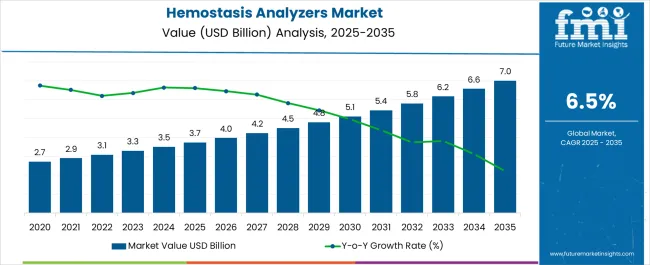
Hemostasis Analyzers Market Key Takeaways
| Metric | Value |
|---|---|
| Hemostasis Analyzers Market Estimated Value in (2025 E) | USD 3.7 billion |
| Hemostasis Analyzers Market Forecast Value in (2035 F) | USD 7.0 billion |
| Forecast CAGR (2025 to 2035) | 6.5% |
Why is the Hemostasis Analyzers Market Growing?
The Hemostasis Analyzers market is witnessing steady growth driven by increasing demand for accurate and rapid coagulation testing across healthcare settings. In 2025, rising prevalence of cardiovascular disorders, coagulation disorders, and surgical procedures requiring preoperative assessment is fueling adoption of hemostasis analyzers. The market is being shaped by continuous advancements in automation, software integration, and high-throughput testing capabilities that enhance operational efficiency in clinical laboratories and hospitals.
Increasing investments in healthcare infrastructure, particularly in emerging regions, support wider deployment of analyzers in both diagnostic and therapeutic monitoring applications. Growing awareness about early detection and monitoring of blood clotting abnormalities is further encouraging adoption.
Furthermore, trends toward personalized medicine and patient-specific treatment regimens are enhancing the reliance on precise coagulation data, driving the market forward With continuous technological innovations, such as enhanced sample processing, digital reporting, and networked data management, the Hemostasis Analyzers market is expected to expand, offering improved patient outcomes and streamlined laboratory operations in both established and developing healthcare systems.
Segmental Analysis
The hemostasis analyzers market is segmented by product type, test type, end use, and geographic regions. By product type, hemostasis analyzers market is divided into Clinical Laboratory Analyzers, Consumables Analyzers, and Point-Of-Care Testing. In terms of test type, hemostasis analyzers market is classified into APTT Tests, D Dimer Tests, Platelet Function Tests, Fibrinogen Tests, Prothrombin Time Tests, and Other Tests. Based on end use, hemostasis analyzers market is segmented into Hospitals & Clinics, Diagnostic Centers, Research And Development Organisations, Ambulatory Surgical Centers, and Others. Regionally, the hemostasis analyzers industry is classified into North America, Latin America, Western Europe, Eastern Europe, Balkan & Baltic Countries, Russia & Belarus, Central Asia, East Asia, South Asia & Pacific, and the Middle East & Africa.
Insights into the Clinical Laboratory Analyzers Segment
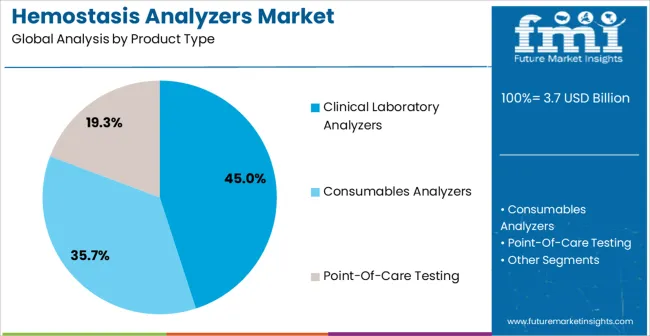
The Clinical Laboratory Analyzers product type is projected to account for 45.0% of the Hemostasis Analyzers market revenue in 2025, positioning it as the leading product category. This dominance is being driven by the segment’s capacity to deliver high-throughput, automated testing for multiple coagulation parameters, reducing manual intervention and operational errors. Adoption has been accelerated by growing demand from centralized laboratories, which require reliable, accurate, and scalable solutions to manage increasing patient volumes.
The ability to integrate with laboratory information systems and perform multiple assays simultaneously has strengthened its market position. Additionally, clinical laboratories prioritize analyzers that enable efficient workflow, consistent results, and rapid turnaround times, making this product type highly preferred.
Continuous enhancements in hardware precision and software analytics have further reinforced adoption The robust performance, ease of maintenance, and compatibility with emerging diagnostic protocols are expected to sustain the leadership of Clinical Laboratory Analyzers in the market over the coming years.
Insights into the APTT Tests Segment
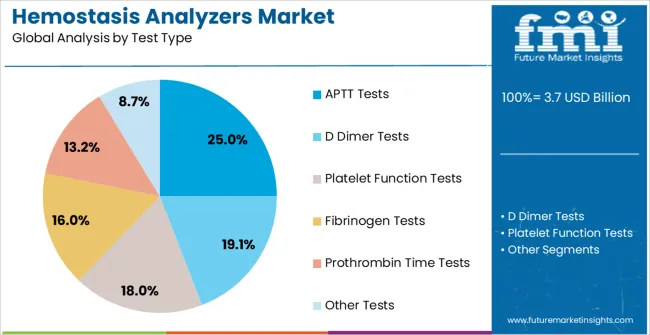
The APTT Tests test type is anticipated to hold 25.0% of the Hemostasis Analyzers market revenue in 2025, making it the largest test type segment. This prominence is being supported by widespread clinical reliance on APTT for monitoring intrinsic and common coagulation pathways, especially in patients receiving heparin therapy or at risk of clotting disorders.
Adoption has been driven by the test’s utility in preoperative assessments, intensive care monitoring, and therapeutic management of coagulation abnormalities. The ease of automation for APTT assays and their integration into modern hemostasis analyzers has facilitated faster, more accurate results, improving laboratory workflow efficiency.
Additionally, increasing awareness among healthcare professionals about the importance of early detection and management of clotting disorders has enhanced demand The ability to produce reproducible and reliable results in a standardized format has positioned APTT as a preferred test type, reinforcing its market share and enabling further expansion as laboratory automation continues to advance.
Insights into the Hospitals & Clinics Segment
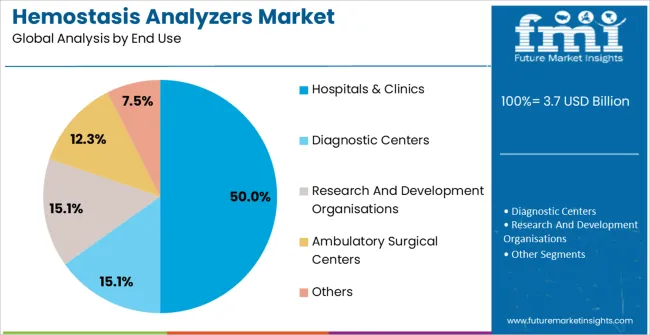
The Hospitals & Clinics end-use industry is projected to account for 50.0% of the Hemostasis Analyzers market revenue in 2025, making it the dominant consumer segment. This leadership is being driven by the high patient volume and continuous monitoring requirements in hospital and clinical environments, which necessitate reliable and automated hemostasis testing solutions.
Adoption has been accelerated by the need for rapid diagnosis and monitoring of coagulation disorders in surgical, intensive care, and emergency settings. The preference for systems that provide accurate, real-time data and can integrate seamlessly with electronic health records has strengthened market presence.
Furthermore, the rising incidence of chronic diseases, cardiovascular disorders, and increasing surgical interventions have expanded the demand for point-of-care and centralized testing in hospitals and clinics The ongoing emphasis on operational efficiency, patient safety, and improved diagnostic accuracy is expected to continue supporting the adoption of hemostasis analyzers in this segment, sustaining its market dominance in the foreseeable future.
Market Overview
Hemostasis Analyzers Market Introduction
Hemostasis analyzers are the laboratory equipments which help medical practitioners for treating patients with blood clotting and bleeding disorder. The demand for advanced and sustainable hemostasis analyzers is increasing to provide optical or mechanical clot detection.
Also, the rising need for safe blood and blood products in various healthcare organizations and laboratories across the globe is driving the growth of hemostasis analyzers market. Moreover, the rapid evolution in clinical diagnostics sector along with the innovative developments in the laboratory mechanization are some of the major factors supporting the rapid adoption of hemostasis analyzers.
Furthermore, the increasing implementation of automated hemostasis analyzers by diagnostic and testing laboratories is also propelling the growth of hemostasis analyzers market.
Analysis of Hemostasis Analyzers Market By Key Countries
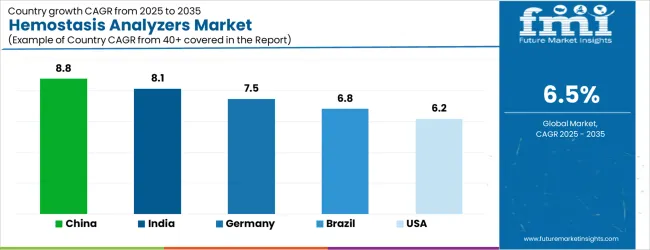
| Country | CAGR |
|---|---|
| China | 8.8% |
| India | 8.1% |
| Germany | 7.5% |
| Brazil | 6.8% |
| USA | 6.2% |
| UK | 5.5% |
| Japan | 4.9% |
Country-wise Analysis
The Hemostasis Analyzers Market is expected to register a CAGR of 6.5% during the forecast period, exhibiting varied country level momentum. China leads with the highest CAGR of 8.8%, followed by India at 8.1%. Developed markets such as Germany, France, and the UK continue to expand steadily, while the USA is likely to grow at consistent rates. Japan posts the lowest CAGR at 4.9%, yet still underscores a broadly positive trajectory for the global Hemostasis Analyzers Market. In 2024, Germany held a dominant revenue in the Western Europe market and is expected to grow with a CAGR of 7.5%. The USA Hemostasis Analyzers Market is estimated to be valued at USD 1.3 billion in 2025 and is anticipated to reach a valuation of USD 1.3 billion by 2035. Sales are projected to rise at a CAGR of 0.0% over the forecast period between 2025 and 2035. While Japan and South Korea markets are estimated to be valued at USD 182.8 million and USD 115.7 million respectively in 2025.
Key Players in the Hemostasis Analyzers Market
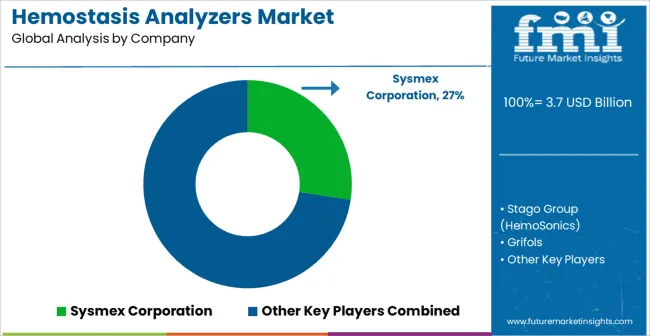
- Sysmex Corporation
- Stago Group (HemoSonics)
- Grifols
- Haemonetics
- Roche Diagnostics
- Abbott (Alere)
- Nihon Kohden
- Thermo Fisher Scientific
- Siemens
- Helena Laboratories
- Instrumentation Laboratory (Werfen)
- International Technidyne Corporation (ITC)
Scope of the Report
| Item | Value |
|---|---|
| Quantitative Units | USD 3.7 Billion |
| Product Type | Clinical Laboratory Analyzers, Consumables Analyzers, and Point-Of-Care Testing |
| Test Type | APTT Tests, D Dimer Tests, Platelet Function Tests, Fibrinogen Tests, Prothrombin Time Tests, and Other Tests |
| End Use | Hospitals & Clinics, Diagnostic Centers, Research And Development Organisations, Ambulatory Surgical Centers, and Others |
| Regions Covered | North America, Europe, Asia-Pacific, Latin America, Middle East & Africa |
| Country Covered | United States, Canada, Germany, France, United Kingdom, China, Japan, India, Brazil, South Africa |
| Key Companies Profiled | Sysmex Corporation, Stago Group (HemoSonics), Grifols, Haemonetics, Roche Diagnostics, Abbott (Alere), Nihon Kohden, Thermo Fisher Scientific, Siemens, Helena Laboratories, Instrumentation Laboratory (Werfen), and International Technidyne Corporation (ITC) |
Hemostasis Analyzers Market by Segments
Product Type:
- Clinical Laboratory Analyzers
- Consumables Analyzers
- Point-Of-Care Testing
Test Type:
- APTT Tests
- D Dimer Tests
- Platelet Function Tests
- Fibrinogen Tests
- Prothrombin Time Tests
- Other Tests
End Use:
- Hospitals & Clinics
- Diagnostic Centers
- Research And Development Organisations
- Ambulatory Surgical Centers
- Others
Region:
- North America
- USA
- Canada
- Mexico
- Latin America
- Brazil
- Chile
- Rest of Latin America
- Western Europe
- Germany
- UK
- Italy
- Spain
- France
- Nordic
- BENELUX
- Rest of Western Europe
- Eastern Europe
- Russia
- Poland
- Hungary
- Balkan & Baltic
- Rest of Eastern Europe
- East Asia
- China
- Japan
- South Korea
- South Asia and Pacific
- India
- ASEAN
- Australia & New Zealand
- Rest of South Asia and Pacific
- Middle East & Africa
- Kingdom of Saudi Arabia
- Other GCC Countries
- Turkiye
- South Africa
- Other African Union
- Rest of Middle East & Africa
Frequently Asked Questions
How big is the hemostasis analyzers market in 2025?
The global hemostasis analyzers market is estimated to be valued at USD 3.7 billion in 2025.
What will be the size of hemostasis analyzers market in 2035?
The market size for the hemostasis analyzers market is projected to reach USD 7.0 billion by 2035.
How much will be the hemostasis analyzers market growth between 2025 and 2035?
The hemostasis analyzers market is expected to grow at a 6.5% CAGR between 2025 and 2035.
What are the key product types in the hemostasis analyzers market?
The key product types in hemostasis analyzers market are clinical laboratory analyzers, consumables analyzers and point-of-care testing.
Which test type segment to contribute significant share in the hemostasis analyzers market in 2025?
In terms of test type, aptt tests segment to command 25.0% share in the hemostasis analyzers market in 2025.
Preview the report firsthand - request a free sample
Get SampleGet the brochure for pricing and purchase details.
Get PDFTable of Content
- Executive Summary
- Global Market Outlook
- Demand-side Trends
- Supply-side Trends
- Technology Roadmap Analysis
- Analysis and Recommendations
- Market Overview
- Market Coverage / Taxonomy
- Market Definition / Scope / Limitations
- Market Background
- Market Dynamics
- Drivers
- Restraints
- Opportunity
- Trends
- Scenario Forecast
- Demand in Optimistic Scenario
- Demand in Likely Scenario
- Demand in Conservative Scenario
- Opportunity Map Analysis
- Product Life Cycle Analysis
- Supply Chain Analysis
- Investment Feasibility Matrix
- Value Chain Analysis
- PESTLE and Porter’s Analysis
- Regulatory Landscape
- Regional Parent Market Outlook
- Production and Consumption Statistics
- Import and Export Statistics
- Market Dynamics
- Global Market Analysis 2020 to 2024 and Forecast, 2025 to 2035
- Historical Market Size Value (USD Million) Analysis, 2020 to 2024
- Current and Future Market Size Value (USD Million) Projections, 2025 to 2035
- Y-o-Y Growth Trend Analysis
- Absolute $ Opportunity Analysis
- Global Market Pricing Analysis 2020 to 2024 and Forecast 2025 to 2035
- Global Market Analysis 2020 to 2024 and Forecast 2025 to 2035, By Product Type
- Introduction / Key Findings
- Historical Market Size Value (USD Million) Analysis By Product Type , 2020 to 2024
- Current and Future Market Size Value (USD Million) Analysis and Forecast By Product Type , 2025 to 2035
- Clinical Laboratory Analyzers
- Consumables Analyzers
- Point-Of-Care Testing
- Y-o-Y Growth Trend Analysis By Product Type , 2020 to 2024
- Absolute $ Opportunity Analysis By Product Type , 2025 to 2035
- Global Market Analysis 2020 to 2024 and Forecast 2025 to 2035, By Test Type
- Introduction / Key Findings
- Historical Market Size Value (USD Million) Analysis By Test Type, 2020 to 2024
- Current and Future Market Size Value (USD Million) Analysis and Forecast By Test Type, 2025 to 2035
- APTT Tests
- D Dimer Tests
- Platelet Function Tests
- Fibrinogen Tests
- Prothrombin Time Tests
- Other Tests
- Y-o-Y Growth Trend Analysis By Test Type, 2020 to 2024
- Absolute $ Opportunity Analysis By Test Type, 2025 to 2035
- Global Market Analysis 2020 to 2024 and Forecast 2025 to 2035, By End Use
- Introduction / Key Findings
- Historical Market Size Value (USD Million) Analysis By End Use, 2020 to 2024
- Current and Future Market Size Value (USD Million) Analysis and Forecast By End Use, 2025 to 2035
- Hospitals & Clinics
- Diagnostic Centers
- Research And Development Organisations
- Ambulatory Surgical Centers
- Others
- Y-o-Y Growth Trend Analysis By End Use, 2020 to 2024
- Absolute $ Opportunity Analysis By End Use, 2025 to 2035
- Global Market Analysis 2020 to 2024 and Forecast 2025 to 2035, By Region
- Introduction
- Historical Market Size Value (USD Million) Analysis By Region, 2020 to 2024
- Current Market Size Value (USD Million) Analysis and Forecast By Region, 2025 to 2035
- North America
- Latin America
- Western Europe
- Eastern Europe
- East Asia
- South Asia and Pacific
- Middle East & Africa
- Market Attractiveness Analysis By Region
- North America Market Analysis 2020 to 2024 and Forecast 2025 to 2035, By Country
- Historical Market Size Value (USD Million) Trend Analysis By Market Taxonomy, 2020 to 2024
- Market Size Value (USD Million) Forecast By Market Taxonomy, 2025 to 2035
- By Country
- USA
- Canada
- Mexico
- By Product Type
- By Test Type
- By End Use
- By Country
- Market Attractiveness Analysis
- By Country
- By Product Type
- By Test Type
- By End Use
- Key Takeaways
- Latin America Market Analysis 2020 to 2024 and Forecast 2025 to 2035, By Country
- Historical Market Size Value (USD Million) Trend Analysis By Market Taxonomy, 2020 to 2024
- Market Size Value (USD Million) Forecast By Market Taxonomy, 2025 to 2035
- By Country
- Brazil
- Chile
- Rest of Latin America
- By Product Type
- By Test Type
- By End Use
- By Country
- Market Attractiveness Analysis
- By Country
- By Product Type
- By Test Type
- By End Use
- Key Takeaways
- Western Europe Market Analysis 2020 to 2024 and Forecast 2025 to 2035, By Country
- Historical Market Size Value (USD Million) Trend Analysis By Market Taxonomy, 2020 to 2024
- Market Size Value (USD Million) Forecast By Market Taxonomy, 2025 to 2035
- By Country
- Germany
- UK
- Italy
- Spain
- France
- Nordic
- BENELUX
- Rest of Western Europe
- By Product Type
- By Test Type
- By End Use
- By Country
- Market Attractiveness Analysis
- By Country
- By Product Type
- By Test Type
- By End Use
- Key Takeaways
- Eastern Europe Market Analysis 2020 to 2024 and Forecast 2025 to 2035, By Country
- Historical Market Size Value (USD Million) Trend Analysis By Market Taxonomy, 2020 to 2024
- Market Size Value (USD Million) Forecast By Market Taxonomy, 2025 to 2035
- By Country
- Russia
- Poland
- Hungary
- Balkan & Baltic
- Rest of Eastern Europe
- By Product Type
- By Test Type
- By End Use
- By Country
- Market Attractiveness Analysis
- By Country
- By Product Type
- By Test Type
- By End Use
- Key Takeaways
- East Asia Market Analysis 2020 to 2024 and Forecast 2025 to 2035, By Country
- Historical Market Size Value (USD Million) Trend Analysis By Market Taxonomy, 2020 to 2024
- Market Size Value (USD Million) Forecast By Market Taxonomy, 2025 to 2035
- By Country
- China
- Japan
- South Korea
- By Product Type
- By Test Type
- By End Use
- By Country
- Market Attractiveness Analysis
- By Country
- By Product Type
- By Test Type
- By End Use
- Key Takeaways
- South Asia and Pacific Market Analysis 2020 to 2024 and Forecast 2025 to 2035, By Country
- Historical Market Size Value (USD Million) Trend Analysis By Market Taxonomy, 2020 to 2024
- Market Size Value (USD Million) Forecast By Market Taxonomy, 2025 to 2035
- By Country
- India
- ASEAN
- Australia & New Zealand
- Rest of South Asia and Pacific
- By Product Type
- By Test Type
- By End Use
- By Country
- Market Attractiveness Analysis
- By Country
- By Product Type
- By Test Type
- By End Use
- Key Takeaways
- Middle East & Africa Market Analysis 2020 to 2024 and Forecast 2025 to 2035, By Country
- Historical Market Size Value (USD Million) Trend Analysis By Market Taxonomy, 2020 to 2024
- Market Size Value (USD Million) Forecast By Market Taxonomy, 2025 to 2035
- By Country
- Kingdom of Saudi Arabia
- Other GCC Countries
- Turkiye
- South Africa
- Other African Union
- Rest of Middle East & Africa
- By Product Type
- By Test Type
- By End Use
- By Country
- Market Attractiveness Analysis
- By Country
- By Product Type
- By Test Type
- By End Use
- Key Takeaways
- Key Countries Market Analysis
- USA
- Pricing Analysis
- Market Share Analysis, 2024
- By Product Type
- By Test Type
- By End Use
- Canada
- Pricing Analysis
- Market Share Analysis, 2024
- By Product Type
- By Test Type
- By End Use
- Mexico
- Pricing Analysis
- Market Share Analysis, 2024
- By Product Type
- By Test Type
- By End Use
- Brazil
- Pricing Analysis
- Market Share Analysis, 2024
- By Product Type
- By Test Type
- By End Use
- Chile
- Pricing Analysis
- Market Share Analysis, 2024
- By Product Type
- By Test Type
- By End Use
- Germany
- Pricing Analysis
- Market Share Analysis, 2024
- By Product Type
- By Test Type
- By End Use
- UK
- Pricing Analysis
- Market Share Analysis, 2024
- By Product Type
- By Test Type
- By End Use
- Italy
- Pricing Analysis
- Market Share Analysis, 2024
- By Product Type
- By Test Type
- By End Use
- Spain
- Pricing Analysis
- Market Share Analysis, 2024
- By Product Type
- By Test Type
- By End Use
- France
- Pricing Analysis
- Market Share Analysis, 2024
- By Product Type
- By Test Type
- By End Use
- India
- Pricing Analysis
- Market Share Analysis, 2024
- By Product Type
- By Test Type
- By End Use
- ASEAN
- Pricing Analysis
- Market Share Analysis, 2024
- By Product Type
- By Test Type
- By End Use
- Australia & New Zealand
- Pricing Analysis
- Market Share Analysis, 2024
- By Product Type
- By Test Type
- By End Use
- China
- Pricing Analysis
- Market Share Analysis, 2024
- By Product Type
- By Test Type
- By End Use
- Japan
- Pricing Analysis
- Market Share Analysis, 2024
- By Product Type
- By Test Type
- By End Use
- South Korea
- Pricing Analysis
- Market Share Analysis, 2024
- By Product Type
- By Test Type
- By End Use
- Russia
- Pricing Analysis
- Market Share Analysis, 2024
- By Product Type
- By Test Type
- By End Use
- Poland
- Pricing Analysis
- Market Share Analysis, 2024
- By Product Type
- By Test Type
- By End Use
- Hungary
- Pricing Analysis
- Market Share Analysis, 2024
- By Product Type
- By Test Type
- By End Use
- Kingdom of Saudi Arabia
- Pricing Analysis
- Market Share Analysis, 2024
- By Product Type
- By Test Type
- By End Use
- Turkiye
- Pricing Analysis
- Market Share Analysis, 2024
- By Product Type
- By Test Type
- By End Use
- South Africa
- Pricing Analysis
- Market Share Analysis, 2024
- By Product Type
- By Test Type
- By End Use
- USA
- Market Structure Analysis
- Competition Dashboard
- Competition Benchmarking
- Market Share Analysis of Top Players
- By Regional
- By Product Type
- By Test Type
- By End Use
- Competition Analysis
- Competition Deep Dive
- Sysmex Corporation
- Overview
- Product Portfolio
- Profitability by Market Segments (Product/Age /Sales Channel/Region)
- Sales Footprint
- Strategy Overview
- Marketing Strategy
- Product Strategy
- Channel Strategy
- Stago Group (HemoSonics)
- Grifols
- Haemonetics
- Roche Diagnostics
- Abbott (Alere)
- Nihon Kohden
- Thermo Fisher Scientific
- Siemens
- Helena Laboratories
- Instrumentation Laboratory (Werfen)
- International Technidyne Corporation (ITC)
- Sysmex Corporation
- Competition Deep Dive
- Assumptions & Acronyms Used
- Research Methodology


