

- Industry Size (2026)
- USD 1.8 Bn
- Forecast (2036)
- USD 3.3 Bn
- CAGR (2026 to 2036)
- 6.6%
Blood Gas Analyzers Market Size, Market Forecast and Outlook By FMI
Global value for blood gas analyzers market reached USD 1.7 billion in 2025. Projections indicate a valuation of USD 1.8 billion in 2026, scaling to USD 3.4 billion by 2036. FMI predicts a steady CAGR of 6.6% over the decade-long forecast period.
Hospital procurement boards are abandoning the "device-first" purchasing model in favor of "outcome-guaranteed" contracts, a shift that fundamentally changes how suppliers must bid for ICU tenders. The decisive factor for 2026 is no longer just analytical throughput, but the capability to integrate with "silent" surveillance systems that predict respiratory failure hours before a code blue event. FMI analysts opine that vendors who can bundle benchtop units with AI-driven deterioration indices, software that synthesizes blood gas data with real-time vitals, will command a 20-30% premium over competitors offering hardware-only solutions.
Roche CEO Thomas Schinecker highlighted the financial impact of this strategic pivot toward high-value integrated diagnostics. "2024 was a strong year for Roche. In the fourth quarter, we continued our very positive momentum for the third consecutive quarter with Group sales growth of 9% (CER)" [1]. For hospital buyers, this sustained corporate momentum signals a shift away from volatile, short-term component suppliers toward entrenched partners capable of supporting long-term digital transformation. As per FMI's projection, this consolidation will force smaller players to exit the acute care segment or pivot entirely to niche veterinary and research markets.
Summary of Blood Gas Analyzers Market
- Blood Gas Analyzers Market Definition
- A specialized diagnostic market focused on measuring essential respiratory and metabolic parameters to guide life-saving interventions.
- Demand Drivers in the Market
- Rising prevalence of chronic respiratory diseases and diabetes necessitates frequent metabolic profiling.
- Development of automated hemolysis detection reduces sample rejection rates and improves lab efficiency.
- Expansion of decentralized testing infrastructure, such as community diagnostic hubs, increases device placement.
- Key Segments Analyzed in the FMI Report
- Portable Analyzers (42.30% share) are expanding due to their utility in ambulance and bedside settings.
- Intensive Care Units (38.70% share) remain the financial backbone, generating high-volume recurring consumable revenue.
- Asia Pacific markets like China and India are outperforming Western regions due to infrastructure greenfield projects.
- Analyst Opinion at FMI
- Sabyasachi Ghosh, Associate Vice President for Healthcare at Future Market Insights, opines, "The bifurcation of the market is becoming distinct; premium buyers in the US and Europe are demanding AI-driven error prevention to combat staffing shortages, while emerging markets are prioritizing ruggedness and low-cost consumables. Vendors who cannot address both tiers with distinct product lines will struggle to maintain global market share."
- Strategic Implications/Executive Takeaways
- Prioritize R&D in pre-analytical error reduction software to justify premium pricing.
- Pursue M&A targets that offer complementary point-of-care technologies to lock in hospital networks.
- Align product launches in emerging markets with local manufacturing incentives to bypass import tariffs.
- Methodology
- Validated through first-hand corporate production and capacity data.
- Zero reliance on speculative third-party market research reports.
- Based on verifiable industrial benchmarks and verified sources.
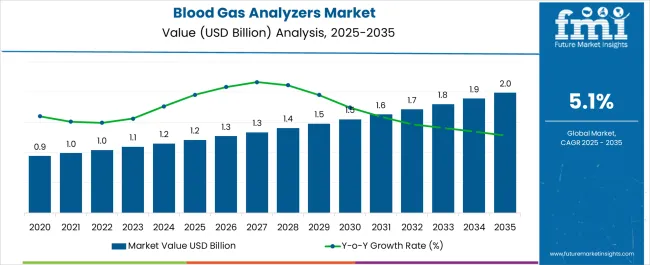
China leads regional expansion with an 8.9% CAGR, fueled by the sheer volume of metabolic management needed for its diabetic population. India follows closely at 8.2% CAGR, supported by a 15% growth rate in its domestic medical device sector [6]. European markets show maturity, with Germany at 7.6% CAGR focusing on replacement cycles for automated systems. Brazil is projected to grow at 6.9% CAGR, while the United States maintains a 6.3% CAGR, anchored by strict reimbursement floors that demand operational efficiency [7].
Blood Gas Analyzers Market Definition
Blood gas analyzers are sophisticated diagnostic instruments designed to measure the partial pressure of oxygen (pO2), carbon dioxide (pCO2), and pH levels in arterial or venous blood samples. These devices serve as the primary tool for assessing a patient's acid-base balance and gas exchange efficiency in critical scenarios such as respiratory failure, sepsis, or trauma. Modern platforms often integrate co-oximetry and metabolite testing (glucose, lactate, electrolytes) to provide a comprehensive physiological snapshot from a single micro-volume sample.
Blood Gas Analyzers Market Inclusions
The report encompasses the full spectrum of analyzer configurations, including high-throughput benchtop systems used in central laboratories and compact portable or handheld devices deployed at the point of care. Revenue calculations include the initial capital expenditure for the analyzers themselves as well as the recurring stream from proprietary consumables like reagent cartridges, sensor cassettes, and calibration fluids. It also accounts for data management software sold as part of the diagnostic ecosystem.
Blood Gas Analyzers Market Exclusions
The analysis explicitly excludes general chemistry analyzers that may offer basic ion-selective electrode (ISE) functions but lack the dedicated sensors for arterial blood gas (ABG) parameters. Over-the-counter (OTC) consumer health devices, such as pulse oximeters or standard blood sugar tester units without blood gas capabilities, are outside the scope. Veterinary-specific models are also omitted unless they are identical technical variants sold into human research applications.
Blood Gas Analyzers Market Research Methodology
- Primary Research: Interviews were conducted with critical care directors, lab managers, and procurement officers to understand shifting tender specifications.
- Desk Research: Analysis included review of CMS fee schedule updates, FDA 510(k) clearances, and corporate annual reports to verify revenue baselines.
- Market-Sizing and Forecasting: A bottom-up model was built using ICU bed density and hospital admission rates, cross-verified with top-down vendor revenue data.
- Data Validation and Update Cycle: Installed base figures were calibrated against import/export trade codes and public tender award notices.
Segmental Analysis
Blood Gas Analyzers Market Analysis by Product Type
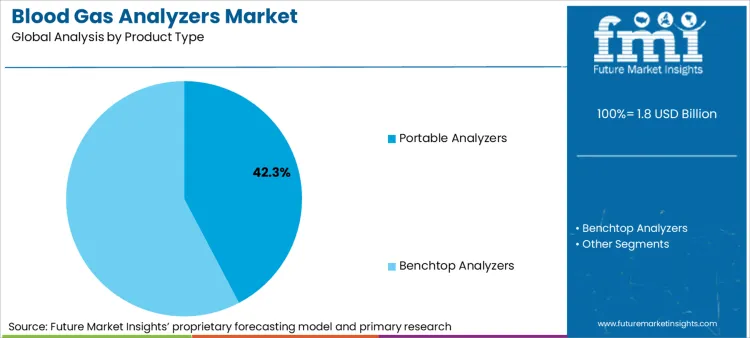
Portable analyzers are projected to capture 42.30% of the global market share by 2026, a trend accelerating as healthcare systems push diagnostics closer to the patient. The traditional reliance on central labs is being challenged by the clinical need for immediate decision-making in emergency transport and remote wards. According to FMI's estimates, the deployment of handheld units will outpace benchtop installations by a factor of 2:1 in ambulatory settings over the forecast period. This shift is further supported by large-scale acquisitions, such as Roche's purchase of LumiraDx, which signals a major industry bet on the dominance of decentralized testing platforms [2].
- Portable Analyzers: Adoption is driven by the operational need to reduce therapeutic turnaround times in pre-hospital and ambulatory settings [2].
- Benchtop Analyzers: These systems retain dominance in high-volume core labs where fully automatic blood gas analyzer efficiency is the primary metric [1].
- Cartridge-based Systems: The shift toward maintenance-free, single-use cartridges is simplifying inventory management for smaller clinics [4].
Blood Gas Analyzers Market Analysis by Application
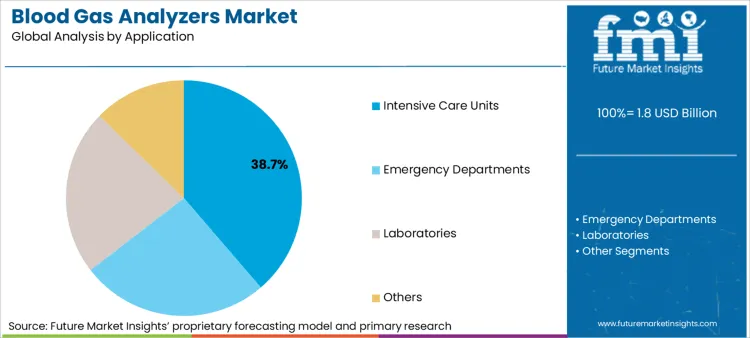
Intensive Care Units (ICUs) constitute the largest application segment, accounting for 38.70% of market value in 2026. The physiological instability of critically ill patients mandates frequent arterial blood gas (ABG) sampling, creating a steady, recession-proof stream of consumable revenue for manufacturers. In this high-stakes environment, the cost of error is prohibitive; consequently, ICUs are rapidly adopting analyzers with integrated automated quality control. FMI analysts opine that technologies capable of identifying hemolysis at the point of draw are becoming mandatory in tender specifications to mitigate the 70% of pre-analytical errors that plague testing workflows [4].
- Intensive Care Units: High-frequency testing requirements for ventilated patients ensure this segment remains the primary revenue generator [9].
- Emergency Departments: Rapid triage protocols for trauma and respiratory distress drive the placement of near-patient testing units [5].
- Laboratories: Central labs focus on consolidating volumes from various hospital wards to maximize reagent utilization efficiency [7].
Blood Gas Analyzers Market Drivers, Restraints, and Opportunities
The relentless rise in chronic metabolic and respiratory conditions acts as the primary engine for market volume. In China alone, the diabetic population has swelled to over 116 million as of 2024, creating a vast, non-negotiable demand for acid-base and electrolyte monitoring to manage complications like diabetic ketoacidosis [8]. This demographic pressure forces healthcare providers to expand their diagnostic capacity, moving beyond acute care into chronic disease management programs that utilize blood gas data for long-term patient stability.
Stringent reimbursement caps in major markets create a hard ceiling on pricing power. In the United States, the Centers for Medicare & Medicaid Services (CMS) have set the 2024 national minimum payment amount for many clinical tests at just $17.76, squeezing the margins for laboratory service providers [7]. This regulatory price floor forces hospitals to be extremely price-sensitive regarding consumables, compelling vendors to demonstrate clear ROI through workflow automation or labor savings to justify contract renewals.
- Infrastructure Expansion: The UK's operational rollout of 165 Community Diagnostic Centres creates a new channel for testing outside traditional hospitals [5].
- Error Mitigation: Technologies that automatically detect hemolysis address a major clinical pain point, justifying hardware upgrades [4].
- Domestic Manufacturing: India's 15% growth in medical devices is supported by policies encouraging local production, offering a route to lower costs [6].
Regional Analysis
Based on the regional analysis, the blood gas analyzers market is segmented into North America, Latin America, Europe, East Asia, South Asia, Oceania, and Middle East & Africa across 40+ countries. The full report also offers market attractiveness analysis based on regional trends.
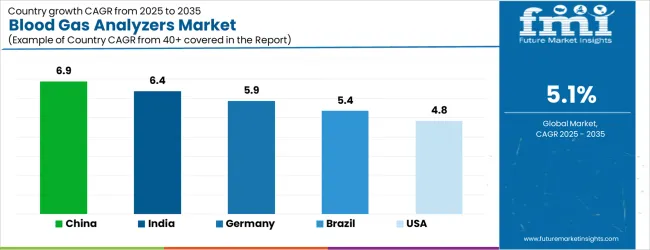
| Country | CAGR (2026 to 2036) |
|---|---|
| China | 8.9% |
| India | 8.2% |
| Germany | 7.6% |
| Brazil | 6.9% |
| United States | 6.3% |
Source: Future Market Insights (FMI) analysis, based on proprietary forecasting model and primary research
Asia Pacific Blood Gas Analyzers Market Analysis
Asia Pacific is transitioning from a region of basic infrastructure build-out to one of sophisticated, high-volume diagnostic capability. The dual forces of massive population scale and government-led localization mandates are reshaping the competitive landscape. As public health systems in China and India modernize, there is a distinct pivot toward analyzers that can handle extreme throughput while offering connectivity for population health management.
- China: A CAGR of 8.9% reflects the urgent need to manage a diabetic population of 116 million, driving instrument placement in both tier-1 cities and provincial centers [8]. The market is rapidly adopting ai integrated blood analyzers to manage the patient load in overcrowded metropolitan hospitals.
- India: Expansion at 8.2% CAGR is underpinned by a robust domestic medical device sector that is growing at 15% annually, supported by "Make in India" initiatives [6]. The market is also seeing the entry of advanced diagnostics, exemplified by Siemens Healthineers installing its first Atellica CI Analyzer at Mahajan Imaging & Labs in New Delhi to enhance pathology capabilities [9].
FMI’s report includes a detailed analysis of growth in the Asia Pacific region, along with a country-wise assessment that includes China and India. Readers can also find regional trends, regulations, and market growth based on different segments and countries in Asia Pacific.
Europe Blood Gas Analyzers Market Analysis
Europe is defining the "connected care" model, where blood gas data is integrated into broader electronic health records to facilitate continuity of care. The region is seeing a strategic shift of testing volume from overburdened acute care hospitals to community-based settings. This decentralization is supported by substantial government investment in diagnostic hubs, creating a fertile market for robust, connected point-of-care devices.
- Germany: Growth tracks a CAGR of 7.6% as university hospitals replace aging inventory with next-generation automated systems that reduce manual calibration needs. The focus is shifting toward next generation blood gas monitors system adoption to streamline lab workflows.
- United Kingdom: A CAGR of 6.3% is underpinned by the NHS "Community Diagnostic Centres" initiative, which has already delivered over 9 million tests to reduce hospital backlogs [5].
FMI’s report includes a detailed analysis of growth in the Europe region, along with a country-wise assessment that includes Germany and the United Kingdom. Readers can also find regional trends, regulations, and market growth based on different segments and countries in Europe.
North America Blood Gas Analyzers Market Analysis
North America remains the global center for high-value diagnostic innovation, characterized by a heavy emphasis on efficiency and compliance. The market is shaped by intense consolidation among providers and rigorous cost-containment measures from payers. Manufacturers here compete not just on hardware specs, but on their ability to navigate complex reimbursement landscapes and deliver seamless IT integration.
- United States: At 6.3% CAGR, the country outlook is shaped by labs optimizing workflows to remain profitable under the $17.76 CMS payment floor for clinical tests [7]. As per FMI's projection, this price pressure will drive the adoption of medical gas analyzers that offer multi-parameter testing to maximize reimbursement per sample.
FMI’s report includes a detailed analysis of growth in the North America region, along with a country-wise assessment that includes the United States. Readers can also find regional trends, regulations, and market growth based on different segments and countries in North America.
Latin America Blood Gas Analyzers Market Analysis
Latin America is emerging as a dynamic market where regulatory harmonization is unlocking new opportunities for import and investment. Key economies are aligning their medical device standards with international benchmarks, reducing the friction for market entry. This regulatory maturity, combined with a growing private hospital sector, is driving the uptake of modern diagnostic technologies.
- Brazil: Demand is projected to rise at 6.9% CAGR through 2036. The regulatory environment is improving, with ANVISA implementing a new strategic plan in 2024 to streamline convergence with WHO/PAHO standards, facilitating faster approval for advanced diagnostic imports [10].
FMI’s report includes a detailed analysis of growth in the Latin America region, along with a country-wise assessment that includes Brazil. Readers can also find regional trends, regulations, and market growth based on different segments and countries in Latin America.
Competitive Aligners for Market Players
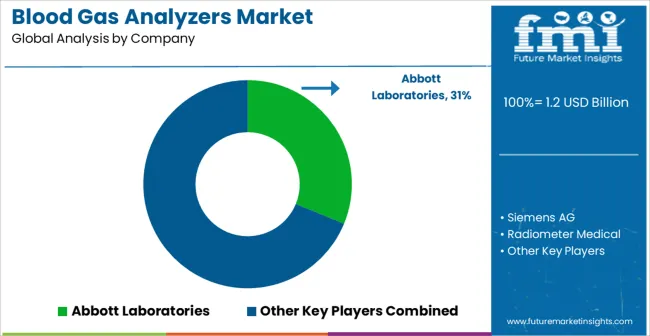
The competitive hierarchy is solidifying around entities that can offer a "closed loop" diagnostic ecosystem. Tier 1 players like Roche and Abbott are aggressively using M&A to eliminate gaps in their portfolios, ensuring they can offer a hospital everything from a high-throughput benchtop unit to a handheld POC device under a single contract. According to FMI's estimates, this strategy creates a high barrier to entry for single-product competitors, who find themselves locked out of network-wide tenders.
Innovation has shifted from pure analytical performance, which is largely commoditized, to pre-analytical error prevention. Companies like Werfen are differentiating themselves by integrating automated hemolysis detection directly into their cartridges. This feature directly addresses the errors that occur before the sample even reaches the sensor, offering a tangible economic value proposition to lab directors struggling with sample rejections and staffing shortages.
Service and supply chain resilience have become critical competitive variables. In the wake of global disruptions, hospitals are prioritizing vendors with diversified manufacturing footprints and robust logistics. Suppliers who can guarantee consumable availability and offer predictive maintenance through remote monitoring are winning long-term contracts over those competing solely on sticker price.
Recent Developments
The report includes full coverage of key trends from competitive benchmarking. Some of the recent developments covered in the reports:
- In July 2025, Advanced Instruments completed the acquisition of Nova Biomedical for an enterprise value of USD 2.2 billion, creating a new dominant force in the critical care testing landscape [3].
- In July 2024, Roche finalized its acquisition of LumiraDx’s Point of Care technology for USD 295 million, a strategic move to secure a leading position in decentralized diagnostic platforms [2].
Key Players in Blood Gas Analyzers Market
- Radiometer
- Siemens Healthineers
- Abbott
- Roche Diagnostics
- Nova Biomedical
- Werfen
- Opti Medical
- Accurex Biomedical
- Edan Instruments
- Sensa Core Medical Instrumentation
Scope of the Report
| Metric | Value |
|---|---|
| Quantitative Units | USD 1.8 billion (2026) to USD 3.3 billion (2036), at a CAGR of 6.6% |
| Market Definition | The blood gas analyzers market comprises the global sales and trade of diagnostic instruments used to measure pH, pO2, and pCO2 in blood, essential for critical care monitoring. |
| Product Type Segmentation | Portable Analyzers, Benchtop Analyzers |
| Application Segmentation | Intensive Care Units, Emergency Departments, Laboratories, Others |
| Application Coverage | Arterial Blood Gas (ABG) Analysis, Electrolyte Monitoring, Metabolite Testing |
| Regions Covered | North America, Latin America, Europe, Asia Pacific, Middle East & Africa |
| Countries Covered | United States, Brazil, Germany, United Kingdom, China, India |
| Key Companies Profiled | Radiometer, Siemens Healthineers, Abbott, Roche Diagnostics, Nova Biomedical, Werfen, Opti Medical, Accurex Biomedical, Edan Instruments, Sensa Core Medical Instrumentation |
| Forecast Period | 2026 to 2036 |
| Approach | Hybrid top-down and bottom-up market modeling validated through primary interviews with lab directors and procurement officers, supported by trade data benchmarking. |
Blood Gas Analyzers Market Analysis by Segments
Product Type
- Portable Analyzers
- Benchtop Analyzers
Application
- Intensive Care Units
- Emergency Departments
- Laboratories
- Others
Region
- Asia Pacific
- India
- China
- Japan
- South Korea
- Indonesia
- Australia & New Zealand
- ASEAN
- Rest of Asia Pacific
- Europe
- Germany
- Italy
- France
- United Kingdom
- Spain
- Benelux
- Nordics
- Central & Eastern Europe
- Rest of Europe
- North America
- United States
- Canada
- Mexico
- Latin America
- Brazil
- Argentina
- Chile
- Rest of Latin America
- Middle East & Africa
- Kingdom of Saudi Arabia
- United Arab Emirates
- South Africa
- Turkey
- Rest of Middle East & Africa
Bibliography
- [1] Roche. (2025). Ad hoc announcement pursuant to Art. 53 LR: Roche reports strong 2024.
- [2] Roche. (2024). Roche completes acquisition of LumiraDx’s Point of Care technology.
- [3] Advanced Instruments. (2025). Advanced Instruments completes acquisition of Nova Biomedical.
- [4] Werfen. (2024). Werfen blood gas testing system features integrated hemolysis detection.
- [5] NHS England. (2024). Community Diagnostic Centres: Delivering over 9 million tests.
- [6] Department of Pharmaceuticals, Govt. of India. (2024). Annual Report 2023-24.
- [7] Centers for Medicare & Medicaid Services. (2024). Clinical Laboratory Fee Schedule 2024 Annual Update.
- [8] Straits Research (citing Chinese Diabetes Society). (2024). IVD Raw Materials Market: China.
- [9] Express Healthcare. (2024). Siemens Healthineers & Mahajan Imaging Labs pioneer India’s first AI-enhanced diagnostic analyser.
- [10] ANVISA. (2024). Executive Summary of Management Report 2024.
This Report Addresses
- Market intelligence to enable structured strategic decision making across mature and emerging diagnostic economies.
- Market size estimation and 10 year revenue forecasts from 2026 to 2036, supported by validated capacity and trade benchmarks.
- Growth opportunity mapping across portable and benchtop forms with emphasis on POC transitions.
- Segment and regional revenue forecasts covering intensive care, emergency departments, and laboratory applications.
- Competition strategy assessment including consolidation models, cost survivability positioning, and compliance capability benchmarking.
- Product reformulation and error reduction tracking including hemolysis detection and connectivity features.
- Regulatory impact analysis covering CMS reimbursement updates, CE marking, and import mandates.
- Market report delivery in PDF, Excel, PPT, and interactive dashboard formats for executive and operational use.
Frequently Asked Questions
How large is the demand for Blood Gas Analyzers in the global market in 2026?
Demand for Blood Gas Analyzers in the global market is estimated to be valued at USD 1.8 billion in 2026.
What will be the market size of Blood Gas Analyzers in the global market by 2036?
Market size for Blood Gas Analyzers is projected to reach USD 3.3 billion by 2036.
What is the expected demand growth for Blood Gas Analyzers in the global market between 2026 and 2036?
Demand for Blood Gas Analyzers in the global market is expected to grow at a CAGR of 6.6% between 2026 and 2036.
Which Product Type is poised to lead global sales by 2026?
Portable Analyzers are expected to lead with 42.30% market share in 2026, driven by the operational need for faster bedside diagnostics.
How significant is the role of Intensive Care Units in driving Blood Gas Analyzers adoption in 2026?
Intensive Care Units represent a critical segment, projected to hold a substantial 38.70% share of the total market in 2026 due to continuous patient monitoring requirements.
What is driving demand in China?
Demand is driven by the management of chronic conditions, specifically a diabetic population that has exceeded 116 million individuals.
What compliance standards or regulations are referenced for the United States?
The CMS Clinical Laboratory Fee Schedule 2024 is referenced as a key benchmark for reimbursement floors.
What is the China growth outlook in this report?
China is projected to grow at a CAGR of 8.9% during 2026 to 2036.
Why is Europe described as a priority region in this report?
Europe is prioritizing decentralized care, exemplified by the rollout of community diagnostic hubs to reduce hospital congestion.
What type of demand dominates in Europe?
Demand is increasingly focused on replacement cycles for connected, automated systems that integrate with electronic health records.
What is India growth outlook in this report?
India is projected to expand at a CAGR of 8.2% during 2026 to 2036.
Does the report cover Germany in its regional analysis?
Yes, Germany is included within Europe under the regional scope of analysis.
What are the sources referred to for analyzing Germany?
Analysis leverages data on hospital infrastructure upgrades and replacement cycles for high-throughput systems.
What is the main demand theme linked to Germany in its region coverage?
The primary theme is the adoption of automated benchtop analyzers to improve efficiency in large university hospitals.
Does the report cover Brazil in its regional analysis?
Yes, Brazil is included within Latin America under the regional coverage framework.
What is the main Brazil related demand theme in its region coverage?
Growth is linked to the modernization of the medical device sector and alignment with international quality standards.
Which product formats or configurations are strategically important for Asia Pacific supply chains?
High-throughput systems that can handle large patient volumes are strategically prioritized in this region.
What is Blood Gas Analyzers and what is it mainly used for?
Blood gas analyzers are diagnostic devices that measure blood pH, oxygen, and carbon dioxide to assess respiratory and metabolic status.
What does Blood Gas Analyzers mean in this report?
It refers to the global market for specific instruments used for arterial blood gas analysis in clinical settings.
What is included in the scope of this Blood Gas Analyzers report?
The scope includes both portable and benchtop analyzers, along with their reagents and consumables, across all major regions.
What is excluded from the scope of this report?
General chemistry analyzers and consumer-grade home monitoring devices like simple pulse oximeters are excluded.
What does market forecast mean on this page?
Market forecast represents a model based projection built on defined assumptions for strategic planning purposes.
How does FMI build and validate the Blood Gas Analyzers forecast?
The forecast is built using a hybrid model that combines bottom-up utilization data with top-down vendor revenue verification.
What does zero reliance on speculative third party market research mean here?
It means the report relies on primary interviews and verified public data sources rather than unverified external estimates.
Preview the report firsthand - request a free sample
Get SampleGet the brochure for pricing and purchase details.
Get PDFTable of Content
- Executive Summary
- Global Market Outlook
- Demand-side Trends
- Supply-side Trends
- Technology Roadmap Analysis
- Analysis and Recommendations
- Market Overview
- Market Coverage / Taxonomy
- Market Definition / Scope / Limitations
- Research Methodology
- Chapter Orientation
- Analytical Lens and Working Hypotheses
- Market Structure, Signals, and Trend Drivers
- Benchmarking and Cross-market Comparability
- Market Sizing, Forecasting, and Opportunity Mapping
- Research Design and Evidence Framework
- Desk Research Programme (Secondary Evidence)
- Company Annual and Sustainability Reports
- Peer-reviewed Journals and Academic Literature
- Corporate Websites, Product Literature, and Technical Notes
- Earnings Decks and Investor Briefings
- Statutory Filings and Regulatory Disclosures
- Technical White Papers and Standards Notes
- Trade Journals, Industry Magazines, and Analyst Briefs
- Conference Proceedings, Webinars, and Seminar Materials
- Government Statistics Portals and Public Data Releases
- Press Releases and Reputable Media Coverage
- Specialist Newsletters and Curated Briefings
- Sector Databases and Reference Repositories
- FMI Internal Proprietary Databases and Historical Market Datasets
- Subscription Datasets and Paid Sources
- Social Channels, Communities, and Digital Listening Inputs
- Additional Desk Sources
- Expert Input and Fieldwork (Primary Evidence)
- Primary Modes
- Qualitative Interviews and Expert Elicitation
- Quantitative Surveys and Structured Data Capture
- Blended Approach
- Why Primary Evidence is Used
- Field Techniques
- Interviews
- Surveys
- Focus Groups
- Observational and In-context Research
- Social and Community Interactions
- Stakeholder Universe Engaged
- C-suite Leaders
- Board Members
- Presidents and Vice Presidents
- R&D and Innovation Heads
- Technical Specialists
- Domain Subject-matter Experts
- Scientists
- Physicians and Other Healthcare Professionals
- Governance, Ethics, and Data Stewardship
- Research Ethics
- Data Integrity and Handling
- Primary Modes
- Tooling, Models, and Reference Databases
- Desk Research Programme (Secondary Evidence)
- Data Engineering and Model Build
- Data Acquisition and Ingestion
- Cleaning, Normalisation, and Verification
- Synthesis, Triangulation, and Analysis
- Quality Assurance and Audit Trail
- Market Background
- Market Dynamics
- Drivers
- Restraints
- Opportunity
- Trends
- Scenario Forecast
- Demand in Optimistic Scenario
- Demand in Likely Scenario
- Demand in Conservative Scenario
- Opportunity Map Analysis
- Product Life Cycle Analysis
- Supply Chain Analysis
- Investment Feasibility Matrix
- Value Chain Analysis
- PESTLE and Porter’s Analysis
- Regulatory Landscape
- Regional Parent Market Outlook
- Production and Consumption Statistics
- Import and Export Statistics
- Market Dynamics
- Global Market Analysis 2021 to 2025 and Forecast, 2026 to 2036
- Historical Market Size Value (USD Million) Analysis, 2021 to 2025
- Current and Future Market Size Value (USD Million) Projections, 2026 to 2036
- Y-o-Y Growth Trend Analysis
- Absolute $ Opportunity Analysis
- Global Market Pricing Analysis 2021 to 2025 and Forecast 2026 to 2036
- Global Market Analysis 2021 to 2025 and Forecast 2026 to 2036, By Product Type
- Introduction / Key Findings
- Historical Market Size Value (USD Million) Analysis By Product Type , 2021 to 2025
- Current and Future Market Size Value (USD Million) Analysis and Forecast By Product Type , 2026 to 2036
- Portable Analyzers
- Benchtop Analyzers
- Portable Analyzers
- Y-o-Y Growth Trend Analysis By Product Type , 2021 to 2025
- Absolute $ Opportunity Analysis By Product Type , 2026 to 2036
- Global Market Analysis 2021 to 2025 and Forecast 2026 to 2036, By Application
- Introduction / Key Findings
- Historical Market Size Value (USD Million) Analysis By Application, 2021 to 2025
- Current and Future Market Size Value (USD Million) Analysis and Forecast By Application, 2026 to 2036
- Intensive Care Value (USD Million)s
- Emergency Departments
- Laboratories
- Others
- Intensive Care Value (USD Million)s
- Y-o-Y Growth Trend Analysis By Application, 2021 to 2025
- Absolute $ Opportunity Analysis By Application, 2026 to 2036
- Global Market Analysis 2021 to 2025 and Forecast 2026 to 2036, By Region
- Introduction
- Historical Market Size Value (USD Million) Analysis By Region, 2021 to 2025
- Current Market Size Value (USD Million) Analysis and Forecast By Region, 2026 to 2036
- North America
- Latin America
- Western Europe
- Eastern Europe
- East Asia
- South Asia and Pacific
- Middle East & Africa
- Market Attractiveness Analysis By Region
- North America Market Analysis 2021 to 2025 and Forecast 2026 to 2036, By Country
- Historical Market Size Value (USD Million) Trend Analysis By Market Taxonomy, 2021 to 2025
- Market Size Value (USD Million) Forecast By Market Taxonomy, 2026 to 2036
- By Country
- USA
- Canada
- Mexico
- By Product Type
- By Application
- By Country
- Market Attractiveness Analysis
- By Country
- By Product Type
- By Application
- Key Takeaways
- Latin America Market Analysis 2021 to 2025 and Forecast 2026 to 2036, By Country
- Historical Market Size Value (USD Million) Trend Analysis By Market Taxonomy, 2021 to 2025
- Market Size Value (USD Million) Forecast By Market Taxonomy, 2026 to 2036
- By Country
- Brazil
- Chile
- Rest of Latin America
- By Product Type
- By Application
- By Country
- Market Attractiveness Analysis
- By Country
- By Product Type
- By Application
- Key Takeaways
- Western Europe Market Analysis 2021 to 2025 and Forecast 2026 to 2036, By Country
- Historical Market Size Value (USD Million) Trend Analysis By Market Taxonomy, 2021 to 2025
- Market Size Value (USD Million) Forecast By Market Taxonomy, 2026 to 2036
- By Country
- Germany
- UK
- Italy
- Spain
- France
- Nordic
- BENELUX
- Rest of Western Europe
- By Product Type
- By Application
- By Country
- Market Attractiveness Analysis
- By Country
- By Product Type
- By Application
- Key Takeaways
- Eastern Europe Market Analysis 2021 to 2025 and Forecast 2026 to 2036, By Country
- Historical Market Size Value (USD Million) Trend Analysis By Market Taxonomy, 2021 to 2025
- Market Size Value (USD Million) Forecast By Market Taxonomy, 2026 to 2036
- By Country
- Russia
- Poland
- Hungary
- Balkan & Baltic
- Rest of Eastern Europe
- By Product Type
- By Application
- By Country
- Market Attractiveness Analysis
- By Country
- By Product Type
- By Application
- Key Takeaways
- East Asia Market Analysis 2021 to 2025 and Forecast 2026 to 2036, By Country
- Historical Market Size Value (USD Million) Trend Analysis By Market Taxonomy, 2021 to 2025
- Market Size Value (USD Million) Forecast By Market Taxonomy, 2026 to 2036
- By Country
- China
- Japan
- South Korea
- By Product Type
- By Application
- By Country
- Market Attractiveness Analysis
- By Country
- By Product Type
- By Application
- Key Takeaways
- South Asia and Pacific Market Analysis 2021 to 2025 and Forecast 2026 to 2036, By Country
- Historical Market Size Value (USD Million) Trend Analysis By Market Taxonomy, 2021 to 2025
- Market Size Value (USD Million) Forecast By Market Taxonomy, 2026 to 2036
- By Country
- India
- ASEAN
- Australia & New Zealand
- Rest of South Asia and Pacific
- By Product Type
- By Application
- By Country
- Market Attractiveness Analysis
- By Country
- By Product Type
- By Application
- Key Takeaways
- Middle East & Africa Market Analysis 2021 to 2025 and Forecast 2026 to 2036, By Country
- Historical Market Size Value (USD Million) Trend Analysis By Market Taxonomy, 2021 to 2025
- Market Size Value (USD Million) Forecast By Market Taxonomy, 2026 to 2036
- By Country
- Kingdom of Saudi Arabia
- Other GCC Countries
- Turkiye
- South Africa
- Other African Union
- Rest of Middle East & Africa
- By Product Type
- By Application
- By Country
- Market Attractiveness Analysis
- By Country
- By Product Type
- By Application
- Key Takeaways
- Key Countries Market Analysis
- USA
- Pricing Analysis
- Market Share Analysis, 2025
- By Product Type
- By Application
- Canada
- Pricing Analysis
- Market Share Analysis, 2025
- By Product Type
- By Application
- Mexico
- Pricing Analysis
- Market Share Analysis, 2025
- By Product Type
- By Application
- Brazil
- Pricing Analysis
- Market Share Analysis, 2025
- By Product Type
- By Application
- Chile
- Pricing Analysis
- Market Share Analysis, 2025
- By Product Type
- By Application
- Germany
- Pricing Analysis
- Market Share Analysis, 2025
- By Product Type
- By Application
- UK
- Pricing Analysis
- Market Share Analysis, 2025
- By Product Type
- By Application
- Italy
- Pricing Analysis
- Market Share Analysis, 2025
- By Product Type
- By Application
- Spain
- Pricing Analysis
- Market Share Analysis, 2025
- By Product Type
- By Application
- France
- Pricing Analysis
- Market Share Analysis, 2025
- By Product Type
- By Application
- India
- Pricing Analysis
- Market Share Analysis, 2025
- By Product Type
- By Application
- ASEAN
- Pricing Analysis
- Market Share Analysis, 2025
- By Product Type
- By Application
- Australia & New Zealand
- Pricing Analysis
- Market Share Analysis, 2025
- By Product Type
- By Application
- China
- Pricing Analysis
- Market Share Analysis, 2025
- By Product Type
- By Application
- Japan
- Pricing Analysis
- Market Share Analysis, 2025
- By Product Type
- By Application
- South Korea
- Pricing Analysis
- Market Share Analysis, 2025
- By Product Type
- By Application
- Russia
- Pricing Analysis
- Market Share Analysis, 2025
- By Product Type
- By Application
- Poland
- Pricing Analysis
- Market Share Analysis, 2025
- By Product Type
- By Application
- Hungary
- Pricing Analysis
- Market Share Analysis, 2025
- By Product Type
- By Application
- Kingdom of Saudi Arabia
- Pricing Analysis
- Market Share Analysis, 2025
- By Product Type
- By Application
- Turkiye
- Pricing Analysis
- Market Share Analysis, 2025
- By Product Type
- By Application
- South Africa
- Pricing Analysis
- Market Share Analysis, 2025
- By Product Type
- By Application
- USA
- Market Structure Analysis
- Competition Dashboard
- Competition Benchmarking
- Market Share Analysis of Top Players
- By Regional
- By Product Type
- By Application
- Competition Analysis
- Competition Deep Dive
- Radiometer
- Overview
- Product Portfolio
- Profitability by Market Segments (Product/Age /Sales Channel/Region)
- Sales Footprint
- Strategy Overview
- Marketing Strategy
- Product Strategy
- Channel Strategy
- Siemens Healthineers
- Abbott
- Roche Diagnostics
- Nova Biomedical
- Werfen
- Radiometer
- Competition Deep Dive
- Assumptions & Acronyms Used


