

- Industry Size (2026)
- USD 2.38 Bn
- Forecast (2036)
- USD 3.39 Bn
- CAGR (2026 to 2036)
- 3.6%
Blood Meal Market Size, Market Forecast and Outlook By FMI
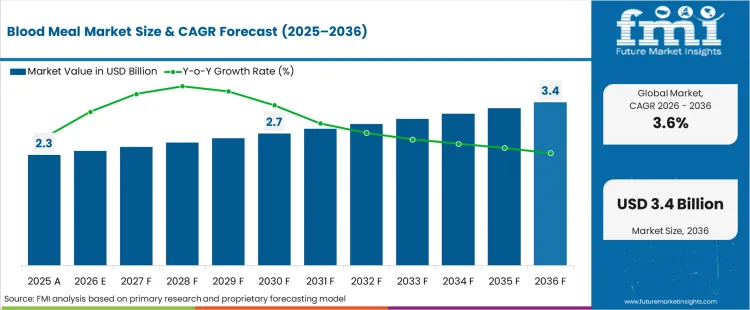
The blood meal market was valued at USD 2.30 billion in 2025, projected to reach USD 2.38 billion in 2026, and is forecast to expand to USD 3.39 billion by 2036 at a 3.6% CAGR. Slaughterhouse by-product valorization and the demand for high-protein feed ingredients with amino acid profiles complementary to plant protein sources are sustaining blood meal production as a structural component of the rendering industry value chain. Blood meal delivers the highest crude protein concentration among rendered animal products at 80% to 90%, making it a cost-effective protein density booster in animal feed and organic fertilizer formulations.
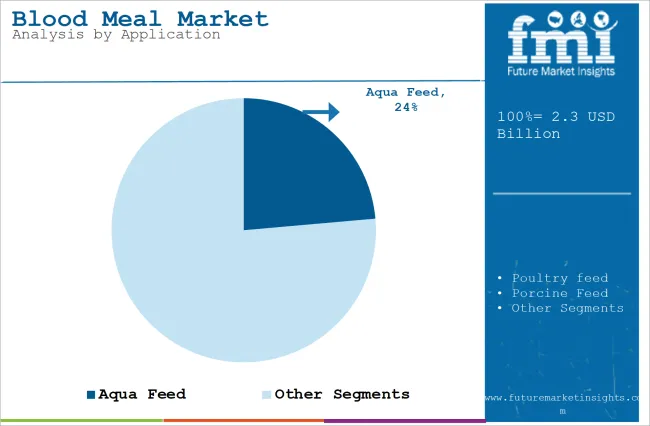
FMI is of the opinion that poultry feed anchors application share at 43.6% because blood meal's high lysine content complements the amino acid profile of corn-soybean meal based poultry rations, improving overall protein quality without requiring synthetic amino acid supplementation. Poultry blood leads source share at 23.6% as the global poultry processing industry generates the highest slaughter volumes and corresponding blood by-product availability. The moderate 3.6% CAGR reflects the mature status of blood meal as an established rendering product where growth tracks slaughter volume expansion rather than new market development.
Summary of Blood Meal Market
- Blood Meal Market Definition
- Blood meal is a dried, powdered protein ingredient produced by collecting, cooking, and dehydrating blood from livestock slaughter operations. The product contains 80% to 90% crude protein with a high lysine amino acid concentration, serving as a feed ingredient in poultry, aquaculture, swine, and ruminant nutrition, and as a nitrogen-rich organic fertilizer in agricultural applications.
- Demand Drivers in the Market
- Slaughterhouse by-product valorization: Blood collection and rendering converts a disposal liability into a revenue-generating protein ingredient. As per FMI, rendering operations that efficiently capture and process slaughter blood reduce waste treatment costs while generating feed-grade protein meal that the animal nutrition industry procures as a lysine-rich protein supplement.
- Lysine amino acid complementarity: FMI analysts note that blood meal's exceptionally high lysine content (7% to 9% of crude protein) makes it a cost-effective amino acid balancer in corn-soybean meal based feed formulations where lysine is the first-limiting amino acid. This complementary amino acid profile justifies blood meal inclusion at 2% to 5% of total ration despite its dark colour and potential palatability concerns.
- Organic fertilizer nitrogen demand: Based on FMI's analysis, blood meal serves as a high-nitrogen organic fertilizer approved for use in certified organic crop production. The organic farming sector's expansion creates a parallel demand channel for blood meal outside the animal feed market, particularly in regions where organic certification standards restrict synthetic nitrogen fertilizer use.
- Key Segments Analyzed in the FMI Report
- Poultry feed lysine supplementation: Poultry Feed holds 43.6% share in 2026. Blood meal's high lysine concentration supplements corn-soybean meal rations at low inclusion rates, improving protein quality and supporting broiler growth performance without the cost of synthetic lysine supplementation.
- Poultry blood source availability: Poultry Blood commands 23.6% share in 2026. The global poultry industry processes the highest number of animals annually among livestock species, generating proportionally high blood by-product volumes that supply rendering operations with consistent raw material.
- Organic fertilizer parallel demand: Organic Fertilizers represent a growing application as certified organic crop production expansion creates demand for approved nitrogen-rich organic inputs. Blood meal delivers 12% to 14% nitrogen content, making it one of the most concentrated organic nitrogen fertilizer sources available.
- Analyst Opinion at FMI
- Nandini Roy Choudhury, Principal Consultant for Food & Beverage analysts observe that the blood meal market is a mature, rendering-industry-linked category where growth tracks livestock slaughter volume expansion and organic fertilizer demand growth. The market is supply-constrained by blood collection efficiency at slaughter facilities, with modern rendering operations achieving 90% or higher blood capture rates compared to 60% to 70% at facilities lacking dedicated blood collection infrastructure. Investment in blood collection and spray-drying technology at slaughter facilities in developing markets represents the primary supply-side growth opportunity.
- Strategic Implications / Executive Takeaways
- Rendering companies should invest in automated blood collection systems at slaughter facilities to maximize raw material capture rates and blood meal production volumes.
- Feed formulators should specify blood meal inclusion rates based on amino acid contribution rather than crude protein alone to optimize the lysine supplementation value in poultry and aquaculture rations.
- Organic fertilizer producers should develop blood meal-based nitrogen fertilizer blends with controlled-release properties for application in certified organic crop production systems.
- Methodology
- Primary Research: FMI conducted technical interviews with procurement specialists and operations directors across 40 countries to validate adoption timelines.
- Desk Research: Analysts aggregated public regulatory documentation, industry standards, and corporate disclosure filings.
- Market-Sizing and Forecasting: Forecasting models apply hybrid methodology starting with global production metrics and projecting adoption conversion rates.
- Data Validation and Update Cycle: Segment forecasts undergo cross-validation against quarterly and annual industry production volumes.
Blood Meal Market Key Takeaways
| Metric | Details |
|---|---|
| Industry Size (2026) | USD 2.38 Billion |
| Industry Value (2036) | USD 3.39 Billion |
| CAGR (2026-2036) | 3.6% |
Source: Future Market Insights, 2026
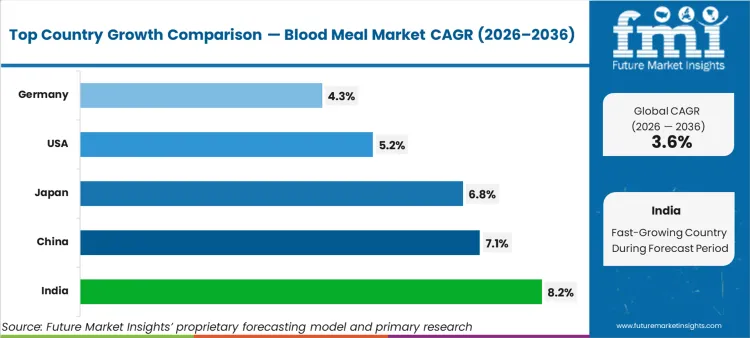
India leads with an 8.2% CAGR, driven by the expanding poultry processing industry and growing organic fertilizer demand. China follows at 7.1% as rendering capacity modernization improves blood collection and processing efficiency. Japan registers a 6.8% pace anchored by the aquaculture feed sector's specification of blood meal as a partial fishmeal replacement. USA tracks at 5.2% driven by the established rendering industry infrastructure. Germany registers a 4.3% pace reflecting the EU animal by-product regulatory framework and the mature rendering sector.
Blood Meal Market Definition
Blood meal is a dried, powdered protein ingredient produced by collecting, cooking, and dehydrating blood from livestock slaughter operations. The product contains 80% to 90% crude protein with a high lysine amino acid concentration, serving as a feed ingredient in poultry, aquaculture, swine, and ruminant nutrition, and as a nitrogen-rich organic fertilizer in agricultural applications.
Blood Meal Market Inclusions
Market scope includes blood meal derived from poultry, porcine, and ruminant blood for animal feed and organic fertilizer applications. The report covers global and regional market sizes from 2026 to 2036, segmented by source, application, and geography.
Blood Meal Market Exclusions
Blood plasma and spray-dried blood products sold as specialty feed ingredients at premium pricing are excluded. Fresh blood sold without rendering processing falls outside scope. Pharmaceutical blood-derived products are excluded from the valuation.
Blood Meal Market Research Methodology
- Primary Research: Analysts engaged with procurement specialists, production managers, and supply chain directors to map purchasing cycles and supplier qualification requirements.
- Desk Research: Data collection aggregated regulatory filings, industry standards, trade association publications, and public company disclosures.
- Market-Sizing and Forecasting: Baseline values derive from hybrid top-down and bottom-up methodology, applying region-specific adoption curves through 2036.
- Data Validation and Update Cycle: Projections tested against publicly reported production volumes, trade data, and industry benchmarks with annual recalibration.
Analyzing Blood Meal Market by Top Investment Segments
Aqua Feed Segment: A Growing Application for Blood Meal in Aquaculture
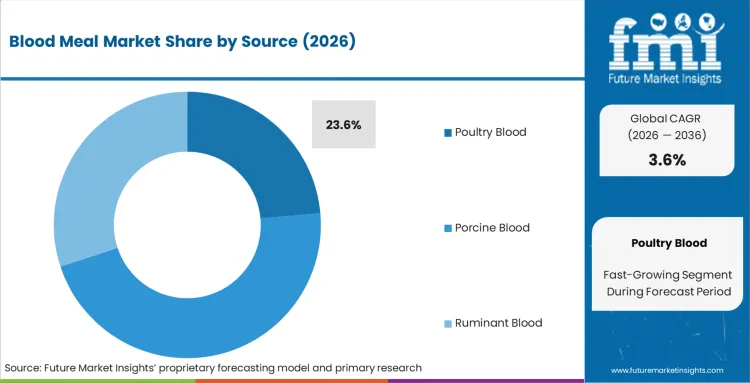
| Segment | Poultry Blood |
|---|---|
| Value Share (2026) | 23.6% |
Bloodmeal is fast growing into a recognized ingredient in aqua feeds since it has proven to be a rich protein and essential amino acids source for different aquatic species. The high protein content in the above 80% range, high iron, and low zinc levels make good and health-grown fish, which will produce high feed efficiency consumption.
The increased inclusion of blood meal into aqua feed not only brings out the nutritional profile and aids the immune system, but at its best, it makes the fish more tolerant to diseases. For this reason, blood meal has become popular in aquaculture, as those producers seek some of the sustainable and lower-cost alternatives to traditional fishmeal. With blood meal becoming quite established in aqua feed, it should keep on attracting such interest within the forecast period.
The latest data, published in 2024 by FAO, shows that overall the amount of terrestrial animal by-product meals being used in compound aquafeeds, including blood meal, is still very low. Thus the vast potential for further uptake can be clearly seen. The blood meal has been shown to enhance feed formulations while meeting the concerns of sustainability in fish-farming practices as the aquaculture industry expands rapidly to meet the global protein requirement.
Poultry Feed Segment: A Key Driver for Blood Meal Market Growth
| Segment | Poultry feed (By Application) |
|---|---|
| Value Share (2026) | 43.6% |
It is a very important use of blood meal in poultry feed as it is one of the vital components of the poultry diets such as chickens, turkeys, and ducks. Blood meal is highly nutritional feed supplement, providing all essential proteins, iron, and lysine, which are important for the poultry production and development.
The increased demand for poultry products, which is due to the preference of consumers worldwide for more protein diets, has further contributed to the escalating use of blood meal in poultry feed. Blood meal is a cost-effective substitute for many conventional feedstuffs and enhances pepsin digestibility. Therefore, it is an excellent supplemental source of protein compared to plant-derived feeds.
The United States is one of the largest countries and other major contributors include China and Brazil. Production of poultry meat has increased dramatically over the last five-decade period and continues to do so, as reflected in growing consumption for poultry products. The forecasts of the USDA show a very steep rise in global poultry imports. Therefore, such imports will be a bulwark to the increasing demand for blood meal and other high-quality feed ingredients.
Therefore, blood meal holds great potential in terms of increasing production and consumption of poultry, contributing significantly to the sector's activities in fulfilling the nutritional needs of livestock toward the continued market growth.
Top Blood Meal Market Dynamics and Industry Trends
Global Growth in Demand for Blood Meal by Associated Meat Consumption and Sustainable Agriculture Presenters
Notably, the growing need for meat products and meat consumption in countries worldwide has stimulated the demand and consumption of blood meal powder in animal feed, thereby increasing market growth. Blood meal is the dried form of blood from animals and serves as a rich source of proteins as well as other important nutrients.
As an input in agriculture in the form of feed and fertilizer, it is projected to increase further demand for the product in the next decade. Again, blood meal is a quick application of liquid protein because of its very high amino acid content, particularly lysine, doing away with many plant proteins that should be a viable source but fail to meet the needs of this essential amino acid.
Also, blood meal is a good, non-synthetic nitrogen source for effective natural fertilization, while it is also practiced in under organic farming techniques. All of these issues are why industry participants are aggressively pursuing research and development programs to innovate organic and green products through which agricultural solutions can better match current consumer preferences for a sustainable agricultural future. Blood meal will be an integral part of delivering the growing global demand for quality animal protein.
The Function of Organic Fertilizers: Blood Meal and Its Influence on Market Demand
As indeed about 10-13% of organic nitrogen, blood meal has been included in high-nitrogen organic fertilizers. This makes it effective for soil fertility enhancement. Primary haemoglobin composition is particularly iron rich, and it supplements effective plant growth. From recent studies, blood meal improves the soil organic matter but then enhances the availability of the essential nutrients, such as iron, during soil incubation.
Meanwhile, as the consumption of organic food products keeps rising, blood meal as natural fertilizer becomes more important. It serves a legitimate alternative to synthetic fertilizers by which consumers' demand for green agriculture will also be satisfied.
Furthermore, blood meal will have value in increased yields for plants such as onions that perform better against conventional fertilizers. The Blood Meal industry analysis suggests that this growing awareness and demand for organic farming solutions are likely to boost the sector significantly in the coming years.
Increasing Slaughterhouse Operations and Blood Collection Supporting Blood Meal Market Growth
The increasing slaughterhouse activities triggered by soaring consumption of animal-based products increase blood production which stands now as huge amounts for collecting disposal. The more blood can be bottled; the more opportunity suppliers have for transforming waste into good blood meal. In slaughterhouses, excessive blood volume oftentimes makes waste disposal burdensome, thus necessitating its separation and processing.
As an excellent organic fertilizer and supplement with bioactivator properties in processes such as composting, blood meal is high in nitrogen and other needed elements. Its highly nitrogenous condition stimulates metabolic activity in microorganisms to break down organic matter into a better fertilizer.
Increased slaughterhouse activities during the forecast period may likely lead to an upsurge of blood meal industry segments as trends of organic farming catch on. Incorporation of blood meal in compost will not only enhance the nutrient profile containing nitrogen, phosphorous, and potassium but also solve issues on waste disposal regarding the environment.
Start-up companies are increasingly realizing these opportunities and investing in the research and development of innovations in organic fertilizers, which customers increasingly demand today. The coming together of increased slaughterhouse activities and the push for organic products will then bring forth substantial fuel in the Blood Meal industry analysis.
Comparison of Historical vs Future Outlook on Changing Consumer Trends for Blood Meal Industry
Global sales increased at a CAGR of 2.9% from 2021 to 2025. For the next ten years (2026 to 2036), projections are that expenditure on such products will rise at 3.6% CAGR.
The blood meal sector was able to grow tremendously from 2021 to 2025, mostly due to the increased demand for animal protein and sustainability regarding food production. The increased meat consumption led to more blood from slaughterhouses that were later converted by suppliers into a precious by-product known as blood meal. Darling Ingredients Inc., West Coast Reduction Ltd., and Valley Proteins Inc. were just some companies that benefited from the trend, for example, expanding their organic fertilizer and high-protein animal feed offerings.
Growing consumer awareness of blood meal as a good natural source of nutrients also improved its use in livestock diet and home gardening applications. However, the market was encumbered with challenges of waste management in slaughterhouses in terms of cost-effective processing methods for optimized blood utilization.
Growth in the blood meal industry outlook, at least from 2026 to 2036, will result from advances in precision nutrition and technology with good utilization available advantages in feed efficiency and blood meal optimization usage across all life stages of animals under improved growth in livestock and aquaculture. More will develop for blood meal supplies as a natural fertilizer in agricultural practices and organic farm consumption.
Demand for quality animal protein is expected to grow as many people are joining the global populace and people become more health conscious. With R&D investments by companies with much attention in the blood meal sector, the blood meal industry is going to be therein. Such a pattern is going to be seen through changing customer tastes and demands in the form of industry standards.
Key Blood Meal Market Players and Concentration
The primary tier blood meal companies are the global key players with huge market shares. These are some of the major players in the industry, namely Darling Ingredients Inc., West Coast Reduction Ltd. to mention a few, that are involve in providing innovative research and development into blood meal products.
They have set forth distribution networks to meet the demands of the market in delivering high-quality blood meal products applicable both to animal feeds and as organic fertilizers, with sustainability values. These companies do not only set trends but also improve processing efficiency and standards when it comes to product quality in the industry.
Some companies are what you call Tier 2 companies which would operate on a narrow geographical range to have products that will be designed for specific market needs. Among the typical examples of this is Terramar Chile SpA and Allanasons Pvt. Ltd., which both have strong blood meal offers selling specialized local products in terms of agricultural use and regulatory environment.
These are the companies that try to see everything from a qualitative perspective and sustainability strategies to be addressed by a product against specific conditions that are faced by farmers from the concerned or particular regions. They may be smaller in comparison with Tier 1 companies, but the way they have gone localized ensures that they take care of specific markets and thus contribute to the overall building of the blood meal industry.
Tier 3 Companies are basically the smaller companies that operate in a local market or a regional one. Though they do not have their R&D facilities like the bigger players, these companies have a very important role to play in the community.
Companies like Ridley Corporation Limited, The Boyer Valley Company, and FASA Group see how these small companies are coping with working effectively in their area through customer service and innovations targeted at within-their-industry solutions. Despite being Tier 3 companies, they play an invaluable role in the market by providing basic services to aid local agriculture and improve blood meal applications across various avenues.
Analysis of Top Countries Producing, Formulating, Packaging, Distributing, and Consuming Blood Meal
The following table shows the estimated growth rates of the top three territories. China and Germany are set to exhibit high consumption, recording CAGRs of 7.1% and 4.3%, respectively, through 2036.
.webp "Top Country Growth Comparison Blood Meal Market Cagr (2026 2036)")
| Countries | CAGR 2026 to 2036 |
|---|---|
| USA | 5.2% |
| Germany | 4.3% |
| China | 7.1% |
| India | 8.2% |
| Japan | 6.8% |
The United States Blood Meal Industry: The Leader of Sustainable Protein Solutions
USA blood meal industry outlook has been growing at significant rate as a result of converging consumer consideration for the sustainably produced animal products and organic farming techniques. Increased demand for meat-and-fish-based products has resulted in an increase in the amount of blood produced at slaughterhouses, providing extensive opportunities for blood meal manufacturing. Among the market leaders in this transfiguration from waste to blood meal are Darling Ingredients Inc. and Valley Proteins Inc.
These two giants are manufacturing high-value blood meal, a very rich source of protein and nitrogen used in animal feed and organic fertilizers. Blood meal's market valuation is nearly USD 1,100 per metric ton since it plays an imminent role in livestock nutrition as a lysine supplement.
Looking into the future, the USA blood meal sector takes a very bright view to enrich and ensure a prominent share of the market, given the emerging developments in processing technologies, combined with increased focus on sustainability.
The increasing realization of the health benefits in soil and crop establishment presented as new avenues for growth. The market for blood meal is expected to flourish with both factors-an environmental consideration and a commitment to sustainable agriculture-in the era of increasing health consciousness among consumers searching for natural and organic food.
Market for Blood Meal in China: Growth Booster for Asia-Pacific
The blood meal industry outlook in China is undergoing phenomenal growth as the country stands as one of the largest producers and consumers of animal-derived products in the Asia-Pacific region. Livestock production witnessed a significant upsurge, accompanied by the emerging demand for quality animal protein, thus giving blood meal prominence as an essential ingredient in animal feeds.
The blood processing by way of dry rendering from slaughterhouses proves very useful for such high protein materials, which can contain fecund nutrients like heme iron. Blood meal thus becomes an excellent choice, not merely from the nutrition of animals but also within clearly-defined sustainable agricultural practices. Such programs further add impetus toward the establishment of manufacturing capacities as well as sustainable agricultural practices.
With FAO-most likely demand increasing for livestock produce, prosperity from the blood meal industry is assured. It is also opening opportunities for blood meal in the course of time as much as possible, due to the rising demand on consumer awareness about animal health and nutrition. Thus factors bring China, thereby putting it in the front row of Europe, and at the same while showing good potential for further growth during the forecast period.
Germany Blood Meal Market: Creating Growth through Nutritional Excellence and Cost Effectiveness
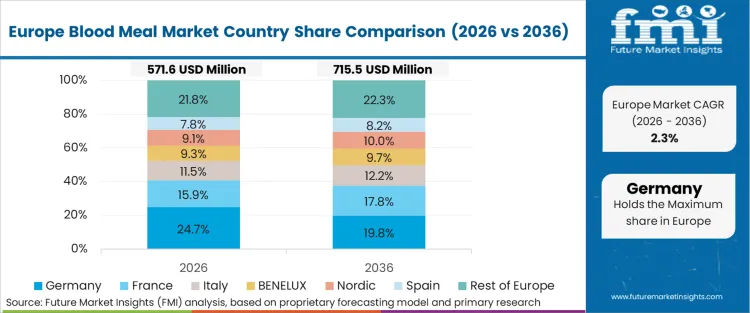
Germany is one of the major countries in the European blood meal sector because it attracts a really promising share of revenue from it since a strong demand is in place for animal protein and as far as the utilization of slaughter by-products is concerned. This country is home to a very developed meat processing industry, which puts the treatment of blood with such impressive volumes with each slaughtering of livestock.
Nothing could be further from reality because this blood is processed into high-quality blood meal, which is known for its rich nutritional value and draws much of its appeal from having high levels of protein and essential amino acids, making it a preferred alternative to plant-based proteins. Consumer craving for protein sources that promote animal health and growth is driving blood meal's characterization as a preferred ingredient in animal feed formulations.
The growth stems from rapidly developing public awareness of the health benefits of blood meal and its low-cost alternative compared with other sources of protein. The rapidly increasing demand for meat commodities promises a wide opportunity for blood meal's enlargement in its share of the feed market, which has indeed opened new avenues in Germany as well as the rest of Europe.
With the markets being increasingly geared toward sustainable agricultural practices and organic farming, blood meal will have an increasing value as both a feed supplement and fertilizer. Thus, the market in Germany looks further brightening, offering these conditions that are supportive with changing consumer tastes.
Leading Suppliers of Blood Meal
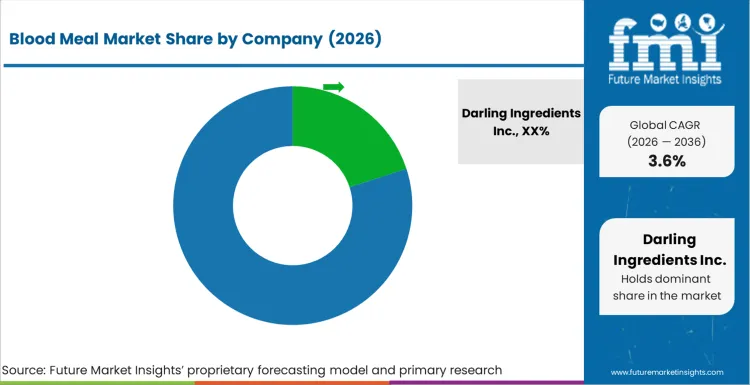
Blood meal is the sector of a very competitive marketplace at the top of which lays the key players such as Darling Ingredients Inc., West Coast Reduction Ltd. and Valley Proteins Inc. These companies spend a lot on research and development for varied innovative and sustainable feed solutions that would produce good feed performance for animal health and growth rate while taking care of environmental issues.
All these have been a source of competitiveness directed into acquiring and forming strategic partnerships to expand market reach and improve their products.
The blood meal is becoming an important raw material in the feed formulation as now-more demands-of-animal feeds with high protein content keep rising from world competition in meat consumption and ever-growing exposure to nutritional information. Thus, agency essentials are established as market drivers in their terms as manufacturers cater to consumer needs while portraying a green image in agriculture.
Leading Blood Meal Producers by Market Share
- Darling Ingredients Inc.
- West Coast Reduction Ltd.
- Terramar Chile SpA
- Valley Proteins Inc.
- Allanasons Pvt. Ltd.
- Ridley Corporation Limited
- The Boyer Valley Company
- APC Inc.
- FASA Group
- Spelsa Guadalajara SA de CV
- Sanimax
- Others
Scope of the Report
| Metric | Value |
|---|---|
| Quantitative Units | USD 2.38 Billion to USD 3.39 Billion, at a CAGR of 3.6% |
| Market Definition | Blood meal is a dried, powdered protein ingredient produced by collecting, cooking, and dehydrating blood from livestock slaughter operations. The product contains 80% to 90% crude protein with a high lysine amino acid concentration, serving as a feed ingredient in poultry, aquaculture, swine, and ruminant nutrition, and as a nitrogen-rich organic fertilizer in agricultural applications. |
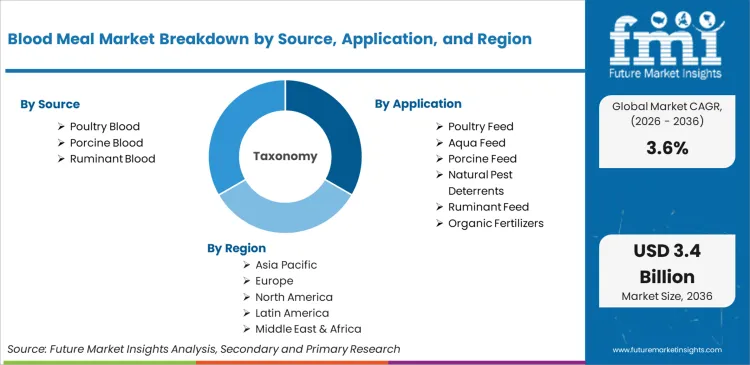
| Source Segmentation | Poultry Blood, Porcine Blood, Ruminant Blood |
| Application Segmentation | Poultry Feed, Aqua Feed, Porcine Feed, Natural Pest Deterrents, Ruminant Feed, Organic Fertilizers |
| Regions Covered | North America, Latin America, Europe, East Asia, South Asia, Oceania, Middle East & Africa |
| Countries Covered | India, China, Japan, USA, Germany, and 40 plus countries |
| Key Companies Profiled | Darling Ingredients Inc., West Coast Reduction Ltd., Terramar Chile SpA, Valley Proteins Inc., Allanasons Pvt. Ltd., Ridley Corporation Limited, The Boyer Valley Company, APC Inc., FASA Group, Spelsa Guadalajara SA de CV, Sanimax |
| Forecast Period | 2026 to 2036 |
| Approach | Hybrid top-down and bottom-up modelling anchored by primary interviews and public data benchmarking |
Top Segments Studied in the Blood Meal Market Report
By Source:
As per Source, the industry has been categorized into Poultry Blood, Porcine Blood and Ruminant Blood.
By Process:
As per process, the industry has been categorized into Drum Drying, Spray Drying, Ring & Flash Drying and Solar Drying.
By Application:
This segment is further categorized into Poultry Feed, Aqua Feed, Porcine Feed, Natural Pest Deterrents, Ruminant Feed and Organic Fertilizers.
By Region:
Industry analysis has been carried out in key countries of North America, Latin America, Europe, East Asia, South Asia, Oceania, and the Middle East & Africa.
Bibliography
- European Commission. (2024). Regulation (EC) No 1069/2009 laying down health rules as regards animal by-products, consolidated text. EUR-Lex.
- National Renderers Association, USA. (2024). Essential Rendering: All About the Animal By-Products Industry. NRA.
- Food and Agriculture Organization of the United Nations. (2024). FAOSTAT: Livestock Primary Production Statistics. FAO.
- Association of American Feed Control Officials. (2024). Official Publication: Blood Meal and Blood Products Definitions. AAFCO.
- International Fertilizer Association. (2024). Organic and Bio-Based Fertilizers Market Report. IFA.
This bibliography is provided for reader reference. The full FMI report contains the complete reference list with primary research documentation.
Frequently Asked Questions
How large is the demand for Blood Meal in the global market in 2026?
Demand for Blood Meal in the global market is estimated to be valued at USD 2.38 Billion in 2026.
What will be the market size of Blood Meal in the global market by 2036?
Market size for Blood Meal is projected to reach USD 3.39 Billion by 2036.
What is the expected demand growth for Blood Meal in the global market between 2026 and 2036?
Demand for Blood Meal is expected to grow at a CAGR of 3.6% between 2026 and 2036.
Which Source is poised to lead global sales by 2026?
Poultry Blood accounts for 23.6% share in 2026.
How significant is the role of Poultry Feed in Application?
Poultry Feed commands 43.6% of the application segment in 2026.
What is the growth outlook for India?
India is projected to grow at a CAGR of 8.2% during 2026 to 2036.
What is the growth rate for China in this market?
China is projected to expand at a CAGR of 7.1% during 2026 to 2036.
What is Blood Meal and what is it mainly used for?
Blood meal is a dried, powdered protein ingredient produced by collecting, cooking, and dehydrating blood from livestock slaughter operations. The product contains 80% to 90% crude protein with a high lysine amino acid concentration, serving as a feed ingredient in poultry, aquaculture, swine, and ruminant nutrition, and as a nitrogen-rich organic fertilizer in agricultural applications.
What is included in the scope of this Blood Meal report?
Market scope includes blood meal derived from poultry, porcine, and ruminant blood for animal feed and organic fertilizer applications. The report covers global and regional market sizes from 2026 to 2036, segmented by source, application, and geography.
What is excluded from the scope of this report?
Blood plasma and spray-dried blood products sold as specialty feed ingredients at premium pricing are excluded. Fresh blood sold without rendering processing falls outside scope.
What does market forecast mean on this page?
The market forecast represents a model-based projection built on defined industry and supply chain assumptions for strategic planning purposes.
How does FMI build and validate the Blood Meal forecast?
Forecasting models apply a hybrid top-down and bottom-up methodology and cross-validate projections against publicly available industry data and primary research inputs.
What does zero reliance on speculative third-party market research mean here?
Primary interviews, verified public regulatory documentation, and official industry standards registries are used instead of unverified syndicated estimates.
Preview the report firsthand - request a free sample
Get SampleGet the brochure for pricing and purchase details.
Get PDFTable of Content
- Executive Summary
- Global Market Outlook
- Demand-side Trends
- Supply-side Trends
- Technology Roadmap Analysis
- Analysis and Recommendations
- Market Overview
- Market Coverage / Taxonomy
- Market Definition / Scope / Limitations
- Research Methodology
- Chapter Orientation
- Analytical Lens and Working Hypotheses
- Market Structure, Signals, and Trend Drivers
- Benchmarking and Cross-market Comparability
- Market Sizing, Forecasting, and Opportunity Mapping
- Research Design and Evidence Framework
- Desk Research Programme (Secondary Evidence)
- Company Annual and Sustainability Reports
- Peer-reviewed Journals and Academic Literature
- Corporate Websites, Product Literature, and Technical Notes
- Earnings Decks and Investor Briefings
- Statutory Filings and Regulatory Disclosures
- Technical White Papers and Standards Notes
- Trade Journals, Industry Magazines, and Analyst Briefs
- Conference Proceedings, Webinars, and Seminar Materials
- Government Statistics Portals and Public Data Releases
- Press Releases and Reputable Media Coverage
- Specialist Newsletters and Curated Briefings
- Sector Databases and Reference Repositories
- FMI Internal Proprietary Databases and Historical Market Datasets
- Subscription Datasets and Paid Sources
- Social Channels, Communities, and Digital Listening Inputs
- Additional Desk Sources
- Expert Input and Fieldwork (Primary Evidence)
- Primary Modes
- Qualitative Interviews and Expert Elicitation
- Quantitative Surveys and Structured Data Capture
- Blended Approach
- Why Primary Evidence is Used
- Field Techniques
- Interviews
- Surveys
- Focus Groups
- Observational and In-context Research
- Social and Community Interactions
- Stakeholder Universe Engaged
- C-suite Leaders
- Board Members
- Presidents and Vice Presidents
- R&D and Innovation Heads
- Technical Specialists
- Domain Subject-matter Experts
- Scientists
- Physicians and Other Healthcare Professionals
- Governance, Ethics, and Data Stewardship
- Research Ethics
- Data Integrity and Handling
- Primary Modes
- Tooling, Models, and Reference Databases
- Desk Research Programme (Secondary Evidence)
- Data Engineering and Model Build
- Data Acquisition and Ingestion
- Cleaning, Normalisation, and Verification
- Synthesis, Triangulation, and Analysis
- Quality Assurance and Audit Trail
- Market Background
- Market Dynamics
- Drivers
- Restraints
- Opportunity
- Trends
- Scenario Forecast
- Demand in Optimistic Scenario
- Demand in Likely Scenario
- Demand in Conservative Scenario
- Opportunity Map Analysis
- Product Life Cycle Analysis
- Supply Chain Analysis
- Investment Feasibility Matrix
- Value Chain Analysis
- PESTLE and Porter’s Analysis
- Regulatory Landscape
- Regional Parent Market Outlook
- Production and Consumption Statistics
- Import and Export Statistics
- Market Dynamics
- Global Market Analysis 2021 to 2025 and Forecast, 2026 to 2036
- Historical Market Size Value (USD Million) Analysis, 2021 to 2025
- Current and Future Market Size Value (USD Million) Projections, 2026 to 2036
- Y-o-Y Growth Trend Analysis
- Absolute $ Opportunity Analysis
- Global Market Pricing Analysis 2021 to 2025 and Forecast 2026 to 2036
- Global Market Analysis 2021 to 2025 and Forecast 2026 to 2036, By Source
- Introduction / Key Findings
- Historical Market Size Value (USD Million) Analysis By Source , 2021 to 2025
- Current and Future Market Size Value (USD Million) Analysis and Forecast By Source , 2026 to 2036
- Poultry Blood
- Porcine Blood
- Ruminant Blood
- Poultry Blood
- Y-o-Y Growth Trend Analysis By Source , 2021 to 2025
- Absolute $ Opportunity Analysis By Source , 2026 to 2036
- Global Market Analysis 2021 to 2025 and Forecast 2026 to 2036, By Application
- Introduction / Key Findings
- Historical Market Size Value (USD Million) Analysis By Application, 2021 to 2025
- Current and Future Market Size Value (USD Million) Analysis and Forecast By Application, 2026 to 2036
- Poultry Feed
- Aqua Feed
- Porcine Feed
- Natural Pest Deterrents
- Ruminant Feed
- Organic Fertilizers
- Poultry Feed
- Y-o-Y Growth Trend Analysis By Application, 2021 to 2025
- Absolute $ Opportunity Analysis By Application, 2026 to 2036
- Global Market Analysis 2021 to 2025 and Forecast 2026 to 2036, By Region
- Introduction
- Historical Market Size Value (USD Million) Analysis By Region, 2021 to 2025
- Current Market Size Value (USD Million) Analysis and Forecast By Region, 2026 to 2036
- North America
- Latin America
- Western Europe
- Eastern Europe
- East Asia
- South Asia and Pacific
- Middle East & Africa
- Market Attractiveness Analysis By Region
- North America Market Analysis 2021 to 2025 and Forecast 2026 to 2036, By Country
- Historical Market Size Value (USD Million) Trend Analysis By Market Taxonomy, 2021 to 2025
- Market Size Value (USD Million) Forecast By Market Taxonomy, 2026 to 2036
- By Country
- USA
- Canada
- Mexico
- By Source
- By Application
- By Country
- Market Attractiveness Analysis
- By Country
- By Source
- By Application
- Key Takeaways
- Latin America Market Analysis 2021 to 2025 and Forecast 2026 to 2036, By Country
- Historical Market Size Value (USD Million) Trend Analysis By Market Taxonomy, 2021 to 2025
- Market Size Value (USD Million) Forecast By Market Taxonomy, 2026 to 2036
- By Country
- Brazil
- Chile
- Rest of Latin America
- By Source
- By Application
- By Country
- Market Attractiveness Analysis
- By Country
- By Source
- By Application
- Key Takeaways
- Western Europe Market Analysis 2021 to 2025 and Forecast 2026 to 2036, By Country
- Historical Market Size Value (USD Million) Trend Analysis By Market Taxonomy, 2021 to 2025
- Market Size Value (USD Million) Forecast By Market Taxonomy, 2026 to 2036
- By Country
- Germany
- UK
- Italy
- Spain
- France
- Nordic
- BENELUX
- Rest of Western Europe
- By Source
- By Application
- By Country
- Market Attractiveness Analysis
- By Country
- By Source
- By Application
- Key Takeaways
- Eastern Europe Market Analysis 2021 to 2025 and Forecast 2026 to 2036, By Country
- Historical Market Size Value (USD Million) Trend Analysis By Market Taxonomy, 2021 to 2025
- Market Size Value (USD Million) Forecast By Market Taxonomy, 2026 to 2036
- By Country
- Russia
- Poland
- Hungary
- Balkan & Baltic
- Rest of Eastern Europe
- By Source
- By Application
- By Country
- Market Attractiveness Analysis
- By Country
- By Source
- By Application
- Key Takeaways
- East Asia Market Analysis 2021 to 2025 and Forecast 2026 to 2036, By Country
- Historical Market Size Value (USD Million) Trend Analysis By Market Taxonomy, 2021 to 2025
- Market Size Value (USD Million) Forecast By Market Taxonomy, 2026 to 2036
- By Country
- China
- Japan
- South Korea
- By Source
- By Application
- By Country
- Market Attractiveness Analysis
- By Country
- By Source
- By Application
- Key Takeaways
- South Asia and Pacific Market Analysis 2021 to 2025 and Forecast 2026 to 2036, By Country
- Historical Market Size Value (USD Million) Trend Analysis By Market Taxonomy, 2021 to 2025
- Market Size Value (USD Million) Forecast By Market Taxonomy, 2026 to 2036
- By Country
- India
- ASEAN
- Australia & New Zealand
- Rest of South Asia and Pacific
- By Source
- By Application
- By Country
- Market Attractiveness Analysis
- By Country
- By Source
- By Application
- Key Takeaways
- Middle East & Africa Market Analysis 2021 to 2025 and Forecast 2026 to 2036, By Country
- Historical Market Size Value (USD Million) Trend Analysis By Market Taxonomy, 2021 to 2025
- Market Size Value (USD Million) Forecast By Market Taxonomy, 2026 to 2036
- By Country
- Kingdom of Saudi Arabia
- Other GCC Countries
- Turkiye
- South Africa
- Other African Union
- Rest of Middle East & Africa
- By Source
- By Application
- By Country
- Market Attractiveness Analysis
- By Country
- By Source
- By Application
- Key Takeaways
- Key Countries Market Analysis
- USA
- Pricing Analysis
- Market Share Analysis, 2025
- By Source
- By Application
- Canada
- Pricing Analysis
- Market Share Analysis, 2025
- By Source
- By Application
- Mexico
- Pricing Analysis
- Market Share Analysis, 2025
- By Source
- By Application
- Brazil
- Pricing Analysis
- Market Share Analysis, 2025
- By Source
- By Application
- Chile
- Pricing Analysis
- Market Share Analysis, 2025
- By Source
- By Application
- Germany
- Pricing Analysis
- Market Share Analysis, 2025
- By Source
- By Application
- UK
- Pricing Analysis
- Market Share Analysis, 2025
- By Source
- By Application
- Italy
- Pricing Analysis
- Market Share Analysis, 2025
- By Source
- By Application
- Spain
- Pricing Analysis
- Market Share Analysis, 2025
- By Source
- By Application
- France
- Pricing Analysis
- Market Share Analysis, 2025
- By Source
- By Application
- India
- Pricing Analysis
- Market Share Analysis, 2025
- By Source
- By Application
- ASEAN
- Pricing Analysis
- Market Share Analysis, 2025
- By Source
- By Application
- Australia & New Zealand
- Pricing Analysis
- Market Share Analysis, 2025
- By Source
- By Application
- China
- Pricing Analysis
- Market Share Analysis, 2025
- By Source
- By Application
- Japan
- Pricing Analysis
- Market Share Analysis, 2025
- By Source
- By Application
- South Korea
- Pricing Analysis
- Market Share Analysis, 2025
- By Source
- By Application
- Russia
- Pricing Analysis
- Market Share Analysis, 2025
- By Source
- By Application
- Poland
- Pricing Analysis
- Market Share Analysis, 2025
- By Source
- By Application
- Hungary
- Pricing Analysis
- Market Share Analysis, 2025
- By Source
- By Application
- Kingdom of Saudi Arabia
- Pricing Analysis
- Market Share Analysis, 2025
- By Source
- By Application
- Turkiye
- Pricing Analysis
- Market Share Analysis, 2025
- By Source
- By Application
- South Africa
- Pricing Analysis
- Market Share Analysis, 2025
- By Source
- By Application
- USA
- Market Structure Analysis
- Competition Dashboard
- Competition Benchmarking
- Market Share Analysis of Top Players
- By Regional
- By Source
- By Application
- Competition Analysis
- Competition Deep Dive
- Darling Ingredients Inc.
- Overview
- Product Portfolio
- Profitability by Market Segments (Product/Age /Sales Channel/Region)
- Sales Footprint
- Strategy Overview
- Marketing Strategy
- Product Strategy
- Channel Strategy
- West Coast Reduction Ltd.
- Terramar Chile SpA
- Valley Proteins Inc.
- Allanasons Pvt. Ltd.
- Ridley Corporation Limited
- The Boyer Valley Company
- APC Inc.
- FASA Group
- Spelsa Guadalajara SA de CV
- Sanimax
- Others
- Darling Ingredients Inc.
- Competition Deep Dive
- Assumptions & Acronyms Used


