

- Industry Size (2026)
- USD 4850.6 Mn
- Forecast (2036)
- USD 7678.3 Mn
- CAGR (2026 to 2036)
- 4.7%
Gas Treating Catalysts Market Size, Market Forecast and Outlook By FMI
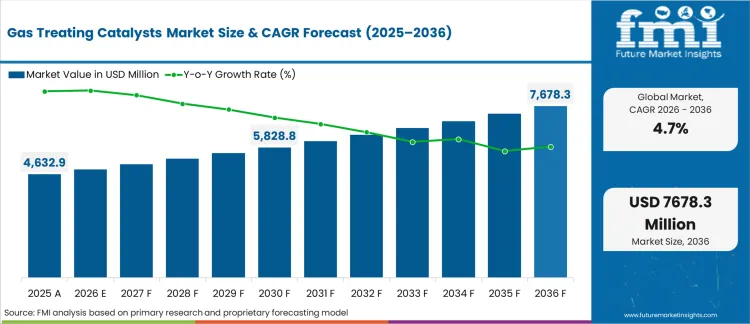
According to Future Market Insights, the global gas treating catalysts market is estimated to reach USD 4,627.5 million in 2025 and expand to USD 4,850.6 million in 2026. The market is projected to attain USD 7,678.3 million by 2036, reflecting a CAGR of 4.7% during 2026 to 2036. Growth is linked to tighter sulfur recovery expectations, refinery modernization for heavier and more sour feed slates, and greater focus on catalyst durability under fluctuating contaminant loads.
The market is projected to generate an absolute dollar opportunity of USD 2,827.7 million between 2026 and 2036, translating into a growth multiple of nearly 1.6 times over the forecast period. Demand strength is supported by hydroprocessing severity upgrades, higher guard-bed usage to protect downstream units, and investment in sulfur recovery and tail gas treatment performance where compliance is measured at the stack.
Summary of Gas Treating Catalysts Market
- Gas Treating Catalysts Market Definition
- The gas treating catalysts market includes catalytic materials used to remove sulfur, nitrogen, carbon oxides, mercury, and other impurities from industrial gas streams. These catalysts are applied across refineries, natural gas processing, petrochemical, hydrogen, and LNG facilities to ensure product purity, environmental compliance, process efficiency, and downstream equipment protection.
- Demand Drivers
- Increasing ultra-low sulfur fuel mandates forcing refineries to deploy advanced hydrodesulfurization catalysts and frequent performance testing.
- Expansion of blue hydrogen and syngas facilities requiring contaminant-tolerant catalysts for high-pressure purification and reliability assurance.
- Rising processing of high-acid and sour gas reservoirs driving demand for durable sulfur recovery and guard catalysts.
- Key Segments analysed in the FMI report
- By Catalyst Type, Hydroprocessing (HDS/HDN) catalysts hold the largest share of 44%. This dominance is attributed to extensive hydrodesulfurization requirements, continuous refinery throughput, strict sulfur reduction mandates, and frequent catalyst replacement cycles necessitating ongoing gas testing and performance validation.
- By Metal Chemistry, CoMo segment holds the largest share of 37%. The segment leads due to strong sulfur removal efficiency, economic viability, operational stability under severe hydroprocessing conditions, and widespread refinery preference, driving consistent catalyst testing and lifecycle monitoring demand.
- By End Use, Refineries segment holds the largest share of 52%. This leadership results from continuous hydrogenation operations, stringent transportation fuel specifications, large catalyst consumption volumes, and turnaround-driven replacement schedules that require rigorous gas testing and catalyst activity validation.
- By Sulfur Handling, High sulfur feed segment holds the largest share of 61%. The segment dominates as refineries increasingly process sour crude and acid gas streams, creating higher risks of catalyst poisoning and necessitating robust contaminant removal testing.
- By Sales Channel, Direct OEM/Projects segment holds the largest share of 58%. This is driven by complex catalyst integration requirements, customization needs, and performance guarantees, encouraging direct collaboration between catalyst suppliers and refinery or gas processing operators.
- USA with 4.2% CAGR stands as the largest market. Mature refining infrastructure and stringent ultra-low sulfur fuel regulations sustain steady catalyst testing demand. Hydrogen optimization initiatives and refinery revamps further support replacement cycles and pilot-scale catalyst validation activities.
- Analyst Opinion at FMI
- According to Nikhil Kaitwade, Associate Vice President at Future Market Insights, the gas treating catalysts market is positioned for stable long-term expansion driven by tightening sulfur emission norms, increasing sour gas processing, and the accelerating hydrogen economy. He highlights that refiners are prioritizing catalysts offering higher poisoning resistance, longer operational cycles, and improved hydrogenation efficiency, which is strengthening demand for rigorous gas testing and performance validation. Kaitwade also emphasizes that growth opportunities will increasingly emerge from blue hydrogen projects, LNG infrastructure, and refinery modernization initiatives, where catalyst reliability, regeneration economics, and process optimization will remain key competitive differentiators across suppliers.
- Executive Takeaways
- Increasing sour crude and high-contaminant gas processing will structurally elevate demand for poisoning-resistant catalysts and continuous performance validation technologies.
- Hydrogen, carbon capture, and blue ammonia investments will shift catalyst testing toward high-pressure, multi-contaminant simulation environments and durability benchmarking.
- Digital reactor modeling and microreactor-based screening will redefine catalyst qualification timelines, enabling faster commercialization and competitive differentiation among suppliers.
- Methodology
- In-depth interviews were conducted with refinery hydroprocessing engineers, sulfur recovery unit operators, catalyst licensors, and regeneration service providers to understand catalyst lifecycle behavior, poisoning risks, and operational performance variations under diverse feedstock conditions.
- Refinery complexity, sour gas production levels, hydrogen capacity additions, and sulfur recovery unit installations were mapped to estimate application-wise catalyst consumption and gas testing frequency across major regional markets.
- Bottom-up market estimates were developed using catalyst loading volumes, replacement cycles, guard bed utilization rates, and pilot testing intensity aligned with refinery turnaround schedules and process severity benchmarks.
- Findings were validated through triangulation with catalyst shipment trends, licensing activities, and project commissioning pipelines, while forecasts were periodically updated to reflect refinery modernization, hydrogen investments, and evolving environmental regulations.
Refinery revamp projects integrating digital twin testing environments, the expansion of carbon capture catalyst evaluation, and stricter industrial emission measurement protocols are accelerating specialized gas testing requirements. FMI also emphasizes that collaborative research and development between catalyst manufacturers and contract testing laboratories, along with demand for high pressure and high temperature reaction testing, will continue to unlock incremental revenue opportunities across the market lifecycle.
Increasing regulatory pressure to achieve near complete sulfur recovery and minimize atmospheric emissions is driving refiners and gas processors to adopt more selective and contaminant tolerant tail gas treating catalysts. Operators are prioritizing catalyst systems capable of maintaining high hydrogenation activity under fluctuating sulfur loads while enabling efficient integration with downstream sulfur recovery units. This trend is strengthening demand for cobalt molybdenum based catalyst formulations and reinforcing investments in performance testing to ensure consistent conversion efficiency and operational stability.
“In its efforts to support customers in achieving 99 per cent sulphur recovery, Axens has developed an industry leading catalyst. The tail gas treatment (TGT) catalyst utilises Cobalt-Moly as its active phase, an effective agent in converting SO₂ to H₂S, which can then be recycled to the sulphur recovery unit,” said Abdulkareem Al-Yami and Quentin Debuisschert of Axens. [1]
The gas testing catalysts market demonstrates varied growth across major economies, reflecting differences in refining complexity, environmental policy intensity, and hydrogen adoption.
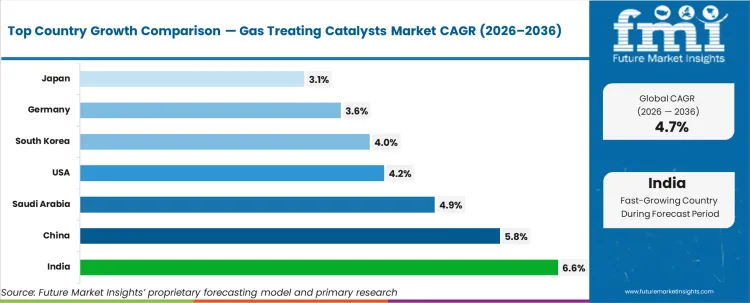
The USA (4.2% CAGR) benefits from advanced refinery infrastructure and strong regulatory pressure for ultra-low emissions, driving continuous catalyst validation and performance monitoring. China (5.8% CAGR) shows higher momentum due to large refining capacity additions and energy-security priorities that increase catalyst testing for complex feedstocks. India (6.6% CAGR) leads growth as refinery expansions and clean-fuel mandates stimulate demand for pilot-scale gas testing and sulfur-removal catalyst validation. Saudi Arabia (4.9% CAGR) gains from heavy-crude processing and large hydroprocessing investments requiring durability testing under extreme conditions. Meanwhile, Germany (3.6% CAGR) and Japan (3.1% CAGR) exhibit moderate growth driven by stringent fuel quality norms and efficiency-focused catalyst optimization. South Korea (4.0% CAGR) benefits from petrochemical-refinery integration and export-oriented clean fuel production, which increases demand for high-precision catalyst performance testing and desulfurization validation. These trends align with expanding refining capacity, hydrogen projects, and stricter emission regulations globally.
Gas Treating Catalysts Market Attributes
| Metric | Value |
|---|---|
| Market Size, 2026 | USD 4,850.6 Million |
| Market Size, 2036 | USD 7,678.3 Million |
| CAGR (2026 to 2036) | 4.7% |
Gas Treating Catalysts Market Definition
The gas treating catalysts market comprises catalytic materials used to remove contaminants such as sulfur compounds, carbon oxides, nitrogen species, mercury, and other impurities from industrial gas streams. These catalysts are widely deployed across natural gas processing, refinery hydrogen purification, syngas conditioning, ammonia production, and LNG facilities to ensure product quality, protect downstream equipment, and meet environmental regulations. Common catalyst types include hydrodesulfurization catalysts, Claus tail-gas treating catalysts, hydrogenation catalysts, and adsorptive guard catalysts.
Gas Treating Catalysts Market Inclusions
The market includes hydrodesulfurization, hydrogenation, Claus tail-gas treating, sulfur recovery, mercury removal, and guard bed catalysts used in refineries, gas processing plants, petrochemical facilities, ammonia plants, and LNG terminals. It also covers catalyst regeneration, replacement demand, and performance optimization solutions supporting industrial gas purification processes.
Gas Treating Catalysts Market Exclusions
The market excludes non-catalytic gas treatment technologies such as amine solvents, membranes, and physical adsorption media without catalytic functionality. It also excludes upstream catalyst manufacturing raw materials, laboratory analytical services, flue-gas treatment catalysts for power generation, and general environmental catalysts not directly involved in industrial process gas purification.
Gas Treating Catalysts Market Research Methodology
- Primary Research: Primary research was conducted through in-depth interviews with catalyst manufacturers, refinery process engineers, gas processing plant operators, technology licensors, and procurement managers. Discussions focused on demand trends, catalyst replacement cycles, performance requirements, pricing dynamics, and regional adoption patterns. Expert consultations also helped validate assumptions regarding hydrogen purification, sulfur recovery efficiency, and catalyst lifecycle economics.
- Desk Research: Desk research was performed using publicly available sources including company annual reports, technical white papers, regulatory publications, trade journals, patent databases, and industry conference proceedings. This phase enabled mapping of technology developments, capacity additions, environmental regulations, and competitive positioning across regions.
- Market Sizing and Forecasting: The market sizing was systematically approached using bottom-up model for each country fetching demand volumes, company presence and share analysis and product specific pricing details applicable to particular countries. The entire data was corroborated to build regional and global estimations, which were statistically validated for any outliers and projection fits.
- Data Validation and Update Cycles: It involved iterative triangulation between primary findings, secondary data, and internal analytical models. Estimates were cross-verified with industry experts, while periodic updates incorporated regulatory changes, project announcements, and pricing shifts to maintain forecast relevance and accuracy.
Segmental Analysis
Gas Treating Catalysts Market Analysis by Catalyst Type
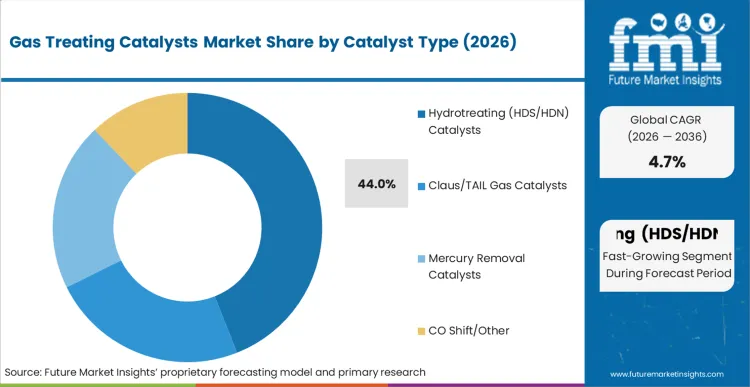
Hydrotreating (HDS/HDN) catalysts accounted for 44% share within catalyst type segmentation, driven by tightening ultra-low sulphur fuel mandates, refinery residue upgrading requirements, and growing sour gas processing intensity across refining and gas monetization projects. Their ability to simultaneously remove sulphur, nitrogen, and trace contaminants while protecting downstream units sustains consistent adoption. Additionally, expanding heavy crude utilization and hydrogen integration strategies are reinforcing demand for advanced Co-Mo and Ni-Mo based hydrotreating formulations delivering higher activity, longer cycles, and improved stability under severe operating conditions.
- In 2024, Topsoe expanded its hydroprocessing catalyst portfolio with advanced solutions improving sulfur removal efficiency and cycle length in high-severity refinery environments. [2]
- In 2024, Axens introduced next-generation hydroprocessing catalysts focused on heavier feedstock desulfurization and enhanced hydrogen utilization across integrated refinery-gas treating operations. [3]
Gas Treating Catalysts Market Analysis by End Use
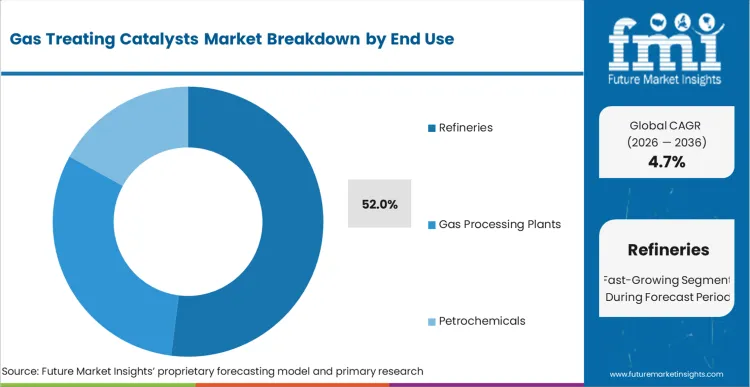
Refineries account for 52% share in the gas treating catalysts market, supported by their continuous need to process heavier crude slates and comply with ultra-low sulfur fuel mandates. Hydrotreating, sulfur recovery, and tail-gas polishing units rely heavily on advanced catalysts to maintain hydrogen efficiency, prevent downstream corrosion, and sustain throughput during feedstock variability. Additionally, refinery decarbonization initiatives are accelerating catalyst replacement cycles, particularly in sulfur recovery and hydroprocessing units where emission reductions and hydrogen optimization directly influence operational margins.
- In December 2025, Topsoe announced deployment of HydroFlex® catalysts and technology for a renewable fuels project at ANCAP’s La Teja refinery, supporting sustainable fuel production. [4]
- May 2025: A refinery case study highlighted improved sulfur recovery and lower emissions through catalytic wet gas sulfuric acid (WSA) processing upgrades. [5]
Gas Treating Catalysts Market Drivers, Restraints and Opportunities
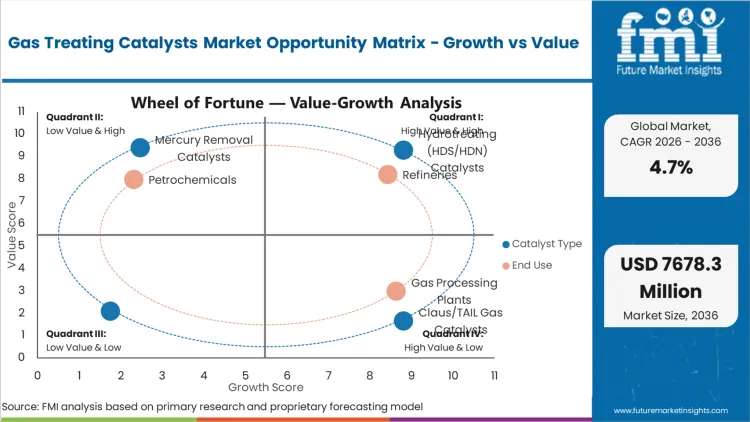
The gas treating catalysts market is being shaped by tightening ultra-low sulfur emission standards, increasing processing of high-acid and sour gas streams, and refinery strategies focused on hydrogen optimization and longer catalyst cycles. Operators are prioritizing catalysts capable of sustaining activity under fluctuating contaminant loads while enabling efficient sulfur recovery and protecting downstream petrochemical units. At the same time, catalyst poisoning risks, regeneration complexity, and hydrogen cost volatility remain key restraints influencing replacement economics. Meaningful opportunities are emerging from refinery decarbonization, renewable fuel co-processing, and integration of carbon capture systems that require advanced hydrogenation and guard catalysts. A notable example is Topsoe’s February 2024 announcement of its HydroFlex™ technology deployment supporting renewable fuel production, reinforcing the growing role of advanced hydrotreating catalysts in refinery transition strategies. [6]
- Increasing opportunity crude processing is structurally raising catalyst severity requirements, forcing refiners to deploy more poisoning-resistant formulations and intensify performance monitoring to avoid throughput losses, thereby sustaining long-term catalyst testing demand across hydroprocessing and sulfur recovery units.
- Hydrogen infrastructure expansion across blue hydrogen, ammonia, and refinery decarbonization projects is creating demand for multi-functional guard catalysts capable of removing trace contaminants that degrade reforming and synthesis catalysts, strengthening innovation in high-pressure hydrogenation catalyst design.
- The emergence of predictive catalyst health analytics and digital reactor modeling is enabling operators to optimize regeneration timing and catalyst loading strategies, reducing unplanned shutdown risks while creating differentiation opportunities for suppliers offering performance guarantees and customized contaminant-tolerant catalyst systems.
Regional Analysis
As per Future Market Insights, the regional analysis is conducted for key seven regions across the globe, including North America, Latin America, Eastern Europe, Western Europe, South Asia and Pacific, East Asia and Middle East and Africa. The full report offers market attractiveness analysis and market potential assessment across 30+ countries based on regional dynamics and regional trends.
Country Wise Growth Comparison of Gas Treating Catalysts Market
.webp "Top Country Growth Comparison Gas Treating Catalysts Market Cagr (2026 2036)")
| Country | Value CAGR (2026-2036) |
|---|---|
| USA | 4.2% |
| China | 5.8% |
| India | 6.6% |
| Saudi Arabia | 4.9% |
| Germany | 3.6% |
| Japan | 3.1% |
| South Korea | 4.0% |
Source: Future Market Insights (FMI) analysis, based on proprietary forecasting model and primary research
North America Market Analysis
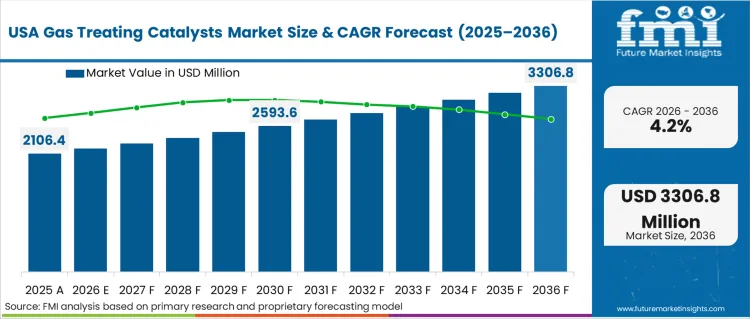
North America’s gas treating catalysts market is influenced by sustained shale gas production, stringent sulfur emission regulations, and refinery modernization initiatives targeting heavier crude processing. Expanding hydrogen production, LNG export infrastructure, and petrochemical integration are further increasing demand for hydrotreating and tail-gas catalysts. Additionally, catalyst replacement cycles are accelerating due to feedstock variability and the need to maintain ultra-low sulfur fuel specifications across refining and gas processing operations.
- Demand for gas treating catalysts in the USA is expected to grow at 4.2% CAGR. Growing shale-derived sour gas processing increases demand for robust guard catalysts and continuous performance testing across USA gas infrastructure.
- Refinery renewable fuel co-processing initiatives are elevating hydrotreating catalyst severity requirements and accelerating replacement frequency across facilities.
FMI’s report covers a detailed analysis of the North American market including USA, Canada and Mexico. Readers can find apt dynamics and pertinent market potential for these countries detailed in the report along with supporting facts and findings.
Latin America Market Analysis
Latin America’s gas treating catalysts market is driven by heavy crude upgrading requirements, refinery modernization programs, and increasing sour gas processing across national oil companies. Growing investments in sulfur recovery units, LNG infrastructure, and hydrogen production are supporting catalyst demand. Additionally, efforts to improve fuel quality standards and reduce refinery emissions are encouraging adoption of advanced hydrotreating and tail-gas catalysts across regional refining and gas processing assets.
- Demand for Gas Treating Catalysts in Brazil is projected to rise at 5.1% CAGR through 2036. Brazil’s pre-salt crude development increases contaminant removal complexity, strengthening demand for high-activity hydrotreating and sulfur recovery catalysts across refineries.
- Petrobras refinery upgrade initiatives are accelerating catalyst replacement cycles and driving adoption of advanced tail-gas treating catalysts improving emissions compliance.
FMI’s assessment of Latin American market includes country level analysis for Brazil, Argentina, Chile, Peru and Rest of Latin America covering key aspects such as trends, pricing dynamics and market developments in detail.
Europe Market Analysis
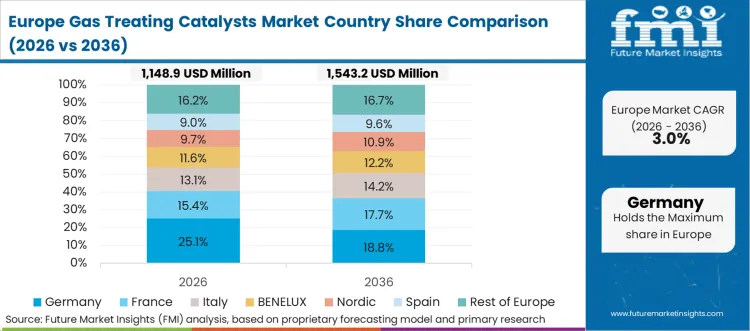
Europe’s gas treating catalysts market is shaped by stringent emission reduction policies, refinery decarbonization initiatives, and growing renewable fuel co-processing across complex refining systems. Increasing hydrogen utilization, carbon capture integration, and demand for ultra-low sulfur transportation fuels are sustaining catalyst replacement cycles. However, gradual refinery rationalization is moderating growth, while efficiency-driven catalyst optimization and sulfur recovery upgrades continue to support steady regional demand.
- Sales of Gas Treating Catalysts in Germany are expected to witness CAGR of 3.6% over the study period. Germany’s refinery efficiency modernization programs are increasing demand for advanced hydrotreating catalysts enabling deeper sulfur removal and hydrogen optimization.
- Strong hydrogen and industrial decarbonization initiatives are driving adoption of guard catalysts protecting downstream synthesis processes from contaminant poisoning.
FMI's analysis of the Gas Treating Catalysts market in Europe includes country-level assessments for Germany, the United Kingdom, France, Italy, and Rest of Europe. Readers can find detailed analysis of replacement cycle dynamics, regulatory developments, and dealer network structure across the region.
Asia Pacific Market Analysis
Asia Pacific’s gas treating catalysts market is expanding due to rapid refining capacity additions, increasing sour crude processing, and tightening transportation fuel quality standards. Strong petrochemical integration, coal-to-chemicals expansion, and growing hydrogen production are further accelerating catalyst demand. Additionally, sulfur recovery upgrades and LNG infrastructure investments are driving adoption of high-activity hydrotreating and tail-gas catalysts across emerging and mature refining economies.
- Demand for Gas Treating Catalysts in China is expected to grow at CAGR of 5.8% over the forecast period.
- China’s coal-to-chemicals and refining integration is increasing demand for contaminant-tolerant catalysts supporting complex syngas purification operations.
FMI's analysis of the Gas Treating Catalysts market in Asia Pacific includes country-level assessments for China, India, Australia, Japan, South Korea, and Rest of Asia Pacific. Readers can find detailed analysis of infrastructure-driven demand, premium residential segment dynamics, labor constraint indicators, and channel structure for each country in the full report.
Competitive aligners for market players
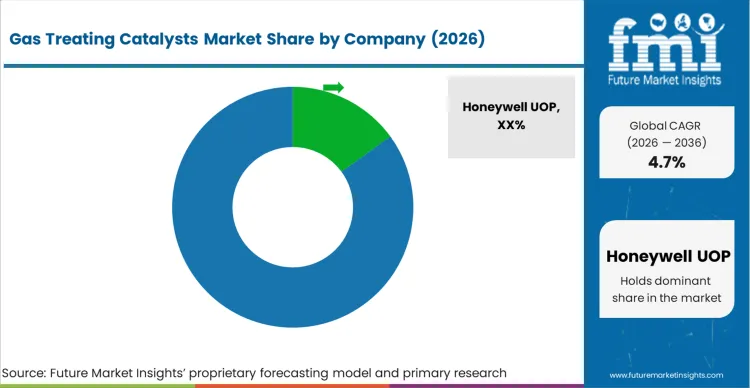
The gas treating catalysts market demonstrates a moderately consolidated structure, dominated by integrated catalyst manufacturers and process licensors that bundle catalysts with proprietary gas purification technologies. Key participants such as Topsoe, Clariant, and Axens operate through technology-led differentiation, offering customized hydrotreating, sulfur recovery, and tail-gas treatment catalysts alongside engineering services. Their global manufacturing footprints and licensing capabilities enable long-term refinery and gas processing partnerships rather than transactional catalyst sales.
Customer buying behavior is shifting toward performance-guaranteed catalyst programs, lifecycle optimization contracts, and digital monitoring support, driven by tighter sulfur regulations and processing of heavier, contaminant-rich feedstocks. Refiners increasingly prioritize catalysts delivering longer run-lengths, hydrogen efficiency, and reduced shutdown frequency, prompting suppliers to expand technical service teams and pilot-scale validation capabilities. Additionally, growing energy-transition investments are encouraging companies to diversify into blue hydrogen, renewable fuels, and carbon capture applications, reshaping competitive positioning. Smaller regional catalyst suppliers remain relevant through cost competitiveness and rapid turnaround services, but strategic collaborations, licensing integration, and catalyst regeneration services are becoming critical differentiators influencing contract awards and customer retention.
Recent Developments
- February 9, 2026 - Axens finalized the acquisition of 100% of Eurecat after regulatory approvals, reinforcing catalyst regeneration, recycling, and ex-situ activation capabilities supporting gas treating and refining catalyst circularity strategies. [7]
- October 23, 2025 - Collaboration restructuring between Axens and Ketjen involving Eurecat ownership transition and expanded catalyst regeneration and sulfiding services strengthened lifecycle catalyst management capabilities across refining and gas processing applications. [8]
Key Players Covered in the Study
- Honeywell UOP
- Albemarle
- Axens
- Johnson Matthey
- BASF
- Clariant
- Haldor Topsoe
- W. R. Grace
- Shell Catalysts & Technologies
- JGC C&C
Report Scope
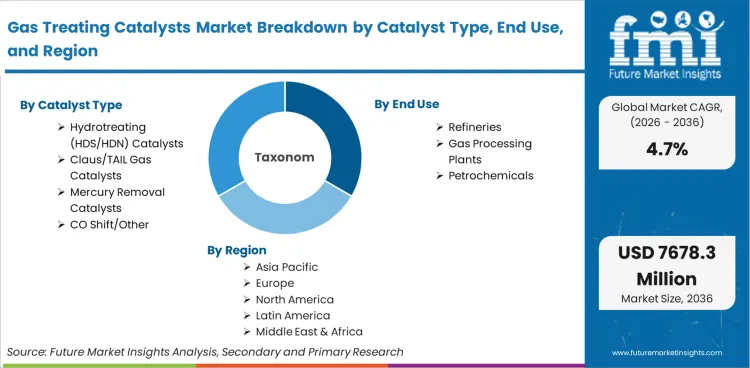
| Metric | Value |
|---|---|
| Quantitative Units | USD 4,850.6 million in 2026 to USD 7,678.3 million by 2036 at CAGR of 4.7% |
| Market Definition | The gas treating catalysts market comprises catalytic materials used to remove sulfur compounds, nitrogen species, carbon oxides, and trace contaminants from industrial gas streams. These catalysts are essential across refineries, natural gas processing, hydrogen production, and petrochemical facilities to ensure product purity, regulatory compliance, process efficiency, and downstream equipment protection. |
| Catalyst Type Segmentation | Hydrotreating (HDS/HDN) Catalysts, Claus/TAIL Gas Catalysts, Mercury Removal Catalysts, CO Shift/Other |
| Metal Chemistry Segmentation | CoMo, NiMo, Cu/Zn-based, Noble/Other |
| End Use Segmentation | Refineries, Gas Processing Plants, Petrochemicals |
| Sulfur Handling Segmentation | High Sulfur Feed, Medium, Low |
| Sales Channel Segmentation | Direct (OEM/Projects), Distributors/Service Partners |
| Regions Covered | North America, Latin America, Eastern Europe, Western Europe, East Asia, South Asia and Pacific, Middle East and Africa |
| Countries Covered | USA, Canada, Mexico, Brazil, Germany, Italy, France, UK, Spain, BENELUX, Nordic, Russia, Hungary, Poland, GCC Countries, Turkiye, South Africa, China, Japan, South Korea, India, Australia, and others. |
| Key Players Covered in the Study | Honeywell UOP, Albemarle, Axens, Johnson Matthey, BASF, Clariant, Haldor Topsoe, W. R. Grace, Shell Catalysts & Technologies, JGC C&C |
| Forecast Period | 2026 to 2036 |
| Approach | The study used a hybrid top-down and bottom-up market modelling approach triangulated using refinery capacity, catalyst loading rates, and gas processing throughput. Interviews with hydroprocessing engineers, sulfur recovery operators, catalyst manufacturers, licensors, and EPC contractors validated demand estimates and lifecycle assumptions. |
Gas Treating Catalysts Market Analysis by Segments
By Catalyst Type:
- Hydrotreating (HDS/HDN) Catalysts
- Claus/TAIL Gas Catalysts
- Mercury Removal Catalysts
- CO Shift/Other
By Metal Chemistry:
- CoMo
- NiMo
- Cu/Zn-based
- Noble/Other
By End Use:
- Refineries
- Gas Processing Plants
- Petrochemicals
By Sulfur Handling:
- High Sulfur Feed
- Medium
- Low
By Sales Channel:
- Direct (OEM/Projects)
- Distributors/Service Partners
By Region:
- North America
- Latin America
- Eastern Europe
- Western Europe
- East Asia
- South Asia and Pacific
- Middle East and Africa
Bibliography
- [1] Al-Yami, A., & Debuisschert, Q. (n.d.). Axens develops industry-leading tail gas treatment catalyst for 99% sulfur recovery. Axens Press Release.
- [2] Topsoe. (2024). Topsoe expands hydroprocessing catalyst portfolio for improved sulfur removal efficiency. Topsoe News.
- [3] Axens. (2024). Next-generation hydroprocessing catalysts introduced for heavier feedstock desulfurization. Axens Press Release.
- [4] Topsoe. (2025, December). Deployment of HydroFlex® catalysts and technology at ANCAP’s La Teja refinery. Topsoe Press Release.
- [5] Case Study. (2025, May). Refinery sulfur recovery improvements through catalytic wet gas sulfuric acid (WSA) upgrades. Industry Case Study.
- [6] Topsoe. (2024, February). HydroFlex™ technology deployment supporting renewable fuel production. Topsoe Press Release.
- [7] Axens. (2026, February 9). Axens finalizes acquisition of Eurecat to enhance catalyst regeneration and circularity. Axens News.
- [9] Axens & Ketjen. (2025, October 23). Collaboration restructuring strengthens lifecycle catalyst management capabilities. Joint Press Release.
This bibliography is provided for reader reference and is not exhaustive. The full report contains the complete reference list and detailed citations.
This report addresses
- Market intelligence enabling comprehensive assessment of leading countries and product segments across Gas Treating Catalysts market globally.
- Market volume (sales units) estimates and 10-year revenue forecasts from 2026 to 2036, validated through manufacturer shipment data, channel partner surveys, and country-level demand modeling.
- Growth opportunity mapping across CoMo, NMo, Cu-Zn-based, and Noble/ Other metal chemistry.
- Segment and regional revenue forecasts by catalyst type, metal chemistry, end use, sulphur handling, sales channel, and geography across 30+ countries.
- Competition strategy analysis covering dealer network structure, recent developments, product portfolio, USPs and market share analysis.
- Product and regulatory compliance tracking aligned with requirements of refineries, gas processing plants, and petrochemicals.
- Report delivery in PDF, Excel, PowerPoint, and interactive dashboard formats for executive, procurement, and operational planning use.
Frequently Asked Questions
How large is the demand for Gas Treating Catalysts in the global market in 2026?
Demand for Gas Treating Catalysts in the global market is estimated to be valued at USD 4,850.6 million in 2026.
What will be the market size of Gas Treating Catalysts by 2036?
The market size for Gas Treating Catalysts is projected to reach USD 7,678.3 million by 2036.
What is the expected demand growth for Gas Treating Catalysts between 2026 and 2036?
Demand for Gas Treating Catalysts in the global market is expected to grow at a CAGR of 4.7% between 2026 and 2036.
Which catalyst type is expected to lead global sales in 2026?
Hydrotreating (HDS/HDN) Catalysts are expected to remain dominant due to essential refining of gas and impurities removal.
How significant is the CoMo in driving market value?
CoMo (Cobalt Molybdenum) plays a vital role in gas treating catalysts, significantly driving market value by efficiently removing sulfur and nitrogen compounds, enhancing fuel quality and regulatory compliance.
Which end use is likely to remain the preferred choice in end use?
Refineries are likely to remain the preferred end use in the gas treating catalysts market, driven by high demand for sulfur and nitrogen removal in fuel processing.
Why is High Sulfur Feed a key buying criterion?
High sulfur feed is a key buying criterion as it necessitates effective gas treating catalysts, ensuring compliance with environmental regulations and producing cleaner, high-quality fuels efficiently.
Which sales channel is most important for scaling adoption?
Direct (OEM/Projects) sales channel is most important for scaling, enabling manufacturers to secure large contracts, ensure customized solutions, strengthen client relationships, and drive consistent revenue growth efficiently.
Preview the report firsthand - request a free sample
Get SampleGet the brochure for pricing and purchase details.
Get PDFTable of Content
- Executive Summary
- Global Market Outlook
- Demand-side Trends
- Supply-side Trends
- Technology Roadmap Analysis
- Analysis and Recommendations
- Market Overview
- Market Coverage / Taxonomy
- Market Definition / Scope / Limitations
- Research Methodology
- Chapter Orientation
- Analytical Lens and Working Hypotheses
- Market Structure, Signals, and Trend Drivers
- Benchmarking and Cross-market Comparability
- Market Sizing, Forecasting, and Opportunity Mapping
- Research Design and Evidence Framework
- Desk Research Programme (Secondary Evidence)
- Company Annual and Sustainability Reports
- Peer-reviewed Journals and Academic Literature
- Corporate Websites, Product Literature, and Technical Notes
- Earnings Decks and Investor Briefings
- Statutory Filings and Regulatory Disclosures
- Technical White Papers and Standards Notes
- Trade Journals, Industry Magazines, and Analyst Briefs
- Conference Proceedings, Webinars, and Seminar Materials
- Government Statistics Portals and Public Data Releases
- Press Releases and Reputable Media Coverage
- Specialist Newsletters and Curated Briefings
- Sector Databases and Reference Repositories
- FMI Internal Proprietary Databases and Historical Market Datasets
- Subscription Datasets and Paid Sources
- Social Channels, Communities, and Digital Listening Inputs
- Additional Desk Sources
- Expert Input and Fieldwork (Primary Evidence)
- Primary Modes
- Qualitative Interviews and Expert Elicitation
- Quantitative Surveys and Structured Data Capture
- Blended Approach
- Why Primary Evidence is Used
- Field Techniques
- Interviews
- Surveys
- Focus Groups
- Observational and In-context Research
- Social and Community Interactions
- Stakeholder Universe Engaged
- C-suite Leaders
- Board Members
- Presidents and Vice Presidents
- R&D and Innovation Heads
- Technical Specialists
- Domain Subject-matter Experts
- Scientists
- Physicians and Other Healthcare Professionals
- Governance, Ethics, and Data Stewardship
- Research Ethics
- Data Integrity and Handling
- Primary Modes
- Tooling, Models, and Reference Databases
- Desk Research Programme (Secondary Evidence)
- Data Engineering and Model Build
- Data Acquisition and Ingestion
- Cleaning, Normalisation, and Verification
- Synthesis, Triangulation, and Analysis
- Quality Assurance and Audit Trail
- Market Background
- Market Dynamics
- Drivers
- Restraints
- Opportunity
- Trends
- Scenario Forecast
- Demand in Optimistic Scenario
- Demand in Likely Scenario
- Demand in Conservative Scenario
- Opportunity Map Analysis
- Product Life Cycle Analysis
- Supply Chain Analysis
- Investment Feasibility Matrix
- Value Chain Analysis
- PESTLE and Porter’s Analysis
- Regulatory Landscape
- Regional Parent Market Outlook
- Production and Consumption Statistics
- Import and Export Statistics
- Market Dynamics
- Global Market Analysis 2021 to 2025 and Forecast, 2026 to 2036
- Historical Market Size Value (USD Million) Analysis, 2021 to 2025
- Current and Future Market Size Value (USD Million) Projections, 2026 to 2036
- Y-o-Y Growth Trend Analysis
- Absolute $ Opportunity Analysis
- Global Market Pricing Analysis 2021 to 2025 and Forecast 2026 to 2036
- Global Market Analysis 2021 to 2025 and Forecast 2026 to 2036, By Catalyst Type
- Introduction / Key Findings
- Historical Market Size Value (USD Million) Analysis By Catalyst Type , 2021 to 2025
- Current and Future Market Size Value (USD Million) Analysis and Forecast By Catalyst Type , 2026 to 2036
- Hydrotreating (HDS/HDN) Catalysts
- Claus/TAIL Gas Catalysts
- Mercury Removal Catalysts
- CO Shift/Other
- Hydrotreating (HDS/HDN) Catalysts
- Y-o-Y Growth Trend Analysis By Catalyst Type , 2021 to 2025
- Absolute $ Opportunity Analysis By Catalyst Type , 2026 to 2036
- Global Market Analysis 2021 to 2025 and Forecast 2026 to 2036, By End Use
- Introduction / Key Findings
- Historical Market Size Value (USD Million) Analysis By End Use, 2021 to 2025
- Current and Future Market Size Value (USD Million) Analysis and Forecast By End Use, 2026 to 2036
- Refineries
- Gas Processing Plants
- Petrochemicals
- Refineries
- Y-o-Y Growth Trend Analysis By End Use, 2021 to 2025
- Absolute $ Opportunity Analysis By End Use, 2026 to 2036
- Global Market Analysis 2021 to 2025 and Forecast 2026 to 2036, By Region
- Introduction
- Historical Market Size Value (USD Million) Analysis By Region, 2021 to 2025
- Current Market Size Value (USD Million) Analysis and Forecast By Region, 2026 to 2036
- North America
- Latin America
- Western Europe
- Eastern Europe
- East Asia
- South Asia and Pacific
- Middle East & Africa
- Market Attractiveness Analysis By Region
- North America Market Analysis 2021 to 2025 and Forecast 2026 to 2036, By Country
- Historical Market Size Value (USD Million) Trend Analysis By Market Taxonomy, 2021 to 2025
- Market Size Value (USD Million) Forecast By Market Taxonomy, 2026 to 2036
- By Country
- USA
- Canada
- Mexico
- By Catalyst Type
- By End Use
- By Country
- Market Attractiveness Analysis
- By Country
- By Catalyst Type
- By End Use
- Key Takeaways
- Latin America Market Analysis 2021 to 2025 and Forecast 2026 to 2036, By Country
- Historical Market Size Value (USD Million) Trend Analysis By Market Taxonomy, 2021 to 2025
- Market Size Value (USD Million) Forecast By Market Taxonomy, 2026 to 2036
- By Country
- Brazil
- Chile
- Rest of Latin America
- By Catalyst Type
- By End Use
- By Country
- Market Attractiveness Analysis
- By Country
- By Catalyst Type
- By End Use
- Key Takeaways
- Western Europe Market Analysis 2021 to 2025 and Forecast 2026 to 2036, By Country
- Historical Market Size Value (USD Million) Trend Analysis By Market Taxonomy, 2021 to 2025
- Market Size Value (USD Million) Forecast By Market Taxonomy, 2026 to 2036
- By Country
- Germany
- UK
- Italy
- Spain
- France
- Nordic
- BENELUX
- Rest of Western Europe
- By Catalyst Type
- By End Use
- By Country
- Market Attractiveness Analysis
- By Country
- By Catalyst Type
- By End Use
- Key Takeaways
- Eastern Europe Market Analysis 2021 to 2025 and Forecast 2026 to 2036, By Country
- Historical Market Size Value (USD Million) Trend Analysis By Market Taxonomy, 2021 to 2025
- Market Size Value (USD Million) Forecast By Market Taxonomy, 2026 to 2036
- By Country
- Russia
- Poland
- Hungary
- Balkan & Baltic
- Rest of Eastern Europe
- By Catalyst Type
- By End Use
- By Country
- Market Attractiveness Analysis
- By Country
- By Catalyst Type
- By End Use
- Key Takeaways
- East Asia Market Analysis 2021 to 2025 and Forecast 2026 to 2036, By Country
- Historical Market Size Value (USD Million) Trend Analysis By Market Taxonomy, 2021 to 2025
- Market Size Value (USD Million) Forecast By Market Taxonomy, 2026 to 2036
- By Country
- China
- Japan
- South Korea
- By Catalyst Type
- By End Use
- By Country
- Market Attractiveness Analysis
- By Country
- By Catalyst Type
- By End Use
- Key Takeaways
- South Asia and Pacific Market Analysis 2021 to 2025 and Forecast 2026 to 2036, By Country
- Historical Market Size Value (USD Million) Trend Analysis By Market Taxonomy, 2021 to 2025
- Market Size Value (USD Million) Forecast By Market Taxonomy, 2026 to 2036
- By Country
- India
- ASEAN
- Australia & New Zealand
- Rest of South Asia and Pacific
- By Catalyst Type
- By End Use
- By Country
- Market Attractiveness Analysis
- By Country
- By Catalyst Type
- By End Use
- Key Takeaways
- Middle East & Africa Market Analysis 2021 to 2025 and Forecast 2026 to 2036, By Country
- Historical Market Size Value (USD Million) Trend Analysis By Market Taxonomy, 2021 to 2025
- Market Size Value (USD Million) Forecast By Market Taxonomy, 2026 to 2036
- By Country
- Kingdom of Saudi Arabia
- Other GCC Countries
- Turkiye
- South Africa
- Other African Union
- Rest of Middle East & Africa
- By Catalyst Type
- By End Use
- By Country
- Market Attractiveness Analysis
- By Country
- By Catalyst Type
- By End Use
- Key Takeaways
- Key Countries Market Analysis
- USA
- Pricing Analysis
- Market Share Analysis, 2025
- By Catalyst Type
- By End Use
- Canada
- Pricing Analysis
- Market Share Analysis, 2025
- By Catalyst Type
- By End Use
- Mexico
- Pricing Analysis
- Market Share Analysis, 2025
- By Catalyst Type
- By End Use
- Brazil
- Pricing Analysis
- Market Share Analysis, 2025
- By Catalyst Type
- By End Use
- Chile
- Pricing Analysis
- Market Share Analysis, 2025
- By Catalyst Type
- By End Use
- Germany
- Pricing Analysis
- Market Share Analysis, 2025
- By Catalyst Type
- By End Use
- UK
- Pricing Analysis
- Market Share Analysis, 2025
- By Catalyst Type
- By End Use
- Italy
- Pricing Analysis
- Market Share Analysis, 2025
- By Catalyst Type
- By End Use
- Spain
- Pricing Analysis
- Market Share Analysis, 2025
- By Catalyst Type
- By End Use
- France
- Pricing Analysis
- Market Share Analysis, 2025
- By Catalyst Type
- By End Use
- India
- Pricing Analysis
- Market Share Analysis, 2025
- By Catalyst Type
- By End Use
- ASEAN
- Pricing Analysis
- Market Share Analysis, 2025
- By Catalyst Type
- By End Use
- Australia & New Zealand
- Pricing Analysis
- Market Share Analysis, 2025
- By Catalyst Type
- By End Use
- China
- Pricing Analysis
- Market Share Analysis, 2025
- By Catalyst Type
- By End Use
- Japan
- Pricing Analysis
- Market Share Analysis, 2025
- By Catalyst Type
- By End Use
- South Korea
- Pricing Analysis
- Market Share Analysis, 2025
- By Catalyst Type
- By End Use
- Russia
- Pricing Analysis
- Market Share Analysis, 2025
- By Catalyst Type
- By End Use
- Poland
- Pricing Analysis
- Market Share Analysis, 2025
- By Catalyst Type
- By End Use
- Hungary
- Pricing Analysis
- Market Share Analysis, 2025
- By Catalyst Type
- By End Use
- Kingdom of Saudi Arabia
- Pricing Analysis
- Market Share Analysis, 2025
- By Catalyst Type
- By End Use
- Turkiye
- Pricing Analysis
- Market Share Analysis, 2025
- By Catalyst Type
- By End Use
- South Africa
- Pricing Analysis
- Market Share Analysis, 2025
- By Catalyst Type
- By End Use
- USA
- Market Structure Analysis
- Competition Dashboard
- Competition Benchmarking
- Market Share Analysis of Top Players
- By Regional
- By Catalyst Type
- By End Use
- Competition Analysis
- Competition Deep Dive
- Honeywell UOP
- Overview
- Product Portfolio
- Profitability by Market Segments (Product/Age /Sales Channel/Region)
- Sales Footprint
- Strategy Overview
- Marketing Strategy
- Product Strategy
- Channel Strategy
- Albemarle
- Axens
- Johnson Matthey
- BASF
- Clariant
- Haldor Topsoe
- W. R. Grace
- Shell Catalysts & Technologies
- JGC C&C
- Honeywell UOP
- Competition Deep Dive
- Assumptions & Acronyms Used


