

- Industry Size (2026)
- USD 833.0 Mn
- Forecast (2036)
- USD 1608.3 Mn
- CAGR (2026 to 2036)
- 6.8%
Ultra-Low-VOC Methacrylate Reactive Diluents Market Size, Market Forecast and Outlook By FMI
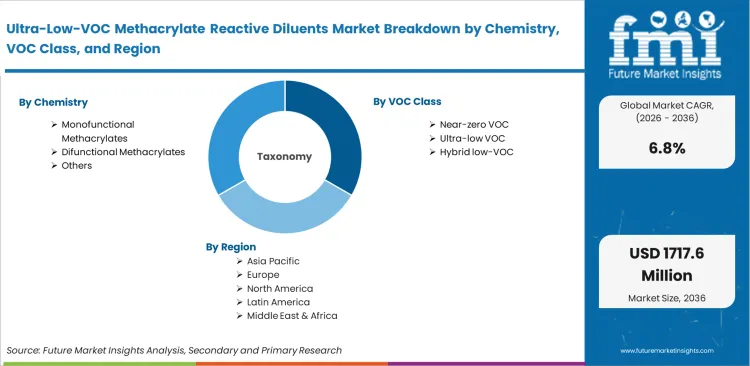
In 2025, the ultra-low-VOC methacrylate reactive diluents market stood at USD 780.0 million, with steadily growing sales, the industry is poised to surpass USD 833.0 million in 2026 at a CAGR of 6.8% during the forecast period. Consistent investment propels total market valuation to USD 1,608.3 million through 2036 as environmental compliance deadlines force formulators to replace traditional styrene and heavy solvents across high-volume resin systems.
Summary of Ultra-Low-VOC Methacrylate Reactive Diluents Market
- The market is estimated at USD 780.0 million in 2025.
- The market is projected to reach USD 1,608.3 million by 2036.
- The market is expected to grow at a CAGR of 6.8% from 2026 to 2036.
- The forecast period represents an incremental opportunity of USD 775.3 million.
- Monofunctional methacrylates lead the chemistry segment with a 34.0% share.
- Near-zero VOC classification dominates the VOC category with a 38.0% share.
- Industrial coatings lead the application segment with a 32.0% share.
- UV cure technology dominates the curing type segment with a 41.0% share.
- Construction leads the end-use segment with a 27.0% share.
- China (8.4%), India (7.8%), and South Korea (7.2%) are among the fastest-growing markets.
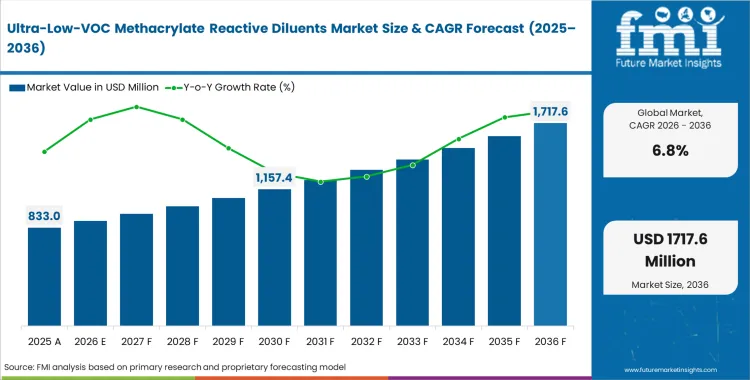
Chemical producers are under increasing pressure to reduce volatile liquid content in resin systems without weakening cure performance or final material strength. Delayed reformulation is likely to raise compliance risk in applications where emission limits are tightening and coating specifications are becoming more demanding. Water-based systems remain one route to compliance, yet ultra-low-VOC methacrylate reactive diluents are gaining attention because they can lower emissions while remaining compatible with high-performance formulations. Such materials react into the cured matrix during polymerization, which helps reduce solvent loss while supporting flow and application efficiency.
Market interest is also being shaped by the need for reformulated systems that can run on existing production lines without major equipment modification. Low-emission ingredients that preserve sprayability and viscosity control are becoming more relevant as manufacturers seek practical substitution pathways for conventional volatile solvents. Styrene-free and lower-emission formulations are likely to gain wider acceptance where they combine processing compatibility with regulatory alignment. Demand growth, in this segment, therefore depends on materials that improve environmental performance without disrupting established manufacturing conditions.
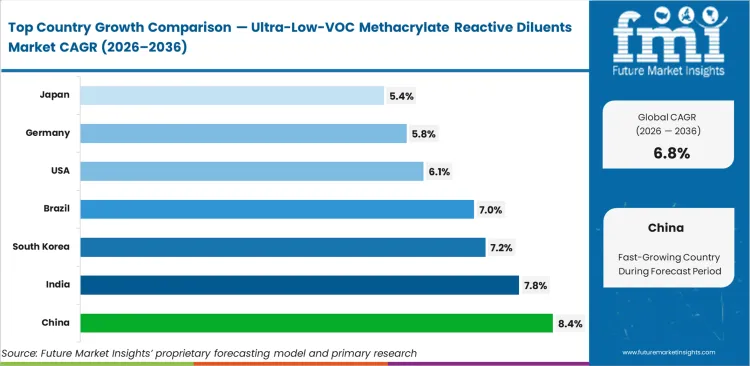
Regional adoption is expected to diverge according to emission control intensity and end-use preference for lower-odor formulations. China is projected to expand at a CAGR of 8.4% from 2026 to 2036, supported by tighter emission reduction efforts across major manufacturing centers. India is likely to register 7.8% over the same period as industrial infrastructure development continues to support demand for compliant coating materials. South Korea is estimated to grow at a CAGR of 7.2% from 2026 to 2036, while Brazil is projected to record 7.0%. United States is likely to witness 6.1% CAGR through 2036, followed by Germany at 5.8% and Japan at 5.4%. Regional variation is being shaped by differences in regulatory pressure, industrial processing needs, and demand for lower-emission end products.
Segmental Analysis
Ultra-Low-VOC Methacrylate Reactive Diluents Market Analysis by Chemistry
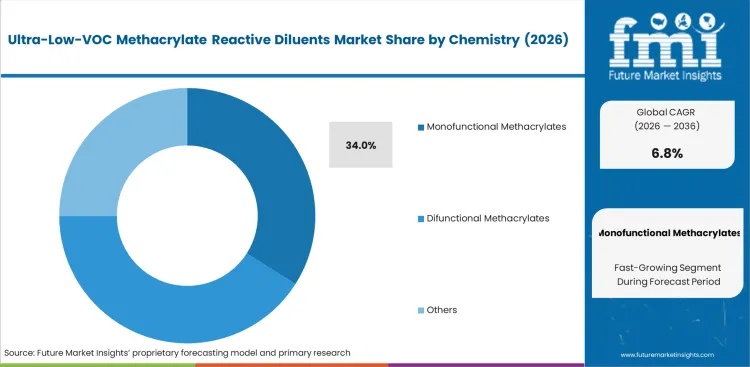
Viscosity reduction requirements force chemists to rely heavily on single-functional monomers when building complex mixtures. Monofunctional methacrylates are estimated to account for a predicted 34% share in 2026, as formulators depend on these specific molecules to aggressively thin out thick resins without causing early hardening. Selecting the right monofunctional variants directly impacts how easily low VOC coatings can be sprayed onto surfaces.
Critical realities often missed in basic chemical comparisons involve the plasticizing effect of these monomers, which fundamentally alters the flexibility of the dried paint. Relying solely on higher-functional variants risks creating overly brittle composites that crack under temperature changes. Delaying the integration of balanced monofunctional thinners leaves production floors struggling with unworkable, sticky batches.
- Initial Viscosity Targeting: Formulation chemists introduce specific monomer ratios to achieve precise flow characteristics prior to application. Operations avoid the heavy solvent loads historically required for spray equipment.
- Crosslink Density Moderation: Plant supervisors monitor the balance of functional groups to prevent excessive brittleness in the final product. Correct monomer selection ensures the cured matrix retains necessary mechanical flexibility.
- Cure Profile Optimization: Chemical engineers specify precise diluent blends to control the exothermic heat generated during rapid polymerization. Managing this thermal output prevents structural micro-cracking in thick-cast components.
Ultra-Low-VOC Methacrylate Reactive Diluents Market Analysis by VOC Class
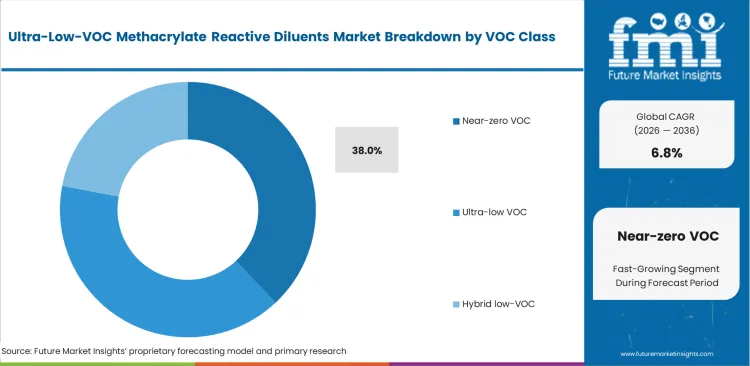
Absolute emission limits push factories toward chemicals with the lowest possible volatile profiles. Environmental compliance rules mandate these specific classifications to keep facility-wide air pollution below penalty levels, which is why the Near-zero VOC category is expected to hold an estimated 38% share in 2026. Replacing legacy solvents with these advanced thinners enables continuous production without expanding expensive air-scrubbing equipment. One non-obvious operational dynamic involves the longer shelf-life monitoring required for near-zero VOC materials. Low volatility means any unreacted liquid remains trapped inside finished low-VOC industrial primers, potentially causing long-term chemical smells if the drying process is incomplete. Failing to secure enough near-zero VOC materials puts a hard cap on daily production volumes.
- Direct Solvent Replacement: Formulation chemists substitute evaporative liquids with reactive monomers to maintain application consistency. This shift completely eliminates the flash-off wait times in industrial primers.
- Hidden Odor Retention: Quality control inspectors evaluate finished components for residual unreacted monomers that cause distinct chemical smells. Complete conversion during the curing stage is essential for consumer-facing applications.
- Total Lifecycle Emissions: Environmental officers calculate the full operational footprint to secure necessary operating permits. Zero-emission formulations simplify regulatory reporting and reduce compliance overhead.
Ultra-Low-VOC Methacrylate Reactive Diluents Market Analysis by Application
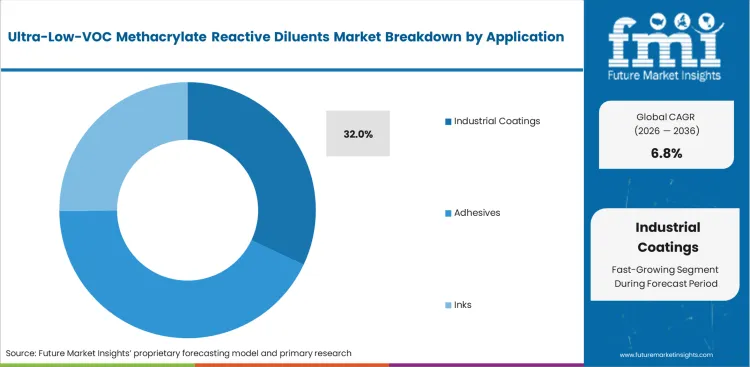
Industrial coatings are anticipated to capture an estimated 32% share of the market in 2026, driven by the massive volumes of liquid resins needed for heavy asset protection. Facility maintenance groups specify these compliant systems to paint large infrastructure safely without shutting down nearby operations due to hazardous fumes. This specific application relies heavily on polymethyl methacrylate derivatives to achieve required weather resistance. Surface-level consumption data often obscures the fact that paints formulated with these thinners show vastly different bonding properties compared to older solvent-based mixtures. Contractors trying to apply these advanced formulas using old drying schedules frequently face severe peeling and paint failure.
- Fume Mitigation: Maintenance officers apply these coatings in confined spaces without triggering hazardous atmospheric conditions. Operations continue normally without requiring extensive external ventilation setups.
- Recoat Window Sensitivity: Coating contractors adjust their application schedules to match the unique curing rhythm of reactive systems. Missing the optimal chemical bonding window requires labor-intensive mechanical abrasion before applying subsequent layers.
- Long-Term Weatherability: Asset officers evaluate the gloss retention and chalking resistance of the cured films. High-quality methacrylate diluents enhance the UV stability of the final protective layer.
Ultra-Low-VOC Methacrylate Reactive Diluents Market Analysis by Cure System
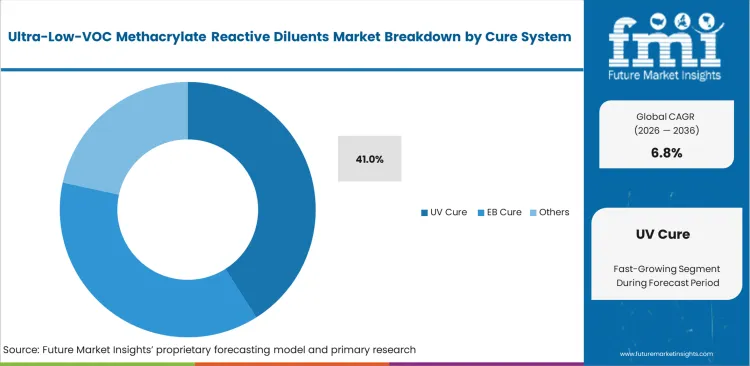
Instantaneous processing lines require matching chemical triggers to function efficiently at high speeds. Production floors use ultraviolet light to turn liquid films into solid coatings in fractions of a second, setting the UV cure segment up to command a 41% share in 2026. Rapid polymerization maximizes throughput on flat-line finishing equipment for UV coatings without needing massive thermal drying ovens. Structural paradoxes exist within this rapid curing environment. Surface layers harden instantly under UV light, but deeply pigmented paints often suffer from incomplete bottom-cure, trapping soft liquid beneath a hard outer shell. Facilities unable to perfectly balance their photo initiator chemicals alongside these thinners will experience high product rejection rates.
- Instantaneous Film Formation: Production supervisors run flat-line finishing equipment at maximum speed to meet output targets. Rapid polymerization eliminates the need for massive thermal drying ovens.
- Depth Of Cure Limitations: Quality technicians measure the hardness of the film down to the substrate interface. Pigments block UV penetration, requiring careful balancing of diluents and photo initiators to ensure full conversion.
- Equipment Calibration: Process engineers maintain strict control over lamp intensity and line speed. Any deviation in UV energy results in tacky surfaces and immediate production halts.
Ultra-Low-VOC Methacrylate Reactive Diluents Market Analysis by End Use
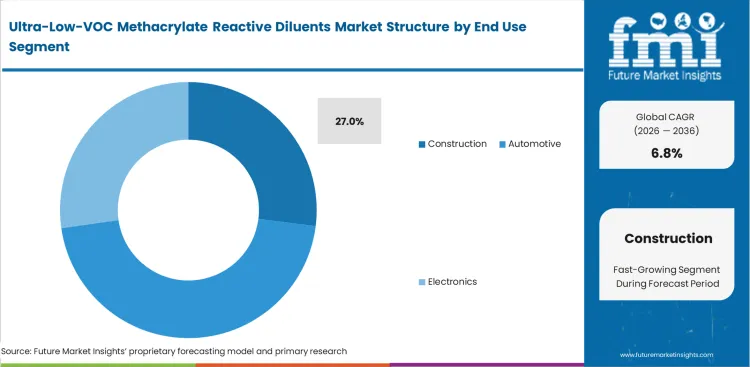
Infrastructure projects consume massive quantities of compliant resins for both structural and cosmetic building needs. Project site supervisors prefer these odorless materials for indoor jobs like bio-acrylic industrial floor coatings to keep building occupants safe and reopen spaces quickly. Eliminating hazardous fumes drastically simplifies site logistics, pushing the construction category to likely account for a 27% share in 2026. Hidden risks on construction sites involve the intense moisture sensitivity of these low-VOC formulations. Unmanaged humidity reacts badly with specific chemicals, causing the mixture to foam up or fail to stick if poured over damp concrete
- Rapid Return-To-Service: Site inspectors specify reactive systems to minimize facility downtime during renovations. Floors withstand forklift traffic within hours rather than days.
- Moisture Sensitivity Risks: Application crews test concrete slabs for residual humidity before pouring resin systems. Unmanaged moisture reacts with specific formulations, compromising adhesion and structural integrity.
- Odorless Indoor Application: Facility operators authorize daytime application in occupied buildings without generating tenant complaints. Eliminating hazardous fumes drastically simplifies site logistics.
Ultra-Low-VOC Methacrylate Reactive Diluents Market Drivers, Restraints, and Opportunities
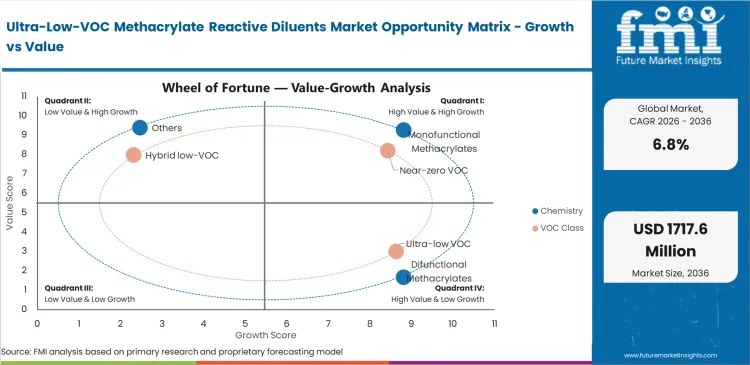
Strict workplace safety rules leave manufacturers with no choice but to stop using older, evaporating solvents immediately. Waiting for slow chemical updates is no longer an option when daily factory emissions are hitting hard legal limits. Falling behind on these environmental updates can force a facility to cut its operating hours or face heavy fines. Missing these strict targets also blocks companies from winning new, eco-friendly construction contracts, directly hurting their revenue.
Commercial survival relies on quickly adopting glycidyl methacrylate and similar low-emission thinners that work without releasing harmful gases into the air. Replacing evaporating liquids with these active ingredients keeps the resin easy to pour and spread over large surfaces. Switching to these newer materials is rarely about making a stronger or better-looking final product. Companies make this specific change entirely to stay under pollution caps, maintain a safe breathing environment on the factory floor, and keep their production lines running at full speed every day.
Surface preparation problems are slowing down the switch to these new chemical mixes on older job sites. Industrial painters find that solvent-free mixtures struggle to grip dirty or oily concrete. Older liquid thinners used to eat through this surface dirt naturally, creating a strong bond without extra work. Losing this built-in cleaning effect forces companies to spend heavily on new grinding equipment and intensive scraping before any painting can begin. Training painting crews to handle this exact surface sensitivity adds more delays to project schedules. Chemical suppliers try to fix this gap by adding extra bonding agents to the liquid mixture. Adding these extra ingredients drives up the total cost of the raw materials and makes the mixing process much more complicated for everyone involved.
- Plant-Based Chemical Creation: Scientists are pulling necessary building blocks from renewable crops instead of oil. Securing ingredients from farming sources protects chemical buyers from wild price jumps in the traditional petroleum market.
- Cold Weather Application: Formulators are designing new liquid thinners that harden perfectly even in freezing temperatures. Fixing this temperature limit allows construction crews to keep applying bio-based and low-VOC paints well into the winter months.
- Structural Metal Replacement: Product designers are using specialized thinners to create heavy-duty glues for factory assembly lines. Strong chemical bonding allows car and appliance makers to drop heavy metal screws in favor of lighter, seamless connections.
Regional Analysis
Regional adoption trajectories depend heavily on how strictly local authorities enforce chemical emission caps and workplace safety limits. Markets with aggressive environmental compliance deadlines mandate rapid solvent replacement, whereas mature regions prioritize high-purity applications to ensure consumer safety.
.webp "Top Country Growth Comparison Ultra Low Voc Methacrylate Reactive Diluents Market Cagr (2026 2036)")
| Country | CAGR (2026 to 2036) |
|---|---|
| China | 8.4% |
| India | 7.8% |
| South Korea | 7.2% |
| Brazil | 7.0% |
| United States | 6.1% |
| Germany | 5.8% |
| Japan | 5.4% |
Source: Future Market Insights (FMI) analysis, based on proprietary forecasting model and primary research
Asia-Pacific Ultra-Low-VOC Methacrylate Reactive Diluents Market Analysis
Industrial modernization across heavy manufacturing hubs dictates the rapid consumption of compliant chemical inputs. Operations phase out legacy solvent systems to meet absolute emission caps imposed on major production zones. Electronics and automotive assembly floors require massive volumes of fast-curing, low-emission resins. Integrating basic methacrylate copolymer variants supports advanced manufacturing throughput. Rapid urbanization fuels massive construction outputs, demanding compliant flooring and structural sealants on tight schedules.
- China: Enforcement of strict national emission standards forces formulators to eliminate traditional solvents entirely. The aggressive transition away from evaporative solvents justifies China's anticipated growth at a CAGR of 8.4% through 2036, as chemical plant supervisors secure long-term supply agreements to keep production lines running legally. This rapid transition positions local chemical producers to dominate regional monomer supply chains.
- India: Massive infrastructure expansion requires high volumes of compliant protective coatings for new assets. Due to the urgent need for compliant coatings across new infrastructure projects, demand in India is expected to rise at a 7.8% CAGR through 2036 to match modern construction requirements. Reaching stable formulation quality remains a critical operational outcome for domestic resin manufacturers as they scale production.
- South Korea: Driven by the specific demands of advanced electronics manufacturing, South Korea is projected to witness a 7.2% CAGR in this chemical segment through 2036 to supply ultra-pure, zero-emission adhesives for delicate component production. Assembly lines demand specialized inputs to prevent hazardous fumes in confined cleanrooms. Engineers specify exact reactive diluents to ensure rapid, stress-free bonding.
- Japan: Mature industrial sectors prioritize premium, odorless formulations for consumer-facing applications. Strict mandates from quality controllers to eliminate residual chemical scents explains why the adoption of these specialty chemicals in Japan is expected to move ahead at a CAGR of 5.4% from 2026 to 2036 for high-purity applications. The lower growth figure obscures the extremely high value and strict purity requirements of the volumes actually consumed by local manufacturers.
As per FMI’s assessments, the massive scale of electronics and automotive assembly across Asian markets guarantees sustained consumption of fast-curing, low-emission resins over the coming decade. Formulators in this region consistently prioritize rapid curing times to match the high-throughput requirements of heavy industrial asset protection. Resulting with, the domestic market heavily relying on localized supply chains to modernize asset protection without violating emerging environmental mandates.
North America & Latin America Ultra-Low-VOC Methacrylate Reactive Diluents Market Analysis
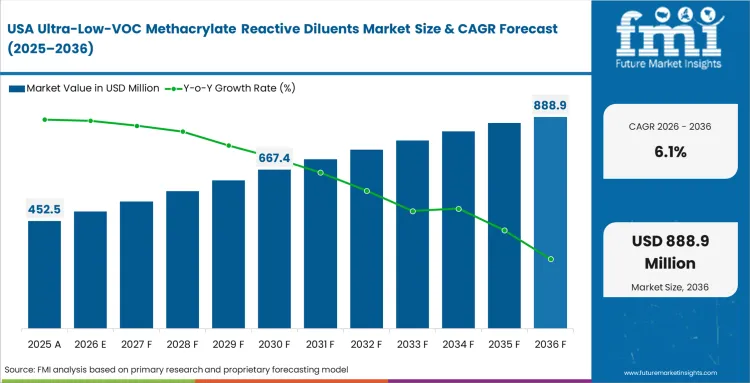
State-level environmental regulations shape the formulation strategies of major resin producers across the Americas. Formulators continuously adjust product lines to navigate a patchwork of local emission restrictions affecting acrylic paints and industrial coatings. Push for sustainable, green-certified building materials drives significant volumes into the construction sector. End users prioritize formulations offering immediate return-to-service without hazardous vapor accumulation. Cross-border supply chains face pressure to standardize formulations to simplify logistics across varying regulatory zones.
- United States: Rigorous environmental agency mandates compel industrial facilities to transition away from high-VOC systems. Necessity to maintain high-throughput coating lines without violating air quality permits justifies why the United States is poised to expand at a CAGR of 6.1% through 2036 in this specialty sector. Suppliers securing early approvals for low-VOC industrial primers lock in massive multi-year purchase contracts.
- Brazil: Anticipating the need to match global safety standards across expanding assembly plants, Brazil is expected to gain momentum with demand rising at a CAGR of 7.0% over the forecast period to modernize its automotive and industrial sectors. Formulators integrate reactive diluents to improve the handling characteristics of localized resin systems. Domestic resin producers gain critical competitive positioning against imported solvent-borne alternatives by localizing the production of compliant formulas.
FMI reports, the market structure across the Americas strongly favors established chemical partners capable of navigating a complex patchwork of varying state-level emission restrictions. Contractors increasingly demand formulations that offer strong mechanical performance despite the complete removal of traditional evaporative solvents. Such operational reality forces continuous investment in advanced monomer technology to meet green-certified building standards without sacrificing application efficiency.
Europe Ultra-Low-VOC Methacrylate Reactive Diluents Market Analysis
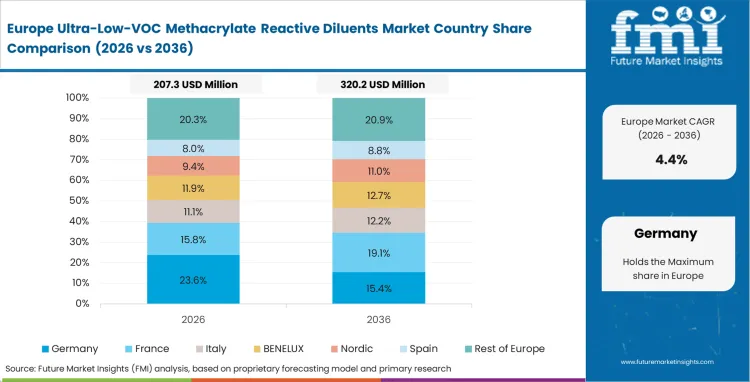
Comprehensive chemical registration and strict workplace safety directives dominate the operational reality for European chemical producers. Chemists engineer highly advanced, solvent-free systems to comply with regulations limiting worker exposure to volatile organics. Formulations increasingly rely on acrylate oligomers combined with reactive diluents to achieve required performance metrics. Sustainability initiatives force major brands to document the entire chemical footprint of their products.
- Germany: Deeply established chemical manufacturing infrastructure pioneers the development of next-generation reactive monomers. Intense focus by researches on maximizing the crosslink efficiency of near-zero VOC diluents justifies the Germany sector's expectation to register a CAGR of 5.8% through 2036 for advanced applications. Achieving perfect formulation stability allows local producers to export these advanced compliant systems globally. Bulk chemical suppliers heavily invest in bio-based alternatives to secure future raw material independence.
FMI analyses, European regulatory frameworks enforce a permanent shift toward solvent-free systems, ensuring long-term demand stability across the continent. Chemical manufacturers treat emission compliance not just as a legal requirement, but as a core competitive differentiator for premium industrial accounts. With the further successful integration of bio-based reactive diluents dictates which suppliers capture the highest-value contracts in the region.
Competitive Aligners for Market Players
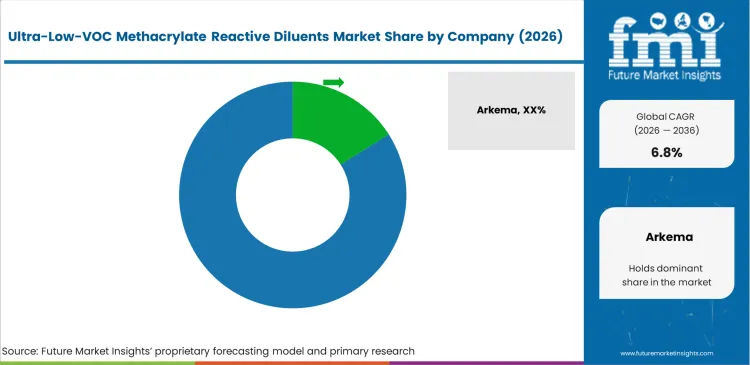
Upstream integration continues to matter in this specialty market. Producers with direct access to acrylic acid and esterification capacity are usually in a stronger position to manage raw material swings and keep supply more stable. Supplier selection for low-VOC methacrylate reactive diluents is shaped by more than price alone. Monomer purity, inhibitor balance, and batch consistency remain important because coating resin performance is closely tied to formulation stability.
Stabilization capability also influences how suppliers are viewed in the market. Reactive diluents need careful handling during storage and transport, since premature hardening can reduce product usability before it reaches the customer. Designing inhibitor systems that maintain storage life without weakening downstream reactivity is still a demanding part of product development. Suppliers with both formulation experience and dependable logistics are often better placed to preserve product quality across longer shipping routes.
Industrial users are placing more weight on supply continuity by approving multiple sources for critical inputs. Secondary suppliers are being assessed more closely because substitute materials need to perform reliably on active production lines. Demand is also moving away from standard monomers toward more application-specific oligomer and diluent combinations. Supplier roles, in turn, are extending beyond material supply and increasingly include formulation support tied to end-use performance.
Key Players in Ultra-Low-VOC Methacrylate Reactive Diluents Market
- Arkema
- allnex
- Evonik Industries AG
- Mitsubishi Chemical Group
- Nippon Shokubai Co., Ltd.
- Atul Ltd.
Scope of the Report
| Metric | Value |
|---|---|
| Quantitative Units | USD 833.0 million to USD 1,608.3 million, at a CAGR of 6.8% |
| Market Definition | Ultra-Low-VOC Methacrylate Reactive Diluents act as low-viscosity monomers designed to thin base resins while participating directly in the curing reaction. They reduce evaporative solvents in formulating coatings, adhesives, and composites, becoming permanently locked into the polymer matrix upon curing. |
| Segmentation | Chemistry, VOC class, Application, Cure system, End use |
| Regions Covered | Asia-Pacific, North America & Latin America, Europe, Middle East & Africa |
| Countries Covered | China, India, South Korea, Brazil, United States, Germany, Japan |
| Key Companies Profiled | Arkema, allnex, Evonik Industries AG, Mitsubishi Chemical Group, Nippon Shokubai Co., Ltd., Atul Ltd. |
| Forecast Period | 2026 to 2036 |
| Approach | Baseline volume consumption of specialty monomers in low-emission resin formulations cross-validated against regional capacity data. |
Source: Future Market Insights (FMI) analysis, based on proprietary forecasting model and primary research
Ultra-Low-VOC Methacrylate Reactive Diluents Market Segments
Chemistry
- Monofunctional methacrylates
- Difunctional methacrylates
- Multifunctional methacrylates
VOC Class
- Near-zero VOC
- Ultra-low VOC
- Hybrid low-VOC
Application
- Industrial coatings
- Adhesives
- Sealants
- Composites
- Inks
Cure System
- UV cure
- EB cure
- Peroxide cure
- Anaerobic cure
End Use
- Construction
- Automotive
- Electronics
- Packaging
- Industrial assembly
Regions:
- Asia Pacific
- India
- China
- Japan
- South Korea
- Indonesia
- Australia & New Zealand
- ASEAN
- Rest of Asia Pacific
- Europe
- Germany
- Italy
- France
- United Kingdom
- Spain
- Benelux
- Nordics
- Central & Eastern Europe
- Rest of Europe
- North America
- United States
- Canada
- Mexico
- Latin America
- Brazil
- Argentina
- Chile
- Rest of Latin America
- Middle East & Africa
- Kingdom of Saudi Arabia
- United Arab Emirates
- South Africa
- Turkey
- Rest of Middle East & Africa
Bibliography
- USA Environmental Protection Agency. (2025). Final Amendments to Aerosol Coatings: National Volatile Organic Compound Emission Standards.
- Janssen, K., Schnelting, G. H. M., Waterink, M., Guit, J., Hul, J., Ye, C., Loos, K., & Voet, V. S. D. (2024). Renewable methacrylate resins for 3D printing containing dynamic hydroxyester linkages for reprocessability. Macromolecular Materials and Engineering, 309(6), Article 2400036.
- Duraccio, D., Capra, P. P., & Malucelli, G. (2024). UV-curable coatings for energy harvesting applications: Current state-of-the-art and future perspectives. Micro and Nano Engineering, 23, Article 100266.
- Azani, M.-R., & Hassanpour, A. (2024). UV-curable polymer nanocomposites: Material selection, formulations, and recent advances. Journal of Composites Science, 8(11), 441.
- Wan, Z., Zhang, H., Niu, M., Zhang, W., Guo, Y., & Li, H. (2024). Development of lignin-derived UV-curable resin for DLP 3D printing. Industrial Crops and Products, 221, Article 119243.
- Hammer, T. J., Pugh, C., & Soucek, M. D. (2025). Photopolymerization kinetics of UV-curable polyester powder coatings containing urethane methacrylate reactive diluents. Journal of Coatings Technology and Research, 22, 1791-1805.
- Jašek, V., Bartoš, O., Prokeš, J., Kameníková, E., Přikryl, R., & Figalla, S. (2025). Sustainable and highly efficient synthesis of reactive diluents from renewable sources for property-enhancing purposes in glass-containing material composites. Precision Chemistry, 4(1), 1-12.
This bibliography is provided for reader reference. The full FMI report contains the complete reference list with primary source documentation.
This Report Addresses
- Viscosity reduction metrics achieved by monofunctional methacrylates across high-solid industrial formulations.
- Operational impacts of transitioning from evaporative solvents to near-zero VOC reactive diluents.
- Exothermic heat management challenges in rapid UV-cure systems utilizing highly functional monomers.
- Supply chain vulnerabilities linked to raw material stabilizer packages and temperature-controlled logistics.
- Substrate preparation requirements for applying low-emission composite systems over damp concrete.
- Absolute emission cap enforcement impacts on manufacturing throughput in China and the United States.
- Integration of bio-based methacrylates into legacy resin architecture without compromising crosslink density.
- Shelf-life stabilization differences between difunctional and multifunctional chemical modifiers.
Frequently Asked Questions
What are ultra-low-VOC methacrylate reactive diluents?
These chemicals act as active viscosity reducers that crosslink into the final polymer structure, enabling formulators to meet strict environmental emission limits by replacing passive solvents.
How do methacrylate reactive diluents reduce VOC emissions?
They substitute evaporative liquids with reactive monomers that participate directly in the curing reaction, remaining permanently locked into the polymer matrix.
Which industries use ultra-low-VOC methacrylate reactive diluents most?
Heavy asset protection consumes massive volumes of these liquid resins, specifically across industrial coatings, adhesives, composites, and high-speed electronics assembly.
Why are low-VOC methacrylate monomers gaining demand?
Stringent occupational exposure limits and absolute environmental emission caps compel facility operators to abandon traditional evaporative solvents immediately.
What is the market size of ultra-low-VOC methacrylate reactive diluents?
The valuation stands at USD 833.0 million in 2026, signaling the massive scale of solvent replacement across global manufacturing sectors.
What is the forecast for low-VOC methacrylate diluents?
Sales are poised to hit USD 1,608.3 million by 2036 at a 6.8% CAGR, relying entirely on the strict enforcement of environmental emission limits.
Which chemistry segment leads this adoption cycle?
Monofunctional methacrylates lead with a 34% share in 2026, as formulation chemists depend on these molecules to aggressively cut the viscosity of highly crosslinked oligomers.
How do monofunctional and multifunctional methacrylate diluents differ?
Monofunctional methacrylates act as internal plasticizers that alter the flexibility of the cured film, whereas multifunctional variants increase crosslink density but risk producing overly brittle composites.
Which countries are growing fastest in this sector?
China expands at an 8.4% CAGR through 2036, followed closely by India at 7.8% CAGR, driven by aggressive national emission reduction mandates affecting heavy manufacturing hubs.
Who are the main suppliers of low-VOC methacrylate reactive diluents?
Raw material integration dictates competitive survival, with companies like Evonik Industries AG, Arkema, and allnex controlling massive upstream capacities.
How do methacrylate vs acrylate reactive diluent chemistries compare?
Acrylates typically offer faster cure speeds suitable for high-throughput lines, while methacrylates provide superior weatherability and lower skin sensitization profiles for manual applications.
What regulations are driving adoption of low-VOC methacrylate monomers?
Strict state-level environmental mandates and national emission caps penalize operations exceeding specific volatile organic compound thresholds, forcing immediate chemical substitutions.
Why is stability a major competitive factor among manufacturers?
Reactive diluents are inherently unstable and prone to premature polymerization during transport, requiring precise inhibitor packages and temperature-controlled logistics networks.
How does odor retention impact near-zero VOC formulations?
Near-zero VOC diluents often require longer shelf-life monitoring because any unreacted monomer remains trapped in the finished good, causing long-term odor issues if the cure is incomplete.
What specific challenge occurs during the UV curing of pigmented systems?
Pigments block UV penetration, requiring careful balancing of diluents and photoinitiators to ensure full conversion down to the substrate and prevent soft material trapping.
Why do buyers resist sole-source dependencies for reactive diluents?
Formulation chemists require identical rheological behavior and cure kinetics to ensure uninterrupted production, forcing secondary suppliers through grueling qualification matrices.
What prevents traditional styrene monomers from competing in this space?
Styrene's high vapor pressure and hazardous air pollutant classification contradict low-emission criteria, forcing a categorical shift away from these legacy materials.
Preview the report firsthand - request a free sample
Get SampleGet the brochure for pricing and purchase details.
Get PDFTable of Content
- Executive Summary
- Global Market Outlook
- Demand-side Trends
- Supply-side Trends
- Technology Roadmap Analysis
- Analysis and Recommendations
- Market Overview
- Market Coverage / Taxonomy
- Market Definition / Scope / Limitations
- Research Methodology
- Chapter Orientation
- Analytical Lens and Working Hypotheses
- Market Structure, Signals, and Trend Drivers
- Benchmarking and Cross-market Comparability
- Market Sizing, Forecasting, and Opportunity Mapping
- Research Design and Evidence Framework
- Desk Research Programme (Secondary Evidence)
- Company Annual and Sustainability Reports
- Peer-reviewed Journals and Academic Literature
- Corporate Websites, Product Literature, and Technical Notes
- Earnings Decks and Investor Briefings
- Statutory Filings and Regulatory Disclosures
- Technical White Papers and Standards Notes
- Trade Journals, Industry Magazines, and Analyst Briefs
- Conference Proceedings, Webinars, and Seminar Materials
- Government Statistics Portals and Public Data Releases
- Press Releases and Reputable Media Coverage
- Specialist Newsletters and Curated Briefings
- Sector Databases and Reference Repositories
- FMI Internal Proprietary Databases and Historical Market Datasets
- Subscription Datasets and Paid Sources
- Social Channels, Communities, and Digital Listening Inputs
- Additional Desk Sources
- Expert Input and Fieldwork (Primary Evidence)
- Primary Modes
- Qualitative Interviews and Expert Elicitation
- Quantitative Surveys and Structured Data Capture
- Blended Approach
- Why Primary Evidence is Used
- Field Techniques
- Interviews
- Surveys
- Focus Groups
- Observational and In-context Research
- Social and Community Interactions
- Stakeholder Universe Engaged
- C-suite Leaders
- Board Members
- Presidents and Vice Presidents
- R&D and Innovation Heads
- Technical Specialists
- Domain Subject-matter Experts
- Scientists
- Physicians and Other Healthcare Professionals
- Governance, Ethics, and Data Stewardship
- Research Ethics
- Data Integrity and Handling
- Primary Modes
- Tooling, Models, and Reference Databases
- Desk Research Programme (Secondary Evidence)
- Data Engineering and Model Build
- Data Acquisition and Ingestion
- Cleaning, Normalisation, and Verification
- Synthesis, Triangulation, and Analysis
- Quality Assurance and Audit Trail
- Market Background
- Market Dynamics
- Drivers
- Restraints
- Opportunity
- Trends
- Scenario Forecast
- Demand in Optimistic Scenario
- Demand in Likely Scenario
- Demand in Conservative Scenario
- Opportunity Map Analysis
- Product Life Cycle Analysis
- Supply Chain Analysis
- Investment Feasibility Matrix
- Value Chain Analysis
- PESTLE and Porter’s Analysis
- Regulatory Landscape
- Regional Parent Market Outlook
- Production and Consumption Statistics
- Import and Export Statistics
- Market Dynamics
- Global Market Analysis 2021 to 2025 and Forecast, 2026 to 2036
- Historical Market Size Value (USD Million) Analysis, 2021 to 2025
- Current and Future Market Size Value (USD Million) Projections, 2026 to 2036
- Y-o-Y Growth Trend Analysis
- Absolute $ Opportunity Analysis
- Global Market Pricing Analysis 2021 to 2025 and Forecast 2026 to 2036
- Global Market Analysis 2021 to 2025 and Forecast 2026 to 2036, By Chemistry
- Introduction / Key Findings
- Historical Market Size Value (USD Million) Analysis By Chemistry , 2021 to 2025
- Current and Future Market Size Value (USD Million) Analysis and Forecast By Chemistry , 2026 to 2036
- Monofunctional Methacrylates
- Difunctional Methacrylates
- Others
- Monofunctional Methacrylates
- Y-o-Y Growth Trend Analysis By Chemistry , 2021 to 2025
- Absolute $ Opportunity Analysis By Chemistry , 2026 to 2036
- Global Market Analysis 2021 to 2025 and Forecast 2026 to 2036, By VOC Class
- Introduction / Key Findings
- Historical Market Size Value (USD Million) Analysis By VOC Class, 2021 to 2025
- Current and Future Market Size Value (USD Million) Analysis and Forecast By VOC Class, 2026 to 2036
- Near-zero VOC
- Ultra-low VOC
- Hybrid low-VOC
- Near-zero VOC
- Y-o-Y Growth Trend Analysis By VOC Class, 2021 to 2025
- Absolute $ Opportunity Analysis By VOC Class, 2026 to 2036
- Global Market Analysis 2021 to 2025 and Forecast 2026 to 2036, By Application
- Introduction / Key Findings
- Historical Market Size Value (USD Million) Analysis By Application, 2021 to 2025
- Current and Future Market Size Value (USD Million) Analysis and Forecast By Application, 2026 to 2036
- Industrial Coatings
- Adhesives
- Inks
- Industrial Coatings
- Y-o-Y Growth Trend Analysis By Application, 2021 to 2025
- Absolute $ Opportunity Analysis By Application, 2026 to 2036
- Global Market Analysis 2021 to 2025 and Forecast 2026 to 2036, By Cure System
- Introduction / Key Findings
- Historical Market Size Value (USD Million) Analysis By Cure System, 2021 to 2025
- Current and Future Market Size Value (USD Million) Analysis and Forecast By Cure System, 2026 to 2036
- UV Cure
- EB Cure
- Others
- UV Cure
- Y-o-Y Growth Trend Analysis By Cure System, 2021 to 2025
- Absolute $ Opportunity Analysis By Cure System, 2026 to 2036
- Global Market Analysis 2021 to 2025 and Forecast 2026 to 2036, By End Use
- Introduction / Key Findings
- Historical Market Size Value (USD Million) Analysis By End Use, 2021 to 2025
- Current and Future Market Size Value (USD Million) Analysis and Forecast By End Use, 2026 to 2036
- Construction
- Automotive
- Electronics
- Construction
- Y-o-Y Growth Trend Analysis By End Use, 2021 to 2025
- Absolute $ Opportunity Analysis By End Use, 2026 to 2036
- Global Market Analysis 2021 to 2025 and Forecast 2026 to 2036, By Region
- Introduction
- Historical Market Size Value (USD Million) Analysis By Region, 2021 to 2025
- Current Market Size Value (USD Million) Analysis and Forecast By Region, 2026 to 2036
- North America
- Latin America
- Western Europe
- Eastern Europe
- East Asia
- South Asia and Pacific
- Middle East & Africa
- Market Attractiveness Analysis By Region
- North America Market Analysis 2021 to 2025 and Forecast 2026 to 2036, By Country
- Historical Market Size Value (USD Million) Trend Analysis By Market Taxonomy, 2021 to 2025
- Market Size Value (USD Million) Forecast By Market Taxonomy, 2026 to 2036
- By Country
- USA
- Canada
- Mexico
- By Chemistry
- By VOC Class
- By Application
- By Cure System
- By End Use
- By Country
- Market Attractiveness Analysis
- By Country
- By Chemistry
- By VOC Class
- By Application
- By Cure System
- By End Use
- Key Takeaways
- Latin America Market Analysis 2021 to 2025 and Forecast 2026 to 2036, By Country
- Historical Market Size Value (USD Million) Trend Analysis By Market Taxonomy, 2021 to 2025
- Market Size Value (USD Million) Forecast By Market Taxonomy, 2026 to 2036
- By Country
- Brazil
- Chile
- Rest of Latin America
- By Chemistry
- By VOC Class
- By Application
- By Cure System
- By End Use
- By Country
- Market Attractiveness Analysis
- By Country
- By Chemistry
- By VOC Class
- By Application
- By Cure System
- By End Use
- Key Takeaways
- Western Europe Market Analysis 2021 to 2025 and Forecast 2026 to 2036, By Country
- Historical Market Size Value (USD Million) Trend Analysis By Market Taxonomy, 2021 to 2025
- Market Size Value (USD Million) Forecast By Market Taxonomy, 2026 to 2036
- By Country
- Germany
- UK
- Italy
- Spain
- France
- Nordic
- BENELUX
- Rest of Western Europe
- By Chemistry
- By VOC Class
- By Application
- By Cure System
- By End Use
- By Country
- Market Attractiveness Analysis
- By Country
- By Chemistry
- By VOC Class
- By Application
- By Cure System
- By End Use
- Key Takeaways
- Eastern Europe Market Analysis 2021 to 2025 and Forecast 2026 to 2036, By Country
- Historical Market Size Value (USD Million) Trend Analysis By Market Taxonomy, 2021 to 2025
- Market Size Value (USD Million) Forecast By Market Taxonomy, 2026 to 2036
- By Country
- Russia
- Poland
- Hungary
- Balkan & Baltic
- Rest of Eastern Europe
- By Chemistry
- By VOC Class
- By Application
- By Cure System
- By End Use
- By Country
- Market Attractiveness Analysis
- By Country
- By Chemistry
- By VOC Class
- By Application
- By Cure System
- By End Use
- Key Takeaways
- East Asia Market Analysis 2021 to 2025 and Forecast 2026 to 2036, By Country
- Historical Market Size Value (USD Million) Trend Analysis By Market Taxonomy, 2021 to 2025
- Market Size Value (USD Million) Forecast By Market Taxonomy, 2026 to 2036
- By Country
- China
- Japan
- South Korea
- By Chemistry
- By VOC Class
- By Application
- By Cure System
- By End Use
- By Country
- Market Attractiveness Analysis
- By Country
- By Chemistry
- By VOC Class
- By Application
- By Cure System
- By End Use
- Key Takeaways
- South Asia and Pacific Market Analysis 2021 to 2025 and Forecast 2026 to 2036, By Country
- Historical Market Size Value (USD Million) Trend Analysis By Market Taxonomy, 2021 to 2025
- Market Size Value (USD Million) Forecast By Market Taxonomy, 2026 to 2036
- By Country
- India
- ASEAN
- Australia & New Zealand
- Rest of South Asia and Pacific
- By Chemistry
- By VOC Class
- By Application
- By Cure System
- By End Use
- By Country
- Market Attractiveness Analysis
- By Country
- By Chemistry
- By VOC Class
- By Application
- By Cure System
- By End Use
- Key Takeaways
- Middle East & Africa Market Analysis 2021 to 2025 and Forecast 2026 to 2036, By Country
- Historical Market Size Value (USD Million) Trend Analysis By Market Taxonomy, 2021 to 2025
- Market Size Value (USD Million) Forecast By Market Taxonomy, 2026 to 2036
- By Country
- Kingdom of Saudi Arabia
- Other GCC Countries
- Turkiye
- South Africa
- Other African Union
- Rest of Middle East & Africa
- By Chemistry
- By VOC Class
- By Application
- By Cure System
- By End Use
- By Country
- Market Attractiveness Analysis
- By Country
- By Chemistry
- By VOC Class
- By Application
- By Cure System
- By End Use
- Key Takeaways
- Key Countries Market Analysis
- USA
- Pricing Analysis
- Market Share Analysis, 2025
- By Chemistry
- By VOC Class
- By Application
- By Cure System
- By End Use
- Canada
- Pricing Analysis
- Market Share Analysis, 2025
- By Chemistry
- By VOC Class
- By Application
- By Cure System
- By End Use
- Mexico
- Pricing Analysis
- Market Share Analysis, 2025
- By Chemistry
- By VOC Class
- By Application
- By Cure System
- By End Use
- Brazil
- Pricing Analysis
- Market Share Analysis, 2025
- By Chemistry
- By VOC Class
- By Application
- By Cure System
- By End Use
- Chile
- Pricing Analysis
- Market Share Analysis, 2025
- By Chemistry
- By VOC Class
- By Application
- By Cure System
- By End Use
- Germany
- Pricing Analysis
- Market Share Analysis, 2025
- By Chemistry
- By VOC Class
- By Application
- By Cure System
- By End Use
- UK
- Pricing Analysis
- Market Share Analysis, 2025
- By Chemistry
- By VOC Class
- By Application
- By Cure System
- By End Use
- Italy
- Pricing Analysis
- Market Share Analysis, 2025
- By Chemistry
- By VOC Class
- By Application
- By Cure System
- By End Use
- Spain
- Pricing Analysis
- Market Share Analysis, 2025
- By Chemistry
- By VOC Class
- By Application
- By Cure System
- By End Use
- France
- Pricing Analysis
- Market Share Analysis, 2025
- By Chemistry
- By VOC Class
- By Application
- By Cure System
- By End Use
- India
- Pricing Analysis
- Market Share Analysis, 2025
- By Chemistry
- By VOC Class
- By Application
- By Cure System
- By End Use
- ASEAN
- Pricing Analysis
- Market Share Analysis, 2025
- By Chemistry
- By VOC Class
- By Application
- By Cure System
- By End Use
- Australia & New Zealand
- Pricing Analysis
- Market Share Analysis, 2025
- By Chemistry
- By VOC Class
- By Application
- By Cure System
- By End Use
- China
- Pricing Analysis
- Market Share Analysis, 2025
- By Chemistry
- By VOC Class
- By Application
- By Cure System
- By End Use
- Japan
- Pricing Analysis
- Market Share Analysis, 2025
- By Chemistry
- By VOC Class
- By Application
- By Cure System
- By End Use
- South Korea
- Pricing Analysis
- Market Share Analysis, 2025
- By Chemistry
- By VOC Class
- By Application
- By Cure System
- By End Use
- Russia
- Pricing Analysis
- Market Share Analysis, 2025
- By Chemistry
- By VOC Class
- By Application
- By Cure System
- By End Use
- Poland
- Pricing Analysis
- Market Share Analysis, 2025
- By Chemistry
- By VOC Class
- By Application
- By Cure System
- By End Use
- Hungary
- Pricing Analysis
- Market Share Analysis, 2025
- By Chemistry
- By VOC Class
- By Application
- By Cure System
- By End Use
- Kingdom of Saudi Arabia
- Pricing Analysis
- Market Share Analysis, 2025
- By Chemistry
- By VOC Class
- By Application
- By Cure System
- By End Use
- Turkiye
- Pricing Analysis
- Market Share Analysis, 2025
- By Chemistry
- By VOC Class
- By Application
- By Cure System
- By End Use
- South Africa
- Pricing Analysis
- Market Share Analysis, 2025
- By Chemistry
- By VOC Class
- By Application
- By Cure System
- By End Use
- USA
- Market Structure Analysis
- Competition Dashboard
- Competition Benchmarking
- Market Share Analysis of Top Players
- By Region
- By Chemistry
- By VOC Class
- By Application
- By Cure System
- By End Use
- Competition Analysis
- Competition Deep Dive
- Arkema
- Overview
- Product Portfolio
- Profitability by Market Segments (Product/Age /Sales Channel/Region)
- Sales Footprint
- Strategy Overview
- Marketing Strategy
- Product Strategy
- Channel Strategy
- allnex
- Evonik Industries AG
- Mitsubishi Chemical Group
- Nippon Shokubai Co., Ltd.
- Atul Ltd.
- Arkema
- Competition Deep Dive
- Assumptions & Acronyms Used


