

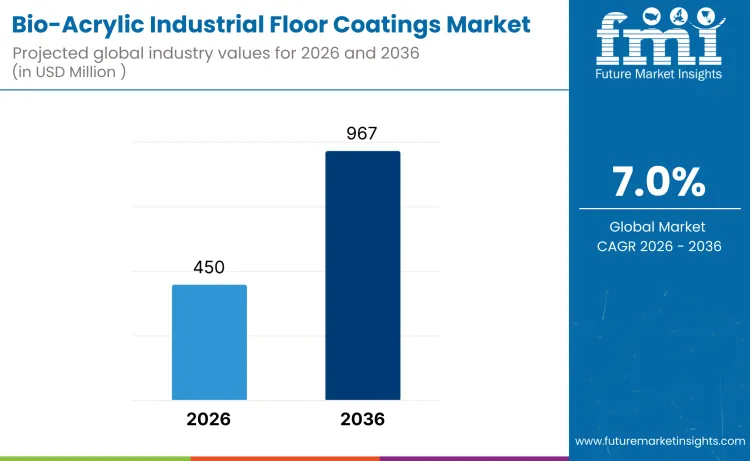
- Industry Size (2026)
- USD 450 Mn
- Forecast (2036)
- USD 967 Mn
- CAGR (2026 to 2036)
- 7%
Bio-Acrylic Industrial Floor Coatings Market Forecast and Outlook 2026 to 2036
The bio-acrylic industrial floor coatings market is experiencing steady growth, driven by the increasing demand for sustainable and eco-friendly solutions in industrial settings. Bio-acrylic waterborne coatings, which account for 40% of the coating type market share, are preferred for their low environmental impact, excellent durability, and superior performance in industrial environments.
Manufacturing facilities, representing 30% of the application segment, dominate the market as industries seek flooring solutions that can withstand heavy machinery and foot traffic while maintaining environmental responsibility. The shift towards bio-based, low-VOC (volatile organic compound) coatings is further fueling the growth in this sector, as industries focus on reducing their environmental footprint.
Quick Stats for Bio-Acrylic Industrial Floor Coatings Market
- Bio-Acrylic Industrial Floor Coatings Market Value (2026): USD 450 million
- Bio-Acrylic Industrial Floor Coatings Market Forecast Value (2036): USD 967 million
- Bio-Acrylic Industrial Floor Coatings Market Global Forecast CAGR: 7%
- Leading Coating Type in Bio-Acrylic Industrial Floor Coatings Market: Bio-acrylic waterborne coatings (40%)
- Key Growth Regions in Bio-Acrylic Industrial Floor Coatings Market: China, India, USA, UK, Japan
- Top Players in Bio-Acrylic Industrial Floor Coatings Market: PPG Industries, Sherwin-Williams, AkzoNobel, RPM International, BASF, Sika, RPM Performance Coatings Group, Hempel, Jotun, Masco Corporation
Bio-Acrylic Industrial Floor Coatings Market Key Takeaways
| Metric | Value |
|---|---|
| Industry Sales Value (2026) | USD 450 million |
| Industry Forecast Value (2036) | USD 967 million |
| Industry Forecast CAGR (2026 to 2036) | 7% |
What Is Driving the Demand for Bio Acrylic Industrial Floor Coatings Globally?
The demand for bio‑acrylic industrial floor coatings globally is shaped by the increasing focus on occupational safety, environmental performance, and regulatory compliance in industrial and commercial facilities. Bio‑acrylic coatings are formulated with bio‑based resins derived from renewable resources rather than purely petroleum‑derived polymers. This supports demand from facility managers and building owners seeking low‑volatile organic compound (VOC) and low‑odor solutions that improve indoor air quality and reduce environmental footprint.
Industrial environments such as warehouses, factories, automotive plants, food and beverage facilities, and logistics centres require durable floor coatings that resist abrasion, impacts, chemical exposure, and heavy traffic. Bio‑acrylic systems offer good adhesion, rapid curing, and toughness that meet these performance requirements while aligning with sustainability goals. In regions with stringent environmental regulations, including Europe, North America, and parts of Asia, pressure to reduce reliance on traditional solvent‑borne coatings further drives interest in bio‑based alternatives. The broader trend toward green building standards and certifications encourages adoption of floor coatings based on renewable materials.
Future demand for bio‑acrylic industrial floor coatings is expected to grow as sustainability commitments and regulatory frameworks evolve. Expansion of manufacturing and logistics sectors in developing markets will increase the total installed base of industrial floors requiring protective coatings. Continued innovation in bio‑resin technology is likely to improve performance characteristics such as chemical resistance and lifecycle durability, making bio‑acrylic options more competitive with conventional systems.
As corporations adopt environmental, social and governance (ESG) targets, procurement policies may prioritize products with reduced carbon intensity and lower environmental impact, supporting uptake of bio‑acrylic coatings. End users may also choose these coatings to meet customer expectations for greener facilities. The pace of growth will depend on cost competitiveness, proven long‑term performance, and alignment of bio‑acrylic formulations with industry standards for industrial floor protection.
What Are the Key Segments in Global Bio‑Acrylic Industrial Floor Coatings Market?
The global bio‑acrylic industrial floor coatings market is segmented by coating type and application. Bio‑acrylic waterborne coatings hold 40% of the market share as a leading product type. In terms of application, manufacturing facilities are the largest segment, accounting for 30% of the market. The demand for bio‑acrylic industrial floor coatings is driven by the need for environmentally friendlier, low‑VOC solutions that maintain performance in heavy‑duty industrial environments.
Which Coating Type Drives Bio‑Acrylic Industrial Floor Coatings Demand Globally?
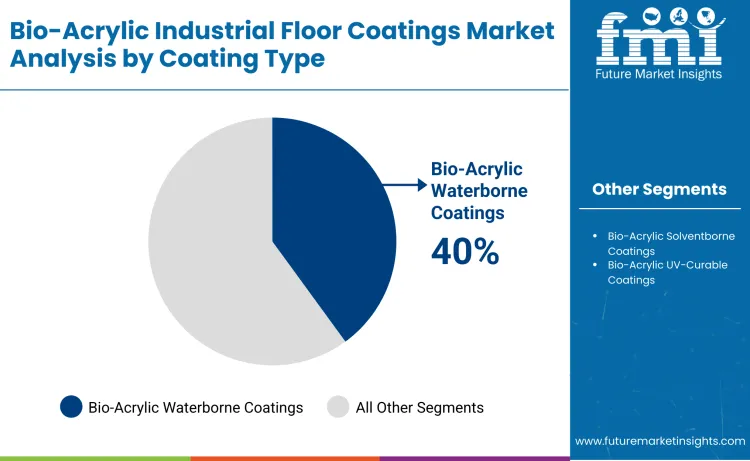
Bio‑acrylic waterborne coatings are the dominant coating type, representing 40% of the global market share. These coatings are formulated to reduce reliance on traditional solvent‑based resins, using bio‑derived acrylic polymers combined with waterborne systems. Bio‑acrylic waterborne coatings offer a balance of chemical resistance, durability, and ease of application while meeting stricter environmental and worker safety standards.
Their relatively lower volatile organic compound (VOC) content compared to solvent‑based alternatives supports adoption in regions with stringent emissions regulations. Bio‑acrylic coatings are also valued for quicker cure times and reduced odor, making them suitable for indoor industrial flooring where minimal downtime is critical. Other coating types, such as epoxy, polyurethane, and hybrid bio‑based systems, also play roles in industrial floor applications, but bio‑acrylic waterborne systems lead due to their combination of performance and environmental compliance.
Which Application Drives Bio‑Acrylic Industrial Floor Coatings Demand Globally?
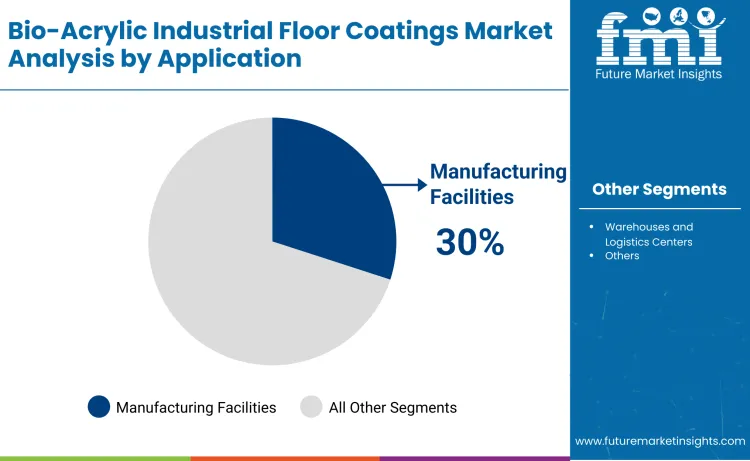
Manufacturing facilities are the largest application segment, accounting for 30% of the market share. Industrial floors in manufacturing environments require coatings that can withstand heavy equipment traffic, chemical exposure, mechanical abrasion, and frequent cleaning. Bio‑acrylic floor coatings meet these needs while offering easier application and lower environmental impact compared to traditional industrial floor coatings.
Their use in automotive plants, electronics manufacturing, food processing facilities, and general heavy industry supports this segment’s leadership. Other applications such as warehouses, logistics centers, commercial facilities, and institutional buildings also adopt bio‑acrylic floor coatings, but manufacturing facilities remain the primary driver due to the high performance demands and large surface areas typical of these environments.
What are the Key Trends of the Global Bio‑Acrylic Industrial Floor Coatings Market?
The global bio‑acrylic industrial floor coatings market is expanding as manufacturers and facility operators prioritize sustainable, low‑emission, and durable coating solutions for warehouses, factories, automotive plants, logistics hubs, and commercial spaces. Bio‑acrylic coatings are derived partially or fully from renewable resources and offer strong adhesion, abrasion resistance, and chemical protection. Growth is supported by tightening environmental regulations on volatile organic compounds, rising sustainability commitments by corporations, and demand for long‑lasting, maintenance‑efficient flooring systems. Overall, adoption reflects the balance of performance, cost, and greener credentials in industrial environments.
What are the Key Drivers for the Global Bio‑Acrylic Industrial Floor Coatings Market?
Key drivers include regulatory pressure on traditional solvent‑borne coatings, prompting a shift toward bio‑based and low‑VOC alternatives that reduce environmental impact and improve workplace air quality. Increasing demand from industrial end users - manufacturers, logistics centers, automotive facilities, and food processing plants - for floor coatings that resist heavy loads, abrasion, and chemical exposure supports uptake. Corporate sustainability goals and green building certifications encourage the use of renewable resource‑based materials, including bio‑acrylics. Rising awareness of lifecycle cost benefits, such as lower maintenance, extended service life, and reduced recoat frequency, also strengthens demand.
What are the Restraints for the Global Bio‑Acrylic Industrial Floor Coatings Market?
One restraint is the higher cost of bio‑based raw materials relative to conventional acrylics or epoxy coatings, which can deter adoption in price‑sensitive segments. Performance perceptions persist in some markets where legacy coatings are well proven, leading buyers to wait for field validation of bio‑acrylic alternatives. Technology barriers remain for bio‑derived formulations to consistently match all performance benchmarks, especially under extreme industrial conditions. Supply chain variability for renewable feedstocks can create cost volatility and availability challenges. In regions with weaker enforcement of environmental regulations, demand may lag behind more stringent markets.
What is the Global Demand Outlook for Bio-Acrylic Industrial Floor Coatings?
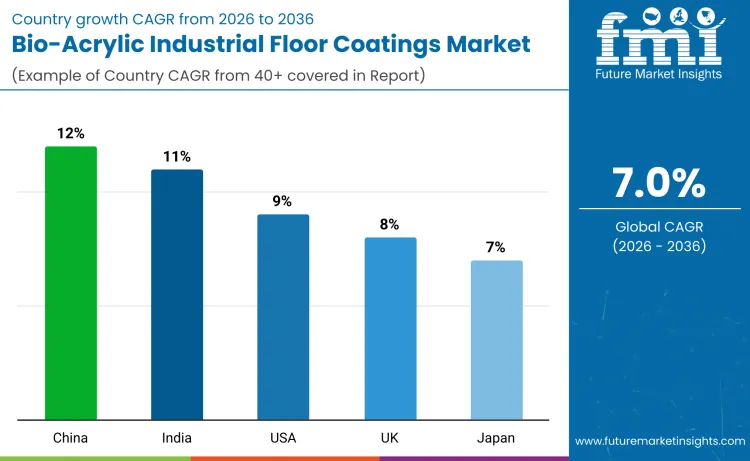
| Country | CAGR (2026-2036) |
|---|---|
| China | 12% |
| India | 11% |
| USA | 9% |
| UK | 8% |
| Japan | 7% |
The demand for bio-acrylic industrial floor coatings is projected to grow steadily across various countries, with China leading the market at a projected CAGR of 12%. India follows with a growth rate of 11%, while the USA is expected to grow at 9%. The UK is projected to grow at 8%, and Japan at 7%. The increasing demand for sustainable and eco-friendly materials in industrial applications, combined with the growing preference for high-performance coatings in sectors like manufacturing, logistics, and construction, is driving the adoption of bio-acrylic industrial floor coatings globally. As industries continue to prioritize environmental responsibility, the bio-acrylic market is set for continued growth.
What is Driving the Growth of Bio-Acrylic Industrial Floor Coatings in China?
China is projected to experience the highest growth in the bio-acrylic industrial floor coatings market, with a projected CAGR of 12%. As one of the world’s largest manufacturing hubs, China’s industrial floor coatings demand is substantial. The growing construction and logistics sectors, combined with increased focus on sustainability, are key drivers of this growth. Bio-acrylic coatings, which offer both durability and eco-friendly benefits, are gaining popularity in Chinese industrial facilities. Additionally, the country’s regulatory environment, which is increasingly focused on reducing hazardous substances and promoting green construction, is pushing manufacturers to adopt more sustainable solutions, further fueling the demand for bio-acrylic industrial floor coatings.
Why is the Bio-Acrylic Industrial Floor Coatings Market Expanding in India?
In India, the demand for bio-acrylic industrial floor coatings is projected to grow at a CAGR of 11%. India’s rapidly expanding industrial sectors, including manufacturing, warehousing, and retail, are driving the demand for high-quality, sustainable coatings. The shift towards eco-friendly and sustainable construction practices in India is contributing to the growing adoption of bio-acrylic coatings, which offer reduced environmental impact without compromising performance. Moreover, increasing government regulations aimed at improving environmental standards in construction and industrial applications are pushing manufacturers and builders to choose non-toxic, sustainable materials. As India’s industrial base continues to expand, the demand for bio-acrylic industrial floor coatings is expected to rise steadily.
How is the Bio-Acrylic Industrial Floor Coatings Market Growing in the USA?
In the USA, the bio-acrylic industrial floor coatings market is projected to grow at a CAGR of 9%. The USA is a significant consumer of industrial coatings, driven by its large-scale manufacturing, construction, and logistics industries. With growing regulatory demands for sustainable and low-emission building materials, bio-acrylic coatings are becoming an increasingly attractive option. The demand for durable, high-performance coatings for high-traffic industrial areas, coupled with the rising adoption of green building standards, is driving this market’s growth. As US industries increasingly prioritize environmental sustainability and safety, the bio-acrylic floor coatings market is expected to continue its upward trajectory, driven by both regulatory compliance and consumer demand for eco-friendly products.
What is Contributing to the Growth of Bio-Acrylic Industrial Floor Coatings in the UK?
In the UK, the demand for bio-acrylic industrial floor coatings is projected to grow at a CAGR of 8%. The UK’s increasing focus on sustainability and reducing the carbon footprint of industrial facilities is driving the adoption of bio-acrylic coatings. As part of its broader environmental initiatives, the UK government has been introducing regulations that encourage the use of eco-friendly materials, which is fostering the demand for bio-based coatings. Furthermore, the UK’s expanding construction and warehousing sectors are increasingly looking for durable and environmentally responsible flooring solutions, with bio-acrylic coatings offering an attractive alternative to traditional, chemical-heavy coatings. As the demand for sustainable construction materials continues to rise, the bio-acrylic industrial floor coatings market is set for steady growth.
What is Influencing the Growth of Bio-Acrylic Industrial Floor Coatings in Japan?
In Japan, the demand for bio-acrylic industrial floor coatings is projected to grow at a CAGR of 7%. Japan’s well-established manufacturing sector, combined with its strong commitment to sustainability, makes it an ideal market for eco-friendly coatings. As the country’s industrial and construction sectors continue to grow, there is an increasing shift toward using more sustainable materials in building and facility maintenance. Japan’s regulatory landscape, which increasingly focuses on reducing the use of harmful chemicals, is pushing the adoption of bio-acrylic coatings. Additionally, Japan’s focus on improving industrial productivity while adhering to environmental standards is contributing to the steady growth of the bio-acrylic industrial floor coatings market.
What is the Competitive Landscape for the Global Bio‑Acrylic Industrial Floor Coatings Market?
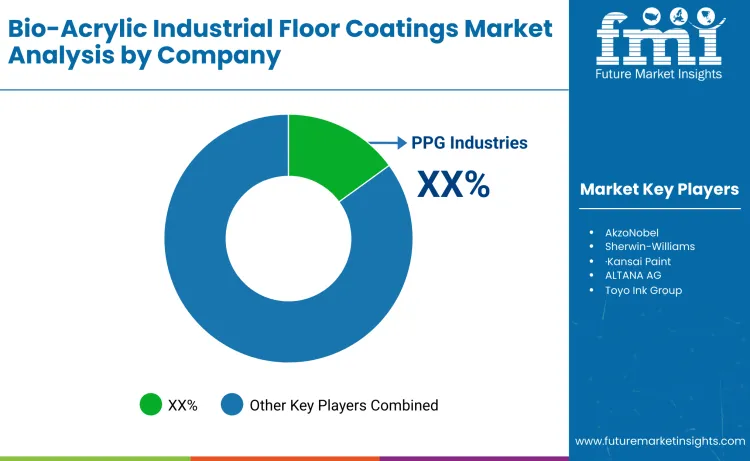
Global demand for bio‑acrylic industrial floor coatings is increasing as industries seek high‑performance coatings that combine durability with improved environmental profiles. Bio‑acrylic formulations use renewable‑content resins or reduced reliance on fossil feedstocks while still delivering abrasion resistance, chemical resistance, load‑bearing strength and ease of maintenance that industrial facilities require. Growth in manufacturing, warehousing, logistics, automotive plants, food processing facilities and clean‑room environments fuels uptake of industrial floor systems.
At the same time, tighter environmental regulations, corporate sustainability commitments and customer preference for low‑volatile organic compound products support the shift toward bio‑based and greener coating technologies. As building owners and industrial users prioritise long service life, worker safety, surface hygiene and reduced environmental impact, bio‑acrylic floor coatings are becoming part of broader facility modernisation and green building strategies across regions including North America, Europe and Asia Pacific.
On the supply side, several major coatings and construction‑materials companies compete to provide bio‑acrylic and related sustainable floor coatings. PPG Industries is widely recognised as a leading player with bio‑acrylic solutions backed by technical expertise and broad industrial reach. Other important competitors include Sherwin‑Williams, AkzoNobel, RPM International, BASF, Sika, RPM Performance Coatings Group, Hempel, Jotun, and Masco Corporation.
These firms offer portfolio variants suited for heavy traffic, chemical exposure, hygiene‑sensitive areas and decorative industrial spaces. Competition among suppliers focuses on coating formulation performance, life‑cycle cost, regulatory compliance, ease of application, technical support and capacity to tailor solutions to specific industrial environments. Suppliers that deliver robust bio‑acrylic coatings with proven performance, strong sustainability credentials and reliable global distribution are best positioned to capture growth as industrial sectors increasingly adopt environmentally considerate floor coating technologies.
Key Players
- PPG Industries
- Sherwin‑Williams
- AkzoNobel
- RPM International
- BASF
- Sika
- RPM Performance Coatings Group
- Hempel
- Jotun
- Masco Corporation
Scope of the Report
| Items | Values |
|---|---|
| Quantitative Units (2026) | USD Million |
| Coating Type | Bio-acrylic waterborne coatings, Bio-acrylic solventborne coatings, Bio-acrylic UV-curable coatings, Bio-acrylic hybrid coatings |
| Application | Manufacturing facilities, Warehouses and logistics centers, Food and beverage processing plants, Pharmaceutical and healthcare facilities, Commercial buildings |
| End-Use Industry | Industrial, Commercial, Institutional, Residential |
| Companies | PPG Industries, Sherwin-Williams, AkzoNobel, RPM International, BASF, Sika, RPM Performance Coatings Group, Hempel, Jotun, Masco Corporation |
| Regions Covered | North America, Latin America, Western Europe, Eastern Europe, South Asia and Pacific, East Asia, Middle East & Africa |
| Countries Covered | United States, Canada, Mexico, Brazil, Argentina, Germany, France, United Kingdom, Italy, Spain, Netherlands, China, India, Japan, South Korea, ANZ, GCC Countries, South Africa |
| Additional Attributes | Dollar by sales by coating type, application, end-use industry, and region. Includes market trends towards bio-based alternatives, performance in various industrial and commercial flooring applications, cost-effectiveness, sustainability practices, impact on product durability and safety, regulatory compliance, market share and competitive positioning of key companies, and the role of bio-acrylic coatings in enhancing floor resilience, safety, and performance across different sectors. |
Key Segments in the Bio-Acrylic Industrial Floor Coatings Market
By Coating Type:
- Bio‑acrylic waterborne coatings
- Bio‑acrylic solventborne coatings
- Bio‑acrylic UV‑curable coatings
- Bio‑acrylic hybrid coatings
By Application:
- Manufacturing facilities
- Warehouses and logistics centers
- Food and beverage processing plants
- Pharmaceutical and healthcare facilities
- Commercial buildings
By End Use Industry:
- Industrial
- Commercial
- Institutional
- Residential
By Region:
- Asia Pacific
- China
- India
- Japan
- South Korea
- ASEAN
- Rest of Asia Pacific
- Europe
- Germany
- United Kingdom
- France
- Italy
- Spain
- Nordic
- BENELUX
- Rest of Europe
- North America
- United States
- Canada
- Mexico
- Latin America
- Brazil
- Chile
- Rest of Latin America
- Middle East & Africa
- Kingdom of Saudi Arabia
- Other GCC Countries
- Turkey
- South Africa
- Other African Union
- Rest of Middle East & Africa
Frequently Asked Questions
How big is the Bio-Acrylic Industrial Floor Coatings market?
The market is valued at USD 450 million in 2026 and is expected to grow at a CAGR of 7%, reaching USD 967 million by 2036.
What is the growth outlook for the Bio-Acrylic Industrial Floor Coatings market?
The market is projected to grow at a CAGR of 7% from 2026 to 2036.
Which region is expected to experience the fastest growth in the Bio-Acrylic Industrial Floor Coatings market?
China is expected to lead with a growth rate of 12%, driven by the increasing demand for sustainable and eco-friendly industrial floor coatings.
What are the key applications of Bio-Acrylic Industrial Floor Coatings?
Bio-Acrylic Industrial Floor Coatings are widely used in industrial facilities, warehouses, and manufacturing plants to provide durable, sustainable flooring solutions.
Who is the major player in the Bio-Acrylic Industrial Floor Coatings market?
The leading player in the market is PPG Industries.
Preview the report firsthand - request a free sample
Get SampleGet the brochure for pricing and purchase details.
Get PDFTable of Content
- Executive Summary
- Market Overview
- Global Market Value, 2020-2025
- Global Market Forecast, 2026-2036
- Market Dynamics
- Drivers
- Restraints
- Opportunities
- Regulatory and Environmental Landscape
- Technology and Material Outlook
- Market Segmentation Analysis
- By Coating Type
- Bio-acrylic waterborne coatings
- Bio-acrylic solventborne coatings
- Bio-acrylic UV-curable coatings
- Bio-acrylic hybrid coatings
- By Application
- Manufacturing facilities
- Warehouses and logistics centers
- Food and beverage processing plants
- Pharmaceutical and healthcare facilities
- Commercial buildings
- By End-Use Industry
- Industrial
- Commercial
- Institutional
- Residential
- By Coating Type
- Regional Outlook
- North America
- Latin America
- Western Europe
- Eastern Europe
- South Asia & Pacific
- East Asia
- Middle East & Africa
- Country-Level Outlook
- United States
- Canada
- Mexico
- Brazil
- Argentina
- Germany
- France
- United Kingdom
- Italy
- Spain
- Netherlands
- China
- India
- Japan
- South Korea
- ANZ
- GCC Countries
- South Africa
- Competitive Landscape
- Market Structure Overview
- Company Positioning
- Strategic Initiatives
- Key Player Profiles
- Scope of the Report
- Research Methodology
- Assumptions & Acronyms


