

- Industry Size (2026)
- USD 725.3 Mn
- Forecast (2036)
- USD 1466.3 Mn
- CAGR (2026 to 2036)
- 7.3%
Factory Floor Edge AI Industrial PCs Market Forecast and Outlook 2026 to 2036
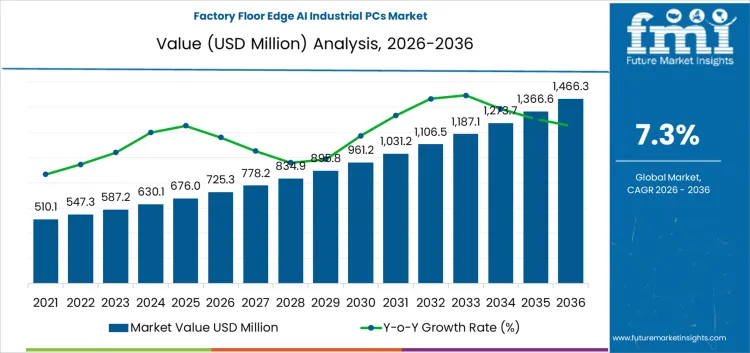
The factory floor edge AI industrial PCs market is valued at USD 725.3 million in 2026 and is projected to reach USD 1,466.3 million by 2036, reflecting a CAGR of 7.3%. Market performance is shaped by concentration in high-volume manufacturing operations requiring low-latency AI processing and robust computing at the edge. Regional concentration affects production costs, hardware sourcing, and system integration. Adoption varies according to factory digitalization levels, automation investment, and regulatory compliance. Smaller operators encounter constraints in scaling manufacturing, maintaining system reliability, and achieving multi-region certifications.
Margin concentration favors suppliers providing certified, high-performance edge AI PCs with integration support, predictive maintenance capabilities, and platform interoperability. Fragmentation persists among regional or niche providers, while leading firms capture concentrated value through hardware reliability, software validation, and alignment with major industrial automation programs. Market outcomes are influenced by factory retrofit schedules, automation adoption cycles, and industrial compliance requirements rather than volume alone.
Quick Stats of the Factory Floor Edge AI Industrial PCs Market
- Factory Floor Edge AI Industrial PCs Market Value (2026): USD 725.3 million
- Factory Floor Edge AI Industrial PCs Forecast Value (2036): USD 1,466.3 million
- Factory Floor Edge AI Industrial PCs Forecast CAGR 2026 to 2036: 7.3%
- Leading Use Case in Factory Floor Edge AI Industrial PCs Market: Machine vision (29% share)
- Leading Industry in Factory Floor Edge AI Industrial PCs Market: Automotive (33% share)
- Key Growth Regions in Factory Floor Edge AI Industrial PCs Market: China, Germany, USA, South Korea
- Top Players in Factory Floor Edge AI Industrial PCs Market: Advantech, Siemens, Beckhoff, Rockwell Automation, Kontron, Mitsubishi Electric
What is the Growth Forecast for Factory Floor Edge AI Industrial PCs Market through 2036?
Between 2026 and 2031, the factory floor edge AI industrial PCs market is projected to grow from USD 725.3 million to USD 961.4 million, generating an absolute increase of USD 236.1 million and reflecting a CAGR of 7.3%. Growth is driven by adoption of machine vision, predictive maintenance, robotics control, quality inspection, and safety monitoring across automotive, electronics, general manufacturing, metals, and other industries. Box, panel, and embedded IPC form factors support deployment. Expansion is supported by demand for low-latency AI processing, real-time analytics, and factory automation. Suppliers focus on ruggedized design, AI compatibility, and seamless integration into industrial environments.
From 2031 to 2036, the market is expected to expand from USD 961.4 million to USD 1,466.3 million, adding USD 504.9 million. Growth is supported by wider adoption of AI-driven industrial PCs, enhanced processing power, and integration with robotics, IoT, and predictive analytics. Market drivers include increased automation, digitalization, and real-time monitoring requirements. Competitive advantage favors suppliers offering high-performance, ruggedized IPCs with AI capabilities and scalable deployment. Leading companies include Advantech, Siemens, Beckhoff, Rockwell Automation, Kontron, and Mitsubishi Electric.
Factory Floor Edge AI Industrial PCs Market Key Takeaways
| Metric | Value |
|---|---|
| Market Value (2026) | USD 725.3 million |
| Forecast Value (2036) | USD 1,466.3 million |
| Forecast CAGR 2026 to 2036 | 7.30% |
How Are Edge AI Industrial PCs Transforming Factory Floor Operations?
Factory floor edge AI industrial PCs are increasingly adopted to enable real-time data processing, predictive maintenance, and automation in manufacturing environments. Historically, manufacturing relied on centralized servers or human monitoring, which introduced latency and limited responsiveness to operational changes. Modern edge AI PCs integrate robust processing power, AI acceleration, and industrial-grade hardware to analyze sensor data on-site, optimize workflows, and support autonomous decision-making. OEMs, industrial automation providers, and smart factory operators prioritize durability, low latency, and compatibility with industrial protocols. Early adoption focused on automotive and high-tech manufacturing, while current demand spans food processing, electronics, and heavy industry, driven by the push for digital transformation, efficiency, and operational resilience. System reliability, compute performance, and integration capabilities influence deployment decisions.
Rising demand for Industry 4.0 implementation, predictive maintenance, and operational efficiency is shaping market growth. Compared with traditional industrial PCs, edge AI platforms emphasize on-site processing, AI inference capabilities, and industrial-grade reliability in harsh environments. Cost structures depend on hardware specifications, AI accelerators, and software integration, concentrating margins among suppliers capable of delivering certified, high-performance solutions. Manufacturers adopt edge AI PCs to improve process control, reduce downtime, and enable autonomous operations. By 2036, factory floor edge AI industrial PCs are expected to become standard in smart factories worldwide, supporting real-time analytics, operational efficiency, and industrial automation.
What Factors Are Shaping the Demand for Factory Floor Edge AI Industrial PCs in Terms of Use Case and Industry?
The demand for factory floor edge AI industrial PCs is segmented by use case and industry. Use cases include machine vision, predictive maintenance, robotics control, quality inspection, and safety monitoring. Industries include automotive, electronics, general manufacturing, metals, and other industrial sectors. Adoption is influenced by operational efficiency, real-time data processing, and production accuracy. Uptake is driven by labor optimization, defect reduction, and process automation. Use case and industry selection depend on production complexity, throughput requirements, and integration needs, ensuring reliable, scalable, and cost-effective deployment of edge AI computing solutions across modern industrial facilities.
Why Is Machine Vision Leading the Use Case Segment in Factory Floor Edge AI Industrial PCs?
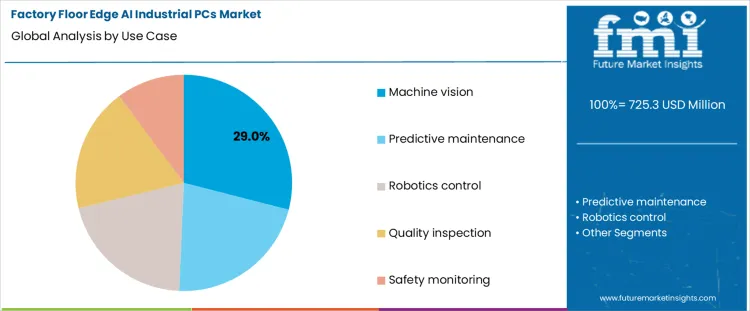
Machine vision accounts for approximately 29% of total use case demand, making it the leading category. Edge AI industrial PCs process high-resolution image data on-site, enabling real-time object recognition, defect detection, and assembly verification. Adoption is driven by the need for precise quality control, reduced inspection errors, and faster throughput. Systems integrate cameras, lighting, and AI algorithms to deliver immediate feedback. Operational procedures include calibration, real-time monitoring, and anomaly detection. Machine vision provides measurable improvements in production efficiency, reduces scrap rates, and enhances product quality, supporting adoption across automotive, electronics, and general manufacturing environments.
Operational factors further support adoption. Edge AI PCs must operate reliably under vibration, temperature fluctuations, and continuous production cycles. Integration with factory automation systems ensures synchronization with conveyor lines, robots, and data management platforms. Machine vision leads because it delivers high accuracy, operational reliability, and consistent performance across industrial processes, enabling real-time decision-making, defect prevention, and scalable quality control for complex manufacturing workflows.
Why Is Automotive Representing the Largest Industry Segment in Factory Floor Edge AI Industrial PCs?
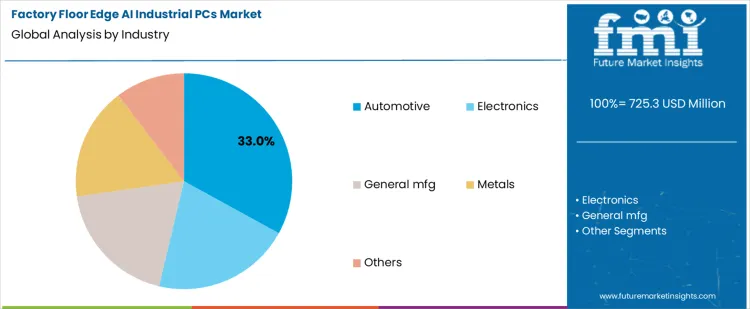
Automotive accounts for approximately 33% of total industry demand, making it the largest category. Adoption is driven by high production volumes, complex assembly processes, and stringent quality standards. Edge AI industrial PCs are deployed to monitor assembly lines, detect defects, and support predictive maintenance of machinery. Operational procedures include sensor integration, real-time data analytics, and automated control of robotic systems. AI copilots process large volumes of machine and sensor data, enabling immediate corrective actions.
Functional and operational factors further reinforce adoption. PCs must handle continuous workloads, high-speed data acquisition, and harsh factory environments. Automotive leads because it benefits from improved production efficiency, defect reduction, and operational predictability. The deployment of edge AI PCs ensures enhanced quality control, reduced downtime, and measurable cost savings, supporting the modernization and digital transformation of automotive manufacturing operations.
How Are Edge AI Industrial PCs Enhancing Smart Factory Operations?
Factory floor edge AI industrial PCs are increasingly deployed to enable real-time data processing, predictive maintenance, and machine learning-driven decision-making on-site. Adoption is strongest in regions with advanced manufacturing, Industry 4.0 initiatives, and high automation density. PCs are selected for ruggedness, low-latency computation, and compatibility with industrial protocols. Growth is driven by the need for on-premise AI analytics, reduced downtime, and process optimization. Investment focuses on embedded AI accelerators, real-time operating systems, and secure connectivity. Manufacturers prioritize systems that deliver immediate insights, withstand harsh factory conditions, and integrate seamlessly with legacy and modern industrial equipment.
Why Are Regional Smart Manufacturing Programs and Data-Driven Operations Driving Adoption?
Demand is shaped by local industrial digitization programs, predictive maintenance mandates, and quality control requirements. Manufacturers adopt edge AI PCs to process sensor data locally, reduce network latency, and improve operational decisions. Systems offering high processing power, industrial durability, and multi-protocol connectivity gain preference. Adoption is concentrated in regions with high automation penetration and Industry 4.0 readiness. Operational efficiency, reduced downtime, and on-site data analysis drive procurement rather than cost. Suppliers providing validated, resilient, and secure industrial PCs gain competitive advantage among OEMs and smart factory operators.
What Constraints Limit Broader Deployment of Edge AI Industrial PCs?
High hardware and integration costs, limited standardization, and technical complexity restrict adoption. Performance can be affected by extreme temperatures, vibration, and electromagnetic interference. Integration with legacy machines, industrial networks, and cloud systems requires expertise. Smaller factories or regions with limited automation infrastructure adopt solutions more slowly. These factors concentrate early deployment among high-volume manufacturing sites, automated production lines, and regions with advanced industrial digital infrastructure.
How Are Technological Innovation and Collaborative Ecosystems Shaping Market Growth?
Recent developments include AI accelerators for on-device inference, ruggedized chassis, and modular I/O for flexible integration. Collaboration between industrial PC manufacturers, AI software developers, and automation integrators ensures system validation, secure connectivity, and workflow alignment. Pilot deployments assess real-time analytics, predictive maintenance accuracy, and environmental resilience before full-scale implementation. Quality monitoring, firmware standardization, and cybersecurity protocols maintain reliability. Focus is on operational insight, edge computation, and system resilience rather than cost or scale. Collaborative initiatives enable broader adoption of edge AI industrial PCs in factory floors worldwide, supporting predictive, autonomous, and efficient manufacturing operations.
What is the Demand for Factory Floor Edge AI Industrial PCs by Country?
| Country | CAGR (%) |
|---|---|
| China | 7.5% |
| Germany | 7.0% |
| USA | 7.0% |
| South Korea | 6.8% |
Demand for factory floor edge AI industrial PCs is rising as manufacturers adopt intelligent computing solutions to enhance automation, process monitoring, and predictive maintenance on the shop floor. China leads with a 7.5% CAGR, driven by rapid industrial automation adoption, government initiatives for smart manufacturing, and integration of AI-driven analytics. Germany follows at 7.0%, supported by advanced manufacturing infrastructure and Industry 4.0 initiatives. The USA also grows at 7.0%, shaped by adoption in automotive, electronics, and industrial sectors. South Korea records 6.8% growth, reflecting steady integration of edge AI systems in manufacturing facilities for improved operational efficiency and real-time decision-making.
How Is China Experiencing Growth in the Factory Floor Edge AI Industrial PCs Market?
China is experiencing growth at a CAGR of 7.5%, supported by adoption of Factory Floor Edge AI Industrial PCs Market solutions to enhance real-time monitoring, predictive maintenance, and automation on manufacturing floors. Industrial equipment manufacturers and technology providers are deploying systems optimized for ruggedness, AI processing, and seamless integration with production lines. Demand is concentrated in industrial hubs, smart factories, and manufacturing R&D centers. Investments focus on system reliability, computational performance, and compliance with industrial safety standards rather than large-scale facility expansion. Growth reflects government support for smart manufacturing, industrial automation adoption, and rising demand for AI-driven production efficiency solutions.
- Smart manufacturing drives adoption.
- Systems optimize monitoring, predictive maintenance, and automation.
- Industrial hubs and smart factories concentrate demand.
- System reliability and industrial compliance guide investment.
How Is Germany Witnessing Growth in the Factory Floor Edge AI Industrial PCs Market?
Germany is witnessing growth at a CAGR of 7%, fueled by adoption of Factory Floor Edge AI Industrial PCs Market solutions to improve operational efficiency, predictive maintenance, and real-time production analytics. Industrial technology providers are deploying systems optimized for rugged performance, AI processing, and integration with existing manufacturing equipment. Demand is concentrated in industrial clusters, automotive production hubs, and advanced manufacturing R&D centers. Investments prioritize system reliability, computational efficiency, and regulatory compliance rather than fleet-scale deployment. Growth reflects Germany’s industrial focus on smart factory technologies, automation adoption, and efficiency-driven manufacturing operations.
- Smart factory solutions drive adoption.
- Systems enhance real-time analytics and predictive maintenance.
- Industrial clusters and automotive hubs concentrate demand.
- System reliability and compliance guide investment.
How Is the United States Experiencing Growth in the Factory Floor Edge AI Industrial PCs Market?
United States is experiencing growth at a CAGR of 7%, supported by adoption of Factory Floor Edge AI Industrial PCs Market solutions to enhance manufacturing process automation, real-time monitoring, and predictive analytics. Industrial technology providers and manufacturing operators are deploying systems optimized for AI computation, durability, and seamless production integration. Demand is concentrated in industrial hubs, manufacturing R&D centers, and smart factory locations. Investments focus on system performance, operational reliability, and regulatory compliance rather than large-scale expansion. Growth reflects industrial adoption of AI-driven automation, efficiency-focused manufacturing, and integration of advanced edge computing systems.
- Industrial automation drives adoption.
- Systems optimize process monitoring and predictive analytics.
- Industrial hubs and R&D centers concentrate demand.
- System performance and regulatory compliance guide investment.
How Is South Korea Witnessing Growth in the Factory Floor Edge AI Industrial PCs Market?
South Korea is witnessing growth at a CAGR of 6.8%, fueled by adoption of Factory Floor Edge AI Industrial PCs Market solutions to improve real-time monitoring, predictive maintenance, and automation on production floors. Manufacturers and technology providers are deploying systems optimized for rugged design, AI processing, and integration with industrial control systems. Demand is concentrated in manufacturing hubs, smart factories, and industrial R&D facilities. Investments prioritize system reliability, computational efficiency, and regulatory compliance rather than fleet-scale deployment. Growth reflects industrial focus on smart factory adoption, AI-driven production solutions, and rising demand for efficiency and predictive analytics in manufacturing operations.
- Smart factory adoption drives growth.
- Systems enhance monitoring, automation, and predictive maintenance.
- Manufacturing hubs and R&D facilities concentrate demand.
- System reliability and computational efficiency guide investment.
Who Competes in the Factory Floor Edge AI Industrial PCs Market and What Defines Their Capabilities?
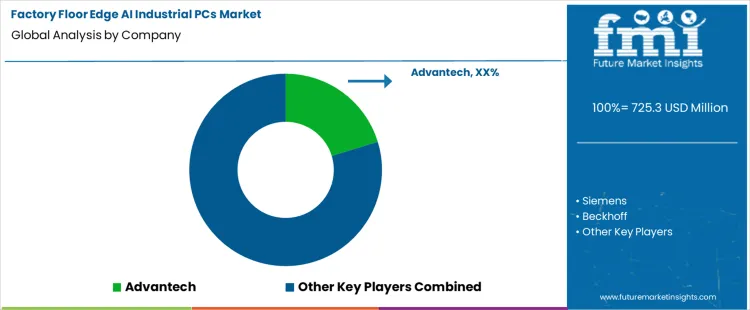
Competition in the factory floor edge AI industrial PCs market is defined by computing performance, environmental robustness, and integration with industrial automation systems. Advantech supplies edge AI industrial PCs engineered for high-performance inference, real-time data processing, and operation in harsh factory conditions. Siemens delivers industrial PCs with integrated AI capabilities for predictive maintenance, process optimization, and seamless connectivity to industrial control systems. Beckhoff provides modular industrial PCs designed for flexible deployment on the factory floor and AI-driven process monitoring. Rockwell Automation develops edge AI PCs compatible with control architectures and real-time analytics for manufacturing environments. Kontron supplies ruggedized industrial PCs optimized for AI workloads in automated production lines.
Mitsubishi Electric delivers edge AI industrial PCs integrated with factory automation and robotics systems for real-time data analysis. Other competitors include regional and specialized suppliers providing compact, high-performance AI-capable industrial PCs for process monitoring, predictive maintenance, and quality assurance applications. Differentiation arises from processing power, environmental resistance, I/O flexibility, connectivity standards, and AI model deployment capabilities. Market positioning depends on integration with existing automation networks, ability to withstand factory conditions, and provision of low-latency, high-accuracy data processing to support real-time operational decisions in smart manufacturing environments.
Key Players in the Factory Floor Edge AI Industrial PCs Market
- Advantech
- Siemens
- Beckhoff
- Rockwell Automation
- Kontron
- Mitsubishi Electric
Scope of the Report
| Items | Values |
|---|---|
| Quantitative Units (2026) | USD million |
| Use Case | Machine vision, Predictive maintenance, Robotics control, Quality inspection, Safety monitoring |
| Industry | Automotive, Electronics, General manufacturing, Metals, Others |
| Form Factor | Box IPC, Panel IPC, Embedded |
| Region | Asia Pacific, Europe, North America, Latin America, Middle East & Africa |
| Key Countries Covered | China, Germany, USA, South Korea, Japan, India |
| Key Companies Profiled | Advantech, Siemens, Beckhoff, Rockwell Automation, Kontron, Mitsubishi Electric |
| Additional Attributes | Dollar sales by use case, industry, and form factor; regional CAGR, volume and value growth projections; adoption across automotive, electronics, general manufacturing, and metals sectors; edge AI processing performance, real-time analytics, and predictive maintenance capabilities; ruggedized industrial design and environmental reliability; integration with industrial automation networks and robotics; AI model deployment and low-latency inference; operational resilience, compliance, and smart factory program alignment. |
Factory Floor Edge AI Industrial PCs Market Segmentation
Use Case:
- Machine vision
- Predictive maintenance
- Robotics control
- Quality inspection
- Safety monitoring
Industry:
- Automotive
- Electronics
- General mfg
- Metals
- Others
Form Factor:
- Box IPC
- Panel IPC
- Embedded
Region:
- Asia Pacific
- China
- Japan
- South Korea
- India
- Australia & New Zealand
- ASEAN
- Rest of Asia Pacific
- Europe
- Germany
- United Kingdom
- France
- Italy
- Spain
- Nordic
- BENELUX
- Rest of Europe
- North America
- United States
- Canada
- Mexico
- Latin America
- Brazil
- Chile
- Rest of Latin America
- Middle East & Africa
- Kingdom of Saudi Arabia
- Other GCC Countries
- Turkey
- South Africa
- Other African Union
- Rest of Middle East & Africa
Bibliography
- National Institute of Standards and Technology. (2023). Artificial Intelligence Risk Management Framework (AI RMF 1.0). U.S. Government Publishing Office (GovInfo).
- International Organization for Standardization. (2023). ISO/IEC 23894:2023 Artificial intelligence — Guidance on risk management. ISO.
- European Telecommunications Standards Institute. (2024). ETSI GS MEC 003 V3.2.1 Multi-access Edge Computing (MEC); Framework and Reference Architecture. ETSI Standards.
- International Telecommunication Union. (2023). Recommendation ITU-T Y.3540 Edge computing — Reference architecture. ITU-T Recommendations.
- National Academies of Sciences, Engineering, and Medicine. (2023). Options for a National Plan for Smart Manufacturing. The National Academies Press.
Frequently Asked Questions
How big is the factory floor edge ai industrial pcs market in 2026?
The global factory floor edge ai industrial pcs market is estimated to be valued at USD 725.3 million in 2026.
What will be the size of factory floor edge ai industrial pcs market in 2036?
The market size for the factory floor edge ai industrial pcs market is projected to reach USD 1,466.3 million by 2036.
How much will be the factory floor edge ai industrial pcs market growth between 2026 and 2036?
The factory floor edge ai industrial pcs market is expected to grow at a 7.3% CAGR between 2026 and 2036.
What are the key product types in the factory floor edge ai industrial pcs market?
The key product types in factory floor edge ai industrial pcs market are machine vision, predictive maintenance, robotics control, quality inspection and safety monitoring.
Which industry segment to contribute significant share in the factory floor edge ai industrial pcs market in 2026?
In terms of industry, automotive segment to command 33.0% share in the factory floor edge ai industrial pcs market in 2026.
Preview the report firsthand - request a free sample
Get SampleGet the brochure for pricing and purchase details.
Get PDFTable of Content
- Executive Summary
- Global Market Outlook
- Demand-side Trends
- Supply-side Trends
- Technology Roadmap Analysis
- Analysis and Recommendations
- Market Overview
- Market Coverage / Taxonomy
- Market Definition / Scope / Limitations
- Market Background
- Market Dynamics
- Drivers
- Restraints
- Opportunity
- Trends
- Scenario Forecast
- Demand in Optimistic Scenario
- Demand in Likely Scenario
- Demand in Conservative Scenario
- Opportunity Map Analysis
- Product Life Cycle Analysis
- Supply Chain Analysis
- Investment Feasibility Matrix
- Value Chain Analysis
- PESTLE and Porter’s Analysis
- Regulatory Landscape
- Regional Parent Market Outlook
- Production and Consumption Statistics
- Import and Export Statistics
- Market Dynamics
- Global Market Analysis 2021 to 2025 and Forecast, 2026 to 2036
- Historical Market Size Value (USD Million) Analysis, 2021 to 2025
- Current and Future Market Size Value (USD Million) Projections, 2026 to 2036
- Y-o-Y Growth Trend Analysis
- Absolute $ Opportunity Analysis
- Global Market Pricing Analysis 2021 to 2025 and Forecast 2026 to 2036
- Global Market Analysis 2021 to 2025 and Forecast 2026 to 2036, By Use Case
- Introduction / Key Findings
- Historical Market Size Value (USD Million) Analysis By Use Case , 2021 to 2025
- Current and Future Market Size Value (USD Million) Analysis and Forecast By Use Case , 2026 to 2036
- Machine vision
- Predictive maintenance
- Robotics control
- Quality inspection
- Safety monitoring
- Machine vision
- Y-o-Y Growth Trend Analysis By Use Case , 2021 to 2025
- Absolute $ Opportunity Analysis By Use Case , 2026 to 2036
- Global Market Analysis 2021 to 2025 and Forecast 2026 to 2036, By Industry
- Introduction / Key Findings
- Historical Market Size Value (USD Million) Analysis By Industry, 2021 to 2025
- Current and Future Market Size Value (USD Million) Analysis and Forecast By Industry, 2026 to 2036
- Automotive
- Electronics
- General mfg
- Metals
- Others
- Automotive
- Y-o-Y Growth Trend Analysis By Industry, 2021 to 2025
- Absolute $ Opportunity Analysis By Industry, 2026 to 2036
- Global Market Analysis 2021 to 2025 and Forecast 2026 to 2036, By Form Factor
- Introduction / Key Findings
- Historical Market Size Value (USD Million) Analysis By Form Factor, 2021 to 2025
- Current and Future Market Size Value (USD Million) Analysis and Forecast By Form Factor, 2026 to 2036
- Box IPC
- Panel IPC
- Embedded
- Box IPC
- Y-o-Y Growth Trend Analysis By Form Factor, 2021 to 2025
- Absolute $ Opportunity Analysis By Form Factor, 2026 to 2036
- Global Market Analysis 2021 to 2025 and Forecast 2026 to 2036, By Region
- Introduction
- Historical Market Size Value (USD Million) Analysis By Region, 2021 to 2025
- Current Market Size Value (USD Million) Analysis and Forecast By Region, 2026 to 2036
- North America
- Latin America
- Western Europe
- Eastern Europe
- East Asia
- South Asia and Pacific
- Middle East & Africa
- Market Attractiveness Analysis By Region
- North America Market Analysis 2021 to 2025 and Forecast 2026 to 2036, By Country
- Historical Market Size Value (USD Million) Trend Analysis By Market Taxonomy, 2021 to 2025
- Market Size Value (USD Million) Forecast By Market Taxonomy, 2026 to 2036
- By Country
- USA
- Canada
- Mexico
- By Use Case
- By Industry
- By Form Factor
- By Country
- Market Attractiveness Analysis
- By Country
- By Use Case
- By Industry
- By Form Factor
- Key Takeaways
- Latin America Market Analysis 2021 to 2025 and Forecast 2026 to 2036, By Country
- Historical Market Size Value (USD Million) Trend Analysis By Market Taxonomy, 2021 to 2025
- Market Size Value (USD Million) Forecast By Market Taxonomy, 2026 to 2036
- By Country
- Brazil
- Chile
- Rest of Latin America
- By Use Case
- By Industry
- By Form Factor
- By Country
- Market Attractiveness Analysis
- By Country
- By Use Case
- By Industry
- By Form Factor
- Key Takeaways
- Western Europe Market Analysis 2021 to 2025 and Forecast 2026 to 2036, By Country
- Historical Market Size Value (USD Million) Trend Analysis By Market Taxonomy, 2021 to 2025
- Market Size Value (USD Million) Forecast By Market Taxonomy, 2026 to 2036
- By Country
- Germany
- UK
- Italy
- Spain
- France
- Nordic
- BENELUX
- Rest of Western Europe
- By Use Case
- By Industry
- By Form Factor
- By Country
- Market Attractiveness Analysis
- By Country
- By Use Case
- By Industry
- By Form Factor
- Key Takeaways
- Eastern Europe Market Analysis 2021 to 2025 and Forecast 2026 to 2036, By Country
- Historical Market Size Value (USD Million) Trend Analysis By Market Taxonomy, 2021 to 2025
- Market Size Value (USD Million) Forecast By Market Taxonomy, 2026 to 2036
- By Country
- Russia
- Poland
- Hungary
- Balkan & Baltic
- Rest of Eastern Europe
- By Use Case
- By Industry
- By Form Factor
- By Country
- Market Attractiveness Analysis
- By Country
- By Use Case
- By Industry
- By Form Factor
- Key Takeaways
- East Asia Market Analysis 2021 to 2025 and Forecast 2026 to 2036, By Country
- Historical Market Size Value (USD Million) Trend Analysis By Market Taxonomy, 2021 to 2025
- Market Size Value (USD Million) Forecast By Market Taxonomy, 2026 to 2036
- By Country
- China
- Japan
- South Korea
- By Use Case
- By Industry
- By Form Factor
- By Country
- Market Attractiveness Analysis
- By Country
- By Use Case
- By Industry
- By Form Factor
- Key Takeaways
- South Asia and Pacific Market Analysis 2021 to 2025 and Forecast 2026 to 2036, By Country
- Historical Market Size Value (USD Million) Trend Analysis By Market Taxonomy, 2021 to 2025
- Market Size Value (USD Million) Forecast By Market Taxonomy, 2026 to 2036
- By Country
- India
- ASEAN
- Australia & New Zealand
- Rest of South Asia and Pacific
- By Use Case
- By Industry
- By Form Factor
- By Country
- Market Attractiveness Analysis
- By Country
- By Use Case
- By Industry
- By Form Factor
- Key Takeaways
- Middle East & Africa Market Analysis 2021 to 2025 and Forecast 2026 to 2036, By Country
- Historical Market Size Value (USD Million) Trend Analysis By Market Taxonomy, 2021 to 2025
- Market Size Value (USD Million) Forecast By Market Taxonomy, 2026 to 2036
- By Country
- Kingdom of Saudi Arabia
- Other GCC Countries
- Turkiye
- South Africa
- Other African Union
- Rest of Middle East & Africa
- By Use Case
- By Industry
- By Form Factor
- By Country
- Market Attractiveness Analysis
- By Country
- By Use Case
- By Industry
- By Form Factor
- Key Takeaways
- Key Countries Market Analysis
- USA
- Pricing Analysis
- Market Share Analysis, 2025
- By Use Case
- By Industry
- By Form Factor
- Canada
- Pricing Analysis
- Market Share Analysis, 2025
- By Use Case
- By Industry
- By Form Factor
- Mexico
- Pricing Analysis
- Market Share Analysis, 2025
- By Use Case
- By Industry
- By Form Factor
- Brazil
- Pricing Analysis
- Market Share Analysis, 2025
- By Use Case
- By Industry
- By Form Factor
- Chile
- Pricing Analysis
- Market Share Analysis, 2025
- By Use Case
- By Industry
- By Form Factor
- Germany
- Pricing Analysis
- Market Share Analysis, 2025
- By Use Case
- By Industry
- By Form Factor
- UK
- Pricing Analysis
- Market Share Analysis, 2025
- By Use Case
- By Industry
- By Form Factor
- Italy
- Pricing Analysis
- Market Share Analysis, 2025
- By Use Case
- By Industry
- By Form Factor
- Spain
- Pricing Analysis
- Market Share Analysis, 2025
- By Use Case
- By Industry
- By Form Factor
- France
- Pricing Analysis
- Market Share Analysis, 2025
- By Use Case
- By Industry
- By Form Factor
- India
- Pricing Analysis
- Market Share Analysis, 2025
- By Use Case
- By Industry
- By Form Factor
- ASEAN
- Pricing Analysis
- Market Share Analysis, 2025
- By Use Case
- By Industry
- By Form Factor
- Australia & New Zealand
- Pricing Analysis
- Market Share Analysis, 2025
- By Use Case
- By Industry
- By Form Factor
- China
- Pricing Analysis
- Market Share Analysis, 2025
- By Use Case
- By Industry
- By Form Factor
- Japan
- Pricing Analysis
- Market Share Analysis, 2025
- By Use Case
- By Industry
- By Form Factor
- South Korea
- Pricing Analysis
- Market Share Analysis, 2025
- By Use Case
- By Industry
- By Form Factor
- Russia
- Pricing Analysis
- Market Share Analysis, 2025
- By Use Case
- By Industry
- By Form Factor
- Poland
- Pricing Analysis
- Market Share Analysis, 2025
- By Use Case
- By Industry
- By Form Factor
- Hungary
- Pricing Analysis
- Market Share Analysis, 2025
- By Use Case
- By Industry
- By Form Factor
- Kingdom of Saudi Arabia
- Pricing Analysis
- Market Share Analysis, 2025
- By Use Case
- By Industry
- By Form Factor
- Turkiye
- Pricing Analysis
- Market Share Analysis, 2025
- By Use Case
- By Industry
- By Form Factor
- South Africa
- Pricing Analysis
- Market Share Analysis, 2025
- By Use Case
- By Industry
- By Form Factor
- USA
- Market Structure Analysis
- Competition Dashboard
- Competition Benchmarking
- Market Share Analysis of Top Players
- By Regional
- By Use Case
- By Industry
- By Form Factor
- Competition Analysis
- Competition Deep Dive
- Advantech
- Overview
- Product Portfolio
- Profitability by Market Segments (Product/Age /Sales Channel/Region)
- Sales Footprint
- Strategy Overview
- Marketing Strategy
- Product Strategy
- Channel Strategy
- Siemens
- Beckhoff
- Rockwell Automation
- Kontron
- Mitsubishi Electric
- Advantech
- Competition Deep Dive
- Assumptions & Acronyms Used
- Research Methodology


