

- Market Size (2026)
- USD 210.6 Mn
- Forecast (2036)
- USD 1029.8 Mn
- CAGR (2026 to 2036)
- 17.2%
Industrial OLED Lighting Market Size, Market Forecast and Outlook By FMI
Summary of the Industrial OLED Lighting Market
- Demand and Growth Drivers
- Machine builders are testing light surfaces near operator panels as compact solid-state lighting becomes easier to integrate.
- Low-glare task lighting is expected to account for 34.0% share in 2026.
- Advanced labs are projected to hold 34.0% share of end-use demand as visual comfort becomes a buying factor.
- Direct OEM modules are expected to hold 52.0% share as machine makers buy panel sets before final assembly.
- Product and Segment View
- Encapsulated industrial OLED modules are projected to account for 44.0% share in 2026 as buyers want moisture control and packaged reliability.
- Rigid OLED panels are forecast to account for 37.0% share in 2026 as flat machine doors and indicator faces use standard panel shapes.
- Flexible OLED panels are expected to hold 19.0% share in 2026 as curved surfaces need tighter qualification before broad use.
- The market connects with display materials and flexible barrier films as sealing quality decides usable life.
- Geography and Competitive Outlook
- The United Kingdom is expected to post 19.4% CAGR through 2036 as specialist labs and design-led industrial interiors widen the buyer pool.
- South Korea is projected at 18.8% CAGR through 2036 due to panel supply depth and advanced display manufacturing links.
- LG Display and Samsung Display shape the panel technology direction, while Signify and Zumtobel Group influence industrial lighting integration.
- BOE and Visionox raise China exposure as flexible OLED capability expands beyond consumer display formats.
- Analyst Opinion
- Nikhil Kaitwade, Principal Consultant at FMI says, “The opportunity for industrial OLED lighting is not scale, but influence. As industrial design priorities move toward compactness and interface quality, thin OLED light surfaces are becoming a deliberate choice in high‑value equipment zones. Success in this market will favor suppliers that lead on durability and visual performance, resetting buying criteria from unit cost to lifecycle confidence and system differentiation.”
- Industrial OLED Lighting Market Value Analysis
- The market is moving from pilot placements into small repeat orders for machine panels and lab lighting zones.
- Cost remains the main barrier as the United States Department of Energy lists current OLED panel pricing near USD 100 per thousand lumens.
- The cost target for wider commercial use is near USD 10 per thousand lumens, which makes yield and scale central to the forecast.
- Industrial buyers will pay a premium where glare reduction and thin form factor reduce fixture depth around operators.
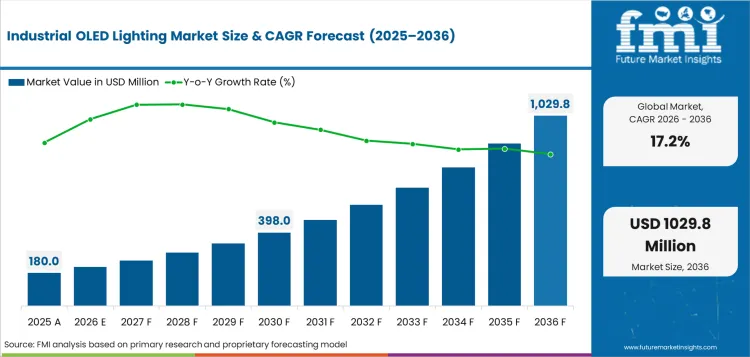
Key Takeaways, Market Size, and Forecast
- The industrial OLED lighting market was valued at USD 180.0 million in 2025.
- By 2036, the industrial OLED lighting market is expected to be worth USD 1,029.8 million.
- From 2026 to 2036, the market is projected to expand at 17.2% CAGR.
- The market is projected to create an incremental opportunity of USD 0.82 billion between 2026 and 2036.
- Encapsulated industrial OLED modules are projected to account for 44.0% share of panel type demand in 2026.
- Direct OEM modules are expected to account for 52.0% share of sales model demand in 2026.
- The United Kingdom at 19.4% CAGR and South Korea at 18.8% CAGR are the faster expanding country markets.
Fixture depth and visual comfort are the main design pressures behind industrial OLED lighting adoption. Current OLEDWorks Brite 3 documentation states that panels reach up to 300 lumens and 85 lm/W. The same source lists 1.4 mm to 2.1 mm thickness. Those dimensions support thinner luminaires for control rooms, equipment panels and premium industrial interiors. IEC published IEC 62868-2-4:2025 in February 2025 for rigid OLED tiles and panels. The standard covers supplies up to 120 V ripple-free DC. A defined safety route makes OLED panels easier to specify in indoor industrial lighting projects. OLEDWorks stated in June 2025 that its Aachen CE05 project aims to double capacity to about 40,000 m² of OLED panels annually. Supply expansion gives luminaire makers more confidence to design OLED panels into programs that need repeat availability rather than one-off decorative use.
Industrial OLED Lighting Market Definition
The industrial OLED lighting market covers organic light-emitting diode panels and modules used as illumination surfaces in industrial settings. Scope includes panel-based task lights, machine indicator surfaces, embedded HMI lighting and design-led interiors for labs or plants. The market excludes consumer OLED televisions, smartphones, general LED luminaires and display panels sold only for image viewing. Revenue covers panel modules, fixture-ready assemblies and direct OEM module sales for industrial use.
Industrial OLED Lighting Market Inclusions
Market scope covers industrial OLED displays only when the device is sold as a light surface or lighting module. Panel type includes rigid OLED panels, flexible OLED panels and encapsulated industrial OLED modules. Application includes machine indicators and HMIs, low-glare task lighting, design-driven industrial interiors and signage or other uses. End use includes electronics manufacturing, advanced labs, automotive plants and other industrial facilities. Sales model includes direct OEM modules, system integrators and specialty distributors.
Industrial OLED Lighting Market Exclusions
Scope does not include consumer television panels, smartphone panels, laptop screens, general LED high bays or non-emissive backlit signs. Automotive exterior LED lamps and conventional control-room monitors are excluded unless the product is specified as an OLED lighting surface. Contract value for building electrical work is excluded unless the OLED module is separately identified.
Industrial OLED Lighting Market Research Methodology
- Primary Research: FMI analysts reviewed supplier portfolios, machine-builder needs, integrator feedback and panel qualification requirements in major industrial countries.
- Desk Research: The study used public data from energy agencies, national statistics bodies, trade bodies and company technical releases.
- Market sizing and forecasting: Market size was estimated using a combination of bottom‑up and top‑down approaches. Historical demand patterns, supplier revenues, and adoption rates across key end‑use segments were analyzed to establish the base year.
- Data validation: Forecast checks compared OLED panel costs, industrial lighting shipments, electronics manufacturing activity and published panel performance signals.
Why is the Industrial OLED Lighting Market Growing?
- Machine builders are adding thin light surfaces near operator touchpoints to reduce fixture depth inside equipment housings.
- Advanced labs are using low-glare area lighting to support visual comfort during inspection and measurement work.
- Direct OEM module buying is expanding as panel suppliers package OLED surfaces with drivers and protective encapsulation.
Industrial OLED lighting is gaining attention where operators work close to the light source. The United States Department of Energy states that OLED sources can offer thin fixture profiles, low glare and uniform diffuse lighting. That feature set suits human-centric lighting in control rooms and lab benches. It also makes panel shape and surface brightness more important than raw lumen output for many industrial users.
Cost limits broad factory adoption during the forecast period. The United States Department of Energy lists current OLED panel pricing near USD 100 per thousand lumens and notes a commercial target near USD 10 per thousand lumens. This gap keeps OLED lighting focused on value-added zones, not high-bay replacement. Suppliers with better encapsulation and higher yield can convert pilot interest into repeat module orders.
Market Segmentation Analysis
- Encapsulated industrial OLED modules are projected to reach 44.0% share in 2026 as sealing quality lowers failure risk.
- Low-glare task lighting is expected to represent 34.0% share in 2026 as close-range work areas need diffuse light.
- Advanced labs are forecast to account for 34.0% share in 2026 due to visual inspection and measurement needs.
- Direct OEM modules are projected to capture 52.0% share in 2026 as machine builders specify panels before final equipment assembly.
- Embedded panels are estimated to account for 39.0% share of installation format demand in 2026 as light surfaces move into machine fronts.
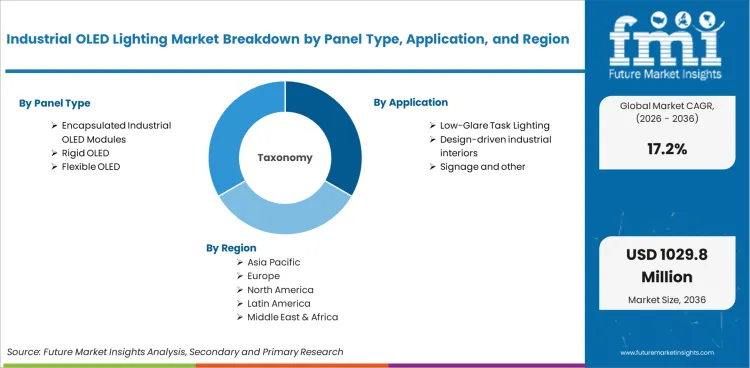
The market for industrial OLED lighting is divided into five primary segment groups based on panel type, application, end use, sales model and installation format. Panel type includes rigid OLED panels, flexible OLED panels and encapsulated industrial OLED modules. Application covers machine indicators and HMIs, low-glare task lighting, design-driven industrial interiors and signage or other uses. End use covers electronics manufacturing, advanced labs, automotive plants and other industrial sites. Sales model and installation format explain how buyers receive modules and where panels are placed.
Insights into the Encapsulated Industrial OLED Modules Panel Type Segment
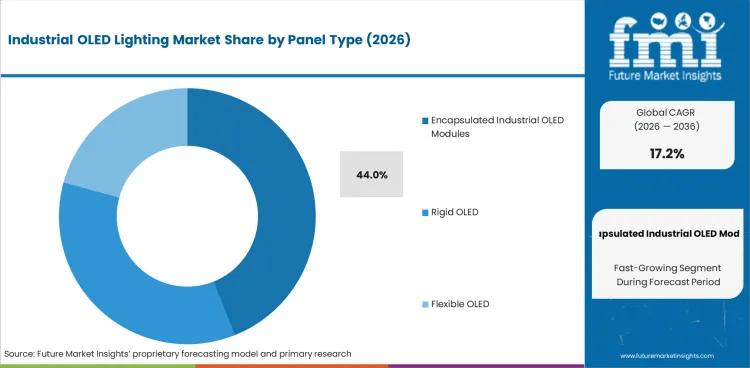
- Encapsulated industrial OLED modules are projected to account for 44.0% share of panel type demand in 2026. Packaged sealing makes these modules better suited for dust handling and repeat cleaning inside industrial spaces.
- Rigid and flexible panels address clear form needs, but encapsulated modules reduce buyer concern about moisture ingress and field damage. This shifts value toward suppliers with reliable barrier stacks.
Insights into the Low-Glare Task Lighting Application Segment
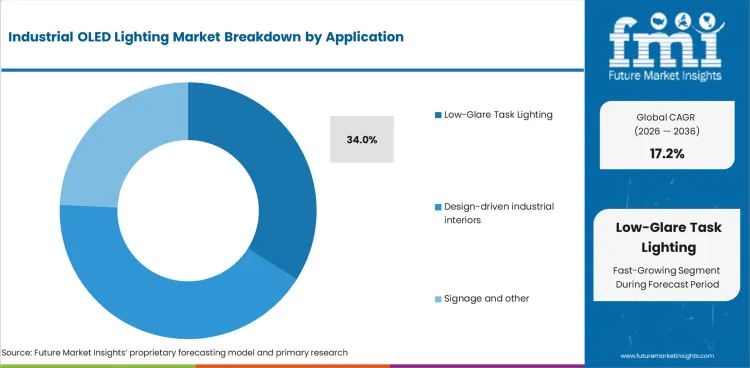
- Low-glare task lighting is expected to represent 34.0% share of application demand in 2026. Close-range bench work benefits from uniform area light that avoids bright point-source glare.
- Machine indicators and HMIs use intelligent lighting control in more selective ways. Buyers in inspection cells care most about surface luminance and flicker control.
Insights into the Advanced Labs End Use Segment
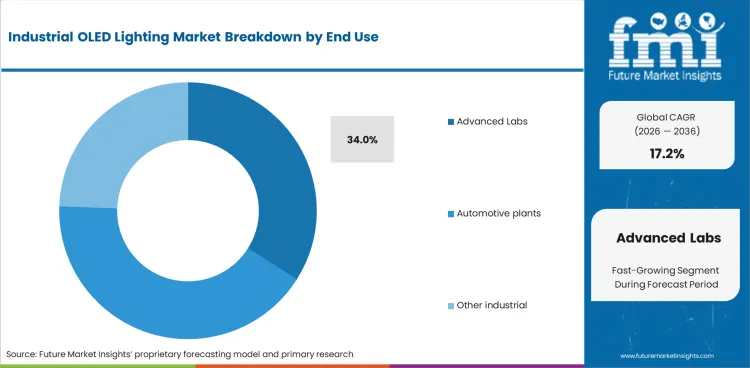
- Advanced labs are forecast to account for 34.0% share of end-use demand in 2026. Lab managers value visual comfort where technicians inspect small components or handle precise instruments.
- Electronics manufacturing remains close behind as clean bench areas need low profile illumination. Automotive plants use OLED surfaces more often in prototype and trim areas.
Insights into the Direct OEM Modules Sales Model Segment
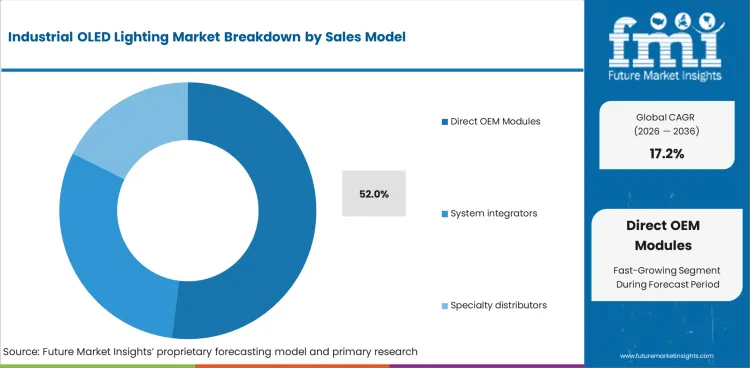
- Direct OEM modules are projected to account for 52.0% share of sales model demand in 2026. Machine builders prefer module sets that fit housing geometry before final production drawings close.
- System integrators serve retrofit and pilot projects, while specialty distributors support low-volume orders. Direct supply gives panel makers stronger control over driver choice and qualification data.
Insights into the Embedded Panels Installation Format Segment
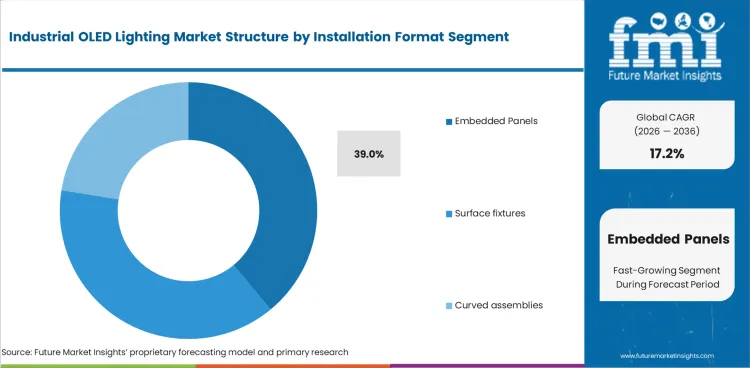
- Embedded panels are estimated to account for 39.0% share of installation format demand in 2026. Equipment makers prefer flush light surfaces that do not add fixture depth.
- Surface fixtures remain useful in benches and test rooms. Curved assemblies are emerging around transparent display and interior design concepts.
Industrial OLED Lighting Market Drivers, Restraints, and Opportunities
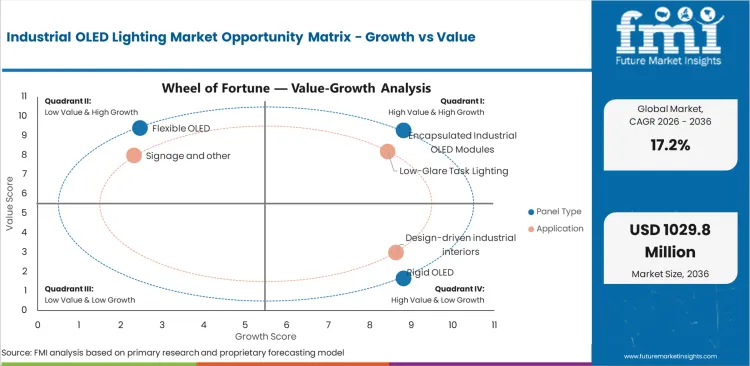
- Low-glare panel demand is raising interest in OLED task lighting for close operator work.
- Panel cost slows scale because OLED lighting remains expensive against high-efficiency LED alternatives.
- OEM module packaging creates opportunity as machine makers seek embedded light surfaces with driver support.
Industrial OLED lighting is expanding from display know-how into task lighting niches that need a flat luminous surface. The United States Census Bureau reported USD 1.56 billion in seasonally adjusted USA electric lighting equipment shipments in March 2026. This shows that lighting remains a large replacement and equipment category. OLED suppliers need to win narrow use cases inside this broader lighting product pool before they can scale.
Panel Cost Is Slowing Wider Factory Use
The main restraint is cost per useful lumen. DOE lists OLED panels near USD 100 per thousand lumens and states that commercial viability needs a move toward USD 10 per thousand lumens. This price gap limits OLED use in broad illumination tasks. Buyers will reserve panels for surfaces where glare control, thin depth and design value justify a premium over LED lights.
Encapsulation Is Creating Module Value
The strongest opportunity sits in packaged modules that solve durability questions before the buyer starts design work. OLED lighting depends on barrier quality because organic layers can degrade if moisture enters the stack. That makes flexible barrier films and edge sealing important for industrial supply. Suppliers with tested encapsulation can price modules above basic panels and reduce failure risk for OEM customers.
Analysis of Industrial OLED Lighting Market by Key Countries
.webp "Top Country Growth Comparison Industrial Oled Lighting Market Cagr (2026 2036)")
| Country | CAGR |
|---|---|
| United States | 15.8% CAGR |
| China | 16.3% CAGR |
| India | 16.6% CAGR |
| Germany | 17.5% CAGR |
| Japan | 18.1% CAGR |
| South Korea | 18.8% CAGR |
| United Kingdom | 19.4% CAGR |
Source: Future Market Insights, 2026.
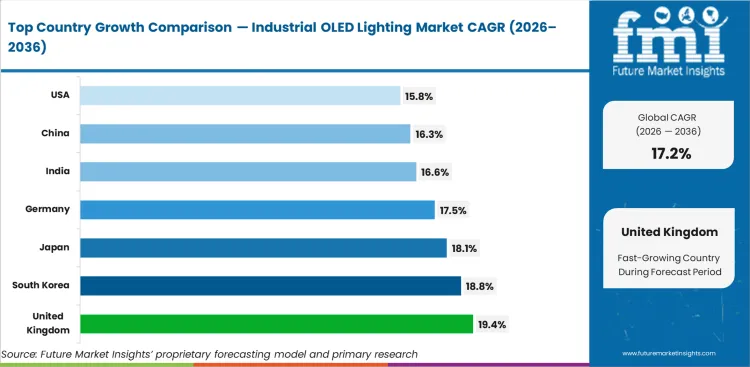
Industrial OLED Lighting Market CAGR Analysis by Country
- The United Kingdom is expected to post 19.4% CAGR by 2036 as specialty labs and design-led industrial interiors create a smaller but faster pool.
- South Korea is projected to record 18.8% CAGR by 2036 as OLED panel depth supports faster industrial module trials.
- Japan is forecast at 18.1% CAGR by 2036 as electronics production and precision labs support high-value lighting surfaces.
- Germany is expected to advance at 17.5% CAGR by 2036 as automation and automotive facilities test low-glare task lighting.
- India and China remain large expansion countries, with 16.6% CAGR and 16.3% CAGR based on electronics manufacturing growth.
Demand for industrial OLED lighting is forecast to rise at 17.2% CAGR from 2026 to 2036. Country-level analysis covers the major markets where electronics production, display supply depth, automation and lab activity support early adoption.
Demand Outlook for Industrial OLED Lighting Market in the United States
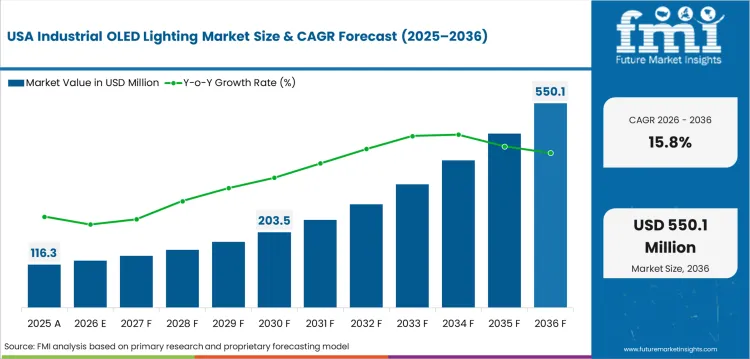
The United States is projected to record 15.8% CAGR through 2036 as lighting equipment makers focus on higher value fixtures. The USA Census Bureau reported USD 1.56 billion in electric lighting equipment shipments for March 2026. Industrial OLED buyers in Michigan, California and Massachusetts are more likely to evaluate panels for machine HMIs, lab benches and visual inspection zones. The practical result is a premium niche that links lighting hardware with inspection lighting fixtures.
- Michigan automotive plants can test OLED surfaces in trim stations and operator prompt panels.
- Massachusetts labs create demand for uniform light near optics benches and measurement spaces.
- California equipment makers need module samples with driver data and thermal notes before design freeze.
Sales Analysis of Industrial OLED Lighting Market in China
China is expected to expand at 16.3% CAGR through 2036 as display supply and automation demand move together. The National Bureau of Statistics of China reported 14.2% growth in computers, communication equipment and other electronic equipment manufacturing for January and February 2026. That activity supports pilot use near work cells and machine fronts. Panel makers in Hefei, Shenzhen and Chengdu can convert display capability into lighting modules for industrial clients.
- Hefei panel clusters give equipment makers access to local OLED sample runs and integration support.
- Shenzhen electronics plants can test embedded light surfaces near assembly and repair benches.
- Chengdu manufacturing zones support demand for compact task lighting linked with display module supply.
Demand Outlook for Industrial OLED Lighting Market in India
India is forecast to grow at 16.6% CAGR through 2036 as electronics manufacturing widens beyond final assembly. India’s Press Information Bureau reported electronics goods production near Rs. 11.3 lakh crore in 2024 to 2025. This raises the number of factories that can use low-glare lighting in test benches and inspection lines. Gujarat and Tamil Nadu will be early industrial trial locations as electronics clusters expand.
- Gujarat semiconductor projects can use OLED task surfaces in pilot labs and display-related inspection rooms.
- Tamil Nadu electronics plants can evaluate panels for low-profile workstations and visual quality checks.
- Noida equipment makers need supplier support on drivers and protective covers before adopting custom modules.
Opportunity Analysis of Industrial OLED Lighting Market in Germany
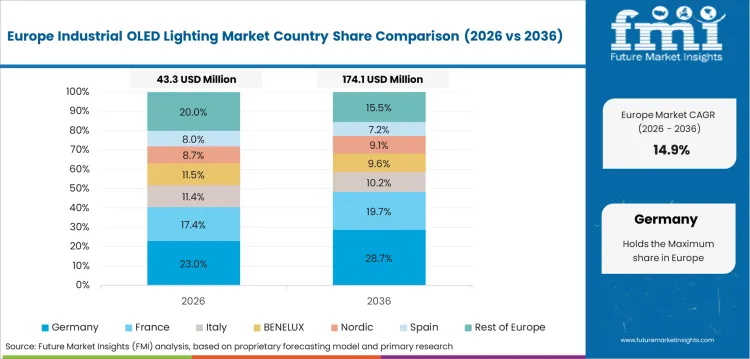
Germany is expected to advance at 17.5% CAGR through 2036 as industrial automation and automotive facilities test specialized lighting. The Federal Statistical Office of Germany reported that real manufacturing orders rose 7.8% month on month in December 2025. Higher equipment order flow supports trials for embedded panels in machine tools and vehicle interiors. Stuttgart, Munich and Saxony provide the strongest routes for supplier engagement.
- Stuttgart automotive engineering teams can use OLED panels in cockpit mockups and plant demonstration cells.
- Munich automation buyers need low-glare task lighting for compact inspection stations and service benches.
- Saxony electronics sites can test panel modules near clean manufacturing and microassembly lines.
Future Outlook for Industrial OLED Lighting Market in Japan
Japan is forecast at 18.1% CAGR through 2036 as electronics production favors high precision lighting surfaces. Japan Electronics and Information Technology Industries Association data showed June 2025 production of electronic components and devices at 645,673 million yen. This production setting supports careful trials in measurement, optics and component inspection environments. Tokyo, Nagoya and Fukuoka can act as early nodes for industrial OLED evaluation.
- Tokyo electronics labs can compare OLED surfaces with microdisplay test environments and visual inspection benches.
- Nagoya automotive suppliers can test low-profile panels in cabin prototypes and plant quality rooms.
- Fukuoka component makers need reliable encapsulation before OLED panels are accepted for workcell lighting.
Sales Analysis of Industrial OLED Lighting Market in South Korea
South Korea is projected to rise at 18.8% CAGR through 2036 as panel makers and equipment users operate close together. Invest Korea reported a KRW 484 billion government plan by 2032 for next-generation display technologies in July 2025. That policy backdrop supports industrial trials around OLED modules and adjacent light-emitting formats. Seoul, Gyeonggi and Cheonan remain central for panel-linked industrial buyers.
- Gyeonggi display clusters give module buyers faster access to Samsung Display and LG Display supply teams.
- Cheonan electronics facilities can trial OLED task lights near panel inspection and equipment service zones.
- Seoul design labs can test OLED-on-silicon and OLED surfaces for compact industrial concepts.
Future Outlook for Industrial OLED Lighting Market in the United Kingdom
The United Kingdom is expected to post 19.4% CAGR through 2036 as small specialist buyers adopt OLED lighting in labs and designed workspaces. The Office for National Statistics reported that computer, electronic and optical products rose 3.3% in the fourth quarter of 2025. This supports demand from Cambridge, Oxford and the Midlands for task lighting in technical rooms. Suppliers that work with high-end lighting channels can reach projects that value design and low glare together.
- Cambridge labs create a route for low-glare panels in optics rooms and precision benches.
- Oxford research facilities can use thin panels where ceiling height and glare limits affect fixture choice.
- Midlands automotive plants can test OLED surfaces in trim labs and HMI demonstration areas.
Competitive Landscape and Strategic Positioning
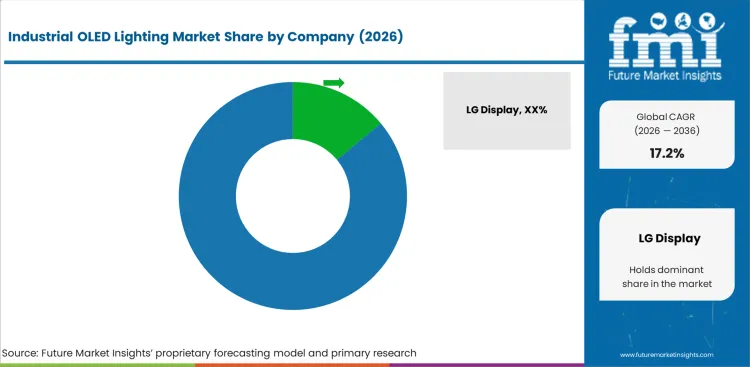
- The market is concentrated around OLED panel know-how, not around standard fixture assembly.
- LG Display and Samsung Display shape panel roadmaps through tandem structures and self-emissive display scale.
- Lighting groups win when they package panels into safer fixtures for plants, labs and specialty interiors.
- Entry barriers include encapsulation reliability, driver matching, panel sourcing and lifetime proof under industrial use.
Panel technology leadership is the main competitive filter in industrial OLED lighting. LG Display showed third-generation tandem OLED with 18% lower power consumption and over twice the lifespan of the prior generation at SID Display Week 2026. That type of advance matters for industrial buyers as it connects brightness, heat and lifetime in one purchase decision. Panel suppliers that can translate these gains into automotive lighting and machine interface modules will shape the premium end of the market.
Samsung Display is using scale in self-emissive panels to support adjacent business applications. In March 2025, the company said it expected QD-OLED monitor panel shipments to grow over 50% from the prior year. That scale does not directly equal industrial lighting supply. It does lower material and process risk for buyers considering OLED surfaces in industrial LED displays and fixtures.
Lighting integrators have a different advantage. Signify’s April 2024 workspace launch used modular panel design and high-efficiency luminaires to address renovation buyers. Zumtobel Group and Acuity Brands can use channel access to place OLED task concepts in premium industrial interiors. The challenge is not only producing the light surface. Suppliers must prove electrical safety, glare control and maintenance terms to secure repeat orders.
Specialist firms can win where large suppliers avoid small custom runs. BOE and Visionox support the flexible display side, while Konica Minolta serves the measurement layer through analyzers for OLED evaluation. This opens room for small module assemblers that can combine panels, drivers and protective covers. For wireless lighting and connected pilots, software and control pairing can become the second differentiator.
Key Companies in the Industrial OLED Lighting Market
Competition is best read by role because panel supply, lighting integration and measurement support differ sharply.
- Panel Technology Leaders: LG Display and Samsung Display hold strong positions through tandem OLED, QD-OLED and automotive display work. BOE and Visionox add China-based flexible OLED capacity and process depth. These companies influence panel cost, brightness, lifetime and module availability for industrial buyers.
- Lighting and Integration Specialists: ams OSRAM, Signify, Acuity Brands and Zumtobel Group are better placed to translate light-emitting surfaces into usable fixture concepts. Their strengths sit in drivers, lighting controls, safety expectations and access to industrial or commercial renovation projects.
- Evaluation and Adjacent OLED Participants: Konica Minolta and Panasonic support the ecosystem through display evaluation tools and premium OLED product knowledge. Konica Minolta is not treated as a new panel production leader here. Its role is stronger in measurement and color control around OLED quality.
Competitive Benchmarking: Industrial OLED Lighting Market
| Company | Panel Supply Depth | Driver Integration Depth | Industrial Qualification Support | Geographic Footprint |
|---|---|---|---|---|
| LG Display | High | Strong | Strong | Global with South Korea production depth and automotive OLED focus |
| Samsung Display | High | Strong | Strong | Global with QD-OLED and business display scale |
| BOE | High | Medium | Strong | China centered with global display customer reach |
| Visionox | Medium | Medium | Strong | China centered with flexible OLED and AMOLED expansion |
| ams OSRAM | Medium | Strong | Medium | Europe centered with automotive and industrial lighting channels |
| Signify | Low | Strong | Medium | Global lighting integration footprint |
| Acuity Brands | Low | Medium | Medium | North America centered with controls and commercial channels |
| Zumtobel Group | Low | Medium | Medium | Europe centered with premium industrial lighting access |
| Panasonic | Medium | Medium | Low | Japan centered with OLED product design knowledge |
| Konica Minolta | Low | Low | Strong | Japan centered with OLED and display measurement tools |
Source: Future Market Insights competitive analysis, 2026. Ratings reflect relative positioning based on panel supply depth, driver integration depth and industrial qualification support.
Key Developments in Industrial OLED Lighting Market
- In May 2026, LG Display showed third-generation tandem OLED for automotive use with 1,200 nits brightness and over 15,000 hours of room-temperature performance. The same durability path supports industrial module confidence.
- In March 2025, Samsung Display targeted over 50% QD-OLED monitor shipment growth from 2024 levels. The scale signal supports wider self-emissive panel supply for business environments.
- In May 2024, ams OSRAM presented ALIYOS LED-on-foil and OSP-based intelligent lighting technologies in Japan. The thin-area lighting concept competes near flexible OLED surfaces.
- In April 2024, Signify introduced UltraEfficient and 3D printed workspace luminaires. The launch shows how industrial and commercial buyers value modular lighting with lower energy use.
- In January 2026, BOE released an OLED clarity standard and cited deep flexible display patent coverage. The move supports stronger specification language for OLED buyers.
Key Players in the Industrial OLED Lighting Market
Major Global Players:
- LG Display
- Samsung Display
- ams OSRAM
- Signify
- Acuity Brands
- Zumtobel Group
Specialist and Regional Players:
- BOE
- Visionox
- Konica Minolta
- Panasonic
Report Scope and Coverage
| Parameter | Details |
|---|---|
| Quantitative Units | USD 210.6 million to USD 1,029.8 million, at 17.2% CAGR |
| Market Definition | OLED panels and lighting modules used as illumination surfaces in industrial facilities |
| Panel Type | Rigid OLED panels, Flexible OLED panels, Encapsulated industrial OLED modules |
| Application | Machine indicators and HMIs, Low-glare task lighting, Design-driven industrial interiors, Signage and other |
| End Use | Electronics manufacturing, Advanced labs, Automotive plants, Other industrial |
| Sales Model | Direct OEM modules, System integrators, Specialty distributors |
| Installation Format | Embedded panels, Surface fixtures, Curved assemblies |
| Regions Covered | North America, Latin America, Western Europe, Eastern Europe, East Asia, South Asia and Pacific, Middle East and Africa |
| Countries Covered | United States, China, India, Germany, Japan, South Korea, United Kingdom, and 30+ countries |
| Key Companies Profiled | LG Display, Samsung Display, ams OSRAM, Konica Minolta, Panasonic, Signify, Acuity Brands, Zumtobel Group, Visionox, BOE |
| Forecast Period | 2026 to 2036 |
| Approach | Hybrid bottom-up and top-down methodology using supplied values, panel cost checks, supplier activity and industrial lighting signals |
Source: Future Market Insights, 2026.
Industrial OLED Lighting Market by Segments
Industrial OLED Lighting Market Segmented by Panel Type:
- Rigid OLED panels
- Flexible OLED panels
- Encapsulated industrial OLED modules
Industrial OLED Lighting Market Segmented by Application:
- Machine indicators and HMIs
- Low-glare task lighting
- Design-driven industrial interiors
- Signage and other
Industrial OLED Lighting Market Segmented by End Use:
- Electronics manufacturing
- Advanced labs
- Automotive plants
- Other industrial
Industrial OLED Lighting Market Segmented by Sales Model:
- Direct OEM modules
- System integrators
- Specialty distributors
Industrial OLED Lighting Market Segmented by Installation Format:
- Embedded panels
- Surface fixtures
- Curved assemblies
Industrial OLED Lighting Market by Region:
- North America
- United States
- Canada
- Mexico
- Latin America
- Brazil
- Chile
- Rest of Latin America
- Western Europe
- Germany
- United Kingdom
- Italy
- Spain
- France
- Nordic
- BENELUX
- Rest of Western Europe
- Eastern Europe
- Russia
- Poland
- Hungary
- Balkan and Baltic
- Rest of Eastern Europe
- East Asia
- China
- Japan
- South Korea
- South Asia and Pacific
- India
- ASEAN
- Australia and New Zealand
- Rest of South Asia and Pacific
- Middle East and Africa
- Kingdom of Saudi Arabia
- Other GCC Countries
- Turkiye
- South Africa
- Other African Union
- Rest of Middle East and Africa
Research Sources and Bibliography
- United States Department of Energy. (2026). OLED studies. Energy.gov.
- United States Department of Energy. (2026). OLED basics. Energy.gov.
- United States Census Bureau. (2026, May 4). Monthly full report on manufacturers’ shipments, inventories and orders: March 2026.
- National Bureau of Statistics of China. (2026, March 17). Industrial production operation from January to February 2026.
- Press Information Bureau. (2026, February 6). Electronics manufacturing in India expanded significantly. Government of India.
- Federal Statistical Office of Germany. (2026, February 5). New orders in manufacturing in December 2025. Destatis.
- Japan Electronics and Information Technology Industries Association. (2025, August 28). June 2025 production by the Japanese electronics industry.
- KOTRA Invest Korea. (2025, August). South Korea’s display industry, taking a leap into IT OLED.
- Office for National Statistics. (2026, February 12). Index of production, UK: December 2025.
- LG Corporation. (2026, May). LG Display presents OLED display solutions optimized for the AI era at SID Display Week 2026.
- Samsung Display. (2025, March 23). Samsung Display targets 2025 shipment growth of 50% for QD-OLED monitor panel.
- ams OSRAM. (2024, May 17). Automotive Engineering Exposition 2024.
- Signify. (2024, April 3). Signify introduces new UltraEfficient and 3D printed innovations supporting the transition to energy-efficient sustainable workspaces.
- BOE Technology Group. (2026, January 29). BOE releases first OLED clarity standard.
The bibliography is provided for reader reference and uses government, trade body, company and official technical sources relevant to OLED lighting and industrial demand signals.
This Report Answers
- What is the current and future size of the industrial OLED lighting market?
- How fast is the industrial OLED lighting market expected to expand between 2026 and 2036?
- Which panel type is expected to lead industrial OLED lighting demand by 2026?
- Which application is projected to account for the largest industrial OLED lighting share in 2026?
- Why are machine indicators and low-glare task lighting important for this market?
- How do OLED panel cost and encapsulation quality affect industrial adoption?
- Which countries are projected to record faster expansion during the forecast period?
- Who are the main companies active in industrial OLED lighting and related panel supply?
- How does FMI define the industrial OLED lighting market scope?
- How does FMI estimate and validate the industrial OLED lighting forecast?
Frequently Asked Questions
What is the global market demand for Industrial OLED Lighting in 2026?
In 2026, the global industrial OLED lighting market is expected to be worth USD 210.6 million as niche industrial uses move into repeat orders.
How big will the Industrial OLED Lighting Market be in 2036?
By 2036, the industrial OLED lighting market is expected to be worth USD 1,029.8 million as machine and lab applications expand.
How much is demand for Industrial OLED Lighting expected to expand between 2026 and 2036?
Between 2026 and 2036, industrial OLED lighting demand is expected to expand at 17.2% CAGR as panel modules gain industrial use.
Which panel type is expected to lead the Industrial OLED Lighting Market by 2026?
Encapsulated industrial OLED modules are projected to lead panel type demand with 44.0% share in 2026 due to sealing and reliability needs.
Which application is expected to lead Industrial OLED Lighting demand in 2026?
Low-glare task lighting is expected to lead application demand with 34.0% share in 2026 as close-range work needs diffuse light.
Which country is forecast to grow fastest in the Industrial OLED Lighting Market?
The United Kingdom is expected to post 19.4% CAGR through 2036 as specialist labs and designed industrial interiors adopt OLED panels.
What does the Industrial OLED Lighting Market include?
The market includes OLED light panels and modules used for machine indicators, HMI lighting, task lighting and industrial interiors.
How does FMI estimate the Industrial OLED Lighting Market forecast?
FMI uses supplied market anchors, panel cost checks, supplier developments, industrial lighting signals and country manufacturing activity to validate the forecast.
Is OLED lighting better than LED lighting for factories?
OLED lighting is better for low-glare surfaces near operators. LED lighting remains better for broad factory illumination where lumen cost and brightness matter most.
How much does OLED lighting cost compared with LED lighting?
OLED panels cost more than LED fixtures today. The United States Department of Energy places OLED panel pricing near USD 100 per thousand lumens.
How does industrial OLED lighting work?
Industrial OLED lighting uses organic layers that emit light across a flat surface when powered. The result is a thin and uniform light panel.
Who uses industrial OLED lighting?
Early users include machine builders, electronics plants, advanced labs and automotive plants that need low-glare light in compact work zones.
How long can OLED lighting panels last?
DOE notes many OLED lighting products expect 30,000 to 50,000 hours before output falls to 70% of initial light.
Preview the report firsthand - request a free sample
Get SampleGet the brochure for pricing and purchase details.
Get PDFTable of Content
- Executive Summary
- Global Market Outlook
- Demand-side Trends
- Supply-side Trends
- Technology Roadmap Analysis
- Analysis and Recommendations
- Market Overview
- Market Coverage / Taxonomy
- Market Definition / Scope / Limitations
- Research Methodology
- Chapter Orientation
- Analytical Lens and Working Hypotheses
- Market Structure, Signals, and Trend Drivers
- Benchmarking and Cross-market Comparability
- Market Sizing, Forecasting, and Opportunity Mapping
- Research Design and Evidence Framework
- Desk Research Programme (Secondary Evidence)
- Company Annual and Sustainability Reports
- Peer-reviewed Journals and Academic Literature
- Corporate Websites, Product Literature, and Technical Notes
- Earnings Decks and Investor Briefings
- Statutory Filings and Regulatory Disclosures
- Technical White Papers and Standards Notes
- Trade Journals, Industry Magazines, and Analyst Briefs
- Conference Proceedings, Webinars, and Seminar Materials
- Government Statistics Portals and Public Data Releases
- Press Releases and Reputable Media Coverage
- Specialist Newsletters and Curated Briefings
- Sector Databases and Reference Repositories
- FMI Internal Proprietary Databases and Historical Market Datasets
- Subscription Datasets and Paid Sources
- Social Channels, Communities, and Digital Listening Inputs
- Additional Desk Sources
- Expert Input and Fieldwork (Primary Evidence)
- Primary Modes
- Qualitative Interviews and Expert Elicitation
- Quantitative Surveys and Structured Data Capture
- Blended Approach
- Why Primary Evidence is Used
- Field Techniques
- Interviews
- Surveys
- Focus Groups
- Observational and In-context Research
- Social and Community Interactions
- Stakeholder Universe Engaged
- C-suite Leaders
- Board Members
- Presidents and Vice Presidents
- R&D and Innovation Heads
- Technical Specialists
- Domain Subject-matter Experts
- Scientists
- Physicians and Other Healthcare Professionals
- Governance, Ethics, and Data Stewardship
- Research Ethics
- Data Integrity and Handling
- Primary Modes
- Tooling, Models, and Reference Databases
- Desk Research Programme (Secondary Evidence)
- Data Engineering and Model Build
- Data Acquisition and Ingestion
- Cleaning, Normalisation, and Verification
- Synthesis, Triangulation, and Analysis
- Quality Assurance and Audit Trail
- Market Background
- Market Dynamics
- Drivers
- Restraints
- Opportunity
- Trends
- Scenario Forecast
- Demand in Optimistic Scenario
- Demand in Likely Scenario
- Demand in Conservative Scenario
- Opportunity Map Analysis
- Product Life Cycle Analysis
- Supply Chain Analysis
- Investment Feasibility Matrix
- Value Chain Analysis
- PESTLE and Porter’s Analysis
- Regulatory Landscape
- Regional Parent Market Outlook
- Production and Consumption Statistics
- Import and Export Statistics
- Market Dynamics
- Global Market Analysis 2021 to 2025 and Forecast, 2026 to 2036
- Historical Market Size Value (USD Million) Analysis, 2021 to 2025
- Current and Future Market Size Value (USD Million) Projections, 2026 to 2036
- Y-o-Y Growth Trend Analysis
- Absolute $ Opportunity Analysis
- Global Market Pricing Analysis 2021 to 2025 and Forecast 2026 to 2036
- Global Market Analysis 2021 to 2025 and Forecast 2026 to 2036, By Panel Type
- Introduction / Key Findings
- Historical Market Size Value (USD Million) Analysis By Panel Type , 2021 to 2025
- Current and Future Market Size Value (USD Million) Analysis and Forecast By Panel Type , 2026 to 2036
- Encapsulated Industrial OLED Modules
- Rigid OLED
- Flexible OLED
- Encapsulated Industrial OLED Modules
- Y-o-Y Growth Trend Analysis By Panel Type , 2021 to 2025
- Absolute $ Opportunity Analysis By Panel Type , 2026 to 2036
- Global Market Analysis 2021 to 2025 and Forecast 2026 to 2036, By Application
- Introduction / Key Findings
- Historical Market Size Value (USD Million) Analysis By Application, 2021 to 2025
- Current and Future Market Size Value (USD Million) Analysis and Forecast By Application, 2026 to 2036
- Low-Glare Task Lighting
- Design-driven industrial interiors
- Signage and other
- Low-Glare Task Lighting
- Y-o-Y Growth Trend Analysis By Application, 2021 to 2025
- Absolute $ Opportunity Analysis By Application, 2026 to 2036
- Global Market Analysis 2021 to 2025 and Forecast 2026 to 2036, By End Use
- Introduction / Key Findings
- Historical Market Size Value (USD Million) Analysis By End Use, 2021 to 2025
- Current and Future Market Size Value (USD Million) Analysis and Forecast By End Use, 2026 to 2036
- Advanced Labs
- Automotive plants
- Other industrial
- Advanced Labs
- Y-o-Y Growth Trend Analysis By End Use, 2021 to 2025
- Absolute $ Opportunity Analysis By End Use, 2026 to 2036
- Global Market Analysis 2021 to 2025 and Forecast 2026 to 2036, By Sales Model
- Introduction / Key Findings
- Historical Market Size Value (USD Million) Analysis By Sales Model, 2021 to 2025
- Current and Future Market Size Value (USD Million) Analysis and Forecast By Sales Model, 2026 to 2036
- Direct OEM Modules
- System integrators
- Specialty distributors
- Direct OEM Modules
- Y-o-Y Growth Trend Analysis By Sales Model, 2021 to 2025
- Absolute $ Opportunity Analysis By Sales Model, 2026 to 2036
- Global Market Analysis 2021 to 2025 and Forecast 2026 to 2036, By Installation Format
- Introduction / Key Findings
- Historical Market Size Value (USD Million) Analysis By Installation Format, 2021 to 2025
- Current and Future Market Size Value (USD Million) Analysis and Forecast By Installation Format, 2026 to 2036
- Embedded Panels
- Surface fixtures
- Curved assemblies
- Embedded Panels
- Y-o-Y Growth Trend Analysis By Installation Format, 2021 to 2025
- Absolute $ Opportunity Analysis By Installation Format, 2026 to 2036
- Global Market Analysis 2021 to 2025 and Forecast 2026 to 2036, By Region
- Introduction
- Historical Market Size Value (USD Million) Analysis By Region, 2021 to 2025
- Current Market Size Value (USD Million) Analysis and Forecast By Region, 2026 to 2036
- North America
- Latin America
- Western Europe
- Eastern Europe
- East Asia
- South Asia and Pacific
- Middle East & Africa
- Market Attractiveness Analysis By Region
- North America Market Analysis 2021 to 2025 and Forecast 2026 to 2036, By Country
- Historical Market Size Value (USD Million) Trend Analysis By Market Taxonomy, 2021 to 2025
- Market Size Value (USD Million) Forecast By Market Taxonomy, 2026 to 2036
- By Country
- USA
- Canada
- Mexico
- By Panel Type
- By Application
- By End Use
- By Sales Model
- By Installation Format
- By Country
- Market Attractiveness Analysis
- By Country
- By Panel Type
- By Application
- By End Use
- By Sales Model
- By Installation Format
- Key Takeaways
- Latin America Market Analysis 2021 to 2025 and Forecast 2026 to 2036, By Country
- Historical Market Size Value (USD Million) Trend Analysis By Market Taxonomy, 2021 to 2025
- Market Size Value (USD Million) Forecast By Market Taxonomy, 2026 to 2036
- By Country
- Brazil
- Chile
- Rest of Latin America
- By Panel Type
- By Application
- By End Use
- By Sales Model
- By Installation Format
- By Country
- Market Attractiveness Analysis
- By Country
- By Panel Type
- By Application
- By End Use
- By Sales Model
- By Installation Format
- Key Takeaways
- Western Europe Market Analysis 2021 to 2025 and Forecast 2026 to 2036, By Country
- Historical Market Size Value (USD Million) Trend Analysis By Market Taxonomy, 2021 to 2025
- Market Size Value (USD Million) Forecast By Market Taxonomy, 2026 to 2036
- By Country
- Germany
- UK
- Italy
- Spain
- France
- Nordic
- BENELUX
- Rest of Western Europe
- By Panel Type
- By Application
- By End Use
- By Sales Model
- By Installation Format
- By Country
- Market Attractiveness Analysis
- By Country
- By Panel Type
- By Application
- By End Use
- By Sales Model
- By Installation Format
- Key Takeaways
- Eastern Europe Market Analysis 2021 to 2025 and Forecast 2026 to 2036, By Country
- Historical Market Size Value (USD Million) Trend Analysis By Market Taxonomy, 2021 to 2025
- Market Size Value (USD Million) Forecast By Market Taxonomy, 2026 to 2036
- By Country
- Russia
- Poland
- Hungary
- Balkan & Baltic
- Rest of Eastern Europe
- By Panel Type
- By Application
- By End Use
- By Sales Model
- By Installation Format
- By Country
- Market Attractiveness Analysis
- By Country
- By Panel Type
- By Application
- By End Use
- By Sales Model
- By Installation Format
- Key Takeaways
- East Asia Market Analysis 2021 to 2025 and Forecast 2026 to 2036, By Country
- Historical Market Size Value (USD Million) Trend Analysis By Market Taxonomy, 2021 to 2025
- Market Size Value (USD Million) Forecast By Market Taxonomy, 2026 to 2036
- By Country
- China
- Japan
- South Korea
- By Panel Type
- By Application
- By End Use
- By Sales Model
- By Installation Format
- By Country
- Market Attractiveness Analysis
- By Country
- By Panel Type
- By Application
- By End Use
- By Sales Model
- By Installation Format
- Key Takeaways
- South Asia and Pacific Market Analysis 2021 to 2025 and Forecast 2026 to 2036, By Country
- Historical Market Size Value (USD Million) Trend Analysis By Market Taxonomy, 2021 to 2025
- Market Size Value (USD Million) Forecast By Market Taxonomy, 2026 to 2036
- By Country
- India
- ASEAN
- Australia & New Zealand
- Rest of South Asia and Pacific
- By Panel Type
- By Application
- By End Use
- By Sales Model
- By Installation Format
- By Country
- Market Attractiveness Analysis
- By Country
- By Panel Type
- By Application
- By End Use
- By Sales Model
- By Installation Format
- Key Takeaways
- Middle East & Africa Market Analysis 2021 to 2025 and Forecast 2026 to 2036, By Country
- Historical Market Size Value (USD Million) Trend Analysis By Market Taxonomy, 2021 to 2025
- Market Size Value (USD Million) Forecast By Market Taxonomy, 2026 to 2036
- By Country
- Kingdom of Saudi Arabia
- Other GCC Countries
- Turkiye
- South Africa
- Other African Union
- Rest of Middle East & Africa
- By Panel Type
- By Application
- By End Use
- By Sales Model
- By Installation Format
- By Country
- Market Attractiveness Analysis
- By Country
- By Panel Type
- By Application
- By End Use
- By Sales Model
- By Installation Format
- Key Takeaways
- Key Countries Market Analysis
- USA
- Pricing Analysis
- Market Share Analysis, 2025
- By Panel Type
- By Application
- By End Use
- By Sales Model
- By Installation Format
- Canada
- Pricing Analysis
- Market Share Analysis, 2025
- By Panel Type
- By Application
- By End Use
- By Sales Model
- By Installation Format
- Mexico
- Pricing Analysis
- Market Share Analysis, 2025
- By Panel Type
- By Application
- By End Use
- By Sales Model
- By Installation Format
- Brazil
- Pricing Analysis
- Market Share Analysis, 2025
- By Panel Type
- By Application
- By End Use
- By Sales Model
- By Installation Format
- Chile
- Pricing Analysis
- Market Share Analysis, 2025
- By Panel Type
- By Application
- By End Use
- By Sales Model
- By Installation Format
- Germany
- Pricing Analysis
- Market Share Analysis, 2025
- By Panel Type
- By Application
- By End Use
- By Sales Model
- By Installation Format
- UK
- Pricing Analysis
- Market Share Analysis, 2025
- By Panel Type
- By Application
- By End Use
- By Sales Model
- By Installation Format
- Italy
- Pricing Analysis
- Market Share Analysis, 2025
- By Panel Type
- By Application
- By End Use
- By Sales Model
- By Installation Format
- Spain
- Pricing Analysis
- Market Share Analysis, 2025
- By Panel Type
- By Application
- By End Use
- By Sales Model
- By Installation Format
- France
- Pricing Analysis
- Market Share Analysis, 2025
- By Panel Type
- By Application
- By End Use
- By Sales Model
- By Installation Format
- India
- Pricing Analysis
- Market Share Analysis, 2025
- By Panel Type
- By Application
- By End Use
- By Sales Model
- By Installation Format
- ASEAN
- Pricing Analysis
- Market Share Analysis, 2025
- By Panel Type
- By Application
- By End Use
- By Sales Model
- By Installation Format
- Australia & New Zealand
- Pricing Analysis
- Market Share Analysis, 2025
- By Panel Type
- By Application
- By End Use
- By Sales Model
- By Installation Format
- China
- Pricing Analysis
- Market Share Analysis, 2025
- By Panel Type
- By Application
- By End Use
- By Sales Model
- By Installation Format
- Japan
- Pricing Analysis
- Market Share Analysis, 2025
- By Panel Type
- By Application
- By End Use
- By Sales Model
- By Installation Format
- South Korea
- Pricing Analysis
- Market Share Analysis, 2025
- By Panel Type
- By Application
- By End Use
- By Sales Model
- By Installation Format
- Russia
- Pricing Analysis
- Market Share Analysis, 2025
- By Panel Type
- By Application
- By End Use
- By Sales Model
- By Installation Format
- Poland
- Pricing Analysis
- Market Share Analysis, 2025
- By Panel Type
- By Application
- By End Use
- By Sales Model
- By Installation Format
- Hungary
- Pricing Analysis
- Market Share Analysis, 2025
- By Panel Type
- By Application
- By End Use
- By Sales Model
- By Installation Format
- Kingdom of Saudi Arabia
- Pricing Analysis
- Market Share Analysis, 2025
- By Panel Type
- By Application
- By End Use
- By Sales Model
- By Installation Format
- Turkiye
- Pricing Analysis
- Market Share Analysis, 2025
- By Panel Type
- By Application
- By End Use
- By Sales Model
- By Installation Format
- South Africa
- Pricing Analysis
- Market Share Analysis, 2025
- By Panel Type
- By Application
- By End Use
- By Sales Model
- By Installation Format
- USA
- Market Structure Analysis
- Competition Dashboard
- Competition Benchmarking
- Market Share Analysis of Top Players
- By Regional
- By Panel Type
- By Application
- By End Use
- By Sales Model
- By Installation Format
- Competition Analysis
- Competition Deep Dive
- LG Display
- Overview
- Product Portfolio
- Profitability by Market Segments (Product/Age /Sales Channel/Region)
- Sales Footprint
- Strategy Overview
- Marketing Strategy
- Product Strategy
- Channel Strategy
- Samsung Display
- ams OSRAM
- Signify
- Acuity Brands
- Zumtobel Group
- LG Display
- Competition Deep Dive
- Assumptions & Acronyms Used


