

- Market Size (2026)
- USD 214.5 Mn
- Forecast (2036)
- USD 446.2 Mn
- CAGR (2026 to 2036)
- 7.6%
Industrial Wastewater Real-Time Toxicity Monitoring Test Systems Market Size, Market Forecast and Outlook By FMI
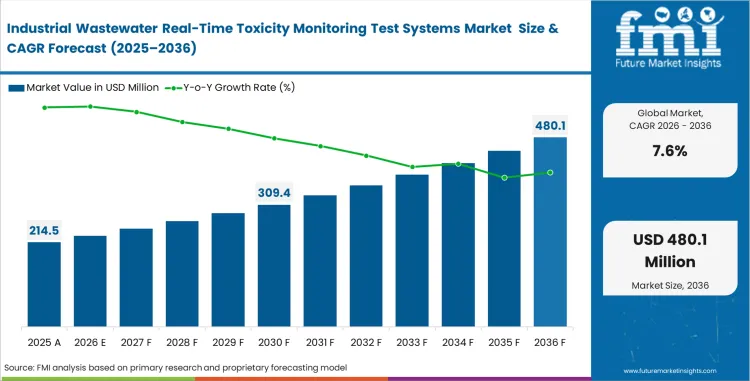
Industrial wastewater real-time toxicity monitoring test systems market was valued at USD 199.3 million in 2025. Industry valuation is estimated to reach USD 214.5 million in 2026 at a 7.6% CAGR during the 2026 to 2036 forecast period. Total opportunity is expected to approach USD 446.2 million by 2036 as industrial wastewater control moves closer to live toxicity surveillance rather than delayed confirmation after a discharge event.
Summary of Industrial Wastewater Real-Time Toxicity Monitoring Test Systems Market
- Market valuation is expected to reach USD 446.2 million by 2036.
- The category is forecast to expand at a 7.6% CAGR from 2026 to 2036.
- Industrial wastewater real-time toxicity monitoring systems generated USD 199.3 million in 2025.
- Market value is expected to rise to USD 214.5 million in 2026.
- Bioluminescent systems are projected to remain the leading test technology with 34% share in 2026.
- Bacteria-based platforms are set to lead bioindicator demand at 36% share in 2026.
- Continuous systems continue to anchor the format mix, with 41% share expected in 2026.
- Among the countries covered, China shows the fastest growth profile through 2036.
Key Takeaways, Market Size, and Forecast
- Industrial Wastewater Real-Time Toxicity Monitoring Test Systems Market is projected to grow from USD 214.5 million in 2026 to USD 446.2 million by 2036, at a CAGR of 7.6%.
- The industrial wastewater real-time toxicity monitoring test systems market was valued at USD 199.3 million in 2025.
- By 2036, the Industrial Wastewater Real-Time Toxicity Monitoring Test Systems Market is expected to be worth USD 446.2 million.
- From 2026 to 2036, the market is anticipated to expand at a CAGR of 7.6%.
- The market is predicted to create an incremental opportunity of USD 231.7 million between 2026 and 2036.
- In 2026, Bioluminescent Systems are expected to account for 34.0% of the test technology segment.
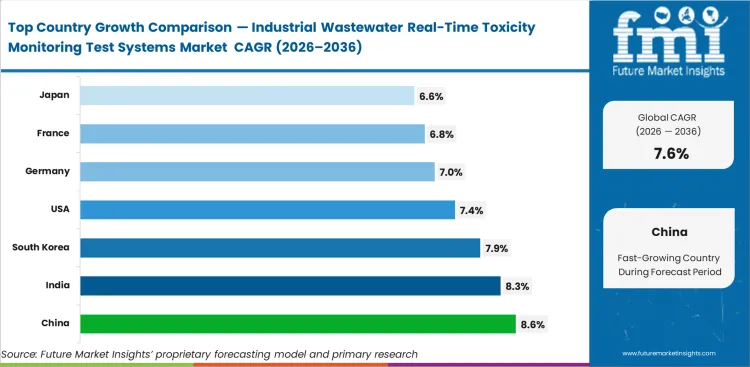
- China (8.6%) and India (8.3%) are projected to be two of the fastest growing markets.
| Metric | Value |
|---|---|
| Market Size (2025) | USD 199.3 million |
| Market Size (2026) | USD 214.5 million |
| Market Size (2036) | USD 446.2 million |
| CAGR (2026-2036) | 7.6% |
| Incremental Opportunity | USD 231.7 million |
| Leading Test Technology | Bioluminescent (34%) |
| Leading Bioindicator | Bacteria (36%) |
| Leading System Format | Continuous (41%) |
| Leading Monitoring Objective | Compliance (37%) |
| Leading Installation Point | Final Outlet (33%) |
| Leading End Use Industry | Chemicals (24%) |
| Leading Purchase Model | Instrument Sale (46%) |
| Leading Output Integration | SCADA-ready (38%) |
Source: Future Market Insights (FMI) analysis and primary research
Environmental compliance teams are now evaluating whether toxicity has to be watched as an operating signal inside the treatment train instead of being handled only as a laboratory checkpoint. That distinction matters in plants where one untreated spike can damage biomass, disrupt discharge quality, or trigger a diversion decision before routine reporting is completed. Periodic chemistry data still has value, though it does not always reveal the biological effect of a mixed stream at the moment it becomes harmful. Category expansion therefore depends on how quickly plant teams begin treating toxicity warning as part of day-to-day wastewater control.
Routine use becomes more likely once treatment supervisors, laboratory managers, and control-room teams trust the alarm enough to connect it with a real operating response. Faster acceptance usually follows when the system fits existing workflows, requires manageable upkeep, and delivers signals that can be interpreted without prolonged internal debate. Installed units then move beyond pilot status and start to sit inside regular environmental planning. That is the point where category adoption becomes easier to defend in capital review.
China is expected to post 8.6% CAGR in this market through 2036. India follows at 8.3% CAGR, while South Korea is likely to register 7.9% CAGR over the same period. United States is estimated at 7.4% CAGR, Germany at 7.0% CAGR, France at 6.8% CAGR, and Japan at 6.6% CAGR from 2026 to 2036. Faster-moving Asian countries are working from a lower installed base and wider industrial wastewater exposure, while mature markets place more weight on validation effort, replacement timing, and approval discipline.
Industrial Wastewater Real-Time Toxicity Monitoring Test Systems Market definition
Industrial wastewater real-time toxicity monitoring test systems are instruments used to detect harmful biological effects in industrial effluent streams during plant operation, where response speed, signal clarity, workflow fit, and integration with wastewater decision points determine practical value.
Industrial Wastewater Real-Time Toxicity Monitoring Test Systems Market inclusions
Market scope includes all commercially traded systems segmented by test technology, bioindicator, system format, monitoring objective, installation point, end-use industry, purchase model, output integration, and region. Coverage includes bioluminescent, respirometric, behavioral, and photosynthetic systems along with related deployment and integration formats. Revenue sizing spans the 2026 to 2036 forecast period.
Industrial Wastewater Real-Time Toxicity Monitoring Test Systems Market exclusions
The scope excludes delayed laboratory-only toxicity workflows that do not support real-time plant monitoring, along with unrelated wastewater instruments not used for live toxicity warning, response support, or discharge-facing biological effect detection.
Industrial Wastewater Real-Time Toxicity Monitoring Test Systems Market research methodology
- Primary research: FMI analysts conducted interviews with environmental compliance teams, wastewater supervisors, laboratory managers, and automation-side users to understand alarm confidence, validation effort, and installation priorities.
- Desk research: Data collection aggregated wastewater monitoring materials, industrial treatment references, company information, and workflow documentation to establish verifiable baseline parameters.
- Market sizing and forecasting: Baseline values reflect instrument-use demand, applying workflow fit, segment leadership, and country adoption patterns to project demand through 2036.
- Data validation and update cycle: Projections are tested against operating logic, country growth spread, and segment-use discipline before publication.
Segmental Analysis
Key Facts About Segments
- Fast-response requirements keep bioluminescent systems at the front of test technology demand, with 34% share projected in 2026. Quicker signal generation supports earlier intervention in unstable wastewater conditions.
- Routine usability keeps bacteria-based systems as the leading bioindicator, with 36% share expected in 2026. Lower handling effort and consistent response strengthen daily operational fit.
- Continuous coverage keeps this format ahead, with 41% share anticipated in 2026. Reduced monitoring gaps improve reliability in toxicity detection.
- Compliance-driven decision-making anchors monitoring objectives, with 37% share projected in 2026. Direct linkage to discharge control strengthens internal approval cases.
- Final outlet positioning leads installation strategy, with 33% share expected in 2026. Alignment with discharge points supports stronger control and reporting clarity.
- Effluent variability keeps chemicals as the leading end-use industry, with 24% share projected in 2026. Rapid composition shifts increase the need for real-time toxicity visibility.
- Ownership preference keeps instrument sales dominant, with 46% share expected in 2026. Greater control over maintenance and usage supports long-term adoption.
- Integrated visibility keeps SCADA-ready systems in the lead, with 38% share anticipated in 2026. Better alarm routing and traceability improve response timing.
Industrial Wastewater Real-Time Toxicity Monitoring Test Systems Market Analysis by Test Technology
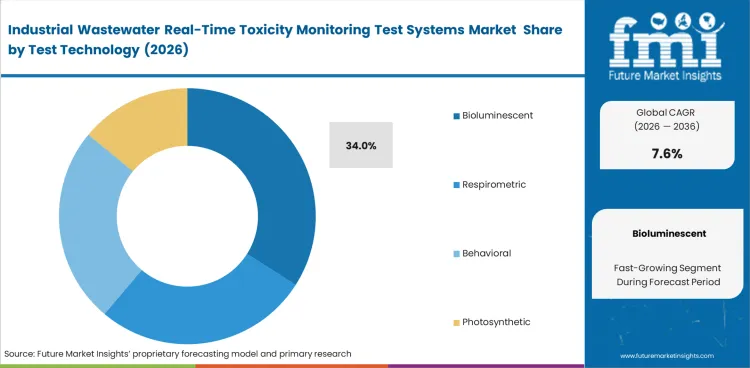
Market estimates place this category at 34% share in 2026 because plant teams value fast signal generation, familiar assay logic, and easier fit with rapid warning routines. Shorter response time gives operators a better chance to isolate a stream, hold a discharge, or launch a confirmatory check before treatment damage spreads. Routine chemistry monitoring can reveal that a wastewater stream moved out of range, yet it may still fail to show whether the stream has become biologically harmful in the moment that matters. Bioluminescent systems remain ahead for that reason. Respirometric, behavioral, and photosynthetic options retain value where the site requires a different sensitivity profile, though wider routine use tends to favor methods that are easier to interpret in real operating conditions. Technology choice therefore comes down to how much warning time the plant can preserve before an upset becomes visible at the final outlet.
- Response timing: Faster signal generation improves the usefulness of an alert because operating teams still have time to act.
- Method familiarity: Known assay logic reduces internal resistance during validation and early routine use.
- Alarm clarity: Easy interpretation matters when the signal must support a decision rather than just a record.
Industrial Wastewater Real-Time Toxicity Monitoring Test Systems Market Analysis by Bioindicator
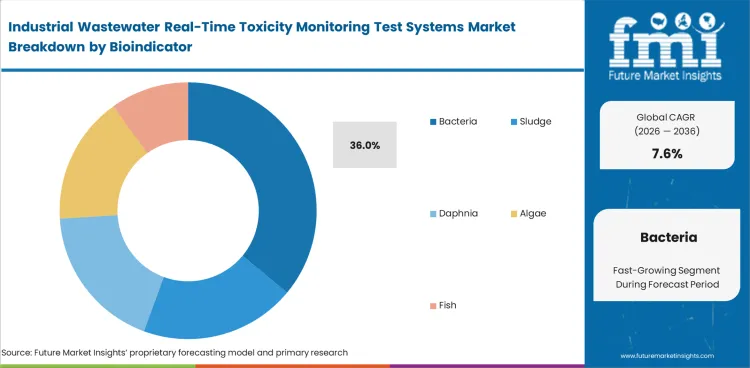
Biological response becomes commercially useful only when the selected organism delivers a repeatable signal without creating excessive handling burden for the site. Bacteria-based systems are anticipated to represent 36% share in 2026 for that reason. Rapid-response formats using bacteria fit plants that need same-day visibility and cannot rely on longer bioassay cycles to guide wastewater action. Sludge, daphnia, algae, and fish-based options continue to matter where the plant wants a different ecological response profile or a broader warning lens. Daily usability still favors bacteria in many facilities because setup is more manageable and internal acceptance usually arrives sooner. Bioindicator choice is therefore less about theoretical sensitivity alone and more about whether the warning can be maintained as part of routine plant discipline.
- Handling burden: Simpler preparation lowers day-to-day pressure on laboratory teams.
- Signal repeatability: Stable response under variable effluent conditions matters more than one-time sensitivity claims.
- Application fit: Organism choice has to match the plant’s likely toxicity pattern or alarm confidence weakens quickly.
Industrial Wastewater Real-Time Toxicity Monitoring Test Systems Market Analysis by System Format
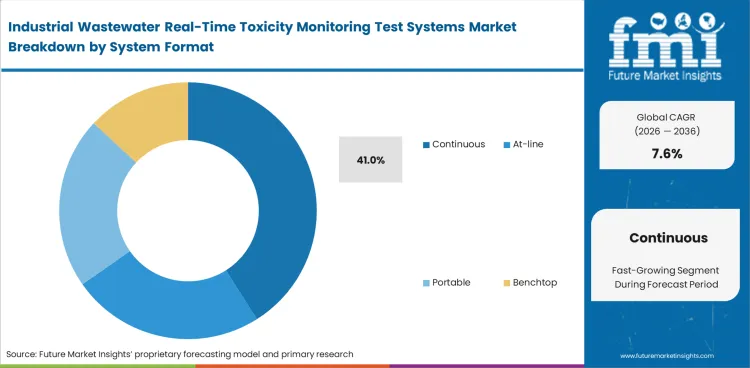
Continuous systems are projected to account for 41% share in 2026, ahead of at-line, portable, and benchtop formats. Continuous coverage leads this category because toxicity events rarely wait for a staffed testing window. Preference is tied to operating reality rather than hardware form alone. Plants choose continuous deployment when unstable discharge conditions, cleaning cycles, or unexpected stream changes can push toxicity outside a scheduled testing pattern. At-line and benchtop systems still carry value in investigation and confirmation work, while portable units remain useful in site checks and temporary review. Core advantage stays with continuous monitoring because warning value falls sharply once the plant accepts blind periods between observations. Format choice therefore affects not only visibility, but also the credibility of the plant’s response logic.
- Coverage window: Continuous deployment reduces blind periods between scheduled checks.
- Recovery behavior: Units that return to routine operation quickly after an event remain more useful in unstable treatment phases.
- Workflow fit: Format choice matters most when the system has to support both warning and confirmation.
Industrial Wastewater Real-Time Toxicity Monitoring Test Systems Market Analysis by Monitoring Objective
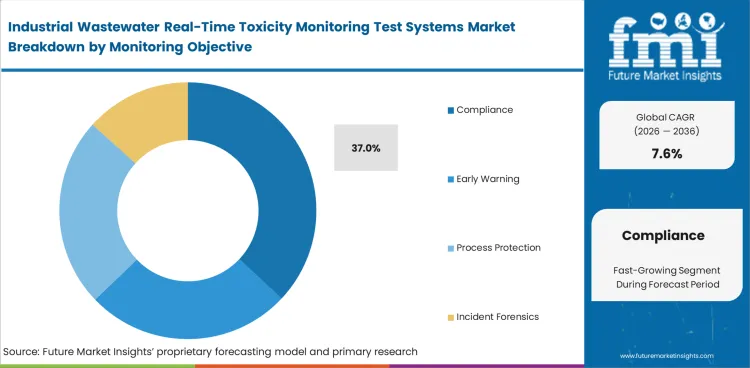
Environmental review still opens with one central question: can the site justify the system in relation to discharge exposure and permit discipline. Compliance-led installations are forecast to represent 37% share in 2026 because that remains the clearest internal case for approval. Early warning, process protection, and incident forensics all matter, though compliance continues to provide the strongest starting point in many plants. Environmental managers can explain a compliance case more easily than a broader optimization case when capital scrutiny is tight. Over time, plants that begin with permit discipline often expand the role of the system into process protection and event review. Monitoring objective therefore evolves with site confidence, even though compliance remains the first budget anchor.
- Permit discipline: Clear linkage to discharge control strengthens the internal spending case.
- Event review: Toxicity records are valuable when a plant needs a defensible explanation after an upset.
- Process support: Sites often extend the system’s role once operating teams gain confidence in the signal.
Industrial Wastewater Real-Time Toxicity Monitoring Test Systems Market Analysis by Installation Point
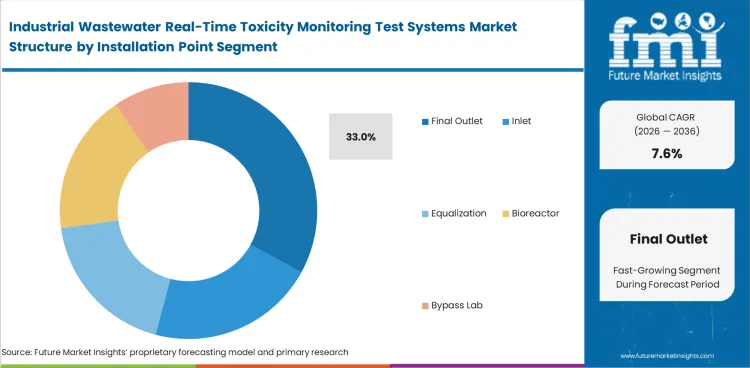
Final outlet monitoring is expected to contribute 33% share in 2026. Final outlet placement remains important because it sits closest to the point where a plant either contains a problem or releases it. Inlet, equalization, bioreactor, and bypass-lab placements all have operational value, especially where a site wants earlier diagnosis inside the treatment train. Final outlet use still leads because environmental managers and plant heads can tie it most directly to discharge exposure and reportable consequence. Early-stage placement helps explanation, while outlet placement strengthens control over the final decision point. Installation point selection therefore reflects how the site balances early warning against the need for a clear compliance-facing record.
- Release visibility: Final outlet data lines up directly with the last controlled discharge point.
- Decision timing: Earlier placements support diagnosis, though outlet placement often secures approval first.
- Record strength: End-point monitoring carries greater weight during internal review after an event.
Industrial Wastewater Real-Time Toxicity Monitoring Test Systems Market Analysis by End-use Industry
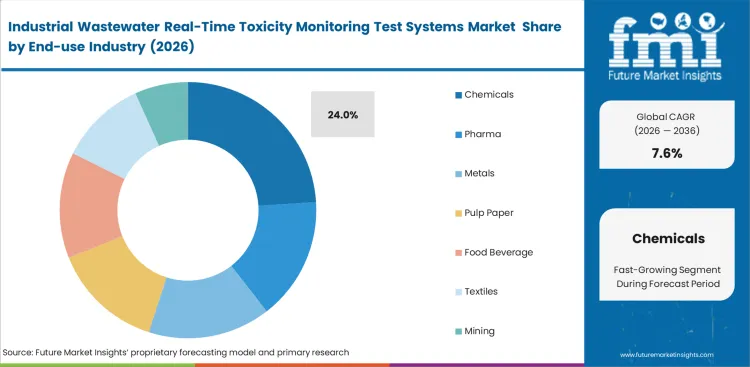
Chemical plants remain central to this category because wastewater composition can change quickly and compound interaction is harder to judge through chemistry data alone. Chemicals are expected to account for 24% share in 2026, ahead of pharma, metals, pulp paper, food beverage, textiles, and mining. Treatment teams in this sector place high value on warning tools that can show biological effect before a variable stream damages biomass or reaches final release. Wastewater complexity, not plant size alone, keeps chemicals in the lead. Other industries continue to add demand where toxic-load variation is meaningful, yet chemical production environments tend to face the strongest case for earlier toxicity visibility. End-use leadership therefore follows wastewater uncertainty more than simple installed base count.
- Effluent variability: Rapid composition change makes early toxicity warning more valuable in chemical production.
- Biology protection: Earlier visibility helps sites avoid longer recovery after a harmful discharge event.
- Operating urgency: Same-day interpretation matters when treatment stability can deteriorate quickly.
Industrial Wastewater Real-Time Toxicity Monitoring Test Systems Market Analysis by Purchase Model
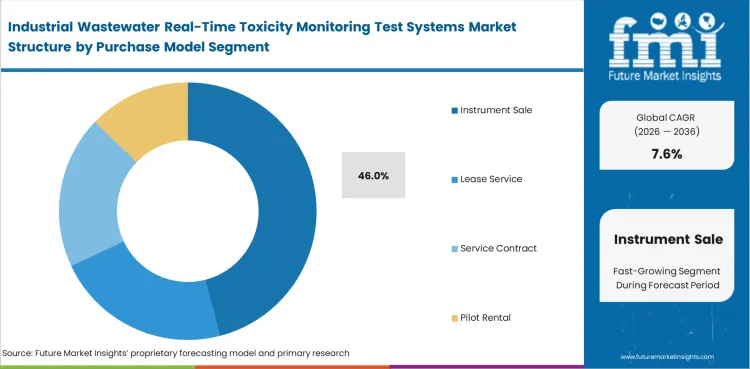
Instrument sale is expected to hold 46% share in 2026. Instrument ownership remains the preferred route where plant teams want direct control over maintenance timing, service windows, and asset use. Lease service, service contracts, and pilot rental still play a role when a site is testing category fit or trying to reduce initial financial pressure. Permanent installation often moves toward ownership once the operating case is proven and internal users want continuity in upkeep and accountability. Early trial formats can help the category enter a site, though long-term use tends to favor direct asset control. Purchase model choice therefore reflects how quickly the plant moves from evaluation into routine operating reliance.
- Asset control: Ownership gives sites more say over upkeep timing and internal accountability.
- Trial entry: Rental and pilot pathways help hesitant plants test fit before a full commitment.
- Continuity: Long-term use benefits when maintenance and responsibility are not split across temporary arrangements.
Industrial Wastewater Real-Time Toxicity Monitoring Test Systems Market Analysis by Output Integration
Control-room visibility gives toxicity data greater operating value once the signal reaches the same digital environment used for wastewater decisions. SCADA-ready systems are forecast to represent 38.0% share in 2026 because alarm routing, event logging, and response review become easier when the output does not remain trapped at the instrument level. Standalone units still matter for narrower confirmation work, while PLC-ready and cloud-linked options attract plants with different control preferences. Advantage stays with SCADA-ready systems because integration improves the chance that the alarm will lead to a timely response rather than delayed interpretation. Output integration therefore influences not just data flow, but whether the instrument becomes part of actual wastewater control.
- Control-room reach: Integrated output improves response because the signal is visible to more than one function.
- Traceability: Logged events are easier to review when toxicity data joins regular plant records.
- Retrofit risk: Late integration planning can add avoidable software work and user retraining.
Industrial Wastewater Real-Time Toxicity Monitoring Test Systems Market Drivers, Restraints, and Opportunities
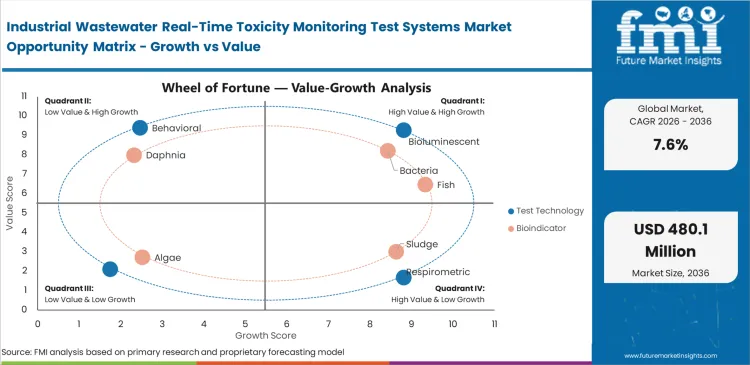
Industrial wastewater teams are being pushed toward earlier toxicity visibility because mixed effluent can become biologically harmful before routine confirmation is completed. Environmental compliance managers, wastewater supervisors, and automation engineers now have to decide whether delayed interpretation remains acceptable when a single event can damage treatment biology or complicate discharge quality. Industry outlook therefore favors systems that support intervention in the same operating window. Faster category expansion is most likely where plants treat toxicity warning as part of wastewater control rather than a narrow laboratory exercise.
Validation burden remains the main restraint. Laboratory managers, maintenance teams, environmental compliance heads, and control-room users all need confidence in the same signal before the instrument is allowed to influence a real operating decision. Friction comes from method comparison, routine upkeep, internal approval discipline, and the effort required to prove that an alarm deserves action. Some suppliers ease the burden with clearer software, easier service routines, and pilot support. Limits remain when the site cannot spare time for validation or wants live alarms without committing to the upkeep needed to sustain trust.
Opportunities in the Industrial Wastewater Real-Time Toxicity Monitoring Test Systems Market
- Retrofit potential: Existing industrial treatment plants present room for wider category use when toxicity monitoring can be added without rewriting the full control setup.
- Validation support: Suppliers that reduce the internal burden on laboratory and operating teams can move pilot interest into routine use more effectively.
- Integrated visibility: Plants that connect toxicity output with alarm handling and wastewater response routines create a stronger operating case than isolated measurement alone.
Regional Analysis
Key Facts About Country
- China continues to lead this market, with demand projected to rise at 8.6% CAGR through 2036, supported by higher industrial wastewater exposure and scale.
- India is expected to grow at a 8.3% CAGR through 2036, driven by expanding industrial activity and increasing need for early toxicity detection.
- South Korea is projected to register 7.9% CAGR through 2036, supported by stronger integration with automation and monitoring systems.
- The United States is expected to expand at 7.4% CAGR through 2036, backed by established toxicity testing practices and large treatment capacity.
- Germany, at 7% CAGR through 2036, reflects a more validation-driven and selective adoption approach.
- France is forecast to grow at 6.8% CAGR through 2036, supported by demand for systems that align with both laboratory and plant operations.
- Japan is expected to grow at 6.6% CAGR through 2036, reflecting mature infrastructure and cautious adoption patterns.
Based on the regional analysis, Industrial Wastewater Real-Time Toxicity Monitoring Test Systems Market is segmented into North America, Europe, Asia Pacific, Latin America, and Middle East & Africa across 40 plus countries.
.webp "Top Country Growth Comparison Industrial Wastewater Real Time Toxicity Monitoring Test Systems Market Cagr (2026 2036)")
| Country | CAGR (2026 to 2036) |
|---|---|
| China | 8.6% |
| India | 8.3% |
| South Korea | 7.9% |
| United States | 7.4% |
| Germany | 7% |
| France | 6.8% |
| Japan | 6.6% |
Source: Future Market Insights (FMI) analysis and primary research
North America Industrial Wastewater Real-Time Toxicity Monitoring Test Systems Market Analysis
Permit discipline keeps North America on a measured but dependable path in this category. Plants here do not add real-time toxicity systems simply to widen instrument coverage. Environmental teams usually need a clear case tied to discharge control, event traceability, and reduced blind periods between routine checks. Capital approval also depends on whether the unit can fit existing wastewater routines without creating avoidable upkeep burden. Connection with water testing analysis remains visible across this region, yet toxicity monitoring is judged more by operating consequence than by broad water-quality visibility. Category valuation is therefore rising on practical plant logic rather than novelty.
-
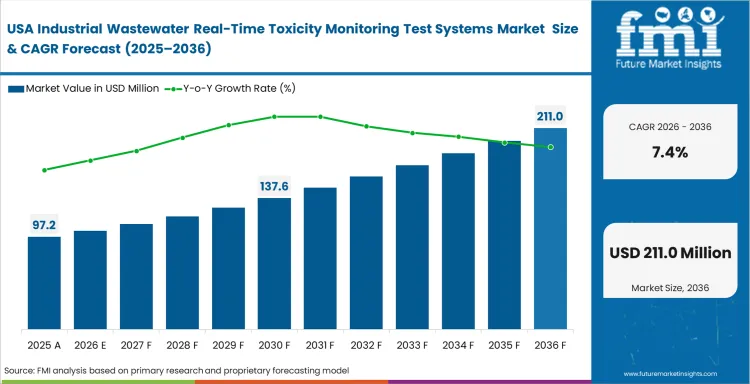
United States: Industry outlook in the United States points to 7.4% CAGR from 2026 to 2036. Whole-effluent-toxicity discipline gives the United States a stronger starting point than many countries still building internal familiarity with toxicity warning. Environmental managers usually want proof that the signal can support a real wastewater decision, while treatment supervisors look for dependable operation during unstable discharge periods. Large industrial treatment capacity supports the category, though adoption still depends on whether a new system improves alarm trust, fits maintenance routines, and shortens the time between detection and corrective action. Clarity at the final outlet remains especially important in large multi-stream facilities.
FMI's report includes Canada and Mexico. Industrial sites in both countries add room for category expansion where exporters and wastewater-intensive facilities need clearer discharge records, though acceptance still depends on how convincingly the system supports day-to-day control inside the treatment train.
Europe Industrial Wastewater Real-Time Toxicity Monitoring Test Systems Market Analysis
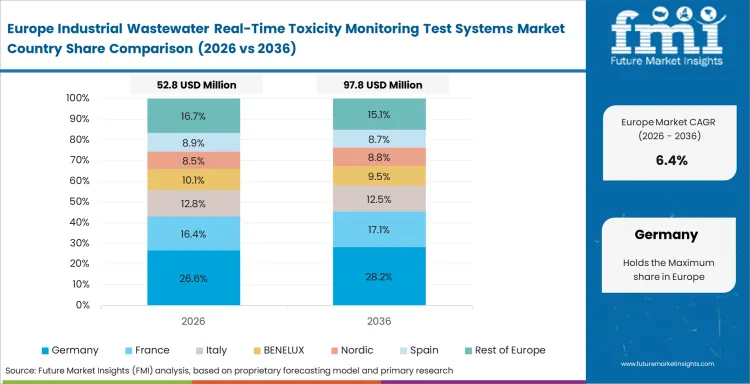
Validation depth, operating fit, and maintenance discipline carry more weight in Europe than quick category acceleration. Industrial sites across the region usually take a careful route because wastewater-control changes interact with engineering review, internal environmental oversight, and high expectations around record credibility. Germany and France form the most visible demand base, while the wider regional outlook remains supported by plants that prefer dependable performance over headline specification claims. Relevance to environmental monitoring is clear, but toxicity systems advance here only when signal stability and service continuity are easy to defend. Europe is therefore inclining forward through selective adoption rather than rushed rollout.
- Germany: Engineering discipline defines how Germany evaluates this category. Environmental managers and wastewater teams usually examine signal consistency, service frequency, and fit with established treatment routines before approving installation. Mid-paragraph commercial logic matters here, because Germany is likely to register 7% CAGR during 2026 to 2036, yet that pace comes more from careful replacement and targeted new installations than from first-time category discovery at scale. Interest is on a positive trend where complex industrial effluent creates uncertainty that ordinary chemistry data cannot resolve quickly enough. Systems that reduce validation effort while keeping data credibility intact stand a better chance of moving from pilot review into routine plant use.
- France: France is estimated at 6.8% CAGR through 2036, with uptake supported by facilities that need warning tools capable of fitting laboratory practice and plant-floor response at the same time. Wastewater reliability and treatment-train protection shape the French case for this category. Sites that have already dealt with discharge uncertainty or treatment upset tend to evaluate toxicity monitoring with more seriousness because late visibility has direct operating consequences. Linkage with water treatment is often part of the internal review, yet final approval usually rests on whether the system improves practical decision timing. Cleaner operating logic, manageable upkeep, and stable signal interpretation remain central in this market.
FMI's report includes Benelux and Nordic regions. Processing facilities and industrial utilities in those areas often serve as reference points for disciplined wastewater control, and category acceptance is helped by a preference for systems that are easy to validate, easy to maintain, and credible in internal environmental review.
Asia Pacific Industrial Wastewater Real-Time Toxicity Monitoring Test Systems Market Analysis
Asia Pacific carries the strongest forward pace in this category because wider industrial wastewater exposure, installed-base expansion, and tighter attention to discharge quality are all moving in the same direction. Category acceptance here does not rely on one single factor. Large manufacturing corridors, more variable toxic-load conditions, and stronger need for earlier response inside the treatment train all support installation of toxicity warning systems. Relevance to industrial water treatment is especially clear across this region, where plants increasingly need earlier visibility before harmful streams damage biological treatment or complicate outlet decisions. Valuation is therefore ascending from a broader first-installation runway than mature regions can offer.
- China: Large industrial clusters and heavier wastewater complexity give China the strongest national case for real-time toxicity systems. Plants operating in chemicals, metals, and other wastewater-intensive sectors often need faster warning when a harmful stream can damage biomass or complicate final discharge quality. China is expected to post 8.6% CAGR between 2026 and 2036, the highest among the countries covered here. Scale matters almost as much as operating need, because once live toxicity warning proves useful at one site, neighboring industrial facilities often gain a clearer basis for similar installation. Category acceptance is also rising where treatment teams want a more direct link between toxicity detection, diversion decisions, and discharge control.
- India: Current outlook places India at 8.3% CAGR through the 2026 to 2036 period. Fast industrial expansion does not automatically create broad category uptake, yet treatment reliability concerns are making toxicity warning more relevant across India. Engineering teams are paying closer attention to systems that help them respond before an upset reaches the outlet or weakens biological treatmentA lower installed base than mature markets leaves more room for first-time installation, while practical acceptance still depends on whether training, validation, and upkeep can be handled without disrupting daily plant routines. Interest is rising most where complex effluent profiles make delayed laboratory confirmation too slow for operating control.
- South Korea: Online monitoring discipline gives South Korea an advantage in categories that depend on dependable alarm handling. Plants here are more likely to examine whether a toxicity system fits existing control routines, service expectations, and wastewater review practice than to treat it as a narrow instrument purchase. South Korea is anticipated to record 7.9% CAGR during the forecast period. Connection with process automation becomes more relevant in this market because alarm routing and signal visibility help determine whether the instrument supports real-time action or remains an isolated measurement point. Well-integrated systems tend to gain faster acceptance once site teams are satisfied that maintenance burden will remain manageable.
- Japan: Long equipment life, careful technical review, and preference for dependable operating discipline keep Japan on a steadier path than faster-rising Asian markets. Sites where wastewater conditions justify earlier warning are expanding category use, though most facilities proceed only after a close review of service continuity, data trust, and fit with existing plant routines. Industry outlook in Japan points to 6.6% CAGR from 2026 to 2036. Pace remains below China, India, and South Korea because many plants already run mature treatment programs and are less inclined to replace established practice without a clearly visible operating gain. Stable usability matters more here than broad category enthusiasm.
FMI's report includes ASEAN and Oceania. Export-oriented manufacturing sites and industrial water utilities across those countries add longer-term room for category expansion, especially where wastewater control is becoming more exacting and plant teams need clearer warning during unstable discharge periods.
Competitive Aligners for Market Players
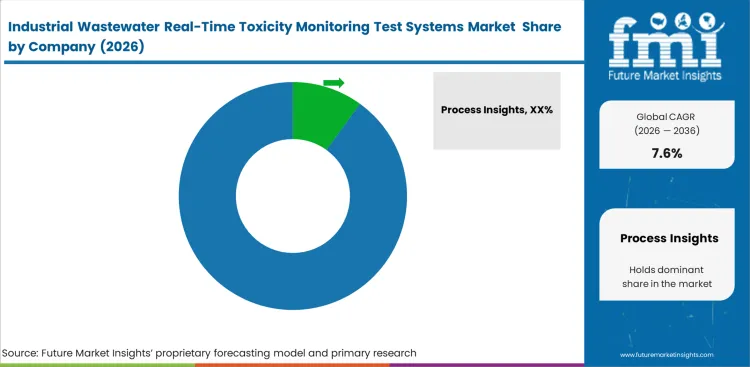
Fragmentation remains a defining feature of this category because industrial plants do not select from one uniform supplier class. Some vendors come from online water analysis, some from biomonitoring, and some from specialist toxicity applications. Process Insights, Hach, bbe Moldaenke GmbH, AQUALABO, MicroLAN B.V., MicroBioTests Inc., and Modern Water sit inside that specialist field. Plant teams usually separate stronger offers from weaker ones through alarm credibility, method fit, service response, software clarity, and confidence that the unit will remain dependable after installation. Broad catalog size matters less than whether the supplier can support routine use in a wastewater-control setting.
Incumbent advantage comes from dependable service, familiar assay logic, and the ability to help a site through validation without adding unnecessary operational burden. Hach and Process Insights benefit from stronger visibility in water analysis and support depth. AQUALABO, bbe Moldaenke, MicroLAN, Modern Water, and MicroBioTests attract attention where biological monitoring depth, application fit, or specialist credibility carries more weight. Competitive standing therefore depends on whether the supplier can shorten alarm interpretation time, support upkeep, and help the site trust the signal in routine operation.
Plant teams still retain meaningful leverage because chemistry monitoring, toxicity warning, software logging, and confirmatory testing can be sourced from different vendors when one offer fails to inspire confidence. Lock-in is therefore limited. Through 2036, competitive balance is likely to remain spread across specialists and broader water-analysis companies, with stronger positions going to suppliers that reduce validation burden, maintain service consistency, and support dependable use after commissioning.
Key Players in Industrial Wastewater Real-Time Toxicity Monitoring Test Systems Market
- Process Insights
- Hach
- bbe Moldaenke GmbH
- AQUALABO
- MicroLAN B.V.
- MicroBioTests Inc.
- Modern Water
Scope of the Report
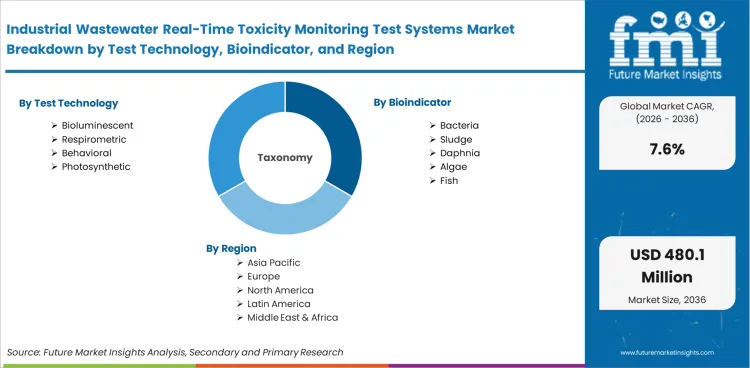
| Metric | Value |
|---|---|
| Quantitative Units | USD 214.5 million to USD 446.2 million, at a 7.6% CAGR |
| Market Definition | Industrial Wastewater Real-Time Toxicity Monitoring Test Systems Market covers dedicated instruments, biomonitoring platforms, linked software, and service support used to detect aggregate toxic effect in industrial effluent. Boundary excludes standard chemistry analyzers and wastewater treatment assets that do not determine toxicity directly. |
| Test Technology Segmentation | Bioluminescent, Respirometric, Behavioral, Photosynthetic |
| Bioindicator Segmentation | Bacteria, Sludge, Daphnia, Algae, Fish |
| System Format Segmentation | Continuous, At-line, Portable, Benchtop |
| Monitoring Objective Segmentation | Compliance, Early Warning, Process Protection, Incident Forensics |
| Installation Point Segmentation | Final Outlet, Inlet, Equalization, Bioreactor, Bypass Lab |
| End-use Industry Segmentation | Chemicals, Pharma, Metals, Pulp Paper, Food Beverage, Textiles, Mining |
| Purchase Model Segmentation | Instrument Sale, Lease Service, Service Contract, Pilot Rental |
| Output Integration Segmentation | SCADA-ready, Standalone, PLC-ready, Cloud-linked |
| Regions Covered | North America, Europe, Asia Pacific, Latin America, Middle East & Africa |
| Countries Covered | China, India, South Korea, United States, Germany, France, Japan, and 40 plus countries |
| Key Companies Profiled | Process Insights, Hach, bbe Moldaenke GmbH, AQUALABO, MicroLAN B.V., MicroBioTests Inc., Modern Water |
| Forecast Period | 2026 to 2036 |
| Approach | FMI combined interviews with plant-level wastewater stakeholders, public technical review, and application-based adoption logic. Baseline sizing was anchored to higher-risk industrial treatment sites and then weighted by equipment use, service attachment, software use, and consumables. Forecast validation relied on treatment-train placement, installed-base maturity, and replacement timing. |
Source: Future Market Insights (FMI) analysis and primary research
Industrial Wastewater Real-Time Toxicity Monitoring Test Systems Market Analysis by Segments
By Test Technology
- Bioluminescent
- Respirometric
- Behavioral
- Photosynthetic
By Bioindicator
- Bacteria
- Sludge
- Daphnia
- Algae
- Fish
By System Format
- Continuous
- At-line
- Portable
- Benchtop
By Monitoring Objective
- Compliance
- Early Warning
- Process Protection
- Incident Forensics
By Installation Point
- Final Outlet
- Inlet
- Equalization
- Bioreactor
- Bypass Lab
By End-use Industry
- Chemicals
- Pharma
- Metals
- Pulp Paper
- Food Beverage
- Textiles
- Mining
By Purchase Model
- Instrument Sale
- Lease Service
- Service Contract
- Pilot Rental
By Output Integration
- SCADA-ready
- Standalone
- PLC-ready
- Cloud-linked
By Region
- North America
- United States
- Canada
- Mexico
- Europe
- Germany
- France
- Benelux
- Nordics
- Rest of Europe
- Asia Pacific
- China
- India
- South Korea
- Japan
- ASEAN
- Oceania
- Latin America
- Brazil
- Rest of Latin America
- Middle East & Africa
- GCC Countries
- South Africa
- Rest of Middle East & Africa
Bibliography
- USA Environmental Protection Agency. (2026, January 15). Whole Effluent Toxicity Methods.
- USA Environmental Protection Agency. (2025, September 12). Permit Limits-Whole Effluent Toxicity (WET). European Environment Agency. (2025, May 08). Industrial emissions intensity indicator. European Environment Agency. (2026, February 17). Summary Releases.
- Organisation for Economic Co-operation and Development. (2025, July 03). Best Available Techniques for Industrial Emission Prevention and Control: Insights from textiles and paper-pulp manufacturing sectors.
This bibliography is provided for reader reference. The full FMI report contains the complete reference list with primary source documentation.
This Report Addresses
- Market intelligence to support strategic decision making across bioluminescent analyzers, bacteria-based biomonitors, continuous toxicity systems, and SCADA-ready alarm platforms.
- Market size estimation and 10-year revenue forecasts from 2026 to 2036, supported by site-level adoption logic, treatment-train placement review, and category validation patterns.
- Growth opportunity mapping across test technology, bioindicator, system format, monitoring objective, installation point, end-use industry, purchase model, and output integration.
- Segment and regional revenue forecasts covering bioluminescent systems, bacteria platforms, continuous systems, compliance-led monitoring, and final-outlet placement across industrial wastewater-control programs.
- Competition assessment covering service reliability, alarm credibility, validation support, assay fit, software clarity, and maintenance continuity.
- Technology tracking across biomonitoring, at-line confirmation, control-room alarm routing, same-day toxicity verification, and final-discharge warning use.
- Market access analysis covering discharge-risk review, installed-base maturity, replacement timing, internal approval discipline, and wastewater-control priorities at industrial sites.
- Market report delivery in PDF, Excel, PPT, and interactive dashboard formats for executive planning, wastewater-control review, and operating benchmark use.
Frequently Asked Questions
How large is the Industrial Wastewater Real-Time Toxicity Monitoring Test Systems Market in 2026?
Industry valuation is estimated at USD 214.5 million in 2026, reflecting wider use of toxicity warning in wastewater control.
What valuation is projected for the market by 2036?
Market valuation is expected to reach USD 446.2 million by 2036 as category use expands beyond narrow confirmation work.
What CAGR is projected for the market during 2026 to 2036?
Industry outlook points to 7.6% CAGR from 2026 to 2036, supported by rising use in plant-level wastewater decisions.
Which test technology segment leads the market?
Bioluminescent systems lead test technology and are expected to account for 34% share in 2026.
Which bioindicator segment remains prominent?
Bacteria-based platforms remain prominent and are likely to represent 36% share in 2026
Which system format leads the market?
Continuous systems lead the format category and are projected to secure 41% share in 2026.
What is the main factor supporting category expansion?
Earlier toxicity warning is becoming more important where delayed confirmation arrives too late for practical wastewater intervention.
What is the primary restraint in this market?
Validation burden remains the main restraint because multiple plant functions must trust the same toxicity signal.
Which country posts the fastest pace in this market?
China leads with 8.6% CAGR through 2036, supported by broad industrial wastewater exposure and earlier-warning requirements.
Why does China lead over other countries in this market?
Large industrial clusters and more complex effluent conditions give China a stronger case for first-time installation.
Why does India remain close behind China?
India is expected to record 8.3% CAGR through 2036 because installed base remains lower and adoption room is wider.
Why does South Korea stand above the United States in growth pace?
South Korea is estimated at 7.9% CAGR, ahead of the United States at 7.4% CAGR, due to stronger online-monitoring readiness.
Why does Japan trail the other Asia Pacific countries covered here?
Japan is expected to register 6.6% CAGR because long equipment life and careful review keep adoption steadier.
Why does Germany advance more slowly than China and India?
Germany is projected at 7% CAGR through 2036, with opportunity tied more to replacement and selective installation.
What keeps France slightly below Germany?
France is estimated at 6.8% CAGR because sites often require laboratory fit and plant-floor usability in the same decision.
Which installation point leads the market?
Final outlet monitoring leads installation point analysis and is expected to contribute 33% share in 2026.
Why does compliance-led monitoring remain the leading objective?
Compliance-focused monitoring is forecast to represent 37% share in 2026 because permit discipline still anchors spending cases.
Which end-use industry leads the market?
Chemicals lead end-use analysis and are likely to account for 24% share in 2026.
Why do continuous systems stay ahead of at-line and portable formats?
Continuous coverage reduces blind periods and improves warning value during unstable discharge conditions.
Which purchase model remains dominant?
Instrument sale remains dominant and is expected to hold 46% share in 2026.
Which output integration format leads the market?
SCADA-ready systems lead output integration and are forecast to represent 38% share in 2026.
Preview the report firsthand - request a free sample
Get SampleGet the brochure for pricing and purchase details.
Get PDFTable of Content
- Executive Summary
- Global Market Outlook
- Demand-side Trends
- Supply-side Trends
- Technology Roadmap Analysis
- Analysis and Recommendations
- Market Overview
- Market Coverage / Taxonomy
- Market Definition / Scope / Limitations
- Research Methodology
- Chapter Orientation
- Analytical Framework
- Market Structure, Signals, and Trend Drivers
- Benchmarking and Cross-market Comparability
- Market Sizing, Forecasting, and Opportunity Mapping
- Research Design and Evidence Framework
- Desk Research Programme (Secondary Evidence)
- Company Annual and Sustainability Reports
- Peer-reviewed Journals and Academic Literature
- Corporate Websites, Product Literature, and Technical Notes
- Earnings Decks and Investor Briefings
- Statutory Filings and Regulatory Disclosures
- Technical White Papers and Standards Notes
- Trade Journals, Industry Magazines, and Analyst Briefs
- Conference Proceedings, Webinars, and Seminar Materials
- Government Statistics Portals and Public Data Releases
- Press Releases and Reputable Media Coverage
- Specialist Newsletters and Curated Briefings
- Sector Databases and Reference Repositories
- FMI Proprietary Databases and Historical Market Data
- Subscription Datasets and Paid Sources
- Social Channels, Communities, and Digital Listening Inputs
- Additional Desk Sources
- Expert Input and Fieldwork (Primary Evidence)
- Primary Modes
- Qualitative Interviews and Expert Elicitation
- Quantitative Surveys and Structured Data Capture
- Blended Approach
- Why Primary Evidence is Used
- Field Techniques
- Interviews
- Surveys
- Focus Groups
- Observational and In-context Research
- Social and Community Interactions
- Stakeholder Universe Engaged
- C-suite Leaders
- Board Members
- Presidents and Vice Presidents
- R&D and Innovation Heads
- Technical Specialists
- Domain Subject-matter Experts
- Scientists
- Physicians and Other Healthcare Professionals
- Governance, Ethics, and Data Stewardship
- Research Ethics
- Data Integrity and Handling
- Primary Modes
- Research Methods and Reference Sources
- Desk Research Programme (Secondary Evidence)
- Market Data Analysis and Forecast Development
- Data Collection
- Data Review and Validation
- Synthesis, Triangulation, and Analysis
- Research Quality and Validation
- Market Background
- Market Dynamics
- Drivers
- Restraints
- Opportunity
- Trends
- Scenario Forecast
- Demand in Optimistic Scenario
- Demand in Likely Scenario
- Demand in Conservative Scenario
- Opportunity Map Analysis
- Product Life Cycle Analysis
- Supply Chain Analysis
- Investment Feasibility Matrix
- Value Chain Analysis
- PESTLE and Porter’s Analysis
- Regulatory Landscape
- Regional Parent Market Outlook
- Production and Consumption Statistics
- Import and Export Statistics
- Market Dynamics
- Global Market Analysis 2021 to 2025 and Forecast, 2026 to 2036
- Historical Market Size Value (USD Million) Analysis, 2021 to 2025
- Current and Future Market Size Value (USD Million) Projections, 2026 to 2036
- Y-o-Y Growth Trend Analysis
- Absolute $ Opportunity Analysis
- Global Market Pricing Analysis 2021 to 2025 and Forecast 2026 to 2036
- Global Market Analysis 2021 to 2025 and Forecast 2026 to 2036, By Test Technology
- Introduction / Key Findings
- Historical Market Size Value (USD Million) Analysis By Test Technology , 2021 to 2025
- Current and Future Market Size Value (USD Million) Analysis and Forecast By Test Technology , 2026 to 2036
- Bioluminescent
- Respirometric
- Behavioral
- Photosynthetic
- Bioluminescent
- Y-o-Y Growth Trend Analysis By Test Technology , 2021 to 2025
- Absolute $ Opportunity Analysis By Test Technology , 2026 to 2036
- Global Market Analysis 2021 to 2025 and Forecast 2026 to 2036, By Bioindicator
- Introduction / Key Findings
- Historical Market Size Value (USD Million) Analysis By Bioindicator, 2021 to 2025
- Current and Future Market Size Value (USD Million) Analysis and Forecast By Bioindicator, 2026 to 2036
- Bacteria
- Sludge
- Daphnia
- Algae
- Fish
- Bacteria
- Y-o-Y Growth Trend Analysis By Bioindicator, 2021 to 2025
- Absolute $ Opportunity Analysis By Bioindicator, 2026 to 2036
- Global Market Analysis 2021 to 2025 and Forecast 2026 to 2036, By System Format
- Introduction / Key Findings
- Historical Market Size Value (USD Million) Analysis By System Format, 2021 to 2025
- Current and Future Market Size Value (USD Million) Analysis and Forecast By System Format, 2026 to 2036
- Continuous
- At-line
- Portable
- Benchtop
- Continuous
- Y-o-Y Growth Trend Analysis By System Format, 2021 to 2025
- Absolute $ Opportunity Analysis By System Format, 2026 to 2036
- Global Market Analysis 2021 to 2025 and Forecast 2026 to 2036, By Monitoring Objective
- Introduction / Key Findings
- Historical Market Size Value (USD Million) Analysis By Monitoring Objective, 2021 to 2025
- Current and Future Market Size Value (USD Million) Analysis and Forecast By Monitoring Objective, 2026 to 2036
- Compliance
- Early Warning
- Process Protection
- Incident Forensics
- Compliance
- Y-o-Y Growth Trend Analysis By Monitoring Objective, 2021 to 2025
- Absolute $ Opportunity Analysis By Monitoring Objective, 2026 to 2036
- Global Market Analysis 2021 to 2025 and Forecast 2026 to 2036, By Installation Point
- Introduction / Key Findings
- Historical Market Size Value (USD Million) Analysis By Installation Point, 2021 to 2025
- Current and Future Market Size Value (USD Million) Analysis and Forecast By Installation Point, 2026 to 2036
- Final Outlet
- Inlet
- Equalization
- Bioreactor
- Bypass Lab
- Final Outlet
- Y-o-Y Growth Trend Analysis By Installation Point, 2021 to 2025
- Absolute $ Opportunity Analysis By Installation Point, 2026 to 2036
- Global Market Analysis 2021 to 2025 and Forecast 2026 to 2036, By End-use Industry
- Introduction / Key Findings
- Historical Market Size Value (USD Million) Analysis By End-use Industry, 2021 to 2025
- Current and Future Market Size Value (USD Million) Analysis and Forecast By End-use Industry, 2026 to 2036
- Chemicals
- Pharma
- Metals
- Pulp Paper
- Food Beverage
- Textiles
- Mining
- Chemicals
- Y-o-Y Growth Trend Analysis By End-use Industry, 2021 to 2025
- Absolute $ Opportunity Analysis By End-use Industry, 2026 to 2036
- Global Market Analysis 2021 to 2025 and Forecast 2026 to 2036, By Purchase Model
- Introduction / Key Findings
- Historical Market Size Value (USD Million) Analysis By Purchase Model, 2021 to 2025
- Current and Future Market Size Value (USD Million) Analysis and Forecast By Purchase Model, 2026 to 2036
- Instrument Sale
- Lease Service
- Service Contract
- Pilot Rental
- Instrument Sale
- Y-o-Y Growth Trend Analysis By Purchase Model, 2021 to 2025
- Absolute $ Opportunity Analysis By Purchase Model, 2026 to 2036
- Global Market Analysis 2021 to 2025 and Forecast 2026 to 2036, By Region
- Introduction
- Historical Market Size Value (USD Million) Analysis By Region, 2021 to 2025
- Current Market Size Value (USD Million) Analysis and Forecast By Region, 2026 to 2036
- North America
- Latin America
- Western Europe
- Eastern Europe
- East Asia
- South Asia and Pacific
- Middle East & Africa
- Market Attractiveness Analysis By Region
- North America Market Analysis 2021 to 2025 and Forecast 2026 to 2036, By Country
- Historical Market Size Value (USD Million) Trend Analysis By Market Taxonomy, 2021 to 2025
- Market Size Value (USD Million) Forecast By Market Taxonomy, 2026 to 2036
- By Country
- USA
- Canada
- Mexico
- By Test Technology
- By Bioindicator
- By System Format
- By Monitoring Objective
- By Installation Point
- By End-use Industry
- By Purchase Model
- By Country
- Market Attractiveness Analysis
- By Country
- By Test Technology
- By Bioindicator
- By System Format
- By Monitoring Objective
- By Installation Point
- By End-use Industry
- By Purchase Model
- Key Takeaways
- Latin America Market Analysis 2021 to 2025 and Forecast 2026 to 2036, By Country
- Historical Market Size Value (USD Million) Trend Analysis By Market Taxonomy, 2021 to 2025
- Market Size Value (USD Million) Forecast By Market Taxonomy, 2026 to 2036
- By Country
- Brazil
- Chile
- Rest of Latin America
- By Test Technology
- By Bioindicator
- By System Format
- By Monitoring Objective
- By Installation Point
- By End-use Industry
- By Purchase Model
- By Country
- Market Attractiveness Analysis
- By Country
- By Test Technology
- By Bioindicator
- By System Format
- By Monitoring Objective
- By Installation Point
- By End-use Industry
- By Purchase Model
- Key Takeaways
- Western Europe Market Analysis 2021 to 2025 and Forecast 2026 to 2036, By Country
- Historical Market Size Value (USD Million) Trend Analysis By Market Taxonomy, 2021 to 2025
- Market Size Value (USD Million) Forecast By Market Taxonomy, 2026 to 2036
- By Country
- Germany
- UK
- Italy
- Spain
- France
- Nordic
- BENELUX
- Rest of Western Europe
- By Test Technology
- By Bioindicator
- By System Format
- By Monitoring Objective
- By Installation Point
- By End-use Industry
- By Purchase Model
- By Country
- Market Attractiveness Analysis
- By Country
- By Test Technology
- By Bioindicator
- By System Format
- By Monitoring Objective
- By Installation Point
- By End-use Industry
- By Purchase Model
- Key Takeaways
- Eastern Europe Market Analysis 2021 to 2025 and Forecast 2026 to 2036, By Country
- Historical Market Size Value (USD Million) Trend Analysis By Market Taxonomy, 2021 to 2025
- Market Size Value (USD Million) Forecast By Market Taxonomy, 2026 to 2036
- By Country
- Russia
- Poland
- Hungary
- Balkan & Baltic
- Rest of Eastern Europe
- By Test Technology
- By Bioindicator
- By System Format
- By Monitoring Objective
- By Installation Point
- By End-use Industry
- By Purchase Model
- By Country
- Market Attractiveness Analysis
- By Country
- By Test Technology
- By Bioindicator
- By System Format
- By Monitoring Objective
- By Installation Point
- By End-use Industry
- By Purchase Model
- Key Takeaways
- East Asia Market Analysis 2021 to 2025 and Forecast 2026 to 2036, By Country
- Historical Market Size Value (USD Million) Trend Analysis By Market Taxonomy, 2021 to 2025
- Market Size Value (USD Million) Forecast By Market Taxonomy, 2026 to 2036
- By Country
- China
- Japan
- South Korea
- By Test Technology
- By Bioindicator
- By System Format
- By Monitoring Objective
- By Installation Point
- By End-use Industry
- By Purchase Model
- By Country
- Market Attractiveness Analysis
- By Country
- By Test Technology
- By Bioindicator
- By System Format
- By Monitoring Objective
- By Installation Point
- By End-use Industry
- By Purchase Model
- Key Takeaways
- South Asia and Pacific Market Analysis 2021 to 2025 and Forecast 2026 to 2036, By Country
- Historical Market Size Value (USD Million) Trend Analysis By Market Taxonomy, 2021 to 2025
- Market Size Value (USD Million) Forecast By Market Taxonomy, 2026 to 2036
- By Country
- India
- ASEAN
- Australia & New Zealand
- Rest of South Asia and Pacific
- By Test Technology
- By Bioindicator
- By System Format
- By Monitoring Objective
- By Installation Point
- By End-use Industry
- By Purchase Model
- By Country
- Market Attractiveness Analysis
- By Country
- By Test Technology
- By Bioindicator
- By System Format
- By Monitoring Objective
- By Installation Point
- By End-use Industry
- By Purchase Model
- Key Takeaways
- Middle East & Africa Market Analysis 2021 to 2025 and Forecast 2026 to 2036, By Country
- Historical Market Size Value (USD Million) Trend Analysis By Market Taxonomy, 2021 to 2025
- Market Size Value (USD Million) Forecast By Market Taxonomy, 2026 to 2036
- By Country
- Kingdom of Saudi Arabia
- Other GCC Countries
- Turkiye
- South Africa
- Other African Union
- Rest of Middle East & Africa
- By Test Technology
- By Bioindicator
- By System Format
- By Monitoring Objective
- By Installation Point
- By End-use Industry
- By Purchase Model
- By Country
- Market Attractiveness Analysis
- By Country
- By Test Technology
- By Bioindicator
- By System Format
- By Monitoring Objective
- By Installation Point
- By End-use Industry
- By Purchase Model
- Key Takeaways
- Key Countries Market Analysis
- USA
- Pricing Analysis
- Market Share Analysis, 2025
- By Test Technology
- By Bioindicator
- By System Format
- By Monitoring Objective
- By Installation Point
- By End-use Industry
- By Purchase Model
- Canada
- Pricing Analysis
- Market Share Analysis, 2025
- By Test Technology
- By Bioindicator
- By System Format
- By Monitoring Objective
- By Installation Point
- By End-use Industry
- By Purchase Model
- Mexico
- Pricing Analysis
- Market Share Analysis, 2025
- By Test Technology
- By Bioindicator
- By System Format
- By Monitoring Objective
- By Installation Point
- By End-use Industry
- By Purchase Model
- Brazil
- Pricing Analysis
- Market Share Analysis, 2025
- By Test Technology
- By Bioindicator
- By System Format
- By Monitoring Objective
- By Installation Point
- By End-use Industry
- By Purchase Model
- Chile
- Pricing Analysis
- Market Share Analysis, 2025
- By Test Technology
- By Bioindicator
- By System Format
- By Monitoring Objective
- By Installation Point
- By End-use Industry
- By Purchase Model
- Germany
- Pricing Analysis
- Market Share Analysis, 2025
- By Test Technology
- By Bioindicator
- By System Format
- By Monitoring Objective
- By Installation Point
- By End-use Industry
- By Purchase Model
- UK
- Pricing Analysis
- Market Share Analysis, 2025
- By Test Technology
- By Bioindicator
- By System Format
- By Monitoring Objective
- By Installation Point
- By End-use Industry
- By Purchase Model
- Italy
- Pricing Analysis
- Market Share Analysis, 2025
- By Test Technology
- By Bioindicator
- By System Format
- By Monitoring Objective
- By Installation Point
- By End-use Industry
- By Purchase Model
- Spain
- Pricing Analysis
- Market Share Analysis, 2025
- By Test Technology
- By Bioindicator
- By System Format
- By Monitoring Objective
- By Installation Point
- By End-use Industry
- By Purchase Model
- France
- Pricing Analysis
- Market Share Analysis, 2025
- By Test Technology
- By Bioindicator
- By System Format
- By Monitoring Objective
- By Installation Point
- By End-use Industry
- By Purchase Model
- India
- Pricing Analysis
- Market Share Analysis, 2025
- By Test Technology
- By Bioindicator
- By System Format
- By Monitoring Objective
- By Installation Point
- By End-use Industry
- By Purchase Model
- ASEAN
- Pricing Analysis
- Market Share Analysis, 2025
- By Test Technology
- By Bioindicator
- By System Format
- By Monitoring Objective
- By Installation Point
- By End-use Industry
- By Purchase Model
- Australia & New Zealand
- Pricing Analysis
- Market Share Analysis, 2025
- By Test Technology
- By Bioindicator
- By System Format
- By Monitoring Objective
- By Installation Point
- By End-use Industry
- By Purchase Model
- China
- Pricing Analysis
- Market Share Analysis, 2025
- By Test Technology
- By Bioindicator
- By System Format
- By Monitoring Objective
- By Installation Point
- By End-use Industry
- By Purchase Model
- Japan
- Pricing Analysis
- Market Share Analysis, 2025
- By Test Technology
- By Bioindicator
- By System Format
- By Monitoring Objective
- By Installation Point
- By End-use Industry
- By Purchase Model
- South Korea
- Pricing Analysis
- Market Share Analysis, 2025
- By Test Technology
- By Bioindicator
- By System Format
- By Monitoring Objective
- By Installation Point
- By End-use Industry
- By Purchase Model
- Russia
- Pricing Analysis
- Market Share Analysis, 2025
- By Test Technology
- By Bioindicator
- By System Format
- By Monitoring Objective
- By Installation Point
- By End-use Industry
- By Purchase Model
- Poland
- Pricing Analysis
- Market Share Analysis, 2025
- By Test Technology
- By Bioindicator
- By System Format
- By Monitoring Objective
- By Installation Point
- By End-use Industry
- By Purchase Model
- Hungary
- Pricing Analysis
- Market Share Analysis, 2025
- By Test Technology
- By Bioindicator
- By System Format
- By Monitoring Objective
- By Installation Point
- By End-use Industry
- By Purchase Model
- Kingdom of Saudi Arabia
- Pricing Analysis
- Market Share Analysis, 2025
- By Test Technology
- By Bioindicator
- By System Format
- By Monitoring Objective
- By Installation Point
- By End-use Industry
- By Purchase Model
- Turkiye
- Pricing Analysis
- Market Share Analysis, 2025
- By Test Technology
- By Bioindicator
- By System Format
- By Monitoring Objective
- By Installation Point
- By End-use Industry
- By Purchase Model
- South Africa
- Pricing Analysis
- Market Share Analysis, 2025
- By Test Technology
- By Bioindicator
- By System Format
- By Monitoring Objective
- By Installation Point
- By End-use Industry
- By Purchase Model
- USA
- Market Structure Analysis
- Competition Dashboard
- Competition Benchmarking
- Market Share Analysis of Top Players
- By Regional
- By Test Technology
- By Bioindicator
- By System Format
- By Monitoring Objective
- By Installation Point
- By End-use Industry
- By Purchase Model
- Competition Analysis
- Competition Deep Dive
- Process Insights
- Overview
- Product Portfolio
- Profitability by Market Segments (Product/Age /Sales Channel/Region)
- Sales Footprint
- Strategy Overview
- Marketing Strategy
- Product Strategy
- Channel Strategy
- Hach
- bbe Moldaenke GmbH
- AQUALABO
- MicroLAN B.V.
- MicroBioTests Inc.
- Modern Water
- Process Insights
- Competition Deep Dive
- Assumptions & Acronyms Used


