

- Industry Size (2026)
- USD 3.6 Bn
- Forecast (2036)
- USD 12.4 Bn
- CAGR (2026 to 2036)
- 13.2%
Chemical Depolymerization Market Forecast and Outlook 2026 to 2036
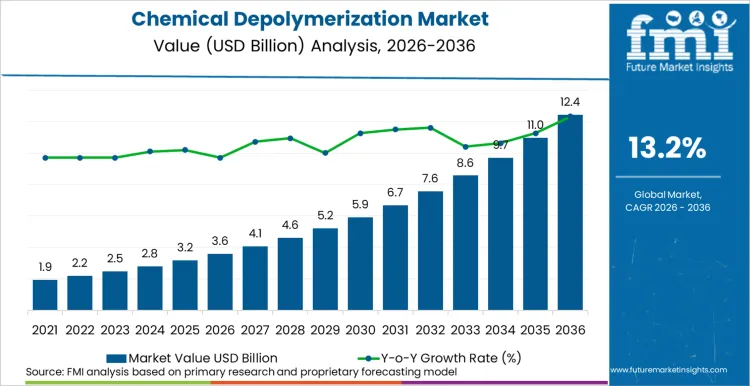
Spending on chemical depolymerization totals USD 3.6 billion in 2026 and is projected to reach USD 12.4 billion by 2036 at a 13.20% CAGR. Demand is defined by the need to convert complex plastic streams into feedstock suitable for food-contact and high-specification applications. Brand owners and material users set acceptance rules through polymer type coverage, contaminant tolerance, and mass-balance accounting during portfolio planning.
Process routes are selected to match target outputs such as monomers or purified intermediates. Once a value chain adopts a route, later changes affect certification scope, offtake contracts, and disclosure files. Growth follows expansion of closed-loop targets across packaging, textiles, and selected engineering resins.
Participation in the chemical depolymerization market depends on inclusion within audited supply chains that link collection, pre-treatment, conversion, and re-polymerization under defined governance. Entry requires documented input control, conversion yield reporting, and consistency of output specifications across campaigns. Approved routes remain in use across extended cycles because regulatory filings and brand claims reference specific processes and balances. Capacity allocation aligns with long-term offtake agreements rather than spot transactions. Revenue development reflects the number of product families committed to chemically recycled feedstock. Competitive position depends on early alignment with brand roadmaps, regulator acceptance, and sustained performance against contracted quality windows.
Chemical Depolymerization Market Quick Stats
- Chemical Depolymerization Market Value (2026): USD 3.6 billion
- Chemical Depolymerization Market Forecast Value (2036): USD 12.4 billion
- Chemical Depolymerization Market Forecast CAGR 2026 to 2036: 13.2%
- Leading End Use in Chemical Depolymerization Market: Food and beverage packaging
- Leading Process Type in Chemical Depolymerization Market: Glycolysis and methanolysis
- Key Growth Regions in Chemical Depolymerization Market: India, China, USA, Germany, Japan
- Top Players in Chemical Depolymerization Market: BASF, JEPLAN, Eastman, Loop Industries, GEM, Wankai New Materials, Teijin, Mitsubishi Chemical Group
What is the Growth Forecast for the Chemical Depolymerization Market through 2036?
Feedstock heterogeneity and output purity targets set the technical boundary in this segment. The chemical depolymerization market in 2026 stands near USD 3.6 billion, up from USD 1.9 billion in 2021 as multilayer, colored, and contaminated plastics enter routes that mechanical recycling cannot handle. Operators evaluate routes through conversion yield, solvent or catalyst stability, energy intensity, and the ability to return monomers to polymer grade specifications. Qualification focuses on impurity profiles, recovery rates, and steady state operation at nameplate capacity. The value path reaches USD 5.9 billion in 2030 and USD 8.6 billion in 2033. The advance to USD 12.4 billion in 2036 corresponds to a 13.20% growth rate supported by wider acceptance of chemically recycled feedstocks in primary applications.
Plant integration and offtake security shape commercial behavior in the chemical depolymerization market. Volumes move under long agreements that connect collectors, preprocessors, conversion plants, and polymerization assets inside closed accounting systems. Stock policy prioritizes continuous feedstock flow and product grade stability. Cost structure reflects pretreatment, reagent consumption, separation steps, utilities, and quality screening. Operators track uptime, solvent losses, and product specification drift as operating gates. Annual values pass USD 7.6 billion in 2032 and USD 11.0 billion in 2035 as more capacity reaches steady operation. The rise to USD 12.4 billion in 2036 comes from broader material coverage, higher plant utilization, and longer contracts that place depolymerized output into fixed resin supply programs.
Chemical Depolymerization Market Key Takeaways
| Metric | Value |
|---|---|
| Market Value (2026) | USD 3.6 billion |
| Forecast Value (2036) | USD 12.4 billion |
| Forecast CAGR 2026 to 2036 | 13.2% |
Source: Future Market Insights’ proprietary forecasting model and primary research
How Is the Chemical Depolymerization Market Being Used to Control Feedstock Variability, Output Quality, and Regulatory Acceptance in Plastics Circularity Programs?
Plastics producers treat the chemical depolymerization market as a conversion control layer rather than as a disposal route. Programs specify monomer recovery process qualification frameworks and contaminant tolerance mapping for mixed plastic streams to keep output chemistry within polymerization specifications. Qualification teams rely on reaction yield and selectivity measurement protocols and byproduct removal and purification control systems to prevent carryover that would destabilize downstream compounding. Engineering groups evaluate solvent based depolymerization technologies and catalytic depolymerization reactor designs to stabilize throughput under variable feedstock conditions. The focus stays on residence time control, moisture management, and impurity cut points because material that meets volume targets but fails purity limits creates polymerization losses and claim exposure.
Release governance places recycled content compliance documentation frameworks inside shipment approval rather than inside marketing review. Selection criteria for depolymerization service and technology providers include feedstock acceptance envelopes, purification depth, and batch to batch consistency. Mass balance accounting for chemically recycled content shapes how output is allocated and audited across customers. Audit readiness for advanced recycling outputs defines acceptance gates and surveillance routines. Polymer grade certification pathways for depolymerized monomers determine test scope and data retention. Third party verification for chemical recycling claims anchors credibility and dispute resolution. This makes chemical depolymerization adoption a process governance and risk management decision rather than a throughput driven waste handling choice.
How Do Feedstock Contamination Risk and Virgin-Equivalent Output Targets Shape Demand in the Chemical Depolymerization Market by End Use and Process Type in 2026?
In the Chemical Depolymerization Market, investment and offtake decisions are driven by impurity tolerance, product slate consistency, and acceptance in food-contact and high-specification applications rather than by input waste cost alone. Operators supplying food packaging resin streams, textile-to-textile recycling programs, and high-purity polymer supply chains require processes that break polymers to monomers or oligomers while controlling color bodies, additives, and unknown contaminants. By end use, demand spans food and beverage packaging, consumer goods and textiles, industrial packaging, high-purity resin supply, emerging chemical recycling, and other uses. By process type, activity covers glycolysis and methanolysis, solvolysis, hydrolysis, methanolysis routes, and other methods. Portfolio structure reflects product qualification burden, offtake security, and plant utilization stability.
Why Does Food and Beverage Packaging Anchor Most Capacity Commitments?
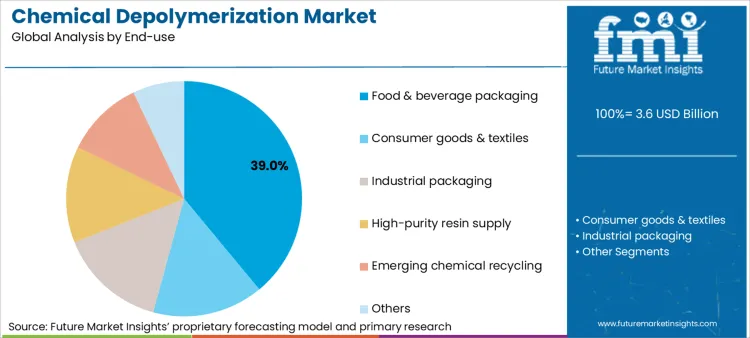
Food and beverage packaging represent about 39% share, placing this segment at the center of most chemical depolymerization project economics. Access to this end use requires outputs that meet strict migration, odor, and color limits, which raises the value of true monomer recovery routes. Consumer goods and textiles follow, driven by fiber-to-fiber and bottle-to-bottle loops with controlled specifications. Industrial packaging tolerates broader property bands but demands scale and reliability. High-purity resin supply overlaps several categories with the tightest acceptance criteria. Packaging engineers qualify outputs through intrinsic viscosity rebuild, color indices, and contaminant screening. Commercial teams qualify through offtake stability and contract duration. Compliance teams qualify through food-contact dossiers and audit readiness.
End-use focus fixes purification depth, finishing steps, and quality control intensity. Entering a new application class requires new validation runs and updated regulatory submissions. Procurement and offtake agreements then lock plant operating windows and feedstock selection rules. Certification files and customer specifications follow the same mapping. Project expansion tends to add parallel lines serving the same end-use class rather than switching targets. Demand therefore concentrates in food and beverage programs where specification tightness, volume scale, and regulatory visibility align to justify higher processing intensity.
Why Do Glycolysis and Methanolysis Lead Process Selection?
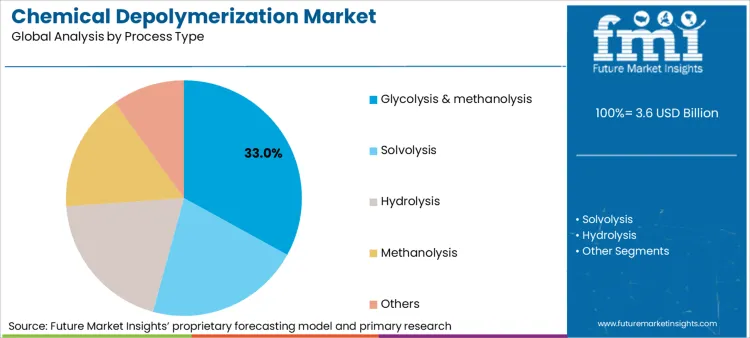
Glycolysis and methanolysis together account for about 33% share, reflecting their ability to return polyesters to defined intermediates with controllable impurity profiles. These routes support closed-loop applications where property rebuilding and food-contact acceptance matter. Solvolysis covers a broader family of solvents and targets mixed or complex structures, though downstream purification burden rises. Hydrolysis serves specific polymer families and waste streams with stable composition. Other processes remain developmental. Process engineers evaluate routes through yield, energy balance, and purification load. Operations teams evaluate through uptime and catalyst or solvent management. Commercial teams evaluate through product slate acceptance and pricing stability.
Process choice fixes reactor design, separation trains, and residue handling. A change in route requires new permitting, new qualification campaigns, and revised offtake agreements. Capital planning, utilities sizing, and feedstock contracts follow the selected pathway. Quality systems and analytical labs also align to that chemistry. Scale-up usually multiplies the same process block rather than introducing parallel chemistries. Demand therefore concentrates in glycolysis and methanolysis pathways that balance conversion efficiency, controllable purity, and acceptance into high-value resin applications.
Why Are Material Recovery Limits and Feedstock Quality Needs Driving Chemical Depolymerization Adoption?
Across plastics value chains, pressure is rising from how mechanical recycling operations interact with packaging and product design requirements and resin quality specifications. Many mixed, colored, or contaminated waste streams cannot meet reuse targets through physical reprocessing alone. Chemical depolymerization steps in where sorting systems and washing lines reach their technical limits, converting polymers back into basic molecules that can be rebuilt into new materials. Polymer production teams evaluate these outputs based on purity, consistency, and compatibility with existing polymerization assets. Demand grows because companies need recovery routes that handle difficult waste streams while still feeding standard resin production processes.
What Is Slowing Industrial Scale Up of Chemical Depolymerization Capacity?
Feedstock variability coming from collection networks and pre-treatment facilities creates instability in input quality, which complicates reactor operation and yield control. At the same time, integration with downstream purification units and resin manufacturing plants requires tight process control and capital coordination. Approval cycles inside brand material qualification systems and converter validation programs also extend time to market for outputs. These dependencies keep capacity additions cautious rather than rapid. Project developers face long commissioning timelines, complex supply agreements, and limited flexibility to switch feedstock sources once a plant is tuned for a specific material stream.
How Are System Integration and Portfolio Strategies Changing Chemical Recycling Development?
Investment strategies increasingly link waste sourcing partnerships, chemical processing assets, and polymer production sites into coordinated material loops. Process engineering teams now design depolymerization units alongside purification and repolymerization steps rather than as standalone plants. Testing and validation partners are involved early to define acceptable impurity limits and output specifications. Development is moving toward dedicated feedstock pipelines and long-term offtake agreements instead of spot material trading. Competitive position depends on controlling both input streams and output quality, not only on reaction technology or nominal processing capacity.
What is the Demand for Chemical Depolymerization by Country?
| Country | CAGR (%) |
|---|---|
| Germany | 12.0% |
| USA | 12.6% |
| China | 14.8% |
| Japan | 10.4% |
| India | 15.2% |
Source: Future Market Insights’ proprietary forecasting model and primary research
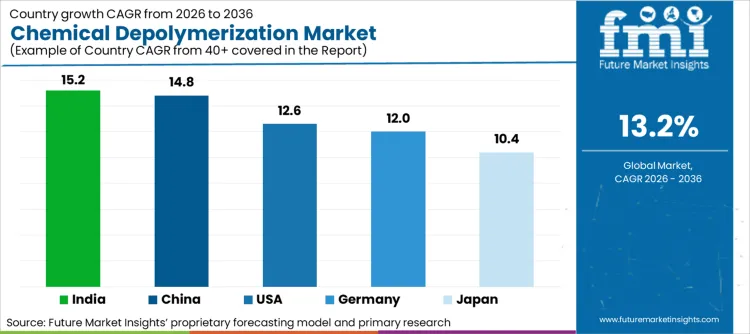
The demand for chemical depolymerization is rising across plastic recycling, packaging, and specialty polymer applications where advanced recycling and material recovery are critical for sustainability and compliance. India leads at 15.2% CAGR, supported by growing recycling infrastructure, regulatory mandates for plastic circularity, and adoption of advanced chemical recycling technologies by domestic producers. China follows at 14.8%, driven by large scale polymer production, increasing plastic waste recovery, and industrial investment in depolymerization systems.
The USA grows at 12.6%, shaped by corporate sustainability initiatives and adoption of chemical recycling for high value polymers. Germany records 12.0%, reflecting regulatory pressures and development of advanced recycling solutions. Japan posts 10.4%, within a mature market emphasizing process efficiency, quality control, and polymer recovery performance.
How Industrial Recycling Facilities Drive the Chemical Depolymerization Market in Germany
Operations at high-capacity recycling facilities in Germany are contributing to a 12% CAGR in the chemical depolymerization market. Process selection emphasizes feedstock compatibility, monomer recovery efficiency, and downstream purity for reuse in packaging and polymer applications. Technical teams assess reaction kinetics, temperature control, and catalyst efficiency to ensure consistent output. Once validated, processes are implemented across multiple facilities and integrated with existing recycling programs. Volume growth aligns with corporate sustainability initiatives, industrial recycling mandates, and supply chain integration of circular polymers. Supplier participation depends on technical documentation, compliance with environmental standards, and operational support. Commercial success relies on reproducible depolymerization performance, process reliability, and consistent quality for end-product applications.
How High-Volume Feedstock Management Shapes the Chemical Depolymerization Market in the USA
In the United States, the chemical depolymerization market is expanding at a 12.6% CAGR due to large-scale feedstock processing in industrial recycling plants. Systems are evaluated for efficiency in converting mixed plastics into high-purity monomers, energy consumption, and scalability. Engineers assess process stability, catalyst performance, and integration with purification and polymerization units. Once validated, operations are scaled across multiple facilities and polymer production lines. Supplier access depends on documentation, quality audits, and technical support for integration with existing production workflows. Volume growth follows adoption by packaging manufacturers, industrial polymer users, and corporate sustainability programs. Commercial success relies on reproducible monomer quality, operational reliability, and technical support across high-throughput facilities.
How Urban and Industrial Recycling Programs Drive the Chemical Depolymerization Market in China
Chemical depolymerization market in China is advancing at a 14.8% CAGR due to the growth of urban recycling programs and industrial-scale plastic recovery operations. Process selection emphasizes recovery efficiency, feedstock versatility, thermal and chemical stability, and monomer purity for high-value applications. Engineers evaluate reaction conditions, catalyst efficacy, and throughput consistency. Once validated, processes are deployed across multiple recycling and polymer manufacturing facilities. Supplier participation relies on audit compliance, technical documentation, and integration support for high-volume operations. Volume growth is tied to urban plastic collection initiatives, industrial recycling expansion, and large-scale polymer production programs. Commercial advantage depends on reproducible depolymerization performance, operational reliability, and consistent monomer quality.
How Regulatory Compliance and Technical Standards Guide the Chemical Depolymerization Market in Japan
In Japan, the chemical depolymerization market is growing at a 10.4% CAGR due to stringent regulatory requirements and technical standards for recycling and polymer recovery. Systems are evaluated for feedstock compatibility, energy efficiency, monomer purity, and environmental performance. Engineers assess catalyst efficiency, reaction stability, and integration with downstream polymer production. Once validated, processes are deployed across multiple facilities for industrial recycling and packaging polymer applications. Supplier participation requires certification compliance, audit documentation, and technical support. Volume growth follows adoption by industrial recycling programs, corporate sustainability initiatives, and large-scale polymer manufacturers. Commercial success depends on reproducible monomer yield, process reliability, and operational consistency.
How High-Throughput Recycling and Production Scaling Drive the Chemical Depolymerization Market in India
Chemical depolymerization market in India is expanding at a 15.2% CAGR due to large-scale recycling initiatives and growing polymer production. Process selection emphasizes feedstock versatility, reaction efficiency, thermal stability, and high-purity monomer recovery. Technical teams evaluate catalyst performance, throughput consistency, and compatibility with downstream polymerization units. Once validated, processes are deployed across multiple recycling and production lines. Supplier participation depends on audit compliance, technical documentation, and operational support for scale-up. Volume growth follows adoption by industrial recycling plants, packaging manufacturers, and large-scale polymer production programs. Commercial advantage relies on reproducible depolymerization output, operational reliability, and consistent monomer quality across multiple facilities.
What Approaches Are Companies Using in the Chemical Depolymerization Market?
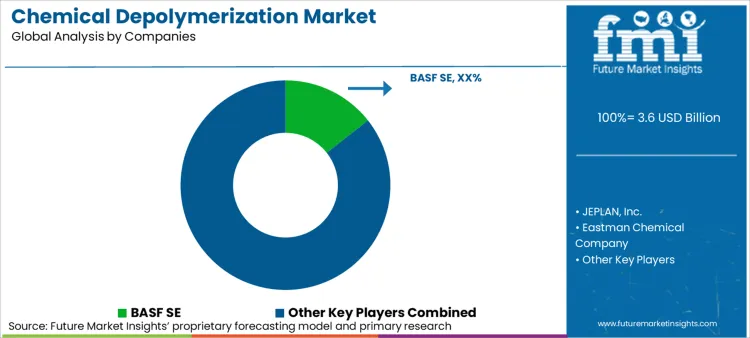
Feedstock flexibility, process efficiency, and monomer recovery determine adoption in the Chemical Depolymerization Market. BASF, JEPLAN, Eastman, Loop Industries, GEM, Wankai New Materials, Teijin, and Mitsubishi Chemical Group compete during pilot depolymerization trials, monomer purification, and industrial-scale recycling validation. Once integrated into chemical recycling workflows, yield consistency, product purity, and regulatory compliance anchor supplier selection. BASF emphasizes high-efficiency depolymerization for polyester recycling.
JEPLAN targets closed-loop chemical recycling for industrial and consumer plastics. Eastman provides scalable chemical recycling processes for PET and specialty polymers. Loop Industries delivers monomer recovery solutions optimized for beverage and packaging applications. GEM and Wankai New Materials focus on regionally scaled chemical recycling. Teijin supplies functional fibers and resins from chemically recycled monomers. Mitsubishi Chemical Group offers industrial-scale depolymerization platforms for polyester and specialty polymers.
Process reliability, monomer quality, and technical support shape competitive positioning in the Chemical Depolymerization Market. Engineers evaluate yield efficiency, chemical stability, purification consistency, and integration with polymer production lines during validation. Suppliers capable of reproducible depolymerization, scalable output, and process guidance gain preference. BASF secures adoption through high-volume industrial recycling programs. JEPLAN maintains positions in closed-loop consumer packaging applications.
Eastman competes in large-scale chemical recycling for PET. Loop Industries captures adoption in beverage and rigid packaging workflows. GEM and Wankai New Materials provide regional depolymerization capacity. Teijin focuses on functional fiber and resin applications. Mitsubishi Chemical Group delivers scalable platforms for polyester and specialty polymers. Market positions vary by polymer type, production scale, process efficiency, and regional recycling regulations.
Key Players in the Chemical Depolymerization Market
- BASF SE
- JEPLAN, Inc.
- Eastman Chemical Company
- Loop Industries, Inc.
- GEM Co., Ltd.
- Wankai New Materials Co., Ltd.
- Teijin Limited
- Mitsubishi Chemical Group Corporation
Scope of the Report
| Items | Values |
|---|---|
| Quantitative Units (2026) | USD billion |
| End-use | Food and beverage packaging, consumer goods and textiles, industrial packaging, high-purity resin supply, emerging chemical recycling, others |
| Process Type | Glycolysis and methanolysis, solvolysis, hydrolysis, methanolysis, others |
| Polymer Focus | PET, PA, others |
| Core Technology | Monomer purification and re-polymerization, high-purity recovery systems, large-scale depolymerization, precision purification, others |
| Regions Covered | Asia Pacific, Europe, North America, Latin America, Middle East & Africa |
| Countries Covered | United States, Canada, Mexico, Germany, United Kingdom, France, Italy, Spain, Nordics, BENELUX, China, Japan, South Korea, India, Australia & New Zealand, ASEAN, Brazil, Chile, Saudi Arabia, Turkey, South Africa, and other regional markets |
| Key Companies Profiled | BASF, JEPLAN, Eastman, Loop Industries, GEM, Wankai New Materials, Teijin, Mitsubishi Chemical Group |
| Additional Attributes | Dollar sales by end-use, process type, polymer focus, and core technology, feedstock acceptance envelopes and impurity tolerance mapping, conversion yield and monomer purity benchmarks, mass-balance and chain-of-custody accounting for chemically recycled output, offtake-linked capacity planning and long-term contracts, plant utilization and uptime tracking, solvent and catalyst management metrics, purification load and residue handling requirements, integration with repolymerization assets, regulatory acceptance pathways for food-contact and high-specification applications, and regional adoption patterns across packaging, textiles, and engineering polymer programs |
Chemical Depolymerization Market Segmentation
End-use:
- Food & beverage packaging
- Consumer goods & textiles
- Industrial packaging
- High-purity resin supply
- Emerging chemical recycling
- Others
Process Type:
- Glycolysis & methanolysis
- Solvolysis
- Hydrolysis
- Methanolysis
- Others
Polymer Focus:
- PET
- PA
- Others
Core Technology:
- Monomer purification & re-polymerization
- High-purity recovery systems
- Large-scale depolymerization
- Precision purification
- Others
Region
- Asia Pacific
- China
- Japan
- South Korea
- India
- Australia & New Zealand
- ASEAN
- Rest of Asia Pacific
- Europe
- Germany
- United Kingdom
- France
- Italy
- Spain
- Nordic
- BENELUX
- Rest of Europe
- North America
- United States
- Canada
- Mexico
- Latin America
- Brazil
- Chile
- Rest of Latin America
- Middle East & Africa
- Kingdom of Saudi Arabia
- Other GCC Countries
- Turkey
- South Africa
- Other African Union
- Rest of Middle East & Africa
Bibliography
- Organisation for Economic Co-operation and Development. (2024). Plastics recycled content requirements: Overview of policy approaches and implications. OECD Publishing.
- Organisation for Economic Co-operation and Development. (2024). Policy scenarios for eliminating plastic pollution by 2040. OECD Publishing.
- European Commission, Joint Research Centre. (2024). EU-wide end-of-waste criteria for plastic waste (JRC139303). Publications Office of the European Union.
- European Food Safety Authority (CEP Panel). (2024). Scientific guidance on the criteria for the evaluation and on the preparation of applications for the safety assessment of post-consumer mechanical PET recycling processes intended to be used for manufacturing materials and articles intended to come into contact with food. EFSA Journal.
- United Nations Environment Programme. (2024). Zero draft text of the international legally binding instrument on plastic pollution, including in the marine environment (Intergovernmental Negotiating Committee). UNEP.
-
Frequently Asked Questions
- How big is the chemical depolymerization market in 2026? The chemical depolymerization market is projected to be valued at USD 3.6 billion in 2026.
- What will be the size of the chemical depolymerization market in 2036? The chemical depolymerization market is projected to reach USD 12.4 billion by 2036.
- How fast will the chemical depolymerization market grow between 2026 and 2036? Spending on chemical depolymerization is expected to grow at a 13.2% CAGR between 2026 and 2036.
- Which end-use segment holds a significant share in the chemical depolymerization market in 2026? In terms of end use, food and beverage packaging is expected to account for a 39% share in 2026.
- Which process type contributes a major share in the chemical depolymerization market in 2026? Glycolysis and methanolysis are expected to together represent a 33% share in the chemical depolymerization market in 2026.
Frequently Asked Questions
How big is the chemical depolymerization market in 2026?
The global chemical depolymerization market is estimated to be valued at USD 3.6 billion in 2026.
What will be the size of chemical depolymerization market in 2036?
The market size for the chemical depolymerization market is projected to reach USD 12.4 billion by 2036.
How much will be the chemical depolymerization market growth between 2026 and 2036?
The chemical depolymerization market is expected to grow at a 13.2% CAGR between 2026 and 2036.
What are the key product types in the chemical depolymerization market?
The key product types in chemical depolymerization market are food & beverage packaging, consumer goods & textiles, industrial packaging, high-purity resin supply, emerging chemical recycling and others.
Which process type segment to contribute significant share in the chemical depolymerization market in 2026?
In terms of process type, glycolysis & methanolysis segment to command 33.0% share in the chemical depolymerization market in 2026.
Preview the report firsthand - request a free sample
Get SampleGet the brochure for pricing and purchase details.
Get PDFTable of Content
- Executive Summary
- Global Market Outlook
- Demand-side Trends
- Supply-side Trends
- Technology Roadmap Analysis
- Analysis and Recommendations
- Market Overview
- Market Coverage / Taxonomy
- Market Definition / Scope / Limitations
- Market Background
- Market Dynamics
- Drivers
- Restraints
- Opportunity
- Trends
- Scenario Forecast
- Demand in Optimistic Scenario
- Demand in Likely Scenario
- Demand in Conservative Scenario
- Opportunity Map Analysis
- Product Life Cycle Analysis
- Supply Chain Analysis
- Investment Feasibility Matrix
- Value Chain Analysis
- PESTLE and Porter’s Analysis
- Regulatory Landscape
- Regional Parent Market Outlook
- Production and Consumption Statistics
- Import and Export Statistics
- Market Dynamics
- Global Market Analysis 2021 to 2025 and Forecast, 2026 to 2036
- Historical Market Size Value (USD Million) Analysis, 2021 to 2025
- Current and Future Market Size Value (USD Million) Projections, 2026 to 2036
- Y-o-Y Growth Trend Analysis
- Absolute $ Opportunity Analysis
- Global Market Pricing Analysis 2021 to 2025 and Forecast 2026 to 2036
- Global Market Analysis 2021 to 2025 and Forecast 2026 to 2036, By End-use
- Introduction / Key Findings
- Historical Market Size Value (USD Million) Analysis By End-use , 2021 to 2025
- Current and Future Market Size Value (USD Million) Analysis and Forecast By End-use , 2026 to 2036
- Food & beverage packaging
- Consumer goods & textiles
- Industrial packaging
- High-purity resin supply
- Emerging chemical recycling
- Others
- Food & beverage packaging
- Y-o-Y Growth Trend Analysis By End-use , 2021 to 2025
- Absolute $ Opportunity Analysis By End-use , 2026 to 2036
- Global Market Analysis 2021 to 2025 and Forecast 2026 to 2036, By Process Type
- Introduction / Key Findings
- Historical Market Size Value (USD Million) Analysis By Process Type, 2021 to 2025
- Current and Future Market Size Value (USD Million) Analysis and Forecast By Process Type, 2026 to 2036
- Glycolysis & methanolysis
- Solvolysis
- Hydrolysis
- Methanolysis
- Others
- Glycolysis & methanolysis
- Y-o-Y Growth Trend Analysis By Process Type, 2021 to 2025
- Absolute $ Opportunity Analysis By Process Type, 2026 to 2036
- Global Market Analysis 2021 to 2025 and Forecast 2026 to 2036, By Polymer Focus
- Introduction / Key Findings
- Historical Market Size Value (USD Million) Analysis By Polymer Focus, 2021 to 2025
- Current and Future Market Size Value (USD Million) Analysis and Forecast By Polymer Focus, 2026 to 2036
- PET
- PA
- Others
- PET
- Y-o-Y Growth Trend Analysis By Polymer Focus, 2021 to 2025
- Absolute $ Opportunity Analysis By Polymer Focus, 2026 to 2036
- Global Market Analysis 2021 to 2025 and Forecast 2026 to 2036, By Core Technology
- Introduction / Key Findings
- Historical Market Size Value (USD Million) Analysis By Core Technology, 2021 to 2025
- Current and Future Market Size Value (USD Million) Analysis and Forecast By Core Technology, 2026 to 2036
- Monomer purification & re-polymerization
- High-purity recovery systems
- Large-scale depolymerization
- Precision purification
- Others
- Monomer purification & re-polymerization
- Y-o-Y Growth Trend Analysis By Core Technology, 2021 to 2025
- Absolute $ Opportunity Analysis By Core Technology, 2026 to 2036
- Global Market Analysis 2021 to 2025 and Forecast 2026 to 2036, By Region
- Introduction
- Historical Market Size Value (USD Million) Analysis By Region, 2021 to 2025
- Current Market Size Value (USD Million) Analysis and Forecast By Region, 2026 to 2036
- North America
- Latin America
- Western Europe
- Eastern Europe
- East Asia
- South Asia and Pacific
- Middle East & Africa
- Market Attractiveness Analysis By Region
- North America Market Analysis 2021 to 2025 and Forecast 2026 to 2036, By Country
- Historical Market Size Value (USD Million) Trend Analysis By Market Taxonomy, 2021 to 2025
- Market Size Value (USD Million) Forecast By Market Taxonomy, 2026 to 2036
- By Country
- USA
- Canada
- Mexico
- By End-use
- By Process Type
- By Polymer Focus
- By Core Technology
- By Country
- Market Attractiveness Analysis
- By Country
- By End-use
- By Process Type
- By Polymer Focus
- By Core Technology
- Key Takeaways
- Latin America Market Analysis 2021 to 2025 and Forecast 2026 to 2036, By Country
- Historical Market Size Value (USD Million) Trend Analysis By Market Taxonomy, 2021 to 2025
- Market Size Value (USD Million) Forecast By Market Taxonomy, 2026 to 2036
- By Country
- Brazil
- Chile
- Rest of Latin America
- By End-use
- By Process Type
- By Polymer Focus
- By Core Technology
- By Country
- Market Attractiveness Analysis
- By Country
- By End-use
- By Process Type
- By Polymer Focus
- By Core Technology
- Key Takeaways
- Western Europe Market Analysis 2021 to 2025 and Forecast 2026 to 2036, By Country
- Historical Market Size Value (USD Million) Trend Analysis By Market Taxonomy, 2021 to 2025
- Market Size Value (USD Million) Forecast By Market Taxonomy, 2026 to 2036
- By Country
- Germany
- UK
- Italy
- Spain
- France
- Nordic
- BENELUX
- Rest of Western Europe
- By End-use
- By Process Type
- By Polymer Focus
- By Core Technology
- By Country
- Market Attractiveness Analysis
- By Country
- By End-use
- By Process Type
- By Polymer Focus
- By Core Technology
- Key Takeaways
- Eastern Europe Market Analysis 2021 to 2025 and Forecast 2026 to 2036, By Country
- Historical Market Size Value (USD Million) Trend Analysis By Market Taxonomy, 2021 to 2025
- Market Size Value (USD Million) Forecast By Market Taxonomy, 2026 to 2036
- By Country
- Russia
- Poland
- Hungary
- Balkan & Baltic
- Rest of Eastern Europe
- By End-use
- By Process Type
- By Polymer Focus
- By Core Technology
- By Country
- Market Attractiveness Analysis
- By Country
- By End-use
- By Process Type
- By Polymer Focus
- By Core Technology
- Key Takeaways
- East Asia Market Analysis 2021 to 2025 and Forecast 2026 to 2036, By Country
- Historical Market Size Value (USD Million) Trend Analysis By Market Taxonomy, 2021 to 2025
- Market Size Value (USD Million) Forecast By Market Taxonomy, 2026 to 2036
- By Country
- China
- Japan
- South Korea
- By End-use
- By Process Type
- By Polymer Focus
- By Core Technology
- By Country
- Market Attractiveness Analysis
- By Country
- By End-use
- By Process Type
- By Polymer Focus
- By Core Technology
- Key Takeaways
- South Asia and Pacific Market Analysis 2021 to 2025 and Forecast 2026 to 2036, By Country
- Historical Market Size Value (USD Million) Trend Analysis By Market Taxonomy, 2021 to 2025
- Market Size Value (USD Million) Forecast By Market Taxonomy, 2026 to 2036
- By Country
- India
- ASEAN
- Australia & New Zealand
- Rest of South Asia and Pacific
- By End-use
- By Process Type
- By Polymer Focus
- By Core Technology
- By Country
- Market Attractiveness Analysis
- By Country
- By End-use
- By Process Type
- By Polymer Focus
- By Core Technology
- Key Takeaways
- Middle East & Africa Market Analysis 2021 to 2025 and Forecast 2026 to 2036, By Country
- Historical Market Size Value (USD Million) Trend Analysis By Market Taxonomy, 2021 to 2025
- Market Size Value (USD Million) Forecast By Market Taxonomy, 2026 to 2036
- By Country
- Kingdom of Saudi Arabia
- Other GCC Countries
- Turkiye
- South Africa
- Other African Union
- Rest of Middle East & Africa
- By End-use
- By Process Type
- By Polymer Focus
- By Core Technology
- By Country
- Market Attractiveness Analysis
- By Country
- By End-use
- By Process Type
- By Polymer Focus
- By Core Technology
- Key Takeaways
- Key Countries Market Analysis
- USA
- Pricing Analysis
- Market Share Analysis, 2025
- By End-use
- By Process Type
- By Polymer Focus
- By Core Technology
- Canada
- Pricing Analysis
- Market Share Analysis, 2025
- By End-use
- By Process Type
- By Polymer Focus
- By Core Technology
- Mexico
- Pricing Analysis
- Market Share Analysis, 2025
- By End-use
- By Process Type
- By Polymer Focus
- By Core Technology
- Brazil
- Pricing Analysis
- Market Share Analysis, 2025
- By End-use
- By Process Type
- By Polymer Focus
- By Core Technology
- Chile
- Pricing Analysis
- Market Share Analysis, 2025
- By End-use
- By Process Type
- By Polymer Focus
- By Core Technology
- Germany
- Pricing Analysis
- Market Share Analysis, 2025
- By End-use
- By Process Type
- By Polymer Focus
- By Core Technology
- UK
- Pricing Analysis
- Market Share Analysis, 2025
- By End-use
- By Process Type
- By Polymer Focus
- By Core Technology
- Italy
- Pricing Analysis
- Market Share Analysis, 2025
- By End-use
- By Process Type
- By Polymer Focus
- By Core Technology
- Spain
- Pricing Analysis
- Market Share Analysis, 2025
- By End-use
- By Process Type
- By Polymer Focus
- By Core Technology
- France
- Pricing Analysis
- Market Share Analysis, 2025
- By End-use
- By Process Type
- By Polymer Focus
- By Core Technology
- India
- Pricing Analysis
- Market Share Analysis, 2025
- By End-use
- By Process Type
- By Polymer Focus
- By Core Technology
- ASEAN
- Pricing Analysis
- Market Share Analysis, 2025
- By End-use
- By Process Type
- By Polymer Focus
- By Core Technology
- Australia & New Zealand
- Pricing Analysis
- Market Share Analysis, 2025
- By End-use
- By Process Type
- By Polymer Focus
- By Core Technology
- China
- Pricing Analysis
- Market Share Analysis, 2025
- By End-use
- By Process Type
- By Polymer Focus
- By Core Technology
- Japan
- Pricing Analysis
- Market Share Analysis, 2025
- By End-use
- By Process Type
- By Polymer Focus
- By Core Technology
- South Korea
- Pricing Analysis
- Market Share Analysis, 2025
- By End-use
- By Process Type
- By Polymer Focus
- By Core Technology
- Russia
- Pricing Analysis
- Market Share Analysis, 2025
- By End-use
- By Process Type
- By Polymer Focus
- By Core Technology
- Poland
- Pricing Analysis
- Market Share Analysis, 2025
- By End-use
- By Process Type
- By Polymer Focus
- By Core Technology
- Hungary
- Pricing Analysis
- Market Share Analysis, 2025
- By End-use
- By Process Type
- By Polymer Focus
- By Core Technology
- Kingdom of Saudi Arabia
- Pricing Analysis
- Market Share Analysis, 2025
- By End-use
- By Process Type
- By Polymer Focus
- By Core Technology
- Turkiye
- Pricing Analysis
- Market Share Analysis, 2025
- By End-use
- By Process Type
- By Polymer Focus
- By Core Technology
- South Africa
- Pricing Analysis
- Market Share Analysis, 2025
- By End-use
- By Process Type
- By Polymer Focus
- By Core Technology
- USA
- Market Structure Analysis
- Competition Dashboard
- Competition Benchmarking
- Market Share Analysis of Top Players
- By Regional
- By End-use
- By Process Type
- By Polymer Focus
- By Core Technology
- Competition Analysis
- Competition Deep Dive
- BASF SE
- Overview
- Product Portfolio
- Profitability by Market Segments (Product/Age /Sales Channel/Region)
- Sales Footprint
- Strategy Overview
- Marketing Strategy
- Product Strategy
- Channel Strategy
- JEPLAN, Inc.
- Eastman Chemical Company
- Loop Industries, Inc.
- GEM Co., Ltd.
- Wankai New Materials Co., Ltd.
- Teijin Limited
- Mitsubishi Chemical Group Corporation
- BASF SE
- Competition Deep Dive
- Assumptions & Acronyms Used
- Research Methodology


