

- Market Size (2026)
- USD 1640.0 Mn
- Forecast (2036)
- USD 5921.7 Mn
- CAGR (2026 to 2036)
- 13.7%
Chemical Recycling Feedstock Aggregation Market Forecast and Outlook 2026 to 2036
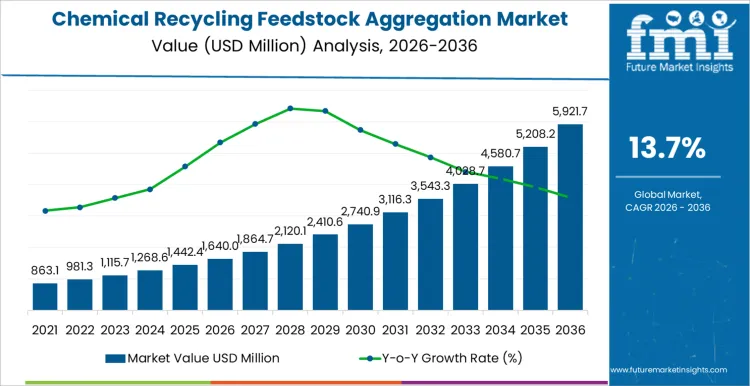
The chemical recycling feedstock aggregation market is expected to be valued at USD 1,640.0 million in 2026, and reach USD 5,921.7 million by 2036, at a 13.7% CAGR. Expansion reflects rapid scaling of chemical recycling capacity that depends on continuous access to large volumes of specification-aligned plastic waste rather than opportunistic sourcing. Aggregation activity increases were mixed, contaminated, or film-heavy streams cannot meet mechanical recycling thresholds but remain viable inputs for pyrolysis and depolymerisation. Value growth concentrates around aggregation models that can balance volume assurance with contamination control, enabling downstream plants to operate at stable utilization rates. Investment intensity rises as aggregators build pre-sorting, blending, and logistics infrastructure capable of supplying predictable feedstock compositions across long-term contracts.
Market behavior is shaped by the operational constraints of chemical recycling plants, which require consistent calorific value, polymer mix, and impurity limits to protect reactors and catalysts. Feedstock aggregation shifts from fragmented collection toward centralized hubs that integrate sorting, preprocessing, and traceability functions. Logistics efficiency and proximity to waste generation centers influence cost structures more than raw material pricing alone. Regulatory reporting requirements on recycled content and waste provenance further elevate the role of aggregators as compliance intermediaries. Scale advantages favor operators with access to municipal, commercial, and brand-led take-back streams, while smaller players face margin pressure from transport and preprocessing costs. Value persistence is linked to aggregation systems that reduce feedstock variability risks rather than those maximizing short-term volume throughput.
Quick Stats for Chemical Recycling Feedstock Aggregation Market
- Chemical Recycling Feedstock Aggregation Market Value (2026): USD 1,640.0 million
- Chemical Recycling Feedstock Aggregation Market Forecast Value (2036): USD 5,921.7 million
- Chemical Recycling Feedstock Aggregation Market Forecast CAGR 2026 to 2036: 13.7%
- Leading Feedstock Type by Demand Share: Mixed plastic bales
- Fastest-Growing Countries: India, China, Brazil, USA, Germany
- Top Players in Global Demand: Remondis, PreZero, Eastman, Agilyx, GEM Co.
Chemical Recycling Feedstock Aggregation Market Key Takeaways
| Metric | Value |
|---|---|
| Market Value (2026) | USD 1,640.0 million |
| Market Forecast Value (2036) | USD 5,921.7 million |
| Forecast CAGR 2026 to 2036 | 13.7% |
Why is the Demand for Chemical Recycling Feedstock Aggregation Growing?
The chemical recycling feedstock aggregation market is growing due to several key drivers related to environmental sustainability, regulatory changes, and technological advancements. One of the primary factors is the increasing global focus on reducing plastic waste and promoting a circular economy. As the volume of plastic waste continues to rise, traditional mechanical recycling processes are struggling to handle mixed and contaminated plastics effectively. Chemical recycling provides a viable solution by breaking down complex plastics into their base chemicals, enabling them to be reused in production processes. This allows the recovery of high-value materials from plastics that are otherwise difficult to recycle.
Governments around the world are implementing stricter regulations to curb plastic pollution. For example, the European Union's directives on single-use plastics and extended producer responsibility (EPR) schemes have pushed companies to adopt more sustainable practices, including the use of recycled feedstock. These regulatory frameworks are creating demand for reliable and high-quality chemical recycling feedstocks, prompting industries to invest in feedstock aggregation systems that can ensure a consistent supply of suitable materials for recycling.
How Is the Chemical Recycling Feedstock Aggregation Industry Segmented by Feedstock Type, Aggregation Technology, and End Use?
Chemical recycling feedstock aggregation is driven by scale requirements of advanced recycling plants, variability of post-consumer plastic waste, and the need for consistent input quality. Aggregators focus on securing reliable volumes while balancing contamination tolerance, polymer mix control, and logistics efficiency. Regulatory traceability, regional waste availability, and long-term supply contracts influence aggregation models. Segmentation by feedstock type, aggregation technology, and end use explains how aggregation strategies are structured to meet throughput, quality, and process compatibility requirements across chemical recycling pathways.
Which Feedstock Type Holds the Largest Share in Chemical Recycling Aggregation?
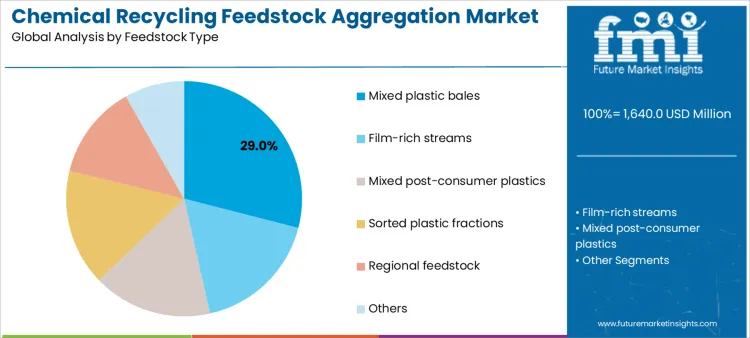
Mixed plastic bales account for 29.0%, reflecting their availability from material recovery facilities and suitability for bulk aggregation. These bales provide volume efficiency while requiring downstream sorting or preprocessing. Film-rich streams, mixed post-consumer plastics, sorted plastic fractions, and regional feedstock streams represent additional aggregation categories addressing different purity and logistics needs. Other feedstock types include industrial residues and niche waste streams. Feedstock-type segmentation reflects trade-offs between volume accessibility, contamination levels, and preprocessing intensity required before chemical recycling.
Key Points
- Mixed plastic bales provide high-volume aggregation potential.
- Film-rich streams support flexible chemical recycling inputs.
- Regional feedstock improves supply reliability and logistics control.
How Does Aggregation Technology Shape Feedstock Readiness?
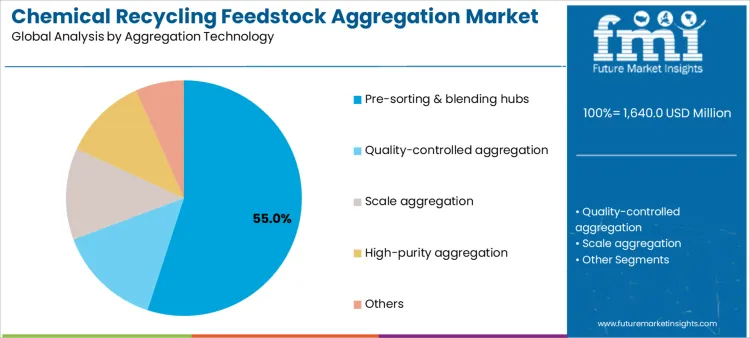
Pre-sorting and blending hubs represent 55.0%, driven by their ability to combine multiple waste streams into specification-aligned feedstock. These hubs balance polymer composition, calorific value, and contamination thresholds before delivery. Quality-controlled aggregation focuses on tighter input specifications for sensitive recycling processes. Scale aggregation emphasizes volume consolidation to support large facilities. High-purity aggregation targets depolymerisation-ready streams requiring minimal preprocessing. Other aggregation technologies address pilot-scale or localized collection models. Aggregation-technology segmentation highlights alignment between feedstock preparation depth and downstream process tolerance.
Key Points
- Pre-sorting hubs enable specification-driven feedstock blending.
- Quality control supports process stability.
- High-purity aggregation serves depolymerisation pathways.
Which End Uses Drive Demand for Aggregated Chemical Recycling Feedstock?
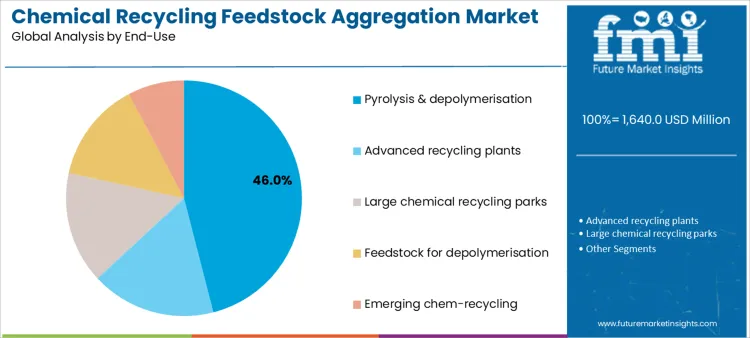
Pyrolysis and depolymerisation account for 46.0%, reflecting their scale requirements and flexibility toward mixed plastic inputs. Advanced recycling plants and large chemical recycling parks represent additional end uses seeking secure, long-term feedstock supply. Feedstock for depolymerisation emphasizes polymer-specific streams for monomer recovery. Emerging chemical recycling pathways account for smaller but developing demand, including pilot and demonstration facilities. End-use segmentation shows concentration of aggregation demand where continuous operation and high throughput necessitate structured feedstock supply chains.
Key Points
- Pyrolysis and depolymerisation drive bulk feedstock demand.
- Large recycling parks require stable aggregation models.
- Emerging technologies rely on flexible feedstock sourcing.
What are the Key Dynamics in the Chemical Recycling Feedstock Aggregation Market?
Demand in the chemical recycling feedstock aggregation market is tied to downstream facilities that convert mixed plastic waste into monomers, oils, or other raw materials used for engineered polymers and high-performance resins. Aggregators collect and preprocess heterogeneous waste streams from municipal, industrial, and retail packaging sources. Market activity reflects brand and regulatory pressure to secure more traceable, consistent feedstock for advanced recycling pathways. Value is driven by feedstock purity, sorting efficiency, and the ability to match volumes with the throughput requirements of solvent, pyrolysis, and depolymerization systems.
How do waste stream complexity and processor requirements shape sourcing practices?
Processors of chemical recycling technologies require feedstock with predictable composition and low contamination to protect expensive reactors and catalysts. Aggregators develop supply networks with collectors, MRFs (materials recovery facilities), and brand take-back initiatives that provide access to targeted polymer types such as PE, PP, and polyester blends. Uneven quality in post-consumer waste challenges reactors designed for narrow input windows, so companies invest in advanced sorting, washing, and pretreatment to reduce non-polymer contaminants. Retail and industrial packaging waste with known resin codes and low filler levels is more attractive than mixed municipal streams from curbside collection. Contracts with fast-moving consumer goods producers help aggregators lock in consistent volumes, aligning feedstock supply with the seasonal and batch processing rhythms of chemical recycling plants.
How do logistic costs and feedstock quality limits influence market growth?
Market growth is influenced by the cost and scale of collecting diverse waste streams and by the technical limits of feedstock quality that chemical recycling systems can tolerate. Transport and preprocessing costs rise when waste is scattered over large geographic areas or when multiple sorting passes are required to meet purity thresholds. Smaller aggregators face challenges competing with regional players that can supply bulk volumes at lower unit costs. Variability in waste composition forces some processors to slow operations or invest in additional pretreatment, affecting operating economics. Regulatory requirements for traceability and documentation create compliance tasks that differ by jurisdiction, shaping where aggregators establish supply bases. Feedstock that fails to meet minimum quality standards often ends up in mechanical recycling or energy recovery, limiting volumes available for chemical pathways and constraining long-term scaling of advanced recycling infrastructure.
How Is Demand for the Chemical Recycling Feedstock Aggregation Market Evolving Globally?
Global demand for chemical recycling feedstock aggregation is rising as industries shift towards more sustainable waste management and recycling practices. Growth reflects increasing investments in chemical recycling technologies to handle mixed and complex plastic waste that cannot be processed through traditional recycling methods. Chemical recycling feedstock aggregation helps optimize feedstock supply for advanced recycling processes, turning waste materials into valuable resources for manufacturing. India records 16.0% CAGR, China records 15.4% CAGR, USA records 13.0% CAGR, Germany records 12.6% CAGR, and Brazil records 12.2% CAGR. Adoption is driven by regulatory requirements, the need for sustainable packaging, and innovations in chemical recycling.
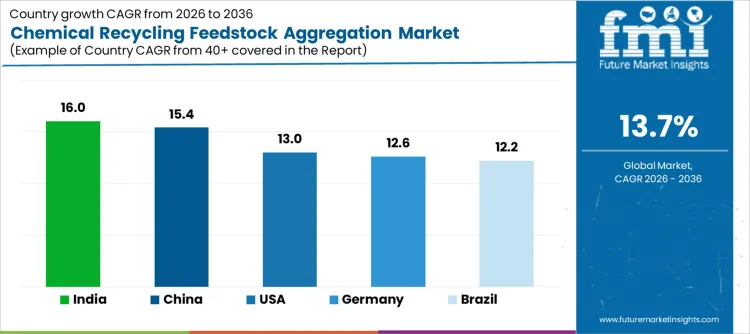
| Country | CAGR (%) |
|---|---|
| India | 16.0% |
| China | 15.4% |
| USA | 13.0% |
| Germany | 12.6% |
| Brazil | 12.2% |
What is driving growth of chemical recycling feedstock aggregation demand in India?
Demand for chemical recycling feedstock aggregation in India is expanding as the country faces growing challenges with plastic waste management and increasing regulatory pressures. Growth at 16.0% CAGR reflects the shift towards chemical recycling technologies, particularly in urban areas, where plastic waste is higher. As India pushes towards circular economy goals, investments in advanced waste sorting and aggregation systems are increasing to optimize feedstock for chemical recycling processes. Local governments and industries are working to improve the quality and quantity of plastic waste being fed into chemical recycling systems, driving growth in aggregation systems to support these initiatives.
- Growing plastic waste management challenges
- Regulatory push for circular economy adoption
- Investment in chemical recycling infrastructure
- Focus on improving waste sorting and feedstock aggregation
Why is China seeing expansion in chemical recycling feedstock aggregation adoption?
Chemical recycling feedstock aggregation demand in China is rising as the country accelerates its efforts to reduce plastic pollution and improve recycling rates. Growth at 15.4% CAGR reflects China’s increasing adoption of chemical recycling technologies to handle mixed plastic waste that traditional mechanical recycling cannot process. As local manufacturers prioritize sustainable practices and comply with regulatory requirements, the demand for feedstock aggregation solutions to optimize chemical recycling processes continues to grow. Investment in waste sorting infrastructure and aggregation systems is key to meeting China’s ambitious plastic waste reduction targets.
- Increasing adoption of chemical recycling technologies
- Strong government focus on plastic waste reduction
- Expansion of waste sorting and aggregation infrastructure
- Growing emphasis on recycling mixed plastics
What factors are shaping chemical recycling feedstock aggregation sales in the USA?
Sales of chemical recycling feedstock aggregation in the USA are increasing as industries seek more effective ways to process complex and contaminated plastic waste. Growth at 13.0% CAGR reflects the rising need for chemical recycling to handle waste that cannot be processed through traditional methods. Government incentives and regulations pushing for higher recycling rates drive investments in feedstock aggregation solutions. As manufacturers seek to meet sustainability targets, the use of aggregated feedstock for chemical recycling processes becomes more critical. Demand remains concentrated in the packaging and automotive sectors, where large volumes of plastic waste are generated.
- Government incentives and regulations for higher recycling rates
- Need for efficient processing of complex plastic waste
- Investment in feedstock aggregation systems
- Growing focus on sustainability and circular economy goals
How is Germany supporting growth of chemical recycling feedstock aggregation demand?
Chemical recycling feedstock aggregation demand in Germany is advancing as the country leads in recycling innovation and sustainability. Growth at 12.6% CAGR reflects Germany’s strong commitment to circular economy principles, which include optimizing plastic waste recovery through chemical recycling processes. The demand for feedstock aggregation solutions is driven by the need to process mixed plastic waste, which is unsuitable for traditional recycling methods. Germany’s recycling industry is investing heavily in waste sorting infrastructure to support the high-quality feedstock needed for chemical recycling, ensuring that more plastic waste can be effectively reused in manufacturing.
- Strong commitment to circular economy and recycling innovation
- Investment in waste sorting and chemical recycling infrastructure
- Regulatory pressures for reducing plastic waste
- Demand for high-quality feedstock for advanced recycling
What is driving expansion of chemical recycling feedstock aggregation demand in Brazil?
Demand for chemical recycling feedstock aggregation in Brazil is growing as the country addresses its plastic waste management challenges and increasing regulatory focus on recycling. Growth at 12.2% CAGR reflects the increasing use of chemical recycling systems to process complex waste streams, particularly in the packaging sector. Brazil is investing in better waste sorting and aggregation systems to improve feedstock quality for chemical recycling. As the need for sustainable packaging solutions grows and the circular economy gains traction, more industries are adopting chemical recycling technologies, boosting the demand for feedstock aggregation solutions.
- Growing focus on plastic waste reduction and recycling
- Expansion of chemical recycling technologies
- Investment in waste sorting and aggregation systems
- Increased adoption of sustainable packaging solutions
What is the competitive landscape of demand for the chemical recycling feedstock aggregation market globally?
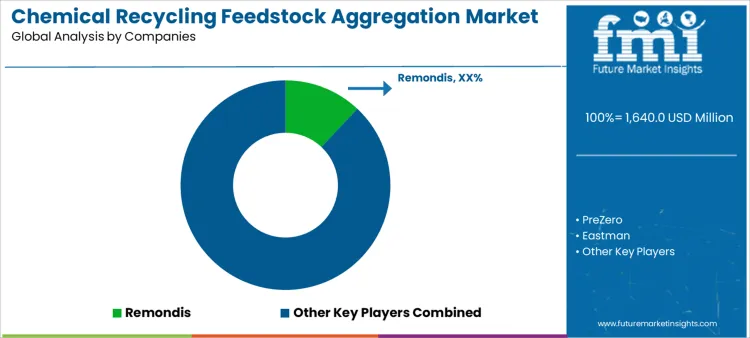
The chemical recycling feedstock aggregation market is driven by the growing demand for efficient and sustainable systems to handle post-consumer plastic waste, particularly as chemical recycling technologies continue to mature. Key players are focused on collecting and pre-treating a wide variety of waste plastics, ensuring the material meets the stringent requirements for chemical recycling processes. Buyers evaluate the quality of aggregated feedstock, contamination levels, and the efficiency of the pre-treatment processes. Procurement behavior favors suppliers with robust collection networks, processing capacity, and proven ability to supply high-purity feedstock suitable for chemical recycling technologies. Trend in the market reflects increasing adoption of chemical recycling as a solution to manage plastic waste and meet circular economy goals.
Remondis leads competitive positioning with its well-established infrastructure for waste management, offering large-scale aggregation and pre-treatment of feedstock for advanced recycling technologies. PreZero competes by providing integrated waste management services and collecting plastics for recycling, particularly targeting industrial and municipal waste streams. Eastman contributes by supplying processed feedstock that meets the requirements for its own chemical recycling platforms, ensuring high-quality material inputs. Agilyx supports demand with its pyrolysis-based systems, aggregating and converting plastics into high-quality monomers for reuse. GEM Co. and Kingfa Recycling participate by focusing on specialized feedstock collection and aggregation for local and regional chemical recycling applications. JEPLAN and JGC are also key players, supporting the aggregation of high-quality feedstock for their respective chemical recycling technologies. Competitive differentiation centers on material quality, collection network scale, regulatory compliance, and integration with advanced recycling technologies.
Key Players in the Chemical Recycling Feedstock Aggregation Market
- Remondis
- PreZero
- Eastman
- Agilyx
- GEM Co.
- Kingfa Recycling
- JEPLAN
- JGC
- Others
Scope of the Report
| Items | Values |
|---|---|
| Quantitative Units | USD million |
| Feedstock Type | Mixed plastic bales; Film-rich streams; Mixed post-consumer plastics; Sorted plastic fractions; Regional feedstock; Others |
| Aggregation Technology | Pre-sorting & blending hubs; Quality-controlled aggregation; Scale aggregation; High-purity aggregation; Others |
| End-Use | Pyrolysis & depolymerisation; Advanced recycling plants; Large chemical recycling parks; Feedstock for depolymerisation; Emerging chem-recycling |
| Regions Covered | Asia Pacific, Europe, North America, Latin America, Middle East & Africa |
| Countries Covered | India, China, USA, Germany, Brazil, and 40+ countries |
| Key Companies Profiled | Remondis; PreZero; Eastman; Agilyx; GEM Co.; Kingfa Recycling; JEPLAN; JGC; Others |
| Additional Attributes | Dollar sales by feedstock type, aggregation technology, and end-use; efficiency in aggregating mixed and sorted plastic fractions for chemical recycling; performance of aggregation technologies in enhancing the purity and quality of feedstocks for pyrolysis and depolymerisation; role in large-scale chemical recycling plants and emerging chem-recycling systems; procurement dynamics driven by regional feedstock availability, regulatory incentives, and long-term partnerships in advancing circular economy goals. |
Chemical Recycling Feedstock Aggregation Market by Segment
Feedstock Type:
- Mixed plastic bales
- Film-rich streams
- Mixed post-consumer plastics
- Sorted plastic fractions
- Regional feedstock
- Others
Aggregation Technology:
- Pre-sorting & blending hubs
- Quality-controlled aggregation
- Scale aggregation
- High-purity aggregation
- Others
End-Use:
- Pyrolysis & depolymerisation
- Advanced recycling plants
- Large chemical recycling parks
- Feedstock for depolymerisation
- Emerging chem-recycling
Region:
- Asia Pacific
- China
- Japan
- South Korea
- India
- Australia & New Zealand
- ASEAN
- Rest of Asia Pacific
- Europe
- Germany
- United Kingdom
- France
- Italy
- Spain
- Nordic
- BENELUX
- Rest of Europe
- North America
- United States
- Canada
- Mexico
- Latin America
- Brazil
- Chile
- Rest of Latin America
- Middle East & Africa
- Kingdom of Saudi Arabia
- Other GCC Countries
- Turkey
- South Africa
- Other African Union
- Rest of Middle East & Africa
Bibliography
- European Commission. (2023). Directive (EU) 2018/851 amending the Waste Framework Directive: Promoting circular economy and recycled content in plastics. Publications Office of the European Union.
- Organisation for Economic Co-operation and Development. (2023). Global Plastics Outlook: Policy scenarios to 2060. OECD Publishing.
- United Nations Environment Programme. (2023). Turning off the Tap: How the world can end plastic pollution and create a circular economy for plastics. UNEP.
- Hopewell, J., Dvorak, R., & Kosior, E. (2024). Waste plastic recycling: Clarifying the chemical recycling landscape and feedstock challenges. Resources, Conservation and Recycling, 190, 106340.
- United States Environmental Protection Agency. (2024). Advancing Sustainable Materials Management: 2024 Fact Sheet - Chemical recycling. USA. EPA.
Frequently Asked Questions
How big is the chemical recycling feedstock aggregation market in 2026?
The global chemical recycling feedstock aggregation market is estimated to be valued at USD 1,640.0 million in 2026.
What will be the size of chemical recycling feedstock aggregation market in 2036?
The market size for the chemical recycling feedstock aggregation market is projected to reach USD 5,921.7 million by 2036.
How much will be the chemical recycling feedstock aggregation market growth between 2026 and 2036?
The chemical recycling feedstock aggregation market is expected to grow at a 13.7% CAGR between 2026 and 2036.
What are the key product types in the chemical recycling feedstock aggregation market?
The key product types in chemical recycling feedstock aggregation market are mixed plastic bales, film-rich streams, mixed post-consumer plastics, sorted plastic fractions, regional feedstock and others.
Which aggregation technology segment to contribute significant share in the chemical recycling feedstock aggregation market in 2026?
In terms of aggregation technology, pre-sorting & blending hubs segment to command 55.0% share in the chemical recycling feedstock aggregation market in 2026.
Preview the report firsthand - request a free sample
Get SampleGet the brochure for pricing and purchase details.
Get PDFTable of Content
- Executive Summary
- Global Market Outlook
- Demand-side Trends
- Supply-side Trends
- Technology Roadmap Analysis
- Analysis and Recommendations
- Market Overview
- Market Coverage / Taxonomy
- Market Definition / Scope / Limitations
- Market Background
- Market Dynamics
- Drivers
- Restraints
- Opportunity
- Trends
- Scenario Forecast
- Demand in Optimistic Scenario
- Demand in Likely Scenario
- Demand in Conservative Scenario
- Opportunity Map Analysis
- Product Life Cycle Analysis
- Supply Chain Analysis
- Investment Feasibility Matrix
- Value Chain Analysis
- PESTLE and Porter’s Analysis
- Regulatory Landscape
- Regional Parent Market Outlook
- Production and Consumption Statistics
- Import and Export Statistics
- Market Dynamics
- Global Market Analysis 2021 to 2025 and Forecast, 2026 to 2036
- Historical Market Size Value (USD Million) Analysis, 2021 to 2025
- Current and Future Market Size Value (USD Million) Projections, 2026 to 2036
- Y-o-Y Growth Trend Analysis
- Absolute $ Opportunity Analysis
- Global Market Pricing Analysis 2021 to 2025 and Forecast 2026 to 2036
- Global Market Analysis 2021 to 2025 and Forecast 2026 to 2036, By Feedstock Type
- Introduction / Key Findings
- Historical Market Size Value (USD Million) Analysis By Feedstock Type , 2021 to 2025
- Current and Future Market Size Value (USD Million) Analysis and Forecast By Feedstock Type , 2026 to 2036
- Mixed plastic bales
- Film-rich streams
- Mixed post-consumer plastics
- Sorted plastic fractions
- Regional feedstock
- Others
- Mixed plastic bales
- Y-o-Y Growth Trend Analysis By Feedstock Type , 2021 to 2025
- Absolute $ Opportunity Analysis By Feedstock Type , 2026 to 2036
- Global Market Analysis 2021 to 2025 and Forecast 2026 to 2036, By Aggregation Technology
- Introduction / Key Findings
- Historical Market Size Value (USD Million) Analysis By Aggregation Technology, 2021 to 2025
- Current and Future Market Size Value (USD Million) Analysis and Forecast By Aggregation Technology, 2026 to 2036
- Pre-sorting & blending hubs
- Quality-controlled aggregation
- Scale aggregation
- High-purity aggregation
- Others
- Pre-sorting & blending hubs
- Y-o-Y Growth Trend Analysis By Aggregation Technology, 2021 to 2025
- Absolute $ Opportunity Analysis By Aggregation Technology, 2026 to 2036
- Global Market Analysis 2021 to 2025 and Forecast 2026 to 2036, By End-Use
- Introduction / Key Findings
- Historical Market Size Value (USD Million) Analysis By End-Use, 2021 to 2025
- Current and Future Market Size Value (USD Million) Analysis and Forecast By End-Use, 2026 to 2036
- Pyrolysis & depolymerisation
- Advanced recycling plants
- Large chemical recycling parks
- Feedstock for depolymerisation
- Emerging chem-recycling
- Pyrolysis & depolymerisation
- Y-o-Y Growth Trend Analysis By End-Use, 2021 to 2025
- Absolute $ Opportunity Analysis By End-Use, 2026 to 2036
- Global Market Analysis 2021 to 2025 and Forecast 2026 to 2036, By Region
- Introduction
- Historical Market Size Value (USD Million) Analysis By Region, 2021 to 2025
- Current Market Size Value (USD Million) Analysis and Forecast By Region, 2026 to 2036
- North America
- Latin America
- Western Europe
- Eastern Europe
- East Asia
- South Asia and Pacific
- Middle East & Africa
- Market Attractiveness Analysis By Region
- North America Market Analysis 2021 to 2025 and Forecast 2026 to 2036, By Country
- Historical Market Size Value (USD Million) Trend Analysis By Market Taxonomy, 2021 to 2025
- Market Size Value (USD Million) Forecast By Market Taxonomy, 2026 to 2036
- By Country
- USA
- Canada
- Mexico
- By Feedstock Type
- By Aggregation Technology
- By End-Use
- By Country
- Market Attractiveness Analysis
- By Country
- By Feedstock Type
- By Aggregation Technology
- By End-Use
- Key Takeaways
- Latin America Market Analysis 2021 to 2025 and Forecast 2026 to 2036, By Country
- Historical Market Size Value (USD Million) Trend Analysis By Market Taxonomy, 2021 to 2025
- Market Size Value (USD Million) Forecast By Market Taxonomy, 2026 to 2036
- By Country
- Brazil
- Chile
- Rest of Latin America
- By Feedstock Type
- By Aggregation Technology
- By End-Use
- By Country
- Market Attractiveness Analysis
- By Country
- By Feedstock Type
- By Aggregation Technology
- By End-Use
- Key Takeaways
- Western Europe Market Analysis 2021 to 2025 and Forecast 2026 to 2036, By Country
- Historical Market Size Value (USD Million) Trend Analysis By Market Taxonomy, 2021 to 2025
- Market Size Value (USD Million) Forecast By Market Taxonomy, 2026 to 2036
- By Country
- Germany
- UK
- Italy
- Spain
- France
- Nordic
- BENELUX
- Rest of Western Europe
- By Feedstock Type
- By Aggregation Technology
- By End-Use
- By Country
- Market Attractiveness Analysis
- By Country
- By Feedstock Type
- By Aggregation Technology
- By End-Use
- Key Takeaways
- Eastern Europe Market Analysis 2021 to 2025 and Forecast 2026 to 2036, By Country
- Historical Market Size Value (USD Million) Trend Analysis By Market Taxonomy, 2021 to 2025
- Market Size Value (USD Million) Forecast By Market Taxonomy, 2026 to 2036
- By Country
- Russia
- Poland
- Hungary
- Balkan & Baltic
- Rest of Eastern Europe
- By Feedstock Type
- By Aggregation Technology
- By End-Use
- By Country
- Market Attractiveness Analysis
- By Country
- By Feedstock Type
- By Aggregation Technology
- By End-Use
- Key Takeaways
- East Asia Market Analysis 2021 to 2025 and Forecast 2026 to 2036, By Country
- Historical Market Size Value (USD Million) Trend Analysis By Market Taxonomy, 2021 to 2025
- Market Size Value (USD Million) Forecast By Market Taxonomy, 2026 to 2036
- By Country
- China
- Japan
- South Korea
- By Feedstock Type
- By Aggregation Technology
- By End-Use
- By Country
- Market Attractiveness Analysis
- By Country
- By Feedstock Type
- By Aggregation Technology
- By End-Use
- Key Takeaways
- South Asia and Pacific Market Analysis 2021 to 2025 and Forecast 2026 to 2036, By Country
- Historical Market Size Value (USD Million) Trend Analysis By Market Taxonomy, 2021 to 2025
- Market Size Value (USD Million) Forecast By Market Taxonomy, 2026 to 2036
- By Country
- India
- ASEAN
- Australia & New Zealand
- Rest of South Asia and Pacific
- By Feedstock Type
- By Aggregation Technology
- By End-Use
- By Country
- Market Attractiveness Analysis
- By Country
- By Feedstock Type
- By Aggregation Technology
- By End-Use
- Key Takeaways
- Middle East & Africa Market Analysis 2021 to 2025 and Forecast 2026 to 2036, By Country
- Historical Market Size Value (USD Million) Trend Analysis By Market Taxonomy, 2021 to 2025
- Market Size Value (USD Million) Forecast By Market Taxonomy, 2026 to 2036
- By Country
- Kingdom of Saudi Arabia
- Other GCC Countries
- Turkiye
- South Africa
- Other African Union
- Rest of Middle East & Africa
- By Feedstock Type
- By Aggregation Technology
- By End-Use
- By Country
- Market Attractiveness Analysis
- By Country
- By Feedstock Type
- By Aggregation Technology
- By End-Use
- Key Takeaways
- Key Countries Market Analysis
- USA
- Pricing Analysis
- Market Share Analysis, 2025
- By Feedstock Type
- By Aggregation Technology
- By End-Use
- Canada
- Pricing Analysis
- Market Share Analysis, 2025
- By Feedstock Type
- By Aggregation Technology
- By End-Use
- Mexico
- Pricing Analysis
- Market Share Analysis, 2025
- By Feedstock Type
- By Aggregation Technology
- By End-Use
- Brazil
- Pricing Analysis
- Market Share Analysis, 2025
- By Feedstock Type
- By Aggregation Technology
- By End-Use
- Chile
- Pricing Analysis
- Market Share Analysis, 2025
- By Feedstock Type
- By Aggregation Technology
- By End-Use
- Germany
- Pricing Analysis
- Market Share Analysis, 2025
- By Feedstock Type
- By Aggregation Technology
- By End-Use
- UK
- Pricing Analysis
- Market Share Analysis, 2025
- By Feedstock Type
- By Aggregation Technology
- By End-Use
- Italy
- Pricing Analysis
- Market Share Analysis, 2025
- By Feedstock Type
- By Aggregation Technology
- By End-Use
- Spain
- Pricing Analysis
- Market Share Analysis, 2025
- By Feedstock Type
- By Aggregation Technology
- By End-Use
- France
- Pricing Analysis
- Market Share Analysis, 2025
- By Feedstock Type
- By Aggregation Technology
- By End-Use
- India
- Pricing Analysis
- Market Share Analysis, 2025
- By Feedstock Type
- By Aggregation Technology
- By End-Use
- ASEAN
- Pricing Analysis
- Market Share Analysis, 2025
- By Feedstock Type
- By Aggregation Technology
- By End-Use
- Australia & New Zealand
- Pricing Analysis
- Market Share Analysis, 2025
- By Feedstock Type
- By Aggregation Technology
- By End-Use
- China
- Pricing Analysis
- Market Share Analysis, 2025
- By Feedstock Type
- By Aggregation Technology
- By End-Use
- Japan
- Pricing Analysis
- Market Share Analysis, 2025
- By Feedstock Type
- By Aggregation Technology
- By End-Use
- South Korea
- Pricing Analysis
- Market Share Analysis, 2025
- By Feedstock Type
- By Aggregation Technology
- By End-Use
- Russia
- Pricing Analysis
- Market Share Analysis, 2025
- By Feedstock Type
- By Aggregation Technology
- By End-Use
- Poland
- Pricing Analysis
- Market Share Analysis, 2025
- By Feedstock Type
- By Aggregation Technology
- By End-Use
- Hungary
- Pricing Analysis
- Market Share Analysis, 2025
- By Feedstock Type
- By Aggregation Technology
- By End-Use
- Kingdom of Saudi Arabia
- Pricing Analysis
- Market Share Analysis, 2025
- By Feedstock Type
- By Aggregation Technology
- By End-Use
- Turkiye
- Pricing Analysis
- Market Share Analysis, 2025
- By Feedstock Type
- By Aggregation Technology
- By End-Use
- South Africa
- Pricing Analysis
- Market Share Analysis, 2025
- By Feedstock Type
- By Aggregation Technology
- By End-Use
- USA
- Market Structure Analysis
- Competition Dashboard
- Competition Benchmarking
- Market Share Analysis of Top Players
- By Regional
- By Feedstock Type
- By Aggregation Technology
- By End-Use
- Competition Analysis
- Competition Deep Dive
- Remondis
- Overview
- Product Portfolio
- Profitability by Market Segments (Product/Age /Sales Channel/Region)
- Sales Footprint
- Strategy Overview
- Marketing Strategy
- Product Strategy
- Channel Strategy
- PreZero
- Eastman
- Agilyx
- GEM Co.
- Kingfa Recycling
- JEPLAN
- JGC
- Others
- Remondis
- Competition Deep Dive
- Assumptions & Acronyms Used
- Research Methodology


