

- Industry Size (2026)
- USD 4260 Mn
- Forecast (2036)
- USD 12880.8 Mn
- CAGR (2026 to 2036)
- 11.70%
Circular Smart City Waste Management Systems Market Forecast and Outlook 2026 to 2036
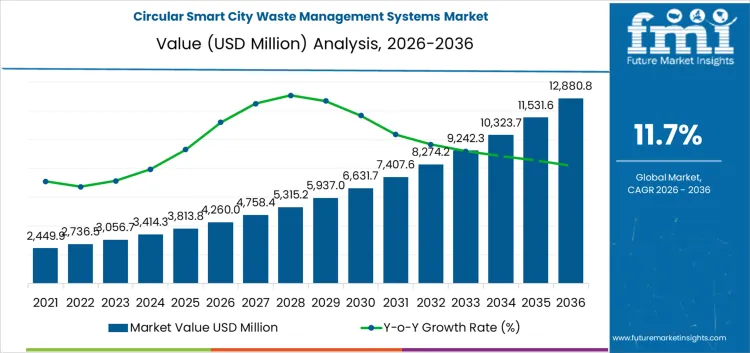
The circular smart city waste management systems market is projected to grow from USD 4,260 million in 2026 to USD 12,880.8 million by 2036, advancing at a CAGR of 11.7%. Growth is concentrated in specific regions rather than broadly distributed, reflecting disparities in city size, waste generation intensity, and public investment cycles. Asia Pacific dominates new installations as large urban centers deploy smart systems to handle continuous, high-volume waste flows with lower marginal operating costs.
Europe’s contribution is driven by regulatory alignment and system modernization, favoring reliability and compliance over rapid scale. North America adopts selectively, where smart waste solutions are justified through cost optimization and private operator involvement. Other regions progress incrementally, constrained by capital availability and infrastructure readiness. Between 2026 and 2036, competitive success will depend on aligning system design and pricing with regional cost structures, governance models, and adoption speed rather than relying on uniform global demand assumptions.
Quick Stats for Circular Smart City Waste Management Systems Market
- Circular Smart City Waste Management Systems Market Value (2026): USD 4,260 Million
- Circular Smart City Waste Management Systems Market Forecast Value (2036): USD 12,880.8 Million
- Circular Smart City Waste Management Systems Market Forecast CAGR 2026 to 2036: 11.7%
- Leading System Type in Circular Smart City Waste Management Systems Market: Integrated Collection & Sorting Systems (44% share)
- Key Growth Regions in Circular Smart City Waste Management Systems Market: Asia Pacific, Europe, North America
- Key Players in Circular Smart City Waste Management Systems Market: Veolia Environnement S.A., SUEZ S.A., Waste Management, Inc., Republic Services, Inc., China Everbright Environment Group Limited, China Conch Venture Holdings Limited, Hitachi Zosen Corporation, JFE Engineering Corporation
Circular Smart City Waste Management Systems Market Key Takeaways
| Metric | Value |
|---|---|
| Circular Smart City Waste Management Systems Market Value (2026) | USD 4,260 Million |
| Circular Smart City Waste Management Systems Market Forecast Value (2036) | USD 12,880.8 Million |
| Circular Smart City Waste Management Systems Market Forecast CAGR 2026 to 2036 | 11.70% |
How are Urban Infrastructure Modernization and Data-Driven Operations Driving the Circular Smart City Waste Management Systems Market?
Sales of circular smart city waste management systems are expanding as cities move from fragmented waste collection toward integrated, technology-enabled circular models. Urban authorities are under pressure to improve collection efficiency, reduce landfill dependency, and increase material recovery rates, all while managing rising population density and operational costs. Smart systems that combine sensor-enabled bins, route optimization software, and centralized data platforms allow municipalities to shift from reactive waste handling to predictive, performance-based operations. For solution providers, demand is increasingly tied to measurable efficiency gains rather than standalone hardware installations.
Procurement and project structuring are also evolving. Cities are favoring end-to-end solutions that integrate collection, sorting, recycling, and reporting into a single digital framework. This is creating opportunities for vendors offering interoperable platforms that connect IoT devices, fleet management, and recycling analytics. Long-term service contracts, software subscriptions, and performance-linked payment models are becoming more common, reshaping revenue profiles for suppliers and system integrators beyond one-time equipment sales.
Circular economy objectives are further strengthening market momentum. Smart waste systems enable traceability of material flows, support compliance with extended producer responsibility programs, and improve transparency for regulators and citizens. Emerging economies are investing in smart city infrastructure to leapfrog legacy waste systems, while developed regions are upgrading existing assets to meet higher recycling and emissions targets. For companies operating in this market, competitive advantage increasingly depends on system scalability, data intelligence capabilities, and the ability to deliver reliable outcomes across complex urban environments positioning circular smart city waste management systems as a core pillar of next-generation urban infrastructure.
How Is the Circular Smart City Waste Management Systems Market Structured Across Key Segments?
The circular smart city waste management systems market is segmented by end use and system type, reflecting how urban scale, waste density, and automation requirements shape deployment choices. By end use, urban circular waste systems lead adoption, driven by city-wide programs that integrate collection, sorting, and processing across multiple districts. Other end uses include municipal recycling, mega-city waste systems, high-efficiency city programs, smart city missions, and targeted urban waste upgrades. By system type, integrated collection and sorting systems form the leading configuration, while smart MRFs and logistics platforms, city-scale recycling systems, and automated sorting solutions support different capacity and control requirements.
Why Do Urban Circular Waste Systems Lead End-Use Adoption in the Circular Smart City Waste Management Systems Market?
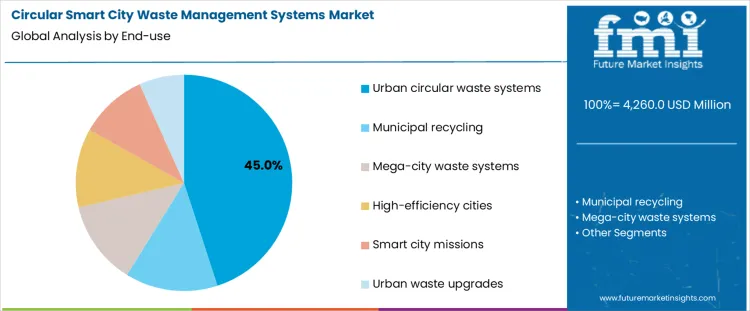
Urban circular waste systems account for 45% share of the circular smart city waste management systems market because dense population centers generate continuous, high-volume waste streams that require coordinated management. Cities deploy integrated systems to manage mixed waste, recyclables, and organics within unified operational frameworks. Centralized planning improves route efficiency, asset utilization, and data-driven monitoring across districts. Urban authorities prioritize scalable systems that can be expanded as city boundaries and waste volumes grow. For system integrators and technology providers, urban programs offer multi-year contracts and phased rollouts. These scale, coordination, and operational control factors explain why urban circular waste systems dominate end-use demand.
Why Do Integrated Collection And Sorting Systems Dominate System Type Selection?
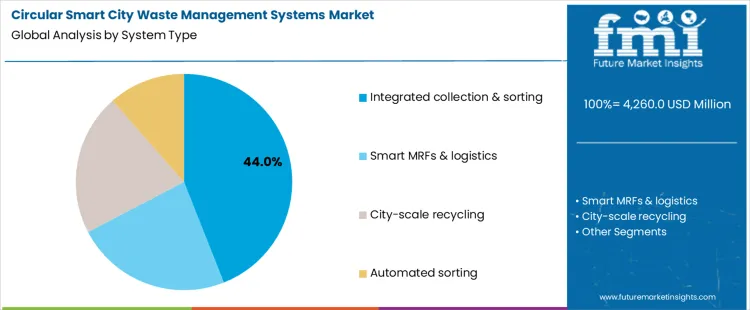
Integrated collection and sorting systems hold 44% share of the circular smart city waste management systems market because they combine waste capture and material separation within a single operational flow. This configuration reduces manual handling, improves material quality, and increases throughput in urban environments. Sensors, automated sorting, and centralized control platforms enable consistent performance across neighborhoods. Operator’s value integrated systems for real-time visibility into collection efficiency and sorting accuracy. The approach simplifies infrastructure planning by reducing dependency on standalone facilities. For suppliers, integrated systems allow standardized deployment with modular expansion. These efficiency, control, and scalability advantages explain their dominance among system types.
What Are The Key Dynamics Of The Circular Smart City Waste Management Systems Market?
The circular smart city waste management systems market is defined by the integration of digital technologies with end-to-end waste collection, sorting, processing, and material recovery systems. Stakeholders include municipal authorities, technology providers, waste processors, and infrastructure operators seeking to improve waste diversion rates, reduce operational costs, and optimize resource use. Core dynamics involve deployment of sensor-enabled bins, route optimization platforms, automated sortation systems, and data analytics dashboards that deliver real-time visibility into waste streams. For solution providers, interoperability with city IT systems, scalability across districts, and total cost of ownership play major roles in winning long-term contracts and service agreements.
How Are Technology And Operational Trends Shaping The Market?
Technology and operational trends are shaping the circular smart city waste management systems market through widespread adoption of IoT connectivity, AI-based analytics, and automation. Smart sensors on waste bins enable fill-level monitoring that drives dynamic collection scheduling and reduces fuel use. Integration of computer vision and robotics in material sortation facilities improves accuracy, reduces manual labor, and enhances recovery of recyclables and organics. Digital platforms that combine route optimization, asset tracking, and service performance KPIs help cities measure progress and forecast needs. For technology vendors, modular platform architectures, cloud-based services, and analytics toolkits tailored to local regulatory frameworks strengthen competitive positioning.
Why Do Integration, Funding, And Policy Challenges Restrain Market Growth?
Integration, funding, and policy challenges restrain adoption in the circular smart city waste management systems market. Deploying smart waste systems requires alignment of legacy infrastructure with new digital tools, often involving complex integration with geographically dispersed assets, payment systems, and service provider networks. Securing capital for upfront infrastructure investments such as smart bins, sensor networks, and advanced sortation equipment can be challenging for municipalities with constrained budgets. Policy fragmentation across regions, differing regulatory requirements for waste handling, recycling targets, and data privacy standards raise compliance risk and system customization costs. These factors can slow implementation timelines and elevate total cost of ownership for cities.
What is the Country-Level Overview for the Circular Smart City Waste Management Systems Market?
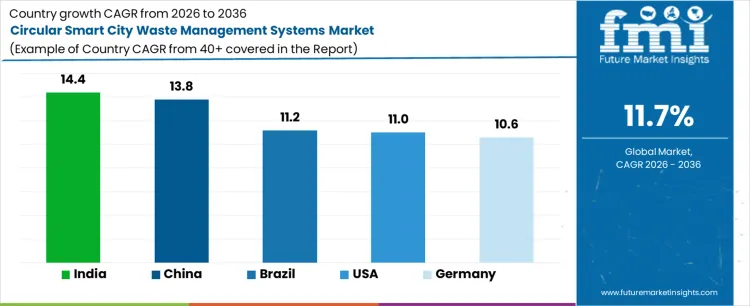
The circular smart city waste management systems market is expanding as urban authorities adopt digitally enabled infrastructure to manage growing waste volumes more efficiently. These systems integrate sensor-based collection assets, fleet tracking, data analytics, and centralized control platforms to improve visibility across waste generation, collection, and processing stages. Country-level growth differs based on urban density, municipal investment capacity, governance coordination, and readiness to deploy citywide digital systems. More established markets focus on operational optimization, system reliability, and interoperability with existing municipal platforms, while faster-growing regions prioritize rapid rollout, scalability, and coverage across complex urban environments.
| country | CAGR (%) |
|---|---|
| India | 14.4 |
| China | 13.8 |
| Brazil | 11.2 |
| USA | 11.0 |
| Germany | 10.6 |
How is Germany Institutionalizing Circular Smart City Waste Management Systems?
Germany’s circular smart city waste management systems market is progressing through policy-led system integration rather than fragmented technology deployment, expanding at a CAGR of 10.6% during 2026-2036. Municipalities focus on tightly coordinated networks linking smart collection, sorting, material recovery, and data platforms. Adoption emphasizes sensor-enabled bins, route optimization software, and centralized monitoring dashboards integrated with city infrastructure systems. Buyers prioritize reliability, interoperability with existing municipal IT frameworks, and long-term operational efficiency. Rollouts typically begin at district levels before scaling citywide, supported by structured procurement and multi-year contracts. Data accuracy and system resilience are critical, as waste flows are closely linked to downstream recovery and processing capacity. Procurement decisions favor vendors offering proven deployments, strong compliance alignment, and lifecycle service support. Germany represents a governance-driven market where success depends on system stability, data integrity, and seamless integration across public waste value chains.
What is Driving Smart Waste System Adoption across USA Cities?
In the United States, circular smart city waste management systems are being adopted as operational efficiency tools rather than purely environmental infrastructure, with the market growing at a CAGR of 11.0% during 2026-2036. Cities deploy smart bins, fleet telematics, and analytics platforms to reduce collection costs, improve service coverage, and optimize labor utilization. Adoption is often pilot-led, starting in high-density urban zones or commercial districts before broader rollout. Buyers emphasize scalability, cloud-based architecture, and compatibility with existing fleet management and city data platforms. Private waste operators play a significant role, shaping procurement toward performance-based contracts and rapid ROI. Data insights are used to adjust collection frequency, reduce overflow incidents, and improve asset utilization. The USA market rewards vendors offering modular solutions, fast deployment, and measurable operational gains rather than fully centralized citywide systems.
Why is China Scaling Circular Smart City Waste Systems So Aggressively?
China’s circular smart city waste management systems market is expanding at a CAGR of 13.8% during 2026-2036, driven by rapid urbanization and high-volume waste generation. Cities deploy large-scale smart collection infrastructure integrated with centralized command platforms to manage throughput across dense urban environments. Adoption focuses on sensor-enabled bins, AI-driven sorting guidance, and real-time monitoring systems capable of handling massive data volumes. Buyers prioritize system capacity, speed of deployment, and localized software development. Rollouts are typically citywide and simultaneous, supported by strong municipal coordination. Integration with mobile platforms increases public participation and compliance. Procurement favors vendors with proven large-scale implementations, robust hardware, and high system uptime. China represents a scale-dominated market where competitiveness depends on platform robustness, localization, and the ability to operate reliably under extreme volume and density conditions.
How is Brazil Building Smart Waste Systems within Urban Growth Constraints?
Brazil’s circular smart city waste management systems market is developing through targeted urban modernization efforts, growing at a CAGR of 11.2% during the forecast period. Adoption is concentrated in major metropolitan areas seeking to improve collection efficiency and reduce informal waste handling. Cities deploy smart bins, GPS-enabled fleets, and basic analytics platforms to improve visibility and route planning. Buyers focus on affordability, ease of implementation, and adaptability to uneven urban infrastructure. Rollouts are incremental, often supported by public-private partnerships and international funding programs. Data utilization centers on improving service consistency rather than advanced recovery optimization. Procurement decisions favor flexible vendors capable of operating across varied city layouts and resource constraints. Brazil represents a pragmatic growth market where success depends on cost-effective systems, operational resilience, and the ability to deliver measurable improvements without heavy infrastructure overhaul.
Why Is India the Fastest-Growing Market for Circular Smart City Waste Systems?
India’s circular smart city waste management systems market is growing at a CAGR of 14.4% during 2026-2036, driven by rapid urban expansion and national smart city initiatives. Adoption is largely greenfield-led, with digital systems embedded early into new municipal waste programs. Cities deploy sensor-enabled bins, GPS-tracked vehicles, and centralized dashboards to manage collection across fragmented urban zones. Buyers prioritize scalability, mobile-first interfaces, and affordability. Systems must function across mixed residential, commercial, and informal areas. Rollouts are fast, often covering multiple wards simultaneously. Procurement favors adaptable platforms, quick onboarding, and strong local support networks. Data is used to improve collection coverage, reduce inefficiencies, and support material recovery planning. India represents a high-growth market where speed, flexibility, and operational scalability define competitive advantage.
How Are Companies Competing in the Circular Smart City Waste Management Systems Market?
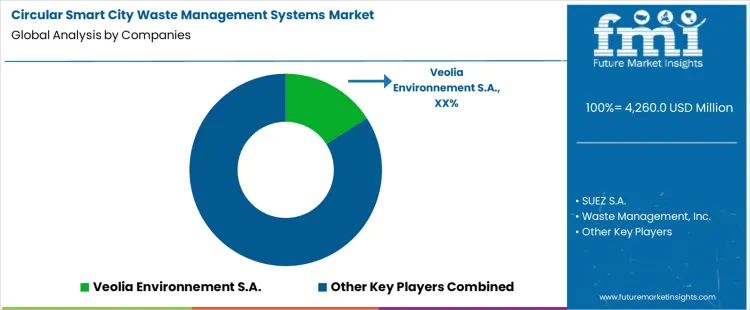
Competition in the circular smart city waste management systems market is defined by solutions that combine waste collection, digital monitoring, advanced sorting, and recycling infrastructure to support sustainable urban ecosystems. Veolia Environnement S.A. positions its smart waste portfolio with official materials highlighting integrated IoT-enabled bins, route optimization platforms, and automated sorting facilities that feed high-quality recyclates back into manufacturing streams. Brochures emphasize predictive analytics, asset tracking, and circularity dashboards that align with city-level sustainability targets.
SUEZ S.A. competes through comprehensive urban waste platforms documented for real-time sensor networks, cloud-based waste flow visualization, and adaptive collection scheduling. Its product literature underscores smart sorting centers equipped with AI-assisted optical and sensor sorting, enabling higher recovery rates and lower landfill diversion. Waste Management, Inc. differentiates by coupling smart infrastructure with large-scale materials recovery facilities (MRFs) and digital customer portals that provide waste generation insights, recycling incentives, and logistics coordination tailored to municipal and commercial clients.
North American service leaders expand competitive breadth with end-to-end systems. Republic Services, Inc. markets smart city waste solutions documented for integrated data analytics, fleet telematics, and customizable recycling programs that support extended producer responsibility (EPR) initiatives. Official brochures focus on modular deployment options, community engagement tools, and compliance reporting frameworks.
Asian infrastructure integrators emphasize localized execution and circular outcomes. China Everbright Environment Group Limited and China Conch Venture Holdings Limited position their offerings with materials highlighting urban sorting complexes, anaerobic digestion, and waste-to-energy integrations that feed recovered materials back to industrial supply chains. Hitachi Zosen Corporation and JFE Engineering Corporation compete through engineered systems with official documentation for advanced materials separation, energy recuperation, and digital process controls designed for megacity applications. Across all players, differentiation is driven by brochure-verified system integration, digital platform maturity, and measurable recovery performance rather than pricing alone.
Key Players in Circular Smart City Waste Management Systems Market
- Veolia Environnement S.A.
- SUEZ S.A.
- Waste Management, Inc.
- Republic Services, Inc.
- China Everbright Environment Group Limited
- China Conch Venture Holdings Limited
- Hitachi Zosen Corporation
- JFE Engineering Corporation
Scope of Report
| Attribute | Description |
|---|---|
| Quantitative Unit | USD Million |
| End-use | Urban Circular Waste Systems, Municipal Recycling, Mega-City Waste Systems, High-Efficiency Cities, Smart City Missions, Urban Waste Upgrades |
| System Type | Integrated Collection & Sorting, Smart MRFs & Logistics, City-Scale Recycling, Automated Sorting |
| Countries Covered | China, Japan, South Korea, India, Australia & New Zealand, ASEAN, Rest of Asia Pacific, Germany, United Kingdom, France, Italy, Spain, aNordic, BENELUX, Rest of Europe, United States, Canada, Mexico, Brazil, Chile, Rest of Latin America, Kingdom of Saudi Arabia, Other GCC Countries, Turkey, South Africa, Other African Union, Rest of Middle East & Africa |
| Regions Covered | Asia Pacific, Europe, North America, Latin America, Middle East & Africa |
| Key Companies Profiled | Veolia Environnement S.A., SUEZ S.A., Waste Management, Inc., Republic Services, Inc., China Everbright Environment Group Limited, China Conch Venture Holdings Limited, Hitachi Zosen Corporation, JFE Engineering Corporation |
| Additional Attributes | Dollar sales by end-use and system type are evaluated across municipal and city-scale circular waste infrastructures. The report includes country-level demand assessment, growth projections for 2026-2036, analysis of automation and digital monitoring integration, evaluation of smart MRF efficiency and logistics optimization, competitive benchmarking of solution providers, and assessment of policy-driven smart city investments and urban sustainability programs. |
Circular Smart City Waste Management Systems Market by Key Segments
End-use:
- Urban circular waste systems
- Municipal recycling
- Mega-city waste systems
- High-efficiency cities
- Smart city missions
- Urban waste upgrades
System Type:
- Integrated collection & sorting
- Smart MRFs & logistics
- City-scale recycling
- Automated sorting
Region:
- Asia Pacific
- China
- Japan
- South Korea
- India
- Australia & New Zealand
- ASEAN
- Rest of Asia Pacific
- Europe
- Germany
- United Kingdom
- France
- Italy
- Spain
- Nordic
- BENELUX
- Rest of Europe
- North America
- United States
- Canada
- Mexico
- Latin America
- Brazil
- Chile
- Rest of Latin America
- Middle East & Africa
- Kingdom of Saudi Arabia
- Other GCC Countries
- Turkey
- South Africa
- Other African Union
- Rest of Middle East & Africa
Bibliography
- European Parliament, & Council of the European Union. (2024). Regulation (EU) 2024/1781 of the European Parliament and of the Council of 13 June 2024 establishing a framework for the setting of ecodesign requirements for sustainable products, amending Directive (EU) 2020/1828 and Regulation (EU) 2023/1542 and repealing Directive 2009/125/EC.
- International Telecommunication Union. (2023, November). U4SSC verification report: Anyang, Korea (Republic of).
- International Organization for Standardization. (2019). ISO 37122:2019 Sustainable cities and communities—Indicators for smart cities.
Frequently Asked Questions
How big is the circular smart city waste management systems market in 2026?
The global circular smart city waste management systems market is estimated to be valued at USD 4,260.0 million in 2026.
What will be the size of circular smart city waste management systems market in 2036?
The market size for the circular smart city waste management systems market is projected to reach USD 12,880.8 million by 2036.
How much will be the circular smart city waste management systems market growth between 2026 and 2036?
The circular smart city waste management systems market is expected to grow at a 11.7% CAGR between 2026 and 2036.
What are the key product types in the circular smart city waste management systems market?
The key product types in circular smart city waste management systems market are urban circular waste systems, municipal recycling, mega-city waste systems, high-efficiency cities, smart city missions and urban waste upgrades.
Which system type segment to contribute significant share in the circular smart city waste management systems market in 2026?
In terms of system type, integrated collection & sorting segment to command 44.0% share in the circular smart city waste management systems market in 2026.
Preview the report firsthand - request a free sample
Get SampleGet the brochure for pricing and purchase details.
Get PDFTable of Content
- Executive Summary
- Global Market Outlook
- Demand-side Trends
- Supply-side Trends
- Technology Roadmap Analysis
- Analysis and Recommendations
- Market Overview
- Market Coverage / Taxonomy
- Market Definition / Scope / Limitations
- Market Background
- Market Dynamics
- Drivers
- Restraints
- Opportunity
- Trends
- Scenario Forecast
- Demand in Optimistic Scenario
- Demand in Likely Scenario
- Demand in Conservative Scenario
- Opportunity Map Analysis
- Product Life Cycle Analysis
- Supply Chain Analysis
- Investment Feasibility Matrix
- Value Chain Analysis
- PESTLE and Porter’s Analysis
- Regulatory Landscape
- Regional Parent Market Outlook
- Production and Consumption Statistics
- Import and Export Statistics
- Market Dynamics
- Global Market Analysis 2021 to 2025 and Forecast, 2026 to 2036
- Historical Market Size Value (USD Million) Analysis, 2021 to 2025
- Current and Future Market Size Value (USD Million) Projections, 2026 to 2036
- Y-o-Y Growth Trend Analysis
- Absolute $ Opportunity Analysis
- Global Market Pricing Analysis 2021 to 2025 and Forecast 2026 to 2036
- Global Market Analysis 2021 to 2025 and Forecast 2026 to 2036, By End-use
- Introduction / Key Findings
- Historical Market Size Value (USD Million) Analysis By End-use , 2021 to 2025
- Current and Future Market Size Value (USD Million) Analysis and Forecast By End-use , 2026 to 2036
- Urban circular waste systems
- Municipal recycling
- Mega-city waste systems
- High-efficiency cities
- Smart city missions
- Urban waste upgrades
- Urban circular waste systems
- Y-o-Y Growth Trend Analysis By End-use , 2021 to 2025
- Absolute $ Opportunity Analysis By End-use , 2026 to 2036
- Global Market Analysis 2021 to 2025 and Forecast 2026 to 2036, By System Type
- Introduction / Key Findings
- Historical Market Size Value (USD Million) Analysis By System Type, 2021 to 2025
- Current and Future Market Size Value (USD Million) Analysis and Forecast By System Type, 2026 to 2036
- Integrated collection & sorting
- Smart MRFs & logistics
- City-scale recycling
- Automated sorting
- Integrated collection & sorting
- Y-o-Y Growth Trend Analysis By System Type, 2021 to 2025
- Absolute $ Opportunity Analysis By System Type, 2026 to 2036
- Global Market Analysis 2021 to 2025 and Forecast 2026 to 2036, By Region
- Introduction
- Historical Market Size Value (USD Million) Analysis By Region, 2021 to 2025
- Current Market Size Value (USD Million) Analysis and Forecast By Region, 2026 to 2036
- North America
- Latin America
- Western Europe
- Eastern Europe
- East Asia
- South Asia and Pacific
- Middle East & Africa
- Market Attractiveness Analysis By Region
- North America Market Analysis 2021 to 2025 and Forecast 2026 to 2036, By Country
- Historical Market Size Value (USD Million) Trend Analysis By Market Taxonomy, 2021 to 2025
- Market Size Value (USD Million) Forecast By Market Taxonomy, 2026 to 2036
- By Country
- USA
- Canada
- Mexico
- By End-use
- By System Type
- By Country
- Market Attractiveness Analysis
- By Country
- By End-use
- By System Type
- Key Takeaways
- Latin America Market Analysis 2021 to 2025 and Forecast 2026 to 2036, By Country
- Historical Market Size Value (USD Million) Trend Analysis By Market Taxonomy, 2021 to 2025
- Market Size Value (USD Million) Forecast By Market Taxonomy, 2026 to 2036
- By Country
- Brazil
- Chile
- Rest of Latin America
- By End-use
- By System Type
- By Country
- Market Attractiveness Analysis
- By Country
- By End-use
- By System Type
- Key Takeaways
- Western Europe Market Analysis 2021 to 2025 and Forecast 2026 to 2036, By Country
- Historical Market Size Value (USD Million) Trend Analysis By Market Taxonomy, 2021 to 2025
- Market Size Value (USD Million) Forecast By Market Taxonomy, 2026 to 2036
- By Country
- Germany
- UK
- Italy
- Spain
- France
- Nordic
- BENELUX
- Rest of Western Europe
- By End-use
- By System Type
- By Country
- Market Attractiveness Analysis
- By Country
- By End-use
- By System Type
- Key Takeaways
- Eastern Europe Market Analysis 2021 to 2025 and Forecast 2026 to 2036, By Country
- Historical Market Size Value (USD Million) Trend Analysis By Market Taxonomy, 2021 to 2025
- Market Size Value (USD Million) Forecast By Market Taxonomy, 2026 to 2036
- By Country
- Russia
- Poland
- Hungary
- Balkan & Baltic
- Rest of Eastern Europe
- By End-use
- By System Type
- By Country
- Market Attractiveness Analysis
- By Country
- By End-use
- By System Type
- Key Takeaways
- East Asia Market Analysis 2021 to 2025 and Forecast 2026 to 2036, By Country
- Historical Market Size Value (USD Million) Trend Analysis By Market Taxonomy, 2021 to 2025
- Market Size Value (USD Million) Forecast By Market Taxonomy, 2026 to 2036
- By Country
- China
- Japan
- South Korea
- By End-use
- By System Type
- By Country
- Market Attractiveness Analysis
- By Country
- By End-use
- By System Type
- Key Takeaways
- South Asia and Pacific Market Analysis 2021 to 2025 and Forecast 2026 to 2036, By Country
- Historical Market Size Value (USD Million) Trend Analysis By Market Taxonomy, 2021 to 2025
- Market Size Value (USD Million) Forecast By Market Taxonomy, 2026 to 2036
- By Country
- India
- ASEAN
- Australia & New Zealand
- Rest of South Asia and Pacific
- By End-use
- By System Type
- By Country
- Market Attractiveness Analysis
- By Country
- By End-use
- By System Type
- Key Takeaways
- Middle East & Africa Market Analysis 2021 to 2025 and Forecast 2026 to 2036, By Country
- Historical Market Size Value (USD Million) Trend Analysis By Market Taxonomy, 2021 to 2025
- Market Size Value (USD Million) Forecast By Market Taxonomy, 2026 to 2036
- By Country
- Kingdom of Saudi Arabia
- Other GCC Countries
- Turkiye
- South Africa
- Other African Union
- Rest of Middle East & Africa
- By End-use
- By System Type
- By Country
- Market Attractiveness Analysis
- By Country
- By End-use
- By System Type
- Key Takeaways
- Key Countries Market Analysis
- USA
- Pricing Analysis
- Market Share Analysis, 2025
- By End-use
- By System Type
- Canada
- Pricing Analysis
- Market Share Analysis, 2025
- By End-use
- By System Type
- Mexico
- Pricing Analysis
- Market Share Analysis, 2025
- By End-use
- By System Type
- Brazil
- Pricing Analysis
- Market Share Analysis, 2025
- By End-use
- By System Type
- Chile
- Pricing Analysis
- Market Share Analysis, 2025
- By End-use
- By System Type
- Germany
- Pricing Analysis
- Market Share Analysis, 2025
- By End-use
- By System Type
- UK
- Pricing Analysis
- Market Share Analysis, 2025
- By End-use
- By System Type
- Italy
- Pricing Analysis
- Market Share Analysis, 2025
- By End-use
- By System Type
- Spain
- Pricing Analysis
- Market Share Analysis, 2025
- By End-use
- By System Type
- France
- Pricing Analysis
- Market Share Analysis, 2025
- By End-use
- By System Type
- India
- Pricing Analysis
- Market Share Analysis, 2025
- By End-use
- By System Type
- ASEAN
- Pricing Analysis
- Market Share Analysis, 2025
- By End-use
- By System Type
- Australia & New Zealand
- Pricing Analysis
- Market Share Analysis, 2025
- By End-use
- By System Type
- China
- Pricing Analysis
- Market Share Analysis, 2025
- By End-use
- By System Type
- Japan
- Pricing Analysis
- Market Share Analysis, 2025
- By End-use
- By System Type
- South Korea
- Pricing Analysis
- Market Share Analysis, 2025
- By End-use
- By System Type
- Russia
- Pricing Analysis
- Market Share Analysis, 2025
- By End-use
- By System Type
- Poland
- Pricing Analysis
- Market Share Analysis, 2025
- By End-use
- By System Type
- Hungary
- Pricing Analysis
- Market Share Analysis, 2025
- By End-use
- By System Type
- Kingdom of Saudi Arabia
- Pricing Analysis
- Market Share Analysis, 2025
- By End-use
- By System Type
- Turkiye
- Pricing Analysis
- Market Share Analysis, 2025
- By End-use
- By System Type
- South Africa
- Pricing Analysis
- Market Share Analysis, 2025
- By End-use
- By System Type
- USA
- Market Structure Analysis
- Competition Dashboard
- Competition Benchmarking
- Market Share Analysis of Top Players
- By Regional
- By End-use
- By System Type
- Competition Analysis
- Competition Deep Dive
- Veolia Environnement S.A.
- Overview
- Product Portfolio
- Profitability by Market Segments (Product/Age /Sales Channel/Region)
- Sales Footprint
- Strategy Overview
- Marketing Strategy
- Product Strategy
- Channel Strategy
- SUEZ S.A.
- Waste Management, Inc.
- Republic Services, Inc.
- China Everbright Environment Group Limited
- China Conch Venture Holdings Limited
- Hitachi Zosen Corporation
- JFE Engineering Corporation
- Veolia Environnement S.A.
- Competition Deep Dive
- Assumptions & Acronyms Used
- Research Methodology


