

- Industry Size (2026)
- USD 1020 Mn
- Forecast (2036)
- USD 3780 Mn
- CAGR (2026 to 2036)
- 14.0%
Digital Twin Modeling for Recycling Plant Operations Market Forecast and Outlook 2026 to 2036
The digital twin modeling for recycling plant operations market revenue is projected to total USD 1,020 million in 2026, increasing to USD 3,780 million by 2036, at a CAGR of 14.0%. FMI analysis indicates the market is undergoing a fundamental shift from standalone simulation software to cloud-native, AI-integrated platforms that provide closed-loop control of material recovery facilities.
Growth is supported by the EU-wide implementation push around DPPs under ESPR. In April 2025, the Commission launched a formal consultation on the DPP system, reinforcing the direction of travel toward standardized, verifiable product information requirements delivered via delegated/implementing acts over time. This strengthens the business case for plant digitalization because recyclers and downstream operators are increasingly expected to contribute traceable, auditable data into product and material information flows-even when the regulation is framed at the product level.
Siemens announced Digital Twin Composer in January 2026 as software to build industrial metaverse environments at scale, connecting simulation and real-time physical data and distributed via Siemens Xcelerator Marketplace (mid-2026 availability referenced). While not positioned publicly as a recycling-only suite, the capability is directly relevant to complex facilities where operators need to model assets, processes, and operational scenarios in a unified twin environment.
AVEVA has publicly outlined how integrating AVEVA PI System with AVEVA Process Simulation can connect live operational data with simulation to support an operating digital twin approach (continuous calibration/what-if analysis). This supports predictive and optimization use cases, though performance claims such as specific downtime reduction percentages should be attributed only where a documented case study exists.
In August 2025, Ansys and NVIDIA announced an agreement to license/sell/support Omniverse technology embedded in Ansys simulation solutions, relevant to building richer physics-based models and digital-twin visualization/interaction workflows across complex assets and processes.
In March 2025, Emerson completed its acquisition of the remaining outstanding shares of AspenTech, making AspenTech a wholly owned subsidiary, an ownership change that can accelerate integrated offerings spanning optimization, asset performance, and industrial analytics relevant to efficiency-led plant operations.
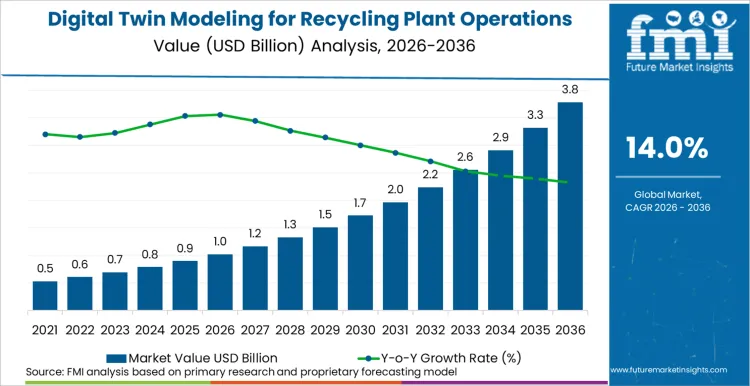
Summary of Digital Twin Modeling for Recycling Plant Operations Market
What is the Long-Term Growth Outlook for the Digital Twin Modeling for Recycling Plant Operations Market?
FMI projects the global digital twin modeling for recycling plant operations market to expand from USD 1,020 million in 2026 to USD 3,780 million by 2036, registering a 14.0% CAGR. Market expansion reflects the critical role digital twins play in transforming recycling from a low-margin, waste-handling operation into a high-efficiency, data-driven material production industry. Digital twins are no longer passive dashboards but are active systems that directly influence operational decisions, predictive maintenance, and compliance reporting.
FMI Research Approach: This projection is derived from FMI's proprietary forecasting framework integrating announced recycling capacity investments, regulatory timelines for circular economy mandates, adoption curves of Industry 4.0 technologies in waste management, and primary interviews with plant operators and technology providers across Asia, Europe, and North America.
How do FMI Analysts Expect the Digital Twin Market for Recycling Plants to Evolve Structurally?
FMI analysts anticipate a transition from generic plant visualization tools to a layered ecosystem of specialized twins. This evolution is driven by operators' need for solutions that address specific operational challenges, from whole-plant throughput optimization to individual equipment health monitoring. The market will fragment into specialized segments for process twins, asset twins, line-level twins, and the emerging segment of “system-of-systems” twins that integrate an entire recycling park’s operations.
FMI Research Approach: Insights are informed by analysis of patent filings related to simulation and control algorithms for waste processing, technology roadmaps from major industrial automation firms, and validation data from pilot projects at advanced recycling facilities.
Which Geographies Command the Largest Share of the Digital Twin Modeling for Recycling Plant Operations Market?
China leads in terms of growth rate, advancing at an estimated 15.4% CAGR, driven by its massive investment in “Zero-Waste Cities” initiatives and the construction of large, integrated recycling parks that require sophisticated management systems. The United States follows with a 13.0% CAGR, supported by Infrastructure Act funding for modernized recycling facilities and strong demand from large waste management corporations seeking operational edge.
Germany and the UK represent high-value, innovation-centric markets in Europe, expanding at 12.8% and a significant rate within the Western Europe aggregate, respectively. Growth is fueled by the European Union’s circular economy package, which sets legally binding recycling targets and promotes digital tools for compliance. Japan represents a mature market focused on precision and efficiency, growing at 11.0% CAGR, while India and Brazil are high-growth emerging markets with CAGRs of 15.8% and 11.6%, driven by new EPR laws and infrastructure development.
FMI Research Approach: Country-level forecasts are built using policy analysis of EPR and recycling targets, tracking of public and private investments in recycling infrastructure, analysis of national digitalization strategies for industry, and primary interviews with regional system integrators and plant operators.
What Will Be the Market Size of Digital Twin Modeling for Recycling Plant Operations by 2036?
By 2036, the digital twin modeling for recycling plant operations market is expected to reach USD 3,780 million. This growth will be supported by the exponential increase in regulatory pressure for transparency, the rising economic value of high-purity recycled materials, and the value premium for AI-enabled optimization platforms.
FMI Research Approach: Long-term market sizing incorporates recycling plant capacity forecasts, technology adoption curves for advanced sorting and processing equipment, and pricing trend analysis for enterprise-level industrial software and IoT platforms.
What are some Globally Distinct Trends Shaping the Market?
Globally, the market is being shaped by the interplay of regulatory digitization, AI convergence, and the economics of material recovery. The rapid scaling of EPR schemes is driving demand for digital twins with robust mass balance and reporting modules, while the pursuit of higher-purity recyclates is fueling R&D into vision-system-integrated twins that can fine-tune sorter settings in real-time.
FMI Research Approach: Trend analysis is informed by regulatory tracking across major economies, technology partnership announcements between AI firms and recycling equipment OEMs, and case study analysis of digital twin deployments in flagship recycling facilities.
Digital Twin Modeling for Recycling Plant Operations Market Key Takeaways
| Metrics | Values |
|---|---|
| Expected Value (2026E) | USD 1,020 Million |
| Projected Value (2036F) | USD 3,780 Million |
| CAGR (2026 to 2036) | 14.0% |
Source: Future Market Insights (FMI) analysis, based on proprietary forecasting model and primary research
Why is the Digital Twin Modeling for Recycling Plant Operations Market Growing?
The transformation of recycling into a strategic material supply industry is creating unprecedented demand for precision and reliability. Consumer packaged goods companies are committing to high percentages of PCR content, necessitating supply chains that can deliver consistent quality and volume. Digital twins address this by enabling predictive yield management and quality control, reducing the variance in output that has historically plagued the recycling industry. A consortium of European plastics recyclers published findings in Q1 2026 demonstrating that digital twins with integrated AI vision feedback could increase the purity of PET flake output by over 8 percentage points, directly addressing this quality imperative.
The emergence of chemical recycling and advanced sorting creates a complex operational environment ripe for digital twin deployment. These facilities operate with high-value feedstock and sensitive chemical processes. Digital twins are critical for simulating process parameters, optimizing thermal conversion yields, and ensuring safety. The USA Department of Energy’s investments in plastic waste reduction technologies are channeling funding into projects that include a strong digital twin component for process design and operational scaling, creating a high-value niche for sophisticated simulation providers.
The economics of recycling are related to data. The launch of the EU Digital Product Passport creates a legal requirement for data integrity throughout a product’s lifecycle, including its end-of-life processing. Digital twin systems that can automatically generate verified data on sorting efficiency, material loss, and energy consumption per ton processed are gaining commercial preference. A 2026 roadmap from a leading global waste handler explicitly calls for digital infrastructure that creates an immutable record of recycling operations for compliance, carbon accounting, and customer reporting, setting a new baseline for technology investments.
How is the Digital Twin Modeling for Recycling Plant Operations Market Segmented?
The digital twin segment landscape is defined by the scope and purpose of the virtual model. Process and asset twins, which model entire material flows or critical equipment, dominate in value share (50%), as they deliver the highest impact on overall plant performance. Plant-wide twins are essential for strategic capacity planning, while line-level and equipment twins focus on tactical operational issues and predictive maintenance.
How is the Dominance of Physics + AI Hybrid Twins Sustained?
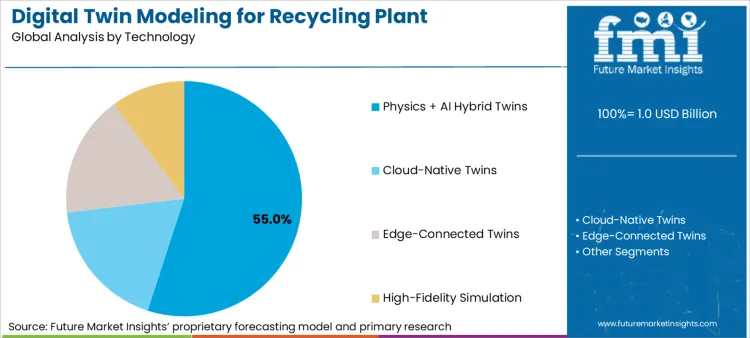
Hybrid twins combining physics-based simulation with AI account for a leading revenue share, estimated at 55%, due to their superior adaptability and predictive power. Pure physics models struggle with the unpredictable nature of waste streams, while pure AI models lack explainability and require vast training data. Hybrid models use physics as a foundational framework, which is continuously calibrated and corrected by machine learning algorithms fed with real-time sensor data. In January 2026, a leading automation provider announced a new hybrid twin engine specifically for plastic sorting lines, which reduced the model’s error rate in predicting contamination levels by 40% compared to static simulations.
Which Data Input Factors are Driving Market Evolution?
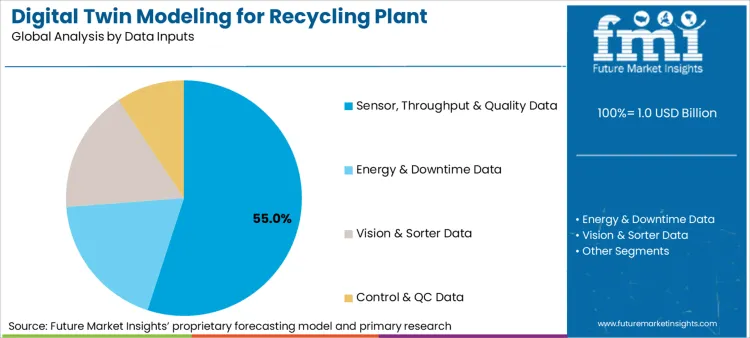
Sensor, throughput, and quality data form the most critical input segment, commanding over 55% share. This dominance is rooted in the fundamental need for real-time, high-fidelity data to keep the digital twin synchronized with the physical world. The proliferation of low-cost IoT sensors on motors, conveyors, and sorters, combined with data from weigh scales and near-infrared (NIR) sorters, provides the essential fuel for an accurate twin. The integration of vision system data-providing real-time images of material on the line-is the fastest-growing input segment, as it enables the twin to “see” and make quality-based adjustments.
What Role does the MRFs & Plastics Recycling Plants Segment Play?
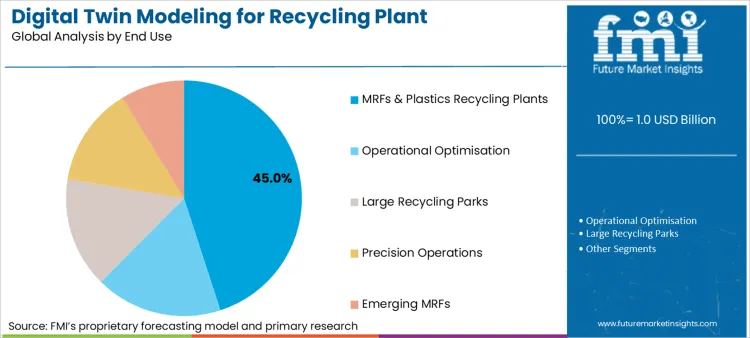
MRFs and plastics recycling plants represent the dominant end-use segment, accounting for 45% of demand by value. This segment acts as the primary driver for digital twin innovation due to its complex material mix, high throughput requirements, and significant economic upside from improved efficiency. During its Q4 2025 investor briefing, a major North American waste firm outlined its “Plant of the Future” roadmap, revealing a partnership with a digital twin vendor to deploy autonomous control systems across 20 facilities by 2030. This highlights how the push for profitability in volume-driven MRFs creates the largest initial market for digital twin solutions.
What Drivers, Restraints, Opportunities, and Trends Prevail in the Market?
Market expansion is supported by binding digitalization legislation. The EU’s Digital Product Passport and similar initiatives in other regions are creating a non-negotiable requirement for detailed, digitized material tracking. This transforms digital twins from a “nice-to-have” efficiency tool into a “must-have” compliance and reporting infrastructure. In October 2025, a global software firm and a recycling industry association announced a joint development agreement to create a standardized data model for recycling plant twins, facilitating compliance reporting and reducing integration costs.
While demand is robust, the industry faces significant challenges in data integration and skills gaps. Financial disclosures from engineering firms in early 2026 highlighted sustained cost pressures in custom-integration projects, as legacy recycling plants often lack standardized data architectures and modern industrial networks. The scarcity of personnel skilled in both data science and recycling operations also restrains faster adoption, creating a reliance on system integrators and driving up total cost of ownership.
Technical innovation is defined by the move toward cloud-native and edge-connected architectures. A 2026 R&D showcase by a leading cloud provider featured a digital twin platform that runs complex simulations in the cloud while executing time-critical control algorithms on edge devices within the plant. This trend enables more sophisticated modeling without compromising real-time responsiveness and facilitates centralized monitoring of distributed recycling assets.
The shift toward autonomous operation represents a disruptive force. Building on the foundational layer of a accurate digital twin, the next step is to implement closed-loop control where the twin not only recommends but executes adjustments. This trend, piloted in advanced facilities in Germany and Japan, threatens to reshape operational roles but opens a new frontier for AI and control system suppliers, promising step-changes in consistency and cost reduction.
Analysis of Digital Twin Modeling for Recycling Plant Operations Market by Key Countries
The following analysis examines the strategic evolution of the market in key countries, each shaped by distinct regulatory frameworks, industrial policies, and market maturity.
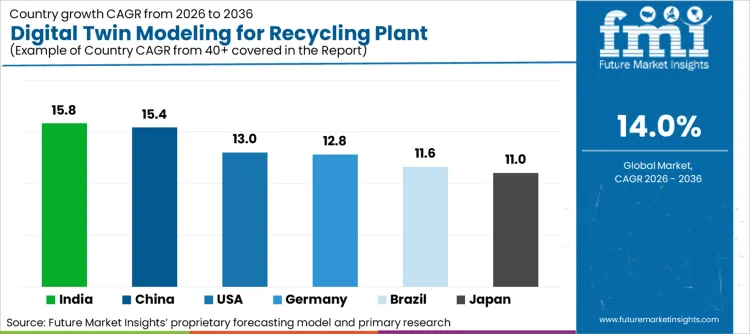
| Country | CAGR (2026 to 2036) |
|---|---|
| China | 15.4% |
| USA | 13.0% |
| Germany | 12.8% |
| Japan | 11.0% |
| India | 15.8% |
| Brazil | 11.6% |
Source: Future Market Insights (FMI) analysis, based on proprietary forecasting model and primary research
How is State-Led Digitalization Shaping the Chinese Market?
China is projected to expand at a 15.4% CAGR through 2036, driven by its “Zero-Waste Cities” and “Internet+” initiatives that mandate the digital upgrading of municipal solid waste management. The Ministry of Housing and Urban-Rural Development’s 2026 to 2030 plan for waste treatment facilities prioritizes the construction of intelligent recycling parks equipped with IoT and AI.
This policy creates a captive, large-scale market for domestic tech giants like Huawei Cloud and SUPCON, which offer integrated digital twin solutions as part of broader smart city packages, often leveraging state-backed projects as testbeds.
Which Policy and Corporate Initiatives are Accelerating Adoption in USA?
USA is set for a 13.0% CAGR, fueled by a combination of federal infrastructure funding and corporate sustainability goals. The Recycling Infrastructure and Accessibility Act provides grants for modernizing MRFs, with a strong emphasis on technology that increases efficiency.
Major consumer brands’ commitments to PCR content are driving their engagement with recyclers, with data transparency and yield guarantees becoming key contract components. This has triggered partnerships between waste management giants like Waste Management Inc. and digital twin providers to deploy solutions that provide the required auditable data and operational excellence.
What Role does Germany’s Engineering Excellence and Regulation Play?
Germany’s 12.8% CAGR is influenced by its dual strengths in advanced industrial automation and stringent environmental regulation. The German Circular Economy Act sets high recycling quotas. German engineering firms like Siemens are leveraging their deep manufacturing expertise to create high-fidelity digital twins for recycling, treating it as a complex industrial process.
The German government’s “Industry 4.0” funding extends to the waste sector, supporting pilot projects that demonstrate how digital twins can achieve the legally mandated recycling rates profitably.
How is Japan’s Focus on Precision and Quality Driving Niche Applications?
Japan’s 11.0% CAGR reflects its mature recycling sector’s focus on maximizing value from a limited waste stream. The emphasis is on precision sorting to achieve extremely high-purity outputs for closed-loop recycling, particularly in plastics and electronics. Japanese automation companies like Yokogawa are developing high-fidelity simulation twins focused on specific, high-value unit operations, such as optical sorting for specific polymer types or disassembly sequencing for e-waste. This creates a high-value niche for specialized, precision-oriented twin solutions rather than plant-wide systems.
Which Factors are Propelling High Growth in India?
India’s 15.8% CAGR, the highest among profiled nations, is driven by the rapid formalization of its waste sector and the implementation of strong EPR rules for plastics and electronics. The government’s Swachh Bharat Mission 2.0 and new waste management rules encourage investment in large, modern MRFs.
For new greenfield facilities, incorporating digital twin technology from the outset is seen as a way to leapfrog operational inefficiencies. Domestic IT and engineering firms are actively developing cost-optimized digital twin solutions tailored to the mixed and often contaminated waste streams prevalent in India.
How is Brazil’s Market Evolving Amidst Infrastructure Challenges?
Brazil’s National Solid Waste Policy (PNRS) and growing corporate sustainability commitments influence its 11.6% CAGR. The challenge of managing vast geographical distances makes centralized monitoring attractive.
Digital twins are being adopted for optimizing logistics and routing for reverse collection systems and for managing high-value operations like electronics recycling. The growth is less about greenfield smart plants and more about incremental digitalization of existing operations to improve reliability and reporting for compliance.
Competition Outlook for Digital Twin Modeling for Recycling Plant Operations
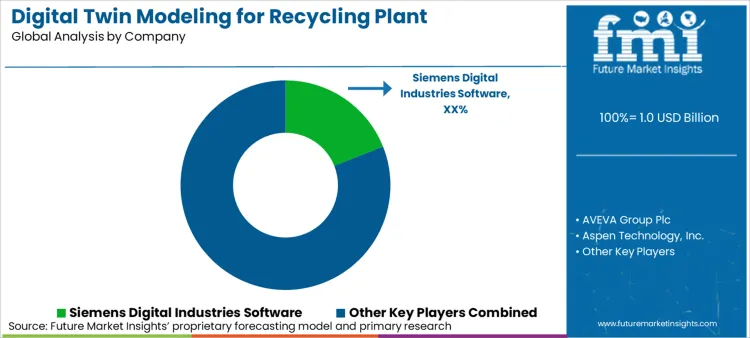
Competition in the digital twin modeling space continues to intensify as traditional industrial automation suppliers, enterprise software vendors, and AI-centric innovators all target complex facility operations-including recycling plants-as strategic use cases for digital twins. Rather than universally packaged solutions, large industrial platform vendors enhancing advanced digital twin frameworks and cloud & software ecosystem players providing flexible digital infrastructure services currently shape the competitive landscape.
A strong theme across these segments is the push toward comprehensive digital twin environments that combine real-time IoT data, simulation, and AI-based analytics to optimize facility performance across planning, operations, and predictive maintenance. Major industrial players are positioning their platforms not just as modeling tools but as integrated operational decision hubs that help customers reduce downtime, boost throughput, and simulate operational changes before execution.
Large platform players distinguish themselves through extensive software portfolios and digital twin toolkits that support simulation, visualization, and operational integration. Siemens’ Digital Twin Composer, announced at CES 2026, enables companies to build immersive 3D twin environments and integrate real-world engineering data with simulation and AI-driven insights at scale, an approach that benefitted early adopters like PepsiCo’s manufacturing and warehouse facilities with measurable throughput gains.
Cloud and enterprise software ecosystems provide modular twin frameworks that can be adapted to industrial and infrastructure contexts. While global hyperscale vendors continue to highlight digital twin frameworks such as Azure Digital Twins as part of broader IoT and digitalization strategies, their role is often as the underlying platform rather than a verticalized recycling-specific solution.
Across the software ecosystem, vendors increasingly emphasize interoperability and data standardization to support multi-vendor plants. Although there has not been a publicly announced open-source recycling plant data schema developed jointly by industry players, broader consortium efforts such as initiatives by the Digital Twin Consortium to facilitate open interfaces and data sharing reflect this industry direction.
Recent ecosystem and competitor developments include:
- Siemens Digital Industries Software unveiled Digital Twin Composer at CES 2026, a new industrial metaverse-oriented solution that assists companies in creating high-fidelity twin environments integrating real-world data and simulation across assets and processes.
- Dassault Systèmes’ Infrastructure & Cities virtual twin offerings illustrate how digital twin technologies are being extended to complex built environments and sustainability planning, which can conceptually support circular economy and material recovery considerations within broader urban and industrial contexts.
Key Players Profiled
- Siemens Digital Industries Software
- AVEVA Group Plc
- Aspen Technology, Inc.
- Ansys, Inc.
- Huawei Cloud
- Zhejiang SUPCON Technology Co., Ltd. (SUPCON)
- Yokogawa Electric Corporation
- IBM Corporation
- General Electric Digital
- PTC Inc.
Market Definition
The digital twin modeling for recycling plant operations market comprises revenue generated from software platforms, services, and related infrastructure used to create, maintain, and operate virtual dynamic representations of physical recycling facilities. These digital twins are synchronized with real-time data from plant sensors and systems to enable simulation, analysis, monitoring, prediction, and optimization of operational processes.
The market includes revenue from software licensing, cloud subscriptions, implementation services, and ongoing support for digital twins used in material recovery facilities, plastic recycling plants, e-waste processing facilities, and other advanced recycling operations. The market scope covers solutions that provide a functional representation of plant processes and/or assets. It excludes generic SCADA systems, simple HMI visualizations, and standalone ERP or MES software unless they are integral components of a defined digital twin platform sold for this specific application.
Scope of Report
| Items | Values |
|---|---|
| Quantitative Units | USD 1,020 Million (2026E) |
| Twin Type | Process & Asset Twins, Plant-Wide Twins, Line-Level Twins, Equipment Twins, Others |
| Data Inputs | Sensor, Throughput & Quality Data, Energy & Downtime Data, Vision & Sorter Data, Control & QC Data, Others |
| Technology | Physics + AI Hybrid Twins, Cloud-Native Twins, Edge-Connected Twins, High-Fidelity Simulation, Others |
| End Use | MRFs & Plastics Recycling Plants, Operational Optimisation (Consulting), Large Recycling Parks, Precision Operations, Emerging MRFs, Others |
| Regions Covered | North America, Western Europe, Eastern Europe, East Asia, South Asia & Pacific, Latin America, Middle East & Africa |
| Countries | China, USA, Germany, Japan, India, Brazil and 40+ countries |
| Key Companies | Siemens Digital Industries, AVEVA, AspenTech, Ansys, Huawei Cloud, SUPCON, Yokogawa, IBM, GE Digital, PTC |
Source: Future Market Insights (FMI) analysis, based on proprietary forecasting model and primary research
Digital Twin Modeling for Recycling Plant Operations Market Key Segments
By Twin Type
- Process & Asset Twins
- Plant-Wide Twins
- Line-Level Twins
- Equipment Twins
- Others
By Data Inputs
- Sensor, Throughput & Quality Data
- Energy & Downtime Data
- Vision & Sorter Data
- Control & QC Data
- Others
By Technology
- Physics + AI Hybrid Twins
- Cloud-Native Twins
- Edge-Connected Twins
- High-Fidelity Simulation
- Others
By End Use
- MRFs & Plastics Recycling Plants
- Operational Optimisation
- Large Recycling Parks
- Precision Operations
- Emerging MRFs
- Others
By Region
- North America
- Western Europe
- Eastern Europe
- East Asia
- South Asia & Pacific
- Latin America
- Middle East & Africa
Bibliography
- Siemens AG. (2026). Annual Report 2025/26: Digital Industries and Software-Defined Automation. Siemens AG.
- International Solid Waste Association (ISWA). (2026). Digital Transformation and Data-Driven Operations in Waste Management Systems. ISWA.
- Organisation for Economic Co-operation and Development (OECD). (2025). Enhancing Circular Economy Outcomes Through Digitalisation. OECD Publishing.
- USA Environmental Protection Agency. (2026). National Recycling Strategy: Implementation Progress and Technology Enablement. EPA.
- Japan Ministry of the Environment. (2025). Circular Economy Vision 2030: Smart Infrastructure and Resource Efficiency. Government of Japan.
- Tomra Systems ASA. (2026). Digital Sorting, Sensor Fusion, and Plant Optimization in Advanced Recycling Facilities. Tomra Systems ASA.
- Dassault Systèmes. (2025). Virtual Twin Applications for Infrastructure, Utilities, and Circular Systems. Dassault Systèmes.
- International Energy Agency (IEA). (2025). Digitalisation and Automation in Industrial Resource Recovery Systems. IEA.
- Brazilian Association of Public Cleaning and Special Waste Companies (ABRELPE). (2025). Panorama of Solid Waste Management in Brazil: Technology and Digitalisation. ABRELPE.
Frequently Asked Questions
How big is the digital twin modeling for recycling plant operations market in 2026?
The global digital twin modeling for recycling plant operations market is estimated to be valued at USD 1.0 billion in 2026.
What will be the size of digital twin modeling for recycling plant operations market in 2036?
The market size for the digital twin modeling for recycling plant operations market is projected to reach USD 3.8 billion by 2036.
How much will be the digital twin modeling for recycling plant operations market growth between 2026 and 2036?
The digital twin modeling for recycling plant operations market is expected to grow at a 14.0% CAGR between 2026 and 2036.
What are the key product types in the digital twin modeling for recycling plant operations market?
The key product types in digital twin modeling for recycling plant operations market are physics + ai hybrid twins , cloud-native twins, edge-connected twins and high-fidelity simulation.
Which data inputs segment to contribute significant share in the digital twin modeling for recycling plant operations market in 2026?
In terms of data inputs, sensor, throughput & quality data segment to command 55.0% share in the digital twin modeling for recycling plant operations market in 2026.
Preview the report firsthand - request a free sample
Get SampleGet the brochure for pricing and purchase details.
Get PDFTable of Content
- Executive Summary
- Global Market Outlook
- Demand-side Trends
- Supply-side Trends
- Technology Roadmap Analysis
- Analysis and Recommendations
- Market Overview
- Market Coverage / Taxonomy
- Market Definition / Scope / Limitations
- Research Methodology
- Chapter Orientation
- Analytical Lens and Working Hypotheses
- Market Structure, Signals, and Trend Drivers
- Benchmarking and Cross-market Comparability
- Market Sizing, Forecasting, and Opportunity Mapping
- Research Design and Evidence Framework
- Desk Research Programme (Secondary Evidence)
- Company Annual and Sustainability Reports
- Peer-reviewed Journals and Academic Literature
- Corporate Websites, Product Literature, and Technical Notes
- Earnings Decks and Investor Briefings
- Statutory Filings and Regulatory Disclosures
- Technical White Papers and Standards Notes
- Trade Journals, Industry Magazines, and Analyst Briefs
- Conference Proceedings, Webinars, and Seminar Materials
- Government Statistics Portals and Public Data Releases
- Press Releases and Reputable Media Coverage
- Specialist Newsletters and Curated Briefings
- Sector Databases and Reference Repositories
- FMI Internal Proprietary Databases and Historical Market Datasets
- Subscription Datasets and Paid Sources
- Social Channels, Communities, and Digital Listening Inputs
- Additional Desk Sources
- Expert Input and Fieldwork (Primary Evidence)
- Primary Modes
- Qualitative Interviews and Expert Elicitation
- Quantitative Surveys and Structured Data Capture
- Blended Approach
- Why Primary Evidence is Used
- Field Techniques
- Interviews
- Surveys
- Focus Groups
- Observational and In-context Research
- Social and Community Interactions
- Stakeholder Universe Engaged
- C-suite Leaders
- Board Members
- Presidents and Vice Presidents
- R&D and Innovation Heads
- Technical Specialists
- Domain Subject-matter Experts
- Scientists
- Physicians and Other Healthcare Professionals
- Governance, Ethics, and Data Stewardship
- Research Ethics
- Data Integrity and Handling
- Primary Modes
- Tooling, Models, and Reference Databases
- Desk Research Programme (Secondary Evidence)
- Data Engineering and Model Build
- Data Acquisition and Ingestion
- Cleaning, Normalisation, and Verification
- Synthesis, Triangulation, and Analysis
- Quality Assurance and Audit Trail
- Market Background
- Market Dynamics
- Drivers
- Restraints
- Opportunity
- Trends
- Scenario Forecast
- Demand in Optimistic Scenario
- Demand in Likely Scenario
- Demand in Conservative Scenario
- Opportunity Map Analysis
- Product Life Cycle Analysis
- Supply Chain Analysis
- Investment Feasibility Matrix
- Value Chain Analysis
- PESTLE and Porter’s Analysis
- Regulatory Landscape
- Regional Parent Market Outlook
- Production and Consumption Statistics
- Import and Export Statistics
- Market Dynamics
- Global Market Analysis 2021 to 2025 and Forecast, 2026 to 2036
- Historical Market Size Value (USD Million) Analysis, 2021 to 2025
- Current and Future Market Size Value (USD Million) Projections, 2026 to 2036
- Y-o-Y Growth Trend Analysis
- Absolute $ Opportunity Analysis
- Global Market Pricing Analysis 2021 to 2025 and Forecast 2026 to 2036
- Global Market Analysis 2021 to 2025 and Forecast 2026 to 2036, By Technology
- Introduction / Key Findings
- Historical Market Size Value (USD Million) Analysis By Technology , 2021 to 2025
- Current and Future Market Size Value (USD Million) Analysis and Forecast By Technology , 2026 to 2036
- Physics + AI Hybrid Twins
- Cloud-Native Twins
- Edge-Connected Twins
- High-Fidelity Simulation
- Physics + AI Hybrid Twins
- Y-o-Y Growth Trend Analysis By Technology , 2021 to 2025
- Absolute $ Opportunity Analysis By Technology , 2026 to 2036
- Global Market Analysis 2021 to 2025 and Forecast 2026 to 2036, By Data Inputs
- Introduction / Key Findings
- Historical Market Size Value (USD Million) Analysis By Data Inputs, 2021 to 2025
- Current and Future Market Size Value (USD Million) Analysis and Forecast By Data Inputs, 2026 to 2036
- Sensor, Throughput & Quality Data
- Energy & Downtime Data
- Vision & Sorter Data
- Control & QC Data
- Sensor, Throughput & Quality Data
- Y-o-Y Growth Trend Analysis By Data Inputs, 2021 to 2025
- Absolute $ Opportunity Analysis By Data Inputs, 2026 to 2036
- Global Market Analysis 2021 to 2025 and Forecast 2026 to 2036, By End Use
- Introduction / Key Findings
- Historical Market Size Value (USD Million) Analysis By End Use, 2021 to 2025
- Current and Future Market Size Value (USD Million) Analysis and Forecast By End Use, 2026 to 2036
- MRFs & Plastics Recycling Plants
- Operational Optimisation
- Large Recycling Parks
- Precision Operations
- Emerging MRFs
- MRFs & Plastics Recycling Plants
- Y-o-Y Growth Trend Analysis By End Use, 2021 to 2025
- Absolute $ Opportunity Analysis By End Use, 2026 to 2036
- Global Market Analysis 2021 to 2025 and Forecast 2026 to 2036, By Region
- Introduction
- Historical Market Size Value (USD Million) Analysis By Region, 2021 to 2025
- Current Market Size Value (USD Million) Analysis and Forecast By Region, 2026 to 2036
- North America
- Latin America
- Western Europe
- Eastern Europe
- East Asia
- South Asia and Pacific
- Middle East & Africa
- Market Attractiveness Analysis By Region
- North America Market Analysis 2021 to 2025 and Forecast 2026 to 2036, By Country
- Historical Market Size Value (USD Million) Trend Analysis By Market Taxonomy, 2021 to 2025
- Market Size Value (USD Million) Forecast By Market Taxonomy, 2026 to 2036
- By Country
- USA
- Canada
- Mexico
- By Technology
- By Data Inputs
- By End Use
- By Country
- Market Attractiveness Analysis
- By Country
- By Technology
- By Data Inputs
- By End Use
- Key Takeaways
- Latin America Market Analysis 2021 to 2025 and Forecast 2026 to 2036, By Country
- Historical Market Size Value (USD Million) Trend Analysis By Market Taxonomy, 2021 to 2025
- Market Size Value (USD Million) Forecast By Market Taxonomy, 2026 to 2036
- By Country
- Brazil
- Chile
- Rest of Latin America
- By Technology
- By Data Inputs
- By End Use
- By Country
- Market Attractiveness Analysis
- By Country
- By Technology
- By Data Inputs
- By End Use
- Key Takeaways
- Western Europe Market Analysis 2021 to 2025 and Forecast 2026 to 2036, By Country
- Historical Market Size Value (USD Million) Trend Analysis By Market Taxonomy, 2021 to 2025
- Market Size Value (USD Million) Forecast By Market Taxonomy, 2026 to 2036
- By Country
- Germany
- UK
- Italy
- Spain
- France
- Nordic
- BENELUX
- Rest of Western Europe
- By Technology
- By Data Inputs
- By End Use
- By Country
- Market Attractiveness Analysis
- By Country
- By Technology
- By Data Inputs
- By End Use
- Key Takeaways
- Eastern Europe Market Analysis 2021 to 2025 and Forecast 2026 to 2036, By Country
- Historical Market Size Value (USD Million) Trend Analysis By Market Taxonomy, 2021 to 2025
- Market Size Value (USD Million) Forecast By Market Taxonomy, 2026 to 2036
- By Country
- Russia
- Poland
- Hungary
- Balkan & Baltic
- Rest of Eastern Europe
- By Technology
- By Data Inputs
- By End Use
- By Country
- Market Attractiveness Analysis
- By Country
- By Technology
- By Data Inputs
- By End Use
- Key Takeaways
- East Asia Market Analysis 2021 to 2025 and Forecast 2026 to 2036, By Country
- Historical Market Size Value (USD Million) Trend Analysis By Market Taxonomy, 2021 to 2025
- Market Size Value (USD Million) Forecast By Market Taxonomy, 2026 to 2036
- By Country
- China
- Japan
- South Korea
- By Technology
- By Data Inputs
- By End Use
- By Country
- Market Attractiveness Analysis
- By Country
- By Technology
- By Data Inputs
- By End Use
- Key Takeaways
- South Asia and Pacific Market Analysis 2021 to 2025 and Forecast 2026 to 2036, By Country
- Historical Market Size Value (USD Million) Trend Analysis By Market Taxonomy, 2021 to 2025
- Market Size Value (USD Million) Forecast By Market Taxonomy, 2026 to 2036
- By Country
- India
- ASEAN
- Australia & New Zealand
- Rest of South Asia and Pacific
- By Technology
- By Data Inputs
- By End Use
- By Country
- Market Attractiveness Analysis
- By Country
- By Technology
- By Data Inputs
- By End Use
- Key Takeaways
- Middle East & Africa Market Analysis 2021 to 2025 and Forecast 2026 to 2036, By Country
- Historical Market Size Value (USD Million) Trend Analysis By Market Taxonomy, 2021 to 2025
- Market Size Value (USD Million) Forecast By Market Taxonomy, 2026 to 2036
- By Country
- Kingdom of Saudi Arabia
- Other GCC Countries
- Turkiye
- South Africa
- Other African Union
- Rest of Middle East & Africa
- By Technology
- By Data Inputs
- By End Use
- By Country
- Market Attractiveness Analysis
- By Country
- By Technology
- By Data Inputs
- By End Use
- Key Takeaways
- Key Countries Market Analysis
- USA
- Pricing Analysis
- Market Share Analysis, 2025
- By Technology
- By Data Inputs
- By End Use
- Canada
- Pricing Analysis
- Market Share Analysis, 2025
- By Technology
- By Data Inputs
- By End Use
- Mexico
- Pricing Analysis
- Market Share Analysis, 2025
- By Technology
- By Data Inputs
- By End Use
- Brazil
- Pricing Analysis
- Market Share Analysis, 2025
- By Technology
- By Data Inputs
- By End Use
- Chile
- Pricing Analysis
- Market Share Analysis, 2025
- By Technology
- By Data Inputs
- By End Use
- Germany
- Pricing Analysis
- Market Share Analysis, 2025
- By Technology
- By Data Inputs
- By End Use
- UK
- Pricing Analysis
- Market Share Analysis, 2025
- By Technology
- By Data Inputs
- By End Use
- Italy
- Pricing Analysis
- Market Share Analysis, 2025
- By Technology
- By Data Inputs
- By End Use
- Spain
- Pricing Analysis
- Market Share Analysis, 2025
- By Technology
- By Data Inputs
- By End Use
- France
- Pricing Analysis
- Market Share Analysis, 2025
- By Technology
- By Data Inputs
- By End Use
- India
- Pricing Analysis
- Market Share Analysis, 2025
- By Technology
- By Data Inputs
- By End Use
- ASEAN
- Pricing Analysis
- Market Share Analysis, 2025
- By Technology
- By Data Inputs
- By End Use
- Australia & New Zealand
- Pricing Analysis
- Market Share Analysis, 2025
- By Technology
- By Data Inputs
- By End Use
- China
- Pricing Analysis
- Market Share Analysis, 2025
- By Technology
- By Data Inputs
- By End Use
- Japan
- Pricing Analysis
- Market Share Analysis, 2025
- By Technology
- By Data Inputs
- By End Use
- South Korea
- Pricing Analysis
- Market Share Analysis, 2025
- By Technology
- By Data Inputs
- By End Use
- Russia
- Pricing Analysis
- Market Share Analysis, 2025
- By Technology
- By Data Inputs
- By End Use
- Poland
- Pricing Analysis
- Market Share Analysis, 2025
- By Technology
- By Data Inputs
- By End Use
- Hungary
- Pricing Analysis
- Market Share Analysis, 2025
- By Technology
- By Data Inputs
- By End Use
- Kingdom of Saudi Arabia
- Pricing Analysis
- Market Share Analysis, 2025
- By Technology
- By Data Inputs
- By End Use
- Turkiye
- Pricing Analysis
- Market Share Analysis, 2025
- By Technology
- By Data Inputs
- By End Use
- South Africa
- Pricing Analysis
- Market Share Analysis, 2025
- By Technology
- By Data Inputs
- By End Use
- USA
- Market Structure Analysis
- Competition Dashboard
- Competition Benchmarking
- Market Share Analysis of Top Players
- By Regional
- By Technology
- By Data Inputs
- By End Use
- Competition Analysis
- Competition Deep Dive
- Siemens Digital Industries Software
- Overview
- Product Portfolio
- Profitability by Market Segments (Product/Age /Sales Channel/Region)
- Sales Footprint
- Strategy Overview
- Marketing Strategy
- Product Strategy
- Channel Strategy
- AVEVA Group Plc
- Aspen Technology, Inc.
- Ansys, Inc.
- Huawei Cloud
- Zhejiang SUPCON Technology Co., Ltd. (SUPCON)
- Siemens Digital Industries Software
- Competition Deep Dive
- Assumptions & Acronyms Used


