

- Industry Size (2026)
- USD 106 Mn
- Forecast (2036)
- USD 301.0 Mn
- CAGR (2026 to 2036)
- 11%
Pilot-Scale Solvent Recycling Plants for Food-Grade HDPE Market Forecast and Outlook 2026 to 2036
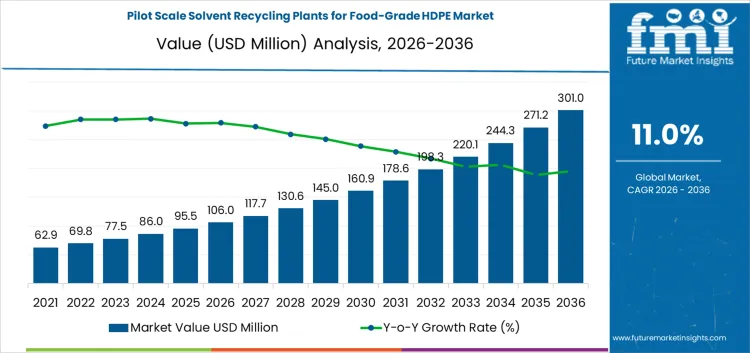
The pilot scale solvent recycling plants for food grade HDPE market is valued at USD 106 million in 2026 and is projected to reach USD 301.0 million by 2036, reflecting a CAGR of 11%. Capital intensity defines early deployment, as solvent recovery systems, purification units, and safety controls require upfront commitment. Returns depend on stable offtake agreements rather than spot resin pricing. Investors favor modular designs that limit stranded asset risk during regulatory refinement. Expansion pace remains selective, with funding directed toward plants demonstrating repeatable yields, certification readiness, and predictable operating costs aligned with food contact compliance requirements globally.
Between 2026 and 2036, value creation centers on disciplined capital allocation rather than aggressive capacity rollout. Projects with shorter payback periods attract priority, especially where solvent recovery efficiency reduces variable cost exposure. Investment committees screen for operators capable of scaling without diluting process control. Margin durability improves when plants secure long term feedstock access and contracted buyers before commissioning. Market leadership reflects patience in site selection, staged expansion, and conservative leverage assumptions. Plants reaching steady state utilization earlier capture disproportionate returns, while delayed ramp ups compress internal rates of return and narrow strategic flexibility for investors evaluating risk exposure profiles.
Quick Stats for Pilot-Scale Solvent Recycling Plants for Food-Grade HDPE Market
- Pilot-Scale Solvent Recycling Plants for Food-Grade HDPE Market Value (2026): USD 106 million
- Pilot-Scale Solvent Recycling Plants for Food-Grade HDPE Market Forecast Value (2036): USD 301.0 million
- Pilot-Scale Solvent Recycling Plants for Food-Grade HDPE Market Forecast CAGR (2026 to 2036): 11%
- Leading Type in Pilot-Scale Solvent Recycling Plants for Food-Grade HDPE Market: Solvent-based dissolution
- Key Growth Regions in Pilot-Scale Solvent Recycling Plants for Food-Grade HDPE Market: Asia Pacific, Europe, and North America
- Top Players in Pilot-Scale Solvent Recycling Plants for Food-Grade HDPE Market: Veolia, SUEZ, APK AG, MBA Polymers, ALPLA
What Is the Growth Forecast for Pilot-Scale Solvent Recycling Plants for Food-Grade HDPE Market through 2036?
Between 2026 and 2031, the pilot-scale solvent recycling plants for food-grade HDPE market is projected to expand from USD 106 million to USD 178 million, creating an absolute increase of USD 72 million and accounting for about 34% of total forecast growth. This phase reflects early-stage investment in solvent-based dissolution, solvent recovery distillation, and membrane-assisted separation technologies aimed at producing food-contact compliant HDPE. Cost structures are dominated by solvent management, energy intensity, and validation protocols. Value capture favors operators demonstrating stable pellet purity and regulatory alignment rather than throughput scale. Pilot facilities primarily serve qualification, customer trials, and process optimization objectives.
From 2031 to 2036, the market is expected to grow from USD 178 million to USD 301.0 million, adding USD 140 million and representing nearly 66% of total decade expansion. This period is shaped by the transition from pilot validation to semi-commercial replication. Margins increasingly concentrate among technology holders integrating adsorption polishing, closed-loop solvent recovery, and digital quality tracking. Long-term partnerships with packaging converters strengthen pricing stability. Competitive positioning shifts toward platforms aligned with food-grade certification pathways, where firms such as Veolia, Suez, APK AG, MBA Polymers, and ALPLA gain advantage through process credibility rather than capacity volume.
Pilot Scale Solvent Recycling Plants for Food Grade HDPE Market Key Takeaways
| Metric | Value |
|---|---|
| Market Value (2026) | USD 106 million |
| Forecast Value (2036) | USD 301.0 million |
| Forecast CAGR (2026 to 2036) | 11% |
How Do Pilot Scale Solvent Recycling Plants Enable Food Grade HDPE Validation and Regulatory Readiness?
The pilot scale solvent recycling plants for food grade HDPE market emerges as regulators and brand owners test advanced recycling routes under controlled volumes. Mechanical recycling historically supplied limited food contact material due to odor retention, additive carryover, and inconsistent polymer chains. Pilot solvent plants isolate polyethylene through dissolution and precipitation, separating pigments, inks, and contaminants with higher selectivity. These facilities allow validation of solvent recovery rates, polymer purity, and closed loop mass balance before commercial scaling. Demand concentrates among packaging producers, chemical recyclers, and compliance teams seeking data for food contact approvals. Capital exposure remains contained at pilot scale, enabling iterative process tuning. Lessons from pilot operation shape reactor design, solvent choice, energy intensity, and waste handling protocols requirements.
Future demand reflects regulatory acceptance pathways, investor caution, and uncertainty around commercial scale economics. Pilot plants support toxicology studies, migration testing, and traceability documentation required for food contact authorisation. Compared with early experimentation focused on proof of concept, current pilots operate with defined throughput targets and solvent loss thresholds. Food brand commitments influence funding decisions, while policymakers evaluate how chemical recycling fits waste hierarchy rules. Cost sensitivity remains high, driven by solvent makeup rates, energy demand, and residue disposal. Scaling decisions depend on feedstock security and offtake pricing visibility. Operators demonstrating reproducible polymer quality, solvent recovery efficiency, and regulatory alignment secure partnerships. As timelines tighten, pilot scale solvent recycling plants act as gating assets determining which technologies advance into production.
What Factors Are Shaping the Demand for Pilot Scale Solvent Recycling Plants for Food Grade HDPE in Terms of Process Technology and Application?
The demand for pilot scale solvent recycling plants for food grade HDPE is structured by process technology and application focus. Process technology segmentation reflects the technical steps used to dissolve, purify, and recover HDPE suitable for food contact compliance. These include solvent based dissolution, solvent recovery distillation, membrane assisted separation, and adsorption or polishing treatments. Application segmentation reflects how pilot output is deployed for validation, including food grade pellets, reprocessed containers, rigid closures, and specialty components. Segment structure highlights how regulatory testing, data generation, and scale readiness guide investment decisions. Demand is shaped by performance validation requirements rather than commercial throughput or branding considerations at the pilot stage.
What Is Driving the Leading Adoption of Solvent Based Dissolution Technology in Pilot Scale HDPE Recycling Plants?
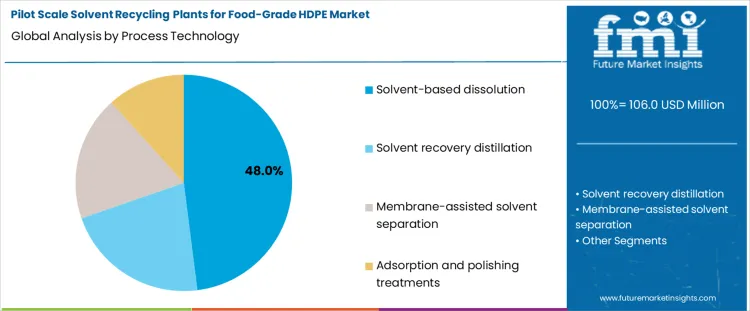
Solvent based dissolution represents 48% of pilot scale process deployment, making it the leading technology segment. This share reflects its effectiveness in selectively dissolving HDPE while isolating contaminants such as pigments, inks, and additives. Pilot plants rely on dissolution to generate controlled datasets on purity, yield, and polymer integrity. The process allows operators to test solvent selectivity, temperature ranges, and residence times across varied feedstocks. Its adaptability supports experimentation with mixed and colored waste streams common in post-consumer HDPE.
Demand for solvent based dissolution is driven by regulatory validation priorities rather than volume efficiency. Pilot facilities focus on repeatability, analytical transparency, and documentation quality. Dissolution processes enable precise measurement of decontamination efficiency and residual solvent levels. Technology developers use these systems to build compliance evidence before scale expansion. The segment remains dominant because it offers the most direct pathway for demonstrating food contact suitability under controlled pilot conditions.
Why Do Food Grade HDPE Pellets Represent the Largest Application Segment for Pilot Scale Solvent Recycling Plants?
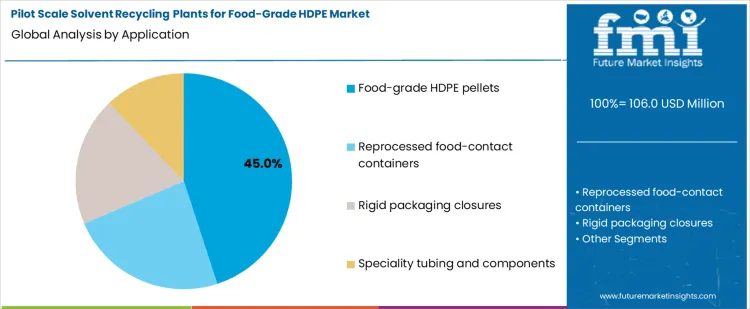
Food grade HDPE pellets account for 45% of pilot scale application demand, making them the largest application segment. This position reflects pellets serving as the standard intermediate for downstream packaging qualification. Pelletized output enables consistent testing of melt flow, mechanical properties, and contamination thresholds. Pilot plants prioritize pellet production to generate representative samples for converters and brand owners. The format supports batch control and repeat testing across regulatory review cycles.
Demand concentration around pellets is shaped by certification and commercialization pathways. Regulatory approval processes rely on pellet level data to assess material safety and consistency. Packaging manufacturers require pellet trials before approving recycled content integration. Pellet output simplifies traceability, documentation, and material handling during evaluation. The segment leads because pellets provide the most efficient and accepted format for proving technical readiness for food contact packaging applications.
How are pilot scale solvent recycling plants redefining food grade HDPE qualification pathways?
Pilot scale solvent recycling plants for food grade HDPE are emerging as validation platforms rather than volume production assets. These facilities allow recyclers and brand owners to demonstrate contaminant removal, polymer integrity, and process repeatability under controlled conditions. Their role centers on regulatory confidence building, especially for food contact approvals. Investment activity is concentrated where authorities require documented pilot evidence before authorizing commercial scale operations. The focus remains on process proof, solvent recovery efficiency, and residue thresholds. Market momentum reflects the need to de risk downstream capital deployment while aligning early with food safety compliance expectations.
Why do national food contact approval regimes drive demand for pilot scale solvent recycling plants?
Demand is driven by country specific food contact regulations that require process level validation before approving recycled HDPE for packaging use. Authorities often mandate pilot data demonstrating contaminant extraction efficiency and solvent removal consistency. Brand owners operating locally need documented trials to support compliance submissions. Pilot plants allow adaptation to regional waste profiles and testing against domestic safety thresholds. This driver is rooted in regulatory gatekeeping rather than capacity shortage. Facilities that generate accepted pilot evidence shorten approval timelines, strengthening their position when commercial plants are later commissioned within the same jurisdiction.
What limits wider deployment of pilot scale solvent recycling plants across recycling ecosystems?
High capital intensity limits pilot deployment to well-funded operators and consortia. Solvent handling infrastructure raises permitting complexity at the local level. Skilled technical staffing requirements increase operating costs relative to mechanical recycling trials. In some regions, regulators lack clear guidance on acceptable pilot protocols, reducing the value of generated data. Feedstock availability at pilot scale can also be inconsistent, complicating test reproducibility. These barriers restrict pilot activity to select markets with defined approval pathways and institutional support, slowing broader diffusion despite interest in food grade HDPE recycling solutions.
How are pilot scale solvent recycling designs evolving to support faster food grade approvals?
Design trends emphasize modularity, allowing rapid adjustment of solvents, residence times, and filtration stages. Plants increasingly integrate inline analytical monitoring to document contaminant reduction in real time. Solvent recovery loops are optimized to demonstrate economic feasibility alongside safety performance. Data logging systems align outputs with regulatory submission formats. Some pilots are co-located with brand owner testing centers to accelerate feedback cycles. The trend favors credibility and documentation strength over throughput. Success is measured by approval readiness rather than output volume within food grade HDPE qualification programs.
What is the Demand for Pilot-Scale Solvent Recycling Plants for Food-Grade HDPE by Country?
| Country | CAGR (%) |
|---|---|
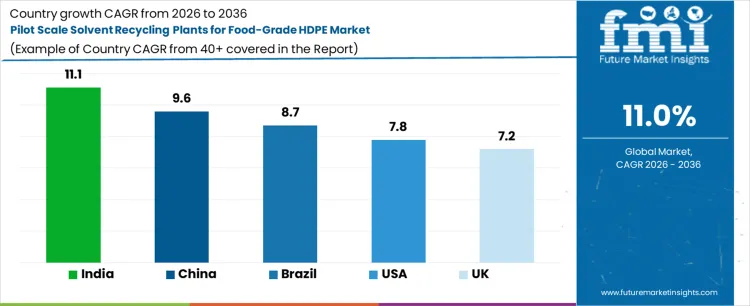
| USA | 7.8 |
| UK | 7.2 |
| China | 9.6 |
| India | 11.1 |
| Brazil | 8.7 |
The demand for pilot-scale solvent recycling plants for food-grade HDPE is rising as packaging producers test advanced recycling routes before committing to full-scale deployment. India leads growth, driven by rapid expansion of flexible and rigid food packaging and the need to validate food-contact compliant recycled polymers domestically. China follows, supported by large pilot investments aimed at improving polymer purity and closing material loops within regulated packaging supply chains. Brazil shows solid growth as brand owners explore solvent-based recycling to access higher quality recycled HDPE for food applications. The USA records steady uptake as recyclers and converters use pilot plants to de-risk regulatory approval and scale-up economics. The UK reflects moderate expansion, shaped by structured pilot programs and cautious capital allocation within established recycling systems.
How Is Food-Grade Packaging Validation Driving Pilot-Scale Solvent Recycling Adoption in the United States?
The pilot-scale solvent recycling plants for food-grade HDPE market in the United States is expanding at a CAGR of 7.8%, shaped by demand for validated recycling pathways that meet strict food-contact safety thresholds. Brand owners and converters are using pilot plants to test solvent-based purification performance before committing to commercial-scale investments. Activity centers on decontamination efficiency, residual solvent control, and repeatability under regulatory review. Pilot facilities are often linked to existing mechanical recycling operations to assess hybrid process integration. Demand reflects cautious capital deployment, where proof of regulatory acceptance and consistent output quality outweigh rapid scale-up ambitions.
- Food-contact validation requirements drive pilot-scale testing demand.
- Brand-led qualification programs influence plant deployment decisions.
- Integration testing with mechanical recycling shapes process design.
- Regulatory scrutiny prioritizes consistency over throughput expansion.
Why Is Pre-Commercial Testing Supporting Measured Growth in the United Kingdom?
The United Kingdom pilot-scale solvent recycling plants for food-grade HDPE market is growing at a CAGR of 7.2%, supported by structured evaluation of advanced recycling routes for regulated packaging use. Recycling developers and packaging firms are using pilot installations to generate performance data aligned with food safety and compliance expectations. Emphasis is placed on solvent recovery efficiency, contaminant removal, and operating stability. Public and private funding mechanisms favor pilot validation over immediate scale-up. Demand remains focused on controlled trials supporting regulatory submissions and future investment decisions.
- Pilot facilities support data generation for regulatory engagement.
- Solvent recovery efficiency is a key performance focus.
- Funding frameworks encourage staged technology validation.
- Compliance testing outweighs near-term commercial output goals.
How Is Export-Oriented Packaging Production Accelerating Pilot Deployment in China?
China is experiencing strong growth in the pilot-scale solvent recycling plants for food-grade HDPE market, recording a CAGR of 9.6%, driven by export-oriented packaging manufacturers preparing for regulated international markets. Pilot plants are used to demonstrate food-grade resin purity and process reliability to overseas buyers. Investment prioritizes contaminant separation, color control, and solvent reuse efficiency. These pilots are often co-located with packaging conversion hubs to shorten validation timelines. Demand reflects external compliance pressure rather than domestic regulatory enforcement.
- Export market access drives pilot-scale validation activity.
- Packaging converters influence performance benchmarks.
- Co-location with manufacturing hubs accelerates testing cycles.
- International buyer requirements shape process specifications.
Why Is Rapid Capacity Learning Fueling Adoption in India?
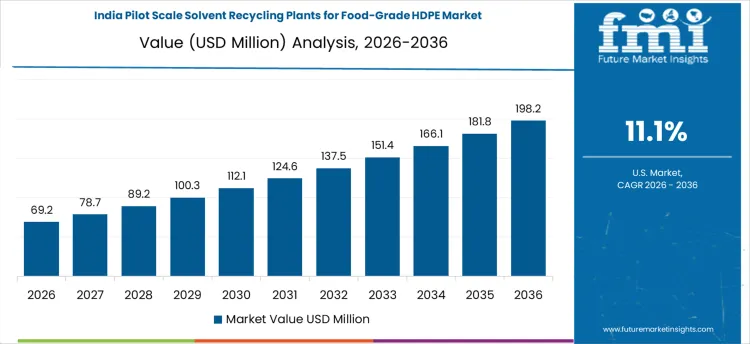
India shows the fastest expansion in the pilot-scale solvent recycling plants for food-grade HDPE market, with growth at a CAGR of 11.1%, reflecting strong interest in accelerated technology learning for export-aligned packaging supply chains. Recycling firms are deploying pilot units to master solvent handling, purification control, and operational stability before scaling. Demand is driven by multinational brand sourcing strategies rather than domestic food-contact regulation. Pilot plants act as training platforms for operators while generating qualification data for overseas customers.
- Export-driven compliance needs accelerate pilot deployment.
- Pilot units support workforce and process capability development.
- Multinational sourcing requirements guide validation priorities.
- Learning-focused investment precedes large-scale capital commitment.
How Is Packaging Sector Integration Supporting Pilot-Scale Growth in Brazil?
Brazil is recording steady growth in the pilot-scale solvent recycling plants for food-grade HDPE market at a CAGR of 8.7%, supported by closer integration between recyclers and food packaging producers. Pilot plants are used to test solvent-based purification under local feedstock conditions and variable contamination profiles. Investment emphasizes adaptability and cost control rather than rapid replication. Demand concentrates among recyclers supplying international brand owners seeking future compliance readiness. Pilot validation serves as a gatekeeper for participation in higher-value food-grade applications.
- Integration with packaging producer’s shapes pilot plant objectives.
- Feedstock variability drives localized process testing.
- Cost discipline influences pilot design and operation.
- Compliance readiness supports access to regulated end uses.
How Are Pilot Scale Solvent Recycling Plants Reshaping Food Grade HDPE Processing Pathways?
Pilot scale solvent recycling plants for food grade HDPE are gaining attention as regulators and brand owners seek alternatives to mechanical recycling limits. These facilities allow controlled evaluation of polymer dissolution, contaminant separation, and solvent recovery under food contact compliance frameworks. Operators use pilot systems to assess odor removal, additive extraction, and resin purity consistency across mixed post-consumer inputs. The approach supports evidence generation required for regulatory submissions and internal quality validation.
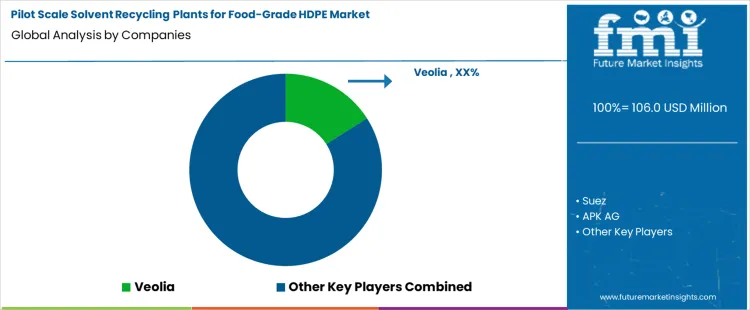
Companies such as Veolia and SUEZ use pilot operations to test closed loop feasibility while reducing risk before capital intensive scale up. Demand is concentrated among packaging suppliers and recyclers aligning future investments with food safety approval pathways.
Competitive positioning in this segment reflects process credibility, solvent management discipline, and integration readiness rather than throughput. APK AG focuses on selective dissolution systems designed to preserve polymer structure while isolating non target layers. MBA Polymers contributes feedstock preparation and impurity control expertise that stabilizes solvent stage performance. ALPLA engages with pilot plants to align packaging design and recycling compatibility. Smaller engineering firms support modular plant layouts and analytical monitoring. Competitive advantage is built through regulatory confidence, repeatable process outcomes, and alignment with food packaging conversion requirements.
Key Players in the Pilot-Scale Solvent Recycling Plants for Food-Grade HDPE Market
- Veolia
- Suez
- APK AG
- MBA Polymers
- ALPLA
Scope of the Report
| Items | Values |
|---|---|
| Quantitative Units (2026) | USD million |
| Type | Solvent-based dissolution, Solvent recovery distillation, Membrane-assisted solvent separation, Adsorption and polishing treatments |
| Application | Food-grade HDPE pellets, Reprocessed food-contact containers, Rigid packaging closures, Specialty tubing and components |
| End User | Packaging producers, Consumer goods brand owners, Chemical recyclers, Food-contact material qualification teams |
| Regions Covered | Asia Pacific, Europe, North America, Latin America, Middle East & Africa |
| Countries Covered | United States, United Kingdom, Germany, France, Italy, Spain, China, India, Japan, South Korea, Brazil, and other pilot-scale regulatory and export-oriented markets |
| Key Companies Profiled | Veolia, SUEZ, APK AG, MBA Polymers, ALPLA |
| Additional Attributes | Dollar sales by process technology and application, pilot-scale validation and certification readiness trends, solvent recovery efficiency and energy intensity considerations, food-contact approval and toxicology testing requirements, modular plant design and scale-up pathways, integration with packaging converter qualification programs and regulatory submission frameworks |
Pilot-Scale Solvent Recycling Plants for Food-Grade HDPE Market Segmentation
By Process Technology:
- Solvent-based dissolution
- Solvent recovery distillation
- Membrane-assisted solvent separation
- Adsorption and polishing treatments
By Application:
- Food-grade HDPE pellets
- Reprocessed food-contact containers
- Rigid packaging closures
- Speciality tubing and components
By Region
- Asia Pacific
- China
- Japan
- South Korea
- India
- Australia & New Zealand
- ASEAN
- Rest of Asia Pacific
- Europe
- Germany
- United Kingdom
- France
- Italy
- Spain
- Nordic
- BENELUX
- Rest of Europe
- North America
- United States
- Canada
- Mexico
- Latin America
- Brazil
- Chile
- Rest of Latin America
- Middle East & Africa
- Kingdom of Saudi Arabia
- Other GCC Countries
- Turkey
- South Africa
- Other African Union
- Rest of Middle East & Africa
Frequently Asked Questions
How big is the pilot scale solvent recycling plants for food-grade HDPE market in 2026?
The global pilot scale solvent recycling plants for food-grade HDPE market is estimated to be valued at USD 106.0 million in 2026.
What will be the size of pilot scale solvent recycling plants for food-grade HDPE market in 2036?
The market size for the pilot scale solvent recycling plants for food-grade HDPE market is projected to reach USD 301.0 million by 2036.
How much will be the pilot scale solvent recycling plants for food-grade HDPE market growth between 2026 and 2036?
The pilot scale solvent recycling plants for food-grade HDPE market is expected to grow at a 11.0% CAGR between 2026 and 2036.
What are the key process technology types in the pilot scale solvent recycling plants for food-grade HDPE market?
The key process technology types in pilot scale solvent recycling plants for food-grade HDPE market are solvent-based dissolution, solvent recovery distillation, membrane-assisted solvent separation and adsorption and polishing treatments.
Which application segment to contribute significant share in the pilot scale solvent recycling plants for food-grade HDPE market in 2026?
In terms of application, food-grade HDPE pellets segment to command 45.0% share in the pilot scale solvent recycling plants for food-grade HDPE market in 2026.
Preview the report firsthand - request a free sample
Get SampleGet the brochure for pricing and purchase details.
Get PDFTable of Content
- Executive Summary
- Global Market Outlook
- Demand-side Trends
- Supply-side Trends
- Technology Roadmap Analysis
- Analysis and Recommendations
- Market Overview
- Market Coverage / Taxonomy
- Market Definition / Scope / Limitations
- Market Background
- Market Dynamics
- Drivers
- Restraints
- Opportunity
- Trends
- Scenario Forecast
- Demand in Optimistic Scenario
- Demand in Likely Scenario
- Demand in Conservative Scenario
- Opportunity Map Analysis
- Product Life Cycle Analysis
- Supply Chain Analysis
- Investment Feasibility Matrix
- Value Chain Analysis
- PESTLE and Porter’s Analysis
- Regulatory Landscape
- Regional Parent Market Outlook
- Production and Consumption Statistics
- Import and Export Statistics
- Market Dynamics
- Global Market Analysis 2021 to 2025 and Forecast, 2026 to 2036
- Historical Market Size Value (USD Million) Analysis, 2021 to 2025
- Current and Future Market Size Value (USD Million) Projections, 2026 to 2036
- Y-o-Y Growth Trend Analysis
- Absolute $ Opportunity Analysis
- Global Market Pricing Analysis 2021 to 2025 and Forecast 2026 to 2036
- Global Market Analysis 2021 to 2025 and Forecast 2026 to 2036, By Process Technology
- Introduction / Key Findings
- Historical Market Size Value (USD Million) Analysis By Process Technology , 2021 to 2025
- Current and Future Market Size Value (USD Million) Analysis and Forecast By Process Technology , 2026 to 2036
- Solvent-based dissolution
- Solvent recovery distillation
- Membrane-assisted solvent separation
- Adsorption and polishing treatments
- Solvent-based dissolution
- Y-o-Y Growth Trend Analysis By Process Technology , 2021 to 2025
- Absolute $ Opportunity Analysis By Process Technology , 2026 to 2036
- Global Market Analysis 2021 to 2025 and Forecast 2026 to 2036, By Application
- Introduction / Key Findings
- Historical Market Size Value (USD Million) Analysis By Application, 2021 to 2025
- Current and Future Market Size Value (USD Million) Analysis and Forecast By Application, 2026 to 2036
- Food-grade HDPE pellets
- Reprocessed food-contact containers
- Rigid packaging closures
- Speciality tubing and components
- Food-grade HDPE pellets
- Y-o-Y Growth Trend Analysis By Application, 2021 to 2025
- Absolute $ Opportunity Analysis By Application, 2026 to 2036
- Global Market Analysis 2021 to 2025 and Forecast 2026 to 2036, By Region
- Introduction
- Historical Market Size Value (USD Million) Analysis By Region, 2021 to 2025
- Current Market Size Value (USD Million) Analysis and Forecast By Region, 2026 to 2036
- North America
- Latin America
- Western Europe
- Eastern Europe
- East Asia
- South Asia and Pacific
- Middle East & Africa
- Market Attractiveness Analysis By Region
- North America Market Analysis 2021 to 2025 and Forecast 2026 to 2036, By Country
- Historical Market Size Value (USD Million) Trend Analysis By Market Taxonomy, 2021 to 2025
- Market Size Value (USD Million) Forecast By Market Taxonomy, 2026 to 2036
- By Country
- USA
- Canada
- Mexico
- By Process Technology
- By Application
- By Country
- Market Attractiveness Analysis
- By Country
- By Process Technology
- By Application
- Key Takeaways
- Latin America Market Analysis 2021 to 2025 and Forecast 2026 to 2036, By Country
- Historical Market Size Value (USD Million) Trend Analysis By Market Taxonomy, 2021 to 2025
- Market Size Value (USD Million) Forecast By Market Taxonomy, 2026 to 2036
- By Country
- Brazil
- Chile
- Rest of Latin America
- By Process Technology
- By Application
- By Country
- Market Attractiveness Analysis
- By Country
- By Process Technology
- By Application
- Key Takeaways
- Western Europe Market Analysis 2021 to 2025 and Forecast 2026 to 2036, By Country
- Historical Market Size Value (USD Million) Trend Analysis By Market Taxonomy, 2021 to 2025
- Market Size Value (USD Million) Forecast By Market Taxonomy, 2026 to 2036
- By Country
- Germany
- UK
- Italy
- Spain
- France
- Nordic
- BENELUX
- Rest of Western Europe
- By Process Technology
- By Application
- By Country
- Market Attractiveness Analysis
- By Country
- By Process Technology
- By Application
- Key Takeaways
- Eastern Europe Market Analysis 2021 to 2025 and Forecast 2026 to 2036, By Country
- Historical Market Size Value (USD Million) Trend Analysis By Market Taxonomy, 2021 to 2025
- Market Size Value (USD Million) Forecast By Market Taxonomy, 2026 to 2036
- By Country
- Russia
- Poland
- Hungary
- Balkan & Baltic
- Rest of Eastern Europe
- By Process Technology
- By Application
- By Country
- Market Attractiveness Analysis
- By Country
- By Process Technology
- By Application
- Key Takeaways
- East Asia Market Analysis 2021 to 2025 and Forecast 2026 to 2036, By Country
- Historical Market Size Value (USD Million) Trend Analysis By Market Taxonomy, 2021 to 2025
- Market Size Value (USD Million) Forecast By Market Taxonomy, 2026 to 2036
- By Country
- China
- Japan
- South Korea
- By Process Technology
- By Application
- By Country
- Market Attractiveness Analysis
- By Country
- By Process Technology
- By Application
- Key Takeaways
- South Asia and Pacific Market Analysis 2021 to 2025 and Forecast 2026 to 2036, By Country
- Historical Market Size Value (USD Million) Trend Analysis By Market Taxonomy, 2021 to 2025
- Market Size Value (USD Million) Forecast By Market Taxonomy, 2026 to 2036
- By Country
- India
- ASEAN
- Australia & New Zealand
- Rest of South Asia and Pacific
- By Process Technology
- By Application
- By Country
- Market Attractiveness Analysis
- By Country
- By Process Technology
- By Application
- Key Takeaways
- Middle East & Africa Market Analysis 2021 to 2025 and Forecast 2026 to 2036, By Country
- Historical Market Size Value (USD Million) Trend Analysis By Market Taxonomy, 2021 to 2025
- Market Size Value (USD Million) Forecast By Market Taxonomy, 2026 to 2036
- By Country
- Kingdom of Saudi Arabia
- Other GCC Countries
- Turkiye
- South Africa
- Other African Union
- Rest of Middle East & Africa
- By Process Technology
- By Application
- By Country
- Market Attractiveness Analysis
- By Country
- By Process Technology
- By Application
- Key Takeaways
- Key Countries Market Analysis
- USA
- Pricing Analysis
- Market Share Analysis, 2025
- By Process Technology
- By Application
- Canada
- Pricing Analysis
- Market Share Analysis, 2025
- By Process Technology
- By Application
- Mexico
- Pricing Analysis
- Market Share Analysis, 2025
- By Process Technology
- By Application
- Brazil
- Pricing Analysis
- Market Share Analysis, 2025
- By Process Technology
- By Application
- Chile
- Pricing Analysis
- Market Share Analysis, 2025
- By Process Technology
- By Application
- Germany
- Pricing Analysis
- Market Share Analysis, 2025
- By Process Technology
- By Application
- UK
- Pricing Analysis
- Market Share Analysis, 2025
- By Process Technology
- By Application
- Italy
- Pricing Analysis
- Market Share Analysis, 2025
- By Process Technology
- By Application
- Spain
- Pricing Analysis
- Market Share Analysis, 2025
- By Process Technology
- By Application
- France
- Pricing Analysis
- Market Share Analysis, 2025
- By Process Technology
- By Application
- India
- Pricing Analysis
- Market Share Analysis, 2025
- By Process Technology
- By Application
- ASEAN
- Pricing Analysis
- Market Share Analysis, 2025
- By Process Technology
- By Application
- Australia & New Zealand
- Pricing Analysis
- Market Share Analysis, 2025
- By Process Technology
- By Application
- China
- Pricing Analysis
- Market Share Analysis, 2025
- By Process Technology
- By Application
- Japan
- Pricing Analysis
- Market Share Analysis, 2025
- By Process Technology
- By Application
- South Korea
- Pricing Analysis
- Market Share Analysis, 2025
- By Process Technology
- By Application
- Russia
- Pricing Analysis
- Market Share Analysis, 2025
- By Process Technology
- By Application
- Poland
- Pricing Analysis
- Market Share Analysis, 2025
- By Process Technology
- By Application
- Hungary
- Pricing Analysis
- Market Share Analysis, 2025
- By Process Technology
- By Application
- Kingdom of Saudi Arabia
- Pricing Analysis
- Market Share Analysis, 2025
- By Process Technology
- By Application
- Turkiye
- Pricing Analysis
- Market Share Analysis, 2025
- By Process Technology
- By Application
- South Africa
- Pricing Analysis
- Market Share Analysis, 2025
- By Process Technology
- By Application
- USA
- Market Structure Analysis
- Competition Dashboard
- Competition Benchmarking
- Market Share Analysis of Top Players
- By Regional
- By Process Technology
- By Application
- Competition Analysis
- Competition Deep Dive
- Veolia
- Overview
- Product Portfolio
- Profitability by Market Segments (Product/Age /Sales Channel/Region)
- Sales Footprint
- Strategy Overview
- Marketing Strategy
- Product Strategy
- Channel Strategy
- Suez
- APK AG
- MBA Polymers
- ALPLA
- Veolia
- Competition Deep Dive
- Assumptions & Acronyms Used
- Research Methodology


