

- Industry Size (2025)
- USD 3.4 Bn
- Forecast (2035)
- USD 14.2 Bn
- CAGR (2025 to 2035)
- 15.6%
Detergent Bottle and Home Care HDPE Bottle-to-Bottle Recycling in Market Forecast and Outlook 2026 to 2036
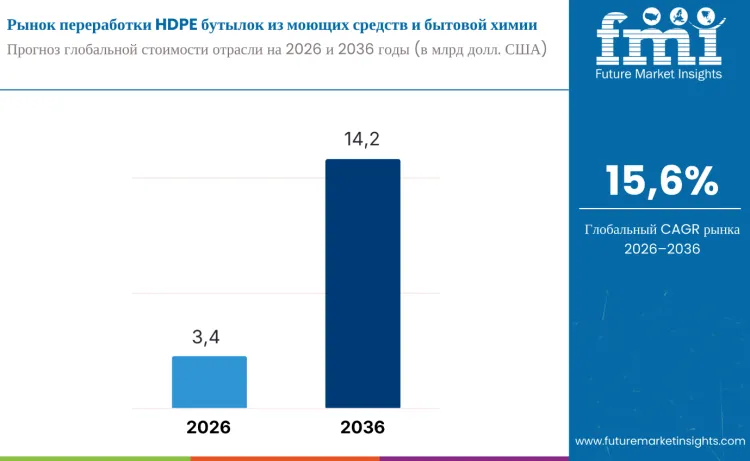
The detergent bottle and home care HDPE bottle-to-bottle recycling market is valued at USD 3.4 billion in 2026 and is projected to reach USD 14.2 billion by 2036, reflecting a CAGR of 15.6%. Demand rises as global FMCG brands adopt circular packaging commitments and expand use of high-purity rHDPE to meet recycled-content targets. Retailer-led sustainability requirements and regulatory alignment across multiple regions reinforce investment in closed-loop HDPE systems. Enhanced wash lines, melt filtration, and odor-removal systems improve color uniformity and structural performance. Quality-assurance protocols raise compliance with brand specifications for detergent, cleaning spray, and household product bottles.
Quick Stats for Detergent Bottle and Home Care HDPE Bottle-to-Bottle Recycling Market
- Market Value (2026): USD 3.4 billion
- Market Forecast Value (2036): USD 14.2 billion
- Forecast CAGR (2026 to 2036): 15.6%
- Leading Recycling Technology in Global Demand: Mechanical HDPE bottle-to-bottle recycling
- Key Growth Regions in Global Demand: China, India, USA, Japan
- Top Players in Global Demand: Alpla Group, Veolia, Plastipak, Faerch Group, Viridor
China, India, USA, and Japan represent key growth regions due to expanding recycling capacity and increasing demand for high-quality secondary plastics. Alpla Group, Veolia, Plastipak, Faerch Group, and Viridor drive competitive momentum by building integrated recycling hubs, partnering with FMCG producers, and deploying advanced purification technologies that strengthen availability of bottle-grade rHDPE for home care packaging.
Detergent Bottle and Home Care HDPE Bottle-to-Bottle Recycling in Market Key Takeaways
| Metric | Value |
|---|---|
| Market Value (2026) | USD 3.4 billion |
| Market Forecast Value (2036) | USD 14.2 billion |
| Forecast CAGR (2026 to 2036) | 15.6% |
How Are the Segments Classified in the Detergent Bottle and Home Care HDPE Bottle-to-Bottle Recycling in Market?
Demand for HDPE bottle-to-bottle recycling is shaped by recycled-content obligations, rising closed-loop commitments from home-care brands, and increased recovery of post-consumer HDPE detergent and cleaning bottles. Buyers evaluate wash-sort-decontamination efficiency, color-sorting precision, and suitability of recycled HDPE for blow-molded packaging formats. Adoption patterns reflect investment in mechanical and hybrid recycling systems that improve resin purity for detergent, dishwashing, and refill packaging applications.
Which Recycling Technology Accounts for the Largest Share of Global Demand?
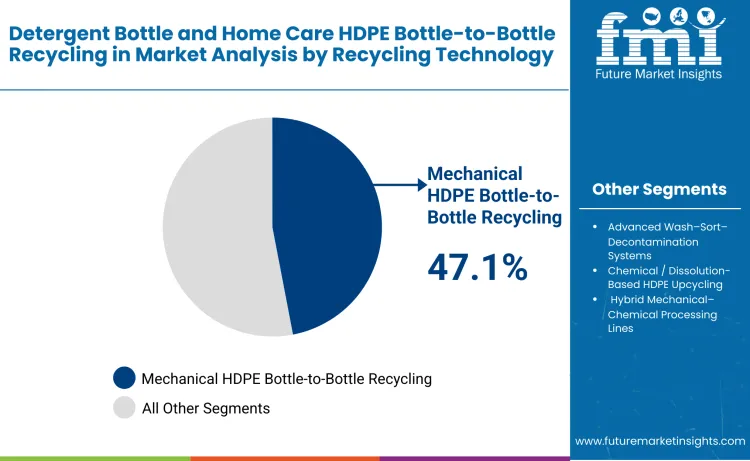
Mechanical HDPE bottle-to-bottle recycling holds 47.1%, making it the leading recycling-technology segment globally. Mechanical lines support high-throughput washing, extrusion, and pelletizing for detergent-grade rHDPE with consistent performance. Advanced wash-sort-decontamination systems target surfactants, fragrances, dyes, and residues common in home-care bottles. Chemical or dissolution-based upcycling addresses heavily colored or contamination-prone bottles that require deeper purification. Hybrid mechanical-chemical processing lines combine scalable mechanical recovery with targeted chemical purification. Technology distribution reflects reliance on mechanical recycling strengthened by advanced decontamination technology.
Key Points:
- Mechanical recycling delivers scalable, bottle-grade rHDPE.
- Advanced decontamination removes residues typical of home-care packaging.
- Chemical upcycling treats complex or colored streams.
- Hybrid systems align with purity and efficiency requirements.
Which Material Stream Represents the Largest Share of Global Demand?
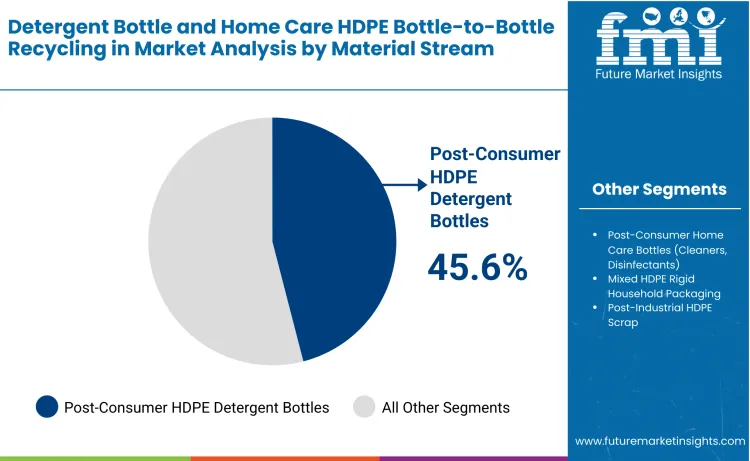
Post-consumer HDPE detergent bottles hold 45.6%, making them the largest material-stream segment globally. These bottles provide high-volume, consistent feedstock suitable for closed-loop recycling into new detergent and laundry-care packaging. Post-consumer home-care bottles add cleaners, disinfectants, and specialty formulations requiring controlled decontamination. Mixed HDPE household packaging requires advanced sorting for bottle-grade resin quality. Post-industrial HDPE scrap provides clean, predictable material but in smaller quantities. Material-stream distribution reflects strong reliance on detergent-bottle feedstock for high-purity closed-loop applications.
Key Points:
- Detergent bottles supply high-volume, bottle-grade feedstock.
- Home-care bottles require controlled decontamination.
- Mixed packaging depends on advanced sorting accuracy.
- Post-industrial scrap offers clean but limited supply.
Which Application Accounts for the Largest Share of Global Demand?
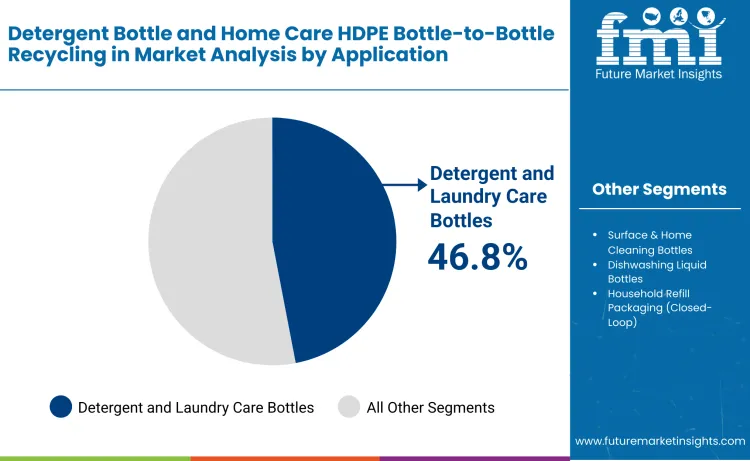
Detergent and laundry care bottles hold 46.8%, making them the leading application segment. These bottles require durable, stress-crack-resistant rHDPE suitable for repeated handling and squeezing. Surface and home-cleaning bottles depend on chemical-resistant rHDPE with controlled color specifications. Dishwashing liquid bottles require uniform processing and consistent mechanical performance. Household refill packaging supports closed-loop reuse systems based on lightweight, mono-material HDPE structures. Application distribution reflects high resin demand in laundry-care packaging and the shift toward recycled-content adoption across home-care formats.
Key Points:
- Laundry-care bottles drive closed-loop rHDPE demand.
- Cleaning bottles require chemical-resistant recycled HDPE.
- Dishwashing bottles need consistent mechanical behavior.
- Refill packaging supports circular packaging systems.
Which End-User Segment Accounts for the Largest Share of Global Demand?
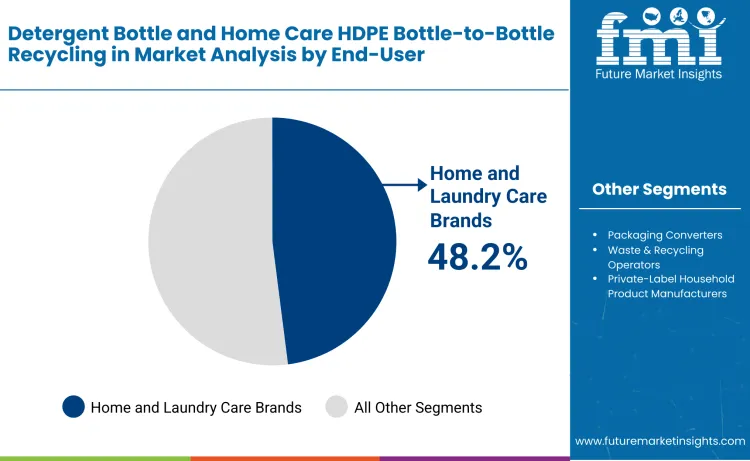
Home and laundry care brands hold 48.2%, making them the leading end-user segment globally. Brands pursue recycled-content targets, reduce virgin-plastic use, and adopt bottle-to-bottle loops to meet regulatory and corporate sustainability commitments. Packaging converters produce bottle molds and incorporate rHDPE into new packaging structures. Waste and recycling operators supply sorted HDPE and invest in advanced cleaning systems. Private-label household product manufacturers use rHDPE for competitively priced home-care packaging. End-user distribution reflects brand-driven demand for high-quality rHDPE and closed-loop packaging systems.
Key Points:
- Home-care brands lead due to recycled-content commitments.
- Converters integrate rHDPE into bottle manufacturing.
- Waste operators enable supply through advanced sorting.
- Private-label manufacturers expand rHDPE adoption.
What are the Key Dynamics in the Detergent Bottle and Home Care HDPE Bottle-to-Bottle Recycling in Market?
Global demand rises as home care brands, recyclers, and converters adopt closed loop HDPE recycling to meet sustainability targets and reduce reliance on virgin resin. Detergent, surface cleaner, and household chemical bottles provide consistent post-consumer feedstock for bottle-to-bottle applications. Advancements in sorting, cleaning, and deodorization enable production of higher purity rHDPE suitable for reuse in home care packaging, strengthening interest across mature and emerging recycling regions.
How are brand sustainability commitments and packaging redesign efforts shaping HDPE bottle-to-bottle adoption?
Brands introduce circular packaging strategies that prioritize recycled content for detergent and home care bottles. Packaging redesigns reduce pigments, adhesives, and multilayer structures that hinder recyclability. Sorting facilities expand polymer recognition and colour-sorting capabilities to capture a higher share of natural and lightly tinted HDPE. Recyclers deploy advanced wash, melt filtration, and odour reduction systems to achieve performance thresholds required for household chemical applications. Retailers support recycled content claims through procurement policies encouraging rHDPE usage. Partnerships between brands and recyclers stabilize feedstock access and secure long term offtake for consistent rHDPE supply.
How do feedstock variability, quality constraints, and processing challenges influence global scalability?
Collection rates differ across regions, limiting steady availability of natural HDPE suitable for closed loop applications. Post-consumer bottles contain residues, dyes, and fragrances that complicate washing and deodorization. Mechanical performance of rHDPE fluctuates when feedstock mixes include coloured or degraded containers. Sorting infrastructure gaps reduce yield in areas lacking optical systems capable of distinguishing bottle grades. Recyclers face cost pressures associated with energy intensive cleaning processes. Brands require uniform viscosity and colour profiles across supply batches, raising expectations for process control. Variability in regulatory frameworks affects investment decisions for bottle-to-bottle production capacity.
How is Demand for Detergent Bottle and Home Care HDPE Bottle-to-Bottle Recycling in Market Evolving Across Key Countries?
Demand for the detergent bottle and home care HDPE bottle-to-bottle recycling market is rising due to increased regulatory pressure on recyclability, wider adoption of mono-material HDPE bottles, and stronger brand-owner commitments to PCR integration. China records a CAGR of 16.8% supported by rapid upgrades in HDPE reprocessing capacity. India shows a 16.1% CAGR driven by expansion of household-packaging consumption. USA posts a 14.9% CAGR supported by modernization of HDPE recovery systems. Japan holds a 13.8% CAGR linked with structured collection and precision washing processes. UK records a 13.2% CAGR supported by EPR-led infrastructure improvements.
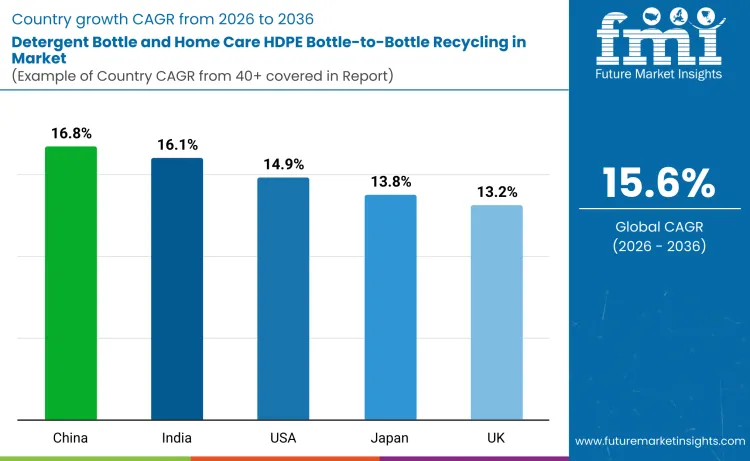
| Country | CAGR (%) |
|---|---|
| China | 16.8% |
| India | 16.1% |
| USA | 14.9% |
| Japan | 13.8% |
| UK | 13.2% |
How is China driving demand for Detergent Bottle and Home Care HDPE Bottle-to-Bottle Recycling?
China drives demand due to high household-packaging output, expansion of HDPE reprocessing capacity, and increased interest in closed-loop packaging compliance. The country’s CAGR of 16.8% reflects investment in high-precision sorting, advanced washing systems, and melt-filtration technologies producing bottle-grade rHDPE. Converters shift toward mono-material HDPE bottle structures improving recyclability. AI-enabled optical sorting enhances polymer identification accuracy. Collaboration between resin suppliers and recyclers strengthens system compatibility. National circular-economy programs promote large-scale implementation of bottle-to-bottle recovery.
- Expansion of high-capacity HDPE washing and extrusion lines
- Increased use of mono-material HDPE bottles
- AI-driven optical sorting improving resin purity
- Policy alignment supporting closed-loop HDPE systems
How is India driving demand for Detergent Bottle and Home Care HDPE Bottle-to-Bottle Recycling?
India supports rising demand due to growth in home-care and detergent packaging, regulatory focus on recycling improvements, and expansion of HDPE recovery infrastructure. The country’s CAGR of 16.1% reflects adoption of upgraded hot-wash, extrusion, and odor-control lines supporting bottle-grade rHDPE. Converters redesign bottles using mono-material HDPE to align with EPR-led recyclability targets. Feedstock quality improves through segregation initiatives across metropolitan regions. Retail and household-product brands increase requirements for PCR-HDPE integration, reinforcing system development.
- Growth in detergent and home-care HDPE bottle usage
- Upgraded washing and decontamination systems
- Mono-material bottle formats strengthening recyclability
- EPR compliance improving feedstock segregation
How is the USA driving demand for Detergent Bottle and Home Care HDPE Bottle-to-Bottle Recycling?
USA drives demand through modernization of HDPE recycling systems, increased brand commitments to PCR usage, and broader adoption of recyclable bottle designs. The country’s CAGR of 14.9% reflects expansion of high-speed optical sorting, precision washing, and melt-filter upgrades improving bottle-grade rHDPE output. Retailers and CPG firms transition detergent and cleaning-product bottles to mono-material HDPE structures. Chemical-recycling pilots support supplemental supply of high-purity recycled resin. Collection networks improve consistency of HDPE feedstock across regional systems.
- Optical-sorting and washing upgrades
- Increased brand procurement of PCR-HDPE
- Movement toward design-for-recycling HDPE bottles
- Chemical-recycling pilots strengthening supply resilience
How is Japan driving demand for Detergent Bottle and Home Care HDPE Bottle-to-Bottle Recycling?
Japan drives demand due to strict material-quality expectations, structured municipal collection, and interest in high-purity rHDPE for closed-loop applications. The country’s CAGR of 13.8% reflects adoption of controlled washing, melt-filtration, and decontamination technologies designed to meet bottle-grade specifications. Municipal systems deliver clean HDPE streams supporting efficient processing. Packaging manufacturers refine bottle designs to enhance recyclability and stability during repeated cycles. Strong emphasis on quality in recycled materials drives continued investment.
- Stable municipal collection improving HDPE feedstock quality
- Controlled high-precision reprocessing lines
- Refinement of bottle specifications supporting recyclability
- Strong quality standards guiding system upgrades
How is the UK driving demand for Detergent Bottle and Home Care HDPE Bottle-to-Bottle Recycling?
UK supports demand through EPR-driven reforms, national recycling targets, and strong retailer commitments to PCR adoption in home-care packaging. The country’s CAGR of 13.2% reflects expansion of HDPE sorting and washing capacity tailored to bottle-grade output. Converters transition to mono-material HDPE bottles eliminating incompatible components. Retailer stewardship programs accelerate incorporation of recycled HDPE. National circular-economy policy encourages infrastructure investment improving feedstock consistency and recycling throughput.
- EPR alignment driving HDPE recovery improvements
- Shift toward mono-material HDPE bottle designs
- Retail and brand commitments to PCR-HDPE usage
- Circular-economy targets supporting infrastructure expansion
What is the competitive landscape of demand for detergent bottle and home care HDPE bottle-to-bottle recycling globally?
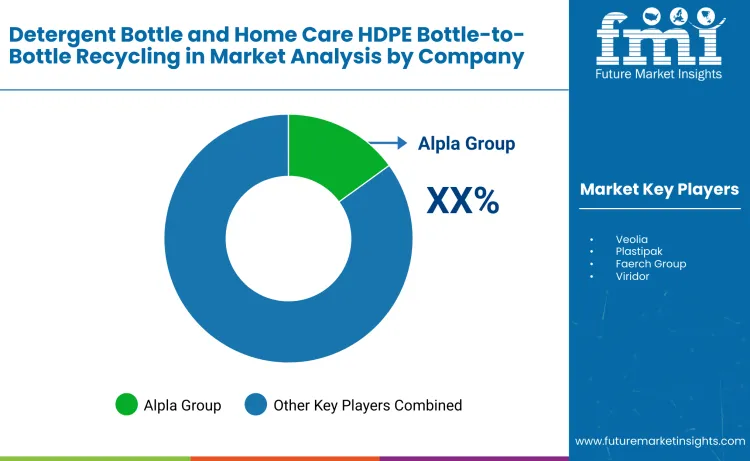
Demand for detergent bottle and home care rHDPE bottle-to-bottle recycling grows with regulatory recycled-content mandates and brand commitments. Buyers prioritize high-purity natural-HDPE streams, effective odor control, and consistent melt-flow for extrusion blow-molding operations. Sorting precision, label and adhesive removal, and hot-wash performance determine feedstock suitability for closed-loop conversion. Procurement teams evaluate pellet color control, contaminant limits, traceability, and documented food-contact or non-food certification pathways.
Alpla Group secures large integrated recycling capacity and in-house blow-molding, supporting consistent supply to global brand owners. Vertical integration and regional recycling sites reduce logistics risk and support higher PCR incorporation in finished bottles. Competitors include Veolia, Plastipak, Faerch Group, and Viridor operating with varied regional strengths and processing footprints.
Technology differentiation centers on advanced washing, optical sorting upgrades, and improved pellet decontamination to meet performance thresholds. Cost competitiveness depends on feedstock access, energy efficiency, and long-term offtake agreements with brand and converter partners. Policy alignment, standardized testing protocols, and scalable plant designs determine which recyclers capture rising detergent bottle demand.
Market dynamics remain regionalized while leading integrated recyclers with bottle production capability achieve superior share and supply resilience. Retail partnerships and recycled-content commitments by major brands create predictable demand signals for rHDPE supply contracts. Investment in color-sorting technologies and natural-HDPE segregation remains decisive for securing long-term detergent bottle contracts.
Key Players in the Detergent Bottle and Home Care HDPE Bottle-to-Bottle Recycling in Market
- Alpla Group
- Veolia
- Plastipak
- Faerch Group
- Viridor
Scope of the Report
| Items | Values |
|---|---|
| Quantitative Units | USD billion |
| Recycling Technology | Mechanical HDPE Bottle-to-Bottle Recycling, Advanced Wash-Sort-Decontamination Systems, Chemical / Dissolution-Based HDPE Upcycling, Hybrid Mechanical-Chemical Processing Lines |
| Material Stream | Post-Consumer HDPE Detergent Bottles, Post-Consumer Home Care Bottles (Cleaners, Disinfectants), Mixed HDPE Rigid Household Packaging, Post-Industrial HDPE Scrap |
| Application | Detergent & Laundry Care Bottles, Surface & Home Cleaning Bottles, Dishwashing Liquid Bottles, Household Refill Packaging (Closed-Loop) |
| End-User | Home & Laundry Care Brands, Packaging Converters, Waste & Recycling Operators, Private-Label Household Product Manufacturers |
| Regions Covered | Asia Pacific, Europe, North America, Latin America, Middle East & Africa |
| Countries Covered | India, China, USA, Germany, South Korea, Japan, Italy, and 40+ countries |
| Key Companies Profiled | Alpla Group, Veolia, Plastipak, Faerch Group, Viridor |
| Additional Attributes | Dollar sales by recycling technology, material stream, application, and end-user categories; analysis of HDPE decontamination requirements for food-adjacent home care containers; adoption trends for mechanical and chemical HDPE recycling; developments in advanced wash-sort systems and AI-enabled optical detection; compatibility of HDPE flakes with closed-loop detergent bottle specifications; compliance alignment with global PCR mandates, EPR frameworks, and retailer-led recycled content targets. |
Detergent Bottle and Home Care HDPE Bottle-to-Bottle Recycling in Market by Segment
By Recycling Technology:
- Mechanical HDPE Bottle-to-Bottle Recycling
- Advanced Wash-Sort-Decontamination Systems
- Chemical / Dissolution-Based HDPE Upcycling
- Hybrid Mechanical-Chemical Processing Lines
By Material Stream:
- Post-Consumer HDPE Detergent Bottles
- Post-Consumer Home Care Bottles (Cleaners, Disinfectants)
- Mixed HDPE Rigid Household Packaging
- Post-Industrial HDPE Scrap
By Application:
- Detergent & Laundry Care Bottles
- Surface & Home Cleaning Bottles
- Dishwashing Liquid Bottles
- Household Refill Packaging (Closed-Loop)
By End-User:
- Home & Laundry Care Brands
- Packaging Converters
- Waste & Recycling Operators
- Private-Label Household Product Manufacturers
Region:
- Asia Pacific
- China
- Japan
- South Korea
- India
- Australia & New Zealand
- ASEAN
- Rest of Asia Pacific
- Europe
- Germany
- United Kingdom
- France
- Italy
- Spain
- Nordic
- BENELUX
- Rest of Europe
- North America
- United States
- Canada
- Mexico
- Latin America
- Brazil
- Chile
- Rest of Latin America
- Middle East & Africa
- Kingdom of Saudi Arabia
- Other GCC Countries
- Turkey
- South Africa
- Other African Union
- Rest of Middle East & Africa
Frequently Asked Questions
What is the size of the detergent bottle and home care HDPE bottle-to-bottle recycling market in 2026?
The market is valued at USD 3.4 billion in 2026 due to rising recovery of rigid HDPE detergent and home care bottles.
What will be the industry size by 2036?
Industry value will reach USD 14.2 billion by 2036 as recyclers scale high-quality rHDPE production lines and brands increase recycled content usage.
What is the CAGR for 2026-2036?
The detergent bottle and home care HDPE bottle-to-bottle recycling market expands at a 15.6% CAGR during the forecast period.
Which recycling-technology segment leads in 2026?
Mechanical HDPE bottle-to-bottle recycling holds 47.1% share, supported by established processing efficiency and suitability for closed-loop applications.
Which material-stream segment holds the highest share?
Post-consumer HDPE detergent bottles lead with 45.6% share due to their stable supply volume and compatibility with bottle-to-bottle recycling.
Preview the report firsthand - request a free sample
Get SampleGet the brochure for pricing and purchase details.
Get PDFTable of Content
- Executive Summary
- Market Overview
- Global Market Value, 2020-2026
- Global Market Forecast, 2026-2036
- Market Dynamics
- Drivers
- Restraints
- Opportunities
- Regulatory & Standards Landscape
- Technology & Material Innovation Outlook
- Market Segmentation Analysis
- By Recycling Technology
- Mechanical HDPE Bottle-to-Bottle Recycling
- Advanced Wash-Sort-Decontamination Systems
- Chemical / Dissolution-Based HDPE Upcycling
- Hybrid Mechanical-Chemical Processing Lines
- By Material Stream
- Post-Consumer HDPE Detergent Bottles
- Post-Consumer Home Care Bottles (Cleaners, Disinfectants)
- Mixed HDPE Rigid Household Packaging
- Post-Industrial HDPE Scrap
- By Application
- Detergent & Laundry Care Bottles
- Surface & Home Cleaning Bottles
- Dishwashing Liquid Bottles
- Household Refill Packaging (Closed-Loop)
- By End-User
- Home & Laundry Care Brands
- Packaging Converters
- Waste & Recycling Operators
- Private-Label Household Product Manufacturers
- By Recycling Technology
- Regional Outlook
- Asia Pacific
- Europe
- North America
- Latin America
- Middle East & Africa
- Country-Level Outlook
- China
- India
- USA
- Japan
- United Kingdom
- Germany
- South Korea
- Italy
- Australia & New Zealand
- ASEAN
- Brazil
- Chile
- Turkey
- South Africa
- Other GCC Countries
- Rest of Europe
- Rest of Latin America
- Rest of Middle East & Africa
- Competitive Landscape
- Market Structure Overview
- Company Positioning
- Strategic Initiatives
- Key Player Profiles
- Scope of the Report
- Research Methodology
- Assumptions & Acronyms


