

- Industry Size (2026)
- USD 450 Mn
- Forecast (2036)
- USD 1554.8 Mn
- CAGR (2026 to 2036)
- 13.2%
Solvent-Based Food-Grade rHDPE Recycling Technologies Market Forecast and Outlook 2026 to 2036
the solvent-based food-grade rHDPE recycling technologies market is projected to grow from USD 450 million in 2026 to USD 1,554.8 million by 2036, reflecting a compound annual growth rate (CAGR) of 13.2%. These figures signal a significant shift in purchasing behavior, with increasing demand for sustainable and compliant recycling technologies in the food packaging industry. The growth indicates rising confidence among suppliers, who are positioning themselves to meet stricter environmental regulations and consumer expectations.
As sustainability becomes a priority, buyers are expected to demonstrate a long-term commitment to sourcing from companies that offer proven, scalable, and compliant solutions. This shift highlights a deeper trend of market consolidation, where companies able to provide consistent, high-quality products that align with regulatory standards will capture long-term value. The market’s expansion suggests that suppliers who can manage both operational efficiency and environmental compliance will hold a competitive edge in securing key partnerships and contracts moving forward.
Quick Stats of the Solvent-Based Food-Grade rHDPE Recycling Technologies Market
- Solvent-Based Food-Grade rHDPE Recycling Technologies Market Value (2026): USD 450 million
- Solvent-Based Food-Grade rHDPE Recycling Technologies Market Forecast Value (2036): USD 1,554.8 million
- Solvent-Based Food-Grade rHDPE Recycling Technologies Market Global Forecast CAGR (2026 to 2036): 13.2%
- Solvent-Based Food-Grade rHDPE Recycling Technologies Market Leading Segment: Buyer Type (Brand Owners - Food & Beverage) 51%
- Key Growth Regions in Solvent-Based Food-Grade rHDPE Recycling Technologies Market: USA
- Top Players in Solvent-Based Food-Grade rHDPE Recycling Technologies Market: APK AG, PureCycle Technologies, Brightmark, Klean Industries, Agilyx, CreaSolv® Process Consortium, Unilever / SCM partners, Eastman, Veolia, Loop Industries
What is the Growth Forecast for the Solvent-Based Food-Grade rHDPE Recycling Technologies Market through 2036?
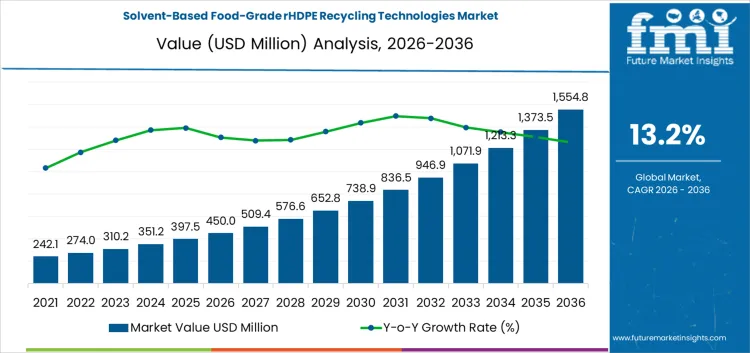
The long-term value accumulation curve for the solvent-based food-grade rHDPE recycling technologies market highlights the gradual and sustained increase in market value over the forecast period. From 2026 to 2031, the market will grow from USD 450 million to USD 975 million, reflecting an increase of USD 525 million. This early-phase growth is driven by rising demand for recycled materials, particularly for food-grade applications, as well as improvements in solvent-based recycling technologies that enhance efficiency and cost-effectiveness.
From 2031 to 2036, the market will continue to accumulate value, increasing from USD 975 million in 2031 to USD 1,554.8 million by 2036. This represents a steady growth trajectory of USD 665 million over the second half of the forecast period. During this phase, the adoption of solvent-based rHDPE recycling technologies will become more widespread, and the focus will shift to optimizing existing technologies and increasing production scale to meet the growing demand for sustainable food-grade packaging. The steady increase in market value over the 10-year period reflects the maturation of the technology and the broader integration of sustainable practices across the packaging industry, leading to a consistent and predictable rise in the market’s value.
Solvent-Based Food-Grade rHDPE Recycling Technologies Market Key Takeaways
| Metric | Value |
|---|---|
| Industry Sales Value (2026) | USD 450 million |
| Industry Forecast Value (2036) | USD 1,554.8 million |
| Industry Forecast CAGR (2026 to 2036) | 13.2% |
What Is Driving the Demand for Solvent-Based Food-Grade rHDPE Recycling Technologies Market?
Historical demand for recycled high-density polyethylene (rHDPE) material in food-grade applications developed from broader growth in the recycled plastics market, where mechanical recycling of HDPE has long provided material for non-food uses such as bottles, pipes, and construction products because of its durability and recyclability. rHDPE has been widely accepted in these applications, with the recycled-plastic segment projected to reach about USD 72.66 billion in 2025 and grow into the early 2030s at over 7 % CAGR, driven by sustainability and regulatory pressures.
Demand for food-grade recycled HDPE grew subsequently as food packaging makers and brand owners sought lower-impact alternatives to virgin HDPE and regulators tightened recycled content requirements. Traditional mechanical recycling methods often fall short of food-safety standards because contamination and mixed feedstock restrict achievement of consistent, high-purity resins required for direct contact with food. Emerging solvent-based recycling technologies use dissolution and precipitation techniques to selectively extract and purify specific polymers such as HDPE from mixed waste streams, producing recycled resins with quality comparable to virgin material.
Future demand for solvent-based food-grade rHDPE recycling technologies is expected to be shaped by regulatory, corporate, and sustainability drivers that emphasise circular economy outcomes and safe, high-quality recycled plastics. Solvent-based plastic recycling markets are poised to grow at mid to high single-digit or double-digit CAGR through the second half of the 2020s as technological advancement and stricter waste-management policies support expanded adoption. This form of advanced recycling can handle complex or contaminated waste that mechanical recycling cannot process efficiently, enabling recovery of HDPE suitable for food packaging and other high-spec applications where safety and performance are critical.
Growth factors include rising regulatory requirements for recycled content in food packaging, advancing purification and sorting technologies, and brand-owner commitments to sustainable materials in end-use sectors such as consumer goods and food and beverage packaging. Additional drivers include expanding collaboration between recyclers and technology developers on solvent-based pilot and commercial projects aimed at closing quality gaps, as illustrated by recent industry testing of solvent-based HDPE recycling pilots in Europe. Barriers to broader adoption include technical and cost challenges associated with solvent handling, energy intensity, and scaling these advanced processes, but ongoing interest in high-quality recycled material and circular plastic solutions is expected to sustain demand for solvent-based recycling technologies that enable food-grade rHDPE supply.
What are the Leading Segments in the Global Solvent-Based Food-Grade rHDPE Recycling Technologies Market?
The global solvent-based food-grade rHDPE recycling technologies market is segmented by buyer type and technology type. Among buyer types, brand owners (food & beverage) lead the market, capturing 51% of the share, followed by recycling or advanced recycling operators, converters & compounders, and OEM & equipment licensors. Brand owners in the food and beverage sector drive the demand for recycled high-density polyethylene (rHDPE) as they seek sustainable packaging solutions. On the technology side, solvent dissolution & purification systems dominate the market, holding 48% of the share, followed by solvent-assisted depolymerization technology, solvent or selective additive removal solutions, and integrated solvent + mechanical hybrid systems. Solvent dissolution & purification systems are favored for their ability to efficiently recycle rHDPE into food-grade material, ensuring high-quality standards for packaging.
What Drives the Growth of Brand Owners (Food & Beverage) in the Solvent-Based Food-Grade rHDPE Recycling Technologies Market?
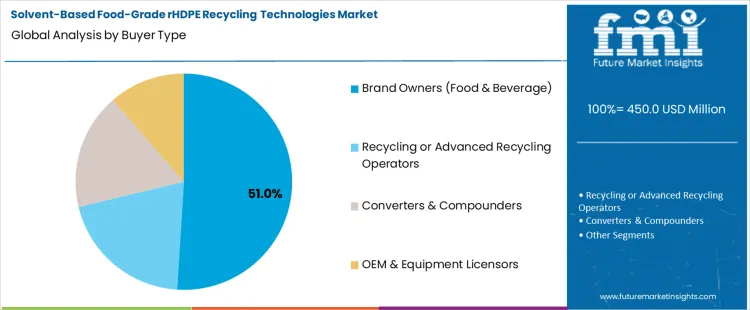
Brand owners (food & beverage) are the leading buyer type in the solvent-based food-grade rHDPE recycling technologies market, holding 51% of the share. This growth is driven by the increasing pressure on food and beverage brands to adopt sustainable packaging solutions due to rising consumer demand for environmentally friendly products and regulatory pressures. The food and beverage sector is one of the largest consumers of plastic packaging, and rHDPE is commonly used for bottles, containers, and other packaging materials. As brands move toward circular economy practices, the demand for recycled rHDPE that can be used safely in food-grade packaging is growing. Solvent-based recycling technologies offer a highly effective method for ensuring that recycled rHDPE meets the necessary purity and quality standards for reuse in food packaging. By adopting solvent-based recycling, food and beverage brands can achieve their sustainability targets, reduce waste, and align with consumer preferences for eco-friendly products, driving the growth of this segment in the market.
What is Driving the Demand for Solvent Dissolution & Purification Systems in the Solvent-Based Food-Grade rHDPE Recycling Technologies Market?
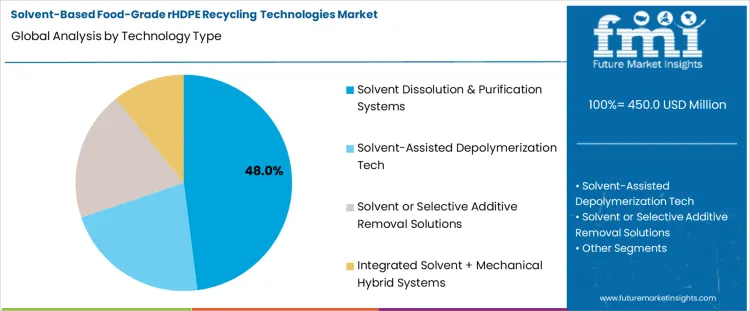
Solvent dissolution & purification systems are the leading technology type in the solvent-based food-grade rHDPE recycling technologies market, capturing 48% of the share. This demand is driven by the efficiency and effectiveness of solvent dissolution in removing contaminants and additives from rHDPE, ensuring the material is suitable for reuse in food-grade packaging. Solvent dissolution & purification systems offer a high level of purity in the recycled material, which is essential for food safety standards and regulations in packaging. These systems are capable of processing large volumes of rHDPE while maintaining high-quality output, making them an attractive option for recycling operators and brand owners looking to incorporate recycled materials into their product packaging. As the focus on sustainable packaging intensifies, the demand for solvent-based recycling technologies that provide high-quality, food-grade recycled rHDPE will continue to grow, ensuring that solvent dissolution & purification systems remain the dominant technology in the market.
What are the Key Dynamics in the Solvent-Based Food-Grade rHDPE Recycling Technologies Market?
The solvent-based food-grade recycled high-density polyethylene (rHDPE) recycling technologies market is defined by processes that enable reclamation of HDPE used in food packaging into material suitable for reuse in food contact applications. Solvent-based approaches dissolve and purify polymers to remove contaminants and restore properties that meet regulatory and safety standards. Food and beverage manufacturers, packaging converters, and recyclers assess technologies on purity outcomes, regulatory compliance, yield, and cost. Regulatory frameworks for food contact materials and recycled content influence adoption. Supply of post-consumer HDPE feedstock, solvent recovery efficiency, and integration with existing recycling infrastructure affect how technologies are commercialised. Demand for circular packaging and documented quality in recycled polymers shapes market activity.
What are the Main Drivers Supporting Growth in This Market?
Growth in this market is supported by regulatory pressure to increase recycled content in food packaging while ensuring safety. Governments and standards bodies are setting targets for recycled plastic use and establishing criteria for food-grade recyclate, which incentivises advanced recycling methods that can meet stringent purity requirements. Consumer demand for sustainable packaging solutions is prompting brand owners to seek rHDPE that aligns with circular economy goals. Advances in solvent separation, purification, and solvent recovery systems improve polymer quality and process economics. Collaboration between packaging manufacturers and recycling technology providers is increasing to validate performance and meet supply chain needs. Expansion of collection and sorting infrastructure ensures more consistent feedstock for solvent-based processes.
What Restraints Are Limiting Market Expansion?
Market expansion is constrained by technical and economic challenges associated with solvent-based recycling. These technologies can require significant capital investment in solvent handling, recovery, and purification equipment, which may deter smaller recyclers. Operating costs, including energy and solvent management, are often higher than for conventional mechanical recycling, which can make final rHDPE grades more expensive. Feedstock variability, contamination levels, and the presence of additives in post-consumer HDPE complicate purification and can affect yield. Regulatory variations in food contact approvals across regions add complexity for technology developers and end users seeking global compliance. There can also be reluctance among some brand owners to rely on newer recycling technologies without long-term performance data.
What Emerging Trends Are Shaping the Future of This Market?
Emerging trends include integration of solvent-based methods with digital tracking and certification systems that document chain-of-custody and material quality for food-grade applications. There is growing interest in hybrid recycling models that combine solvent purification with advanced sorting and pre-treatment to improve feedstock quality and reduce process waste. Research into greener and more recoverable solvents aims to lower environmental impact and operating cost. Partnerships between consumer goods companies and recycling technology providers are expanding to scale solutions and secure supply of certified rHDPE. Standardisation of testing methods and performance benchmarks for solvent-recycled food-grade polymers is gaining traction, supporting wider acceptance and specification in packaging design.
What is the Country-Wise Analysis of the Solvent-Based Food-Grade rHDPE Recycling Technologies Market?
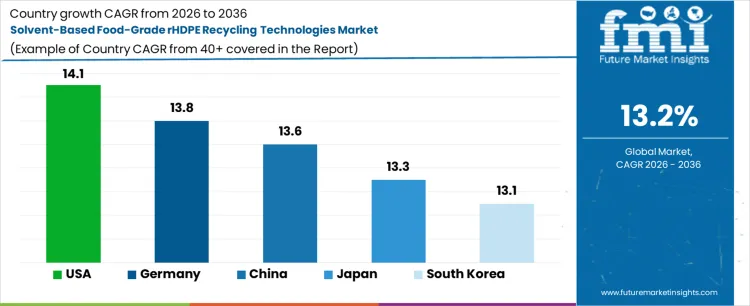
The solvent-based food-grade recycled high-density polyethylene (rHDPE) recycling technologies market is growing as industries seek to improve sustainability and reduce plastic waste. rHDPE, a commonly used plastic in food packaging, can be recycled to produce new food-grade materials through solvent-based recycling methods. Developed markets like the USA, Germany, and Japan are leading the adoption of solvent-based rHDPE recycling technologies due to strong regulatory pressures, government support for recycling initiatives, and the growing demand for sustainable packaging solutions. Emerging markets such as China and South Korea are also experiencing growth, driven by increasing environmental awareness, government incentives for recycling technologies, and the need to reduce plastic waste. As global sustainability efforts intensify, the market for solvent-based food-grade rHDPE recycling technologies is expected to expand significantly.
| Country | CAGR (2026-2036) |
|---|---|
| USA | 14.1% |
| Germany | 13.8% |
| China | 13.6% |
| Japan | 13.3% |
| South Korea | 13.1% |
What is the Growth Outlook for the Solvent-Based Food-Grade rHDPE Recycling Technologies Market in the USA?
The solvent-based food-grade rHDPE recycling technologies market in the USA is projected to grow steadily, with a projected CAGR of 14.1% from 2026 to 2036. The USA has long been at the forefront of sustainability and innovation in the recycling industry, and the demand for solvent-based rHDPE recycling technologies is rising as the food packaging sector focuses on reducing plastic waste. Government regulations encouraging recycling and sustainability, coupled with the increasing consumer demand for eco-friendly packaging, are key drivers of market growth. As the USA continues to prioritize green technologies and expand recycling initiatives, the market for solvent-based food-grade rHDPE recycling technologies is expected to experience steady growth over the coming years.
What is the Market Outlook for the Solvent-Based Food-Grade rHDPE Recycling Technologies Market in Germany?
Germany is expected to see steady growth in the solvent-based food-grade rHDPE recycling technologies market, with a projected CAGR of 13.8% from 2026 to 2036. As a leader in environmental sustainability, Germany has implemented strong regulations to reduce plastic waste and promote recycling. The adoption of solvent-based rHDPE recycling technologies in the food packaging industry is growing in response to these regulations and the increasing demand for sustainable packaging solutions. The German government’s support for green technologies and circular economy practices is driving the development and adoption of recycling technologies in the country. As Germany continues to push for sustainability and reduce plastic pollution, the market for solvent-based rHDPE recycling technologies is set to grow steadily.
What is the Growth Forecast for the Solvent-Based Food-Grade rHDPE Recycling Technologies Market in China?
China is projected to experience steady growth in the solvent-based food-grade rHDPE recycling technologies market, with a projected CAGR of 13.6% from 2026 to 2036. As the largest producer and consumer of plastic products, China is increasingly focusing on sustainability and improving recycling technologies. The government is introducing policies to encourage green development and reduce plastic waste, which is driving the adoption of solvent-based recycling methods for food-grade rHDPE. With a growing commitment to reducing plastic pollution and improving the sustainability of its manufacturing sector, China’s market for rHDPE recycling technologies is expected to grow steadily. The increasing demand for eco-friendly packaging and sustainable solutions in food packaging will further support the growth of this market.
What is the Market Outlook for the Solvent-Based Food-Grade rHDPE Recycling Technologies Market in Japan?
Japan is expected to see steady growth in the solvent-based food-grade rHDPE recycling technologies market, with a projected CAGR of 13.3% from 2026 to 2036. Japan has been proactive in adopting sustainability initiatives, and the demand for sustainable food packaging solutions is rising. Solvent-based rHDPE recycling technologies are becoming a key focus for the Japanese food packaging sector as the country works to reduce plastic waste and improve its recycling systems. The government’s regulations encouraging the use of recycled materials in packaging and its strong commitment to reducing plastic pollution are driving the adoption of these recycling technologies. As Japan continues to prioritize environmental sustainability, the market for solvent-based food-grade rHDPE recycling technologies is expected to continue growing.
What is the Growth Forecast for the Solvent-Based Food-Grade rHDPE Recycling Technologies Market in South Korea?
South Korea is projected to experience steady growth in the solvent-based food-grade rHDPE recycling technologies market, with a projected CAGR of 13.1% from 2026 to 2036. South Korea is increasingly focused on sustainability and reducing plastic waste in the packaging sector. The government’s push for green technologies and circular economy initiatives is driving the adoption of recycling technologies, including solvent-based rHDPE recycling methods for food packaging. As consumer demand for sustainable and eco-friendly products rises, South Korean industries are adopting more advanced recycling solutions to meet both regulatory requirements and consumer preferences. With increasing investments in green technologies and recycling infrastructure, the market for solvent-based rHDPE recycling technologies in South Korea is expected to grow steadily.
What is the Competitive Landscape for the Solvent-Based Food-Grade rHDPE Recycling Technologies Market?
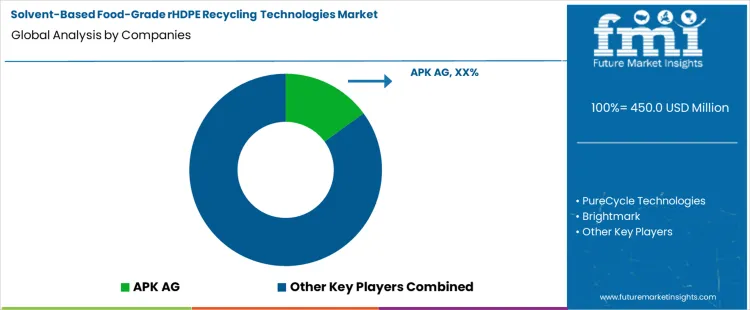
The solvent-based food-grade recycled high-density polyethylene (rHDPE) recycling technologies market is growing as demand for sustainable packaging solutions in the food industry increases. APK AG leads the market with its innovative solvent-based recycling technologies that efficiently transform post-consumer rHDPE waste into high-quality, food-grade materials. Their focus on enhancing recycling processes to meet food safety standards and environmental regulations has positioned them as a dominant player in this sector. PureCycle Technologies, Brightmark, and Klean Industries are significant competitors, each offering advanced technologies for recycling rHDPE into food-grade materials. PureCycle Technologies focuses on using solvent-based processes to purify recycled plastics, while Brightmark is known for its innovative waste-to-plastics technologies. Klean Industries offers solutions for waste management that include turning plastic waste into high-quality rHDPE.
Agilyx, CreaSolv® Process Consortium, and Unilever / SCM partners further contribute to the competitive landscape with their own solvent-based technologies for food-grade rHDPE recycling. Agilyx provides advanced chemical recycling technologies that turn plastic waste into usable materials, while the CreaSolv® Process Consortium focuses on solvent-based recycling for various plastic types, including rHDPE. Unilever / SCM partners is leveraging their vast supply chain experience to drive sustainability in the recycling of rHDPE for food packaging. Eastman, Veolia, and Loop Industries also play key roles by offering innovative solutions that contribute to the circular economy of plastics. Eastman focuses on advanced recycling processes for a range of plastics, while Veolia and Loop Industries offer scalable, sustainable solutions for food-grade rHDPE recycling. These companies compete by focusing on product innovation, sustainability, and the growing demand for environmentally responsible packaging solutions. As the push for sustainable packaging intensifies, the market for solvent-based food-grade rHDPE recycling technologies is expected to expand, driving further innovation and competition.
Key Players of the Solvent-Based Food-Grade rHDPE Recycling Technologies Market
- APK AG
- PureCycle Technologies
- Brightmark
- Klean Industries
- Agilyx
- CreaSolv® Process Consortium
- Unilever / SCM partners
- Eastman
- Veolia
- Loop Industries
Scope of the Report
| Items | Values |
|---|---|
| Quantitative Units (2026) | USD Million |
| Technology Type | Solvent Dissolution & Purification Systems, Solvent-Assisted Depolymerization Tech, Solvent/Selective Additive Removal Solutions, Integrated Solvent + Mechanical Hybrid Systems |
| End Use | Food & Beverage Containers, Caps, Closures & Thin Wall Packaging, Flexible Food Films & Liners, Specialty High-Purity Tubing & Blown Film, Other Food Contact Components |
| Buyer Type | Brand Owners (Food & Beverage), Recycling or Advanced Recycling Operators, Converters & Compounders, OEM & Equipment Licensors |
| Companies | APK AG, PureCycle Technologies, Brightmark, Klean Industries, Agilyx, CreaSolv® Process Consortium, Unilever / SCM partners, Eastman, Veolia, Loop Industries |
| Regions Covered | North America, Latin America, Western Europe, Eastern Europe, South Asia & Pacific, East Asia, Middle East & Africa |
| Countries Covered | United States, Canada, Mexico, Brazil, Argentina, Germany, France, United Kingdom, Italy, Spain, Netherlands, China, India, Japan, South Korea, ANZ, GCC Countries, South Africa |
| Additional Attributes | Dollar sales by technology type, end use, buyer type, and region. Includes analysis of market trends in solvent-based food-grade rHDPE recycling technologies, performance of solvent dissolution and depolymerization systems in high-purity recyclate recovery, cost and operational considerations for hybrid solutions, regulatory and food contact compliance drivers, demand by brand owners for circular food-grade rHDPE, competitive positioning and market share of key technology providers, innovations in selective additive removal and purification approaches, and evaluation of impact on material quality, recyclability, supply chain integration, and growth of advanced recycling infrastructure. |
Solvent-Based Food-Grade rHDPE Recycling Technologies Market Segmentation
Technology Type
- Solvent Dissolution & Purification Systems
- Solvent-Assisted Depolymerization Tech
- Solvent or Selective Additive Removal Solutions
- Integrated Solvent + Mechanical Hybrid Systems
End Use
- Food & Beverage Containers
- Caps, Closures & Thin Wall Packaging
- Flexible Food Films & Liners
- Specialty High-Purity Tubing & Blown Film
- Other Food Contact Components
Buyer Type
- Brand Owners (Food & Beverage)
- Recycling or Advanced Recycling Operators
- Converters & Compounders
- OEM & Equipment Licensors
Region
- Asia Pacific
- China
- Japan
- South Korea
- India
- Australia & New Zealand
- ASEAN
- Rest of Asia Pacific
- Europe
- Germany
- United Kingdom
- France
- Italy
- Spain
- Nordic
- BENELUX
- Rest of Europe
- North America
- United States
- Canada
- Mexico
- Latin America
- Brazil
- Chile
- Rest of Latin America
- Middle East & Africa
- Kingdom of Saudi Arabia
- Other GCC Countries
- Turkey
- South Africa
- Other African Union
- Rest of Middle East & Africa
Frequently Asked Questions
How big is the solvent-based food-grade rHDPE recycling technologies market in 2026?
The global solvent-based food-grade rHDPE recycling technologies market is estimated to be valued at USD 450.0 million in 2026.
What will be the size of solvent-based food-grade rHDPE recycling technologies market in 2036?
The market size for the solvent-based food-grade rHDPE recycling technologies market is projected to reach USD 1,554.8 million by 2036.
How much will be the solvent-based food-grade rHDPE recycling technologies market growth between 2026 and 2036?
The solvent-based food-grade rHDPE recycling technologies market is expected to grow at a 13.2% CAGR between 2026 and 2036.
What are the key technology types in the solvent-based food-grade rHDPE recycling technologies market?
The key technology types in solvent-based food-grade rHDPE recycling technologies market are solvent dissolution & purification systems, solvent‑assisted depolymerization tech, solvent or selective additive removal solutions and integrated solvent + mechanical hybrid systems.
Which buyer type segment will contribute significant share in the solvent-based food-grade rHDPE recycling technologies market in 2026?
In terms of buyer type, brand owners (food & beverage) segment to command 51.0% share in the solvent-based food-grade rHDPE recycling technologies market in 2026.
Preview the report firsthand - request a free sample
Get SampleGet the brochure for pricing and purchase details.
Get PDFTable of Content
- Executive Summary
- Global Market Outlook
- Demand-side Trends
- Supply-side Trends
- Technology Roadmap Analysis
- Analysis and Recommendations
- Market Overview
- Market Coverage / Taxonomy
- Market Definition / Scope / Limitations
- Market Background
- Market Dynamics
- Drivers
- Restraints
- Opportunity
- Trends
- Scenario Forecast
- Demand in Optimistic Scenario
- Demand in Likely Scenario
- Demand in Conservative Scenario
- Opportunity Map Analysis
- Product Life Cycle Analysis
- Supply Chain Analysis
- Investment Feasibility Matrix
- Value Chain Analysis
- PESTLE and Porter’s Analysis
- Regulatory Landscape
- Regional Parent Market Outlook
- Production and Consumption Statistics
- Import and Export Statistics
- Market Dynamics
- Global Market Analysis 2021 to 2025 and Forecast, 2026 to 2036
- Historical Market Size Value (USD Million) Analysis, 2021 to 2025
- Current and Future Market Size Value (USD Million) Projections, 2026 to 2036
- Y-o-Y Growth Trend Analysis
- Absolute $ Opportunity Analysis
- Global Market Pricing Analysis 2021 to 2025 and Forecast 2026 to 2036
- Global Market Analysis 2021 to 2025 and Forecast 2026 to 2036, By Technology Type
- Introduction / Key Findings
- Historical Market Size Value (USD Million) Analysis By Technology Type , 2021 to 2025
- Current and Future Market Size Value (USD Million) Analysis and Forecast By Technology Type , 2026 to 2036
- Solvent Dissolution & Purification Systems
- Solvent‑Assisted Depolymerization Tech
- Solvent or Selective Additive Removal Solutions
- Integrated Solvent + Mechanical Hybrid Systems
- Solvent Dissolution & Purification Systems
- Y-o-Y Growth Trend Analysis By Technology Type , 2021 to 2025
- Absolute $ Opportunity Analysis By Technology Type , 2026 to 2036
- Global Market Analysis 2021 to 2025 and Forecast 2026 to 2036, By End Use
- Introduction / Key Findings
- Historical Market Size Value (USD Million) Analysis By End Use, 2021 to 2025
- Current and Future Market Size Value (USD Million) Analysis and Forecast By End Use, 2026 to 2036
- Food & Beverage Containers
- Caps, Closures & Thin Wall Packaging
- Flexible Food Films & Liners
- Specialty High‑Purity Tubing & Blown Film
- Other Food Contact Components
- Food & Beverage Containers
- Y-o-Y Growth Trend Analysis By End Use, 2021 to 2025
- Absolute $ Opportunity Analysis By End Use, 2026 to 2036
- Global Market Analysis 2021 to 2025 and Forecast 2026 to 2036, By Buyer Type
- Introduction / Key Findings
- Historical Market Size Value (USD Million) Analysis By Buyer Type, 2021 to 2025
- Current and Future Market Size Value (USD Million) Analysis and Forecast By Buyer Type, 2026 to 2036
- Brand Owners (Food & Beverage)
- Recycling or Advanced Recycling Operators
- Converters & Compounders
- OEM & Equipment Licensors
- Brand Owners (Food & Beverage)
- Y-o-Y Growth Trend Analysis By Buyer Type, 2021 to 2025
- Absolute $ Opportunity Analysis By Buyer Type, 2026 to 2036
- Global Market Analysis 2021 to 2025 and Forecast 2026 to 2036, By Region
- Introduction
- Historical Market Size Value (USD Million) Analysis By Region, 2021 to 2025
- Current Market Size Value (USD Million) Analysis and Forecast By Region, 2026 to 2036
- North America
- Latin America
- Western Europe
- Eastern Europe
- East Asia
- South Asia and Pacific
- Middle East & Africa
- Market Attractiveness Analysis By Region
- North America Market Analysis 2021 to 2025 and Forecast 2026 to 2036, By Country
- Historical Market Size Value (USD Million) Trend Analysis By Market Taxonomy, 2021 to 2025
- Market Size Value (USD Million) Forecast By Market Taxonomy, 2026 to 2036
- By Country
- USA
- Canada
- Mexico
- By Technology Type
- By End Use
- By Buyer Type
- By Country
- Market Attractiveness Analysis
- By Country
- By Technology Type
- By End Use
- By Buyer Type
- Key Takeaways
- Latin America Market Analysis 2021 to 2025 and Forecast 2026 to 2036, By Country
- Historical Market Size Value (USD Million) Trend Analysis By Market Taxonomy, 2021 to 2025
- Market Size Value (USD Million) Forecast By Market Taxonomy, 2026 to 2036
- By Country
- Brazil
- Chile
- Rest of Latin America
- By Technology Type
- By End Use
- By Buyer Type
- By Country
- Market Attractiveness Analysis
- By Country
- By Technology Type
- By End Use
- By Buyer Type
- Key Takeaways
- Western Europe Market Analysis 2021 to 2025 and Forecast 2026 to 2036, By Country
- Historical Market Size Value (USD Million) Trend Analysis By Market Taxonomy, 2021 to 2025
- Market Size Value (USD Million) Forecast By Market Taxonomy, 2026 to 2036
- By Country
- Germany
- UK
- Italy
- Spain
- France
- Nordic
- BENELUX
- Rest of Western Europe
- By Technology Type
- By End Use
- By Buyer Type
- By Country
- Market Attractiveness Analysis
- By Country
- By Technology Type
- By End Use
- By Buyer Type
- Key Takeaways
- Eastern Europe Market Analysis 2021 to 2025 and Forecast 2026 to 2036, By Country
- Historical Market Size Value (USD Million) Trend Analysis By Market Taxonomy, 2021 to 2025
- Market Size Value (USD Million) Forecast By Market Taxonomy, 2026 to 2036
- By Country
- Russia
- Poland
- Hungary
- Balkan & Baltic
- Rest of Eastern Europe
- By Technology Type
- By End Use
- By Buyer Type
- By Country
- Market Attractiveness Analysis
- By Country
- By Technology Type
- By End Use
- By Buyer Type
- Key Takeaways
- East Asia Market Analysis 2021 to 2025 and Forecast 2026 to 2036, By Country
- Historical Market Size Value (USD Million) Trend Analysis By Market Taxonomy, 2021 to 2025
- Market Size Value (USD Million) Forecast By Market Taxonomy, 2026 to 2036
- By Country
- China
- Japan
- South Korea
- By Technology Type
- By End Use
- By Buyer Type
- By Country
- Market Attractiveness Analysis
- By Country
- By Technology Type
- By End Use
- By Buyer Type
- Key Takeaways
- South Asia and Pacific Market Analysis 2021 to 2025 and Forecast 2026 to 2036, By Country
- Historical Market Size Value (USD Million) Trend Analysis By Market Taxonomy, 2021 to 2025
- Market Size Value (USD Million) Forecast By Market Taxonomy, 2026 to 2036
- By Country
- India
- ASEAN
- Australia & New Zealand
- Rest of South Asia and Pacific
- By Technology Type
- By End Use
- By Buyer Type
- By Country
- Market Attractiveness Analysis
- By Country
- By Technology Type
- By End Use
- By Buyer Type
- Key Takeaways
- Middle East & Africa Market Analysis 2021 to 2025 and Forecast 2026 to 2036, By Country
- Historical Market Size Value (USD Million) Trend Analysis By Market Taxonomy, 2021 to 2025
- Market Size Value (USD Million) Forecast By Market Taxonomy, 2026 to 2036
- By Country
- Kingdom of Saudi Arabia
- Other GCC Countries
- Turkiye
- South Africa
- Other African Union
- Rest of Middle East & Africa
- By Technology Type
- By End Use
- By Buyer Type
- By Country
- Market Attractiveness Analysis
- By Country
- By Technology Type
- By End Use
- By Buyer Type
- Key Takeaways
- Key Countries Market Analysis
- USA
- Pricing Analysis
- Market Share Analysis, 2025
- By Technology Type
- By End Use
- By Buyer Type
- Canada
- Pricing Analysis
- Market Share Analysis, 2025
- By Technology Type
- By End Use
- By Buyer Type
- Mexico
- Pricing Analysis
- Market Share Analysis, 2025
- By Technology Type
- By End Use
- By Buyer Type
- Brazil
- Pricing Analysis
- Market Share Analysis, 2025
- By Technology Type
- By End Use
- By Buyer Type
- Chile
- Pricing Analysis
- Market Share Analysis, 2025
- By Technology Type
- By End Use
- By Buyer Type
- Germany
- Pricing Analysis
- Market Share Analysis, 2025
- By Technology Type
- By End Use
- By Buyer Type
- UK
- Pricing Analysis
- Market Share Analysis, 2025
- By Technology Type
- By End Use
- By Buyer Type
- Italy
- Pricing Analysis
- Market Share Analysis, 2025
- By Technology Type
- By End Use
- By Buyer Type
- Spain
- Pricing Analysis
- Market Share Analysis, 2025
- By Technology Type
- By End Use
- By Buyer Type
- France
- Pricing Analysis
- Market Share Analysis, 2025
- By Technology Type
- By End Use
- By Buyer Type
- India
- Pricing Analysis
- Market Share Analysis, 2025
- By Technology Type
- By End Use
- By Buyer Type
- ASEAN
- Pricing Analysis
- Market Share Analysis, 2025
- By Technology Type
- By End Use
- By Buyer Type
- Australia & New Zealand
- Pricing Analysis
- Market Share Analysis, 2025
- By Technology Type
- By End Use
- By Buyer Type
- China
- Pricing Analysis
- Market Share Analysis, 2025
- By Technology Type
- By End Use
- By Buyer Type
- Japan
- Pricing Analysis
- Market Share Analysis, 2025
- By Technology Type
- By End Use
- By Buyer Type
- South Korea
- Pricing Analysis
- Market Share Analysis, 2025
- By Technology Type
- By End Use
- By Buyer Type
- Russia
- Pricing Analysis
- Market Share Analysis, 2025
- By Technology Type
- By End Use
- By Buyer Type
- Poland
- Pricing Analysis
- Market Share Analysis, 2025
- By Technology Type
- By End Use
- By Buyer Type
- Hungary
- Pricing Analysis
- Market Share Analysis, 2025
- By Technology Type
- By End Use
- By Buyer Type
- Kingdom of Saudi Arabia
- Pricing Analysis
- Market Share Analysis, 2025
- By Technology Type
- By End Use
- By Buyer Type
- Turkiye
- Pricing Analysis
- Market Share Analysis, 2025
- By Technology Type
- By End Use
- By Buyer Type
- South Africa
- Pricing Analysis
- Market Share Analysis, 2025
- By Technology Type
- By End Use
- By Buyer Type
- USA
- Market Structure Analysis
- Competition Dashboard
- Competition Benchmarking
- Market Share Analysis of Top Players
- By Regional
- By Technology Type
- By End Use
- By Buyer Type
- Competition Analysis
- Competition Deep Dive
- APK AG
- Overview
- Product Portfolio
- Profitability by Market Segments (Product/Age /Sales Channel/Region)
- Sales Footprint
- Strategy Overview
- Marketing Strategy
- Product Strategy
- Channel Strategy
- PureCycle Technologies
- Brightmark
- Klean Industries
- Agilyx
- CreaSolv® Process Consortium
- Unilever / SCM partners
- Eastman
- Veolia
- Loop Industries
- APK AG
- Competition Deep Dive
- Assumptions & Acronyms Used
- Research Methodology


