

- Industry Size (2026)
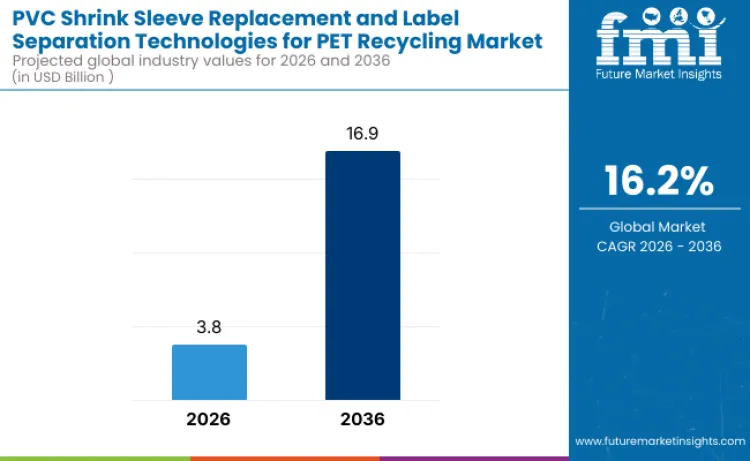
- USD 3.8 Bn
- Forecast (2036)
- USD 16.9 Bn
- CAGR (2026 to 2036)
- 16.2%
PVC Shrink Sleeve Replacement and Label Separation Technologies for PET Recycling Market Forecast and Outlook 2026 to 2036
The PVC shrink sleeve replacement and label separation technologies for the PET recycling market are valued at USD 3.8 billion in 2026. They are projected to reach USD 16.9 billion by 2036, reflecting a CAGR of 16.2%. Demand grows as beverage and personal care brands phase out non-recyclable PVC sleeves to meet PET circularity targets and comply with PPWR-aligned design-for-recycling requirements. Improved label-container compatibility strengthens rPET yield and quality in bottle-to-bottle systems.
Floatable polyolefin shrink sleeve alternatives lead technology adoption because they separate cleanly from PET during sink-float processes, reducing contamination and improving washing efficiency. Low-density polyolefin materials paired with washable inks and de-inkable coatings enhance optical sorting accuracy and raise recyclate purity. Sleeve engineering focuses on shrink performance, printability, and compatibility with high-speed labeling lines.
Quick Stats for PVC Shrink Sleeve Replacement and Label Separation Technologies for PET Recycling Market
- Market Value (2026): USD 3.8 billion
- Market Forecast Value (2036): USD 16.9 billion
- Market Forecast CAGR (2026-2036): 16.2%
- Leading Technology Type in Global Demand: Floatable polyolefin shrink sleeve alternatives
- Key Growth Regions in Global Demand: China, India, USA, Japan
- Top Players in Global Demand: SKC Inc., Siegwerk, Avery Dennison, CCL Label, Tomra
China, India, USA, and Japan function as key growth regions due to large PET bottle consumption, stringent recycling regulations, and rapid adoption of design-for-recycling technologies. SKC Inc., Siegwerk, Avery Dennison, CCL Label, and Tomra drive competitive advancement through floatable sleeve innovations, label-PET separation systems, and AI-enabled sorting solutions that increase high-quality rPET output across global recycling networks.
PVC Shrink Sleeve Replacement and Label Separation Technologies for PET Recycling Market Key Takeaways
| Metric | Value |
|---|---|
| Market Value (2026) | USD 3.8 billion |
| Market Forecast Value (2036) | USD 16.9 billion |
| Forecast CAGR (2026-2036) | 16.2% |
How Are the Segments Classified in the PVC Shrink Sleeve Replacement and Label Separation Technologies for PET Recycling Market?
Demand for PVC-shrink-sleeve replacement and label-separation technologies is shaped by requirements for food-grade PET recycling, regulatory restrictions on PVC, and the need for clean label removal during bottle-to-bottle processes. Buyers evaluate floatability, wash-off performance, adhesive behaviour, optical detectability, and compatibility with automated recycling systems. Adoption patterns reflect increased conversion toward polyolefin sleeves, advanced wash-off adhesive systems, and digital-watermark separation tools that improve rPET yield and purity.
Which Technology Type Accounts for the Largest Share of Global Demand?
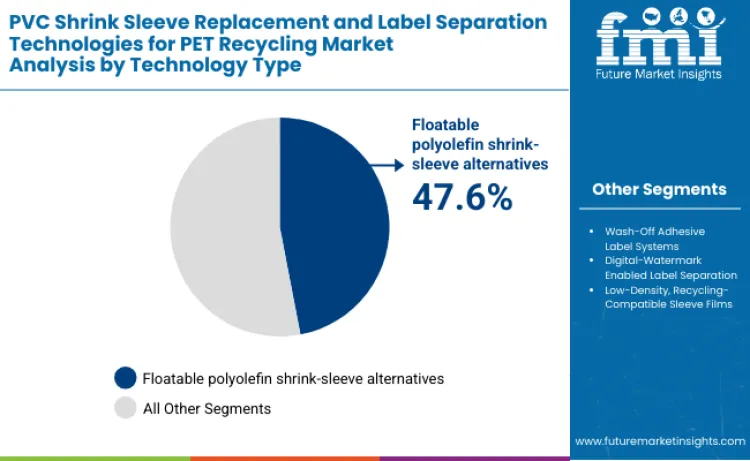
Floatable polyolefin shrink-sleeve alternatives hold 47.6%, making them the leading technology-type segment globally. These sleeves separate efficiently from PET in float-sink tanks and avoid contamination risks associated with PVC. Wash-off adhesive label systems use controlled-release adhesives that detach during hot-wash stages. Digital-watermark enabled label separation supports machine-vision recognition of sleeve types for precise sorting. Low-density, recycling-compatible sleeve films improve process compatibility by matching PET-recycling density parameters. Technology-type distribution reflects strong demand for floatable polyolefin sleeves that support high-purity rPET production.
Key Points:
- Polyolefin sleeves float and separate cleanly during recycling.
- Wash-off labels detach reliably during hot-wash stages.
- Digital watermarks enable precise sorting and identification.
- Low-density sleeves improve recycling-line compatibility.
Which Separation Mechanism Represents the Largest Share of Global Demand?
Hot-wash label removal systems hold 45.4%, making them the largest separation-mechanism segment globally. These systems dissolve or release adhesives during heated alkaline washing, enabling PET flakes to remain uncontaminated. Near-infrared automated label sorting identifies sleeve materials based on spectral signatures. Density-based float-sink separation supports removal of low-density films from PET. Optical and camera-based sleeve identification enhances sorting accuracy for multi-material containers. Mechanism distribution reflects widespread use of hot-wash removal in conventional PET-recycling infrastructure.
Key Points:
- Hot-wash systems provide effective adhesive and label removal.
- NIR sorting distinguishes sleeve materials with high accuracy.
- Float-sink separation isolates low-density sleeves from PET flakes.
- Optical systems enhance identification of label variations.
Which Application Accounts for the Largest Share of Global Demand?
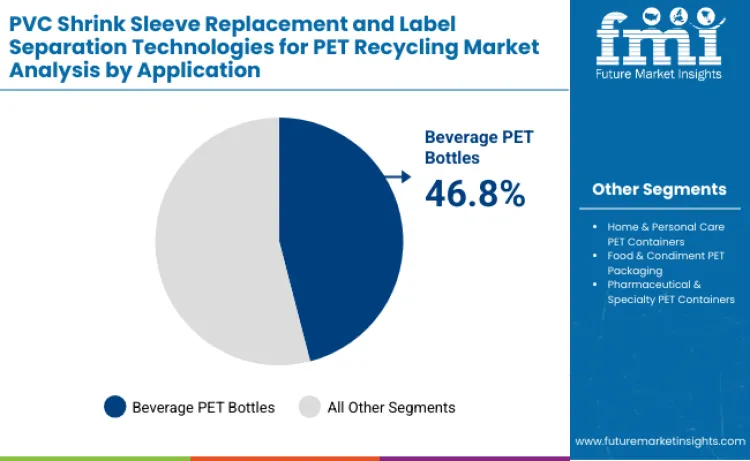
Beverage PET bottles hold 46.8%, making them the leading application segment globally. Beverage packaging requires full-label compatibility with food-grade rPET systems and faces the highest volume of shrink-sleeve usage. Home and personal-care PET containers adopt recycling-compatible sleeves to support brand sustainability commitments. Food and condiment PET packaging uses wash-off label systems to reduce contamination risk. Pharmaceutical and specialty PET containers rely on advanced identification methods for precise material recovery. Application distribution reflects dominant sleeve usage and recycling requirements in beverage PET packaging.
Key Points:
- Beverage bottles demand strict compatibility with food-grade rPET.
- Personal-care containers shift toward recycling-friendly sleeves.
- Food packaging requires clean label removal to protect PET purity.
- Pharmaceutical containers rely on precise sorting and identification.
What are the Key Dynamics in the PVC Shrink Sleeve Replacement and Label Separation Technologies for PET Recycling Market?
Global demand rises as beverage and household product brands transition from PVC shrink sleeves to recycling-compatible label systems that support high-purity PET recovery. PVC contamination disrupts melt quality, prompting investment in alternative label materials, washable inks, and advanced separation technologies. Sorting and recycling facilities adopt optical systems, delamination processes, and float-sink innovations to improve PET bale purity. Interest grows as regulatory and voluntary commitments push brands toward fully recyclable bottle architectures.
How are recyclability requirements and packaging redesign efforts shaping adoption of PVC-free sleeve and separation technologies?
Brands redesign bottles to eliminate PVC sleeves, shifting toward PET-G, polyolefin, or perforated label formats that detach cleanly during recycling. Converters develop shrink sleeves with washable inks and adhesives engineered to release in standard hot-wash conditions. Sorting facilities upgrade NIR detection to differentiate PVC from PET at high throughput. Material developers introduce low-density sleeves that float during separation, enabling clean removal. Beverage producers pursue label-container compatibility to meet recyclability benchmarks and rPET integration targets. Collaboration between bottle manufacturers and recyclers strengthens interest in label systems supporting closed-loop PET recovery without compromising brand visibility or print quality.
How do contamination risks, infrastructure variability, and processing challenges influence scalability?
PVC sleeves remain prevalent in some markets, creating risk of cross-contamination that reduces rPET yield and increases processing cost. Recycling plants vary in wash-line conditions, affecting reliability of label detachment technologies. Mixed resin sleeves, aggressive inks, and stubborn adhesives complicate separation, requiring additional sorting stages. Facilities lacking advanced optical sortation face difficulty removing PVC at scale. Brands must manage cost differentials when adopting novel sleeve materials. Regulatory differences across regions influence allowable label chemistries and recyclability claims. Long-term scalability depends on uniform adoption of sleeve standards, consistent wash-line performance, and increased PET-compatible label availability across global packaging supply chains.
How is Demand for PVC Shrink Sleeve Replacement and Label Separation Technologies for PET Recycling Market Evolving Across Key Countries?
Demand for the PVC shrink sleeve replacement and label separation technologies for PET recycling market is rising due to stronger recyclability standards, growth in PET packaging, and the industry-wide shift toward labels compatible with established PET recovery systems. China records a CAGR of 17.4% supported by rapid PET-packaging expansion. India shows a 16.8% CAGR driven by regulatory alignment and increased PET use. USA posts a 15.6% CAGR supported by modernization of label-separation infrastructure. Japan holds a 14.7% CAGR linked with precision sorting capabilities. UK records a 14.1% CAGR supported by EPR-driven packaging redesign.
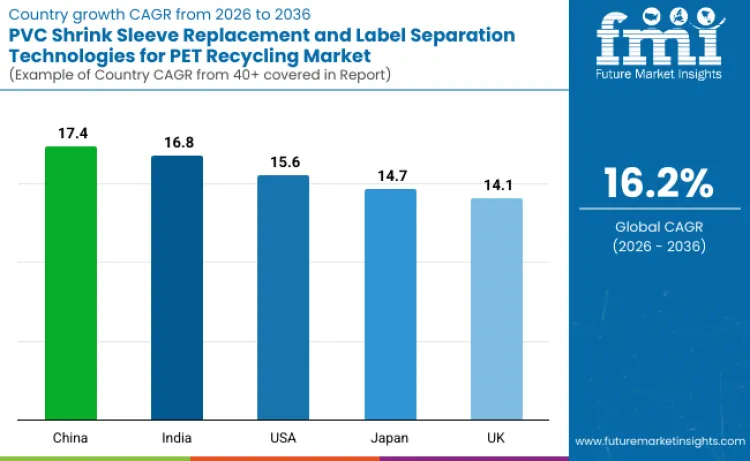
| Country | CAGR (%) |
|---|---|
| China | 17.4% |
| India | 16.8% |
| USA | 15.6% |
| Japan | 14.7% |
| UK | 14.1% |
How is China driving demand for PVC Shrink Sleeve Replacement and Label Separation Technologies for PET Recycling?
China drives demand due to rapid PET bottle production, increasing pressure to eliminate problematic PVC sleeves, and expansion of advanced recycling infrastructure. The country’s CAGR of 17.4% reflects adoption of PET-compatible shrink films and washable-ink label systems improving optical sortability. Recycling plants integrate near-infrared and AI-driven sorting to remove PVC contamination. Label manufacturers shift toward polyolefin or PETG structures enabling delamination during washing. National recyclability guidelines promote elimination of non-compatible labels across beverage and household-product packaging. Large-scale PET recycling investment strengthens long-term technology adoption.
- Shift from PVC sleeves to PET-compatible shrink materials
- Integration of advanced NIR and AI-driven sorting
- Increased use of washable-ink and delaminating label systems
- National packaging guidelines supporting PVC elimination
How is India driving demand for PVC Shrink Sleeve Replacement and Label Separation Technologies for PET Recycling?
India supports rising demand due to growth in PET beverage and household-packaging consumption, EPR implementation, and increased interest in improving PET recycling yields. The country’s CAGR of 16.8% reflects movement away from PVC sleeves toward polyolefin and PETG shrink materials compatible with domestic recycling systems. Sorting facilities adopt upgraded optical-identification modules to detect sleeve contamination. Label suppliers develop low-density, floatable films improving separation in hot-wash processes. Beverage and FMCG companies redesign packaging to align with recyclability guidelines. Strengthening EPR frameworks enhance adoption of PET-friendly label technologies.
- Transition to floatable polyolefin and PETG sleeves
- Upgraded optical sorting supporting sleeve detection
- Adoption of label materials improving hot-wash separation
- EPR programs accelerating recyclability-focused redesign
How is the USA driving demand for PVC Shrink Sleeve Replacement and Label Separation Technologies for PET Recycling?
USA drives demand through modernization of PET-recycling infrastructure, strong design-for-recycling initiatives, and commitment from major beverage brands to eliminate PVC sleeves. The country’s CAGR of 15.6% reflects adoption of APR-compliant shrink labels, washable inks, and floatable-film technologies improving PET recovery purity. MRFs and PET reprocessors install advanced optical and density-separation systems targeting sleeve removal. Packaging suppliers deploy low-density polyolefin shrink sleeves compatible with flotation separation. National recyclability frameworks accelerate redesign of PET packaging for closed-loop applications.
- Adoption of APR-compliant shrink sleeves
- Advanced optical and density-separation technology deployment
- Use of floatable polyolefin films improving PET purity
- Brand commitments accelerating removal of PVC sleeves
How is Japan driving demand for PVC Shrink Sleeve Replacement and Label Separation Technologies for PET Recycling?
Japan drives demand due to strict material-purity requirements, advanced collection systems, and precise sorting and washing technologies. The country’s CAGR of 14.7% reflects early adoption of PET-friendly shrink materials and high-efficiency label-separation systems. Label suppliers develop washable-adhesive, delaminating label formats enabling clean separation during hot-wash. Sorting centers employ precise NIR systems capable of distinguishing PVC contaminants. Beverage brands transition to PETG or polyolefin sleeves aligned with recyclability standards. National focus on high-purity recycled PET supports technology adoption.
- Development of washable-adhesive and delaminating labels
- NIR-based precision sorting eliminating PVC contamination
- Shift to PETG and polyolefin sleeves
- Emphasis on high-purity rPET supporting advanced recycling
How is the UK driving demand for PVC Shrink Sleeve Replacement and Label Separation Technologies for PET Recycling?
UK supports demand through EPR-driven packaging reforms, increased PET usage, and industry commitments to eliminate non-recyclable label formats. The country’s CAGR of 14.1% reflects adoption of recyclable shrink-sleeve materials, washable inks, and label designs improving removal efficiency. Material suppliers develop floatable, low-density films suited for hot-wash separation. PET recyclers invest in optical and density-separation upgrades to manage complex label streams. National circular-packaging targets encourage rapid transition to label technologies supporting high-yield PET recovery.
- Expansion of recyclable shrink-sleeve materials
- Adoption of washable inks for improved delabeling
- Investments in optical and flotation-separation upgrades
- Policy targets accelerating elimination of non-compatible sleeves
What is the competitive landscape of demand for PVC shrink-sleeve replacement and label separation technologies for PET recycling globally?
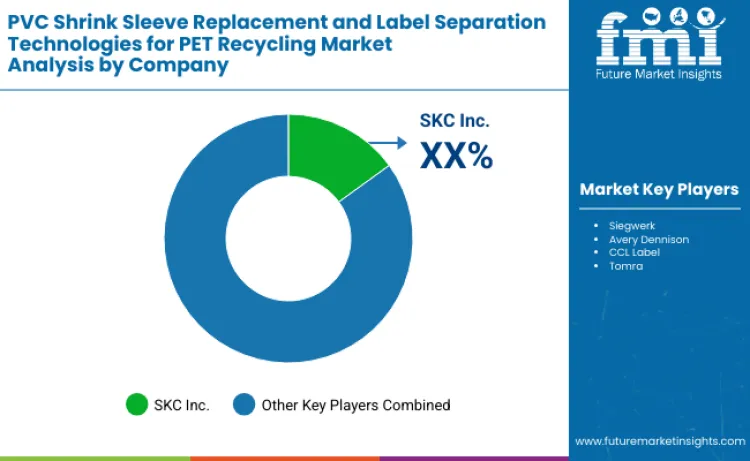
Demand for PVC shrink-sleeve replacement and label separation technologies for PET recycling grows as brand owners, converters, and recyclers address contamination issues linked to PVC and full-body label films. Requirements center on float-sink separability, washable inks, clean label release, and compatibility with high-throughput PET recycling systems. Buyers evaluate adhesive behavior, delamination performance, density differentials, and optical-sorting response supporting food-grade and non-food rPET production. Procurement teams prioritize label-substrate compatibility, certification under design-for-recycling guidelines, and integration feasibility within existing sorting and washing lines. Trend in the global market reflects adoption of polyolefin-based shrink sleeves, washable ink systems, and advanced label-removal technologies supporting closed-loop PET recovery.
Siegwerk participates with washable ink technologies enabling clean label removal in standard hot-wash conditions. Avery Dennison maintains visibility through pressure-sensitive and shrink-label innovations engineered for enhanced recyclability and rapid detachment. CCL Label contributes floatable full-body labels and recycling-compatible sleeve constructions adopted by major beverage producers. Tomra supports demand with optical-sorting platforms tuned for label-PET differentiation and contamination reduction. Competitive positioning globally reflects separation efficiency, ink-wash behavior, density design, and alignment with global PET design-for-recycling protocols.
Key Players in the PVC Shrink Sleeve Replacement and Label Separation Technologies for PET Recycling Market
- SKC Inc.
- Siegwerk
- Avery Dennison
- CCL Label
- Tomra
Scope of the Report
| Items | Values |
|---|---|
| Quantitative Units | USD billion |
| Technology Type | Floatable Polyolefin Shrink Sleeve Alternatives; Wash-Off Adhesive Label Systems; Digital-Watermark Enabled Label Separation; Low-Density, Recycling-Compatible Sleeve Films |
| Separation Mechanism | Hot-Wash Label Removal Systems; Near-Infrared (NIR) Automated Label Sorting; Density-Based Float-Sink Separation; Optical & Camera-Based Sleeve Identification |
| Application | Beverage PET Bottles; Home & Personal Care PET Containers; Food & Condiment PET Packaging; Pharmaceutical & Specialty PET Containers |
| End-User | Beverage & FMCG Brands; Packaging Converters; PET Recyclers & MRF Operators; Label & Sleeve Material Manufacturers |
| Regions Covered | Asia Pacific, Europe, North America, Latin America, Middle East & Africa |
| Countries Covered | USA, Germany, China, India, South Korea, Japan, Italy, France, plus 40+ countries |
| Key Companies Profiled | SKC Inc.; Siegwerk; Avery Dennison; CCL Label; Tomra |
| Additional Attributes | Dollar sales by technology type and separation mechanism; adoption of floatable polyolefin sleeves and wash-off label systems; digital-watermark integration trends for automated PET label separation; recycling-compatibility performance analysis across PET bottle and container formats; regional deployment of optical sorting technologies; role of low-density sleeves in achieving food-grade rPET recovery; competitive landscape for label and sleeve technologies aligned with PET recycling requirements. |
PVC Shrink Sleeve Replacement and Label Separation Technologies for PET Recycling Market by Segment
By Technology Type:
- Floatable Polyolefin Shrink Sleeve Alternatives
- Wash-Off Adhesive Label Systems
- Digital-Watermark Enabled Label Separation
- Low-Density, Recycling-Compatible Sleeve Films
By Separation Mechanism:
- Hot-Wash Label Removal Systems
- Near-Infrared (NIR) Automated Label Sorting
- Density-Based Float-Sink Separation
- Optical & Camera-Based Sleeve Identification
By Application:
- Beverage PET Bottles
- Home & Personal Care PET Containers
- Food & Condiment PET Packaging
- Pharmaceutical & Specialty PET Containers
By End-User:
- Beverage & FMCG Brands
- Packaging Converters
- PET Recyclers & MRF Operators
- Label & Sleeve Material Manufacturers
Region:
- Asia Pacific
- China
- Japan
- South Korea
- India
- Australia & New Zealand
- ASEAN
- Rest of Asia Pacific
- Europe
- Germany
- United Kingdom
- France
- Italy
- Spain
- Nordic
- BENELUX
- Rest of Europe
- North America
- United States
- Canada
- Mexico
- Latin America
- Brazil
- Chile
- Rest of Latin America
- Middle East & Africa
- Kingdom of Saudi Arabia
- Other GCC Countries
- Turkey
- South Africa
- Other African Union
- Rest of Middle East & Africa
Frequently Asked Questions
What is driving demand for PVC-free shrink sleeves and better label separation in PET recycling?
Demand is being pushed by the need to reduce PVC-related contamination in PET recycling streams and improve rPET yield and quality, especially for bottle-to-bottle applications. Brands and recyclers are prioritizing designs that separate cleanly in existing sorting and hot-wash infrastructure.
Which technology types are leading adoption, and why?
Floatable polyolefin shrink sleeve alternatives lead because they separate via sink-float systems more reliably than PVC sleeves. Hot-wash label removal systems are widely used because they align with common PET washing processes and can improve adhesive and label release without forcing major plant redesign.
What is limiting scalability across regions and recycling plants?
Scalability is constrained by variability in recycling infrastructure, wash-line chemistry and temperature, and the real-world mix of inks, adhesives, and sleeve materials entering the stream. Where optical sorting is weaker, contamination risk is higher, and solutions may require extra steps or tighter input control.
How do buyers typically evaluate sleeve and label-separation solutions before switching?
Buyers usually test separation performance under operating conditions: floatability, wash-off behavior, ink removal, adhesive residue, NIR detectability, and compatibility with high-speed labeling lines. Adoption tends to depend on whether purity improves without adding downtime, extra sorting stages, or unstable results.
Which applications tend to adopt these solutions first, and why?
Beverage PET bottles typically adopt first because volumes are high and food-grade rPET requirements are more stringent. Home and personal care follows where packaging redesign can meet recyclability targets without compromising shelf appearance or line performance.
Preview the report firsthand - request a free sample
Get SampleGet the brochure for pricing and purchase details.
Get PDFTable of Content
- Executive Summary
- Market Overview
- Global Market Value, 2020-2026
- Global Market Forecast, 2026-2036
- Market Dynamics
- Drivers
- Restraints
- Opportunities
- Regulatory & Standards Landscape
- PET Recycling and Label Separation Technology Outlook
- Market Segmentation Analysis
- By Technology Type
- Floatable Polyolefin Shrink Sleeve Alternatives
- Wash-Off Adhesive Label Systems
- Digital-Watermark Enabled Label Separation
- Low-Density Recycling-Compatible Sleeve Films
- By Separation Mechanism
- Hot-Wash Label Removal Systems
- Near-Infrared Automated Label Sorting
- Density-Based Float-Sink Separation
- Optical & Camera-Based Sleeve Identification
- By Application
- Beverage PET Bottles
- Home & Personal Care PET Containers
- Food & Condiment PET Packaging
- Pharmaceutical & Specialty PET Containers
- By Technology Type
- Regional Outlook
- North America
- Latin America
- Western Europe
- Eastern Europe
- South Asia & Pacific
- East Asia
- Middle East & Africa
- Country-Level Outlook
- United States
- Canada
- Mexico
- Brazil
- Argentina
- Germany
- France
- United Kingdom
- Italy
- Spain
- Netherlands
- China
- India
- Japan
- South Korea
- ANZ
- GCC Countries
- South Africa
- Competitive Landscape
- Market Structure Overview
- Company Positioning
- Strategic Initiatives
- Key Player Profiles
- Scope of the Report
- Research Methodology
- Assumptions & Acronyms


