

- Industry Size (2026):
- USD 1040.0 Mn
- Forecast (2036):
- USD 3760.0 Mn
- CAGR (2026 to 2036)
- 13.7%
Smart Labeling & Consumer Transparency Systems for PCR Content Market Forecast and Outlook 2026 to 2036
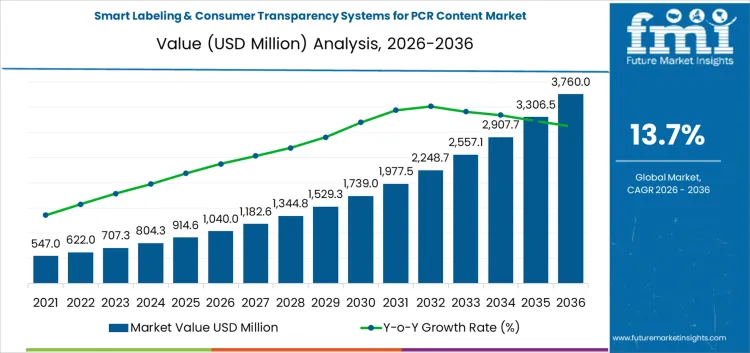
The smart labeling & consumer transparency systems for PCR content market is likely to be valued at USD 1,040.0 million in 2026, is set to reach USD 3,760.0 million by 2036, and is expected to expand at a 13.7% CAGR. Value is being shaped by who controls the “proof layer” behind PCR claims, not by who prints the label. Platform leaders are being rewarded when verification data can be translated into consumer-facing disclosures without exposing supplier-sensitive inputs.
Pricing power is being defended through proprietary identifier frameworks, integration into packaging-line workflows, and governance models that make data access permissioned and audit-ready. Entry barriers are being raised by the need to interoperate with traceability systems, certification references, and retailer compliance templates at scale, which increases deployment complexity beyond a basic QR rollout. Fragmentation is being sustained because brands, geographies, and packaging formats demand different disclosure depth and UX design, while some buyers will only pay for engagement analytics and others will pay for compliance-grade evidence.
Quick Stats for Smart Labeling & Consumer Transparency Systems for PCR Content Market
- Smart Labeling & Consumer Transparency Systems for PCR Content Market Value (2026): USD 1,040.0 Million
- Smart Labeling & Consumer Transparency Systems for PCR Content Market Forecast Value (2036): USD 3,760.0 Million
- Smart Labeling & Consumer Transparency Systems for PCR Content Market Forecast CAGR 2026 to 2036: 13.7%
- Leading Interface Type in Smart Labeling & Consumer Transparency Systems for PCR Content Market: QR Codes & Digital Product Passports
- Key Growth Regions in Smart Labeling & Consumer Transparency Systems for PCR Content Market: Asia Pacific, North America, Latin America
- Top Key Players in Smart Labeling & Consumer Transparency Systems for PCR Content Market: Digimarc Corporation, Circularise B.V., Kezzler AS, Ant Group Co., Ltd. (AntChain), Alibaba Cloud Computing Co., Ltd., Recykal Sustainability Private Limited, Tagbox Solutions Pvt. Ltd.
Smart Labeling & Consumer Transparency Systems for PCR Content Market Key Takeaways
| Metric | Value |
|---|---|
| Industry Value (2026) | USD 1,040.0 Million |
| Forecast Value (2036) | USD 3,760.0 Million |
| Forecast CAGR 2026 to 2036 | 13.7% |
How Is the Global Smart Labeling & Consumer Transparency Systems for PCR Content Market Advancing?
The global smart labeling and consumer transparency systems for PCR content market is advancing rapidly, driven by increasing demand for clear, verifiable communication of recycled content claims. Smart labeling systems enable brands to disclose PCR content information through digital tools such as QR codes, serialized labels, and connected packaging interfaces, allowing consumers and stakeholders to access detailed material origin and usage data.
A key driver supporting market growth is the rising scrutiny of recycled content claims by consumers, retailers, and regulatory authorities. Conventional on-pack text is often insufficient to convey detailed PCR information or support verification requirements. Smart labeling systems address this gap by linking physical packaging to digital data sources that provide auditable PCR content details, certification references, and supply chain context.
Expansion of brand-led transparency initiatives is further contributing to market adoption. Consumer goods and packaging companies are increasingly using smart labels to differentiate products, support compliance reporting, and improve trust in PCR claims. These systems also enable brands to update information dynamically without redesigning packaging, improving flexibility across product lines and regions.
Technological advancements are strengthening market implementation. Integration with cloud-based traceability platforms, certification databases, and analytics tools is improving data accuracy and scalability. As PCR usage expands and transparency expectations continue to rise, smart labeling and consumer transparency systems are expected to become a standard component of PCR communication strategies over the forecast period.
What Is the Segment-Wise Overview of the Smart Labeling & Consumer Transparency Systems for PCR Content Market?
The smart labeling & consumer transparency systems for PCR content market is driven by rising demand for verified recycled-content disclosure and digital consumer engagement. Consumer packaging and electronics lead the end-use segment with a 42% share, as brands in these categories face the highest scrutiny around recycled material claims and product provenance. These sectors increasingly rely on digital transparency tools to communicate PCR usage clearly at the point of purchase. By interface type, QR codes and digital product passports dominate with a 48% share, reflecting their scalability, low implementation cost, and compatibility with smartphones.
Why Do Consumer Packaging & Electronics Lead the Smart Labeling & PCR Transparency Market?
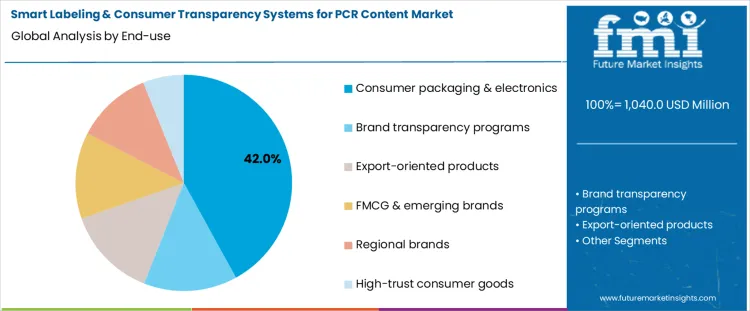
Consumer packaging and electronics account for 42% of market demand because these categories are directly exposed to consumer trust, regulatory oversight, and brand reputation risks related to recycled content claims. Packaging and electronics products are produced at high volumes and sold across multiple regions, increasing the need for standardized, and verifiable PCR disclosure. Smart labeling systems allow brands to communicate recycled content percentages, sourcing narratives, and compliance information in a consistent format. These tools also support audit readiness and reduce greenwashing risk. As regulators and consumers increasingly expect proof-backed sustainability claims, packaging and electronics brands continue to lead adoption of smart labeling and transparency platforms.
How Do QR Codes and Digital Product Passports Drive Adoption in the PCR Transparency Market?
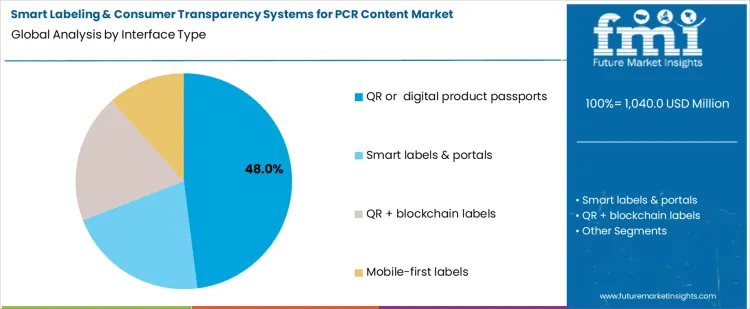
QR codes and digital product passports represent 48% of interface type demand, making them the most widely adopted transparency mechanism in the PCR content market. These interfaces enable instant access to detailed product-level information, including recycled material composition, certifications, and supply chain data. QR-based systems are easy to deploy across packaging formats and work seamlessly with mobile devices, eliminating the need for specialized hardware. Digital product passports also support future regulatory requirements by providing structured, updateable data linked to individual products. As brands scale transparency initiatives across portfolios and regions, QR-enabled digital passports remain the preferred interface for PCR communication.
What Are the Key Dynamics for the Smart Labeling & Consumer Transparency Systems for PCR Content Market?
Smart labeling systems use technologies such as QR codes, NFC tags, digital watermarks, and linked databases to disclose PCR content, sourcing, and recycling credentials. Key market dynamics include increasing regulatory scrutiny on environmental claims, rising consumer demand for transparency, and brand efforts to differentiate products through credible PCR disclosure. These systems connect packaging, digital platforms, and verification databases to deliver traceable, real-time information. As greenwashing concerns intensify, smart labeling solutions are becoming essential tools for substantiating PCR claims and improving trust across consumer-facing packaging markets.
Why Is the Smart Labeling & Consumer Transparency Systems for PCR Content Market Growing?
The smart labeling & consumer transparency systems for PCR content market is growing as brands face pressure to provide proof-backed PCR claims rather than static on-pack statements. Expansion of recycled-content mandates and labeling regulations is increasing the need for dynamic, updatable disclosure mechanisms. Growth in smart packaging adoption across food, beverage, personal care, and household products is supporting integration of digital transparency features. Consumers increasingly expect access to detailed sustainability information through mobile devices, reinforcing demand for interactive labeling systems. In parallel, brand owners are adopting smart labels to reduce reputational risk and improve compliance reporting.
How Are the Key Drivers Shaping the Smart Labeling & Consumer Transparency Systems for PCR Content Market?
Key drivers shaping the smart labeling & consumer transparency systems for PCR content market include regulatory enforcement of truthful environmental marketing and increased consumer awareness of recycled content authenticity. Integration of smart labels with PCR verification and traceability platforms strengthens data credibility and enables real-time updates. Advances in digital identification technologies and low-cost tagging solutions are lowering barriers to adoption at scale. Brand procurement and sustainability teams are influencing labeling requirements by mandating supplier-level PCR data integration. Retailers are also encouraging transparent labeling to support responsible sourcing narratives. These drivers are pushing smart labeling systems beyond marketing tools into compliance and data communication infrastructure that links PCR verification, packaging, and consumer engagement.
What is the Growth Outlook for the Smart Labeling & Consumer Transparency Systems for PCR Content Market by Country?
| Country | CAGR (%) |
|---|---|
| India | 15.4% |
| China | 14.6% |
| USA | 12.8% |
| Germany | 12.4% |
| Brazil | 11.6% |
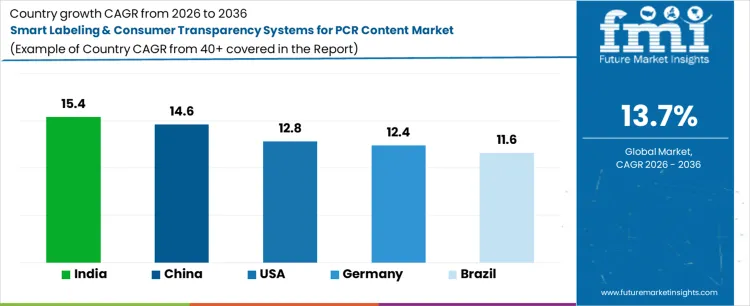
The smart labeling & consumer transparency systems for PCR content market is expanding as verified disclosure becomes essential for recycled-content packaging. India leads with a 15.4% CAGR, driven by EPR enforcement and rising consumer awareness. China follows at 14.6%, supported by export-oriented manufacturing and digital adoption. The USA grows at 12.8%, reflecting strong retailer and consumer transparency expectations. Germany records 12.4% growth, driven by regulatory rigor and informed consumers. Brazil expands at 11.6%, supported by multinational brand standards and retail modernization. As PCR usage rises globally, demand for smart labeling and consumer transparency systems is expected to strengthen across regions.
Why Is the Smart Labeling & Consumer Transparency Systems for PCR Content Market Expanding Rapidly in India?
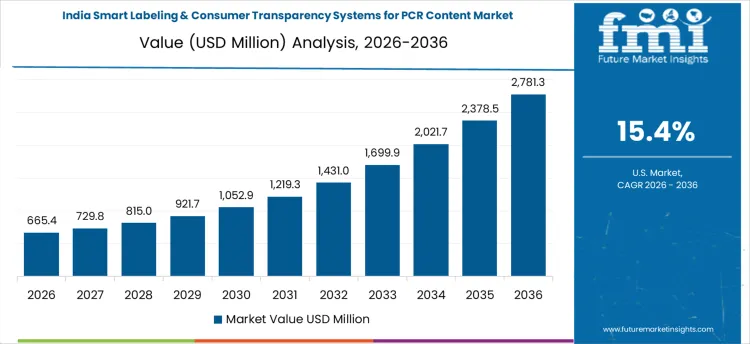
Demand for smart labeling & consumer transparency systems for PCR content in India is expanding at a CAGR of 15.4%. Growth is driven by rising regulatory scrutiny, increasing brand accountability, and growing consumer awareness around recycled content claims. Packaging producers and FMCG brands are adopting smart labels such as QR codes and digital product passports to communicate verified PCR information. These systems support traceability, audit readiness, and real-time consumer engagement. Expansion of EPR frameworks and mandatory disclosure norms is strengthening adoption. Brands view transparency systems as tools to build trust and differentiate products in competitive retail environments. Integration with digital compliance and traceability platforms enhances system value. As PCR usage scales across packaging formats, demand for smart labeling and transparency systems in India is expected to rise strongly.
What Is Driving Smart Labeling & Consumer Transparency Systems for PCR Content Market Growth in China?
Demand for smart labeling & consumer transparency systems for PCR content in China is expanding at a CAGR of 14.6%. High-volume manufacturing and export-oriented packaging sectors are driving adoption of digital labeling solutions that verify recycled content. Brands and converters are deploying smart labels to meet international customer and regulatory expectations. Transparency systems enable access to batch-level PCR data, certification details, and supply-chain verification. Rapid digital adoption among consumers supports use of QR-based disclosure tools. Domestic technology providers are offering scalable smart labeling platforms integrated with traceability systems. Growth of cross-border trade reinforces the need for standardized transparency mechanisms. As China continues to expand PCR usage in packaging and consumer goods, demand for smart labeling systems is expected to grow steadily.
Why Is the Smart Labeling & Consumer Transparency Systems for PCR Content Market Advancing in the USA?
Demand for smart labeling & consumer transparency systems for PCR content in the USA is expanding at a CAGR of 12.8%. Brand owners face increasing pressure from retailers, regulators, and consumers to substantiate recycled content claims. Smart labeling systems enable transparent communication of PCR percentages, sourcing details, and compliance credentials. Adoption is strong among packaged food, personal care, and household product brands. Integration with sustainability reporting and ESG disclosure platforms strengthens business value. Consumers actively scan digital labels to access product impact information, reinforcing adoption. Technology maturity and established digital infrastructure support scalable deployment. As transparency expectations continue to rise, demand for smart labeling systems for PCR content in the USA is expected to remain strong.
What Is Supporting Growth of the Smart Labeling & Consumer Transparency Systems for PCR Content Market in Germany?
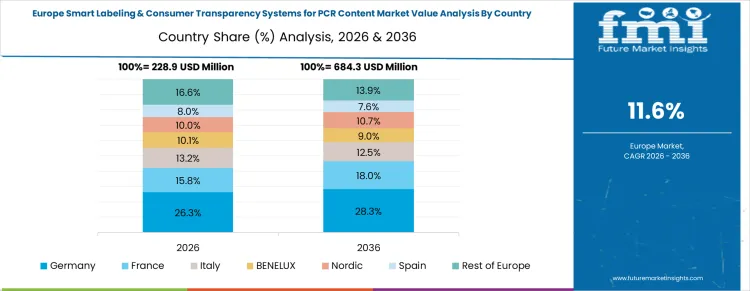
Sales for smart labeling & consumer transparency systems for PCR content in Germany is growing at a CAGR of 12.4%. Strong regulatory frameworks and high consumer awareness of material sourcing support widespread adoption. Packaging producers use smart labels to provide verified PCR information and comply with disclosure requirements. German consumers value detailed product transparency, increasing engagement with digital labeling tools. Integration with European traceability and certification standards strengthens system credibility. Brands prioritize data accuracy and documentation, aligning well with smart transparency platforms. Adoption is also supported by structured retail compliance requirements. As transparency remains a core expectation in German markets, demand for smart labeling systems for PCR content is expected to grow steadily.
Why Is the Smart Labeling & Consumer Transparency Systems for PCR Content Market Growing Steadily in Brazil?
Demand for smart labeling & consumer transparency systems for PCR content in Brazil is expanding at a CAGR of 11.6%. Increasing PCR adoption in packaging and consumer goods is driving interest in verified disclosure mechanisms. Multinational brands operating in Brazil are extending global transparency standards to local packaging. Smart labeling systems help communicate recycled content credentials and support brand trust. Growth of organized retail and digital consumer engagement supports label scanning and information access. Platforms that integrate PCR verification with consumer-facing disclosures are gaining traction. While adoption is gradual, demand is strengthening as compliance and brand accountability increase. As Brazil’s PCR ecosystem matures, demand for smart labeling and transparency systems is expected to rise consistently.
How Are Companies Competing in the Smart Labeling & Consumer Transparency Systems for PCR Content Market?
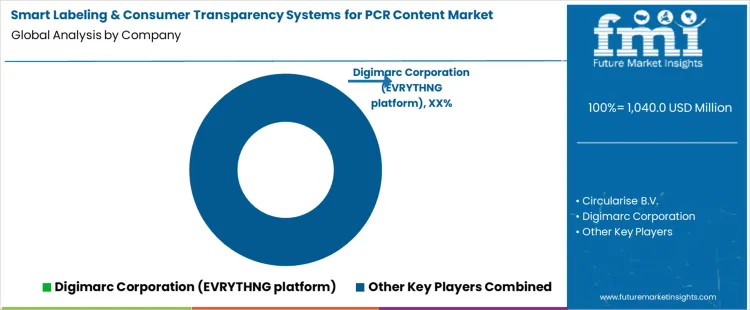
Competition in the smart labeling and consumer transparency systems for PCR content market is being shaped by how effectively data credibility, brand trust, and scalability are delivered through productized platforms rather than custom projects. Digimarc Corporation, through its Digimarc Barcode and the EVRYTHNG platform, has positioned its offering as an enterprise-grade digital identity layer. Product brochures emphasize imperceptible digital watermarks, cloud-based content orchestration, and compatibility with high-speed packaging lines. These capabilities are being framed as foundational infrastructure, enabling standardized PCR communication across global product portfolios while maintaining audit readiness and regulatory alignment.
Circularise B.V. and Kezzler AS are competing through depth of traceability and controlled data disclosure. Circularise brochures focus on permission-based data exchange, material passports, and blockchain-backed verification suited to multi-tier PCR supply chains. Data sovereignty is being positioned as a commercial safeguard rather than a technical add-on. Kezzler highlights serialization and digital product passport solutions designed for rapid deployment and compliance with evolving EU frameworks. AntChain, operating under Ant Group Co., Ltd., and Alibaba Cloud Computing Ltd. are leveraging cloud-scale blockchain services, with product materials stressing transaction-level traceability, interoperability with enterprise systems, and suitability for high-volume manufacturing and export flows.
Recykal Sustainability Private Limited and Tagbox Solutions Pvt. Ltd. are differentiating through direct linkage between recycling operations and consumer engagement. Recykal brochures highlight end-to-end PCR traceability from collection networks to brand reporting dashboards, reinforcing credibility through operational visibility. Tagbox positions its QR-led transparency tools as engagement layers, translating verified PCR data into accessible consumer narratives and analytics. Across the market, competitive strength is being determined by how convincingly PCR information is converted into trusted signals for regulators, brands, and consumers at scale.
Key Players in Smart Labeling & Consumer Transparency Systems for PCR Content Market
- Digimarc Corporation
- Circularise B.V.
- Digimarc Corporation
- Kezzler AS
- Ant Group Co., Ltd. (AntChain)
- Alibaba Cloud Computing Co., Ltd.
- Recykal Sustainability Private Limited
- Tagbox Solutions Pvt. Ltd.
Scope of Report
| Attributes | Description |
|---|---|
| Quantitative Unit (2026) | USD Million |
| End-use | Consumer Packaging & Electronics, Brand Transparency Programs, Export-Oriented Products, FMCG & Emerging Brands, Regional Brands, High-Trust Consumer Goods |
| Interface Type | QR or Digital Product Passports, Smart Labels & Portals, QR + Blockchain Labels, Mobile-First Labels |
| Regions Covered | Asia Pacific, Europe, North America, Latin America, Middle East & Africa |
| Countries Covered | China, Japan, South Korea, India, Australia & New Zealand, ASEAN, Rest of Asia Pacific, Germany, United Kingdom, France, Italy, Spain, Nordic, BENELUX, Rest of Europe, United States, Canada, Mexico, Brazil, Chile, Rest of Latin America, Kingdom of Saudi Arabia, Other GCC Countries, Turkey, South Africa, Other African Union, Rest of Middle East & Africa |
| Key Companies Profiled | Digimarc Corporation (incl. EVRYTHNG platform), Circularise B.V., Kezzler AS, Ant Group Co., Ltd. (AntChain), Alibaba Cloud Computing Co., Ltd., Recykal Sustainability Private Limited, Tagbox Solutions Pvt. Ltd. |
| Additional Attributes | Dollar sales by end-use and interface type; regional market size and forecast analysis; growth outlook across major regions; adoption trends for smart labeling and consumer transparency systems; assessment of data accessibility, verification credibility, consumer engagement requirements, and demand patterns across PCR-labeled consumer goods and export-oriented packaging ecosystems. |
Smart Labeling & Consumer Transparency Systems for PCR Content Market by Key Segments
End-use:
- Consumer packaging & electronics
- Brand transparency programs
- Export-oriented products
- FMCG & emerging brands
- Regional brands
- High-trust consumer goods
Interface Type:
- QR or digital product passports
- Smart labels & portals
- QR + blockchain labels
- Mobile-first labels
Region:
- Asia Pacific
- China
- Japan
- South Korea
- India
- Australia & New Zealand
- ASEAN
- Rest of Asia Pacific
- Europe
- Germany
- United Kingdom
- France
- Italy
- Spain
- Nordic
- BENELUX
- Rest of Europe
- North America
- United States
- Canada
- Mexico
- Latin America
- Brazil
- Chile
- Rest of Latin America
- Middle East & Africa
- Kingdom of Saudi Arabia
- Other GCC Countries
- Turkey
- South Africa
- Other African Union
- Rest of Middle East & Africa
Bibliography
- United Nations Environment Programme. (2023). Turning off the tap: How the world can end plastic pollution and create a circular economy. United Nations Environment Programme.
- UN Trade and Development. (2025). A review of parameters and requirements for an effective consumer label on plastics and plastics alternatives (UNCTAD/TCS/DITC/INF/2025/7). UN Trade and Development.
- Organisation for Economic Co-operation and Development. (2025). Protecting and empowering consumers in the green transition: Misleading green claims (OECD Digital Economy Papers No. 375). OECD Publishing.
- National Institute of Standards and Technology. (2025). Supply chain traceability: Manufacturing meta-framework (NIST IR 8536 2pd, Second Public Draft). National Institute of Standards and Technology.
- The Recycling Partnership. (2024, October 3). America’s most recognized recycling label to offer real-time, localized disposal instructions on packaging across the U.S. The Recycling Partnership.
Frequently Asked Questions
How big is the smart labeling & consumer transparency systems for pcr content market in 2026?
The global smart labeling & consumer transparency systems for pcr content market is estimated to be valued at USD 1,040.0 million in 2026.
What will be the size of smart labeling & consumer transparency systems for pcr content market in 2036?
The market size for the smart labeling & consumer transparency systems for pcr content market is projected to reach USD 3,760.0 million by 2036.
How much will be the smart labeling & consumer transparency systems for pcr content market growth between 2026 and 2036?
The smart labeling & consumer transparency systems for pcr content market is expected to grow at a 13.7% CAGR between 2026 and 2036.
What are the key product types in the smart labeling & consumer transparency systems for pcr content market?
The key product types in smart labeling & consumer transparency systems for pcr content market are consumer packaging & electronics, brand transparency programs, export-oriented products, fmcg & emerging brands, regional brands and high-trust consumer goods.
Which interface type segment to contribute significant share in the smart labeling & consumer transparency systems for pcr content market in 2026?
In terms of interface type, qr or digital product passports segment to command 48.0% share in the smart labeling & consumer transparency systems for pcr content market in 2026.
Preview the report firsthand - request a free sample
Get SampleGet the brochure for pricing and purchase details.
Get PDFTable of Content
- Executive Summary
- Global Market Outlook
- Demand-side Trends
- Supply-side Trends
- Technology Roadmap Analysis
- Analysis and Recommendations
- Market Overview
- Market Coverage / Taxonomy
- Market Definition / Scope / Limitations
- Market Background
- Market Dynamics
- Drivers
- Restraints
- Opportunity
- Trends
- Scenario Forecast
- Demand in Optimistic Scenario
- Demand in Likely Scenario
- Demand in Conservative Scenario
- Opportunity Map Analysis
- Product Life Cycle Analysis
- Supply Chain Analysis
- Investment Feasibility Matrix
- Value Chain Analysis
- PESTLE and Porter’s Analysis
- Regulatory Landscape
- Regional Parent Market Outlook
- Production and Consumption Statistics
- Import and Export Statistics
- Market Dynamics
- Global Market Analysis 2021 to 2025 and Forecast, 2026 to 2036
- Historical Market Size Value (USD Million) Analysis, 2021 to 2025
- Current and Future Market Size Value (USD Million) Projections, 2026 to 2036
- Y-o-Y Growth Trend Analysis
- Absolute $ Opportunity Analysis
- Global Market Pricing Analysis 2021 to 2025 and Forecast 2026 to 2036
- Global Market Analysis 2021 to 2025 and Forecast 2026 to 2036, By End-use
- Introduction / Key Findings
- Historical Market Size Value (USD Million) Analysis By End-use, 2021 to 2025
- Current and Future Market Size Value (USD Million) Analysis and Forecast By End-use, 2026 to 2036
- Consumer packaging & electronics
- Brand transparency programs
- Export-oriented products
- FMCG & emerging brands
- Regional brands
- High-trust consumer goods
- Consumer packaging & electronics
- Y-o-Y Growth Trend Analysis By End-use, 2021 to 2025
- Absolute $ Opportunity Analysis By End-use, 2026 to 2036
- Global Market Analysis 2021 to 2025 and Forecast 2026 to 2036, By Interface Type
- Introduction / Key Findings
- Historical Market Size Value (USD Million) Analysis By Interface Type, 2021 to 2025
- Current and Future Market Size Value (USD Million) Analysis and Forecast By Interface Type, 2026 to 2036
- QR or digital product passports
- Smart labels & portals
- QR + blockchain labels
- Mobile-first labels
- QR or digital product passports
- Y-o-Y Growth Trend Analysis By Interface Type, 2021 to 2025
- Absolute $ Opportunity Analysis By Interface Type, 2026 to 2036
- Global Market Analysis 2021 to 2025 and Forecast 2026 to 2036, By Region
- Introduction
- Historical Market Size Value (USD Million) Analysis By Region, 2021 to 2025
- Current Market Size Value (USD Million) Analysis and Forecast By Region, 2026 to 2036
- North America
- Latin America
- Western Europe
- Eastern Europe
- East Asia
- South Asia and Pacific
- Middle East & Africa
- Market Attractiveness Analysis By Region
- North America Market Analysis 2021 to 2025 and Forecast 2026 to 2036, By Country
- Historical Market Size Value (USD Million) Trend Analysis By Market Taxonomy, 2021 to 2025
- Market Size Value (USD Million) Forecast By Market Taxonomy, 2026 to 2036
- By Country
- USA
- Canada
- Mexico
- By End-use
- By Interface Type
- By Country
- Market Attractiveness Analysis
- By Country
- By End-use
- By Interface Type
- Key Takeaways
- Latin America Market Analysis 2021 to 2025 and Forecast 2026 to 2036, By Country
- Historical Market Size Value (USD Million) Trend Analysis By Market Taxonomy, 2021 to 2025
- Market Size Value (USD Million) Forecast By Market Taxonomy, 2026 to 2036
- By Country
- Brazil
- Chile
- Rest of Latin America
- By End-use
- By Interface Type
- By Country
- Market Attractiveness Analysis
- By Country
- By End-use
- By Interface Type
- Key Takeaways
- Western Europe Market Analysis 2021 to 2025 and Forecast 2026 to 2036, By Country
- Historical Market Size Value (USD Million) Trend Analysis By Market Taxonomy, 2021 to 2025
- Market Size Value (USD Million) Forecast By Market Taxonomy, 2026 to 2036
- By Country
- Germany
- UK
- Italy
- Spain
- France
- Nordic
- BENELUX
- Rest of Western Europe
- By End-use
- By Interface Type
- By Country
- Market Attractiveness Analysis
- By Country
- By End-use
- By Interface Type
- Key Takeaways
- Eastern Europe Market Analysis 2021 to 2025 and Forecast 2026 to 2036, By Country
- Historical Market Size Value (USD Million) Trend Analysis By Market Taxonomy, 2021 to 2025
- Market Size Value (USD Million) Forecast By Market Taxonomy, 2026 to 2036
- By Country
- Russia
- Poland
- Hungary
- Balkan & Baltic
- Rest of Eastern Europe
- By End-use
- By Interface Type
- By Country
- Market Attractiveness Analysis
- By Country
- By End-use
- By Interface Type
- Key Takeaways
- East Asia Market Analysis 2021 to 2025 and Forecast 2026 to 2036, By Country
- Historical Market Size Value (USD Million) Trend Analysis By Market Taxonomy, 2021 to 2025
- Market Size Value (USD Million) Forecast By Market Taxonomy, 2026 to 2036
- By Country
- China
- Japan
- South Korea
- By End-use
- By Interface Type
- By Country
- Market Attractiveness Analysis
- By Country
- By End-use
- By Interface Type
- Key Takeaways
- South Asia and Pacific Market Analysis 2021 to 2025 and Forecast 2026 to 2036, By Country
- Historical Market Size Value (USD Million) Trend Analysis By Market Taxonomy, 2021 to 2025
- Market Size Value (USD Million) Forecast By Market Taxonomy, 2026 to 2036
- By Country
- India
- ASEAN
- Australia & New Zealand
- Rest of South Asia and Pacific
- By End-use
- By Interface Type
- By Country
- Market Attractiveness Analysis
- By Country
- By End-use
- By Interface Type
- Key Takeaways
- Middle East & Africa Market Analysis 2021 to 2025 and Forecast 2026 to 2036, By Country
- Historical Market Size Value (USD Million) Trend Analysis By Market Taxonomy, 2021 to 2025
- Market Size Value (USD Million) Forecast By Market Taxonomy, 2026 to 2036
- By Country
- Kingdom of Saudi Arabia
- Other GCC Countries
- Turkiye
- South Africa
- Other African Union
- Rest of Middle East & Africa
- By End-use
- By Interface Type
- By Country
- Market Attractiveness Analysis
- By Country
- By End-use
- By Interface Type
- Key Takeaways
- Key Countries Market Analysis
- USA
- Pricing Analysis
- Market Share Analysis, 2025
- By End-use
- By Interface Type
- Canada
- Pricing Analysis
- Market Share Analysis, 2025
- By End-use
- By Interface Type
- Mexico
- Pricing Analysis
- Market Share Analysis, 2025
- By End-use
- By Interface Type
- Brazil
- Pricing Analysis
- Market Share Analysis, 2025
- By End-use
- By Interface Type
- Chile
- Pricing Analysis
- Market Share Analysis, 2025
- By End-use
- By Interface Type
- Germany
- Pricing Analysis
- Market Share Analysis, 2025
- By End-use
- By Interface Type
- UK
- Pricing Analysis
- Market Share Analysis, 2025
- By End-use
- By Interface Type
- Italy
- Pricing Analysis
- Market Share Analysis, 2025
- By End-use
- By Interface Type
- Spain
- Pricing Analysis
- Market Share Analysis, 2025
- By End-use
- By Interface Type
- France
- Pricing Analysis
- Market Share Analysis, 2025
- By End-use
- By Interface Type
- India
- Pricing Analysis
- Market Share Analysis, 2025
- By End-use
- By Interface Type
- ASEAN
- Pricing Analysis
- Market Share Analysis, 2025
- By End-use
- By Interface Type
- Australia & New Zealand
- Pricing Analysis
- Market Share Analysis, 2025
- By End-use
- By Interface Type
- China
- Pricing Analysis
- Market Share Analysis, 2025
- By End-use
- By Interface Type
- Japan
- Pricing Analysis
- Market Share Analysis, 2025
- By End-use
- By Interface Type
- South Korea
- Pricing Analysis
- Market Share Analysis, 2025
- By End-use
- By Interface Type
- Russia
- Pricing Analysis
- Market Share Analysis, 2025
- By End-use
- By Interface Type
- Poland
- Pricing Analysis
- Market Share Analysis, 2025
- By End-use
- By Interface Type
- Hungary
- Pricing Analysis
- Market Share Analysis, 2025
- By End-use
- By Interface Type
- Kingdom of Saudi Arabia
- Pricing Analysis
- Market Share Analysis, 2025
- By End-use
- By Interface Type
- Turkiye
- Pricing Analysis
- Market Share Analysis, 2025
- By End-use
- By Interface Type
- South Africa
- Pricing Analysis
- Market Share Analysis, 2025
- By End-use
- By Interface Type
- USA
- Market Structure Analysis
- Competition Dashboard
- Competition Benchmarking
- Market Share Analysis of Top Players
- By Regional
- By End-use
- By Interface Type
- Competition Analysis
- Competition Deep Dive
- Digimarc Corporation
- Overview
- Product Portfolio
- Profitability by Market Segments (Product/Age /Sales Channel/Region)
- Sales Footprint
- Strategy Overview
- Marketing Strategy
- Product Strategy
- Channel Strategy
- Circularise B.V.
- Digimarc Corporation
- Kezzler AS
- Ant Group Co., Ltd. (AntChain)
- Alibaba Cloud Computing Co., Ltd.
- Recykal Sustainability Private Limited
- Tagbox Solutions Pvt. Ltd.
- Digimarc Corporation
- Competition Deep Dive
- Assumptions & Acronyms Used
- Research Methodology


