

- Industry Size (2026)
- USD 3260.0 Mn
- Forecast (2036)
- USD 10399.6 Mn
- CAGR (2026 to 2036)
- 12.3%
PCR in Consumer Electronics Market Forecast and Outlook 2026 to 2036
The PCR in consumer electronics market is projected to reach USD 3,260.0 million in 2026 and is forecasted to reach USD 10,399.6 million by 2036, at a CAGR of 12.3% over the forecast period. Growth is supported by increasing integration of post-consumer recycled plastics into device housings, bezels, and internal components across laptops, smartphones, wearables, and accessories. OEMs are prioritizing PCR materials that meet tight dimensional tolerances, flame-retardancy standards, and surface finish requirements, enabling substitution of virgin polymers without disrupting assembly precision or product aesthetics.
Expansion of this market is shaped by engineering validation cycles, supply consistency requirements, and regulatory disclosure obligations rather than unit shipment growth alone. Electronics manufacturers are aligning recycled content targets with material qualification programs that emphasize odor control, color stability, and mechanical retention across production batches. Long-term sourcing partnerships with recyclers and compounders improve feedstock reliability and reduce variability risks. As sustainability commitments become embedded into product roadmaps and supplier scorecards, PCR adoption is moving beyond internal parts toward visible components, positioning recycled materials as a structural element of consumer electronics design and compliance strategies.
Quick Stats for PCR in Consumer Electronics Market
- PCR in Consumer Electronics Market Value (2026): USD 3,260.0 million
- PCR in Consumer Electronics Market Forecast Value (2036): USD 10,399.6 million
- PCR in Consumer Electronics Market Forecast CAGR (2026-2036): 12.3%
- Leading Polymer Focus by Demand Share: PCR-ABS / PCR-PC
- Fastest-Growing Countries: India, China, USA, Germany, Korea
- Top Players in Global Demand: HP, Dell Technologies, Foxconn, Lenovo, Sony
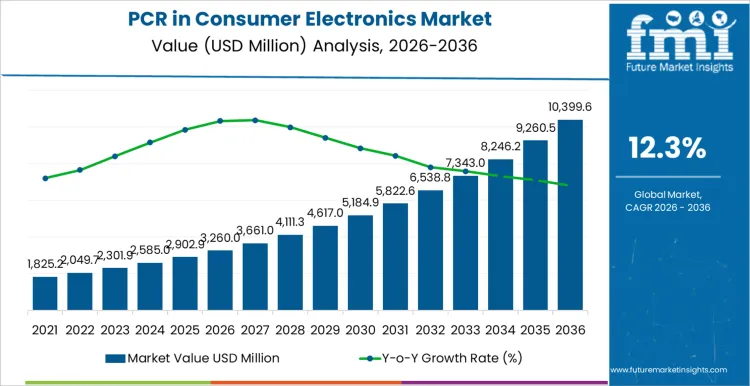
PCR in Consumer Electronics Market Key Takeaways
| Metric | Value |
|---|---|
| Market Value (2026) | USD 3,260.0 million |
| Market Forecast Value (2036) | USD 10,399.6 million |
| Forecast CAGR (2026-2036) | 12.3% |
Why is the Demand for PCR in Consumer Electronics Market Growing?
Brand owners in consumer electronics are increasingly integrating post-consumer recycled (PCR) plastics and metals into device housings, bezels, and internal structural components as sustainability becomes central to product strategy. Smartphones, laptops, and wearable devices have historically relied on virgin polycarbonate, ABS, and aluminum for strength, finish, and precision fit. Recent advances in PCR feedstock purification and compounding yield materials with mechanical and thermal performance that approach virgin benchmarks, supporting adoption in applications where dimensional tolerance and surface quality are critical. Manufacturers planning annual model refresh cycles procure PCR resins that maintain consistency across production lots, ensuring casings and trim pieces meet design and assembly specs.
Retailers promoting eco-focused product lines require transparent PCR content reporting to support environmental claims without degrading user experience. Procurement teams in the electronics supply chain prioritize PCR materials that withstand processing stresses such as injection molding, CNC machining, and ultrasonic welding. Material scientists refine PCR blends to manage impact resistance, creep, and heat deflection for devices exposed to daily handling and varied temperatures. Regulatory pressures in major markets encourage recycled content disclosure and recycling take-back programs that feed higher quality PCR streams back into production. Strategic partnerships between OEMs and recyclers secure feedstock supply, enabling integration of PCR into battery housings, speaker grilles, and external chassis where performance and recycled content targets intersect.
How Is the PCR in Consumer Electronics Market Segmented by Polymer Focus and End Use?
Adoption of post-consumer recycled polymers in consumer electronics is driven by sustainability mandates, OEM ESG targets, and pressure to reduce virgin plastic usage without compromising performance. Material selection prioritizes impact resistance, thermal stability, surface finish, and color consistency, which are critical for electronics housings and visible components. Segmentation by polymer focus and end use highlights how manufacturers balance recyclate content with functional and aesthetic requirements across different electronics categories.
Which Polymer Focus Accounts for the Largest Share in PCR Use for Consumer Electronics?
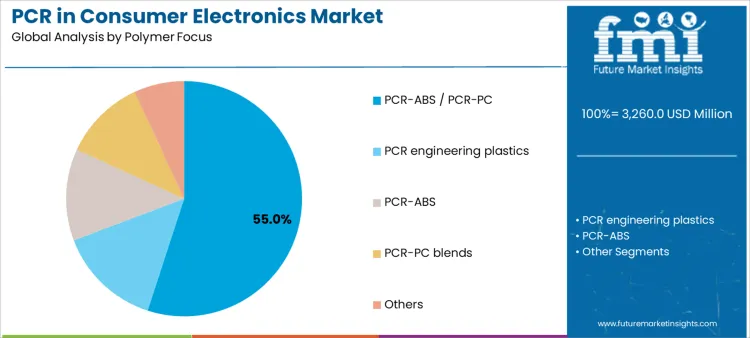
PCR-ABS and PCR-PC together hold a dominant 55.0% share, reflecting their widespread use in electronic enclosures, laptop shells, and peripheral casings. These materials offer a favorable balance of strength, heat resistance, and processability, making them suitable for high-volume injection molding. Other polymer categories, including standalone PCR-ABS, PCR-PC blends, and additional engineering plastics, are adopted selectively where performance specifications or design constraints vary, although individual shares are not specified.
Key Points
- PCR-ABS and PCR-PC dominate due to balanced mechanical and thermal properties.
- Material choice aligns with enclosure durability and surface finish needs.
- Polymer selection remains application- and design-driven.
Which End-Use Segment Drives Demand for PCR Materials in Consumer Electronics?
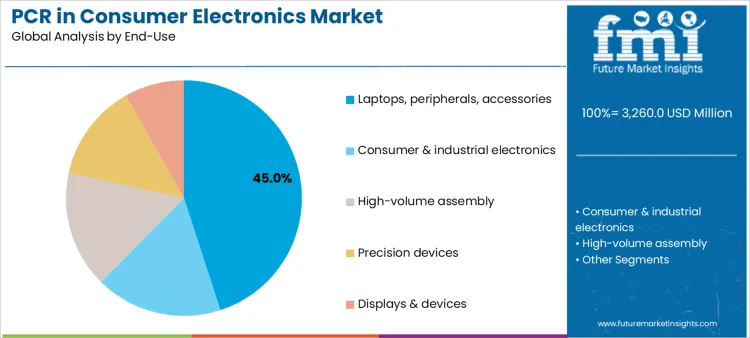
Laptops, peripherals, and accessories represent the largest end-use segment at 45.0%, supported by high production volumes and visible sustainability commitments from global brands. These products offer scalable opportunities to integrate PCR materials without extensive requalification. Other end uses include consumer and industrial electronics, high-volume assembly components, precision devices, and display-related products, where adoption depends on tolerance limits, regulatory requirements, and lifecycle expectations rather than disclosed percentage shares.
Key Points
- High-volume laptop and accessory production accelerates PCR adoption.
- Visibility of end products reinforces sustainability positioning.
- Precision applications adopt PCR selectively based on performance thresholds.
What are the Key Dynamics in the PCR in Consumer Electronics Market?
Demand in the post-consumer recycled (PCR) materials market for consumer electronics is shaped by manufacturers’ need to balance sustainability goals with stringent functional performance requirements. Electronics OEMs and tier suppliers increasingly specify PCR content for housings, bezels, internal brackets, and non-critical structural parts where mechanical integrity must match virgin resins.
Growth is especially notable in products with visible sustainability labeling or corporate environmental goals, including laptops, mobile phones, wearable devices, and home appliances. Material choice reflects not just recycled content percentage but performance criteria such as impact resistance, dimensional stability, and flame retardancy required by electronics standards.
In what ways do performance specifications in consumer electronics influence PCR adoption?
Consumer electronics place high demands on material performance, which directly affects the adoption of PCR resins. Housing components for laptops and tablets require consistent surface finish and color stability to support premium aesthetics and branding. Mobile phone bezels and mid-frames demand tight dimensional tolerances to ensure assembly fit and component integration without compromising drop performance.
Wearable devices, exposed to frequent handling and flex stress, drive demand for PCR materials with reliable fatigue resistance and low creep under thermal cycling. Appliance interfaces and remote control housings require flame retardant PCR formulations that meet UL 94 or equivalent standards without degrading mechanical properties. Electronics manufacturers assess PCR grades for predictable melt flow behavior and absence of contaminants that could cause sink marks or flow lines during injection molding.
What do supply chain quality controls and regulatory conditions mean for market growth?
Market growth for PCR in consumer electronics is influenced by feedstock quality controls, certification requirements, and regulatory conditions. Sorting and preprocessing operations must isolate polymer streams with minimal contamination to meet the strict performance criteria needed for electronics components. Advanced reclamation and purification technologies help achieve consistent properties across production lots, which reduces rejection rates during molding and assembly.
Certification to international safety and material standards, including those governing flame retardancy, RoHS compliance, and recyclability claims are essential for manufacturers before PCR grades are deployed in consumer products. Regional regulatory frameworks on recycled content, extended producer responsibility, and eco-labeling shape where electronics firms can promote sustainability performance without extensive compliance documentation.
Price sensitivity in mid-range and budget product segments influences how much PCR content manufacturers can justify without impacting cost structures and perceived product value. Integration of PCR materials into global electronics supply chains requires harmonized material specifications and quality assurance processes across multiple production sites to support consistency in finished goods performance.
How Is Demand for PCR in the Consumer Electronics Market Evolving Globally?
Global demand for PCR in consumer electronics is rising as OEMs integrate recycled plastics into regulated, performance-sensitive devices. Growth reflects sustainability mandates, brand recycled content targets, and expanding electronics production requiring certified material consistency. PCR adoption concentrates on housings, structural parts, and internal components where aesthetics, flame retardancy, and durability remain critical. Qualification cycles emphasize traceability, odor control, and mechanical stability. India records 15.4% CAGR, China records 14.0% CAGR, USA records 11.6% CAGR, Germany records 11.2% CAGR, and Korea records 10.6% CAGR. Market expansion is driven by engineering validation requirements and compliance intensity rather than unit shipment growth.
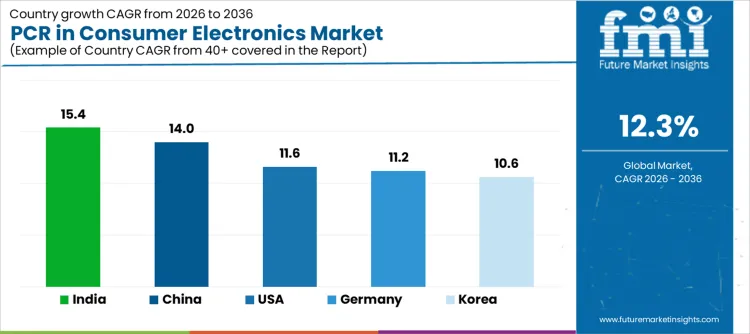
| Country | CAGR (%) |
|---|---|
| India | 15.4% |
| China | 14.0% |
| USA | 11.6% |
| Germany | 11.2% |
| Korea | 10.6% |
What is driving growth of PCR demand in consumer electronics across India?
Demand for PCR in consumer electronics in India is expanding as domestic manufacturing of appliances and electronics accelerates. Growth at 15.4% CAGR reflects rising production of televisions, air conditioners, smartphones, and accessories requiring recycled engineering plastics. Government policies on waste reduction increase specification pressure for recycled content. Contract manufacturers prioritize PCR grades meeting flame retardancy and impact requirements. Cost sensitivity favors blends balancing recycled content with performance retention.
Local compounders improve sorting and stabilization to meet electronics standards. Demand concentrates within housings, bezels, and non-load-bearing components serving fast-growing domestic assembly clusters.
- Expansion of domestic electronics manufacturing
- Regulatory pressure on recycled content usage
- Focus on flame-retardant PCR grades
- Growth of local compounding capabilities
Why is China seeing expansion in PCR adoption for consumer electronics?
PCR demand in consumer electronics in China is rising as large OEMs scale recycled materials across global product platforms. Growth at 14.0% CAGR reflects high-volume production of smartphones, laptops, televisions, and accessories requiring certified recycled plastics. Regulatory mandates accelerate recycled content integration.
Export-oriented manufacturers prioritize PCR grades meeting international safety and durability standards. Domestic recyclers invest in advanced purification, deodorization, and color control. Centralized manufacturing hubs support consistent material qualification across product lines. Demand remains anchored in housings and structural parts supplying global consumer electronics brands.
- High-volume electronics manufacturing scale
- Export compliance driven material qualification
- Investment in advanced PCR purification
- Regulatory mandates on recycled plastics
What factors are shaping PCR sales in consumer electronics across the USA?
Sales of PCR in consumer electronics in the USA are increasing as brands execute sustainability roadmaps. Growth at 11.6% CAGR reflects adoption across laptops, peripherals, home electronics, and smart devices. Brand risk management drives conservative material qualification and extended validation cycles. Retail sustainability scorecards influence procurement decisions. Performance criteria emphasize odor neutrality, color stability, and mechanical retention. Suppliers align documentation and traceability with audit requirements. Demand is driven by portfolio-wide material transitions rather than rapid device innovation cycles.
- Brand-level recycled content commitments
- Retail sustainability compliance pressure
- Emphasis on odor and color control
- Conservative qualification timelines
How is Germany supporting growth of PCR use in consumer electronics?
PCR demand in consumer electronics in Germany is advancing as circular economy regulations intensify material substitution. Growth at 11.2% CAGR reflects adoption within appliances, professional electronics, and industrial consumer devices. EU directives increase documentation and traceability requirements. German manufacturers prioritize certified PCR with consistent performance and emissions control. Engineering standards require stable flame retardancy and dimensional accuracy. Demand remains focused on regulated product categories supplying European markets with strict compliance expectations.
- EU circular economy compliance requirements
- High standards for traceability and certification
- Focus on flame-retardant PCR materials
- Adoption in regulated electronics categories
What is driving expansion of PCR demand in consumer electronics across Korea?
Demand for PCR in consumer electronics in Korea is rising as global electronics leaders integrate recycled materials. Growth at 10.6% CAGR reflects usage in smartphones, displays, home appliances, and accessories requiring precision molding. OEM sustainability targets influence supplier material specifications. Performance validation centers on surface finish, impact resistance, and color consistency. Domestic compounders enhance feedstock control and additive systems. Demand concentrates within export-oriented manufacturing clusters supplying premium global brands.
- Expansion of premium electronics manufacturing
- OEM sustainability specification pressure
- Focus on surface quality and durability
- Export-oriented material qualification processes
What is the competitive landscape of demand for the PCR in consumer electronics market globally?
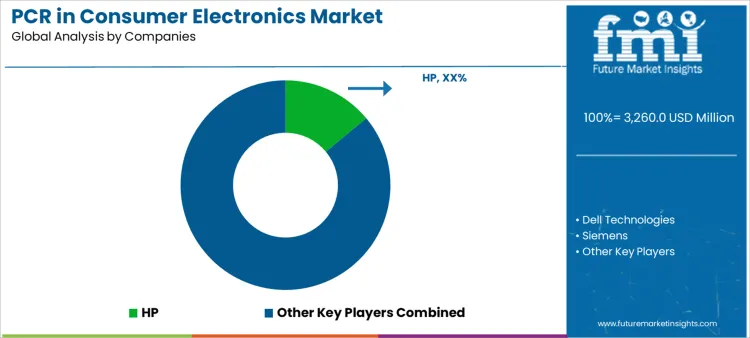
Design-for-sustainability commitments and regulatory recycled content thresholds are reshaping Demand for PCR across consumer electronics housings, peripherals, and accessories. OEMs evaluate impact resistance, dimensional stability, surface finish, color consistency, and odor control when recycled polymers replace virgin grades. Buyer assessment includes supply assurance for certified PCR, batch-to-batch consistency, compatibility with injection molding and flame-retardant systems, and compliance with electronics safety standards. Procurement behavior prioritizes long-term material partnerships, qualification data, and closed-loop sourcing tied to take-back programs. Trend in the PCR in consumer electronics market reflects expansion from internal components to visible parts without compromising aesthetics or durability.
HP leads competitive positioning through established closed-loop plastics programs supplying PCR resins back into printers, PCs, and accessories at scale. Dell Technologies competes by embedding PCR targets into product roadmaps and supplier scorecards, accelerating material qualification across portfolios. Lenovo maintains relevance by integrating PCR into chassis and packaging with regional sourcing flexibility. Foxconn supports demand by enabling PCR processing at contract manufacturing scale, easing OEM adoption. Sony and Panasonic participate through selective PCR use in housings aligned with brand sustainability pledges. Competitive differentiation centers on material qualification depth, closed-loop execution, supplier integration, and ability to scale PCR across multiple product lines.
Key Players in the PCR in Consumer Electronics Market
- HP
- Dell Technologies
- Siemens
- Bosch
- Foxconn
- Lenovo
- Sony
- Panasonic
- Others
Scope of the Report
| Items | Values |
|---|---|
| Quantitative Units | USD million |
| Polymer Focus | PCR-ABS / PCR-PC; PCR engineering plastics; PCR-ABS; PCR-PC blends; Others |
| End-Use | Laptops, peripherals, accessories; Consumer & industrial electronics; High-volume assembly; Precision devices; Displays & devices |
| Regions Covered | Asia Pacific, Europe, North America, Latin America, Middle East & Africa |
| Countries Covered | India, China, USA, Germany, Korea, and 40+ countries |
| Key Companies Profiled | HP; Dell Technologies; Siemens; Bosch; Foxconn; Lenovo; Sony; Panasonic; Others |
| Additional Attributes | Dollar sales by polymer focus and end-use across consumer and industrial electronics manufacturing; PCR resin adoption trends in laptop housings, peripherals, and display components; material performance requirements for heat resistance, dimensional stability, and aesthetics; sourcing strategies balancing recycled content targets with supply consistency; procurement alignment with OEM sustainability mandates and electronics compliance standards. |
PCR in Consumer Electronics Market by Segment
Polymer Focus:
- PCR-ABS / PCR-PC
- PCR engineering plastics
- PCR-ABS
- PCR-PC blends
- Others
End-Use:
- Laptops, peripherals, accessories
- Consumer & industrial electronics
- High-volume assembly
- Precision devices
- Displays & devices
Region:
- Asia Pacific
- China
- Japan
- South Korea
- India
- Australia & New Zealand
- ASEAN
- Rest of Asia Pacific
- Europe
- Germany
- United Kingdom
- France
- Italy
- Spain
- Nordic
- BENELUX
- Rest of Europe
- North America
- United States
- Canada
- Mexico
- Latin America
- Brazil
- Chile
- Rest of Latin America
- Middle East & Africa
- Kingdom of Saudi Arabia
- Other GCC Countries
- Turkey
- South Africa
- Other African Union
- Rest of Middle East & Africa
Bibliography
- International Electrotechnical Commission. (2023). IEC 62474: Material declaration for products of and for the electrotechnical industry. International Electrotechnical Commission.
- International Organization for Standardization. (2023). ISO 22095: Chain of custody—General terminology and models. International Organization for Standardization.
- Organisation for Economic Co-operation and Development. (2023). Circular economy approaches in electronics manufacturing and material recovery. OECD Publishing.
Frequently Asked Questions
How big is the pcr in consumer electronics market in 2026?
The global pcr in consumer electronics market is estimated to be valued at USD 3,260.0 million in 2026.
What will be the size of pcr in consumer electronics market in 2036?
The market size for the pcr in consumer electronics market is projected to reach USD 10,399.6 million by 2036.
How much will be the pcr in consumer electronics market growth between 2026 and 2036?
The pcr in consumer electronics market is expected to grow at a 12.3% CAGR between 2026 and 2036.
What are the key product types in the pcr in consumer electronics market?
The key product types in pcr in consumer electronics market are pcr-abs / pcr-pc, pcr engineering plastics, pcr-abs, pcr-pc blends and others.
Which end-use segment to contribute significant share in the pcr in consumer electronics market in 2026?
In terms of end-use, laptops, peripherals, accessories segment to command 45.0% share in the pcr in consumer electronics market in 2026.
Preview the report firsthand - request a free sample
Get SampleGet the brochure for pricing and purchase details.
Get PDFTable of Content
- Executive Summary
- Global Market Outlook
- Demand-side Trends
- Supply-side Trends
- Technology Roadmap Analysis
- Analysis and Recommendations
- Market Overview
- Market Coverage / Taxonomy
- Market Definition / Scope / Limitations
- Market Background
- Market Dynamics
- Drivers
- Restraints
- Opportunity
- Trends
- Scenario Forecast
- Demand in Optimistic Scenario
- Demand in Likely Scenario
- Demand in Conservative Scenario
- Opportunity Map Analysis
- Product Life Cycle Analysis
- Supply Chain Analysis
- Investment Feasibility Matrix
- Value Chain Analysis
- PESTLE and Porter’s Analysis
- Regulatory Landscape
- Regional Parent Market Outlook
- Production and Consumption Statistics
- Import and Export Statistics
- Market Dynamics
- Global Market Analysis 2021 to 2025 and Forecast, 2026 to 2036
- Historical Market Size Value (USD Million) Analysis, 2021 to 2025
- Current and Future Market Size Value (USD Million) Projections, 2026 to 2036
- Y-o-Y Growth Trend Analysis
- Absolute $ Opportunity Analysis
- Global Market Pricing Analysis 2021 to 2025 and Forecast 2026 to 2036
- Global Market Analysis 2021 to 2025 and Forecast 2026 to 2036, By Polymer Focus
- Introduction / Key Findings
- Historical Market Size Value (USD Million) Analysis By Polymer Focus , 2021 to 2025
- Current and Future Market Size Value (USD Million) Analysis and Forecast By Polymer Focus , 2026 to 2036
- PCR-ABS / PCR-PC
- PCR engineering plastics
- PCR-ABS
- PCR-PC blends
- Others
- PCR-ABS / PCR-PC
- Y-o-Y Growth Trend Analysis By Polymer Focus , 2021 to 2025
- Absolute $ Opportunity Analysis By Polymer Focus , 2026 to 2036
- Global Market Analysis 2021 to 2025 and Forecast 2026 to 2036, By End-Use
- Introduction / Key Findings
- Historical Market Size Value (USD Million) Analysis By End-Use, 2021 to 2025
- Current and Future Market Size Value (USD Million) Analysis and Forecast By End-Use, 2026 to 2036
- Laptops, peripherals, accessories
- Consumer & industrial electronics
- High-volume assembly
- Precision devices
- Displays & devices
- Laptops, peripherals, accessories
- Y-o-Y Growth Trend Analysis By End-Use, 2021 to 2025
- Absolute $ Opportunity Analysis By End-Use, 2026 to 2036
- Global Market Analysis 2021 to 2025 and Forecast 2026 to 2036, By Region
- Introduction
- Historical Market Size Value (USD Million) Analysis By Region, 2021 to 2025
- Current Market Size Value (USD Million) Analysis and Forecast By Region, 2026 to 2036
- North America
- Latin America
- Western Europe
- Eastern Europe
- East Asia
- South Asia and Pacific
- Middle East & Africa
- Market Attractiveness Analysis By Region
- North America Market Analysis 2021 to 2025 and Forecast 2026 to 2036, By Country
- Historical Market Size Value (USD Million) Trend Analysis By Market Taxonomy, 2021 to 2025
- Market Size Value (USD Million) Forecast By Market Taxonomy, 2026 to 2036
- By Country
- USA
- Canada
- Mexico
- By Polymer Focus
- By End-Use
- By Country
- Market Attractiveness Analysis
- By Country
- By Polymer Focus
- By End-Use
- Key Takeaways
- Latin America Market Analysis 2021 to 2025 and Forecast 2026 to 2036, By Country
- Historical Market Size Value (USD Million) Trend Analysis By Market Taxonomy, 2021 to 2025
- Market Size Value (USD Million) Forecast By Market Taxonomy, 2026 to 2036
- By Country
- Brazil
- Chile
- Rest of Latin America
- By Polymer Focus
- By End-Use
- By Country
- Market Attractiveness Analysis
- By Country
- By Polymer Focus
- By End-Use
- Key Takeaways
- Western Europe Market Analysis 2021 to 2025 and Forecast 2026 to 2036, By Country
- Historical Market Size Value (USD Million) Trend Analysis By Market Taxonomy, 2021 to 2025
- Market Size Value (USD Million) Forecast By Market Taxonomy, 2026 to 2036
- By Country
- Germany
- UK
- Italy
- Spain
- France
- Nordic
- BENELUX
- Rest of Western Europe
- By Polymer Focus
- By End-Use
- By Country
- Market Attractiveness Analysis
- By Country
- By Polymer Focus
- By End-Use
- Key Takeaways
- Eastern Europe Market Analysis 2021 to 2025 and Forecast 2026 to 2036, By Country
- Historical Market Size Value (USD Million) Trend Analysis By Market Taxonomy, 2021 to 2025
- Market Size Value (USD Million) Forecast By Market Taxonomy, 2026 to 2036
- By Country
- Russia
- Poland
- Hungary
- Balkan & Baltic
- Rest of Eastern Europe
- By Polymer Focus
- By End-Use
- By Country
- Market Attractiveness Analysis
- By Country
- By Polymer Focus
- By End-Use
- Key Takeaways
- East Asia Market Analysis 2021 to 2025 and Forecast 2026 to 2036, By Country
- Historical Market Size Value (USD Million) Trend Analysis By Market Taxonomy, 2021 to 2025
- Market Size Value (USD Million) Forecast By Market Taxonomy, 2026 to 2036
- By Country
- China
- Japan
- South Korea
- By Polymer Focus
- By End-Use
- By Country
- Market Attractiveness Analysis
- By Country
- By Polymer Focus
- By End-Use
- Key Takeaways
- South Asia and Pacific Market Analysis 2021 to 2025 and Forecast 2026 to 2036, By Country
- Historical Market Size Value (USD Million) Trend Analysis By Market Taxonomy, 2021 to 2025
- Market Size Value (USD Million) Forecast By Market Taxonomy, 2026 to 2036
- By Country
- India
- ASEAN
- Australia & New Zealand
- Rest of South Asia and Pacific
- By Polymer Focus
- By End-Use
- By Country
- Market Attractiveness Analysis
- By Country
- By Polymer Focus
- By End-Use
- Key Takeaways
- Middle East & Africa Market Analysis 2021 to 2025 and Forecast 2026 to 2036, By Country
- Historical Market Size Value (USD Million) Trend Analysis By Market Taxonomy, 2021 to 2025
- Market Size Value (USD Million) Forecast By Market Taxonomy, 2026 to 2036
- By Country
- Kingdom of Saudi Arabia
- Other GCC Countries
- Turkiye
- South Africa
- Other African Union
- Rest of Middle East & Africa
- By Polymer Focus
- By End-Use
- By Country
- Market Attractiveness Analysis
- By Country
- By Polymer Focus
- By End-Use
- Key Takeaways
- Key Countries Market Analysis
- USA
- Pricing Analysis
- Market Share Analysis, 2025
- By Polymer Focus
- By End-Use
- Canada
- Pricing Analysis
- Market Share Analysis, 2025
- By Polymer Focus
- By End-Use
- Mexico
- Pricing Analysis
- Market Share Analysis, 2025
- By Polymer Focus
- By End-Use
- Brazil
- Pricing Analysis
- Market Share Analysis, 2025
- By Polymer Focus
- By End-Use
- Chile
- Pricing Analysis
- Market Share Analysis, 2025
- By Polymer Focus
- By End-Use
- Germany
- Pricing Analysis
- Market Share Analysis, 2025
- By Polymer Focus
- By End-Use
- UK
- Pricing Analysis
- Market Share Analysis, 2025
- By Polymer Focus
- By End-Use
- Italy
- Pricing Analysis
- Market Share Analysis, 2025
- By Polymer Focus
- By End-Use
- Spain
- Pricing Analysis
- Market Share Analysis, 2025
- By Polymer Focus
- By End-Use
- France
- Pricing Analysis
- Market Share Analysis, 2025
- By Polymer Focus
- By End-Use
- India
- Pricing Analysis
- Market Share Analysis, 2025
- By Polymer Focus
- By End-Use
- ASEAN
- Pricing Analysis
- Market Share Analysis, 2025
- By Polymer Focus
- By End-Use
- Australia & New Zealand
- Pricing Analysis
- Market Share Analysis, 2025
- By Polymer Focus
- By End-Use
- China
- Pricing Analysis
- Market Share Analysis, 2025
- By Polymer Focus
- By End-Use
- Japan
- Pricing Analysis
- Market Share Analysis, 2025
- By Polymer Focus
- By End-Use
- South Korea
- Pricing Analysis
- Market Share Analysis, 2025
- By Polymer Focus
- By End-Use
- Russia
- Pricing Analysis
- Market Share Analysis, 2025
- By Polymer Focus
- By End-Use
- Poland
- Pricing Analysis
- Market Share Analysis, 2025
- By Polymer Focus
- By End-Use
- Hungary
- Pricing Analysis
- Market Share Analysis, 2025
- By Polymer Focus
- By End-Use
- Kingdom of Saudi Arabia
- Pricing Analysis
- Market Share Analysis, 2025
- By Polymer Focus
- By End-Use
- Turkiye
- Pricing Analysis
- Market Share Analysis, 2025
- By Polymer Focus
- By End-Use
- South Africa
- Pricing Analysis
- Market Share Analysis, 2025
- By Polymer Focus
- By End-Use
- USA
- Market Structure Analysis
- Competition Dashboard
- Competition Benchmarking
- Market Share Analysis of Top Players
- By Regional
- By Polymer Focus
- By End-Use
- Competition Analysis
- Competition Deep Dive
- HP
- Overview
- Product Portfolio
- Profitability by Market Segments (Product/Age /Sales Channel/Region)
- Sales Footprint
- Strategy Overview
- Marketing Strategy
- Product Strategy
- Channel Strategy
- Dell Technologies
- Siemens
- Bosch
- Foxconn
- Lenovo
- Sony
- Panasonic
- Others
- HP
- Competition Deep Dive
- Assumptions & Acronyms Used
- Research Methodology


