

- Industry Size (2026)
- USD 2240 Mn
- Forecast (2036)
- USD 7877.3 Mn
- CAGR (2026 to 2036)
- 13.40%
Digital Product Ecosystems Using PCR for Consumer Goods Market Forecast and Outlook 2026 to 2036
The digital product ecosystems using PCR for consumer goods market is forecast to expand from USD 2,240 million in 2026 to USD 7,877.3 million by 2036, registering a CAGR of 13.40%. Growth is fundamentally shaped by compliance economics rather than digital experimentation. Regulatory bodies are increasingly requiring proof of recycled content, verifiable supply-chain data, and standardized reporting formats, shifting PCR adoption from marketing initiatives to legal obligations. Digital product ecosystems lower long-term compliance costs by automating data capture, certification linkage, and audit readiness.
However, certification complexity raises entry barriers, as brands must coordinate data standards across multiple suppliers and jurisdictions. Adoption therefore concentrates among large FMCG and global consumer-goods players with the scale to absorb upfront integration costs. Vendor positioning depends on regulatory alignment, data governance strength, and ability to adapt to evolving compliance frameworks. Over the forecast period, ecosystem providers that function as compliance enablers rather than visibility platforms will capture disproportionate value as regulatory pressure continues to intensify.
Quick Stats for Digital Product Ecosystems Using PCR for Consumer Goods Market
- Digital Product Ecosystems Using PCR for Consumer Goods Market Value (2026): USD 2,240 Million
- Digital Product Ecosystems Using PCR for Consumer Goods Market Forecast Value (2036): USD 7,877.3 Million
- Digital Product Ecosystems Using PCR for Consumer Goods Market Forecast CAGR 2026 to 2036: 13.4%
- Leading Ecosystem Type in Digital Product Ecosystems Using PCR for Consumer Goods Market: Digital Product Passport Ecosystems (37% share)
- Key Growth Regions in Digital Product Ecosystems Using PCR for Consumer Goods Market: Asia Pacific, Europe, North America
- Key Players in Digital Product Ecosystems Using PCR for Consumer Goods Market: SAP SE, Circularise B.V., Salesforce, Inc. (Net Zero Cloud), Digimarc Corporation, Alibaba Cloud, AntChain Technologies, NEC Corporation, Fujitsu Limited
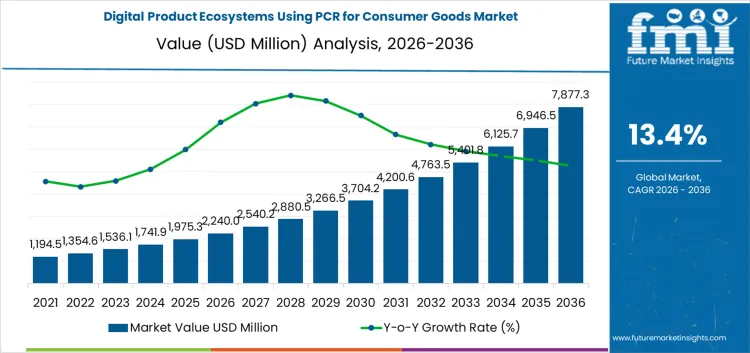
Digital Product Ecosystems Using PCR for Consumer Goods Market Key Takeaways
| Metric | Value |
|---|---|
| Digital Product Ecosystems Using PCR for Consumer Goods Market Value (2026) | USD 2,240 Million |
| Digital Product Ecosystems Using PCR for Consumer Goods Market Forecast Value (2036) | USD 7,877.3 Million |
| Digital Product Ecosystems Using PCR for Consumer Goods Market Forecast CAGR 2026 to 2036 | 13.40% |
How are Digital Integration and PCR Traceability Converging to Reshape Consumer Goods Value Chains?
The digital product ecosystems using PCR market is expanding as consumer-goods companies move from isolated recycled-material sourcing toward digitally connected, traceable product systems. Brands are increasingly embedding PCR usage into broader digital frameworks that link material sourcing, product design, packaging identity, and post-consumer recovery. For ecosystem providers, this shift creates demand for platforms that connect PCR material data with digital product passports, enabling brands to verify recycled content, track material flows, and demonstrate compliance across global markets.
Procurement and supplier relationships are also being redefined. Consumer-goods companies are seeking digitally enabled PCR ecosystems that reduce sourcing risk and improve transparency across converters, compounders, and recyclers. Digital integration allows real-time visibility into PCR availability, quality metrics, and certification status, supporting faster decision-making and long-term contracting. Suppliers that can interface material performance data with brand-level digital systems are gaining strategic relevance beyond commodity material supply.
Commercial value creation is increasingly tied to data, not materials alone. Digital ecosystems enable monetization through compliance reporting, consumer engagement, lifecycle analytics, and circularity metrics embedded directly into products. As regulatory scrutiny and consumer expectations rise, brands are using digitally enabled PCR ecosystems to differentiate products, streamline audits, and optimize packaging portfolios. For participants across the value chain, competitive advantage depends on the ability to integrate PCR materials with scalable digital infrastructure positioning digital PCR ecosystems as a high-growth enabler of transparent, compliant, and future-ready consumer goods manufacturing.
What Is the Segment Structure of Digital Product Ecosystems Using PCR for Consumer Goods?
The digital product ecosystems using PCR for consumer goods market is segmented by end use and ecosystem type, reflecting how digital traceability, product data integration, and material tracking are applied across consumer-facing industries. By end use, FMCG and durable goods lead adoption, supported by high product volumes and frequent consumer interaction across retail channels. Other end uses include brand-consumer transparency initiatives, digital retail ecosystems, high-trust consumer goods, emerging digital FMCG formats, and regional consumer brands seeking structured data visibility. By ecosystem type, digital product passport ecosystems represent the leading model, while connected packaging ecosystems, platform-integrated PCR tracking, and secure product ecosystems address different levels of data depth, access control, and system integration.
Why Do FMCG And Durable Goods Lead Adoption In Digital Product Ecosystems Using PCR For Consumer Goods?
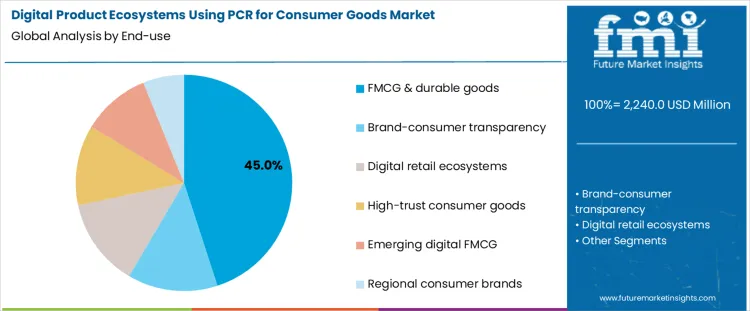
FMCG and durable goods account for 45% share of the digital product ecosystems using PCR for consumer goods market because these categories involve high product turnover and complex supply chains. Brands manage multiple SKUs, suppliers, and packaging formats, creating demand for centralized digital systems that track material attributes and product history. Frequent retail interaction increases the need for accurate, accessible product data across digital touchpoints. Manufacturers use ecosystem platforms to improve internal coordination between procurement, packaging, and distribution teams. For solution providers, FMCG and durable goods offer scale, repeat platform usage, and cross-category deployment opportunities. These operational and commercial factors explain why FMCG and durable goods dominate end-use adoption.
Why Do Digital Product Passport Ecosystems Dominate Ecosystem Type Selection?
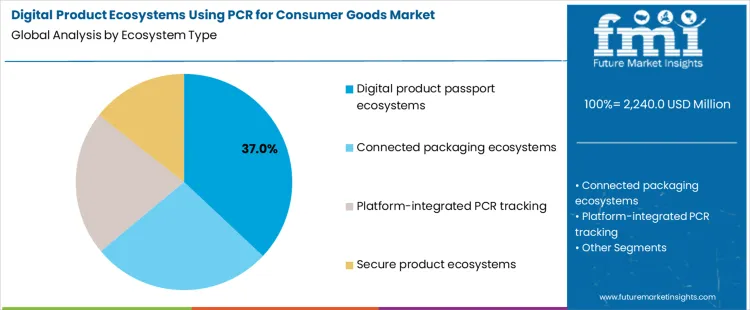
Digital product passport ecosystems hold 37% share of the digital product ecosystems using PCR for consumer goods market because they consolidate product-level data into a single, structured digital record. This ecosystem type enables consistent identification, tracking, and verification of product attributes across the value chain. Brand owners prefer passport-based systems to support internal audits, supplier coordination, and product lifecycle documentation. Integration with existing enterprise platforms allows automated data exchange without disrupting production workflows. For technology providers, digital product passports offer scalable architecture adaptable across product categories and regions. These data management and integration advantages explain why digital product passport ecosystems remain the most widely adopted ecosystem model.
What are the Key Dynamics of the Digital Product Ecosystems Using PCR for Consumer Goods Market?
The digital product ecosystems using PCR (post-consumer recycled materials) for consumer goods market are shaped by the integration of digital platforms with PCR supply chains to enhance visibility, traceability, and performance tracking of recycled content in products. Stakeholders include PCR resin suppliers, digital solution providers, consumer goods manufacturers, and packaging converters. Digital data systems from material passports to blockchain-enabled traceability allow all parties to verify PCR content, quality, and processing history throughout the product lifecycle. For technology integrators and material suppliers, interoperability with enterprise resource planning (ERP), manufacturing execution systems (MES), and supply-chain visibility platforms is critical to ensure smooth data flow and commercialization.
How are Technology and Data Platforms Transforming This Market?
Digital technologies and data platforms are transforming the market by enabling real-time tracking and reporting of PCR material attributes across manufacturing workflows. Cloud-based material databases, IoT sensor networks, and API-enabled integrations allow PCR quantities, quality test results, and movement across nodes (collection → processing → conversion → product) to be recorded and shared among stakeholders. Blockchain and distributed ledger systems provide tamper-resistant records of material provenance, enhancing trust between suppliers and consumer brands. For digital solution providers, offering analytics dashboards, automated compliance reporting, and integration with supplier portals strengthens ecosystem value. These capabilities help manufacturers manage PCR inventories, forecast material needs, and reduce reconciliation labor.
What Opportunities are emerging for Technology Providers and Material Stakeholders?
Emerging opportunities in this market focus on enhancing digital analytics, traceability services, and data-driven supply-chain optimization. Technology providers that deliver modular, scalable platforms with pre-built integrations for common manufacturing systems can accelerate ecosystem adoption among consumer goods players. PCR resin suppliers and converters can leverage digital dashboards to showcase material quality performance, certification data, and sustainability attributes to brand partners, reducing procurement friction. Analytics tools that combine market demand forecasting with PCR inventory tracking help manufacturers optimize buy-sell decisions. Collaboration frameworks and standardized PCR data schemas offer opportunities to align industry players, enabling streamlined reporting to regulators and auditors while strengthening product value propositions to downstream customers.
What Is the Country-Wise Outlook for Digital Product Ecosystems Using PCR in Consumer Goods?
Digital product ecosystems using PCR in consumer goods combine material recovery, digital identification, data tracking, and closed feedback loops across manufacturing, distribution, and post-use stages. Growth varies by country depending on digital infrastructure maturity, brand participation, regulatory alignment, and ability to integrate PCR materials into digitally enabled supply chains. Mature markets emphasize traceability, data integrity, and system interoperability, while high-growth regions focus on scaling participation across brands and retail networks. Ecosystem value is increasingly driven by real-time data visibility, product authentication, and coordinated recovery models linking physical goods with digital platforms.
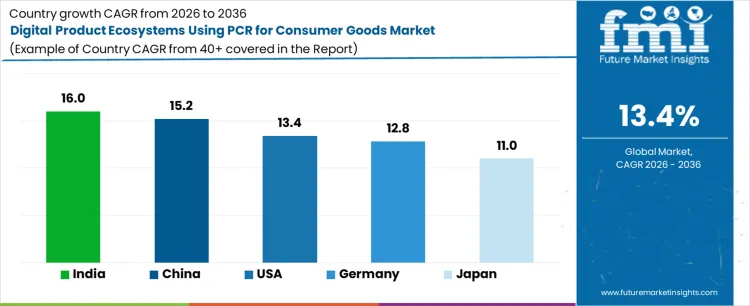
| Country | CAGR (%) |
|---|---|
| India | 16.0 |
| China | 15.2 |
| United States | 13.4 |
| Germany | 12.8 |
| Japan | 11.0 |
How is Germany Structuring High-Integrity Digital Product Ecosystems Using PCR for Consumer Goods?
The digital product ecosystems using PCR market in Germany, growing at a CAGR of 12.8% during 2026-2036, is characterized by structured collaboration between consumer goods brands, packaging converters, recyclers, and digital solution providers. German companies deploy digital identifiers such as QR codes, digital watermarks, and embedded tracking features to connect physical products with data platforms that monitor material flows and usage cycles. Buyers prioritize system interoperability, data accuracy, and secure integration with ERP and manufacturing execution systems. Adoption typically begins with pilot programs focused on specific packaging formats or product lines, followed by gradual scaling across portfolios. Ecosystem value is derived from precise data linkage between PCR material inputs and finished goods, enabling improved planning and quality control. Procurement decisions favor providers offering robust data governance, analytics dashboards, and long-term platform stability. Qualification cycles are deliberate, emphasizing reliability and consistency rather than rapid rollout.
What is Driving Rapid Expansion of Digital PCR Ecosystems in the United States Consumer Goods Market?
The digital product ecosystems using PCR market in the United States, expanding at a CAGR of 13.4% during 2026-2036, is driven by large, diversified consumer goods brands managing extensive product portfolios and distribution networks. Companies use digital identifiers and cloud platforms to gain visibility into material sourcing, production, and post-use recovery across geographically dispersed operations. Buyers emphasize scalability, cloud-native architecture, and compatibility with retail systems, logistics platforms, and loyalty applications. Adoption is largely brand-led, with ecosystems designed to support multiple product categories and rapid market deployment. Data analytics and reporting capabilities play a central role in ecosystem value creation, supporting decision-making across sourcing, inventory, and product design. Procurement decisions prioritize speed of implementation, flexibility, and the ability to integrate with existing digital infrastructure. Qualification timelines are shorter than in Europe, allowing faster commercialization.
Why is China Emerging as a High-Growth Hub for Digital Product Ecosystems Using PCR?
The digital product ecosystems using PCR market in China, growing at a CAGR of 15.2% during 2026-2036, reflects rapid digitization of consumer goods supply chains and high-volume market dynamics. Brands deploy QR-based systems, mobile applications, and centralized data platforms to manage large product flows across urban and regional markets. Buyers focus on throughput, cost efficiency, and capacity to process massive data volumes in real time. Adoption is scale-led, with fast rollout across multiple brands, cities, and retail formats. Ecosystems are often integrated with e-commerce platforms and mobile payment systems, increasing consumer interaction and data capture. Procurement favors providers offering localized software development, high system capacity, and rapid deployment capability. Qualification cycles are relatively short, enabling quick expansion. China represents a scale-driven market where success depends on platform robustness, localization, and the ability to operate reliably under high transaction volumes while coordinating multiple ecosystem participants.
How Does Japan Apply Precision and Control to Digital PCR Product Ecosystems?
The digital product ecosystems using PCR market in Japan, expanding at a CAGR of 11.0% during the forecast period, reflects a precision-oriented and control-focused approach. Japanese consumer goods companies emphasize accuracy, system reliability, and disciplined implementation when linking digital records with physical products. Adoption is incremental, often beginning with limited product ranges and extensive validation before expansion. Buyers prioritize data integrity, long-term platform stability, and detailed reporting capabilities. Ecosystems are designed to minimize errors and ensure consistent alignment between material tracking and production data. Procurement favors providers with strong documentation, proven reliability, and long-term support models. Volumes are moderate, but performance expectations are high. Japan represents a quality-driven market where ecosystem providers are valued for predictability, governance strength, and close collaboration with brand owners rather than rapid scale or aggressive deployment.
Why is India the Fastest-Growing Market for Digital Product Ecosystems Using PCR?
The digital product ecosystems using PCR market in India, growing at a CAGR of 16.0% during 2026-2036, is driven by rapid digitization of consumer markets and expanding participation from FMCG brands. Adoption is largely greenfield-led, with digital platforms embedded early into product tracking and recovery initiatives. Buyers emphasize mobile-first design, affordability, and scalability across diverse retail environments. Ecosystems are designed to function across fragmented distribution networks, including traditional trade and modern retail. Procurement favors adaptable platforms, quick onboarding, and strong local technical support. Qualification cycles are shorter, enabling rapid expansion. India represents a high-growth market where ecosystem success depends on speed, flexibility, and the ability to operate at scale while coordinating multiple brands, retailers, and service providers.
What Defines Competition in Digital Product Ecosystems Using PCR for Consumer Goods?
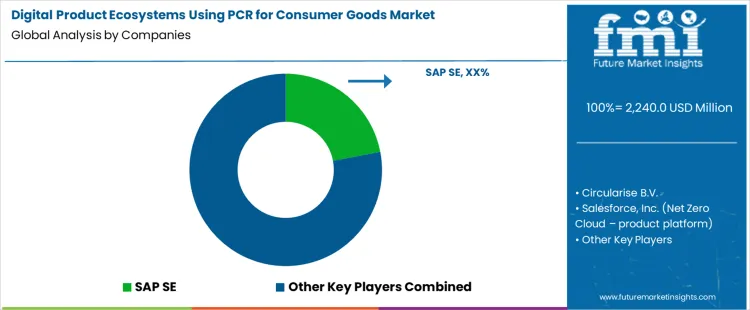
Competition in the digital product ecosystems using PCR (Post-Consumer Recycled) for consumer goods market is centered on data transparency, traceability frameworks, and verified sustainability metrics that matter to brands, supply chain partners, and compliance teams. SAP SE positions its digital ecosystem with official platform literature highlighting integration of PCR content tracking into enterprise resource planning (ERP) and product lifecycle management (PLM) systems. Brochures emphasize real-time material provenance, compliance dashboards, and audit trails that support ESG reporting and extended producer responsibility (EPR) obligations.
Data interoperability and secure traceability are key differentiators among platform providers. Circularise B.V. competes through blockchain-based supply chain networks documented for their ability to trace PCR inputs from feedstock to finished goods without exposing sensitive commercial data. Official materials highlight decentralized identity and permissioned workflows that appeal to multi-tier consumer goods supply chains. Salesforce, Inc. (Net Zero Cloud - product platform) positions its offering with brochures that underscore integrated carbon accounting, PCR usage tracking, and sustainability scorecards tied to Salesforce CRM and analytics suites, enabling brands to correlate PCR adoption with market and environmental outcomes.
Unique digital identifiers and cloud-native ecosystems define other competitive angles. Digimarc Corporation leverages digital watermarking and authenticated supply chain metadata, with product literature showing how embedded identifiers support PCR verification and consumer engagement. Alibaba Cloud (Alibaba Cloud Computing Co., Ltd.) and AntChain Technologies (Ant Group Co., Ltd.) bring scalable cloud and blockchain infrastructures, documented for secure data capture, cross-border traceability, and interoperable APIs that enable brands to visualize PCR journeys at scale.
Key Players in Digital Product Ecosystems Using PCR for Consumer Goods Market
- SAP SE
- Circularise B.V.
- Salesforce, Inc. (Net Zero Cloud - product platform)
- Digimarc Corporation
- Alibaba Cloud (Alibaba Cloud Computing Co., Ltd.)
- AntChain Technologies (Ant Group Co., Ltd.)
- NEC Corporation
- Fujitsu Limited
Scope of Report
| Attribute | Description |
|---|---|
| Quantitative Unit | USD Million |
| End-use | FMCG & Durable Goods, Brand-Consumer Transparency, Digital Retail Ecosystems, High-Trust Consumer Goods, Emerging Digital FMCG, Regional Consumer Brands |
| Ecosystem Type | Digital Product Passport Ecosystems, Connected Packaging Ecosystems, Platform-Integrated PCR Tracking, Secure Product Ecosystems |
| Countries Covered | China, Japan, South Korea, India, Australia & New Zealand, ASEAN, Rest of Asia Pacific, Germany, United Kingdom, France, Italy, Spain, Nordic, BENELUX, Rest of Europe, United States, Canada, Mexico, Brazil, Chile, Rest of Latin America, Kingdom of Saudi Arabia, Other GCC Countries, Turkey, South Africa, Other African Union, Rest of Middle East & Africa |
| Regions Covered | Asia Pacific, Europe, North America, Latin America, Middle East & Africa |
| Key Companies Profiled | SAP SE, Circularise B.V., Salesforce, Inc. (Net Zero Cloud - product platform), Digimarc Corporation, Alibaba Cloud (Alibaba Cloud Computing Co., Ltd.), AntChain Technologies (Ant Group Co., Ltd.), NEC Corporation, Fujitsu Limited |
| Additional Attributes | Dollar sales by end-use and ecosystem type are evaluated across digital traceability and PCR-enabled consumer goods platforms. The report includes country-level demand assessment, growth projections for 2026-2036, and analysis of data integrity and interoperability standards, evaluation of blockchain and cloud adoption, competitive benchmarking of platform providers, and assessment of regulatory-driven transparency and circular economy compliance initiatives. |
Digital Product Ecosystems Using PCR for Consumer Goods Market by Key Segments
End-use:
- FMCG & durable goods
- Brand-consumer transparency
- Digital retail ecosystems
- High-trust consumer goods
- Emerging digital FMCG
- Regional consumer brands
Ecosystem Type:
- Digital product passport ecosystems
- Connected packaging ecosystems
- Platform-integrated PCR tracking
- Secure product ecosystems
Region:
- Asia Pacific
- China
- Japan
- South Korea
- India
- Australia & New Zealand
- ASEAN
- Rest of Asia Pacific
- Europe
- Germany
- United Kingdom
- France
- Italy
- Spain
- Nordic
- BENELUX
- Rest of Europe
- North America
- United States
- Canada
- Mexico
- Latin America
- Brazil
- Chile
- Rest of Latin America
- Middle East & Africa
- Kingdom of Saudi Arabia
- Other GCC Countries
- Turkey
- South Africa
- Other African Union
- Rest of Middle East & Africa
Bibliography
- European Parliament & Council of the European Union. (2024, December 19). Regulation (EU) 2025/40 on packaging and packaging waste (PPWR). EUR-Lex.
- European Commission. (2024, July 31). Implementing Decision C(2024)5423 as regards digital product passports (standardisation request to CEN, CENELEC and ETSI). European Commission (Single Market—Notification System).
- International Telecommunication Union. (2024, November). Recommendation ITU-T L.1071: A model for digital product passport information on sustainability and circularity. ITU.
Frequently Asked Questions
How big is the digital product ecosystems using PCR for consumer goods market in 2026?
The global digital product ecosystems using PCR for consumer goods market is estimated to be valued at USD 2,240.0 million in 2026.
What will be the size of digital product ecosystems using PCR for consumer goods market in 2036?
The market size for the digital product ecosystems using PCR for consumer goods market is projected to reach USD 7,877.3 million by 2036.
How much will be the digital product ecosystems using PCR for consumer goods market growth between 2026 and 2036?
The digital product ecosystems using PCR for consumer goods market is expected to grow at a 13.4% CAGR between 2026 and 2036.
What are the key product types in the digital product ecosystems using PCR for consumer goods market?
The key product types in digital product ecosystems using PCR for consumer goods market are fmcg & durable goods, brand-consumer transparency, digital retail ecosystems, high-trust consumer goods, emerging digital fmcg and regional consumer brands.
Which ecosystem type segment to contribute significant share in the digital product ecosystems using PCR for consumer goods market in 2026?
In terms of ecosystem type, digital product passport ecosystems segment to command 37.0% share in the digital product ecosystems using PCR for consumer goods market in 2026.
Preview the report firsthand - request a free sample
Get SampleGet the brochure for pricing and purchase details.
Get PDFTable of Content
- Executive Summary
- Global Market Outlook
- Demand-side Trends
- Supply-side Trends
- Technology Roadmap Analysis
- Analysis and Recommendations
- Market Overview
- Market Coverage / Taxonomy
- Market Definition / Scope / Limitations
- Market Background
- Market Dynamics
- Drivers
- Restraints
- Opportunity
- Trends
- Scenario Forecast
- Demand in Optimistic Scenario
- Demand in Likely Scenario
- Demand in Conservative Scenario
- Opportunity Map Analysis
- Product Life Cycle Analysis
- Supply Chain Analysis
- Investment Feasibility Matrix
- Value Chain Analysis
- PESTLE and Porter’s Analysis
- Regulatory Landscape
- Regional Parent Market Outlook
- Production and Consumption Statistics
- Import and Export Statistics
- Market Dynamics
- Global Market Analysis 2021 to 2025 and Forecast, 2026 to 2036
- Historical Market Size Value (USD Million) Analysis, 2021 to 2025
- Current and Future Market Size Value (USD Million) Projections, 2026 to 2036
- Y-o-Y Growth Trend Analysis
- Absolute $ Opportunity Analysis
- Global Market Pricing Analysis 2021 to 2025 and Forecast 2026 to 2036
- Global Market Analysis 2021 to 2025 and Forecast 2026 to 2036, By End-use
- Introduction / Key Findings
- Historical Market Size Value (USD Million) Analysis By End-use , 2021 to 2025
- Current and Future Market Size Value (USD Million) Analysis and Forecast By End-use , 2026 to 2036
- FMCG & durable goods
- Brand-consumer transparency
- Digital retail ecosystems
- High-trust consumer goods
- Emerging digital FMCG
- Regional consumer brands
- FMCG & durable goods
- Y-o-Y Growth Trend Analysis By End-use , 2021 to 2025
- Absolute $ Opportunity Analysis By End-use , 2026 to 2036
- Global Market Analysis 2021 to 2025 and Forecast 2026 to 2036, By Ecosystem Type
- Introduction / Key Findings
- Historical Market Size Value (USD Million) Analysis By Ecosystem Type, 2021 to 2025
- Current and Future Market Size Value (USD Million) Analysis and Forecast By Ecosystem Type, 2026 to 2036
- Digital product passport ecosystems
- Connected packaging ecosystems
- Platform-integrated PCR tracking
- Secure product ecosystems
- Digital product passport ecosystems
- Y-o-Y Growth Trend Analysis By Ecosystem Type, 2021 to 2025
- Absolute $ Opportunity Analysis By Ecosystem Type, 2026 to 2036
- Global Market Analysis 2021 to 2025 and Forecast 2026 to 2036, By Region
- Introduction
- Historical Market Size Value (USD Million) Analysis By Region, 2021 to 2025
- Current Market Size Value (USD Million) Analysis and Forecast By Region, 2026 to 2036
- North America
- Latin America
- Western Europe
- Eastern Europe
- East Asia
- South Asia and Pacific
- Middle East & Africa
- Market Attractiveness Analysis By Region
- North America Market Analysis 2021 to 2025 and Forecast 2026 to 2036, By Country
- Historical Market Size Value (USD Million) Trend Analysis By Market Taxonomy, 2021 to 2025
- Market Size Value (USD Million) Forecast By Market Taxonomy, 2026 to 2036
- By Country
- USA
- Canada
- Mexico
- By End-use
- By Ecosystem Type
- By Country
- Market Attractiveness Analysis
- By Country
- By End-use
- By Ecosystem Type
- Key Takeaways
- Latin America Market Analysis 2021 to 2025 and Forecast 2026 to 2036, By Country
- Historical Market Size Value (USD Million) Trend Analysis By Market Taxonomy, 2021 to 2025
- Market Size Value (USD Million) Forecast By Market Taxonomy, 2026 to 2036
- By Country
- Brazil
- Chile
- Rest of Latin America
- By End-use
- By Ecosystem Type
- By Country
- Market Attractiveness Analysis
- By Country
- By End-use
- By Ecosystem Type
- Key Takeaways
- Western Europe Market Analysis 2021 to 2025 and Forecast 2026 to 2036, By Country
- Historical Market Size Value (USD Million) Trend Analysis By Market Taxonomy, 2021 to 2025
- Market Size Value (USD Million) Forecast By Market Taxonomy, 2026 to 2036
- By Country
- Germany
- UK
- Italy
- Spain
- France
- Nordic
- BENELUX
- Rest of Western Europe
- By End-use
- By Ecosystem Type
- By Country
- Market Attractiveness Analysis
- By Country
- By End-use
- By Ecosystem Type
- Key Takeaways
- Eastern Europe Market Analysis 2021 to 2025 and Forecast 2026 to 2036, By Country
- Historical Market Size Value (USD Million) Trend Analysis By Market Taxonomy, 2021 to 2025
- Market Size Value (USD Million) Forecast By Market Taxonomy, 2026 to 2036
- By Country
- Russia
- Poland
- Hungary
- Balkan & Baltic
- Rest of Eastern Europe
- By End-use
- By Ecosystem Type
- By Country
- Market Attractiveness Analysis
- By Country
- By End-use
- By Ecosystem Type
- Key Takeaways
- East Asia Market Analysis 2021 to 2025 and Forecast 2026 to 2036, By Country
- Historical Market Size Value (USD Million) Trend Analysis By Market Taxonomy, 2021 to 2025
- Market Size Value (USD Million) Forecast By Market Taxonomy, 2026 to 2036
- By Country
- China
- Japan
- South Korea
- By End-use
- By Ecosystem Type
- By Country
- Market Attractiveness Analysis
- By Country
- By End-use
- By Ecosystem Type
- Key Takeaways
- South Asia and Pacific Market Analysis 2021 to 2025 and Forecast 2026 to 2036, By Country
- Historical Market Size Value (USD Million) Trend Analysis By Market Taxonomy, 2021 to 2025
- Market Size Value (USD Million) Forecast By Market Taxonomy, 2026 to 2036
- By Country
- India
- ASEAN
- Australia & New Zealand
- Rest of South Asia and Pacific
- By End-use
- By Ecosystem Type
- By Country
- Market Attractiveness Analysis
- By Country
- By End-use
- By Ecosystem Type
- Key Takeaways
- Middle East & Africa Market Analysis 2021 to 2025 and Forecast 2026 to 2036, By Country
- Historical Market Size Value (USD Million) Trend Analysis By Market Taxonomy, 2021 to 2025
- Market Size Value (USD Million) Forecast By Market Taxonomy, 2026 to 2036
- By Country
- Kingdom of Saudi Arabia
- Other GCC Countries
- Turkiye
- South Africa
- Other African Union
- Rest of Middle East & Africa
- By End-use
- By Ecosystem Type
- By Country
- Market Attractiveness Analysis
- By Country
- By End-use
- By Ecosystem Type
- Key Takeaways
- Key Countries Market Analysis
- USA
- Pricing Analysis
- Market Share Analysis, 2025
- By End-use
- By Ecosystem Type
- Canada
- Pricing Analysis
- Market Share Analysis, 2025
- By End-use
- By Ecosystem Type
- Mexico
- Pricing Analysis
- Market Share Analysis, 2025
- By End-use
- By Ecosystem Type
- Brazil
- Pricing Analysis
- Market Share Analysis, 2025
- By End-use
- By Ecosystem Type
- Chile
- Pricing Analysis
- Market Share Analysis, 2025
- By End-use
- By Ecosystem Type
- Germany
- Pricing Analysis
- Market Share Analysis, 2025
- By End-use
- By Ecosystem Type
- UK
- Pricing Analysis
- Market Share Analysis, 2025
- By End-use
- By Ecosystem Type
- Italy
- Pricing Analysis
- Market Share Analysis, 2025
- By End-use
- By Ecosystem Type
- Spain
- Pricing Analysis
- Market Share Analysis, 2025
- By End-use
- By Ecosystem Type
- France
- Pricing Analysis
- Market Share Analysis, 2025
- By End-use
- By Ecosystem Type
- India
- Pricing Analysis
- Market Share Analysis, 2025
- By End-use
- By Ecosystem Type
- ASEAN
- Pricing Analysis
- Market Share Analysis, 2025
- By End-use
- By Ecosystem Type
- Australia & New Zealand
- Pricing Analysis
- Market Share Analysis, 2025
- By End-use
- By Ecosystem Type
- China
- Pricing Analysis
- Market Share Analysis, 2025
- By End-use
- By Ecosystem Type
- Japan
- Pricing Analysis
- Market Share Analysis, 2025
- By End-use
- By Ecosystem Type
- South Korea
- Pricing Analysis
- Market Share Analysis, 2025
- By End-use
- By Ecosystem Type
- Russia
- Pricing Analysis
- Market Share Analysis, 2025
- By End-use
- By Ecosystem Type
- Poland
- Pricing Analysis
- Market Share Analysis, 2025
- By End-use
- By Ecosystem Type
- Hungary
- Pricing Analysis
- Market Share Analysis, 2025
- By End-use
- By Ecosystem Type
- Kingdom of Saudi Arabia
- Pricing Analysis
- Market Share Analysis, 2025
- By End-use
- By Ecosystem Type
- Turkiye
- Pricing Analysis
- Market Share Analysis, 2025
- By End-use
- By Ecosystem Type
- South Africa
- Pricing Analysis
- Market Share Analysis, 2025
- By End-use
- By Ecosystem Type
- USA
- Market Structure Analysis
- Competition Dashboard
- Competition Benchmarking
- Market Share Analysis of Top Players
- By Regional
- By End-use
- By Ecosystem Type
- Competition Analysis
- Competition Deep Dive
- SAP SE
- Overview
- Product Portfolio
- Profitability by Market Segments (Product/Age /Sales Channel/Region)
- Sales Footprint
- Strategy Overview
- Marketing Strategy
- Product Strategy
- Channel Strategy
- Circularise B.V.
- Salesforce, Inc. (Net Zero Cloud – product platform)
- Digimarc Corporation
- Alibaba Cloud (Alibaba Cloud Computing Co., Ltd.)
- AntChain Technologies (Ant Group Co., Ltd.)
- NEC Corporation
- Fujitsu Limited
- SAP SE
- Competition Deep Dive
- Assumptions & Acronyms Used
- Research Methodology


