

- Industry Size (2026)
- USD 2180.0 Mn
- Forecast (2036)
- USD 6474.5 Mn
- CAGR (2026 to 2036)
- 11.5%
White Goods Plastic Recovery and PCR Market Forecast and Outlook 2026 to 2036
The white goods plastic recovery and PCR market is forecasted to be valued at USD 2,180.0 million in 2026, and reach USD 6,474.5 million by 2036, at a CAGR of 11.5%. Government regulations governing the recovery of plastics from white goods and the use of post-consumer recycled (PCR) plastics focus on waste management, recycling targets, and producer responsibility. In India, the plastic waste management rules require producers, importers, and brand owners to implement extended producer responsibility (EPR) for plastic packaging. They must meet collection and recycling targets and submit annual compliance reports to the ministry of environment, forest and climate change. non-compliance results in penalties and corrective actions.
In the European Union, the waste framework directive and packaging and packaging waste directive enforce mandatory recycling targets and EPR schemes for producers. These regulations aim to promote recyclability and the use of minimum recycled content in certain products, including white goods packaging. The EU also sets recycling and recovery targets for member states to encourage sustainable practices in plastic use and recovery. In the United States, federal and state governments are developing EPR laws for electronics and appliances. These laws include requirements for plastic collection, recycling, and infrastructure support. China has strengthened domestic recycling by imposing restrictions on plastic waste imports, further promoting the recovery of plastics for use in industries like white goods.
Quick Stats for White Goods Plastic Recovery and PCR Market
- White Goods Plastic Recovery and PCR Market Value (2026): USD 2,180.0 million
- White Goods Plastic Recovery and PCR Market Forecast Value (2036): USD 6,474.5 million
- White Goods Plastic Recovery and PCR Market Forecast CAGR 2026 to 2036: 11.5%
- Leading End-Use by Demand Share: Large home appliances
- Fastest-Growing Countries: India, China, Brazil, USA, Germany
- Top Players in Global Demand: BSH Recycling, MBA Polymers, WM Plastics Recovery, Eastman, GEM Co.
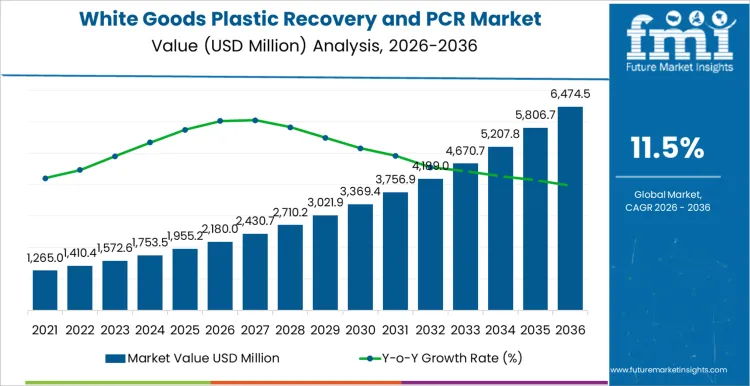
White Goods Plastic Recovery and PCR Market Key Takeaways
| Metric | Value |
|---|---|
| Market Value (2026) | USD 2,180.0 million |
| Market Forecast Value (2036) | USD 6,474.5 million |
| Forecast CAGR 2026 to 2036 | 11.5% |
Who are the Major Exporting and Importing Countries in the White Goods Plastic Recovery and PCR Space?
Major exporting and importing countries in the white goods plastic recovery and post-consumer recycled plastics market reflect broader global flows of recycled plastics and plastic waste. The global recycled plastic trade includes numerous exporting nations that supply recovered plastic feedstock used in manufacturing including for white goods components. China, United States, and Vietnam rank among the largest exporters of recycled plastic globally according to export shipment data, with substantial volumes of PCR pellets and scrap shipped to international buyers. South Korea and Malaysia also feature as notable suppliers of recycled plastics on world markets. These exporting countries provide critical feedstock for manufacturing industries that incorporate PCR materials into products such as housings and components for appliances.
On the importing side several large economies lead demand for recycled plastics and plastic waste used in recovery and reprocessing. United States, China, and India are among the top importers of recycled plastic shipments, drawing material from global suppliers to support domestic recycling and manufacturing markets. Turkey and Malaysia have historically been significant importers of plastic waste for recycling and reuse, particularly after major policy shifts like China’s waste import ban reshaped trade flows. European countries also import specific grades of recycled plastic to supply their recycling and polymer markets where demand for PCR content is rising under regulatory drivers.
How Is the White Goods Plastic Recovery and PCR Industry Segmented?
Demand for white goods plastic recovery and PCR materials is shaped by extended producer responsibility frameworks, appliance take-back programs, and material circularity targets. Manufacturers focus on recovering high-quality plastics from end-of-life appliances while maintaining consistency for reintegration into new products. Recovery efficiency, dismantling automation, and polymer separation accuracy influence system design. Segmentation by end use, appliance segment, and polymer type explains how recovery pathways align with appliance complexity, material purity requirements, and reintegration feasibility across large household appliances.
Which End Use Accounts for the Largest Share in White Goods Plastic Recovery?
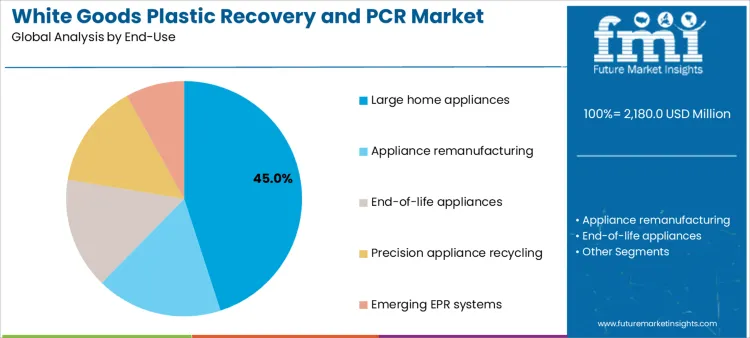
Large home appliances account for 45.0%, reflecting the substantial plastic volume generated from refrigerators, washing machines, and similar equipment at end of life. These appliances offer predictable material streams suitable for organized dismantling and recovery operations. Appliance remanufacturing, end-of-life appliances, precision appliance recycling, and emerging EPR systems represent additional recovery pathways focused on extending product life or improving material traceability. End-use segmentation reflects prioritization of high-volume appliance categories where recovery economics, regulatory compliance, and material consistency converge to support PCR integration into new appliance manufacturing.
Key Points:
- Large appliances generate the highest recoverable plastic volumes.
- Remanufacturing extends material and product life cycles.
- EPR systems improve structured recovery participation.
How Do Appliance Segments Influence Plastic Recovery Strategies?
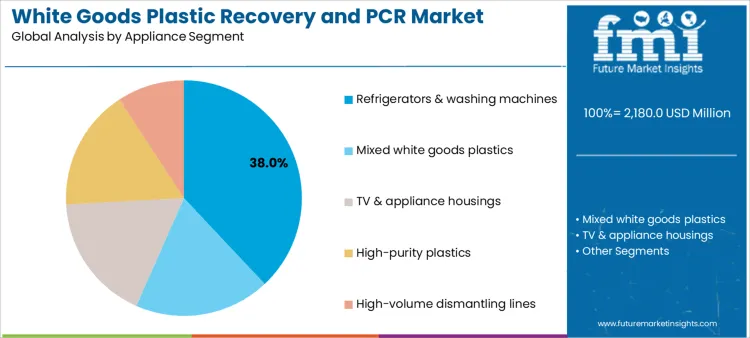
Refrigerators and washing machines represent 38.0%, driven by standardized designs and consistent plastic housings suitable for automated dismantling. Mixed white goods plastics include varied appliance types requiring advanced sorting to manage polymer diversity. TV and appliance housings contribute additional plastic streams where cosmetic quality influences reuse potential. High-purity plastics and high-volume dismantling lines support recovery efficiency through targeted separation and throughput optimization. Appliance segment differentiation highlights how design uniformity, material composition, and processing scale affect recovery yield and PCR suitability.
Key Points:
- Refrigerators and washers enable predictable recovery workflows.
- Mixed appliance streams require advanced sorting systems.
- High-volume lines improve recovery efficiency and consistency.
Which Polymer Types Dominate PCR Output from White Goods Recycling?
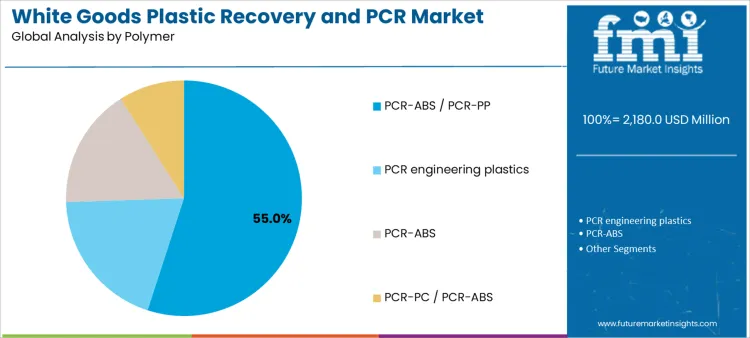
PCR-ABS and PCR-PP account for 55.0%, reflecting widespread use in appliance housings, internal components, and structural parts. These polymers offer favorable mechanical properties and recyclability for closed-loop applications. PCR engineering plastics include higher-performance materials recovered for specialized reuse. PCR-ABS and PCR-PC or PCR-ABS blends address applications requiring enhanced impact resistance or heat stability. Polymer segmentation reflects alignment between recovered material quality, performance requirements, and reintegration into new appliance components.
Key Points:
- PCR-ABS and PCR-PP dominate recovered polymer output.
- Engineering plastics support higher-performance reuse cases.
- Polymer blends address durability and thermal demands.
What are the Key Dynamics in the White Goods Plastic Recovery and PCR Market?
The demand in the white goods plastic recovery and post-consumer recycled (PCR) market is largely driven by appliance manufacturers facing pressure to meet sustainability targets and regulatory requirements for recycled content. Plastics recovered from discarded appliances like refrigerators, washing machines, dishwashers, and air conditioners are repurposed for new products such as housings, brackets, and internal components. The key to success in this market lies in ensuring consistent material quality, minimizing contamination, and meeting the mechanical property standards typically required by virgin plastics. Additionally, brands are increasingly linking their adoption of PCR plastics to their involvement in extended producer responsibility schemes and eco-labeling initiatives.
How do appliance design trends and performance requirements shape adoption?
As appliance designs evolve, manufacturers are looking for recycled plastics that can match the durability and performance of virgin materials. For example, refrigerator liners and washing machine door panels need to be tough and dimensionally stable, but achieving these properties can be difficult if recycled plastics are contaminated or vary in quality. Modular designs, which make appliances easier to service and repair, help improve the quality of recovered plastics by separating materials more efficiently, reducing contamination. However, as appliances with integrated electronics grow in popularity, they require PCR plastics with predictable melting behavior and flame resistance, so manufacturers must carefully evaluate the performance of recycled materials.
How do collection logistics and material quality constraints influence market growth?
The growth of the white goods plastic recovery and PCR market is held back by the complexities of collecting and sorting plastics from end-of-life appliances. Sorting technologies must be advanced enough to distinguish between high-value plastics such as ABS, PP, HIPS, and PC, as well as separating foams, metals, and composite parts. These sorting processes add time and costs to the recycling process, and if contamination levels are too high, the quality of the final product decreases, resulting in downcycled materials. Regulatory differences in recycling programs across regions also make it difficult to create a standard approach to appliance plastic recovery. To make the use of PCR plastics viable, manufacturers need to find ways to balance investment in recycling infrastructure with fluctuating PCR resin prices, which must be competitive with virgin materials to expand adoption in appliance components.
How Is Demand for the White Goods Plastic Recovery and PCR Market Evolving Globally?
Global demand for white goods plastic recovery and post-consumer recycled (PCR) plastic is rising as the electronics and appliance sectors prioritize sustainability and circular economy practices. Growth reflects rising demand for recycled plastics in the production of household appliances, particularly as governments and industries push to reduce waste and improve material recovery rates. The use of recycled plastic in white goods supports both cost reduction and sustainability objectives. India records 15.2% CAGR, China records 13.8% CAGR, USA records 11.0% CAGR, Germany records 10.6% CAGR, and Japan records 9.6% CAGR. Adoption is driven by regulatory pressures, consumer demand for eco-friendly products, and the increasing availability of recycled plastic.
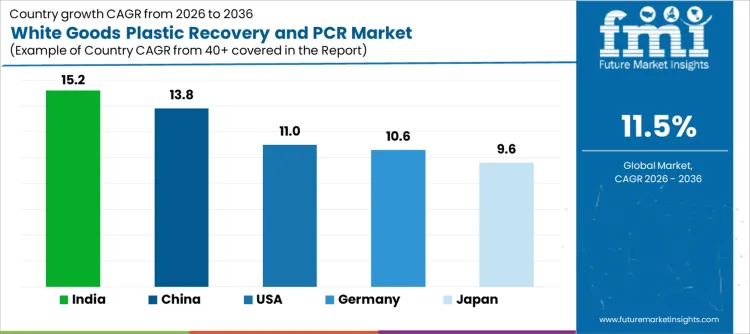
| Country | CAGR (%) |
|---|---|
| India | 15.2% |
| China | 13.8% |
| USA | 11.0% |
| Germany | 10.6% |
| Japan | 9.6% |
What is driving growth of white goods plastic recovery and PCR demand in India?
Demand for white goods plastic recovery and PCR plastic in India is expanding as the country strengthens its waste management infrastructure and embraces circular economy models. Growth at 15.2% CAGR reflects increasing adoption of recycled plastic in the production of household appliances, such as refrigerators, washing machines, and air conditioners. Government regulations, coupled with consumer demand for sustainable products, push manufacturers toward using recycled content to reduce plastic waste. Local recycling facilities are improving the quality and volume of recovered plastics, making them more accessible for manufacturers. Demand is strongest in the appliance and electronics sectors, where cost-effective and sustainable materials are becoming a priority.
- Government regulations on plastic waste management
- Rising adoption of recycled plastic in appliance manufacturing
- Consumer demand for sustainable products
- Expansion of local recycling infrastructure
Why is China seeing expansion in white goods plastic recovery and PCR adoption?
White goods plastic recovery and PCR plastic demand in China is rising as the country’s electronics and appliance industries increase their reliance on recycled materials to meet sustainability targets. Growth at 13.8% CAGR reflects the country’s efforts to improve material recovery rates and reduce environmental impact. The Chinese government’s focus on waste reduction and recycling is driving investments in advanced recycling technologies. As China’s appliance manufacturers adopt more eco-friendly production methods, the demand for high-quality PCR plastics, particularly in white goods, is expected to continue growing.
- Government-led push for recycling and waste reduction
- Increased adoption of recycled materials in appliance manufacturing
- Focus on improving material recovery efficiency
- Industry shift towards sustainable production methods
What factors are shaping white goods plastic recovery and PCR sales in the USA?
Sales of white goods plastic recovery and PCR plastic in the USA are increasing as manufacturers in the appliance sector embrace sustainable production practices. Growth at 11.0% CAGR reflects the strong shift towards using recycled plastic in household appliances, particularly as regulations on plastic waste become stricter. The demand for eco-friendly products is growing among consumers, pushing brands to incorporate more recycled content in their product lines. As recycling systems improve and the quality of recovered plastics increases, manufacturers are turning to PCR plastics to meet both regulatory requirements and consumer expectations.
- Stringent regulatory requirements for waste management
- Rising consumer demand for eco-friendly products
- Increased availability of high-quality PCR plastics
- Focus on sustainability in the appliance industry
How is Germany supporting growth of white goods plastic recovery and PCR demand?
White goods plastic recovery and PCR plastic demand in Germany is advancing as the country leads in circular economy initiatives and sustainable manufacturing practices. Growth at 10.6% CAGR reflects the increasing use of recycled plastic in the appliance sector, where stringent waste management regulations drive the adoption of PCR plastics. Germany’s commitment to high recycling rates and environmental responsibility is pushing appliance manufacturers to integrate more recycled materials into their products. The demand for white goods plastic recovery solutions is supported by Germany’s leadership in recycling technology and commitment to reducing plastic waste.
- Strong emphasis on circular economy and sustainability
- Stringent recycling regulations and compliance standards
- Increased demand for high-quality recycled plastics
- Leadership in recycling technology and infrastructure
What is driving expansion of white goods plastic recovery and PCR demand in Japan?
Demand for white goods plastic recovery and PCR plastic in Japan is rising as the country prioritizes sustainability in its electronics and appliance sectors. Growth at 9.6% CAGR reflects Japan’s focus on reducing plastic waste and increasing the use of recycled materials in consumer goods, particularly in household appliances. As Japan strengthens its recycling programs and invests in efficient material recovery technologies, the availability and quality of PCR plastics improve, driving greater adoption in the white goods industry. Demand is also fueled by consumer preference for eco-friendly products and the increasing focus on sustainability.
- Government-driven sustainability initiatives
- Growing consumer preference for eco-friendly products
- Investment in recycling technologies and infrastructure
- Adoption of recycled plastics in appliance manufacturing
What is the competitive landscape of demand for the white goods plastic recovery and PCR market globally?
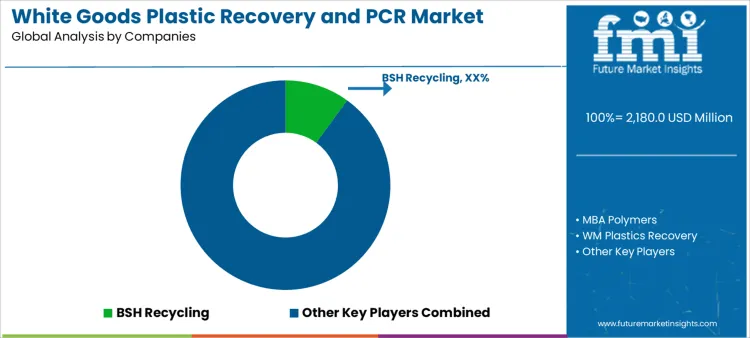
The white goods plastic recovery and PCR market is driven by the increasing need for sustainable recycling solutions to recover valuable plastics from discarded household appliances and electronics. Companies focus on enhancing recovery rates, separating mixed plastic streams, and improving the quality of post-consumer recycled (PCR) materials. Buyers assess processing efficiency, contamination control, and the ability to recover high-quality plastics suitable for reuse in manufacturing. Procurement behavior emphasizes the adoption of cost-effective recycling technologies, scalability of recovery systems, and compliance with environmental regulations. The market is seeing rising demand from manufacturers seeking to meet recycling quotas and incorporate PCR content into new products.
BSH Recycling leads competitive positioning by leveraging its established infrastructure for efficient plastic recovery and commitment to high-quality PCR output, particularly within the white goods sector. MBA Polymers stands out with its advanced sorting and recycling technologies that allow for high recovery rates from complex waste streams, including household appliances. WM Plastics Recovery supports demand with its comprehensive waste management systems, focusing on the recovery and recycling of plastics from large appliances. Eastman participates by combining chemical recycling solutions with its expertise in turning recovered plastic into high-quality PCR resins for the packaging and automotive sectors. GEM Co. and TCL Circular provide strong regional competition by focusing on both the collection and recycling of white goods plastics for local markets, while Panasonic Eco Technology emphasizes its sustainability goals through effective material recovery practices. DOWA focuses on industrial-scale recycling processes, integrating state-of-the-art separation technologies for higher-grade PCR plastic outputs.
Key Players in the White Goods Plastic Recovery and PCR Market
- BSH Recycling
- MBA Polymers
- WM Plastics Recovery
- Eastman
- GEM Co.
- TCL Circular
- Panasonic Eco Technology
- DOWA
Scope of the Report
| Items | Values |
|---|---|
| Quantitative Units | USD million |
| End-Use | Large home appliances; Appliance remanufacturing; End-of-life appliances; Precision appliance recycling; Emerging EPR systems |
| Appliance Segment | Refrigerators & washing machines; Mixed white goods plastics; TV & appliance housings; High-purity plastics; High-volume dismantling lines |
| Polymer | PCR-ABS / PCR-PP; PCR engineering plastics; PCR-ABS; PCR-PC / PCR-ABS |
| Regions Covered | Asia Pacific, Europe, North America, Latin America, Middle East & Africa |
| Countries Covered | India, China, USA, Germany, Japan, and 40+ countries |
| Key Companies Profiled | BSH Recycling; MBA Polymers; WM Plastics Recovery; Eastman; GEM Co.; TCL Circular; Panasonic Eco Technology; DOWA |
| Additional Attributes | Dollar sales by end-use, appliance segment, and polymer type; effectiveness in recovering and remanufacturing high-purity plastics from white goods; role of emerging EPR systems in improving recycling efficiency; impact on reducing plastic waste and increasing the circularity of appliance components; procurement dynamics shaped by appliance lifecycle management, regulatory standards, and supplier collaborations in sustainable recycling. |
White Goods Plastic Recovery and PCR Market by Segment
End-Use:
- Large home appliances
- Appliance remanufacturing
- End-of-life appliances
- Precision appliance recycling
- Emerging EPR systems
Appliance Segment:
- Refrigerators & washing machines
- Mixed white goods plastics
- TV & appliance housings
- High-purity plastics
- High-volume dismantling lines
Polymer:
- PCR-ABS / PCR-PP
- PCR engineering plastics
- PCR-ABS
- PCR-PC / PCR-ABS
Region:
- Asia Pacific
- China
- Japan
- South Korea
- India
- Australia & New Zealand
- ASEAN
- Rest of Asia Pacific
- Europe
- Germany
- United Kingdom
- France
- Italy
- Spain
- Nordic
- BENELUX
- Rest of Europe
- North America
- United States
- Canada
- Mexico
- Latin America
- Brazil
- Chile
- Rest of Latin America
- Middle East & Africa
- Kingdom of Saudi Arabia
- Other GCC Countries
- Turkey
- South Africa
- Other African Union
- Rest of Middle East & Africa
Bibliography
- European Commission. (2024). Directive (EU) 2018/851 amending Directive 2008/98/EC on waste (circular economy package) and packaging and packaging waste directive: Recycled content and extended producer responsibility provisions. Luxembourg: Publications Office of the European Union.
- Government of India, Ministry of Environment, Forest and Climate Change. (2023). Plastic Waste Management Rules, 2023: Extended producer responsibility, recycling targets, and compliance mechanisms. New Delhi, India: Government of India.
- United Nations Environment Programme. (2023). Turning off the tap: How the world can end plastic pollution and create a circular economy for plastics. Nairobi, Kenya: United Nations Environment Programme.
Frequently Asked Questions
How big is the white goods plastic recovery and pcr market in 2026?
The global white goods plastic recovery and pcr market is estimated to be valued at USD 2,180.0 million in 2026.
What will be the size of white goods plastic recovery and pcr market in 2036?
The market size for the white goods plastic recovery and pcr market is projected to reach USD 6,474.5 million by 2036.
How much will be the white goods plastic recovery and pcr market growth between 2026 and 2036?
The white goods plastic recovery and pcr market is expected to grow at a 11.5% CAGR between 2026 and 2036.
What are the key product types in the white goods plastic recovery and pcr market?
The key product types in white goods plastic recovery and pcr market are large home appliances, appliance remanufacturing, end-of-life appliances, precision appliance recycling and emerging epr systems.
Which appliance segment segment to contribute significant share in the white goods plastic recovery and pcr market in 2026?
In terms of appliance segment, refrigerators & washing machines segment to command 38.0% share in the white goods plastic recovery and pcr market in 2026.
Preview the report firsthand - request a free sample
Get SampleGet the brochure for pricing and purchase details.
Get PDFTable of Content
- Executive Summary
- Global Market Outlook
- Demand-side Trends
- Supply-side Trends
- Technology Roadmap Analysis
- Analysis and Recommendations
- Market Overview
- Market Coverage / Taxonomy
- Market Definition / Scope / Limitations
- Market Background
- Market Dynamics
- Drivers
- Restraints
- Opportunity
- Trends
- Scenario Forecast
- Demand in Optimistic Scenario
- Demand in Likely Scenario
- Demand in Conservative Scenario
- Opportunity Map Analysis
- Product Life Cycle Analysis
- Supply Chain Analysis
- Investment Feasibility Matrix
- Value Chain Analysis
- PESTLE and Porter’s Analysis
- Regulatory Landscape
- Regional Parent Market Outlook
- Production and Consumption Statistics
- Import and Export Statistics
- Market Dynamics
- Global Market Analysis 2021 to 2025 and Forecast, 2026 to 2036
- Historical Market Size Value (USD Million) Analysis, 2021 to 2025
- Current and Future Market Size Value (USD Million) Projections, 2026 to 2036
- Y-o-Y Growth Trend Analysis
- Absolute $ Opportunity Analysis
- Global Market Pricing Analysis 2021 to 2025 and Forecast 2026 to 2036
- Global Market Analysis 2021 to 2025 and Forecast 2026 to 2036, By End-Use
- Introduction / Key Findings
- Historical Market Size Value (USD Million) Analysis By End-Use , 2021 to 2025
- Current and Future Market Size Value (USD Million) Analysis and Forecast By End-Use , 2026 to 2036
- Large home appliances
- Appliance remanufacturing
- End-of-life appliances
- Precision appliance recycling
- Emerging EPR systems
- Large home appliances
- Y-o-Y Growth Trend Analysis By End-Use , 2021 to 2025
- Absolute $ Opportunity Analysis By End-Use , 2026 to 2036
- Global Market Analysis 2021 to 2025 and Forecast 2026 to 2036, By Appliance Segment
- Introduction / Key Findings
- Historical Market Size Value (USD Million) Analysis By Appliance Segment, 2021 to 2025
- Current and Future Market Size Value (USD Million) Analysis and Forecast By Appliance Segment, 2026 to 2036
- Refrigerators & washing machines
- Mixed white goods plastics
- TV & appliance housings
- High-purity plastics
- High-volume dismantling lines
- Refrigerators & washing machines
- Y-o-Y Growth Trend Analysis By Appliance Segment, 2021 to 2025
- Absolute $ Opportunity Analysis By Appliance Segment, 2026 to 2036
- Global Market Analysis 2021 to 2025 and Forecast 2026 to 2036, By Polymer
- Introduction / Key Findings
- Historical Market Size Value (USD Million) Analysis By Polymer, 2021 to 2025
- Current and Future Market Size Value (USD Million) Analysis and Forecast By Polymer, 2026 to 2036
- PCR-ABS / PCR-PP
- PCR engineering plastics
- PCR-ABS
- PCR-PC / PCR-ABS
- PCR-ABS / PCR-PP
- Y-o-Y Growth Trend Analysis By Polymer, 2021 to 2025
- Absolute $ Opportunity Analysis By Polymer, 2026 to 2036
- Global Market Analysis 2021 to 2025 and Forecast 2026 to 2036, By Region
- Introduction
- Historical Market Size Value (USD Million) Analysis By Region, 2021 to 2025
- Current Market Size Value (USD Million) Analysis and Forecast By Region, 2026 to 2036
- North America
- Latin America
- Western Europe
- Eastern Europe
- East Asia
- South Asia and Pacific
- Middle East & Africa
- Market Attractiveness Analysis By Region
- North America Market Analysis 2021 to 2025 and Forecast 2026 to 2036, By Country
- Historical Market Size Value (USD Million) Trend Analysis By Market Taxonomy, 2021 to 2025
- Market Size Value (USD Million) Forecast By Market Taxonomy, 2026 to 2036
- By Country
- USA
- Canada
- Mexico
- By End-Use
- By Appliance Segment
- By Polymer
- By Country
- Market Attractiveness Analysis
- By Country
- By End-Use
- By Appliance Segment
- By Polymer
- Key Takeaways
- Latin America Market Analysis 2021 to 2025 and Forecast 2026 to 2036, By Country
- Historical Market Size Value (USD Million) Trend Analysis By Market Taxonomy, 2021 to 2025
- Market Size Value (USD Million) Forecast By Market Taxonomy, 2026 to 2036
- By Country
- Brazil
- Chile
- Rest of Latin America
- By End-Use
- By Appliance Segment
- By Polymer
- By Country
- Market Attractiveness Analysis
- By Country
- By End-Use
- By Appliance Segment
- By Polymer
- Key Takeaways
- Western Europe Market Analysis 2021 to 2025 and Forecast 2026 to 2036, By Country
- Historical Market Size Value (USD Million) Trend Analysis By Market Taxonomy, 2021 to 2025
- Market Size Value (USD Million) Forecast By Market Taxonomy, 2026 to 2036
- By Country
- Germany
- UK
- Italy
- Spain
- France
- Nordic
- BENELUX
- Rest of Western Europe
- By End-Use
- By Appliance Segment
- By Polymer
- By Country
- Market Attractiveness Analysis
- By Country
- By End-Use
- By Appliance Segment
- By Polymer
- Key Takeaways
- Eastern Europe Market Analysis 2021 to 2025 and Forecast 2026 to 2036, By Country
- Historical Market Size Value (USD Million) Trend Analysis By Market Taxonomy, 2021 to 2025
- Market Size Value (USD Million) Forecast By Market Taxonomy, 2026 to 2036
- By Country
- Russia
- Poland
- Hungary
- Balkan & Baltic
- Rest of Eastern Europe
- By End-Use
- By Appliance Segment
- By Polymer
- By Country
- Market Attractiveness Analysis
- By Country
- By End-Use
- By Appliance Segment
- By Polymer
- Key Takeaways
- East Asia Market Analysis 2021 to 2025 and Forecast 2026 to 2036, By Country
- Historical Market Size Value (USD Million) Trend Analysis By Market Taxonomy, 2021 to 2025
- Market Size Value (USD Million) Forecast By Market Taxonomy, 2026 to 2036
- By Country
- China
- Japan
- South Korea
- By End-Use
- By Appliance Segment
- By Polymer
- By Country
- Market Attractiveness Analysis
- By Country
- By End-Use
- By Appliance Segment
- By Polymer
- Key Takeaways
- South Asia and Pacific Market Analysis 2021 to 2025 and Forecast 2026 to 2036, By Country
- Historical Market Size Value (USD Million) Trend Analysis By Market Taxonomy, 2021 to 2025
- Market Size Value (USD Million) Forecast By Market Taxonomy, 2026 to 2036
- By Country
- India
- ASEAN
- Australia & New Zealand
- Rest of South Asia and Pacific
- By End-Use
- By Appliance Segment
- By Polymer
- By Country
- Market Attractiveness Analysis
- By Country
- By End-Use
- By Appliance Segment
- By Polymer
- Key Takeaways
- Middle East & Africa Market Analysis 2021 to 2025 and Forecast 2026 to 2036, By Country
- Historical Market Size Value (USD Million) Trend Analysis By Market Taxonomy, 2021 to 2025
- Market Size Value (USD Million) Forecast By Market Taxonomy, 2026 to 2036
- By Country
- Kingdom of Saudi Arabia
- Other GCC Countries
- Turkiye
- South Africa
- Other African Union
- Rest of Middle East & Africa
- By End-Use
- By Appliance Segment
- By Polymer
- By Country
- Market Attractiveness Analysis
- By Country
- By End-Use
- By Appliance Segment
- By Polymer
- Key Takeaways
- Key Countries Market Analysis
- USA
- Pricing Analysis
- Market Share Analysis, 2025
- By End-Use
- By Appliance Segment
- By Polymer
- Canada
- Pricing Analysis
- Market Share Analysis, 2025
- By End-Use
- By Appliance Segment
- By Polymer
- Mexico
- Pricing Analysis
- Market Share Analysis, 2025
- By End-Use
- By Appliance Segment
- By Polymer
- Brazil
- Pricing Analysis
- Market Share Analysis, 2025
- By End-Use
- By Appliance Segment
- By Polymer
- Chile
- Pricing Analysis
- Market Share Analysis, 2025
- By End-Use
- By Appliance Segment
- By Polymer
- Germany
- Pricing Analysis
- Market Share Analysis, 2025
- By End-Use
- By Appliance Segment
- By Polymer
- UK
- Pricing Analysis
- Market Share Analysis, 2025
- By End-Use
- By Appliance Segment
- By Polymer
- Italy
- Pricing Analysis
- Market Share Analysis, 2025
- By End-Use
- By Appliance Segment
- By Polymer
- Spain
- Pricing Analysis
- Market Share Analysis, 2025
- By End-Use
- By Appliance Segment
- By Polymer
- France
- Pricing Analysis
- Market Share Analysis, 2025
- By End-Use
- By Appliance Segment
- By Polymer
- India
- Pricing Analysis
- Market Share Analysis, 2025
- By End-Use
- By Appliance Segment
- By Polymer
- ASEAN
- Pricing Analysis
- Market Share Analysis, 2025
- By End-Use
- By Appliance Segment
- By Polymer
- Australia & New Zealand
- Pricing Analysis
- Market Share Analysis, 2025
- By End-Use
- By Appliance Segment
- By Polymer
- China
- Pricing Analysis
- Market Share Analysis, 2025
- By End-Use
- By Appliance Segment
- By Polymer
- Japan
- Pricing Analysis
- Market Share Analysis, 2025
- By End-Use
- By Appliance Segment
- By Polymer
- South Korea
- Pricing Analysis
- Market Share Analysis, 2025
- By End-Use
- By Appliance Segment
- By Polymer
- Russia
- Pricing Analysis
- Market Share Analysis, 2025
- By End-Use
- By Appliance Segment
- By Polymer
- Poland
- Pricing Analysis
- Market Share Analysis, 2025
- By End-Use
- By Appliance Segment
- By Polymer
- Hungary
- Pricing Analysis
- Market Share Analysis, 2025
- By End-Use
- By Appliance Segment
- By Polymer
- Kingdom of Saudi Arabia
- Pricing Analysis
- Market Share Analysis, 2025
- By End-Use
- By Appliance Segment
- By Polymer
- Turkiye
- Pricing Analysis
- Market Share Analysis, 2025
- By End-Use
- By Appliance Segment
- By Polymer
- South Africa
- Pricing Analysis
- Market Share Analysis, 2025
- By End-Use
- By Appliance Segment
- By Polymer
- USA
- Market Structure Analysis
- Competition Dashboard
- Competition Benchmarking
- Market Share Analysis of Top Players
- By Regional
- By End-Use
- By Appliance Segment
- By Polymer
- Competition Analysis
- Competition Deep Dive
- BSH Recycling
- Overview
- Product Portfolio
- Profitability by Market Segments (Product/Age /Sales Channel/Region)
- Sales Footprint
- Strategy Overview
- Marketing Strategy
- Product Strategy
- Channel Strategy
- MBA Polymers
- WM Plastics Recovery
- Eastman
- GEM Co.
- TCL Circular
- Panasonic Eco Technology
- DOWA
- BSH Recycling
- Competition Deep Dive
- Assumptions & Acronyms Used
- Research Methodology


