

- Industry Size (2026)
- USD 1320 Mn
- Forecast (2036)
- USD 4683.1 Mn
- CAGR (2026 to 2036)
- 13.50%
Marine Waste-Derived PCR Plastics Market Forecast and Outlook 2026 to 2036
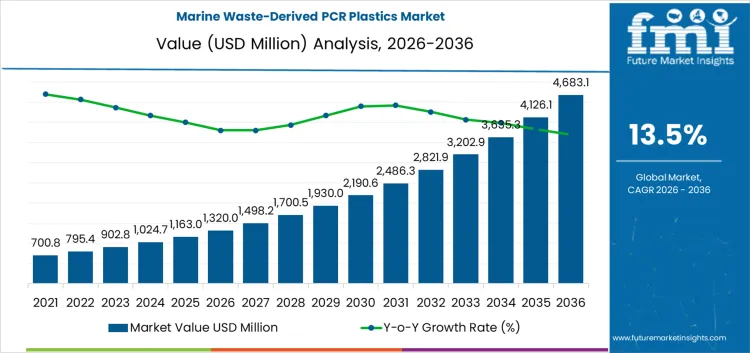
The marine waste-derived PCR plastics market is projected to expand from USD 1,320 million in 2026 to USD 4,683.1 million by 2036, registering a CAGR of 13.5%. This market occupies a distinct position within the recycled plastics landscape, driven less by volume substitution and more by credibility, traceability, and brand differentiation. Marine-sourced feedstocks introduce higher collection, processing, and qualification complexity, which elevates costs but also supports premium positioning. Commercial adoption is concentrated in packaging and consumer goods where storytelling value, visible sustainability claims, and standardized formats enable controlled integration.
Supply remains structurally constrained, making long-term sourcing agreements and hybrid blends with conventional PCR common procurement strategies. Buyers place strong emphasis on certification, chain-of-custody documentation, and consistent material performance to mitigate reputational and operational risk. As a result, growth quality depends on suppliers’ ability to stabilize variable feedstock, scale advanced washing and deodorization processes, and defend impact claims under regulatory scrutiny. Between 2026 and 2036, market expansion will favor performance-validated, traceable solutions rather than commoditized recycled resins.
Quick Stats for Marine Waste-Derived PCR Plastics Market
- Marine Waste-Derived PCR Plastics Market Value (2026): USD 1,320 Million
- Marine Waste-Derived PCR Plastics Market Forecast Value (2036): USD 4,683.1 Million
- Marine Waste-Derived PCR Plastics Market Forecast CAGR 2026 to 2036: 13.5%
- Leading Product Type in Marine Waste-Derived PCR Plastics Market: Rigid & Flexible Plastics (28% share)
- Key Growth Regions in Marine Waste-Derived PCR Plastics Market: Asia Pacific, Europe, North America
- Key Players in Marine Waste-Derived PCR Plastics Market: BASF SE, Covestro AG, Oceanworks, Inc., Envision Plastics Industries, LLC, GEM Co., Ltd., Far Eastern New Century Corporation, Toray Industries, Inc., JEPLAN, Inc.
Marine Waste-Derived PCR Plastics Market Key Takeaways
| Metric | Value |
|---|---|
| Marine Waste-Derived PCR Plastics Market Value (2026) | USD 1,320 Million |
| Marine Waste-Derived PCR Plastics Market Forecast Value (2036) | USD 4,683.1 Million |
| Marine Waste-Derived PCR Plastics Market Forecast CAGR 2026 to 2036 | 13.50% |
How are Feedstock Qualification and Brand Credibility Requirements Shaping the Marine Waste-Derived PCR Plastics Market?
The marine waste-derived PCR plastics market is expanding as brands seek differentiated recycled materials that deliver both environmental impact and storytelling value. Unlike conventional PCR, marine-sourced feedstocks require complex collection, sorting, and pre-processing across coastal regions, rivers, and ports. For material suppliers, demand is shifting toward solutions that can translate highly variable waste streams into consistent, application-ready resins while preserving traceability claims that matter to brand owners and regulators.
Qualification rigor is a primary driver of supplier selection. Marine waste plastics often carry higher contamination, odor, and degradation risks, increasing the importance of advanced washing, deodorization, and stabilization technologies. Converters and OEMs are prioritizing suppliers that provide performance data on melt stability, mechanical strength, and aesthetics particularly for consumer goods and packaging applications. Offering compounded grades, controlled blends with conventional PCR, and technical support during trials is becoming essential to reduce adoption risk.
Scale-up economics and credibility management are also shaping long-term growth. Volumes of marine waste remain limited relative to demand, pushing buyers toward long-term sourcing agreements and hybrid formulations to ensure continuity. Certification, chain-of-custody documentation, and impact verification are increasingly tied to commercial contracts, not marketing alone. For stakeholders across the value chain, competitive advantage in the marine waste-derived PCR plastics market depends on combining reliable material performance with defensible sourcing narratives positioning these materials as premium, impact-led inputs rather than commodity recyclates.
How Is The Marine Waste-Derived PCR Plastics Market Structured By End Use And Product Type?
The marine waste-derived PCR plastics market is segmented by end use and product type, reflecting how recovered material streams are converted into commercially viable plastic formats. By end use, packaging and consumer goods lead adoption, supported by high-volume applications that can absorb consistent resin output. Other end uses include apparel and durable goods, consumer packaging, premium consumer products, FMCG and textiles, and regional packaging programs that apply material grades based on performance needs. By product type, rigid and flexible plastics form the leading category, while injection-moulded parts, bottles and containers, and specialty plastics address application-specific processing and design requirements.
Why Do Packaging And Consumer Goods Lead End-Use Demand In The Marine Waste-Derived PCR Plastics Market?
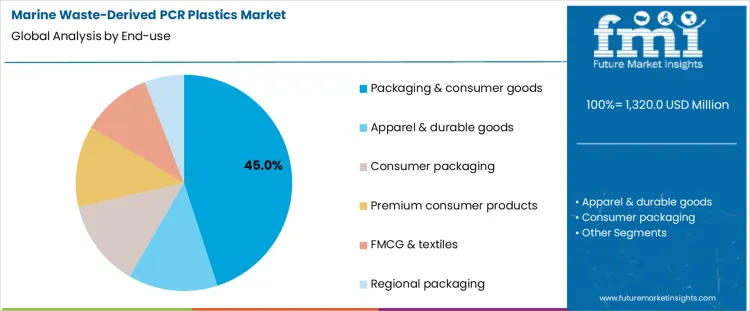
Packaging and consumer goods account for 45% share of the marine waste-derived PCR plastics market because these categories require large, repeatable volumes of plastic materials across standardized formats. Rigid containers, flexible packs, and household items can incorporate consistent resin grades while maintaining functional performance. High production throughput enables steady material uptake and supports qualification across multiple SKUs. Converters favor these applications due to compatibility with existing extrusion and molding lines. Retail distribution amplifies demand through frequent replenishment cycles. For material suppliers, packaging and consumer goods offer predictable offtake and long-term supply agreements, explaining why this end-use segment remains the largest demand center.
Why Do Rigid And Flexible Plastics Dominate Product Type Adoption?
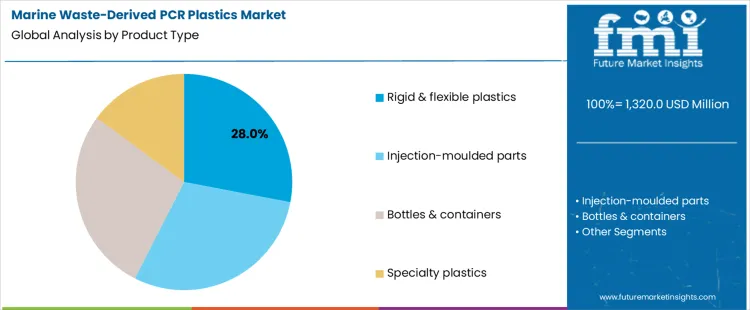
Rigid and flexible plastics hold 28% share of the marine waste-derived PCR plastics market because they represent the most versatile and widely processed product forms. These formats cover films, sheets, containers, and molded items used across packaging and consumer applications. Processing routes such as extrusion, thermoforming, and blow molding readily accommodate these materials at scale. Their adaptability allows manufacturers to meet different strength, thickness, and barrier requirements without extensive tooling changes. Rigid and flexible plastics also support efficient logistics and storage during conversion. These processing flexibility and application breadth advantages explain their dominance among product types.
What Are The Key Dynamics Of The Marine Waste-Derived PCR Plastics Market?
The marine waste-derived PCR plastics market is shaped by the demand for recycled materials sourced specifically from ocean, coastal, and aquatic litter streams that are processed into usable post-consumer recycled (PCR) polymers. Brand owners and converters in packaging, consumer goods, and specialty applications are seeking differentiated PCR feedstocks that demonstrate origin from marine waste collection efforts. For recyclers and compounders, securing consistent marine litter input, implementing effective cleaning and decontamination processes, and producing polymers with reliable mechanical and processing properties are central to commercialization. Contracts with coastal cleanup organizations, municipal waste programs, and global brands influence market scale and supply predictability.
How Are Collection, Sorting, And Processing Technologies Shaping This Market?
Collection, sorting, and processing technologies are shaping the marine waste-derived PCR plastics market by enabling more efficient recovery, classification, and refinement of ocean-bound polymers into high-value resin streams. Advanced coastal and river-based collection systems often coupled with community and NGO initiatives improve input feedstock volumes. Sorting technologies combining AI, optical recognition, and robotics enhance identification of marine plastics versus mixed waste. Effective washing, decontamination, and contaminant removal processes (including microplastic separation) are critical to achieving PCR resin quality compatible with downstream extrusion, injection molding, or film production. Suppliers that offer end-to-end systems from feedstock handling to pelletizing can streamline converter adoption.
Why Do Feedstock Variability And Quality Assurance Challenges Restrain Market Adoption?
Feedstock variability and quality assurance challenges restrain the marine waste-derived PCR plastics market because marine litter streams exhibit wide variation in polymer types, degradation levels, and contaminant burdens. Materials recovered from aquatic environments often contain salts, biofilm residues, and weathered polymers with altered mechanical properties, requiring rigorous washing and quality control. Achieving consistent intrinsic viscosity, color, and performance benchmarks comparable to conventional PCR resins is technically demanding and increases processing cost. Conveying origin claims and validating material sourcing (e.g., certification for marine origin) while ensuring functional equivalence in converters’ processes adds complexity to qualification cycles, slowing broader adoption.
What is The Country-Level Overview And Growth Outlook For The Marine Waste-Derived PCR Plastics Market?
The marine waste-derived PCR plastics market is developing as manufacturers seek alternative recycled feedstocks sourced from ocean-bound and coastal plastic waste streams. These systems integrate waste collection from marine and near-marine environments, sorting and cleaning infrastructure, polymer reprocessing, and material certification frameworks to convert recovered plastics into usable PCR resins. Country-level growth varies based on coastline length, waste recovery infrastructure, policy enforcement, and brand participation in marine waste programs. Mature markets focus on material quality, traceability, and controlled integration into packaging and consumer goods, while high-growth regions emphasize scale, feedstock availability, and rapid incorporation into mass-market applications.
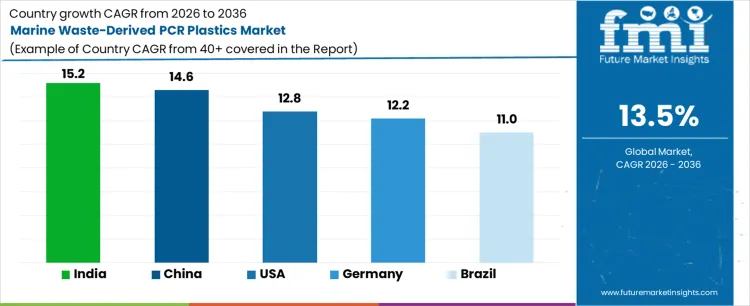
| Country | CAGR (%) |
|---|---|
| India | 15.2 |
| China | 14.6 |
| USA | 12.8 |
| Germany | 12.2 |
| Brazil | 11.0 |
How is Germany Building Quality-Controlled Marine Waste-Derived PCR Plastics Supply Chains?
Demand for marine waste-derived PCR plastics is developing through tightly controlled sourcing and material qualification frameworks, expanding at a CAGR of 12.2% during 2026-2036. German adoption focuses on integrating marine-origin plastics into existing PCR streams while maintaining strict performance and quality thresholds. Collection is often linked to certified coastal recovery programs and international partnerships rather than domestic marine volumes alone. Buyers emphasize traceability, contamination control, and consistency of resin properties before approving marine-derived materials for packaging and consumer goods. Adoption typically begins with non-food or secondary packaging applications, followed by gradual expansion as confidence in material stability improves. Procurement decisions are driven by engineering, quality, and compliance teams, resulting in extended validation timelines. Market value accrues to suppliers offering documented sourcing, stable formulations, and compatibility with established processing infrastructure. Germany represents a quality-driven market where success depends on governance, material integrity, and long-term supplier credibility rather than rapid scale.
What is Driving USA Demand for Marine Waste-Derived PCR Plastics?
In the United States, the marine waste-derived PCR plastics market is expanding at a CAGR of 12.8% during 2026-2036, driven by brand-led initiatives targeting differentiated recycled content sourcing. USA brands adopt marine-derived PCR to support packaging narratives and diversify recycled feedstock supply beyond conventional post-consumer streams. Collection programs are often tied to coastal cleanup initiatives, nonprofit partnerships, and extended supply networks. Buyers prioritize scalability, resin availability, and processing flexibility across multiple product lines. Qualification cycles are shorter than in Europe, enabling faster commercialization, particularly in rigid packaging, consumer goods, and promotional applications. Procurement favors suppliers capable of blending marine-derived PCR with conventional PCR to achieve cost and performance balance. Market value is created through flexibility, storytelling alignment, and the ability to support national brand rollouts. The USA represents a commercialization-focused market where speed, volume access, and formulation adaptability are critical success factors.
Why Is China Scaling Marine Waste-Derived PCR Plastics So Rapidly?
China’s marine waste-derived PCR plastics market is growing at a CAGR of 14.6% during 2026-2036, supported by extensive coastal activity and large-scale waste recovery programs. Adoption is driven by the need to supplement traditional PCR feedstocks while managing high volumes of ocean-bound plastics. Chinese processors focus on throughput efficiency, cost optimization, and integration of marine-derived inputs into mass-market resin grades. Buyers emphasize volume availability, processing consistency, and price competitiveness rather than premium certification depth. Deployment is rapid, with marine-derived PCR often blended into packaging, consumer goods, and industrial applications at scale. Procurement favors suppliers with strong local collection networks, high-capacity washing and reprocessing systems, and reliable logistics. Qualification cycles are brief, with performance validated in production environments. China represents a scale-led market where competitive advantage depends on operational efficiency, feedstock access, and the ability to process large marine waste volumes consistently.
How Is Brazil Developing Marine Waste-Derived PCR Plastics Within Coastal Recovery Programs?
Brazil’s marine waste-derived PCR plastics market is expanding at a CAGR of 11.0% during the forecast period, shaped by coastal recovery initiatives and growing interest from packaging and consumer goods companies. Adoption is concentrated near major coastal regions where marine waste collection programs are most active. Buyers focus on affordability, availability, and the ability to integrate marine-derived PCR into existing processing lines with minimal modification. Applications are primarily in non-food packaging, consumer goods, and construction-related products. Rollouts are incremental, often supported by public-private partnerships and international funding. Procurement decisions favor suppliers offering flexible blends, stable supply, and local technical support. Certification and traceability are important but balanced against cost considerations. Brazil represents a pragmatic market where growth depends on scalable recovery programs, cost-efficient processing, and alignment with regional manufacturing capabilities rather than highly specialized resin grades.
Why Is India the Fastest-Growing Market for Marine Waste-Derived PCR Plastics?
Sale of marine waste-derived PCR plastics in India is projected to grow at a CAGR of 15.2% during 2026-2036, driven by extensive coastlines, rising waste recovery efforts, and strong demand for alternative recycled feedstocks. Adoption is largely greenfield-led, with marine-derived PCR integrated early into new product and packaging designs. Buyers emphasize affordability, processing flexibility, and access to consistent material volumes. Marine waste collection is often coordinated through coastal cleanup programs, local aggregators, and emerging recycling clusters. Qualification cycles are relatively short, enabling rapid deployment across packaging, household goods, and infrastructure applications. Procurement favors suppliers with local sourcing capability, scalable processing, and responsive technical support. Market value is created through speed, cost efficiency, and the ability to convert diverse marine waste streams into usable PCR resins. India represents a high-growth market where scale, adaptability, and supply reliability define competitiveness.
How are Companies Competing in the Marine Waste-Derived PCR Plastics Market?
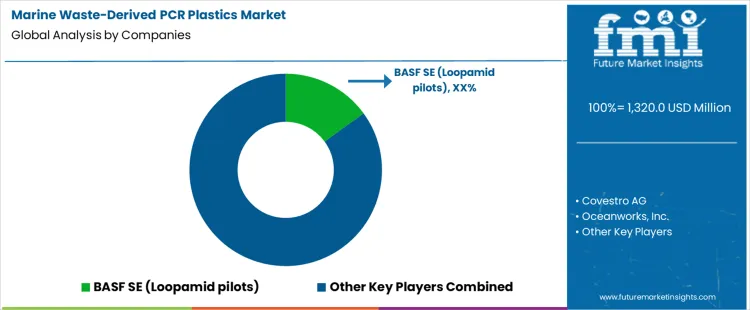
Competition in the marine waste-derived PCR plastics market is anchored in validated feedstock traceability, material performance, and documented integration with existing manufacturing processes that matter to brand owners, converters, and sustainability teams. BASF SE positions its marine waste-derived PCR initiatives such as Loopamid pilot projects with official materials highlighting proprietary sorting and purification processes that elevate polymer quality for engineered applications. Product literature emphasizes traceability systems and performance benchmarks that align recycled content with mechanical and thermal requirements of end users.
Covestro AG competes through high-value resin grades incorporating marine-sourced PCR, backed by brochures that detail material properties such as impact strength and elongation tailored for durable consumer and industrial goods. Its documentation also underscores sustainability claims validated through third-party certification schemes. Oceanworks, Inc. differentiates by offering a digital marketplace and verification platform for marine waste PCR feedstocks; official resources emphasize robust chain-of-custody data and standardized quality parameters that support supply chain confidence. Envision Plastics Industries, LLC markets marine-derived PCR pellets with technical guides that outline consistent melt flow and processing windows suitable for blow molding and extrusion.
Regional and technology-driven players enhance competitive breadth. GEM Co., Ltd. (GEM High-Tech Co., Ltd.) positions its marine PCR offerings with product materials that stress high capture rates of ocean plastics and stable pellet characteristics for commodity applications. Far Eastern New Century Corporation competes with marine waste PCR integrated into broader recycled resin portfolios, with literature highlighting balanced performance and supply reliability for packaging and fiber applications. Toray Industries, Inc. and JEPLAN, Inc. emphasize advanced recycling mechanisms and marine-derived PCR grades with official documentation focused on mechanical performance and contamination control, enabling integration into high-value products. Across all suppliers, competitive value is defined by brochure-verified feedstock traceability, performance consistency, and documented compliance with food contact or technical application standards rather than unit cost alone.
Key Players in Marine Waste-Derived PCR Plastics Market
- BASF SE (Loopamid pilots)
- Covestro AG
- Oceanworks, Inc.
- Envision Plastics Industries, LLC
- GEM Co., Ltd. (GEM High-Tech Co., Ltd.)
- Far Eastern New Century Corporation
- Toray Industries, Inc.
- JEPLAN, Inc.
Scope of Report
| Attribute | Description |
|---|---|
| Quantitative Unit | USD Million |
| End-use | Packaging & Consumer Goods, Apparel & Durable Goods, Consumer Packaging, Premium Consumer Products, FMCG & Textiles, Regional Packaging |
| Product Type | Rigid & Flexible Plastics, Injection-Moulded Parts, Bottles & Containers, Specialty Plastics |
| Countries Covered | China, Japan, South Korea, India, Australia & New Zealand, ASEAN, Rest of Asia Pacific, Germany, United Kingdom, France, Italy, Spain, Nordic, BENELUX, Rest of Europe, United States, Canada, Mexico, Brazil, Chile, Rest of Latin America, Kingdom of Saudi Arabia, Other GCC Countries, Turkey, South Africa, Other African Union, Rest of Middle East & Africa |
| Regions Covered | Asia Pacific, Europe, North America, Latin America, Middle East & Africa |
| Key Companies Profiled | BASF SE (Loopamid pilots), Covestro AG, Oceanworks, Inc., Envision Plastics Industries, LLC, GEM Co., Ltd. (GEM High-Tech Co., Ltd.), Far Eastern New Century Corporation, Toray Industries, Inc., JEPLAN, Inc. |
| Additional Attributes | Dollar sales by end-use and product type are evaluated across marine waste recovery and PCR plastic value chains. The report includes country-level demand assessment, growth projections for 2026-2036, analysis of feedstock sourcing and contamination control, evaluation of traceability and certification standards, competitive benchmarking of suppliers, and assessment of sustainability-led adoption across packaging, apparel, and consumer goods markets. |
Marine Waste-Derived PCR Plastics Market by Key Segments
End-use
- Packaging & consumer goods
- Apparel & durable goods
- Consumer packaging
- Premium consumer products
- FMCG & textiles
- Regional packaging
Product Type
- Rigid & flexible plastics
- Injection-moulded parts
- Bottles & containers
- Specialty plastics
Region
- Asia Pacific
- China
- Japan
- South Korea
- India
- Australia & New Zealand
- ASEAN
- Rest of Asia Pacific
- Europe
- Germany
- United Kingdom
- France
- Italy
- Spain
- Nordic
- BENELUX
- Rest of Europe
- North America
- United States
- Canada
- Mexico
- Latin America
- Brazil
- Chile
- Rest of Latin America
- Middle East & Africa
- Kingdom of Saudi Arabia
- Other GCC Countries
- Turkey
- South Africa
- Other African Union
- Rest of Middle East & Africa
Bibliography
- Organisation for Economic Co-operation and Development. (2024). Plastics recycled content requirements (Environment Working Paper No. 236). OECD Publishing.
- United Nations Environment Programme & Secretariat of the Basel Convention. (2023). Technical document on the life-cycle impacts of plastics. UN Environment Programme.
- European Commission. (2025). Circular economy action plan: Updated EU strategy for plastics in the circular economy. Publications Office of the European Union.
Frequently Asked Questions
How big is the marine waste-derived PCR plastics market in 2026?
The global marine waste-derived PCR plastics market is estimated to be valued at USD 1,320.0 million in 2026.
What will be the size of marine waste-derived PCR plastics market in 2036?
The market size for the marine waste-derived PCR plastics market is projected to reach USD 4,683.1 million by 2036.
How much will be the marine waste-derived PCR plastics market growth between 2026 and 2036?
The marine waste-derived PCR plastics market is expected to grow at a 13.5% CAGR between 2026 and 2036.
What are the key product types in the marine waste-derived PCR plastics market?
The key product types in marine waste-derived PCR plastics market are packaging & consumer goods, apparel & durable goods, consumer packaging, premium consumer products, fmcg & textiles and regional packaging.
Which product type segment to contribute significant share in the marine waste-derived PCR plastics market in 2026?
In terms of product type, rigid & flexible plastics segment to command 28.0% share in the marine waste-derived PCR plastics market in 2026.
Preview the report firsthand - request a free sample
Get SampleGet the brochure for pricing and purchase details.
Get PDFTable of Content
- Executive Summary
- Global Market Outlook
- Demand-side Trends
- Supply-side Trends
- Technology Roadmap Analysis
- Analysis and Recommendations
- Market Overview
- Market Coverage / Taxonomy
- Market Definition / Scope / Limitations
- Market Background
- Market Dynamics
- Drivers
- Restraints
- Opportunity
- Trends
- Scenario Forecast
- Demand in Optimistic Scenario
- Demand in Likely Scenario
- Demand in Conservative Scenario
- Opportunity Map Analysis
- Product Life Cycle Analysis
- Supply Chain Analysis
- Investment Feasibility Matrix
- Value Chain Analysis
- PESTLE and Porter’s Analysis
- Regulatory Landscape
- Regional Parent Market Outlook
- Production and Consumption Statistics
- Import and Export Statistics
- Market Dynamics
- Global Market Analysis 2021 to 2025 and Forecast, 2026 to 2036
- Historical Market Size Value (USD Million) Analysis, 2021 to 2025
- Current and Future Market Size Value (USD Million) Projections, 2026 to 2036
- Y-o-Y Growth Trend Analysis
- Absolute $ Opportunity Analysis
- Global Market Pricing Analysis 2021 to 2025 and Forecast 2026 to 2036
- Global Market Analysis 2021 to 2025 and Forecast 2026 to 2036, By End-use
- Introduction / Key Findings
- Historical Market Size Value (USD Million) Analysis By End-use , 2021 to 2025
- Current and Future Market Size Value (USD Million) Analysis and Forecast By End-use , 2026 to 2036
- Packaging & consumer goods
- Apparel & durable goods
- Consumer packaging
- Premium consumer products
- FMCG & textiles
- Regional packaging
- Packaging & consumer goods
- Y-o-Y Growth Trend Analysis By End-use , 2021 to 2025
- Absolute $ Opportunity Analysis By End-use , 2026 to 2036
- Global Market Analysis 2021 to 2025 and Forecast 2026 to 2036, By Product Type
- Introduction / Key Findings
- Historical Market Size Value (USD Million) Analysis By Product Type, 2021 to 2025
- Current and Future Market Size Value (USD Million) Analysis and Forecast By Product Type, 2026 to 2036
- Rigid & flexible plastics
- Injection-moulded parts
- Bottles & containers
- Specialty plastics
- Rigid & flexible plastics
- Y-o-Y Growth Trend Analysis By Product Type, 2021 to 2025
- Absolute $ Opportunity Analysis By Product Type, 2026 to 2036
- Global Market Analysis 2021 to 2025 and Forecast 2026 to 2036, By Region
- Introduction
- Historical Market Size Value (USD Million) Analysis By Region, 2021 to 2025
- Current Market Size Value (USD Million) Analysis and Forecast By Region, 2026 to 2036
- North America
- Latin America
- Western Europe
- Eastern Europe
- East Asia
- South Asia and Pacific
- Middle East & Africa
- Market Attractiveness Analysis By Region
- North America Market Analysis 2021 to 2025 and Forecast 2026 to 2036, By Country
- Historical Market Size Value (USD Million) Trend Analysis By Market Taxonomy, 2021 to 2025
- Market Size Value (USD Million) Forecast By Market Taxonomy, 2026 to 2036
- By Country
- USA
- Canada
- Mexico
- By End-use
- By Product Type
- By Country
- Market Attractiveness Analysis
- By Country
- By End-use
- By Product Type
- Key Takeaways
- Latin America Market Analysis 2021 to 2025 and Forecast 2026 to 2036, By Country
- Historical Market Size Value (USD Million) Trend Analysis By Market Taxonomy, 2021 to 2025
- Market Size Value (USD Million) Forecast By Market Taxonomy, 2026 to 2036
- By Country
- Brazil
- Chile
- Rest of Latin America
- By End-use
- By Product Type
- By Country
- Market Attractiveness Analysis
- By Country
- By End-use
- By Product Type
- Key Takeaways
- Western Europe Market Analysis 2021 to 2025 and Forecast 2026 to 2036, By Country
- Historical Market Size Value (USD Million) Trend Analysis By Market Taxonomy, 2021 to 2025
- Market Size Value (USD Million) Forecast By Market Taxonomy, 2026 to 2036
- By Country
- Germany
- UK
- Italy
- Spain
- France
- Nordic
- BENELUX
- Rest of Western Europe
- By End-use
- By Product Type
- By Country
- Market Attractiveness Analysis
- By Country
- By End-use
- By Product Type
- Key Takeaways
- Eastern Europe Market Analysis 2021 to 2025 and Forecast 2026 to 2036, By Country
- Historical Market Size Value (USD Million) Trend Analysis By Market Taxonomy, 2021 to 2025
- Market Size Value (USD Million) Forecast By Market Taxonomy, 2026 to 2036
- By Country
- Russia
- Poland
- Hungary
- Balkan & Baltic
- Rest of Eastern Europe
- By End-use
- By Product Type
- By Country
- Market Attractiveness Analysis
- By Country
- By End-use
- By Product Type
- Key Takeaways
- East Asia Market Analysis 2021 to 2025 and Forecast 2026 to 2036, By Country
- Historical Market Size Value (USD Million) Trend Analysis By Market Taxonomy, 2021 to 2025
- Market Size Value (USD Million) Forecast By Market Taxonomy, 2026 to 2036
- By Country
- China
- Japan
- South Korea
- By End-use
- By Product Type
- By Country
- Market Attractiveness Analysis
- By Country
- By End-use
- By Product Type
- Key Takeaways
- South Asia and Pacific Market Analysis 2021 to 2025 and Forecast 2026 to 2036, By Country
- Historical Market Size Value (USD Million) Trend Analysis By Market Taxonomy, 2021 to 2025
- Market Size Value (USD Million) Forecast By Market Taxonomy, 2026 to 2036
- By Country
- India
- ASEAN
- Australia & New Zealand
- Rest of South Asia and Pacific
- By End-use
- By Product Type
- By Country
- Market Attractiveness Analysis
- By Country
- By End-use
- By Product Type
- Key Takeaways
- Middle East & Africa Market Analysis 2021 to 2025 and Forecast 2026 to 2036, By Country
- Historical Market Size Value (USD Million) Trend Analysis By Market Taxonomy, 2021 to 2025
- Market Size Value (USD Million) Forecast By Market Taxonomy, 2026 to 2036
- By Country
- Kingdom of Saudi Arabia
- Other GCC Countries
- Turkiye
- South Africa
- Other African Union
- Rest of Middle East & Africa
- By End-use
- By Product Type
- By Country
- Market Attractiveness Analysis
- By Country
- By End-use
- By Product Type
- Key Takeaways
- Key Countries Market Analysis
- USA
- Pricing Analysis
- Market Share Analysis, 2025
- By End-use
- By Product Type
- Canada
- Pricing Analysis
- Market Share Analysis, 2025
- By End-use
- By Product Type
- Mexico
- Pricing Analysis
- Market Share Analysis, 2025
- By End-use
- By Product Type
- Brazil
- Pricing Analysis
- Market Share Analysis, 2025
- By End-use
- By Product Type
- Chile
- Pricing Analysis
- Market Share Analysis, 2025
- By End-use
- By Product Type
- Germany
- Pricing Analysis
- Market Share Analysis, 2025
- By End-use
- By Product Type
- UK
- Pricing Analysis
- Market Share Analysis, 2025
- By End-use
- By Product Type
- Italy
- Pricing Analysis
- Market Share Analysis, 2025
- By End-use
- By Product Type
- Spain
- Pricing Analysis
- Market Share Analysis, 2025
- By End-use
- By Product Type
- France
- Pricing Analysis
- Market Share Analysis, 2025
- By End-use
- By Product Type
- India
- Pricing Analysis
- Market Share Analysis, 2025
- By End-use
- By Product Type
- ASEAN
- Pricing Analysis
- Market Share Analysis, 2025
- By End-use
- By Product Type
- Australia & New Zealand
- Pricing Analysis
- Market Share Analysis, 2025
- By End-use
- By Product Type
- China
- Pricing Analysis
- Market Share Analysis, 2025
- By End-use
- By Product Type
- Japan
- Pricing Analysis
- Market Share Analysis, 2025
- By End-use
- By Product Type
- South Korea
- Pricing Analysis
- Market Share Analysis, 2025
- By End-use
- By Product Type
- Russia
- Pricing Analysis
- Market Share Analysis, 2025
- By End-use
- By Product Type
- Poland
- Pricing Analysis
- Market Share Analysis, 2025
- By End-use
- By Product Type
- Hungary
- Pricing Analysis
- Market Share Analysis, 2025
- By End-use
- By Product Type
- Kingdom of Saudi Arabia
- Pricing Analysis
- Market Share Analysis, 2025
- By End-use
- By Product Type
- Turkiye
- Pricing Analysis
- Market Share Analysis, 2025
- By End-use
- By Product Type
- South Africa
- Pricing Analysis
- Market Share Analysis, 2025
- By End-use
- By Product Type
- USA
- Market Structure Analysis
- Competition Dashboard
- Competition Benchmarking
- Market Share Analysis of Top Players
- By Regional
- By End-use
- By Product Type
- Competition Analysis
- Competition Deep Dive
- BASF SE (Loopamid pilots)
- Overview
- Product Portfolio
- Profitability by Market Segments (Product/Age /Sales Channel/Region)
- Sales Footprint
- Strategy Overview
- Marketing Strategy
- Product Strategy
- Channel Strategy
- Covestro AG
- Oceanworks, Inc.
- Envision Plastics Industries, LLC
- GEM Co., Ltd. (GEM High-Tech Co., Ltd.)
- Far Eastern New Century Corporation
- Toray Industries, Inc.
- JEPLAN, Inc.
- BASF SE (Loopamid pilots)
- Competition Deep Dive
- Assumptions & Acronyms Used
- Research Methodology


