

- Industry Size (2026)
- USD 980 Mn
- Forecast (2036)
- USD 3360 Mn
- CAGR (2026 to 2036)
- 13.1%
PCR Material Market for Industrial Robotics Housings Forecast and Outlook 2026 to 2036
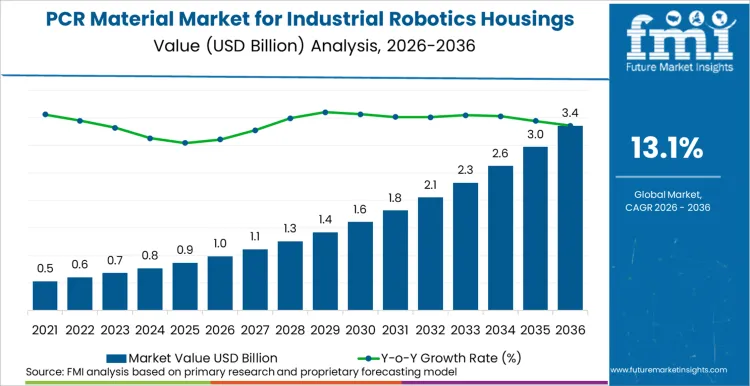
The global PCR material market for industrial robotics housings is estimated to be valued at USD 980 million in 2026 and is projected to reach USD 3,360 million by 2036, expanding at a 13.1% CAGR. FMI analysis indicates that this trajectory is driven less by short-term material substitution and more by the structural scaling of automation platforms that increasingly standardize housing architectures across robot families, enabling PCR integration to scale once validated.
Robotics OEMs are increasing the density of robots and cobots in manufacturing environments where housings face repeated mechanical shock, chemical cleaning regimes, and abrasion from handling and maintenance. As housing systems become standardized across platforms, the economic and operational payoff of qualifying a PCR compound increases. A validated PCR housing compound can be rolled out across multiple models and factories, which reduces the marginal cost of sustainability improvements and increases the willingness of engineering teams to pursue PCR adoption.
FMI observes that adoption is concentrated in housing domains where polymer substitution does not interfere with safety-rated motion control, precision joints, or embedded electronics. This means external covers, cosmetic shells, and service panels are the highest-feasibility entry points, while structural parts that influence stiffness, alignment, or thermal management remain more constrained. As a result, market growth is anchored in high-volume housing categories that can be upgraded without expanding system-level risk.
Another driver shaping the forecast is customer audit pressure. Large industrial customers include sustainability, recycled content expectations in capital equipment procurement, especially in Europe, and advanced manufacturing hubs in Asia.
Robotics OEMs can use PCR housings as a visible compliance lever, but only if the material performance is repeatable at scale. This shifts buying decisions toward compounders that can deliver predictable impact performance, ESD behavior, and dimensional stability across batches, rather than simply offering recycled content percentages.
Summary of PCR Material Market for Industrial Robotics Housings
- The PCR material market for industrial robotics housings comprises post-consumer recycled polymer compounds used in external housings, covers, shells, and modular enclosure systems of industrial robots, collaborative robots, and factory automation equipment operating in high-uptime industrial environments.
- The defined scope is structured under FMI taxonomy with segmentation across end use, housing type, material, and engineering technology, focusing on injection-molded PCR ABS, PCR PC, and engineered blends for robotics housings and excluding metal enclosures, internal motion systems, sensors, actuators, and safety-rated electronic components.
- The PCR material market for industrial robotics housings is projected to grow at a CAGR of 13.1% from 2026 to 2036, expanding from USD 980 million in 2026 to USD 3,360 million by 2036, based on FMI proprietary forecasting integrating industrial automation deployment rates, housing platform standardization dynamics, and PCR polymer qualification and compounding capabilities.
- The sector is transitioning from sustainability-led pilot use toward qualification-led engineering material adoption, where PCR compounds are evaluated on impact resistance, electrostatic discharge performance, dimensional stability, and batch-to-batch repeatability under harsh industrial operating conditions.
- Competition is concentrated among robotics OEMs and engineering polymer suppliers such as ABB Robotics, Covestro, FANUC, Mitsubishi Electric, and Avient, with competitive advantage defined by compounding discipline, ESD-safe formulation capability, global supply consistency, and the ability to meet OEM qualification and customer audit requirements.
- India is projected to record the fastest growth at a 15.6% CAGR through 2036, while USA and Germany retain the largest value shares, supported by high automation density, standardized robot housing platforms, and rising procurement pressure for recycled content in industrial equipment supply chains.
PCR Material Market for Industrial Robotics Housings Key Takeaways?
| Metric | Value |
|---|---|
| Expected Value 2026E | USD 980 million |
| Forecast Value 2036F | USD 3,360 million |
| CAGR 2026 to 2036 | 13.1% |
Source: Future Market Insights analysis based on proprietary forecasting model and primary research
Why is the PCR Material Market for Industrial Robotics Housings Growing?
The primary growth driver is the scaling of industrial automation into high-utilization settings where robot fleets are expanding rapidly. As robots shift from isolated workcells into continuous-operation environments, housings become a recurring bill-of-materials item that must balance durability, serviceability, and consistent appearance. This creates a large and predictable addressable volume where PCR integration becomes attractive if it can meet repeatable engineering thresholds.
A second driver is the elevation of sustainability requirements from corporate messaging to procurement gating criteria. Many robotics buyers now ask for equipment-level sustainability disclosures, including material choices and recycled content alignment. PCR housings offer a practical pathway for OEMs to demonstrate recycled content adoption without redesigning motion systems or safety-rated subsystems. Adoption therefore accelerates when PCR compounds can be qualified as drop-in equivalents within established toolsets, molding cycles, and mechanical acceptance windows.
A third growth driver is polymer governance maturity. PCR supply chains for electronics-derived ABS and PC streams are improving in purity and traceability, which increases the feasibility of meeting engineering plastics expectations. Robotics housings are particularly well-suited to benefit from these improvements because they require predictable impact behavior and ESD control rather than extreme thermal resistance, allowing advanced compounding to close the gap between PCR and virgin performance.
Growth remains constrained by the engineering reality that robotics housings are not purely cosmetic. They play a role in contamination control, safety, and maintenance outcomes. This keeps adoption disciplined, but it also makes demand durable once a PCR compound is validated and locked into a platform.
What is the Segment Profile of the PCR Material Market for Industrial Robotics Housings?
The segment structure reflects where PCR materials can be integrated without undermining robotics system reliability, safety, and multi-site manufacturing repeatability. FMI retains only the dominant segment in each category.
Why do industrial robots and cobots anchor end-use demand?
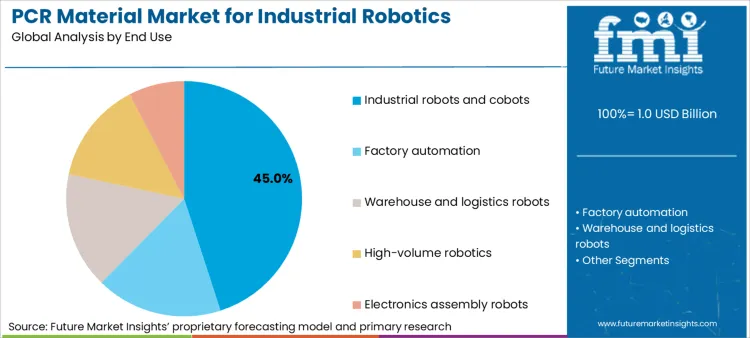
Industrial robots and cobots account for 45% of end-use demand because they represent the most standardized and fastest scaling robotics platforms in factory environments. These systems are deployed in harsh duty cycles where housings face repeated incidental impacts, abrasion from operator contact, and exposure to cleaning chemicals. As deployment volumes rise, OEMs seek housing materials that deliver stable mechanical behavior across high-volume injection molding while meeting customer sustainability expectations.
A second driver of dominance is platform reuse. Industrial robots and cobots are typically produced in modular families that share housing geometries across payload classes and variants. Once a PCR housing material is qualified for a platform, it can be deployed across multiple models, factories, and customer programs with limited incremental validation. FMI observes that this is where the economics of PCR adoption become compelling, because qualification cost is amortized across a wide installed base and multiple production years, turning PCR from a pilot initiative into a platform standard.
Why do external housings and covers dominate housing type demand?
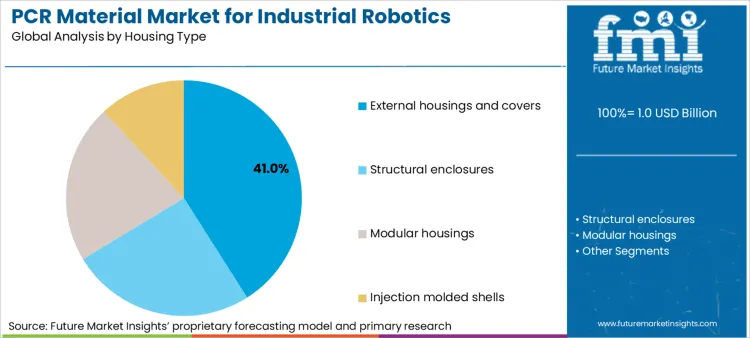
External housings and covers represent 41% of housing type demand because they offer the cleanest separation between protection requirements and system-critical structural performance. These parts must resist impact, scratches, and chemical exposure, but they generally do not carry primary structural loads or control precision alignment. This makes them the most feasible entry point for PCR substitution under conservative OEM risk frameworks.
A second reinforcing factor is maintenance and replacement logic. External covers are often removed during service and replaced during refurbishment, enabling OEMs and operators to manage risk by isolating PCR adoption to replaceable components. FMI finds that adoption accelerates when PCR materials are introduced through modular cover strategies, because the material can be validated on non-critical housings first and expanded gradually as field performance confidence accumulates.
How do PCR ABS and PCR PC sustain material leadership?
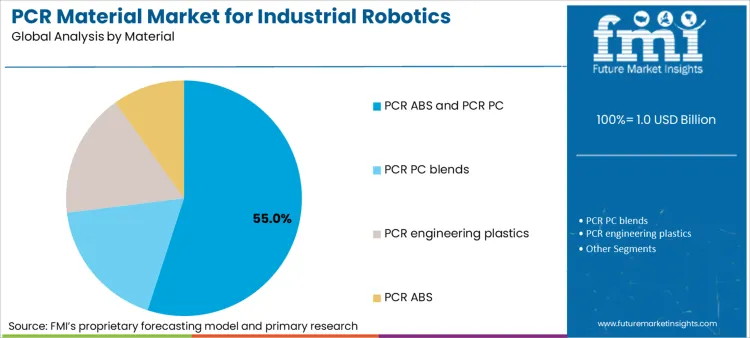
PCR ABS and PCR PC together account for 55% of material demand because they align with the mechanical and electrical needs of robotics housings when properly compounded. ABS and PC families provide a strong balance of impact performance and dimensional stability, and they are already widely used by OEMs in virgin forms. This legacy compatibility lowers the engineering barrier to qualifying PCR variants, because design envelopes, tooling behavior, and molding performance expectations already exist.
Supply chain feasibility also reinforces this leadership. Electronics-related recycling streams can provide relatively pure sources of ABS and PC, which improves batch consistency and supports traceability expectations. FMI observes that OEMs prefer PCR polymers that can be governed through supplier documentation and incoming quality checks, and ABS and PC derived from controlled streams are better positioned to meet these governance expectations than mixed PCR engineering plastic blends.
Why does impact-modified and ESD-safe compounding dominate engineering technology?
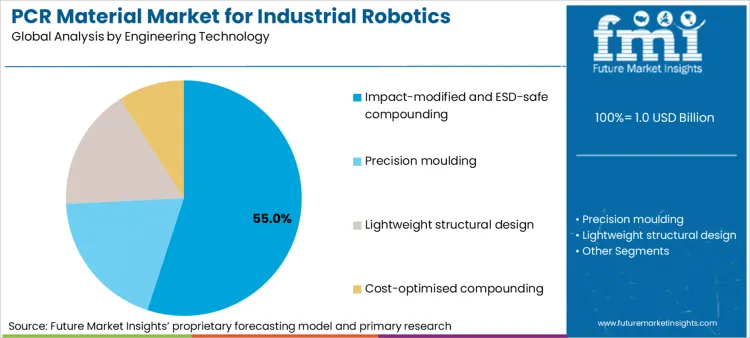
Impact-modified and ESD-safe compounding represents 55% of engineering technology demand because robotics housings must meet two hard constraints simultaneously. They must dissipate static charge in sensitive environments and withstand impact events that occur during operation and maintenance. PCR polymers can introduce variability in impact behavior and electrical properties, so advanced compounding becomes essential to stabilize performance across batches and production sites.
A second reason for dominance is OEM qualification strategy. Robotics manufacturers want compounding approaches that are auditable, scalable, and repeatable across regions. Impact modification and ESD-safe formulation pathways can be standardized through controlled additive packages, dispersion protocols, and quality monitoring. FMI finds that compounders who can demonstrate consistent ESD behavior and stable impact performance across high-volume molding cycles gain a preferred position in platform qualification programs, because they reduce the risk of field failures and minimize requalification churn.
What Drivers, Restraints, Opportunities, and Trends Prevail in the PCR Material Market for Industrial Robotics Housings?
The central driver is the rapid expansion of industrial automation and the associated scaling of standardized housing systems. As robot shipments rise, housings become a large recurring polymer demand pool. OEMs are increasingly motivated to integrate PCR content because it offers a visible sustainability lever that does not require redesigning motion subsystems or safety-critical electronics, provided engineering thresholds are met. Sustainability procurement requirements, particularly in Europe and advanced manufacturing hubs in Asia, are making recycled content a procurement qualifier in certain customer segments.
The largest restraint is performance and consistency risk. Robotics housings operate under continuous vibration, occasional impact, and repeated cleaning, creating demanding conditions for plastics. PCR materials must meet tight tolerance windows for impact strength, dimensional stability, and ESD behavior. Any increase in field failure rates damages OEM credibility and increases warranty exposure. Qualification and validation cycles are also a barrier. Once an OEM locks a housing material into a platform, change control becomes expensive and slow, which makes OEMs conservative about adopting PCR unless suppliers provide robust documentation and long-run batch consistency.
The strongest opportunity lies in modular housing architectures that isolate PCR adoption to specific cover systems first, enabling staged deployment. As OEMs move toward easier serviceability and faster refurbishment cycles, modular housings allow PCR materials to scale without increasing risk across structural enclosures. Another opportunity is closed-loop or semi-closed-loop PCR sourcing tied to electronics and industrial waste streams, which can improve feedstock consistency and support traceability documentation that OEMs need for customer audits.
The dominant trend is the shift toward engineering-grade PCR compounds with formalized quality documentation, rather than generic recycled plastics. OEMs increasingly demand supplier test certificates, batch consistency evidence, and controlled additive packages for ESD and impact performance. FMI also observes a trend toward multi-region qualification strategies, where materials must perform consistently across different molding plants and climate conditions. This drives demand toward compounders with global production footprints or tightly standardized manufacturing protocols.
How is the PCR Material Market for Industrial Robotics Housings Analyzed in Key Countries?
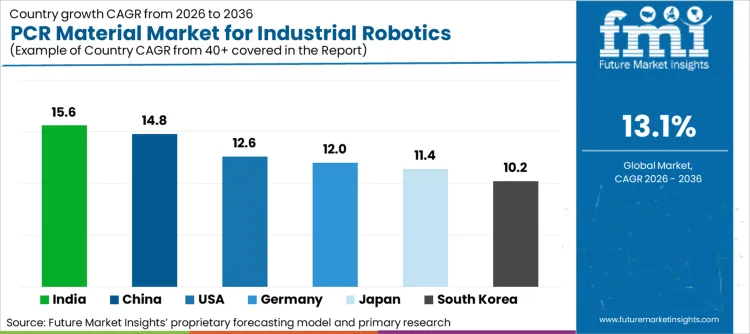
| Country | CAGR (2026-2036) |
|---|---|
| Germany | 12.0% |
| Japan | 11.4% |
| USA | 12.6% |
| China | 14.8% |
| South Korea | 10.2% |
| India | 15.6% |
Source: FMI analysis based on primary research and proprietary forecasting model
Why is Germany a lead market for PCR adoption in robotics housings?
Germany is projected to grow at a 12.0% CAGR, supported by high automation density and strong engineering governance in industrial equipment supply chains. German robotics and automation ecosystems tend to institutionalize material qualification through documentation-heavy processes that prioritize repeatability, long service life performance, and clear supplier accountability. This creates an environment where PCR materials can scale once validated, because platform standardization and disciplined change control allow adoption to spread across robot families with minimal incremental risk.
A second factor is procurement scrutiny from advanced manufacturing customers that increasingly evaluate equipment sustainability credentials. FMI observes that PCR adoption in Germany is strongest where compounders can provide stable ESD behavior and impact performance supported by consistent batch documentation. Adoption concentrates in external housings and cover systems where PCR integration does not expand system-level certification exposure, enabling OEMs to demonstrate sustainability progress while preserving reliability metrics that matter in high-uptime factory environments.
How is Japan advancing through precision governance and conservative qualification?
Japan is expected to grow at an 11.4% CAGR, shaped by precision manufacturing culture and conservative qualification thresholds for industrial equipment. Robotics platforms in Japan emphasize stability, cleanliness, and consistent performance over long operating windows, which increases the importance of dimensional stability and predictable material behavior. PCR adoption therefore progresses selectively, typically beginning in housing areas where performance requirements can be demonstrated under controlled internal validation regimes.
A second driver is the durability of adoption once approved. FMI finds that Japanese OEMs may adopt more slowly, but once a PCR compound passes extended validation and field monitoring, it tends to remain locked into platforms for long periods due to conservative change control and high trust in qualified suppliers. This favors compounders that can deliver repeatability and documentation, and it supports steady scaling in precision factory automation environments where the installed base grows predictably.
Why is USA scaling through logistics automation and fleet standardization?
USA is forecasted to expand at a 12.6% CAGR, driven by warehouse automation, logistics robotics, and broader industrial automation investment. Large deployments in distribution centers and high-throughput facilities increase the value of standardized housings that can be serviced and replaced quickly across fleets. PCR housing materials gain traction where they support procurement sustainability requirements without increasing downtime risk, because operational continuity is the dominant buying priority in these environments.
A second factor is corporate reporting pressure in large industrial and retail supply chains. FMI observes that U.S. equipment procurement increasingly includes sustainability-linked disclosure requirements, which pushes robotics OEMs to adopt recycled content in visible, high-volume components such as housings. Adoption accelerates where PCR compounds maintain stable impact behavior and ESD safety across regional molding operations, enabling OEMs to avoid fleet-level variability that would complicate maintenance and spare-part standardization.
How is China leveraging scale economics and rapid iteration in compounding?
China is projected to grow at a 14.8% CAGR, supported by high-volume robotics manufacturing and the speed with which suppliers can iterate materials and production processes. Scale magnifies the economic impact of polymer selection. If PCR compounds can be produced with consistent quality, they offer an attractive pathway to reduce reliance on virgin engineering plastics while meeting rising sustainability expectations. Adoption is strongest in high-volume robotics segments where cost and throughput pressures are intense and where standardized housings provide a large addressable polymer pool.
A second driver is domestic capability development in compounding and material engineering. FMI expects continued investment in cost-optimized compounding and quality control infrastructure, enabling PCR ABS and PCR engineering plastics to be qualified for more housing applications over time. The constraint remains consistency. China’s growth will be sustained where suppliers can demonstrate stable performance across large production runs, because field failures in high-volume deployments create high reputational risk for OEMs.
Why is South Korea developing as a focused niche market linked to electronics assembly?
Korea is expected to grow at a 10.2% CAGR, shaped by concentrated demand in electronics assembly robots and high-cleanliness automation environments. These use cases prioritize predictable electrostatic behavior and surface durability, which increases the importance of ESD-safe compounding and stable dimensional performance. PCR adoption therefore progresses where compounders can prove ESD performance repeatability and minimize property drift that could create contamination or reliability issues.
A second factor is the selective nature of adoption. FMI observes that Korea is likely to scale PCR housings through targeted programs rather than broad platform shifts, focusing on housing components that are replaceable and non-structural while maintaining conservative thresholds for parts that interface closely with precision sensors and electronics. This yields steady growth, but it concentrates value in suppliers that can provide narrowly specified, high-consistency PCR compounds rather than broad recycled resin portfolios.
Why is India emerging as the fastest-growing market despite a smaller current base?
India is projected to grow at a 15.6% CAGR, driven by accelerating automation in manufacturing, electronics assembly, and process industries seeking productivity improvements and labor stability. Robotics deployment is expanding from automotive and large factories into mid-sized manufacturers and new industrial corridors. This creates fresh demand for standardized housing systems where PCR materials can be introduced as part of cost discipline and sustainability alignment, especially in segments where external housings and covers dominate volume and where qualification requirements are manageable.
A second driver is export-linked governance. Indian manufacturers increasingly serve global supply chains that require sustainability disclosures and recycled content progress across production equipment. FMI finds that PCR housing adoption in India grows fastest among OEMs and integrators that align their material strategies with customer audit expectations, using controlled PCR ABS and PC streams with documented quality. Over time, as compounding capacity and quality monitoring mature, India is positioned to expand PCR adoption from external housings into more structurally relevant enclosure categories, but near-term growth remains anchored in replaceable covers and modular housing systems.
How Competitive is the PCR Material Market for Industrial Robotics Housings?
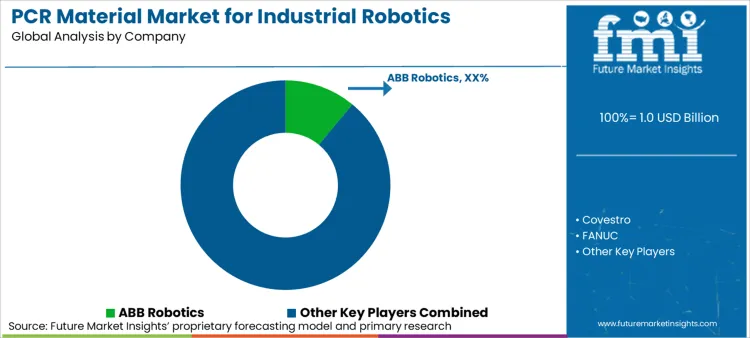
The competitive landscape of the PCR material market for industrial robotics housings is defined by qualification credibility, compounding discipline, and the ability to translate recycled feedstock variability into industrial-grade repeatability. Competition is not primarily price-driven. In robotics, uptime, reliability, and customer confidence dominate decision-making, so OEMs are willing to pay for compounds that reduce risk, minimize scrap, and maintain consistent appearance and electrostatic behavior across long production runs.
The first axis of competition is performance governance under variability. PCR polymers, even when sourced from high-purity streams, carry greater heterogeneity than virgin resins. Robotics housings need stable impact resistance, stable dimensional behavior under thermal cycles, and consistent ESD performance in sensitive environments. This places compounders with strong filtration, dispersion control, additive management, and batch monitoring capabilities at a structural advantage. FMI observes that suppliers that can demonstrate repeatability through documented statistical process control and standardized compounding recipes tend to win platform approvals because they reduce OEM risk.
The second axis is platform-level lock-in. Robotics housings are not frequently requalified once a platform is launched. Mold tools, surface finish requirements, and assembly interfaces are designed around specific material shrinkage behavior and mechanical response. This means the supplier that wins the initial platform qualification often gains a multi-year revenue stream. Competition therefore concentrates in the pre-award phase, where suppliers must provide evidence packages that satisfy engineering, quality, procurement, and sustainability teams simultaneously. Suppliers that can supply complete documentation and stable global supply are more likely to be selected because they reduce change-control churn across multi-site manufacturing.
The third axis is ESD and impact engineering differentiation. Impact-modified and ESD-safe compounding is the dominant technology pathway because it addresses two high-consequence failure modes. Housing impact failures cause cracking and expose internal systems. ESD failures can create intermittent faults and downtime. Suppliers differentiate by how well they stabilize these properties in PCR formulations without sacrificing processability in high-volume injection molding. FMI finds that compounders capable of maintaining stable ESD behavior while also meeting impact thresholds become preferred partners for high-uptime robotics platforms, especially in electronics and automated logistics applications.
The fourth axis is OEM collaboration and design influence. Competitive advantage increasingly comes from early engagement in housing design, where compounders advise on wall thickness, ribbing, assembly tolerances, and surface finish to increase the probability that PCR compounds meet performance targets. When suppliers contribute during design stages, they can shape the housing to be more tolerant of PCR behavior, increasing qualification success. This also raises switching costs for OEMs. Once a housing architecture is optimized for a compounder’s PCR formulation, alternative suppliers face a higher barrier because they must match both performance and processing behavior in existing tools.
The competitive landscape includes robotics OEMs and material suppliers that shape adoption through platform scale and materials capability. Key players profiled include ABB Robotics, Covestro, FANUC, Mitsubishi Electric, Rockwell Automation, Avient, and Estun Automation. Competitive advantage will be held by organizations that combine platform volume, compounding depth, qualification credibility, and audit-ready documentation, because those capabilities determine whether PCR housings can move from pilot deployments into baseline platform materials.
Key Players Profiled
- ABB Robotics
- Covestro
- FANUC
- Mitsubishi Electric
- Rockwell Automation
- Avient
- Estun Automation
Market Definition
The PCR materials market for industrial robotics housings comprises revenues generated from PCR polymer compounds used in external and semi-structural enclosure systems of industrial robots, collaborative robots, factory automation robots, warehouse and logistics robots, and electronics assembly robots. These materials are deployed in housings, covers, shells, and modular panels where polymers are engineered to deliver mechanical durability, dimensional stability, flame performance, and electrostatic control required for continuous industrial operation.
The scope includes PCR ABS, PCR PC, and PCR engineering plastic blends used in injection-molded robotic housings and enclosures, including grades requiring impact modification, reinforcement, and ESD-safe compounding. Materials qualified for use in automated manufacturing environments and supplied through validated industrial plastics value chains are included. The scope excludes metal housings, coatings-only or surface-treatment sustainability solutions, virgin polymer compounds without recycled content, and internal motion systems, actuators, sensors, or safety-rated electronic components.
Scope of Report
| Items | Values |
|---|---|
| Quantitative Units | USD 980 million |
| End Use | Industrial robots and cobots, Factory automation, Warehouse and logistics robots, High-volume robotics, Electronics assembly robots, Others |
| Housing Type | External housings and covers, Structural enclosures, Modular housings, Injection molded shells, Others |
| Material | PCR ABS and PCR PC, PCR PC blends, PCR engineering plastics, PCR ABS, Others |
| Engineering Technology | Impact-modified and ESD-safe compounding, Precision moulding, Lightweight structural design, Cost-optimised compounding, Others |
| Regions Covered | Western Europe, East Asia, North America, South Asia and Pacific |
| Countries Covered | Germany, Japan, USA, China, Korea, India and 40 plus countries |
| Key Companies | ABB Robotics, Covestro, FANUC, Mitsubishi Electric, Rockwell Automation, Avient, Estun Automation |
Source: Future Market Insights analysis based on proprietary forecasting model and primary research
PCR Material Market for Industrial Robotics Housings Key Segments?
End Use:
- Industrial robots and cobots
- Factory automation
- Warehouse and logistics robots
- High-volume robotics
- Electronics assembly robots
- Others
Housing Type:
- External housings and covers
- Structural enclosures
- Modular housings
- Injection molded shells
- Others
Material:
- PCR ABS and PCR PC
- PCR PC blends
- PCR engineering plastics
- PCR ABS
- Others
Engineering Technology:
- Impact-modified and ESD-safe compounding
- Precision moulding
- Lightweight structural design
- Cost-optimised compounding
- Others
Region:
- North America
- Europe
- Asia Pacific
- Latin America
- Middle East & Africa
Bibliography
- ASTM International. (2024). Standard guides for plastics material characterization and mechanical property testing relevant to engineering plastics qualification. ASTM International.
- International Electrotechnical Commission. (2024). Electrostatics guidance and ESD control considerations for industrial equipment environments. IEC.
- International Organization for Standardization. (2025). Environmental management systems requirements and guidance for manufacturing supply chains. ISO.
- OECD. (2025). Policy and market implications of circular plastics and recycled polymer supply governance. OECD Publishing.
- Fraunhofer Institute. (2024). Industrial polymer compounding and quality control trends for recycled engineering plastics in manufacturing applications. Fraunhofer.
- VDMA. (2025). Robotics and automation market outlook and industrial deployment trends influencing equipment design and materials. VDMA.
- U.S. National Institute of Standards and Technology. (2024). Manufacturing quality infrastructure and measurement considerations for polymer processing repeatability. NIST.
Frequently Asked Questions
How big is the pcr material market for industrial robotics housings in 2026?
The global pcr material market for industrial robotics housings is estimated to be valued at USD 1.0 billion in 2026.
What will be the size of pcr material market for industrial robotics housings in 2036?
The market size for the pcr material market for industrial robotics housings is projected to reach USD 3.4 billion by 2036.
How much will be the pcr material market for industrial robotics housings growth between 2026 and 2036?
The pcr material market for industrial robotics housings is expected to grow at a 13.1% CAGR between 2026 and 2036.
What are the key product types in the pcr material market for industrial robotics housings?
The key product types in pcr material market for industrial robotics housings are industrial robots and cobots , factory automation, warehouse and logistics robots, high-volume robotics and electronics assembly robots.
Which housing type segment to contribute significant share in the pcr material market for industrial robotics housings in 2026?
In terms of housing type, external housings and covers segment to command 41.0% share in the pcr material market for industrial robotics housings in 2026.
Preview the report firsthand - request a free sample
Get SampleGet the brochure for pricing and purchase details.
Get PDFTable of Content
- Executive Summary
- Global Market Outlook
- Demand-side Trends
- Supply-side Trends
- Technology Roadmap Analysis
- Analysis and Recommendations
- Market Overview
- Market Coverage / Taxonomy
- Market Definition / Scope / Limitations
- Research Methodology
- Chapter Orientation
- Analytical Lens and Working Hypotheses
- Market Structure, Signals, and Trend Drivers
- Benchmarking and Cross-market Comparability
- Market Sizing, Forecasting, and Opportunity Mapping
- Research Design and Evidence Framework
- Desk Research Programme (Secondary Evidence)
- Company Annual and Sustainability Reports
- Peer-reviewed Journals and Academic Literature
- Corporate Websites, Product Literature, and Technical Notes
- Earnings Decks and Investor Briefings
- Statutory Filings and Regulatory Disclosures
- Technical White Papers and Standards Notes
- Trade Journals, Industry Magazines, and Analyst Briefs
- Conference Proceedings, Webinars, and Seminar Materials
- Government Statistics Portals and Public Data Releases
- Press Releases and Reputable Media Coverage
- Specialist Newsletters and Curated Briefings
- Sector Databases and Reference Repositories
- FMI Internal Proprietary Databases and Historical Market Datasets
- Subscription Datasets and Paid Sources
- Social Channels, Communities, and Digital Listening Inputs
- Additional Desk Sources
- Expert Input and Fieldwork (Primary Evidence)
- Primary Modes
- Qualitative Interviews and Expert Elicitation
- Quantitative Surveys and Structured Data Capture
- Blended Approach
- Why Primary Evidence is Used
- Field Techniques
- Interviews
- Surveys
- Focus Groups
- Observational and In-context Research
- Social and Community Interactions
- Stakeholder Universe Engaged
- C-suite Leaders
- Board Members
- Presidents and Vice Presidents
- R&D and Innovation Heads
- Technical Specialists
- Domain Subject-matter Experts
- Scientists
- Physicians and Other Healthcare Professionals
- Governance, Ethics, and Data Stewardship
- Research Ethics
- Data Integrity and Handling
- Primary Modes
- Tooling, Models, and Reference Databases
- Desk Research Programme (Secondary Evidence)
- Data Engineering and Model Build
- Data Acquisition and Ingestion
- Cleaning, Normalisation, and Verification
- Synthesis, Triangulation, and Analysis
- Quality Assurance and Audit Trail
- Market Background
- Market Dynamics
- Drivers
- Restraints
- Opportunity
- Trends
- Scenario Forecast
- Demand in Optimistic Scenario
- Demand in Likely Scenario
- Demand in Conservative Scenario
- Opportunity Map Analysis
- Product Life Cycle Analysis
- Supply Chain Analysis
- Investment Feasibility Matrix
- Value Chain Analysis
- PESTLE and Porter’s Analysis
- Regulatory Landscape
- Regional Parent Market Outlook
- Production and Consumption Statistics
- Import and Export Statistics
- Market Dynamics
- Global Market Analysis 2021 to 2025 and Forecast, 2026 to 2036
- Historical Market Size Value (USD Million) Analysis, 2021 to 2025
- Current and Future Market Size Value (USD Million) Projections, 2026 to 2036
- Y-o-Y Growth Trend Analysis
- Absolute $ Opportunity Analysis
- Global Market Pricing Analysis 2021 to 2025 and Forecast 2026 to 2036
- Global Market Analysis 2021 to 2025 and Forecast 2026 to 2036, By End Use
- Introduction / Key Findings
- Historical Market Size Value (USD Million) Analysis By End Use , 2021 to 2025
- Current and Future Market Size Value (USD Million) Analysis and Forecast By End Use , 2026 to 2036
- Industrial robots and cobots
- Factory automation
- Warehouse and logistics robots
- High-volume robotics
- Electronics assembly robots
- Industrial robots and cobots
- Y-o-Y Growth Trend Analysis By End Use , 2021 to 2025
- Absolute $ Opportunity Analysis By End Use , 2026 to 2036
- Global Market Analysis 2021 to 2025 and Forecast 2026 to 2036, By Housing Type
- Introduction / Key Findings
- Historical Market Size Value (USD Million) Analysis By Housing Type, 2021 to 2025
- Current and Future Market Size Value (USD Million) Analysis and Forecast By Housing Type, 2026 to 2036
- External housings and covers
- Structural enclosures
- Modular housings
- Injection molded shells
- External housings and covers
- Y-o-Y Growth Trend Analysis By Housing Type, 2021 to 2025
- Absolute $ Opportunity Analysis By Housing Type, 2026 to 2036
- Global Market Analysis 2021 to 2025 and Forecast 2026 to 2036, By Material
- Introduction / Key Findings
- Historical Market Size Value (USD Million) Analysis By Material, 2021 to 2025
- Current and Future Market Size Value (USD Million) Analysis and Forecast By Material, 2026 to 2036
- PCR ABS and PCR PC
- PCR PC blends
- PCR engineering plastics
- PCR ABS
- PCR ABS and PCR PC
- Y-o-Y Growth Trend Analysis By Material, 2021 to 2025
- Absolute $ Opportunity Analysis By Material, 2026 to 2036
- Global Market Analysis 2021 to 2025 and Forecast 2026 to 2036, By Engineering Technology
- Introduction / Key Findings
- Historical Market Size Value (USD Million) Analysis By Engineering Technology, 2021 to 2025
- Current and Future Market Size Value (USD Million) Analysis and Forecast By Engineering Technology, 2026 to 2036
- Impact-modified and ESD-safe compounding
- Precision moulding
- Lightweight structural design
- Cost-optimised compounding
- Impact-modified and ESD-safe compounding
- Y-o-Y Growth Trend Analysis By Engineering Technology, 2021 to 2025
- Absolute $ Opportunity Analysis By Engineering Technology, 2026 to 2036
- Global Market Analysis 2021 to 2025 and Forecast 2026 to 2036, By Region
- Introduction
- Historical Market Size Value (USD Million) Analysis By Region, 2021 to 2025
- Current Market Size Value (USD Million) Analysis and Forecast By Region, 2026 to 2036
- North America
- Latin America
- Western Europe
- Eastern Europe
- East Asia
- South Asia and Pacific
- Middle East & Africa
- Market Attractiveness Analysis By Region
- North America Market Analysis 2021 to 2025 and Forecast 2026 to 2036, By Country
- Historical Market Size Value (USD Million) Trend Analysis By Market Taxonomy, 2021 to 2025
- Market Size Value (USD Million) Forecast By Market Taxonomy, 2026 to 2036
- By Country
- USA
- Canada
- Mexico
- By End Use
- By Housing Type
- By Material
- By Engineering Technology
- By Country
- Market Attractiveness Analysis
- By Country
- By End Use
- By Housing Type
- By Material
- By Engineering Technology
- Key Takeaways
- Latin America Market Analysis 2021 to 2025 and Forecast 2026 to 2036, By Country
- Historical Market Size Value (USD Million) Trend Analysis By Market Taxonomy, 2021 to 2025
- Market Size Value (USD Million) Forecast By Market Taxonomy, 2026 to 2036
- By Country
- Brazil
- Chile
- Rest of Latin America
- By End Use
- By Housing Type
- By Material
- By Engineering Technology
- By Country
- Market Attractiveness Analysis
- By Country
- By End Use
- By Housing Type
- By Material
- By Engineering Technology
- Key Takeaways
- Western Europe Market Analysis 2021 to 2025 and Forecast 2026 to 2036, By Country
- Historical Market Size Value (USD Million) Trend Analysis By Market Taxonomy, 2021 to 2025
- Market Size Value (USD Million) Forecast By Market Taxonomy, 2026 to 2036
- By Country
- Germany
- UK
- Italy
- Spain
- France
- Nordic
- BENELUX
- Rest of Western Europe
- By End Use
- By Housing Type
- By Material
- By Engineering Technology
- By Country
- Market Attractiveness Analysis
- By Country
- By End Use
- By Housing Type
- By Material
- By Engineering Technology
- Key Takeaways
- Eastern Europe Market Analysis 2021 to 2025 and Forecast 2026 to 2036, By Country
- Historical Market Size Value (USD Million) Trend Analysis By Market Taxonomy, 2021 to 2025
- Market Size Value (USD Million) Forecast By Market Taxonomy, 2026 to 2036
- By Country
- Russia
- Poland
- Hungary
- Balkan & Baltic
- Rest of Eastern Europe
- By End Use
- By Housing Type
- By Material
- By Engineering Technology
- By Country
- Market Attractiveness Analysis
- By Country
- By End Use
- By Housing Type
- By Material
- By Engineering Technology
- Key Takeaways
- East Asia Market Analysis 2021 to 2025 and Forecast 2026 to 2036, By Country
- Historical Market Size Value (USD Million) Trend Analysis By Market Taxonomy, 2021 to 2025
- Market Size Value (USD Million) Forecast By Market Taxonomy, 2026 to 2036
- By Country
- China
- Japan
- South Korea
- By End Use
- By Housing Type
- By Material
- By Engineering Technology
- By Country
- Market Attractiveness Analysis
- By Country
- By End Use
- By Housing Type
- By Material
- By Engineering Technology
- Key Takeaways
- South Asia and Pacific Market Analysis 2021 to 2025 and Forecast 2026 to 2036, By Country
- Historical Market Size Value (USD Million) Trend Analysis By Market Taxonomy, 2021 to 2025
- Market Size Value (USD Million) Forecast By Market Taxonomy, 2026 to 2036
- By Country
- India
- ASEAN
- Australia & New Zealand
- Rest of South Asia and Pacific
- By End Use
- By Housing Type
- By Material
- By Engineering Technology
- By Country
- Market Attractiveness Analysis
- By Country
- By End Use
- By Housing Type
- By Material
- By Engineering Technology
- Key Takeaways
- Middle East & Africa Market Analysis 2021 to 2025 and Forecast 2026 to 2036, By Country
- Historical Market Size Value (USD Million) Trend Analysis By Market Taxonomy, 2021 to 2025
- Market Size Value (USD Million) Forecast By Market Taxonomy, 2026 to 2036
- By Country
- Kingdom of Saudi Arabia
- Other GCC Countries
- Turkiye
- South Africa
- Other African Union
- Rest of Middle East & Africa
- By End Use
- By Housing Type
- By Material
- By Engineering Technology
- By Country
- Market Attractiveness Analysis
- By Country
- By End Use
- By Housing Type
- By Material
- By Engineering Technology
- Key Takeaways
- Key Countries Market Analysis
- USA
- Pricing Analysis
- Market Share Analysis, 2025
- By End Use
- By Housing Type
- By Material
- By Engineering Technology
- Canada
- Pricing Analysis
- Market Share Analysis, 2025
- By End Use
- By Housing Type
- By Material
- By Engineering Technology
- Mexico
- Pricing Analysis
- Market Share Analysis, 2025
- By End Use
- By Housing Type
- By Material
- By Engineering Technology
- Brazil
- Pricing Analysis
- Market Share Analysis, 2025
- By End Use
- By Housing Type
- By Material
- By Engineering Technology
- Chile
- Pricing Analysis
- Market Share Analysis, 2025
- By End Use
- By Housing Type
- By Material
- By Engineering Technology
- Germany
- Pricing Analysis
- Market Share Analysis, 2025
- By End Use
- By Housing Type
- By Material
- By Engineering Technology
- UK
- Pricing Analysis
- Market Share Analysis, 2025
- By End Use
- By Housing Type
- By Material
- By Engineering Technology
- Italy
- Pricing Analysis
- Market Share Analysis, 2025
- By End Use
- By Housing Type
- By Material
- By Engineering Technology
- Spain
- Pricing Analysis
- Market Share Analysis, 2025
- By End Use
- By Housing Type
- By Material
- By Engineering Technology
- France
- Pricing Analysis
- Market Share Analysis, 2025
- By End Use
- By Housing Type
- By Material
- By Engineering Technology
- India
- Pricing Analysis
- Market Share Analysis, 2025
- By End Use
- By Housing Type
- By Material
- By Engineering Technology
- ASEAN
- Pricing Analysis
- Market Share Analysis, 2025
- By End Use
- By Housing Type
- By Material
- By Engineering Technology
- Australia & New Zealand
- Pricing Analysis
- Market Share Analysis, 2025
- By End Use
- By Housing Type
- By Material
- By Engineering Technology
- China
- Pricing Analysis
- Market Share Analysis, 2025
- By End Use
- By Housing Type
- By Material
- By Engineering Technology
- Japan
- Pricing Analysis
- Market Share Analysis, 2025
- By End Use
- By Housing Type
- By Material
- By Engineering Technology
- South Korea
- Pricing Analysis
- Market Share Analysis, 2025
- By End Use
- By Housing Type
- By Material
- By Engineering Technology
- Russia
- Pricing Analysis
- Market Share Analysis, 2025
- By End Use
- By Housing Type
- By Material
- By Engineering Technology
- Poland
- Pricing Analysis
- Market Share Analysis, 2025
- By End Use
- By Housing Type
- By Material
- By Engineering Technology
- Hungary
- Pricing Analysis
- Market Share Analysis, 2025
- By End Use
- By Housing Type
- By Material
- By Engineering Technology
- Kingdom of Saudi Arabia
- Pricing Analysis
- Market Share Analysis, 2025
- By End Use
- By Housing Type
- By Material
- By Engineering Technology
- Turkiye
- Pricing Analysis
- Market Share Analysis, 2025
- By End Use
- By Housing Type
- By Material
- By Engineering Technology
- South Africa
- Pricing Analysis
- Market Share Analysis, 2025
- By End Use
- By Housing Type
- By Material
- By Engineering Technology
- USA
- Market Structure Analysis
- Competition Dashboard
- Competition Benchmarking
- Market Share Analysis of Top Players
- By Regional
- By End Use
- By Housing Type
- By Material
- By Engineering Technology
- Competition Analysis
- Competition Deep Dive
- ABB Robotics
- Overview
- Product Portfolio
- Profitability by Market Segments (Product/Age /Sales Channel/Region)
- Sales Footprint
- Strategy Overview
- Marketing Strategy
- Product Strategy
- Channel Strategy
- Covestro
- FANUC
- Mitsubishi Electric
- Rockwell Automation
- Avient
- Estun Automation
- ABB Robotics
- Competition Deep Dive
- Assumptions & Acronyms Used


