

- Industry Size (2026)
- USD 1.7 Bn
- Forecast (2036)
- USD 4.8 Bn
- CAGR (2026 to 2036)
- 10.9%
Crash Test Certified PCR Automotive Materials Market Forecast and Outlook 2026 to 2036
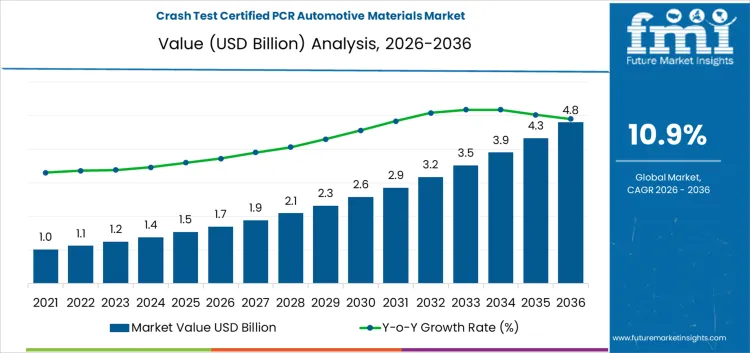
The crash test certified PCR automotive materials market is projected to reach USD 1.7 billion in 2026 and is likely to grow to USD 4.8 billion by 2036, registering a CAGR of 10.9%. Growth is driven by the rising adoption of post-consumer recycled (PCR) materials in automotive components that require high safety and performance standards. Crash test certification ensures that PCR materials meet stringent regulatory and safety requirements, making them suitable for structural and interior applications in vehicles while maintaining compliance with global safety standards.
Automotive manufacturers are increasingly incorporating crash test certified PCR materials to enhance safety while optimizing material usage and reducing reliance on virgin plastics. These materials provide the necessary impact resistance and durability for components such as bumpers, panels, and interior trims. Advances in polymer engineering have improved the structural integrity and consistency of recycled materials, enabling wider adoption in safety-critical applications. As regulatory frameworks tighten and manufacturers prioritize efficient resource utilization, the market for crash test certified PCR automotive materials is expected to expand steadily, supported by technological innovation and growing awareness of material performance in safety testing.
Quick Stats of the Crash Test Certified PCR Automotive Materials Market
- Crash Test Certified PCR Automotive Materials Market Value (2026): USD 1.7 billion
- Crash Test Certified PCR Automotive Materials Market Forecast Value (2036): USD 4.8 billion
- Crash Test Certified PCR Automotive Materials Market Forecast CAGR 2026 to 2036: 10.9%
- Crash Test Certified PCR Automotive Materials Market Leading Material Class: Reinforced crash-grade compounds (48 % share)
- Crash Test Certified PCR Automotive Materials Market Key Growth Regions: Asia Pacific, North America, Europe, Latin America, Middle East & Africa
- Crash Test Certified PCR Automotive Materials Market Top Players: BASF, Lanxess, Celanese, SABIC, Kingfa, Wanhua, Reliance Industries, Braskem, Mitsubishi Chemical
What is the Growth Forecast for Crash Test Certified PCR Automotive Materials Market through 2036?
The crash test certified PCR automotive materials market is projected to reach USD 1.7 billion in 2026 and USD 4.8 billion by 2036, growing at a compound annual growth rate (CAGR) of 10.9%. Growth reflects increasing adoption of recycled materials in vehicle manufacturing to meet safety and environmental standards. Regional concentration is evident, with North America and Europe leading in certified applications due to stringent safety regulations. Asia Pacific is emerging as a high-growth region, leveraging lower production costs and rapid expansion in automotive manufacturing, which supports wider PCR adoption.
From 2026 to 2036, the market is expected to expand from USD 1.7 billion to USD 4.8 billion. Uneven adoption patterns persist, with advanced economies favoring fully certified materials, while developing regions show slower uptake due to higher initial investment costs. Geographic cost advantages influence production strategies, as regions with lower polymer processing expenses gain a competitive edge in large-scale implementation. Between 2026 and 2034, values grow from USD 1.9 billion to USD 4 billion, reflecting growing demand for safety-compliant, recycled materials in automotive interiors, structural components, and crash-relevant parts. Technological upgrades and increasing regulatory pressure will continue to shape regional investment and adoption trends through 2036.
Crash Test Certified PCR Automotive Materials Market Key Takeaways
| Metric | Value |
|---|---|
| Market Value (2026) | USD 1.7 billion |
| Forecast Value (2036) | USD 4.8 billion |
| Forecast CAGR 2026 to 2036 | 10.9% |
What Factors Are Driving Growth in the Crash Test Certified PCR Automotive Materials Market?
The Crash Test Certified PCR Automotive Materials Market is expanding as automotive manufacturers increasingly require materials that meet both safety and material reuse standards. PCR materials are being engineered to satisfy stringent crash test criteria, allowing their integration into structural and semi-structural components such as door panels, seat backs, and interior reinforcements. Regulatory frameworks in regions including North America and Europe now encourage higher recycled content in vehicles while maintaining crashworthiness standards. Vehicle safety assessments, including frontal, side, and rollover tests, guide material selection, ensuring that PCR-based components perform comparably to virgin materials under impact conditions. Adoption is particularly notable in electric and hybrid vehicles, where designers aim to optimize weight while ensuring occupant protection, making certified PCR materials an attractive option for interior and non-critical structural applications.
Industry procurement practices and material qualification procedures are accelerating market growth. Automotive suppliers are incorporating PCR materials into component prototypes that undergo crash simulation testing to verify compliance with safety standards. Specific applications include dashboard reinforcements, door impact beams, and interior paneling, where material performance under impact is critical. Suppliers capable of providing PCR materials with verified crash test certification are securing long-term agreements with OEMs, as these components meet both sustainability and safety mandates. Additionally, cost considerations and regulatory compliance pressures encourage manufacturers to explore PCR alternatives without compromising occupant protection.
What Are the Key Segments in the Crash Test Certified PCR Automotive Materials Market?
The Crash Test Certified PCR Automotive Materials Market is organized into two primary segments: Material Class and Polymer Base. The Reinforced crash-grade compounds lead the material class segment with a 48% market share, while PCR-PP and PCR-PA dominate the polymer base segment at 55%. These segments underscore the need for materials that combine safety performance and sustainability in automotive applications. Crash-grade PCR materials are increasingly adopted to meet regulatory crash-test standards while also incorporating recycled content. The market growth is influenced by manufacturers’ focus on high-performance plastics that ensure occupant safety without compromising environmental targets.
How Do Reinforced Crash-Grade Compounds Influence Automotive Safety and Market Share?
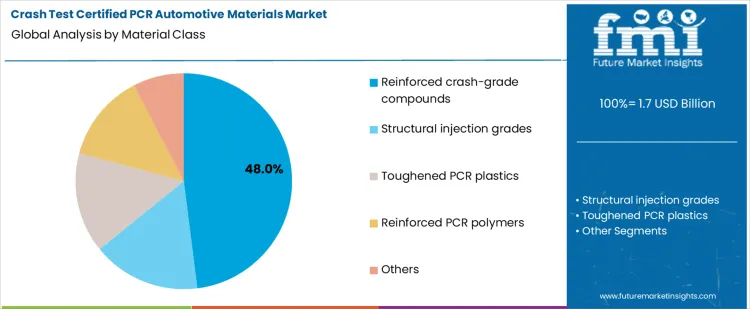
The Reinforced crash-grade compounds segment captures 48% of the material class share in the Crash Test Certified PCR Automotive Materials Market. These compounds are engineered for high impact resistance and energy absorption, making them essential in structural components such as front and rear bumper systems, side panels, and crash boxes. Their design focuses on maintaining mechanical integrity under high-stress conditions, ensuring compliance with crash-test certification standards. Reinforced compounds enable automakers to achieve safety targets while using post-consumer recycled content, balancing performance with sustainability requirements.
The adoption of reinforced crash-grade compounds is driven by regulatory requirements for crash-test performance in passenger vehicles and the need to maintain structural reliability. These materials are particularly attractive because they allow the incorporation of recycled polymers without compromising safety. Limitations include higher production complexity and the need for precise formulation to ensure consistent mechanical properties. Manufacturers are investing in advanced compounding technologies to overcome these constraints. As crash safety standards evolve, reinforced crash-grade compounds are expected to remain a critical segment, combining high performance, regulatory compliance, and Eco-efficient material adoption.
What Role Do PCR-PP and PCR-PA Polymers Play in Automotive Crash Test Certified Materials?
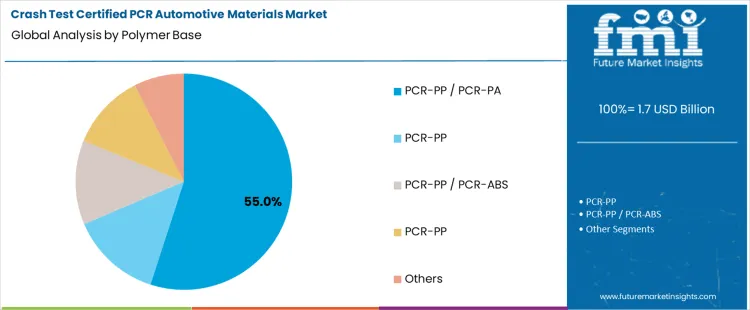
The Polymer Base Segment is dominated by PCR-PP and PCR-PA, representing 55% of the market share. These recycled polymers provide a balance of strength, stiffness, and thermal stability, which is critical for automotive components subjected to crash loads. PCR-PP (Post-Consumer Recycled Polypropylene) is valued for its impact resistance and lightweight properties, while PCR-PA (Post-Consumer Recycled Polyamide) is used for higher-strength applications where durability and energy absorption are required. Together, they enable the production of structural automotive parts that meet both performance and sustainability goals.
The growing adoption of PCR-PP and PCR-PA is driven by automakers’ focus on reducing environmental impact while maintaining safety standards. These polymers support the integration of recycled materials in critical structural components without compromising crashworthiness. Supply-side factors, such as consistent quality of recycled feedstock and processing requirements, can affect adoption rates. The market is seeing increased investment in advanced recycling technologies to produce high-quality PCR-PP and PCR-PA suitable for crash-grade applications. Overcoming these constraints is expected to expand their use across more automotive components, supporting both environmental objectives and regulatory compliance.
What Procurement and Certification Criteria Are Driving Demand for Crash Test Certified PCR Automotive Materials?
Automotive OEMs and tier suppliers are placing greater emphasis on post-consumer recycled (PCR) materials that can pass crash test requirements defined by standards such as FMVSS and ECE R95. Decision teams evaluate PCR grades on impact resistance, energy absorption, and tensile properties to ensure substitute materials mirror performance of virgin counterparts in structural applications. Material traceability and batch certification documentation are now key factors in supplier selection. Procurement strategies increasingly hinge on reliable supply of PCR with documented crash performance. Buyers weigh test data alongside cost models to determine if PCR materials support both safety mandates and internal material content goals across vehicle platforms.
What Material Quality and Testing Challenges Are Restricting Use of Crash Test Certified PCR Automotive Materials?
Achieving uniform mechanical properties in PCR streams remains a main barrier for structural safety applications. Variations in source plastics affect PCR tensile strength, elongation at break, and fracture toughness, creating uncertainty in crash performance predictions. Manufacturers must conduct extensive lab testing, such as dynamic impact tests, to validate material suitability for components like bumper beams, energy absorbers, and reinforcements. Lengthy qualification protocols delay integration into production schedules, imposing extra development costs. Regional discrepancies in crash safety regulations further complicate global deployment of a single PCR grade. Certification cycles for safety-critical materials elevate both timing and expense for suppliers and OEM engineers.
What Application-Specific Trends Are Shaping Use of Crash Test Certified PCR Automotive Materials?
Adoption patterns are shifting toward strategic incorporation of certified PCR materials into non-structural load paths that still influence crash outcomes, such as interior impact liners and door module carriers. Application engineers reference crash simulation models to study how PCR components affect vehicle deformation patterns and occupant safety metrics. Multi-material design workflows now include PCR grades alongside metals and engineered plastics, allowing tailored distribution of recycled content where impact performance is acceptable. Growing interest in regional content scoring prompts engineers to document PCR usage without compromising safety performance. These trends affect how vehicle architecture teams plan material mix for next-generation platforms.
What Supply Chain Limitations Are Hindering Wider Deployment of Crash Test Certified PCR Automotive Materials?
The supply chain for PCR materials suitable for certified crash applications remains fragmented, with inconsistent feedstock quality limiting predictability of mechanical performance. Feedstock streams often contain polymers with differing thermal histories and residual contaminants that reduce strength properties required for crash certification. Sorting and pre-processing enhancements add cost and lead time, making it harder for recyclers to guarantee uniform PCR batches. OEMs require long-term material availability commitments to support multi-year vehicle programs. Transport logistics and regional variation in recycling infrastructure contribute to unpredictable material availability and pricing. These supply dynamics restrict expansion of PCR use into safety-critical automotive components.
What Are the Growth Trends for Crash Test Certified PCR Automotive Materials by Country?
| Country | CAGR (%) |
|---|---|
| Germany | 10.2% |
| USA | 9.6% |
| China | 13.8% |
| India | 14.6% |
| Brazil | 9.4% |
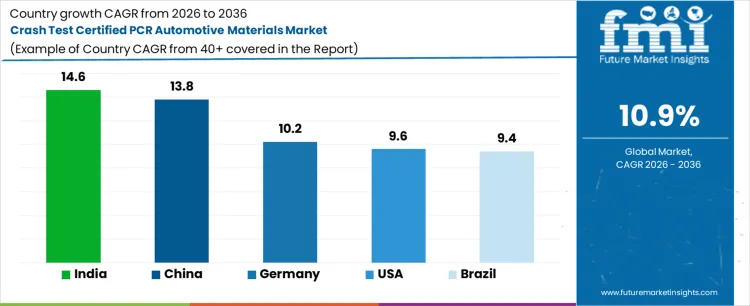
The demand for crash test certified post-consumer recycled (PCR) automotive materials is growing strongly across major automotive markets. India leads with a 14.6% CAGR, driven by rising adoption of safety-compliant vehicles, regulatory emphasis on material certification, and increasing incorporation of PCR materials in automotive manufacturing. China follows at 13.8%, supported by large-scale vehicle production, government mandates on sustainability, and focus on certified materials for vehicle safety. Germany records a 10.2% CAGR, reflecting its mature automotive sector and stringent crash safety and material standards. The USA shows steady growth at 9.6%, fueled by automakers integrating certified PCR components to meet safety and sustainability goals. Brazil, with a 9.4% CAGR, demonstrates gradual adoption as automotive manufacturers incorporate PCR materials into safety-critical components to comply with evolving regulatory frameworks.
What Is Driving Demand for Crash Test Certified PCR Automotive Materials in Germany?
Demand for crash test certified PCR automotive materials in Germany is projected to grow at a CAGR of 10.2%. Germany’s automotive sector, known for high-quality manufacturing, is increasingly adopting Eco-efficient materials to meet regulatory and consumer expectations. The integration of PCR materials in safety-critical components supports both environmental and performance goals. Strict government regulations on material reuse and safety standards incentivize the use of certified recycled plastics in vehicle production. With the rise of electric vehicles, which require lighter and safer materials, German manufacturers are investing in advanced PCR materials that meet crash test certifications. These factors collectively reinforce Germany’s position as a key market for Eco-efficient automotive safety components.
- Automotive industry prioritizes Eco-efficient, crash-certified materials.
- Government regulations drive adoption of recycled plastics.
- Electric vehicle production fuels demand for lighter, safer materials.
How Is the Outlook for Crash Test Certified PCR Automotive Materials in the USA?
Outlook on crash test certified PCR automotive materials in the USA shows growth at a CAGR of 9.6%. USA automakers are integrating recycled plastics in safety-critical components to align with environmental regulations and consumer demand for Eco-efficient vehicles. The increasing adoption of electric vehicles adds pressure to utilize lightweight, high-performance materials. Federal and state-level policies encouraging recycling and safety compliance further support market growth. As manufacturers enhance production capabilities and invest in certified PCR materials, the demand for these materials is expected to expand across passenger vehicles and commercial fleets. Continuous innovation in polymer technology and rigorous crash testing standards underpin the USA’s market growth trajectory.
- Electric vehicles increase demand for lightweight safety materials.
- Recycling regulations encourage the use of PCR components.
- Innovation in polymer technology supports market expansion.
What Factors Are Shaping the Crash Test Certified PCR Automotive Materials Market in China?
Sales of crash test certified PCR automotive materials in China are expected to grow at a CAGR of 13.8%. China’s automotive manufacturing sector, particularly electric vehicle production, is driving the adoption of Eco-efficient and certified recycled materials. Government policies supporting circular economy practices and environmental sustainability encourage manufacturers to incorporate PCR materials into safety-critical automotive components. The demand for lighter and safer materials is further reinforced by consumer focus on vehicle performance and environmental impact. Investments in polymer innovation and advanced recycling infrastructure ensure that materials meet stringent crash certification requirements. With these trends, China is positioned to lead globally in the adoption of PCR automotive materials for enhanced safety and sustainability.
- Automotive industry expansion drives PCR adoption in safety components.
- Government policies support Eco-efficient and certified materials.
- Technological advancements ensure materials meet crash standards.
How Is India Driving Growth in Crash Test Certified PCR Automotive Materials?
Outlook on crash test certified PCR automotive materials in India indicates a CAGR of 14.6%. India’s growing automotive and electric vehicle sectors are generating demand for lightweight, durable, and crash-certified recycled materials. Government initiatives promoting recycling and Eco-efficient manufacturing practices further accelerate adoption. Rising environmental awareness among consumers and automakers reinforces the shift toward PCR materials in vehicle interiors and safety-critical components. Manufacturers are increasingly investing in polymer technology and certification processes to meet both safety and sustainability targets. The combination of regulatory support, market growth in electric vehicles, and consumer preference for greener vehicles positions India as one of the fastest-growing markets for crash test certified PCR automotive materials globally.
- Expanding electric vehicle sector increases demand for certified PCR materials.
- Government initiatives support recycling and eco-efficient manufacturing.
- Consumer awareness drives adoption of crash-certified eco-efficient materials.
What Is Fueling the Crash Test Certified PCR Automotive Materials Market in Brazil?
Industry in Brazil for crash test certified PCR automotive materials is expected to grow at a CAGR of 9.4%. Brazil’s automotive manufacturers are increasingly incorporating recycled materials into safety-critical vehicle components to comply with regulations and meet consumer demand for eco-efficient vehicles. The rise of electric vehicle production and stricter environmental policies accelerate the adoption of PCR materials. Investment in polymer technology ensures that these materials meet crash certification standards while maintaining performance and durability. As consumer interest in eco-friendly and safe vehicles grows, Brazil’s market for certified PCR automotive materials is set for steady expansion over the forecast period, aligning sustainability with safety and regulatory compliance.
- Automotive production growth drives adoption of certified PCR materials.
- Government regulations encourage recycling and eco-efficient practices.
- Electric vehicle expansion fuels demand for crash-certified materials.
What Sets Competitors Apart in Crash Test Certified PCR Automotive Materials?
BASF competes with PCR-modified high-performance polymers engineered to meet stringent crashworthiness metrics used in front and side impact zones. Its Ultramid® PCR polyamide and PCR polycarbonate blends are presented with crash test data showing energy absorption and ductility retention at low temperatures. BASF’s materials are marketed with validated performance in standardized crash simulations, enabling OEM engineers to specify recycled content without lowering safety margins. Lanxess advances Durethan® PCR flame-retardant polyamides that retain tensile strength and impact resistance, emphasizing certified results from automotive crash tests. Celanese focuses on PCR polyester and polyamide structural resins with tailored modulus and elongation profiles that enhance deformation control during high-load events. SABIC offers PCR PP and PA grades supplemented with impact modifiers, positioned with technical sheets showing controlled energy dispersion in barrier and bumper applications.
Kingfa and Wanhua invest in PCR ABS and engineering polymer blends formulated for improved impact toughness and validated through crash assessment protocols. Kingfa’s materials highlight controlled fracture behavior, while Wanhua emphasizes optimized polymer chain architecture to mitigate brittle failure. Reliance Industries supplies PCR base resins that are compounded with reinforcing fillers for structural components requiring crash performance certification. Braskem markets fire-safe and impact-tested PCR PP suitable for load-bearing trim and interior supports, accompanied by test results on Izod impact strength and deformation limits. Mitsubishi Chemical competes with PCR-integrated high-impact polymers that have undergone formal automotive crash testing, with emphasis on consistency across production batches. Competitive differentiation in this market rests on documented crash certification data, ease of integration into existing safety designs, and material processing characteristics that support high-volume automotive manufacturing.
Key Players in the Crash Test Certified PCR Automotive Materials Market
- BASF
- Lanxess
- Celanese
- SABIC
- Kingfa
- Wanhua
- Reliance Industries
- Braskem
- Mitsubishi Chemical
Scope of the Report
| Items | Values |
|---|---|
| Quantitative Units (2026) | USD billion |
| End-use | Energy-Absorbing Structures, Bumper Systems & Brackets, Mass-Platform Vehicles, Passenger Vehicle Structures, Automotive Components, Premium Vehicle Platforms |
| Material Class | Reinforced Crash-Grade Compounds, Structural Injection Grades, Toughened PCR Plastics, Reinforced PCR Polymers, Others |
| Polymer Base | PCR-PP and PCR-PA, PCR-PP, PCR-PP and PCR-ABS, Others |
| Technology | CAE-Validated & Crash-Tested Compounding, Impact-Tuned Formulations, High-Volume Crash-Grade Compounding, Cost-Optimized Crash Compliance, Others |
| Regions Covered | Asia Pacific, Europe, North America, Latin America, Middle East & Africa |
| Countries Covered | China, Japan, South Korea, India, Australia & New Zealand, ASEAN, Germany, United Kingdom, France, Italy, Spain, Nordic, BENELUX, United States, Canada, Mexico, Brazil, Chile, Saudi Arabia, Turkey, South Africa, and other regional markets |
| Key Companies Profiled | BASF, Lanxess, Celanese, SABIC, Kingfa, Wanhua, Reliance Industries, Braskem, Mitsubishi Chemical |
| Additional Attributes | Dollar sales by end-use, material class, polymer base, and technology, reinforced crash-grade compounds representing the largest material class due to impact resistance and energy absorption requirements, PCR-PP and PCR-PA representing the leading polymer base because of balance between strength, stiffness, and lightweight properties, demand driven by stricter crash safety regulations and recycled content mandates, procurement shaped by FMVSS and ECE certification requirements, performance economics influenced by compounding quality, CAE validation, and feedstock consistency, increasing use in bumper systems, energy absorbers, and structural interior supports, and competitive positioning based on documented crash test data, certification cycles, and ability to supply consistent crash-grade PCR materials at automotive scale. |
Crash Test Certified PCR Automotive Materials Market Segmentation
By End-use:
- Energy-absorbing structures
- Bumper systems & brackets
- Mass-platform vehicles
- Passenger vehicle structures
- Automotive components
- Premium vehicle platforms
By Material Class:
- Reinforced crash-grade compounds
- Structural injection grades
- Toughened PCR plastics
- Reinforced PCR polymers
- Others
By Polymer Base:
- PCR-PP and PCR-PA
- PCR-PP
- PCR-PP and PCR-ABS
- PCR-PP
- Others
By Technology:
- CAE-validated & crash-tested compounding
- Impact-tuned formulations
- High-volume crash-grade compounding
- Cost-optimized crash compliance
- Others
By Region:
- Asia Pacific
- China
- Japan
- South Korea
- India
- Australia & New Zealand
- ASEAN
- Rest of Asia Pacific
- Europe
- Germany
- United Kingdom
- France
- Italy
- Spain
- Nordic
- BENELUX
- Rest of Europe
- North America
- United States
- Canada
- Mexico
- Latin America
- Brazil
- Chile
- Rest of Latin America
- Middle East & Africa
- Kingdom of Saudi Arabia
- Other GCC Countries
- Turkey
- South Africa
- Other African Union
- Rest of Middle East & Africa
Bibliography
- European Commission. (2023). Proposal for a regulation of the European Parliament and of the Council on circularity requirements for vehicle design and on management of end-of-life vehicles, amending Regulations (EU) 2018/858 and 2019/1020 and repealing Directives 2000/53/EC and 2005/64/EC (COM/2023/451 final). European Commission.
- Organization for Economic Co-operation and Development. (2024). Policy scenarios for eliminating plastic pollution by 2040. OECD Publishing.
- United States Environmental Protection Agency. (2024). National strategy to prevent plastic pollution. U.S. Environmental Protection Agency.
Frequently Asked Questions
How big is the crash test certified pcr automotive materials market in 2026?
The global crash test certified pcr automotive materials market is estimated to be valued at USD 1.7 billion in 2026.
What will be the size of crash test certified pcr automotive materials market in 2036?
The market size for the crash test certified pcr automotive materials market is projected to reach USD 4.8 billion by 2036.
How much will be the crash test certified pcr automotive materials market growth between 2026 and 2036?
The crash test certified pcr automotive materials market is expected to grow at a 10.9% CAGR between 2026 and 2036.
What are the key product types in the crash test certified pcr automotive materials market?
The key product types in crash test certified pcr automotive materials market are energy-absorbing structures, bumper systems & brackets, mass-platform vehicles, passenger vehicle structures, automotive components and premium vehicle platforms.
Which material class segment to contribute significant share in the crash test certified pcr automotive materials market in 2026?
In terms of material class, reinforced crash-grade compounds segment to command 48.0% share in the crash test certified pcr automotive materials market in 2026.
Preview the report firsthand - request a free sample
Get SampleGet the brochure for pricing and purchase details.
Get PDFTable of Content
- Executive Summary
- Global Market Outlook
- Demand-side Trends
- Supply-side Trends
- Technology Roadmap Analysis
- Analysis and Recommendations
- Market Overview
- Market Coverage / Taxonomy
- Market Definition / Scope / Limitations
- Market Background
- Market Dynamics
- Drivers
- Restraints
- Opportunity
- Trends
- Scenario Forecast
- Demand in Optimistic Scenario
- Demand in Likely Scenario
- Demand in Conservative Scenario
- Opportunity Map Analysis
- Product Life Cycle Analysis
- Supply Chain Analysis
- Investment Feasibility Matrix
- Value Chain Analysis
- PESTLE and Porter’s Analysis
- Regulatory Landscape
- Regional Parent Market Outlook
- Production and Consumption Statistics
- Import and Export Statistics
- Market Dynamics
- Global Market Analysis 2021 to 2025 and Forecast, 2026 to 2036
- Historical Market Size Value (USD Million) Analysis, 2021 to 2025
- Current and Future Market Size Value (USD Million) Projections, 2026 to 2036
- Y-o-Y Growth Trend Analysis
- Absolute $ Opportunity Analysis
- Global Market Pricing Analysis 2021 to 2025 and Forecast 2026 to 2036
- Global Market Analysis 2021 to 2025 and Forecast 2026 to 2036, By End-use
- Introduction / Key Findings
- Historical Market Size Value (USD Million) Analysis By End-use , 2021 to 2025
- Current and Future Market Size Value (USD Million) Analysis and Forecast By End-use , 2026 to 2036
- Energy-absorbing structures
- Bumper systems & brackets
- Mass-platform vehicles
- Passenger vehicle structures
- Automotive components
- Premium vehicle platforms
- Energy-absorbing structures
- Y-o-Y Growth Trend Analysis By End-use , 2021 to 2025
- Absolute $ Opportunity Analysis By End-use , 2026 to 2036
- Global Market Analysis 2021 to 2025 and Forecast 2026 to 2036, By Material Class
- Introduction / Key Findings
- Historical Market Size Value (USD Million) Analysis By Material Class, 2021 to 2025
- Current and Future Market Size Value (USD Million) Analysis and Forecast By Material Class, 2026 to 2036
- Reinforced crash-grade compounds
- Structural injection grades
- Toughened PCR plastics
- Reinforced PCR polymers
- Others
- Reinforced crash-grade compounds
- Y-o-Y Growth Trend Analysis By Material Class, 2021 to 2025
- Absolute $ Opportunity Analysis By Material Class, 2026 to 2036
- Global Market Analysis 2021 to 2025 and Forecast 2026 to 2036, By Polymer Base
- Introduction / Key Findings
- Historical Market Size Value (USD Million) Analysis By Polymer Base, 2021 to 2025
- Current and Future Market Size Value (USD Million) Analysis and Forecast By Polymer Base, 2026 to 2036
- PCR-PP / PCR-PA
- PCR-PP
- PCR-PP / PCR-ABS
- PCR-PP
- Others
- PCR-PP / PCR-PA
- Y-o-Y Growth Trend Analysis By Polymer Base, 2021 to 2025
- Absolute $ Opportunity Analysis By Polymer Base, 2026 to 2036
- Global Market Analysis 2021 to 2025 and Forecast 2026 to 2036, By Technology
- Introduction / Key Findings
- Historical Market Size Value (USD Million) Analysis By Technology, 2021 to 2025
- Current and Future Market Size Value (USD Million) Analysis and Forecast By Technology, 2026 to 2036
- CAE-validated & crash-tested compounding
- Impact-tuned formulations
- High-volume crash-grade compounding
- Cost-optimized crash compliance
- Others
- CAE-validated & crash-tested compounding
- Y-o-Y Growth Trend Analysis By Technology, 2021 to 2025
- Absolute $ Opportunity Analysis By Technology, 2026 to 2036
- Global Market Analysis 2021 to 2025 and Forecast 2026 to 2036, By 0.38
- Introduction / Key Findings
- Historical Market Size Value (USD Million) Analysis By 0.38, 2021 to 2025
- Current and Future Market Size Value (USD Million) Analysis and Forecast By 0.38, 2026 to 2036
- 0.26
- 0.22
- 0.1
- 0.02
- 0.02
- 0.26
- Y-o-Y Growth Trend Analysis By 0.38, 2021 to 2025
- Absolute $ Opportunity Analysis By 0.38, 2026 to 2036
- Global Market Analysis 2021 to 2025 and Forecast 2026 to 2036, By Region
- Introduction
- Historical Market Size Value (USD Million) Analysis By Region, 2021 to 2025
- Current Market Size Value (USD Million) Analysis and Forecast By Region, 2026 to 2036
- North America
- Latin America
- Western Europe
- Eastern Europe
- East Asia
- South Asia and Pacific
- Middle East & Africa
- Market Attractiveness Analysis By Region
- North America Market Analysis 2021 to 2025 and Forecast 2026 to 2036, By Country
- Historical Market Size Value (USD Million) Trend Analysis By Market Taxonomy, 2021 to 2025
- Market Size Value (USD Million) Forecast By Market Taxonomy, 2026 to 2036
- By Country
- USA
- Canada
- Mexico
- By End-use
- By Material Class
- By Polymer Base
- By Technology
- By 0.38
- By Country
- Market Attractiveness Analysis
- By Country
- By End-use
- By Material Class
- By Polymer Base
- By Technology
- By 0.38
- Key Takeaways
- Latin America Market Analysis 2021 to 2025 and Forecast 2026 to 2036, By Country
- Historical Market Size Value (USD Million) Trend Analysis By Market Taxonomy, 2021 to 2025
- Market Size Value (USD Million) Forecast By Market Taxonomy, 2026 to 2036
- By Country
- Brazil
- Chile
- Rest of Latin America
- By End-use
- By Material Class
- By Polymer Base
- By Technology
- By 0.38
- By Country
- Market Attractiveness Analysis
- By Country
- By End-use
- By Material Class
- By Polymer Base
- By Technology
- By 0.38
- Key Takeaways
- Western Europe Market Analysis 2021 to 2025 and Forecast 2026 to 2036, By Country
- Historical Market Size Value (USD Million) Trend Analysis By Market Taxonomy, 2021 to 2025
- Market Size Value (USD Million) Forecast By Market Taxonomy, 2026 to 2036
- By Country
- Germany
- UK
- Italy
- Spain
- France
- Nordic
- BENELUX
- Rest of Western Europe
- By End-use
- By Material Class
- By Polymer Base
- By Technology
- By 0.38
- By Country
- Market Attractiveness Analysis
- By Country
- By End-use
- By Material Class
- By Polymer Base
- By Technology
- By 0.38
- Key Takeaways
- Eastern Europe Market Analysis 2021 to 2025 and Forecast 2026 to 2036, By Country
- Historical Market Size Value (USD Million) Trend Analysis By Market Taxonomy, 2021 to 2025
- Market Size Value (USD Million) Forecast By Market Taxonomy, 2026 to 2036
- By Country
- Russia
- Poland
- Hungary
- Balkan & Baltic
- Rest of Eastern Europe
- By End-use
- By Material Class
- By Polymer Base
- By Technology
- By 0.38
- By Country
- Market Attractiveness Analysis
- By Country
- By End-use
- By Material Class
- By Polymer Base
- By Technology
- By 0.38
- Key Takeaways
- East Asia Market Analysis 2021 to 2025 and Forecast 2026 to 2036, By Country
- Historical Market Size Value (USD Million) Trend Analysis By Market Taxonomy, 2021 to 2025
- Market Size Value (USD Million) Forecast By Market Taxonomy, 2026 to 2036
- By Country
- China
- Japan
- South Korea
- By End-use
- By Material Class
- By Polymer Base
- By Technology
- By 0.38
- By Country
- Market Attractiveness Analysis
- By Country
- By End-use
- By Material Class
- By Polymer Base
- By Technology
- By 0.38
- Key Takeaways
- South Asia and Pacific Market Analysis 2021 to 2025 and Forecast 2026 to 2036, By Country
- Historical Market Size Value (USD Million) Trend Analysis By Market Taxonomy, 2021 to 2025
- Market Size Value (USD Million) Forecast By Market Taxonomy, 2026 to 2036
- By Country
- India
- ASEAN
- Australia & New Zealand
- Rest of South Asia and Pacific
- By End-use
- By Material Class
- By Polymer Base
- By Technology
- By 0.38
- By Country
- Market Attractiveness Analysis
- By Country
- By End-use
- By Material Class
- By Polymer Base
- By Technology
- By 0.38
- Key Takeaways
- Middle East & Africa Market Analysis 2021 to 2025 and Forecast 2026 to 2036, By Country
- Historical Market Size Value (USD Million) Trend Analysis By Market Taxonomy, 2021 to 2025
- Market Size Value (USD Million) Forecast By Market Taxonomy, 2026 to 2036
- By Country
- Kingdom of Saudi Arabia
- Other GCC Countries
- Turkiye
- South Africa
- Other African Union
- Rest of Middle East & Africa
- By End-use
- By Material Class
- By Polymer Base
- By Technology
- By 0.38
- By Country
- Market Attractiveness Analysis
- By Country
- By End-use
- By Material Class
- By Polymer Base
- By Technology
- By 0.38
- Key Takeaways
- Key Countries Market Analysis
- USA
- Pricing Analysis
- Market Share Analysis, 2025
- By End-use
- By Material Class
- By Polymer Base
- By Technology
- By 0.38
- Canada
- Pricing Analysis
- Market Share Analysis, 2025
- By End-use
- By Material Class
- By Polymer Base
- By Technology
- By 0.38
- Mexico
- Pricing Analysis
- Market Share Analysis, 2025
- By End-use
- By Material Class
- By Polymer Base
- By Technology
- By 0.38
- Brazil
- Pricing Analysis
- Market Share Analysis, 2025
- By End-use
- By Material Class
- By Polymer Base
- By Technology
- By 0.38
- Chile
- Pricing Analysis
- Market Share Analysis, 2025
- By End-use
- By Material Class
- By Polymer Base
- By Technology
- By 0.38
- Germany
- Pricing Analysis
- Market Share Analysis, 2025
- By End-use
- By Material Class
- By Polymer Base
- By Technology
- By 0.38
- UK
- Pricing Analysis
- Market Share Analysis, 2025
- By End-use
- By Material Class
- By Polymer Base
- By Technology
- By 0.38
- Italy
- Pricing Analysis
- Market Share Analysis, 2025
- By End-use
- By Material Class
- By Polymer Base
- By Technology
- By 0.38
- Spain
- Pricing Analysis
- Market Share Analysis, 2025
- By End-use
- By Material Class
- By Polymer Base
- By Technology
- By 0.38
- France
- Pricing Analysis
- Market Share Analysis, 2025
- By End-use
- By Material Class
- By Polymer Base
- By Technology
- By 0.38
- India
- Pricing Analysis
- Market Share Analysis, 2025
- By End-use
- By Material Class
- By Polymer Base
- By Technology
- By 0.38
- ASEAN
- Pricing Analysis
- Market Share Analysis, 2025
- By End-use
- By Material Class
- By Polymer Base
- By Technology
- By 0.38
- Australia & New Zealand
- Pricing Analysis
- Market Share Analysis, 2025
- By End-use
- By Material Class
- By Polymer Base
- By Technology
- By 0.38
- China
- Pricing Analysis
- Market Share Analysis, 2025
- By End-use
- By Material Class
- By Polymer Base
- By Technology
- By 0.38
- Japan
- Pricing Analysis
- Market Share Analysis, 2025
- By End-use
- By Material Class
- By Polymer Base
- By Technology
- By 0.38
- South Korea
- Pricing Analysis
- Market Share Analysis, 2025
- By End-use
- By Material Class
- By Polymer Base
- By Technology
- By 0.38
- Russia
- Pricing Analysis
- Market Share Analysis, 2025
- By End-use
- By Material Class
- By Polymer Base
- By Technology
- By 0.38
- Poland
- Pricing Analysis
- Market Share Analysis, 2025
- By End-use
- By Material Class
- By Polymer Base
- By Technology
- By 0.38
- Hungary
- Pricing Analysis
- Market Share Analysis, 2025
- By End-use
- By Material Class
- By Polymer Base
- By Technology
- By 0.38
- Kingdom of Saudi Arabia
- Pricing Analysis
- Market Share Analysis, 2025
- By End-use
- By Material Class
- By Polymer Base
- By Technology
- By 0.38
- Turkiye
- Pricing Analysis
- Market Share Analysis, 2025
- By End-use
- By Material Class
- By Polymer Base
- By Technology
- By 0.38
- South Africa
- Pricing Analysis
- Market Share Analysis, 2025
- By End-use
- By Material Class
- By Polymer Base
- By Technology
- By 0.38
- USA
- Market Structure Analysis
- Competition Dashboard
- Competition Benchmarking
- Market Share Analysis of Top Players
- By Regional
- By End-use
- By Material Class
- By Polymer Base
- By Technology
- By 0.38
- Competition Analysis
- Competition Deep Dive
- BASF
- Overview
- Product Portfolio
- Profitability by Market Segments (Product/Age /Sales Channel/Region)
- Sales Footprint
- Strategy Overview
- Marketing Strategy
- Product Strategy
- Channel Strategy
- Lanxess
- Celanese
- SABIC
- Kingfa
- Wanhua
- Reliance Industries
- Braskem
- Mitsubishi Chemical
- BASF
- Competition Deep Dive
- Assumptions & Acronyms Used
- Research Methodology


