

- Industry Size (2026)
- USD 1980 Mn
- Forecast (2036)
- USD 4820 Mn
- CAGR (2026 to 2036)
- 9.3%
PCR-Ready Automotive PP Compound Market Forecast and Outlook 2026 to 2036
The PCR-ready automotive PP compound market revenue is likely to total USD 1,980 million in 2026, rising further to USD 4,820 million by 2036, at a CAGR of 9.3%. Future Market Insights analysis indicates this market is transitioning from limited pilot use to systematic integration into global vehicle platforms. This expansion through 2026 is underpinned by regulatory pressure for recycled content, the development of OEM-specific material standards for PCR, and significant investment in advanced compounding lines equipped with sophisticated filtration and mixing technology.
A primary market driver is the regulatory and policy framework emerging around vehicle circularity in the European Union. The End-of-Life Vehicles (ELV) Directive emphasizes recyclability, material recovery, and circular design principles, creating a structural incentive for increased use of recycled polymers in automotive components. While the Directive does not yet mandate fixed recycled-content quotas for plastics in new vehicles, it has been reinforced by proposed ELV revisions and broader EU circular-economy policy signals. In parallel, major OEMs, including Volkswagen Group, have articulated long-term material circularity strategies that prioritize the rising integration of secondary plastics across vehicle platforms, translating regulatory intent into procurement-level demand for PCR-ready, performance-validated polypropylene compounds.
The technical challenge of odor control, contamination variability, and mechanical property retention in post-consumer recycled polypropylene is being addressed through advanced compounding solutions. In 2024, Borealis continued the commercialization of its Borcycle™ M mechanically recycled polypropylene portfolio for automotive applications.
These compounds incorporate high levels of PCR-PP sourced from post-consumer waste streams and are engineered to meet automotive requirements for stiffness, impact resistance, and process stability. The deployment of Borcycle™ grades in interior and structural automotive components demonstrates the growing feasibility of using high-PCR PP materials in demanding vehicle applications without compromising functional performance.
Supply-chain alignment remains a critical enabler for consistent PCR adoption in automotive plastics. Compounders and material solution providers are increasingly working upstream with recyclers to improve feedstock consistency, color control, and impurity management in PCR-PP streams. Companies such as Avient Corporation have highlighted recycled-content material development and additive optimization as strategic priorities, enabling PCR-PP compounds to meet automotive processing and durability requirements. While specific closed-loop partnerships are not widely disclosed publicly, this trend toward tighter recycler–compounder integration is central to scaling PCR-ready polypropylene compounds for interior and under-the-hood automotive uses.
The economic model is being reshaped by green premiums and compliance benefits. A 2025 total cost of ownership analysis published by the European Association of Plastics Recycling (EuPC) concluded that while PCR-ready compounds carry a 10-15% premium over virgin equivalents, their use can reduce OEMs' overall environmental compliance costs linked to the ELV Directive and contribute directly to corporate carbon reduction goals, improving the financial rationale for adoption.
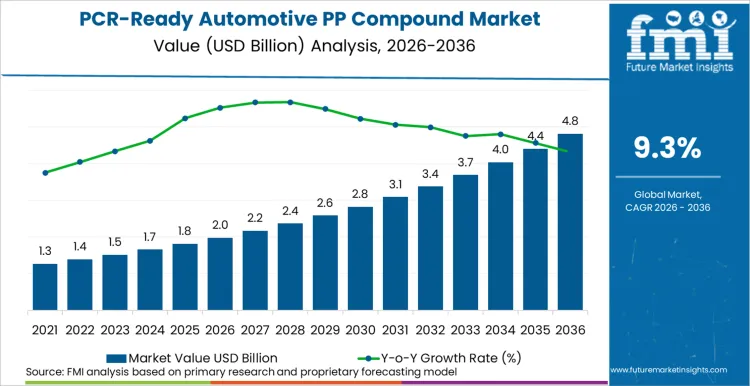
Summary of PCR-Ready Automotive PP Compound Market
What is the Long-Term Growth Outlook for the PCR-Ready Automotive PP Compound Market?
FMI projects the global PCR-ready automotive PP compound market to expand from USD 1,980 million in 2026 to USD 4,820 million by 2036, registering a 9.3% CAGR. This robust growth is structurally anchored in the automotive industry's urgent need to reduce lifecycle carbon emissions and incorporate circular materials. The market's progression is tied to the scaling of high-quality PCR supply and the compounding industry's ability to deliver standardized, OEM-approved materials that perform identically to virgin solutions.
FMI Research Approach: This projection utilizes a proprietary model integrating OEM recycled content announcements, analysis of PCR collection and sorting infrastructure investment, regulatory timelines in key regions, and capacity expansion plans from leading compounders.
How do FMI Analysts Expect the PCR-Ready Automotive PP Compound Market to Evolve Structurally?
FMI analysts anticipate a market evolution from simple PCR blending toward sophisticated, application-engineered compounds. Future formulations will use compatibilizers and impact modifiers specifically designed for PCR matrices, and will increasingly target structurally demanding applications beyond interior trim. The market will also see a bifurcation between premium, highly engineered compounds for visible parts and cost-optimized solutions for hidden, high-volume components.
FMI Research Approach: Insights are derived from patent analysis in polymer compatibilization, monitoring of OEM technical specification sheets for recycled content, and reviewing material data sheets from compounders launching new PCR-ready grades.
Which Geographies Command Strategic Importance in the PCR-Ready Automotive PP Compound Market?
Strategic growth is concentrated in regions with strong automotive manufacturing bases and progressive regulations. The European Union, led by Germany, is the regulatory and innovation frontrunner. China and India represent high-growth markets where domestic OEMs are rapidly integrating sustainability into mass-volume platforms. The United States market is driven by corporate sustainability goals and the specifications of global OEMs with North American operations.
FMI Research Approach: Regional market sizing is based on automotive production volumes, the strength of ELV-like regulations, domestic PCR infrastructure, and the localization strategies of global compounders.
What Will Be the Market Size of PCR-Ready Automotive PP Compound by 2036?
By 2036, the PCR-ready automotive PP compound market is expected to reach USD 4,820 million. This expansion will correlate with the anticipated rollout of next-generation vehicle platforms designed from the outset to use high levels of recycled content. Market maturity will be marked by the broad availability of OEM-approved compound grades with recycled content levels of 50% or higher for a wide array of applications.
FMI Research Approach: The long-term outlook incorporates forecasts for global vehicle production, projected increases in PCR-PP yield from waste streams, and the anticipated tightening of recycled content mandates in automotive regulations.
What are some Globally Distinct Trends Shaping the PCR-Ready Automotive PP Compound Market?
Globally, the market is shaped by the pursuit of "virgin-like" performance, the critical need for color consistency, and the integration of traceability. Compounders are investing in super-clean PCR feedstock and advanced dispersion technology to match the mechanical properties of virgin PP. The automotive industry's color-matching demands require sophisticated masterbatch solutions for PCR compounds. Furthermore, blockchain and digital tagging are being explored to provide verifiable chain-of-custody for the recycled content, which is vital for OEM sustainability reporting.
FMI Research Approach: Trend identification involves tracking technical sessions at automotive polymer conferences, analyzing OEM requests for proposals that include traceability requirements, and monitoring investments in digital product passport initiatives for materials.
PCR-Ready Automotive PP Compound Market Key Takeaways
| Metrics | Values |
|---|---|
| Expected Value (2026E) | USD 1,980 million |
| Projected Value (2036F) | USD 4,820 million |
| CAGR (2026 to 2036) | 9.3% |
Source: Future Market Insights (FMI) analysis, based on proprietary forecasting model and primary research
Why is the PCR-Ready Automotive PP Compound Market Growing?
The primary growth catalyst is the automotive industry's comprehensive decarbonization strategy, which extends beyond tailpipe emissions to embodied carbon in materials. Using PCR-PP can reduce the carbon footprint of a plastic component by 50-80% compared to virgin fossil-based PP. This reduction is directly quantifiable and contributes to OEMs' Scope 3 emission targets, making it a prioritized lever in environmental product declarations and life-cycle assessments for new vehicles.
Stringent OEM quality control and approval processes are creating a formalized market. An automotive-grade PCR-ready compound is not a commodity; it must undergo extensive testing for long-term heat aging, fogging, odor, and mechanical performance under temperature cycles. The establishment of dedicated OEM material standards for PCR content-with clear test protocols-provides a framework that legitimizes the market and gives compounders a clear benchmark for development, de-risking investment in new formulations.
Advancements in pre-compounding recycling technology are expanding the usable feedstock base. Modern recycling facilities now employ advanced flake sorting (e.g., NIR technology) and high-intensity washing processes that produce PCR-PP flake with significantly lower contamination levels. This "super-clean" flake is a more consistent and reliable raw material for compounders, enabling them to produce higher-performance, higher-percentage PCR compounds with less batch-to-batch variation, which is essential for automotive manufacturing.
How is PCR-Ready Automotive PP Compound Market Segmented?
The market segment landscape is defined by the automotive industry's application-specific material requirements and the technical imperative of incorporating recycled content without sacrificing performance. Interior and exterior parts represent the largest application arena, while mineral-filled compounds are the leading vehicle for integrating PCR. PCR-PP at 30-50% content is the target formulation, enabled by OEM-approved compounding and dispersion technology.
How are Interior and Exterior Parts Driving Material Development?
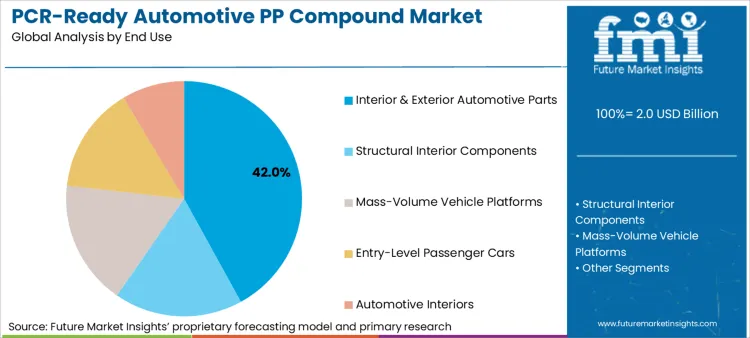
Interior and exterior automotive parts constitute the largest end-use segment with a 42.0% share. This includes bumpers, door panels, trim, and under-the-hood components. These applications demand a balance of stiffness, impact resistance, dimensional stability, and surface finish. The push to incorporate PCR into these parts is strongest in non-aesthetic, semi-structural components where color can be managed through painting or the use of black compounds. The segment's volume makes it the primary battleground for achieving recycled content targets at scale.
This segment's requirements validate the entire technology stack. A successful PCR compound for a bumper bracket, for example, must demonstrate consistent impact strength at low temperatures and resistance to automotive fluids. Meeting these specs with a 30% PCR load requires sophisticated compounding with impact modifiers and stabilizers, driving the value of engineered solutions over simple blends.
Which Compound Type is the Primary Carrier for PCR Content?
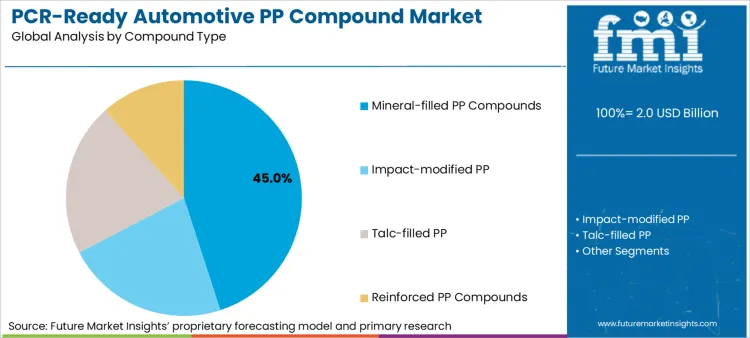
Mineral-filled PP compounds represent the leading compound type segment with a 45.0% share. Talc or calcium carbonate-filled PP is ubiquitous in automotive for parts requiring enhanced stiffness, higher heat distortion temperature, and reduced shrinkage. The mineral filler itself can help mask variations in the PCR feedstock and improve dimensional stability. Incorporating PCR into these already complex formulations is a significant technical challenge, requiring expertise to ensure the filler, virgin PP, PCR-PP, and additives are optimally dispersed to prevent weak points.
The dominance of this type directs R&D. Compounders are focusing on developing coupling agents and dispersion aids that work effectively in the presence of PCR contaminants to maintain the strong polymer-filler interface necessary for mechanical performance.
What is the Target Recycled Content Range for Automotive Applications?
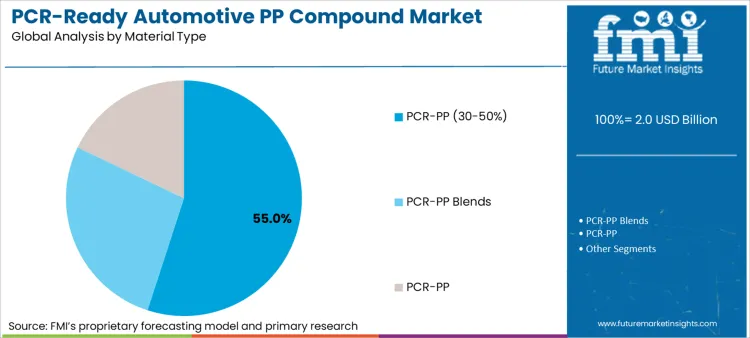
PCR-PP with 30-50% post-consumer recycled content is the leading material segment with a 55.0% share. This range represents the current practical and commercial sweet spot. Formulations below 30% often do not provide a compelling sustainability story or sufficient carbon reduction for OEM targets, while exceeding 50% with today's PCR quality and technology frequently entails significant compromises in performance or processability that are unacceptable for automotive specs. This 30-50% bracket is where compounders are concentrating their efforts to deliver reliable, OEM-approved materials.
This target range is becoming a de facto standard in OEM sourcing guidelines, providing a clear benchmark for suppliers and ensuring a degree of material consistency across the supply chain as the market scales.
Which Technology is Critical to Achieving Automotive-Grade Quality?
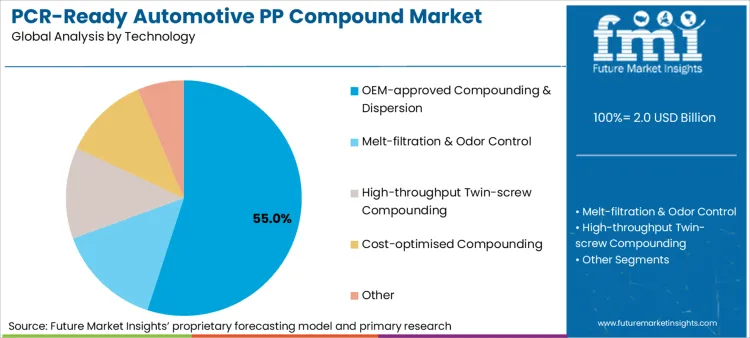
OEM-approved compounding and dispersion technology is the dominant technology segment with a 55.0% share. This encompasses far more than standard twin-screw extrusion. It refers to integrated systems featuring multi-stage melt filtration to remove solid contaminants, devolatilization ports to strip VOCs and odors, and precision side-feeding for additives. Furthermore, the entire process must be rigorously controlled and validated to meet IATF 16949 quality management standards, with comprehensive lot traceability from PCR flake to finished compound pellet.
Mastery of this technology is the key barrier to entry. It requires significant capital investment and deep process engineering knowledge to adapt extrusion parameters (temperature, shear, residence time) to the variable nature of PCR feedstock while consistently hitting tight automotive property specifications.
What Drivers, Restraints, Opportunities, and Trends Prevail in the PCR-Ready Automotive PP Compound Market?
Market expansion is powerfully driven by the economics of carbon pricing and compliance. As emissions trading schemes and internal carbon pricing become more prevalent, the CO2 savings from using PCR translate into direct financial value. Additionally, avoiding potential future penalties associated with "greenwashing" or failing to meet self-declared recycled content targets makes investing in certified, traceable PCR compounds a risk mitigation strategy for Tier 1 suppliers and OEMs.
A fundamental restraint is the limited availability of automotive-grade PCR feedstock. The ideal feedstock comes from closed-loop streams, like bumpers from ELV processing, but these volumes are limited. Most PCR-PP comes from mixed household packaging, which contains contaminants (other polymers, adhesives, inks) and additives not designed for automotive service conditions. This feedstock inconsistency remains the largest technical hurdle, requiring robust compounding technology to "wash out" performance variability.
A significant opportunity lies in developing compounds for electric vehicle specific applications. EVs have unique packaging and component needs, such as battery housings and interior parts that prioritize acoustic damping and lightweighting. Developing PCR-ready compounds tailored for these new applications allows compounders to establish themselves early in the design phase of evolving EV platforms, securing long-term supply agreements.
A key technical trend is the use of chain extenders and compatibilizers specifically designed for PCR. These additives can repair polymer chains degraded during the initial use and recycling process, restoring molecular weight and improving melt strength. They also improve adhesion between the PCR phase and virgin polymer or filler, leading to better mechanical properties. The development of next-generation additive packages is a major area of R&D competition among compounders.
The trend toward digital material passports is gaining momentum. To verify recycled content claims for sustainability reporting, OEMs are demanding granular data. This is leading to pilot projects using molecular tagging or blockchain-based traceability systems that follow the PCR flake from the recycler through the compounder to the final molded part, ensuring the integrity of the recycled content claim and providing data for life-cycle assessment.
Analysis of PCR-Ready Automotive PP Compound Market by Key Countries
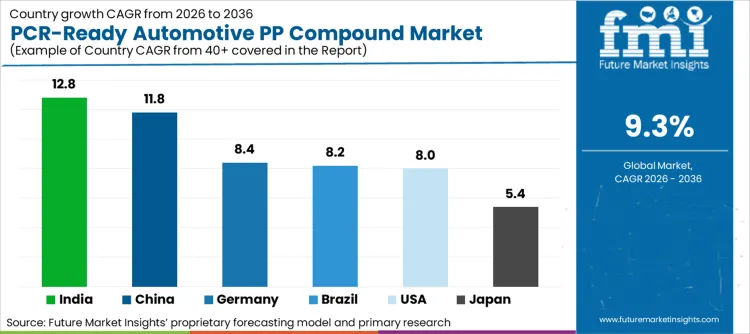
| Country | CAGR (2026-2036) |
|---|---|
| India | 12.8% |
| China | 11.8% |
| Germany | 8.4% |
| USA | 8.0% |
| Brazil | 8.2% |
| Japan | 5.4% |
Source: Future Market Insights (FMI) analysis, based on proprietary forecasting model and primary research
How are Mass-Market OEMs and Local Sourcing Driving the Indian Market?
India is projected to expand at a 12.8% CAGR through 2036, the highest among key nations. This is driven by the strategies of domestic volume OEMs like Tata Motors and Maruti Suzuki, which are targeting entry-level and compact car segments where cost is paramount. These OEMs are pushing for cost-optimized PCR compounds that meet basic performance specs for non-critical interior parts. The growth of organized PCR collection and the presence of integrated petrochemical players like Reliance Industries, which can link PCR feedstock to compounding, enable localized, affordable solutions tailored to this price-sensitive but high-volume market.
How is the Scale of Automotive Production and Policy Steering the Chinese Market?
China’s market is growing at an 11.8% CAGR, fueled by its position as the world's largest automotive producer and its "Dual Carbon" policy framework. Domestic OEMs and their vast supplier networks are under pressure to improve the environmental profile of their vehicles. Chinese compounders like Kingfa Sci. & Tech. and Shanghai PRET are leveraging high-volume twin-screw compounding expertise to produce PCR-ready PP for mass-volume vehicle platforms. The focus is on achieving economies of scale to supply the immense domestic production of vehicles for both local consumption and export, aligning with global OEMs' mandates for Chinese-made vehicles.
Which Regulatory Leadership and Premium OEM Demand Define the German Market?
Germany’s market, expanding at an 8.4% CAGR, is the qualitative benchmark globally. Driven by the EU's ELV Directive and the sustainability ambitions of its premium OEMs (Volkswagen Group, BMW, Mercedes-Benz), the demand is for high-performance, technically validated compounds. German and Austrian compounders like Borealis lead in developing advanced materials with high PCR content for both interior and under-the-hood applications, focusing on overcoming odor and long-term aging challenges. Rigorous approval processes and a willingness to pay a green premium for guaranteed quality characterize the market.
How do Corporate Sustainability Goals and a Re-shoring Supply Chain Influence the US Market?
The United States market, with an 8.0% CAGR, is shaped by the sustainability commitments of Detroit-based OEMs and the North American operations of foreign OEMs. While federal regulation is less prescriptive than in Europe, corporate targets are a strong driver. Furthermore, the trend toward supply chain regionalization ("re-shoring") supports the development of local PCR compounding. Companies like Avient and Celanese are expanding their North American portfolios of PCR-ready compounds, often collaborating with regional recyclers to create shorter, more transparent supply loops for OEMs and Tier 1 suppliers.
What Role does a Growing Domestic Auto Industry and Bio-Integration Play in Brazil?
Brazil’s market, with an 8.2% CAGR, is influenced by the growth of its domestic automotive industry and its leadership in sugarcane-based bioplastics. While PCR use is still emerging, local resin giant Braskem is exploring synergies between its bio-based PE/PP and recycled content. The opportunity lies in developing hybrid "bio-circular" compounds that combine renewable feedstocks with PCR, creating a uniquely sustainable proposition for the South American market and for global OEMs manufacturing in Brazil.
How do Precision Engineering and Closed-Loop Models Shape the Japanese Market?
Precision engineering and a strong focus on quality define Japan’s market, growing at a 5.4% CAGR. Japanese OEMs like Toyota and Nissan are pioneering closed-loop recycling for specific components, such as bumper-to-bumper recycling. This provides a very clean, known feedstock for compounding. Domestic compounders like Prime Polymer focus on developing OEM-specific compound platforms that meet exacting standards for color, gloss, and performance for visible interior trim, leveraging high-quality PCR from these controlled streams.
What is the Competition Outlook for PCR-Ready Automotive PP Compound?
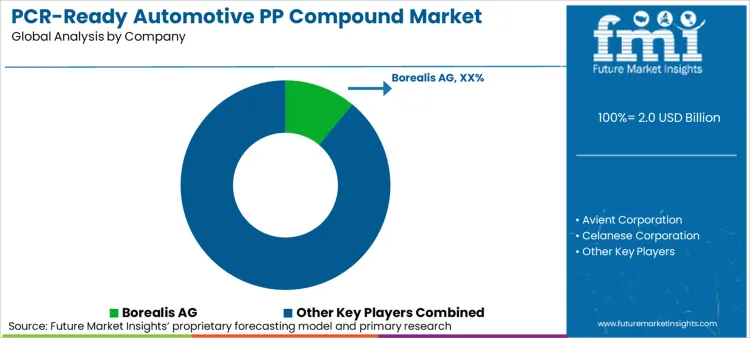
Competitive intensity centers on technological mastery of PCR integration and the ability to secure OEM approvals. The landscape is divided between large, integrated chemical companies with in-house compounding and recycling divisions, and specialized engineering compounders with deep application know-how. Success requires a dual capability: excellence in polymer science to stabilize and enhance PCR, and a strong technical sales force capable of navigating the lengthy and demanding automotive OEM qualification process.
Strategic moves are focused on vertical integration and dedicated capacity. Leading players are investing in "molecule-to-module" capabilities, controlling or partnering closely with the PCR flake supply. They are also installing dedicated compounding lines for PCR-ready materials to avoid cross-contamination with virgin production and to optimize process parameters specifically for the recycled feedstock. Competition is as much about securing sustainable feedstock contracts as it is about material performance.
Key Developments
- In 2024, Borealis advanced the automotive deployment of its Borcycle™ M mechanically recycled polypropylene portfolio, with multiple grades qualified for series production in interior and carrier-type automotive components. This marked a further step toward broader OEM acceptance of high-PCR PP materials for applications adjacent to semi-structural use, supported by improvements in material consistency, odor control, and long-term performance stability.
- In 2024, Avient Corporation expanded its recycled-content material solutions for automotive applications by continuing the development of PCR-enabled polymer formulations supported by tailored additive and color technologies. During the year, Avient emphasized low-odor, low-fogging performance and recyclate compatibility as priority design criteria for interior and functional automotive components, reinforcing its role in enabling higher PCR adoption without compromising durability or aesthetics.
- In 2024, SABIC, in partnership with Plastic Energy, continued to scale the European supply of certified circular polypropylene produced via advanced recycling of mixed plastic waste. These chemically recycled PP grades, marketed under SABIC’s circular polymer portfolio, were increasingly positioned for automotive compounding applications during the year, complementing mechanically recycled PCR-PP streams and broadening material options for OEMs pursuing circularity objectives.
Key Players Profiled
- Borealis AG
- Avient Corporation
- Celanese Corporation
- Kingfa Sci. & Tech. Co., Ltd.
- Shanghai PRET Composites Co., Ltd.
- Reliance Industries Limited
- Braskem S.A.
- Prime Polymer Co., Ltd.
Market Definition
The PCR-ready automotive PP compound market comprises revenue generated from the sale of polypropylene-based compound formulations that are engineered to incorporate significant percentages of post-consumer recycled PP (PCR-PP) and are certified or developed to meet the performance, processing, and quality standards of the global automotive industry for use in interior, exterior, and under-the-hood components.
The market scope includes compounded pellets sold to Tier 1 and Tier 2 automotive parts molders. These compounds are differentiated from virgin PP compounds by their designed-in recycled content (typically 30-50%) and the specialized additive packages and processing required to mitigate the variability of the PCR feedstock. The market excludes simple blends of PCR flake with virgin PP made by parts molders themselves, as well as compounds for non-automotive applications.
Scope of Report
| Items | Values |
|---|---|
| Quantitative Units | USD 1,980 Million |
| End-use | Interior & Exterior Automotive Parts, Structural Interior Components, Mass-Volume Vehicle Platforms, Entry-Level Passenger Cars, Automotive Interiors, OEM-Specific Platforms |
| Compound Type | Mineral-filled PP Compounds, Impact-modified PP, Talc-filled PP, Reinforced PP Compounds, Other |
| Material | PCR-PP (30-50%), PCR-PP Blends, PCR-PP, Other |
| Technology | OEM-approved Compounding & Dispersion, Melt-filtration & Odor Control, High-throughput Twin-screw Compounding, Cost-optimised Compounding, Other |
| Regions Covered | North America, Europe, Asia-Pacific, Latin America, Middle East & Africa |
| Countries | USA, Germany, China, India, Brazil, Japan and 40+ countries |
| Key Companies | Borealis, Avient, Celanese, Kingfa, Shanghai PRET, Reliance Industries, Braskem, Prime Polymer |
Source: Future Market Insights (FMI) analysis, based on proprietary forecasting model and primary research
PCR-Ready Automotive PP Compound Market Key Segments
End-use:
- Interior & Exterior Automotive Parts
- Structural Interior Components
- Mass-Volume Vehicle Platforms
- Entry-Level Passenger Cars
- Automotive Interiors
- OEM-Specific Platforms
Compound Type:
- Mineral-filled PP Compounds
- Impact-modified PP
- Talc-filled PP
- Reinforced PP Compounds
- Other
Material:
- PCR-PP (30-50%)
- PCR-PP Blends
- PCR-PP
- Other
Technology:
- OEM-approved Compounding & Dispersion
- Melt-filtration & Odor Control
- High-throughput Twin-screw Compounding
- Cost-optimised Compounding
- Other
Region:
- North America
- Europe
- Asia-Pacific
- Latin America
- Middle East & Africa
Bibliography
- International Organization for Standardization. (2023). ISO 22628: Road vehicles - Recyclability and recoverability - Calculation method. ISO.
- International Automotive Task Force. (2024). IATF 16949: Quality management system requirements for automotive production and relevant service parts organizations. IATF.
- Society of Automotive Engineers International. (2023). SAE J3061: Material circularity and sustainability in automotive applications. SAE International.
- PlasticsEurope. (2024). Eco-profiles and environmental product declarations of polypropylene (PP). PlasticsEurope Eco-profiles Programme.
- Organisation for Economic Co-operation and Development. (2022). Global material resources outlook to 2060: Economic drivers and environmental consequences. OECD Publishing.
- United Nations Economic Commission for Europe. (2023). Recommendations on circular economy approaches for vehicle materials. UNECE.
- VDI - Verein Deutscher Ingenieure. (2022). VDI 2243: Circular economy - Principles and strategies for technical products. VDI Guidelines.
- Fraunhofer Institute for Structural Durability and System Reliability LBF. (2024). Performance stabilization of recycled polyolefins for demanding automotive applications. Fraunhofer-Gesellschaft.
- International Energy Agency. (2023). Material efficiency in clean energy transitions: Implications for plastics and polymers. IEA.
- World Auto Steel and Materials Organization. (2023). Lifecycle assessment methodologies for lightweight and recycled materials in vehicles. WAMO.
Frequently Asked Questions
How big is the pcr-ready automotive pp compound market in 2026?
The global pcr-ready automotive pp compound market is estimated to be valued at USD 2.0 billion in 2026.
What will be the size of pcr-ready automotive pp compound market in 2036?
The market size for the pcr-ready automotive pp compound market is projected to reach USD 4.8 billion by 2036.
How much will be the pcr-ready automotive pp compound market growth between 2026 and 2036?
The pcr-ready automotive pp compound market is expected to grow at a 9.3% CAGR between 2026 and 2036.
What are the key product types in the pcr-ready automotive pp compound market?
The key product types in pcr-ready automotive pp compound market are interior & exterior automotive parts, structural interior components, mass-volume vehicle platforms, entry-level passenger cars and automotive interiors.
Which compound type segment to contribute significant share in the pcr-ready automotive pp compound market in 2026?
In terms of compound type, mineral-filled pp compounds segment to command 45.0% share in the pcr-ready automotive pp compound market in 2026.
Preview the report firsthand - request a free sample
Get SampleGet the brochure for pricing and purchase details.
Get PDFTable of Content
- Executive Summary
- Global Market Outlook
- Demand-side Trends
- Supply-side Trends
- Technology Roadmap Analysis
- Analysis and Recommendations
- Market Overview
- Market Coverage / Taxonomy
- Market Definition / Scope / Limitations
- Research Methodology
- Chapter Orientation
- Analytical Lens and Working Hypotheses
- Market Structure, Signals, and Trend Drivers
- Benchmarking and Cross-market Comparability
- Market Sizing, Forecasting, and Opportunity Mapping
- Research Design and Evidence Framework
- Desk Research Programme (Secondary Evidence)
- Company Annual and Sustainability Reports
- Peer-reviewed Journals and Academic Literature
- Corporate Websites, Product Literature, and Technical Notes
- Earnings Decks and Investor Briefings
- Statutory Filings and Regulatory Disclosures
- Technical White Papers and Standards Notes
- Trade Journals, Industry Magazines, and Analyst Briefs
- Conference Proceedings, Webinars, and Seminar Materials
- Government Statistics Portals and Public Data Releases
- Press Releases and Reputable Media Coverage
- Specialist Newsletters and Curated Briefings
- Sector Databases and Reference Repositories
- FMI Internal Proprietary Databases and Historical Market Datasets
- Subscription Datasets and Paid Sources
- Social Channels, Communities, and Digital Listening Inputs
- Additional Desk Sources
- Expert Input and Fieldwork (Primary Evidence)
- Primary Modes
- Qualitative Interviews and Expert Elicitation
- Quantitative Surveys and Structured Data Capture
- Blended Approach
- Why Primary Evidence is Used
- Field Techniques
- Interviews
- Surveys
- Focus Groups
- Observational and In-context Research
- Social and Community Interactions
- Stakeholder Universe Engaged
- C-suite Leaders
- Board Members
- Presidents and Vice Presidents
- R&D and Innovation Heads
- Technical Specialists
- Domain Subject-matter Experts
- Scientists
- Physicians and Other Healthcare Professionals
- Governance, Ethics, and Data Stewardship
- Research Ethics
- Data Integrity and Handling
- Primary Modes
- Tooling, Models, and Reference Databases
- Desk Research Programme (Secondary Evidence)
- Data Engineering and Model Build
- Data Acquisition and Ingestion
- Cleaning, Normalisation, and Verification
- Synthesis, Triangulation, and Analysis
- Quality Assurance and Audit Trail
- Market Background
- Market Dynamics
- Drivers
- Restraints
- Opportunity
- Trends
- Scenario Forecast
- Demand in Optimistic Scenario
- Demand in Likely Scenario
- Demand in Conservative Scenario
- Opportunity Map Analysis
- Product Life Cycle Analysis
- Supply Chain Analysis
- Investment Feasibility Matrix
- Value Chain Analysis
- PESTLE and Porter’s Analysis
- Regulatory Landscape
- Regional Parent Market Outlook
- Production and Consumption Statistics
- Import and Export Statistics
- Market Dynamics
- Global Market Analysis 2021 to 2025 and Forecast, 2026 to 2036
- Historical Market Size Value (USD Million) Analysis, 2021 to 2025
- Current and Future Market Size Value (USD Million) Projections, 2026 to 2036
- Y-o-Y Growth Trend Analysis
- Absolute $ Opportunity Analysis
- Global Market Pricing Analysis 2021 to 2025 and Forecast 2026 to 2036
- Global Market Analysis 2021 to 2025 and Forecast 2026 to 2036, By End Use
- Introduction / Key Findings
- Historical Market Size Value (USD Million) Analysis By End Use , 2021 to 2025
- Current and Future Market Size Value (USD Million) Analysis and Forecast By End Use , 2026 to 2036
- Interior & Exterior Automotive Parts
- Structural Interior Components
- Mass-Volume Vehicle Platforms
- Entry-Level Passenger Cars
- Automotive Interiors
- Interior & Exterior Automotive Parts
- Y-o-Y Growth Trend Analysis By End Use , 2021 to 2025
- Absolute $ Opportunity Analysis By End Use , 2026 to 2036
- Global Market Analysis 2021 to 2025 and Forecast 2026 to 2036, By Compound Type
- Introduction / Key Findings
- Historical Market Size Value (USD Million) Analysis By Compound Type, 2021 to 2025
- Current and Future Market Size Value (USD Million) Analysis and Forecast By Compound Type, 2026 to 2036
- Mineral-filled PP Compounds
- Impact-modified PP
- Talc-filled PP
- Reinforced PP Compounds
- Mineral-filled PP Compounds
- Y-o-Y Growth Trend Analysis By Compound Type, 2021 to 2025
- Absolute $ Opportunity Analysis By Compound Type, 2026 to 2036
- Global Market Analysis 2021 to 2025 and Forecast 2026 to 2036, By Material Type
- Introduction / Key Findings
- Historical Market Size Value (USD Million) Analysis By Material Type, 2021 to 2025
- Current and Future Market Size Value (USD Million) Analysis and Forecast By Material Type, 2026 to 2036
- PCR-PP (30-50%)
- PCR-PP Blends
- PCR-PP
- PCR-PP (30-50%)
- Y-o-Y Growth Trend Analysis By Material Type, 2021 to 2025
- Absolute $ Opportunity Analysis By Material Type, 2026 to 2036
- Global Market Analysis 2021 to 2025 and Forecast 2026 to 2036, By Technology
- Introduction / Key Findings
- Historical Market Size Value (USD Million) Analysis By Technology, 2021 to 2025
- Current and Future Market Size Value (USD Million) Analysis and Forecast By Technology, 2026 to 2036
- OEM-approved Compounding & Dispersion
- Melt-filtration & Odor Control
- High-throughput Twin-screw Compounding
- Cost-optimised Compounding
- Other
- OEM-approved Compounding & Dispersion
- Y-o-Y Growth Trend Analysis By Technology, 2021 to 2025
- Absolute $ Opportunity Analysis By Technology, 2026 to 2036
- Global Market Analysis 2021 to 2025 and Forecast 2026 to 2036, By Region
- Introduction
- Historical Market Size Value (USD Million) Analysis By Region, 2021 to 2025
- Current Market Size Value (USD Million) Analysis and Forecast By Region, 2026 to 2036
- North America
- Latin America
- Western Europe
- Eastern Europe
- East Asia
- South Asia and Pacific
- Middle East & Africa
- Market Attractiveness Analysis By Region
- North America Market Analysis 2021 to 2025 and Forecast 2026 to 2036, By Country
- Historical Market Size Value (USD Million) Trend Analysis By Market Taxonomy, 2021 to 2025
- Market Size Value (USD Million) Forecast By Market Taxonomy, 2026 to 2036
- By Country
- USA
- Canada
- Mexico
- By End Use
- By Compound Type
- By Material Type
- By Technology
- By Country
- Market Attractiveness Analysis
- By Country
- By End Use
- By Compound Type
- By Material Type
- By Technology
- Key Takeaways
- Latin America Market Analysis 2021 to 2025 and Forecast 2026 to 2036, By Country
- Historical Market Size Value (USD Million) Trend Analysis By Market Taxonomy, 2021 to 2025
- Market Size Value (USD Million) Forecast By Market Taxonomy, 2026 to 2036
- By Country
- Brazil
- Chile
- Rest of Latin America
- By End Use
- By Compound Type
- By Material Type
- By Technology
- By Country
- Market Attractiveness Analysis
- By Country
- By End Use
- By Compound Type
- By Material Type
- By Technology
- Key Takeaways
- Western Europe Market Analysis 2021 to 2025 and Forecast 2026 to 2036, By Country
- Historical Market Size Value (USD Million) Trend Analysis By Market Taxonomy, 2021 to 2025
- Market Size Value (USD Million) Forecast By Market Taxonomy, 2026 to 2036
- By Country
- Germany
- UK
- Italy
- Spain
- France
- Nordic
- BENELUX
- Rest of Western Europe
- By End Use
- By Compound Type
- By Material Type
- By Technology
- By Country
- Market Attractiveness Analysis
- By Country
- By End Use
- By Compound Type
- By Material Type
- By Technology
- Key Takeaways
- Eastern Europe Market Analysis 2021 to 2025 and Forecast 2026 to 2036, By Country
- Historical Market Size Value (USD Million) Trend Analysis By Market Taxonomy, 2021 to 2025
- Market Size Value (USD Million) Forecast By Market Taxonomy, 2026 to 2036
- By Country
- Russia
- Poland
- Hungary
- Balkan & Baltic
- Rest of Eastern Europe
- By End Use
- By Compound Type
- By Material Type
- By Technology
- By Country
- Market Attractiveness Analysis
- By Country
- By End Use
- By Compound Type
- By Material Type
- By Technology
- Key Takeaways
- East Asia Market Analysis 2021 to 2025 and Forecast 2026 to 2036, By Country
- Historical Market Size Value (USD Million) Trend Analysis By Market Taxonomy, 2021 to 2025
- Market Size Value (USD Million) Forecast By Market Taxonomy, 2026 to 2036
- By Country
- China
- Japan
- South Korea
- By End Use
- By Compound Type
- By Material Type
- By Technology
- By Country
- Market Attractiveness Analysis
- By Country
- By End Use
- By Compound Type
- By Material Type
- By Technology
- Key Takeaways
- South Asia and Pacific Market Analysis 2021 to 2025 and Forecast 2026 to 2036, By Country
- Historical Market Size Value (USD Million) Trend Analysis By Market Taxonomy, 2021 to 2025
- Market Size Value (USD Million) Forecast By Market Taxonomy, 2026 to 2036
- By Country
- India
- ASEAN
- Australia & New Zealand
- Rest of South Asia and Pacific
- By End Use
- By Compound Type
- By Material Type
- By Technology
- By Country
- Market Attractiveness Analysis
- By Country
- By End Use
- By Compound Type
- By Material Type
- By Technology
- Key Takeaways
- Middle East & Africa Market Analysis 2021 to 2025 and Forecast 2026 to 2036, By Country
- Historical Market Size Value (USD Million) Trend Analysis By Market Taxonomy, 2021 to 2025
- Market Size Value (USD Million) Forecast By Market Taxonomy, 2026 to 2036
- By Country
- Kingdom of Saudi Arabia
- Other GCC Countries
- Turkiye
- South Africa
- Other African Union
- Rest of Middle East & Africa
- By End Use
- By Compound Type
- By Material Type
- By Technology
- By Country
- Market Attractiveness Analysis
- By Country
- By End Use
- By Compound Type
- By Material Type
- By Technology
- Key Takeaways
- Key Countries Market Analysis
- USA
- Pricing Analysis
- Market Share Analysis, 2025
- By End Use
- By Compound Type
- By Material Type
- By Technology
- Canada
- Pricing Analysis
- Market Share Analysis, 2025
- By End Use
- By Compound Type
- By Material Type
- By Technology
- Mexico
- Pricing Analysis
- Market Share Analysis, 2025
- By End Use
- By Compound Type
- By Material Type
- By Technology
- Brazil
- Pricing Analysis
- Market Share Analysis, 2025
- By End Use
- By Compound Type
- By Material Type
- By Technology
- Chile
- Pricing Analysis
- Market Share Analysis, 2025
- By End Use
- By Compound Type
- By Material Type
- By Technology
- Germany
- Pricing Analysis
- Market Share Analysis, 2025
- By End Use
- By Compound Type
- By Material Type
- By Technology
- UK
- Pricing Analysis
- Market Share Analysis, 2025
- By End Use
- By Compound Type
- By Material Type
- By Technology
- Italy
- Pricing Analysis
- Market Share Analysis, 2025
- By End Use
- By Compound Type
- By Material Type
- By Technology
- Spain
- Pricing Analysis
- Market Share Analysis, 2025
- By End Use
- By Compound Type
- By Material Type
- By Technology
- France
- Pricing Analysis
- Market Share Analysis, 2025
- By End Use
- By Compound Type
- By Material Type
- By Technology
- India
- Pricing Analysis
- Market Share Analysis, 2025
- By End Use
- By Compound Type
- By Material Type
- By Technology
- ASEAN
- Pricing Analysis
- Market Share Analysis, 2025
- By End Use
- By Compound Type
- By Material Type
- By Technology
- Australia & New Zealand
- Pricing Analysis
- Market Share Analysis, 2025
- By End Use
- By Compound Type
- By Material Type
- By Technology
- China
- Pricing Analysis
- Market Share Analysis, 2025
- By End Use
- By Compound Type
- By Material Type
- By Technology
- Japan
- Pricing Analysis
- Market Share Analysis, 2025
- By End Use
- By Compound Type
- By Material Type
- By Technology
- South Korea
- Pricing Analysis
- Market Share Analysis, 2025
- By End Use
- By Compound Type
- By Material Type
- By Technology
- Russia
- Pricing Analysis
- Market Share Analysis, 2025
- By End Use
- By Compound Type
- By Material Type
- By Technology
- Poland
- Pricing Analysis
- Market Share Analysis, 2025
- By End Use
- By Compound Type
- By Material Type
- By Technology
- Hungary
- Pricing Analysis
- Market Share Analysis, 2025
- By End Use
- By Compound Type
- By Material Type
- By Technology
- Kingdom of Saudi Arabia
- Pricing Analysis
- Market Share Analysis, 2025
- By End Use
- By Compound Type
- By Material Type
- By Technology
- Turkiye
- Pricing Analysis
- Market Share Analysis, 2025
- By End Use
- By Compound Type
- By Material Type
- By Technology
- South Africa
- Pricing Analysis
- Market Share Analysis, 2025
- By End Use
- By Compound Type
- By Material Type
- By Technology
- USA
- Market Structure Analysis
- Competition Dashboard
- Competition Benchmarking
- Market Share Analysis of Top Players
- By Regional
- By End Use
- By Compound Type
- By Material Type
- By Technology
- Competition Analysis
- Competition Deep Dive
- Borealis AG
- Overview
- Product Portfolio
- Profitability by Market Segments (Product/Age /Sales Channel/Region)
- Sales Footprint
- Strategy Overview
- Marketing Strategy
- Product Strategy
- Channel Strategy
- Avient Corporation
- Celanese Corporation
- Kingfa Sci. & Tech. Co., Ltd.
- Shanghai PRET Composites Co., Ltd.
- Reliance Industries Limited
- Borealis AG
- Competition Deep Dive
- Assumptions & Acronyms Used


