

- Industry Size (2026)
- USD 2.2 Bn
- Forecast (2036)
- USD 5.9 Bn
- CAGR (2026 to 2036)
- 10.4%
Automotive Interior Trim Components Using PCR Market Forecast and Outlook 2026 to 2036
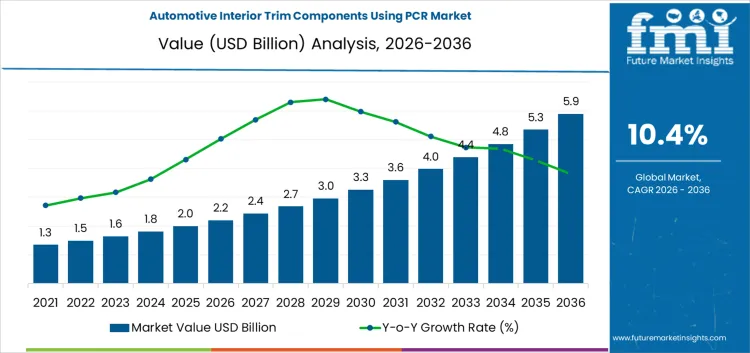
The automotive interior trim components using PCR market is set to reach USD 2.2 billion in 2026 and is projected to grow to USD 5.9 billion by 2036, with a CAGR of 10.4%. The growth of this market is driven by the increasing use of post-consumer recycled (PCR) materials in the automotive industry, particularly for interior trim components. As the demand for more efficient and environmentally conscious production processes intensifies, automakers are increasingly turning to PCR materials to reduce costs and improve resource efficiency in manufacturing.
PCR materials offer significant advantages in automotive applications, particularly in interior trim, where durability and aesthetic quality are critical. By utilizing recycled plastics, manufacturers can reduce the environmental impact of vehicle production without compromising on the quality or performance of the components. As the automotive industry continues to prioritize reducing its carbon footprint and adhering to stricter regulations, the adoption of PCR materials is expected to increase. Innovations in polymer technologies and processing techniques are also contributing to the growth of this market, offering better performance and expanded applications for automotive interior trim components.
Quick Stats of the Automotive Interior Trim Components Using PCR Market
- Automotive Interior Trim Components Using PCR Market Value (2026): USD 2.2 billion
- Automotive Interior Trim Components Using PCR Market Forecast Value (2036): USD 5.9 billion
- Automotive Interior Trim Components Using PCR Market Forecast CAGR 2026 to 2036: 10.4%
- Automotive Interior Trim Components Using PCR Market Leading Component Type: Injection-molded trim parts (50 % share)
- Automotive Interior Trim Components Using PCR Market Key Growth Regions: Asia Pacific, North America, Europe, Latin America, Middle East & Africa
- Automotive Interior Trim Components Using PCR Market Top Players: Faurecia (FORVIA), BASF, Lear, Celanese, Yanfeng, Kingfa, Motherson, Reliance, Braskem, Toyota Boshoku
What is the Growth Forecast for Automotive Interior Trim Components Using PCR Market through 2036?
The automotive interior trim components using PCR market is expected to reach USD 2.2 billion in 2026 and USD 5.9 billion by 2036, growing at a compound annual growth rate (CAGR) of 10.4%. From 2020 to 2026, the market steadily increases from USD 1.2 billion to USD 2.2 billion. This growth reflects the automotive industry's increasing focus on sustainability, with PCR materials being a key solution for reducing waste and energy consumption in the manufacturing of vehicle interiors. With environmental regulations tightening and consumer preferences shifting towards eco-friendly alternatives, the adoption of PCR materials in automotive interiors is expected to rise significantly.
From 2026 to 2036, the market will continue to expand, reaching USD 5.9 billion by 2036. This growth is driven by the ongoing push for lightweight, durable, and sustainable automotive components. PCR materials are gaining traction due to their ability to meet these demands while supporting the industry's efforts to reduce carbon footprints. The market is expected to grow from USD 2.4 billion in 2027 to USD 4.3 billion by 2034. The demand for PCR-based trim components will be further supported by advancements in recycling technologies and increasing pressure from manufacturers to incorporate more recycled content into their products. As consumer interest in sustainable vehicle design rises, PCR materials will play a crucial role in shaping the future of automotive interiors.
Automotive Interior Trim Components Using PCR Market Key Takeaways
| Metric | Value |
|---|---|
| Market Value (2026) | USD 2.2 billion |
| Forecast Value (2036) | USD 5.9 billion |
| Forecast CAGR 2026 to 2036 | 10.4% |
What Factors Are Influencing Growth in the Automotive Interior Trim Components Using PCR Market?
The Automotive Interior Trim Components Using PCR Market is expanding as original equipment manufacturers (OEMs) and tier suppliers adjust procurement criteria for interior components. Interior trim elements such as instrument panels, door trims, center consoles, and seat back panels increasingly incorporate post-consumer recycled (PCR) plastics that meet industry standards for dimensional stability, surface finish, and long-term performance in operational environments. Regulations in key automotive regions mandate higher recycled content in vehicles without reducing quality benchmarks. Market activity reflects this regulatory landscape, with interior trim specifications now integrating quantitative recycled content thresholds alongside mechanical performance targets. Purchase decisions by OEM engineering teams weigh factors such as part fit, finish quality, and performance under thermal and mechanical stress to ensure parity with virgin polymers. These shifts have broadened application of PCR materials beyond secondary parts into primary interior surfaces where consumer perception and long-term durability are critical.
Procurement strategies within the automotive industry are contributing to adoption rates of PCR interior trim components. Tier suppliers report increasing bid submissions featuring PCR grades for components historically made from virgin resin. Automotive manufacturers are issuing requests for proposals that include recycled content criteria, driving suppliers to qualify PCR materials through in-house and third-party testing protocols. Specific use cases include PCR-based door panel facings, decorative trim pieces, and molded interior covers. OEM validation processes focus on scratch resistance, color consistency, and performance under sustained heat exposure typical of interior environments. Suppliers capable of delivering consistent PCR material quality are positioned to secure long-term contracts. Market growth is also influenced by cost considerations; PCR resin pricing relative to virgin equivalents affects supplier margins and final component costs.
What Are the Key Segments in the Automotive Interior Trim Components Using PCR Market?
The automotive interior trim components using PCR market is segmented into two primary categories: Component Type and Material. The injection-molded trim parts lead the component type segment, capturing 50% of the market share, while PCR-PP / PCR-ABS dominate the material segment, accounting for 55%. These segments are driven by the automotive industry's growing focus on incorporating sustainable materials into vehicle interiors. The shift toward PCR materials is influenced by consumer demand for eco-friendly solutions, regulatory requirements, and the desire to reduce the environmental footprint of the automotive sector.
What Role Do Injection-molded Trim Parts Play in the Automotive PCR Market?
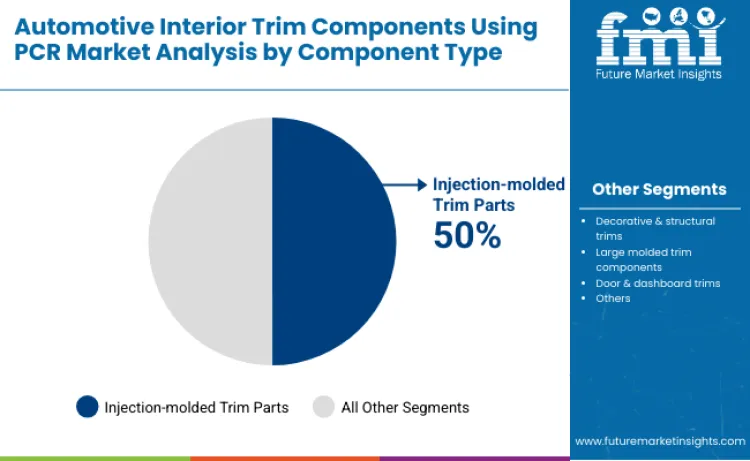
The injection-molded trim parts segment holds a 50% share of the market. Injection molding is the preferred manufacturing technique for producing automotive interior trim components such as dashboards, consoles, and door panels. This method allows for complex designs, high precision, and efficient mass production. The use of PCR-PP / PCR-ABS in injection-molded parts offers automotive manufacturers an opportunity to meet sustainability targets while maintaining the performance standards required in interior components. These materials offer the necessary strength, durability, and aesthetic appeal required for automotive applications.
The demand for injection-molded trim parts made from PCR materials is propelled by the automotive industry's push for sustainability. Automakers are under increasing pressure to reduce the environmental impact of their products, making PCR-based materials an attractive option. The adoption of these materials helps meet regulatory requirements for recyclability and reduces the dependency on virgin plastics. However, challenges remain in ensuring consistent quality and performance from recycled materials, especially in complex automotive components. As recycling technologies improve and economies of scale are achieved, the integration of PCR-PP and PCR-ABS in injection-molded parts is expected to increase, driving growth in this segment.
How Do PCR-PP and PCR-ABS Materials Shape the Automotive Interior Trim Market?
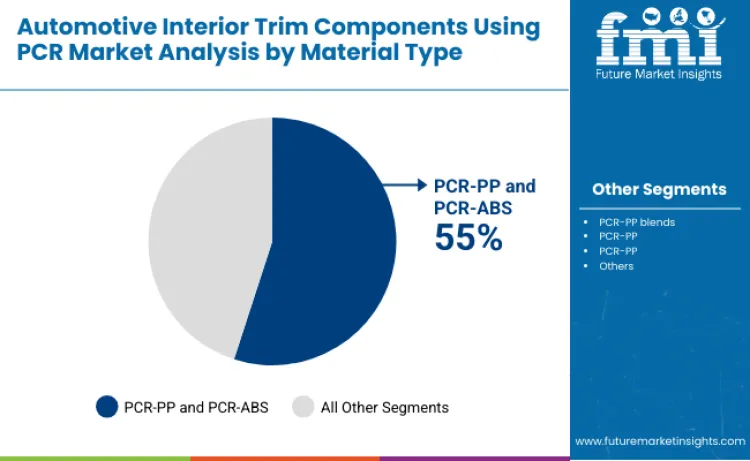
The material Segment is significantly influenced by PCR-PP and PCR-ABS, which make up 55% of the market share in the Automotive Interior Trim Components Using PCR Market. These materials are ideal for automotive interior trim applications due to their robustness, impact resistance, and flexibility. PCR-PP (Post-Consumer Recycled Polypropylene) is known for its durability and recyclability, making it suitable for a wide range of interior components. PCR-ABS offers similar performance characteristics but is also favored for its aesthetic versatility, making it suitable for decorative and structural trims.
The demand for PCR-PP / PCR-ABS is closely tied to the automotive industry's efforts to increase the use of sustainable materials while ensuring high product performance. PCR-PP and PCR-ABS provide the necessary mechanical properties for interior trim components without compromising on environmental sustainability. However, adoption is constrained by factors such as material availability, cost fluctuations, and the need for consistent quality in recycled materials. As the infrastructure for recycling and material processing continues to improve, the use of PCR-based plastics in automotive interiors is set to increase, driven by both regulatory pressures and consumer demand for greener, more sustainable products.
What Procurement And Specification Needs Are Driving Use Of PCR In Automotive Interior Trim Components?
Automakers are aligning interior trim specifications with targets for recycled content while maintaining fit, finish, and tactile quality. Procurement teams evaluate post-consumer recycled (PCR) materials based on metrics such as tensile strength, impact resistance, and color stability under UV exposure, ensuring trim parts like instrument panels, door liners, and console bezels meet design criteria. Tier suppliers that can guarantee consistent PCR supply and material test reports gain preference in sourcing rounds. Price negotiations reflect the balance between PCR resin cost and the engineering validation effort required for interior parts. This focus on measurable specifications is reshaping material selection decisions across the vehicle supply chain.
What Quality and Validation Challenges Are Limiting Adoption Of PCR In Automotive Interior Trim Components?
Consistent quality of PCR feedstock remains a core hurdle for interior applications where appearance and durability are critical. Variations in recycled streams affect surface uniformity, making it difficult to meet automotive finish standards for visible trim pieces. Processing conditions must be tightly controlled to avoid issues such as flow irregularities and color blotching, increasing cycle times and inspection needs. OEM validation protocols require extensive testing for wear, abrasion, and long-term color retention under cabin conditions. Regional regulatory differences in permissible additives and residual contaminants complicate approval for global platforms. These constraints extend development timelines and raise qualification costs for new PCR-based interior trim parts.
What Material Formulation and Application Patterns Are Influencing Trends In Automotive Interior Trim Components Using PCR?
Formulators are creating PCR material grades tailored to the functional needs of specific interior components, such as soft-touch skins for armrests and rigid PCR compounds for seat-back frames. Material analysts reference acoustic damping, thermal dimensional stability, and paint adhesion test data to match PCR compounds with part performance needs. Automotive designers are mapping component geometries to known property windows of PCR grades, enabling trim designs that meet ergonomic targets without compromising structural integrity. Increasing use of virtual inspection tools during prototyping allows rapid assessment of fit and surface finish before physical molds are cut, reducing iterations. These evolving practices are informing how PCR materials are specified across interior trim portfolios.
What Supply Chain and Logistics Barriers Are Hindering Growth Of PCR In Automotive Interior Trim Components?
The fragmented supply chain for PCR feedstock continues to limit large-scale adoption in the automotive sector. Sourcing consistent, high-quality recycled plastics across regions is challenging, as feedstock may vary in polymer types and contamination levels. This variability requires additional sorting and processing to meet automotive specifications, raising logistical costs and processing time. Limited infrastructure for efficiently collecting and transporting recycled materials also creates bottlenecks. Moreover, fluctuating availability of PCR material sources can result in unpredictable price swings, making long-term contracts and stable supply uncertain. These barriers contribute to delays in scaling PCR adoption within the automotive interior trim segment.
What Are the Growth Trends for Automotive Interior Trim Components Using PCR Materials by Country?
| Country | CAGR (%) |
|---|---|
| Germany | 8.8% |
| USA | 8.2% |
| China | 12.4% |
| India | 13.2% |
| Brazil | 8.6% |
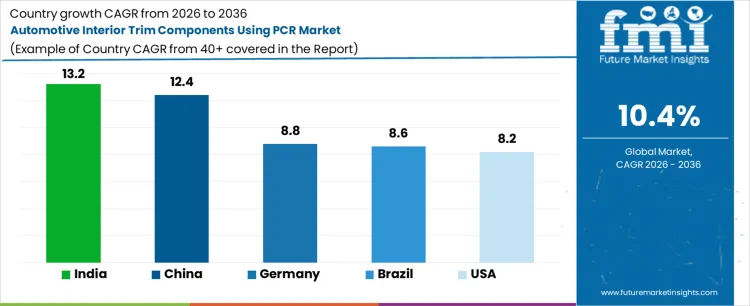
The market for automotive interior trim components made from post-consumer recycled (PCR) materials is experiencing steady growth in various countries. India leads with a 13.2% CAGR, driven by the country’s expanding automotive industry, a push towards sustainability, and increasing regulations supporting the use of recycled materials. China follows with a 12.4% growth rate, where the growing demand for eco-friendly vehicles and the automotive sector's rapid expansion are key factors. Germany shows solid growth at 8.8%, supported by its well-established automotive market and a strong regulatory environment pushing for sustainable practices. The USA, with an 8.2% CAGR, demonstrates steady growth due to the rising demand for environmentally friendly materials in automotive production. Brazil, experiencing an 8.6% CAGR, is gradually integrating PCR materials in automotive interiors, responding to both sustainability efforts and increasing automotive manufacturing.
What Drives the Demand for Automotive Interior Trim Components Using PCR Materials in Germany?
Demand for automotive interior trim components using PCR materials in Germany is expected to grow at a CAGR of 8.8%. The country’s well-established automotive sector is shifting towards sustainability, with increasing adoption of eco-friendly materials, especially for interior trim components. Germany’s strong regulatory environment, aimed at reducing environmental impact, is pushing automakers to incorporate more recycled materials in vehicle production. As electric vehicle production rises, the demand for durable, fire-resistant PCR materials also increases. With ongoing advancements in recycling technologies, Germany is leading the way in using PCR materials for automotive interior solutions, making significant strides in reducing the industry’s carbon footprint.
- Automotive industry transitions to more sustainable interior solutions.
- Stringent regulations encourage increased use of PCR materials.
- Technological innovations drive the adoption of eco-friendly vehicle interiors.
How Is the Outlook for Automotive Interior Trim Components Using PCR Materials in the USA?
Outlook on the automotive interior trim components using PCR materials market in the USA points to steady growth at a CAGR of 8.2%. With the shift toward electric vehicles (EVs) and an increasing focus on sustainability, USA manufacturers are integrating recycled materials in vehicle interiors to meet environmental targets. Government incentives that support green technologies and the use of sustainable materials in automotive manufacturing further drive this trend. As consumer demand for eco-friendly vehicles rises, automakers are increasingly turning to PCR materials to meet these expectations, ensuring that the market for sustainable automotive interiors continues to expand.
- Electric vehicle growth drives demand for sustainable interior materials.
- Government policies encourage the adoption of recycled materials.
- Consumer demand for eco-friendly solutions accelerates market growth.
What Factors Are Driving the Adoption of PCR Materials in China’s Automotive Interior Trim Market?
Sales of automotive interior trim components using PCR materials in China are projected to grow at a CAGR of 12.4%. As the world’s largest automotive manufacturer, China is increasingly prioritizing sustainability, and the use of recycled materials in vehicle interiors is gaining traction. The Chinese government is pushing for circular economy practices, encouraging manufacturers to integrate eco-friendlier materials in automotive production. The rapid growth of the electric vehicle market in China further boosts demand for PCR materials that are both sustainable and durable. With continuous innovation in recycling technologies, China is set to lead the way in adopting PCR materials for automotive interiors.
- China’s automotive production growth accelerates demand for PCR materials.
- Government policies promote sustainable and circular manufacturing practices.
- The rise of electric vehicles drives demand for eco-friendly interior components.
What Is Influencing the Growth of Automotive Interior Trim Components Using PCR Materials in India?
Sales of automotive interior trim components using PCR materials in India are forecasted to grow at a CAGR of 13.2%. As India’s automotive industry expands, there is an increasing demand for environmentally friendly materials in vehicle interiors. The rise of electric vehicles and consumer awareness about environmental sustainability are driving the adoption of PCR materials. Government initiatives promoting recycling and waste management further support this shift toward eco-friendly solutions. As manufacturers in India seek ways to reduce their carbon footprint, the market for PCR materials in automotive interiors is expected to grow substantially in the coming years.
- Expanding automotive sector increases demand for sustainable interior materials.
- Government policies support recycling and the use of recycled materials.
- Consumer demand for eco-friendly products drives adoption of PCR materials.
What Is Shaping the Adoption of PCR Materials in Brazil’s Automotive Interior Trim Components?
In Brazil, the automotive interior trim components using PCR materials market is projected to grow at a CAGR of 8.6%. The demand for eco-friendly vehicle interiors is rising as Brazil’s automotive industry adopts more sustainable manufacturing practices. With an increasing focus on electric vehicles and the need for environmentally friendly solutions, Brazilian manufacturers are turning to PCR materials for interior trim components. Government initiatives supporting recycling and reducing plastic waste further accelerate the market’s growth. As consumers and manufacturers alike place greater emphasis on sustainability, Brazil is well-positioned to lead the way in integrating PCR materials into vehicle production.
- Electric vehicle adoption fuels the demand for sustainable interior components.
- Government incentives encourage the use of recycled materials in automotive production.
- The growing focus on environmental sustainability accelerates market growth.
What Differentiates Competition in Automotive Interior Trim Components Using PCR?
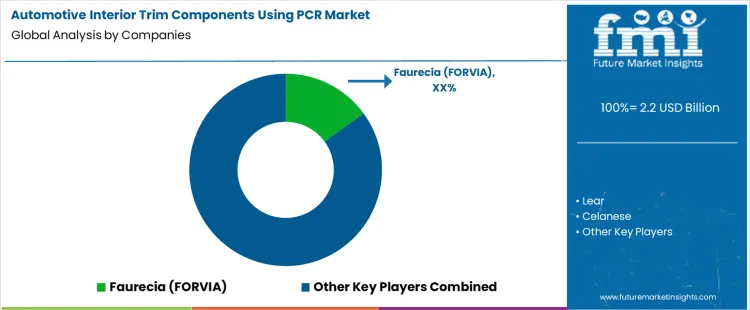
In Automotive Interior Trim Components Using PCR, Faurecia (FORVIA) has been positioned with PCR-enhanced door panels and console overlays that are marketed for reduced carbon footprint and material circularity. These components are specified with defined recycled content percentages and are validated for surface quality, color stability, and scratch resistance. BASF has supplied PCR-modified engineering polymers that are compounded to maintain impact performance and heat resistance in instrument panels and trim bezels. Lear’s offerings include PCR-based seat covers and armrests that are engineered for durability under repeated stress and abrasion, with flame retardant properties retained. Celanese has focused on PCR polyamide and polyester blends for interior fittings that are claimed to meet OEM specifications for gloss and formability in injection molding. Yanfeng markets PCR grade components for pillars and headliners that are compatible with existing assembly processes. Kingfa has been advancing PCR ABS and TPO compounds targeted at interior surface parts requiring consistent texture and reduced warpage. Motherson’s PCR trim components are positioned with structured data on tensile strength and shrinkage tolerance. Reliance Industries provides base PCR polymers that are further compounded by tier-1 integrators. Braskem’s PCR polypropylene grades are specified for cost-effective interior parts. Toyota Boshoku’s PCR solutions include recycled fiber-reinforced panels for seating and trim.
Specific technological innovations are being leveraged to ensure that PCR interior trim components meet automotive standards for fit, finish, and long-term performance. Faurecia has incorporated surface texture controls into PCR-based materials that have been demonstrated to resist fading and abrasion in accelerated aging tests. BASF’s PCR formulations include stabilizers that preserve mechanical integrity at elevated cabin temperatures, enabling adoption in instrument panel applications. Lear has developed seat trim materials with enhanced PCR content while retaining flame retardancy and dye uptake consistency. Celanese has introduced PCR polyester blends with controlled crystallinity to support dimensional stability in complex geometries. Yanfeng’s development work has yielded PCR materials with controlled gloss levels that are held within narrow tolerances, allowing aesthetic uniformity across interior surfaces. Kingfa’s PCR ABS compounds are engineered to reduce off-gassing while ensuring impact resistance, attributes that are increasingly specified for EV interiors. Motherson’s PCR trim products are backed by test reports detailing thermal cycling performance. Reliance Industries has supplied PCR polyolefins that are compounded with performance additives by tier-1s for specific trim line items. Braskem’s PCR PP grades have been processed in high-volume molding lines with cycle time data provided in technical brochures. Toyota Boshoku’s PCR fiber composites have been validated in seating structures with quantified improvements in recycled content metrics.
Key Players in the Automotive Interior Trim Components Using PCR Market
- Faurecia (FORVIA)
- BASF
- Lear
- Celanese
- Yanfeng
- Kingfa
- Motherson
- Reliance
- Braskem
- Toyota Boshoku
Scope of the Report
| Items | Values |
|---|---|
| Quantitative Units (2026) | USD billion |
| End-use | Door Panels, Dashboards, Consoles, Center Consoles & Pillar Trims, High-Volume Interiors, Entry-Level Passenger Cars, Passenger Vehicles, Premium Interiors |
| Component Type | Injection-Molded Trim Parts, Decorative & Structural Trims, Large Molded Trim Components, Door & Dashboard Trims, Others |
| Material | PCR-PP and PCR-ABS, PCR-PP Blends, PCR-PP, Others |
| Technology | OEM-Validated PCR Compounding & Low-VOC Design, Surface Finish & Odor Control, High-Output Injection Molding, Cost-Efficient Trim Molding, Others |
| Regions Covered | Asia Pacific, Europe, North America, Latin America, Middle East & Africa |
| Countries Covered | China, Japan, South Korea, India, Australia & New Zealand, ASEAN, Germany, United Kingdom, France, Italy, Spain, Nordic, BENELUX, United States, Canada, Mexico, Brazil, Chile, Saudi Arabia, Turkey, South Africa, and other regional markets |
| Key Companies Profiled | Faurecia (FORVIA), BASF, Lear, Celanese, Yanfeng, Kingfa, Motherson, Reliance, Braskem, Toyota Boshoku |
| Additional Attributes | Dollar sales by end-use, component type, material, and technology, injection-molded trim parts representing the leading component category due to precision and high-volume suitability, PCR-PP and PCR-ABS representing the dominant material group because of impact resistance and surface quality requirements, demand driven by OEM recycled content mandates and interior sustainability targets, performance economics shaped by fit, finish, scratch resistance, and color stability requirements, increasing adoption in door panels, dashboards, consoles, and pillar trims, and competitive positioning based on validated OEM test data, surface appearance control, low-VOC performance, and ability to ensure consistent PCR feedstock quality at scale. |
Automotive Interior Trim Components Using PCR Market Segmentation
End-use:
- Door panels, dashboards, consoles
- Center consoles & pillar trims
- High-volume interiors
- Entry-level passenger cars
- Passenger vehicles
- Premium interiors
Component Type:
- Injection-molded trim parts
- Decorative & structural trims
- Large molded trim components
- Door & dashboard trims
- Others
Material:
- PCR-PP and PCR-ABS
- PCR-PP blends
- PCR-PP
- PCR-PP
- Others
Technology:
- OEM-validated PCR compounding & low-VOC design
- Surface finish & odor control
- High-output injection molding
- Cost-efficient trim molding
- Others
Region
- Asia Pacific
- China
- Japan
- South Korea
- India
- Australia & New Zealand
- ASEAN
- Rest of Asia Pacific
- Europe
- Germany
- United Kingdom
- France
- Italy
- Spain
- Nordic
- BENELUX
- Rest of Europe
- North America
- United States
- Canada
- Mexico
- Latin America
- Brazil
- Chile
- Rest of Latin America
- Middle East & Africa
- Kingdom of Saudi Arabia
- Other GCC Countries
- Turkey
- South Africa
- Other African Union
- Rest of Middle East & Africa
Bibliography
- Organisation for Economic Co-operation and Development. (2024). Extended producer responsibility: Basic facts and key principles (OECD Environment Policy Papers No.41). OECD Publishing.
- Brown, A., & Börkey, P. (2024). Plastics recycled content requirements (OECD Environment Working Papers No.236). OECD Publishing.
- Park, B.C., Brown, A., Laubinger, F., & Börkey, P. (2024). Monitoring trade in plastic waste and scrap 2024 (OECD Environment Working Papers No.233). OECD Publishing.
- Organisation for Economic Co-operation and Development. (2024). Policy scenarios for eliminating plastic pollution by 2040. OECD Publishing.
Frequently Asked Questions
How big is the automotive interior trim components using pcr market in 2026?
The global automotive interior trim components using pcr market is estimated to be valued at USD 2.2 billion in 2026.
What will be the size of automotive interior trim components using pcr market in 2036?
The market size for the automotive interior trim components using pcr market is projected to reach USD 5.9 billion by 2036.
How much will be the automotive interior trim components using pcr market growth between 2026 and 2036?
The automotive interior trim components using pcr market is expected to grow at a 10.4% CAGR between 2026 and 2036.
What are the key product types in the automotive interior trim components using pcr market?
The key product types in automotive interior trim components using pcr market are center consoles & pillar trims, high-volume interiors, entry-level passenger cars, passenger vehicles and premium interiors.
Which injection-molded trim parts segment to contribute significant share in the automotive interior trim components using pcr market in 2026?
In terms of injection-molded trim parts, decorative & structural trims segment to command 50% share in the automotive interior trim components using pcr market in 2026.
Preview the report firsthand - request a free sample
Get SampleGet the brochure for pricing and purchase details.
Get PDFTable of Content
- Executive Summary
- Global Market Outlook
- Demand-side Trends
- Supply-side Trends
- Technology Roadmap Analysis
- Analysis and Recommendations
- Market Overview
- Market Coverage / Taxonomy
- Market Definition / Scope / Limitations
- Market Background
- Market Dynamics
- Drivers
- Restraints
- Opportunity
- Trends
- Scenario Forecast
- Demand in Optimistic Scenario
- Demand in Likely Scenario
- Demand in Conservative Scenario
- Opportunity Map Analysis
- Product Life Cycle Analysis
- Supply Chain Analysis
- Investment Feasibility Matrix
- Value Chain Analysis
- PESTLE and Porter’s Analysis
- Regulatory Landscape
- Regional Parent Market Outlook
- Production and Consumption Statistics
- Import and Export Statistics
- Market Dynamics
- Global Market Analysis 2021 to 2025 and Forecast, 2026 to 2036
- Historical Market Size Value (USD Million) Analysis, 2021 to 2025
- Current and Future Market Size Value (USD Million) Projections, 2026 to 2036
- Y-o-Y Growth Trend Analysis
- Absolute $ Opportunity Analysis
- Global Market Pricing Analysis 2021 to 2025 and Forecast 2026 to 2036
- Global Market Analysis 2021 to 2025 and Forecast 2026 to 2036, By Door panels, dashboards, consoles
- Introduction / Key Findings
- Historical Market Size Value (USD Million) Analysis By Door panels, dashboards, consoles , 2021 to 2025
- Current and Future Market Size Value (USD Million) Analysis and Forecast By Door panels, dashboards, consoles , 2026 to 2036
- Center consoles & pillar trims
- High-volume interiors
- Entry-level passenger cars
- Passenger vehicles
- Premium interiors
- Center consoles & pillar trims
- Y-o-Y Growth Trend Analysis By Door panels, dashboards, consoles , 2021 to 2025
- Absolute $ Opportunity Analysis By Door panels, dashboards, consoles , 2026 to 2036
- Global Market Analysis 2021 to 2025 and Forecast 2026 to 2036, By Injection-molded trim parts
- Introduction / Key Findings
- Historical Market Size Value (USD Million) Analysis By Injection-molded trim parts, 2021 to 2025
- Current and Future Market Size Value (USD Million) Analysis and Forecast By Injection-molded trim parts, 2026 to 2036
- Decorative & structural trims
- Large molded trim components
- Door & dashboard trims
- Others
- Decorative & structural trims
- Y-o-Y Growth Trend Analysis By Injection-molded trim parts, 2021 to 2025
- Absolute $ Opportunity Analysis By Injection-molded trim parts, 2026 to 2036
- Global Market Analysis 2021 to 2025 and Forecast 2026 to 2036, By PCR-PP / PCR-ABS
- Introduction / Key Findings
- Historical Market Size Value (USD Million) Analysis By PCR-PP / PCR-ABS, 2021 to 2025
- Current and Future Market Size Value (USD Million) Analysis and Forecast By PCR-PP / PCR-ABS, 2026 to 2036
- PCR-PP blends
- PCR-PP
- PCR-PP
- Others
- PCR-PP blends
- Y-o-Y Growth Trend Analysis By PCR-PP / PCR-ABS, 2021 to 2025
- Absolute $ Opportunity Analysis By PCR-PP / PCR-ABS, 2026 to 2036
- Global Market Analysis 2021 to 2025 and Forecast 2026 to 2036, By OEM-validated PCR compounding & low-VOC design
- Introduction / Key Findings
- Historical Market Size Value (USD Million) Analysis By OEM-validated PCR compounding & low-VOC design, 2021 to 2025
- Current and Future Market Size Value (USD Million) Analysis and Forecast By OEM-validated PCR compounding & low-VOC design, 2026 to 2036
- Surface finish & odor control
- High-output injection molding
- Cost-efficient trim molding
- Others
- Surface finish & odor control
- Y-o-Y Growth Trend Analysis By OEM-validated PCR compounding & low-VOC design, 2021 to 2025
- Absolute $ Opportunity Analysis By OEM-validated PCR compounding & low-VOC design, 2026 to 2036
- Global Market Analysis 2021 to 2025 and Forecast 2026 to 2036, By 0.36
- Introduction / Key Findings
- Historical Market Size Value (USD Million) Analysis By 0.36, 2021 to 2025
- Current and Future Market Size Value (USD Million) Analysis and Forecast By 0.36, 2026 to 2036
- 0.28
- 0.22
- 0.1
- 0.02
- 0.02
- 0.28
- Y-o-Y Growth Trend Analysis By 0.36, 2021 to 2025
- Absolute $ Opportunity Analysis By 0.36, 2026 to 2036
- Global Market Analysis 2021 to 2025 and Forecast 2026 to 2036, By Region
- Introduction
- Historical Market Size Value (USD Million) Analysis By Region, 2021 to 2025
- Current Market Size Value (USD Million) Analysis and Forecast By Region, 2026 to 2036
- North America
- Latin America
- Western Europe
- Eastern Europe
- East Asia
- South Asia and Pacific
- Middle East & Africa
- Market Attractiveness Analysis By Region
- North America Market Analysis 2021 to 2025 and Forecast 2026 to 2036, By Country
- Historical Market Size Value (USD Million) Trend Analysis By Market Taxonomy, 2021 to 2025
- Market Size Value (USD Million) Forecast By Market Taxonomy, 2026 to 2036
- By Country
- USA
- Canada
- Mexico
- By Door panels, dashboards, consoles
- By Injection-molded trim parts
- By PCR-PP / PCR-ABS
- By OEM-validated PCR compounding & low-VOC design
- By 0.36
- By Country
- Market Attractiveness Analysis
- By Country
- By Door panels, dashboards, consoles
- By Injection-molded trim parts
- By PCR-PP / PCR-ABS
- By OEM-validated PCR compounding & low-VOC design
- By 0.36
- Key Takeaways
- Latin America Market Analysis 2021 to 2025 and Forecast 2026 to 2036, By Country
- Historical Market Size Value (USD Million) Trend Analysis By Market Taxonomy, 2021 to 2025
- Market Size Value (USD Million) Forecast By Market Taxonomy, 2026 to 2036
- By Country
- Brazil
- Chile
- Rest of Latin America
- By Door panels, dashboards, consoles
- By Injection-molded trim parts
- By PCR-PP / PCR-ABS
- By OEM-validated PCR compounding & low-VOC design
- By 0.36
- By Country
- Market Attractiveness Analysis
- By Country
- By Door panels, dashboards, consoles
- By Injection-molded trim parts
- By PCR-PP / PCR-ABS
- By OEM-validated PCR compounding & low-VOC design
- By 0.36
- Key Takeaways
- Western Europe Market Analysis 2021 to 2025 and Forecast 2026 to 2036, By Country
- Historical Market Size Value (USD Million) Trend Analysis By Market Taxonomy, 2021 to 2025
- Market Size Value (USD Million) Forecast By Market Taxonomy, 2026 to 2036
- By Country
- Germany
- UK
- Italy
- Spain
- France
- Nordic
- BENELUX
- Rest of Western Europe
- By Door panels, dashboards, consoles
- By Injection-molded trim parts
- By PCR-PP / PCR-ABS
- By OEM-validated PCR compounding & low-VOC design
- By 0.36
- By Country
- Market Attractiveness Analysis
- By Country
- By Door panels, dashboards, consoles
- By Injection-molded trim parts
- By PCR-PP / PCR-ABS
- By OEM-validated PCR compounding & low-VOC design
- By 0.36
- Key Takeaways
- Eastern Europe Market Analysis 2021 to 2025 and Forecast 2026 to 2036, By Country
- Historical Market Size Value (USD Million) Trend Analysis By Market Taxonomy, 2021 to 2025
- Market Size Value (USD Million) Forecast By Market Taxonomy, 2026 to 2036
- By Country
- Russia
- Poland
- Hungary
- Balkan & Baltic
- Rest of Eastern Europe
- By Door panels, dashboards, consoles
- By Injection-molded trim parts
- By PCR-PP / PCR-ABS
- By OEM-validated PCR compounding & low-VOC design
- By 0.36
- By Country
- Market Attractiveness Analysis
- By Country
- By Door panels, dashboards, consoles
- By Injection-molded trim parts
- By PCR-PP / PCR-ABS
- By OEM-validated PCR compounding & low-VOC design
- By 0.36
- Key Takeaways
- East Asia Market Analysis 2021 to 2025 and Forecast 2026 to 2036, By Country
- Historical Market Size Value (USD Million) Trend Analysis By Market Taxonomy, 2021 to 2025
- Market Size Value (USD Million) Forecast By Market Taxonomy, 2026 to 2036
- By Country
- China
- Japan
- South Korea
- By Door panels, dashboards, consoles
- By Injection-molded trim parts
- By PCR-PP / PCR-ABS
- By OEM-validated PCR compounding & low-VOC design
- By 0.36
- By Country
- Market Attractiveness Analysis
- By Country
- By Door panels, dashboards, consoles
- By Injection-molded trim parts
- By PCR-PP / PCR-ABS
- By OEM-validated PCR compounding & low-VOC design
- By 0.36
- Key Takeaways
- South Asia and Pacific Market Analysis 2021 to 2025 and Forecast 2026 to 2036, By Country
- Historical Market Size Value (USD Million) Trend Analysis By Market Taxonomy, 2021 to 2025
- Market Size Value (USD Million) Forecast By Market Taxonomy, 2026 to 2036
- By Country
- India
- ASEAN
- Australia & New Zealand
- Rest of South Asia and Pacific
- By Door panels, dashboards, consoles
- By Injection-molded trim parts
- By PCR-PP / PCR-ABS
- By OEM-validated PCR compounding & low-VOC design
- By 0.36
- By Country
- Market Attractiveness Analysis
- By Country
- By Door panels, dashboards, consoles
- By Injection-molded trim parts
- By PCR-PP / PCR-ABS
- By OEM-validated PCR compounding & low-VOC design
- By 0.36
- Key Takeaways
- Middle East & Africa Market Analysis 2021 to 2025 and Forecast 2026 to 2036, By Country
- Historical Market Size Value (USD Million) Trend Analysis By Market Taxonomy, 2021 to 2025
- Market Size Value (USD Million) Forecast By Market Taxonomy, 2026 to 2036
- By Country
- Kingdom of Saudi Arabia
- Other GCC Countries
- Turkiye
- South Africa
- Other African Union
- Rest of Middle East & Africa
- By Door panels, dashboards, consoles
- By Injection-molded trim parts
- By PCR-PP / PCR-ABS
- By OEM-validated PCR compounding & low-VOC design
- By 0.36
- By Country
- Market Attractiveness Analysis
- By Country
- By Door panels, dashboards, consoles
- By Injection-molded trim parts
- By PCR-PP / PCR-ABS
- By OEM-validated PCR compounding & low-VOC design
- By 0.36
- Key Takeaways
- Key Countries Market Analysis
- USA
- Pricing Analysis
- Market Share Analysis, 2025
- By Door panels, dashboards, consoles
- By Injection-molded trim parts
- By PCR-PP / PCR-ABS
- By OEM-validated PCR compounding & low-VOC design
- By 0.36
- Canada
- Pricing Analysis
- Market Share Analysis, 2025
- By Door panels, dashboards, consoles
- By Injection-molded trim parts
- By PCR-PP / PCR-ABS
- By OEM-validated PCR compounding & low-VOC design
- By 0.36
- Mexico
- Pricing Analysis
- Market Share Analysis, 2025
- By Door panels, dashboards, consoles
- By Injection-molded trim parts
- By PCR-PP / PCR-ABS
- By OEM-validated PCR compounding & low-VOC design
- By 0.36
- Brazil
- Pricing Analysis
- Market Share Analysis, 2025
- By Door panels, dashboards, consoles
- By Injection-molded trim parts
- By PCR-PP / PCR-ABS
- By OEM-validated PCR compounding & low-VOC design
- By 0.36
- Chile
- Pricing Analysis
- Market Share Analysis, 2025
- By Door panels, dashboards, consoles
- By Injection-molded trim parts
- By PCR-PP / PCR-ABS
- By OEM-validated PCR compounding & low-VOC design
- By 0.36
- Germany
- Pricing Analysis
- Market Share Analysis, 2025
- By Door panels, dashboards, consoles
- By Injection-molded trim parts
- By PCR-PP / PCR-ABS
- By OEM-validated PCR compounding & low-VOC design
- By 0.36
- UK
- Pricing Analysis
- Market Share Analysis, 2025
- By Door panels, dashboards, consoles
- By Injection-molded trim parts
- By PCR-PP / PCR-ABS
- By OEM-validated PCR compounding & low-VOC design
- By 0.36
- Italy
- Pricing Analysis
- Market Share Analysis, 2025
- By Door panels, dashboards, consoles
- By Injection-molded trim parts
- By PCR-PP / PCR-ABS
- By OEM-validated PCR compounding & low-VOC design
- By 0.36
- Spain
- Pricing Analysis
- Market Share Analysis, 2025
- By Door panels, dashboards, consoles
- By Injection-molded trim parts
- By PCR-PP / PCR-ABS
- By OEM-validated PCR compounding & low-VOC design
- By 0.36
- France
- Pricing Analysis
- Market Share Analysis, 2025
- By Door panels, dashboards, consoles
- By Injection-molded trim parts
- By PCR-PP / PCR-ABS
- By OEM-validated PCR compounding & low-VOC design
- By 0.36
- India
- Pricing Analysis
- Market Share Analysis, 2025
- By Door panels, dashboards, consoles
- By Injection-molded trim parts
- By PCR-PP / PCR-ABS
- By OEM-validated PCR compounding & low-VOC design
- By 0.36
- ASEAN
- Pricing Analysis
- Market Share Analysis, 2025
- By Door panels, dashboards, consoles
- By Injection-molded trim parts
- By PCR-PP / PCR-ABS
- By OEM-validated PCR compounding & low-VOC design
- By 0.36
- Australia & New Zealand
- Pricing Analysis
- Market Share Analysis, 2025
- By Door panels, dashboards, consoles
- By Injection-molded trim parts
- By PCR-PP / PCR-ABS
- By OEM-validated PCR compounding & low-VOC design
- By 0.36
- China
- Pricing Analysis
- Market Share Analysis, 2025
- By Door panels, dashboards, consoles
- By Injection-molded trim parts
- By PCR-PP / PCR-ABS
- By OEM-validated PCR compounding & low-VOC design
- By 0.36
- Japan
- Pricing Analysis
- Market Share Analysis, 2025
- By Door panels, dashboards, consoles
- By Injection-molded trim parts
- By PCR-PP / PCR-ABS
- By OEM-validated PCR compounding & low-VOC design
- By 0.36
- South Korea
- Pricing Analysis
- Market Share Analysis, 2025
- By Door panels, dashboards, consoles
- By Injection-molded trim parts
- By PCR-PP / PCR-ABS
- By OEM-validated PCR compounding & low-VOC design
- By 0.36
- Russia
- Pricing Analysis
- Market Share Analysis, 2025
- By Door panels, dashboards, consoles
- By Injection-molded trim parts
- By PCR-PP / PCR-ABS
- By OEM-validated PCR compounding & low-VOC design
- By 0.36
- Poland
- Pricing Analysis
- Market Share Analysis, 2025
- By Door panels, dashboards, consoles
- By Injection-molded trim parts
- By PCR-PP / PCR-ABS
- By OEM-validated PCR compounding & low-VOC design
- By 0.36
- Hungary
- Pricing Analysis
- Market Share Analysis, 2025
- By Door panels, dashboards, consoles
- By Injection-molded trim parts
- By PCR-PP / PCR-ABS
- By OEM-validated PCR compounding & low-VOC design
- By 0.36
- Kingdom of Saudi Arabia
- Pricing Analysis
- Market Share Analysis, 2025
- By Door panels, dashboards, consoles
- By Injection-molded trim parts
- By PCR-PP / PCR-ABS
- By OEM-validated PCR compounding & low-VOC design
- By 0.36
- Turkiye
- Pricing Analysis
- Market Share Analysis, 2025
- By Door panels, dashboards, consoles
- By Injection-molded trim parts
- By PCR-PP / PCR-ABS
- By OEM-validated PCR compounding & low-VOC design
- By 0.36
- South Africa
- Pricing Analysis
- Market Share Analysis, 2025
- By Door panels, dashboards, consoles
- By Injection-molded trim parts
- By PCR-PP / PCR-ABS
- By OEM-validated PCR compounding & low-VOC design
- By 0.36
- USA
- Market Structure Analysis
- Competition Dashboard
- Competition Benchmarking
- Market Share Analysis of Top Players
- By Regional
- By Door panels, dashboards, consoles
- By Injection-molded trim parts
- By PCR-PP / PCR-ABS
- By OEM-validated PCR compounding & low-VOC design
- By 0.36
- Competition Analysis
- Competition Deep Dive
- Faurecia (FORVIA)
- Overview
- Product Portfolio
- Profitability by Market Segments (Product/Age /Sales Channel/Region)
- Sales Footprint
- Strategy Overview
- Marketing Strategy
- Product Strategy
- Channel Strategy
- Lear
- Celanese
- Yanfeng
- Kingfa
- Motherson
- Reliance
- Braskem
- Toyota Boshoku
- BASF
- Faurecia (FORVIA)
- Competition Deep Dive
- Assumptions & Acronyms Used
- Research Methodology


