

- Industry Size (2026)
- USD 340 Mn
- Forecast (2036)
- USD 845 Mn
- CAGR (2026 to 2036)
- 9.5%
Low-Fogging Interior Trim Adhesives for Premium Automotive Cabins Market Forecast and Outlook 2026 to 2036
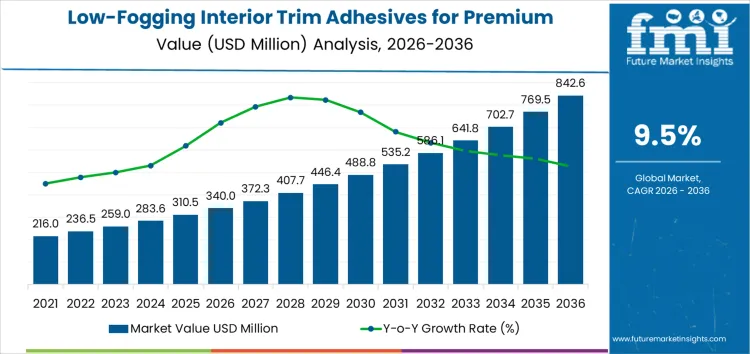
The low fogging interior trim adhesives for premium automotive cabins market is valued at USD 340 million in 2026 and is projected to reach USD 845 million by 2036, reflecting a CAGR of 9.5%. Performance during this period is shaped by emission thresholds, material compatibility, and cabin air quality specifications rather than adhesive volumes. Cost structures reflect formulation refinement, volatile organic compound control, and extended validation testing. Suppliers investing in low emission chemistries face higher development costs but gain earlier access to premium programs. Pricing control improves where adhesive selection is locked during interior module design, limiting substitution after tooling approval.
Between 2026 and 2036, value capture centers on qualification depth and integration within interior supply chains. Automotive OEMs prioritize consistency under temperature cycling, surface aesthetics, and long term odor control. Once approved, adhesives remain embedded due to revalidation risk and program timelines. Dependency on compliant raw materials constrains sourcing flexibility. Strategic tradeoffs arise between tailoring formulations for luxury interiors and maintaining scalable production economics. Firms aligning technical support with platform level design cycles secure stronger margins. Profit concentration favors suppliers embedded in premium cabin programs with long production runs and limited mid cycle redesign.
Quick Stats for Low Fogging Interior Trim Adhesives for Premium Automotive Cabins Market
- Low Fogging Interior Trim Adhesives for Premium Automotive Cabins Market Value (2026): USD 340 million
- Low Fogging Interior Trim Adhesives for Premium Automotive Cabins Market Forecast Value (2036): USD 845 million
- Low Fogging Interior Trim Adhesives for Premium Automotive Cabins Market Forecast CAGR (2026–2036): 9.5%
- Leading Type in Low Fogging Interior Trim Adhesives for Premium Automotive Cabins Market: Waterborne acrylic and polyurethane dispersions
- Key Growth Regions in Low Fogging Interior Trim Adhesives for Premium Automotive Cabins Market: Asia Pacific, Europe, North America
- Top Players in Low Fogging Interior Trim Adhesives for Premium Automotive Cabins Market: Henkel AG & Co. KGaA, H.B. Fuller Company, Sika AG, 3M Company, Arkema / Bostik
What Is the Growth Forecast for Low Fogging Interior Trim Adhesives for Premium Automotive Cabins Market through 2036?
Cabin air quality standards and material compatibility requirements shape the early growth phase of the low fogging interior trim adhesives for premium automotive cabins market between 2026 and 2031. During this period, the market expands from USD 340 million to USD 486 million, adding USD 146 million in value. Annual progression from USD 201 million to USD 340 million reflects rising adoption in luxury and upper mid segment vehicles where interior emission control is a purchasing criterion. Historical growth was constrained by limited adhesive options meeting fogging thresholds. Future expansion in this phase is supported by wider qualification across substrates, improved bonding performance, and increased integration in dashboards, headliners, and door panels.
Interior material sophistication and platform level standardization drive growth from 2031 to 2036. Over this period, the market increases from USD 486 million to USD 845 million, adding USD 359 million and representing the stronger expansion window. Annual values rise from USD 531 million to USD 845 million, indicating accelerating year over year momentum. Earlier demand centered on niche premium models, while future growth reflects broader adoption across electric and luxury vehicle platforms. Greater use of soft touch materials, tighter cabin emission norms, and longer interior durability expectations support sustained expansion as low fogging adhesives become standard specifications in high value automotive interiors.
Low Fogging Interior Trim Adhesives for Premium Automotive Cabins Market Key Takeaways
| Metric | Value |
|---|---|
| Market Value (2026) | USD 340 million |
| Forecast Value (2036) | USD 845 million |
| Forecast CAGR (2026–2036) | 9.5% |
What Is Driving Growth in the Low-Fogging Interior Trim Adhesives for Premium Automotive Cabins Market?
Growth in this market is driven by cabin air quality requirements specific to premium vehicles. Traditional interior adhesives release volatile compounds that condense on windshields and displays under heat exposure, creating visible fogging. Premium cabins with tighter sealing, larger glass areas, and higher interior temperatures amplify this issue. Automakers specify low-fogging adhesives to meet internal quality audits and customer comfort expectations. Demand is linked to thermal performance testing, reduced volatile emissions, and consistent bonding across foams, textiles, and trim substrates rather than general adhesive consumption.
Future growth reflects stricter in-cabin emission limits and evolving vehicle architectures. Regulatory attention to interior air quality and consumer testing programs is pushing manufacturers to document fogging and volatile profiles. Electrified vehicles generate different heat patterns that increase material stress inside cabins. Adhesive selection now occurs early in design to meet defined fogging thresholds and long-term durability targets. Advances in low-volatility polymer systems support this shift. Demand will follow specification driven procurement tied to occupant comfort metrics and validated material performance.
What Factors Are Affecting the Demand for Low Fogging Interior Trim Adhesives for Premium Automotive Cabins Market in Terms of Adhesive Chemistry and Application?
The low fogging interior trim adhesives market for premium automotive cabins is driven by stricter VOC and fogging regulations, rising consumer expectations for cabin air quality, and increased use of soft touch interior materials. Demand focuses on adhesive chemistries that maintain bonding strength while minimizing volatile emissions. Adoption is shaped by OEM specifications, validation requirements, and compatibility with automated interior assembly processes. Market leadership reflects regulatory compliance and interior quality priorities rather than adhesive cost alone.
What Is Driving Leadership by Adhesive Chemistry in the Low Fogging Interior Trim Adhesives Market?
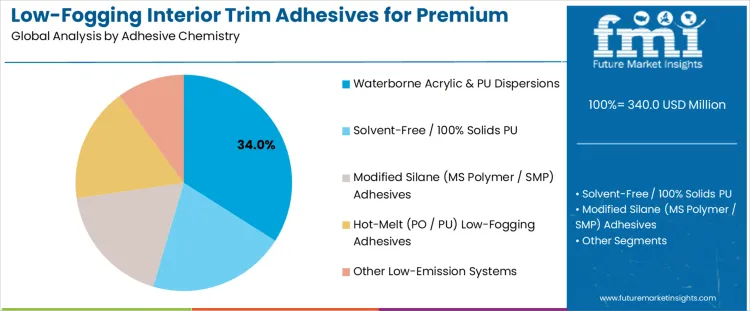
Waterborne acrylic and polyurethane dispersions account for about 34% of demand because they offer low volatile emissions while delivering reliable bonding across plastics, foams, and textiles used in premium interiors. These systems support compliance with cabin air quality standards and OEM fogging limits without requiring solvent handling infrastructure. Automotive manufacturers favor waterborne chemistries due to ease of application, controlled curing, and compatibility with automated spray and roll coating systems. Their thermal stability and resistance to plasticizer migration support long term interior appearance and odor control. Established qualification data and broad supplier availability further reinforce adoption across global vehicle platforms.
Solvent free polyurethane systems, modified silane adhesives, and low fogging hot melts expand material choice but serve more specific needs. Solvent free PU systems deliver strong structural bonds but require precise process control. MS polymer adhesives offer flexibility and moisture tolerance for mixed substrates but cure more slowly. Hot melt systems support fast cycle times yet face temperature sensitivity limits. Other low emission systems remain niche. Chemistry leadership therefore reflects balanced performance, regulatory acceptance, and process reliability rather than peak bond strength or curing speed alone.
What Is Driving Leadership by Application in the Low Fogging Interior Trim Adhesives Market?
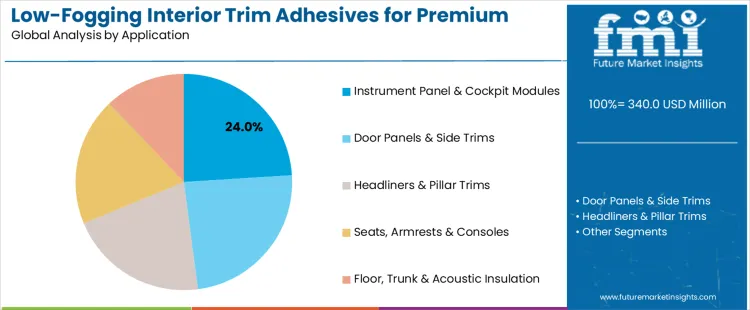
Instrument panels and cockpit modules account for about 24% of demand because they are the most visible and emission sensitive interior components. These assemblies incorporate large surface areas, soft touch skins, foams, and decorative films positioned close to occupants. Even minor fogging or odor issues in these zones directly affect perceived vehicle quality. OEMs apply the strictest emission and aging tests to cockpit components, driving early adoption of low fogging adhesive systems. High component value and complex multilayer construction further reinforce demand concentration in this application.
Door panels, side trims, headliners, seats, and consoles represent significant secondary applications. These areas also require low emissions but face slightly lower scrutiny than dashboards. Floor, trunk, and acoustic insulation applications prioritize durability and noise control, allowing broader adhesive selection. While these segments add volume, they often adopt solutions validated first in cockpit modules. Application leadership therefore reflects visibility, occupant proximity, and interior quality sensitivity rather than total bonded surface area across the vehicle interior.
How Are Low-Fogging Interior Trim Adhesives Being Applied Across Premium Automotive Cabins?
Use appears in high-end vehicles where interior trim components such as dashboards, door panels, and headliners require bonding without releasing volatile compounds that condense as fog on windshields. Manufacturers adopt low-fogging adhesives to maintain cabin visibility, comfort, and safety while complying with stringent automotive VOC regulations. OEMs integrate these adhesives in assembly lines for leather, plastics, and composite panels. These applications reflect operational and safety priorities rather than aesthetic objectives, with adoption driven by air quality, regulatory compliance, and long-term interior performance.
What Operational and Material Conditions Support Adoption of Low-Fogging Interior Trim Adhesives?
Selection aligns with substrates that require strong adhesion while remaining compatible with heat, UV exposure, and cabin vibration. Formulations are optimized for minimal volatile emissions, curing speed, and temperature stability. Automotive assembly lines rely on controlled dispensing, curing, and handling to prevent misalignment or bonding defects. Quality control monitors adhesion strength, VOC content, and long-term durability. These conditions emerge from operational reliability, material performance, and regulatory compliance priorities in structured automotive manufacturing workflows.
Which Practical Considerations Limit Wider Use of Low-Fogging Interior Trim Adhesives?
High formulation cost and precise application requirements may limit adoption in mid-range or budget vehicles. Adhesive compatibility with multiple materials and finishes must be verified. VOC measurement and certification processes add time and operational oversight. Curing conditions and line integration may require equipment adjustments. These factors lead to selective deployment where interior air quality, adhesion reliability, and regulatory compliance justify incremental cost and workflow adaptation.
What is the Demand for Low Fogging Interior Trim Adhesives for Premium Automotive Cabins by Country?
| Country | CAGR (%) |
|---|---|
| China | 10.8% |
| India | 10.2% |
| USA | 8.1% |
| Germany | 7.4% |
| Japan | 6.9% |
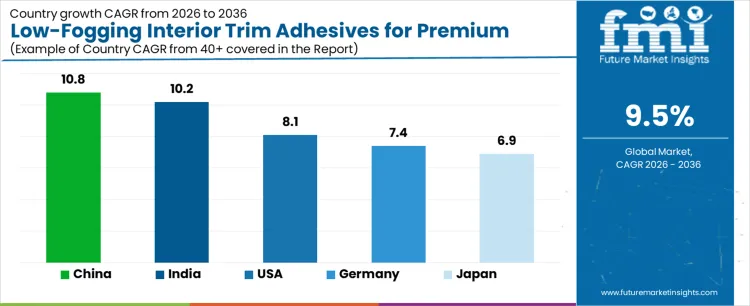
The demand for low fogging interior trim adhesives for premium automotive cabins varies across countries, driven by automotive production, consumer safety standards, and adoption of advanced cabin materials. China leads with a 10.8% CAGR, supported by expanding premium automotive manufacturing, regulatory focus on interior air quality, and adoption of advanced adhesives. India follows at 10.2%, driven by growing premium car sales and use of low emission cabin components. The USA grows at 8.1%, reflecting adoption in high end vehicles and automotive OEMs. Germany records 7.4%, shaped by mature automotive markets and compliance with strict interior safety standards. Japan posts 6.9%, supported by established automotive manufacturing and stable adoption of low fogging adhesives.
How Are Low-Fogging Interior Trim Adhesives Driving Growth in China?
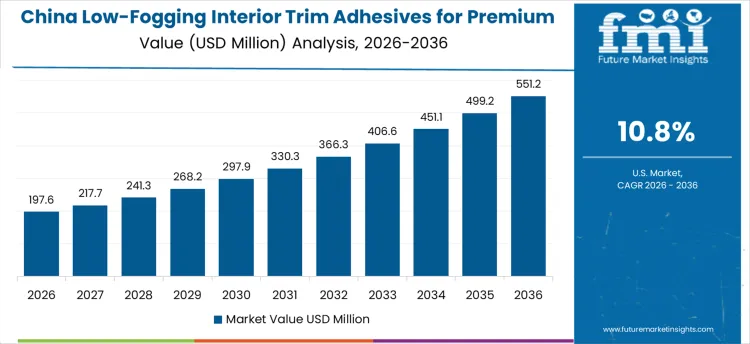
In China, the Low-Fogging Interior Trim Adhesives Market is expanding at a CAGR of 10.8% through 2036, fueled by rapid growth in premium automotive manufacturing and consumer demand for high-quality, safe vehicle interiors. Automotive OEMs and tier-one suppliers are adopting low-emission, low-fogging adhesives to improve cabin air quality, meet domestic regulations, and enhance passenger comfort. Demand is concentrated in automotive manufacturing hubs, interior component suppliers, and premium vehicle assembly plants. Compared to India, China emphasizes large-scale industrial adoption and integration with automated assembly lines. Domestic suppliers provide high-performance adhesives compatible with recurring production and quality inspection cycles.
- Automotive manufacturing hubs, interior component suppliers, and premium assembly plants drive adoption
- Adhesives improve cabin air quality and reduce interior fogging
- Domestic suppliers provide high-performance, production-compatible solutions
- Recurring production and inspection cycles sustain adoption
How Is Premium Vehicle Growth Supporting Adoption in India?
In India, revenue is growing at a CAGR of 10.2% through 2036, driven by rising production of premium vehicles, increasing urban affluence, and focus on passenger safety. Automotive OEMs and interior suppliers are integrating low-fogging adhesives to comply with domestic emission regulations, enhance cabin comfort, and improve long-term vehicle quality. Demand is concentrated in automotive clusters, interior component manufacturing hubs, and premium assembly facilities. Compared to China, India’s adoption is influenced more by emerging industrial zones and government incentives. Domestic suppliers provide cost-effective, high-performance adhesives suitable for recurring production and assembly cycles.
- Automotive clusters, interior component hubs, and premium assembly facilities drive adoption
- Adhesives enhance cabin comfort and meet emission regulations
- Domestic suppliers provide cost-effective, high-performance solutions
- Recurring production and assembly cycles sustain adoption
How Are Consumer Safety and Regulatory Requirements Driving Growth in the United States?
In the United States, the market is expanding at a CAGR of 8.1% through 2036, supported by OEM focus on premium vehicle interiors, passenger safety, and compliance with VOC emission standards. Automotive manufacturers are integrating low-fogging adhesives in dashboards, door panels, and trim components to improve air quality and cabin comfort. Demand is concentrated in automotive production hubs, interior suppliers, and assembly plants for high-end vehicles. Compared to Germany, where adoption is regulatory-driven, the U.S. market balances safety, quality, and performance efficiency. Domestic suppliers provide adhesives compatible with automated production lines and recurring assembly operations.
- Automotive production hubs, interior suppliers, and premium assembly plants drive adoption
- Adhesives improve cabin air quality and passenger comfort
- Domestic suppliers provide production-compatible, low-emission solutions
- Recurring assembly operations sustain adoption
How Are Environmental and Safety Standards Supporting Adoption in Germany?
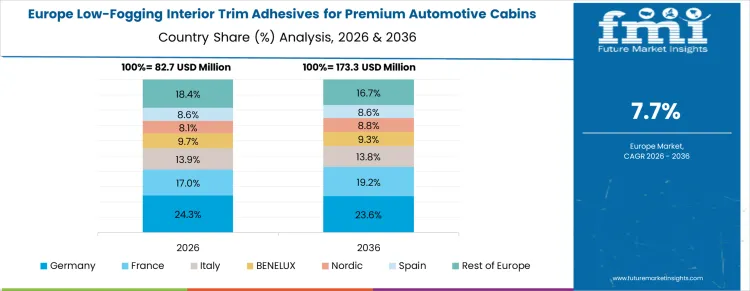
In Germany, revenue is growing at a CAGR of 7.4% through 2036, driven by stringent EU VOC emission regulations and automotive industry safety standards. Manufacturers are adopting low-fogging adhesives in dashboards, trim, and interior panels to comply with environmental standards and improve passenger comfort. Demand is concentrated in automotive clusters, interior component suppliers, and premium assembly plants. Compared to the U.S., Germany emphasizes regulatory compliance over operational efficiency. Domestic suppliers provide high-quality, EU-compliant adhesives suitable for automated production and recurring quality inspections. Recurring assembly cycles and regulatory audits sustain steady adoption.
- Automotive clusters, interior suppliers, and premium assembly plants drive adoption
- Adhesives comply with emission regulations and enhance passenger comfort
- Domestic suppliers provide EU-compliant, high-quality solutions
- Recurring assembly cycles and regulatory audits sustain adoption
How Is Automotive Interior Quality Driving Market Growth in Japan?
In Japan, the market is expanding at a CAGR of 6.9% through 2036, supported by demand for high-quality, low-emission interior components in premium vehicles. Automotive OEMs and interior suppliers are integrating low-fogging adhesives to reduce VOC emissions, improve cabin air quality, and comply with safety standards. Demand is concentrated in automotive manufacturing hubs, interior component production facilities, and premium vehicle assembly plants. Compared to China and India, adoption in Japan focuses more on precision, quality, and compliance rather than volume. Domestic suppliers provide high-performance adhesives suitable for recurring production and assembly processes.
- Automotive hubs, interior component facilities, and premium assembly plants drive adoption
- Adhesives reduce VOC emissions and improve cabin air quality
- Domestic suppliers provide high-performance, compliant solutions
- Recurring production and assembly processes sustain adoption
Which Strategic Approaches Define Competition in the Low Fogging Interior Trim Adhesives Market for Premium Automotive Cabins?
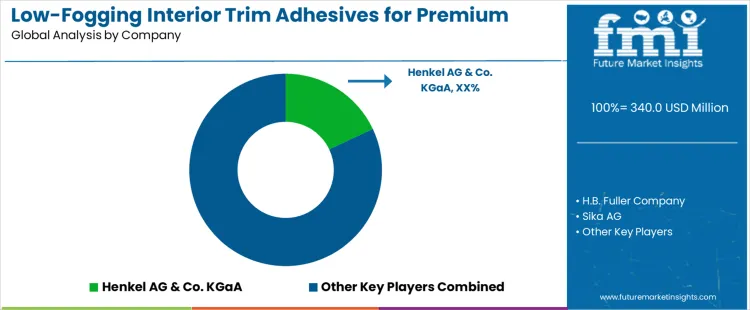
Competition in low fogging interior trim adhesives is shaped by how suppliers manage volatile emissions under elevated temperatures while preserving bond durability across mixed substrates. Henkel and Sika pursue platform strategies aligned with OEM interior specifications, embedding low fogging performance within validated adhesive families used for headliners, pillars, and instrument panels. Their approach emphasizes repeatable emission control across production batches and compatibility with automated dispensing and curing processes. H.B. Fuller competes through formulation discipline and application support, tailoring adhesive rheology and cure profiles to reduce condensation risk on glass and display surfaces. Selection is driven by OEM test protocols, long term cabin aging results, and consistency during thermal cycling rather than initial adhesion strength alone.
Application fit and portfolio positioning define secondary competitive dynamics. Arkema, through Bostik, emphasizes hybrid and water based systems designed to meet interior air quality targets without disrupting assembly line takt times. 3M positions select products where low fogging must coexist with acoustic damping or vibration control, integrating adhesive choice with broader interior system performance. Across the market, suppliers prioritize incremental formulation refinement to preserve existing approvals, extensive validation under OEM specific test methods, and close collaboration during early design freezes. Competitive advantage rests on emission stability, manufacturability, and audit readiness. Adoption favors suppliers that reduce cabin air quality risk while supporting premium interior aesthetics and long service life expectations.
Key Players in the Low Fogging Interior Trim Adhesives Market
- Henkel AG & Co. KGaA
- H.B. Fuller Company
- Sika AG
- 3M Company
- Arkema / Bostik
Scope of the Report
| Items | Values |
|---|---|
| Quantitative Units (2026) | USD million |
| Type | Waterborne Acrylic and PU Dispersions, Solvent-Free and 100% Solids PU Adhesives, Modified Silane (MS Polymer) Adhesives, Low-Fogging Hot-Melt Adhesives, Other Low-Emission Adhesive Systems |
| Application | Instrument Panel and Cockpit Modules, Door Panels and Side Trims, Headliners and Pillar Trims, Seats Armrests and Consoles, Floor Trunk and Acoustic Insulation |
| End User | Automotive OEMs, Tier-1 Interior Module Suppliers, Interior Trim and Upholstery Manufacturers, Premium Vehicle Assembly Plants |
| Regions Covered | Asia Pacific, Europe, North America, Latin America, Middle East & Africa |
| Countries Covered | China, India, USA, Germany, Japan, South Korea, United Kingdom, France, Italy, Canada, Mexico, Brazil, ASEAN countries, GCC countries, and other global regions |
| Key Companies Profiled | Henkel AG & Co. KGaA, H.B. Fuller Company, Sika AG, 3M Company, Arkema (Bostik) |
| Additional Attributes | Dollar sales by adhesive chemistry and interior application, regional adoption trends across Asia Pacific Europe and North America, competitive landscape of global and regional automotive adhesive suppliers, VOC and fogging compliance requirements for premium cabins, cabin air quality testing protocols and validation timelines, integration with interior module design and automated assembly processes |
Low Fogging Interior Trim Adhesives Market Segmentation
Adhesive Chemistry:
- Waterborne Acrylic & PU Dispersions
- Solvent-Free / 100% Solids PU
- Modified Silane (MS Polymer / SMP) Adhesives
- Hot-Melt (PO / PU) Low-Fogging Adhesives
- Other Low-Emission Systems
Application:
- Instrument Panel & Cockpit Modules
- Door Panels & Side Trims
- Headliners & Pillar Trims
- Seats, Armrests & Consoles
- Floor, Trunk & Acoustic Insulation
Vehicle Category:
- Premium & Luxury ICE Vehicles
- Premium & Luxury EVs
- Upper-Mid Segment Passenger Cars
- Premium LCVs & Vans
Region
Asia Pacific
- China
- Japan
- South Korea
- India
- Australia & New Zealand
- ASEAN
- Rest of Asia Pacific
Europe
- Germany
- United Kingdom
- France
- Italy
- Spain
- Nordic
- BENELUX
- Rest of Europe
North America
- United States
- Canada
- Mexico
Latin America
- Brazil
- Chile
- Rest of Latin America
Middle East & Africa
- Kingdom of Saudi Arabia
- Other GCC Countries
- Turkey
- South Africa
- Other African Union
- Rest of Middle East & Africa
Frequently Asked Questions
How big is the low-fogging interior trim adhesives for premium automotive cabins market in 2026?
The global low-fogging interior trim adhesives for premium automotive cabins market is estimated to be valued at USD 340.0 million in 2026.
What will be the size of low-fogging interior trim adhesives for premium automotive cabins market in 2036?
The market size for the low-fogging interior trim adhesives for premium automotive cabins market is projected to reach USD 842.6 million by 2036.
How much will be the low-fogging interior trim adhesives for premium automotive cabins market growth between 2026 and 2036?
The low-fogging interior trim adhesives for premium automotive cabins market is expected to grow at a 9.5% CAGR between 2026 and 2036.
What are the key product types in the low-fogging interior trim adhesives for premium automotive cabins market?
The key product types in low-fogging interior trim adhesives for premium automotive cabins market are waterborne acrylic & pu dispersions, solvent-free / 100% solids pu, modified silane (ms polymer / smp) adhesives, hot-melt (po / pu) low-fogging adhesives and other low-emission systems.
Which application segment to contribute significant share in the low-fogging interior trim adhesives for premium automotive cabins market in 2026?
In terms of application, instrument panel & cockpit modules segment to command 24.0% share in the low-fogging interior trim adhesives for premium automotive cabins market in 2026.
Preview the report firsthand - request a free sample
Get SampleGet the brochure for pricing and purchase details.
Get PDFTable of Content
- Executive Summary
- Global Market Outlook
- Demand-side Trends
- Supply-side Trends
- Technology Roadmap Analysis
- Analysis and Recommendations
- Market Overview
- Market Coverage / Taxonomy
- Market Definition / Scope / Limitations
- Market Background
- Market Dynamics
- Drivers
- Restraints
- Opportunity
- Trends
- Scenario Forecast
- Demand in Optimistic Scenario
- Demand in Likely Scenario
- Demand in Conservative Scenario
- Opportunity Map Analysis
- Product Life Cycle Analysis
- Supply Chain Analysis
- Investment Feasibility Matrix
- Value Chain Analysis
- PESTLE and Porter’s Analysis
- Regulatory Landscape
- Regional Parent Market Outlook
- Production and Consumption Statistics
- Import and Export Statistics
- Market Dynamics
- Global Market Analysis 2021 to 2025 and Forecast, 2026 to 2036
- Historical Market Size Value (USD Million) Analysis, 2021 to 2025
- Current and Future Market Size Value (USD Million) Projections, 2026 to 2036
- Y-o-Y Growth Trend Analysis
- Absolute $ Opportunity Analysis
- Global Market Pricing Analysis 2021 to 2025 and Forecast 2026 to 2036
- Global Market Analysis 2021 to 2025 and Forecast 2026 to 2036, By Adhesive Chemistry
- Introduction / Key Findings
- Historical Market Size Value (USD Million) Analysis By Adhesive Chemistry , 2021 to 2025
- Current and Future Market Size Value (USD Million) Analysis and Forecast By Adhesive Chemistry , 2026 to 2036
- Waterborne Acrylic & PU Dispersions
- Solvent-Free / 100% Solids PU
- Modified Silane (MS Polymer / SMP) Adhesives
- Hot-Melt (PO / PU) Low-Fogging Adhesives
- Other Low-Emission Systems
- Waterborne Acrylic & PU Dispersions
- Y-o-Y Growth Trend Analysis By Adhesive Chemistry , 2021 to 2025
- Absolute $ Opportunity Analysis By Adhesive Chemistry , 2026 to 2036
- Global Market Analysis 2021 to 2025 and Forecast 2026 to 2036, By Application
- Introduction / Key Findings
- Historical Market Size Value (USD Million) Analysis By Application, 2021 to 2025
- Current and Future Market Size Value (USD Million) Analysis and Forecast By Application, 2026 to 2036
- Instrument Panel & Cockpit Modules
- Door Panels & Side Trims
- Headliners & Pillar Trims
- Seats, Armrests & Consoles
- Floor, Trunk & Acoustic Insulation
- Instrument Panel & Cockpit Modules
- Y-o-Y Growth Trend Analysis By Application, 2021 to 2025
- Absolute $ Opportunity Analysis By Application, 2026 to 2036
- Global Market Analysis 2021 to 2025 and Forecast 2026 to 2036, By Vehicle Category
- Introduction / Key Findings
- Historical Market Size Value (USD Million) Analysis By Vehicle Category, 2021 to 2025
- Current and Future Market Size Value (USD Million) Analysis and Forecast By Vehicle Category, 2026 to 2036
- Premium & Luxury ICE Vehicles
- Premium & Luxury EVs
- Upper-Mid Segment Passenger Cars
- Premium LCVs & Vans
- Premium & Luxury ICE Vehicles
- Y-o-Y Growth Trend Analysis By Vehicle Category, 2021 to 2025
- Absolute $ Opportunity Analysis By Vehicle Category, 2026 to 2036
- Global Market Analysis 2021 to 2025 and Forecast 2026 to 2036, By Region
- Introduction
- Historical Market Size Value (USD Million) Analysis By Region, 2021 to 2025
- Current Market Size Value (USD Million) Analysis and Forecast By Region, 2026 to 2036
- North America
- Latin America
- Western Europe
- Eastern Europe
- East Asia
- South Asia and Pacific
- Middle East & Africa
- Market Attractiveness Analysis By Region
- North America Market Analysis 2021 to 2025 and Forecast 2026 to 2036, By Country
- Historical Market Size Value (USD Million) Trend Analysis By Market Taxonomy, 2021 to 2025
- Market Size Value (USD Million) Forecast By Market Taxonomy, 2026 to 2036
- By Country
- USA
- Canada
- Mexico
- By Adhesive Chemistry
- By Application
- By Vehicle Category
- By Country
- Market Attractiveness Analysis
- By Country
- By Adhesive Chemistry
- By Application
- By Vehicle Category
- Key Takeaways
- Latin America Market Analysis 2021 to 2025 and Forecast 2026 to 2036, By Country
- Historical Market Size Value (USD Million) Trend Analysis By Market Taxonomy, 2021 to 2025
- Market Size Value (USD Million) Forecast By Market Taxonomy, 2026 to 2036
- By Country
- Brazil
- Chile
- Rest of Latin America
- By Adhesive Chemistry
- By Application
- By Vehicle Category
- By Country
- Market Attractiveness Analysis
- By Country
- By Adhesive Chemistry
- By Application
- By Vehicle Category
- Key Takeaways
- Western Europe Market Analysis 2021 to 2025 and Forecast 2026 to 2036, By Country
- Historical Market Size Value (USD Million) Trend Analysis By Market Taxonomy, 2021 to 2025
- Market Size Value (USD Million) Forecast By Market Taxonomy, 2026 to 2036
- By Country
- Germany
- UK
- Italy
- Spain
- France
- Nordic
- BENELUX
- Rest of Western Europe
- By Adhesive Chemistry
- By Application
- By Vehicle Category
- By Country
- Market Attractiveness Analysis
- By Country
- By Adhesive Chemistry
- By Application
- By Vehicle Category
- Key Takeaways
- Eastern Europe Market Analysis 2021 to 2025 and Forecast 2026 to 2036, By Country
- Historical Market Size Value (USD Million) Trend Analysis By Market Taxonomy, 2021 to 2025
- Market Size Value (USD Million) Forecast By Market Taxonomy, 2026 to 2036
- By Country
- Russia
- Poland
- Hungary
- Balkan & Baltic
- Rest of Eastern Europe
- By Adhesive Chemistry
- By Application
- By Vehicle Category
- By Country
- Market Attractiveness Analysis
- By Country
- By Adhesive Chemistry
- By Application
- By Vehicle Category
- Key Takeaways
- East Asia Market Analysis 2021 to 2025 and Forecast 2026 to 2036, By Country
- Historical Market Size Value (USD Million) Trend Analysis By Market Taxonomy, 2021 to 2025
- Market Size Value (USD Million) Forecast By Market Taxonomy, 2026 to 2036
- By Country
- China
- Japan
- South Korea
- By Adhesive Chemistry
- By Application
- By Vehicle Category
- By Country
- Market Attractiveness Analysis
- By Country
- By Adhesive Chemistry
- By Application
- By Vehicle Category
- Key Takeaways
- South Asia and Pacific Market Analysis 2021 to 2025 and Forecast 2026 to 2036, By Country
- Historical Market Size Value (USD Million) Trend Analysis By Market Taxonomy, 2021 to 2025
- Market Size Value (USD Million) Forecast By Market Taxonomy, 2026 to 2036
- By Country
- India
- ASEAN
- Australia & New Zealand
- Rest of South Asia and Pacific
- By Adhesive Chemistry
- By Application
- By Vehicle Category
- By Country
- Market Attractiveness Analysis
- By Country
- By Adhesive Chemistry
- By Application
- By Vehicle Category
- Key Takeaways
- Middle East & Africa Market Analysis 2021 to 2025 and Forecast 2026 to 2036, By Country
- Historical Market Size Value (USD Million) Trend Analysis By Market Taxonomy, 2021 to 2025
- Market Size Value (USD Million) Forecast By Market Taxonomy, 2026 to 2036
- By Country
- Kingdom of Saudi Arabia
- Other GCC Countries
- Turkiye
- South Africa
- Other African Union
- Rest of Middle East & Africa
- By Adhesive Chemistry
- By Application
- By Vehicle Category
- By Country
- Market Attractiveness Analysis
- By Country
- By Adhesive Chemistry
- By Application
- By Vehicle Category
- Key Takeaways
- Key Countries Market Analysis
- USA
- Pricing Analysis
- Market Share Analysis, 2025
- By Adhesive Chemistry
- By Application
- By Vehicle Category
- Canada
- Pricing Analysis
- Market Share Analysis, 2025
- By Adhesive Chemistry
- By Application
- By Vehicle Category
- Mexico
- Pricing Analysis
- Market Share Analysis, 2025
- By Adhesive Chemistry
- By Application
- By Vehicle Category
- Brazil
- Pricing Analysis
- Market Share Analysis, 2025
- By Adhesive Chemistry
- By Application
- By Vehicle Category
- Chile
- Pricing Analysis
- Market Share Analysis, 2025
- By Adhesive Chemistry
- By Application
- By Vehicle Category
- Germany
- Pricing Analysis
- Market Share Analysis, 2025
- By Adhesive Chemistry
- By Application
- By Vehicle Category
- UK
- Pricing Analysis
- Market Share Analysis, 2025
- By Adhesive Chemistry
- By Application
- By Vehicle Category
- Italy
- Pricing Analysis
- Market Share Analysis, 2025
- By Adhesive Chemistry
- By Application
- By Vehicle Category
- Spain
- Pricing Analysis
- Market Share Analysis, 2025
- By Adhesive Chemistry
- By Application
- By Vehicle Category
- France
- Pricing Analysis
- Market Share Analysis, 2025
- By Adhesive Chemistry
- By Application
- By Vehicle Category
- India
- Pricing Analysis
- Market Share Analysis, 2025
- By Adhesive Chemistry
- By Application
- By Vehicle Category
- ASEAN
- Pricing Analysis
- Market Share Analysis, 2025
- By Adhesive Chemistry
- By Application
- By Vehicle Category
- Australia & New Zealand
- Pricing Analysis
- Market Share Analysis, 2025
- By Adhesive Chemistry
- By Application
- By Vehicle Category
- China
- Pricing Analysis
- Market Share Analysis, 2025
- By Adhesive Chemistry
- By Application
- By Vehicle Category
- Japan
- Pricing Analysis
- Market Share Analysis, 2025
- By Adhesive Chemistry
- By Application
- By Vehicle Category
- South Korea
- Pricing Analysis
- Market Share Analysis, 2025
- By Adhesive Chemistry
- By Application
- By Vehicle Category
- Russia
- Pricing Analysis
- Market Share Analysis, 2025
- By Adhesive Chemistry
- By Application
- By Vehicle Category
- Poland
- Pricing Analysis
- Market Share Analysis, 2025
- By Adhesive Chemistry
- By Application
- By Vehicle Category
- Hungary
- Pricing Analysis
- Market Share Analysis, 2025
- By Adhesive Chemistry
- By Application
- By Vehicle Category
- Kingdom of Saudi Arabia
- Pricing Analysis
- Market Share Analysis, 2025
- By Adhesive Chemistry
- By Application
- By Vehicle Category
- Turkiye
- Pricing Analysis
- Market Share Analysis, 2025
- By Adhesive Chemistry
- By Application
- By Vehicle Category
- South Africa
- Pricing Analysis
- Market Share Analysis, 2025
- By Adhesive Chemistry
- By Application
- By Vehicle Category
- USA
- Market Structure Analysis
- Competition Dashboard
- Competition Benchmarking
- Market Share Analysis of Top Players
- By Regional
- By Adhesive Chemistry
- By Application
- By Vehicle Category
- Competition Analysis
- Competition Deep Dive
- Henkel AG & Co. KGaA
- Overview
- Product Portfolio
- Profitability by Market Segments (Product/Age /Sales Channel/Region)
- Sales Footprint
- Strategy Overview
- Marketing Strategy
- Product Strategy
- Channel Strategy
- H.B. Fuller Company
- Sika AG
- 3M Company
- Arkema / Bostik
- Henkel AG & Co. KGaA
- Competition Deep Dive
- Assumptions & Acronyms Used
- Research Methodology


