

- Industry Size (2026)
- USD 392.0 Mn
- Forecast (2036)
- USD 1131.0 Mn
- CAGR (2026 to 2036)
- 11.2%
Automotive Battery Pack Fire Barrier Pad Market Size, Market Forecast and Outlook By FMI
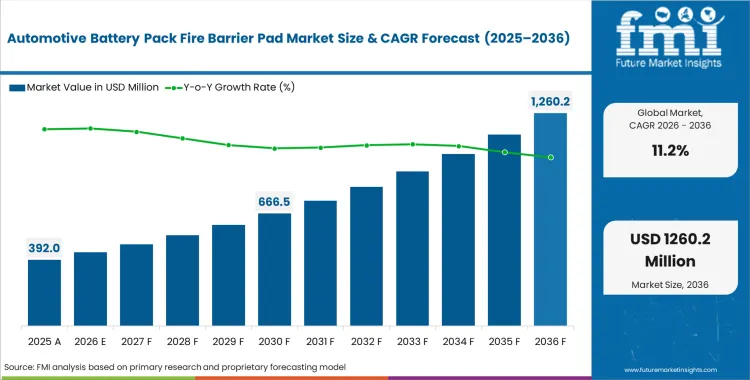
The automotive battery pack fire barrier pad market was valued at USD 352.5 million in 2025 and is projected to reach USD 392.0 million in 2026. Industry is expected to expand at a CAGR of 11.2% during 2026 to 2036, with total valuation projected at USD 1,131.0 million by 2036. Demand remains linked to stricter safety requirements in electric vehicle battery systems, where thermal containment and propagation control are critical.
Summary of Automotive Battery Pack Fire Barrier Pad Market
- The market is estimated at USD 352.5 million in 2025.
- The market is projected to reach USD 1,131.0 million by 2036.
- The market is expected to grow at a CAGR of 11.2% from 2026 to 2036.
- The forecast period represents an incremental opportunity of USD 739.0 million.
- Mica-based pads lead the material segment with a 36% share.
- Prismatic battery packs dominate the battery format segment with a 48% share.
- Cell-to-cell placement leads the application segment with a 34% share.
- Passenger BEVs dominate the vehicle type segment with a 72% share.
- OEM fitment leads the sales channel segment with a 94% share.
- India (13.3%), China (12.1%), and South Korea (10.6%) are among the fastest-growing markets.
Material selection is influenced by the need to manage thermal runaway events within compact battery architectures. Higher energy density targets increase heat concentration, which raises the importance of effective thermal isolation. Fire barrier pads support containment by limiting heat transfer between adjacent cells. Integration of advanced materials often requires redesign of cooling systems and internal pack layouts. Safety requirements related to passenger evacuation timelines also influence material performance standards.
Design shifts toward cell-to-pack configurations increase the functional role of fire barrier pads. Removal of module housings reduces structural separation between cells, placing greater reliance on thin thermal barriers. These materials are required to provide both mechanical support and heat resistance under compression. Thermal isolation components become integral to pack structure in high-density battery designs. Performance expectations include maintaining separation under mechanical stress and elevated temperatures.
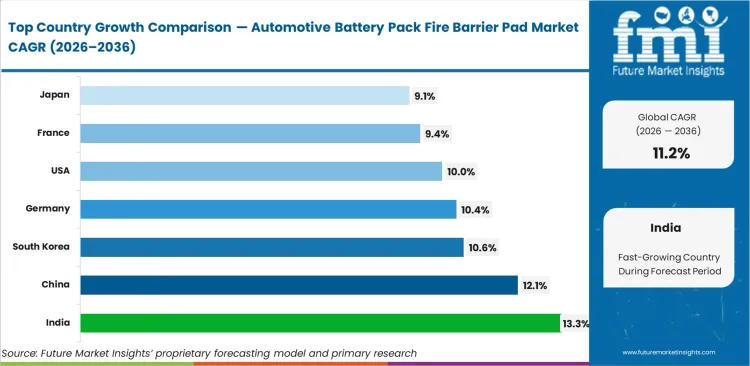
India is estimated to record a CAGR of 13.3% in the battery pack fire barrier pad market during 2026 to 2036, followed by China at 12.1% and South Korea at 10.6%. Germany is projected to expand at a CAGR of 10.4% over the same period, while the United States is expected to register 10.0%, followed by France at 9.4% and Japan at 9.1%. Demand patterns differ by region, with higher emphasis on thermal containment under elevated ambient conditions in emerging markets, while mature regions focus on performance under high-power charging and advanced battery system integration.
Segmental Analysis
Automotive Battery Pack Fire Barrier Pad Market Analysis by Material Type
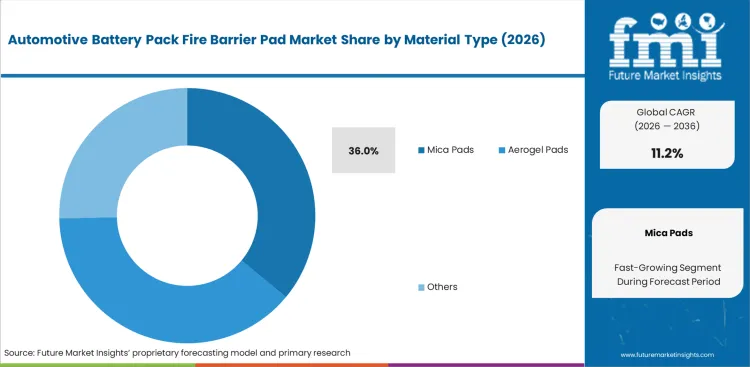
Thermal runaway protection requires materials that maintain integrity under extreme heat and compression. Mica remains widely used due to its passive fire resistance and cost efficiency across established battery designs. Brittle behavior under mechanical stress introduces handling risks, especially during automated assembly processes. Alternative materials face consistency challenges when exposed to compression and thermal cycling. Mica pads is set to account for an estimated 36.0% share of automotive battery fire barrier pad materials in 2026, reflecting continued reliance on validated legacy solutions.
- Brittle fracture behavior in mica structures creates micro-cracking risks during automated handling, which can reduce insulation effectiveness and introduce debris within tightly packed battery assemblies
- Alternative barrier materials often show thickness inconsistency under compression, which affects uniform heat resistance and can lead to localized failure during high-temperature events
- Demand for non-fragmenting materials increases as battery designs evolve, with focus shifting toward structures that maintain stability without shedding particles during long-term operational stress
Automotive Battery Pack Fire Barrier Pad Market Analysis by Battery Format
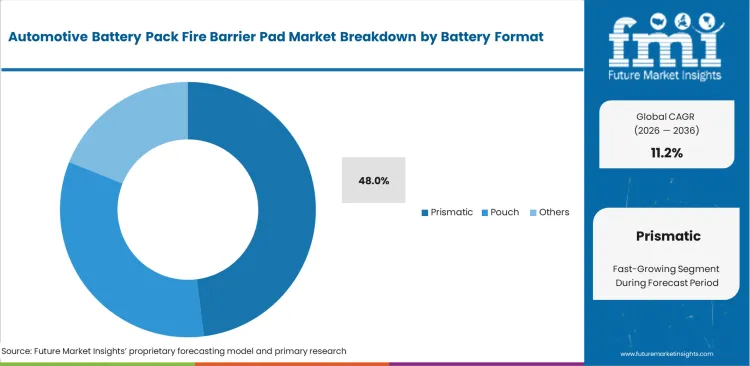
Prismatic packs are likely to hold 48.0% share in 2026 as flat cell geometry provides ideal surfaces for sandwiching rigid insulation panels. Based on FMI's assessment, pack integration engineers demand a highly compressible thermal barrier pad battery solution to counter continuous swelling forces generated during normal charging cycles. A distinct reality practitioner engineers acknowledge involves prismatic expansion physically crushing standard compression pads, destroying essential thermal resistance properties over vehicle lifespans. Systems designers who deploy liquid immersion cooling fluids alongside standard foams in high-expansion prismatic layouts experience rapid material degradation.
- Continuous expansion in prismatic cells applies sustained pressure on barrier materials, which can reduce thickness and weaken thermal insulation performance across repeated charging cycles.
- Compression resistance becomes critical in maintaining consistent protection, as material deformation under load directly affects the ability to limit heat propagation between adjacent cells.
- Compatibility issues arise when combining cooling systems with standard barrier materials, since exposure to fluids or pressure variation can accelerate structural degradation.
Automotive Battery Pack Fire Barrier Pad Market Analysis by Placement
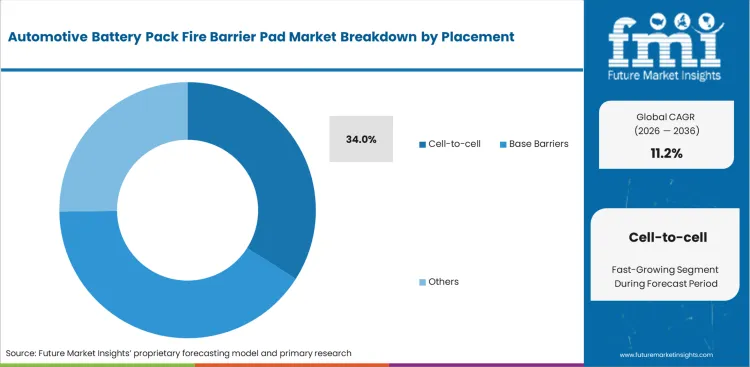
Barrier positioning determines effectiveness in controlling heat propagation across battery packs. Intercellular placement provides direct isolation between adjacent cells, limiting early-stage thermal spread. Cell-to-cell configurations are estimated to account for 34.0% share of placement strategies in 2026 due to their localized containment capability. Broader layouts distribute protection across modules, supporting secondary containment layers. Design decisions balance safety requirements with cooling efficiency, as excessive material thickness can restrict thermal management within compact battery systems.
- Direct placement between cells limits propagation at the source, reducing the likelihood of cascading thermal events across tightly packed battery configurations.
- Increased barrier thickness can restrict heat dissipation, creating trade-offs between fire protection and long-term battery performance under continuous operating conditions.
- Multi-layer placement strategies improve containment but introduce complexity in thermal management, requiring careful balance between insulation and cooling efficiency.
Automotive Battery Pack Fire Barrier Pad Market Analysis by Vehicle Type
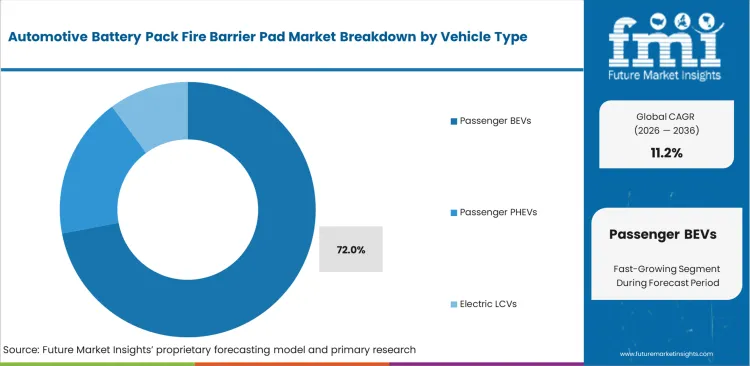
Energy density and pack size influence safety requirements across vehicle segments. Passenger battery electric vehicles require higher levels of protection due to larger energy storage systems. Passenger BEVs are likely to hold 72.0% share of fire barrier pad demand in 2026, reflecting their dominance in electric vehicle adoption. Higher energy chemistries increase thermal risk, requiring materials that withstand elevated temperatures. Weight sensitivity also shapes material selection, as excessive mass affects vehicle efficiency and range.
- Larger battery capacities increase thermal risk, requiring materials that can withstand higher temperatures without degrading under prolonged exposure.
- High-energy chemistries generate more intense heat during failure events, increasing the need for advanced barrier materials that maintain stability under extreme conditions.
- Weight considerations influence design decisions, as heavier materials reduce vehicle efficiency and limit overall driving range in electric platforms.
Automotive Battery Pack Fire Barrier Pad Market Analysis by Sales Channel
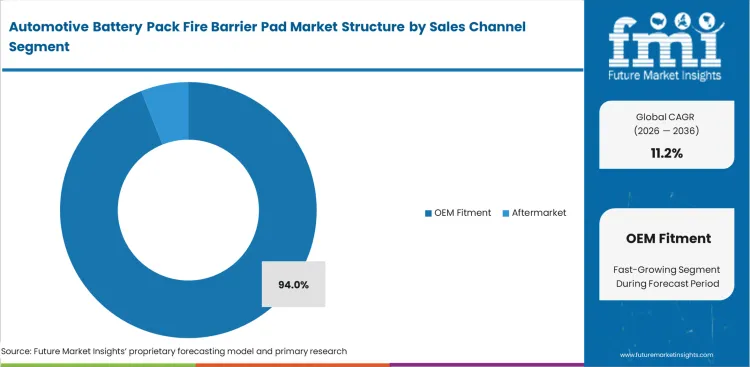
Integrated battery pack design limits accessibility of internal components after assembly. Fire barrier pads are installed during manufacturing and remain enclosed within sealed systems. OEM channels are predicted to reach 94.0% share of fire barrier pad distribution in 2026, reflecting restricted aftermarket involvement. Replacement typically requires full pack servicing rather than individual component access. This structure concentrates demand within original manufacturing channels and reduces opportunities for independent replacement solutions.
- Sealed battery pack construction prevents direct access to internal components, limiting replacement options and increasing reliance on complete system-level servicing
- Module-level replacement becomes the standard approach; as individual barrier components cannot be accessed without compromising structural integrity
- Aftermarket participation remains minimal due to technical constraints, concentrating supply within original equipment manufacturing networks
Automotive Battery Pack Fire Barrier Pad Market Drivers, Restraints, and Opportunities
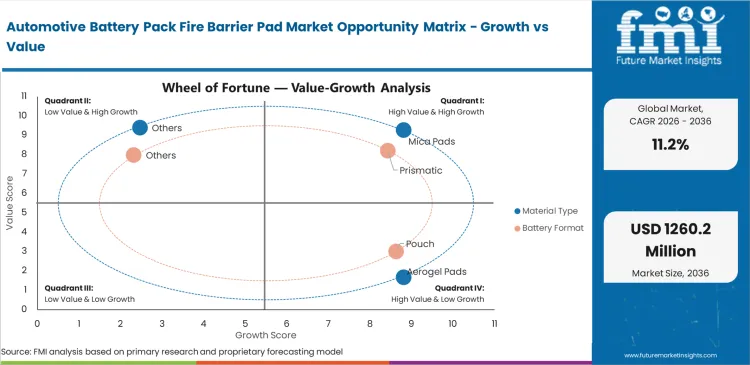
Thermal propagation regulations are increasing reliance on zero-clearance isolation within EV battery packs. Compliance with passenger escape time requirements drives replacement of basic separators with high-performance barrier pads. Materials capable of withstanding extreme heat and particle exposure gain preference in pack design. Selection decisions increasingly prioritize thermal resistance and containment performance over unit cost. Adoption of advanced materials such as aerogel-based structures supports compliance across high-density battery configurations.
Validation requirements extend development timelines during battery system integration. Changes in pad thickness or material composition require repeated certification testing to confirm thermal containment performance. Destructive testing remains a standard method for proving resistance to heat and particle propagation. Simulation tools support early-stage evaluation but are not sufficient for final approval. Testing complexity and cost slow iteration cycles and influence material selection decisions across battery programs.
Automotive Battery Pack Fire Barrier Pad Market Opportunities
- Sensor integration: Material scientists embedding delicate sensor modules directly into refractory sheets. Safety architects utilizing smart pads gain instantaneous fault detection.
- Intumescent formulations: Chemical engineers developing ultra-thin coatings expanding under extreme heat. Packaging leads specify reactive layers to save space during normal operation.
- Structural bonding: Adhesive specialists creating load-bearing debonding on demand adhesives tied to fire barriers. Chassis designers deploying dual-purpose composites eliminate heavy metal module frames entirely.
Regional Analysis
Based on regional analysis, the landscape is segmented into Asia Pacific, Europe, and North America across 40 plus countries.
.webp "Top Country Growth Comparison Automotive Battery Pack Fire Barrier Pad Market Cagr (2026 2036)")
| Country | CAGR (2026 to 2036) |
|---|---|
| India | 13.3% |
| China | 12.1% |
| South Korea | 10.6% |
| Germany | 10.4% |
| United States | 10.0% |
| France | 9.4% |
| Japan | 9.1% |
Source: Future Market Insights (FMI) analysis, based on proprietary forecasting model and primary research
Asia Pacific Automotive Battery Pack Fire Barrier Pad Market Analysis
Thermal safety mandates reshape battery architecture across Asia Pacific. Increasing energy density in electric vehicle platforms raises demand for advanced fire containment materials. Localized material production accelerates design iteration across domestic supply chains. Integration of thermal barrier systems becomes critical in preventing propagation across high-density battery modules.
- India: High ambient temperature exposure increases reliance on advanced fire barrier materials across India. Localization of supply chains supports rapid deployment of heat-resistant composites in electric vehicle production. The automotive battery pack fire barrier pad market in India is anticipated to reach 13.3% CAGR over the forecast period, driven by adoption of thermally stable materials designed for extreme climate conditions. Consistent material performance supports prevention of thermal runaway across expanding electric vehicle fleets.
- China: The automotive battery pack fire barrier pad market in China is projected to grow at 12.1% during the study period, driven by cost-focused engineering that accelerates the adoption of lightweight thermal materials. Thin aerogel-based insulation formats are replacing traditional structures within high-volume vehicle production. The integration of these compact fire-resistant materials into battery systems is bolstered by scalable manufacturing, supporting rapid deployment across both domestic and export-oriented electric vehicle platforms.
- South Korea: High-energy battery systems increase risk exposure to thermal instability across South Korea. Advanced intumescent materials support controlled expansion under heat stress conditions. The automotive battery pack fire barrier pad market in South Korea is predicted to record a CAGR of 10.6% across the assessment timeline, reflecting demand for high-performance fire barrier solutions. Reliable containment performance supports stable battery operation under high-load electric vehicle conditions.
- Japan: Japan is anticipated to secure a CAGR of 9.1% in the automotive battery pack fire barrier pad sector during 2026 to 2036, supported by strict quality standards and preference for validated fire barrier materials. Mica-based solutions continue to see steady adoption due to consistent performance under extended operating conditions. Demand remains linked to reliability requirements across precision-focused automotive manufacturing. Stable thermal resistance supports low defect rates and consistent battery pack performance.
FMI's report includes extensive coverage of surrounding Southeast Asian nations. Regional supply chain officers increasingly rely on localized assembly hubs to bypass volatile trans-Pacific shipping bottlenecks.
Europe Automotive Battery Pack Fire Barrier Pad Market Analysis
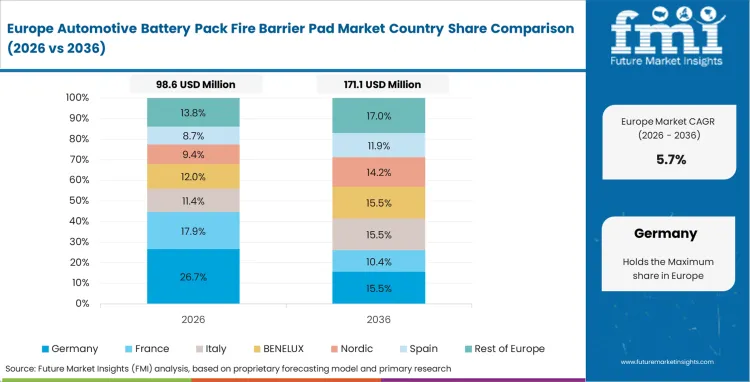
Premium driving dynamics dictate ultra-dense energy storage configurations across continental luxury platforms. Powertrain software directors require multi-pole feedback mechanisms to eliminate microscopic torque ripples disrupting premium acoustic environments. According to FMI's estimates, stringent UNECE functional safety mandates physically hardwire thermal propagation redundancy requirements into every newly designed procurement contract.
- Germany: High-speed autobahn cruising exposes high-voltage architectures to sustained peak discharge loads. The industry in Germany is anticipated to rise with a CAGR of 10.4% during the forecast period to prevent high-speed cascading failures. Once engineering teams validate high-temperature profiles, internal qualification standards elevate permanently across all future model years.
- France: Compact vehicle platforms increase demand for space-efficient thermal barrier solutions across France. Flexible ceramic materials support integration within constrained battery pack designs. The automotive battery pack fire barrier pad market in France is likely to record a CAGR of 9.4% by 2036, reflecting adoption of compact fire-resistant materials. Efficient material integration supports optimization of battery layouts while maintaining required safety performance across urban electric mobility systems.
FMI's report includes analysis of Italian and British specialized component ecosystems. Niche supercar manufacturers operating here drive early adoption of extreme high-frequency inductive technologies.
North America Automotive Battery Pack Fire Barrier Pad Market Analysis
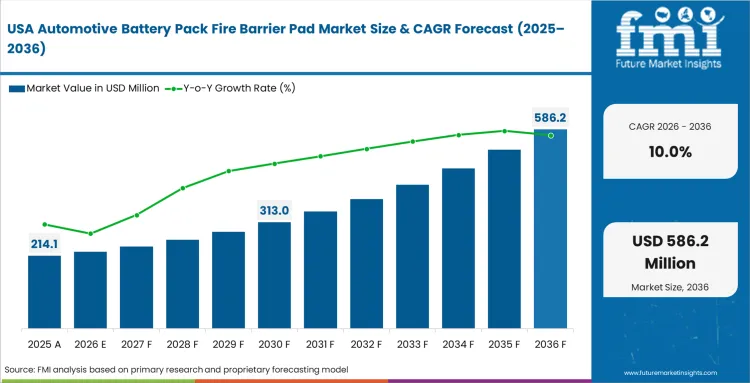
Heavy-duty towing requirements fundamentally shape domestic electric powertrain specifications. Commercial vehicle chief engineers actively reject delicate nanoscale sensing, favoring massive refractory composites capable of surviving extreme thermal saturation during sustained uphill hauling. As per FMI's projection, sheer capacity demands force component suppliers to over-engineer magnetic targets, prioritizing ruggedized durability over fractional weight savings.
- United States: Electric pickup truck programs demand exceptionally high thermal shock resistance. Drivetrain packaging teams increasingly specify military‑grade composite materials to withstand extreme operating conditions, supporting a 10.0% CAGR during the forecast period. These stringent durability requirements effectively exclude standard passenger‑vehicle components from use in domestic utility and heavy‑duty fleet applications.
FMI's report includes detailed assessments of Canadian manufacturing corridors. Cross-border logistics managers tightly synchronize component flow to feed massive consolidated electric drive assembly plants.
Competitive Aligners for Market Players
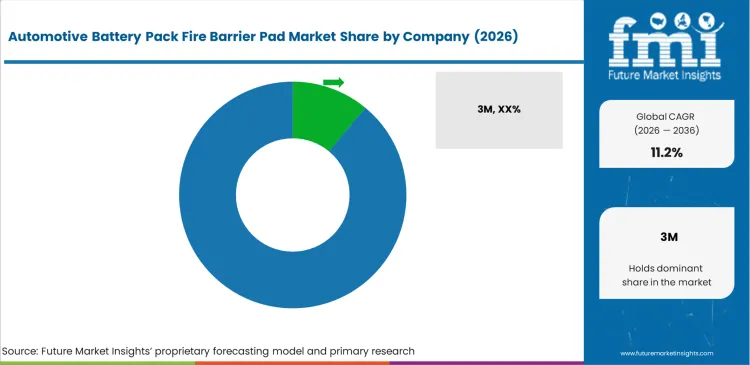
Thermal validation barriers completely isolate advanced containment materials from standard industrial insulation suppliers. Powertrain integrators choose partners based on proprietary plasma-jet survival pedigree. By evaluating battery fire barrier pad manufacturers through rigorous field-failure rates, OEMs entirely disregard unit pricing from unproven foundries. Assessing the key players in automotive battery pack fire barrier pad market dynamics, Morgan Advanced Materials and Aerogels dominate early platform wins.
Established refractory chemical makers wield devastating advantages through proprietary binder formulations embedded directly into composite matrices. Leading thermal runaway barrier solutions invest heavily in molecular-level bonding technology instantly preventing brittle structural collapse without taxing surrounding module rigidity. Challengers attempting basic fiberglass cost competition fail spectacularly when integration engineers realize hidden shedding risks inside sensitive high-voltage enclosures. Entities providing fiber-based flame shields capitalize on the growing demand for non-mineral alternatives. Dual-layer flame retardant polyamide compounds also enhance structural rigidity in these applications.
Global battery unit manufacturers systematically resist single-source material dependency by testing UL 2596 battery enclosure materials across multiple vendor portfolios. Sourcing executives actively fund secondary heat shield coatings suppliers to ensure dual-path supply chains for critical safety structures. Structural integration of reactive intumescent layers directly into cooling plates will eventually eliminate standalone pad sourcing, forcing legacy insulation firms into deep mechanical joint ventures with traditional automotive thermal management manufacturers.
Key Players in the Automotive Battery Pack Fire Barrier Pad Market
- 3M
- Aspen Aerogels
- Morgan Advanced Materials
- Autoneum
- Henkel
- Zotefoams
- Alkegen
Scope of the Report
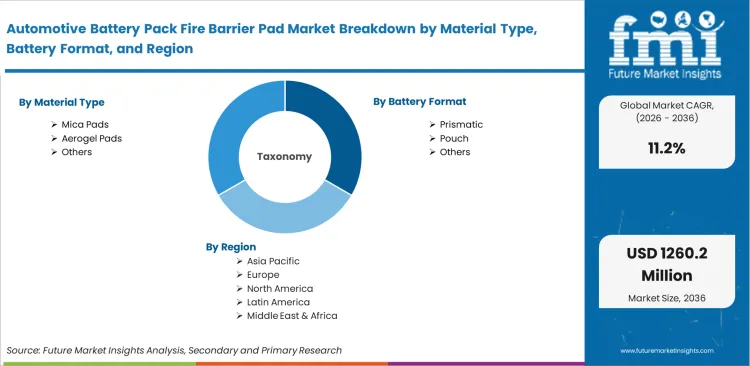
| Metric | Value |
|---|---|
| Quantitative Units | USD 392.0 million to USD 1,131.0 million, at a CAGR of 11.2% |
| Definition | Automotive battery pack fire barrier pads constitute specialized dielectric and thermal isolation sheets engineered for high-voltage energy storage systems. These structures utilize refractory materials, aerogels, or expanding composites to delay heat transfer and block flame propagation between individual cells during catastrophic failure events. |
| Segmentation | Material Type, Battery Format, Placement, Vehicle Type, and Sales Channel |
| Regions Covered | Asia Pacific, North America, Europe |
| Countries Covered | India, China, South Korea, Germany, United States, France, Japan |
| Key Companies Profiled | 3M, Aspen Aerogels, Morgan Advanced Materials, Autoneum, Henkel, Zotefoams, Alkegen |
| Forecast Period | 2026 to 2036 |
| Approach | Installed base of lithium-ion cell capacity cross-referenced with average pad thickness specifications per vehicle architecture. |
Source: Future Market Insights (FMI) analysis, based on proprietary forecasting model and primary research
Automotive Battery Pack Fire Barrier Pad Market Analysis by Segments
Material Type
- Mica pads
- Aerogel pads
- Ceramic fiber pads
- Foam composites
- Intumescent pads
Battery Format
- Prismatic packs
- Pouch packs
- Cylindrical packs
Placement
- Cell-to-cell
- Module-to-module
- Top-cover shields
- Sidewall liners
- Base barriers
Vehicle Type
- Passenger BEVs
- Passenger PHEVs
- Electric LCVs
- Electric buses
Sales Channel
- OEM fitment
- Aftermarket
Region:
- North America
- United States
- Canada
- Europe
- Germany
- United Kingdom
- France
- Italy
- Spain
- Asia Pacific
- China
- Japan
- South Korea
- Taiwan
- Singapore
- Latin America
- Brazil
- Mexico
- Argentina
- Middle East & Africa
- GCC Countries
- South Africa
- Israel
Bibliography
- Dai, Y., Wang, Q., Jiang, J., & Wang, C. (2025). Thermal runaway process in lithium-ion batteries: A review. Carbon Neutralization, 4, Article 8.
- Kim, S. J., Jeong, S., & Lee, J. (2025). Thermal Runaway Propagation in Pouch-Type Lithium-Ion Batteries: Mitigation Strategies and Safety Improvements. Batteries, 11(11), 398.
- Li, Y., Zhang, H., & Chen, X. (2026). Recent Advances in Polymer-Based Thermal Barrier Materials for Lithium-Ion Battery Safety. Polymers, 18(7), 801.
- Read, E., Lamb, J., Finegan, D., & Offer, G. (2024). Performance of interstitial thermal barrier materials on the mitigation of lithium-ion battery thermal runaway propagation. Journal of Energy Storage, 92, 112246.
- Schöberl, J., et al. (2026). A methodology for reliable thermal runaway propagation risk assessment in battery modules. Journal of Energy Storage, 111, 115227.
This bibliography is provided for reader reference. The full FMI report contains the complete reference list with primary source documentation.
This Report Addresses
- Mandatory thermal propagation regulations force packaging directors to integrate zero-clearance isolation mechanisms.
- Volumetric energy density goals force pack designers to adopt ultra-thin aerogel solutions.
- Brittle mineral structures crack invisibly under robotic vacuum grippers during assembly.
- Prismatic expansion physically crushes standard barriers, destroying essential thermal resistance properties over vehicle lifespans.
- Thick intercellular insulating sheets block natural lateral heat dissipation during high-power driving.
- High-nickel chemistries burn significantly hotter than legacy formats, making advanced protection mandatory.
- Removing internal barriers requires breaking hermetic seals, essentially destroying independent aftermarket repair viability.
- Sourcing teams relying on open-air certification data routinely deploy materials failing instantly under actual internal pack pressures.
Frequently Asked Questions
What is the automotive battery pack fire barrier pad market size in 2025, 2026, and 2036?
Industry valuation reached USD 392.0 million in 2026, up from USD 352.5 million in 2025. Projections point to USD 1,131.0 million by 2036. This metric signals how deeply automakers rely on advanced composite structures to hit aggressive safety targets across mass-market platforms.
What is the CAGR of the automotive battery pack fire barrier pad market?
Operations scale at an 11.20% CAGR through 2036. This aggressive growth masks an intense technological race to miniaturize isolation envelopes without sacrificing UN GTR No. 20 compliance.
Why do EV battery packs need fire barrier pads?
Strict passenger evacuation mandates compel engineering heads to integrate multi-layer containment structures. These pads provide localized isolation, halting thermal runaway chains immediately at source points to guarantee mandatory five-minute evacuation windows.
How do thermal runaway barrier pads work?
These specialized dielectric structures utilize refractory materials, aerogels, or expanding composites to delay heat transfer and physically block focused plasma jets from breaching adjacent cells during catastrophic failure events.
Which material leads the fire barrier pad market, mica or aerogel?
Purchasing managers leverage massive scale to drastically compress bill-of-materials expenditures, allowing mica pads to maintain volume dominance. However, extreme driving range targets and packaging constraints are rapidly accelerating aerogel adoption in EV battery safety.
Which battery format uses the most fire barrier pads?
Prismatic packs hold the commanding share. Flat aluminum cans expand outward significantly during rapid charging phases, requiring specialized composite barriers capable of absorbing continuous physical stress without crushing microscopic air pockets.
Which countries are growing fastest in battery fire barrier pads?
India leads with a 13.3% compound growth rate as extreme tropical ambient temperatures force immediate localized supply chain development. China follows closely at 12.1% due to hyper-competitive domestic pricing mandates.
Who are the key companies in automotive battery pack fire barrier pads?
Major entities dominating early platform wins include 3M, Aspen Aerogels, Morgan Advanced Materials, Autoneum, Henkel, Zotefoams, and Alkegen.
How are fire barrier pads different from thermal interface materials?
Thermal interface materials are engineered to conduct and dissipate heat rapidly into cooling plates during normal operation. Fire barrier pads serve the exact opposite function, acting as impenetrable thermal insulators to completely block heat transfer during a failure event.
What standards are driving demand for battery fire barrier pads?
Stringent regulations including UN GTR No. 20, Chinese GB 38031, and emerging FMVSS criteria physically hardwire thermal propagation redundancy requirements into every newly designed procurement contract.
What are the main design tradeoffs in fire barrier pad selection?
Engineers must balance extreme temperature resistance against spatial volume. Thick insulating sheets block natural lateral heat dissipation during high-power driving, meaning maximum fire protection can ironically trigger premature capacity fade if not properly engineered.
Preview the report firsthand - request a free sample
Get SampleGet the brochure for pricing and purchase details.
Get PDFTable of Content
- Executive Summary
- Global Market Outlook
- Demand-side Trends
- Supply-side Trends
- Technology Roadmap Analysis
- Analysis and Recommendations
- Market Overview
- Market Coverage / Taxonomy
- Market Definition / Scope / Limitations
- Research Methodology
- Chapter Orientation
- Analytical Lens and Working Hypotheses
- Market Structure, Signals, and Trend Drivers
- Benchmarking and Cross-market Comparability
- Market Sizing, Forecasting, and Opportunity Mapping
- Research Design and Evidence Framework
- Desk Research Programme (Secondary Evidence)
- Company Annual and Sustainability Reports
- Peer-reviewed Journals and Academic Literature
- Corporate Websites, Product Literature, and Technical Notes
- Earnings Decks and Investor Briefings
- Statutory Filings and Regulatory Disclosures
- Technical White Papers and Standards Notes
- Trade Journals, Industry Magazines, and Analyst Briefs
- Conference Proceedings, Webinars, and Seminar Materials
- Government Statistics Portals and Public Data Releases
- Press Releases and Reputable Media Coverage
- Specialist Newsletters and Curated Briefings
- Sector Databases and Reference Repositories
- FMI Internal Proprietary Databases and Historical Market Datasets
- Subscription Datasets and Paid Sources
- Social Channels, Communities, and Digital Listening Inputs
- Additional Desk Sources
- Expert Input and Fieldwork (Primary Evidence)
- Primary Modes
- Qualitative Interviews and Expert Elicitation
- Quantitative Surveys and Structured Data Capture
- Blended Approach
- Why Primary Evidence is Used
- Field Techniques
- Interviews
- Surveys
- Focus Groups
- Observational and In-context Research
- Social and Community Interactions
- Stakeholder Universe Engaged
- C-suite Leaders
- Board Members
- Presidents and Vice Presidents
- R&D and Innovation Heads
- Technical Specialists
- Domain Subject-matter Experts
- Scientists
- Physicians and Other Healthcare Professionals
- Governance, Ethics, and Data Stewardship
- Research Ethics
- Data Integrity and Handling
- Primary Modes
- Tooling, Models, and Reference Databases
- Desk Research Programme (Secondary Evidence)
- Data Engineering and Model Build
- Data Acquisition and Ingestion
- Cleaning, Normalisation, and Verification
- Synthesis, Triangulation, and Analysis
- Quality Assurance and Audit Trail
- Market Background
- Market Dynamics
- Drivers
- Restraints
- Opportunity
- Trends
- Scenario Forecast
- Demand in Optimistic Scenario
- Demand in Likely Scenario
- Demand in Conservative Scenario
- Opportunity Map Analysis
- Product Life Cycle Analysis
- Supply Chain Analysis
- Investment Feasibility Matrix
- Value Chain Analysis
- PESTLE and Porter’s Analysis
- Regulatory Landscape
- Regional Parent Market Outlook
- Production and Consumption Statistics
- Import and Export Statistics
- Market Dynamics
- Global Market Analysis 2021 to 2025 and Forecast, 2026 to 2036
- Historical Market Size Value (USD Million) Analysis, 2021 to 2025
- Current and Future Market Size Value (USD Million) Projections, 2026 to 2036
- Y-o-Y Growth Trend Analysis
- Absolute $ Opportunity Analysis
- Global Market Pricing Analysis 2021 to 2025 and Forecast 2026 to 2036
- Global Market Analysis 2021 to 2025 and Forecast 2026 to 2036, By Material Type
- Introduction / Key Findings
- Historical Market Size Value (USD Million) Analysis By Material Type , 2021 to 2025
- Current and Future Market Size Value (USD Million) Analysis and Forecast By Material Type , 2026 to 2036
- Mica Pads
- Aerogel Pads
- Others
- Mica Pads
- Y-o-Y Growth Trend Analysis By Material Type , 2021 to 2025
- Absolute $ Opportunity Analysis By Material Type , 2026 to 2036
- Global Market Analysis 2021 to 2025 and Forecast 2026 to 2036, By Battery Format
- Introduction / Key Findings
- Historical Market Size Value (USD Million) Analysis By Battery Format, 2021 to 2025
- Current and Future Market Size Value (USD Million) Analysis and Forecast By Battery Format, 2026 to 2036
- Prismatic
- Pouch
- Others
- Prismatic
- Y-o-Y Growth Trend Analysis By Battery Format, 2021 to 2025
- Absolute $ Opportunity Analysis By Battery Format, 2026 to 2036
- Global Market Analysis 2021 to 2025 and Forecast 2026 to 2036, By Placement
- Introduction / Key Findings
- Historical Market Size Value (USD Million) Analysis By Placement, 2021 to 2025
- Current and Future Market Size Value (USD Million) Analysis and Forecast By Placement, 2026 to 2036
- Cell-to-cell
- Base Barriers
- Others
- Cell-to-cell
- Y-o-Y Growth Trend Analysis By Placement, 2021 to 2025
- Absolute $ Opportunity Analysis By Placement, 2026 to 2036
- Global Market Analysis 2021 to 2025 and Forecast 2026 to 2036, By Vehicle Type
- Introduction / Key Findings
- Historical Market Size Value (USD Million) Analysis By Vehicle Type, 2021 to 2025
- Current and Future Market Size Value (USD Million) Analysis and Forecast By Vehicle Type, 2026 to 2036
- Passenger BEVs
- Passenger PHEVs
- Electric LCVs
- Passenger BEVs
- Y-o-Y Growth Trend Analysis By Vehicle Type, 2021 to 2025
- Absolute $ Opportunity Analysis By Vehicle Type, 2026 to 2036
- Global Market Analysis 2021 to 2025 and Forecast 2026 to 2036, By Sales Channel
- Introduction / Key Findings
- Historical Market Size Value (USD Million) Analysis By Sales Channel, 2021 to 2025
- Current and Future Market Size Value (USD Million) Analysis and Forecast By Sales Channel, 2026 to 2036
- OEM Fitment
- Aftermarket
- OEM Fitment
- Y-o-Y Growth Trend Analysis By Sales Channel, 2021 to 2025
- Absolute $ Opportunity Analysis By Sales Channel, 2026 to 2036
- Global Market Analysis 2021 to 2025 and Forecast 2026 to 2036, By Region
- Introduction
- Historical Market Size Value (USD Million) Analysis By Region, 2021 to 2025
- Current Market Size Value (USD Million) Analysis and Forecast By Region, 2026 to 2036
- North America
- Latin America
- Western Europe
- Eastern Europe
- East Asia
- South Asia and Pacific
- Middle East & Africa
- Market Attractiveness Analysis By Region
- North America Market Analysis 2021 to 2025 and Forecast 2026 to 2036, By Country
- Historical Market Size Value (USD Million) Trend Analysis By Market Taxonomy, 2021 to 2025
- Market Size Value (USD Million) Forecast By Market Taxonomy, 2026 to 2036
- By Country
- USA
- Canada
- Mexico
- By Material Type
- By Battery Format
- By Placement
- By Vehicle Type
- By Sales Channel
- By Country
- Market Attractiveness Analysis
- By Country
- By Material Type
- By Battery Format
- By Placement
- By Vehicle Type
- By Sales Channel
- Key Takeaways
- Latin America Market Analysis 2021 to 2025 and Forecast 2026 to 2036, By Country
- Historical Market Size Value (USD Million) Trend Analysis By Market Taxonomy, 2021 to 2025
- Market Size Value (USD Million) Forecast By Market Taxonomy, 2026 to 2036
- By Country
- Brazil
- Chile
- Rest of Latin America
- By Material Type
- By Battery Format
- By Placement
- By Vehicle Type
- By Sales Channel
- By Country
- Market Attractiveness Analysis
- By Country
- By Material Type
- By Battery Format
- By Placement
- By Vehicle Type
- By Sales Channel
- Key Takeaways
- Western Europe Market Analysis 2021 to 2025 and Forecast 2026 to 2036, By Country
- Historical Market Size Value (USD Million) Trend Analysis By Market Taxonomy, 2021 to 2025
- Market Size Value (USD Million) Forecast By Market Taxonomy, 2026 to 2036
- By Country
- Germany
- UK
- Italy
- Spain
- France
- Nordic
- BENELUX
- Rest of Western Europe
- By Material Type
- By Battery Format
- By Placement
- By Vehicle Type
- By Sales Channel
- By Country
- Market Attractiveness Analysis
- By Country
- By Material Type
- By Battery Format
- By Placement
- By Vehicle Type
- By Sales Channel
- Key Takeaways
- Eastern Europe Market Analysis 2021 to 2025 and Forecast 2026 to 2036, By Country
- Historical Market Size Value (USD Million) Trend Analysis By Market Taxonomy, 2021 to 2025
- Market Size Value (USD Million) Forecast By Market Taxonomy, 2026 to 2036
- By Country
- Russia
- Poland
- Hungary
- Balkan & Baltic
- Rest of Eastern Europe
- By Material Type
- By Battery Format
- By Placement
- By Vehicle Type
- By Sales Channel
- By Country
- Market Attractiveness Analysis
- By Country
- By Material Type
- By Battery Format
- By Placement
- By Vehicle Type
- By Sales Channel
- Key Takeaways
- East Asia Market Analysis 2021 to 2025 and Forecast 2026 to 2036, By Country
- Historical Market Size Value (USD Million) Trend Analysis By Market Taxonomy, 2021 to 2025
- Market Size Value (USD Million) Forecast By Market Taxonomy, 2026 to 2036
- By Country
- China
- Japan
- South Korea
- By Material Type
- By Battery Format
- By Placement
- By Vehicle Type
- By Sales Channel
- By Country
- Market Attractiveness Analysis
- By Country
- By Material Type
- By Battery Format
- By Placement
- By Vehicle Type
- By Sales Channel
- Key Takeaways
- South Asia and Pacific Market Analysis 2021 to 2025 and Forecast 2026 to 2036, By Country
- Historical Market Size Value (USD Million) Trend Analysis By Market Taxonomy, 2021 to 2025
- Market Size Value (USD Million) Forecast By Market Taxonomy, 2026 to 2036
- By Country
- India
- ASEAN
- Australia & New Zealand
- Rest of South Asia and Pacific
- By Material Type
- By Battery Format
- By Placement
- By Vehicle Type
- By Sales Channel
- By Country
- Market Attractiveness Analysis
- By Country
- By Material Type
- By Battery Format
- By Placement
- By Vehicle Type
- By Sales Channel
- Key Takeaways
- Middle East & Africa Market Analysis 2021 to 2025 and Forecast 2026 to 2036, By Country
- Historical Market Size Value (USD Million) Trend Analysis By Market Taxonomy, 2021 to 2025
- Market Size Value (USD Million) Forecast By Market Taxonomy, 2026 to 2036
- By Country
- Kingdom of Saudi Arabia
- Other GCC Countries
- Turkiye
- South Africa
- Other African Union
- Rest of Middle East & Africa
- By Material Type
- By Battery Format
- By Placement
- By Vehicle Type
- By Sales Channel
- By Country
- Market Attractiveness Analysis
- By Country
- By Material Type
- By Battery Format
- By Placement
- By Vehicle Type
- By Sales Channel
- Key Takeaways
- Key Countries Market Analysis
- USA
- Pricing Analysis
- Market Share Analysis, 2025
- By Material Type
- By Battery Format
- By Placement
- By Vehicle Type
- By Sales Channel
- Canada
- Pricing Analysis
- Market Share Analysis, 2025
- By Material Type
- By Battery Format
- By Placement
- By Vehicle Type
- By Sales Channel
- Mexico
- Pricing Analysis
- Market Share Analysis, 2025
- By Material Type
- By Battery Format
- By Placement
- By Vehicle Type
- By Sales Channel
- Brazil
- Pricing Analysis
- Market Share Analysis, 2025
- By Material Type
- By Battery Format
- By Placement
- By Vehicle Type
- By Sales Channel
- Chile
- Pricing Analysis
- Market Share Analysis, 2025
- By Material Type
- By Battery Format
- By Placement
- By Vehicle Type
- By Sales Channel
- Germany
- Pricing Analysis
- Market Share Analysis, 2025
- By Material Type
- By Battery Format
- By Placement
- By Vehicle Type
- By Sales Channel
- UK
- Pricing Analysis
- Market Share Analysis, 2025
- By Material Type
- By Battery Format
- By Placement
- By Vehicle Type
- By Sales Channel
- Italy
- Pricing Analysis
- Market Share Analysis, 2025
- By Material Type
- By Battery Format
- By Placement
- By Vehicle Type
- By Sales Channel
- Spain
- Pricing Analysis
- Market Share Analysis, 2025
- By Material Type
- By Battery Format
- By Placement
- By Vehicle Type
- By Sales Channel
- France
- Pricing Analysis
- Market Share Analysis, 2025
- By Material Type
- By Battery Format
- By Placement
- By Vehicle Type
- By Sales Channel
- India
- Pricing Analysis
- Market Share Analysis, 2025
- By Material Type
- By Battery Format
- By Placement
- By Vehicle Type
- By Sales Channel
- ASEAN
- Pricing Analysis
- Market Share Analysis, 2025
- By Material Type
- By Battery Format
- By Placement
- By Vehicle Type
- By Sales Channel
- Australia & New Zealand
- Pricing Analysis
- Market Share Analysis, 2025
- By Material Type
- By Battery Format
- By Placement
- By Vehicle Type
- By Sales Channel
- China
- Pricing Analysis
- Market Share Analysis, 2025
- By Material Type
- By Battery Format
- By Placement
- By Vehicle Type
- By Sales Channel
- Japan
- Pricing Analysis
- Market Share Analysis, 2025
- By Material Type
- By Battery Format
- By Placement
- By Vehicle Type
- By Sales Channel
- South Korea
- Pricing Analysis
- Market Share Analysis, 2025
- By Material Type
- By Battery Format
- By Placement
- By Vehicle Type
- By Sales Channel
- Russia
- Pricing Analysis
- Market Share Analysis, 2025
- By Material Type
- By Battery Format
- By Placement
- By Vehicle Type
- By Sales Channel
- Poland
- Pricing Analysis
- Market Share Analysis, 2025
- By Material Type
- By Battery Format
- By Placement
- By Vehicle Type
- By Sales Channel
- Hungary
- Pricing Analysis
- Market Share Analysis, 2025
- By Material Type
- By Battery Format
- By Placement
- By Vehicle Type
- By Sales Channel
- Kingdom of Saudi Arabia
- Pricing Analysis
- Market Share Analysis, 2025
- By Material Type
- By Battery Format
- By Placement
- By Vehicle Type
- By Sales Channel
- Turkiye
- Pricing Analysis
- Market Share Analysis, 2025
- By Material Type
- By Battery Format
- By Placement
- By Vehicle Type
- By Sales Channel
- South Africa
- Pricing Analysis
- Market Share Analysis, 2025
- By Material Type
- By Battery Format
- By Placement
- By Vehicle Type
- By Sales Channel
- USA
- Market Structure Analysis
- Competition Dashboard
- Competition Benchmarking
- Market Share Analysis of Top Players
- By Region
- By Material Type
- By Battery Format
- By Placement
- By Vehicle Type
- By Sales Channel
- Competition Analysis
- Competition Deep Dive
- 3M
- Overview
- Product Portfolio
- Profitability by Market Segments (Product/Age /Sales Channel/Region)
- Sales Footprint
- Strategy Overview
- Marketing Strategy
- Product Strategy
- Channel Strategy
- Aspen Aerogels
- Morgan Advanced Materials
- Autoneum
- Henkel
- Zotefoams
- Alkegen
- 3M
- Competition Deep Dive
- Assumptions & Acronyms Used


