

- Industry Size (2026)
- USD 72.8 Mn
- Forecast (2036)
- USD 273.6 Mn
- CAGR (2026 to 2036)
- 14.2%
Battery Pack Immersion Cooling System Performance Test Rigs Market Size, Market Forecast and Outlook By FMI
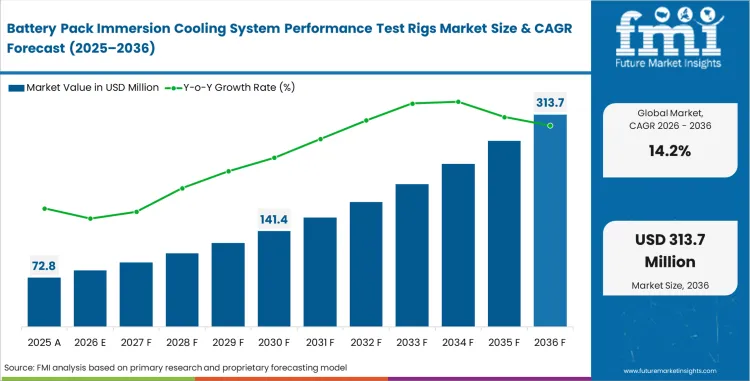
The battery pack immersion cooling system performance test rigs market was valued at USD 63.7 million in 2025. The sector is expected to reach USD 72.8 million in 2026 at a CAGR of 14.2% during the forecast period. Sustained investment takes the valuation to USD 273.6 million through 2036 as battery developers push more pack programs into thermal conditions that standard electrical benches do not handle well, especially when validation must combine charge behavior, fluid control, and safety monitoring in one test environment.
Summary of Battery Pack Immersion Cooling System Performance Test Rigs Market
- Market Snapshot
- The battery pack immersion cooling system performance test rigs market is valued at USD 63.7 million in 2025 and is projected to reach USD 273.6 million by 2036.
- The industry is expected to grow at a 14.2% CAGR from 2026 to 2036, creating an incremental opportunity of USD 200.8 million over the period.
- This category remains a specialized battery validation equipment space where pack-level thermal control, fluid handling, electrical loading, and safety instrumentation determine purchase decisions.
- Buyers treat these rigs as development and release infrastructure rather than general lab hardware because the asset must reproduce realistic pack conditions without compromising test repeatability.
- Demand and Growth Drivers
- Demand is increasing as EV battery programs require pack-level thermal data that links electrical performance with coolant behavior before final validation.
- Immersion-capable test benches are gaining adoption because direct fluid control improves temperature stability during high-load and fast-charge testing.
- Expansion is supported by stricter durability and safety requirements, which are shifting validation into structured laboratory workflows instead of one-off engineering setups.
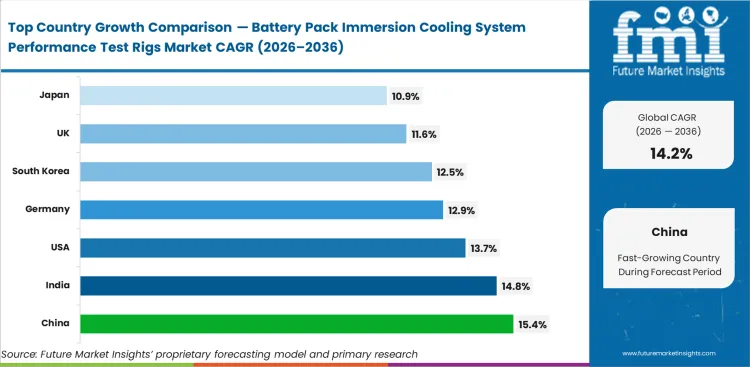
- China is projected to expand at 15.4% CAGR in the battery pack immersion cooling test rigs market from 2026 to 2036, followed by India at 14.8% CAGR. The United States is expected to record 13.7% CAGR, while Germany posts 12.9% CAGR, South Korea 12.5% CAGR, the United Kingdom 11.6% CAGR, and Japan 10.9% CAGR over the same period.
- Adoption speed is moderated by long approval cycles, custom integration requirements, and the need to align thermal, electrical, and safety workflows within a single validation program.
- Product and Segment View
- The market is estimated to include pack-level test rigs equipped with cyclers, fluid circulation systems, chillers, sensors, control units, and safety interlocks designed for immersion cooling validation.
- These systems are used for thermal characterization, charge-discharge cycling, fast-charge testing, durability evaluation, and pack safety validation across OEM, supplier, and independent laboratory environments.
- Integrated pack rigs are projected to account for 42.0% share of the rig type segment in 2026, as turnkey systems reduce integration gaps between thermal management and electrical load control.
- Thermal performance testing is expected to represent 38.0% share of the test focus segment in 2026, since temperature distribution and hotspot behavior determine pack readiness under demanding conditions.
- Single-phase cooling is anticipated to hold 61.0% share of the cooling mode segment in 2026, supported by simpler fluid handling and lower operational complexity during early-stage immersion adoption.
- OEM laboratories are projected to capture 36.0% share of the end-use segment in 2026, reflecting their role in early-stage validation before supplier-scale deployment.
- The scope is estimated to include immersion-capable rig systems, synchronized control platforms, thermal loop components, and pack-level safety instrumentation, while excluding general-purpose battery cyclers, cell formation systems, and outsourced testing services.
- Geography and Competitive Outlook
- China, India, and the USA are the fastest-expanding national demand centers, while Germany remains a stable high-value engineering base for sophisticated validation programs.
- Competition is shaped by pack validation accuracy, thermal-loop integration, software coordination, service support, and the ability to configure a bench around a customer’s specific pack program.
- AVL, HORIBA, Keysight Technologies, Chroma ATE, Digatron, Arbin Instruments, and ENORISE are among the active participants, with AVL estimated to account for significant share in a fragmented supplier field.
- No single supplier controls the category globally because buyer needs differ by pack architecture, safety workflow, power profile, and lab integration strategy.
Key Takeaways, Market Size, and Forecast
- The Battery Pack Immersion Cooling System Performance Test Rigs Market is projected to grow from USD 72.8 million in 2026 to USD 273.6 million by 2036, expanding at a CAGR of 14.2%.
- The market was valued at USD 63.7 million in 2025, reflecting its position as a specialized but rapidly scaling battery validation equipment category.
- By 2036, the Battery Pack Immersion Cooling System Performance Test Rigs Market is expected to reach USD 273.6 million, supported by wider adoption of pack-level thermal validation workflows.
- From 2026 to 2036, the market is projected to expand at a 14.2% CAGR, reflecting sustained investment in integrated thermal, electrical, and safety validation infrastructure.
- The market is expected to create an incremental opportunity of USD 200.8 million between 2026 and 2036 as pack programs move from experimental setups to standardized lab assets.
- In 2026, Single-Phase Cooling Systems are anticipated to account for 61.0% of the cooling mode segment, driven by simpler fluid control and lower operational complexity.
- China (15.4% CAGR) and India (14.8% CAGR) are among the fastest-growing national markets, supported by expanding battery manufacturing capacity and new validation infrastructure development.
Battery Pack Immersion Cooling System Performance Test Rigs Market Key Takeaways
| Metric | Details |
|---|---|
| Industry Size (2026) | USD 72.8 million |
| Industry Value (2036) | USD 273.6 million |
| CAGR (2026-2036) | 14.2% |
Source: Future Market Insights (FMI) analysis, based on proprietary forecasting model and primary research
Focus has shifted from electrical throughput alone to the ability of test systems to replicate real operating thermal conditions. Higher charging rates, denser pack designs, and stricter durability targets are moving failure risk from individual cells to full pack integration. Equipment selection now depends on how well thermal, control, and safety functions operate within a single workflow. Test setups that cannot align these functions tend to slow fault analysis and delay pack release decisions.
Commercial adoption becomes easier once pack programs move from one-off thermal experiments to repeatable validation protocols that procurement teams can budget as a standard lab asset rather than a custom engineering project. OEM laboratories, battery suppliers, and independent test houses are the groups that trigger that shift because they convert specialized development work into reusable validation capacity, much like the move seen in high-power cyclers.
China is projected to expand at 15.4% CAGR in the battery pack immersion cooling test rigs market from 2026 to 2036, supported by high battery production activity and frequent EV program turnover. India is expected to record 14.8% CAGR over the same period, as ongoing cell and pack manufacturing expansion continues to add new testing capacity. The United States is anticipated to grow at 13.7% CAGR, while Germany is forecast at 12.9% CAGR and South Korea at 12.5% CAGR, reflecting upgrades in established engineering environments toward higher thermal and safety validation standards. The United Kingdom is projected at 11.6% CAGR, and Japan at 10.9% CAGR, where demand is driven more by lab upgrades than new facility development.
Segmental Analysis
Battery Pack Immersion Cooling System Performance Test Rigs Market Analysis by Rig Type
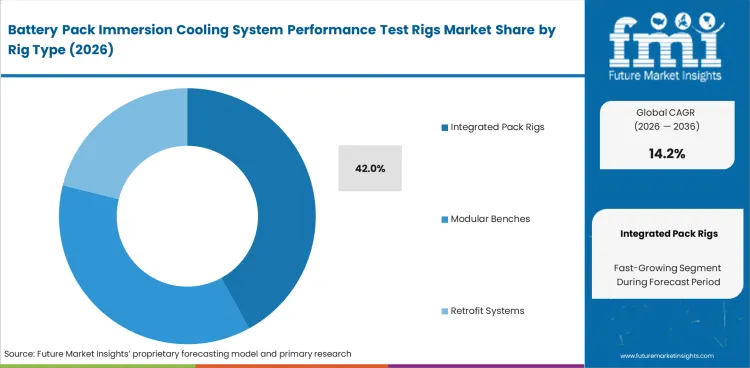
Engineering teams rarely struggle with electrical loading alone; they struggle with keeping fluid control, sensing, and safety logic synchronized while a pack is pushed through realistic duty profiles. Integrated pack rigs are expected to account for 42.0% share in 2026, as buyers prefer a bench that arrives with the thermal loop, controls architecture, and data path already coordinated. FMI’s reading of vent gas rigs supports that preference for packaged validation environments in adjacent battery safety niches. Procurement teams choose integrated systems when downtime from multi-vendor troubleshooting would cost more than the premium paid upfront. Modular benches still suit labs that already own parts of the stack, while retrofit systems remain relevant where budgets favor extension of legacy assets. A poor rig choice usually shows up later as unstable test replication and slower fault isolation during pack release work.
- Thermal orchestration: Integrated designs reduce coordination gaps between chillers, pumps, sensors, and load control, which lowers setup risk for validation teams.
- Commissioning speed: Turnkey architecture cuts the time spent aligning hardware from several suppliers, which matters when lab schedules are tied to vehicle program gates.
- Troubleshooting burden: Fragmented bench design leaves more room for interface failures and slows root-cause work when a pack behaves unpredictably.
Battery Pack Immersion Cooling System Performance Test Rigs Market Analysis by Test Focus
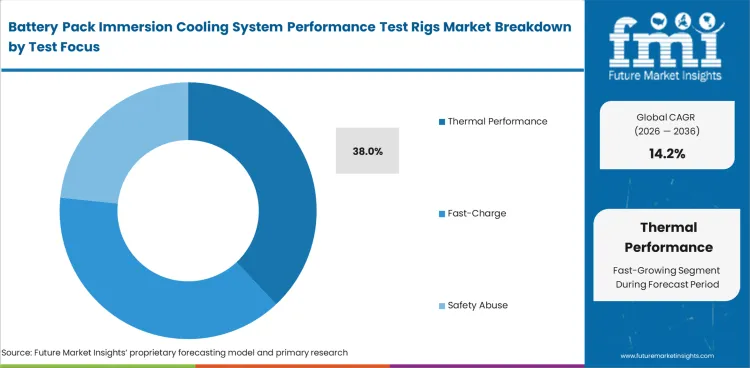
Thermal Performance is projected to contribute 38.0% of total market share in 2026, and that lead reflects the buyer need to understand heat rejection, gradient formation, and cooldown recovery before performance claims move into sign-off. Strong alignment between this demand profile and immersion fluids categories, where fluid behavior and operating stability shape equipment specification. Fast-Charge testing remains important, though it often sits inside a broader thermal validation sequence rather than standing alone. Safety Abuse programs gain traction when a buyer needs failure mapping, yet many labs still enter that workflow after core thermal behavior is understood. Missing this order can leave teams with safety data that lacks the operating context needed to interpret it.
- Heat mapping: Thermal validation shows whether pack architecture spreads or concentrates stress, which directly affects release confidence.
- Duty realism: Rigs tuned for thermal work let engineers test under conditions that resemble demanding charge and discharge use rather than simplified lab cases.
- Interpretation quality: Safety findings are easier to act on when teams already understand how the pack behaves thermally under normal and heavy loads.
Battery Pack Immersion Cooling System Performance Test Rigs Market Analysis by Cooling Mode
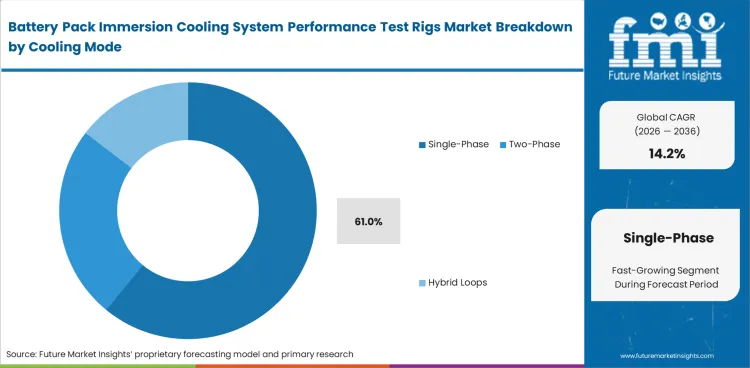
Fluid handling requirements explain why single-phase systems are expected to account for 61.0% share of the cooling mode segment in 2026. Labs prioritize setups that can be operated, maintained, and stabilized without adding uncertainty to test conditions. Single-phase loops provide predictable control and simpler troubleshooting, which supports consistent validation workflows. Two-phase systems remain relevant where higher heat rejection is required, but they introduce added complexity in fluid behavior and test interpretation. Hybrid configurations are used in development programs that need flexibility in thermal design. Early adoption tends to favor systems that match current lab capabilities, as more complex setups can increase maintenance effort and reduce testing stability if not properly managed.
- Fluid control: Single-phase loops are easier to monitor and maintain, which helps labs keep repeatability intact across long validation runs.
- Technician readiness: Workflows that fit current lab skill sets are easier to scale than systems that require a deeper process-learning curve.
- Maintenance exposure: More advanced cooling modes can widen service demands and extend downtime when the support structure is still developing.
Battery Pack Immersion Cooling System Performance Test Rigs Market Analysis by End Use
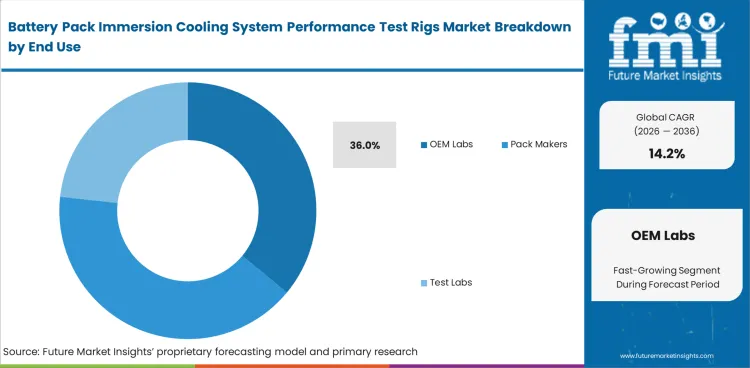
Program ownership still sits closest to the vehicle developer in many advanced battery launches, so OEM Labs are expected to make up 36.0% of the market in 2026. Buyers in that group carry the responsibility for pack architecture decisions, validation timing, and cross-functional sign-off, which gives them the strongest reason to invest early in specialized rigs. FMI links that spending posture with battery cyclers and related lab assets that tighten control over demanding battery workflows. Pack Makers expand their role when customers hand over more validation scope, and independent Test Labs benefit where neutral verification is needed or capacity is tight. Even so, many programs keep the earliest immersion-cooling work close to the OEM because data ownership and interpretation still influence design direction. Delaying internal capability can force a developer to rely on external schedules at the stage when pack architecture changes are hardest to absorb.
- Program control: OEM laboratories invest first when validation results feed directly into pack design choices and release timing.
- Data ownership: Keeping early test work in-house helps development teams interpret thermal findings without losing context across handoffs.
- Capacity risk: Late dependence on outside test slots can stretch program calendars when specialized bench time is limited.
Battery Pack Immersion Cooling System Performance Test Rigs Market Drivers, Restraints, and Opportunities
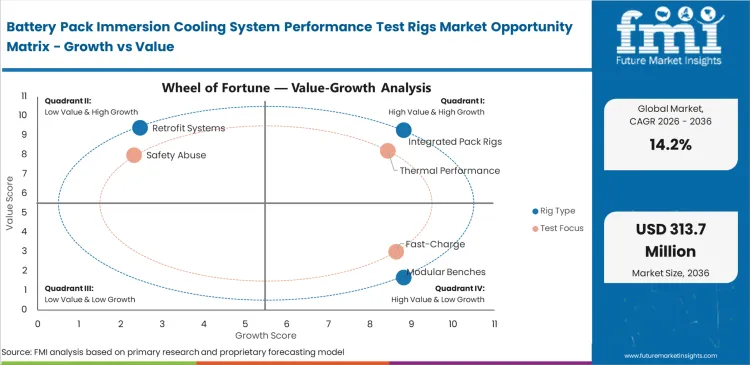
Pack testing is shifting from a purely electrical activity to a combined thermal and safety workflow. This change is driving demand for systems that can capture fluid behavior, temperature distribution, and electrical performance in one environment. General-purpose benches no longer meet these requirements when validation depends on coordinated data across multiple domains. Integrated setups reduce handoffs and improve interpretation, while delayed adoption keeps critical pack risks hidden until later stages when design changes become more difficult and costly.
Approval cycles remain the main constraint. Battery programs involve multiple functions, including electrical design, thermal analysis, safety review, and budgeting, which slows equipment decisions even when the need is clear. A system may meet technical requirements before it clears funding, infrastructure planning, software validation, and safety approval. Integration choices also affect adoption, as partial alignment with existing lab systems can reduce upfront cost but introduce inefficiencies during operation.
Opportunities in the Battery Pack Immersion Cooling System Performance Test Rigs Market
- Pack release workflows: As more vehicle programs tie pack approval to realistic thermal behavior, suppliers that deliver repeatable validation workflows can win earlier in the program cycle.
- Lab retrofit paths: Facilities that cannot replace an entire bench stack at once still create room for vendors that add fluid loops, controls, and data coordination around installed assets using solid-state testing style upgrade logic rather than full lab replacement, which helps buyers stage capex more carefully.
- Independent capacity: Third-party laboratories can capture demand when OEM and supplier facilities hit internal test bottlenecks, especially for overflow work or neutral validation.
Regional Analysis
Based on the regional analysis, the Battery Pack Immersion Cooling System Performance Test Rigs Market is segmented into North America, Latin America, Western Europe, Eastern Europe, East Asia, South Asia and Pacific, and the Middle East and Africa across 40 plus countries.
.webp "Top Country Growth Comparison Battery Pack Immersion Cooling System Performance Test Rigs Market Cagr (2026 2036)")
| Country | CAGR (2026 to 2036) |
|---|---|
| China | 15.4% |
| India | 14.8% |
| USA | 13.7% |
| Germany | 12.9% |
| South Korea | 12.5% |
| UK | 11.6% |
| Japan | 10.9% |
Source: Future Market Insights (FMI) analysis, based on proprietary forecasting model and primary research
East Asia Battery Pack Immersion Cooling System Performance Test Rigs Market Analysis
Manufacturing concentration defines East Asia’s role in the industry. Battery development programs, pack engineering cycles, and supplier coordination sit close enough together that a lab investment can support several layers of the value chain rather than one buyer alone. FMI sees that regional profile echoed in adjacent swelling systems classes, where pack developers and safety teams upgrade measurement capability as architectures become harder to validate with generic tools. Buyers in this region usually care as much about turnaround time and engineering support as they do about the bench specification itself, because validation assets are expected to fit fast-moving program calendars.
- China: Battery manufacturing scale in China keeps validation tightly aligned with rapid product turnover and continuous chemistry transitions. Development cycles move quickly, which compresses the time available for testing and feedback. China is likely to record 15.4% CAGR through 2036 in battery pack immersion cooling system performance test rigs. Engineering teams are under pressure to validate thermal behavior early, before designs reach advanced stages. When labs rely on general-purpose setups, gaps in thermal insight begin to appear. These gaps often surface later in the program, where design changes become more difficult to implement. Buyers therefore lean toward systems that deliver stable and repeatable results without extending validation timelines.
- South Korea: Supplier discipline and engineering depth shape South Korea’s trajectory more than overall market size. Development programs are tightly structured, and validation teams place strong emphasis on repeatable lab methods that can support high-value battery platforms and strict customer requirements. The market in South Korea is anticipated to register 12.5% CAGR through 2036. Testing environments are expected to deliver consistent results across multiple design iterations without variation in conditions. When investment in advanced rigs is delayed, labs often rely on limited or shared capacity, which creates bottlenecks during peak development phases. This affects timelines, especially when parallel validation is required. Buyers therefore focus on systems that support synchronized testing and maintain consistency across channels, ensuring that comparisons between different designs remain reliable throughout the program lifecycle.
- Japan: Installed laboratory capability in Japan is relatively mature, which shifts buyer focus toward targeted upgrades instead of broad new investments. The industry in Japan is expected to record 10.9% CAGR through 2036 for battery pack immersion cooling system performance test rigs. Most labs continue working with existing setups until clear performance gaps appear, especially in thermal validation accuracy. Newer battery designs place different demands on testing, which older systems do not always handle effectively. When upgrades are delayed, engineers often rely on workarounds that slow analysis. Buyers therefore look for systems that improve precision without disrupting established workflows, ensuring that updated validation needs can be met without restructuring entire lab operations.
FMI’s report also reviews other East Asian demand centers where battery development is expanding through supplier networks and applied research programs. Across those countries, buyers tend to favor equipment that improves validation discipline without creating an operating model their lab teams cannot sustain.
South Asia and Pacific Battery Pack Immersion Cooling System Performance Test Rigs Market Analysis
Capacity build-out drives the regional story across South Asia and Pacific. Much of the demand still comes from laboratories that are adding new validation infrastructure rather than replacing a mature installed base, which changes the buying logic from upgrade efficiency to capability formation. FMI relates that pattern to fluid test gear where buyers often enter the category while they are still defining internal process standards. Equipment selection therefore leans heavily on ease of commissioning, support responsiveness, and the ability to adapt the bench around evolving pack programs.
- India: Domestic battery and EV programs in India continue to build testing infrastructure, which keeps purchasing tied more to new capacity than replacement cycles. In regions such as Pune and Bengaluru, where EV startups and battery development labs are expanding, validation capability is still catching up with design ambition. India is projected to record 14.8% CAGR through 2036 for battery pack immersion cooling system performance test rigs. Many labs begin with general-purpose benches, which later struggle to handle immersion-specific workflows and thermal mapping requirements. This creates repeated adjustments during testing, slowing program timelines. When investment is delayed, advanced pack designs often move forward without fully aligned validation, increasing risk at later stages. Buyers therefore shift toward dedicated systems that can deliver stable and repeatable results early, reducing dependency on workaround methods and improving confidence during design validation.
FMI’s report includes Australia and New Zealand, ASEAN, and additional South Asian countries within the wider regional scope. Buyers across these markets tend to balance ambition with staffing and utility constraints, which makes staged deployment more practical than oversized first-step investments.
North America and Western Europe Battery Pack Immersion Cooling System Performance Test Rigs Market Analysis
Qualification discipline and program accountability shape demand across North America and Western Europe. Labs in these regions usually buy with a clear view of how the rig will connect to release gates, safety review, data management, and service support, so the decision often turns on workflow fit rather than hardware alone. FMI reads similar buyer behavior across testing certification and other adjacent validation categories, where proof quality matters as much as raw test capacity. Procurement teams here typically resist custom complexity unless it solves a defined bottleneck in pack development or compliance preparation.
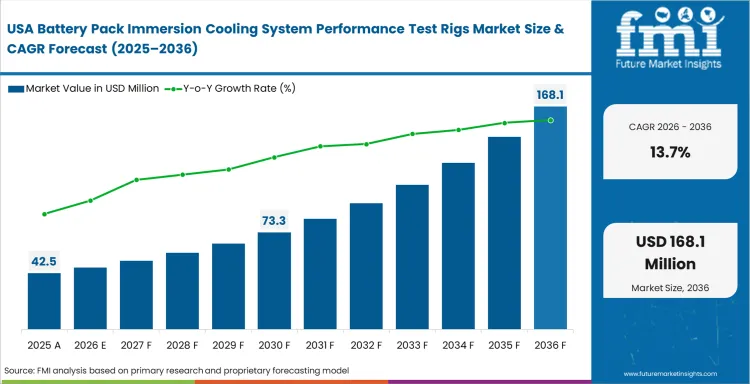
- USA: Program ownership and deep engineering resources keep the United States near the front of this niche. Labs operate with clear responsibility for validation outcomes, which shapes how equipment is evaluated. Buyers look beyond bench capability and focus on how well systems connect with software platforms, data workflows, and evolving test protocols. The USA market is projected to record 13.7% CAGR through 2036 for battery pack immersion cooling system performance test rigs. As testing volumes increase, coordination across teams becomes more critical. Suppliers are expected to respond quickly when pack designs change or test conditions shift. Weak service coverage or delayed support can quickly turn into contract risks once programs scale, especially when timelines are tightly managed across multiple validation stages.
- Germany: Automotive engineering depth keeps Germany central to validation-led equipment demand, where reproducibility and structured testing carry more weight than simple lab expansion. The market is projected to record 12.9% CAGR through the forecast period, supported by increasing complexity in battery pack design and stricter validation requirements from automotive OEMs. As programs move toward tighter release timelines, the ability to isolate faults quickly becomes critical. Labs working with loosely connected or fragmented test setups often face delays in identifying root causes. Buyers therefore prioritize systems that deliver consistent results across long-duration tests and simplify diagnostic workflows, ensuring that validation keeps pace with evolving engineering demands.
- UK: Independent testing capability and advanced engineering work give the United Kingdom a distinct position, even without the same manufacturing scale as larger markets. Many labs support multiple external programs, which increases pressure on scheduling and turnaround time. The UK market is likely to post 11.6% CAGR through 2036 for battery pack immersion cooling system performance test rigs, supported by demand for flexible and multi-project validation environments. When investment in in-house rigs is delayed, teams often depend on third-party facilities. This creates timing constraints, especially when rapid validation feedback is required. Buyers therefore look for systems that allow quicker test transitions and reduce dependency on external lab schedules.
FMI’s report also covers France, Italy, Spain, Canada, and other established demand centers across these regions. A common pattern across them is selective spending on rigs that tighten release discipline rather than broad, undifferentiated expansion of lab hardware.
Competitive Aligners for Market Players
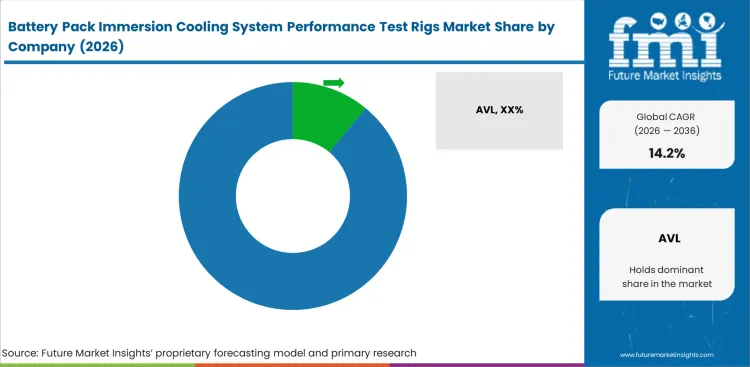
Fragmentation remains a defining feature of this market because equipment selection depends on validation performance rather than brand scale. Buyers focus on how well a system supports pack-level reliability, thermal-loop integration, control coordination, and stable operation during long test cycles. Suppliers such as AVL, HORIBA, Keysight Technologies, Chroma ATE, Digatron, Arbin Instruments, and ENORISE compete across these parameters, but selection is driven by application fit rather than product range. Systems that reduce uncertainty in both test results and day-to-day operation are preferred over generic platforms.
Established suppliers hold an advantage when they combine hardware, software, and service support within one coordinated system. This reduces the need to manage multiple vendors during active validation programs and lowers the risk of integration issues. Buyers prefer setups where thermal management, electrical loading, and safety monitoring are already aligned, as this improves test consistency and reduces troubleshooting effort. New entrants can still compete by addressing specific workflow gaps, offering faster setup, or simplifying integration for targeted use cases.
Large organizations aim to avoid dependence on a single supplier by selecting systems that support flexible integration and long-term lab planning. Software compatibility, modular expansion, and data portability are key considerations in these decisions. Vendors must balance proprietary system design with the need to fit into broader lab environments without creating constraints on future upgrades.
Market structure is expected to remain fragmented through 2036 because validation requirements vary across battery programs, lab setups, and development stages. No single system design meets all use cases. Suppliers that improve integration clarity, reduce operational complexity, and support evolving validation workflows are likely to maintain a stronger position in this environment.
Key Players in Battery Pack Immersion Cooling System Performance Test Rigs Market
- AVL
- HORIBA
- Keysight Technologies
- Chroma ATE
- Digatron
- Arbin Instruments
- ENORISE
Scope of the Report
| Metric | Value |
|---|---|
| Quantitative Units | USD 72.8 million to USD 273.6 million, at a CAGR of 14.2% |
| Market Definition | Battery pack immersion cooling system performance test rigs are specialized pack-level validation systems that combine electrical loading, fluid-loop management, measurement, and safety controls for immersion-capable battery test work. |
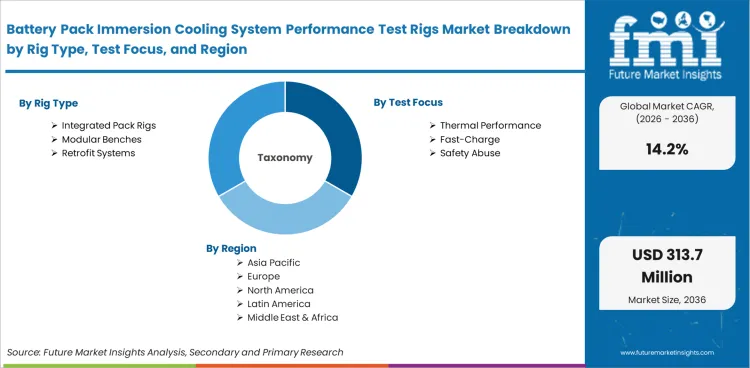
| Rig Type Segmentation | Integrated Pack Rigs, Modular Benches, Retrofit Systems |
| Test Focus Segmentation | Thermal Performance, Fast-Charge, Safety Abuse |
| Cooling Mode Segmentation | Single-Phase, Two-Phase, Hybrid Loops |
| End Use Segmentation | OEM Labs, Pack Makers, Test Labs |
| Regions Covered | North America, Latin America, Western Europe, Eastern Europe, East Asia, South Asia and Pacific, Middle East and Africa |
| Countries Covered | China, India, USA, Germany, South Korea, UK, Japan, and 40 plus countries |
| Key Companies Profiled | AVL, HORIBA, Keysight Technologies, Chroma ATE, Digatron, Arbin Instruments, ENORISE |
| Forecast Period | 2026 to 2036 |
| Approach | Independent assessment of battery pack test equipment demand, cross-validated with immersion cooling adoption patterns, pack-level thermal validation needs, supplier benchmark data, and battery development lab procurement trends. |
Source: Future Market Insights (FMI) analysis, based on proprietary forecasting model and primary research
Battery Pack Immersion Cooling System Performance Test Rigs Market Analysis by Segments
Rig Type:
- Integrated Pack Rigs
- Modular Benches
- Retrofit Systems
Test Focus:
- Thermal Performance
- Fast-Charge
- Safety Abuse
Cooling Mode:
- Single-Phase
- Two-Phase
- Hybrid Loops
End Use:
- OEM Labs
- Pack Makers
- Test Labs
Region:
- North America
- United States
- Canada
- Europe
- Germany
- United Kingdom
- France
- Italy
- Spain
- Asia Pacific
- China
- Japan
- South Korea
- Taiwan
- Singapore
- Latin America
- Brazil
- Mexico
- Argentina
- Middle East & Africa
- GCC Countries
- South Africa
- Israel
Bibliography
- International Energy Agency. (2025). Global EV Outlook 2025. International Energy Agency.
- United Nations Economic Commission for Europe. (2024, January). Global technical regulation on in-vehicle battery durability for electrified vehicles. UNECE.
- Piggott, A. J., Allen, J. S., & Pesaran, A. A. (2025). High-heat transfer lithium-ion batteries: A new era in battery thermal management. Applied Thermal Engineering.
- Shen, R., Quan, Y., McIntosh, J. D., Salem, A., & Wang, Q. (2024). Fire safety of battery electric vehicles: Hazard identification, analysis, and mitigation strategies. SAE International Journal of Electrified Vehicles.
- Ameer Batcha, M., Sathis Kumar, M., Tai, L. D., Vijayakumar, T., & Muruganandam, S. (2025). Experimental study on thermal management of 5S7P battery module with immersion cooling under high charging/discharging C-rates. Batteries
This bibliography is provided for reader reference. The full FMI report contains the complete reference list with primary source documentation.
This Report Addresses
- Battery pack immersion cooling system performance test rigs market size in 2025, 2026, and 2036.
- Growth outlook for the category at a 14.2% CAGR through 2036.
- Leading segment positions across Rig Type, Test Focus, Cooling Mode, and End Use.
- Country outlook for China, India, USA, Germany, South Korea, UK, and Japan.
- Commercial logic behind OEM laboratory demand and the preference for integrated pack rigs.
- Competitive positioning of AVL, HORIBA, Keysight Technologies, Chroma ATE, Digatron, Arbin Instruments, and ENORISE.
- Scope boundaries that separate immersion-cooling-capable pack rigs from generic cyclers and outsourced testing services.
- Regional differences in validation investment, capacity build-out, and lab integration priorities.
Frequently Asked Questions
What is included in the Battery Pack Immersion Cooling System Performance Test Rigs Market?
This market includes specialized pack-level validation rigs that combine electrical loading, immersion-capable thermal-loop hardware, sensors, controls, and safety systems. Generic battery cyclers and outsourced test services are outside the defined scope.
How large is the Battery Pack Immersion Cooling System Performance Test Rigs Market in 2025?
FMI places the market at USD 63.7 million in 2025. That figure reflects a narrow equipment category rather than the full battery testing equipment universe.
What is the 2026 value of the Battery Pack Immersion Cooling System Performance Test Rigs Market?
The market is expected to reach USD 72.8 million in 2026. That base year anchors the forecast period used in this article.
What is the 2036 forecast for this market?
FMI projects the market to reach USD 273.6 million by 2036. Expansion reflects broader adoption of pack-level thermal validation workflows.
What CAGR is expected for the market from 2026 to 2036?
The forecast points to a CAGR of 14.2% from 2026 to 2036. That pace fits an emerging validation niche rather than a mature lab-equipment segment.
Which rig type leads the market?
Integrated Pack Rigs lead the Rig Type segment. Buyers prefer a coordinated bench architecture when thermal hardware, controls, and safety logic must work together under program pressure.
Which test focus leads the market?
Thermal Performance leads the Test Focus segment. Buyers still need a clear understanding of heat distribution and temperature recovery before they can interpret harder-duty validation results confidently.
Which cooling mode leads the market?
Single-Phase leads the Cooling Mode segment. Labs favor easier fluid handling and lower operating complexity while immersion workflows continue to standardize.
Which end-use group leads demand?
OEM Labs lead the End Use segment. Early pack programs usually keep the toughest validation work close to the vehicle developer because data ownership still influences design decisions.
Why are buyers moving toward immersion-cooling-capable test rigs?
Pack programs increasingly need test setups that connect electrical behavior with fluid response and safety monitoring. Standard benches often leave those workflows too fragmented.
Why does China lead the country outlook?
China leads because battery manufacturing scale, engineering turnover, and test-capacity expansion all reinforce one another. Validation demand rises when more pack programs move through development at the same time.
Why is India growing so quickly?
India is adding new battery and EV validation capacity, which creates fresh demand for specialized lab assets. Growth comes from infrastructure formation as much as from replacement demand.
What keeps growth in the USA strong?
USA demand benefits from program ownership at OEM and supplier level, strong engineering depth, and the need for service-backed validation hardware. Buyers there often assess workflow fit as closely as headline bench capability.
Why is Germany important even with a lower CAGR than China and India?
Germany remains valuable because its engineering base and automotive validation culture support sophisticated demand. A lower CAGR does not reduce its role as a serious test-equipment buying center.
Why is Japan growing more slowly than the top markets?
Japan has a more mature laboratory base, so spending often centers on upgrades rather than broad greenfield expansion. That keeps growth healthy while pulling the rate below the fastest-build markets.
What do buyers compete on when selecting a supplier?
Buyers focus on validation reliability, thermal-loop integration, software coordination, service support, and how easily the rig fits the lab roadmap. Brand recognition alone rarely closes the decision.
Is the supplier landscape concentrated or fragmented?
The field remains fragmented. No single supplier dominates all customer needs because pack architectures, program timing, utility conditions, and workflow preferences vary widely.
What is the biggest operational restraint in this market?
Qualification cycles are the main restraint. A purchase often needs alignment across engineering, safety, procurement, software, and facility planning before it can move forward.
How does this market differ from the broader battery testing equipment category?
This niche is narrower and more specialized. It focuses on immersion-cooling-capable pack validation rather than general battery measurement or cycling hardware.
What is excluded from the market scope?
Generic battery cyclers, cell formation lines, and outsourced testing services are excluded. They do not provide the integrated immersion-capable pack validation function that defines this category.
How do independent test labs fit into the opportunity set?
Independent labs benefit when OEM and supplier facilities reach capacity or need neutral verification. Their opportunity grows when specialized test demand rises faster than internal bench availability.
Why do integrated rigs lead over modular benches and retrofit systems?
Integrated rigs reduce commissioning risk and coordination burden. Buyers often accept the higher upfront cost when it lowers troubleshooting exposure during live validation programs.
How should readers interpret the market’s long-term opportunity?
The opportunity lies in the shift from custom experimentation toward repeatable pack-level thermal validation infrastructure. Suppliers that reduce workflow complexity stand to benefit most as that shift matures.
Preview the report firsthand - request a free sample
Get SampleGet the brochure for pricing and purchase details.
Get PDFTable of Content
- Executive Summary
- Global Market Outlook
- Demand-side Trends
- Supply-side Trends
- Technology Roadmap Analysis
- Analysis and Recommendations
- Market Overview
- Market Coverage / Taxonomy
- Market Definition / Scope / Limitations
- Research Methodology
- Chapter Orientation
- Analytical Lens and Working Hypotheses
- Market Structure, Signals, and Trend Drivers
- Benchmarking and Cross-market Comparability
- Market Sizing, Forecasting, and Opportunity Mapping
- Research Design and Evidence Framework
- Desk Research Programme (Secondary Evidence)
- Company Annual and Sustainability Reports
- Peer-reviewed Journals and Academic Literature
- Corporate Websites, Product Literature, and Technical Notes
- Earnings Decks and Investor Briefings
- Statutory Filings and Regulatory Disclosures
- Technical White Papers and Standards Notes
- Trade Journals, Industry Magazines, and Analyst Briefs
- Conference Proceedings, Webinars, and Seminar Materials
- Government Statistics Portals and Public Data Releases
- Press Releases and Reputable Media Coverage
- Specialist Newsletters and Curated Briefings
- Sector Databases and Reference Repositories
- FMI Internal Proprietary Databases and Historical Market Datasets
- Subscription Datasets and Paid Sources
- Social Channels, Communities, and Digital Listening Inputs
- Additional Desk Sources
- Expert Input and Fieldwork (Primary Evidence)
- Primary Modes
- Qualitative Interviews and Expert Elicitation
- Quantitative Surveys and Structured Data Capture
- Blended Approach
- Why Primary Evidence is Used
- Field Techniques
- Interviews
- Surveys
- Focus Groups
- Observational and In-context Research
- Social and Community Interactions
- Stakeholder Universe Engaged
- C-suite Leaders
- Board Members
- Presidents and Vice Presidents
- R&D and Innovation Heads
- Technical Specialists
- Domain Subject-matter Experts
- Scientists
- Physicians and Other Healthcare Professionals
- Governance, Ethics, and Data Stewardship
- Research Ethics
- Data Integrity and Handling
- Primary Modes
- Tooling, Models, and Reference Databases
- Desk Research Programme (Secondary Evidence)
- Data Engineering and Model Build
- Data Acquisition and Ingestion
- Cleaning, Normalisation, and Verification
- Synthesis, Triangulation, and Analysis
- Quality Assurance and Audit Trail
- Market Background
- Market Dynamics
- Drivers
- Restraints
- Opportunity
- Trends
- Scenario Forecast
- Demand in Optimistic Scenario
- Demand in Likely Scenario
- Demand in Conservative Scenario
- Opportunity Map Analysis
- Product Life Cycle Analysis
- Supply Chain Analysis
- Investment Feasibility Matrix
- Value Chain Analysis
- PESTLE and Porter’s Analysis
- Regulatory Landscape
- Regional Parent Market Outlook
- Production and Consumption Statistics
- Import and Export Statistics
- Market Dynamics
- Global Market Analysis 2021 to 2025 and Forecast, 2026 to 2036
- Historical Market Size Value (USD Million) Analysis, 2021 to 2025
- Current and Future Market Size Value (USD Million) Projections, 2026 to 2036
- Y-o-Y Growth Trend Analysis
- Absolute $ Opportunity Analysis
- Global Market Pricing Analysis 2021 to 2025 and Forecast 2026 to 2036
- Global Market Analysis 2021 to 2025 and Forecast 2026 to 2036, By Rig Type
- Introduction / Key Findings
- Historical Market Size Value (USD Million) Analysis By Rig Type , 2021 to 2025
- Current and Future Market Size Value (USD Million) Analysis and Forecast By Rig Type , 2026 to 2036
- Integrated Pack Rigs
- Modular Benches
- Retrofit Systems
- Integrated Pack Rigs
- Y-o-Y Growth Trend Analysis By Rig Type , 2021 to 2025
- Absolute $ Opportunity Analysis By Rig Type , 2026 to 2036
- Global Market Analysis 2021 to 2025 and Forecast 2026 to 2036, By Test Focus
- Introduction / Key Findings
- Historical Market Size Value (USD Million) Analysis By Test Focus, 2021 to 2025
- Current and Future Market Size Value (USD Million) Analysis and Forecast By Test Focus, 2026 to 2036
- Thermal Performance
- Fast-Charge
- Safety Abuse
- Thermal Performance
- Y-o-Y Growth Trend Analysis By Test Focus, 2021 to 2025
- Absolute $ Opportunity Analysis By Test Focus, 2026 to 2036
- Global Market Analysis 2021 to 2025 and Forecast 2026 to 2036, By Cooling Mode
- Introduction / Key Findings
- Historical Market Size Value (USD Million) Analysis By Cooling Mode, 2021 to 2025
- Current and Future Market Size Value (USD Million) Analysis and Forecast By Cooling Mode, 2026 to 2036
- Single-Phase
- Two-Phase
- Hybrid Loops
- Single-Phase
- Y-o-Y Growth Trend Analysis By Cooling Mode, 2021 to 2025
- Absolute $ Opportunity Analysis By Cooling Mode, 2026 to 2036
- Global Market Analysis 2021 to 2025 and Forecast 2026 to 2036, By End Use
- Introduction / Key Findings
- Historical Market Size Value (USD Million) Analysis By End Use, 2021 to 2025
- Current and Future Market Size Value (USD Million) Analysis and Forecast By End Use, 2026 to 2036
- OEM Labs
- Pack Makers
- Test Labs
- OEM Labs
- Y-o-Y Growth Trend Analysis By End Use, 2021 to 2025
- Absolute $ Opportunity Analysis By End Use, 2026 to 2036
- Global Market Analysis 2021 to 2025 and Forecast 2026 to 2036, By Region
- Introduction
- Historical Market Size Value (USD Million) Analysis By Region, 2021 to 2025
- Current Market Size Value (USD Million) Analysis and Forecast By Region, 2026 to 2036
- North America
- Latin America
- Western Europe
- Eastern Europe
- East Asia
- South Asia and Pacific
- Middle East & Africa
- Market Attractiveness Analysis By Region
- North America Market Analysis 2021 to 2025 and Forecast 2026 to 2036, By Country
- Historical Market Size Value (USD Million) Trend Analysis By Market Taxonomy, 2021 to 2025
- Market Size Value (USD Million) Forecast By Market Taxonomy, 2026 to 2036
- By Country
- USA
- Canada
- Mexico
- By Rig Type
- By Test Focus
- By Cooling Mode
- By End Use
- By Country
- Market Attractiveness Analysis
- By Country
- By Rig Type
- By Test Focus
- By Cooling Mode
- By End Use
- Key Takeaways
- Latin America Market Analysis 2021 to 2025 and Forecast 2026 to 2036, By Country
- Historical Market Size Value (USD Million) Trend Analysis By Market Taxonomy, 2021 to 2025
- Market Size Value (USD Million) Forecast By Market Taxonomy, 2026 to 2036
- By Country
- Brazil
- Chile
- Rest of Latin America
- By Rig Type
- By Test Focus
- By Cooling Mode
- By End Use
- By Country
- Market Attractiveness Analysis
- By Country
- By Rig Type
- By Test Focus
- By Cooling Mode
- By End Use
- Key Takeaways
- Western Europe Market Analysis 2021 to 2025 and Forecast 2026 to 2036, By Country
- Historical Market Size Value (USD Million) Trend Analysis By Market Taxonomy, 2021 to 2025
- Market Size Value (USD Million) Forecast By Market Taxonomy, 2026 to 2036
- By Country
- Germany
- UK
- Italy
- Spain
- France
- Nordic
- BENELUX
- Rest of Western Europe
- By Rig Type
- By Test Focus
- By Cooling Mode
- By End Use
- By Country
- Market Attractiveness Analysis
- By Country
- By Rig Type
- By Test Focus
- By Cooling Mode
- By End Use
- Key Takeaways
- Eastern Europe Market Analysis 2021 to 2025 and Forecast 2026 to 2036, By Country
- Historical Market Size Value (USD Million) Trend Analysis By Market Taxonomy, 2021 to 2025
- Market Size Value (USD Million) Forecast By Market Taxonomy, 2026 to 2036
- By Country
- Russia
- Poland
- Hungary
- Balkan & Baltic
- Rest of Eastern Europe
- By Rig Type
- By Test Focus
- By Cooling Mode
- By End Use
- By Country
- Market Attractiveness Analysis
- By Country
- By Rig Type
- By Test Focus
- By Cooling Mode
- By End Use
- Key Takeaways
- East Asia Market Analysis 2021 to 2025 and Forecast 2026 to 2036, By Country
- Historical Market Size Value (USD Million) Trend Analysis By Market Taxonomy, 2021 to 2025
- Market Size Value (USD Million) Forecast By Market Taxonomy, 2026 to 2036
- By Country
- China
- Japan
- South Korea
- By Rig Type
- By Test Focus
- By Cooling Mode
- By End Use
- By Country
- Market Attractiveness Analysis
- By Country
- By Rig Type
- By Test Focus
- By Cooling Mode
- By End Use
- Key Takeaways
- South Asia and Pacific Market Analysis 2021 to 2025 and Forecast 2026 to 2036, By Country
- Historical Market Size Value (USD Million) Trend Analysis By Market Taxonomy, 2021 to 2025
- Market Size Value (USD Million) Forecast By Market Taxonomy, 2026 to 2036
- By Country
- India
- ASEAN
- Australia & New Zealand
- Rest of South Asia and Pacific
- By Rig Type
- By Test Focus
- By Cooling Mode
- By End Use
- By Country
- Market Attractiveness Analysis
- By Country
- By Rig Type
- By Test Focus
- By Cooling Mode
- By End Use
- Key Takeaways
- Middle East & Africa Market Analysis 2021 to 2025 and Forecast 2026 to 2036, By Country
- Historical Market Size Value (USD Million) Trend Analysis By Market Taxonomy, 2021 to 2025
- Market Size Value (USD Million) Forecast By Market Taxonomy, 2026 to 2036
- By Country
- Kingdom of Saudi Arabia
- Other GCC Countries
- Turkiye
- South Africa
- Other African Union
- Rest of Middle East & Africa
- By Rig Type
- By Test Focus
- By Cooling Mode
- By End Use
- By Country
- Market Attractiveness Analysis
- By Country
- By Rig Type
- By Test Focus
- By Cooling Mode
- By End Use
- Key Takeaways
- Key Countries Market Analysis
- USA
- Pricing Analysis
- Market Share Analysis, 2025
- By Rig Type
- By Test Focus
- By Cooling Mode
- By End Use
- Canada
- Pricing Analysis
- Market Share Analysis, 2025
- By Rig Type
- By Test Focus
- By Cooling Mode
- By End Use
- Mexico
- Pricing Analysis
- Market Share Analysis, 2025
- By Rig Type
- By Test Focus
- By Cooling Mode
- By End Use
- Brazil
- Pricing Analysis
- Market Share Analysis, 2025
- By Rig Type
- By Test Focus
- By Cooling Mode
- By End Use
- Chile
- Pricing Analysis
- Market Share Analysis, 2025
- By Rig Type
- By Test Focus
- By Cooling Mode
- By End Use
- Germany
- Pricing Analysis
- Market Share Analysis, 2025
- By Rig Type
- By Test Focus
- By Cooling Mode
- By End Use
- UK
- Pricing Analysis
- Market Share Analysis, 2025
- By Rig Type
- By Test Focus
- By Cooling Mode
- By End Use
- Italy
- Pricing Analysis
- Market Share Analysis, 2025
- By Rig Type
- By Test Focus
- By Cooling Mode
- By End Use
- Spain
- Pricing Analysis
- Market Share Analysis, 2025
- By Rig Type
- By Test Focus
- By Cooling Mode
- By End Use
- France
- Pricing Analysis
- Market Share Analysis, 2025
- By Rig Type
- By Test Focus
- By Cooling Mode
- By End Use
- India
- Pricing Analysis
- Market Share Analysis, 2025
- By Rig Type
- By Test Focus
- By Cooling Mode
- By End Use
- ASEAN
- Pricing Analysis
- Market Share Analysis, 2025
- By Rig Type
- By Test Focus
- By Cooling Mode
- By End Use
- Australia & New Zealand
- Pricing Analysis
- Market Share Analysis, 2025
- By Rig Type
- By Test Focus
- By Cooling Mode
- By End Use
- China
- Pricing Analysis
- Market Share Analysis, 2025
- By Rig Type
- By Test Focus
- By Cooling Mode
- By End Use
- Japan
- Pricing Analysis
- Market Share Analysis, 2025
- By Rig Type
- By Test Focus
- By Cooling Mode
- By End Use
- South Korea
- Pricing Analysis
- Market Share Analysis, 2025
- By Rig Type
- By Test Focus
- By Cooling Mode
- By End Use
- Russia
- Pricing Analysis
- Market Share Analysis, 2025
- By Rig Type
- By Test Focus
- By Cooling Mode
- By End Use
- Poland
- Pricing Analysis
- Market Share Analysis, 2025
- By Rig Type
- By Test Focus
- By Cooling Mode
- By End Use
- Hungary
- Pricing Analysis
- Market Share Analysis, 2025
- By Rig Type
- By Test Focus
- By Cooling Mode
- By End Use
- Kingdom of Saudi Arabia
- Pricing Analysis
- Market Share Analysis, 2025
- By Rig Type
- By Test Focus
- By Cooling Mode
- By End Use
- Turkiye
- Pricing Analysis
- Market Share Analysis, 2025
- By Rig Type
- By Test Focus
- By Cooling Mode
- By End Use
- South Africa
- Pricing Analysis
- Market Share Analysis, 2025
- By Rig Type
- By Test Focus
- By Cooling Mode
- By End Use
- USA
- Market Structure Analysis
- Competition Dashboard
- Competition Benchmarking
- Market Share Analysis of Top Players
- By Regional
- By Rig Type
- By Test Focus
- By Cooling Mode
- By End Use
- Competition Analysis
- Competition Deep Dive
- AVL
- Overview
- Product Portfolio
- Profitability by Market Segments (Product/Age /Sales Channel/Region)
- Sales Footprint
- Strategy Overview
- Marketing Strategy
- Product Strategy
- Channel Strategy
- HORIBA
- Keysight Technologies
- Chroma ATE
- Digatron
- Arbin Instruments
- ENORISE
- AVL
- Competition Deep Dive
- Assumptions & Acronyms Used


