

- Industry Size (2026)
- USD 198.5 Mn
- Forecast (2036)
- USD 529.1 Mn
- CAGR (2026 to 2036)
- 10.3%
Immersion Cooling Fluid Test Equipment Market Forecast and Outlook 2026 to 2036
Demand for the immersion cooling fluid test equipment market is valued at USD 198.5 million in 2026 and is projected to reach USD 529.1 million by 2036, expanding at a CAGR of 10.3%. Growth is driven by accelerated deployment of immersion cooling across hyperscale data centers, high-performance computing clusters, and AI training infrastructure. Validation of fluid stability, electrical safety, and long-term reliability has become critical as operators transition from air and liquid cold-plate cooling toward full single-phase and two-phase immersion systems.
Dielectric strength and resistivity testing represent the leading test function globally. This segment dominates because electrical insulation performance directly determines equipment safety, leakage risk, and operational uptime. Test platforms focus on precise measurement of breakdown voltage, volume resistivity, moisture contamination, and ionic impurities under elevated temperature conditions. Additional demand is supported by thermal conductivity, viscosity, oxidation stability, and material compatibility testing, reflecting need to qualify fluids over extended operating cycles and aggressive thermal loads.
Quick Stats for Immersion Cooling Fluid Test Equipment Market
- Immersion Cooling Fluid Test Equipment Market Value (2026): USD 198.5 million
- Immersion Cooling Fluid Test Equipment Market Forecast Value (2036): USD 529.1 million
- Immersion Cooling Fluid Test Equipment Market Forecast CAGR (2026-2036): 10.3%
- Leading Test Function in Global Demand: Dielectric Strength and Resistivity Testing
- Fastest-Growing Countries: China, Brazil, USA, South Korea, Germany
- Top Players in Global Demand: Anton Paar, Thermo Fisher Scientific, Mettler Toledo, Metrohm, TA Instruments (Waters), Agilent Technologies, PerkinElmer, AMETEK Brookfield, Malvern Panalytical, Hioki
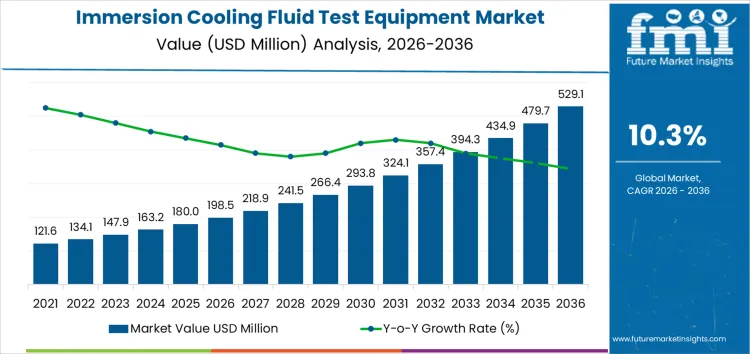
China, Brazil, USA, South Korea, and Germany represent fastest-growing countries due to data center expansion, AI infrastructure investment, and energy efficiency mandates. Competitive landscape is shaped by instrumentation specialists including Anton Paar, Thermo Fisher Scientific, Mettler Toledo, Metrohm, and TA Instruments. Segment structure indicates sustained preference for high-accuracy, standards-compliant test systems supporting qualification of next-generation dielectric immersion fluids.
Immersion Cooling Fluid Test Equipment Market Key Takeaways
| Metric | Value |
|---|---|
| Market Value (2026) | USD 198.5 million |
| Market Forecast Value (2036) | USD 529.1 million |
| Forecast CAGR (2026-2036) | 10.3% |
Why is the Demand for Immersion Cooling Fluid Test Equipment Market Growing?
Demand for immersion cooling fluid test equipment is growing globally due to expanding deployment of immersion cooled systems across data centers, high performance computing, cryptocurrency mining, and telecommunication infrastructure. Immersion cooling provides efficient heat removal for high density electronic components, which increases interest in validating fluid properties, dielectric performance, and long term stability under varied operating conditions. Data center expansion worldwide elevates the need for test platforms that assess thermal conductivity, viscosity, contamination resistance, and material compatibility before field implementation. Semiconductor and hardware manufacturers adopt standardized evaluation to verify fluid interaction with components, seals, and packaging materials.
Research institutions and industrial laboratories invest in test equipment to support development of advanced dielectric fluids and evaluate environmental impact, safety, and recyclability. Growth in edge computing and AI workloads increases heat load challenges, reinforcing reliance on immersion cooling solutions that require precise fluid characterization. Test equipment suppliers deliver modular systems that support repeatable measurement protocols aligned with industry standards. Regulatory and safety expectations for dielectric fluids strengthen adoption of controlled testing practices across deployment regions. Collaboration on test methodologies improves confidence in immersion cooling performance across diverse applications worldwide.
How Are the Segments Classified in the Immersion Cooling Fluid Test Equipment Market?
Demand for immersion cooling fluid test equipment globally is shaped by accelerated adoption of liquid cooling in high-density computing environments and thermal reliability requirements. Stakeholders assess dielectric stability, thermal transfer behavior, fluid longevity, and contamination resistance under continuous operation. Adoption patterns reflect validation needs across fluid formulation, system integration, and operational assurance supporting data centers, high-performance computing, and advanced electronics cooling architectures.
Which Test Function Accounts for the Largest Share of Global Demand?
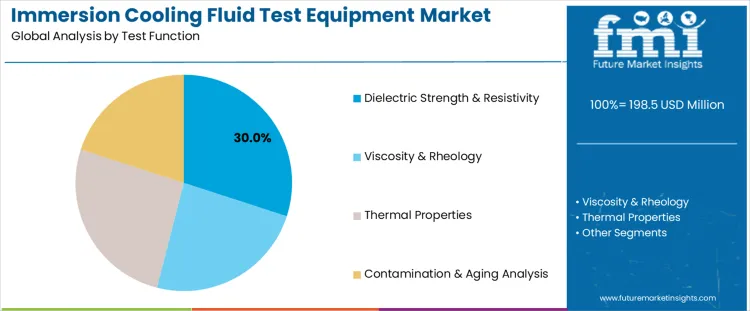
Dielectric strength and resistivity testing holds 30.0%, accounting for the largest share of global demand. These tests verify electrical insulation integrity required for direct fluid contact with energized components. Thermal properties testing holds 26.0%, supporting evaluation of heat transfer efficiency and cooling performance under load. Viscosity and rheology testing account for 24.0%, enabling assessment of fluid flow behavior and pump compatibility. Contamination and aging analysis holds 20.0%, addressing fluid degradation, particulate buildup, and long-term reliability. Test-function distribution reflects priority for electrical safety and sustained cooling performance.
Key Points
- Dielectric testing leads due to direct-contact electrical safety needs.
- Thermal testing supports cooling efficiency validation.
- Aging analysis addresses long-term fluid stability.
Which Fluid Type Represents the Largest Share of Global Testing Demand?
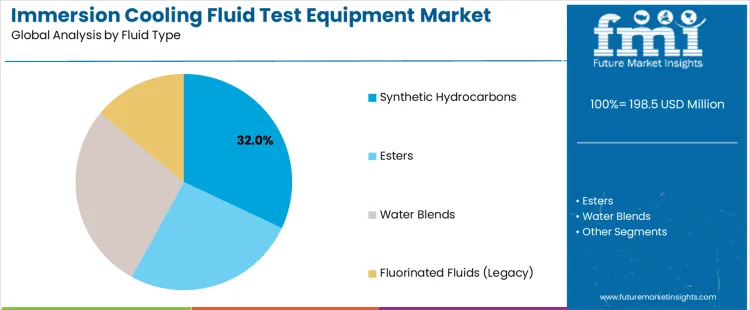
Synthetic hydrocarbons hold 32.0%, representing the largest share of global testing demand. These fluids offer balanced dielectric properties, thermal performance, and material compatibility. Water blends account for 28.0%, supporting cost-sensitive and hybrid cooling strategies requiring careful corrosion and conductivity testing. Esters hold 26.0%, favored for biodegradability and high flash points. Fluorinated fluids account for 14.0%, reflecting reduced adoption due to environmental considerations. Fluid-type distribution reflects transition toward sustainable and performance-balanced immersion cooling solutions.
Key Points
- Synthetic hydrocarbons lead due to balanced performance profiles.
- Water blends require extensive safety and stability testing.
- Ester fluids support sustainability-focused cooling strategies.
Which Buyer Type Drives the Largest Share of Global Demand?
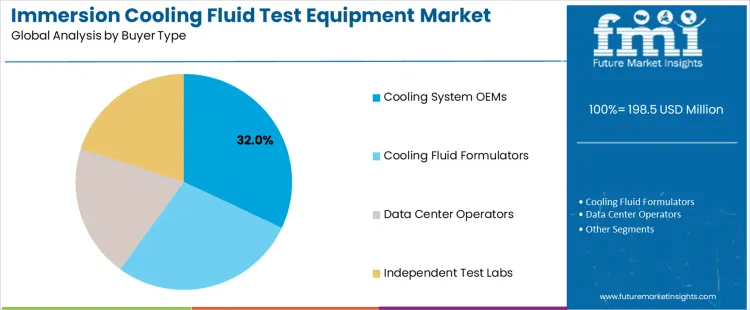
Cooling system OEMs hold 32.0%, driving the largest share of global demand. OEMs require test equipment to validate system-fluid compatibility and performance prior to deployment. Cooling fluid formulators hold 28.0%, supporting formulation optimization and certification testing. Data center operators account for 20.0%, validating operational safety and maintenance intervals. Independent test laboratories also hold 20.0%, providing third-party verification services. Buyer distribution reflects concentration of testing responsibility within system design and fluid development organizations.
Key Points
- OEMs lead due to system-level validation requirements.
- Formulators focus on fluid optimization and compliance testing.
- Operators and labs support operational assurance and verification.
What are the Key Dynamics in the Immersion Cooling Fluid Test Equipment Market?
Global demand rises as data centers, high-performance computing facilities, and edge computing deployments adopt immersion cooling to manage elevated heat densities from CPUs, GPUs, and AI accelerators. Test equipment evaluates thermal conductivity, dielectric properties, contaminant stability, and long-term chemical performance of immersion fluids. Adoption aligns with demand for energy-efficient cooling, reduction of water and air-based systems, and sustainability commitments across hyperscale, enterprise, and telecom infrastructure worldwide.
How do data center heat management needs and sustainability priorities shape global demand?
Rapid growth in compute-intensive workloads AI training, blockchain operations, and real-time analytics produces heat loads that challenge traditional air and liquid cooling. Immersion cooling offers uniform heat transfer and reduced fan or chiller energy, lowering PUE metrics globally. Operators use test equipment to characterize fluid performance under realistic thermal cycles, assess breakdown thresholds, and optimize fluid chemistry for dielectric strength and corrosion resistance. Hyperscale providers in North America, Europe, and Asia-Pacific lead adoption, while telecom and edge compute nodes explore compact immersion systems for constrained spaces. Government and corporate sustainability targets incentivize evaluation of low-GWP and recyclable fluid options, strengthening demand for rigorous testing data.
How do capital costs, fluid variability, and standardization influence market scalability?
Immersion fluid test systems involve significant investment in thermal chambers, dielectric test rigs, contamination and moisture measurement tools, and long-duration aging studies. Fluid chemistry diversity hydrocarbons, fluorocarbons, and engineered synthetics, requires flexible equipment capable of handling varied thermal and electrical properties. Standardized protocols for fluid performance and reliability are still emerging, leading to customized test methodologies and longer verification cycles. Access to advanced labs is uneven across regions, concentrating capability in technology hubs and shared service providers. Skilled technicians are essential for complex test setup and data interpretation. Long-term growth hinges on development of modular, cost-effective test solutions and harmonized global standards that support interoperability and fluid qualification across diverse immersion cooling applications.
How Is Demand for Immersion Cooling Fluid Test Equipment Evolving?
Demand for immersion cooling fluid test equipment is increasing globally due to higher rack power densities, liquid cooling adoption, and reliability validation needs. China leads with a 12.2% CAGR, supported by hyperscale expansion and domestic fluid development. Brazil follows at 11.8%, driven by research clusters and pilot data center deployments. USA records a 10.3% CAGR, shaped by retrofit programs and qualification of new fluids. South Korea posts 10.2%, reflecting semiconductor intensity and electronics reliability standards. Germany records 10.1%, supported by industrial compute use and rigorous compliance testing. Growth reflects need for repeatable fluid characterization, long-duration stability assessment, and standards-aligned validation worldwide.
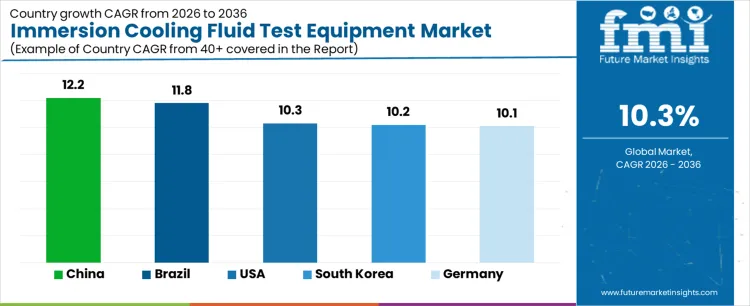
| Country | CAGR (%) |
|---|---|
| China | 12.2% |
| Brazil | 11.8% |
| USA | 10.3% |
| South Korea | 10.2% |
| Germany | 10.1% |
What factors are accelerating immersion cooling fluid test equipment adoption in China?
China drives demand through rapid buildout of high-density data centers and parallel development of dielectric fluids. Country’s CAGR of 12.2% reflects extensive testing of thermal conductivity, viscosity, dielectric strength, and material compatibility. Operators validate single-phase and two-phase fluids under sustained loads and transient spikes. In-house laboratories shorten iteration cycles and protect formulations. Platforms emphasize automation, scalability, and correlation with rack-level performance. Academic and industrial labs expand capacity to support volume programs. Growth remains scale-driven and investment-led, aligned with national compute infrastructure expansion and domestic supply development.
- Hyperscale expansion and domestic fluid programs
- Single-phase and two-phase fluid validation
- In-house labs for rapid iteration
- Automated, scalable test platforms
Why is Brazil emerging as a fast-growing market for immersion fluid testing?
Brazil demand is shaped by applied research, pilot deployments, and regional data center growth. Country’s CAGR of 11.8% reflects investment in laboratory rigs for fluid aging, contamination tolerance, and heat transfer performance. Shared facilities enable cost-efficient access for universities and operators. Collaboration with global vendors supports adoption of standard methods. Demand favors modular benches adaptable to varied fluids and workloads. Growth remains capability-building focused, aligned with gradual transition from air cooling to immersion in selected sites.
- Research-led pilots and regional data centers
- Shared laboratory access models
- Fluid aging and contamination testing
- Modular and adaptable test benches
How do retrofit programs influence immersion fluid testing demand in the USA?
USA demand reflects large installed base transitioning from air to liquid cooling. Country’s CAGR of 10.3% is supported by qualification of fluids for retrofits, materials compatibility checks, and long-duration reliability tests. Operators validate corrosion risk, seal compatibility, and serviceability impacts. Test platforms integrate telemetry and workload emulation to mirror field conditions. Procurement emphasizes throughput, reproducibility, and standards alignment. Growth remains lifecycle-driven, aligned with phased retrofits and evaluation of total cost of ownership.
- Retrofit qualification and compatibility checks
- Long-duration reliability assessment
- Telemetry-integrated workload emulation
- Standards-aligned, high-throughput testing
What role does South Korea’s electronics ecosystem play in testing growth?
South Korea demand reflects semiconductor and electronics reliability requirements extending into data center cooling. Country’s CAGR of 10.2% is supported by precise measurement of dielectric properties, thermal stability, and contamination effects. Manufacturers emphasize repeatability and tight control of test conditions. Government-backed initiatives promote standardized validation. Facilities prioritize compact systems compatible with cleanroom adjacencies. Growth remains process-driven, aligned with stringent quality targets and rapid technology ramps.
- Electronics reliability and dielectric validation
- Precision-controlled test environments
- Standardized qualification initiatives
- Compact, high-accuracy systems
How is Germany positioned within the global immersion fluid test equipment landscape?
Germany demand reflects industrial compute adoption, automotive simulation workloads, and strong compliance culture. Country’s CAGR of 10.1% is supported by testing fluids under combined stresses, including thermal cycling and material exposure. Shared institutes expand access to reliability labs. Procurement favors documentation, traceability, and standards compliance. Growth remains engineering-led, aligned with durability and safety expectations across industrial applications.
- Industrial and automotive compute validation
- Combined-stress and compatibility testing
- Strong documentation and compliance focus
- Shared research and industry laboratories
What is the competitive landscape of demand for immersion cooling fluid test equipment?
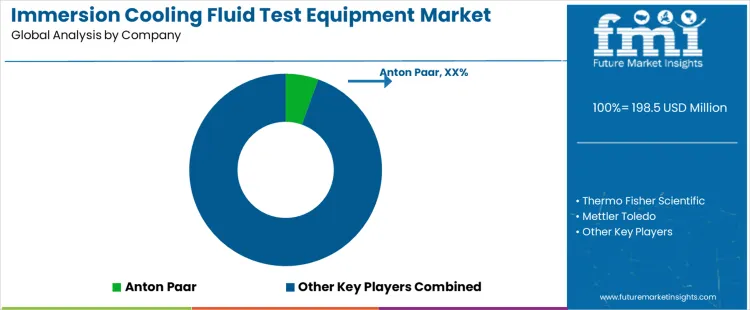
Demand for immersion cooling fluid test equipment is driven by deployment of liquid cooling in hyperscale data centers, AI accelerators, and high-density power electronics. Testing activities focus on thermal conductivity, viscosity, dielectric strength, moisture content, oxidation stability, and long-term fluid degradation behavior. Buyers require precise measurement under controlled temperature conditions and repeatable results aligned with qualification and reliability standards. Procurement teams evaluate instrument accuracy, automation readiness, sample throughput, and compatibility with synthetic and fluorinated cooling fluids. Reliability of instruments under continuous laboratory operation and availability of global calibration services influence purchasing decisions. Trend in the global market reflects increased qualification of single-phase and two-phase immersion fluids and tighter performance tolerances.
Anton Paar maintains strong positioning through rheology, density, and thermal property instruments widely used for immersion fluid characterization. Thermo Fisher Scientific supplies analytical platforms supporting chemical composition, contamination analysis, and aging studies. Mettler Toledo supports precision measurement of thermal transitions, moisture content, and material stability. Metrohm contributes electrochemical analysis systems used for fluid purity and degradation monitoring. TA Instruments, part of Waters, supplies thermal analysis equipment supporting heat transfer and stability evaluation. Agilent Technologies and PerkinElmer provide spectroscopy and chromatography systems used in fluid composition verification. AMETEK Brookfield supports viscosity and flow behavior measurement critical for cooling performance validation. Malvern Panalytical contributes particle characterization and material analysis for contamination control. Hioki supplies electrical measurement instruments supporting dielectric and insulation performance testing. Competitive differentiation depends on measurement accuracy, method standardization, automation capability, and global service support.
Key Players in the Immersion Cooling Fluid Test Equipment Market
- Anton Paar
- Thermo Fisher Scientific
- Mettler Toledo
- Metrohm
- TA Instruments (Waters)
- Agilent Technologies
- PerkinElmer
- AMETEK Brookfield
- Malvern Panalytical
- Hioki
Scope of the Report
| Items | Values |
|---|---|
| Quantitative Units | USD million |
| Test Function | Viscosity and Rheology; Thermal Properties; Dielectric Strength and Electrical Resistivity; Contamination, Oxidation, and Aging Analysis |
| Fluid Type | Synthetic Hydrocarbons; Esters; Water-Based Blends; Fluorinated Fluids (Legacy Use) |
| Buyer Type | Cooling Fluid Formulators; Cooling System OEMs; Data Center Operators; Independent Testing and Certification Laboratories |
| Application | Server Immersion Cooling; Power Electronics Cooling; Energy Storage Systems; Research, Development, and Pilot-Scale Test Rigs |
| Regions Covered | Asia Pacific; Europe; North America; Latin America; Middle East & Africa |
| Countries Covered | USA; China; Brazil; South Korea; Germany; UK; France; and 40+ countries |
| Key Companies Profiled | Anton Paar; Thermo Fisher Scientific; Mettler Toledo; Metrohm; TA Instruments (Waters); Agilent Technologies; PerkinElmer; AMETEK Brookfield; Malvern Panalytical; Hioki |
| Additional Attributes | Dollar sales by test function, fluid chemistry, and application area; regional adoption trends in hyperscale data centers and advanced electronics cooling; rising demand for dielectric and thermal characterization tools; alignment with immersion cooling qualification standards; growing use in energy-efficient data center and power electronics validation programs. |
Immersion Cooling Fluid Test Equipment Market by Segment
Test Function:
- Viscosity & Rheology
- Thermal Properties
- Dielectric Strength & Resistivity
- Contamination & Aging Analysis
Fluid Type:
- Synthetic Hydrocarbons
- Esters
- Water Blends
- Fluorinated Fluids (Legacy)
Buyer Type:
- Cooling Fluid Formulators
- Cooling System OEMs
- Data Center Operators
- Independent Test Labs
Application:
- Server Immersion
- Power Electronics Cooling
- Energy Storage
- R&D or Pilot Rigs
Region:
- Asia Pacific
- China
- Japan
- South Korea
- India
- Australia & New Zealand
- ASEAN
- Rest of Asia Pacific
- Europe
- Germany
- United Kingdom
- France
- Italy
- Spain
- Nordic
- BENELUX
- Rest of Europe
- North America
- United States
- Canada
- Mexico
- Latin America
- Brazil
- Chile
- Rest of Latin America
- Middle East & Africa
- Kingdom of Saudi Arabia
- Other GCC Countries
- Turkey
- South Africa
- Other African Union
- Rest of Middle East & Africa
Frequently Asked Questions
How big is the global tablet-activated face masks market?
The global tablet-activated face masks market is valued at USD 14.5 billion in 2026 and is forecast to reach USD 47.9 billion by 2036.
What is the growth outlook for the tablet-activated face masks market over the next 10 years?
The category is projected to expand at a 12.7% CAGR from 2026 to 2036, reflecting accelerating conversion from traditional sheet masks to activation-based treatment formats.
Which product segments or functions drive demand in this market?
Compressed mask tablets lead demand with a 42.6% share, supported by ease of activation and controlled expansion properties across different treatment types.
How does consumer behavior differ by region?
Adoption is strongest where treatment customization and ingredient freshness are prioritized, with South Korea (15.2% CAGR), Japan (14.1%), United States (13.8%), and China (13.3%) outpacing the global baseline during 2026-2036.
What are the main risks and constraints affecting this market?
Growth is constrained where consumers perceive complex activation procedures, inconsistent dissolution results, or higher cost-per-treatment versus traditional sheet masks, reducing repeat purchase confidence.
Preview the report firsthand - request a free sample
Get SampleGet the brochure for pricing and purchase details.
Get PDFTable of Content
- Executive Summary
- Global Market Outlook
- Demand-side Trends
- Supply-side Trends
- Technology Roadmap Analysis
- Analysis and Recommendations
- Market Overview
- Market Coverage / Taxonomy
- Market Definition / Scope / Limitations
- Market Background
- Market Dynamics
- Drivers
- Restraints
- Opportunity
- Trends
- Scenario Forecast
- Demand in Optimistic Scenario
- Demand in Likely Scenario
- Demand in Conservative Scenario
- Opportunity Map Analysis
- Product Life Cycle Analysis
- Supply Chain Analysis
- Investment Feasibility Matrix
- Value Chain Analysis
- PESTLE and Porter’s Analysis
- Regulatory Landscape
- Regional Parent Market Outlook
- Production and Consumption Statistics
- Import and Export Statistics
- Market Dynamics
- Global Market Analysis 2021 to 2025 and Forecast, 2026 to 2036
- Historical Market Size Value (USD Million) Analysis, 2021 to 2025
- Current and Future Market Size Value (USD Million) Projections, 2026 to 2036
- Y-o-Y Growth Trend Analysis
- Absolute $ Opportunity Analysis
- Global Market Pricing Analysis 2021 to 2025 and Forecast 2026 to 2036
- Global Market Analysis 2021 to 2025 and Forecast 2026 to 2036, By Test Function
- Introduction / Key Findings
- Historical Market Size Value (USD Million) Analysis By Test Function , 2021 to 2025
- Current and Future Market Size Value (USD Million) Analysis and Forecast By Test Function , 2026 to 2036
- Dielectric Strength & Resistivity
- Viscosity & Rheology
- Thermal Properties
- Contamination & Aging Analysis
- Dielectric Strength & Resistivity
- Y-o-Y Growth Trend Analysis By Test Function , 2021 to 2025
- Absolute $ Opportunity Analysis By Test Function , 2026 to 2036
- Global Market Analysis 2021 to 2025 and Forecast 2026 to 2036, By Fluid Type
- Introduction / Key Findings
- Historical Market Size Value (USD Million) Analysis By Fluid Type, 2021 to 2025
- Current and Future Market Size Value (USD Million) Analysis and Forecast By Fluid Type, 2026 to 2036
- Synthetic Hydrocarbons
- Esters
- Water Blends
- Fluorinated Fluids (Legacy)
- Synthetic Hydrocarbons
- Y-o-Y Growth Trend Analysis By Fluid Type, 2021 to 2025
- Absolute $ Opportunity Analysis By Fluid Type, 2026 to 2036
- Global Market Analysis 2021 to 2025 and Forecast 2026 to 2036, By Buyer Type
- Introduction / Key Findings
- Historical Market Size Value (USD Million) Analysis By Buyer Type, 2021 to 2025
- Current and Future Market Size Value (USD Million) Analysis and Forecast By Buyer Type, 2026 to 2036
- Cooling System OEMs
- Cooling Fluid Formulators
- Data Center Operators
- Independent Test Labs
- Cooling System OEMs
- Y-o-Y Growth Trend Analysis By Buyer Type, 2021 to 2025
- Absolute $ Opportunity Analysis By Buyer Type, 2026 to 2036
- Global Market Analysis 2021 to 2025 and Forecast 2026 to 2036, By Application
- Introduction / Key Findings
- Historical Market Size Value (USD Million) Analysis By Application, 2021 to 2025
- Current and Future Market Size Value (USD Million) Analysis and Forecast By Application, 2026 to 2036
- Server Immersion
- Power Electronics Cooling
- Energy Storage
- R&D or Pilot Rigs
- Server Immersion
- Y-o-Y Growth Trend Analysis By Application, 2021 to 2025
- Absolute $ Opportunity Analysis By Application, 2026 to 2036
- Global Market Analysis 2021 to 2025 and Forecast 2026 to 2036, By Region
- Introduction
- Historical Market Size Value (USD Million) Analysis By Region, 2021 to 2025
- Current Market Size Value (USD Million) Analysis and Forecast By Region, 2026 to 2036
- North America
- Latin America
- Western Europe
- Eastern Europe
- East Asia
- South Asia and Pacific
- Middle East & Africa
- Market Attractiveness Analysis By Region
- North America Market Analysis 2021 to 2025 and Forecast 2026 to 2036, By Country
- Historical Market Size Value (USD Million) Trend Analysis By Market Taxonomy, 2021 to 2025
- Market Size Value (USD Million) Forecast By Market Taxonomy, 2026 to 2036
- By Country
- USA
- Canada
- Mexico
- By Test Function
- By Fluid Type
- By Buyer Type
- By Application
- By Country
- Market Attractiveness Analysis
- By Country
- By Test Function
- By Fluid Type
- By Buyer Type
- By Application
- Key Takeaways
- Latin America Market Analysis 2021 to 2025 and Forecast 2026 to 2036, By Country
- Historical Market Size Value (USD Million) Trend Analysis By Market Taxonomy, 2021 to 2025
- Market Size Value (USD Million) Forecast By Market Taxonomy, 2026 to 2036
- By Country
- Brazil
- Chile
- Rest of Latin America
- By Test Function
- By Fluid Type
- By Buyer Type
- By Application
- By Country
- Market Attractiveness Analysis
- By Country
- By Test Function
- By Fluid Type
- By Buyer Type
- By Application
- Key Takeaways
- Western Europe Market Analysis 2021 to 2025 and Forecast 2026 to 2036, By Country
- Historical Market Size Value (USD Million) Trend Analysis By Market Taxonomy, 2021 to 2025
- Market Size Value (USD Million) Forecast By Market Taxonomy, 2026 to 2036
- By Country
- Germany
- UK
- Italy
- Spain
- France
- Nordic
- BENELUX
- Rest of Western Europe
- By Test Function
- By Fluid Type
- By Buyer Type
- By Application
- By Country
- Market Attractiveness Analysis
- By Country
- By Test Function
- By Fluid Type
- By Buyer Type
- By Application
- Key Takeaways
- Eastern Europe Market Analysis 2021 to 2025 and Forecast 2026 to 2036, By Country
- Historical Market Size Value (USD Million) Trend Analysis By Market Taxonomy, 2021 to 2025
- Market Size Value (USD Million) Forecast By Market Taxonomy, 2026 to 2036
- By Country
- Russia
- Poland
- Hungary
- Balkan & Baltic
- Rest of Eastern Europe
- By Test Function
- By Fluid Type
- By Buyer Type
- By Application
- By Country
- Market Attractiveness Analysis
- By Country
- By Test Function
- By Fluid Type
- By Buyer Type
- By Application
- Key Takeaways
- East Asia Market Analysis 2021 to 2025 and Forecast 2026 to 2036, By Country
- Historical Market Size Value (USD Million) Trend Analysis By Market Taxonomy, 2021 to 2025
- Market Size Value (USD Million) Forecast By Market Taxonomy, 2026 to 2036
- By Country
- China
- Japan
- South Korea
- By Test Function
- By Fluid Type
- By Buyer Type
- By Application
- By Country
- Market Attractiveness Analysis
- By Country
- By Test Function
- By Fluid Type
- By Buyer Type
- By Application
- Key Takeaways
- South Asia and Pacific Market Analysis 2021 to 2025 and Forecast 2026 to 2036, By Country
- Historical Market Size Value (USD Million) Trend Analysis By Market Taxonomy, 2021 to 2025
- Market Size Value (USD Million) Forecast By Market Taxonomy, 2026 to 2036
- By Country
- India
- ASEAN
- Australia & New Zealand
- Rest of South Asia and Pacific
- By Test Function
- By Fluid Type
- By Buyer Type
- By Application
- By Country
- Market Attractiveness Analysis
- By Country
- By Test Function
- By Fluid Type
- By Buyer Type
- By Application
- Key Takeaways
- Middle East & Africa Market Analysis 2021 to 2025 and Forecast 2026 to 2036, By Country
- Historical Market Size Value (USD Million) Trend Analysis By Market Taxonomy, 2021 to 2025
- Market Size Value (USD Million) Forecast By Market Taxonomy, 2026 to 2036
- By Country
- Kingdom of Saudi Arabia
- Other GCC Countries
- Turkiye
- South Africa
- Other African Union
- Rest of Middle East & Africa
- By Test Function
- By Fluid Type
- By Buyer Type
- By Application
- By Country
- Market Attractiveness Analysis
- By Country
- By Test Function
- By Fluid Type
- By Buyer Type
- By Application
- Key Takeaways
- Key Countries Market Analysis
- USA
- Pricing Analysis
- Market Share Analysis, 2025
- By Test Function
- By Fluid Type
- By Buyer Type
- By Application
- Canada
- Pricing Analysis
- Market Share Analysis, 2025
- By Test Function
- By Fluid Type
- By Buyer Type
- By Application
- Mexico
- Pricing Analysis
- Market Share Analysis, 2025
- By Test Function
- By Fluid Type
- By Buyer Type
- By Application
- Brazil
- Pricing Analysis
- Market Share Analysis, 2025
- By Test Function
- By Fluid Type
- By Buyer Type
- By Application
- Chile
- Pricing Analysis
- Market Share Analysis, 2025
- By Test Function
- By Fluid Type
- By Buyer Type
- By Application
- Germany
- Pricing Analysis
- Market Share Analysis, 2025
- By Test Function
- By Fluid Type
- By Buyer Type
- By Application
- UK
- Pricing Analysis
- Market Share Analysis, 2025
- By Test Function
- By Fluid Type
- By Buyer Type
- By Application
- Italy
- Pricing Analysis
- Market Share Analysis, 2025
- By Test Function
- By Fluid Type
- By Buyer Type
- By Application
- Spain
- Pricing Analysis
- Market Share Analysis, 2025
- By Test Function
- By Fluid Type
- By Buyer Type
- By Application
- France
- Pricing Analysis
- Market Share Analysis, 2025
- By Test Function
- By Fluid Type
- By Buyer Type
- By Application
- India
- Pricing Analysis
- Market Share Analysis, 2025
- By Test Function
- By Fluid Type
- By Buyer Type
- By Application
- ASEAN
- Pricing Analysis
- Market Share Analysis, 2025
- By Test Function
- By Fluid Type
- By Buyer Type
- By Application
- Australia & New Zealand
- Pricing Analysis
- Market Share Analysis, 2025
- By Test Function
- By Fluid Type
- By Buyer Type
- By Application
- China
- Pricing Analysis
- Market Share Analysis, 2025
- By Test Function
- By Fluid Type
- By Buyer Type
- By Application
- Japan
- Pricing Analysis
- Market Share Analysis, 2025
- By Test Function
- By Fluid Type
- By Buyer Type
- By Application
- South Korea
- Pricing Analysis
- Market Share Analysis, 2025
- By Test Function
- By Fluid Type
- By Buyer Type
- By Application
- Russia
- Pricing Analysis
- Market Share Analysis, 2025
- By Test Function
- By Fluid Type
- By Buyer Type
- By Application
- Poland
- Pricing Analysis
- Market Share Analysis, 2025
- By Test Function
- By Fluid Type
- By Buyer Type
- By Application
- Hungary
- Pricing Analysis
- Market Share Analysis, 2025
- By Test Function
- By Fluid Type
- By Buyer Type
- By Application
- Kingdom of Saudi Arabia
- Pricing Analysis
- Market Share Analysis, 2025
- By Test Function
- By Fluid Type
- By Buyer Type
- By Application
- Turkiye
- Pricing Analysis
- Market Share Analysis, 2025
- By Test Function
- By Fluid Type
- By Buyer Type
- By Application
- South Africa
- Pricing Analysis
- Market Share Analysis, 2025
- By Test Function
- By Fluid Type
- By Buyer Type
- By Application
- USA
- Market Structure Analysis
- Competition Dashboard
- Competition Benchmarking
- Market Share Analysis of Top Players
- By Regional
- By Test Function
- By Fluid Type
- By Buyer Type
- By Application
- Competition Analysis
- Competition Deep Dive
- Anton Paar
- Overview
- Product Portfolio
- Profitability by Market Segments (Product/Age /Sales Channel/Region)
- Sales Footprint
- Strategy Overview
- Marketing Strategy
- Product Strategy
- Channel Strategy
- Thermo Fisher Scientific
- Mettler Toledo
- Metrohm
- TA Instruments (Waters)
- Agilent Technologies
- PerkinElmer
- AMETEK Brookfield
- Malvern Panalytical
- Hioki
- Anton Paar
- Competition Deep Dive
- Assumptions & Acronyms Used
- Research Methodology


